
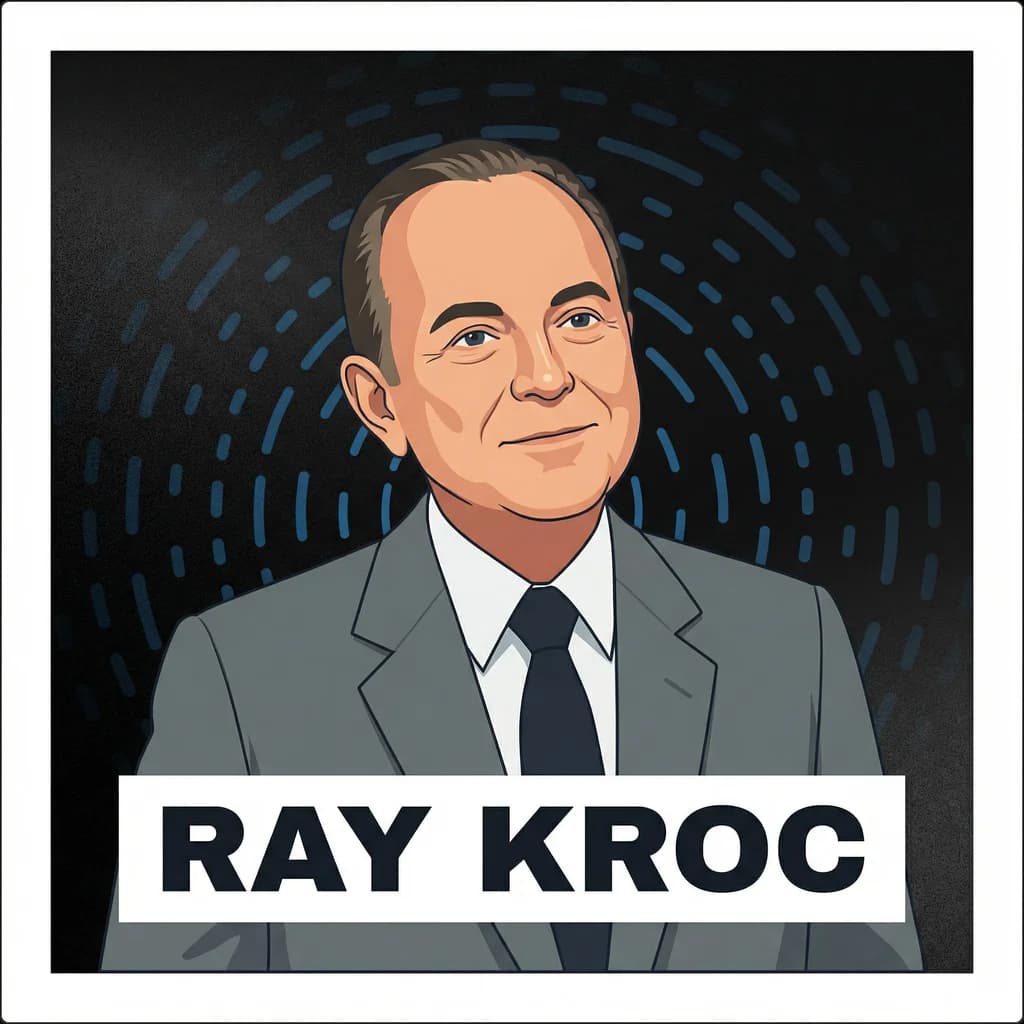

Part IThe Story
Eight Multimixers in the Desert
The calls kept coming. Portland, Oregon. Yuma, Arizona. Washington, D.C. The message was always the same: I want one of those mixers of yours like the McDonald Brothers have out in California. By 1954, Ray Kroc had been selling milkshake machines for seventeen years — crisscrossing the country with samples in his trunk, sleeping in motels that smelled of disinfectant and old carpet, nursing tumblers of Early Times whiskey while listening to self-help records before bed. He was fifty-two years old. He had diabetes and incipient arthritis. He had lost his gall bladder and most of his thyroid gland. His marriage was a slow-motion wreck. His company, Prince Castle Sales, was bleeding customers as the drugstore soda fountain — once the great American gathering place, now yielding to soft-serve ice-cream stands and television — slid toward extinction. And yet these calls. Restaurant owners kept telephoning his Chicago office, not to place orders but to make a specific, strange request: they wanted a Multimixer like the one used at a place called McDonald's in San Bernardino.
Kroc did some checking. What he discovered defied ordinary commercial logic. This wasn't a chain. It wasn't a famous name. It was a single hamburger stand — a walk-up octagon of red-and-white tile sitting in practically the desert — and it had purchased not one, not three, but eight of his five-spindle Multimixers. Eight machines. Forty milkshakes churning simultaneously. At $150 apiece, in a town most Americans couldn't find on a map. "The mental picture of eight Multimixers churning out forty shakes at one time was just too much to be believed," Kroc later wrote. He flew to Los Angeles, made some routine sales calls, then drove sixty miles east through the scrubby exurbia of the Inland Empire, and parked across the street.
What he saw that morning in San Bernardino was not a restaurant. It was a revelation dressed up as a fifteen-cent hamburger. And within hours, the chronic dreamer — the man his mother had called "Danny Dreamer" since he was a child staring out windows on the West Side of Chicago — would begin the work of turning someone else's invention into the most recognizable brand in the history of the world.
By the Numbers
The Golden Arches Empire
$366.12First-day receipts, Des Plaines, April 15, 1955
$2.7MPrice Kroc paid to buy out the McDonald brothers in 1961
228Restaurants operating at the time of the buyout
7,500Outlets worldwide at the time of Kroc's death in 1984
$8B+McDonald's annual systemwide sales in 1983
$500MKroc's estimated personal fortune at death
36,000+McDonald's restaurants operating today in 100+ countries
Peasant Bones and Danny Dreamer
Raymond Albert Kroc was born on October 5, 1902, in Oak Park, Illinois — the same leafy Chicago suburb that produced Ernest Hemingway and Frank Lloyd Wright, men who also fled its pleasant predictability at the earliest opportunity. His parents were Czech-American: Louis Kroc, a midlevel executive at American District Telegraph, and Rose Mary Hrach, a part-time piano teacher who gave her eldest son his first lessons at the keyboard. The family was modest, neither poor nor comfortable. "I think it must have been passed along to me in the peasant bones of my Bohemian ancestors," Kroc wrote in Grinding It Out, his 1977 autobiography, describing the plainspoken philosophy — each man makes his own happiness — that would guide him for eight decades. His father had made good money speculating on land in the 1920s, then lost everything in the crash of 1929. The lesson lodged.
Young Ray was a daydreamer of the productive variety. His parents nicknamed him Danny Dreamer after catching him staring into space, but his fantasies were, he insisted, "invariably linked to some form of action." He dreamed of a lemonade stand and built one. He dreamed of a music store and opened one with two friends after his freshman year of high school. The store failed. He didn't care. He was already on to the next thing. At fifteen, bored by academics and electrified by the news from France, Kroc dropped out of Oak Park High School in 1917, lied about his age, and enlisted in the Red Cross ambulance corps. He was sent to Connecticut for training. The war ended before his unit shipped overseas. In the same regiment — also fifteen, also fibbing — was a quiet kid from Chicago who, instead of chasing girls on leave, stayed in camp drawing pictures. His name was Walt Disney.
The armistice returned Kroc to Oak Park and to a restless, unglamorous decade of searching. He tried to go back to high school; one frustrated semester convinced him he was done with classrooms forever. He played piano professionally — at dances, on the radio, at clubs — and discovered he was good but not good enough to make it his life. He sold ribbon novelties door-to-door. He tried real estate in Fort Lauderdale during the Florida boom of the mid-twenties; the bust sent him back to Chicago. By 1927, he had settled into what would become a seventeen-year career selling paper cups for the Lily-Tulip Cup Company. It was not glamorous. It was an education. Kroc worked his way up to Midwest sales manager, calling on every diner, soda fountain, and drive-in between the Great Lakes and the Ozarks. He learned how restaurants succeeded and, more usefully, how they failed. He watched operators cut corners, ignore sanitation, ruin good products with sloppy execution, and slowly go broke. He absorbed a geography of American appetites.
The Multimixer and the Long Apprenticeship
In the late 1930s, Kroc's restless eye landed on a device that would change the trajectory of his life, though not for another fifteen years. Earl Prince, an ice cream shop owner, had invented a five-spindle milkshake mixer — a machine that could make five shakes simultaneously, a significant leap over the single-spindle models that were standard. Kroc, who had been selling Lily cups to places like Prince's shop, recognized the machine's potential instantly. He obtained exclusive marketing rights and, in 1941, left the security of Lily-Tulip to bet everything on the Multimixer.
His wife, Ethel Fleming — whom he'd married in 1922, with whom he had a daughter, Marilyn — was shocked. The decision looked reckless: walking away from a well-paying job with a major company to become a one-man distributor for a milkshake machine. But Kroc had spent nearly two decades watching from the supply side of the restaurant industry. He understood something that Ethel, his friends, and his business associates did not: that the places buying paper cups were not just restaurants. They were small engines of American social life, and the ones that figured out speed and consistency would eat the ones that didn't.
For the next thirteen years, Kroc crisscrossed the country selling Multimixers. He set up a tiny office run by a secretary. He operated sales booths at dairy association conventions. In a good year, he moved five thousand units. The work was solitary, repetitive, dependent on charm and mileage. It was also the longest, most thorough training program in the American food-service industry, though nobody designed it and nobody enrolled. By the time Kroc pulled into San Bernardino in 1954, he had spent thirty-four years selling to restaurants. Half that time was in paper cups; half in milkshake machines. He knew the business from the supply closet out.
The Brothers from Manchester
Richard and Maurice McDonald — Dick and Mac — had come to California from Manchester, New Hampshire, in the late 1920s, carrying the particular ambition of men whose father had been kicked to the curb after forty-two years at a shoe factory. They watched Patrick McDonald lose everything — his livelihood, his dignity, his relevance — and resolved to control their own fates. They wanted to be millionaires by fifty. They failed at the movie business, sweating on film sets at Columbia Studios for $25 a week, hauling lights and building sets. They bought a 750-seat movie theater in Glendora in 1930, renamed it the Beacon, and watched it flounder through the Depression. The only person making money on the block was a root beer stand operator named Wiley. So the brothers sold the theater in 1937 and opened a hot dog stand in Monrovia.
By 1940, they had scraped together $5,000 — Bank of America was the only institution willing to lend to them — and opened a drive-in restaurant on the corner of North E Street and West 14th Street in San Bernardino, a large working-class town of about 100,000 people. The drive-in did well. Within a few years, the brothers were clearing $40,000 annually. Most of their customers were young families, not the teenage cruisers who turned other drive-ins into hangouts. Dick and Mac noticed this. They cared about this.
In 1948, the brothers did something radical. They shut down their profitable drive-in and rebuilt it from scratch — eliminating the carhops, the dishware, the extensive menu, the jukebox, the pay phone, everything that made a 1950s hamburger joint a 1950s hamburger joint. What they created instead was a machine for feeding families. The menu shrank to nine items: hamburgers, cheeseburgers, french fries, soft drinks, milk, coffee, and three flavors of milkshake. Hamburgers cost fifteen cents. The kitchen was redesigned as an assembly line — what they called the Speedee Service System. Food was prepared ahead of time, wrapped, kept warm under heat lamps. Customers ordered at a walk-up window. There were no waitresses. There was no tipping. There was no uncertainty.
The brothers had, in effect, applied Henry Ford's production logic to the hamburger. They didn't know it yet, but they had designed the prototype of the fast-food restaurant of the future. Their innovation was not the food itself — hamburgers were hardly new — but the systematic elimination of everything that slowed food delivery down, introduced inconsistency, or repelled the families they wanted to attract. They began franchising cautiously: fourteen franchises sold, of which ten became operating restaurants, plus their original location. They ordered eight Multimixers. And the calls started coming to a man in Chicago who had spent his whole life waiting for exactly this signal.
A Latter-Day Newton in the Parking Lot
Kroc arrived in San Bernardino on a morning in 1954 and did what any good salesman would do: he watched. He parked across the street and observed the operation for hours. The parking lot was full. The line of customers moved with metronomic efficiency. Families — fathers in shirtsleeves, mothers in house dresses, kids vibrating with anticipation — stepped up to the window, placed an order, and received their food in approximately thirty seconds. Not twenty minutes, as was typical at drive-ins. Thirty seconds. The place was clean — spotlessly, obsessively clean. No cigarette butts, no trash on the ground, no surly teenagers loitering in the parking lot. The food was cheap, consistent, and, by the standards of roadside America in 1954, remarkable for its quality.
"When I saw it working that day in 1954, I felt like some latter-day Newton who'd just had an Idaho potato caromed off his skull," Kroc wrote. That night, in his motel room — the same genre of motel room where he had spent a thousand other nights with his Multimixer samples and his whiskey — he couldn't sleep. Visions of McDonald's restaurants "dotting crossroads all over the country paraded through my brain."
The next morning, Kroc approached the brothers. He was not subtle. Dick and Mac were gentle, unassuming men — craftsmen, really, who cared about the quality of their product and the comfort of their lives. They were buying new Cadillacs every year. They played golf. They didn't want to expand. They had tried franchising and found it exhausting — you couldn't maintain quality at a distance, and the further a restaurant was from San Bernardino, the worse it got. "Their life was great," as journalist Lisa Napoli would later put it. "They were ambitious enough, but they weren't hyper ambitious to dominate the world."
Kroc was. He was exactly the kind of person the McDonald brothers were not: a man for whom the current arrangement was never sufficient, for whom any horizon implied something beyond it. He proposed becoming their franchise agent — the person who would sell the McDonald's system across the country. The brothers, who had recently lost their previous agent to health problems, reluctantly agreed. The formal agreement was signed on March 2, 1955. Each franchisee would return 1.9 percent of gross sales to McDonald's Systems, Inc. Of that total, 0.5 percent went to Dick and Mac McDonald. The remaining 1.4 percent went to Kroc's company.
It was, by any measure, a terrible deal for Kroc. The margins were razor-thin. There was almost no money to finance expansion. But Kroc had not spent thirty-four years as a salesman without learning the most essential lesson of his trade: sometimes you take the deal that gets you in the room.
$366.12
On April 15, 1955 — a date Kroc would enshrine in corporate mythology the way nations enshrine the dates of their founding — the first McDonald's franchise east of the Mississippi River opened at 400 North Lee Street in Des Plaines, Illinois. Kroc chose the location because it was a seven-minute drive from his home in Arlington Heights and a short walk from the Northwestern Railroad Station. He hoped to lure recreational travelers driving between Chicago and the Wisconsin lakes.
The building was a replica of the brothers' red-and-white tiled design, complete with the paired golden arches that Dick McDonald had added to Stanley Meston's architectural plans because he felt the roofline was too flat. A sign maker had incorporated yellow neon into the arches, and they glowed at night like twin parentheses bracketing the promise of something fast and cheap and reliably the same.
There were immediate problems. The brothers' building had been designed for the bone-dry heat of the California desert, not for Illinois winters. French fries, which in San Bernardino emerged golden and crisp from the deep fryer, turned into pale, limp disappointments in Des Plaines. The potatoes behaved differently in Midwestern humidity. Kroc and his early team spent months reverse-engineering the brothers' fry process, eventually discovering that the San Bernardino fries owed their crispness partly to the arid desert air, which naturally cured the potatoes in their outdoor storage bins. In Des Plaines, they had to replicate this artificially — curing the potatoes, adjusting cooking times, obsessing over oil temperature. The story of those french fries is the story of the entire enterprise in miniature: someone else's invention, perfected through Kroc's maniacal insistence on replication.
First-day receipts were $366.12. A hamburger cost fifteen cents. Fries were a dime. A milkshake was twenty cents. A cup of coffee was a nickel. Two more stores opened that year; gross sales reached $235,000. Growth was slow — painfully so for a man in his fifties who had bet his remaining professional years on this venture. By the end of 1957, McDonald's had only thirty-one stores. Kroc was still living on his income from Prince Castle Multimixer sales. He would not draw a salary from McDonald's until 1961.
— Ray Kroc, Grinding It OutI was an overnight success all right. But thirty years is a long, long night.
The Man Who Made It Rain
What Kroc needed — what the entire enterprise needed — was money. The franchise agreement with the McDonald brothers left almost nothing for expansion. The 1.4 percent of gross sales that flowed to Kroc's company was barely enough to keep the lights on, let alone finance new restaurants. Enter Harry J. Sonneborn.
Sonneborn was a well-paid executive at Tastee-Freeze, a competing franchise operation, who in 1956 walked away from a comfortable salary to work for Ray Kroc at $100 a week. Born in 1916 in New York, Sonneborn was the temperamental inverse of Kroc — reserved, analytical, obsessed with the balance sheet where Kroc was obsessed with the grill. He saw something in McDonald's that Kroc himself hadn't fully articulated: the business wasn't really in the hamburger business. It was in the real estate business.
Sonneborn devised a leaseback system of breathtaking elegance. McDonald's Corporation would find desirable locations, negotiate long-term leases on the land and buildings (or buy them outright), and then sublease them to franchisees at a significant markup. The franchisee paid for equipment, signs, seating, and decor. McDonald's Corporation collected rent, royalties, and fees. The markup on the real estate — not the 1.4 percent skim on hamburger sales — would generate the capital Kroc needed to grow.
It was, in retrospect, one of the most consequential financial innovations in American business history. Sonneborn's insight transformed McDonald's from a struggling franchise operation into a real estate company that happened to sell hamburgers. The system aligned incentives in both directions: McDonald's had a reason to pick the best locations (since it owned the leases), and franchisees had a reason to succeed (since their rent payments were tied to their revenues). "My business is real estate," Kroc would later quip, a line that sounded like bravado but was, in fact, the literal truth.
The Sonneborn plan worked. McDonald's, which had thirty-one stores at the end of 1957, had 228 restaurants in operation by 1960. The trajectory had changed. The question was no longer whether the system would grow, but who would control it.
The $2.7 Million Divorce
The relationship between Ray Kroc and the McDonald brothers had been strained from the beginning. The first rupture came before the Des Plaines restaurant even opened: Kroc discovered that the brothers had already sold the franchise rights to northern Illinois to someone else, forcing him to buy back the rights to his own neighborhood before he could build his showcase store. The brothers were not malicious — they were simply indifferent to the kind of detail that drove Kroc mad. They had their restaurant. They had their Cadillacs. They did not lie awake at night envisioning a thousand locations.
By 1961, the friction had become unbearable. Kroc wanted to modify the building design, add indoor seating, and expand the menu. The brothers' contract required that every detail — store design, signage, menu, pricing — be duplicated without deviation. Kroc's 1.4 percent margin left no room for the kind of investments he believed were necessary. He wanted unfettered control.
He asked the brothers to name their price. They demanded $2.7 million in cash — $1 million for Dick, $1 million for Mac, and $700,000 for taxes. It was, in 1961, an astronomical sum. A reluctant Kroc agreed, financing the buyout through a loan arranged with the help of Sonneborn's financial relationships. But when the papers were signed, Kroc discovered that ownership of McDonald's did not extend to the original restaurant in San Bernardino. The brothers had excluded their flagship from the deal — a detail they may have considered reasonable but that Kroc experienced as betrayal.
What happened next reveals the part of Ray Kroc that hagiographers prefer to elide. In 1963, he opened a brand-new McDonald's restaurant virtually across the street from the original San Bernardino location. The brothers, who could no longer legally use the name "McDonald's," renamed their restaurant the Big M. Within a year, it was out of business. Kroc had destroyed the men who gave him everything — the name, the system, the arches, the idea — and he had done it with the precision of a man who understood that sentiment is a luxury the ambitious cannot afford.
Dick McDonald lived until 1998. Mac died in 1971, some said of a heart broken by the loss of his creation. Neither brother ever became as wealthy as the man who took their name. The $2.7 million, adjusted for inflation, would be roughly $27 million today — a fraction of the $500 million fortune Kroc amassed by the time of his death, and a rounding error on the $234 billion market capitalization of the company that still bears the brothers' name.
— Ray KrocThe organization can't trust the individual; the individual must always trust the organization.
Hamburger University and the Science of Sameness
Kroc's genius was not invention. The McDonald brothers invented the system. Sonneborn invented the financial model. The franchisees themselves would invent many of the company's most famous products — the Filet-O-Fish, the Big Mac, the Egg McMuffin. Kroc's genius was replication. He understood, with the bone-deep certainty of a man who had watched a thousand restaurants fail, that the value of a system lies not in its creation but in its perfect, endless duplication.
In 1961, the same year he bought out the brothers, Kroc established the forerunner of what would become Hamburger University — a training program for franchise owner-operators that was, in its way, the most important institutional innovation in the history of American franchising. The program, eventually housed in Elk Grove Village, Illinois, taught franchisees the McDonald's system with the rigor of a military academy. Graduates received certificates in "hamburgerology with a minor in french fries." The joke concealed a deadly serious proposition: every hamburger, in every restaurant, in every state, would taste exactly the same. Every floor would be mopped to the same standard. Every french fry would be cooked at the same temperature for the same duration. No freelancing. No improvisation. No regional character.
"You must perfect every fundamental of your business if you expect it to perform well," Kroc preached. The quality guru W. Edwards Deming, who was laughed out of American boardrooms before the Japanese proved him right, once declared McDonald's the highest-quality restaurant in America — not because its food was the finest, but because it was the most consistent. A Big Mac in Houston tasted like a Big Mac in Moscow. That was the point.
Kroc's obsession with uniformity extended to every visible and invisible surface. He was famous for picking up trash in McDonald's parking lots. He would call restaurant managers — at any hour — to remind them about cleanliness. He codified his obsession into the mantra QSC&V: Quality, Service, Cleanliness, and Value. It was not a slogan. It was a religion. "There's an intangible something that's noticeable to everybody and puts us a step above — a touch of class," Kroc said. "Do it first class. If you do it first class and you don't compromise quality, service, and cleanliness, then everybody else will have to play catch-up."
The paradox at the heart of this system was that Kroc demanded absolute conformity at the operational level while encouraging innovation at the product level. Many of McDonald's best ideas came from the bottom, not the top. A Cincinnati franchisee, seeking a meatless option for the area's large Catholic population (who abstained from meat on Fridays), asked headquarters for help. Kroc himself proposed the Hulaburger — two slices of cheese wrapped around grilled pineapple on a toasted bun. It was an instant flop. The Cincinnati stores solved the problem themselves with the Filet-O-Fish, which became a permanent menu item. The Big Mac was born in a Pittsburgh franchise in the mid-1960s. Ronald McDonald originated at a Washington, D.C., store in 1963, originally named "Donald McDonald" and first portrayed by Willard Scott, the television weatherman. Kroc was wise enough — and, crucially, humble enough — to let the system teach him.
Going Public, Going Global
On the day McDonald's stock began trading publicly in April 1965, Ray Kroc became a multimillionaire. Within days, shares that had been offered at $22.50 were trading at $30. By the end of the 1960s, McDonald's had more than two thousand stores and was still growing rapidly. Fred Turner — a young man from Des Moines, Iowa, who had started as a grill cook at the Des Plaines restaurant in 1956 and risen to become Kroc's most trusted lieutenant — became president in 1967 and would serve as chairman after Kroc.
Turner was, in many ways, the operational genius who made Kroc's vision function at scale. Where Kroc was the evangelist — charismatic, volcanic, capable of selling a franchisee on a dream with a handshake and a burst of conviction — Turner was the systems architect, the man who standardized supplier relationships, codified food-preparation protocols, and built the infrastructure that allowed McDonald's to expand without diluting its identity. He introduced suppliers to the strict standards of quality and consistency that became the company's hallmark. Together, Kroc and Turner formed one of the great complementary partnerships in American business, though it was Kroc's name — not Turner's — that history would remember.
The first international franchise opened in Richmond, British Columbia, Canada, in 1967. By the early 1990s, growth was so swift that a new McDonald's was said to open somewhere in the world every five hours. In January 1990, thousands of Muscovites lined up in Pushkin Square to inaugurate the first McDonald's in what was still, barely, the Soviet Union — a scene that, as the Atlantic later noted, was once a swell of national pride but now reads with considerably more ambiguity.
Kroc's original vision was modest: a thousand restaurants in the United States. The system he built exceeded that dream by a factor of thirty-six and counting, spreading across more than a hundred countries on six continents. By the mid-1990s, one company estimate boasted that one out of every eight Americans had worked for McDonald's at some point in their life. The Golden Arches became, depending on your disposition, either the most democratic symbol of American abundance or the most ubiquitous emblem of its excesses.
Three Wives and the Sound of Music
Kroc's personal life was turbulent in the way that the personal lives of obsessive empire builders often are — not because he was indifferent to love but because he was incapable of half-measures in any domain. He married Ethel Fleming in 1922, and they had one daughter, Marilyn. The marriage endured for decades — through the paper-cup years, the Multimixer years, the early McDonald's years — but it could not survive the transformation of Ray Kroc from a middle-aged salesman into a man consumed by a vision that left no room for domestic routine. They divorced in 1961, the same year Kroc bought out the McDonald brothers.
The second marriage was brief and strange. In 1962, having moved to California to revitalize McDonald's West Coast business, Kroc met Jane Dobbins Green, a secretary to the actor John Wayne. After a whirlwind fourteen-day courtship, they married. It lasted seven years.
The great love story of Kroc's life — the one that suggests the man was capable of a devotion not limited to hamburger patties — began in 1957, in St. Paul, Minnesota. Kroc walked into the Criterion Restaurant, an elegant supper club on University Avenue, hoping to sell a franchise to the owner. In the center of the restaurant sat a beautiful, blond woman, twenty-six years his junior, playing an electric organ. Her name was Joan Mansfield Smith. She was born in West St. Paul in 1928 — her father ran numbers in the neighborhood, her mother sold coffee beans door-to-door — and she had been studying music at the prestigious MacPhail School since she was six. She was, by all accounts, enormously talented, and Kroc, who had been a pianist himself, was captivated by the combination of musical proficiency and good looks.
"A lady musician with the perfect combination of skill and soul, possessed of glamorous good looks too — it was the most alluring cocktail of qualities he could have imagined in a member of the opposite sex," Lisa Napoli wrote. Never mind that Joan's husband had just arrived to take her home. Never mind that Ray himself had a wife in the suburbs of Chicago. Never mind the twenty-six-year age gap. On that night, what mattered was the music.
Kroc proposed that they both get divorces and marry each other. Joan initially agreed, then changed her mind. Kroc was crushed. He married Jane Dobbins Green on the rebound. It wasn't until 1969, at a McDonald's convention in San Diego, that Kroc and Joan Smith crossed paths again — she was attending the convention with her husband, a McDonald's manager. The spark, apparently, had not dimmed. This time they followed through. They married on March 8, 1969, and remained together until his death.
Joan Kroc would outlive her husband by nearly two decades, inheriting a fortune worth roughly $3 billion. She became one of the most generous philanthropists in American history, giving away hundreds of millions to causes — nuclear disarmament, public radio, the Salvation Army — that her conservative, Republican husband might not have endorsed. She donated $200 million to the Salvation Army alone. She donated $235 million to National Public Radio. The money Ray Kroc made selling hamburgers was, in the end, redistributed by a woman who played the organ in a supper club in St. Paul, and the irony of that — the sheer unpredictable circularity of it — would have driven Kroc to distraction or delight, depending on the day.
— Ray Kroc, Grinding It OutI have always believed that each man makes his own happiness and is responsible for his own problems. It is a simple philosophy.
The Padres, the Public Address System, and the End
By the early 1970s, Kroc was out of his element in the corporate atmosphere McDonald's now occupied. He was an entrepreneur, not a manager. He thrived on the smell of the greasepits and the roar of the crowds, not the proverbial bottom line. His role as strategist morphed into that of corporate cheerleader. He and Joan turned their interests elsewhere, purchasing the San Diego Padres baseball team for $10 million in 1974.
The Padres gave Kroc a new stage, and he used it with characteristic restraint — which is to say, none. After the Padres made three errors and a costly base-running blunder in a 1974 game against the Houston Astros, Kroc seized the San Diego Stadium public address system and told the fans, "I suffer with you; I've never seen such stupid ball playing in my life." Major League Baseball was not amused. Kroc was unrepentant. He had spent his entire career believing that performance could be systematized and that failure was a matter of insufficient discipline, and the discovery that baseball did not yield to the same logic as hamburger preparation did not change his mind. It just made him louder.
The Kroc Foundation, established in 1969, supported research on diabetes — from which Kroc himself suffered — arthritis, and multiple sclerosis. The first Ronald McDonald House, providing housing for families near hospitals where their children received cancer treatment, opened in Philadelphia in 1974. By the early twenty-first century, more than 360 such houses existed worldwide. Kroc gave $8 million to some of his top employees in 1972. He was generous with money in the way that many self-made men are: freely, impulsively, and with the unspoken expectation that generosity confers the right to set the terms.
Ray Kroc died of heart failure on January 14, 1984, at Scripps Memorial Hospital in San Diego. He was eighty-one. He is interred at El Camino Memorial Park in La Jolla, California. At the time of his death, McDonald's annual sales exceeded $8 billion. Three-quarters of its 7,500 outlets were run by franchise holders. Fred Turner, who had succeeded him as the company's operational leader, eulogized his old boss at a memorial service on January 20: "Ray touched us. He was positive, not negative. He was a giver, not a taker. He was the best boss in the world, a best friend, a second father, a perfect partner, and an inspiration."
Esquire named Kroc to a list of fifty people who contributed most to American life in the twentieth century. TIME placed him among the hundred most important people of the century, in an entry written by the French chef Jacques Pépin, who — with exquisite irony — had spent the 1960s working at Howard Johnson's on Queens Boulevard in New York, watching the old model of American dining collapse as Kroc's system devoured the landscape. Pépin called him "the ultimate salesman." It was accurate but incomplete. Kroc was also the ultimate replicator, the ultimate standardizer, the man who took someone else's brilliant idea and subjected it to such relentless, obsessive, evangelical duplication that the idea ceased to be an idea and became a fact of American life — as universal as electricity, as inescapable as the automobile, as fundamental to the national identity as the highway system that carried customers to his restaurants.
The Arches at Dusk
There is a photograph, taken sometime in the mid-1980s, of the McDonald's Museum in Des Plaines — a replica of the original 1955 restaurant, rebuilt on the same site after the actual building was demolished and remodeled beyond recognition. The replica is precise: the red-and-white tile, the golden arches, the walk-up windows, the Speedee mascot on the sign. It sits on Lee Street as a monument to what began there, though the thing it commemorates — a fifty-two-year-old salesman's desperate, brilliant, morally complicated bet on someone else's idea — is not the kind of story that fits easily on a plaque.
In 2018, McDonald's demolished the replica, too. The corporate decision drew little protest. The company had long since outgrown the need for a physical origin story. It had 36,000 restaurants in more than a hundred countries. It served 69 million customers a day. The golden arches, which Dick McDonald had sketched on the back of a napkin because he thought the roofline needed something, had become the second most widely recognized trademark in the world — after, depending on the survey, either the Christian cross or the Olympic rings.
Somewhere in San Bernardino, on the corner of North E Street and West 14th Street, there is nothing left of the brothers' original octagonal restaurant — the place where the eight Multimixers churned forty shakes at once in the desert heat, where the Speedee Service System turned hamburger preparation into industrial choreography, where a traveling milkshake salesman with diabetes and arthritis and a failing marriage looked through the window and saw, with the clarity of a man who had been waiting his whole life for exactly this, the future. The building is gone. The brothers are gone. The name remains — golden, glowing, visible from the highway at dusk, the same in Houston as it is in Moscow, in Tokyo, in São Paulo — a pair of arches curving upward like the parentheses around a promise Ray Kroc made to a country that was hungry for something fast, cheap, familiar, and exactly the same every time.
Part IIThe Playbook
Ray Kroc did not invent fast food. He did not invent the assembly-line kitchen, the walk-up window, the golden arches, or the fifteen-cent hamburger. What he invented — or, more precisely, what he perfected — was the art of turning someone else's invention into a system that could be replicated without degradation across an entire continent. The principles below are drawn from the decisions, mistakes, and obsessions that built McDonald's from a single restaurant in Des Plaines to an empire that reshaped how the world eats.
The principles
- 1.Thirty years of selling is thirty years of learning.
- 2.See the system, not the product.
- 3.Take the bad deal that gets you in the room.
- 4.Find the Sonneborn — the person who sees what you can't.
- 5.Replication is its own form of genius.
- 6.Own the land beneath the business.
- 7.Mandate the system; liberate the innovation.
- 8.Align the incentive so the franchisee must win.
- 9.Obsess over the thing nobody notices until it's missing.
- 10.Start late. Finish violently.
- 11.Recognize that the founder's dilemma cuts both ways.
- 12.Build the institution, not the legend.
Principle 1
Thirty years of selling is thirty years of learning.
Kroc was fifty-two when he opened his first McDonald's. He had spent seventeen years selling paper cups and another seventeen selling milkshake machines. The standard reading of this career — the one that appears in every motivational blog post — is that Kroc was a late bloomer. The more interesting reading is that those thirty-four years were the most rigorous apprenticeship in the history of the American restaurant industry. Kroc didn't stumble into San Bernardino as a naive outsider. He arrived as a man who had visited thousands of restaurants, watched hundreds fail, and absorbed — through the repetitive, unglamorous work of selling supplies — a comprehensive understanding of what made food-service operations succeed or collapse.
The paper-cup years taught him how restaurants bought, how they thought about costs, how they treated customers. The Multimixer years put him inside the kitchen itself — he understood speed, volume, the relationship between equipment and throughput. When he watched the McDonald brothers' Speedee Service System, he wasn't seeing a hamburger stand for the first time. He was seeing the answer to a question he'd been thinking about for three decades.
Tactic: Treat every job — especially the unglamorous, pre-breakthrough ones — as intelligence gathering for the business you haven't started yet.
Principle 2
See the system, not the product.
What Kroc saw in San Bernardino was not a hamburger. It was a system — a set of interlocking processes that produced a uniform result with minimal variability. The hamburger was incidental. Any number of food items could have been run through the same logic. Kroc's insight was that the brothers had cracked something more fundamental than a recipe: they had cracked the problem of consistency at scale.
This is the distinction between an inventor and a builder. The McDonald brothers were inventors — they designed the Speedee Service System, the kitchen layout, the limited menu. Kroc was a builder. He recognized that the system's value was not in its existence but in its replicability. The hamburger was the vehicle; the system was the asset.
Tactic: When evaluating a business opportunity, ask not "Is this a good product?" but "Is this a good system — one that can be replicated without degradation across geographies, operators, and time?"
Principle 3
Take the bad deal that gets you in the room.
The 1955 franchise agreement was, by any financial measure, terrible for Kroc. He received 1.4 percent of gross sales — less than $3,300 per restaurant per year at early volumes — and had to pay operating expenses, hire staff, and finance expansion out of that margin. The brothers took their 0.5 percent and went golfing. Kroc couldn't modify the building, change the menu, or deviate from the prescribed system without their approval.
He took the deal anyway. Not because he was naive — Kroc had been negotiating commercial agreements for three decades — but because he understood that access to the system was worth more than favorable terms. The margin was thin. The opportunity was enormous. He bet that once he was inside, he could find a way to make the economics work. Sonneborn's real estate innovation proved him right.
Tactic: In an asymmetric opportunity — where the upside vastly exceeds the apparent terms — accept unfavorable initial conditions in exchange for access to the underlying asset.
Principle 4
Find the Sonneborn — the person who sees what you can't.
Harry Sonneborn's insight — that McDonald's was a real estate company that happened to sell hamburgers — was not one Ray Kroc would have arrived at on his own. Kroc was a salesman, an evangelist, a man of the grill and the handshake. Balance sheets bored him. Sonneborn, by contrast, was a financial architect who understood that the franchise agreement's thin margins could be supplemented — and eventually dwarfed — by capturing the value of the real estate underneath each restaurant.
Kroc's willingness to hire Sonneborn — a man whose temperament, skills, and worldview were almost entirely opposite his own — was perhaps his single most important personnel decision. "If a corporation has two executives who think alike," Kroc once said, "one of them is unnecessary." This was not empty rhetoric. Kroc genuinely sought complementary minds, not echoes.
⚖️
Kroc vs. Sonneborn: Complementary Minds
The partnership that built McDonald's was defined by opposition, not alignment.
| Ray Kroc | Harry Sonneborn |
|---|---|
| Salesman, evangelist, field operator | Financial strategist, balance-sheet thinker |
| Obsessed with the product and the customer | Obsessed with the capital structure and the lease |
| Earned $35/week selling paper cups | Left a well-paid Tastee-Freeze executive role for $100/week |
| Saw McDonald's as a restaurant system | Saw McDonald's as a real estate company |
Tactic: Identify the critical function your business needs that is furthest from your own competence, and hire someone who is your temperamental and intellectual opposite to own it entirely.
Principle 5
Replication is its own form of genius.
The Western canon of innovation celebrates the inventor — the person who creates the original thing. Kroc's career is a rebuke to this bias. He did not invent the Speedee Service System, the limited menu, the assembly-line kitchen, or the golden arches. He replicated them. But replication at scale — without degradation, without compromise, without the creeping entropy that destroys franchises — is a form of genius that the innovation-obsessed world persistently undervalues.
Hamburger University was the institutional expression of this insight. By codifying every detail of the McDonald's system into a curriculum that could be taught, tested, and enforced, Kroc transformed tacit knowledge (how the brothers ran their restaurant) into explicit knowledge (how any trained operator could run the identical restaurant). This is harder than inventing the system in the first place. Invention requires a single act of creative insight. Replication requires sustained, unglamorous discipline across thousands of independent operators, each of whom has a natural incentive to cut corners.
Tactic: Build the training infrastructure before you need it — the system that turns your best practices into teachable, enforceable standards is the asset that makes scaling possible.
Principle 6
Own the land beneath the business.
Sonneborn's real estate strategy — in which McDonald's Corporation purchased or leased the land and buildings, then subleased them to franchisees at a markup — was the financial engine that made everything else possible. It solved the chronic capital problem (the thin franchise margins couldn't fund growth), created a recurring revenue stream independent of hamburger sales, and gave McDonald's enormous leverage over its franchisees. If a franchise operator underperformed, the Corporation controlled the lease. The land was the collateral, the incentive, and the insurance policy — all in one.
Today, McDonald's derives roughly a third of its revenue from real estate. The company is, as Kroc liked to point out, a real estate company that happens to sell hamburgers. This model has been studied and imitated across industries, but its original implementation at McDonald's remains the canonical example of using asset ownership — not operational excellence alone — to create durable competitive advantage.
Tactic: Identify the scarce, appreciating asset that underlies your business — whether it's real estate, data, or distribution — and build your financial model around owning it rather than renting it.
Principle 7
Mandate the system; liberate the innovation.
Kroc's operating philosophy contained a productive contradiction. At the system level, he was an absolutist — every restaurant had to follow the prescribed methods for food preparation, cleaning, service, and presentation. No freelancing. No deviations. "The organization can't trust the individual; the individual must always trust the organization." But at the product level, he was remarkably open to innovation from the field. The Filet-O-Fish, the Big Mac, the Egg McMuffin, and Ronald McDonald all originated with individual franchisees, not with headquarters.
This is a subtler framework than it first appears. Kroc understood that the system's value depended on uniformity of execution, but that its vitality depended on diversity of ideas. The distinction is between how you operate (which must be standardized) and what you offer (which can evolve). By maintaining rigid control over process while encouraging experimentation with product, Kroc created an organization that was simultaneously disciplined and innovative — a rare combination.
The Hulaburger — Kroc's own disastrous attempt at product innovation — is instructive. Pineapple and cheese on a bun. It was terrible. The fact that Kroc could fail at product innovation while his franchisees succeeded suggests that the best ideas often emerge not from visionary leaders but from people who are closest to the customer and the problem.
Tactic: Standardize the operating system ruthlessly; create structured channels for bottom-up product and service innovation. The center should set the rules; the edges should generate the ideas.
Principle 8
Align the incentive so the franchisee must win.
Warren Buffett, who once owned more than four percent of McDonald's, identified the key to successful franchising with characteristic bluntness: "You want the franchise operator to make money and you want him to create a capital asset that's worth more than he's put in it." Kroc understood this intuitively. Unlike many franchise operators who extracted maximum fees upfront and remained indifferent to individual franchisee outcomes, Kroc structured McDonald's so that the Corporation's financial health was directly tied to the franchisee's success. The real estate model ensured this: rent was typically calculated as a percentage of sales, so McDonald's only made more money when the franchisee made more money.
This alignment created a virtuous cycle. Successful franchisees attracted better franchise applicants. Better operators improved the brand. A stronger brand attracted more customers. More customers increased revenues, which increased rents, which funded more expansion. The system fed itself — but only because the incentive structure made the franchisee's success non-optional for the Corporation.
Tactic: Design your partner and distributor economics so that you cannot prosper unless they do — not as a philosophical commitment but as a structural feature of the financial model.
Principle 9
Obsess over the thing nobody notices until it's missing.
Cleanliness. Kroc's obsession with it was legendary — and, by most accounts, clinically intense. He picked up trash in parking lots. He called managers at odd hours to discuss floor mopping. He inspected restrooms. The "C" in QSC&V (Quality, Service, Cleanliness, Value) was not an afterthought; it was, in Kroc's mind, the foundation on which everything else rested.
This makes intuitive sense but is commercially non-obvious. Cleanliness generates no revenue. You cannot charge more for a clean floor. Customers will not notice when a restaurant is spotless — but they will notice, instantly and viscerally, when it is not. Kroc understood that cleanliness functioned as a trust signal: a restaurant that kept its floors clean and its bathrooms immaculate was, in the customer's unconscious calculus, a restaurant that could be trusted with food safety, portion accuracy, and consistent quality. The visible discipline implied invisible discipline. The mop was a marketing tool.
Tactic: Identify the "hygiene factors" in your business — the things customers never notice when they're right but instantly notice when they're wrong — and invest disproportionate attention in maintaining them, because they are the foundation of trust.
Principle 10
Start late. Finish violently.
Kroc was fifty-two when he opened his first McDonald's. He had diabetes, arthritis, and a failing marriage. He had lost his gall bladder and most of his thyroid gland. By any conventional career timeline, he was done. His best years — by the accounting of anyone who measures such things — were behind him. "But I was convinced that the best was ahead of me."
This is not a lesson about optimism. It is a lesson about the accumulation of knowledge. Kroc's late start was not a handicap; it was a competitive advantage. He arrived at the McDonald's opportunity with thirty-four years of industry knowledge, a nationwide network of restaurant contacts, a deep understanding of supply chains and operational failure modes, and the specific kind of hunger that belongs to men who have spent decades watching others succeed while waiting for their own moment. His age gave him pattern recognition that a younger entrepreneur would have lacked.
The violence — the ruthlessness with which he pursued control, the destruction of the brothers' San Bernardino restaurant, the relentless expansion — was the flip side of the patience. A man who waits thirty years for his opportunity does not treat it gently when it arrives.
Tactic: If you haven't found your breakthrough by forty or fifty, reframe the delay as preparation — the knowledge you've accumulated is compounding, and the right opportunity will convert decades of learning into rapid, decisive action.
Principle 11
Recognize that the founder's dilemma cuts both ways.
The moral complexity of Kroc's story resists easy resolution. He did not invent McDonald's. He did not create the system, the name, the arches, or the food. He took those things from two brothers who created them, paid $2.7 million for the privilege, and then destroyed their original restaurant out of spite. The word "founder" on his legacy is a provocation — an act of narrative appropriation as brazen as any in American business history.
And yet. The McDonald brothers had no interest in expansion. They had tried franchising and found it unsatisfying. Their system, left in their hands, would have remained a regional curiosity — a great restaurant in San Bernardino, perhaps a dozen mediocre copies scattered across the Southwest. It was Kroc who saw what the system could become and had the obsessive drive, the financial ingenuity (via Sonneborn), and the operational rigor to make it happen. Without Kroc, there is no McDonald's as the world knows it. Without the brothers, there is nothing for Kroc to build.
The lesson is not that one party was right and the other wrong. The lesson is that invention and scaling are different skills, often residing in different people, and that the distribution of credit and compensation between them is almost never fair.
Tactic: When partnering with an inventor or creator, define ownership, credit, and exit terms with surgical precision at the outset — because the value created by scaling will always dwarf the value of the original invention, and the person who scales will always want the credit.
Principle 12
Build the institution, not the legend.
Kroc's most enduring achievement was not the fortune, the fame, or even the franchise system. It was the creation of an institution that could outlive him. McDonald's after Kroc — led by Turner, and then by a succession of professional managers — continued to grow, innovate, and adapt. The company survived the health-food backlash, the Super Size Me documentary, the wage protests, and the rise of competitors like Burger King, Wendy's, Chipotle, and a thousand regional challengers. It did so not because of Kroc's lingering charisma but because the systems he built — the training program, the real estate model, the franchisee selection process, the QSC&V standards — were embedded in the institution's DNA.
Kroc understood this, even if his ego sometimes resisted it. "None of us is as good as all of us," he liked to say — a line that sounds like corporate boilerplate but reflected a genuine organizational philosophy. He hired people who disagreed with him. He let franchisees invent products. He built Hamburger University to ensure that the system survived any individual departure. The result is a company that, forty years after its visionary's death, serves 69 million customers a day and generates $27 billion in annual revenue.
Tactic: Design your organization so that it does not depend on your continued presence — build the training systems, the operating manuals, the cultural norms, and the succession plans that will allow the institution to outlast any individual, including you.

Free playbook
Get The Business Model Playbook
58 business models, one visual page each: how the money flows, the metrics that matter, and who runs it. Free when you join the Faster Than Normal email.
Free. No spam. Unsubscribe anytime.
Part IIIMaxims
-
Sell the system, not the sandwich. The value of a business lies not in its product but in the replicability of the process that produces it.
-
Your pre-breakthrough career is your R&D phase. Thirty-four years selling paper cups and milkshake machines gave Kroc a depth of industry knowledge that no MBA could replicate; the preparation was the advantage.
-
Accept thin margins for fat optionality. A bad deal with a great asset is better than a great deal with a bad one — access matters more than initial terms.
-
The franchise only works if the franchisee gets rich. Align your economics so that your success is structurally impossible without your partners' success.
-
Own the scarce asset. McDonald's is a real estate company that sells hamburgers; identify the durable, appreciating asset beneath your business and control it.
-
Standardize the execution; decentralize the imagination. Rigid process and creative freedom are not contradictions — they are complementary forces that produce disciplined innovation.
-
Cleanliness is a trust signal. Invest disproportionately in the things customers never notice when they're right, because those things are the invisible foundation of your brand.
-
Hire your opposite. The most valuable person on your team is the one who sees everything you miss, not the one who confirms what you already believe.
-
Invention is insufficient. The world rewards the person who replicates a great idea at scale more than the person who had the idea in the first place — which is unfair, and true.
-
Build the institution to survive you. The ultimate test of a leader is not what happens during their tenure but what happens after they're gone.
In Their Own Words
We take the hamburger business more seriously than anyone else.
The quality of a leader is reflected in the standards they set for themselves.
If you've got time to lean, you've got time to clean.
Luck is a dividend of sweat. The more you sweat, the luckier you get.
The more I help others to succeed, the more I succeed.
Are you green and growing or ripe and rotting?
If you're not a risk taker, you should get the hell out of business.
Look after the customer and the business will take care of itself.
None of Us is as Good as All of Us.
If you work just for money, you'll never make it, but if you love what you're doing and you always put the customer first, success will be yours.
It's easy to have principles when you're rich. The important thing is to have principles when you're poor.
Creativity is a highfalutin word for the work I have to do between now and Tuesday.
I was 52 years old. I had diabetes and incipient arthritis. I had lost my gall bladder and most of my thyroid gland in earlier campaigns. But I was convinced that the best was ahead of me.— Ray Kroc, Grinding It Out
The definition of salesmanship is the gentle art of letting the customer have it your way.— Ray Kroc
As long as you're green you're growing. As soon as you're ripe you start to rot.— Ray Kroc
I have always believed that each man makes his own happiness and is responsible for his own problems. It is a simple philosophy. I think it must have been passed along to me in the peasant bones of my Bohemian ancestors.— Ray Kroc, Grinding It Out
You must perfect every fundamental of your business if you expect it to perform well.— Ray Kroc
Further reading
- Grinding It Out: The Making of McDonald's by Ray Kroc


