


Part IThe Story
The Abominable No-Man
On the morning of Thanksgiving 2003, at a gathering in Los Angeles, a young fund manager named Li Lu sat across from a seventy-nine-year-old man and walked him through every investment he had ever made, every company he had researched, every position that interested him. The old man listened, commented on each one, and then delivered a verdict that would alter the trajectory of Li Lu's career and, by extension, billions of dollars of capital. The problems Li Lu faced, Charlie Munger told him, were the problems of all of Wall Street. The entire way the Street thought was wrong. If Li Lu was willing to abandon that path entirely — to restructure his fund in a manner that no institutional investor on Wall Street had adopted, despite the towering evidence of Berkshire Hathaway's success — then Munger would invest with him.
Li Lu agreed. He dismantled his hedge fund and rebuilt it as a long-term investment partnership modeled on the early structures of Buffett and Munger themselves: no new investors, long-term commitments, no typical hedge fund incentives. The fund, from the fourth quarter of 2004 through the end of 2009, generated returns that Li Lu later described as "substantial growth." Munger, who had never taken a meeting he didn't want and had spent a lifetime perfecting the art of saying no — earning the nickname "The Abominable No-Man" for the frequency with which he rejected investment ideas — had said yes. He had seen, in a conversation over a holiday meal, what he always looked for: a mind willing to be corrected, operating within a system designed to avoid stupidity rather than chase brilliance.
This was how Munger operated. Not through volume, not through frenzy, not through the ceaseless deal-making that defined the financial industry he inhabited for six decades, but through a kind of radical stillness punctuated by devastating clarity. He would wait — years, sometimes decades — for the rare moment when preparation and opportunity intersected with overwhelming odds. And then he would act with a conviction that bordered on violence. Warren Buffett, who knew him for sixty-four years and never once argued with him, put it simply: Munger had "the best thirty-second mind in the world. He goes from A to Z in one move. He sees the essence of everything before you can even finish the sentence."
Munger died on November 28, 2023, at a California hospital, thirty-three days short of his hundredth birthday. Berkshire Hathaway, the company he helped architect from a failing textile mill into a $785 billion conglomerate, released a statement from Buffett: "Berkshire Hathaway could not have been built to its present status without Charlie's inspiration, wisdom, and participation." The sentence, for Buffett, was almost terse. But Munger would have approved. He spent his life compressing wisdom into its smallest possible container, then waiting to see who could hold it.
By the Numbers
The Munger Record
99Age at death, November 28, 2023
19.8%Annual compound return, Wheeler Munger & Co., 1962–1975
~20%Berkshire's compounded annual return during Munger's tenure as Vice Chairman
$785BBerkshire Hathaway market cap at time of Munger's death
$2.6BEstimated net worth at death (Forbes), after giving away 75%+ of Berkshire stock
45Years as Vice Chairman of Berkshire Hathaway (1978–2023)
25Standard causes of human misjudgment in Munger's psychological framework
Five Blocks and Sixty Years
The biographical coincidence is almost too neat to be true, the kind of detail a screenwriter would discard as heavy-handed. Charles Thomas Munger was born on January 1, 1924, in Omaha, Nebraska, roughly five blocks from the house where Warren Edward Buffett would grow up. As a teenager, Munger worked at Buffett & Son, the grocery store owned by Buffett's grandfather Ernest. Buffett himself, six years younger, also worked there. The two never met. The store was a modest operation in a modest city, and neither boy would have had reason to notice the other — one a teenager heading toward the University of Michigan, the other a child still collecting bottle caps and running paper routes.
They would not meet until 1959, at a dinner party in Omaha. Munger, then thirty-five, was visiting from California after his father's death. Buffett was twenty-nine, already running an investment partnership but still in the early construction phase of what would become his empire. The chemistry was immediate and unmistakable. "About five minutes into it," Buffett later recalled, "Charlie was sort of rolling on the floor laughing at his own jokes, which is exactly the same thing I did. I thought, 'I'm not going to find another guy like this.'" Buffett's wife Susie observed that "both thought the other was the smartest guy they ever met."
What they shared was not merely temperament — the dry humor, the omnivorous reading, the constitutional aversion to pretense — but a way of seeing the world that ran at an angle to the financial establishment of their time. Both were products of Depression-era Omaha, a place where money was understood as a function of character rather than cleverness, and where a man's word was worth more than his balance sheet. But there the parallels diverged. Buffett was a prodigy who knew by age eleven that he wanted to be rich and began compounding at twenty. Munger was something stranger: a generalist polymath who regarded wealth as a means to independence and intellectual life as the only life worth living.
The Education of a Contrarian
Munger's family was provincial aristocracy of the kind that the American Midwest once produced in abundance — lawyers, judges, minor pillars of civic life whose ambitions ran toward respectability rather than fortune. His father, Alfred Munger, had attended Harvard Law School. His grandfather was a distinguished federal judge in Nebraska. The path was clear: law, duty, a life of quiet competence within the inherited institutions of the Republic.
Charlie enrolled at the University of Michigan to study mathematics, a discipline he loved for its clarity and logical structure. He was nineteen when he dropped out, a few days after his birthday in January 1943, to serve in the U.S. Army Air Corps. The military sent him to Caltech in Pasadena for training in meteorology — the science of predicting weather from incomplete data, a skill whose relevance to his later career in investment would prove almost comically direct. At Caltech, he inhabited the campus where Thomas Hunt Morgan, the world's greatest geneticist, worked with fruit flies. "My whole part of the campus had the odor of dying fruit flies the whole time I was there," Munger recalled decades later. He also recalled, self-deprecatingly, that he was "too dumb" to walk over and introduce himself to Morgan. "It didn't occur to me."
The young Munger was, by his own account, "naturally arrogant" — not in the bluster of insecurity but in the quiet certainty that his mind worked differently than most. "I was in the top 1%, but no prodigy," he told CNBC's Becky Quick in his final interview. "I never would've succeeded in a field that required a mind to be that of a prodigy. But it was a much better mind than ordinary people had. And I recognized that quite early. I just played the hand I was dealt in order to get as much advantage as I could."
This self-assessment — precise, unflattering in its refusal of false modesty, and devastating in its implications — would become the foundation of Munger's entire intellectual method. He did not possess genius in the sense of a Mozart or a von Neumann. What he possessed was the rare ability to recognize the boundaries of his own cognition and then systematically expand those boundaries through the accumulation of mental models drawn from every discipline he could reach. As a child in grade school, he was "often revising the textbook in the course in my head to make it more correct — because I realized the professor was doing it wrong." His Latin teacher, a maladjusted woman devoted to Sigmund Freud, introduced him inadvertently to the pleasures of intellectual demolition: the teenage Munger bought the complete writings of Freud from the American Library, worked through them laboriously, and concluded that the father of psychoanalysis was "a goddamn lunatic."
After the war, Munger entered Harvard Law School without an undergraduate degree — an admission secured through family connections, his father's alma mater, and whatever residual meritocratic generosity Harvard still extended to bright Midwesterners with military service. He graduated magna cum laude in 1948, a member of the Harvard Legal Aid Bureau, and moved to Southern California to practice law. He was following the script. He was also, already, chafing against it.
The Cost of Everything
The decade between Munger's arrival in California and his meeting with Buffett in 1959 contained a concentration of suffering that would have destroyed a lesser character — and that, in fact, nearly destroyed him.
He joined the law firm of Wright & Garrett in Los Angeles for $3,300 a year. He married young, had children, built a house. The marriage did not survive. In 1953, at twenty-nine, Munger and his first wife divorced. He lost everything — the house in South Pasadena, the modest savings, the scaffolding of domestic life. He moved into what he described as "dreadful" conditions at the University Club, driving a yellow Pontiac with a paint job so terrible that his daughter Molly asked him why he kept it. "To discourage gold diggers," he replied.
Then came the blow that defied wit or stoicism. His son Teddy, nine years old, was diagnosed with leukemia. In the early 1950s, there was no health insurance for such things; you paid out of pocket and watched your child die. The death rate was near 100%. Rick Guerin, Munger's friend and future business partner — a man who would later run his own investment fund and survive the 1973–74 crash only by the skin of his margin calls — said that Munger "would go into the hospital, hold his young son, and then walk the streets of Pasadena crying." Teddy died in 1955. Munger was thirty-one, divorced, functionally broke, and burying his child.
Years later, a botched cataract operation left him blind in one eye, with pain so severe that the eye was eventually removed and replaced with a glass one. He learned to play tennis with impaired depth perception. He continued to read voraciously, adjusting his technique. He did not complain, or if he did, he did not complain publicly. What he did instead was arrive at a set of convictions about the nature of human suffering that would inform every subsequent decision — a philosophical position that had less to do with optimism than with the refusal to be defeated by what could not be changed.
— Charlie Munger, 2007 USC Law Commencement AddressThe first rule of a happy life is low expectations. If you have unrealistic expectations you're going to be miserable your whole life. You want to have reasonable expectations and take life's results, good and bad, as they happen with a certain amount of stoicism.
When he spoke to young people — at commencement addresses, at shareholder meetings, in the rare interviews he consented to give — he returned obsessively to the theme of endurance. Johnny Carson's prescriptions for guaranteed misery: chemicals, envy, resentment. Munger's own additions: unreliability, learning everything from your own experience rather than the experience of others, and — his masterstroke of inversive logic — giving up after getting knocked down. "My friend, the World War II hero, said to me once," Munger recalled, "'Charlie, I have only one rule for you. If you tell yourself you can't do anything, you generally won't.'" The man who buried his son and lost his eye and started over from nothing was not offering platitudes. He was describing an operating system that had been tested to failure and rebuilt from its own wreckage.
The Blueprint
Munger's intellectual transformation of Buffett — and by extension, of the largest investment vehicle in American history — is one of the great under-told stories of twentieth-century capitalism. It is also, in the telling, deceptively simple. But that simplicity is the point.
When Buffett met Munger, his investment approach was the product of his apprenticeship under Benjamin Graham at Columbia. Graham's method, refined during the Depression, was brutally arithmetical: find companies trading below their liquidation value, buy them cheaply, extract whatever residual profit remained, and move on. Buffett called this "cigar butt" investing. "A cigar butt found on the street that has only one puff left in it may not offer much of a smoke," he wrote in his 1989 shareholder letter, "but the 'bargain purchase' will make that puff all profit."
The method worked brilliantly when Buffett was managing small sums. It could not scale. You cannot build a $785 billion conglomerate by rooting through corporate ashtrays. Munger, who had absorbed the influence of Philip Fisher — a San Francisco–based investor who emphasized the qualitative characteristics of great businesses — and who had, through his legal career, developed an intimate understanding of what made certain enterprises durable and others fragile, pushed Buffett toward a fundamentally different paradigm.
— Warren Buffett, 2015 Berkshire Hathaway Shareholder LetterThe blueprint he gave me was simple: Forget what you know about buying fair businesses at wonderful prices; instead, buy wonderful businesses at fair prices.
Buffett resisted. He had been enormously successful. Why listen to a lawyer who had never attended business school? "I had enjoyed reasonable success without Charlie's input," Buffett wrote, "so why should I listen to a lawyer who had never spent a day in business school (when — ahem — I had attended three). But Charlie never tired of repeating his maxims about business and investing to me, and his logic was irrefutable. Consequently, Berkshire has been built to Charlie's blueprint. My role has been that of general contractor, with the CEOs of Berkshire's subsidiaries doing the real work as sub-contractors."
The self-deprecation is charming but misleading. Buffett was not merely the general contractor; he was the capital allocator of perhaps unequaled skill, the man who could look at a business and understand its cash flows with the intuitive fluency of a musician hearing a chord progression. But the framework — the insistence on quality over cheapness, on moats over margins, on the character of management over the discount to book value — that was Munger's. It was the difference between playing checkers and playing chess. Or, in Munger's preferred analogy, the difference between a one-legged man in an ass-kicking contest and a man who had bothered to grow the second leg.
The shift manifested in specific decisions that would define Berkshire's trajectory. See's Candies, purchased in 1972 for $25 million — a price that traditional Ben Graham math said was too high — became the ur-example. The company had modest tangible assets but enormous brand value, pricing power, and customer loyalty. It was not a cigar butt; it was a perpetual motion machine of cash generation. By traditional metrics, Munger and Buffett overpaid. By the metrics Munger had taught Buffett to use — the qualitative characteristics of an exceptional business — they had stolen it. Over the ensuing decades, See's would generate over $2 billion in pre-tax earnings on that initial $25 million investment.
"It's not that the cigar butt approach wouldn't work," Munger explained at a 2017 event at the University of Michigan. "It was kind of scroungy and unpleasant when you're firing people. Who in the hell wants to do that? So we just ran the money out and bought better businesses. And we've been doing it ever since."
The Latticework
If the shift from cigar butts to wonderful businesses was Munger's most consequential investment insight, his most consequential intellectual contribution was something far more ambitious: a unified theory of human cognition that he called "elementary, worldly wisdom."
The idea, which he first articulated in a now-legendary 1994 talk at USC Business School, was both radical and self-evidently correct — the kind of insight that, once stated, makes you wonder why no one had formalized it before. "The first rule is that you can't really know anything if you just remember isolated facts and try and bang 'em back," Munger told the audience. "If the facts don't hang together on a latticework of theory, you don't have them in a usable form. You've got to have models in your head. And you've got to array your experience — both vicarious and direct — on this latticework of models."
The latticework was composed of mental models drawn from every discipline Munger could master: mathematics (compound interest, permutations and combinations), physics (critical mass, breakpoints), biology (evolution, adaptation), psychology (the twenty-five standard causes of human misjudgment he would later enumerate), engineering (redundancy, backup systems), economics (competitive advantage, incentives). He estimated that eighty or ninety important models would "carry about 90% of the freight in making you a worldly-wise person. And, of those, only a mere handful really carry very heavy freight."
The method was, at bottom, an attack on specialization — on the tendency of the modern university to silo knowledge into departments that never communicated with each other. "All the wisdom of the world is not to be found in one little academic department," Munger observed. "That's why poetry professors, by and large, are so unwise in a worldly sense. They don't have enough models in their heads." The man with only a hammer sees every problem as a nail. The chiropractor, "the great boob in medicine," approaches every ailment through the spine. Munger wanted to be the opposite: a man with a hundred tools who could reach for the right one instinctively, the way a master carpenter selects a chisel by feel.
Munger treated the method as a competitive weapon rather than an intellectual hobby. He believed — and the evidence of his life suggests he was correct — that the intersection of multiple mental models produced what he called a "lollapalooza effect": a compounding of insights that generated understanding far exceeding what any single discipline could provide. Just as autocatalysis in chemistry causes a reaction to accelerate itself, the right combination of models could produce an insight so powerful that it transformed a merely good decision into an overwhelming one. He pointed to Coca-Cola as an example: the business could be understood only through the simultaneous application of psychology (brand attachment, Pavlovian association), economics (worldwide distribution, pricing power), and biology (the addictive properties of caffeine and sugar combined with cold). Any single model was insufficient. The lattice was the thing.
Twenty-Five Ways to Fool Yourself
Munger's deepest intellectual obsession — the one that consumed him from his first reading of Freud as a teenager through his final interview at ninety-nine — was the systematic study of how smart people make terrible decisions.
His magnum opus on the subject, "The Psychology of Human Misjudgment," began as a rough talk at Harvard circa 1995 and underwent what Munger's editor Peter Kaufman described as a "stop-the-press" full-scale rewrite for Poor Charlie's Almanack in 2005. The rewrite was done entirely from memory, without research, by an eighty-one-year-old man who cheerfully admitted that his formal psychological knowledge came from "skimming three psychology textbooks about fifteen years ago." The result was a framework that Marc Andreessen called one of the best talks anyone would ever hear, and that Andrew Wilkinson — the entrepreneur behind Tiny — said he listened to every single day for over a year on his drive to work.
The framework enumerated twenty-five standard causes of human misjudgment, from the straightforward (incentive-caused bias, reciprocation tendency) to the subtle (deprival-superreaction tendency, the "lollapalooza" effect of multiple biases operating in concert). Munger did not discover these tendencies — many were well-established in the psychological literature he professed barely to know — but he did something no academic psychologist had attempted: he organized them into a practical checklist for avoiding catastrophic error in real-world decision-making.
The FedEx case was his favorite illustration of incentive-caused bias. The company's central hub required all packages to be shifted rapidly in a single overnight operation. Moral suasion failed. Everything failed. Then someone realized they were paying the night shift by the hour. They switched to paying by the shift. The problem vanished overnight. "I think I've been in the top 5% of my age cohort all my life in understanding the power of incentives," Munger said, "and all my life I've underestimated it."
The Xerox case illustrated the same principle in reverse: Joe Wilson, the company's leader, had to leave government to investigate why Xerox's superior new machine was selling poorly against its inferior predecessor. The answer was that the sales commission structure massively favored the old machine. The technology was irrelevant. The incentive was everything.
What made Munger's framework genuinely original was not the individual entries but the insistence on their combination. A single bias misleads. Multiple biases operating simultaneously produce what he called a lollapalooza — a cascade of irrationality so powerful that it can bring down institutions, destroy fortunes, and make intelligent people behave like idiots. The open-outcry auction, where social proof combines with reciprocation and deprival-superreaction to drive bids to insane levels. The cult, where commitment-and-consistency bias reinforces authority bias reinforces social proof until members are drinking poison. "The psychology of human misjudgment," Munger wrote, is "a terribly important thing to learn" because the tendencies "often combine, and the effects of such combinations can be awesome."
The Partnership and Its Architecture
Munger's role at Berkshire Hathaway — formally Vice Chairman from 1978 until his death — defied every convention of corporate governance. He lived in Los Angeles, more than 1,500 miles from Buffett in Omaha. He had no operational responsibilities. He managed no staff. His compensation, for decades, was a fraction of what any comparable executive at any comparable corporation would have accepted. What he did was think.
The partnership functioned through telephone calls — long, discursive, unpredictable conversations in which Buffett would describe an opportunity and Munger would either affirm it, demolish it, or (most often) say some variant of "I have nothing to add." The phrase became legendary at Berkshire shareholder meetings, where Munger sat beside Buffett for hours, offering terse confirmations or devastating one-liners while Buffett held forth. "Most of the time, we think alike," Munger acknowledged in 2014. "That's one of the problems. If one of us misses it, the other is likely to, too."
The Costco obsession became a running joke between them — one of the rare points of genuine divergence. Munger loved Costco with the fervor of a convert. He joined its board in 1997. He championed its culture, its pricing discipline, its fanatical devotion to the customer proposition. He agitated for its expansion into China, overcoming cofounder Jim Sinegal's thirty-year reluctance after a bribery demand soured the company's initial interest. Buffett, for his part, was never particularly enthusiastic. At Berkshire's 2011 annual meeting, Buffett crafted a parable: airplane hijackers grant each man a final request. Munger asks to deliver, one more time, his speech on the virtues of Costco — with illustrations. Buffett's request: "Shoot me first."
Yet beneath the comedy lay a serious structural innovation. Berkshire's design — the radical decentralization, the absence of a corporate bureaucracy, the trust placed in operating managers — reflected Munger's conviction that most conglomerates failed because they assumed more managerial talent existed at headquarters than actually did. "The reason that Berkshire has been successful as a big conglomerate," he explained, "is we try to buy things that aren't going to require much managerial talent at headquarters. Everybody else thinks they've got a lot of managerial talent at headquarters and that's a lot of hubris. Most lousy businesses can't be fixed."
The no-argument claim, made publicly by both men on multiple occasions, was either a miracle of temperament or a shared understanding that the relationship was more valuable than any individual investment decision. "Charlie and I have never had an argument," Buffett said in 2014. "We've disagreed on a lot of things. And it's just never led, and never will, lead to an argument. We argue with other people." Munger's explanation of how they resolved disagreements was blunter: "You'll end up agreeing with me because you're smart and I am right."
The Inversion
If Munger had a signature intellectual move — a technique that distilled his entire approach to thinking into a single principle — it was inversion. The idea came from the mathematician Carl Gustav Jacob Jacobi, who advised: "Invert, always invert." Instead of asking how to achieve a goal, ask how to guarantee failure, then avoid those behaviors. Instead of asking where you want to go, ask where you'll die, and never go there.
Munger elevated this from mathematical trick to life philosophy. His 1986 commencement address at Harvard School — the one modeled on Johnny Carson's prescriptions for guaranteed misery — was a masterclass in the technique. Instead of telling graduates how to be happy, he told them how to be miserable: ingest chemicals to alter mood, cultivate envy, cultivate resentment, be unreliable, learn everything only from your own experience, and never recover from setbacks. Munger believed the method was more reliable than its positive counterpart. Human beings are terrible at predicting what will make them happy. They are considerably better at identifying what will make them miserable. By eliminating the misery-producing behaviors, happiness — or at least the absence of self-inflicted catastrophe — follows with surprising regularity.
The investment application was equally powerful. Instead of asking "What will succeed?" — a question that invited overconfidence, narrative bias, and the full catalog of psychological misjudgments — Munger asked "What will certainly fail?" Excessive leverage. Businesses with no competitive moat. Management teams driven by envy or compensation rather than long-term value creation. Industries subject to technological disruption beyond the investor's ability to predict. By systematically eliminating what was certain to fail, the remaining opportunity set — though small — was composed almost entirely of high-probability outcomes.
"It is remarkable how much long-term advantage people like us have gotten by trying to be consistently not stupid," Munger observed, "instead of trying to be very intelligent."
A Peculiar Kind of Ambition
Munger's relationship with money was deeply unusual for a man who spent six decades accumulating it. He did not live modestly — his Los Angeles home, which he designed himself, was substantial — but his relationship with wealth was instrumental rather than acquisitive. Money was a tool for independence. Independence was the precondition for clear thinking. Clear thinking was the closest thing to a moral imperative he recognized.
"The world is not driven by greed," he said at the 2022 Daily Journal annual meeting. "It's driven by envy." The distinction was important to him. Greed at least has a rational object — more resources, more security. Envy is purely relational, a poison that corrodes the envious regardless of their material condition. "I have conquered envy in my own life. I don't envy anybody. I don't give a damn what someone else has. But other people are driven crazy by it."
The claim was credible. Forbes listed more than 1,300 billionaires with larger fortunes than Munger's $2.6 billion — including his own partner, Buffett, at $106 billion. Munger appeared genuinely indifferent. He gave away more than 75% of his Berkshire stock during his lifetime, to organizations including Planned Parenthood, Stanford University, the University of Michigan, and the Huntington Library in San Marino, California. "I'm deliberately taking my net worth down," he told the Omaha World-Herald in 2013. "My thinking is, I'm not immortal… I won't need it where I'm going."
His philanthropic passions were idiosyncratic and occasionally controversial. He had a deep love of architecture — he had designed and built five apartment projects near Los Angeles in his thirties — and channeled it into designing residential buildings for universities. A $43.5 million gift funded a graduate residence at Stanford Law School. A $110 million stock donation built a graduate residence at the University of Michigan. Then, in 2016, he pledged $200 million to build dorms at UC Santa Barbara, pushing for an eleven-story warehouse-sized structure with 4,500 beds in small rooms. The design, which critics dubbed "Dormzilla," became the most controversial episode of his later life — a reminder that the same stubbornness that made him a great investor could, when applied to domains outside his competence, produce results that reasonable people found appalling. The architect Dennis McFadden resigned from UCSB's design review committee over the project. Munger was unmoved.
The Company He Kept
The people who orbited Munger form a constellation that illuminates, by refraction, the qualities he valued. Rick Guerin, his early investment partner — a Korean War veteran with a quantitative mind and a gambler's nerve — co-managed the fund Wheeler, Munger & Company before the devastating 1973–74 bear market forced him to liquidate positions at the worst possible time. Guerin survived, barely, and remained Munger's friend for life, but his experience became a cautionary tale that Munger wielded against leverage with the conviction of a man who had watched his friend nearly drown.
Peter Kaufman, the CEO of Glenair, Inc. and a former director of Wesco Financial, became Munger's Boswell — editing Poor Charlie's Almanack with the care of a medieval scribe preserving sacred texts. The book, never advertised, sold tens of thousands of copies through word of mouth alone, a phenomenon Buffett called "something of a publishing miracle." Kaufman's devotion to the project was total. He would later say that the book's success vindicated Munger's own principle: make the product so good that the product itself is the marketing.
Li Lu, the Tiananmen Square student leader turned Columbia-educated fund manager, became perhaps Munger's most consequential protégé — the man Munger selected to manage a portion of his personal capital and whom he reportedly recommended to Berkshire's board as a potential successor for the company's investment operations. Li Lu's story — refugee, activist, scholar, investor — rhymed with something deep in Munger's psyche: the belief that the best minds are forged in adversity, that character reveals itself not in triumph but in the quality of one's response to defeat.
And then there was Buffett himself — the partnership that defined both men's lives, an alliance so improbable in its durability that it challenges the statistical base rate for human collaboration. Two men, separated by 1,500 miles, who spoke almost daily for over sixty years and never once argued. Two minds, similar enough to think in parallel and different enough that the combination produced insights neither could have reached alone. Munger, who spoke bluntly and sometimes brutally, deflected credit for his own contribution: "I think there's some mythology in the idea that I've been this great enlightener of Warren. He hasn't needed much enlightenment. If Charlie Munger had never lived, the Buffett record would still be pretty much what it is." Nobody believed him.
Worldly Wisdom at Ninety-Nine
Two weeks before his death, on November 14, 2023, Munger sat in his Los Angeles home with CNBC's Becky Quick for what would become his final extended interview. He was ninety-nine years old. His body was failing. His mind was not.
Quick asked him about his multidisciplinary approach — whether he had pursued it intentionally. "Of course," Munger said. "I could see the power of it." When had he figured it out? "Well, it came naturally to me." He recalled revising textbooks in his head as a grade school student, dismissing Freud as a teenager, recognizing early that his mind — good but not prodigious — could be made to outperform prodigious minds through the systematic acquisition of models from every available discipline. "This is just a bag of tricks," he told the audience at the 2020 Redlands Forum, "that enables a non-prodigious man to get prodigious results."
The phrase captures something essential about Munger's legacy that the hagiography sometimes obscures. He was not, by any conventional measure, a natural genius. He did not have Buffett's preternatural feel for numbers. He did not have the mathematical brilliance of a Jim Simons or the trading instincts of a George Soros. What he had was a system — rigorous, multidisciplinary, ruthlessly self-correcting — and the discipline to apply it consistently for seven decades. The system was learnable. That was the promise he held out to anyone willing to do the work: not that you could become Charlie Munger, but that you could avoid the worst mistakes that destroy most careers and most fortunes. "It is so simple," he said at Berkshire's 2023 annual meeting. "Spend less than you earn, invest shrewdly, avoid toxic people and toxic activities, try and keep learning all your life, and do a lot of deferred gratification. If you do all those things, you are almost certain to succeed. If you don't, you're going to need a lot of luck."
He died on a Tuesday morning. He was thirty-three days from a century. The cathedral, when it came time to fill it, was not full of people celebrating the fact that the deceased was dead. It was full of people who had tried to follow his advice and, in varying degrees, succeeded — people who understood that the cantankerous, one-eyed, impossibly well-read old man from Omaha by way of Pasadena had given them the closest thing to a formula for a rational life that the twentieth century produced.
In the months after his death, Stripe Press published a new edition of Poor Charlie's Almanack, with a foreword by Stripe cofounder John Collison. Collison described visiting Munger at his home, finding him "just as engaging and intellectually curious in person as he is on the page," and discovering — to his astonishment — that the ninety-nine-year-old had "considerably more stamina than I do." More than four hours into their dinner, Collison was ready for bed. Munger showed no signs of flagging. They discussed the economics of ski resorts, the evolution of the news industry, the raising of children. The breadth of the conversation was unremarkable to anyone who knew Munger. It was what his mind did. It reached for everything, held everything against everything else, and returned to the only question that mattered: does this help me understand the world a little better than I did when I woke up this morning?
Part IIThe Playbook
Charlie Munger left behind not a portfolio theory but a cognitive operating system — a set of interlocking principles for making decisions in a world designed to exploit every weakness of the human mind. What follows are twelve principles distilled from his speeches, letters, interviews, and the observable record of his seven decades as an investor, partner, and contrarian thinker.
The principles
- 1.Build a latticework, not a specialty.
- 2.Invert, always invert.
- 3.Buy wonderful businesses at fair prices.
- 4.Develop a checklist for stupidity avoidance.
- 5.Respect the power of incentives above all other forces.
- 6.Concentrate ferociously on the few things you understand.
- 7.Use patience as a weapon.
- 8.Conquer envy or be consumed by it.
- 9.Choose partners with the care you'd choose a spouse.
- 10.Make yourself redundant to the operation.
- 11.Seek deserved trust, not attention.
- 12.Treat wisdom acquisition as a moral obligation.
Principle 1
Build a latticework, not a specialty
Munger's central intellectual claim is that the modern world rewards generalists who can synthesize across disciplines more than it rewards specialists trapped within one. "You've got to have multiple models," he told USC Business School in 1994, "because if you just have one or two that you're using, the nature of human psychology is such that you'll torture reality so that it fits your models." The chiropractor treats everything through the spine. The finance professor sees everything through efficient markets. The result is not merely incomplete — it is actively dangerous.
The latticework model is not a call for dilettantism. Munger was precise about the required investment: eighty to ninety important models, drawn from mathematics, physics, biology, psychology, economics, engineering, and history. Of those, "only a mere handful really carry very heavy freight." The goal is not encyclopedic knowledge but fluency in the models that matter most — compound interest, critical mass, incentive structures, Darwinian adaptation, backup systems, breakpoints — deployed automatically and in combination.
The competitive advantage is structural. A specialist competes against every other specialist in the same field. A multidisciplinary thinker competes against almost no one, because almost no one has done the work. "You will frequently find you are sitting in the presence of some other expert," Munger noted, "maybe even an expert that's superior to you, supervising you. And you will know more than he does about his own specialty."
Tactic: Identify the ten to fifteen mental models that are most relevant to your field and spend a year achieving fluency in each through deliberate study and active application — not passive reading.
Principle 2
Invert, always invert
Jacobi's maxim became Munger's first-order problem-solving tool. Instead of asking "How do I succeed?" ask "How do I guarantee failure?" Instead of constructing a theory of what will work, enumerate the conditions under which catastrophe is certain, then design your system to avoid them.
The method is more reliable than its positive counterpart because human beings are psychologically better at recognizing disaster than at predicting success. We can all identify a terrible diet, a ruinous relationship, a catastrophic investment structure — even when we cannot articulate what the ideal version of each would look like. Inversion exploits this asymmetry. Munger's Harvard School commencement address — Johnny Carson's prescriptions for misery, expanded — remains the purest distillation: chemicals, envy, resentment, unreliability, refusing to learn from others' mistakes, and giving up after defeat.
In investment specifically, inversion means beginning not with what might go right but with what will certainly go wrong. Excessive leverage. Unaligned management incentives. Businesses outside your circle of competence. Overpaying, even for quality. By eliminating these failure modes, the remaining opportunity set shrinks dramatically — but what survives is disproportionately likely to compound.
Tactic: Before committing to any significant decision, write out the three to five ways the decision could produce catastrophic failure, and confirm that none of them are likely before proceeding.
Principle 3
Buy wonderful businesses at fair prices
The shift from cigar-butt investing to quality investing — from Ben Graham to Charlie Munger, in shorthand — was the pivotal strategic insight of Berkshire Hathaway's evolution. It reflected a deeper truth about compounding: mediocre businesses, no matter how cheaply purchased, cannot compound wealth over decades because their earnings power is inherently limited. A wonderful business — one with a durable competitive moat, pricing power, high returns on invested capital, and competent management — compounds almost regardless of the price paid, as long as that price is not insane.
See's Candies was the proof of concept: $25 million for a business with modest tangible assets but extraordinary brand loyalty, purchased over the objections of traditional value metrics. The subsequent $2 billion-plus in pre-tax earnings demonstrated that the qualitative characteristics Munger emphasized — customer attachment, pricing power, low capital requirements — were worth more than any quantitative margin of safety.
💎
The Quality Shift
How Munger changed Berkshire's investment paradigm
| Graham Approach (Pre-Munger) | Munger Approach (Post-1972) |
|---|---|
| Buy fair businesses at wonderful prices | Buy wonderful businesses at fair prices |
| Focus on quantitative margin of safety | Focus on qualitative competitive advantage |
| Sell when price recovers | Hold permanently if the business remains wonderful |
| Requires active portfolio turnover | Requires patience and conviction |
| Scales poorly as capital grows | Scales with capital because great businesses absorb reinvestment |
Tactic: When evaluating any investment, ask whether you would want to own the entire business at the current price and hold it for twenty years with no ability to sell — if the answer is no, the business is not wonderful enough.
Principle 4
Develop a checklist for stupidity avoidance
Munger's twenty-five standard causes of human misjudgment constitute a practical checklist — not for making brilliant decisions but for avoiding idiotic ones. The distinction is critical. Munger believed that the biggest gains in life come not from being smart but from being "consistently not stupid." Most people who destroy their careers or their wealth do so through errors that were eminently avoidable: leverage they didn't need, incentive structures they didn't examine, social proof they followed without questioning.
The checklist is not meant to be consulted mechanically but to be internalized until the pattern recognition becomes automatic. "If you don't practice you lose it," Munger warned. The pilot analogy is apt: no pilot consults a laminated card in a genuine emergency because the drills have been run so many times that the responses are reflexive. Similarly, Munger wanted the twenty-five tendencies — incentive-caused bias, denial, reciprocation tendency, authority-misinfluence, social proof, deprival-superreaction, and the rest — to become part of the operating system, not a reference document.
The greatest danger, he emphasized repeatedly, was the combination of biases — the lollapalooza effect. A single bias might push you slightly off course. Three or four biases operating simultaneously can produce decisions so catastrophic that they defy rational reconstruction after the fact.
Tactic: Memorize Munger's list of twenty-five psychological biases and, before any consequential decision, run through the five or six most likely to be active in the current situation.
Principle 5
Respect the power of incentives above all other forces
Of all twenty-five causes of misjudgment, Munger placed incentive-caused bias first — not because it was the most psychologically subtle but because it was the most reliably destructive and the most persistently underestimated. "I think I've been in the top 5% of my age cohort all my life in understanding the power of incentives," he said, "and all my life I've underestimated it."
The FedEx night-shift case. The Xerox commission structure. The Wall Street compensation schemes that rewarded short-term trading at the expense of long-term value. In each case, the people involved were not stupid. They were responding rationally to the incentive structure in which they were embedded. Change the incentive and the behavior changes overnight. Leave the incentive in place and no amount of moral suasion, strategic planning, or cultural exhortation will alter outcomes.
Munger's application of this principle to Berkshire's design was total. Operating managers were given enormous autonomy precisely because the incentive structure — typically tied to the earnings of their specific business unit — made bureaucratic oversight unnecessary. Headquarters remained skeletal because the system itself did the managing. "Never, ever, think about something else when you should be thinking about the power of incentives," Munger warned.
Tactic: In any organization or deal, identify the three most powerful incentive structures at play and ask: if I assumed everyone was responding purely to these incentives, would the observed behavior make perfect sense?
Principle 6
Concentrate ferociously on the few things you understand
Munger and Buffett's concept of the "circle of competence" — the domain within which an investor can claim genuine understanding — is one of the most powerful and least followed principles in finance. Both men were explicit about the technology businesses they would not buy, not because those businesses were bad but because they lay outside the circle. "We have a special lack of aptitude in that area," Munger acknowledged. "We'd rather deal with what we understand."
The corollary was equally important: within the circle, concentrate ferociously. Munger had no patience for diversification as practiced by most institutional investors, which he regarded as a confession of ignorance masquerading as prudence. "I would say that Berkshire Hathaway's system is to go to what's important and knowable," he explained. "We only find a few — maybe one or two a year. We have no system for having automatic good judgment on all investment decisions that can be made." The opportunities that were important and knowable were, by definition, rare. When they appeared, the correct response was not to add them to a diversified portfolio of seventy positions but to load up — to bet big with overwhelming conviction.
His own record demonstrated this: Wheeler, Munger & Company's 19.8% annual compound return from 1962 to 1975 was built on concentrated positions, not broad diversification. The volatility was stomach-churning — the fund declined over 31% in 1973 and another 31% in 1974 — but the long-term outcome vindicated the approach.
Tactic: Define your circle of competence in writing, be honest about its boundaries, and when a rare opportunity presents itself within that circle, have the conviction to allocate meaningfully rather than hedging with diversification.
Principle 7
Use patience as a weapon
"You make your money by the waiting," Munger said — one of his most-repeated maxims and one of the most difficult to execute. The financial industry is structurally hostile to patience. Its incentive systems reward activity: trades generate commissions, quarterly performance drives bonuses, and the human psychological need for action makes sitting still feel like failure.
Munger's approach was the opposite. He described the ideal investing temperament as that of a man sitting at a card table, folding hand after hand after hand, enduring the boredom and the social pressure and the appearance of inactivity, until the deck finally dealt a hand so overwhelmingly favorable that the correct play was to push all the chips in. This was not laziness. It was, in his framing, the most difficult form of discipline — the willingness to look stupid in the short term in service of compounding in the long term.
The patience extended beyond individual investments to Berkshire's corporate strategy. The company's cash pile — which sometimes exceeded $100 billion — was regularly criticized by analysts who wanted capital deployed. Munger and Buffett's response was consistent: we will deploy when the price is right and not a moment before. The 2008 financial crisis, when Berkshire was able to invest at extraordinary terms precisely because it had enormous cash reserves while everyone else was scrambling for liquidity, vindicated the approach with devastating finality.
Tactic: Design your information diet and decision process to reduce the frequency of action rather than increase it — fewer investments made with higher conviction will almost always outperform many investments made reactively.
Principle 8
Conquer envy or be consumed by it
Munger placed envy alongside chemicals and resentment as the most reliable paths to misery — not because it was unusual but because it was universal and, in his view, almost entirely unnecessary. "The world is not driven by greed. It's driven by envy," he declared. The distinction mattered: greed is at least oriented toward an objective; envy is purely comparative and therefore infinite. No amount of wealth, status, or achievement can satisfy it, because there is always someone with more.
The investment implications were direct. Envy drives investors to chase performance, to follow strategies that have worked for others without understanding whether those strategies match their own capabilities, and to take risks they cannot afford in pursuit of returns they do not need. The institutional version — the endowment manager who shifts strategy after a peer reports outsized returns — is arguably the single most destructive force in professional money management.
Munger claimed to have conquered envy entirely. "I don't give a damn what someone else has," he said. Whether or not this was fully true, the direction of the claim was clear: the deliberate cultivation of contentment with one's own trajectory, regardless of others', was both a psychological discipline and a competitive advantage. An investor free of envy can hold a position through underperformance, can sit in cash while others chase momentum, and can make decisions based on intrinsic merit rather than relative standing.
Tactic: When you catch yourself comparing your results to someone else's, stop and ask whether the comparison is changing your behavior — and if so, whether the behavioral change is rational or driven by envy.
Principle 9
Choose partners with the care you'd choose a spouse
Munger's three rules for career satisfaction — don't sell what you wouldn't buy, don't work for anyone you don't respect, and work with people you enjoy — were deceptively simple and rigorously applied. The partnership with Buffett, which endured for sixty-four years without a single argument, was not merely fortunate. It was the product of mutual selection so careful that the resulting alliance had the stability of a chemical bond.
"You particularly want to avoid working directly under somebody you don't admire and don't want to be like," Munger wrote. "It's dangerous. We're all subject to control to some extent by authority figures, particularly authority figures who are rewarding us." The danger was not that bad partners would cheat you — though they might — but that proximity to their values would subtly reshape your own. Authority-misinfluence tendency, one of his twenty-five biases, operated in the workplace as reliably as anywhere else.
The Buffett-Munger partnership worked because the two men shared not just investment philosophy but moral architecture. Both valued honesty over cleverness, independence over conformity, and long-term reputation over short-term gain. They also divided labor along natural lines: Buffett managed the portfolio and the relationships; Munger provided the intellectual framework and the quality control. Neither tried to do the other's job.
Tactic: Before entering any significant partnership — business, investment, or otherwise — define in writing the values, competencies, and temperamental qualities you require, and do not compromise because the economics look attractive.
Principle 10
Make yourself redundant to the operation
Berkshire's design principle — minimal headquarters, maximum autonomy for operating managers, no corporate bureaucracy — was Munger's direct contribution and reflected his conviction that the purpose of leadership was to create systems that did not depend on the leader's continued presence. "When Warren is gone, the acquisition side of Berkshire will not do as well, but the rest will do well," Munger said. "And the acquisition side will do just fine."
This was not fatalism but engineering. A system that depends on the irreplaceable genius of its founder is not a system — it is a cult of personality with a catastrophic single point of failure. Munger designed Berkshire to survive both him and Buffett, not by making the company independent of judgment but by embedding the judgment into the structure itself: the incentive alignment of managers, the culture of long-term thinking, the radical decentralization that made each subsidiary a self-contained unit accountable for its own performance.
The principle extended to his personal intellectual legacy. By codifying his thinking in speeches, the Almanack, and decades of public commentary at shareholder meetings, Munger ensured that his mental models would outlive him. The system was explicitly designed to be transferable — "almost any intelligent person can learn" it, he insisted.
Tactic: Ask yourself: if you disappeared from your organization for six months, what would break? Those are your system failures — fix them before they become emergencies.
Principle 11
Seek deserved trust, not attention
Munger's insistence on "deserved trust" — the phrase recurred in nearly every commencement address he delivered — was both a moral position and a strategic one. In a world of information asymmetry, where the quality of a counterparty's character determines the quality of every deal, trust is the ultimate competitive advantage. It cannot be manufactured through marketing. It can only be earned through consistent behavior over long periods.
"The safest way to try and get what you want is to try and deserve what you want," Munger told USC Law graduates in 2007. "You want to deliver to the world what you would buy if you were on the other end." The golden rule, reframed as business strategy. The man who sells what he wouldn't buy, who works with people he doesn't respect, who optimizes for transactions over relationships, will eventually find his cathedral full of people there to celebrate his departure.
Munger practiced this by disappearing into the institution. He let Buffett be the face of Berkshire. He avoided media attention with the reflexive irritation of a man who regards publicity as a waste of time. His contributions to Berkshire's success were known primarily to the small community of investors, scholars, and practitioners who studied the company closely — and those were exactly the people whose opinion he valued.
Tactic: In every transaction, ask: would the other party, if they knew everything I know, still want to do this deal? If the answer is no, you are building a reputation for short-term extraction rather than long-term trust.
Principle 12
Treat wisdom acquisition as a moral obligation
Munger's final and perhaps most radical principle was that learning was not a means to an end but a moral duty. "Without lifetime learning, you people are not going to do very well," he told USC graduates. "You are not going to get very far in life based on what you already know. You're going to advance in life by what you're going to learn after you leave here."
The duty was not abstract. Munger was perhaps the most voracious reader in American business — a man who consumed books across every discipline with the appetite of a doctoral student and the judgment of a skeptical editor. He read biography, history, psychology, physics, mathematics, and evolutionary biology. He read Ben Franklin and Samuel Johnson and the complete works of Sigmund Freud (even if only to conclude that Freud was "a goddamn lunatic"). He read until his remaining eye could barely see, and then he adjusted his technique and kept reading.
The moral dimension came from his conviction that the world's problems — and most individual problems — were caused not by malice but by ignorance. The man who understood compound interest avoided crushing debt. The manager who understood incentive structures avoided hiring the wrong people. The investor who understood psychology avoided the lollapalooza cascades that destroyed fortunes. Ignorance was not merely disadvantageous; it was, in a non-trivial sense, irresponsible.
"Spend each day trying to be a little wiser than you were when you woke up," he advised. "Discharge your duties faithfully and well. Systematically you get ahead, but not necessarily in fast spurts. Nevertheless, you build discipline by preparing for fast spurts. Slug it out one inch at a time, day by day. At the end of the day — if you live long enough — most people get what they deserve."
Tactic: Commit to reading at least one book per month from a discipline outside your primary field, and for each, identify a single mental model that can be applied to your work.
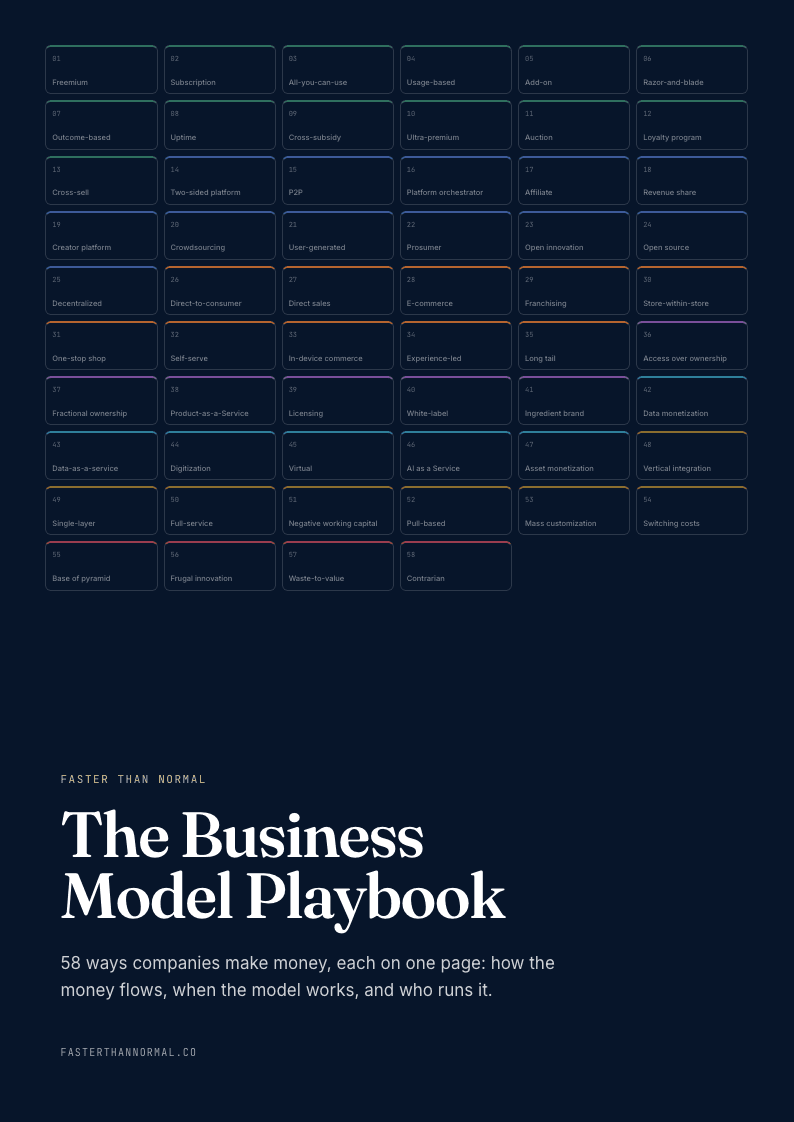
Free playbook
Get The Business Model Playbook
58 business models, one visual page each: how the money flows, the metrics that matter, and who runs it. Free when you join the Faster Than Normal email.
Free. No spam. Unsubscribe anytime.
Part IIIMaxims
-
Say no by reflex, and yes with conditions. The Abominable No-Man backed Li Lu only after Li Lu agreed to tear up his hedge fund structure. Munger's rare yes came with a redesign attached.
-
A partner who thinks like you shares your blind spots. "If one of us misses it, the other is likely to, too," Munger said of Buffett in 2014. Agreement is comfortable; it is not a second opinion.
-
Stubbornness that pays in your field can embarrass you outside it. The conviction that made Munger a great investor produced Dormzilla at UC Santa Barbara, and an architect resigned from the design review committee over it.
-
Learn about leverage from a friend's margin calls. Rick Guerin's forced selling in 1973–74 became the cautionary tale Munger used against borrowed money for the rest of his life.
-
Drop a method when it makes you do ugly work. Munger said cigar-butt investing was "scroungy and unpleasant when you're firing people." Distaste was part of the case for buying better businesses.
-
"The first rule of a happy life is low expectations." Munger told USC Law graduates this in 2007, half a century after the years that cost him a marriage, his savings, and a son.
-
Pedigree is a weak rebuttal to logic. Buffett asked why he should listen to a lawyer who had never spent a day in business school. Munger kept repeating his maxims until Berkshire was built to his blueprint.
-
Give it away while you can still see where it goes. Munger gave away more than three-quarters of his Berkshire stock while alive and said he was deliberately taking his net worth down.
-
Walk over and introduce yourself. At Caltech, Munger worked beside the world's greatest geneticist and never met him. "It didn't occur to me," he said decades later.
-
The worst decade does not have to set the terms of the next one. By thirty-one, Munger was divorced, nearly broke, and burying his son. Four years later he met Buffett at a dinner party in Omaha.
In Their Own Words
It is remarkable how much long-term advantage people like us have gotten by trying to be consistently not stupid, instead of trying to be very intelligent.
The game of life is the game of everlasting learning. At least it is if you want to win.
You don't have to be brilliant, only a little bit wiser than the other guys, on average, for a long, long time.
The big money is not in the buying and selling, but in the waiting.
I never allow myself to have an opinion on anything that I don't know the other side's argument better than they do.
In my whole life, I have known no wise people who didn't read all the time — none, zero.
The best thing a human being can do is to help another human being know more.
Spend each day trying to be a little wiser than you were when you woke up.
A majority of life's errors are caused by forgetting what one is really trying to do.
Assume life will be really tough, and then ask if you can handle it. If the answer is yes, you've won.
Envy is a really stupid sin because it's the only one you could never possibly have any fun at.
You're not going to get very far in life on the basis of what you already know. You're going to advance in life by what you're going to learn.
The safest way to try and get what you want is to try and deserve what you want. It's such a simple idea. It's the golden rule. You want to deliver to the world what you would buy if you were on the other end.— Charlie Munger, USC Law Commencement, 2007
It's certainly a peculiar example of one life. It's interesting that a man who started out to be a lawyer ended up with an identity that's more like a guru's than a lawyer's.— Charlie Munger, CNBC interview, November 14, 2023
You've got to have multiple models — because if you just have one or two that you're using, the nature of human psychology is such that you'll torture reality so that it fits your models. It's like the old saying, 'To the man with only a hammer, every problem looks like a nail.'— Charlie Munger, A Lesson on Elementary, Worldly Wisdom, USC Business School, 1994
Berkshire has been built to Charlie's blueprint. My role has been that of general contractor, with the CEOs of Berkshire's subsidiaries doing the real work as sub-contractors.— Warren Buffett, 2015 Berkshire Hathaway Shareholder Letter
Further reading
- Damn Right!: Behind the Scenes with Berkshire Hathaway Billionaire Charlie Munger by Janet Lowe
- Poor Charlie's Almanack (Expanded Third Edition) by Peter D. Kaufman
- Poor Charlie's Almanack: The Essential Wit and Wisdom of Charles T. Munger by Charles T. Munger
- Tao of Charlie Munger by David Clark


