
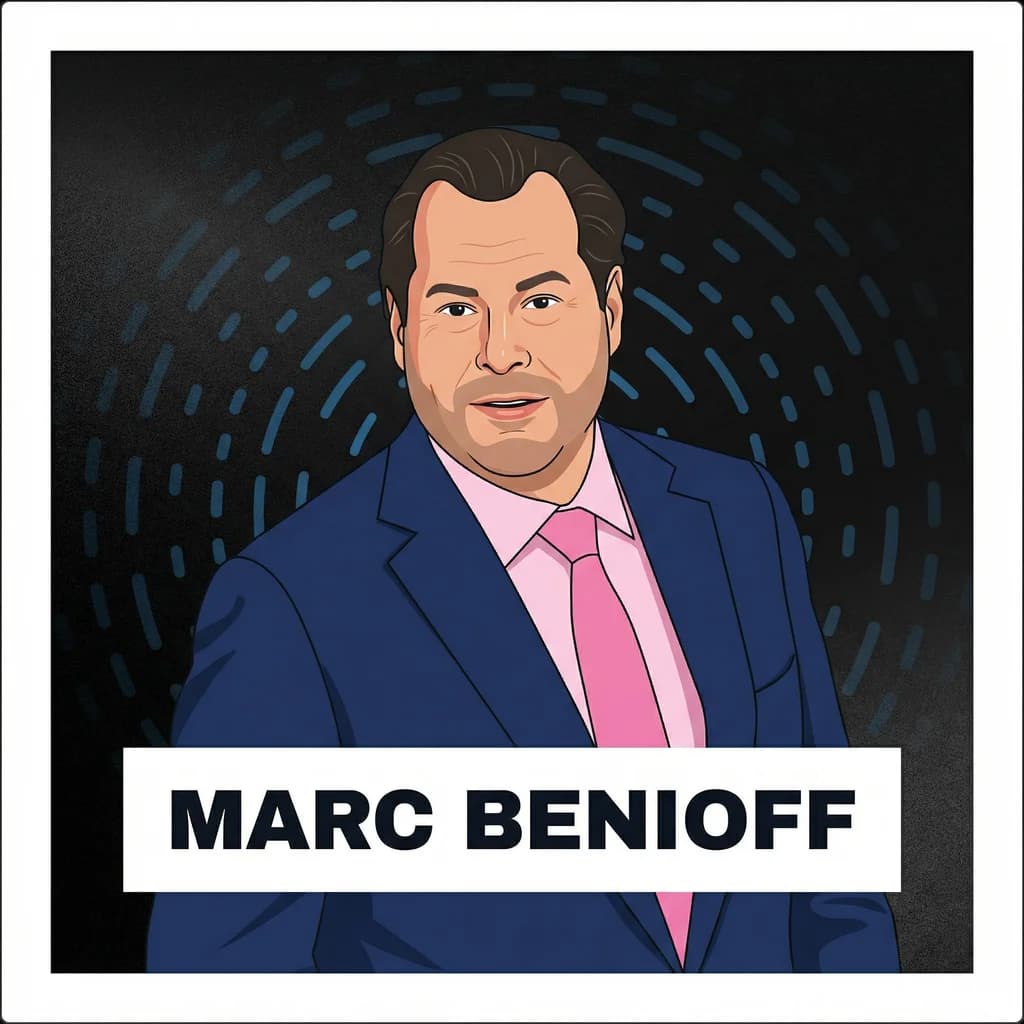

Part IThe Story
The Apartment on Telegraph Hill
In March 1999, four men crowded into a rented one-bedroom apartment at 1449 Montgomery Street, on the steep eastern face of San Francisco's Telegraph Hill, and began writing code that would — within a decade — annihilate the business model of every major enterprise software company on earth. The apartment sat next door to Marc Benioff's own house, which tells you something about the man: even his startup's origin story doubles as a real estate play. The walls were decorated with posters of the Dalai Lama and Albert Einstein — spiritual aspiration and scientific genius, side by side, as if the occupants couldn't decide which mythology to inhabit. Two dogs wandered underfoot. The mantra, scrawled on whiteboards and repeated until it calcified into corporate scripture, was "no fluff." Within a month they had a working prototype. Within a year they had forty employees and an 8,000-square-foot office. Within five years they were public. Within twenty-five years, the company Marc Russell Benioff conjured in that apartment — Salesforce — would be the third-largest enterprise software company in the world, its 61-storey tower the tallest thing on the San Francisco skyline, its founder worth north of $10 billion, his name affixed to children's hospitals and ocean conservation initiatives and the masthead of Time magazine.
The trajectory sounds clean. It wasn't. Between that apartment and that tower lies a quarter-century of guerrilla marketing stunts and genuine technical revolution, of mentorship received and mentorship betrayed, of philanthropic grandstanding and philanthropic substance, of a man who meditates for an hour each morning and then spends the rest of the day selling with a ferocity that makes his competitors reach for metaphors involving natural disasters. Marc Benioff is the rare founder who has been both prophet and profiteer of three consecutive technological upheavals — cloud computing, mobile-social enterprise, and now artificial intelligence — and who has managed, through charisma, showmanship, acquisitive hunger, and what one journalist called "a blend of bohemian mysticism and ruthless entrepreneurialism," to remain atop the same company through all of them. To understand Benioff is to understand what happens when a born salesman discovers that the most powerful thing you can sell is a vision of the future.
By the Numbers
Salesforce at a Glance
$262BMarket capitalization (May 2025)
$37.9BAnnual revenue (FY2025)
75,000+Employees worldwide
$700M+Total grants given through 1-1-1 model
56,000+Nonprofits using Salesforce technology
$190MPurchase price of Time magazine (2018)
26Years as CEO of the same company
The Kid Who Sold Juggling Instructions
Benioff was born in San Francisco — a fourth-generation San Franciscan, a fact he deploys with the frequency and conviction of someone presenting a passport at a border crossing. His father's family had been in the city long enough that "local" barely covers it; the Benioffs were woven into the civic fabric in the way that only families who predate the tech boom can claim. Young Marc was not a prodigy of the ethereal, code-in-the-garage variety. He was something more specific: a kid who discovered, at fifteen, that you could write software and then sell it for money.
The program was called How to Juggle. He wrote it for a TRS-80 and sold it to CLOAD Magazine — a publication based in Goleta, California, that shipped software to subscribers on cassette tapes — for $75. The command CLOAD, as Benioff has taken pleasure in explaining to interviewers who assume it refers to disk drives, stood for "cassette load." He was a teenager making money from instructions — not juggling itself but the systematization of juggling, the reduction of a physical skill to a sequence of commands. It is tempting to read the entire Salesforce story back into this moment: the impulse to take something complex, make it simple, deliver it remotely, charge a modest fee.
By the time he graduated from the University of Southern California's Marshall School of Business, Benioff had already internalized two convictions that would define his career. The first was that software should be easy — as easy as ordering a book from Amazon, a comparison he would make relentlessly in the late 1990s. The second was that the people who made software rarely understood this.
Thirteen Years in Ellison's Court
In 1986, Marc Benioff went to work for Oracle. He was twenty-two. He stayed for thirteen years.
Larry Ellison — the combative, yacht-racing, fighter-jet-buying founder of Oracle who had by then already earned a reputation as one of the most brilliant and impossible men in enterprise technology — became Benioff's mentor, patron, and, eventually, his most complicated relationship. Ellison saw in the young salesman a version of his own appetites. Benioff rose fast. By twenty-five, he was a millionaire. By twenty-six, he was the youngest vice president in Oracle's history. He was, by all accounts, a prodigious seller — not of code, but of possibility. The product was secondary to the performance.
But something curdled. The success came too easily, or perhaps it was the wrong kind of success. Benioff has told the story many times, with the practiced cadence of a parable: he was rich, he was rising, and he was miserable. Oracle, to its credit, suggested he take a sabbatical. He went to India. While visiting a village, he encountered Mata Amritanandamayi, a Hindu spiritual leader known as "The Hugging Saint," who, amid chanting and incense, delivered a line that Benioff has repeated in every commencement address and book jacket since: "In your quest to change the world, don't forget to do something for somebody else."
It is the kind of origin story that sounds too neat, too cinematic — the millionaire wandering the subcontinent, finding wisdom from a guru. And yet the epiphany, however polished in the retelling, produced material consequences. Benioff returned to Oracle with the germ of an idea: not just a new company, but a new kind of company, one that would embed philanthropy into its operating system from day one. He also returned with a restlessness that Oracle could no longer contain.
Ellison, remarkably, gave his blessing. More than that — he invested $2 million of his own money in the venture. He joined the board. The relationship between protégé and mentor held, for a time, the warmth of mutual admiration and the tension of diverging ambitions. It would not last. Within two years, as Oracle launched its own competing web-based sales product, Benioff asked Ellison to leave the board. In one account, Ellison's response was characteristically theatrical: "It would be much cooler if you just threw me off the board."
Benioff did.
— Marc Benioff, on Larry EllisonA huge mentor for me. Incredible person. He had a huge impact on my life and taught me all kinds of amazing things that I still use.
The rupture was real but not permanent. The two men would circle each other for decades — competing, admiring, occasionally collaborating — in a dynamic that says something about how power works in Silicon Valley. By 2025, Benioff was still calling Ellison "as innovative and as pioneering as I've ever seen," marveling at how the eighty-year-old had engineered the $500 billion Stargate data center partnership with Sam Altman and Masayoshi Son. "Only Larry Ellison could have pulled it off," Benioff said. It was the kind of praise that only a former disciple can bestow: generous, sincere, and laced with the quiet awareness that the student had long since surpassed the teacher in at least one crucial dimension — the ability to build not just a company, but a movement.
The End of Software
The founding mythology of Salesforce is inseparable from an act of provocation so audacious it almost qualifies as performance art.
On February 7, 2000, Salesforce officially launched at an event themed "The End of Software" at San Francisco's Regency Theater. Fifteen hundred people attended. The B-52s played. But the real spectacle had come a month earlier, when Benioff hired actors to stage a fake protest outside a Siebel Systems conference. The "protestors" carried signs with anti-software slogans. It was guerrilla theater in service of a business model — the idea that enterprise software, with its million-dollar licenses and year-long implementations and armies of consultants, was a racket. Salesforce would deliver the same functionality over the internet, for $50 per user per month. No hardware. No installation. No CD.
Tom Siebel — the CEO of Siebel Systems, an Oracle alumnus like Benioff, and the man who dominated the sales force automation market — was not amused. In a twist that Benioff surely relished, the two had been friends for years. Benioff had been one of the original investors in Siebel Systems. The year before Salesforce launched, Benioff and Siebel had even hatched a plan to create a new company together, with Siebel providing the financing. Siebel changed his mind at the last minute, deciding he'd rather create an internal division than an outside venture. Benioff went solo.
The competitive dynamics were vicious. Siebel publicly belittled Benioff as "one of the greatest media figures in history" — intended as an insult, received by Benioff as something close to a compliment. Craig Conway, the CEO of PeopleSoft, who had once recommended Benioff for his job at Oracle, predicted he would soon be out of business. The incumbents were unified in their contempt and catastrophically wrong in their forecasts.
What they missed — what nearly everyone missed — was that Benioff wasn't selling software. He was selling a delivery mechanism. The product was, in his own description, "an Internet site that's also an enterprise application." Customers didn't buy anything; they subscribed. They didn't install anything; they logged in. Salesforce stored their data on its own Oracle databases. The irony — that the revolutionary who declared "the end of software" was running his revolution on his former mentor's software — was not lost on the industry. But it didn't matter. The model worked.
Revenue hit $5.4 million in fiscal year 2001. By 2002, despite the dot-com bust — which had forced Salesforce to lay off 20% of its workforce — sales tripled to $60 million. By the time Salesforce went public on the New York Stock Exchange on June 23, 2004, the company Siebel and Conway had dismissed as a sideshow was valued at over $1 billion. Siebel Systems would be acquired by Oracle in 2005. PeopleSoft had already been swallowed by Oracle the year before.
Benioff had said the incumbents would be consumed. They were.
The Coach, the General, and the President
Benioff collects mentors the way some people collect watches — with discernment, with public displays of affection, and with a connoisseur's appreciation for provenance. The effect is cumulative: by studying who shaped Marc Benioff, you begin to see the composite figure he was assembling.
Bill Campbell — the former Columbia football coach who became Silicon Valley's most trusted executive whisperer — was one. Campbell, who died in 2016 at seventy-five, had coached Steve Jobs through his return to Apple, saved Jeff Bezos from a board revolt at Amazon, and sat silently in the room during Google's Monday executive meetings for more than a decade despite being neither an employee nor a director. He fervently believed in founders and spent his career teaching entrepreneurs to become CEOs — to listen, to partner, to look up from the screen. For Benioff, Campbell represented the human dimension of leadership that engineering culture chronically undervalued.
Colin Powell — the four-star general, Secretary of State, and, in Benioff's telling, one of the most important influences on his "core leadership" — was another. Benioff doesn't elaborate at length on what, specifically, Powell taught him, but the outline is clear enough: the marriage of discipline and communication, the ability to project calm authority while navigating institutions riven by internal politics.
And then there was Shimon Peres, the Israeli president and Nobel Peace Prize laureate, who gave Benioff what he has called "incredible wisdom in terms of trying to create peace in the world." It is a characteristically Benioff-ian roster of advisors: a football coach, a general, a statesman. Three men who operated at the intersection of power and persuasion. Three men who understood that institutions are, ultimately, made of people.
Perhaps the most revealing entry on Benioff's list of influences is a man he never met: Harold Geneen, the legendary CEO of ITT who ran the conglomerate from 1959 to 1977 and wrote a book called Managing that Benioff has cited as a touchstone. Geneen was the archetype of the mid-century corporate empire-builder — a man who managed 350 companies across 80 countries through relentless attention to detail and a refusal to accept any report he couldn't verify himself. That Benioff admires a figure so removed from Silicon Valley's ethos of disruption and flat hierarchies suggests something important about his own operating philosophy: beneath the Hawaiian shirts and meditation retreats, there is a man who believes in management as a discipline, not an afterthought.
One-One-One
Before Salesforce had generated a dollar of revenue, before the first customer had logged into the prototype, Marc Benioff did something that struck most of his peers as either visionary or insane: he committed one percent of the company's equity, one percent of its product, and one percent of its employees' time to charitable causes.
The 1-1-1 model, as it became known, was baked into the corporate charter from day one. Not bolted on after an IPO. Not announced at a gala after the founder had already made his fortune. On the first day. Benioff has been characteristically vocal about why. "We decided that no matter how big the company grew, we should always set aside one percent of our equity, product, and employee time for charitable causes," he has written. The formulation sounds modest — one percent is, after all, one percent — but compounded over a quarter-century of explosive growth, the numbers became enormous. More than $700 million in grants. More than 8.7 million hours of employee volunteer service. Technology donated to more than 56,000 nonprofits and higher-education institutions. Nearly 20,000 companies have adopted the 1-1-1 model through Pledge 1%, a nonprofit Benioff co-founded to evangelize the approach.
The cynical reading is that 1-1-1 is brilliant marketing — a way to attract talent in a hypercompetitive labor market, to differentiate Salesforce from companies whose social impact extends no further than a recycling bin in the break room. Benioff's own data supports this interpretation: giving back is the second-highest reason new hires join Salesforce and ranks in the top three reasons employees stay. The idealistic reading is that Benioff genuinely means it — that the encounter with The Hugging Saint in India produced a durable moral commitment that has survived the corrupting pressures of wealth and scale.
The truth, as usual, lives in the tension between these readings. Benioff is both sincere and strategic, and the genius of 1-1-1 is that it doesn't require you to choose. The model works precisely because doing good is good business. This is not a contradiction. It is the insight.
The Showman's Pulpit
Dreamforce — Salesforce's annual conference, held each September in San Francisco — is not a corporate event in any conventional sense. It is a pilgrimage. At its pre-pandemic peak, 170,000 people descended on the city, hotel rooms spiked to $2,000 a night, entire city blocks were shut down, and the headliners ranged from Metallica to Barack Obama to Matthew McConaughey. Benioff presides over it like a combination of evangelist, stadium-rock frontman, and Renaissance prince receiving supplicants.
The keynote is the centerpiece. Benioff typically rehearses it dozens of times, delivers it to 10,000 people across the globe in advance, and arrives at the final performance with the confidence of a man who has memorized his scripture. Except in 2024. Three weeks before Dreamforce 2024, Benioff tore up the entire keynote. "Usually, by the time I give the keynote, I have already practiced it three dozen times," he explained. "The keynote just got finished last night. I had never done it before. I didn't even practice it."
The reason was a growing awareness that customers were simultaneously excited about AI and furious that it wasn't working. "They hold both in their hands," he said. "They're very excited because they realize what the potential is... But then they're like, 'Why don't we have more of this happening in our business right now?'" The rewritten keynote was designed to "break the hypnosis" that Microsoft and other vendors had created around DIY AI — the notion that enterprises should build their own AI infrastructure from scratch. Benioff's counterargument, delivered with the conviction of a man who has been making this exact argument since 1999, was that Salesforce could do it for them. The technology changed. The sales pitch didn't.
This is Benioff's particular genius: the ability to repackage a consistent worldview — that enterprise technology should be simple, delivered as a service, and managed by the vendor rather than the customer — for each new technological epoch. In 2000, the enemy was installed software. In 2010, it was companies that hadn't moved to the cloud. In 2024, it was "science projects" — AI experiments that consumed budgets without producing results. The targets rotate. The argument endures.
— Marc Benioff, Dreamforce 2024They're selling you science projects. You need to move away from it and we can prove it to you.
The Acquisition Machine
If Salesforce's organic growth story is a study in platform thinking, its acquisition history is a study in appetite.
The company's most consequential deal — and the one that best illustrates Benioff's strategic instincts — was the $27.7 billion acquisition of Slack in December 2020, announced during the depths of the pandemic when remote work had transformed a popular-but-embattled messaging platform into essential corporate infrastructure. Slack's founder, Stewart Butterfield — a philosophy major turned video game designer who had stumbled into enterprise software almost by accident when a failed game project produced a chat tool that his team couldn't stop using — had built something Salesforce needed: a collaborative layer that could sit atop the CRM and become the connective tissue of the enterprise.
The price was staggering. But Benioff's logic was consistent with the pattern that had driven earlier acquisitions: MuleSoft for $6.5 billion in 2018 (integration), Tableau for $15.7 billion in 2019 (analytics and data visualization), and, most recently, Informatica for $8 billion in 2025 (data management). Each acquisition added a layer to the platform stack. Each made it harder for customers to leave. The cumulative effect was to transform Salesforce from a CRM company into something closer to an enterprise operating system — a federated data layer, in Benioff's language, that connected every data source inside a company and made it available to whatever application or agent needed it.
The risk, of course, is indigestion. The Slack acquisition, in particular, drew skepticism from analysts who questioned whether a messaging platform was worth nearly $28 billion and whether Salesforce could integrate a product whose culture and user base were fundamentally different from its own. The jury, as of 2025, remains partially sequestered. But Benioff's bet was not primarily about Slack's current revenue. It was about what Slack could become inside the Salesforce ecosystem — a surface through which AI agents could interact with humans, a channel through which the federated data layer could be queried and acted upon. "You don't even know which [AI model] we have there," Benioff said of Slack's AI integrations. "We just pick the one that's best for us and our customers."
The Values Question
In 2015, Indiana Governor Mike Pence signed the Religious Freedom Restoration Act, a law widely seen as inviting discrimination against LGBTQ individuals. Marc Benioff took to Twitter. Within hours, he had sparked a business-led backlash that pressured Pence into amending the law. It was, by Benioff's own admission, "not familiar territory" — not something he had learned in business school. But the episode established a template: the CEO as activist, using the company as a platform for political engagement.
The template would be applied repeatedly. In 2015, after learning that women at Salesforce might be paid less than men, Benioff ordered a company-wide salary audit. The results were damning. Salesforce spent millions closing the gap — and then repeated the audit annually, finding and fixing new discrepancies each time. "I didn't consider that it could happen at our company," Benioff told UC Berkeley graduates that year. The confession was disarming precisely because it was an admission of a failure that most CEOs would prefer to deny.
In 2018, San Francisco's Proposition C — a ballot initiative that would raise taxes on large companies to fund homelessness services — became the occasion for Benioff's most public display of civic combativeness. He threw his support behind the measure, pledged over $2 million to the campaign, and then, on Twitter, publicly eviscerated Jack Dorsey, the CEO of both Twitter and Square, who had opposed the tax. "Hi Jack," Benioff wrote. "Thanks for the feedback. Which homeless programs in our city are you supporting? Can you tell me what Twitter and Square & you are in for & at what financial levels?" The exchange — two billionaires virtue-squabbling in public — lit up the internet. Prop C passed.
The activism is genuine. The Benioffs have given more than $250 million to UCSF, funding children's hospitals in both San Francisco and Oakland. They have established ocean conservation initiatives, homelessness research programs, microbiome medicine centers. Marc is a fourth-generation San Franciscan, and his philanthropy carries the weight of inherited obligation, not acquired conscience.
But the activism is also strategic. Benioff's willingness to wade into polarizing issues has occasionally cost him — Ron Conway, the legendary angel investor, resigned from Salesforce's board in October 2025 after twenty-five years, writing that he "barely recognized" the man he had long admired, following controversial comments Benioff made about the National Guard and public safety in San Francisco. The incident revealed the limits of the CEO-activist model: speak loudly enough, and eventually someone on your own board will disagree.
Benioff's response to the Conway rupture was characteristically Benioff: he clarified, contextualized, and moved on. The Yale Insights assessment was that what looked like political opportunism was actually a "legitimate safety concern" that "became a political drama" through media distortion. Perhaps. The more revealing detail is that Benioff, after buying Time magazine in 2018 for $190 million, stopped making political contributions entirely. "When I bought Time Magazine, it reinforced that for me," he told the Financial Times in 2025. "I decided I wasn't going to make political contributions any more." He has not visited Mar-a-Lago. He has not rebuilt bridges with the Trump administration in the manner of Mark Zuckerberg or Sundar Pichai. "I've never been a Democrat," he told the FT, to the evident surprise of the interviewer. "I'm happy to be more in the middle."
The Agentforce Gambit
In the autumn of 2024, Salesforce unveiled Agentforce — a platform for deploying autonomous AI agents across enterprise workflows — and Benioff did something he almost never does: he considered changing the company's name. The fact that he didn't tells you he is still a disciplined operator. The fact that he considered it tells you how large the bet is.
The thesis is sweeping. Benioff projects a $3 trillion to $12 trillion opportunity in "digital labour" — AI agents that handle customer service queries, qualify sales leads, manage supply chains, write code, and perform an expanding universe of tasks that were previously the exclusive domain of human workers. At Salesforce itself, the transformation is already underway. AI agents now resolve 85% of customer service inquiries. Sales leads are qualified 40% faster. AI-generated code accounts for 25% of net new research and development output. By mid-2025, Benioff was claiming that AI performs 30% to 50% of all work inside Salesforce.
The numbers have drawn skepticism. A Reddit thread with over 100 comments greeted the claims with variations of "I don't believe this" and "this is a lie." One user wrote: "If it were true, you'd see a massive change in Salesforce's financial results — there's nothing significant to be found when you can look." The Salesforce community site Salesforce Ben published an analysis noting that offshoring, not AI, might account for much of the efficiency gain.
Benioff's response has been to lean in harder. At Davos in January 2025, he predicted that today's CEOs would be "the last generation" to lead all-human workforces. In interviews throughout the year, he disclosed that Salesforce had largely paused hiring for engineering roles, that 51% of first-quarter hiring was internal redeployment, and that the company had cut roughly 4,000 customer service positions as AI agents took over. "I need less heads," he told one interviewer with the bluntness of a man who has decided that euphemism is a luxury.
And yet — and this is the tension that defines Benioff's AI narrative — he simultaneously insists that humans must remain "at the center of the story." In a July 2025 Financial Times op-ed, he wrote that humans possess a "superpower" AI lacks: the ability to express compassion, to truly connect. "AI is not destiny," he wrote. "We must choose wisely." The man laying off thousands of customer service agents and the man insisting on human centrality are the same person. The contradiction is not hypocrisy; it is the condition of running a major technology company during a period of genuine disruption.
The Model Is the Commodity
At the center of Benioff's AI worldview is a claim that puts him at odds with nearly every major AI company in the world: the models don't matter.
"The model will increasingly be a commodity," he told the Financial Times in 2025. "They're all mostly doing the same thing. I'm sure an impartial observer would agree with that. And they're following each other within six months." He uses ChatGPT, Gemini, Claude, and You.com interchangeably. Inside Slack, Salesforce picks whichever model performs best for a given task — and the user doesn't know or care which one is running.
The argument is self-serving, of course. If models are commodities, then the value accrues not to the model builders — OpenAI, Anthropic, Google — but to the companies that control the data and the applications through which AI is deployed. Companies like Salesforce. "AI agents without data and apps just aren't accurate enough," Benioff has said. "That's where Salesforce wins in AI." It's a neat trick: position the most expensive, most hyped layer of the technology stack as the least differentiated, and then argue that your layer — the enterprise platform layer — is the one that actually matters.
The evidence is mixed but not dismissible. DeepSeek, the Chinese open-source model released in early 2025 with an MIT license, did seem to validate Benioff's thesis by demonstrating that frontier-level AI capabilities could be achieved at a fraction of the cost, using techniques like mixture-of-experts that the commercial labs were slower to adopt. "Salesforce, for example, could easily reduce our cost of using our model by 90 per cent," Benioff said, barely containing his glee. The commercial model companies, he argued, were being outflanked by open source — the same force that had powered two decades of AI research.
His most pointed attacks were reserved for Microsoft. He called Copilot "Clippy 2.0" — a comparison designed to wound, invoking Microsoft's legendarily annoying 1990s office assistant. He declared a "full proximal rupture" between Microsoft and OpenAI, citing Sarah Friar's Goldman Sachs presentation in which OpenAI's strategy stack contained no Microsoft software and no mention of Azure. "I noticed that Microsoft's executives stopped saying I don't know what I was talking about," Benioff said, with the satisfaction of a man who keeps receipts.
Whether the model-as-commodity thesis holds will determine the next decade of enterprise technology. If Benioff is right, Salesforce's position — sitting atop the data layer, controlling the application layer, and treating models as interchangeable infrastructure — is the most valuable real estate in AI. If he is wrong, if the model builders achieve a durable competitive advantage through scale, data, or some emergent capability that defies commoditization, then Salesforce becomes a distribution layer for someone else's intelligence. Benioff is betting the company that he is right. He has been right before.
The Futurist at the Table
Among Benioff's more revealing habits is his relationship with Peter Schwartz — Salesforce's in-house futurist, a man who contributed as a writer to Minority Report, WarGames, and Deep Impact. That a $262 billion enterprise software company employs someone whose résumé includes helping Steven Spielberg imagine the surveillance state of 2054 tells you something about how Benioff thinks about strategy: not as a spreadsheet exercise but as a narrative one. The future is a story. The question is who gets to tell it.
This narrative orientation runs through everything Benioff does. The V2MOM — Vision, Values, Methods, Obstacles, and Measures — is Salesforce's strategic planning framework, first drafted on the back of an envelope in 1999 and still used twenty-six years later. Every employee writes one. Every decision is supposed to flow from it. In its structure, the V2MOM is less a business document than a personal credo — it begins with vision and values before getting to anything operational. Benioff has recently added a third participant to his V2MOM sessions: an AI agent. "I now have a three-party approach," he told one interviewer. "Myself, a Salesforce executive, and an AI agent working together." The agent asks questions about competitive positioning, distribution expansion, ecosystem impact. It is, in Benioff's telling, a form of "enlightenment."
— Marc Benioff, on AI and leadershipThis is the last generation of CEOs that only had human employees.
The statement is characteristically grandiose. It is also, possibly, correct.
The Tower and the City
From nearly anywhere in San Francisco, you can see Salesforce Tower — 1,070 feet of glass and steel rising from the south-of-Market district, completed in 2018, the tallest building in the city and one of the tallest on the West Coast. At night, its crown displays an LED art installation by Jim Campbell that projects shifting images across nine floors of the building's top. It is, depending on your perspective, either a gift to the skyline or an act of branding so enormous it alters the horizon.
The relationship between Benioff and San Francisco is the longest-running subplot of his career. He was born here. He built his company here. He named his tower here. He has given hundreds of millions to its hospitals, its schools, its parks — $410 million to UCSF alone, $100 million to public education, $15 million for the Tunnel Tops park, $7 million to restore China Beach. He championed Prop C. He has been, for two decades, the city's most visible corporate citizen.
And yet the relationship has grown complicated. During the pandemic, Salesforce — like most software companies — stopped requiring employees to come to the office. It unloaded much of its downtown real estate. The 10,000 people who once worked in Salesforce's downtown offices dispersed. Benioff's private jet records, tracked by enterprising journalists, showed him in Hawaii as often as San Francisco. At the very moment the city needed its largest employer to anchor the downtown, Salesforce was, quietly, everywhere else.
When Dreamforce returned in 2022, in-person attendance was roughly 40,000 — a fraction of the 170,000 pre-pandemic peak. The city, meanwhile, was grappling with what the San Francisco Standard delicately called "the crisis facing downtown" — the disappearance of office workers, the visible homelessness, the open drug use that newly elected Mayor Dan Lurie was trying to roll back. Benioff announced education grants. He pledged continued philanthropy. But on the question of what role Salesforce itself would play in bringing workers back to the city, he remained conspicuously silent.
The silence said something. Benioff has always been willing to use his company as a platform for change when the change in question aligns with his values and his brand. But the return-to-office question — unglamorous, operationally fraught, involving no villain to tweet at — offers no such alignment. It is the kind of problem that resists the CEO-as-activist playbook. You can't stage a mock protest against remote work.
In October 2025, the tension erupted. Benioff made comments in a New York Times interview that were widely interpreted as supporting the deployment of the National Guard in San Francisco. The backlash was fierce. Ron Conway resigned from the board. A Bloomberg columnist called it "more than the general bootlicking." Benioff clarified: he was talking about police staffing levels, not martial law. The clarification was probably accurate. But the damage revealed something about the fragility of the CEO-activist brand. When your public identity is built on speaking out, every word is a liability.
Still, the tower remains. The grants continue. As recently as September 2025, the Benioffs announced another $100 million gift to UCSF's children's hospitals, plus $39 million from Salesforce for schools, nonprofits, and local healthcare. "As a fourth-generation San Franciscan," Benioff said, "I've always believed in our responsibility to invest deeply in our local community." Fourth-generation. He always says it. The city is his inheritance, and he behaves accordingly — not always gracefully, not always consistently, but with the stubbornness of a man who has decided that his name and the city's name are, in some fundamental way, the same.
The Measure of the Man
The most instructive thing about Marc Benioff may be the gap between how he describes himself and how others experience him. He speaks of beginner's mind, of meditation, of compassion as a human superpower. He cites spiritual gurus and Nobel laureates. He sleeps eight hours a night and checks his Oura Ring. He wears Hawaiian shirts.
And then he calls Microsoft's flagship AI product "Clippy 2.0" on a public stage. He publicly shames Jack Dorsey's charitable giving in 279 characters. He considers renaming a $262 billion company after a product that launched six months ago. He tells an interviewer, with zero affect, "I need less heads."
The contradiction is not a flaw. It is the architecture. Benioff's operating system runs on two processors simultaneously: the spiritual seeker who believes that values create value, and the Oracle-trained salesman who understands that competitive advantage is taken, not given. The meditation is real. The ruthlessness is real. The Hawaiian shirt is real. The sixty-one stories of glass and steel are also real.
He has written three books — Behind the Cloud, the founding narrative; Trailblazer, the values manifesto — and each one is, in its way, an act of self-mythology, a carefully constructed narrative in which the protagonist is both a hardheaded businessman and a moral philosopher. The books are not dishonest. They are selected. They emphasize the moments that support the thesis — that capitalism can be reformed from within, that profit and purpose are not opposed — and glide past the moments that complicate it. The layoffs. The real estate retreats. The Conway resignation.
But mythology has its uses. The 20,000 companies that adopted the 1-1-1 model did so because someone showed them it was possible. The equal-pay audits at Salesforce prompted similar audits across the industry. The Prop C campaign raised $300 million a year for homelessness services. These are not abstractions. They are consequences.
At sixty, Benioff is still selling. The product changes — cloud, mobile, social, AI agents, digital labor — but the performance endures. He is late to his own meetings. He takes calls from his private jet. He texts with Jane Goodall and FaceTimes with Bono. He arrives, eventually, at the patio overlooking San Francisco Bay, where the fog is burning off and the Golden Gate Bridge is just visible if you squint, and he begins to talk about the future with the certainty of a man who has been right enough times that doubt feels like an indulgence.
Somewhere in a rented apartment on Telegraph Hill, the posters of the Dalai Lama and Albert Einstein still face each other across the room. Nobody works there anymore. The dogs are long gone. But the argument they represented — that you could be both — is the one Marc Benioff has spent twenty-six years trying to win.
Part IIThe Playbook
Marc Benioff has built Salesforce across three technological eras — cloud, social-mobile, AI — while maintaining operational control of the company for over a quarter-century. The following principles are drawn from the specific decisions, relationships, and structural choices documented in Part I.
The principles
- 1.Sell the model, not the product.
- 2.Embed your philosophy in your charter before you earn your first dollar.
- 3.Stage the contrast.
- 4.Collect mentors across domains, not just your industry.
- 5.Use a single strategic framework for twenty-six years.
- 6.Acquire layers, not competitors.
- 7.Treat the model layer as a commodity — and position accordingly.
- 8.Rewrite the keynote.
- 9.Be your own first customer.
- 10.Make your values a hiring moat.
- 11.Maintain political ambiguity while exercising moral clarity.
- 12.Accept that the contradiction is the operating system.
Principle 1
Sell the model, not the product.
Salesforce's CRM was never, by most technical assessments, the most sophisticated product in its category. What Benioff sold from day one was the delivery mechanism — the idea that enterprise software should be rented, not bought; accessed through a browser, not installed from a disc; maintained by the vendor, not the customer. This is the distinction between selling a product and selling a model. The product changes; the model compounds. In 2000, the model was SaaS. In 2024, the model is Agentforce — AI agents delivered through the same platform architecture, with the same promise: you don't have to build this yourself.
Every successful Salesforce initiative has followed this pattern. The V2MOM isn't a strategy document; it's a model for strategic thinking. The 1-1-1 program isn't philanthropy; it's a model for corporate giving. Dreamforce isn't a conference; it's a model for customer evangelism. Benioff's instinct is always to abstract upward from the specific to the replicable.
Tactic: When launching a new product or initiative, ask whether you're selling a thing or selling a way of doing things — then invest disproportionately in the latter.
Principle 2
Embed your philosophy in your charter before you earn your first dollar.
The 1-1-1 model was created before Salesforce had revenue, customers, or even a finished product. This was not reckless generosity; it was structural foresight. By embedding philanthropy into the company's DNA at founding, Benioff ensured that it could never be removed without violating the company's original charter. As the company grew, the one percent pledges grew with it — from trivial to transformative. More than $700 million in grants, 8.7 million volunteer hours, technology for 56,000 nonprofits.
The lesson is about timing, not amounts. Values articulated after success look like branding. Values articulated before success look like conviction. The 20,000 companies that adopted the 1-1-1 model did so because Salesforce demonstrated that the commitment predated the profit — that it was a cause, not a campaign.
Tactic: Define your company's non-negotiable commitments in the founding documents, before financial pressures can rationalize their removal.
Principle 3
Stage the contrast.
Benioff's earliest marketing instinct was theatrical: hire actors to protest outside a competitor's conference. The tactic was absurd, and it worked. The fake protesters outside the Siebel Systems event generated Salesforce's first major press coverage, in The Wall Street Journal, and established a brand identity — Salesforce as insurgent, as liberation army — that persisted for decades.
The principle extends beyond stunts. Every Benioff-era product launch is staged as a contrast: old vs. new, complex vs. simple, installed vs. delivered. "The End of Software." "Clippy 2.0." "Science projects." The rhetorical pattern is consistent: name the enemy, make the enemy look ridiculous, offer the alternative. The enemy changes. The structure doesn't.
⚡
The Contrast Framework
How Benioff has staged positioning across three eras
| Era | Enemy | Benioff's Frame |
|---|---|---|
| Cloud (2000) | Installed enterprise software | "The End of Software" |
| Social-Mobile (2012) | Disconnected legacy systems | "The Customer Company" |
| AI (2024) | DIY AI / Microsoft Copilot | "Clippy 2.0" / "Science projects" |
Tactic: Before launching any major initiative, identify the incumbent approach, give it a name your audience will remember, and position your offering as its structural opposite.
Principle 4
Collect mentors across domains, not just your industry.
Benioff's mentor roster — Larry Ellison (technology), Bill Campbell (human leadership), Colin Powell (institutional command), Shimon Peres (geopolitics), Mata Amritanandamayi (spirituality), Harold Geneen (corporate management) — is deliberately cross-domain. No two of these figures operated in the same world. The cumulative effect was a composite leadership style that draws on military discipline, Silicon Valley speed, philosophical reflection, and old-school industrial management.
Most founders' networks are homogeneous: other founders, their investors, a handful of journalists. Benioff's insistence on learning from people who have nothing to do with software — a football coach, a general, a Nobel Peace Prize laureate — produced a breadth of perspective that insulated him from the tunnel vision endemic to technology leadership.
Tactic: Deliberately seek advisors from at least three domains that have no obvious connection to your industry, and invest in those relationships with the same seriousness you bring to board recruitment.
Principle 5
Use a single strategic framework for twenty-six years.
The V2MOM — Vision, Values, Methods, Obstacles, and Measures — was written on the back of an envelope in 1999. It is still the primary strategic planning tool at Salesforce in 2025. Every employee writes one. Every major decision is supposed to be traceable to one. The framework's durability is itself a strategic asset: it creates organizational coherence across 75,000 employees and dozens of product lines without requiring a rigid hierarchy.
The power of V2MOM is its insistence that vision and values come first — before methods, before metrics. This is not a cosmetic ordering. It means that every strategic conversation at Salesforce begins with why before proceeding to how. In a company that has undergone three major technological pivots, a consistent framework provides the organizational connective tissue that prevents strategic whiplash from becoming cultural fragmentation.
Tactic: Create a strategic planning framework in your company's first year and commit to using it, unmodified, for at least a decade — the consistency itself becomes a competitive advantage.
Principle 6
Acquire layers, not competitors.
Salesforce's major acquisitions — MuleSoft ($6.5B, integration), Tableau ($15.7B, analytics), Slack ($27.7B, collaboration), Informatica ($8B, data management) — follow a clear pattern: each adds a functional layer to the platform stack rather than eliminating a direct competitor. The result is not a conglomerate but an integrated ecosystem in which each acquisition makes every other acquisition more valuable.
🏗️
The Salesforce Platform Stack
Acquired layers, not competitors
2018
MuleSoft ($6.5B) — Integration layer
2019
Tableau ($15.7B) — Data visualization layer
2021
Slack ($27.7B) — Collaboration layer
2025
Informatica ($8B) — Data management layer
This approach creates switching costs that no single product can generate. A customer using Salesforce CRM might leave for a competitor. A customer using Salesforce CRM + MuleSoft + Tableau + Slack + Informatica is building their entire digital infrastructure on the platform. Leaving means rebuilding everything.
Tactic: When evaluating acquisitions, ask whether the target adds a new layer to your platform stack — if it merely eliminates a competitor without deepening the ecosystem, the premium is rarely justified.
Principle 7
Treat the model layer as a commodity — and position accordingly.
Benioff's most contrarian AI thesis — that large language models are commodities, interchangeable within six months, and destined to be displaced by open source — is also his most strategically consequential. If true, the implication is that the value in enterprise AI accrues to whoever controls the data layer and the application layer, not the model layer. "AI agents without data and apps just aren't accurate enough," he has said. "That's where Salesforce wins."
The thesis is self-serving, but it is also supported by evidence: DeepSeek's release demonstrated that frontier capabilities could be achieved at dramatically lower cost through open-source methods. The commercial model companies responded by accelerating their own open-source releases. The commoditization trajectory is real, even if its timeline is uncertain.
Benioff has built this philosophy into his technology. Agentforce is model-agnostic — customers can swap models without rebuilding their AI infrastructure. "I've put my philosophy into my technology," he said, "so that my customers won't get burned as winners and losers are chosen by the market over time." It is a hedge disguised as a conviction.
Tactic: In any rapidly evolving technology stack, identify which layer is commoditizing fastest and position your offering to be the durable layer adjacent to it.
Principle 8
Rewrite the keynote.
Three weeks before Dreamforce 2024 — the most important sales event of the year — Benioff threw away a keynote he had rehearsed dozens of times and started over. The reason: he realized the prepared talk didn't address what customers were actually feeling. The new keynote was assembled overnight, unpracticed, and delivered raw. It worked.
The decision reflects a broader principle: strategic plans are hypotheses, not commitments. Benioff's own formulation is telling: "Tactics are going to dictate strategy over time." This is an inversion of conventional business wisdom, which treats strategy as the stable foundation and tactics as the flexible execution layer. Benioff argues the reverse — that you discover your strategy by observing what's actually working in the field, then scaling it.
This requires a specific organizational capability: the willingness to discard expensive preparation when the signal from the market changes. Most companies can't do this because the sunk cost of preparation creates institutional inertia. Benioff's willingness to tear up the keynote is not spontaneity; it is disciplined responsiveness to real-time information.
Tactic: Build a "kill switch" into every major initiative — a pre-committed decision point at which you'll evaluate whether the plan still matches the market reality, and an organizational norm that makes changing course a sign of strength, not failure.
Principle 9
Be your own first customer.
Benioff calls Salesforce "customer zero" for its own products. AI agents resolve 85% of internal customer service queries. Sales leads are qualified 40% faster through Agentforce. AI generates 25% of net new code. The internal deployment is not a pilot; it is a production system at scale.
The value of being customer zero is threefold. First, it generates credible performance data that no external case study can match. Second, it surfaces bugs and edge cases before they reach paying customers. Third, it creates an organizational culture in which every employee is also a user, which means product feedback is ambient rather than extracted.
The risk is confirmation bias — if Salesforce's internal needs are not representative of its customers' needs, being customer zero can produce a product optimized for the wrong use case. But for enterprise software, where the vendor's own operations closely mirror the customer's, the approach has clear advantages.
Tactic: Deploy your own product internally at production scale before selling it externally — use the internal deployment to generate quantitative performance claims that no competitor can challenge.
Principle 10
Make your values a hiring moat.
Salesforce's internal data shows that giving back is the second-highest reason new hires join the company and ranks in the top three reasons employees stay. In the hypercompetitive market for enterprise software talent, this is a structural advantage. Companies that treat values as window dressing cannot replicate it because candidates can tell the difference between a values page on a website and a 1-1-1 model that has distributed $700 million in grants.
The mechanism is self-reinforcing. Values-driven hiring produces a values-driven workforce, which produces a values-driven culture, which attracts more values-driven candidates. Competitors attempting to replicate the effect face a cold-start problem: without the twenty-five-year track record, the claims ring hollow.
Tactic: Track the specific reasons candidates accept and employees stay — if values-related factors appear in the top three, invest in them as you would any other competitive moat.
Principle 11
Maintain political ambiguity while exercising moral clarity.
After buying Time magazine in 2018, Benioff stopped making political contributions, stopped identifying with either party, and adopted a posture of deliberate political ambiguity. He has not visited Mar-a-Lago. He has not publicly endorsed any presidential candidate. He served in the Bush administration, lives in a Democratic city, and calls himself "more of an American" than a partisan.
Simultaneously, he has taken aggressive public stances on LGBTQ rights, equal pay, homelessness, and — most recently — AI regulation, calling for legislative action after documented cases of AI-linked suicides. "It can't be just growth at any cost," he told CNBC at Davos in January 2026.
The distinction is between partisan positioning and moral positioning. Benioff avoids the former and embraces the latter. The effect is that his public stands gain credibility from their apparent independence — he is not attacking Indiana's Religious Freedom Restoration Act because he is a Democrat, but because it violates a principle. The approach is not without cost (the Conway resignation demonstrated that), but it preserves the ability to engage on issues that matter without becoming captive to a political tribe.
Tactic: Separate your moral commitments from partisan affiliation — take public positions on principles, not parties, and ensure your credibility is grounded in track record, not alignment.
Principle 12
Accept that the contradiction is the operating system.
Marc Benioff meditates for an hour each morning and publicly humiliates competitors on stage. He donates hundreds of millions to children's hospitals and tells interviewers "I need less heads." He preaches beginner's mind and has run the same company for twenty-six years. He buys Time magazine for its journalistic independence and puts Donald Trump on the Person of the Year cover because it's good for business.
The temptation is to resolve these contradictions — to decide that Benioff is either the values-driven leader or the ruthless operator. The more useful reading is that he is both, and that the coexistence of these modes is not a bug but the operating system. The meditation produces the clarity to make hard decisions. The hard decisions fund the philanthropy. The philanthropy attracts the talent that executes the hard decisions.
Most leadership advice assumes coherence — pick a lane, be consistent, build a personal brand. Benioff's career suggests that, at a certain scale, coherence is less valuable than range. The ability to oscillate between registers — spiritual and commercial, generous and aggressive, visionary and transactional — is what has allowed him to navigate three technological revolutions without losing control of the company or the narrative.
Tactic: Stop trying to resolve the tensions in your leadership style — instead, identify which apparent contradictions are actually complementary capabilities, and invest in both sides simultaneously.

Free playbook
Get The Business Model Playbook
58 business models, one visual page each: how the money flows, the metrics that matter, and who runs it. Free when you join the Faster Than Normal email.
Free. No spam. Unsubscribe anytime.
Part IIIMaxims
-
Fund them all to find the hundred. Innovation requires waste. The hype cycle, the funding bubble, the thousand doomed startups — they are not market failures but the cost of discovering which ideas survive contact with reality.
-
Technology is never good or bad; it's what you do with it. Nuclear, genetic, AI — the instrument is morally neutral. The actor is not. Build regulatory and ethical frameworks around the actor, not the instrument.
-
Tactics dictate strategy over time. Don't mistake your strategic plan for the strategy. The real strategy emerges from observing which tactics are working in the field and scaling them relentlessly.
-
The model is a commodity; the data is the moat. In enterprise AI, the foundation models are converging on equivalent capability within six-month cycles. Durable competitive advantage lives in the proprietary data and the applications that sit above the model layer.
-
Embed your values before you earn your first dollar. Commitments made before financial success are structural; commitments made after success are discretionary. The first kind survives pressure. The second kind doesn't.
-
If everything is important, nothing is important. Meditation is not leisure; it is the practice of letting go of what doesn't matter so you can focus on what does. Prioritization is a skill, not a gift.
-
Be the platform, not the app. Apps are features that can be replicated. Platforms are ecosystems that compound. Build the thing that other things are built on.
-
Don't hide the dark scenarios. Optimism without contingency planning is recklessness. Employ futurists. Watch the disaster movies. Talk publicly about what could go wrong, because that's how you figure out how to get to the right place.
-
Throw away the rehearsed keynote. When the market reality shifts, the prepared message becomes a liability. The willingness to start over three weeks before the biggest event of the year is not spontaneity — it is the highest form of discipline.
-
Your customers are your salespeople. The most credible marketing is a customer telling another customer what your product actually did for them. Invest in their success first; the evangelism follows.
In Their Own Words
The only constant in the technology industry is change.
You need to get to the future, ahead of your customers, and be ready to greet them when they arrive.
You must always be able to predict what's next and then have the flexibility to evolve.
The secret to successful hiring is this: look for the people who want to change the world.
90% of the world's data was created in the last two years.
You need to have a beginner's mind to create bold innovation.
The real joy in life comes from giving. It comes from service. It comes from doing things for other people. That is what is so powerful about this. Nothing will make you happier than giving.
We strive always to have a beginner's mind.
Most of all, I discovered that in order to succeed with a product, you must truly get to know your customers and build something for them.
Seize the opportunity in front of you. Imagine. Invent. Disrupt. Do good. I know that you must be passionate, unreasonable, and a little bit crazy to follow your own ideas and do things differently. But it's worth it. Life grows relative to one's investment in it.
One idea alone is a tactic, but if it can be executed a number of different ways, it becomes a great strategy.
There is a Japanese belief that business is temporal, whereas relationships are eternal.
You're going to have to throw a lot against the wall before you figure out what sticks. And that is the magic. So you're like, "wait a minute, this doesn't make any sense. These 10,000 companies just got funded, and only 100 of them are good." But you have to fund them all to get to the 100.— Marc Benioff, Financial Times interview, May 2025
It's all playing out right in front of our eyes that there is a huge breach between Microsoft and OpenAI. It's a full proximal rupture. And it's not coming back together.— Marc Benioff, on the OpenAI-Microsoft rupture, 2025
I've never been more excited about software, more energized or motivated, inspired. And I think that we're about to move into a completely new world. And I don't really have all the words yet because in a lot of these areas that we're moving into, I'm not an expert and I feel like I need to pick up my level of expertise.— Marc Benioff, Fortune Leadership Next podcast, December 2024
AI is not destiny. We must choose wisely. We must design intentionally.— Marc Benioff, Financial Times op-ed, July 2025
Bad things were happening all over the world because social media was fully unregulated, and now you're kind of seeing that play out again with artificial intelligence.— Marc Benioff, CNBC at Davos, January 2026


