
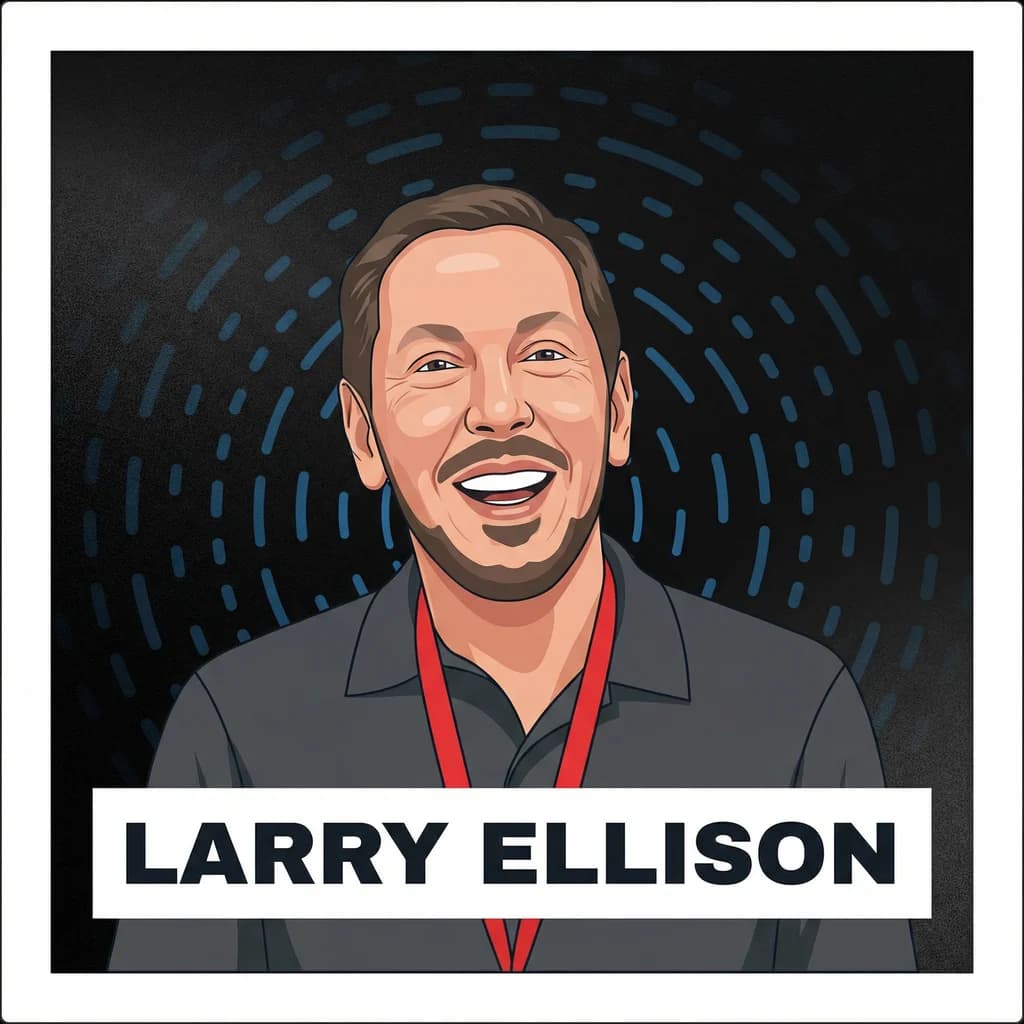

Part IThe Story
The Dinner at Nobu
In Palo Alto, at the elegant Japanese restaurant Nobu, sometime in 2024, two of the wealthiest men on earth sat across from a third and begged. Larry Ellison, eighty years old and worth something north of $200 billion, and Elon Musk, worth considerably more, had arranged to dine with Jensen Huang, the CEO of NVIDIA, whose graphics processing units had become the plutonium of the artificial intelligence age — the scarce, irreplaceable element without which nothing could be built. The dinner was, by Ellison's own cheerful admission, an exercise in supplication. "I would describe the dinner as me and Elon begging Jensen for GPUs," he later told a room of financial analysts. "'Please take our money. No, no, take more of it.' By the way, I got dinner... It went okay. It worked."
It worked. Three words that contain multitudes when spoken by a man who has spent nearly five decades in an industry that routinely devours its founders, chews through paradigm shifts like so many quarterly earnings cycles, and has produced precisely one figure — one — who has remained at the commanding heights of Silicon Valley since the Carter administration. Not Gates, who retreated to philanthropy. Not Jobs, who died. Not the parade of founders and visionaries and would-be emperors who rose and fell across the personal computer revolution, the internet boom, the dotcom bust, the mobile era, the cloud transition, and now the delirium of generative AI. Just Ellison. Still here. Still begging for chips. Still getting dinner.
On September 10, 2025, after Oracle reported quarterly results so staggeringly bullish that analysts groped for superlatives — $455 billion in remaining performance obligations, a figure that made the Street's consensus estimate of $180 billion look like a rounding error — Ellison's net worth exploded by $101 billion in a single day, the largest one-day increase ever recorded on Bloomberg's Billionaires Index, vaulting him past Musk to become, for several hours at least, the richest human being alive. His fortune touched $393 billion. Oracle's shares surged 36%, their best single-day performance since 1992, the very year the company nearly died. The symmetry was exquisite and probably lost on no one who had watched the arc of this particular life.
"He stands alone," said Marc Benioff, CEO of Salesforce and a former Ellison protégé, a man who had both worshipped and warred with his mentor across decades. "There's no one else like this, who has prospered in Silicon Valley for 50 years. Other people have passed on; he perseveres."
By the Numbers
The Oracle Empire
$393BPeak net worth (September 10, 2025)
~41%Ellison's ownership stake in Oracle
$455BRemaining performance obligations (Q1 FY2026)
48 yearsDuration at Oracle's helm (1977–present)
$101BLargest single-day wealth gain ever recorded
130,000+Oracle employees worldwide
$8.4BParamount-Skydance merger value (2025)
A South Side Boy Looking East
The origin story is practically liturgical by now, rehearsed so often in profiles and keynotes and commencement speeches that it has acquired the burnished quality of myth — which does not, in this case, make it untrue. Lawrence Joseph Ellison was born on August 17, 1944, in the Bronx, to Florence Spellman, a nineteen-year-old unwed mother. His father was an Italian American Air Force pilot whose name, in the tellings, barely registers. At nine months old, the infant contracted pneumonia. Spellman sent the boy to Chicago to be raised by her aunt and uncle, Lillian and Louis Ellison, who adopted him. He would not see his biological mother again until he was forty-eight years old.
The apartment was two bedrooms, on the South Side, in a neighborhood that was middle-class and Jewish and unremarkable. Louis Ellison had made a small fortune in Chicago real estate and lost it in the Depression — a fact that calcified into a kind of permanent emotional austerity. He worked as an auditor for the public housing authority. He told the boy, repeatedly and with conviction, that he would never amount to anything. Lillian was the counterweight: warm, loving, doting, the person to whom young Larry was tethered. When she died of kidney cancer during his second year at the University of Illinois, where he had been named science student of the year, the tether snapped. He dropped out. He enrolled at the University of Chicago the following fall. Dropped out again after one semester.
"I had all the disadvantages necessary for success," Ellison would say later, one of those gnomic lines he delivers with a half-smile that dares you to unpack it. The disadvantages: abandonment at nine months, an adoptive father who radiated disapproval like heat from asphalt, a dead mother-figure at twenty, two universities entered and exited with nothing to show for it. The necessary part: a temperament forged in the conviction that the world's assessment of your worth is probably wrong, and that proving this is not optional but existential.
He packed jeans, a leather jacket, a guitar, and whatever money he had into a car and drove to California. It was the mid-1960s. He was twenty-one.
The Paper, the Agency, and the Name
For the next decade, Ellison drifted — though "drifted" may be the wrong word for someone who was, beneath the surface restlessness, assembling a very specific set of skills. He worked as a programmer at Fireman's Fund, at Wells Fargo, at Amdahl Corporation, where he participated in building the first IBM-compatible mainframe system. He worked at Ampex, the electronics company that had pioneered magnetic tape recording and instant replay, where he met two men who would change his life: Bob Miner, a quiet, principled mathematician from Cicero, Illinois — the son of Assyrian immigrants, a University of Illinois graduate who was Ellison's supervisor at Ampex and his temperamental opposite in nearly every respect — and Ed Oates, a fellow programmer.
Between jobs, Ellison took a sailing class at Berkeley, taught rock climbing for the Sierra Club, ran river tours in the Sierra Nevada. His first wife divorced him for what she perceived as a lack of ambition. He was, in these years, someone whose energies had not yet found their channel — a search engine, as one biographer would later put it, gone haywire, capable of extraordinary processing power but lacking a query.
The query arrived in the form of a twelve-page paper. In 1970, Edgar F. Codd, a British-born mathematician working at IBM's San Jose Research Laboratory, had published "A Relational Model of Data for Large Shared Data Banks" — a paper that proposed organizing information in tables linked by common fields, a structure that would allow enormous datasets to be stored efficiently and retrieved at speed using a standardized language. IBM, with the bureaucratic caution of a company that already dominated computing, saw no commercial urgency in Codd's idea. They researched it. They studied it. They did not build it.
Ellison read the paper. He saw, with the clarity of someone unburdened by institutional inertia, what IBM could not or would not see: that this was not an academic curiosity but a product. A business. A future.
In 1977, Ellison, Miner, and Oates pooled $2,000 — some accounts say $1,200 — and incorporated Software Development Laboratories in Santa Clara, California. Ellison was thirty-two. The company had no product, no customers, and a name so generic it might have been generated by an algorithm. But it had a contract — a two-year deal to build a relational database management system for the Central Intelligence Agency. The CIA's project code name: Oracle.
They finished the project a year ahead of schedule. They used the extra time to develop the system for commercial applications. They named the commercial product Oracle as well. And then, in a move that would prove as important as any line of code they wrote, they decided to make it compatible with IBM's System R — to speak IBM's language even when IBM wouldn't share its error codes, to position their product not as an alternative to the mainframe establishment but as its natural extension. It was, in retrospect, a stroke of positioning genius: CIOs could buy Oracle and feel safe, could tell their boards they had chosen the relational database that worked with IBM, could avoid the career-ending risk of betting on an unknown. Lock-in by comfort. Distribution by compatibility.
Bob Miner — loyal, meticulous, allergic to the theatrics that Ellison cultivated — was the lead engineer. He programmed the majority of Oracle Version 3 by himself. His management style was everything Ellison's was not: quiet, humane, protective of his people. He thought it was wrong for engineers to work the kind of hours Ellison's culture demanded. "Loyal to the people before the company," Ellison would say of him. Miner would stay at Oracle until illness forced him out in 1993. He died of lung cancer on November 11, 1994, at the age of fifty-two, his legacy encoded in every line of the product that bore the agency's code name.
Doubling, Doubling, and Then the Cliff
In 1981, IBM signed on to use Oracle. The effect was thermonuclear. Sales doubled every year for the next seven years. The million-dollar company became a billion-dollar company with a velocity that made even Silicon Valley's most jaded observers blink. Oracle went public in 1986, raising $31.5 million. By 1987, it was the largest database-management company in the world.
Ellison, in these years, was building not just a product but a culture — and the culture was, to put it diplomatically, aggressive. The sales organization operated on the principle that a deal closed in the last week of the quarter was still a deal closed, that discounting was a tool to be wielded situationally and without sentiment, and that winning meant not merely outperforming competitors but annihilating them. "It's not enough that we win; all others must lose," Ellison said, paraphrasing Genghis Khan — or perhaps not paraphrasing, perhaps channeling. The line became so associated with him that it functioned as a corporate motto.
The aggression worked spectacularly until it didn't. In 1990, in the wake of a shareholder lawsuit, an internal audit revealed that Oracle had overstated its earnings — the result of sales practices so zealous that revenue was being recognized on deals that hadn't actually closed, on contracts whose terms were creative enough to constitute a kind of fiction. The stock plunged. The company teetered on the edge of bankruptcy. Ellison, who had by then become famous for his Armani suits and fighter jets and the 78-foot yacht Sayonara, found himself in a position familiar to founders who confuse momentum with invulnerability: suddenly, terrifyingly mortal.
He restructured management. He brought in new financial discipline. By the end of 1992, Oracle had returned to financial health. The lesson, by all accounts, stuck — not in the sense that Ellison became cautious, but in the sense that he never again confused aggressive selling with sloppy accounting. The bravado remained. The recklessness refined itself into something harder, more calculating, more patient. He had seen the cliff. He had not gone over it. And he had learned that survival, in an industry obsessed with the new, was itself a form of competitive advantage.
— Larry Ellison, Playboy interview, 2002When you're the first person whose beliefs are different from what everyone else believes, you're basically saying, 'I'm right, and everyone else is wrong.' That's a very unpleasant position to be in. It's at once exhilarating and at the same time an invitation to be attacked.
The Suite Always Wins
The central strategic insight of Ellison's career is not about databases. It is about suites.
In the late 1990s and early 2000s, the enterprise software industry was organized around what practitioners called "best of breed" — the notion that a company should buy its human resources system from PeopleSoft, its customer relationship management from Siebel, its supply chain automation from i2, its financials from SAP, and then hire a small army of consultants from IBM or Accenture to glue the pieces together. The consultants loved this arrangement. The vendors loved this arrangement. The customers, who were paying five times more for integration than they would have paid for a unified system, and whose data was fragmented across separate databases like a library whose books had been distributed to different buildings on different continents — the customers mostly didn't know enough to object.
Ellison knew. He had watched Microsoft destroy the standalone word processor, the standalone spreadsheet, the standalone database, the standalone graphics package — had watched Lotus and WordPerfect and Ashton-Tate vanish into the maw of Microsoft Office. He had internalized the lesson. "Remember when there was a PC software industry?" he told government attorneys during a deposition in the PeopleSoft antitrust case. "There isn't one now. There's Microsoft. The integrated suite always wins. So you don't have to look forward, you can look back. It's always the way."
He told his sales teams that best of breed "only works at dog shows." He built what he called the car-parts analogy: "What a wonderful way to buy a car. Maybe Porsche makes the best fuel injection, maybe Mercedes makes the best transmission, Cadillac makes the best air-conditioning, and the best catalytic converter comes from Ford, but these pieces were never designed to fit together." He deployed the line with the relish of a man who had been waiting years for the audience to catch up.
Oracle's E-Business Suite — a unified system that ran sales, service, marketing, accounting, finance, human resources, payroll, supply chain, and manufacturing on a single database — was the architectural expression of this conviction. SAP had pioneered the idea with its R/3 system. Ellison went further: Oracle would be the first to combine all the back-office ERP modules with all the front-office CRM modules on a common data model. "We tried to leapfrog them," he said of SAP, with the particular pleasure he took in the word "leapfrog" — a word that, in his vocabulary, meant not merely surpassing a competitor but making their prior advantage look quaint.
The bet on suites led directly to the bet on acquisitions.
The Roll-Up
On June 2, 2003, at 7:34 in the morning, Safra Catz — an Israeli-born former investment banker who had joined Oracle in 1999 and would eventually become its CEO, a woman whose operational intensity matched Ellison's strategic ambition the way a scalpel matches a surgeon's hand — sent Larry Ellison an email. Six words: "Now would be the time to launch on PSFT."
PSFT was PeopleSoft. The company had just announced its acquisition of J.D. Edwards. Ellison, who had been watching PeopleSoft for years, who regarded its human resources product as the one area where Oracle was not clearly ahead, saw the window. "Just what I was thinking," he replied. "Where are you?"
What followed was one of the most brutal, protracted, and legally contested acquisitions in the history of enterprise software. Oracle launched a hostile tender offer for PeopleSoft at $16 per share. PeopleSoft's CEO, Craig Conway — a man Ellison openly disdained — fought back with poison pills, customer retention campaigns, and a lobbying effort that persuaded the Department of Justice to sue to block the deal. The antitrust trial, which dragged into 2004, produced hundreds of pages of deposition testimony in which Ellison, under oath, laid out his vision of the enterprise software market with a candor and specificity that would have been remarkable in a strategy memo, let alone a legal proceeding.
The government's theory was that Oracle and PeopleSoft were close competitors whose merger would reduce competition and raise prices. Ellison's defense was, essentially, that the government did not understand the market. The real competition, he argued, was not between Oracle and PeopleSoft but between suite vendors — Oracle, SAP, PeopleSoft, and the looming threat of Microsoft — and a fragmented universe of industry specialists (Lawson in hospitals, Cerner in healthcare, unnamed companies in banking and insurance) who competed intensely in specific verticals. The market was organized by industry, not by size. SAP had a hundred percent of oil and gas. Lawson was stronger in hospitals than Oracle or PeopleSoft. The idea of a tidy two-player market was, Ellison insisted, "not the way it really works."
He won. The judge ruled in Oracle's favor. Conway was fired by PeopleSoft's board. Oracle ultimately acquired PeopleSoft for $10.3 billion — a price that reflected eighteen months of warfare and the strategic premium Ellison was willing to pay for scale. "Scale is hugely important in this business," he had testified. "There are two things you compete on, one is innovation — that's very important — and the other is scale."
The PeopleSoft acquisition was the opening movement of a consolidation symphony that would define Oracle's next decade. Siebel Systems followed in 2006, for $5.85 billion — the "last best of breed company" whose demise Ellison had celebrated in a July 2003 email to his executive team with the grim economy of a general reporting a casualty: "The last best of breed company is in the process of dieing." (The misspelling was his.) BEA Systems came next in 2008, for $8.5 billion. And then, in 2010, the acquisition that stunned the industry: Sun Microsystems, for $7.4 billion, which gave Oracle not just Java — the programming language that ran on billions of devices — but hardware. Actual, physical, plug-it-in-and-go hardware.
— Larry Ellison, SEC interview on the Sun Microsystems acquisition, 2009If a company designs both hardware and software, it can build much better systems than if they only design the software. That's why Apple's iPhone is so much better than Microsoft phones.
The Apple Parallel, the Jobs Friendship
The Sun acquisition made sense only if you understood Ellison's relationship with Steve Jobs.
They had been close friends since the late 1980s — two California dropouts, two men who believed that design was not decoration but architecture, two temperaments so similar in their intensity and so different in their aesthetics that their friendship acquired the quality of a philosophical dialogue conducted across decades and dinner tables and hiking trails in the Santa Cruz Mountains. Ellison owned a Japanese-style compound in Woodside. Jobs lived nearby. They walked. They argued. They competed, even with each other, in the way that two people who are fundamentally alike cannot help competing.
The most famous story from the friendship: sometime around 1997, when Jobs was considering his return to Apple, the two men discussed how to make it happen. Ellison offered to buy Apple and install Jobs as CEO. Jobs held him by the shoulders and said they didn't need to make money. "If I do this, I need to do this my way." Ellison recounted this at USC's 2016 commencement. "Steve was right. After a certain point, it can't be about the money."
What Ellison took from Jobs — and what the Sun acquisition embodied — was the conviction that the best products come from companies that control both the hardware and the software, that design them to work together, that refuse the modular, mix-and-match orthodoxy of the PC era. "Apple and Cisco have proven that they can do it," Ellison said when analysts questioned why a software company was buying a hardware company. He invoked Apple's iPhone. He invoked integrated design. He was borrowing Jobs's playbook and applying it to the enterprise.
At Oracle OpenWorld in October 2011, Ellison unveiled new SPARC processors and declared his intention to challenge IBM in the data center. "We want to take IBM on in their strongest suit, microprocessors," he said. He thanked the Sun engineers for their work on chips and indicated he would be investing heavily to maintain a competitive edge. The analysts who had predicted Oracle would strip Sun for parts and starve its hardware teams were wrong. Ellison was building a vertical stack — silicon to software — that mirrored, in the corporate market, what Apple had built in the consumer market.
Jobs died on October 5, 2011, four days after that OpenWorld keynote. When Ellison spoke of him publicly — on Charlie Rose, at industry events, at USC — his voice carried something that his usual bravado could not quite mask. Loss. The loss of the one person whose opinion he could not dismiss, whose genius he acknowledged without qualification, whose friendship was not transactional but the real thing. "I can't think of a better friend," he told Charlie Rose in 2013, and for once the man who always had a prepared line seemed to be searching for words.
The Wait, the Watch, the Late Play
For most of the 2010s, the conventional wisdom was that Larry Ellison had missed the cloud.
Amazon Web Services had launched in 2006. Microsoft Azure was gaining momentum. Google Cloud was spending billions. And Oracle — the company whose database sat in the guts of nearly every Fortune 500 IT system on the planet — was conspicuously, stubbornly late to the party. Ellison mocked cloud computing in public. He called it "a fad." He said the word "cloud" was being slapped onto everything like a marketing sticker. The industry's cognoscenti concluded that the old man had lost his touch, that Oracle would become the next IBM — a legacy vendor living off maintenance revenue while the future happened elsewhere.
They were half right. Ellison was skeptical of the hype. He was not, however, oblivious to the economics. According to people who worked closely with him, he was watching carefully — watching where the money was flowing, watching which customers were actually moving workloads, watching the margins. "Being first isn't what matters to him," one former colleague told the Financial Times. "It's about being the last man standing."
In 2014, Ellison stepped down as CEO, installing Safra Catz and Mark Hurd as co-CEOs while retaining the titles of executive chairman and chief technology officer. The move was widely interpreted as a graceful exit. It was not. It was a reorganization of his attention. Freed from the operational machinery of running a $40-billion company, Ellison turned his focus to what he called Oracle Cloud Infrastructure — OCI — and began, methodically and with the resources of a company generating billions in free cash flow, to build the data centers, the networking, the compute fabric that would position Oracle not as a cloud also-ran but as a provider whose infrastructure was purpose-built for the most demanding workloads in the world.
The timing was, in retrospect, uncanny. Or perhaps not uncanny — perhaps the product of fifty years of watching technology transitions, of understanding that the thing that matters is not who arrives first but who arrives with the right architecture at the moment demand inflects. When ChatGPT launched in November 2022 and set off an arms race for large language model training capacity, Oracle had something its cloud competitors did not quite have: available capacity, flexible pricing, and a willingness to build at a pace that startled even its own engineers.
The AI Super-Cycle and the $455 Billion Backlog
The numbers, by late 2025, had become difficult to process. Oracle's cloud infrastructure revenue was growing at 54% year-over-year, with OCI consumption revenue up 57%. The company had signed contracts worth $455 billion in remaining performance obligations — up 359% from a year earlier. It had inked a deal to provide OpenAI with 4.5 gigawatts of electricity to power its AI training. It was a founding equity partner, alongside SoftBank and OpenAI, in Stargate, a $500 billion AI infrastructure initiative announced at the White House in January 2025, with Donald Trump — a close Ellison ally — presiding.
The Stargate announcement was itself a scene worth pausing over. Three billionaires — Ellison, Sam Altman of OpenAI, Masayoshi Son of SoftBank — standing behind the President of the United States in the Roosevelt Room, the full weight of American industrial policy directed at the thing Ellison had been talking about for two years. "AI is a much bigger deal than the Industrial Revolution, electricity and everything that's come before," Ellison had told Tony Blair in February 2025. On earnings calls, he said it again and again: "AI changes everything."
Analysts at Bank of America and Citi upgraded Oracle to "buy." Goldman Sachs, more cautious, maintained a neutral rating but acknowledged the demand momentum. The projections were staggering: cloud infrastructure revenue of $18 billion in 2025, potentially $144 billion by 2029 — a 14x increase in five years. "Microsoft and Oracle really aren't software companies anymore," wrote Ben Reitzes of Melius Research. "They are AI cloud infrastructure stocks that happen to sell software too."
Oracle's stock doubled year-to-date. Its market value surged past $900 billion, leapfrogging Eli Lilly, Walmart, and JPMorgan Chase in a single session. And Ellison — who had started with $2,000 and a CIA contract and a twelve-page paper about relational databases — found himself, at eighty-one, richer than he had ever been, richer than almost anyone who had ever lived, and still showing up for work.
— Larry Ellison, Oracle earnings call, 2025AI changes everything.
The Database of You
There is a thread that connects the twenty-two-year-old programmer who read Codd's paper in the 1970s to the eighty-one-year-old CTO who, in 2025, is spending billions on data centers to train AI models. The thread is data. Its organization. Its retrieval. Its meaning.
Oracle acquired Cerner, the electronic health records company, in 2022, and Ellison threw himself into healthcare transformation with a zeal that startled even his own executives. "There's a global database for credit with all everyone's credit card information that allows you to have credit cards," he told an audience at the Oracle Health Summit. "There's no system that keeps track of our medical records in a single place that anyone can find in an emergency, but I can immediately find all of your credit history. What does that say about our priorities as a civilization? Shopping is more important than the lives of our family."
The argument was pure Ellison — contrarian, reductive, delivered with the impatience of a man who cannot understand why the world has not already solved a problem whose solution is, to him, obvious. Unify the data. Put it in one place. Make it searchable. It was, in essence, the same argument he had been making since 1977, when the "one place" was a relational database and the data was inventory records for the CIA. Now the database was global, the data was your medical history, and the stakes were life and death.
He compared it to the library at Alexandria — a comparison he had been making for thirty years, since a 1995 interview with the Smithsonian. "The goal of the Alexandrian Greeks was simply to collect all of the books, all of the histories, all of the great literature... and store them all in that one building. We have the same ambition." The digital library. The unified record. The single source of truth. It was the founding metaphor of his career and, at eighty-one, its animating obsession.
The CEO of Everything
The Ellison empire, by 2025, had grown tentacles that extended well beyond enterprise software.
There was Lanai, the Hawaiian island he purchased in 2012 for an estimated $300 million — 141 square miles, 3,200 residents, once the Dole pineapple plantation, now a laboratory for Ellison's ideas about sustainable agriculture, renewable energy, and luxury hospitality. There was Lawrence Investments, LLC, the single-family office overseeing assets exceeding $110 billion, with concentrated holdings in Oracle and Tesla (Ellison had served on Tesla's board from 2018 to 2022 and remained a significant shareholder). There was the Ellison Institute of Technology at the University of Oxford, funded by the $200 million he pledged to USC for cancer research, expanded into a broader initiative focused on AI, health, food security, and climate.
And then there was the media empire.
David Ellison — Larry's son, a film producer who had founded Skydance Media and built it into a production powerhouse behind films like Top Gun: Maverick and the Mission: Impossible franchise — completed an $8.4 billion merger with Paramount Global in 2025. The deal, backed substantially by Larry's capital, gave the Ellisons control of CBS, MTV, Paramount Pictures, Paramount+, and Pluto TV. David became chairman and CEO of the new Paramount Skydance. Reports soon followed that the Ellisons were bidding for Warner Bros. Discovery — CNN, HBO, Comedy Central — at a price north of $60 billion. An Oracle-led consortium was emerging as the preferred buyer of TikTok's U.S. operations.
"In the case of Larry, Larry Ellison, it's well beyond technology, sort of CEO of everything," Trump said at the Stargate announcement in January 2025. The honorific, bestowed in the Roosevelt Room by the President of the United States, was the kind of thing that might have embarrassed a different man. Ellison did not appear embarrassed.
The media researcher Michael Socolow, at the University of Maine, observed that if the Ellisons succeeded in acquiring both Paramount and Warner Bros. Discovery while also controlling TikTok, "the potential to persuade Americans" would exceed anything the Murdoch family had ever assembled. A database company's founder — a man whose product had always been, at its core, about organizing and retrieving information — was now positioning himself to control the creation and distribution of information at a civilizational scale.
The Paradox, the Restlessness, the Fridge of Self-Belief
Matthew Symonds, the Economist editor who spent two years traveling with Ellison and produced Softwar: An Intimate Portrait of Larry Ellison and Oracle — the closest thing to an authorized biography that exists — wrote of his subject:
"He's enormously vain, intellectually dominating, and irrepressibly extroverted but he's also shy, has relatively few close friends, and is in constant need of the emotional reassurance that much of his life had been lacking. He is determinately useful, but he is never far from thoughts of mortality. He detests vulgarity and yearns for simplicity and naturalness, but he also derives straightforward pleasure from owning hugely expensive material status symbols."
The contradictions are real and they do not resolve. The man who built a Japanese imperial estate in Woodside also raced a 243-foot yacht named Sayonara and once tried to buy a Russian MiG fighter jet. The man who yearns for simplicity employs an army of tax advisors and investment professionals at Lawrence Investments. The man who told USC graduates to follow their own dreams — not the dreams of well-meaning friends and family — also spent decades in a rivalry with Bill Gates that, by most accounts, was entirely one-sided: Ellison obsessed, Gates largely indifferent.
He has been married five times. His children — David and Megan Ellison, both film producers — grew up wealthy in ways he could not have imagined on the South Side of Chicago. He signed the Giving Pledge in 2010, promising to give away 95% of his wealth. He has given generously to medical research and education. He is, by the testimony of people who know him well, funny and entertaining, intensely curious, capable of genuine warmth, and almost impossible to work for if your definition of work involves predictable hours and manageable expectations.
"Death doesn't make sense to Larry Ellison," the Economist wrote in January 2025. "Especially if it is premature like that of his doting adoptive mother, of kidney cancer when he was 20 years old. Even mere ageing is an irritant." He works out daily. He eats fish and drinks green tea. He is eighty-one years old and running the technology strategy for a nearly trillion-dollar company that is building data centers on multiple continents to train the artificial intelligences that may, in some tellings, outlive us all.
At the Smithsonian, in 1995, thirty years before the AI super-cycle, before the cloud wars, before the acquisitions and the antitrust trials and the island and the fighter jets and the five marriages and the briefly-richest-man-alive headlines, a young interviewer asked Ellison about the Alexandria project — his vision of the universal digital library. Ellison's answer contained a phrase that serves, better than any motto or mission statement, as the key to his half-century of restless, relentless, contradictory life: "It is not a far-out dream. It is not media hype. It is real. It is certain to happen."
He was talking about the future. He was always talking about the future. And he was, more often than anyone had a right to expect, correct.
On a wall somewhere in Redwood Shores — or perhaps in a data center in Nashville, or in a conference room in the Oval Office, or aboard a yacht off Lanai — there is probably no plaque, no framed mission statement, no inspirational poster. There is just the work. The relational model. The unified database. The suite that always wins. The data, organized and retrievable, the story of your life in a single place. And Larry Ellison, still here, still asking Jensen Huang for chips, still picking up the dinner tab.
Part IIThe Playbook
Larry Ellison's career spans the entire commercial history of enterprise software — from the first relational database sold to the CIA in 1979 to the AI infrastructure contracts of 2025. What follows are the operating principles distilled from that arc: not motivational slogans but strategic patterns, observable in his decisions and verifiable in their outcomes.
The principles
- 1.Find the error in conventional wisdom — then commercialize it before the incumbents wake up.
- 2.Compatibility is a weapon. Speak the incumbent's language.
- 3.The integrated suite always wins.
- 4.Buy distribution, not just features.
- 5.Scale is the prerequisite for survival, not a luxury.
- 6.Price is situational. Context is everything.
- 7.You don't have to be first. You have to be last.
- 8.Control the full stack.
- 9.Markets are organized by industry, not by size.
- 10.If you can take it for free, don't pay billions for it.
- 11.Recurring revenue is the real business. New licenses are the sideshow.
- 12.Survive long enough and the compound interest of relationships becomes your moat.
Principle 1
Find the error in conventional wisdom — then commercialize it before the incumbents wake up.
Ellison's entire career began with a single recognition: IBM had published the theoretical foundation for relational databases but failed to see the commercial opportunity. "Because conventional wisdom was in error, this gave us tremendous advantage," Ellison has said. "We were the only ones trying to do it." The critical move was not merely being contrarian — it was identifying a specific, falsifiable error in the incumbent's thinking and building a product around the correction.
This pattern repeated across decades. In the late 1990s, Oracle was "considered mad" for releasing internet-only applications when the industry was still committed to client-server architecture. In the 2000s, Ellison declared that best-of-breed would lose to integrated suites when the consulting industry — which earned billions from integration work — had every incentive to argue otherwise. In each case, the contrarian bet was grounded not in temperamental rebelliousness but in a structural analysis of where value would migrate.
The key distinction is between contrarianism as posture and contrarianism as arbitrage. Ellison's bets worked because they exploited asymmetries: IBM's institutional inertia, the consulting industry's conflicted incentives, the market's tendency to extrapolate the present into the future.
Tactic: Identify one assumption your industry treats as settled fact, pressure-test it against first principles, and if it fails, build your entire strategy around the correction — before the incumbents reorganize.
Principle 2
Compatibility is a weapon. Speak the incumbent's language.
Oracle's earliest and most consequential strategic decision was to make its database compatible with IBM's System R — to support SQL, to work with IBM mainframes, to reduce the switching cost for customers who were already committed to the IBM ecosystem. This was not a capitulation to the incumbent. It was a flanking maneuver. By speaking IBM's language, Oracle made itself the safe choice for enterprise buyers who wanted relational database technology but couldn't wait for IBM to commercialize its own research.
The brilliance of this approach is that it turns the incumbent's installed base into your distribution channel. Customers don't have to abandon their existing investments; they extend them. The competitive frame shifts from "Oracle versus IBM" to "Oracle plus IBM."
Tactic: When entering a market dominated by an incumbent, design your product to integrate seamlessly with the incumbent's ecosystem — reduce switching costs for customers and reframe the competition from replacement to extension.
Principle 3
The integrated suite always wins.
This was Ellison's most consequential strategic conviction, and the one he defended most aggressively. His reasoning was historical and structural: Microsoft Office destroyed the standalone word processor, spreadsheet, and database. SAP's ERP suite was displacing best-of-breed vendors industry by industry. The pattern was, in his view, iron law: fragmented markets consolidate around integrated platforms because the total cost of ownership — including integration, maintenance, and upgrade costs — overwhelms any advantage of individual component quality.
"Systems integration is a gift that keeps on giving," he told government attorneys. Every time one vendor upgrades, the customer has to re-integrate the entire stack. The integrated suite eliminates this cost. It also consolidates data into a single database, eliminating the information fragmentation that Ellison regarded as the single biggest operational problem facing large organizations.
⚔
Suite vs. Best-of-Breed: Ellison's Framework
How Ellison mapped the competitive landscape in his antitrust deposition.
| Best-of-Breed | Integrated Suite |
|---|---|
| Best individual components | Components designed to work together |
| Data fragmented across separate databases | Single unified database |
| Ongoing integration costs (the "gift that keeps giving") | One upgrade cycle, one support contract |
| 5x total cost of ownership | Baseline cost of ownership |
| Benefits consultants (IBM, Accenture) | Benefits the vendor and the customer |
Tactic: If your market is fragmented across multiple point solutions, build the platform that integrates them — and make the total cost of ownership comparison the centerpiece of your sales pitch.
Principle 4
Buy distribution, not just features.
Oracle's acquisition strategy from 2003 to 2010 — PeopleSoft, Siebel, BEA, Sun — was not a random shopping spree. It was a systematic effort to acquire customer bases, not just products. When Ellison explained the PeopleSoft acquisition to government attorneys, he framed it in terms of scale, not technology: Oracle needed more customers to amortize its R&D costs, to price aggressively against Microsoft, to invest in industry-specific features.
The acquisitions followed a clear logic: acquire the applications that sit on top of the Oracle database (PeopleSoft, Siebel); acquire the middleware layer (BEA); acquire the hardware and programming language that complete the stack (Sun, Java). Each acquisition expanded Oracle's surface area with enterprise customers. Each gave the sales force more products to sell into existing accounts. The compound effect was a virtuous cycle: more customers funded more R&D, which produced better products, which attracted more customers.
Tactic: When evaluating acquisitions, prioritize customer base and distribution reach over feature differentiation — features can be built, but customer relationships and installed bases are nearly impossible to replicate organically at scale.
Principle 5
Scale is the prerequisite for survival, not a luxury.
In his antitrust deposition, Ellison laid out the economics of software competition with unusual clarity. Software has enormous fixed costs (R&D for the first version) and near-zero marginal costs (each additional copy costs almost nothing to produce). This cost structure means that the company with the largest installed base can amortize its R&D over more customers, price more aggressively, and invest more in the next version — creating a flywheel that smaller competitors cannot match.
"Microsoft's ability to sell at a low price is because they sell a lot of software," Ellison testified. "That's exactly what enables them to sell at a low price. Scale is what allows you to price very, very aggressively." He framed the PeopleSoft acquisition explicitly as a scale play: without it, Oracle would struggle to match Microsoft's pricing as it entered the enterprise market. The lesson extends beyond software: in any industry with high fixed costs and low marginal costs, scale is not a growth metric — it is a survival prerequisite.
Tactic: In high-fixed-cost, low-marginal-cost businesses, pursue scale aggressively — through organic growth or acquisition — because falling behind on scale means falling behind on pricing power, R&D investment, and ultimately viability.
Principle 6
Price is situational. Context is everything.
Under oath, when asked whether there was any discount Oracle would not approve, Ellison's answer was remarkable: "Can I imagine where we'd give a hundred percent discount? The answer is yes. Can I imagine where we'd give no discount? The answer's yes. So I think that's the full range." He described granting not just zero-price licenses but negative-price deals — free software plus free consulting — to win strategically important reference customers.
Ellison's pricing framework was not based on cost-plus or competitive benchmarking. It was based on a "complex calculus" that included: the credibility of the competing vendor, their product's functionality versus Oracle's, whether the competitor was an incumbent at the account, the customer's satisfaction with Oracle's past performance, the long-term trajectory of the competing vendor's investment, and the strategic value of the specific account as a reference. "It's not like buying lumber," he said.
The implication for operators is that pricing should never be mechanical. It should be a strategic instrument calibrated to the specific dynamics of each deal.
Tactic: Develop a pricing framework that explicitly incorporates competitive context, customer strategic value, and long-term relationship economics — and give your best operators the authority to exercise judgment within that framework.
Principle 7
You don't have to be first. You have to be last.
Ellison's career is full of late arrivals that turned into dominant positions. Oracle was not the first relational database (IBM's research preceded it by seven years). Oracle was not the first to move to the internet (but was arguably the most committed). Oracle was not the first to the cloud (AWS launched thirteen years before Oracle Cloud Infrastructure became competitive). And Oracle was not the first to offer AI infrastructure — but it may be the most strategically positioned.
In each case, Ellison watched the early movers, assessed where the economics were heading, and timed his entry to coincide with the inflection point where demand outstripped supply. "He watches where the business is, where the money is flowing," one former colleague observed. The strategy requires patience, deep pockets, and a willingness to absorb short-term ridicule — Ellison was openly mocked for dismissing cloud computing as a "fad" before building one of the fastest-growing cloud businesses in the industry.
Tactic: Don't confuse being first with being right. Watch the early movers, learn from their mistakes, and enter when the market's real economics — not its hype cycles — favor your strengths.
Principle 8
Control the full stack.
The Sun Microsystems acquisition was the clearest expression of Ellison's conviction — borrowed from his friend Steve Jobs — that the best products emerge when a single company controls the entire technology stack, from silicon to software. "If a company designs both hardware and software, it can build much better systems," Ellison said. "That's why Apple's iPhone is so much better than Microsoft phones."
After acquiring Sun, Ellison invested in SPARC chip design, built integrated hardware-software systems (Exadata) that claimed 100x performance improvements, and declared his intention to challenge IBM in the data center. The strategy was counterintuitive in an era when the industry was disaggregating (cloud providers sold commodity compute; software companies sold pure software). But Ellison's bet was that for the most demanding workloads — the workloads that would define the AI era — tight integration would deliver performance advantages that no amount of commodity hardware could match.
Tactic: In markets where performance, reliability, and security are non-negotiable, consider vertical integration — owning more of the stack gives you optimization levers that horizontally integrated competitors cannot access.
Principle 9
Markets are organized by industry, not by size.
One of Ellison's most overlooked insights — articulated repeatedly in his antitrust deposition — is that enterprise software markets are segmented by industry vertical, not by company size. SAP dominated oil and gas and automotive. Oracle was strongest in high-tech manufacturing and banking. Lawson owned hospitals and state and local government. PeopleSoft had services companies.
The implications are profound: once a vendor achieves critical mass in a vertical — enough reference customers, a specialized sales force, industry-specific features, user groups — the barriers to entry become enormous. "Once you get to critical mass, industry by industry, it gets more and more difficult to compete in that market," Ellison testified. Conversely, without critical mass, every sale in that vertical is an uphill battle.
Tactic: Map your competitive position by industry vertical, not by company size or geography. Concentrate resources to achieve critical mass in your strongest verticals before expanding horizontally.
Principle 10
If you can take it for free, don't pay billions for it.
Ellison's approach to open source was characteristically unsentimental. "If an open source product gets good enough, we'll simply take it," he told the Financial Times. When Apache's web server surpassed Oracle's own, "we threw it away and took Apache." He framed the strategic calculation with brutal clarity: open source companies don't own their intellectual property. Anyone can take the code. The only assets worth paying for are people and brand.
This led him to reject acquiring Red Hat at "anything near these prices" — because IBM or anyone else could simply hire the same engineers and distribute the same code. It led him to decline buying JBoss — because if the open-source middleware ever got good enough, Oracle could embed it in its own products for free. The one open-source acquisition he did make — the Berkeley DB team — was explicitly "for the people," not the code.
Tactic: Before acquiring any company whose core product is open source or otherwise non-proprietary, ask: What do they own that we can't replicate for free? If the answer is "people and brand," price accordingly.
Principle 11
Recurring revenue is the real business. New licenses are the sideshow.
"I'd much rather be in the monthly service charge business," Ellison told the Financial Times. "A huge percentage of our sales are done in the last week of the quarter: all of that goes away, it's a much better business model." He was talking about software-as-a-service in 2006, years before Wall Street would begin valuing SaaS companies at enormous multiples.
Ellison's insight was that recurring subscription revenue, with 90% margins and no piracy, no need to maintain old versions, and no end-of-quarter sales crunches, was structurally superior to the traditional license-and-maintenance model — even if Wall Street didn't yet appreciate it. He was also an early investor in Salesforce.com (a 5% founding stake) and founded NetSuite, both of which proved the SaaS model at scale.
The deeper point is that Ellison optimized for margin dollars, not margin percentages. "I'd much rather make $10 billion at 40 percent margins than $8 billion at 50 percent margins. I want to make $10 billion."
Tactic: Optimize for total margin dollars generated, not margin percentage — and aggressively transition toward recurring revenue models that reduce sales volatility, eliminate piracy, and compound over time.
Principle 12
Survive long enough and the compound interest of relationships becomes your moat.
The most underappreciated aspect of Ellison's career is sheer duration. He has been at Oracle for forty-eight years. In that time, he has built relationships with customers, regulators, investors, and competitors that no new entrant can replicate. His dinner with Jensen Huang and Elon Musk in 2024 was not a cold outreach — it was the latest iteration of a relationship network built across five decades, from CIA contract officers to the President of the United States.
Enterprise software is, as Ellison testified, "a long-term relationship." Customers buy into a vendor for a decade. The vendor who survives longest accumulates the most relationships, the deepest trust, the widest installed base. Every additional year compounds the advantage. This is why Ellison's longevity is not merely biographical trivia but a structural competitive asset — perhaps his most important one.
Tactic: Invest disproportionately in the longevity of your relationships — with customers, partners, and talent. In enterprise markets, the compound interest of trust and institutional knowledge is the hardest moat to breach.

Free playbook
Get The Business Model Playbook
58 business models, one visual page each: how the money flows, the metrics that matter, and who runs it. Free when you join the Faster Than Normal email.
Free. No spam. Unsubscribe anytime.
Part IIIMaxims
-
The error is the opportunity. When an incumbent's conventional wisdom is wrong, the gap between what they believe and what is true is your entire addressable market.
-
Compatibility is a Trojan horse. Speak the incumbent's language to enter through their installed base, then expand from within.
-
Best of breed only works at dog shows. Fragmented point solutions create integration costs that compound forever; the integrated platform wins on total cost of ownership.
-
Scale is not a vanity metric. It is the cost structure. In high-fixed-cost businesses, the company with the most customers sets the price floor everyone else must match or die.
-
You don't have to be first. You have to be the last man standing. Watch where the money flows, time your entry to the demand inflection, and let the early movers educate the market at their expense.
-
Pricing is not arithmetic. It is calculus. Every deal exists in a context — competitive, relational, strategic — and the discount should reflect that context, not a policy manual.
-
Buy the customer base, not the feature set. Acquisitions that expand distribution compound; acquisitions that add features depreciate.
-
Own the stack when performance is non-negotiable. Vertical integration creates optimization levers that horizontally integrated competitors cannot access.
-
Recurring revenue compounds. License revenue spikes. Optimize for the predictable, high-margin revenue stream that eliminates piracy, reduces sales volatility, and grows with the customer.
-
Longevity is a moat. In enterprise markets, every year of survival deepens relationships, expands the installed base, and compounds trust — the one asset no competitor can acquire.
In Their Own Words
When you innovate, you've got to be prepared for people telling you that you are nuts.
I'm addicted to winning. The more you win, the more you want to win.
You have to act and act now.
Great achievers are driven, not so much by the pursuit of success, but by the fear of failure.
Winning is not enough. All others must lose.
See things in the present, even if they are in the future.
You have to believe in what you do in order to get what you want.
Winning is a habit. Unfortunately, so is losing. Sure, there's the talent, but there also has to be the will. Give me human will and the intense desire to win and it will trump talent every day of the week.
I just can't accept defeat until I've been carried dead from the field.
I've always been more motivated by fear of failure than by greed.
It's win or die.
I am a sprinter. I rest, I sprint, I rest, I sprint again.
If an open source product gets good enough, we'll simply take it. So the great thing about open source is nobody owns it — a company like Oracle is free to take it for nothing, include it in our products and charge for support, and that's what we'll do. So it is not disruptive at all — you have to find places to add value.— Larry Ellison, Financial Times interview, 2006
I don't think anyone looks at it that way — a snapshot of what's the state of your product now, what's the state of their product now. The vast majority of people look at a long-term, five- to ten-year relationship with a supplier — how is that product going to evolve and not just meet my needs today but meet my needs two years from now, four years from now, or ten years from now.— Larry Ellison, antitrust deposition, 2004
Their dreams and my dreams were different. I would never confuse the two again.— Larry Ellison, USC commencement address, 2016
There's a global database for credit with all everyone's credit card information that allows you to have credit cards. There's no system that keeps track of our medical records in a single place that anyone can find in an emergency. What does that say about our priorities as a civilization?— Larry Ellison, Oracle Health Summit, 2024
He stands alone. There's no one else like this, who has prospered in Silicon Valley for 50 years. Other people have passed on; he perseveres.— Marc Benioff, CEO of Salesforce, on Ellison
Further reading
- The Difference Between God and Larry Ellison by Mike Wilson


