Tell Him I'll See Him in Hell
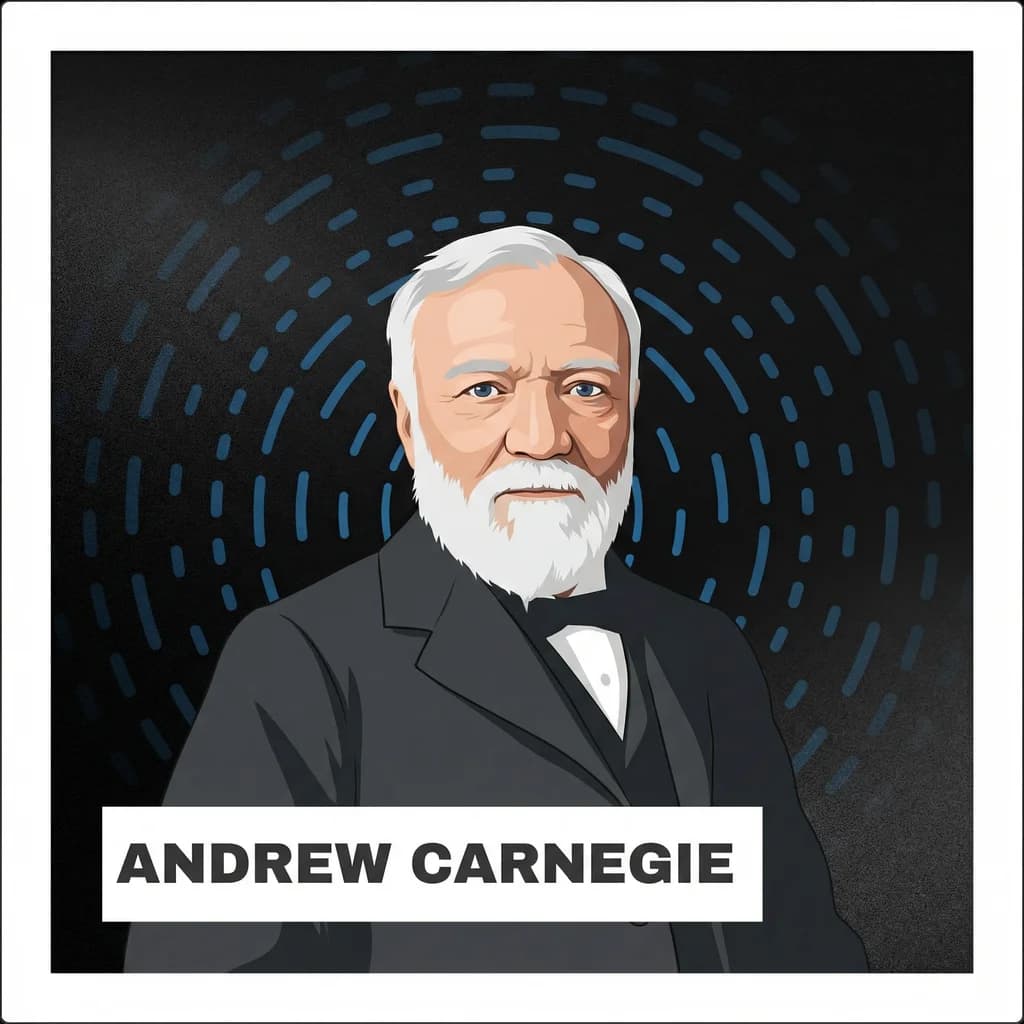
The story has been retold for a century, and it may be more legend than record. Sometime in 1919, an eighty-three-year-old man propped himself up in a sickbed inside a sixty-four-room mansion on Fifth Avenue and called for pen and paper. Andrew Carnegie — influenza-ravaged, white-bearded, his once-tireless body finally failing — began to write as though possessed. When he finished, he summoned James Bridge, his longtime personal secretary, and handed over the letter with an instruction that would have snapped Bridge upright: "Take this to Frick."
Henry Clay Frick. The name Carnegie had not spoken in two decades. The man he had trusted above all others to run Carnegie Steel, and then driven from the company in a rupture so total that neither man had forgiven it. The letter was conciliatory — Carnegie reasoned that both men were growing old, that past grievances were beneath their dignity. Surely it was time to meet and patch up the wounds they had inflicted upon each other. Bridge walked twenty blocks south on Fifth Avenue, from Carnegie's awe-inspiring palace across from Central Park to an even more imposing structure — the Frick mansion, which its owner had vowed would make Carnegie's place "look like a hovel."
Frick read the letter and glanced up. "Yes, you can tell Carnegie I'll meet him," he said finally, wadding the letter and tossing it back at Bridge. "Tell him I'll see him in hell, where we're both going."
Carnegie died on August 11, 1919. By then he had given away roughly $350 million — nearly all of his fortune — to libraries, universities, concert halls, peace organizations, and scientific institutions across three continents. He had, in the span of a single lifetime, crossed an ocean in steerage, worked as a bobbin boy for $1.20 a week, built the largest steel company on earth, sold it for $480 million, and then systematically distributed the proceeds to what he hoped was the permanent betterment of the human race. He had written the foundational text of modern philanthropy, befriended presidents and prime ministers, and crushed the unions of the very workers whose labor made his fortune possible. He was, depending on whom you asked, Saint Andrew or the most calculating hypocrite of the Gilded Age.
The question of which Carnegie was the real one — the boy who watched his father beg for work and vowed no one should have to, or the man who delegated wage cuts to a lieutenant while vacationing in Scotland — is not a question with an answer. It is the engine of the story. The contradiction was not a flaw in his character. It was his character.
By the Numbers
The Carnegie Empire
$480MSale price of Carnegie Steel to J.P. Morgan, 1901
$350M+Total philanthropic giving during his lifetime
2,509Free public libraries funded worldwide
$1.20/wkFirst wage as a bobbin boy, age 13
~25%Approximate share of U.S. steel output, c. 1900
$100B+Estimated fortune in today's dollars
26Organizations still bearing the Carnegie name
The Weaver's Son
The story begins, as so many American stories do, with the failure of a father. William Carnegie was a handloom weaver in Dunfermline, Scotland — an ancient town that had once served as Scotland's medieval capital and whose linen industry had long enjoyed a reputation for producing the finest damask in Great Britain. William owned three or four hand looms, operated one himself, and hired extra hands as trade required. His son Andrew was to follow him into the craft. But the Industrial Revolution had other plans. When steam-powered looms arrived in Dunfermline in 1847, hundreds of hand-loom weavers — William among them — became expendable overnight. The craft that had sustained the Carnegie family for generations was abolished in a season.
"I began to learn what poverty meant," Andrew would later write. "It was burnt into my heart then that my father had to beg for work. And then and there came the resolve that I would cure that when I got to be a man."
The Carnegies were not merely poor. They were political. William Carnegie and his brother-in-law Tom Morrison were leaders of the Chartist movement in Dunfermline — a radical working-class crusade that believed allowing the masses to vote and run for Parliament would seize government from the landed gentry. Tom was a prominent local agitator during the strikes of 1842. William published letters in radical magazines and presided over a local weavers' society. Family lore held that the Morrisons' radicalism had them barred from Pittencrieff, the laird's estate beside Dunfermline Abbey. Young Andrew absorbed democratic convictions with his mother's milk — convictions he would carry into the steel mills of Pittsburgh, the drawing rooms of New York, and the pages of the North American Review, though they would sit in increasingly uneasy coexistence with his accumulating fortune.
When Chartism fizzled in 1848, after Parliament rejected the movement's demands for the final time, the Carnegie family faced destitution. Andrew's mother Margaret — a woman of ferocious practicality who had already opened a small grocery shop in their cottage and taken in shoe-mending work — concluded there was no future in Scotland. She borrowed twenty pounds, auctioned the family's belongings (which did not cover the fare), and secured passage on a small sailing ship called the Wiscasset. The crossing from Glasgow took fifty days. There was no privacy, miserable food, and tightly squeezed bunks in the hold. Andrew, apparently one of the few passengers who did not suffer from seasickness, picked up jobs aboard ship — showing, even at twelve, the instinct to convert adverse circumstances into minor advantages.
They arrived in Allegheny City, just outside Pittsburgh, and moved into two rooms rented from Margaret's sister. They had escaped the poverty of Dunfermline only to find its American equivalent. But there were at least jobs. Andrew had five years of schooling behind him, total. He went to work.
From Darkness to Light
His first position, at thirteen, was as a bobbin boy in a cotton mill, where his father also worked, for $1.20 a week. He soon moved to a bobbin factory, where he fired the boiler and ran a small steam engine in the cellar — work that gave him nightmares. Within a year or so, Andrew found something better: a job as a messenger boy in a Pittsburgh telegraph office, at $2.50 per week. In his autobiography, Carnegie called this the transformation that saved his life: "My 'Good Fairy' found me in a cellar firing a boiler and a little steam engine and carried me into the bright and sunny office surrounded with newspapers, pencils, pens and paper, and ringing in the ears the miraculous tick, tick, tick, of the tamed lightning and doing the work of a man. I was the happiest boy alive, carried from darkness to light."
The telegraph office was Carnegie's real university. He memorized street names. He committed to memory the names and faces of every businessman to whom he delivered messages, then greeted them by name on the street to make an impression. He taught himself telegraphy and became one of the few operators in the country who could translate Morse code by ear rather than reading the tape — a skill that made him indispensable and conspicuous. By the time he was seventeen, he had come to the attention of a man who would redirect the trajectory of his life.
Thomas A. Scott — born in 1823 in Peters Township, Pennsylvania, the seventh of eleven children, orphaned by his father as a child, a man who had joined the Pennsylvania Railroad as a station agent in 1850 and risen to general superintendent by 1858 — was the superintendent of the railroad's western division and, by temperament and intellect, a builder of men as much as a builder of systems. Scott was notoriously secretive about his business dealings, conducting most of his affairs in private letters and instructing his partners to destroy them after reading. He was politically powerful and helped shape the modern corporation. In 1853, Scott hired Carnegie as his personal telegrapher and assistant for $35 a month. It was the most consequential hire either man would ever make.
Carnegie spent twelve years with the Pennsylvania Railroad, and in those years he absorbed the operating principles that would govern everything he built afterward. He learned how to run complex systems at scale. He learned the economics of capital-intensive industry — the relentless pressure to drive down costs, the importance of information flow, the power of infrastructure as competitive moat. He learned to keep the telegraph office open twenty-four hours a day. He learned to burn wrecked railroad cars to clear the tracks and get trains moving again. He learned that speed of decision, even at the cost of occasional error, mattered more than deliberation. When an informant tipped him off to an upcoming strike and handed him a list of labor organizers, Carnegie passed the intelligence to Scott, who fired them. The strike was broken before it began. He was twenty-one years old.
Scott and J. Edgar Thomson — the railroad's president, a quiet engineer who would lend his name to Carnegie's first steel mill — together showed Carnegie something more important than railroad operations. They showed him how to invest. In 1856 Scott offered him ten shares of Adams Express for $500, and Margaret Carnegie mortgaged the family house to raise the money. The first dividend check, for ten dollars, was a revelation. "I shall remember that check as long as I live," Carnegie wrote in his autobiography — it was his first income from capital rather than from the sweat of his brow. A couple of years later he borrowed $217.50 to buy into the Woodruff Sleeping Car Company; within a few years that stake was paying him more than his railroad salary.
That distinction — with its precise moral line between earned and unearned income, its instinctive understanding that capital generates capital in a way that labor never can — contains the entire paradox of Carnegie's life. The weaver's son who watched his father beg for work had discovered that money, properly deployed, could reproduce itself while its owner slept. This knowledge would never sit comfortably alongside his Chartist inheritance. But it would make him the richest man in the world.
The Education of a Speculator
By the Civil War, Carnegie was no longer just a railroad man. He was a speculator of widening ambition. When Scott was appointed assistant secretary of war in 1861, Carnegie went to Washington as his right-hand man, organizing military telegraph systems and supervising railroad repairs after secessionist mobs in Maryland destroyed the lines. He repaired telegraph wires personally, by hand, on the way to the capital. The war revealed to him, with the clarity of artillery fire, the vast industrial needs of a nation in conflict — and the fortunes available to those who could supply them.
Carnegie invested $11,000 in an oil company in Titusville, Pennsylvania, using returns from the sleeping car venture. He invested in iron mills, blast furnaces, and railroad equipment manufacturing. He formed the Keystone Bridge Company, betting that iron bridges would replace the wooden ones then spanning the nation's rivers and railroads. He was right. He and his partners — including Scott and Thomson, who invested under his wife's name to avoid the perception of conflict of interest — grew wealthy.
His father, William, who had never found work as a weaver in America, had tried to produce his own cloth, traveling as far as Cincinnati to peddle it, finding few buyers. William died in 1855, at fifty-one. Andrew was twenty years old and the only breadwinner in the family.
In 1865, Carnegie left the Pennsylvania Railroad. Two years later, he and his mother — the indomitable Margaret, who had pushed the family across an ocean and whose ambitions for her sons were bottomless — moved to the St. Nicholas Hotel in New York City, one of the most fashionable addresses in the country. There, Carnegie was introduced to the philosophy of Herbert Spencer, the English polymath whose doctrine of Social Darwinism — "survival of the fittest" — would give Carnegie an intellectual framework for the fortune he was about to build. Spencer's ideas allowed Carnegie to reconcile his democratic instincts with his capitalist appetites: inequality was not merely tolerable but necessary, a natural consequence of competition that, in the long run, advanced the species. It was a convenient philosophy for a man about to become very, very rich.
And yet — the complication that makes Carnegie Carnegie — he drew from Spencer conclusions that Spencer himself had not quite intended. Carnegie believed that among the disadvantaged one might find what he called "the epochmakers," because those who triumphed over adversity had to be possessed of extraordinary will and indomitable spirit. The fittest were not merely those who accumulated wealth but those who deployed it wisely. The rich man was not an end unto himself but a trustee — a temporary custodian of capital that belonged, in some moral sense, to the community that produced it.
It was an extraordinary intellectual construction. And Carnegie, who had watched his father destroyed by technological change and then profited enormously from the same forces of industrialization, needed it more than most.
The Cathedral of Cost
In 1872, Carnegie visited England and saw the future. British iron mills were converting to steel production using the Bessemer process — an innovation by Henry Bessemer that allowed, for the first time, the mass production of steel from pig iron. Carnegie recognized immediately what this meant. Steel would replace iron as the structural material of civilization. Bridges, railroads, buildings — all of it would be steel. He was thirty-six years old, and the early retirement he had once mused about in a private memo was forgotten.
He returned to Pittsburgh and, in 1875, opened his first steel mill — the J. Edgar Thomson Steel Works, in Braddock, Pennsylvania, named after his old patron at the railroad (a gesture that was simultaneously an act of gratitude and a shrewd commercial calculation, since Thomson controlled the purchasing decisions of the nation's most important railroad). The Bessemer process was already in use in the United States, but Thomson was built from the ground up around it, at a scale no American mill had attempted.
What followed over the next two decades was one of the most relentless campaigns of cost reduction and vertical integration in the history of American industry. Carnegie did not merely make steel. He owned the iron mines that supplied the ore. He owned the coke fields that fueled the furnaces. He owned the railroads and river barges that transported the raw materials and finished products. He owned the ships. He controlled every step from extraction to delivery, and at each step he wrung out cost without letup.
His mills were chaos and grandeur in equal measure. "Wild shouts resounded amid the rumbling of an overhead train," McClure's Magazine reported of the Homestead mill in 1894. "On every side tumultuous action seemed to make every inch of ground dangerous. Savage little engines went rattling about among the piles of great beams." Flames, noise, and danger ruled the Carnegie mills. "Protective gear" consisted of two layers of wool long-johns. Fatal accidents were common. Wives and children dreaded the sound of factory whistles that meant an accident had occurred. "They wipe a man out here every little while," a worker said in 1893. "Sometimes a chain breaks, and a ladle tips over, and the iron explodes."
Carnegie did not spend much time in the mills. He did not need to. He had mastered the art of management at a distance — a skill he had learned from Thomson at the Pennsylvania Railroad and refined into a governing philosophy. He demanded detailed cost reports. He compared the performance of every furnace, every mill, every shift, against every other. He pitted his managers against one another. And when technology improved, he ordered existing equipment torn out and replaced, regardless of how recently it had been installed. He quickly recouped these investments through reduced labor costs. His mills remained always the most productive in the world.
In 1892, his holdings were consolidated into the Carnegie Steel Company, capitalized at $25 million. The United States had by then overtaken Britain as the world's largest steel producer, and Carnegie's company was its dominant force; by the end of the decade it was producing roughly a quarter of all American steel. Its headquarters would soon occupy the Carnegie Building, one of downtown Pittsburgh's first steel-frame skyscrapers.
Hard! I guess it's hard. I lost forty pounds the first three months I came into this business. It sweats the life out of a man.
The workers who made this empire possible labored twelve-hour shifts, seven days a week, for a weekly wage of about $10. Days off were reportedly limited to one or two holidays a year. "We stop only the time it takes to oil the engine," said one plate-mill worker, "a stop of three to five minutes. While they are oiling they eat." The contrast between the palace of the millionaire and the cottage of the laborer, as Carnegie himself would write in another context, measured the change which had come with civilization.
The Perfect Partnership
Carnegie needed a man to run the mills. He found Henry Clay Frick.
Frick was Carnegie's dark complement — born in 1849, fourteen years younger, raised on a farm in West Overton, Pennsylvania, with none of Carnegie's immigrant pathos but all of his ferocity. Where Carnegie charmed, Frick intimidated. Where Carnegie philosophized, Frick calculated. Where Carnegie fled to Scotland for six months of the year to golf, fish, and cultivate his image as a benevolent friend of the working man, Frick stayed in Pittsburgh and did the ugly work. "You see that his head is there, placed on that body for his triumph and your defeat," a contemporary observed of Frick. He had built the Frick Coke Company into the dominant producer in the region by the time he was thirty, controlling the fuel supply essential to every steel furnace in western Pennsylvania. Carnegie, recognizing both the strategic value of Frick's coke and the operational genius of the man himself, brought him into the fold in 1881.
Their partnership was, for a time, astonishing in its productivity. Carnegie was the visionary, the strategist, the public face. Carnegie set the grand objectives; Frick executed them with merciless efficiency. Frick centralized the management structure across all of Carnegie's scattered mills and furnaces. He integrated the productive units into a single, coordinated organism. Under Frick's operational command and Carnegie's strategic direction, Carnegie Steel became not merely the largest steel company in the world but a prototype of the modern industrial corporation — a machine for converting raw materials into profit at a scale and speed that had no precedent.
The arrangement had a design flaw. Carnegie wanted two irreconcilable things: to be the benevolent friend of working people and to pay them as little as possible. He resolved this contradiction by delegating the dirty work to Frick while positioning himself as the voice of enlightened capitalism. Frick understood the arrangement. He accepted it, for a time. But the dynamic ensured that any crisis severe enough to expose the fiction would destroy the partnership along with it.
The crisis arrived at Homestead.
Blood on the Monongahela
The Homestead Steel Works, which Carnegie had purchased from a rival group in 1883, sat along the Monongahela River in the borough of Homestead, Pennsylvania. By 1892, it was one of the most productive steel plants in the world. Its workers were represented by the Amalgamated Association of Iron and Steel Workers — one of the most powerful unions in the country and one of the few that had survived the wave of union-breaking that had swept American industry in the 1880s.
On July 1, 1892, the union's contract with Carnegie Steel was set to expire. Frick — acting, he maintained, with Carnegie's approval — cut wages in what appeared to be a deliberate provocation of organized labor. When the workers rejected the terms, Frick fired all 3,800 of them, built a fence around the plant topped with barbed wire and lined with watchtowers that workers called "Fort Frick," and hired 300 Pinkerton agents to defend it.
Carnegie was in Scotland. He had gone to great pains to portray himself as labor's ally, publishing essays and giving speeches about the dignity of workers and the rights of men to organize. "The right of the working-men to combine and to form trade-unions is no less sacred than the right of the manufacturer to enter into associations and conferences with his fellows," he had written. But he had also told Frick, before departing for his Scottish holiday, to hold the line on wages.
The Pinkerton agents arrived by armed barges on the river early on the morning of July 6. The striking workers were waiting. A battle ensued that lasted an entire day — gunfire across the water, dynamite, burning oil poured onto the barges. At least three Pinkerton agents and seven workers were killed. Dozens more were wounded. Union members occupied the plant until July 12, when the Pennsylvania state militia arrived and ousted them. Union leaders were jailed. Management rebuilt the workforce with strikebreakers. Wages were cut. Hours stayed the same.
Two weeks after the battle, a young anarchist named Alexander Berkman — a Russian-born immigrant who saw the violence as a call to action — walked into Frick's office and shot him twice, then stabbed him. Frick survived. He finished his business that day before leaving the office.
Carnegie, from Scotland, was furious — though what exactly he was furious about has been debated for more than a century. His public statements expressed dismay at the violence. His private communications suggest frustration that Frick had allowed the situation to escalate so visibly. The distinction matters. Carnegie did not object to breaking the union. He objected to being seen breaking it.
Homestead destroyed Carnegie's carefully cultivated reputation as a friend of labor. It stuck to him for the rest of his life, a stain no amount of library-building could fully remove. And it planted the seed of the rupture with Frick that would, within a decade, shatter their partnership entirely.
The Fracture
The break, when it came, was total. By the late 1890s, Carnegie and Frick were at war over the valuation of Frick's coke company, which Carnegie believed was charging Carnegie Steel above-market prices. The details of the financial dispute are intricate and not especially illuminating. What matters is the animating dynamic: Carnegie, who owned the majority of Carnegie Steel, could dictate terms to his partners. He used this power to force Frick out of the chairmanship in 1899, offering to buy back Frick's shares at what Frick considered an insultingly low valuation.
Frick refused and sued. The case was settled out of court in 1900 on terms that valued Frick's stake far above Carnegie's offer and forced a reorganization of the company. It was a victory, but it was also a severance. The two men never spoke again. In their final years they lived about twenty blocks apart on Fifth Avenue, patrons of the same city, giants of the same era, united by wealth and industry and mutual contempt.
Frick's revenge was meticulous and spatial. He purchased a parcel of land in downtown Pittsburgh adjacent to Carnegie's office building and erected a skyscraper — taller, grander, and, by long-standing Pittsburgh legend, designed to cast Carnegie's headquarters in shadow. Later, he built the Fifth Avenue mansion that would dwarf Carnegie's own palace up the street. Where Carnegie spent his fortune on libraries and peace conferences, Frick spent his on art — assembling one of the finest private collections in the world, which he bequeathed to the public as a museum. The Frick Collection remains, to this day, one of the glories of New York, a monument to refined taste funded by the profits of industrial brutality.
Carnegie and Frick represent, as Les Standiford observed in
Meet You in Hell, "the American ethos of limitless possibility. Both men were born to poverty and both became wealthy and powerful beyond imagining." The impact of their steelmaking enterprise on the economy at the end of the nineteenth century was as profound, the argument goes, as the impact of the American Revolution had been on the country's politics a century before. And the rupture of their once "perfect partnership" illuminated the contradictions embedded in capitalism and the Protestant ethic — contradictions that Carnegie had tried to philosophize away and that Frick had never bothered to disguise.
The Gospel
In June 1889 — three years before Homestead, while his partnership with Frick was still intact, while his mills were generating fortunes and his workers were laboring twelve-hour shifts for ten dollars a week — Andrew Carnegie published an essay in the North American Review titled simply "Wealth." It would later become known as "The Gospel of Wealth," and it remains, more than 135 years later, the foundational document of American philanthropy.
The argument was radical in its clarity. "The problem of our age," Carnegie wrote, "is the proper administration of wealth, so that the ties of brotherhood may still bind together the rich and poor in harmonious relationship." He accepted the reality of inequality as a necessary byproduct of competition and progress. He accepted the concentration of wealth in the hands of the few. But he insisted that the man who accumulates a great fortune has a moral obligation — not merely a charitable impulse but a binding duty — to distribute that fortune during his lifetime for the benefit of the community.
The man who dies thus rich dies disgraced.
Carnegie's prescription was specific. The wealthy man should live modestly, provide for his family's legitimate wants, and then treat all surplus revenue as "trust funds, which he is strictly bound as a matter of duty, to administer in the manner which in his judgment is best calculated to produce the most beneficial results for the community." The rich man was to be a trustee for his poorer brethren, bringing to their service his "superior wisdom, experience, and ability to administer." Carnegie was explicit that he distrusted indiscriminate charity: "It were better for mankind that the millions of the rich were thrown into the sea than so spent as to encourage the slothful, the drunken, the unworthy." The philanthropist's duty was to help those who help themselves — "to provide part of the means by which those who desire to improve may do so; to give to those who desire to rise the aids by which they may rise."
The essay contained within it both Carnegie's greatest insight and his most revealing blind spot. The insight: that wealth accumulated through the machinery of industrial capitalism created an obligation that extended beyond the individual and his heirs, that a fortune was in some sense the property of the society that produced it. The blind spot: that the same man who cut his workers' wages and broke their unions considered himself uniquely qualified, by virtue of his "superior wisdom," to determine how the proceeds of their labor should be spent. Carnegie saw no contradiction here. Or rather, he saw the contradiction and attempted to resolve it through philosophy. The workers could not be trusted with higher wages — they would waste them. But Carnegie, who had risen from their ranks, could be trusted with their surplus — he would invest it in libraries.
His friend
Mark Twain called him "St. Andrew." William Gladstone praised the essay and helped bring it to a British audience. More than a century later,
Warren Buffett and
Bill Gates would be counted among its heirs. The phrase "the man who dies rich dies disgraced" entered the permanent lexicon of American capitalism. And yet there was something maddening about the formulation — a circularity that Carnegie's admirers rarely acknowledged. The Gospel of Wealth argued that inequality was both inevitable and desirable, that the rich man's moral duty was to redistribute his fortune wisely, and that the rich man himself was the only person qualified to determine what "wisely" meant. It was a closed system. The poor had no voice in it.
The Library Builder
Carnegie's philanthropic career had begun in the 1870s, with modest gifts to his hometown of Dunfermline — including public baths and, in the early 1880s, the town's first free library. But the library program, once Carnegie committed to it fully, became something unprecedented in scale and ambition.
The origin of his obsession was specific and personal. As a young messenger boy in Allegheny City, Carnegie had spent most of his evenings at the private library of Colonel James Anderson — a prosperous local businessman who opened his personal library to working boys free of charge every Saturday. Anderson was not a famous man. He was not rich by the standards of the industrialists Carnegie would later join. But he gave Carnegie access to knowledge at the precise moment when knowledge could change a life, and Carnegie never forgot it.
"It was from my own early experience that I decided there was no use to which money could be applied so productive of good to boys and girls who have good within them and ability and ambition to develop it, as the founding of a public library," Carnegie would write. The logic was characteristically precise: not charity for its own sake, not relief for the suffering, but investment in the infrastructure of self-improvement. Libraries were the perfect Carnegie institution — they helped those who helped themselves.
He funded 2,509 libraries in the English-speaking world: 1,689 in the United States, 660 in Great Britain, 125 in Canada. The total expenditure exceeded $56 million. But Carnegie attached a condition that revealed both his business instincts and his philosophy: he would pay for the buildings, and only the buildings. Local communities had to demonstrate credible plans for acquiring books, hiring staff, and maintaining the institutions with public funds. This was not merely fiscal prudence. It was ideology. Carnegie believed that a gift fully given created dependency; a gift that required matching effort created partnership. The library would belong to the community, not to Carnegie. His name might be on the building, but the books — and the obligation to keep them coming — belonged to the town.
The Carnegie libraries were, in many towns, the most beautiful buildings for miles — beaux arts palaces in communities that had never had a public building of any consequence. The Carnegie Library in Washington, D.C., opened in 1903, built with Carnegie's money; inscribed above the doorway were the words Science, Poetry, History. It was open to women, children, and all races. African Americans remembered it as one of the only places downtown where they could use the bathrooms. During the Depression, people called it "the intellectual breadline" — no one had any money, so you went there to feed your brain.
The Architecture of Giving
The libraries were only the most visible expression of a philanthropic program that, in its totality, amounted to one of the most systematic redistributions of private wealth up to that time. Carnegie funded more than 7,000 church organs — he was not religious himself, but he adored the hymnody of his Scottish youth. He established the Carnegie Institute of Technology in Pittsburgh (now Carnegie Mellon University) in 1900. He endowed the Carnegie Institution of Washington in 1902 for scientific research. He built Carnegie Hall in New York. He created the Carnegie Foundation for the Advancement of Teaching in 1905, with an initial endowment of $10 million, after discovering as a trustee of Cornell University that professors were paid so poorly they could not save for retirement. He founded the Carnegie Endowment for International Peace in 1910, with another $10 million, and the Carnegie Corporation of New York in 1911, his capstone institution, charged with the broadest possible mandate: to do "real and permanent good in this world."
He funded the construction of the Peace Palace at The Hague. He created the Carnegie Dunfermline Trust with a substantial endowment to benefit the people of his birthplace. He established hero funds — organizations that rewarded acts of civilian bravery — in the United States and across Europe. The list goes on, and on, with a cumulative force that overwhelms attempts to dismiss it as mere reputation-laundering. Carnegie gave away more than ninety percent of his fortune. He did it deliberately, systematically, and with an intellectual framework that survived his death by more than a century.
And he did it while the workers of the Homestead mill still labored twelve-hour shifts. While the Amalgamated Association of Iron and Steel Workers lay broken. While the wages his employees earned would not support their families without the labor of their wives and children.
The Price of Peace
In retirement, Carnegie threw himself into the cause of international peace with the same intensity he had once brought to the steel business. He was, by his own account, a utopian — but a utopian backed by virtually unlimited capital. He believed that war was backward, barbaric, outmoded, and that arbitration between nations could replace armed conflict. He read Herbert Spencer with the fervor of a convert and concluded that human evolution was trending, inevitably, toward the extinction of war. All that was needed was for men of vision to hasten the process.
He built institutions. He held conferences. He published articles and pamphlets. He cultivated relationships with presidents —
Theodore Roosevelt, William Howard Taft, Woodrow Wilson — in the hope that American leadership could broker a lasting peace among the European powers. Roosevelt held Carnegie in private contempt, feigning friendship while ridiculing his pacifism behind closed doors. As biographer David Nasaw recounts, Carnegie pressed Roosevelt to use his influence with Kaiser Wilhelm II on behalf of peace; Roosevelt agreed to carry the message but did little with it. Taft was more sympathetic but no more effective; the Senate gutted his arbitration treaties. Carnegie refused to give up. He had succeeded at everything he had put his mind to. Why not international diplomacy?
The answer arrived on August 4, 1914. Carnegie had been writing his memoirs at Aultnagar, a bungalow on the Scottish moors, when word came that the Great War had begun. He and his wife Louise returned immediately to Skibo Castle to be closer to the news. The memoirs stopped that day and were never resumed. "Henceforth he was never able to interest himself in private affairs," his wife would later write. "Many times he made the attempt to continue writing, but found it useless."
The war destroyed something in Carnegie that age and illness had not yet reached. His biographers describe it as a broken heart. The optimist who had believed in progress as an iron law of nature watched the most civilized nations on earth consume a generation of their young men in trench warfare. The peace institutions he had funded, the arbitration treaties he had championed, the conferences and pamphlets and personal diplomacy — none of it mattered. A severe attack of influenza followed by two serious bouts of pneumonia precipitated old age upon him virtually overnight. The man who had been golfing, fishing, and swimming daily — sometimes all three in a single day — became an invalid.
The Burden of Old Age
Carnegie bore it well, by all accounts. "Always patient, considerate, cheerful, grateful for any little pleasure or service, never thinking of himself, but always of the dawning of the better day, his spirit ever shone brighter and brighter," his wife wrote. On the fly-leaf of his unfinished manuscript, he had written: "It is probable that material for a small volume might be collected from these memoirs which the public would care to read, and that a private and larger volume might please my relatives and friends. Much I have written from time to time may, I think, wisely be omitted. Whoever arranges these notes should be careful not to burden the public with too much."
Even in this — the instruction to an editor about how much of himself to reveal — Carnegie was performing the calculation that defined his life: how much is too much? How much can the public absorb? How much of the truth serves the cause, and how much undermines it?
By the end, the giving had nearly caught up with the fortune. Of the roughly $225 million he took from the sale of Carnegie Steel, and the income it threw off, he had given away some $350 million. About $30 million remained, and his will sent most of it to the Carnegie Corporation. The man who had written that dying rich was a disgrace very nearly avoided it.
He died on August 11, 1919, at his summer home in Lenox, Massachusetts. He was eighty-three. The obituaries began, almost without exception, with the bobbin boy — exactly the story Carnegie would have wanted told.
And somewhere on Fifth Avenue, twenty blocks south, Henry Clay Frick — still a director of U.S. Steel, still inhabiting the mansion meant to make Carnegie's look like a hovel — received the news. He died four months later, on December 2, 1919.