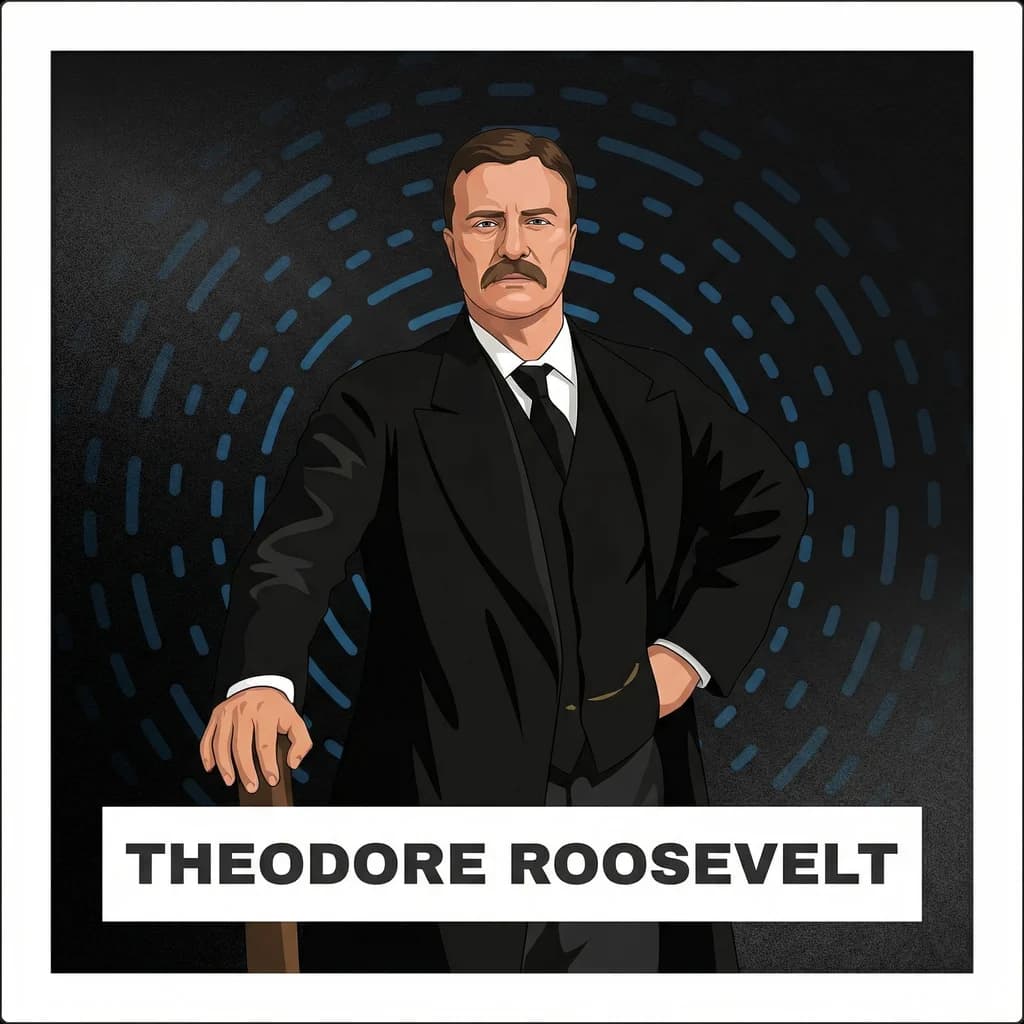
The Light in the Room Went Out
On the afternoon of February 14, 1884 — Valentine's Day — a twenty-five-year-old New York State Assemblyman named Theodore Roosevelt received a telegram in Albany summoning him home. His wife, Alice Hathaway Lee, had given birth to their first child two days earlier. But the telegram was not a celebration. It was a warning. He boarded a train through fog so thick the locomotive crawled, arriving at the four-story brownstone on West 57th Street in Manhattan close to midnight. His brother Elliott met him at the door with four words: "There is a curse on this house."
Upstairs, Roosevelt's mother, Martha "Mittie" Bulloch Roosevelt — a Georgia plantation belle of legendary wit, forty-eight years old, still beautiful — was dying of typhoid fever. She died at three in the morning. Eleven hours later, in a bedroom one floor above, Alice Lee Roosevelt, twenty-two, the radiant girl he had courted with such frantic persistence at Harvard that his friends thought him unhinged, died of Bright's disease, a kidney ailment that had been masked by her pregnancy. The baby girl, also named Alice, had been placed in the arms of Roosevelt's older sister Anna. Roosevelt held his dying wife. She could barely recognize him. In his diary that night he drew a large black X and beneath it wrote a single sentence: "The light has gone out of my life."
Two women, the same house, the same day. The coincidence was so operatic, so grotesquely symmetrical, that it might have destroyed a lesser will entirely. What it did to Theodore Roosevelt was something stranger and more consequential: it cracked him open, and from the fissure emerged something that looked, to the rest of the world, like inexhaustible force. Within weeks he had handed his infant daughter to Anna, finished the legislative session, and fled — not to a parlor or a sanatorium but to the badlands of the Dakota Territory, where he bought two cattle ranches outside the flyspeck town of Medora and began, at twenty-five, to rebuild himself from raw materials: wind, leather, horseback, loneliness, and a physical landscape so barren it seemed to mirror the blankness he carried inside. He would later refuse to speak Alice's name, even to his own daughter. He would never mention her in his autobiography. The erasure was total, deliberate, and, in its way, a kind of founding act — the moment when the frail, asthmatic, grief-stricken young aristocrat chose to become something else entirely, something that the nation would recognize, love, fear, mock, and finally carve into a mountain.
This is a profile of that becoming.
By the Numbers
Theodore Roosevelt
42Age upon becoming president — youngest in U.S. history
194MAcres of public land set aside for conservation
43Antitrust suits initiated during his presidency
~30Books authored over his lifetime
1906Year he became the first American to win any Nobel Prize
$60KInheritance from his father (~$1.3M in today's dollars)
6Children raised across two marriages
The Body as Argument
To understand Roosevelt, you must begin with his lungs. Or rather, with the absence of reliable breath. Born on October 27, 1858, the second of four children in a socially prominent New York family of Dutch and English ancestry, Theodore — "Teedie" to the household — suffered from asthma so severe that his parents would bundle him into a carriage at night and race through the streets of Manhattan, the rushing air the only thing that could open his constricted airways. His father, Theodore Sr., a noted businessman, philanthropist, and civic reformer whom the boy would later call "the best man I ever knew," issued a challenge that sounds apocryphal but was, by all accounts, utterly sincere: "Theodore, you have the mind but you have not the body, and without the help of the body the mind cannot go as far as it should. You must make your body." The boy, who by this point was already devouring books far beyond his age, reading about explorers and naturalists and warriors, accepted the charge with a literalism that would define his entire approach to the world. He lifted weights. He boxed. He hiked. He wrestled. He did not merely exercise; he waged a campaign against his own constitution, as though frailty were a political enemy that could be defeated through sheer exertion of will.
This was not metaphor to him. The weak eyesight that plagued him throughout his life, the asthma that never fully relented — these were not conditions to be managed but adversaries to be overcome. And the philosophy he extracted from the struggle, which he would articulate with increasing confidence as a writer, politician, and president, was startlingly direct: the strenuous life was not one option among many. It was the only moral option. Ease was corruption. Comfort was decay. The individual and the nation were, in Roosevelt's cosmology, subject to the same iron law.
"I wish to preach, not the doctrine of ignoble ease, but the doctrine of the strenuous life," he told an audience in Chicago on April 10, 1899, "the life of toil and effort, of labor and strife; to preach that highest form of success which comes, not to the man who desires mere easy peace, but to the man who does not shrink from danger, from hardship, or from bitter toil, and who out of these wins the splendid ultimate triumph."
There is something almost frightening in the intensity. The speech was delivered by a man who had already been a state assemblyman, a rancher, a published author, a Civil Service commissioner, a New York City police commissioner, an assistant secretary of the Navy, and a war hero — and who was, at forty, just getting started.
The Aristocrat in the Dust
The Dakota years — 1884 to 1886, roughly — were the crucible. Roosevelt arrived in the badlands as a bespectacled Harvard man in custom-buckskin, an easy target for ridicule among the cowboys and drifters who populated Medora. He was twenty-five and freshly destroyed. He had acquired the Maltese Cross and Elkhorn ranches and threw himself into the work with the same lunatic thoroughness he brought to everything: roping cattle, riding all day in sub-zero weather, chasing horse thieves, sleeping on the ground. The residents were wary of him. He endeared himself by keeping up.
What happened in those years was less a reinvention than a graft — the careful welding of the frontier mythos onto the frame of an Eastern patrician. Roosevelt was not the first wealthy New Yorker to play cowboy, but he may have been the first to actually believe it, to internalize the experience so thoroughly that it became inseparable from his identity. He wrote three books about his time in the West —
Hunting Trips of a Ranchman (1885),
Ranch Life and the Hunting Trail (1888),
The Wilderness Hunter (1893) — and in them you can watch the transformation happen on the page, the syntax tightening, the sensibility roughening. The prose is a record of a man teaching himself to be someone new.
"Had it not been for the years spent in North Dakota and what I learned there," he told a crowd in Fargo years later, "I would not have been President of the United States."
This is almost certainly true, and not only because the West toughened him physically. It taught him something about class — or rather, about the permeability of class in a democracy. For the first time in his life, the scion of one of New York's oldest families mixed regularly with common folk: ranch hands, miners, drifters, men whose hands were calloused and whose educations ended early. The experience humbled him, and the humility was genuine, even if the frontier persona it produced was, like all personae, partly a performance. Roosevelt returned East carrying two things he hadn't possessed before: a body that could endure nearly anything and an instinct for the democratic theater that would, eventually, revolutionize the presidency itself.
The ranching venture ended badly. Devastating blizzards in the winter of 1886–87 wiped out most of his cattle herd. Roosevelt lost much of his investment and was forced back to New York year-round. But during a trip home from Dakota, he encountered an old friend and childhood sweetheart: Edith Kermit Carow. They married on December 2, 1886, in London — a quiet ceremony, an ocean away from the memories of Alice Lee. Together they would raise six children at Sagamore Hill, the estate near Oyster Bay, Long Island, that Roosevelt had begun building during his first marriage and that would become, in the public imagination, the physical emblem of his restless domesticity: a house full of books and taxidermy and children and noise, presided over by a man who could not sit still.
The Machinery of Ascent
The speed of Roosevelt's political rise is dizzying even in retrospect, and it's worth noting that each rung on the ladder was, in its way, an act of defiance against the people who put him there.
Elected to the New York State Assembly at twenty-three, he immediately attacked the Republican machine — the very apparatus that had enabled his candidacy. As a member of the U.S. Civil Service Commission from 1889 to 1895, he went after patronage with such relentless zeal that both parties wished he would stop. As president of the New York City Board of Police Commissioners starting in 1895, he prowled the streets at night to catch officers derelict in their duties — a habit that was excellent publicity and terrible politics. He hired women for executive positions in the department, decades ahead of his time.
Each of these positions was, on its face, minor. What Roosevelt did was treat them as major. He brought to a police commissioner's desk the same moral intensity he would later bring to the presidency — not because the stakes were equivalent, but because his operating philosophy admitted no distinction between large fights and small ones. Every job was a bully pulpit. Every appointment was an opportunity to reform.
When William McKinley appointed him assistant secretary of the Navy in 1897, Roosevelt found his natural habitat: a vast, bureaucratic institution with global implications and a chief who was disinclined to supervise closely. Roosevelt agitated for war with Spain with such flagrant enthusiasm that he made his superiors uncomfortable. He expanded the Navy. He positioned ships. He planned for contingencies that his boss, Secretary John D. Long, would have preferred to ignore. And when war came, in April 1898, Roosevelt did something that even his admirers found astonishing: he resigned his comfortable Washington post and went to fight.
Rough Walkers
The legend of the Rough Riders is one of the most durable myths in American political history, and like most durable myths it is roughly forty percent true.
The 1st Volunteer Cavalry was Roosevelt's creation — recruited, organized, and publicized with the same manic energy he brought to everything. Its membership was deliberately theatrical: cowboys and miners from the Southwest, Ivy League athletes, law enforcement officials, Native Americans, a handful of polo players. Colonel Leonard Wood, who had resigned as White House physician to command the regiment, was technically in charge. Roosevelt, as lieutenant colonel, was the star.
The unit shipped to Tampa, Florida — over a thousand men and an even larger number of horses and mules — but miscues, disease, and logistical chaos reduced their numbers drastically before they even embarked for Cuba aboard the steamship Yucatan. Most critically, the horses and mules were left behind. The cavalry became infantry. The Rough Riders became, as one historian put it, the Rough Walkers — cavalrymen accustomed to carrying supplies on horseback now slogging through Cuban jungle in killing heat and humidity, laden with weapons and ammunition and inadequate food.
The famous charge up San Juan Heights on July 1, 1898, was conducted on foot, not horseback. Roosevelt led men up Kettle Hill — a subsidiary position — under heavy fire, then charged across a valley to assist in the seizure of San Juan Ridge. It was brave and reckless and magnificently publicized, and it made Roosevelt the most famous man in America overnight. He was, the newspapers agreed, the biggest national hero to come out of the Spanish-American War.
But the Rough Riders' real enemy was not Spanish bullets. It was mosquitoes. Malaria and yellow fever swept through both armies with an impartiality that mocked the carefully staged heroics of the battlefield. By some accounts, more than 16,000 Spanish troops had already been incapacitated by disease before the first American shot was fired. Roosevelt's men suffered terribly in the aftermath of the battle — not from enemy action but from tropical disease, compounded by the brutal conditions of a campaign fought without adequate supply lines.
None of this diminished the legend. If anything, the suffering enhanced it. And the legend was precisely what the Republican bosses of New York needed: a war hero to run for governor and distract voters from the corruption scandals engulfing the state.
Kicked Upstairs
Thomas C. Platt was the Republican boss of New York — a creature of the Gilded Age machine, shrewd, cynical, and deeply allergic to reform. He tapped Roosevelt for the gubernatorial nomination in 1898 despite his misgivings, because a war hero on the ticket was worth the risk. Roosevelt won and promptly became the nightmare Platt had feared: an energetic reformer who removed corrupt officials and pushed legislation to regulate corporations and the civil service.
Platt's solution was elegant in its malice. He conspired to get Roosevelt nominated for the vice presidency in 1900, pairing him with the incumbent McKinley on the national ticket. The vice presidency was, at the turn of the century, a gilded coffin — a largely ceremonial office that had destroyed more political careers than it had advanced. Platt was betting that it would neutralize Roosevelt. McKinley's campaign manager, Senator Mark Hanna, was less sanguine. "Don't any of you realize," Hanna reportedly warned his fellow Republicans, "that there's only one life between this madman and the White House?"
Roosevelt campaigned for McKinley with characteristic fury. "Tis Teddy alone that's running," one observer quipped, "an' he ain't a runnin', he's a gallopin'." McKinley won easily. Roosevelt chafed in his powerless new office for exactly six months.
On September 6, 1901, while Roosevelt was hiking in the Adirondacks, President McKinley was shot at the Pan-American Exposition in Buffalo, New York, by Leon Czolgosz, an anarchist. McKinley lingered for eight days. Roosevelt rushed to Buffalo — another desperate train journey echoing the one seventeen years earlier, when he had raced to reach his dying father and arrived hours too late. This time, the result was inverted. He arrived not too late to save a life but just in time to inherit an office. On September 14, 1901, six weeks before his forty-third birthday, Theodore Roosevelt took the oath of office and became the twenty-sixth president of the United States.
He was the youngest person ever to hold the job. Mark Hanna's nightmare had come to pass.
I believe in a strong executive; I believe in power. While President, I have been President, emphatically; I have used every ounce of power there was in the office.… I do not believe that any President ever had as thoroughly good a time as I have had, or has ever enjoyed himself as much.
The Bully Pulpit
Roosevelt's transformation of the presidency was not primarily legislative. It was atmospheric. He changed what the office felt like — how it sounded, how it moved, how it occupied space in the national imagination.
He renamed the executive mansion the White House. He threw open its doors to cowboys, prizefighters, explorers, writers, and artists — a deliberate democratization of access that doubled as brilliant publicity. His young children romped on the lawn while he led ambassadors on grueling hikes through Rock Creek Park. His daughter Alice's wedding to Representative Nicholas Longworth of Ohio in 1905 became the social event of the decade. His refusal to shoot a bear cub on a 1902 hunting trip inspired a toy maker to create the teddy bear, and the resulting fad swept the nation — a piece of accidental branding so perfect that no modern PR firm could have engineered it.
But the theatrical brilliance served a serious purpose. Roosevelt understood, earlier and more intuitively than any of his predecessors, that the presidency's greatest power was not constitutional but communicative. He called it the "bully pulpit" — a phrase he coined — and he used it to speak directly to the American people, bypassing Congress, bypassing the party apparatus, bypassing the career politicians who had always served as intermediaries between the executive and the electorate. He was, the Miller Center notes, "the first to use the media to appeal directly to the people."
This was not merely a stylistic innovation. It was a structural one. From the Civil War to the turn of the twentieth century, the seat of real power in the federal government had resided in Congress. Roosevelt reversed the polarity. The president, not the legislature, became the center of the American political arena — and he did it not through a formal expansion of constitutional authority but through sheer force of personality, amplified by a press corps that found him irresistible and a public that adored the spectacle.
He appointed young, college-educated men to administrative positions. He was cautious where caution served him and bold where boldness could not be avoided. He understood that he had become president by accident, and he wanted, above all, to be elected in his own right in 1904. The combination of theatrical populism and tactical prudence was potent. It would define not just his presidency but the modern presidency itself.
Trust-Buster
The first real test came in 1902, when Roosevelt resurrected the nearly defunct Sherman Antitrust Act by filing suit against the Northern Securities Company — a colossal railroad conglomerate created by a syndicate of industrialists and financiers led by
J.P. Morgan. The suit sent shockwaves through the business community. No Republican president had ever challenged the titans of industry so directly. Morgan, accustomed to treating presidents as subordinates, reportedly sent an emissary to the White House to ask whether Roosevelt intended to attack his other interests. Roosevelt's attorney general replied that they would if they had violated the law.
The Supreme Court ruled in the government's favor in 1904, ordering the company dissolved. Over the next seven years, Roosevelt's administration would initiate antitrust suits against forty-three major corporations. The trust-busting campaign was never as radical as its critics feared or its admirers hoped — Roosevelt did not oppose bigness per se, only what he considered abuses of power — but it established a principle that had been theoretical since the Sherman Act's passage in 1890: the federal government could, and would, constrain the excesses of industrial capitalism.
The coal strike of 1902 revealed a different dimension of the same instinct. When anthracite miners in Pennsylvania walked off the job, threatening to cut off heating fuel for homes, schools, and hospitals as winter approached, Roosevelt did something no president had done before: he publicly intervened in a labor dispute, at least implicitly on the side of workers. He summoned both sides to the White House. He talked about calling in the army to run the mines. He got Wall Street investment houses to threaten to withhold credit from the coal companies and dump their stock.
In a private letter to his friend Robert Bacon, Roosevelt revealed the depth of his fury at the mine operators: "At the conference between the miners and the coal operators in my presence John Mitchell towered above the six operators present. He was dignified and moderate and straightforward. He made no threats and resorted to no abuse. The proposition he made seemed to me eminently fair. The operators refused even to consider it; used insolent and abusive language about him."
The combination of tactics — public theater, private pressure, the implicit threat of government force — worked. The strike ended. The miners got a modest pay raise. And Roosevelt had a slogan: the "Square Deal," which he described as striving for fairness between capital and labor. It became his campaign platform for the 1904 election, in which he crushed the Democrat Alton B. Parker by 336 to 140 electoral votes.
If when the severe weather comes on there is a coal famine I dread to think of the suffering, in parts of our great cities especially, and I fear there will be fuel riots of as bad a type as any bread riots we have ever seen.
The Conservation President
Roosevelt's boldest domestic legacy was not in antitrust or labor relations. It was in the dirt beneath his feet.
He set aside almost five times as much public land as all of his predecessors combined — 194 million acres, an area larger than the state of Texas. He created the Forest Service in 1905 and appointed Gifford Pinchot — a fellow conservationist and one of the first professionally trained foresters in America, a man who had studied silviculture at the French National School of Forestry in Nancy before returning to manage the Vanderbilt estate in North Carolina — to run it. He designated national forests, national monuments, and wildlife refuges with an aggressive use of executive authority that infuriated Western extractive industries and delighted the nascent conservation movement.
The impulse was rooted in the Dakota years. Roosevelt had witnessed the environmental devastation of the West firsthand — the depletion of game, the destruction of habitat, the relentless commercial exploitation of timber and minerals. He understood, as few of his contemporaries did, that the frontier was not infinite, that the wilderness could be consumed, and that its preservation was not a luxury but a national obligation. Theodore Roosevelt National Park in North Dakota and Theodore Roosevelt Island in Washington, D.C. — a ninety-one-acre wooded island in the Potomac River — were later named in his honor.
He also pushed through the Hepburn Act of 1906, which gave the Interstate Commerce Commission genuine regulatory power over railroad rates — creating, in effect, the federal government's first true regulatory agency. The Pure Food and Drug Act and the Meat Inspection Act, both passed the same year, established consumer protection standards that had been demanded by the "muckrakers" — the investigative journalists, Lincoln Steffens and Upton Sinclair chief among them, whose exposés of squalid industrial conditions had horrified the reading public. Roosevelt's relationship with the muckrakers was characteristically paradoxical: he appreciated their journalism, used their findings to advance his agenda, and then coined the very term "muckraker" as a mild rebuke, cautioning them against wallowing in exposure for its own sake.
Speak Softly
In foreign policy, Roosevelt was as theatrical as in domestic affairs, but the theater served a different function — not populist communication but strategic deterrence. "Speak softly and carry a big stick," he said, quoting an African proverb. The formulation was deceptively simple. It implied restraint backed by overwhelming capability — the diplomat's version of the strenuous life.
The Panama Canal was his masterwork, and also his most ethically ambiguous achievement. When Colombia's congress rejected the terms of a canal treaty in 1903 — the financial offer was, admittedly, insulting — Roosevelt dispatched warships to Panama City and Colón in support of Panamanian independence. Colombia's troops could not negotiate the jungles of the Darién Gap. Panama declared independence on November 3, 1903. The newly minted republic immediately appointed Philippe Bunau-Varilla, a French engineer who had been involved in Ferdinand de Lesseps's failed earlier canal attempt, as its diplomatic representative. Bunau-Varilla negotiated the Hay-Bunau-Varilla Treaty, which gave the United States a ten-mile-wide strip of land, a one-time payment of $10 million to Panama, and an annual annuity of $250,000. The United States guaranteed Panamanian independence.
"I took the Isthmus, started the canal and then left Congress not to debate the canal, but to debate me," Roosevelt boasted in his autobiography. The sentence is revealing in its candor — and in its elision. He had, in effect, engineered a secessionist movement in a sovereign nation to advance American geopolitical interests. He considered it his greatest accomplishment as president.
In 1906, Roosevelt visited the canal construction site, becoming the first president to leave the country while in office. In a letter to his son Ted, he remarked on the five thousand Americans at work on the Isthmus: "From the chief engineer and the chief sanitary officer down to the last arrived machinist or time-keeper, the five thousand Americans at work on the Isthmus seemed to me an exceptionally able, energetic lot, some of them grumbling, of course, but on the whole a mighty good lot of men." The canal was completed in 1914, five years after he left office. It symbolized American technological prowess and economic power — and, to Latin Americans, a new and not altogether benign form of hemispheric domination.
The Peace Prize and Its Paradox
The Nobel Peace Prize committee awarded its 1906 prize to Theodore Roosevelt "for his role in bringing to an end the bloody war recently waged between two of the world's great powers, Japan and Russia." He was the first American to win any Nobel Prize. The award was immediately controversial.
The Russo-Japanese War of 1904–05 had alarmed Roosevelt — not because he was a pacifist, which he emphatically was not, but because the conflict threatened to destabilize the balance of power in Asia. Russian expansionism worried him. Rising Japanese power worried him more. He brought both nations to the Portsmouth Peace Conference in New Hampshire and mediated between them with a combination of flattery, pressure, and strategic ambiguity that resulted in the Treaty of Portsmouth. More than mere peacemaking, Roosevelt was constructing a balance of power that might uphold American interests in the Pacific — a calculation that was strategic, not sentimental.
The Norwegian Left denounced him as "military mad." Swedish newspapers wrote that Alfred Nobel was turning in his grave. The suspicion was that Norway had awarded the prize to curry favor with a powerful American president in the aftermath of Norway's dramatic dissolution of its union with Sweden the previous year. Roosevelt was, after all, the man who had built the U.S. Navy into a major force at sea, reorganized the army along modern lines, occupied Cuba, established a military protectorate in the Caribbean, and articulated the Roosevelt Corollary to the Monroe Doctrine — which asserted America's right not merely to exclude European powers from the Western Hemisphere but to police it.
The contradiction was real and, for Roosevelt, entirely comfortable. He saw no tension between military strength and diplomatic peacemaking. The big stick made the soft speech possible. Force and negotiation were not opposites but complements — the two hands of the same strenuous body.
The Third Act
Roosevelt left the presidency in March 1909, handing the office to his chosen successor, William Howard Taft, and departing for an African safari. He was fifty years old and still vibrating with energy. The safari itself was characteristic — ten months, eleven thousand miles, five hundred and twelve animals killed and collected for the Smithsonian Institution. He was, by this point, as much a brand as a person: the Rough Rider, the
Trust-Buster, the Conservation President, the author of thirty books, the man who had charged up Kettle Hill on foot and brokered peace between empires.
But retirement did not suit him. By 1910, he was openly critical of Taft, whom he considered too conservative and too beholden to the party's old guard. On April 23, 1910, at the Sorbonne in Paris, Roosevelt delivered the speech that would become his most enduring utterance — "Citizenship in a Republic," better known by its central passage:
It is not the critic who counts; not the man who points out how the strong man stumbles, or where the doer of deeds could have done them better. The credit belongs to the man who is actually in the arena, whose face is marred by dust and sweat and blood; who strives valiantly; who errs, who comes short again and again, because there is no effort without error and shortcoming; but who does actually strive to do the deeds.
The "Man in the Arena" speech, as it came to be known, is routinely quoted by executives, coaches, motivational speakers, and anyone who has ever felt criticized for trying. Its power is real, its rhetoric magnificent. But the context is essential: Roosevelt delivered it as a man out of power, watching his legacy being dismantled by a successor he had personally installed, preparing to re-enter the fight.
In 1912, he ran for president again — not as a Republican but as the candidate of the newly formed Progressive Party, colloquially known as the Bull Moose Party after Roosevelt told reporters he felt "as fit as a bull moose." The platform was aggressively reformist: women's suffrage, direct primaries, regulation of monopolies, worker protections, a minimum wage. Roosevelt had evolved, or perhaps simply revealed what had always been latent — a belief that the federal government was the only institution powerful enough to counterbalance the excesses of industrial capitalism.
On October 14, 1912, while campaigning in Milwaukee, Roosevelt was shot in the chest by a fanatic named John Schrank. The bullet passed through his steel eyeglass case and a folded fifty-page speech manuscript in his breast pocket before lodging in his chest. Roosevelt, coughing into his hand and noting the absence of blood, determined that the bullet had not penetrated his lung. He insisted on delivering his full speech — ninety minutes, with a bullet in his chest and his shirt darkening with blood. "Ladies and gentlemen," he told the stunned audience, "I don't know whether you fully understand that I have just been shot; but it takes more than that to kill a Bull Moose."
He lost the election. Woodrow Wilson, the Democrat, won with 42 percent of the popular vote; Roosevelt took 27 percent, Taft just 23 percent. Roosevelt had split the Republican vote and handed the presidency to the opposition. The Bull Moose Party did not survive him.
The River and the Silence
The final years were a diminuendo played in a minor key. In 1913–14, Roosevelt embarked on an expedition down the River of Doubt — an unmapped tributary of the Amazon in the Brazilian interior — a journey so perilous that it nearly killed him. He contracted malaria. He developed a leg abscess so severe that at one point he urged his companions to leave him behind. He lost over fifty pounds. He emerged alive but permanently weakened, the strenuous life having exacted its ultimate tax.
When World War I broke out in Europe, Roosevelt lobbied furiously — and unsuccessfully — to be allowed to serve as an officer, despite being fifty-eight years old, half-blind, and still recovering from the Amazon. President Wilson refused him. Roosevelt never forgave the slight. He spent the war years writing, speaking, and agitating for American intervention, growing increasingly bitter at what he perceived as Wilson's cowardice. He opposed American membership in the League of Nations.
His youngest son, Quentin, a fighter pilot, was shot down and killed over France on July 14, 1918. Roosevelt bore the loss with the stoicism his philosophy demanded and the devastation his nature could not conceal. "To feel that one has inspired a boy to conduct that has resulted in his death," he wrote, "has a pretty serious side for a father."
He died in his sleep at Sagamore Hill on January 6, 1919, at the age of sixty. A blood clot had lodged in his coronary artery. His son Archie cabled his siblings: "The old lion is dead."
The vice president, Thomas R. Marshall, offered the most fitting epitaph: "Death had to take Roosevelt sleeping, for if he had been awake, there would have been a fight."
At Sagamore Hill, in the room where he died, the books were still piled high on every surface, and a reading lamp was still burning.