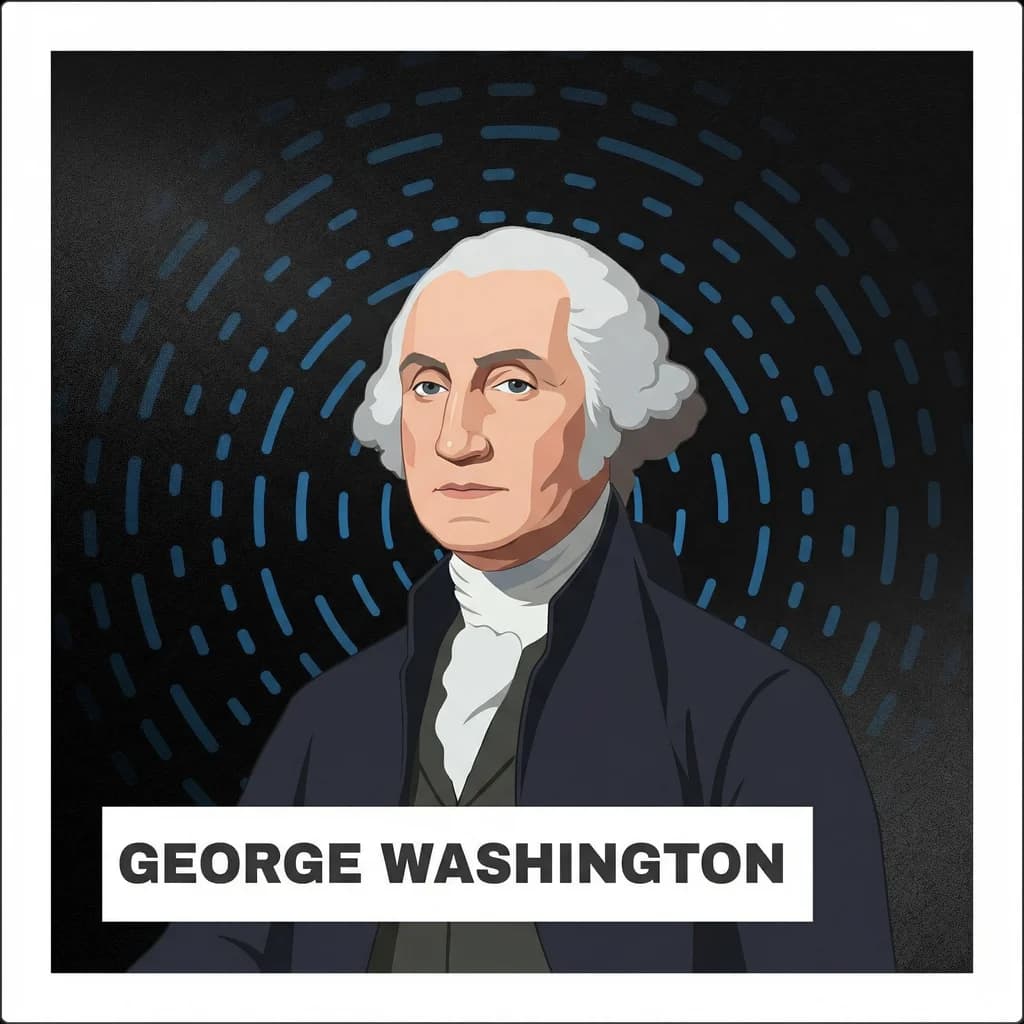
The Trembling
On the morning of April 30, 1789, the most powerful man on the North American continent stood on a second-floor balcony of Federal Hall in New York City and could not stop his hands from shaking. Below him, a crowd packed the intersection of Wall and Broad Streets — merchants, dockworkers, women in bonnets craning from windows — straining to witness something that had never happened before and that most of the world's political theorists believed could not happen at all: the voluntary assumption of limited, constitutional executive power by a man who could, with a word, have claimed a throne. Robert R. Livingston, Chancellor of New York, administered the oath. George Washington placed his hand on a Bible, open to Genesis 49, and swore to preserve, protect, and defend the Constitution of the United States. Then he bent and kissed the book. Senator William Maclay of Pennsylvania, watching from the Senate Chamber where Washington would shortly deliver his inaugural address, recorded what he saw with the unsparing eye of a man who had spent years observing power: "This great man was agitated and embarrassed more than ever he was by the levelled Cannon or pointed Musket."
The trembling was real. Not stage fright — Washington had faced grapeshot at Monongahela, had ridden between the lines at Princeton with musket balls tearing through his coat — but something closer to the vertigo of a man who understood, with a clarity that eluded nearly everyone around him, the magnitude of what he was being asked to create from nothing. There was no precedent. No manual. No model in the history of republics for what a president was supposed to be, how he should behave, whom he should consult, what deference he was owed or owed in return. The Constitution that Washington had sworn to defend said remarkably little about the office he now held. The rest would have to be invented, and the man inventing it knew — had written to Henry Knox weeks earlier — that his "movements to the chair of government will be accompanied with feelings not unlike those of a culprit who is going to the place of his execution."
This was not false modesty. It was not the performative reluctance of a man who secretly craved the role. Washington genuinely feared the presidency — feared failing at it, feared what it would cost him, feared most of all that the fragile experiment he had spent the previous thirteen years building could be destroyed by a single wrong step in its infancy. He had told Edward Rutledge that in accepting the office he had given up "all expectations of private happiness in this world." The man who trembled on that balcony was fifty-seven years old, his teeth were failing, his hearing was going, and he had already resigned supreme military command once, voluntarily, in an act that stunned the courts of Europe. He could have stayed home. Mount Vernon's fields needed him. Instead he chose — was chosen, was called, submitted — to build the thing that did not yet exist.
The story of George Washington is not, in the end, a story about greatness conferred by birth, or genius, or even courage, though he possessed the last in abundance. It is the story of a man who understood something that almost no one in power ever does: that the most consequential act of leadership is choosing when to stop leading. That restraint, not ambition, is the rarest commodity in political life. And that the only way to build an institution that outlasts its founder is to make the founder dispensable.
By the Numbers
The Washington Balance Sheet
8 yearsDuration of command of the Continental Army (1775–1783)
69Electoral votes received in 1789 — every one cast
~60,000 acresLand surveyed before his twentieth birthday
317Enslaved people at Mount Vernon at his death (1799)
$50,000+In land sales proceeds consumed in four years just to stay afloat
135,000+Documents in the Papers of George Washington collection
2 termsPrecedent for presidential tenure he established — codified 152 years later
The Education of an Ambitious Provincial
The fact that would shape everything — more than the cherry tree myth, more than the false teeth, more even than the battlefield heroics — was this: George Washington never went to college. He was born on February 22, 1732, at Popes Creek farm in Westmoreland County, Virginia, the first child of Augustine Washington's second marriage, to Mary Ball. His father was a middling planter and justice of the peace who owned nearly 3,000 acres of tobacco land and managed an iron furnace for an English company. His older half-brothers, Lawrence and Austin, studied in England. George would not. Augustine died when the boy was eleven, and with him went any prospect of schooling abroad.
This gap — between what Washington was and what he wanted to become — became the engine of his entire life. He received what he later called, with acid self-awareness, "a defective education": irregular tutoring, basic mathematics, the technical skills of land surveying. No Latin. No French. No grounding in the classics that his future collaborators and rivals — Jefferson, Adams, Madison, Hamilton — would wield like weapons. John Adams, in one of his less generous moments, dismissed Washington as "too illiterate, unread, unlearned for his station." The insult was not entirely wrong. It was entirely beside the point.
What Washington had, instead of a university education, was an almost preternatural instinct for self-improvement through observation and imitation. The famous story — a teenager hunched over a table at Ferry Farm, laboriously copying 110 "Rules of Civility & Decent Behaviour in Company and Conversation" from a French manual for aristocratic conduct — is usually treated as a charming anecdote. It was something more radical than that. It was the first evidence of a method Washington would deploy for the rest of his life: identify the standard, study it with ferocious attention to detail, and then perform it so convincingly that performance becomes identity. The rules he copied — "Every Action done in Company, ought to be with Some Sign of Respect, to those that are Present" — read like a protocol manual for someone who knows he does not belong and is determined to pass.
He was, in the language of a later era, an operator. By sixteen, he had attached himself to the orbit of the Fairfax family — the most powerful clan in colonial Virginia, controllers of the five-million-acre Fairfax Grant stretching from the Northern Neck into the Shenandoah Valley — through his half-brother Lawrence's marriage to Ann Fairfax. The Fairfaxes were not entirely what they seemed, a fact that most Washington biographers have treated gingerly if at all. Colonel William Fairfax, George's patron, had a son from an earlier marriage in the West Indies, and in a letter to his mother requesting help having the boy educated in England, Fairfax wrote with unmistakable anxiety that the child had "the marks in his visage that will always testify his parentage" — a reference, scholars have concluded, to mixed-race ancestry. The Fairfax household that welcomed young Washington was more complicated, and more representative of the colonial world's tangled racial hierarchies, than the marble version of the story admits.
Under the Fairfaxes' patronage, Washington was appointed official surveyor for Culpeper County at seventeen. In the next several years, he acquired approximately 9,000 acres of land. He was building something — not a fortune yet, but the foundation for one, plot by plot, survey by survey, in the methodical way that would define his approach to everything from farming to war to nation-building.
Bullets Through the Coat
In 1751, Washington made the only journey outside the continent he would ever take, traveling to Barbados with Lawrence, who was seeking relief from tuberculosis. There, George survived smallpox — gaining the immunity that would prove decisive during the Revolution — and toured the military fortifications on the island with the fascinated eye of a young man who had already decided that soldiering, not surveying, was the path to distinction. Lawrence died the following year. Washington inherited Mount Vernon and pivoted entirely toward a military career.
What followed was a catastrophe that Washington, through sheer force of will and extraordinary narrative management, transformed into a legend. In 1753, Lieutenant Governor Robert Dinwiddie dispatched the twenty-one-year-old Washington — on the Fairfax family's recommendation — with only six frontiersmen to demand the departure of French forces from the Ohio country. The winter journey was brutal. Washington nearly drowned crossing the Allegheny River on a makeshift raft. He nearly froze. He delivered his message, the French rejected it, and he returned to Williamsburg with intelligence about enemy capabilities that made him, briefly, the most talked-about young officer in Virginia.
The following year came the incident that sparked a world war. Setting out with about 140 men for the Forks of the Ohio, Washington encountered a French scouting party. What happened next depends on which account you believe. According to Washington's later retelling, he intended to accept the French surrender, but Tanacharison, his Native American ally, attacked and scalped several French soldiers, killing their commander, Joseph Jumonville. The French called it an assassination. Washington called it combat. The diplomatic consequences were enormous — the skirmish helped ignite the Seven Years' War, the global conflict that would reshape the map of North America.
Weeks later, Washington found himself besieged at the hastily constructed Fort Necessity, where he was forced into a humiliating surrender. He signed articles of capitulation that included, in French he could not read, an admission of having "assassinated" Jumonville. It was a disaster. And yet Washington emerged from it with his reputation, if not enhanced, then at least intact — because he had been there, had fought, had survived.
Then came Monongahela. On July 9, 1755, a combined British and colonial force under General Edward Braddock marched into a devastating French and Indian ambush near the Monongahela River. Braddock was killed. The regulars broke and ran. Washington, twenty-three years old and wracked with dysentery, had two horses shot from under him and took four bullets through his coat without suffering a wound. He wrote to his brother John Augustine from Fort Cumberland with the sardonic understatement of a man who has just survived something that should have killed him: "As I have heard, since my arrival at this place, a circumstantial account of my death and dying speech, I take this early opportunity of contradicting the first, and of assuring you, that I have not, as yet, composed the latter."
I had four Bullets through my Coat, and two Horses shot under me; yet escaped unhurt, altho' Death was leveling my Companions on every side of me!
The British regarded him as a mediocre commander. The colonists saw a hero. Both assessments contained truth. Washington's tactical skills in the French and Indian War were, at best, uneven. But something else was becoming visible — a quality that had nothing to do with tactics and everything to do with presence. He could hold men together in the worst conditions. He could take a beating and come back. He could project calm authority when everything around him was collapsing. This was not strategy. It was character, and it turned out to be worth more.
The Plantation and Its Contradictions
Between the wars — the period from 1758, when he resigned his militia commission, to 1775, when the Continental Congress handed him command of an army — Washington became what he most wanted to be: a Virginia gentleman of substance. He married Martha Dandridge Custis in January 1759, a wealthy widow whose first husband had left an estate including significant property and enslaved people. The marriage was strategic and genuine, comfortable and deep, though the exact contours of Washington's inner romantic life remain opaque. (There is the matter of Sally Fairfax — George William Fairfax's wife, the woman to whom Washington wrote letters of unmistakable ardor in his twenties, the woman historians have debated for two centuries. The letters exist. The affair, if there was one, remains unproven.)
Washington threw himself into Mount Vernon with the same obsessive attention to detail he would later bring to the Continental Army and the presidency. He was, as Edward Lengel has documented in First Entrepreneur, a genuine businessman — not a gentleman farmer dabbling in agriculture but an operator constantly experimenting, calculating, optimizing. He diversified away from tobacco into wheat. He built a commercial fishing operation on the Potomac that pulled in tens of thousands of herring and shad each season. He operated a distillery. He experimented with crop rotation, soil management, new breeds of livestock. "He naturally thought of the country as a business," Lengel observed. "When he became President, he said, 'Building the national prosperity is my first and my only aim.'"
His mother, Mary Ball Washington — who has, as Lengel noted, "a bad reputation for being a grouchy woman" — had instilled in him the principle that industry and morality were inseparable, that building prosperity was itself an ethical act. This conviction animated everything Washington did. It also coexisted, with a tension he never fully resolved, with the fact that his prosperity was built on the labor of enslaved people.
By the time of his death in 1799, 317 enslaved individuals lived and worked at Mount Vernon. Washington's relationship to slavery was neither simple nor static, but it was always, at its core, self-serving in its timing. In 1786, he wrote to Robert Morris what has become one of the most frequently quoted letters in the Washington corpus: "I can only say that there is not a man living who wishes more sincerely than I do, to see a plan adopted for the abolition of it — but there is only one proper and effectual mode by which it can be accomplished, and that is by Legislative authority." The letter is remarkable for its clarity about the moral wrongness of slavery. It is equally remarkable for its insistence that the problem be solved by someone else, somewhere else, at some other time.
By 1799, Washington had come to a starker reckoning. He wrote to his nephew Robert Lewis with something close to anguish: "It is demonstratively clear, that on this Estate I have more working Negros by a full moiety, than can be employed to any advantage in the farming System… To sell the overplus I cannot, because I am principled against this kind of traffic in the human species. To hire them out, is almost as bad, because they could not be disposed of in families to any advantage, and to disperse the families I have an aversion. What then is to be done? Something must, or I shall be ruined."
The moral and financial crisis described in that letter — the impossibility of profiting from slavery, the impossibility of ending it without ruin, the impossibility of doing nothing — was the trap from which Washington never fully escaped. His will provided for the emancipation of his enslaved workers after Martha's death. It was a gesture, and it was real, and it was also a decision deferred beyond the grave, structured so that Washington himself would never have to bear its costs.
The story of Ona Judge — one of the enslaved people in the Washington household who escaped in 1796 while the family lived in Philadelphia and whom the Washingtons pursued relentlessly, unsuccessfully, for years afterward — is the necessary counternarrative to any account of Washington's moral evolution. Washington may have wished, sincerely, for abolition. He also sent agents to capture a woman who had chosen freedom. The contradiction was not incidental to his character. It was central.
The Art of Holding Together
On June 15, 1775, the Continental Congress voted unanimously to appoint George Washington commander-in-chief of the Continental Army. He accepted four days later. His personal integrity, his military experience, his status as a Virginian whose selection would bind the southern colonies to a war that had begun in Massachusetts, his physical presence — at six feet two inches he towered over most of his contemporaries — all contributed. "He was viewed as the only man who could do the job," as the National Museum of the United States Army has summarized it, with the sort of flatness that obscures how extraordinary the proposition was.
Washington arrived outside Boston on July 2, 1775, to take command of what was less an army than an idea of one. He found smallpox raging among soldiers and civilians, inadequate supplies, no discipline to speak of, and a collection of militia units whose members felt loyalty to their colonies, not to any abstraction called "the United States." What he did over the next eight years — holding this force together, losing more battles than he won, retreating and regrouping and retreating again, managing thirteen jealous colonial governments and a feckless Continental Congress, enduring the winter at Valley Forge, the betrayal of Benedict Arnold, his own recurrent bouts of doubt and depression — was not a triumph of military genius. It was something harder to categorize and more important: a triumph of organizational will.
His greatness as a commander, as Ron Chernow argued in
Washington: A Life, "should not be ascribed to his skills as a strategist. After all, he lost more battles than he won." He pushed the French to abort their planned operation in Yorktown in favor of a strike against New York — an argument he lost, fortunately. But "by sheer force of will, he held together an inexperienced, ill-equipped, often unpaid, motley, mongrel army for more than eight years — while fending off 13 selfish colonies, a feckless Continental Congress and his own doubts and depression."
The inoculation decision is the detail that best captures Washington's leadership method. In an era when inoculation against smallpox was widely feared — banned in several colonies, a criminal offense in Connecticut — Washington ordered all his soldiers inoculated. The decision was scientifically sound, politically explosive, and operationally risky: inoculated soldiers were temporarily weakened, and premature release from quarantine could spread the disease. Washington had contracted smallpox himself in Barbados at nineteen. He knew what the disease could do. He also knew what it was doing: fully half of 10,000 uninoculated Massachusetts and Connecticut reinforcements sent to the Quebec campaign died of smallpox. The decision to inoculate was not a calculated risk. It was a calculated certainty that doing nothing was worse.
Influence is no government. Let us have one by which our lives, liberties, and properties will be secured, or let us know the worst at once.
The Resignation That Made Everything Possible
The moment that made Washington Washington — the moment that separated him from every other victorious general in history up to that point, from Caesar to Cromwell — came on December 23, 1783, in the Maryland State House in Annapolis. The war was over. The Treaty of Paris was signed. And George Washington, commander-in-chief of the most successful revolutionary army in modern history, stood before the Continental Congress and gave back his commission.
"Having now finished the work assigned me," he said, "I retire from the great theatre of Action — and bidding an Affectionate farewell to this August body under whose orders I have so long acted, I here offer my Commission, and take my leave of all the employments of public life."
When King George III heard that Washington planned to resign his command and return to farming, he allegedly remarked, "If he does that, he will be the greatest man in the world." Whether or not the story is apocryphal, its logic is sound. The voluntary relinquishment of military power by a victorious commander was so rare as to be essentially unprecedented in Western political history. Washington understood what he was doing. He understood that the entire meaning of the Revolution — the idea that a republic could govern itself without degenerating into tyranny — depended on the commanding general demonstrating, through his own action, that power could be surrendered peacefully.
He went home to Mount Vernon. He tried to farm. The country fell apart.
The Mist of Intoxication and Folly
The years between the resignation and the presidency — 1784 to 1789 — were the years that clarified, for Washington, the necessity of the thing he least wanted to do. The Articles of Confederation had created a national government so weak it could barely function. Congress could not raise revenue. States imposed tariffs against one another. The currency was worthless. When Shays' Rebellion erupted in Massachusetts in 1786, Washington wrote to Henry Lee with a fury and despair that cracked through his usual epistolary composure:
"I am mortified beyond expression whenever I view the clouds which have spread over the brightest morn that ever dawned upon any Country. In a word, I am lost in amazement, when I behold what intriegueing; the interested views of desperate characters; Jealousy; & ignorance of the Minor part, are capable of effecting as a scurge on the major part of our fellow citizens of the Union."
And then the line that reveals the core of Washington's political philosophy, stripped of all ornamentation: "Influence is no government. Let us have one by which our lives, liberties, and properties will be secured, or let us know the worst at once."
He wrote to James Warren in 1785 with similar directness: "The confederation appears to me to be little more than a shadow without the substance; and Congress a nugatory body, their ordinances being little attended to." The solution, he argued, was obvious: a central government with real power. "Why it should be withheld is beyond my comprehension."
Washington came to the Constitutional Convention in Philadelphia in 1787 as its president, his presence lending the proceedings a legitimacy that no one else could provide. He said very little during the debates. He didn't need to. His being there was the argument.
Converting Parchment into Practice
The presidency Washington built was, in Ron Chernow's formulation, the conversion of a silent, skeletal document into "a viable, elastic" institution. The Constitution said almost nothing about how the president should conduct himself. Washington invented the answers.
He established the cabinet — selecting
Thomas Jefferson as Secretary of State,
Alexander Hamilton as Secretary of the Treasury, Henry Knox as Secretary of War, Edmund Randolph as Attorney General — and created a decision-making process that every subsequent president would adapt. He chose "Mr. President" as his title, rejecting the absurdly baroque alternatives Congress proposed ("His Highness the President of the United States of America, and Protector of the Rights of the Same"). He delivered inaugural addresses. He held weekly receptions. He cultivated, with extraordinary deliberateness, a public persona that balanced accessibility with dignity — close enough to the people to earn their trust, distant enough to command their respect.
He also recognized that the early presidency was, above all, an exercise in restraint. When Pennsylvania built him a presidential mansion in Philadelphia without his asking, Washington refused to live in it, fearing it would "send the wrong message to Americans and the world about the nature of the new American republic." The mansion existed. The symbolism of living in it was wrong. So he didn't.
The Indian diplomacy is revealing. Washington's dinner table in Philadelphia regularly hosted delegations from the Kaskaskia, Peoria, Piankashaw, Potawatomi, Mascouten, Haudenosaunee, Cherokee, Chickasaw, and other nations. He followed Native American diplomatic protocol — smoking the calumet pipe, exchanging wampum, eating and drinking together — with the same meticulous attention to form he applied to everything else. The image of Washington puffing on a long-stemmed peace pipe with Cherokee chiefs does not fit the marble portrait. It was, for Washington, simply part of the job: the new republic was too weak to ignore the powerful Indian nations on its frontiers, and diplomacy demanded respect for the other party's customs.
The Sacred Fire of Liberty
His first inaugural address, delivered in the Senate Chamber after the trembling on the balcony, contained the phrase that would become the defining metaphor of his presidency: "the preservation of the sacred fire of liberty and the destiny of the republican model of government are justly considered, perhaps, as deeply, as finally, staked on the experiment entrusted to the hands of the American people." The experiment. Washington always called it that. Not a destiny, not a certainty, not a divine right — an experiment. Subject to failure. Contingent on virtuous execution.
His first Annual Message to Congress, on January 8, 1790, was a blueprint for nation-building that reads, two centuries later, like a startup founder's all-hands memo: establish a regular army; improve roads for communication; take a census; create a system of education; promote manufacturing independence; standardize currency, weights, and measures; define naturalization laws. "To be prepared for War is one of the most effectual means of preserving peace," he told Congress. "A free people ought not only to be armed but disciplined."
The two-term limit — the decision that cemented everything — was not inevitable. The Constitution imposed no restriction. Many of Washington's allies urged him to stay. He could have served until he died. His health was declining, his hearing fading, his patience with partisan attacks exhausted. But he understood, in the structural way that defined his thinking, that the republic needed to learn how to elect, transition, and inaugurate a new president while he was still alive to ensure the process worked. A planned succession was safer than an unplanned one. The precedent he set — voluntarily leaving power — held for 152 years, until Franklin Roosevelt's four elections prompted the Twenty-Second Amendment to codify what Washington had established through example alone.
The Farewell
The Farewell Address, published on September 19, 1796, was coauthored with Alexander Hamilton — the two men exchanging drafts throughout the spring and summer, with Washington maintaining what Stephen F. Knott has called "tight editorial control over the finished product." It was not a speech. Washington never delivered it aloud. It was published in a Philadelphia newspaper, Claypoole's American Daily Advertiser, and then reprinted across the country.
The address is often described as a warning against foreign entanglements. It was that. But it was more fundamentally a meditation on the conditions under which self-government might survive or fail. Washington warned against "the baneful effects of the spirit of party" — factionalism, he believed, was the republic's most lethal internal threat. He warned against "permanent, inveterate antipathies against particular nations, and passionate attachments for others." He urged Americans to "observe good faith and justice toward all nations; cultivate peace and harmony with all."
And he posed the question that haunts the entire American experiment: "Can it be that Providence has not connected the permanent felicity of a nation with its virtue? The experiment, at least, is recommended by every sentiment which ennobles human nature. Alas! is it rendered impossible by its vices?"
There it is. The question Washington couldn't answer and didn't pretend to. Whether the republic he had built would endure. Whether virtue was strong enough to sustain self-government. Whether the experiment would hold.
The Last Winter
George Washington died at Mount Vernon on December 14, 1799, at the age of sixty-seven, of a throat infection — probably acute epiglottitis — that killed him within forty-eight hours of its onset. He had been out riding his plantation in freezing rain the day before. His doctors bled him four times, removing an estimated five pints of blood. Modern medicine would likely have saved him. The medicine of 1799 hastened his end.
His will contained the provision for emancipation that he had deferred throughout his life. The 123 enslaved people Washington owned outright would be freed upon Martha's death. (The remaining enslaved individuals at Mount Vernon belonged to the Custis estate and were not his to free.) Martha, apparently uncomfortable living among people who had a material interest in her death, emancipated them within a year.
John Adams, upon learning of Washington's death, wrote to Congress about convening a committee to determine the best methods for commemorating the man. There was a proposal to entomb his remains in the Capitol itself. It never happened. Washington's body stayed at Mount Vernon, in the Virginia soil he had surveyed and farmed and defended and never, in the end, been able to leave behind.
From beyond the grave, Washington asked family members and friends to temper public adulation by minimizing "tedious tributes." He probably didn't mean it.
Two centuries later, the Americans who turned him into a civic deity have, as Chernow observed, rendered him "a stiff figure composed of too much marble to be quite human." The papers project at the University of Virginia — launched in 1968, still ongoing, encompassing over 135,000 documents — has, paradoxically, made him both more knowable and more elusive. "Strange as it may seem," Chernow wrote, "George Washington's life has now been so minutely documented that we know far more about him than did his own friends, family, and contemporaries."
The trembling hands on the balcony at Federal Hall. The four bullets through the coat at Monongahela. The commission offered back in the Maryland State House. The 317 enslaved people at Mount Vernon. The sacred fire of liberty. These are not pieces of a puzzle that, assembled correctly, produce a coherent portrait. They are the irreducible contradictions of a man who understood, better than anyone of his era, that the institutions outlast the founder only if the founder is willing to become dispensable — and who spent his entire life performing that willingness while knowing, in his bones, that the experiment might still fail.
Mount Vernon stands on a bluff above the Potomac. The river is wide there, and slow, and brown with the sediment of the Virginia piedmont. Washington surveyed that land when he was a teenager. He farmed it. He left it for war, twice. He came home each time. He is buried there, in a brick vault on the grounds, beside Martha, with a view of the river he could not stop watching and the country he could not stop building and the future he could not see.