
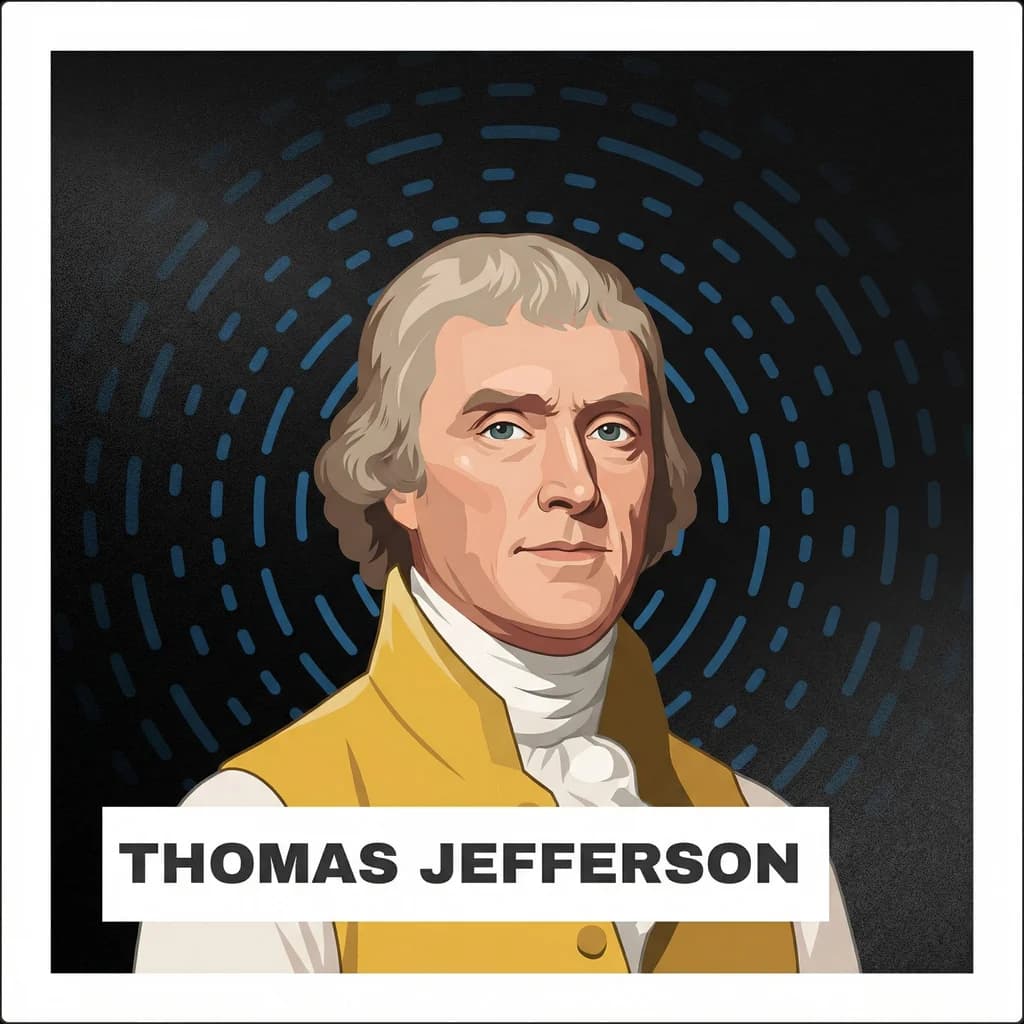

Part IThe Story
On the afternoon of October 28, 1785, Thomas Jefferson—forty-two years old, recently widowed, serving as America's Minister to France, and already the author of the most consequential political document in modern history—left his lodgings at the Hôtel de Langeac and walked toward the village of Fontainebleau. He had come to attend King Louis XVI's autumn levees, a diplomatic obligation he fulfilled intermittently and with visible reluctance, his finances too strained to sustain a continuous presence at court. He shaped his course, he later wrote to James Madison, "towards the highest of the mountains in sight," and soon fell in with a poor woman walking at the same rate, heading in the same direction. She was a day laborer earning eight sous—roughly four pence sterling—per day, with two children to maintain and an annual rent that consumed seventy-five days of wages. Often she could find no employment at all. Jefferson gave her twenty-four sous upon parting. "She burst into tears of a gratitude which I could perceive was unfeigned," he told Madison, "because she was unable to utter a word."
The encounter sent him spiraling into a train of reflections that would shape American governance for centuries. Walking alone on that French hillside, Jefferson did what he always did when confronted with the misery produced by concentrated wealth: he built a system. He reasoned backward from the woman's tears to the structure of property ownership in France, from the idle lands held for aristocratic game to the "enormous inequality producing so much misery to the bulk of mankind," and arrived at a conclusion both radical and characteristically his own—that "legislators cannot invent too many devices for subdividing property." The letter he wrote to Madison that evening, by firelight in a village inn, is less famous than the Declaration of Independence but more revealing: it shows the machinery of Jefferson's mind at work, moving from a single human encounter to universal principle, from sentiment to system, from a woman's sob to a theory of republican government. He was, in that moment, the complete Jeffersonian article—philosopher, empiricist, sentimentalist, reformer—and also, inescapably, something else entirely: a man who owned over a hundred human beings, who had inherited his wealth in enslaved labor and Virginia land, and who would return to Monticello to preside over a plantation economy built on the very inequality he condemned in France.
That doubleness—the capacity to feel another's suffering with exquisite precision and to maintain, simultaneously, a system of suffering at home—is the central fact of Jefferson's life, the thing that makes him not merely a historical figure but an ongoing American problem. He is the author of the American creed and its most conspicuous violator, the man who gave voice to humanity's highest aspirations while holding over six hundred people in bondage across his lifetime. To study Jefferson is to study the distance between what a nation says and what it does.
By the Numbers
The Jeffersonian Record
19,000+Letters written in his lifetime
6,700Books in his personal library, sold to Congress in 1815
600+Enslaved people owned over his lifetime
$107,000Approximate debt at death (equivalent to ~$2.5M today)
828,000 sq miTerritory acquired via the Louisiana Purchase
126Bills drafted for Virginia's legal revision (1776–1779)
83Age at death, July 4, 1826—same day as John Adams
The Machinery of Self-Invention
The mountain where Jefferson would build Monticello—868 feet above the Virginia piedmont, overlooking the Rivanna River and the Blue Ridge beyond—was not a practical site for a plantation house. It was impractical in the extreme: water had to be hauled, supplies carted up a punishing grade, every brick and nail transported through forest to a summit that offered views but no convenience. Jefferson chose it anyway. He was twenty-five years old. The choice tells you nearly everything you need to know about the man—that he preferred the ideal to the expedient, the prospect to the foundation, the view from the mountaintop to the muddy reality below.
Thomas Jefferson was born on April 13, 1743, at Shadwell, in the foothills of the Blue Ridge. His father, Peter Jefferson, was a self-educated surveyor and planter who had clawed his way to respectability through industry, sound judgment, and the acquisition of some five thousand acres and sixty enslaved people. Peter Jefferson never attended college but read voraciously, made the first accurate map of Virginia, and pushed into wilderness that was, in his son's telling, only three or four settlers deep. His mother, Jane Randolph, came from the other direction—one of Virginia's most distinguished families, the Randolphs, whose pedigree stretched back to England and Scotland in ways that Jefferson would later dismiss with the driest filial ambivalence: "to which let every one ascribe the faith & merit he chooses."
Peter Jefferson died on August 17, 1757, when Thomas was fourteen. The inheritance was substantial—£2,400 and thousands of acres—but the loss was shattering in ways Jefferson could never quite articulate. "When I recollect that at fourteen years of age, the whole care and direction of myself was thrown on myself entirely," he wrote to his grandson Thomas Jefferson Randolph decades later, "without a relation or friend qualified to advise or guide me, and recollect the various sorts of bad company with which I associated from time to time, I am astonished that I did not turn off with some of them, and become as worthless to society as they were." Of his mother, who lived until 1776, we know almost nothing from Jefferson's pen. When she died on March 31 of that year—the year of the Declaration—he noted it in his pocket account book with the clinical terseness of a man recording an expenditure: "My mother died at eight o'clock this morning, in the 57th year of age." Then he suffered for weeks from violent headaches.
What followed was the kind of relentless self-education that looks, in retrospect, like the construction of a personality from first principles. Jefferson studied under the Scottish clergyman William Douglas, whom he remembered as "a superficial Latinist" and "less instructed in Greek"—phrases that reveal both the rigor of his standards and the pleasure he took in exercising them. After his father's death, he moved to the tutelage of the Reverend James Maury, "a correct classical scholar," and then, in the spring of 1760, entered the College of William and Mary in Williamsburg. By all accounts he was an obsessive student, spending fifteen hours a day with his books, three hours practicing the violin, and the remaining six eating and sleeping.
The decisive encounter was with William Small, a Scottish professor of mathematics. "It was my great good fortune, and what probably fixed the destinies of my life," Jefferson wrote in his Autobiography, "that Dr. Wm. Small of Scotland was then professor of Mathematics, a man profound in most of the useful branches of science, with a happy talent of communication, correct and gentlemanly manners, & an enlarged & liberal mind." Small was the only non-minister on the faculty—a fact of some significance for a young man beginning to question inherited orthodoxies. He introduced Jefferson to the system of things Enlightenment thinkers were assembling: the universe as machine, nature as law, knowledge as power. Small also introduced Jefferson to George Wythe, the leading legal scholar in Virginia, and through Wythe to Governor Francis Fauquier. What is striking is not just the quality of these mentors but Jefferson's instinct for finding them. He gravitated toward the most prominent Virginians of his day, not toward his fellow students.
Under Wythe's tutelage from 1762 to 1767, Jefferson undertook a course of legal study so comprehensive it amounted to a liberal education in disguise. His advisory letters to younger students reveal the scope: physical sciences, morality, religion, natural law, politics, history, rhetoric, oratory, belle lettres. A lawyer, in Jefferson's conception, would be a human encyclopedia of useful knowledge, ready for any turn of events. His actual legal practice, focused primarily on cases involving property—land acquisition, quieting of titles—was distinguished but unremarkable. He took six pro bono cases on behalf of enslaved people seeking freedom, including the case of Samuel Howell in Howell v. Netherland in April 1770, in which he argued: "Under the law of nature, all men are born free, every one comes into the world with a right to his own person, which includes the liberty of moving and using it at his own will." The court awarded the case to Netherland before George Wythe, arguing for the other side, could present his case. The court, it seems, was unprepared to hear of the natural equality of all men. Jefferson would practice law until August 11, 1774, when he passed his practice to Edmund Randolph at the start of the Revolutionary War.
The Expression of the American Mind
The document was never meant to be philosophy. Jefferson, writing in an upper-floor apartment at Seventh Street and Market Street in Philadelphia during the summer of 1776, was composing what he later called "an expression of the American mind"—a brief for revolution submitted to "the tribunal of the world." He was thirty-three years old, the second youngest member of the Continental Congress, selected for the drafting committee because he was a Virginian (prestige), because John Adams was obnoxious (politics), and because he could, in Adams's own generous admission, "write ten times better than I can."
Jefferson's first draft listed certain "sacred & undeniable" truths. The language is worth pausing over, because the revisions matter. In his rough draft, the truths were "sacred & undeniable"; the committee, probably at Benjamin Franklin's suggestion, changed them to "self-evident"—a shift from the theological to the rational that perfectly suited the Enlightenment mood. In the draft, men were created "equal & independent," deriving from "that equal creation" rights that were "inherent & inalienable." The final version streamlined: "endowed by their Creator with certain unalienable Rights." The engine of the argument remained Jefferson's: rights are prior to government; government exists to secure them; when government becomes destructive of these ends, revolution is not merely permitted but obligatory.
— Thomas Jefferson, Declaration of Independence (1776)We hold these truths to be self-evident, that all men are created equal, that they are endowed by their Creator with certain unalienable Rights, that among these are Life, Liberty and the pursuit of Happiness.
Rigorous debate followed. Congress reduced Jefferson's draft to roughly three-quarters of its original length, excising, most notably, a fiery passage condemning King George III for the slave trade—"this assemblage of horrors," Jefferson had called it, a "cruel war against human nature itself, violating its most sacred rights of life & liberties." South Carolina and Georgia, hungry for more enslaved laborers, would not abide shutting down the market. The passage was struck. Jefferson never forgave the Congress for the cut, noting bitterly in his Autobiography the changes "the pusillanimous" delegates had made. But the removal of that anti-slavery clause is one of those silences that echoes across centuries: the moment when the nation's founding document was edited to accommodate the very institution it might have condemned.
The Declaration, not thought to be especially significant at the time of its adoption on July 4, 1776, would become arguably the most consequential political writing ever composed. Massachusetts freed its enslaved people on the strength of its language. Lincoln would use it, eighty-seven years later, to mobilize the anti-slavery cause. And it embedded in American life a permanent standard against which every generation's failures could be measured—including, most painfully, those of its author.
The Reviser of Laws and Builder of Systems
Jefferson returned to Virginia almost immediately after the Declaration's adoption, not out of modesty but urgency. He had concluded that the real work of revolution lay not in declaring independence but in remaking the laws under which people actually lived. Appointed to a committee to revise Virginia's outdated legal code, Jefferson—alongside George Wythe and Edmund Pendleton, after two other members excused themselves—drafted 126 bills over roughly three years, from 1776 to 1779. It was a staggering act of legislative imagination, and it reveals the systematic, almost architectural quality of Jefferson's mind.
Two bills stand above the rest. The Bill for Religious Freedom, drafted in 1777 and finally passed in 1786 through the political maneuvering of James Madison while Jefferson was in France, established the separation of church and state in language that still reverberates. "Believing with you that religion is a matter which lies solely between Man & his God," Jefferson wrote to the Danbury Baptist Association on January 1, 1802, "I contemplate with sovereign reverence that act of the whole American people which declared that their legislature should 'make no law respecting an establishment of religion, or prohibiting the free exercise thereof,' thus building a wall of separation between Church & State." The metaphor—the wall—became constitutional doctrine.
The Bill for the More General Diffusion of Knowledge was, in Jefferson's own estimation, "the most important bill of our whole code"—the foundation "for the preservation of freedom and happiness" in a true republic. It proposed a system of public education that would divide Virginia into wards, each with a school teaching reading, writing, and arithmetic; above these, district grammar schools for classical learning; and at the summit, a reformed and secularized William and Mary College. The bill never passed. Virginia's gentry, with ready access to education at every level, saw no reason to fund schooling for, as Jefferson put it, the hoi polloi. The defeat haunted him for decades and ultimately drove him, in his retirement, to found the University of Virginia from scratch—an institution he designed down to the architectural plans, the curriculum, the faculty appointments, and the arrangement of books in the library.
Jefferson chose to have that fact inscribed on his tombstone, alongside the Declaration and the Virginia Statute for Religious Freedom. Not the presidency. Not the Louisiana Purchase. The three things he asked to be remembered for were all, in essence, acts of writing—texts that established principles.
The Minister in Paris and the Silence at Home
On September 6, 1782, Martha Wayles Skelton Jefferson died at Monticello, ten years into their marriage. Jefferson was overwhelmingly distraught. He found some consolation in an invitation to serve as Minister to France—he needed to be away from Monticello—and departed in 1784, bringing with him his eldest daughter, Martha, and an enslaved man named James Hemings, whom he intended to have trained as a French chef.
Paris transformed Jefferson. He immersed himself in French culture, architecture, wine, and ideas with the fervor of a man escaping grief through intellectual engagement. He befriended scientists, philosophes, and revolutionaries. He negotiated a commercial treaty with Prussia in 1785 and the Consular Convention with France in 1788. He witnessed the early stirrings of the French Revolution with an enthusiasm that bordered on romantic identification, believing that France might achieve what America had begun.
But Paris also produced one of the defining entanglements of Jefferson's life. In 1787, his younger daughter Mary—called Polly—arrived from Virginia accompanied by an enslaved girl named Sally Hemings. Sally was fourteen years old, light-skinned, and, as a daughter of Elizabeth Hemings and John Wayles, she was the half-sister of Jefferson's dead wife Martha. According to the testimony of her son Madison Hemings, Sally "became Mr. Jefferson's concubine" during their time in Paris. In France, where enslaved people who petitioned for freedom routinely received it, both James and Sally Hemings had legal grounds to remain free. They chose to return to Virginia—James after negotiating for his eventual emancipation, Sally after Jefferson promised, according to Madison Hemings, privileges and eventual freedom for their children. DNA evidence confirmed in 1998 what the Hemings family had maintained for generations: Jefferson almost certainly fathered at least six of Sally Hemings's children, four of whom survived to adulthood.
The relationship—if one can call a relationship between an owner and the person he owned by that word—lasted nearly four decades. Jefferson never publicly acknowledged it, never freed Sally Hemings in his lifetime, and never reconciled it with the principles he had inscribed in the Declaration. The silence is not merely personal. It is architectural: Jefferson built a life, a philosophy, and a nation around ideals he could not or would not apply to the people closest to him.
— Thomas Jefferson to Jean Nicolas Démeunier, June 1786What a stupendous, what an incomprehensible machine is man! Who can endure toil, famine, stripes, imprisonment or death itself in vindication of his own liberty, and the next moment be deaf to all those motives whose power supported him thro' his trial, and inflict on his fellow men a bondage, one hour of which is fraught with more misery than ages of that which he rose in rebellion to oppose.
The Party of One Against the Party of Hamilton
George Washington summoned Jefferson home from Paris in 1789 to serve as the nation's first Secretary of State. Within months, Jefferson found himself locked in a conflict with Secretary of the Treasury Alexander Hamilton that would cleave American politics into two parties and establish the ideological poles around which the country has rotated ever since.
Hamilton—an orphan from the Caribbean island of Nevis, a war hero, a financial genius who saw in a strong central bank and a funded national debt the instruments for transforming a fragile republic into a commercial empire—was everything Jefferson distrusted. Hamilton wanted a standing army, a national bank, an industrial economy modeled on Britain's. Jefferson wanted a pastoral republic of small farmers, strict constitutional limits on federal power, and as little government as possible. Hamilton trusted institutions; Jefferson trusted people—or rather, he trusted educated people to govern themselves. The quarrel was philosophical, personal, and venomous. Jefferson resigned from the cabinet in 1793. The two men never reconciled.
What emerged from the collision was the first American party system: Hamilton's Federalists, who favored strong centralized government and a loose interpretation of the Constitution, versus Jefferson's Democratic-Republicans, who championed small government, states' rights, and strict constructionism. Jefferson did not set out to build a party—he professed to loathe factionalism—but he built one anyway, because the alternative was to leave the field to Hamilton. It was perhaps the most consequential act of reluctant institution-building in American history.
We Are All Republicans, We Are All Federalists
The election of 1800 was a near-catastrophe. Jefferson and his running mate, Aaron Burr, tied in the Electoral College, throwing the decision to the Federalist-controlled House of Representatives. Hamilton—who despised Jefferson but despised Burr more—lobbied for Jefferson's election. After thirty-six ballots over seven days, Jefferson prevailed. The peaceful transfer of power from one party to another—the first in American history—remains one of the republic's most extraordinary achievements, and Jefferson knew it.
His First Inaugural Address, delivered on March 4, 1801, in the still-unfinished Capitol building, is the finest piece of political reconciliation in the American canon. Jefferson—tall, gangly, reddish-haired, famously inaudible to anyone beyond the first few rows—spoke to a nation that had torn itself apart:
— Thomas Jefferson, First Inaugural Address, March 4, 1801Every difference of opinion is not a difference of principle. We have called by different names brethren of the same principle. We are all Republicans: we are all Federalists.
The address laid out fifteen essential principles of republican government: equal justice regardless of political or religious persuasion; peace and commerce without entangling alliances; federal support for states' rights; preservation of constitutional vigor; election by the people; acquiescence in majority rule; a well-disciplined militia; supremacy of civil over military authority; light taxation; ready payment of debts; encouragement of agriculture and commerce; diffusion of information; freedom of the press; habeas corpus and trial by jury; and freedom of religion. It reads, two centuries later, less like a speech than like a constitution of the spirit.
The Earth Belongs to the Living
On September 6, 1789—the same month that the Bastille fell—Jefferson wrote to James Madison from Paris a letter that contains, compressed into a few pages, the most radical idea in his political philosophy. "The question Whether one generation of men has a right to bind another," he began, "seems never to have been started either on this or our side of the water. Yet it is a question of such consequences as not only to merit decision, but place also, among the fundamental principles of every government."
Jefferson's answer was unequivocal: "the earth belongs in usufruct to the living." No generation has the right to bind the next. Debts, constitutions, laws—all expire naturally with the generation that created them. Using actuarial tables, Jefferson calculated the span of a generation at nineteen years. At the end of each nineteen-year period, a constitutional convention should be held, defects addressed, changes made. "Every constitution, then, and every law, naturally expires at the end of 19 years. If it be enforced longer, it is an act of force, and not of right."
Madison wrote back politely, months later, with "some very powerful objections." Jefferson never answered that letter. He also never renounced the principle. The idea was too radical for implementation—no republic has ever adopted nineteen-year constitutional sunsets—but it illuminated something essential about Jefferson's political mind: he believed in perpetual revolution, not as violence but as mechanism. If constitutions renewed themselves regularly, there would be no need for bloodshed. If the earth truly belonged to the living, tyranny would have no foothold.
The letter also reveals Jefferson's deepest conviction about the relationship between progress and politics. "Laws and constitutions must go hand in hand with the progress of the human mind," he wrote to Samuel Kercheval on July 12, 1816. "As that becomes more developed, more enlightened, as new discoveries are made, new truths disclosed, and manners and opinions change with the change of circumstances, institutions must advance also, and keep pace with the times." A republic, for Jefferson, was not a fixed structure but a living experiment—progressive, scientific, always becoming.
The Louisiana Gamble and the Empire of Liberty
In 1803, Napoleon Bonaparte offered to sell the entire Louisiana Territory—828,000 square miles, from the Mississippi to the Rockies—for fifteen million dollars. Jefferson, the strict constructionist who believed the federal government possessed only those powers explicitly enumerated in the Constitution, could find no constitutional authority for the purchase. He suppressed his qualms. The territory doubled the size of the country overnight and secured American navigation rights on the Mississippi, the commercial artery of the West.
It was the defining act of Jefferson's presidency—and its most revealing contradiction. The man who had spent a career warning against expansive federal power exercised that power more dramatically than any of his predecessors. He justified it, as he justified all exceptions, by appealing to necessity: the survival of the republic trumped the letter of the Constitution. He then commissioned the Lewis and Clark Expedition, which departed in 1804 to map the newly acquired territory and which returned in 1806 with specimens, observations, and the confirmation that the continent could be crossed.
Jefferson's vision was of an "empire for liberty"—a phrase he used to James Madison on April 27, 1809—that would cover the North American continent. He imagined a nation of independent yeoman farmers spreading west, each owning enough land to be self-sufficient, each participating in local governance, each free from the corruptions of urban manufacturing and concentrated wealth. "Those who labour in the earth are the chosen people of God," he wrote in Notes on the State of Virginia, "if ever he had a chosen people." The vision was, in its way, an expanded version of the Fontainebleau walk—a world in which no one would need to labor for eight sous a day and burst into tears at the gift of twenty-four.
What the vision excluded—Native Americans, whose land the empire required, and enslaved Black people, whom Jefferson could not imagine integrating into the republic—was not incidental but structural. The pastoral dream required the displacement of one population and the continued subjugation of another.
The Great Contradiction
Jefferson's views on race are the wound that will not close. In Query XIV of his Notes on the State of Virginia, published in 1787, he advanced as "a suspicion only" that Black people "are inferior to the whites in the endowments both of body and mind." In memory, he conceded, they were equal; in reason, "much inferior"; in imagination, "dull, tasteless, and anomalous." He offered these judgments as provisional, hedged with qualifications, noting that Black and Native American peoples "have never yet been viewed by us as subjects of natural history." But the damage was done: the author of "all men are created equal" had provided intellectual cover for the very inequality he professed to deplore.
His assessment of Native Americans, notably, was far more generous. Their carvings "prove the existence of a germ in their minds which only wants cultivation"; their oratory proved "their reason and sentiment strong, their imagination glowing and elevated." Why the asymmetry? The sources point in several directions. Jefferson had a political stake in defending Native Americans against the French naturalist Buffon, who had argued that all North American biota—humans included—were inferior to European specimens. To accept Buffon's thesis was to accept that Europeans transplanted to America would degenerate too. But the asymmetry also reflected Jefferson's vision for the republic: Native Americans, in his estimation, could be assimilated into a farming civilization. Black people, he believed, could not. "Ten thousand recollections, by the black, of the injuries they have sustained" made coexistence dangerous; admixture of black and white blood, he imagined, would "taint" the offspring and threaten the republican experiment.
His proposed solution—educate, emancipate, and expatriate every enslaved person—was shared by numerous contemporaries and eventually gave rise to the American Colonization Society. But even this gradualist vision was one Jefferson increasingly declined to act upon. As early as 1805, he expressed skepticism about abolition to William Burwell: "The older we grow, the larger we are disposed to believe the last part to be"—the last part being those who recognize slavery's immorality "but think sympathy is equivalent to action." To Edward Coles in 1814, who had written seeking Jefferson's support for emancipation, the aging patriarch replied with eloquent hand-washing: "This enterprise is for the young; for those who can follow it up, and bear it through to its consummation." He even urged Coles not to free his own slaves—a "precipitous act."
Over his lifetime, Jefferson owned over six hundred enslaved people. He freed only a handful—members of the Hemings family, mostly—and those predominantly in his will. George Washington freed all his enslaved people upon his death. Jefferson did not go even that far. His estate was too deep in debt, his creditors too impatient, his heirs too dependent on the labor force he had accumulated. The man who had written that "the God who gave us life, gave us liberty at the same time" died on July 4, 1826, owing approximately $107,000—and those debts were, in practical terms, secured by human beings.
— Thomas Jefferson to John Holmes, April 22, 1820, on the Missouri CompromiseThis momentous question, like a fire bell in the night, awakened and filled me with terror. I considered it at once as the knell of the Union.
The Sage of Monticello
Retirement did not bring peace. Jefferson returned to Monticello in 1809, resumed his domestic life, continued as president of the American Philosophical Society, and embarked on the project that would consume his final years: the University of Virginia. He chose the site, designed the architecture—his "Academical Village," with its famous rotunda modeled on the Pantheon—prescribed the curriculum, hired the faculty, and controlled the early governance. It opened in 1825, one year before his death.
The university embodied every Jeffersonian conviction: education should be secular, useful, free from religious dictation, controlled locally, and open to the mentally proficient regardless of birth. It should funnel the most talented and virtuous into positions of public service—the "natural aristoi" whose rise Jefferson had championed in his 1813 letter to John Adams. "There is a natural aristocracy among men," he told Adams. "The grounds of this are virtue and talents." A republic's survival depended on its ability to elevate these natural aristocrats over the "artificial aristoi"—the wealthy and wellborn who governed by inheritance rather than merit. Education was the mechanism. "Leave to the citizens the free election and separation of the aristoi from the pseudo-aristoi," Jefferson wrote, "and in general they will elect the real good and wise."
His finances, meanwhile, were catastrophic. Jefferson had lived grandly his entire life—the wine, the books, the architecture, the hospitality—and the debts had compounded across decades. In 1815, he sold his personal library of approximately 6,700 volumes to Congress for $23,950, a fraction of their worth, to pay off some of what he owed. Congress's existing collection had been destroyed when the British burned Washington in 1814; Jefferson's library became the foundation of the Library of Congress. Even this sacrifice was insufficient. At his death, the estate was insolvent. Monticello and most of its enslaved people were sold at auction.
He died on July 4, 1826—the fiftieth anniversary of the Declaration of Independence. John Adams died the same day, five hours later, in Quincy, Massachusetts, his last words reportedly: "Thomas Jefferson survives." He was wrong, but only by a few hours.
On Jefferson's obelisk at Monticello, there was inscribed, upon his request:
Here was buried Thomas Jefferson, Author of the Declaration of American Independence, of the Statute of Virginia for religious freedom, & Father of the University of Virginia.
Not the presidency. Not the Louisiana Purchase. Not the party he built or the revolution he helped lead. Three acts of writing, three acts of institution-making—the creed, the wall, the school. He knew what mattered. He also knew, one suspects, what he had failed to do. The obelisk says nothing about slavery. The obelisk says nothing about six hundred human lives. The obelisk, like much of Jefferson's legacy, is an exercise in selective emphasis—an argument made by omission, a monument to what a man chose to remember and what he chose to forget.
Part IIThe Playbook
Thomas Jefferson never wrote a formal philosophical treatise, but he left behind a political philosophy as detailed and internally consistent as any produced by the Enlightenment. What follows are the principles embedded in his writings, his decisions, and his architecture—the operating system of a mind that shaped a nation.
The principles
- 1.Write the creed before you build the institution.
- 2.Treat constitutions as software, not scripture.
- 3.Build systems, not monuments.
- 4.Cultivate natural aristocracy through universal education.
- 5.Subdivide power until it reaches the individual.
- 6.Separate church and state absolutely.
- 7.Trust sentiment over syllogism in moral judgment.
- 8.Use writing as the primary instrument of power.
- 9.Maintain radical optimism about human capacity.
- 10.Accept contradiction as the cost of ambition.
- 11.Design for the future generation, not the present one.
- 12.Let the record speak for itself.
Principle 1
Write the creed before you build the institution
Jefferson understood that institutions derive their legitimacy from principles, not the reverse. The Declaration of Independence was not a plan of government—it was a statement of why government exists at all. By establishing the creed first—equality, unalienable rights, consent of the governed—Jefferson created a standard against which every subsequent American institution would be measured. The Constitution came eleven years later; the Bill of Rights, fifteen years after the Declaration. The sequence was not accidental. Jefferson knew that a nation's founding document had to be aspirational before it could be operational.
This approach extended to every institution he built. The Virginia Statute for Religious Freedom articulated a principle—that the mind cannot be coerced—before establishing the legal mechanism of church-state separation. The University of Virginia was designed around an educational philosophy before a single brick was laid. In each case, the idea preceded the structure, and the structure was judged by its fidelity to the idea.
Tactic: Before building any organization, articulate—in writing, in precise language—the principles it exists to serve; the principles are the institution's constitution, and they must be set before the operating rules.
Principle 2
Treat constitutions as software, not scripture
Jefferson's most radical political idea was that no constitution should outlast the generation that wrote it. "Every constitution, then, and every law, naturally expires at the end of 19 years," he wrote to Madison. "If it be enforced longer, it is an act of force, and not of right." This was not rhetorical. Jefferson genuinely believed that binding future generations to the decisions of the dead was a form of tyranny—that the earth belonged "in usufruct to the living."
The practical implications were enormous. Constitutions should be revisable by design, with built-in mechanisms for periodic renewal. Debts should not be heritable. Laws should sunset. The implication for any enterprise—political, corporate, institutional—is that founding documents are provisional. They express the best judgment of their time and should be periodically stress-tested against changed circumstances and new knowledge. "Laws and constitutions must go hand in hand with the progress of the human mind."
Tactic: Build sunset clauses and mandatory review periods into your founding documents—organizational constitutions, bylaws, partnership agreements—so that each generation of stakeholders has the opportunity to reaffirm or revise the terms.
Principle 3
Build systems, not monuments
Jefferson's approach to governance was always systemic. His revision of Virginia's laws was not a patchwork of reforms but a comprehensive overhaul: 126 bills addressing education, religion, property, criminal justice, and governance in an integrated framework. His educational philosophy was explicitly a "system"—ward schools feeding grammar schools feeding a university, each level calibrated to produce specific civic outcomes. Even his architecture was systematic: Monticello's dependencies, gardens, and service buildings were arranged as functional components of a self-sustaining plantation economy.
The systemic mindset allowed Jefferson to see connections invisible to piecemeal reformers. Eliminating primogeniture was connected to distributing property, which was connected to creating an independent yeomanry, which was connected to sustaining republican government. Each reform reinforced the others. The whole was designed to be greater than the sum of its parts.
Tactic: When addressing a complex problem, map the full system of interdependencies before designing any single intervention; isolated reforms are easily reversed, but systemic reforms reinforce themselves.
Principle 4
Cultivate natural aristocracy through universal education
Jefferson distinguished sharply between "natural aristoi"—those whose merit derived from virtue and talent—and "artificial aristoi," whose status rested on birth and wealth. The survival of a republic, he argued, depended on its ability to identify and elevate the former while preventing the ascendancy of the latter. The mechanism was education. Universal primary education would create an informed citizenry capable of recognizing merit; grammar schools would identify the most talented; a university would cultivate them for leadership.
🏛
Jefferson's Educational System
A three-tier structure designed to produce republican citizens and identify natural leaders.
| Level | Purpose | Access |
|---|---|---|
| Ward Schools | Reading, writing, arithmetic; civic literacy | Universal (all free white males) |
| Grammar Schools | Classical languages, sciences, higher mathematics | Meritocratic selection; public expense for the talented |
| University | Professional training, free inquiry, moral leadership | Natural aristoi; open to all qualified |
Jefferson insisted that the system be tax-supported, secular, locally controlled, and open at its highest levels to the mentally proficient at public expense. "It is an axiom in my mind that our liberty can never be safe but in the hands of the people themselves, and that too of the people with a certain degree of education," he wrote to George Washington on January 4, 1786.
Tactic: Design your talent pipeline as a system with multiple entry points and meritocratic advancement; the goal is not to find leaders but to build an ecosystem that reliably produces them.
Principle 5
Subdivide power until it reaches the individual
Jefferson's "mother principle" of republicanism—that "governments are republican only in proportion as they embody the will of their people, and execute it"—implied the radical decentralization of authority. His vision of "little republics" organized at the ward level, with citizens participating directly in affairs within their reach and electing representatives for affairs beyond it, was a fractal structure: the same principle of self-governance replicated at every scale.
He proposed dividing Virginia into wards, each small enough that every citizen could participate in local decisions—schools, roads, the poor, justice of the peace, militia. Representatives chosen at the ward level would constitute the county government; county representatives would constitute the state government; state representatives, the national government. At each level, the principle of popular sovereignty would be maintained and the representatives would serve short terms and remain recallable.
Tactic: Push decision-making authority as close to the affected population as possible; reserve for higher levels only those decisions that cannot be made locally.
Principle 6
Separate church and state absolutely
Jefferson's commitment to religious freedom was not tolerance but architecture. He did not merely argue that the state should be kind to dissenters; he argued that the state had no jurisdiction over the mind. "The legitimate powers of government reach actions only, & not opinions," he wrote to the Danbury Baptists. The wall of separation was not a metaphor of accommodation but a structural principle: the state cannot establish religion because it has no competence in the domain of belief.
This principle extended to education. Jefferson insisted that the University of Virginia have no divinity professor and no compulsory religious instruction—radical positions in early nineteenth-century America. He believed that free inquiry was incompatible with doctrinal authority, and that a republic of self-governing citizens required minds unshackled by clerical control.
Tactic: Identify the domains where your organization has genuine competence and authority, and refuse to extend its reach into domains where it does not; institutional overreach into matters of belief or conscience destroys legitimacy.
Principle 7
Trust sentiment over syllogism in moral judgment
Jefferson's moral philosophy was anti-rationalist—a surprising position for a man so often associated with Enlightenment reason. He believed morality was dictated not by logic but by a god-given "moral sense," an innate faculty as natural as hearing or sight. "State a moral case to a ploughman and a professor," he wrote to Peter Carr on August 10, 1787. "The former will decide it as well, and often better than the latter, because he has not been led astray by artificial rules."
This had practical implications. Jefferson advised his nephew to skip lectures on moral philosophy entirely: "He who made us would have been a pitiful bungler if he had made the rules of our moral conduct a matter of science." Instead, he recommended reading novels and history—works that exercised moral feeling rather than moral reasoning. The moral sense, like a muscle, grew stronger through use and atrophied through neglect. One's guide should not be abstract principles but the example of moral exemplars—in Jefferson's case, Small, Wythe, and Peyton Randolph. "I am certain that this mode of deciding on my conduct tended more to correctness than any reasoning powers I possessed."
Tactic: When facing a moral decision, consult your instinctive reaction before constructing a rational justification; the justification may be sophisticated but the instinct is more likely to be honest.
Principle 8
Use writing as the primary instrument of power
Jefferson was no orator. Apart from his two inaugural addresses, there is no record of him delivering a public speech. He was, by his own admission and others' observation, a nervous and somewhat indifferent speaker before the bench. His power was entirely literary. The Declaration of Independence, the Virginia Statute for Religious Freedom, A Summary View of the Rights of British America, Notes on the State of Virginia, his nineteen thousand letters—these were the instruments through which he shaped a nation.
He understood, perhaps better than any of his contemporaries, that written language outlasts spoken language, that a well-crafted sentence can propagate itself across centuries, and that the precision of a word—"self-evident" rather than "sacred & undeniable"—can determine the trajectory of a civilization. Writing was not a substitute for action in Jefferson's world; it was the highest form of action.
Tactic: If you are not a natural speaker, invest entirely in the written word; a single document of enduring clarity can outweigh a lifetime of speeches.
Principle 9
Maintain radical optimism about human capacity
Jefferson believed that human capacities were "greatly underdeveloped"—that education could graft "a new man on the native stock," transforming what was "vicious and perverse into qualities of virtue and social worth." He believed in moral progress across centuries, in the "general amelioration of the condition of man," and in America's special role as the vanguard of that progress. "We are destined to be a barrier against the returns of ignorance and barbarism," he told Adams. "Old Europe will have to lean on our shoulders."
This optimism was not naïve—he recognized "retrogradations" and periods of moral decline—but it was foundational. Without it, the entire Jeffersonian project collapses. If people cannot be educated into virtue, there is no basis for self-governance. If moral progress is impossible, constitutional renewal is pointless. If human nature is fixed, the experiment fails. Jefferson's optimism was, in the end, a wager: that the American republic, given sufficient education and sufficient freedom, would produce citizens worthy of governing themselves.
Tactic: Default to optimism about the people you serve or lead—not because it is always warranted, but because the alternative makes every democratic and meritocratic project impossible.
Principle 10
Accept contradiction as the cost of ambition
Jefferson embodied contradictions so vast that they have become, for many scholars, the subject itself. He championed human equality while owning six hundred people. He advocated for limited government while executing the most expansive executive action in American history. He loathed political parties while founding one. He valued privacy while living the most public of lives.
Historian Joseph Ellis called him "the greatest enigma among major figures in American history." Annette Gordon-Reed has observed that "a lot of Jefferson's contradictions are alive in us." The contradictions were not accidental. They arose from the scale of Jefferson's ambition—the attempt to reconcile idealism with governance, philosophy with politics, the universal with the particular. Anyone operating at that scale will produce contradictions. The question is not whether contradictions exist but whether the aspirations they reveal are worth the mess they create.
Tactic: Do not resolve contradictions prematurely by lowering your aspirations; hold the tension between what you believe and what you can achieve, and let the gap drive improvement rather than cynicism.
Principle 11
Design for the future generation, not the present one
Jefferson's usufruct principle—that the earth belongs to the living—was not only a constraint on the past but a mandate for the future. He designed institutions that would outlast him: the University of Virginia, the Library of Congress (seeded by his personal collection), the system of western land governance that shaped half a continent. He chose his epitaph to emphasize creations, not offices. He planted trees he would never sit under.
📜
Jefferson's Timeline of Institutional Creation
Key institutions and frameworks designed for posterity.
1776
Declaration of Independence—the American creed
1776–1779
Revision of Virginia's laws: 126 bills including religious freedom and public education
1784
First draft of ordinance for western territorial governance
1803
Louisiana Purchase—doubling the nation's territory
1815
Sale of personal library to Congress, seeding the Library of Congress
1819
Chartered the University of Virginia
1825
University of Virginia opens, one year before his death
Tactic: When building anything consequential, ask: will this serve the generation after the one I am building it for? If not, redesign it until it does.
Principle 12
Let the record speak for itself
Jefferson penned some nineteen thousand letters, wrote the only book-length study of a state published by a sitting American governor, constructed two harmonies of the Gospels, drafted his own epitaph, and began an autobiography he never finished. He was compulsive about documentation—not from vanity (he destroyed his correspondence with his wife before she died) but from a conviction that the historical record was itself a form of governance. A republic of self-governing citizens required access to information: about their leaders, their laws, their history.
His epitaph names three acts of authorship—the Declaration, the Statute, the University—because Jefferson believed that what you write is what you are. Not what you say in speeches, not what you hold in office, not what you accumulate in property. What you put on paper, submit to the tribunal of the world, and let stand against the judgment of time.
Tactic: Document relentlessly; your record is your legacy, and it should be comprehensive enough that future generations can judge you on your own terms—and on theirs.

Free playbook
Get The Business Model Playbook
58 business models, one visual page each: how the money flows, the metrics that matter, and who runs it. Free when you join the Faster Than Normal email.
Free. No spam. Unsubscribe anytime.
Part IIIMaxims
-
The pen is mightier than the podium. Jefferson never gave a memorable speech but authored the most consequential sentence in modern political history; lasting influence is written, not spoken.
-
Aspire beyond what you can live up to. A creed that exceeds its author's behavior is still more useful than a creed calibrated to the author's limitations; the gap between ideal and practice is where progress lives.
-
Educate the masses or lose the republic. Self-governance requires an educated citizenry; without universal access to knowledge, democracy degenerates into demagoguery or oligarchy.
-
Decentralize until it hurts. The smallest viable unit of governance is the best unit of governance; every power that can be exercised locally should be.
-
Sunset everything. No law, no constitution, no organizational charter should be presumed permanent; what one generation builds, the next must have the right to rebuild.
-
Institutions over offices. Jefferson asked to be remembered for what he created—a creed, a law, a university—not for the offices he held; build things that outlast your tenure.
-
Mentor upward. Jefferson sought the most accomplished minds of his generation—Small, Wythe, Fauquier—and attached himself to them as student and companion; the quality of your mentors determines the ceiling of your ambition.
-
Contradiction is not hypocrisy if it produces motion. The gap between Jefferson's ideals and his actions has tortured every generation since; but the ideals themselves became the instruments of liberation for those he failed to free.
-
Trust moral instinct. A ploughman decides moral questions as well as a professor, and often better; when the rules conflict with the feeling, interrogate the rules.
-
Design for the thousandth generation. Jefferson imagined a nation with "room enough for our descendants to the thousandth and thousandth generation"; think at that timescale, even if your prediction is wrong, and you will build things that matter.
In Their Own Words
I cannot live without books.
Do you want to know who you are? Don't ask. Act! Action will delineate and define you.
I predict future happiness for Americans, if they can prevent the government from wasting the labors of the people under the pretense of taking care of them.
Honesty is the first chapter of the book wisdom.
The most valuable of all talents is that of never using two words when one will do.
If you want something you've never had, you must be willing to do something you've never done.
I never considered a difference of opinion in politics, in religion, in philosophy, as cause for withdrawing from a friend.
To compel a man to furnish funds for the propagation of ideas he disbelieves and abhors is sinful and tyrannical.
Good wine is a necessity of life for me.
Whenever you do a thing, act as if all the world were watching.
The care of human life and happiness, and not their destruction, is the first and only object of good government.
One man with courage is a majority.
He who made us would have been a pitiful bungler if he had made the rules of our moral conduct a matter of science. For one man of science, there are thousands who are not. What would have become of them?— Thomas Jefferson to Peter Carr, August 10, 1787
The tree of liberty must be refreshed from time to time with the blood of patriots and tyrants. It is it's natural manure.— Thomas Jefferson to William Stephens Smith, November 13, 1787
Laws and constitutions must go hand in hand with the progress of the human mind. As that becomes more developed, more enlightened, as new discoveries are made, new truths disclosed, and manners and opinions change with the change of circumstances, institutions must advance also, and keep pace with the times.— Thomas Jefferson to Samuel Kercheval, July 12, 1816
Sometimes it is said that man can not be trusted with the government of himself. Can he, then, be trusted with the government of others? Or have we found angels in the forms of kings to govern him? Let history answer this question.— Thomas Jefferson, First Inaugural Address, March 4, 1801
There is a natural aristocracy among men. The grounds of this are virtue and talents. … The natural aristocracy I consider as the most precious gift of nature for the instruction, the trusts, and government of society.— Thomas Jefferson to John Adams, October 28, 1813


