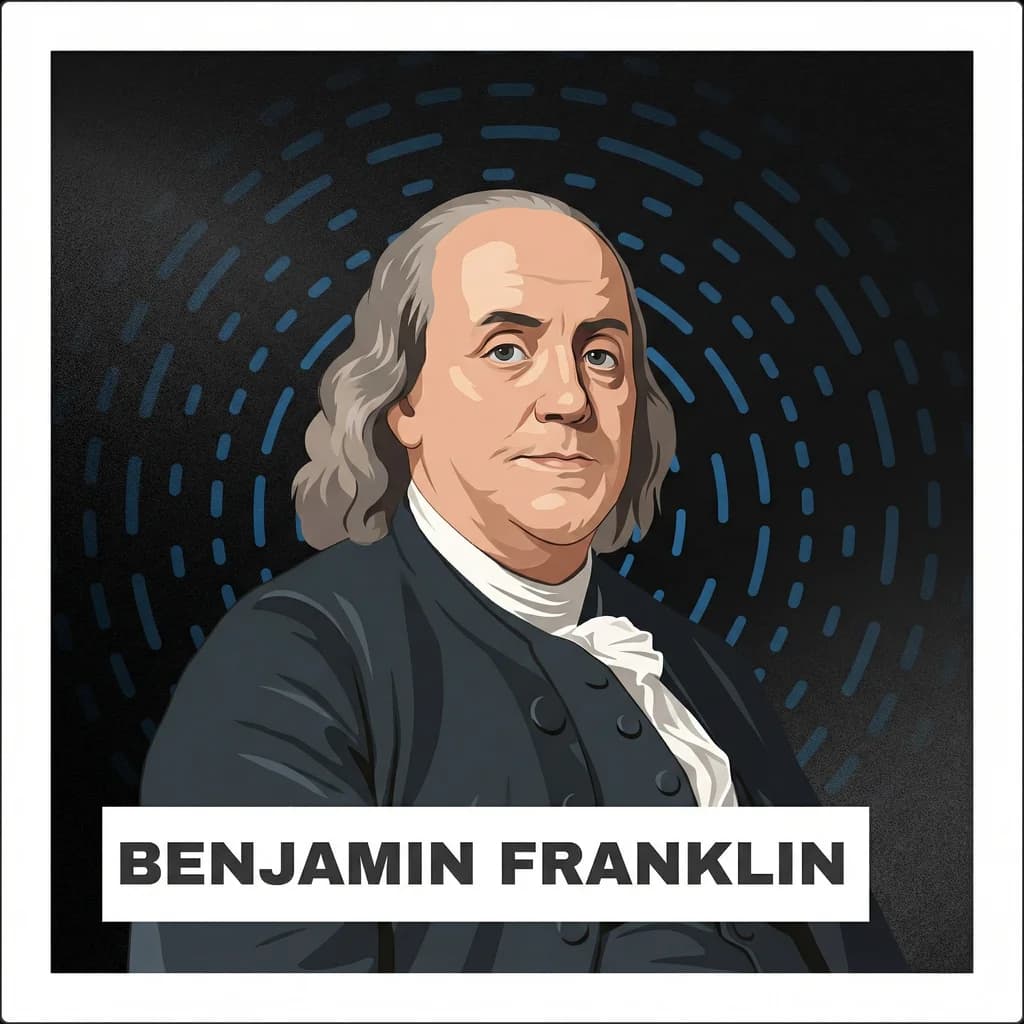
The Puffy Rolls
On a Sunday morning in October 1723, a seventeen-year-old runaway walked up Market Street in Philadelphia carrying three great puffy rolls — one under each arm, a third being devoured as he went. He was filthy from travel, his pockets stuffed with shirts and stockings, his funds reduced to a single Dutch dollar and about a shilling in copper. He had fled a legally binding apprenticeship to his brother in Boston, failed to find work in New York, and arrived in a city where he knew no one, carrying no letters of introduction, possessing no credentials beyond his own hands and whatever was inside his skull. Standing in the doorway of a house on Market Street, a young woman named Deborah Read watched him pass. She "thought I made, as I certainly did, a most awkward ridiculous Appearance," Franklin would later write in his Autobiography — a book that, like its author, would become one of the foundational documents of American self-invention.
This scene is the most famous in American autobiography, and Franklin knew exactly what he was doing when he wrote it. He was seventy years old, the most celebrated American on earth, living in a mansion at Passy outside Paris as the ambassador who had convinced Louis XVI to bankroll a revolution. He chose to open his life story not with triumph but with absurdity — a hungry teenager clutching bread, observed by his future wife, who found him ridiculous. The image is calibrated with the precision of a man who understood, before anyone else in the colonies, that the story you tell about yourself is the self. Every detail serves: the three rolls (abundance purchased with almost nothing), the young woman's gaze (the future already watching), the voluntary admission of his own comic figure (a man so confident he can afford to be embarrassed). It is the origin myth of American meritocracy — not Plymouth Rock, not Jamestown, but a broke kid with bread.
What followed from that morning is perhaps the most improbable résumé in Western history. Printer, publisher, essayist, satirist, postmaster, firefighter, insurance pioneer, lending library founder, hospital founder, university founder, militia organizer, political theorist, colonial agent, revolutionary, diplomat, constitution-maker. Scientist who decoded electricity, inventor of bifocals and the lightning rod and the Franklin stove and a flexible urinary catheter and swim fins and a rocking chair with an attached fan. The man who flew a kite into a thunderstorm and tamed the result. The only Founding Father to sign all four documents that created the United States: the Declaration of Independence in 1776, the Treaty of Alliance with France in 1778, the Treaty of Paris in 1783, and the Constitution in 1787. He was America's first celebrity, its first great diplomat, its first self-help author, its first media entrepreneur, and — in the most consequential sense — its first self-made man.
And he was, as he tartly noted, "the youngest Son of the youngest Son for five Generations back." The tenth son of seventeen children born to a man who made soap and candles — one of the lowliest of the artisan crafts. Two years of formal education. Apprenticed at twelve. On the run at seventeen. Dead at eighty-four, mourned by 20,000 Philadelphians at his funeral. The distance between those puffy rolls and the Treaty of Paris is the distance America likes to believe anyone can travel. Franklin was the proof of concept.
By the Numbers
The Franklin Ledger
84Years lived (1706–1790)
17Children in his father's household
2Years of formal schooling
25Years publishing Poor Richard's Almanack (1733–1758)
4Founding documents signed — only Founder to sign all four
~30,000Extant papers in the Franklin archive at Yale
20,000Mourners at his Philadelphia funeral, April 1790
The Candlemaker's Tenth Son
To understand Franklin, you must understand what he escaped. His father, Josiah Franklin, was born in Ecton, Northamptonshire, England, trained as a silk dyer — a trade that withered under Puritan economic pressures — and emigrated to Boston around 1683, where he reinvented himself as a tallow chandler: a maker of candles and soap. It was hard, foul-smelling, low-margin work. Josiah married twice and produced seventeen children. Benjamin, born January 17, 1706, was the youngest son and the fifteenth child. In an age that privileged primogeniture, he was the residue, the afterthought, the one for whom no inheritance or profession was set aside.
His formal education lasted exactly two years. One year at the Boston Latin School, another under a private teacher, and then at ten he was pulled out to cut wicks and dip tallow in his father's shop. The work disgusted him. Josiah, sensing his son's restlessness and fearing he might run off to sea (as another son had), apprenticed twelve-year-old Benjamin to his older brother James, a printer. It was the decisive intervention. The print shop gave Franklin access to the two things that would define him: words and the machinery that reproduced them. He read voraciously — discovering a volume of The Spectator, the famous periodical essays by Joseph Addison and Richard Steele, he copied and recopied them, turned them into poetry and then back into prose, training his ear for rhythm and argument. "Prose writing," he would recall, became "of great Use to me in the Course of my Life, and was a principal Means of my Advancement."
At sixteen, Franklin began his first act of literary impersonation. Unable to get his brother to publish his writing — James, who founded the New-England Courant in 1721, treated his younger sibling with the condescension typical of the era's master-apprentice relationships — Benjamin adopted the persona of a middle-aged widow named Silence Dogood. He slipped the first letter under the print shop door. The fourteen Dogood essays lampooned Harvard students, funeral eulogies, hoop petticoats, and the pretensions of colonial Boston. Readers were delighted. James and his friends speculated about which learned wit could possibly be writing them. The teenager took "exquisite Pleasure" in the deception. When the truth emerged, James was furious.
The pattern was set. Franklin's genius was not merely intellectual — it was theatrical. He understood, at an age when most people are still learning who they are, that identity is a performance. Silence Dogood was the first of many masks. Later came Richard Saunders (the fictitious author of Poor Richard's Almanack), the Busy-Body, Margaret Aftercast, Ephraim Censorious, Caelia Shortface, and dozens of others. Each persona allowed Franklin to say things Benjamin Franklin could not — to satirize without consequence, to test ideas at a remove, to inhabit perspectives not his own. It was the colonial equivalent of what a modern entrepreneur might call rapid prototyping of the self.
The Education of an Autodidact
Late in 1722, James Franklin was forbidden by the provincial authorities from printing or publishing the Courant. To keep the paper alive, he discharged Benjamin from his apprenticeship and made him the nominal publisher — a legal fiction, since new, secret indentures bound the younger brother as before. Months later, after a bitter quarrel, Benjamin exploited the subterfuge: he walked away, knowing James could not reveal the arrangement without exposing his own deception.
He was seventeen, in possession of a printer's skills and a self-taught prose style and nothing else. He tried New York. No work. He pushed on to Philadelphia — Quaker-dominated, more tolerant than Puritan Boston, and hungry for printers. Within weeks he had a job and a room at the Read family's house, where that young woman from the doorway scene, Deborah, became his companion. Within months, the governor of Pennsylvania, Sir William Keith, was urging him to set up his own shop. Keith was one of those figures who populate the early lives of ambitious young men: the powerful patron who promises everything and delivers nothing. He offered to fund Franklin's trip to London to buy type and make connections with stationers and booksellers. Franklin, barely eighteen, sailed in November 1724, accompanied by a friend named James Ralph — a would-be writer who would prove an expensive companion. Not until the ship was well out at sea did Franklin discover that Keith's letters of credit and introduction did not exist.
London was Franklin's real university. He found work quickly — his skills as a compositor were in demand — and lent money to Ralph, who spent freely and pursued women and literary fame with equal futility. Franklin, too, indulged: he enjoyed the theater, the coffee houses, the women. He wrote a philosophical pamphlet, A Dissertation on Liberty and Necessity, Pleasure and Pain (1725), arguing that humans lack free will and therefore bear no moral responsibility for their actions — a convenient thesis for a young man ignoring the girl he'd left behind. (He later repudiated the pamphlet and burned all but one copy.) He had written Deborah Read only once.
But London also taught him something essential about networks. He met gentlemen scientists. He narrowly missed being introduced to the aging
Isaac Newton. He perfected his knowledge of the printing trade at a level impossible in the colonies. And he observed, with the sharp eye of an outsider, the mechanics of British power — the clubs, the Royal Society, the coffeehouses where ideas circulated among men who controlled capital and policy. He was filing it all away.
By 1726, he was tired of London and its temptations. Thomas Denham, a Quaker merchant, offered him a clerkship in Philadelphia with prospects in the West Indian trade. Franklin sailed home. He was twenty years old. He had been a runaway, a con victim, a London printer, a philosophical provocateur, and an unfaithful almost-fiancé. His formal education had ended sixteen years earlier. His real education was just beginning.
The Printing Press as Platform
Franklin returned to Philadelphia and, by 1728, had opened his own printing shop — financed not by a governor's empty promises but by a small loan and a partnership. What followed was a masterclass in what a later century would call platform building.
He acquired the Pennsylvania Gazette in 1729, transforming it from a moribund sheet into one of the American colonies' major newspapers. He wrote much of the content himself, often under pseudonyms, and used the paper to advocate for civic improvements — better fire protection, cleaner streets, a more reliable postal system. In 1732, he launched Poor Richard's Almanack under the pseudonym Richard Saunders, and for twenty-five years — from 1733 to 1758 — he published it annually, filling its pages with the pithy maxims that would make him the most quotable American of his century. "Early to bed and early to rise, makes a man healthy, wealthy and wise." "An investment in knowledge pays the best interest." "Remember that time is money."
These weren't just aphorisms. They were a business strategy. Each saying reinforced the persona Franklin was constructing: the industrious, frugal, self-improving tradesman. And the persona wasn't merely for show — or rather, the show was the substance. As a young printer, he carted rolls of paper through the streets of Philadelphia to give the appearance of being industrious. He made sure he was seen at his press early and late. He dressed plainly. He cultivated the image of a man too busy working to waste time on vanity. "I took care not only to be in Reality Industrious and frugal, but to avoid all Appearances of the Contrary," he wrote. The gap between performance and reality was negligible; Franklin was industrious. But he understood that being perceived as industrious was a separate and equally important achievement.
The printing business generated cash flow. The Gazette and the Almanack generated influence. And influence, in colonial Philadelphia, could be converted into civic power with remarkable efficiency. Franklin founded the Junto in 1727 — a self-improvement society of tradesmen, originally called the Leather Apron Club, that met weekly in a tavern to discuss morals, politics, and natural philosophy. Its members included a silversmith, a clockmaker, a glazier — men who wore leather aprons, not powdered wigs. The Junto became Franklin's think tank, his focus group, and his political base.
From the Junto and its expanding network sprang an astonishing sequence of civic institutions. The Library Company of Philadelphia in 1731 — the first subscription lending library in North America. The Union Fire Company in 1736 — America's first volunteer fire brigade, formed after a devastating wharf fire in 1730 that caused thousands of pounds in damage and convinced Franklin that "an ounce of prevention is worth a pound of cure." The American Philosophical Society in 1743 — modeled on the Royal Society of London, dedicated to the pursuit of "useful knowledge." An academy in 1749 that would become the University of Pennsylvania. A hospital — Pennsylvania Hospital, the first in the colonies. The Philadelphia Contributionship for the Insurance of Houses from Loss by Fire in 1752 — the oldest property insurance company in the United States, still operating today from its headquarters on Fourth Street. Each institution solved a specific problem while simultaneously expanding Franklin's reputation and his web of obligations and alliances.
I took care not only to be in Reality Industrious and frugal, but to avoid all Appearances of the Contrary.
The method was consistent: identify a public need, propose a solution, organize a subscription or mutual association, let others take credit while retaining operational control, and move on to the next problem. Franklin understood — decades before anyone theorized it — that civic infrastructure is a form of compounding capital. A lending library creates educated citizens who create demand for newspapers and almanacks and political pamphlets, all of which a printer can supply. A fire company creates demand for fire insurance. A postal system creates demand for printed material. Every institution he founded fed the others, and all of them fed the printing press at the center. It was, in the truest sense, a platform business.
Lightning and the Laws of Charge
By 1748, at the age of forty-two, Franklin had made enough money to retire from active business. He turned over the printing operation to his partner David Hall, retaining a share of the profits, and announced his intention to devote himself to "philosophical studies and amusements." The timing was impeccable. An itinerant English lecturer had demonstrated the latest electrical experiments in Philadelphia in 1743, and Franklin, who had bought the man's entire apparatus, had been conducting his own experiments in the intervals between money-making and politics ever since.
Electricity in the 1740s was largely a parlor trick — Leyden jars, sparks, the peculiar shock that could be passed through a chain of people holding hands. It was curious, entertaining, and scientifically incoherent. Nobody understood what it was. Franklin, working from his home laboratory with a small group of Philadelphia collaborators, brought to the problem the same combination of empirical rigor and practical imagination he applied to everything. He introduced the vocabulary — "positive," "negative," "battery," "conductor," "charge" — that scientists still use. He established that electrical charge is conserved: the positive and negative states of electrification must occur in exactly equal amounts, a principle now known as the law of conservation of charge. He was not tinkering. He was rewriting the grammar of a new science.
Then came the kite. In June 1752, Franklin and his son William launched a silk kite into a thunderstorm. A metal key was attached to the kite string. When the key sparked and the Leyden jar connected to it became charged, the experiment demonstrated what Franklin had hypothesized: lightning and electricity are identical phenomena. The experiment was genuinely dangerous — a Swedish physicist attempting to replicate it was killed the following year — though Franklin himself was well insulated and in less peril than legend suggests. From the discovery came the lightning rod, a device of elegant simplicity: a pointed metal conductor extending above a building, drawing the electrical charge safely into the ground. It was science converted immediately into public utility. People's houses stopped burning down.
The lightning rod made Franklin the most famous scientist in the world. The Royal Society of London awarded him the Copley Medal in 1753 — a colonial autodidact breaking through the frosty hierarchy of British institutional science. France's Academy of Sciences elected him one of its eight foreign associates (a century would pass before another American received this honor). Yale awarded him an honorary Master of Arts in 1753 for his scientific accomplishments. He was, suddenly, a celebrity — and celebrity, in the eighteenth century as in the twenty-first, was a form of power.
The more I discover'd of the former, the more I admir'd them; the more I know of the latter, the more I am disgusted with them. Men I find to be a Sort of Beings very badly constructed, as they are generally more easily provok'd than reconcil'd, more dispos'd to do Mischief to each other than to make Reparation.
The Long Absence
Franklin's civic and scientific achievements made him indispensable to the colony of Pennsylvania — and then to the colonies collectively. He was elected to the Pennsylvania Assembly. He served as deputy postmaster for the Colonies from 1753 to 1774, reorganizing the entire postal system to make it efficient and profitable. He proposed the Albany Plan of Union in 1754 — a visionary scheme for uniting the colonies under a federal model that anticipated the Articles of Confederation and, ultimately, the Constitution. The plan was rejected by both the colonial assemblies and the Crown, but the idea had entered the bloodstream.
In 1757, the Assembly sent him to London to negotiate with the Penn family — the hereditary proprietors of Pennsylvania — over their refusal to pay taxes on their lands. He was fifty-one years old. He would not return to America for five years. And then, after a brief interlude, he would go back to London and remain for another decade. Altogether, Franklin spent roughly the last third of his adult life outside the United States — more than sixteen years in London, nearly nine in France. He was, as the BBC noted, a founding father "who travelled the globe," journeying farther and longer than any other American of his time.
London was intoxicating. Franklin settled at 36 Craven Street, near Charing Cross, in the house of a widow named Margaret Stevenson, and for nearly seventeen years — with a brief return to Philadelphia — this was his home. He dined with the intelligentsia, corresponded with David Hume, toured the great estates, served as colonial agent for not just Pennsylvania but Georgia, New Jersey, and Massachusetts. He was the colonies' de facto ambassador, but he was also, unmistakably, a man who loved London. He loved its coffeehouses, its Royal Society, its intellectual ferment, its proximity to power. The question that haunted the last London years was whether Franklin, the greatest booster of the British Empire in America, could remain a loyal subject when the Empire began treating its colonies as cash cows.
The Stamp Act of 1765 was the turning point — not because Franklin opposed it from the start (he didn't; he even secured for a friend the position of stamp agent in Philadelphia, a catastrophic misjudgment that nearly destroyed his reputation) but because he came to understand, through the fury of the colonial response, that Parliament's attempt to levy internal taxes on the colonies was an existential threat to the relationship. He testified before Parliament and helped secure the Act's repeal in 1766. But the damage was done, and deeper wounds followed.
In 1773, Franklin obtained and leaked to Massachusetts a set of private letters written by the colony's royal governor, Thomas Hutchinson, which revealed Hutchinson's advocacy for restricting colonial liberties. The Hutchinson affair was an act of what a later era would call whistleblowing — Franklin believed the letters showed that the conflict between the colonies and the Crown was being inflamed by a few bad actors, not by British policy itself. He was wrong about the underlying cause, but right about the explosive power of the letters. When the source of the leak was exposed, Franklin was summoned before the Privy Council in January 1774 and publicly humiliated by Solicitor General Alexander Wedderburn, who called him a thief and a man of "no honour" for more than an hour before a jeering audience. Franklin stood motionless throughout the ordeal, wearing the same suit of blue Manchester velvet. He said nothing.
He would wear that suit again, a decade later, on a very different occasion.
The Revolution's Oldest Soldier
Franklin arrived back in Philadelphia on May 5, 1775, eighteen days after the battles of Lexington and Concord. He was nearly seventy — by far the oldest delegate to the Second Continental Congress, which was gathering in the Pennsylvania statehouse he had known for forty years. Most of the other sixty-two delegates —
Thomas Jefferson, Patrick Henry, John Adams, John Hancock — had not been born when Franklin first went to work in that building.
He moved into the house on Market Street that he had designed but never actually lived in. His wife Deborah had died there, in 1774, without him — after more than a decade of separation during which he had written her dutifully but visited rarely. It is one of the genuine shadows on Franklin's character: the civic improver, the champion of useful knowledge, the man who could charm French aristocrats and negotiate with kings, was also a husband who let his wife die alone. His thirty-one-year-old daughter, Sally, took care of his domestic needs. His grandsons — Ben, six, and Will, two — provided amusement. "Will has got a little gun, marches with it, and whistles at the same time by way of fife," he wrote, and the image is tender, but there is the matter of the other William.
William Franklin — Benjamin's illegitimate son, whose mother remains unidentified — had been his father's closest collaborator. It was William who had helped fly the kite in the thunderstorm. Benjamin had secured for him the position of royal governor of New Jersey in 1763. And William, unlike his father, did not turn rebel. He remained loyal to the Crown. The estrangement between father and son — the revolutionary and the loyalist, the self-made American and the royal appointee — was permanent. They would exchange a few cold letters after the war. They would never reconcile in any meaningful sense. The man who helped found a nation on the principle of self-evident truths could not find common ground with his own child. The contradiction is not incidental; it is, in some ways, the subject.
At the Congress, Franklin kept quiet about whether he favored independence. He attended sessions, served on committees, said little, and dined at home — declining the tavern debates where the other delegates argued the question nightly. Then, when the moment came, he moved decisively. He was appointed to the Committee of Five tasked with drafting a Declaration of Independence: John Adams, Roger Sherman, Robert Livingston, Thomas Jefferson, and Franklin. Jefferson wrote the first draft. Franklin made only a few edits, but one was pivotal. Jefferson's most important sentence began: "We hold these truths to be sacred and undeniable, that all men are created equal." Franklin crossed out "sacred and undeniable" and wrote "self-evident." The change was more than editorial. "Sacred and undeniable" grounds the claim in religion and argument. "Self-evident" grounds it in reason and common sense — in the Enlightenment itself. It is the most consequential edit in American history.
According to legend, Franklin was not permitted to write the Declaration himself because his colleagues feared he would smuggle in a joke. Whether or not this is true, it rhymes with what we know. At the signing, as the delegates braced themselves for the consequences of treason, John Hancock reportedly said, "We must all hang together." Franklin's reply: "We must, indeed, all hang together, or most assuredly we shall all hang separately."
The Sage of Passy
In late 1776, the Congress dispatched Franklin to France on the most critical diplomatic mission of the Revolution: securing French recognition of American independence and, with it, the money, arms, and naval power that could tip the war. He was seventy. He had gout, kidney stones, and a skin disease. He took with him his sixteen-year-old grandson, Temple (William's son), and another grandson, seven-year-old Benny Bache (Sally's son). The crossing took thirty days. Upon landing, he learned that, in France, he was already the most famous American alive.
His reputation as the "Newton of electricity" preceded him. His likeness appeared on medallions, rings, watches, snuffboxes. Fashionable Parisiennes adopted the "coiffure à la Franklin" in imitation of the fur cap he wore instead of a powdered wig. He settled in a mansion at Passy, just outside Paris, provided by Jacques-Donatien Le Ray de Chaumont — a wealthy admirer who refused to accept rent — and began one of the most brilliant diplomatic campaigns in modern history.
Franklin understood that his celebrity was a weapon. He played the role the French wanted him to play: the simple philosopher-frontiersman, the embodiment of Rousseau's noble natural man, uncorrupted by civilization. In a court of powdered periwigs and silk stockings, he appeared in plain brown suits and that fur cap. It was pure theater — Franklin had lived in London for sixteen years, dined with lords, and moved as comfortably in aristocratic circles as anyone in Europe — but it was effective theater. He befriended the philosophes, charmed the salons, and became, at the court of Versailles, the living argument for American worthiness.
The alliance he helped forge was decisive. After the American victory at Saratoga in October 1777 — the first major battlefield success that demonstrated the colonies could actually win — France formally recognized American independence and concluded a military alliance in February 1778. Franklin presented his credentials to the French court in 1779, becoming the first American minister received by a foreign government. When Thomas Jefferson succeeded him in 1785, French Foreign Minister Vergennes asked: "It is you who replace Dr. Franklin?" Jefferson's reply became famous: "No one can replace him, Sir; I am only his successor."
The culmination came on September 3, 1783, when Franklin and his colleagues signed the Treaty of Paris, ending the American Revolution and establishing the United States. The papers — approximately 30,000 extant documents spanning Franklin's decades of correspondence — were later catalogued in what became a monumental scholarly project at Yale, still underway after seven decades, projected to reach forty-seven volumes.
For the signing of the treaty, Franklin wore a blue Manchester velvet suit.
It was the same suit.
The Rising Sun
Franklin returned to Philadelphia in 1785, at seventy-nine, and was immediately elected president of Pennsylvania's Supreme Executive Council — the state's chief executive. He served three years. Then, in 1787, he was appointed a delegate to the Constitutional Convention. He was eighty-one, in constant pain, and had to be carried to the sessions in a sedan chair borne by prisoners from the Walnut Street jail.
He was not the Convention's most influential voice. He brought no new theoretical framework. His specific proposals — a unicameral legislature, unpaid executives — were rejected. His importance was, as historians at the University of Wisconsin have noted, "largely symbolic." In 1787, Franklin and
George Washington were venerated as the two greatest living Americans — the diplomatic hero and the military hero. Their mere presence gave Americans confidence that the outcome would be legitimate.
But Franklin's final act at the Convention was a masterpiece of political rhetoric. On September 17, 1787, as the engrossed Constitution was read aloud for the last time, the enfeebled Franklin rose with a speech in his hand — too weak to deliver it himself, he asked fellow Pennsylvania delegate James Wilson to read it for him. The speech is a marvel of strategic humility:
I confess that there are several parts of this constitution which I do not at present approve, but I am not sure I shall never approve them: For having lived long, I have experienced many instances of being obliged by better information or fuller consideration, to change opinions even on important subjects, which I once thought right, but found to be otherwise. It is therefore that the older I grow, the more apt I am to doubt my own judgment, and to pay more respect to the judgment of others.
He acknowledged the Constitution's imperfections. He sacrificed his private objections to the public good. He urged every delegate to sign — and all but three complied. Then, while the last signatures were being affixed, Franklin looked toward the president's chair, at the back of which a rising sun happened to be painted. He turned to the members near him and observed that painters had always found it difficult to distinguish a rising sun from a setting one. "I have," he said, "often and often in the course of the Session, and the vicissitudes of my hopes and fears as to its issue, looked at that behind the President without being able to tell whether it was rising or setting: But now at length I have the happiness to know that it is a rising and not a setting Sun."
The Last Petition
Franklin spent his final years at his home on Market Street, increasingly frail, managing his pain with laudanum, writing. In November 1789, he composed a letter to the French scientist Jean-Baptiste Le Roy — concerned that he hadn't heard from his friend since the start of the French Revolution — and included what became his most famous late remark: "Our new Constitution is now established, everything seems to promise it will be durable; but, in this world, nothing is certain except death and taxes."
He was not done surprising people. In February 1790, two months before his death, Franklin submitted a petition to Congress on behalf of the Pennsylvania Abolition Society — of which he was president — calling for the abolition of slavery. It was one of the first such petitions the new government received. Franklin had himself been complicit in slavery — he had owned enslaved people in middle age, published advertisements for the sale of slaves in the Gazette — and his late-life turn to abolitionism was, depending on your perspective, a redemptive arc or an insufficient reckoning. Perhaps both. The petition was tabled by Congress. Slavery would endure for another seventy-five years.
On March 25, 1790, three weeks before his death, Franklin published what appears to be his final public writing: a biting satirical essay on the slave trade, using the device of a fictional Algerian pirate who argues — with reasoning exactly parallel to that of American slaveholders — that Christian captives should not be freed because their enslavement is sanctioned by custom and necessity. It is, like the Silence Dogood letters of sixty-eight years earlier, an act of literary impersonation deployed in the service of moral argument. The masks never came off because the masks were how Franklin told the truth.
He died on April 17, 1790, at eighty-four. In what is believed to be his last known letter, dated April 8, he responded to Secretary of State Thomas Jefferson's inquiry about a boundary dispute between the Bay of Fundy and Maine, noting that he had been too ill to attend to business but could confirm his memory of which map had been used in the Treaty negotiations. "I have the Honor to be with the greatest Esteem and Respect Sir, Your most obedient and most humble Servant," he signed off. It is the most Franklin ending imaginable: no grand valediction, just a useful piece of information, precisely delivered.
To his friend George Whatley, years earlier, he had written about death with the equanimity of a man who had spent a lifetime studying natural phenomena: "I look upon death to be as necessary to our constitutions as sleep. We shall rise refreshed in the morning."
Twenty thousand people attended the funeral. The National Assembly of France declared three days of mourning. The Pennsylvania Gazette — the newspaper he had built from nothing at twenty-three — carried the notice. In Franklin, Massachusetts — a town that had changed its name from Exeter in 1778, hoping he would donate a bell for the church — he had instead sent books, which became the foundation of the first public library in the United States. Always the useful thing rather than the ornamental one. Always the institution rather than the gesture.
In the bedroom on Market Street where he died, the light came through the same windows Deborah Read had looked out of during the decade he was in London, the decade he was in Paris. Whether the sun that fell across the floor that April morning was rising or setting is, at this point, a question each reader must answer alone.