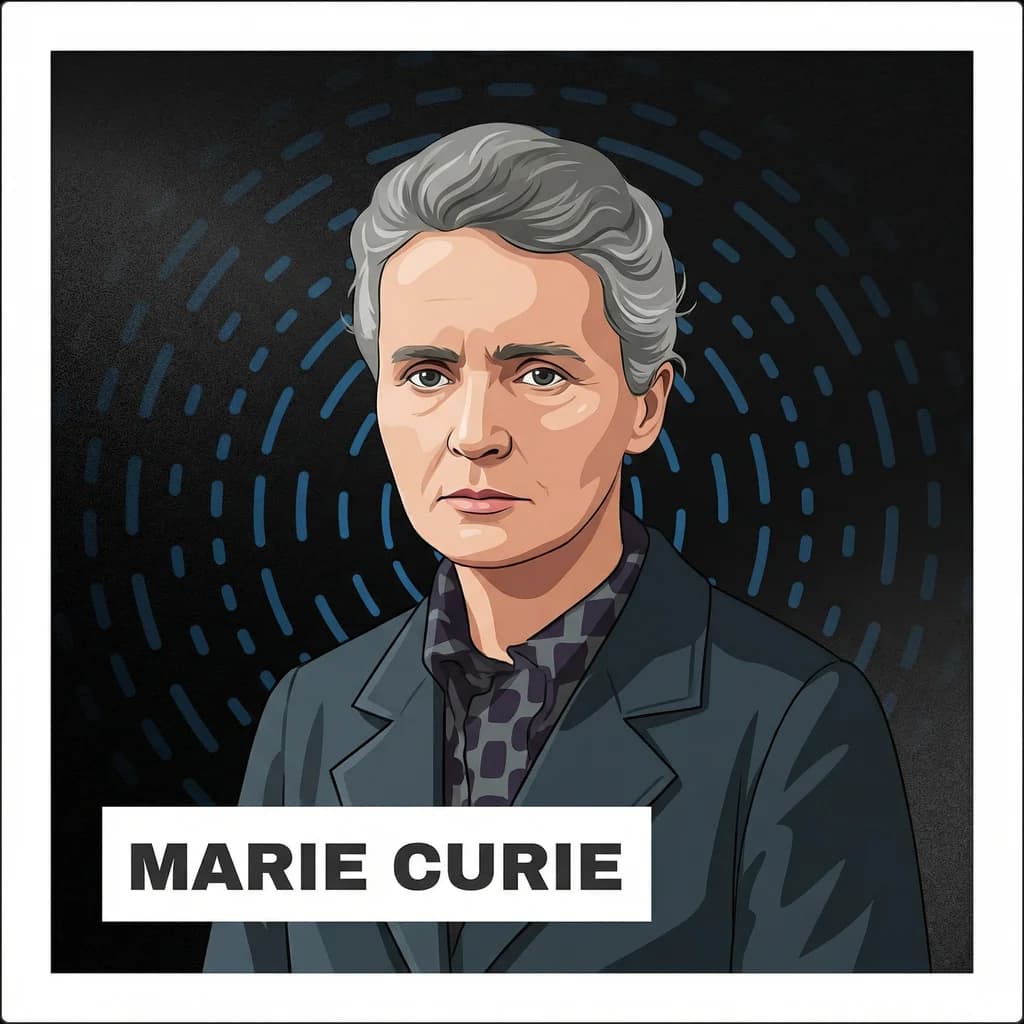
The Chemistry of the Imponderable
In a converted shed on the grounds of the École de Physique et Chimie Industrielles in Paris — a space that had previously served as a medical school's dissecting room, its glass roof leaking in rain, its iron stove barely adequate against the damp — a woman spent four years stirring boiling cauldrons of pitchblende residue with an iron rod nearly as tall as she was. The work was more industrial than scientific: treating batches of ore of up to twenty kilograms, dissolving them in acid, filtering, precipitating, crystallizing, measuring, then doing it all again. Thousands of crystallizations. Tons of raw material refined to fractions of fractions. The shed had no fume hoods; the poisonous gases were vented in the courtyard. Her fingertips became cracked, hardened and painful, and the Curies reported the damage in print. She did not complain about this, or about much else. "Sometimes I had to spend a whole day mixing a boiling mass with a heavy iron rod nearly as large as myself," she would later write, with the flat affect of someone describing the weather. "I would be broken with fatigue at the day's end." What she was chasing — a new element, present in uranium ore at "scarcely more than three decigrammes of radium to the ton" — had never been seen, weighed, or isolated by anyone in the history of the world. She would extract it. She would name it. And the radiation it emitted would, over the course of decades, remake physics, transform medicine, kill her, and leave her personal notebooks so contaminated that they remain stored in lead-lined boxes at the Bibliothèque Nationale de France, where researchers who wish to consult them must sign a liability waiver and don protective clothing. The notebooks will be radioactive for another 1,500 years. It seems fitting, if savage, that Marie Curie's most intimate scientific records — her handwriting, her calculations, the coffee-ring stains and splashes from boiling radium salts — constitute a kind of immortality that no biography can match. The woman herself has been dead since 1934. Her fingerprints still register on a Geiger counter.
By the Numbers
Marie Curie
2Nobel Prizes (Physics 1903, Chemistry 1911)
1 decigramPure radium chloride from tons of pitchblende residue (1902)
400,000 francsMarket value per gram of radium in her era
45+Women who trained in her laboratory (1906–1934)
150Women trained as X-ray technicians during WWI
1,500 yearsRemaining radioactivity of her notebooks
66Age at death from aplastic anemia (July 4, 1934)
The Pact
To understand the force that propelled Maria Sklodowska from Warsaw to Paris, from governess to double Nobel laureate, one must begin not with genius but with grief, poverty, and a deal between sisters.
She was born on November 7, 1867, in the Congress Kingdom of Poland — which is to say, in a country that did not officially exist. Poland had been partitioned among Russia, Prussia, and Austria; Warsaw was under Tsarist control, and the Russian authorities were engaged in a systematic campaign to erase Polish culture, Polish language, Polish identity. Maria's parents, Władysław and Bronisława Sklodowski, were both teachers — educated, patriotic, and poor. Her father taught mathematics and physics in Russian-run schools and in 1873 was demoted from his post as assistant director of a gymnasium. His savings vanished in a brother-in-law's mill scheme. The family moved to progressively smaller apartments. When Maria was eight, her oldest sister Zofia died of typhus. On May 9, 1878, her mother, Bronisława, died of tuberculosis. The girl was ten.
What the Sklodowski household had in abundance, in lieu of money or security, was intellectual ambition, and a habit of defiance. At school Maria and her friend Kazia spat on the Tsar's loyalty obelisk in Saxon Square every time they passed. She finished her secondary education in 1883, at fifteen, first in her class with the gold medal, at a Russian gymnasium where instruction in the Polish language was forbidden. She could not, however, attend a university. Warsaw University did not admit women, and the realistic future, she wrote, was to "take a post as teacher in a girls' school." So Maria did what she would do again and again: she struck a bargain.
She and her sister Bronisława — Bronya — agreed to "work as a relay team." Maria would work as a governess, sending money to Paris so that Bronya could study medicine. Then Bronya would reciprocate, funding Maria's own education. For six years, from the age of seventeen to twenty-three, Maria worked in Polish households, saving what she could. At the Zorawski estate at Szczuki she sent Bronya "fifteen rubles every month and sometimes twenty—nearly half her salary," according to her daughter Ève, taught the family's children seven hours a day, ran an illegal reading class for peasant children from her own room, and studied at night. Before and after, she attended the clandestine "Floating University" (Susan Quinn calls it the Flying University), a secret Polish academy that met in private rooms, and in Ève's account read aloud in Polish to the employees of a dressmaking establishment, an act that was illegal and genuinely dangerous.
At Szczuki the Zorawskis' son Kazimierz wanted to marry her. His parents refused to let him take a penniless governess, and he gave way. She stayed on for more than a year in the house of people who thought her unworthy of their son, because the money was needed. A last attempt to save the romance failed in the Tatra mountains in the summer of 1891, and she wrote to Bronya of "the cruel trials I have been through this summer, which will have an influence on my whole life." Her first principle, set down in 1888, was "never to let one's self be beaten down by persons or by events."
Bread, Butter, and the Sorbonne
In November 1891, at the age of twenty-four, Maria Sklodowska took a fourth-class train to Paris. She carried almost nothing. She enrolled at the Sorbonne under the name Marie — a small, decisive act of self-reinvention — and threw herself into the study of physics and mathematics with the ferocity of someone who had been waiting six years for the opportunity.
Her living conditions were austere to the point of myth. She rented a sixth-floor garret in the Latin Quarter and carried her own coal up the six flights. She lived, she wrote, on "bread with a cup of chocolate, eggs or fruit." Ève records that she grew anaemic and once fainted in front of a fellow student, who fetched Bronya's husband. She did not seem to regard this as remarkable, or even particularly unfortunate. It was the price of the work. She came first in her licence in physical sciences in 1893, and second in mathematical sciences the following year — this in a cohort that was overwhelmingly male, overwhelmingly French, and overwhelmingly better funded than she was.
She began research in the laboratory of Gabriel Lippmann, the physicist who would himself win a Nobel Prize in 1908 for his work in color photography. She needed space. She needed equipment. And it was in the spring of 1894, while looking for both, that she was introduced to a man whose name would become inseparable from her own.
Two Dreamers on Bicycles
Pierre Curie was thirty-five years old when he met Marie Sklodowska — a dreamy, deeply serious physicist who had already made significant contributions to the study of piezoelectricity and magnetism, yet held a relatively modest position as head of the laboratory at the École de Physique et Chimie Industrielles. Born in Paris on May 15, 1859, to a physician father who had educated him at home rather than subject him to the rigidities of formal schooling, Pierre was a man who seemed constitutionally averse to self-promotion. He had discovered that the magnetic properties of a substance change at a specific temperature — now called the Curie point — and had constructed delicate measuring instruments of extraordinary precision, yet he had never aggressively pursued the professorships or honors that his work merited. He was, in the language of a later era, an introvert's introvert: brilliant, gentle, and almost pathologically indifferent to career advancement.
Marie needed laboratory space. Pierre had some. What began as a practical arrangement became, rapidly, something else entirely. They bonded over magnetism — the scientific kind, and the other kind. They went on long bicycle rides. He proposed. She hesitated; she was still thinking of returning to Poland to teach. He proposed again. On July 25, 1895, they were married in a civil ceremony in Sceaux, a suburb of Paris. There was no religious service, no reception to speak of. They used their wedding-gift money to buy bicycles.
The partnership that followed was, by the available evidence, one of the most productive marriages in the history of science — and also, by every account, genuinely happy. Pierre, who "used to say that he had got a wife made expressly for him to share all his preoccupations," eventually abandoned his work on crystals, "provisionally, he thought," to join Marie's investigation into the strange phenomenon that Henri Becquerel had stumbled upon in 1896: the spontaneous emission of rays from uranium salts. It was Marie who chose it for her doctoral thesis, because "the question was entirely new and nothing yet had been written upon it," and who decided that "the first thing to do was to measure the phenomenon with precision." Working in a glassed-in storeroom where the temperature fell to forty-three degrees Fahrenheit, she surveyed every element and mineral she could borrow to see whether the property was unique to uranium. It was Marie who coined the term radioactivity. And it was Marie whose systematic measurements of every available compound led to the crucial observation that would change everything: certain minerals containing uranium were more radioactive than pure uranium itself.
"I verified this surprising fact carefully, and could not doubt its truth." Something else was in the ore. Something unknown. Something intensely, astonishingly active. Her paper of April 12, 1898, had to be read to the Academy of Sciences by Lippmann, since neither Curie was a member. She was not first on everything: Gerhard Schmidt had reported thorium's activity nineteen days before her.
I then thought that the greater activity of the natural minerals might be determined by the presence of a small quantity of a highly-radioactive material, different from uranium, thorium and the elements known at present.
A New Method of Searching for New Elements
What Marie Curie did next — methodically, relentlessly, over months and then years — was to create an entirely new approach to chemical discovery. Rather than identifying elements by their weight, their color, their spectral lines, or their reactions with other known substances, she used radioactivity itself as a detection tool. Each chemical separation was followed by a measurement of the activity of the products obtained, and in this way she could track the unknown substance through a labyrinth of chemical reactions, following its invisible signal like a hunter following a trail of heat through snow.
Pierre joined the hunt. They worked together in the leaky shed. In the summer of 1898, they announced the discovery of a new element, far more radioactive than uranium, which Marie named polonium — a deliberate act of political memory, a declaration of love for a country that had been erased from the map. A few months later, they found a second element, even more powerfully radioactive. They called it radium.
But finding radium and proving its existence as a distinct chemical element were two very different things. Physicists accepted it; chemists did not. "To make chemists admit their existence, it was necessary to isolate them." The proportion of radium in pitchblende was staggeringly small — a few decigrams per ton of ore, where she had first guessed one per cent. "Would we have insisted... if we had known the true proportion of what we were searching for, no one can tell." To extract a measurable quantity, the Curies would need to process enormous amounts of raw material, using a tedious technique of fractional crystallization that Marie had developed: dissolving mixed salts in water, allowing crystals to form, separating them, dissolving again, crystallizing again, each cycle slightly enriching the radium concentration. Several thousand crystallizations would be required to achieve purity.
They could not afford to buy pitchblende. Instead, they secured the residues of the Austrian state mine at St. Joachimsthal, "then quite valueless," left in a heap in a pine wood after the uranium had been extracted. "How glad I was when the sacks arrived, with the brown dust mixed with pine needles." Quinn calls it "her gift as a scavenger."
Tons of material have to be treated in order to extract radium from the ore. The quantities of radium available in a laboratory are of the order of one milligram, or of a gram at the very most, this substance being worth 400,000 francs per gram.
The work was physically brutal and intellectually painstaking in equal measure. Marie performed the chemical separations and the interminable crystallizations. Pierre focused on the physical study of the new radiations. The chemist Gustave Bémont helped with the first separations, and André Debierne, whom Pierre recruited to radioactivity, later found actinium and stayed Marie's collaborator for decades. By 1902, Marie had isolated one decigram of pure radium chloride and determined its atomic weight: 225, refined in 1907 to 226.45. Eugène Demarçay's spectroscopy confirmed a new element, with a line that "intensifies at the same time that the radioactivity intensifies." Radium was real. "For equal weights this substance emits a radiation more than a million times more intense than uranium." It glowed in the dark. And it was, at 400,000 francs per gram, among the most valuable substances on earth. "It had taken me almost four years," she wrote. "One year would probably have been enough for the same purpose, if reasonable means had been at my disposal." Yet she called the shed years "the best and happiest years of our life."
In June 1903 Marie Curie defended her doctoral thesis — Recherches sur les Substances Radioactives — at the Sorbonne, before Lippmann, Bouty and Moissan; it was published that summer in England and France as an important document of the new science. Two months later she miscarried in the fifth month: "I am absolutely desperate and cannot be consoled." In December she, Pierre, and Henri Becquerel shared the Nobel Prize in Physics.
The Omission and the Insistence
The 1903 Nobel Prize almost did not include her name. The French academicians who nominated for the prize proposed only Becquerel and Pierre Curie. Marie was simply not mentioned — an omission that the Swedish mathematician Gustav Mittag-Leffler, one of the most influential members of the Swedish Academy, wrote to tell Pierre about in the summer of 1903. Pierre replied on August 6: "If it is true that one is seriously thinking about me [for the prize], I very much wish to be considered together with Madame Curie with respect to our research on radioactive bodies." Since no one had nominated her that year, the committee, as Quinn tells it, resurrected a 1902 letter from Charles Bouchard to do so.
Marie Curie became the first woman to receive a Nobel Prize. But the episode revealed a fault line that would run through the rest of her career: the persistent institutional assumption that her contributions were secondary, derivative, the work of a helpmate rather than a pioneer. When she won the Gegner prize in 1898, the Academy informed Pierre, not her. In January 1911 she stood for the Academy of Sciences and lost to Édouard Branly, amid a press campaign in which, Ève writes, "Kindly informers declared to the Catholics that Marie was a Jewess." She was never elected, and said she would never stand again. The Academy did not elect a woman as a full member until 1979.
The Curies did not patent their processes for isolating radium. "We took out no patent and we did not reserve any advantage in any industrial exploitation. No detail was kept secret," she wrote. She knew the price: "it is a fortune which we have sacrificed in renouncing the exploitation of our discovery, a fortune that could, after us, have gone to our children." But "I still believe that we have done right." Until the Nobel money came, the Curies were short of funds, dependent on teaching salaries; she took a post at the girls' Normal School at Sèvres to pay for the work.
The Accident on the Rue Dauphine
On April 19, 1906, Pierre Curie stepped off a curb on the Rue Dauphine in the rain. He was crushed under the rear wheel of a six-ton horse-drawn wagon and killed instantly. He was forty-six years old. Their younger daughter, Ève, was sixteen months old.
Marie's grief was devastating and private. She kept a journal addressed to Pierre — a raw, anguished document that she showed to no one, and from which a page was later torn out. "I will not kill myself, I don't even have the desire for suicide. But among all these carriages, isn't there one which will make me share the fate of my beloved?" What pulled her through was Pierre's own rule: "Whatever happens, even if one should become like a body without a soul, still one must always work." The faculty's first move was a compromise: leave Pierre's chair vacant and make her chargé de cours, doing his job without his title. "They have offered that I should take your place, my Pierre... I accepted. I don't know if it is good or bad." No woman had taught at the Sorbonne before. She was made titular professor two years later.
On November 5, 1906, she delivered her first lecture to a packed amphitheatre of society women, journalists and, in the front rows, her students from Sèvres. She gave no tribute and no speech. She began: "When one considers the progress in physics in the last decade," then, "one is surprised by the changes it has produced in our ideas about electricity and about matter." Ève writes that she "had resumed the course at the precise sentence where Pierre Curie had left it"; Quinn says only that she began right away to summarise the decade's research. The next day she wrote in the journal: "Yesterday I gave the first class replacing my Pierre. What grief and what despair!"
She was thirty-eight, a widow with two daughters, and now the most prominent woman scientist in the world. She moved to Sceaux, near Pierre's grave, and a year later was still writing, "How sweet it would be to go to sleep and not wake up." The decade that followed would bring her both her greatest professional triumph and the most vicious public attack of her life.
The Second Prize and the Scandal
In 1911, Marie Curie received her second Nobel Prize — this time in chemistry, for the isolation of pure radium and the determination of its atomic weight. She remains, as of this writing, the only person ever to receive Nobel Prizes in two different scientific categories. The award recognized what her 1911 Nobel Lecture would call "the corner-stone of the edifice of the science of radioactivity": the definitive proof that radium was a distinct chemical element, not a molecular compound, and that radioactivity was an atomic property that survived all chemical transformations.
But the ceremony in Stockholm on December 11, 1911, occurred against the backdrop of a scandal that nearly destroyed her. In 1910 she had begun a love affair with the physicist Paul Langevin — Pierre's former student, married and unhappily so — and they had rented a flat together. Around Easter of 1911 someone, apparently hired by Langevin's wife Jeanne, broke in and stole their letters. In November the story broke, and on November 23 Gustave Téry printed the letters, calling her "a foreign woman, an intellectual, emancipated." The xenophobia was the point: she was called in turn a Russian, a German and a Jew (she was none of these). The affair provoked, Quinn counts, at least five duels; Langevin fought one with Téry in which neither man fired. A crowd gathered outside her house at Sceaux, and friends had to fetch her out. Her prize had been announced on November 7. Svante Arrhenius, who had championed her, now wrote: "I therefore beg you to stay in France."
She would not. "I cannot accept the idea in principle that the appreciation of the value of scientific work should be influenced by libel and slander concerning private life," she replied. When her brother and sister urged her home to Poland, she said: "I am French. My daughters also. Like Pierre. I will stay here and I will continue if I'm allowed to." She went to Stockholm, ill, with Bronya and Irène, and spoke about the chemistry of radium, about atomic weights and fractional crystallization and the electrometric detection of radioactive substances. She did not mention the scandal. She claimed her own work more openly than ever: isolating radium "was undertaken by me alone." And near the start she made a carefully worded claim on behalf of her dead husband:
I thus feel that I interpret correctly the intention of the Academy of Sciences in assuming that the award of this high distinction to me is motivated by this common work and thus pays homage to the memory of Pierre Curie.
It was an act of extraordinary composure under circumstances that would have broken most people. The cost came after. On December 29 she was taken by ambulance to a nursing home with a kidney infection; she had surgery in March 1912, weighed 103 pounds, and could not work for most of two years. She hid under borrowed names, in Brunoy and then in England with Hertha Ayrton. Langevin went back to his wife. Quinn finds her afterward more defensive, spending energy "in defending her past accomplishments." Ève's 1937 biography reduces the affair to "a perfidious campaign" and never names Langevin; her mother's own memoir leaves 1911 out entirely.
The Petites Curies
When the First World War erupted in August 1914, the men of her laboratory were mobilised, leaving her with a mechanic with heart trouble. The radium, declared a national asset, had to be protected. As Paris looked about to fall and the government left for Bordeaux, she took it there herself in a heavy lead-lined case on a government train, and came back the next day on a military train: "I felt that I must stay at my post."
Then she went to war. Not as a soldier, but as something arguably more useful: a field radiologist. She recognized immediately that X-ray technology — still relatively new and almost entirely confined to hospitals — could save lives if brought to the front lines, where surgeons were operating on shrapnel wounds and bullet injuries without any way to see what they were cutting into. She designed and equipped mobile X-ray units, installing generators and radiological equipment in ordinary automobiles. These vehicles — the petites Curies, as the soldiers called them — could be driven directly to field hospitals and casualty clearing stations, their X-ray dynamos run off the car engines. "Since chauffeurs were scarce, I learned to drive the car." She loaded equipment onto trains with her own hands and pestered officials for passes. Her daughter Irène, seventeen years old in 1914, worked beside her at Furnes, Hoogstade and Amiens.
From October 1916 the course she founded at the Edith Cavell hospital trained about 150 women as X-ray operators, and Irène taught in it at eighteen. They did it without any of the official authority that their male counterparts took for granted: "No general instructions to this were given to the members of the University. It was left to each to take his own initiative." She put her Swedish prize money into French war bonds and offered her medals to be melted down; the Bank of France "indignantly refused."
With funds from the French Red Cross's Union des femmes de France, she procured and equipped eighteen radiology cars herself, Quinn counts (twenty by her own count), and about two hundred fixed posts; some cars examined ten thousand wounded. Ève puts the total examined at the posts Marie created above a million. The army built its own service "owing to the example given by private initiative." She wrote up the work in La Radiologie et la guerre — technical and understated. The cost was more exposure; Ève judged that the war's X-rays exposed her to "even more dangerous radiation" than radium.
A Gram of Radium and the Women of America
In May 1920, a journalist named Marie Mattingly Meloney — known as Missy — arrived in Paris for an interview with Curie. Meloney was formidable in her own right: she had started reporting for the Washington Post at seventeen, was the first woman admitted to the U.S. Senate press gallery, and was now editing the Delineator, a popular American magazine. She was experienced, confident, and accustomed to powerful subjects. She was also nervous.
Curie had loathed the press since the Langevin affair. Meloney expected a white palace and found "a pale, timid little woman in a black cotton dress, with the saddest face I had ever looked upon." Curie talked about radium: America "has about fifty grams of radium. Four of these are in Baltimore, six in Denver, seven in New York." And her own? "I? Oh, I have none. It belongs to my laboratory." Meloney learned that the market price of a gram was one hundred thousand dollars, and that the radium her laboratory held was used to extract emanation for hospitals. When she suggested patent royalties, Curie said: "Radium was not to enrich anyone. Radium is an element. It belongs to all people."
Meloney went home and organized a fundraising campaign among American women, selling Curie as an impoverished widow who might cure cancer. Quinn adds what Ève leaves out: Curie was better off than most French scientists, and "participated in this poverty myth," sending a long list of needs and tempering the story only privately: "that I am not rich, but that is nearly always so for French scientists." By January 1921 Meloney had raised the hundred thousand dollars. On May 20, 1921, President Warren G. Harding presented Curie with the key to the radium at the White House. According to Ève, on the eve of the ceremony Marie read the deed of gift and demanded a lawyer: the radium "must belong to science," not to her daughters after her death.
Her six-week American tour was a triumph and an ordeal. She attended a luncheon at the home of Mrs.
Andrew Carnegie, receptions at the Waldorf Astoria and Carnegie Hall. Two thousand Smith College students sang her praises in a choral concert. Many universities conferred honorary degrees, though Harvard's physicists voted in private not to, believing she had done nothing of great importance since 1906. A handshake injured her hand. She endured it because the radium was worth more to her than her comfort. In 1929 she returned to the United States, and President Herbert Hoover presented her with $50,000 — donated by American friends of science — to buy a second gram for the radium laboratory she was establishing in Warsaw.
The Laboratory Daughters
Between 1906 and 1933, at least forty-five women passed through Marie Curie's laboratory, from 1914 at the Radium Institute on the new rue Pierre Curie (today rue Pierre et Marie Curie) in Paris. This fact — documented by Dava Sobel in
The Elements of Marie Curie — is less well known than it should be. Curie did not simply tolerate women in her lab; she actively recruited them, mentored them, and fought for their careers at a time when the scientific establishment regarded female researchers as anomalies at best and interlopers at worst.
She was the first woman to teach at the Sorbonne, and that distinction made her a magnet. Young women from across Europe and beyond came to study radioactivity under the woman who had invented the field. Some arrived without university degrees; several made discoveries that were celebrated internationally before they had completed their baccalaureates. These women — Curie's "laboratory daughters," as Sobel calls them — formed a network of researchers in radiochemistry and atomic physics that extended across continents and generations.
Curie's own daughter Irène became the most prominent of these successors. Born in 1897, she had been educated partly through a remarkable experiment in alternative schooling that Curie organized in 1907 with the Perrins, Langevins, Chavannes and Moutons: a cooperative of about ten children in which each parent taught in his or her area of expertise. Jean Perrin taught the children physics in his small lab at the Sorbonne, and Marie taught chemistry on Pierre's old ground at the École de physique et chimie. It lasted two years. The arrangement echoed the Flying University of Curie's own youth in occupied Warsaw: a defiant insistence that education was too important to be left to institutions that excluded you.
She was not a gentle mother. She once punished Irène by not speaking to her for two days, and once threw her daughter's notebook out of the window when she failed to answer a mathematics question; Irène went down two floors "without a word" and came back with the answer. Ève, under two when Pierre died, remembered a mother "ever away from home" and wrote, "My young years were not happy ones." Quinn judges that the long absences from Ève "bordered on neglect."
Irène joined her mother in the lab, married Frédéric Joliot — a gifted physicist who had been Marie's assistant — and in 1935, a year after Marie's death, the Joliot-Curies received the Nobel Prize in Chemistry for their synthesis of new radioactive elements. The Curie family would eventually be connected to five Nobel Prizes: Marie's two, Pierre's share of the 1903 Physics Prize, Irène and Frédéric's 1935 Chemistry Prize, and — in a poignant coda — the 1965 Nobel Peace Prize, accepted by Henry R. Labouisse on behalf of UNICEF. Labouisse was married to Ève Curie, Marie's younger daughter, who had become a journalist, pianist, diplomat, and the author of
Madame Curie, the celebrated biography that fixed her mother's story in the public imagination.
The Doorknob That Still Glows
Marie Curie handled radioactive substances for most of her career with bare hands. She and Pierre both did. They did not fully understand the danger — nobody did, not in 1898, not even by 1910 — and when they began to suspect that the radiation was harmful, they largely chose to continue anyway. Pierre once deliberately exposed his arm to radium to observe the effects: a burn developed, then an open wound, and he recorded the results with clinical detachment. Marie's hands grew increasingly damaged — cracked, scarred, the fingertips hardened. Becquerel was burned by a tube of radium he carried in his waistcoat pocket. The Curies loved the glow. "One of our joys was to go into our workroom at night; we then perceived on all sides the feebly luminous silhouettes of the bottles or capsules containing our products," she wrote. "The glowing tubes looked like faint, fairy lights." Quinn draws the line straight: "it would be this understandable pride in the luminous new substances which made Marie Curie reluctant to acknowledge their deadly potential."
Both Curies were frequently ill. Fatigue, aching bones, chronic malaise — symptoms they attributed to overwork rather than radiation exposure. In 1925, while workers in her own institute were falling ill, she insisted "we have still not had anything serious in our Institute." Ève writes that she "scorned the precautions which she so severely imposed on her pupils." She did organise a collection for the widows of two engineers killed by radiation. And she hid her own damage: she checked into clinics as "Mme Carré" and told Ève of her four cataract operations, "Nobody needs to know that I have ruined eyes."
She worked at the Radium Institute from 1914 until 1934, the year of her death. The laboratory's doorknobs, her office chair, the pages of her books and lecture notes — all absorbed traces of the radium she transferred through touch. In 2025, a BBC journalist with a Geiger counter confirmed that the doorknob between Curie's laboratory and her office still registers above-background radioactivity: approximately 0.24 microsieverts per hour. Low. Non-threatening. But persistent. The museum's director, Renaud Huynh, has traced the path of her radioactive handprints through her workspaces — "from the lab to the office, opened the door and pulled out the office chair to sit down." A cupboard from her family home was so contaminated it had to be destroyed. Her dining table registers. Her drawers register. Everything she touched, she marked.
On July 4, 1934, in a sanatorium near Sallanches in the French Alps, Marie Curie died. The cause was aplastic anemia — a failure of the bone marrow to produce blood cells — almost certainly induced by decades of radiation exposure. She was sixty-six. Her death, the New York Times reported, "was hastened by what her physicians termed 'a long accumulation of radiations' which affected the bones and prevented her from reacting normally to the disease." Irène Joliot-Curie and Frédéric Joliot would both also die of diseases induced by radiation, continuing the family tradition in a sense that no one had intended.
The funeral was strictly private, in accordance with Curie's wishes. She was buried next to Pierre in the cemetery at Sceaux. In 1995, their remains were transferred to the Panthéon in Paris — the first woman to be interred there on her own merits. The coffins were sealed in lead.
The Chemistry of the Imponderable, Revisited
Near the end of her 1911 Nobel Lecture, Marie Curie made a remark that reads, more than a century later, as both a technical description and an inadvertent self-portrait. She was discussing the extraordinary sensitivity of radioactive detection methods — how radioactive analysis could identify a thousandth of a milligram of radium, how emanation could be detected in quantities as small as 10⁻¹⁰ cubic millimeters — and she concluded with a phrase that sounds like it belongs to poetry rather than chemistry:
"We are also accustomed to deal currently in the laboratory with substances the presence of which is only shown to us by their radioactive properties but which nevertheless we can determine, dissolve, reprecipitate from their solutions and deposit electrolytically. This means that we have here an entirely separate kind of chemistry for which the current tool we use is the electrometer, not the balance, and which we might well call the chemistry of the imponderable."
The chemistry of the imponderable. It is hard to think of a more precise epitaph for a woman who dealt in things too small to weigh, too dangerous to touch, too consequential to ignore. Who left Poland and became French, who lost her husband and became his successor, who won two Nobel Prizes and was sold to America as too poor to buy a gram of her own discovery. Whose twenty-five-word autobiography — "I was born in Warsaw of a family of teachers. I married Pierre Curie and had two children. I have done my work in France" — is a masterpiece of compression and a lie of omission, concealing behind its simplicity a life of complexity, sacrifice, and will.
Her notebooks sit in their lead-lined boxes in Paris, still warm with the element she extracted from the earth. Visitors to the Curie Museum can peer through the red cordon at her laboratory, at the chair and the doorknob and the rose garden she designed, visible through the tall windows. They cannot touch anything. The traces she left are invisible and everywhere and will outlast every building on the street.