


Part IThe Story
Polyurethane and Promises
On a New Year's Eve in 1981, at a bar called the Mill Tavern Inn in Manchester, Vermont, a young woman named Donna Gaston met a man who had quit his Wall Street job to build toy snowboards in a barn. Jake Burton Carpenter was not, at that moment, an impressive catch. He had been caretaker of a barn in Londonderry. He bartended nights at the Birkenhaus Inn to keep the lights on. His company, Burton Snowboards — "company" being a generous characterization of one man hand-shaping wooden planks in a converted agricultural building — had sold three hundred boards in its first year, which was roughly three hundred more than the market seemed to want. The living room was the store. The basement was the warehouse. The bedroom was the office. His business plan, by his own later admission, had begun as "a get-rich-quick scheme and to attract women."
It worked, eventually, on the latter count. Donna and Jake married the following year, and her first jobs in the enterprise that would consume her life were elemental: dipping the wood-core boards Jake had made that week into polyurethane — "nasty stuff," she would later recall — and answering the customer service line that rang in the bedroom. There was no separation between domestic life and commercial life, between the kitchen table and the balance sheet, because there was no balance sheet worth mentioning. Their "date weekends" involved hazmat suits.
What followed over the next four decades is one of the stranger love stories in American business — not the romance between two people, though that is part of it, but the romance between a woman and a sport she did not invent, a brand she did not found, and a culture she would quietly, stubbornly, transform from the inside out. Donna Carpenter did not create snowboarding. She did something arguably harder. She made it last.
By the Numbers
Burton Snowboards
1977Year Jake Burton Carpenter founded the company in a Vermont barn
300Snowboards sold in year one
1,050+Employees at headquarters
64Freestanding Burton retail stores worldwide
40%U.S. snowboarding market share at peak (late 1990s)
7Countries with Burton offices today
40%Women in strategic leadership roles by 2015 (up from 10% in 2002)
The Barn and the Bedroom
The mythology of Burton Snowboards belongs, by convention, to Jake. And the mythology is magnificent — the restless kid from Cedarhurst, New York, who grew up skiing, enrolled at the University of Colorado at Boulder, had his competitive skiing career ended by a car accident, drifted for years after the deaths of his mother and brother, landed back east "lonely and sad," finished an economics degree at NYU, spent six miserable months in mergers and acquisitions at a small Wall Street investment firm, and then, at the precise moment when every rational signal pointed toward staying in finance, walked away to pursue the lunatic conviction that a toy called the Snurfer — Sherman Poppen's basic plywood contraption with a rope for steering — could be the basis of a legitimate sport.
Jake once explained his brief Wall Street interlude this way: "I wasn't loving it. But I got to talk to the entrepreneurs whose businesses we were selling. I was amazed that they didn't seem to care about money. They cared about what they were building." He wanted to build something. What he built, at least initially, was a cottage industry so small it barely registered as commercial activity. By the late 1970s, working from a barn in Londonderry, Vermont, he had improved the Snurfer into something recognizable as a snowboard — bentwood laminate core, rigid bindings that held the board to the rider's boot — and joined a tiny cadre of manufacturers, including Tom Sims, who were chasing the same improbable dream. Supply outpaced demand almost immediately. Burton was producing more boards than anyone wanted to buy.
But the critical intervention in this story — the one that turned a charismatic man's obsession into a durable institution — arrived in the form of a woman who had fenced competitively at Columbia, who had learned to cook as a child because neither of her parents would ("it was survival," she later said), and who was, by her own account, "competitive but not naturally athletic." Donna Gaston did not come to snowboarding with a convert's zeal. She came to it through proximity to a man she loved, and she stayed because she saw the structural problems that passion alone could not solve.
From Resort to Resort, Wearing Down the No
The early 1980s presented a challenge that no amount of product innovation could address: ski resorts would not let snowboarders on the mountain. The ban was nearly universal. Resort operators viewed Burton boards as dangerous, their riders as degenerates. Every skier could be "smoking weed, getting drunk on the hill," Jake later told Snowboarder Magazine, "but if a snowboarder did it they were banned for life, and maybe even snowboarding was banned there forever." The cultural prejudice was real and, from the resort operators' perspective, economically rational — why risk alienating your established skiing clientele for a sport that might be a fad?
Jake and Donna's response was retail diplomacy at its most relentless. They went from resort to resort, giving demonstrations, making pitches, arguing the case for coexistence. This was not glamorous work. It was closer to door-to-door sales, except the doors belonged to ski area general managers who did not want to talk to you. The breakthrough came in 1984, when Stratton Mountain in Vermont agreed to allow snowboarders. "That was our big break," Jake said. Burton would go on to host the U.S. Open of Snowboarding at Stratton for twenty-seven consecutive years.
But here is the detail that the hagiographic accounts tend to gloss: while Jake was the charismatic front man — the one whose name was literally the brand — Donna was the one who understood that legitimacy required more than access. It required infrastructure. Systems. An international business that could sustain the sport's growth even when growth felt impossible. In the mid-1980s, with Europe serving as the global manufacturing hub for ski equipment, Jake found a home for snowboard production at Austria's Keil Factory. And it was Donna who led the expansion of Burton's business to Europe, running the company's first international office in Innsbruck, Austria. She was not yet thirty, working in a foreign country, in an industry that had barely acknowledged snowboarding's existence, building the operational backbone of a company that still operated like a startup held together by enthusiasm and duct tape.
— Donna Carpenter, Edible Vermont, 2016On our 'date' weekends, we'd put on hazmat suits and dip the wood-core boards Jake had made that week into polyurethane. Nasty stuff. We've come a long way since then.
The Woman Who Made Burton a Place Women Could Work
By the year 2000, Burton Snowboards had become something remarkable — a privately held company controlling roughly forty percent of the U.S. snowboarding market, with annual revenues approaching $300 million and a cultural cachet that extended well beyond the slopes. The sport Jake had championed was in the Olympics (since Nagano in 1998). The brand had sponsored hundreds of athletes, from Shaun White to Chloe Kim to Kelly Clark. The product line had expanded from boards into boots, bindings, outerwear, layering, and year-round apparel. Burton had outfitted the American team for four consecutive Olympic Winter Games.
And then Jake walked into a meeting of twenty-five global directors and counted the women. There were three.
He brought the problem to Donna. "We've got a problem," he said. "At a meeting with 25 of our global directors, there were only three women at the table." The observation was startling in part because it contradicted how they saw themselves. "Our company didn't start that way," Donna later recalled. "We had been very diverse and promoted women athletes as much as males." But the surf-snow-skateboard industry had a gravitational pull toward male dominance, and Burton had drifted into that field without noticing. The pipeline had narrowed. The culture had calcified.
What Donna did next would become, in many ways, the defining project of her career — and the one that reveals most clearly the kind of operator she actually is. She did not hire a consultant. She did not issue a memo. She built a fourteen-year initiative from scratch. The Women's Leadership Initiative, launched in the early 2000s, was designed not merely to recruit women but to retain and promote them — to alter the structural conditions that made talented women leave. She developed mentoring programs. She pushed for progressive parental leave policies. She insisted that Burton's product lines for women be designed by women, rejecting the industry-standard approach she witheringly described as "pink and shrink" — taking men's products, making them smaller, coloring them pink, and calling it a women's line.
The results were measurable and dramatic. In 2002, women held ten percent of leadership positions at Burton. By 2015, forty percent of the company's strategic decision-making roles were held by women. Donna reframed the entire conversation around women in snow sports, launching the "Burton Girls" concept as both a product line and a cultural stance. "We welcome women into our sport through the images and language we use," she said. "It's all about empowering women regardless of age or ability. Anyone can be a Burton girl; it's just an attitude."
This is the kind of initiative that, in lesser hands, collapses into corporate branding — a press release, a hashtag, a brief burst of performative virtue. What made Donna's version different was duration and specificity. Fourteen years. Measurable targets. Structural change to hiring, promotion, and product development pipelines. It was not a campaign. It was a reengineering.
The Quiet Architecture of a Dual Leadership
How do you run a company with your spouse for thirty-five years without destroying either the company or the marriage? The question is not rhetorical. The landscape of family businesses is littered with the wreckage of couples who could not separate strategic disagreement from personal grievance, who let the boardroom poison the bedroom or vice versa. Jake and Donna's partnership is interesting precisely because it was not symmetrical. He was the visionary, the evangelist, the man who wanted to ride a hundred days a season and whose personal passion for the product resulted in a development cycle called "The Process" — listening to riders, testing obsessively, iterating ruthlessly. She was the operator, the institution-builder, the one who saw that a company needs more than passion to survive its founder's mortality.
The division of labor was telling. When John Lacy, a Walker College of Business alumnus who had worked at Burton for over eighteen years, was named president in 2016, the reporting structure made the architecture explicit: Lacy reported to CEO Donna Carpenter. She oversaw sustainability, legal, the Chill Foundation, human resources, and U.S. sales. He oversaw product, marketing, operations, and finance, along with international business. The arrangement was not a demotion for either party. It was a recognition that the company's two centers of gravity — brand and operations, vision and systems — required distinct leadership.
Jake's own assessment of what made Burton durable was characteristically blunt. In a 1999 interview, he said: "What you learn from watching other companies' mistakes is that you can't be too humble. Your biggest threat is your ego. I'm reminded of that all the time. Fortunately, not in a catastrophic way." The humility was genuine, but it was also structural — encoded in the decision to keep the company private, to resist the siren call of public markets, to maintain family ownership even as competitors went public, got acquired, or imploded.
Donna's role in enforcing that discipline is harder to document, because she is not the kind of leader who leaves a trail of quotable pronouncements. She is the kind who builds systems that outlast the people who built them. "Vermont's more than a place," she told an interviewer. "It's a spirit of community. That's a value all Vermonters share. By staying here, we bring a little Vermont to the rest of the world." The statement sounds like boilerplate. It is not. The decision to keep Burton's headquarters in Burlington, Vermont — population sixty-five thousand, not exactly a global talent magnet — was a strategic choice with real costs, and Donna was its steadiest defender.
Illness as Crucible
Jake Burton Carpenter's body began to betray him with a cruelty that seemed designed to test the limits of resilience. Testicular cancer in 2011 — treated, declared cancer-free. Then, in 2015, Miller Fisher syndrome, a rare autoimmune nerve disorder that is a variant of Guillain-Barré syndrome. It left him paralyzed. Seven weeks in a hospital bed, unable to move anything except his hands. Six weeks in rehabilitation, relearning to walk and talk. Open-heart surgery. Knee replacement. The man who had committed to riding a hundred days every season was now fighting to stand.
Donna's response to these crises — a cascade of health emergencies spanning nearly a decade — reveals the operational temperament at her core. "Jake has been seriously ill twice in the last five years," she told Edible Vermont in 2016, "so I've had to take on double duty." The phrase is almost comically understated. "Double duty" meant running a global company while caring for a husband who was, at various points, incapacitated. She leaned into yoga and hiking — "three or four times a week" — not as lifestyle accessories but as survival mechanisms. "I learned long ago that if I don't take care of myself, I'm useless to others."
The illness years forced a transfer of operational authority that had been gradual and was now sudden. Donna became CEO. The title formalized what had been true in practice for years: she was the one holding the institution together. Jake remained chairman, the spiritual center, the man whose name was on every board. But the daily machinery of a company with over a thousand employees, sixty-four retail stores, and offices on three continents — that was Donna's.
And then, in November 2019, the final blow. Jake sent an email to his staff: "You will not believe this, but my cancer has come back." He was determined to fight. The fight lasted days, not months. Jake Burton Carpenter died on November 20, 2019, at the University of Vermont Medical Center, at the age of sixty-five. He was survived by Donna and their three sons: Timi, George, and Taylor.
— Jake Burton Carpenter, email to Burton staff, November 2019You will not believe this, but my cancer has come back.
What It Means to Be the One Who Stays
Pat Bridges, a writer for Snowboarder Magazine, offered the observation that crystallizes the problem Donna inherited: "People take it for granted now. They don't even realize that the name Burton isn't a company. It's a person. Obviously, it's the biggest brand in snowboarding. The man himself is even bigger."
The man himself was bigger than the brand. What do you do with that? How do you run a company whose identity is inseparable from a dead founder — a founder who was not merely the CEO but the culture, the mythology, the living embodiment of the sport? This is not the succession problem that business schools teach. It is closer to the theological problem of a church after its charismatic founder dies. The doctrine must be preserved. The institution must adapt. And the person responsible for both — the one who was always there, who dipped the first boards in polyurethane, who opened the Innsbruck office, who built the Women's Leadership Initiative — must somehow step into the light without eclipsing the shadow.
Donna's answer has been characteristically structural. She serves as chair of the board and owner. The three sons are involved in the company's leadership. The brand's official history page, updated after Jake's death, reads with careful intentionality: "Jake passed away in 2019. Donna and their three sons continue to lead the company and celebrate his legacy, along with the lifestyle, community, and mindset they helped create." The verb is helped. Not he created. Not she inherited. They helped create. The phrasing distributes agency without diminishing anyone.
Columbia Sportswear's CEO Tim Boyle, assessing Jake's legacy, drew the grandest possible comparison: "He built an industry of sport. I mean, who else can say that other than James Naismith, the guy who invented basketball?" Vermont Governor Phil Scott reached for geological metaphor: "It takes millions of years to move mountains, but Jake Burton Carpenter was able to do it in a single lifetime."
Donna, characteristically, did not eulogize in metaphor. She kept the company running. She kept it private. She kept it in Vermont.
The Anti-Ego as Competitive Advantage
There is a particular kind of leader who is most visible in their absence from the spotlight — whose influence is legible only in the institution's behavior, in the decisions that didn't get made, in the crises that didn't metastasize. Donna Carpenter is this kind of leader, and the difficulty of writing about her is the difficulty of writing about negative space.
She is not a thought leader. She does not maintain a public intellectual persona. She has not, as of this writing, published a memoir, launched a podcast, or cultivated a social media following as a personal brand vehicle. Her public appearances tend to be at industry events, Vermont business forums, and the occasional podcast interview — always about the company, the sport, the community. Never about Donna Carpenter, the individual, as a category of interest.
This reticence is strategic, even if it is also temperamental. In an industry defined by personality — where athletes are brands, where the founder's name is the company name, where charisma is the primary marketing asset — the decision to lead without seeking attention is itself a form of competitive advantage. It creates institutional stability. It signals to employees that the company is not a vehicle for one person's ego. It allows the brand's identity to be snowboarding rather than Donna Carpenter.
And yet the reticence also creates a problem for the historical record. Donna Carpenter has led one of the most important companies in action sports for decades. She has overseen its transformation from a barn operation to a global enterprise. She has navigated the founder's illness and death, managed succession, maintained private ownership against the pressures of an industry that consolidates relentlessly. She has done all of this while living in a state with fewer people than the city of Memphis, running a company named after someone else.
The record is thin not because the accomplishments are small but because the accomplishments are structural — and structures, by design, are invisible when they work.
Vermont as Character
Burton Snowboards could have moved anywhere. Donna acknowledged this directly: "You could move Burton to anywhere in the world." The talent pool would be deeper in Denver, the logistics easier from a coastal hub, the tax advantages substantial in any number of states courting corporate relocations. The decision to stay in Vermont — first in Londonderry, then Manchester, then Burlington, where the company moved its factory and headquarters in 1992 — was not a default. It was a repeated, deliberate choice.
"Vermont's more than a place; it's a spirit of community," Donna said. The sentiment is real, but the strategic logic is also real. A company rooted in a place develops a culture that a rootless company cannot replicate. Employees who choose to live in Vermont are, by that very choice, self-selecting for a set of values — proximity to mountains, tolerance for cold, preference for community over cosmopolitanism — that align with the brand's identity. The place is the filter.
Burton now ranks among the top echelon in environmental sustainability, driving the snow sports industry forward — a positioning that is difficult to imagine emerging from a headquarters in a suburban office park. Vermont is not just where the company happens to be. Vermont is part of what the company means. And Donna, who could have argued for relocation at any of the inflection points that might have justified it — the European expansion, the post-Olympic boom, the founder's death — chose instead to argue for staying.
This is the kind of decision that looks obvious in retrospect and was anything but in real time. It required sacrificing operational efficiency for cultural coherence. It required betting that the brand's authenticity — its connection to a specific landscape, a specific set of values, a specific community — was worth more than the marginal gains of relocation. It was, in its quiet way, one of the most consequential strategic choices Donna Carpenter ever made.
The Sport That Wasn't Supposed to Last
Snowboarding's journey from banned activity to Olympic sport is compressed, in popular memory, into a simple narrative of inevitable triumph. It was not inevitable. Every step was contested. The sport that Jake saw from "a very young age" — "then it was sort of a fad that came and went, but it never left for me" — could have remained a fad. It almost did. The resorts didn't want it. The skiing establishment despised it. The equipment was, in its early iterations, genuinely dangerous. The culture surrounding it was defiantly countercultural in ways that alienated the mainstream consumers who would need to adopt it for the economics to work.
What turned snowboarding from fad to institution was not any single innovation but a sustained, decades-long campaign to build legitimacy on every front simultaneously — better equipment, resort access, instructional programs, competitive circuits, media coverage, Olympic inclusion. Jake was the evangelist. Donna was the engineer. Together, they attacked the problem from both ends: Jake made people want to snowboard; Donna made it possible to snowboard — by building the company that could supply the equipment, sponsor the athletes, fund the events, and lobby the resorts.
The global snowboard equipment industry was projected to exceed $352 billion in annual sales by 2023. There are 7.56 million snowboarding participants in the United States — roughly half the number of skiers, which is a remarkable showing for a sport that essentially did not exist in organized form before 1977. The sport made it to the Olympics in 1998. Burton had outfitted the American team for the past four Olympic Winter Games.
These numbers represent something more than commercial success. They represent the institutionalization of what was once dismissed as a novelty — the transformation of one man's obsession into a global sport, a global industry, and a global culture. And the person most responsible for that institutionalization, for building the organizational machinery that turned vision into durability, is a woman who learned to cook as a child because no one else would, who fenced at Columbia because her riding instructor suggested it, and who spent her first years in the snowboarding business wearing hazmat suits on date night.
— Pat Bridges, Snowboarding MagazinePeople take it for granted now. They don't even realize that the name Burton isn't a company. It's a person. Obviously, it's the biggest brand in snowboarding. The man himself is even bigger.
Privately Held, Publicly Consequential
The decision to keep Burton private deserves more attention than it typically receives. In an era when action sports brands have been acquired, merged, taken public, and generally subjected to the full range of financial engineering that private equity and public markets can deploy, Burton has remained privately held and family-owned. This is not an accident or an oversight. It is a strategic choice with enormous implications.
Private ownership means no quarterly earnings calls. No activist investors demanding margin expansion. No pressure to sacrifice long-term brand equity for short-term revenue growth. It means the freedom to invest in sustainability initiatives that have no immediate ROI, to maintain a headquarters in Vermont when the spreadsheet says you should be in Portland, to keep a Women's Leadership Initiative running for fourteen years because it is the right thing to do rather than because it will move the stock price.
It also means accepting constraints. Private companies cannot raise capital as easily. They cannot use stock as currency for acquisitions. They cannot offer the kind of equity compensation packages that public companies use to attract top talent. Every dollar of investment comes from retained earnings or debt, not from diluting ownership to public shareholders.
Donna and Jake chose these constraints deliberately. The company belongs to the family. The family's values shape the company's decisions. The result is a business that operates with a time horizon measured in generations rather than quarters — a rare thing in any industry, and nearly unheard of in action sports.
Jake once said his goals in life had evolved from wanting to "make the best snowboarding equipment in the world" to wanting to "have as much fun as possible." The progression sounds casual. It is not. The shift from product excellence to experiential joy — from what we make to how we live — is the kind of strategic evolution that only a private company, unbeholden to external shareholders, can afford to undertake. It is the luxury of ownership. And Donna, as owner and chair of the board, is its guardian.
A Concrete Image, Unresolved
One year, Jake made a formal commitment to ride a hundred days that season and every one that followed. Another year, he and Donna decided to take their family on a trip around the world, running the company from the road and documenting every second. The company rallied around this work-hard-play-hard mentality. It came to define the cultural ethos.
Today Burton has offices in Australia, Austria, Canada, China, Japan, the United States, and the Republic of Korea. Donna and their three sons continue to lead. The barn in Londonderry is long gone. The polyurethane fumes have dissipated. The bedroom no longer doubles as an office, though one suspects the impulse — the refusal to separate life from work, the insistence that the thing you build should be the thing you love — never entirely left.
In Stowe, Vermont, where Donna and Jake raised their three sons, the mountains are still there. The snow still falls. And somewhere in a closet or a garage, there is probably a board — scarred, outdated, its edges nicked from a thousand turns — that Donna once dipped in chemicals on a Saturday night, in a barn, in the early 1980s, when the sport did not yet exist and the company was nothing but two people and a conviction that it could.
Part IIThe Playbook
Donna Carpenter's career offers a set of operating principles for anyone building a durable institution — particularly those who find themselves in the structurally thankless position of building alongside a charismatic founder rather than as one. These principles are drawn from the observable record of her decisions, not from any self-mythology she has constructed. She has not constructed one. That is the first lesson.
The principles
- 1.Disappear into the institution.
- 2.Build the systems the visionary cannot see.
- 3.Lead the international expansion yourself.
- 4.Measure culture change in decades, not quarters.
- 5.Keep the company private — and accept the constraints.
- 6.Use place as strategy.
- 7.Design for the underserved user, not the default one.
- 8.Prepare for succession before succession is needed.
- 9.Let your competitive disadvantage become your filter.
- 10.Survive the founder.
Principle 1
Disappear into the institution.
The most counterintuitive move in an age of personal branding is to refuse to build one. Donna Carpenter has led Burton Snowboards for decades — as the person who opened its first international office, who built its Women's Leadership Initiative, who served as CEO and now chairs the board — and yet she is virtually unknown outside the snowboarding world. This is not a failure of self-promotion. It is a deliberate strategic choice.
When the leader's identity is subordinate to the institution's identity, the institution becomes more resilient. It does not depend on any single personality for its coherence. Employees orient toward the mission, not the leader. Customers connect with the brand, not the CEO. The company can survive the loss of its most visible figure — as Burton survived Jake's death — because the institution was never primarily about any one person.
Donna's invisibility is her greatest structural contribution. It is also, paradoxically, what makes her story worth telling: the proof that you can be consequential without being visible.
Tactic: Ask whether your personal visibility serves the institution or yourself — and if the answer is yourself, redirect that energy into systems that will outlast your tenure.
Principle 2
Build the systems the visionary cannot see.
Every visionary founder has blind spots. Jake Burton Carpenter could see a sport where others saw a toy. He could see a global culture where others saw a fad. What he could not see — or at least could not build alone — were the operational systems required to support that vision at scale: international distribution, HR infrastructure, sustainability programs, legal frameworks, financial controls.
Donna built those systems. Not because they were glamorous — no one writes documentaries about HR policy — but because without them, the vision collapses. The barn-to-global-enterprise trajectory of Burton Snowboards is a story of vision, yes. But it is equally a story of logistics, compliance, talent management, and supply chain optimization. Those are Donna's fingerprints.
Tactic: Identify the three operational systems your organization most needs and least wants to build — then build them before the crisis that reveals their absence.
Principle 3
Lead the international expansion yourself.
In the mid-1980s, when Burton decided to expand to Europe — where the ski equipment manufacturing infrastructure was concentrated — Donna did not delegate the task. She moved to Innsbruck, Austria, and ran the company's first international office personally. She was not yet thirty. The industry had barely acknowledged snowboarding's existence.
The principle is simple but rarely followed: the highest-stakes expansions require the leader's presence, not their oversight. Delegation works for operations that are already understood. Entering a new market, in a new country, for a product that the market does not yet recognize as legitimate — that requires someone with both the authority to make decisions and the willingness to do the unglamorous daily work of building relationships in a foreign context.
Tactic: When entering an entirely new market or geography, assign your most senior available leader to run the effort on the ground — preferably yourself.
Principle 4
Measure culture change in decades, not quarters.
The Women's Leadership Initiative at Burton ran for at least fourteen years. It moved the percentage of women in leadership from ten percent to forty percent. These numbers are impressive, but the timeline is the real lesson. Genuine cultural transformation — not performative gestures but structural change to hiring, promotion, retention, and product development — cannot be accomplished in a quarter, a year, or even a five-year strategic plan.
Donna's initiative was not a campaign. It was a reengineering. It involved mentoring programs, parental leave policies, product lines designed by women, changes to marketing language and imagery. Each of these interventions required time to implement, time to take effect, and time to compound. The results at year three were probably discouraging. The results at year fourteen were transformative.
📊
Burton's Women in Leadership
Measured outcomes of the Women's Leadership Initiative
| Year | Women in Leadership | Key Initiative |
|---|---|---|
| 2000 | ~12% (est.) | Jake identifies the problem: 3 women out of 25 global directors |
| 2002 | 10% | Women's Leadership Initiative launched |
| 2002–2010 | Rising | Mentoring programs, recruitment changes, Burton Girls product line |
| 2015 | 40% | Progressive parental policies, gender-diverse leadership team |
Tactic: When pursuing genuine culture change, set a ten-year minimum horizon, measure annually, and resist the temptation to declare victory after the first encouraging data point.
Principle 5
Keep the company private — and accept the constraints.
Burton's decision to remain privately held and family-owned is not merely a preference. It is a strategic architecture that enables every other distinctive feature of the company: the Vermont headquarters, the long-term sustainability investments, the fourteen-year cultural initiative, the refusal to chase quarterly revenue growth at the expense of brand integrity.
Private ownership imposes real costs. Capital is harder to raise. Stock cannot be used as acquisition currency. Talent must be attracted without public-company equity packages. These constraints are significant. But the freedom they purchase — the ability to operate on a generational time horizon, to make decisions that sacrifice short-term efficiency for long-term coherence — is the foundation of Burton's competitive position.
Tactic: If you choose private ownership, articulate explicitly what that ownership structure enables you to do that a public company could not — and ensure every major strategic decision reflects those advantages.
Principle 6
Use place as strategy.
Burlington, Vermont is not where you would locate a global action sports company if you were optimizing for talent access, logistics, or tax efficiency. Donna chose to keep the company there anyway, and the choice functions as a competitive moat.
Employees who relocate to Vermont self-select for values alignment. The landscape reinforces the brand identity. The community roots create stakeholder loyalty that no marketing budget can replicate. And the sheer specificity of the location — this town, these mountains, this weather — makes the brand feel authentic in a way that a headquarters in a generic corporate park never could.
Place is not just where you are. Place is who you attract, what you signal, and what you cannot fake.
Tactic: Evaluate your physical location not just as a cost center but as a cultural asset — ask what it says about your values and whether it attracts or repels the people you most need.
Principle 7
Design for the underserved user, not the default one.
Donna's rejection of the "pink and shrink" approach to women's products — taking men's gear, making it smaller and pinker — is a masterclass in user-centered design. The insight is broader than snowboarding: most industries have a default user (typically male, typically mainstream) and treat everyone else as a derivative. The derivative products are, predictably, inferior. The underserved users notice. They leave.
Burton Girls was not a cosmetic rebrand. It was a ground-up redesign of products by women, for women, accompanied by changes in marketing language, imagery, and community programming. The result was not just more female customers. It was a fundamentally more inclusive brand — one that expanded the total addressable market by serving users who had been poorly served by everyone, including Burton itself.
Tactic: Identify your industry's "pink and shrink" — the segment being served derivatively rather than natively — and redesign from scratch for that user.
Principle 8
Prepare for succession before succession is needed.
Jake's health crises — testicular cancer in 2011, Miller Fisher syndrome in 2015, the return of cancer in 2019 — created a succession emergency that was, in fact, not an emergency. Donna had been building operational capacity for years. When she formally became CEO, the transition was smooth because the infrastructure was already in place. The reporting structures, the leadership bench, the cultural continuity — all had been constructed before the crisis demanded them.
The 2016 appointment of John Lacy as president, reporting to Donna, was not a response to Jake's illness. It was the culmination of a deliberate leadership architecture. Donna oversaw sustainability, legal, HR, the Chill Foundation, and U.S. sales. Lacy oversaw product, marketing, operations, finance, and international business. The structure distributed authority without creating ambiguity.
Tactic: Build your succession plan during periods of stability, not crisis — and test it by gradually distributing authority before the moment when distribution becomes unavoidable.
Principle 9
Let your competitive disadvantage become your filter.
Burton's Vermont location, its private ownership, its founder-centric culture, its insistence on sustainability — each of these is, in narrow financial terms, a disadvantage. Competitors with cheaper locations, public capital, and fewer values constraints can move faster, spend more, and optimize more aggressively.
But each disadvantage also functions as a filter. It repels people and partners who are misaligned with the company's values and attracts those who share them. The result is an organization with unusually high cultural coherence — a company where people are there because they want to be, not because the compensation package is marginally superior to alternatives.
Donna understood this intuitively. Every time she chose to maintain a perceived disadvantage — staying in Vermont, staying private, staying committed to a fourteen-year cultural initiative — she was tightening the filter.
Tactic: List your organization's three biggest perceived disadvantages and ask: which of these are actually filters that attract the right people and repel the wrong ones?
Principle 10
Survive the founder.
The hardest thing a co-builder can do is outlast the person whose name is on the building. Not because of grief, though grief is real. Because the institution's identity is entangled with the founder's identity, and disentangling them — preserving what mattered while allowing what must change to change — is an act of almost impossible judgment.
Donna's approach after Jake's death was characteristically structural. She maintained private ownership. She kept the family involved. She ensured the brand's history page used the pronoun they rather than he. She did not attempt to replace Jake's charisma with her own. She replaced it with systems — with an institutional identity strong enough to carry meaning beyond any individual.
The company's official statement after Jake's death read: "He was the soul of snowboarding, the one who gave us the sport we love." Donna's contribution is in the word us. She built the us.
Tactic: If you are building alongside a charismatic founder, invest disproportionately in institutional identity — shared language, shared values, shared systems — so that the organization's meaning does not depend on any single person's presence.
Free playbook
Get The Business Model Playbook
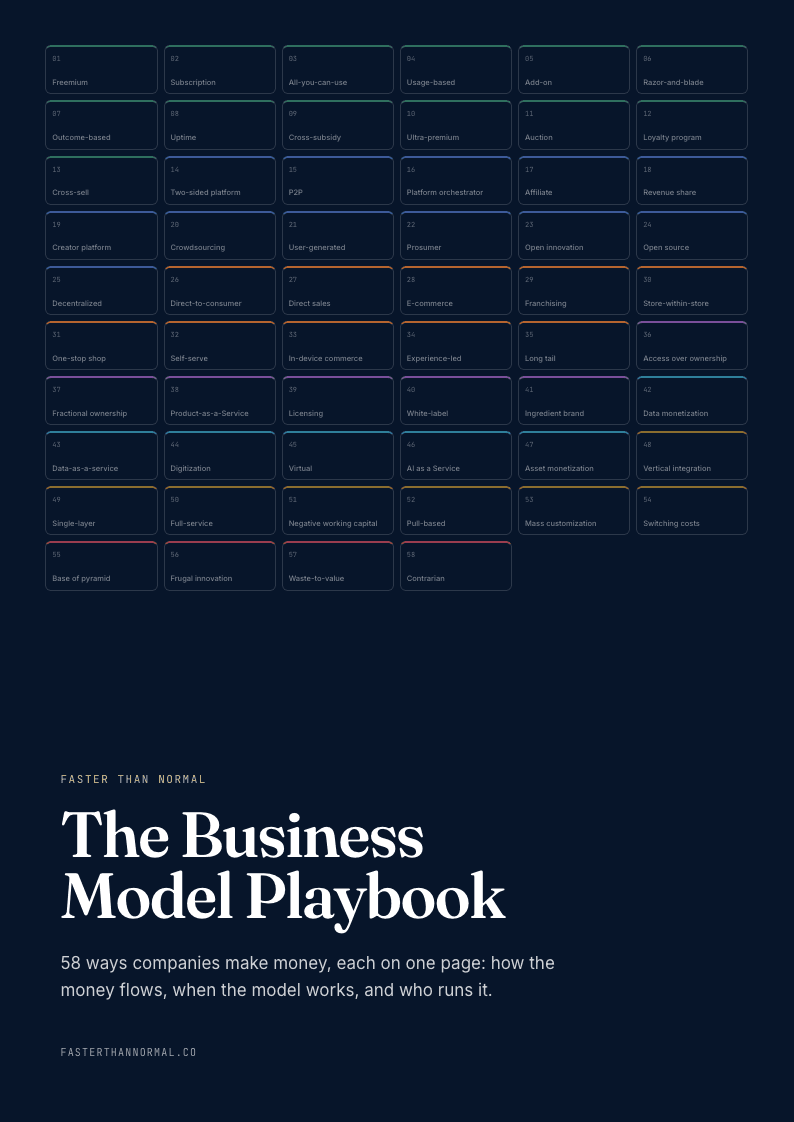
58 business models, one visual page each: how the money flows, the metrics that matter, and who runs it. Free when you join the Faster Than Normal email.
Free. No spam. Unsubscribe anytime.
Part IIIMaxims
-
Start with the hazmat suit. The willingness to do the unglamorous foundational work — literally dipping boards in toxic chemicals — is what earns the right to lead later.
-
The operator outlasts the evangelist. Vision creates the spark. Systems sustain the fire. Build both, but know which one keeps the building standing.
-
"Pink and shrink" is a symptom of laziness. When you serve a new market by simply repackaging what you made for the old one, you insult the market and lose it.
-
Fourteen years is not too long. Real cultural change operates on a timeline that outlasts most CEO tenures, most strategic plans, and most people's patience.
-
Private ownership is a strategic weapon, not a lifestyle preference. It buys you a time horizon that public markets will not grant.
-
Place is not overhead; place is identity. Where you choose to be says who you are, attracts who you want, and repels who you don't.
-
The best succession plan is one that's never noticed. Build capacity gradually enough that the transfer of authority, when it comes, feels like continuity rather than disruption.
-
Your biggest threat is your ego. Jake said it. Donna lived it. The most powerful leaders in a founder-driven company are the ones who never need the room to know they're there.
-
Build the "us." A company that depends on one person's charisma is not a company. It is a cult of personality with a balance sheet. The leader's job is to construct a collective identity that survives individual departure.
-
Survive, and stay. The hardest thing is not building the institution. It is remaining, after loss, and continuing to build — without replacing what was lost, without pretending it wasn't lost, but by honoring it through the quiet, unglamorous act of keeping the thing alive.
In Their Own Words
With a promotion, a woman will give you five reasons why she's not ready. A man will give you five reasons why he should've had that job yesterday.
In the beginning, we were excluded from ski areas and we were excluded from their trade shows, so we always saw ourselves as a very inclusive community.
Jake and I woke up one day in 2002 looked around a room of leaders, and realized that, out of 25 global leaders, there were only two women.
This was not going to bode well for our company — not just that it didn't match our values, but that we were never going to be innovative, or be able to pull from the best talent, or reach the women's market unless we had women in the room.
It was an incredibly empowering experience, and everybody came back even more determined than ever to work on gender diversity here.
We created the Women's Leadership Initiative, which was a comprehensive effort and is still ongoing.
This was not going to bode well for our company — not just that it didn't match our values, which it didn't, but that we were never going to be innovative, or be able to pull from the best talent, or reach the women's market unless we had women in the room.
What you learn from watching other companies' mistakes is that you can't be too humble. Your biggest threat is your ego. I'm reminded of that all the time. Fortunately, not in a catastrophic way.— Jake Burton Carpenter, WWD interview, 1999
I learned long ago that if I don't take care of myself, I'm useless to others. Jake has been seriously ill twice in the last five years so I've had to take on double duty.— Donna Carpenter, Edible Vermont, 2016
We welcome women into our sport through the images and language we use. It's all about empowering women regardless of age or ability. Anyone can be a Burton girl; it's just an attitude.— Donna Carpenter, on the Women's Leadership Initiative
Vermont's more than a place; it's a spirit of community. That's a value all Vermonters share. By staying here, we bring a little Vermont to the rest of the world.— Donna Carpenter, on keeping Burton in Vermont
I saw a sport there from a very young age. Then it was sort of a fad that came and went, but it never left for me.— Jake Burton Carpenter, BBC interview, 2019


