
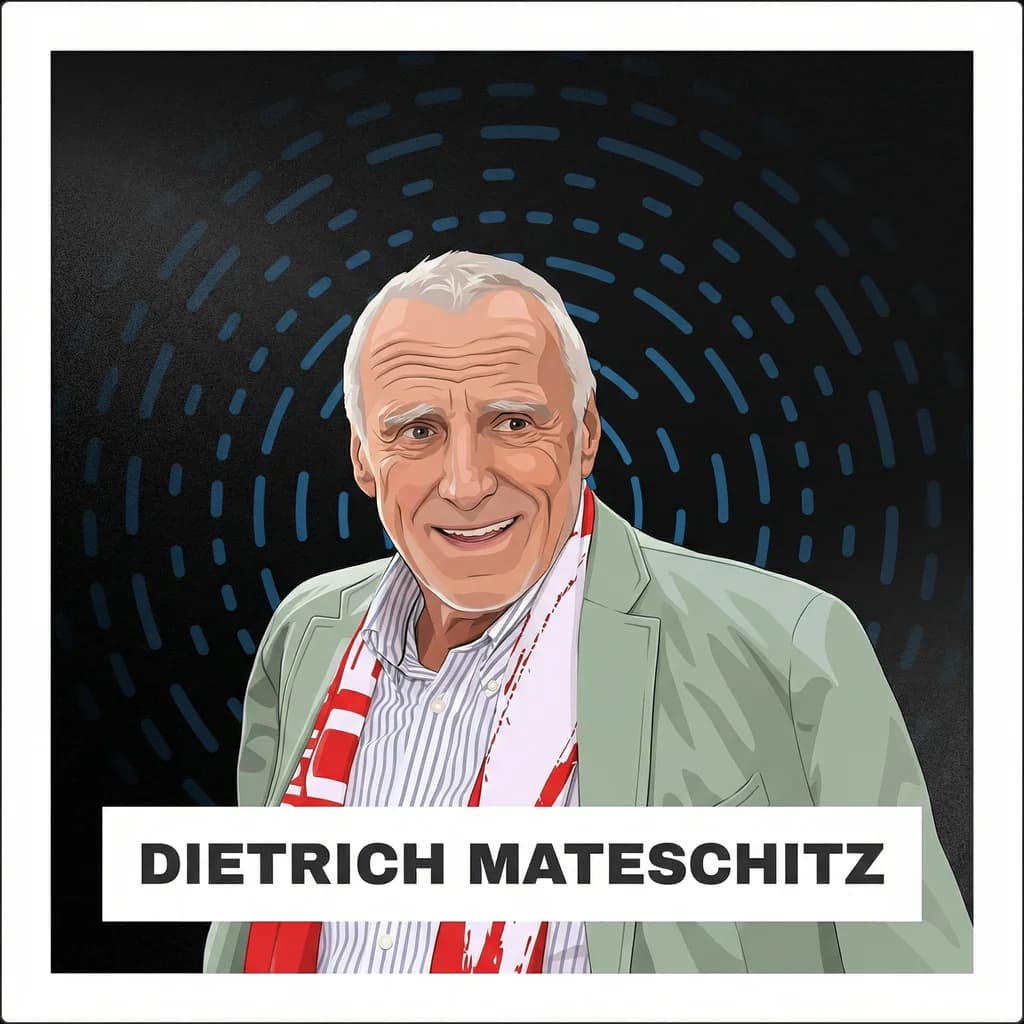

Dietrich Mateschitz (May 20, 1944 – October 22, 2022) was the Austrian entrepreneur who co-founded Red Bull and created the Western energy drink category outright. A Blendax toothpaste marketer who discovered the Thai tonic Krating Daeng in Bangkok in 1982, he partnered with its creator, Chaleo Yoovidhya, in 1984 — each investing $500,000 for a 49% stake in Red Bull GmbH — and launched Red Bull in Austria on April 1, 1987, against catastrophic market research. The company he ran, debt-free and unlisted, from the lakeside village of Fuschl am See now sells nearly fourteen billion cans a year in 178 countries and generated €12.2 billion in revenue in 2025; Forbes put his fortune at $27.4 billion when he died. "All I could see were the same gray airplanes, the same gray suits, the same gray faces," he told Bloomberg of the moment, at thirty-eight, that changed his direction. "I asked myself whether I wanted to spend the next decade as I'd spent the previous one."
Part IThe Story
How did Dietrich Mateschitz discover Red Bull?
Sometime in 1982 — the exact date lost to the studied vagueness Dietrich Mateschitz cultivated around his own mythology — a tired Austrian toothpaste salesman walked through a Bangkok hotel lobby and drank something that changed his life. He was thirty-eight years old, a marketing director for a German cosmetics company called Blendax, and by his own later admission he had hit a wall so absolute that it had become a kind of philosophical condition. "All the hotel bars looked the same, and so did the women in them," he would tell Bloomberg decades later. The drink was called Krating Daeng — Thai for "red bull" — a syrupy, uncarbonated tonic sold in small brown pharmacy bottles to truck drivers and rice farmers and construction workers who needed help staying awake through twelve-hour shifts in equatorial heat. It was cheap. It was functional. It tasted like liquid sugar cut with cough medicine. And when Mateschitz drank it, his jet lag vanished.
This is a story about what happened next — how a man who took a full decade to graduate from college and spent his best professional years selling toothpaste across time zones would, at the age of forty, quit his job, invest his entire savings in a product that failed every consumer taste test, and build from that failure a company that today sells nearly fourteen billion cans a year in 178 countries, generating more than €12 billion in annual revenue. Red Bull did not merely create a new brand. It created a new category — energy drinks — where none had existed in the Western world, then dominated that category so thoroughly that thirty-eight years later the slim blue-and-silver can remains the global market leader despite containing nothing patentable, nothing proprietary, nothing that a competitor couldn't replicate for pennies. The ingredients are listed right there on the outside of the can.
What could not be replicated was the mind that conceived of the whole thing. Dietrich Mateschitz — universally called "Didi" by the few people who knew him — gave only a handful of interviews over the course of his entire career. He shunned cameras, suits, red carpets, shareholders' meetings, and the very concept of celebrity that his brand so assiduously manufactured for others. "I don't believe in 50 friends," he once said. "I believe in a smaller number. Nor do I care about society events. It's the most senseless use of time. When I do go out, from time to time, it's just to convince myself again that I'm not missing a lot." He died on October 22, 2022, at the age of seventy-eight, after a long illness. The details of his final years stayed as private as the rest of his life.
By the Numbers
The Red Bull Empire
~14BCans sold worldwide in 2025
€12.2BGroup turnover, 2025
21,924Employees worldwide (end of 2025)
178Countries where Red Bull is sold
$27.4BMateschitz's estimated net worth at death (Forbes, 2022)
49/49/2Ownership split: Mateschitz / Yoovidhya family / Chalerm
0Outside investors brought in beyond the founding partners
The Decade That Wasn't Wasted
To understand Mateschitz you have to begin with the slowness, because the slowness explains everything that came after. Born on May 20, 1944, in Sankt Marein im Mürztal — a small town in the Austrian province of Styria, tucked among hills that produce more schoolteachers than entrepreneurs — he was the only child of two primary school teachers who separated when he was young. His father, whom he reportedly did not meet until he was eleven, is said to have been held in a prisoner-of-war camp after World War II ended. His mother raised him largely alone. The family had Croatian roots, a detail Mateschitz seldom discussed, embedded in the difficult consonant clusters of his surname.
He enrolled at the Vienna University of Economics and Business. It took him ten years to graduate with a marketing degree. He was twenty-eight when he finished, in 1972 — an age when many of his contemporaries were already mid-career. When an interviewer later pressed him about this glacial pace, he was unapologetic: "You know, it's a good time, so you shouldn't shorten it unnecessarily." He worked as a tour guide in summer and a ski instructor in winter, and he conceded, with a dry smile, that "a student ski instructor at 28, 30? It's not so funny any more."
But the decade served as an incubation. Friends from those years describe a man who was charismatic, funny, full of ambition, perpetually generating ideas that seemed half-brilliant and half-insane. He was, by all accounts, extraordinarily good company — and extraordinarily good at persuading people to go along with whatever he was proposing. What he lacked was urgency. Or rather: he lacked the conventional kind of urgency, the career-ladder anxiety of the postwar Austrian middle class. He was waiting — though he didn't know yet for what.
After graduating, Mateschitz joined Unilever, the Anglo-Dutch consumer goods colossus, where he spent his days marketing detergents and soap across Europe. He moved to Jacobs Coffee briefly, then landed at Blendax, a German cosmetics company later acquired by Procter & Gamble, as its director of international marketing. He was good at it — toothpaste, shampoo, the whole portfolio — and the position required constant travel to Asia, which is how a man selling Blendax toothpaste in Thailand ended up, at a business meeting with one of Blendax's Thai franchise partners, tasting a drink that would make him a billionaire.
Who was Chaleo Yoovidhya?
The Thai franchise partner was T.C. Pharmaceutical Industries, and its founder was Chaleo Yoovidhya — a figure so reclusive that he made Mateschitz look like a publicity hound. Chaleo was the son of poor Chinese immigrants who had settled in Siam (as Thailand was then known) in 1932. He grew up in Phichit province, a quiet agricultural region, helping his parents sell fruit and raise ducks. No formal education to speak of. He drifted to Bangkok, drove buses, sold cosmetics, and eventually scraped together enough to found a small pharmaceutical company that sold antibiotics and imported cosmetics. In 1976, Chaleo developed a sweet, uncarbonated energy tonic aimed at Thailand's blue-collar workforce — truck drivers, farmers, factory hands — and named it Krating Daeng. The label bore two red gaurs (a wild bovine resembling a bull) charging at each other against a yellow sun: power, perseverance, energy. His son Saravoot would later say the drink "wasn't very popular" at first, but within a few years it had built a cult following among the very workers it was designed for. Chaleo marketed it at Muay Thai boxing matches, handed out bottles at construction sites, sold it through pharmacies. By the time Mateschitz encountered it, Krating Daeng was the dominant energy tonic in Southeast Asia.
Chaleo gave almost no interviews in over thirty years. Various news outlets couldn't agree on whether he was eighty-one, eighty-nine, or ninety when he died in Bangkok on March 17, 2012. His was a life lived almost entirely off the record — a quality that Mateschitz, recognizing a kindred spirit, would have appreciated deeply.
The precise sequence of Mateschitz's discovery has been told in slightly varying versions. In one account, he tried Krating Daeng at the T.C. Pharmaceutical offices during a business meeting about toothpaste distribution. In another, he was served it at a hotel bar. What is consistent across all tellings is the jet lag, the instantaneous cure, and the magazine article. Sitting in a hotel bar — in Bangkok in most tellings, in Hong Kong in some; the setting shifts — Mateschitz read that the top corporate taxpayer in Japan that year was not Sony, not Toyota, but Taisho Pharmaceuticals, a company that made energy drinks. Something clicked. Not a business plan, not yet. An instinct. He would sell the stuff in the West.
Who owns Red Bull?
Red Bull has been owned since its founding by two families — 49% Mateschitz, 49% Chaleo Yoovidhya, and 2% Chaleo's son Chalerm. The structure dates to 1984, when Mateschitz approached Chaleo with a proposition: a partnership to distribute Krating Daeng outside Asia. Each man invested $500,000 in the new company, Red Bull GmbH, incorporated in Austria. The 2% held by Chalerm gave the Yoovidhya family technical majority ownership — but the deal stipulated that Mateschitz would have full management control and run the business from Austria. Chaleo would handle the Thai and Chinese markets. It was an arrangement built on mutual trust between two men who shared a preference for silence over spectacle, and it held for nearly four decades without a single public dispute.
Mateschitz quit Blendax at forty, with no fallback, and invested everything he had.
What followed was three years of tinkering — from 1984 to 1987 — during which Mateschitz did four things that would define the company's entire future. First, he carbonated the drink, making it fizzier, lighter, more palatable to European tastes, and — crucially — a better mixer for alcohol. Second, he replaced the small brown pharmacy bottle with a slim, silver-and-blue aluminum can, painstakingly designed to look like nothing else on any shelf. Third, he changed the name to the rough English translation: Red Bull. And fourth, he turned to his university friend Johannes Kastner, who owned an advertising agency in Frankfurt, for help with branding and a slogan.
"He said he had no money," Kastner later recalled, "so we agreed that he would do freelance work for me to pay me for it." Over the next year and a half, Kastner's team produced about fifty different designs. Mateschitz rejected them all. The slogan was even harder. "Nothing satisfied him, and I was finally so upset that I told him to find another agency," Kastner said. "He asked me to think about it for one more night." Racking his brain at 3 a.m. on the night before the deadline, Kastner landed on it: Red Bull gives you wings.
On April 1, 1987, Red Bull Energy Drink launched in Austria. The market research had been catastrophic. Focus groups hated the taste. Hated the concept. Hated the name. Every conventional indicator said the product would fail.
— Dietrich MateschitzIf we don't create the market, it doesn't exist.
He set the price unreasonably high — far above any comparable soft drink — in order to position Red Bull as a premium product in a category of its own. Not a soft drink. Not a sports drink. An energy drink. A category that, in the Western world, did not yet exist. The pricing was intentional provocation: it made retailers eager to stock it (the margins were extraordinary for everyone in the supply chain) and it made consumers believe they were buying something fundamentally different from Coca-Cola or Pepsi. With production costs later estimated at less than twenty cents per can and a retail price of roughly two dollars for an 8.3-ounce serving, the margins were, and remain, staggering. Red Bull's operating return on sales in 2020 was 26% — during a pandemic that shut down the nightclubs and bars where the drink had first found its audience.
The Anti-Marketing Marketing Machine
By the company's account, Red Bull financed its growth from its own profits rather than borrowed or outside money. "Don't confuse the creativity of the Red Bull brand with our business conduct," Mateschitz said. "I was raised with the motto: don't go into debt. That's also a virtue." All expansion was financed from profits. The company reached break-even in its third year and has been profitable every year since. In a world of venture-backed growth-at-all-costs blitzscaling, Red Bull bootstrapped its way to global domination using only its own cash flow.
The marketing, though — the marketing was where Mateschitz's genius became undeniable. He eschewed traditional advertising almost entirely. No television commercials in the early years. No print campaigns. No celebrity endorsements of the conventional kind. Instead, he deployed what would later be called guerrilla marketing, though at the time it had no name. He hired student brand ambassadors — "Red Bull Wings Girls" — to cruise university campuses and après-ski bars in Mini Coopers with a giant Red Bull can strapped on top, handing out free samples. He left empty Red Bull cans in the trash cans of trendy nightclubs, creating the impression that the drink was already ubiquitous. He strategically placed product at parties, at music festivals, at any venue where young people congregated late at night and might be looking for something to mix with vodka. Red Bull and vodka became the cocktail of the 1990s youth — a stimulative, transgressive, vaguely dangerous concoction that City of London stockbrokers eventually upgraded by adding champagne, producing a libation some called "liquid cocaine."
The transgression was the point. When France, Denmark, and Norway banned the drink for its high caffeine and taurine content, Mateschitz didn't fight the bans. He celebrated them. In Germany, where the drink had not yet been approved, young people began driving across the border to Austria to buy cases of it. When Germany finally approved the drink, Red Bull sold 33 million cans in the first three months. The bans, the rumors, the whispered dangers — Mateschitz understood that for a branded product, the most lethal thing was not controversy but indifference. "The most dangerous thing for a branded product is low interest," he said. He would have agreed with Edwin Land, the Polaroid founder, who argued that the real enemy of any invention is "not opposition, but indifference."
— Dietrich MateschitzIt is a must to believe in one's product. If this were just a marketing gimmick, it would never work.
The expansion was methodical, almost military in its discipline. Austria in 1987. Hungary, Slovenia, and other neighboring markets starting in 1992 — as the fall of the Iron Curtain opened Central Europe to Western brands. The United Kingdom in 1994. The United States in 1997. Each new market entered the same way: the Wings Girls, the club placements, the whisper campaigns, then the slow ramp of availability as demand outstripped supply by design. Scarcity was a weapon. "We don't bring the product to the consumer," Mateschitz said. "We bring consumers to the product."
Why does Red Bull sponsor extreme sports?
Red Bull sponsors — and owns — extreme sports because Mateschitz concluded that Red Bull was not a drinks company that did marketing but a marketing company that happened to sell drinks, and the marketing was not advertising: it was storytelling. He arrived at that insight by the late 1990s, and it would separate Red Bull from every beverage company in history, including Coca-Cola.
He began sponsoring extreme sports — cliff diving, motocross, snowboarding, mountain biking, paragliding — activities that embodied the brand's promise of transcendence, of pushing past limits. His first major sports sponsorship was Gerhard Berger, then Austria's top Formula One driver, a choice that combined national pride with the velocity and danger that Red Bull wanted to embody. From Berger, the sponsorships expanded to embrace hundreds of athletes in dozens of sports, nearly all of them characterized by physical risk, visual spectacle, and a countercultural edge. The Red Bull Dolomitenmann — an extreme sports relay involving running, cycling, kayaking, and paragliding — became one of the brand's early signature events.
But Mateschitz went further than sponsorship. He began owning the events themselves. The Red Bull Flugtag, in which competitors launch homemade flying machines off a pier into a body of water, was a perfect distillation of the brand ethos: absurd, joyful, slightly dangerous, irresistibly watchable. The Red Bull Air Race, in which stunt planes slalomed through giant inflatable pylons at terrifying speeds, was another. Each event was conceived not as an advertising vehicle but as content — content that Red Bull produced, filmed, distributed, and owned outright.
In 2007, Mateschitz founded Red Bull Media House, an in-house production company that created television programs, films, magazines, websites, and a ceaseless torrent of video content. Red Bull Magazine. Red Bull TV. Thousands of hours of footage distributed free to broadcasters worldwide. "We see ourselves much more as a TV station than we see ourselves as an energy drink company," a Red Bull executive told journalists, and the statement — hyperbolic as it sounded — was closer to the truth than most outsiders realized. The lines between Red Bull, Red Bull athletes, and Red Bull events were deliberately, strategically, irrevocably blurred. "To Mateschitz, it's just one big image campaign with many manifestations," as one analysis put it.
The apotheosis came on October 14, 2012, when Austrian skydiver Felix Baumgartner — a Red Bull athlete, naturally — jumped from a helium balloon at the edge of space, 128,000 feet above the New Mexico desert, and fell for four minutes and nineteen seconds, breaking the sound barrier with his body, landing safely in a field while more than fifty million people watched the livestream. Red Bull had spent an estimated $65 million on the Stratos project. What it bought was a piece of human achievement that happened to be conceived, funded, produced, and distributed by an energy drink company. The editorial media value was incalculable.
— Dietrich MateschitzIn literal financial terms, our sports teams are not yet profitable, but in value terms, they are. The total editorial media value plus the media assets created around the teams are superior to pure advertising expenditures.
The Feudal Lord of Fuschl am See
Red Bull's global headquarters is in Fuschl am See, a lakeside village near Salzburg nestled in a verdant Alpine valley — a setting that could not be less like the frenetic, urban, adrenaline-soaked world the brand projects. Mateschitz chose it deliberately. He liked the quiet. He liked that it was difficult to reach. He liked the distance it put between him and the media centers of Vienna, London, and New York. The campus features state-of-the-art creative spaces, biking trails, hiking paths, lakeside gathering areas, and buildings shaped as two erupting volcanoes with a herd of bronze bulls charging out from between them, a physical embodiment of the brand's "energy."
Red Bull farmed out nearly everything that wasn't marketing. Production was outsourced to Rauch Fruchtsäfte, an Austrian fruit juice company with canning facilities in Austria, Switzerland, and the United States. Distribution used a mixture of in-house subsidiaries (the lucrative American market was handled through Red Bull Distribution Company) and external distributors. The company itself — the entity in Fuschl am See — was, at its core, a marketing and brand management operation that happened to oversee the sale of a physical product. Headcount stayed remarkably small for the revenue it supported: lean, focused, obsessively efficient.
Mateschitz ran the operation the way the German newspaper Handelsblatt described it: "like a feudal lord." He worked three days a week, reportedly. He was hands-on to the point of perfectionism — personally approving marketing campaigns, personally involved in the design of events, personally invested in the details that most billionaire CEOs would delegate. He drank, by his own claim, a dozen cans of Red Bull a day. He was always tanned, always stubbled, always in jeans and an open-collared shirt. He flew his own planes — a Falcon 900 business jet and a Piper Super Cub monoplane — and stored his collection of historic military aircraft at Hangar-7, a spectacular steel-and-glass structure at Salzburg Airport that he built to house a DC-6B that once belonged to Yugoslav President Tito, along with vintage fighters, Formula One cars, and motorcycles. The hangar doubled as a public museum, event center, and home to Ikarus, a gourmet restaurant, and the ThreeSixty Bar — because even Mateschitz's hobbies were extensions of the brand.
He had no plans to sell. No plans to go public. "It's not a question of money," he said. "It's a question of fun. Can you imagine me in a shareholders' meeting?"
Buying Speed
Mateschitz's first incursion into Formula One came through Sauber, the Swiss-based team, of which Red Bull acquired a 60% shareholding in 1995. The partnership ended badly: Sauber signed the inexperienced Finnish driver Kimi Räikkönen for the 2001 season instead of Red Bull protégé Enrique Bernoldi, and Mateschitz — a man who did not tolerate having his preferences overruled — walked away.
Three years later, he came back with grander ambitions. In November 2004, he bought the struggling Jaguar Racing team from Ford for a price he refused to confirm. ("I have read that I paid unbelievable amounts in one of your British papers: £60 million," he told the Independent. "Maybe the journalist should not estimate at all. Or change his profession.") He renamed it Red Bull Racing, hired the young former Formula 3000 driver Christian Horner as team principal, and lured Adrian Newey — the sport's preeminent design engineer — as technical director on a $10 million salary. In 2005, he and his close friend Gerhard Berger purchased the Italian-registered Minardi team from Australian owner Paul Stoddart, renaming it Scuderia Toro Rosso (Italian for "Red Bull") as a junior development squad.
Christian Horner was thirty-one years old when Mateschitz hired him — the youngest team principal in Formula One. He had raced in Formula 3000 and Formula Three without particular distinction, then pivoted to team management with an intuitive understanding of how racing organizations work. Newey was the prize, though: a quiet, obsessive, almost monkish engineer from Stratford-upon-Avon who designed racing cars the way other people wrote symphonies, by feel and spatial intuition as much as computational analysis. Between Horner's organizational ruthlessness and Newey's aerodynamic genius, Red Bull Racing became, by 2009, the fastest team in Formula One.
In 2010, with twenty-three-year-old German driver Sebastian Vettel behind the wheel, Red Bull won both the Constructors' and Drivers' World Championships. They won again in 2011, 2012, and 2013 — four consecutive doubles, a feat that placed the team among the sport's all-time greats alongside Ferrari, McLaren, and Mercedes. Vettel became the youngest quadruple world champion in F1 history.
Then came Max Verstappen — a Dutch prodigy who entered Red Bull's driver development program as a teenager, became the youngest driver in F1 history to start a grand prix at age seventeen in 2015, and by 2021 was the most dominant driver in the sport. Verstappen won his first world championship that year, his second in 2022 — a season in which his fifteen victories broke the single-season record — and won nineteen races in 2023. "You know, I have always said that the cheapest thing in Formula One is buying the team," Mateschitz told a journalist, smiling. "The responsibility and the expenditure comes afterwards."
The football empire grew in parallel. In 2005, he purchased SV Austria Salzburg, renaming it Red Bull Salzburg (to the fury of traditionalist fans who mourned the erasure of the club's identity). In 2006, he bought the New York MetroStars, renaming them the New York Red Bulls. He founded Red Bull Brasil in Campinas. Most controversially, he created RB Leipzig in Germany's lower divisions and funded its rapid ascent to the Bundesliga, where it became one of the league's leading clubs — a source of both sporting pride and intense philosophical discomfort for German football purists who viewed the arrangement as a corporate hijacking of their country's supporter-ownership traditions.
The Invisible Billionaire
The paradox of Mateschitz's life was a simple one, though it never quite resolved: he built one of the most visible brands in human history while remaining, himself, almost completely invisible. He understood publicity — its mechanics, its psychology, its multiplicative power — better than perhaps any person alive. And he wanted none of it for himself.
"In Austria everyone knows that I don't do any television or radio because I like my privacy," he told the Independent in 2005, during one of his vanishingly rare interviews with British press. "For me, privacy is quality. I don't want to be recognised by everybody." When the interviewer checked that his son — born in 1992 to a former ski instructor named Anita, with whom he'd had a brief relationship — was thirteen years old, the guard went up instantly: "There is no reason to tell your readers that I have a son who's 13."
He never married. "I was too immature to get married," he said — a formulation that could be read as self-deprecation or as the most honest thing a man who prized freedom above all else ever uttered. In his later years, he was accompanied at the rare public events he attended by his long-term girlfriend, Marion Feichtner. His son, Mark — enrolled not at an elite school but at a vocational institution, the Werkschulheim Felbertal — was gradually being prepared to inherit the empire. Classmates described the younger Mateschitz as bright, interested, sporty. His father was teaching him the business.
Mateschitz's aversion to media was not passive. It was active, sometimes aggressive. He controlled the narrative around Red Bull with an iron hand. Journalists who wrote critically were blackballed. When Austrian journalist Wolfgang Fürweger published The Red Bull Story in 2008 — the only book-length account of the company, painstakingly assembled from external sources — Red Bull froze him out entirely. The company gave no official cooperation. Fürweger's book, a bestseller in Germany and Austria, was not translated into English until 2025, three years after Mateschitz's death.
He bought the Austrian society magazine Seitenblicke partly, it was widely reported, to ensure he would never appear in its pages. He founded Servus TV in Austria, ostensibly as a regional broadcaster focused on culture, nature, and sport, but it increasingly became a vehicle for editorial positions that aligned with Mateschitz's own conservative views — criticizing European immigration policy, questioning aspects of pandemic response, and giving airtime to figures whom mainstream Austrian media considered fringe. A rare 2017 interview with the regional newspaper Kleine Zeitung sparked a backlash when Mateschitz criticized the "lack of control over migration" in Europe, expressed support for then-Foreign Minister Sebastian Kurz (leader of the center-right Austrian People's Party), and announced plans for a new investigative media platform — launched later that year as Addendum — which some Austrian commentators promptly compared to Breitbart.
The political controversies were real, and they complicated the image of a man otherwise admired across ideological lines. But they also underscored something fundamental about Mateschitz: he genuinely did not care what people thought of him. "I fundamentally oppose being told what to think," he told the Kleine Zeitung, "even if one immediately makes oneself suspicious in all directions: in America you're branded a communist, in Europe as a conspiracy theorist or a right-wing populist." The statement has the ring of authentic stubbornness — the same quality that led him to launch a drink the market research said nobody wanted, set the price impossibly high, and build a company that answered to no shareholders, no board, no outside capital of any kind.
The Island, the Hangar, and the Architecture of Solitude
In 2003, Mateschitz purchased Laucala Island — a 2,950-acre private island in Fiji — from the Forbes family for an undisclosed price, reportedly around £7 million. When asked why, he quoted the late Malcolm Forbes himself: "He gave a nice answer, which was, 'Doesn't everybody want their own South Pacific island?' Well, in my case, he was right. I did." He transformed it into a super-high-end luxury resort with just twenty-five villas, where a night's stay cost €15,000. In 2013, he spent $1.7 million on a custom DeepFlight Super Falcon submarine for his guests' amusement. He visited once or twice a year, for weeks at a time, when he needed complete solitude.
Back in Austria, there was the 900-square-meter villa in Nonntal, the estate in Maria Alm, the Haflinger horse stud, the Red Bull Ring in Spielberg — the former Österreichring that he'd purchased, demolished, and rebuilt from scratch as a state-of-the-art racing facility, revitalizing the entire Styrian region in the process. There were the planes: not just the Falcon 900 and the Super Cub but the whole Flying Bulls collection housed at Hangar-7, lovingly restored military aircraft that he flew himself when time and weather permitted. During the COVID-19 pandemic, he funded the Austrian Grand Prix at the Red Bull Ring to help keep Formula One afloat — an act of generosity or brand investment or both, depending on your level of cynicism.
And there was the Wings for Life Foundation, perhaps the venture closest to his heart. When Heinz Kinigadner — a former motocross world champion and one of Mateschitz's closest friends — saw his son left a tetraplegic after an accident, Mateschitz co-founded a not-for-profit organization dedicated to spinal cord research. Wings for Life has raised and distributed millions of dollars, bringing together top researchers worldwide. Since 2014, it has organized the Wings for Life World Run, a global charity event. "Money was never a driving force for me," Mateschitz said. "The driving force has always been freedom and independence and joy in my projects. Joy is the basic requirement."
The Quiet Departure
Dietrich Mateschitz was diagnosed with cancer at some point in his final years — the precise timeline, like so many details of his life, held closely by the very small circle he trusted. The disease tormented him for some time, according to those who knew. He continued to work. He continued to monitor the company he'd built from a single idea in a Bangkok hotel lobby. Max Verstappen clinched his second consecutive Formula One world title at the Japanese Grand Prix on October 9, 2022. Christian Horner said later that Mateschitz was aware, that he was "very proud of the team."
Thirteen days after Verstappen's title, he was gone. Red Bull announced his death in an email to its 15,500 employees across 175 countries. "The sadness about his passing," the company wrote, "will make way for gratitude — gratitude for what he changed, moved, encouraged and made possible for so many individual people."
On Sunday, October 23, the day after the official announcement, Verstappen raced at the Circuit of the Americas in Austin, Texas. Signs reading "Danke Didi" appeared throughout the paddock. Red Bull won the constructors' championship that afternoon — the team's fifth. "There's still a race ahead," Verstappen had said the day before, his voice barely steady, "and we're going to try to make him proud tomorrow."
Mark Mateschitz, then thirty years old, inherited his father's 49% stake in Red Bull. His net worth was instantly estimated in excess of $20 billion. He stepped down from his role as Head of Organics at the company to concentrate on his position as a shareholder. The empire continued. Nearly fourteen billion cans of Red Bull were sold in 2025. The brand endured.
Somewhere in a verdant Alpine valley, in a village on a lake, the headquarters of the world's most recognized energy drink sits quietly, as it always has, in a setting that suggests nothing so much as deliberate invisibility — the architecture of a man who understood, better than anyone, that the most powerful thing a brand can do is make you forget there's a person behind it. In Fuschl am See, the company carries on without him.
Part IIThe Playbook
Dietrich Mateschitz built one of the most valuable brands in the world from a product that failed consumer taste tests, in a category that didn't exist, using a marketing approach that had no precedent. The principles below are drawn from the decisions, habits, and convictions that shaped Red Bull's trajectory — and they are less intuitive than they first appear.
The principles
- 1.Create the category, then own it.
- 2.Price for perception, not penetration.
- 3.Outsource everything except the story.
- 4.Make controversy your unpaid media buyer.
- 5.Never take on debt — not because you can't, but because freedom is the product.
- 6.Blur the line between brand and culture until they are indistinguishable.
- 7.Stay private to stay in control.
- 8.Believe in the product with irrational conviction.
- 9.Expand slowly, then all at once.
- 10.Build the company around one product — and resist the urge to diversify.
- 11.Use sports not as sponsorship but as ownership.
- 12.Design your life around the work, not the other way around.
Principle 1
Create the category, then own it.
When Mateschitz launched Red Bull in 1987, he was not entering an existing market. There was no "energy drink" category in Western retail. No shelf space allocated for it. No consumer behavior to exploit. The entire concept had to be invented — not just the product but the language, the packaging format, the occasion for consumption, and the competitive frame. "When we first started, we were told there is no existing market for Red Bull," Mateschitz said. "But Red Bull will create it." This is fundamentally different from market disruption or competitive positioning. It is market creation — and it is one of the hardest things a company can do, because you cannot use existing consumer behavior as a guide. You must manufacture the behavior itself.
Red Bull's category creation succeeded because Mateschitz understood that the product needed to be perceived as genuinely different from anything already on shelves — not a soft drink, not a sports drink, not a juice. The slim 8.3-ounce can, the premium price, the pharmacological language around taurine and caffeine, the long refusal to offer a larger size — all of these were deliberate signals that Red Bull occupied its own conceptual territory. When competitors eventually arrived (Monster, Rockstar, countless others), they were entering Red Bull's category, playing by rules Red Bull had already defined.
Tactic: If no market exists for what you're building, resist the temptation to position against adjacent categories — instead, design every aspect of the product (format, price, language, occasion) to signal that you are something entirely new.
Principle 2
Price for perception, not penetration.
Mateschitz priced Red Bull at a significant premium to every comparable beverage — and he did so on purpose, before the product had any brand equity at all. This violated standard pricing theory, which holds that new entrants should price low to build volume and market share. Mateschitz's logic was the inverse: premium pricing was the brand. It told consumers that Red Bull was not merely another flavored sugar water. It told retailers that stocking the product was financially worthwhile. It created margins that funded the extraordinary marketing spend that built the brand in the first place.
The margins described in Part I — among the highest in the beverage industry, and resilient even through the pandemic — are the product of this positioning. Crucially, Mateschitz maintained pricing discipline even as competitors entered with larger cans at similar prices. Red Bull kept its pricing "at the edge of acceptable," as one analyst put it — high enough to signal premium quality, never so high as to feel exploitative. And unlike publicly traded competitors, Red Bull could absorb cost increases without raising prices, because it answered to no quarterly earnings call.
Tactic: Set your price at the upper bound of what the market will accept, not the lower bound of what competitors charge — and use the resulting margins to fund the investments that justify the premium.
Principle 3
Outsource everything except the story.
Red Bull does not manufacture its own product. It outsources production to Rauch Fruchtsäfte. It uses a mixture of in-house and external distributors. The company's core competency — the thing it refuses to outsource under any circumstances — is the brand narrative: the marketing, the events, the athlete relationships, the content production, the storytelling.
This is an inversion of the traditional consumer goods model, where companies own manufacturing and outsource marketing to agencies. Mateschitz did the opposite: he treated Red Bull as a media and marketing company that happened to sell a physical product. The result was a radically lean operating structure. In 2010, 7,758 employees generated more than $667,000 in revenue per person. The company spent as much as 30% of revenue on marketing — an astonishingly high figure by any industry standard — but it controlled every aspect of that spend internally.
🏭
The Red Bull Operating Model
What Red Bull owns vs. what it outsources.
| Function | Approach |
|---|---|
| Manufacturing | Outsourced to Rauch Fruchtsäfte (Austria, Switzerland, US) |
| US Distribution | In-house (Red Bull Distribution Company) |
| Global Distribution | Mixed in-house and external |
| Marketing & Brand | 100% in-house — never outsourced |
| Content Production | In-house (Red Bull Media House, est. 2007) |
| Event Creation | In-house — Red Bull creates, owns, and produces its own events |
Tactic: Identify the one capability that creates disproportionate value in your business — and keep it in-house, even if outsourcing everything else.
Principle 4
Make controversy your unpaid media buyer.
When France banned Red Bull for its caffeine and taurine content, Mateschitz did not lobby for approval or issue press releases defending the product's safety. He let the ban stand — and watched as the prohibition transformed Red Bull into a forbidden fruit, an object of desire amplified by its very unavailability. Before Germany approved the drink, young Germans drove across the border into Austria to buy it. When approval finally came, the pent-up demand did the rest.
Mateschitz applied this principle repeatedly. Rumors that Red Bull contained bull testicles, bull semen, or dangerous stimulants were never aggressively corrected. He understood that the rumors — however false — generated attention, and attention was the scarcest resource in consumer marketing. "Gossip and malicious rumors are worth more than the most expensive publicity campaign in the world," as one source put it. The nicknames — "speed in a can," "liquid cocaine" — were gifts. They positioned Red Bull as transgressive, edgy, slightly dangerous: exactly the image a drink targeting young, thrill-seeking consumers needed.
Tactic: When controversy generates attention without genuine harm, resist the instinct to control the narrative — the rumors are doing your marketing for free.
Principle 5
Never take on debt — not because you can't, but because freedom is the product.
Red Bull has never taken on external debt or outside investment. This was not a financial strategy. It was a philosophical commitment. "I don't believe in the formula: two-thirds debt capital, one-third equity," Mateschitz said. The company was entirely self-funded before it became profitable in year three. Since then, all expansion — into 178 countries, into Formula One, into football, into media — has been financed from operating profits.
The no-debt policy gave Mateschitz something more valuable than financial leverage: it gave him absolute control. No investors to pacify. No board to consult. No quarterly earnings pressure. No need to explain a decision to send a man to the edge of space. The company could price patiently, expand slowly, invest in brand-building activities whose returns were measured in decades rather than quarters.
Tactic: Treat financial independence not as an optimization problem but as a prerequisite for strategic freedom — the ability to make irrational-seeming bets that rational, accountable managers cannot.
Principle 6
Blur the line between brand and culture until they are indistinguishable.
Red Bull does not sponsor extreme sports. Red Bull is extreme sports — or at least, it has worked for three decades to make that equation feel natural. The company owns Formula One teams, football clubs, ice hockey teams. It creates its own events (Flugtag, Air Race, Dolomitenmann, Stratos). It produces its own media (Red Bull Media House generates thousands of hours of programming annually). It employs close to 500 world-class athletes. The lines between the brand, the athletes, the events, and the content are, in Mateschitz's words, "blurry on purpose."
This is fundamentally different from traditional sponsorship, where a brand attaches its logo to someone else's event. Red Bull doesn't attach its logo. It builds the entire ecosystem — the competition, the athletes, the broadcast, the narrative — and the brand is embedded so deeply that extracting it would collapse the structure. As the New York Times wrote in 2006, "sports is marketing, and marketing is sports — and the company won't stop until the two things are one."
Tactic: Don't sponsor existing culture — create culture that cannot exist without your brand, so that the brand becomes synonymous with the experience itself.
Principle 7
Stay private to stay in control.
Mateschitz treated his obsessive privacy as a strategic principle and extended it from his personal life to the company's operating structure. Red Bull has never gone public. It publishes minimal financial data. It does not hold press conferences. It controls access to its athletes and events with military discipline. Journalists who write critically are cut off. The company's financial opacity — it publishes revenue and can sales but few profitability details — is deliberate.
The result is that Red Bull exists in public consciousness almost entirely on its own terms. There is no analyst coverage dissecting its margins. No activist investors demanding share buybacks. No quarterly earnings calls where executives must justify the cost of a skydive from the stratosphere. Mateschitz understood that transparency, while culturally celebrated, is also a form of vulnerability — it gives outsiders leverage over your narrative. By staying private and staying silent, he retained total control over the Red Bull story.
Tactic: Recognize that every piece of information you share publicly is leverage you surrender — and calibrate your transparency to the minimum required by your stakeholders.
Principle 8
Believe in the product with irrational conviction.
Every consumer taste test told Mateschitz that Red Bull would fail. The focus groups were unambiguous: people did not like the flavor. The concept confused them. The price offended them. Mateschitz launched anyway — not because he was ignoring the data, but because he understood something the data could not measure: the product worked. It delivered on its functional promise. It cured his jet lag. It gave people energy. And if the product worked, then the question of whether people liked the taste was, in his view, almost irrelevant.
"It's not just another flavoured sugar water," he told Bloomberg. "It's an efficiency product. I'm talking about improving endurance, concentration, reaction time, speed, vigilance and emotional status. Taste is of no importance whatsoever." This conviction — irrational by conventional market-research standards — was the necessary precondition for everything that followed. Without it, Mateschitz would never have quit his job, invested his savings, endured the early losses, or held firm on the premium pricing that made the entire business model work.
Tactic: When your product delivers genuine functional value, trust that value over consumer taste-test data — the market research measures preference for the familiar, not demand for the genuinely new.
Principle 9
Expand slowly, then all at once.
Red Bull launched in Austria in 1987. It did not enter its second market — Hungary — until 1992, five full years later. It did not reach the United Kingdom until 1994. The United States until 1997. Each market was entered one at a time, each using the same grassroots playbook: student ambassadors, nightclub placements, whisper campaigns, deliberate scarcity. The methodical pace was by design. Mateschitz wanted to build authentic demand before scaling distribution — to make consumers seek out the product rather than having it pushed upon them.
🌍
Red Bull's Expansion Timeline
From one country to global dominance.
1987
Launch in Austria. One market. One product.
1992
Second market: Hungary. Five years after Austrian launch.
1994
UK launch. Enters Western European mainstream.
1997
US launch. The critical mass market.
2004
First Formula One team purchase (Jaguar → Red Bull Racing).
2012
Felix Baumgartner's Stratos jump. 50M+ live viewers.
2021
9.8 billion cans sold in 172 countries.
2025
Nearly 14 billion cans sold in 178 countries.
Once the demand was established, though, the expansion accelerated dramatically. The pattern was not linear but exponential: slow, patient groundwork followed by rapid, capital-efficient scaling financed entirely from operating cash flow. The opening of Central and Eastern Europe after 1989 gave that scaling a structural tailwind: new markets arrived just as Red Bull was ready to enter them.
Tactic: Enter new markets one at a time, building authentic demand before scaling distribution — use scarcity as a tool to create desire, not as a limitation to overcome.
Principle 10
Build the company around one product — and resist the urge to diversify.
For most of its history, Red Bull sold exactly one product: Red Bull Energy Drink, in one size (250 ml), in one flavor, in one can design. The company eventually introduced sugar-free and flavored editions, but the core offering remained astonishingly narrow compared to competitors who proliferated SKUs, line extensions, and entirely new beverage categories. Mateschitz had learned this lesson the hard way: early in Red Bull's history, the company experimented with other product lines, all of which failed. He responded by eliminating everything that wasn't Red Bull. The focus was total.
This concentration produced what venture capitalists call a "power law" outcome — one product generating virtually all of the company's revenue and profit. It also simplified operations, marketing, and brand identity to an extraordinary degree. Every dollar of marketing spend reinforced the same product. Every consumer touchpoint communicated the same message. The clarity was the competitive advantage.
Tactic: Resist the urge to diversify prematurely — if your core product is working, concentrating all resources behind it will almost always outperform spreading those resources across multiple offerings.
Principle 11
Use sports not as sponsorship but as ownership.
When competitors began copying Red Bull's strategy of sponsoring extreme sports athletes, Mateschitz pivoted from sponsorship to ownership. He didn't just pay for logo placement on someone else's event or team. He bought Formula One teams, football clubs, and created entirely original competitions. The difference is profound: a sponsor rents attention; an owner builds equity. When Red Bull buys an F1 team, the media coverage, the broadcast rights, the driver development pipeline, the global brand exposure — all of it accrues to Red Bull as an asset, not a marketing expense.
The sports investments were, by Mateschitz's own admission, not immediately profitable in financial terms. But they were profitable "in value terms" — the editorial media value, the brand awareness, the cultural association with excellence and daring. Mateschitz was explicit about this calculus: "The total editorial media value plus the media assets created around the teams are superior to pure advertising expenditures."
Tactic: When sponsorship becomes a commodity, shift from renting attention to owning it — acquire or create the platforms that generate the cultural value your brand needs.
Principle 12
Design your life around the work, not the other way around.
He lived in an Alpine village. He owned a private island. He flew his own planes. He drank twelve Red Bulls a day and answered to no one. This was not work-life balance as conventionally understood — it was something more radical: the deliberate design of a life in which work, play, passion, and profit were architecturally inseparable. The planes were hobbies and brand assets. The Formula One teams were investments and entertainment. The island was a retreat and a resort business. Nothing existed in isolation from the Red Bull universe, and the Red Bull universe existed, in turn, as an extension of Mateschitz's personality: daring, private, obsessively detailed, and fundamentally oriented toward joy.
"For me, the driving force has always been freedom and independence and joy in my projects," he said. "Joy is the basic requirement." The refusal to go public, the refusal to take on debt, the refusal to hire a CEO — all of these were not business decisions in the conventional sense. They were lifestyle decisions that happened to produce one of the most successful companies in the world.
Tactic: Structure your company's ownership, financing, and governance to protect the conditions under which you do your best work — and treat personal autonomy as a non-negotiable input, not a reward earned after success.

Free playbook
Get The Business Model Playbook
58 business models, one visual page each: how the money flows, the metrics that matter, and who runs it. Free when you join the Faster Than Normal email.
Free. No spam. Unsubscribe anytime.
Part IIIMaxims
-
A slow start is not a late start. Mateschitz took ten years to finish university and was forty when he quit Blendax to found Red Bull. Asked about the pace of his studies, he said it was a good time and you shouldn't shorten it unnecessarily.
-
Buying in is the cheap part. "The cheapest thing in Formula One is buying the team," Mateschitz said. "The responsibility and the expenditure comes afterwards." Budget for the years after the acquisition, not the acquisition.
-
A majority stake is not the same as control. Red Bull held 60% of Sauber, yet the team still chose Kimi Räikkönen over Red Bull's protégé, and Mateschitz walked away. When he returned to Formula One, he bought Jaguar Racing outright and installed his own team principal.
-
Equal partners still need one boss. The 49/49/2 split gave the Yoovidhya family technical majority ownership, but the deal gave Mateschitz full management control. Settled up front, that arrangement ran for nearly four decades without a public dispute.
-
Pay for the genius, gamble on the manager. Mateschitz put Adrian Newey on a $10 million salary and made thirty-one-year-old Christian Horner the youngest team principal in the sport. Red Bull Racing was the fastest team in Formula One by 2009.
-
Renaming what people love has a price. Turning SV Austria Salzburg into Red Bull Salzburg enraged traditionalist fans, and RB Leipzig's rise unsettled German football purists. Buying a community's heritage and overwriting it creates opponents your money can't win over.
-
Silence hands the story to someone else. Red Bull froze out Wolfgang Fürweger, so the only book-length account of the company was assembled from outside sources — and became a bestseller in Germany and Austria anyway. Refusing to talk does not stop others from writing.
-
Owning media ties its politics to you. Servus TV and Addendum drew criticism for editorial positions aligned with Mateschitz's own, which complicated the image of a man otherwise admired across ideological lines. A brand-builder who buys a platform also buys its controversies.
-
"Joy is the basic requirement." Mateschitz said money was never his driving force; freedom, independence, and joy in his projects were. He answered questions about selling or listing Red Bull the same way: it was a question of fun, not money.
Keep exploring
In Their Own Words
When launching a product called an Energy Drink and named Red Bull, a product that stimulates body and mind, it is a short step to the roots where Red Bull came from. We have been doing this for 20 years – now it's called adventure sports, extreme sports, and outdoor sports.
It is a must to believe in one's product.
The most dangerous thing for a branded product is low interest.
There are almost no sports within which mortal accidents are not a reality.
I don't believe in 50 friends. I believe in a smaller number. Nor do I care about society events. It's the most senseless use of time. When I do go out, from time to time, it's just to convince myself again that I'm not missing a lot.— Dietrich Mateschitz
We don't bring the product to the consumer, we bring consumers to the product.— Dietrich Mateschitz
It's not a question of money. It's a question of fun. Can you imagine me in a shareholders' meeting?— Dietrich Mateschitz
It's not just another flavoured sugar water. It's an efficiency product. I'm talking about improving endurance, concentration, reaction time, speed, vigilance and emotional status. Taste is of no importance whatsoever.— Dietrich Mateschitz
Further reading
- Wolfgang Fürweger, 'The Red Bull Story' (2008)
- Bloomberg interview
- The Independent interview (2005)
- Kleine Zeitung interview (2017)


