


Part IThe Story
Coffered Ceilings
The word she didn't know was coffered. That was the problem — or rather, the problem in miniature, the linguistic fracture that would, within three years, produce a company valued at four billion dollars and reshape how tens of millions of people think about the insides of their homes. It was 2006 or 2007, somewhere in there, and Adi Tatarko and her husband Alon Cohen were sitting across from an architect in their newly purchased ranch house in Palo Alto — a four-bedroom place built in 1955, all low ceilings and postwar optimism — when the professional asked whether they'd like coffered ceilings in the living room. The couple looked at each other. "What?" Tatarko would recall. They started digging into books and magazines, trying to educate themselves on the vocabulary of their own desires, but the whole process was, in her word, "unbearable." They didn't have the terminology. Most people don't. You know what you want when you see it, and you cannot see it when you don't know what it's called.
This is a small humiliation that millions of homeowners have swallowed — the feeling of standing in your own house, spending your own money, and being unable to articulate the thing you're paying someone to build. The architects and contractors had their own frustrations, mirror-images of the homeowners': clients who ripped a photo from Architectural Digest showing a $400,000 kitchen and asked for something similar on a $20,000 budget, in a house half the size. The two sides of the transaction — desire and execution, dream and trade — were separated by an informational chasm that no amount of magazine clipping could bridge.
Tatarko, who had spent the previous several years deliberately downshifting her career to raise two small boys, who had moved from sixteen-hour days in Israel's tech sector to ten-hour days at a boutique investment firm in Silicon Valley, who had chosen financial planning school precisely because it seemed compatible with motherhood — Tatarko saw the gap and thought, someone should fix this. It was not a billion-dollar thought. It was a kitchen-table thought. But the distance between those two categories, it turns out, is sometimes nothing more than six months and the internet.
By the Numbers
The Houzz Empire
40M+Monthly unique users at peak
$4BPeak reported valuation
$600M+Total funding raised
3M+Active home professionals on platform
15Localized country platforms
10M+Products in marketplace
$430MTatarko estimated net worth
The Vocabulary of Desire
To understand what Tatarko built, you have to understand what didn't exist. In 2009, the year Houzz launched as a side project — not a startup, not a company, barely even a website — the home improvement industry in the United States was a roughly $300 billion market that operated, technologically speaking, in something close to the late 1980s. You found your contractor through a friend. You found your architect through your contractor. You communicated your aesthetic preferences by tearing pages from magazines and arranging them in a manila folder that you handed, hopefully, to a professional who would squint at your collage and try to reverse-engineer your taste. If you were lucky, you got something close to what you wanted. If you were unlucky — and renovation is a domain where unluck compounds — you ended up like the Tatarkos: months into a process, tens of thousands of dollars spent, holding plans they hated, forced to throw everything away and start over.
"It became miserable," Tatarko told The Independent. "After a long process and a lot of time and money that we couldn't afford, we ended up with plans that we didn't like and we had to throw it away and start all over again."
The couple's frustration was universal, which is precisely what made it commercially interesting, though neither of them saw it that way at first. Tatarko and Cohen did what frustrated tech-literate people do: they went online looking for help and found almost nothing. Pinterest wouldn't launch until 2010. Angie's List, founded in 1995, was a directory with reviews — useful for finding a plumber, less useful for imagining what your bathroom could become. There was no platform that combined visual inspiration, professional portfolios, community discussion, and actionable connection between homeowners and the people who could execute their visions.
So they decided to make one. Tatarko invited about twenty parents from their children's school, along with a handful of architects and interior designers from the Bay Area, to participate in what was essentially a shared visual bulletin board — a place where professionals could post photos of their work and homeowners could browse, save, and discuss them. The founding instinct was social, not commercial. It was a community before it was a product, a conversation before it was a marketplace.
"We really wanted to keep it small," Tatarko said, "as we didn't want to lose the community feeling of it. We never thought we'd expand beyond California."
From Tel Aviv to the Ranch House
Adi Tatarko was born in Tel Aviv, into a family where female entrepreneurship was not theoretical but hereditary — a trait passed down like eye color or a tendency toward impatience. Her grandmother, a Holocaust survivor, had been a fashion designer in the 1940s and 1950s, a woman who traveled the world attending fashion shows at a time when mothers of two were expected to stay home. "People really looked at her and said, 'What is she doing?'" Tatarko recalled. Her grandfather supported the work; society was less accommodating. Her mother ran her own real estate business. The women in the family shared a certain constitution: they built things, they raised children, and they did not accept that these were mutually exclusive activities.
Tatarko studied computer science at the Technion — Israel's equivalent of MIT, a school that has produced more startup founders per capita than perhaps any institution on earth — and then co-founded a small technology services company with Cohen. They married in 1998. The couple moved to the United States shortly after, arriving first in New York and then, in 2001, relocating to Silicon Valley. Cohen, a software engineer, took a senior director of engineering position at eBay. Tatarko, who had been working brutal hours in Israel's tech sector, made a deliberate choice: she would slow down, retrain as a financial planner, work at a small boutique investment firm, and focus on raising their growing family.
"I felt that working 10 hours a day and raising two kids is fun and great," she said. "You don't have to work 16 in order to be happy."
This was the plan. The plan held for several years. And then they bought the ranch house.
— Adi TatarkoWithout planning it, I was back to the 16 hours a day, around the clock, with the two kids, and as you can see, I'm crazy enough to have a third one now.
The thing about Tatarko's story that resists the standard founder mythology — the visionary who sees the future and sprints toward it — is its accidental quality. She wasn't looking for a startup. She wasn't bored with financial planning. She wasn't sitting in a garage nursing a world-changing idea. She was trying to renovate a house, failing at it, and complaining to her neighbors, who turned out to be failing at it too. The insight was ordinary. What made it extraordinary was what happened next: the speed with which other people's frustrations validated her own.
Twenty Parents and a Few Architects
The initial Houzz community — if you can call twenty parents and a handful of Bay Area design professionals a community — grew in a way that nobody planned and nobody marketed. The professionals who joined early began recommending the site to their clients. The clients told their friends. Within six months, requests arrived from New York and Chicago, asking whether Houzz could open sections for their cities. The couple hadn't spent a dollar on advertising. The site was running on roughly $2,000 a month in operating costs.
"Before we knew it this little community website had 350,000 users," Tatarko told the BBC.
The growth pattern was almost absurdly organic. Professionals would tell colleagues in other states, who would tell their own clients, who would tell other homeowners. The site crossed state lines without any promotion whatsoever. Tatarko and Cohen discovered that people in markets they had never targeted were finding and using the platform on their own. It was the kind of growth that venture capitalists tell you to look for and founders dream about — pull, not push.
The mechanics of this virality were embedded in the product's structure. When a designer in San Francisco uploaded beautiful photos of a kitchen remodel, those images attracted homeowners from around the country who were planning their own kitchen projects. Those homeowners would then ask the designer questions, or look for similar professionals in their own city, or share the photos with friends who were also renovating. Each piece of content served multiple purposes simultaneously: portfolio for the professional, inspiration for the homeowner, social currency for the sharer. The network effects were layered and self-reinforcing.
A homeowner in Houston might never hire a designer in Portland, but the Portland designer's photos of a mid-century modern bathroom could inspire the Houston homeowner to search for a similar style — and find a local professional on Houzz who offered it. Content created anywhere had value everywhere, which meant the network grew globally even when individual transactions remained local. This was the insight that later Harvard Business School analyses would describe as Houzz's combination of "content, community, and commerce" — though the couple arrived at it not through strategic analysis but through observation of what their users actually did.
The Passenger and the Driver
In 2010, a year after the side project launched, Tatarko and Cohen secured their first outside investment: $2 million from Oren Zeev, a Silicon Valley venture capitalist whose operating style was as unconventional as his track record was improbable.
Zeev — Israeli-born, INSEAD-educated, self-described "one-man VC" — managed more than $250 million in assets without an office, without an assistant, without a blog. He answered his own phone and got his own coffee. His investment philosophy was contrarian and independent: he avoided the partnership dynamics that characterize most venture firms, preferring to make decisions alone, with the speed of an angel investor and the capital of an institutional fund. His portfolio included Chegg and Audible — companies that, like Houzz, reimagined legacy industries through technology.
What Zeev told the Tatarko-Cohen team during those early conversations would become foundational to how they built the company. "He told them clearly that they are on the driving seat," as one account put it. "They are responsible for moving the company forward and he would be a passenger giving the assurance." The metaphor was deliberate: Zeev would ride along, offering guidance when asked, but the founders controlled the wheel, the route, the speed.
— Adi Tatarko, on choosing investorsWhen you are choosing your investor, choose someone who will support you where you want to go. We had that luxury.
This was not the norm in Silicon Valley, where investors routinely demanded board seats, strategic control, and the right to reshape companies in their own image. Tatarko and Cohen kept their board extraordinarily lean: just four members — Adi, Alon, Oren Zeev, and Alfred Lin of Sequoia Capital — despite raising hundreds of millions of dollars across multiple rounds. The small board allowed them to make decisions about acquisitions and strategic direction quickly, without the committee dynamics that slow larger organizations. It was governance by trust rather than oversight.
With the $2 million in hand, both founders left their jobs. Cohen departed eBay. Tatarko left the investment firm. The side project became the main project.
Content Before Commerce
The decision that would define Houzz's trajectory — and distinguish it from every competitor in the home improvement space — was the decision to not make money. Or rather: to deliberately defer making money for years, pouring every resource into building the platform's content base, user experience, and community before attempting to monetize any of it.
"It's always product first," Tatarko said. Money, she believed, would "automatically follow."
This was not the prevailing wisdom in 2010 or 2011 or 2012. Angie's List, which had launched fourteen years before Houzz, charged membership fees. HomeAdvisor and similar platforms exacted commissions on matchmaking from the start. The conventional playbook for two-sided marketplaces was to reach critical mass and then extract value from transactions as quickly as possible. Tatarko and Cohen did the opposite. They said no to ads. No to commissions. No to any revenue model that would compromise the user experience or slow the accumulation of content.
This wasn't naïveté. It was, in retrospect, a calculated wager that the home improvement industry's massive scale — Tatarko estimated the combined construction and home furnishings market at $2 trillion across the US, Canada, and Europe — meant that even a small fraction of value captured later would be enormous, provided the platform had established itself as the indispensable hub. Better to own the community than to tax it prematurely.
The Harvard Business School analysis of Houzz put it this way: "This lack of value capture by Houzz gave all the value to its users, lowered the 'cost-to-try,' and helped accelerate Houzz's user growth." By the time Houzz did begin monetizing — first through premium listings for professionals, then through a product marketplace that collected a 15% commission on sales — the platform had built such density of content and such loyalty among its users that competitors couldn't replicate the advantage. The moat was the community itself.
📐
Houzz's Three-Layer Platform
How content, community, and commerce built a $4B company
| Layer | Function | Monetization |
|---|---|---|
| Content | Professionals upload portfolios; 14M+ home design photos | Free — drives traffic and engagement |
| Community | Homeowners browse, save, discuss, and connect with pros | Premium listings for professionals (freemium model) |
| Commerce | 10M+ products from 20,000+ sellers; AR visualization tools | 15% commission on marketplace transactions |
The marketplace function, which launched in the US in 2014, was part of the original vision — even the earliest iterations of the website had tags on products showing where they were sold. But the infrastructure to make it work — connecting with thousands of suppliers, building logistics for shipping bathtubs to Hawaii — took years. "We started getting phone calls to the office," Tatarko recalled, "saying, 'We see the tag, but we don't understand how to add it to the cart,' or 'Can you ship this bathtub to us in Hawaii?'" The demand preceded the capability. Houzz had to grow into what its users already wanted it to be.
The Accidental Bootstrap
There is a particular kind of founder wisdom that can only be acquired in ignorance. Tatarko has said, more than once, that she's glad she didn't know Houzz was a big business in the early days. The not-knowing was the advantage.
"In retrospect, we didn't realize what we were doing was bootstrapping," she told Entrepreneur, "but it enabled us to take our time and build the company from the ground up the right way."
The bootstrapping period — roughly 2009 to mid-2010, when the couple was running Houzz as a nights-and-weekends project while maintaining full-time jobs — forced a discipline that deliberate strategy might not have produced. With no employees, no office, and almost no operating costs, every decision had to be evaluated against the question: Does this make the product better for the people using it? There was no board to impress, no investor deck to update, no quarterly growth target to hit. There was only the product and the community's response to it.
This period also shaped the company's relationship to fundraising. When Tatarko eventually sought capital, she had something most founders don't: irrefutable evidence of product-market fit. Three hundred and fifty thousand users, acquired with zero marketing spend, generating organic growth across state lines and professional categories. The numbers didn't need a narrative. "Go invest the first six months and validate and see that this idea can really scale," she would later advise entrepreneurs. "People will really use it, you're really invested in it, and you really love it. And then you will not need to prove these things to investors."
The advice contained a theory of fundraising that inverted the standard Silicon Valley sequence. Most founders raise money to build a product to find users. Tatarko built a product, found users, and only then raised money — which meant the capital went toward scaling something that already worked rather than proving something that might. It was the difference between acceleration and exploration, and it made every subsequent dollar dramatically more efficient.
The Hiring Obsession
If the bootstrapping period was about product, the scaling period — from 2010 onward — was about people. And here Tatarko's approach bordered on compulsive.
"Concentrate 50% on the product and 50% on hiring the best people possible without any compromise," she told a group of founders at a breakfast meeting in London. The ratio was not metaphorical. For a long time, she and Cohen personally interviewed every candidate. "In fact 50% of our time was spent looking for them," she told the BBC. Up to 150 salespeople, Tatarko conducted every interview herself.
The logic was circular in the best sense: hire exceptional people early, and they will attract and hire subsequent exceptional people, creating a self-reinforcing quality gradient. But the logic also had a painful corollary that Tatarko learned the hard way. When you invest that much in the hiring process, you become emotionally attached to the people you've selected — which makes it agonizing to admit when someone isn't working out.
"In earlier stages, I really struggled to let go and move on," she told Entrepreneur, "but ultimately I learned that hanging on was more detrimental to everyone involved." The correction was simple to state and difficult to practice: hire thoughtfully, but part fast when you've made a mistake. The relief of finding the right person for a role, she said, was "tremendous" — but it could only arrive after the pain of acknowledging the wrong person had to leave.
The company's internal culture reflected this intensity. Employees were called "Houzzers" — a term that signaled belonging but also a certain self-selecting fervor. Tatarko wanted people who shared the founders' vision not as an abstraction but as a daily practice, people who would read every user email, respond to every complaint, spend nights fixing bugs to make the experience incrementally better. The company didn't hire PR in the early years. It didn't chase press coverage. It built, and it listened, and it built again.
The Immigrant's Compound Eye
Tatarko is one of 52 Israeli-born founders who have built billion-dollar companies in the United States, according to Stanford's Venture Capital Initiative research. The statistic is remarkable for what it implies about a country of nine million people producing, per capita, more unicorn founders than almost any other nation on earth. Israeli startups that relocated to the US were nine times more likely to achieve unicorn status than those that stayed home.
What the statistic doesn't capture is the specific texture of the immigrant founder's experience — the way dislocation sharpens perception, the way operating in a foreign language (even one you speak fluently) forces a heightened attention to communication, the way having once built a life from scratch in one country prepares you to build a company from scratch in another.
Tatarko's renovation frustration was, at its root, a language problem. She and Cohen didn't know the English words for the architectural features they wanted. They couldn't translate the images in their heads into the specialized vocabulary that professionals required. The gap wasn't just informational — it was cultural, the specific bewilderment of educated people who are experts in their own domains but illiterate in someone else's. When Tatarko told The Guardian that "we didn't have the right terminology," she was describing a universal homeowner experience, but she was also describing something that immigrants know in their bones: the sensation of competence rendered invisible by the wrong words.
This double perspective — insider enough to understand Silicon Valley's tools, outsider enough to feel the friction that natives had learned to ignore — gave Tatarko what you might call a compound eye. She saw the home improvement industry the way a user sees it, not the way a professional sees it, because she had been the confused user in a way that an industry veteran could never replicate. The frustration was authentic, not researched.
In 2019, the Carnegie Corporation of New York named Tatarko one of its "Great Immigrants" — a distinction that placed her alongside writers, surgeons, bishops, and refugee activists. The citation noted that Houzz, at $4 billion in valuation, was "the highest-valued business in the United States run by a female founder." It also noted the advice she considered the best she'd ever received: "Don't enter to exit."
Seeing the Room Before It Exists
The technology that cemented Houzz's competitive position arrived not at the beginning but in the middle of the company's story, when the platform was already dominant in content and community and was building out its commerce layer. In 2016, Houzz launched "View In My Room," an augmented reality feature that allowed users to place three-dimensional images of products from the Houzz marketplace into their actual living spaces using their phone's camera. You could see, before buying, whether that Danish rug would work with your California living room's light. Whether the armchair would fit beside the bookshelf. Whether the lamp was too tall for the end table.
The tool was not a gimmick. According to Houzz's own research of two million users, shoppers who used View In My Room 3D were eleven times more likely to make a purchase. Fast Company named Houzz to its 2018 list of the World's Top 10 Most Innovative Companies for AR and VR, and the tool surpassed one million users within its first seven months.
The AR feature was a natural extension of the problem Tatarko had identified from the beginning. The homeowner's frustration was never just about finding products or professionals — it was about visualization, about closing the gap between imagination and reality. Coffered ceilings. A kitchen island in Carrara marble. A bathroom with hexagonal floor tile. You know what you want when you see it, and you cannot see it when it doesn't exist yet. Houzz's earliest contribution was making other people's completed projects visible as inspiration. The AR tool went further: it made your own future project visible, in your own space, before a single hammer was swung.
Tatarko herself used the platform to buy a rug she found on Houzz Denmark. "I placed it in my room using the visualisation feature, saw that it worked and got it shipped to my house in California," she told The Independent — a sentence that sounds banal until you consider that it represents a transaction that would have been inconceivable a decade earlier, a Danish textile purchased by an Israeli-American in California based on an augmented reality preview in her Palo Alto living room. The global, the local, and the personal, collapsed into a single click.
Don't Enter to Exit
The phrase became something like a company koan. Someone told Tatarko and Cohen in the early days — she has never publicly identified who — and it lodged in her consciousness as the distilled wisdom of everything she believed about building a company.
"Don't enter to exit." Five words. The state of mind, Tatarko explained, had to be: I want to do it. It will be fun in the long term. If you're building something just to sell it, the whole enterprise is corrupted from the start — not morally, necessarily, but structurally. An exit-oriented founder optimizes for different metrics than a founder who is building for permanence. The exit-oriented founder values growth over depth, speed over sustainability, the appearance of traction over the reality of product quality. The permanence-oriented founder can afford to delay monetization for years, because the timeline extends beyond any particular funding round or acquisition window.
This philosophy manifested in decisions that made Houzz unusual among Silicon Valley unicorns. The company didn't follow the "blitzscale at all costs" playbook. No reckless pivots. No cash burn engineered to inflate user numbers for the next funding round. No PR campaigns designed to generate acquisition interest. Tatarko grew intentionally, focusing on tools professionals actually needed, letting product quality fuel growth rather than marketing spend.
The approach had its costs. Houzz was never the flashiest name in tech. While other startups generated breathless press coverage and astronomical growth numbers, Houzz — as one TechCrunch writer noted — "eschewed the limelight to keep their heads down building their business." The company raised over $600 million in total funding, reached a reported $4 billion valuation after a $400 million round in 2017, and built localized platforms in fifteen countries. But it did so without the noise that typically accompanies that kind of scale.
The company's evolution also included an unusual leadership transition. For years, Tatarko served as CEO and Cohen as president and chairman. Then, in a move that Tatarko described with characteristic understatement at a 2025 conference, she suggested they swap: Cohen would become CEO, and she would become executive chair. "Just like in family life, in business, it's important to have the right partner," she said. "And I wouldn't choose anyone else to be by my side." The role exchange was not a departure but a recalibration — a married couple adjusting the division of labor the way married couples do, except the household in question had 2,000 employees and operations in eleven offices worldwide.
The House That Frustration Built
There is a detail in the Architectural Digest profile of the Tatarko-Cohen partnership that carries more weight than its placement suggests. It comes at the end of the piece, almost as a throwaway. After describing the rapid rise of Houzz — the millions of users, the hundreds of thousands of professionals, the international expansion — the writer notes that the couple's original Palo Alto ranch house, the one that started everything, was still not finished.
"We're not done with our house yet," Tatarko said, adding that she and Cohen still used the site for their own projects. "It's an ongoing process."
The line reads as a charming aside — the cobbler's children going barefoot, the renovation experts who can't finish their own renovation. But it also reads as something more honest and more revealing. The house, like the company, like any worthwhile human project, is never done. The frustration that started Houzz didn't resolve when the platform launched, or when it hit 40 million users, or when the valuation crossed $4 billion. The frustration was not a problem to be solved once and discarded. It was a condition to be managed, channel by channel, room by room, one improvement at a time, in the spaces where people actually live.
On the Houzz professional software platform today, contractors report revenue increases from $2 million to $7 million. The site serves over 65 million users worldwide. The community includes three million professionals. And somewhere in Palo Alto, in a ranch house built in 1955, there is probably still a room that needs work — a room whose future shape exists right now only as a saved photo in an ideabook, waiting for the right moment, the right professional, the right word to describe the thing its owners see in their heads but haven't yet learned to name.
Part IIThe Playbook
The following principles are drawn from Adi Tatarko's decisions, interviews, and the structural evolution of Houzz over fifteen years. They are not motivational slogans. They are operational patterns — habits of judgment that recur across the company's history and that, taken together, constitute a philosophy of building.
The principles
- 1.Start with your own frustration, not a market thesis.
- 2.Bootstrap in ignorance — it's a feature, not a bug.
- 3.Build community before product, and product before revenue.
- 4.Let your users cross borders for you.
- 5.Spend half your time on hiring, and fire faster than you hired.
- 6.Choose investors who ride passenger.
- 7.Keep the board small enough to make decisions.
- 8.Defer monetization until the community demands it.
- 9.Use immigrant outsider status as perceptual advantage.
- 10.Don't enter to exit.
- 11.Treat your co-founder relationship like a marriage — because it might be one.
- 12.Technology should close the gap between imagination and reality.
Principle 1
Start with your own frustration, not a market thesis
The best marketplace companies tend to emerge not from top-down market analysis but from the founder's personal encounter with a broken process. Tatarko wasn't studying the $300 billion home renovation industry when she conceived Houzz. She was trying to explain what coffered ceilings were. The frustration was granular, specific, and deeply felt — which meant the solution she built addressed a real human problem rather than an abstracted market opportunity.
Reid Hoffman, on his Masters of Scale episode with Tatarko, framed this as a general principle: "Frustration is something you should be attracted to as an entrepreneur because it is often the first sign that there is a problem that needs to be solved." But Tatarko's version is more specific. The frustration has to be yours. Not observed, not researched — experienced. Because only lived frustration gives you the relentless motivation to keep solving the problem through the years of iteration that follow.
Tatarko's renovation nightmare persisted long enough, and was shared by enough of her neighbors, that by the time she built a solution, she already had her first twenty users. The insight and the market validation arrived simultaneously.
Tactic: Before building anything, identify a frustration you've personally experienced that you can confirm — through conversations, not surveys — that at least twenty other people share with equal intensity.
Principle 2
Bootstrap in ignorance — it's a feature, not a bug
Tatarko has said she's grateful she didn't realize Houzz was a big business in the early days. The ignorance protected her. Had she known what the company could become, she might have raised money immediately, hired aggressively, and optimized for growth metrics that would have distorted the product's development.
Instead, the constraints of running a side project — no employees, no office, $2,000 a month in costs — imposed a ruthless focus on product quality. Every feature had to justify itself against the only question that mattered: does this make the experience better for users? There was no board to present to, no investor to reassure, no competitive pressure to respond to. The bootstrapping period was, paradoxically, the most strategically pure phase of the company's existence.
"I think, in retrospect, delaying it and bootstrapping it, the way we bootstrapped it without even understanding that this is what it is back then, helped us tremendously down the road," Tatarko told Secret Leaders.
Tactic: If you can afford to, run your idea as a side project for six months before seeking funding — not to save money, but to preserve the clarity that comes from having no one to impress except your users.
Principle 3
Build community before product, and product before revenue
Houzz's growth sequence — content, then community, then commerce — was not the standard playbook. Most platforms attempt to monetize as quickly as possible to validate their business model for investors. Houzz said no to ads, no to commissions, and no to subscription fees for years, choosing instead to maximize user value and minimize friction.
The strategy was expensive in the short term but created an almost insurmountable advantage in the long term. By the time Houzz introduced its marketplace in 2014, it had built such density of content (millions of photos) and such loyalty among its community (40 million monthly users) that competitors couldn't replicate the position. The content was the moat. Each photo uploaded by a professional was simultaneously a portfolio piece, an inspiration source, and a potential product showcase — a unit of value that served all three sides of the platform.
The Harvard analysis noted that Houzz's deliberate avoidance of early value capture "gave all the value to its users, lowered the 'cost-to-try,' and helped accelerate user growth." The compound effect of millions of users who had invested time in creating ideabooks, saving photos, and building relationships with professionals created switching costs that no advertising budget could replicate.
Tactic: Identify which layer of your platform creates the most defensible value over time, and invest disproportionately in that layer — even if it means deferring revenue for years.
Principle 4
Let your users cross borders for you
Houzz's expansion beyond California was not planned. Within six months of launch, the company received requests from New York and Chicago asking for local sections. Professionals told colleagues in other states. Clients told friends. The platform crossed state lines and, eventually, national borders through pure word-of-mouth — zero marketing spend, zero deliberate expansion effort.
This organic geographic spread was a function of the product's structure. Content created in one location had value everywhere. A beautifully photographed kitchen remodel in Portland could inspire a homeowner in Houston, who would then search for similar professionals locally. The global value of local content meant that each new piece of content extended the platform's reach without requiring any operational expansion.
Tatarko used international search data to guide formal expansion. "We saw many users searching for Asian designs or products, and knew we had to expand to Asia," she told The Business Times. The demand signal preceded the investment. Houzz didn't enter new markets speculatively — it followed its users' revealed preferences, launching localized platforms in countries where organic usage was already substantial.
Tactic: Track where your users are coming from before you have a presence there — geographic or category demand that materializes without marketing is the strongest signal for expansion.
Principle 5
Spend half your time on hiring, and fire faster than you hired
Tatarko's 50/50 rule — half on product, half on hiring — sounds extreme until you consider the mathematics. Early employees don't just do work; they establish the cultural norms, quality standards, and hiring criteria that will govern every subsequent hire. Getting the first fifty people right creates a self-reinforcing quality gradient. Getting them wrong creates a self-reinforcing mediocrity spiral.
But the corollary is equally important and harder to practice. When you invest enormous time in selecting someone, you develop emotional attachment that makes it painful to acknowledge a mistake. Tatarko's candid admission that she "struggled to let go and move on" in the early stages reflects a common founder failure mode: confusing investment in the hiring process with investment in the person hired.
The resolution — "hiring thoughtfully but parting fast when you've made a mistake" — is operationally simple and psychologically brutal. It requires the founder to hold two truths simultaneously: that the hiring process was rigorous and that its outcome was nonetheless wrong.
Tactic: Personally interview early hires to embed your standards, but set a clear evaluation window (90 days) after which you are willing to act on misfit signals without renegotiation.
Principle 6
Choose investors who ride passenger
Oren Zeev's metaphor — founders in the driver's seat, investor as passenger — encoded a specific theory of the founder-investor relationship that Tatarko and Cohen internalized as policy. The right investor doesn't just provide capital; they provide the confidence that founders can seek guidance without ceding control.
This is harder to find than it sounds. Most venture capital firms are structured around partnership decisions, board seats, and governance rights that inherently shift power toward the capital provider. Zeev's solo-GP structure — no partners, no committee, no office — allowed him to operate with the conviction and speed that aligned with the founders' own pace. He wasn't managing internal politics. He was managing his relationship with the company.
The lesson extends beyond the specific relationship. Tatarko's advice — "choose someone who will support you where you want to go" — implies that founders should be interviewing investors as rigorously as investors interview founders. The alignment isn't just on vision or strategy but on operating style, communication cadence, and the fundamental question of who decides.
Tactic: Before accepting an investment, ask the investor to describe a situation where they disagreed with a portfolio company's founder on strategy — and what they did about it. The answer reveals their actual operating model.
Principle 7
Keep the board small enough to make decisions
Four board members across multiple funding rounds totaling over $600 million is unusual to the point of being radical. Most companies at Houzz's scale have boards of seven to nine members, reflecting the accumulated governance demands of successive investors. Tatarko and Cohen resisted this expansion deliberately, understanding that each additional board member adds not just a perspective but a veto, a scheduling constraint, and a layer of communication overhead.
The small board allowed Houzz to make strategic decisions — including acquisitions — quickly and without the consensus-building rituals that slow larger governance structures. It also meant that board meetings could be substantive working sessions rather than performative presentations. When four people who trust each other sit in a room, the conversation can move at the speed of thought rather than the speed of politics.
Tactic: Resist the default expectation that each funding round adds a board seat. Negotiate for board observer seats or information rights instead of full governance positions when possible.
Principle 8
Defer monetization until the community demands it
Houzz's marketplace didn't launch because the company needed revenue. It launched because users were calling the office asking how to add products to a cart that didn't yet exist. The demand for commerce functionality came from the community, not from the business plan.
This distinction matters enormously. A revenue model that emerges from user demand has inherent product-market fit. Users are telling you, explicitly, that they want to give you money in exchange for a specific capability. A revenue model imposed by the company — because investors expect it, because the business plan requires it, because competitors are doing it — has no such guarantee.
Fast Company recognized this dynamic when it noted that "unlike many tech companies that try to lather on unnatural business models, Houzz is so strong because its revenue streams grew out of customer demand." The 15% commission on marketplace transactions was not extractive; it was the price of a service that users had asked for and that the platform was uniquely positioned to provide.
Tactic: Before launching a monetization feature, look for evidence that users are already trying to do the thing you're planning to charge for — improvised workarounds are the strongest signal that a revenue model will work.
Principle 9
Use immigrant outsider status as perceptual advantage
Tatarko's inability to describe coffered ceilings was not a deficiency. It was a perceptual gift. She experienced the home renovation process as a frustrated outsider — someone who lacked the vocabulary, the cultural context, and the professional network that native-born, industry-connected Americans took for granted. This outsider perspective gave her unmediated access to the user's experience in a way that no industry veteran could replicate.
The pattern is not unique to Tatarko. Stanford's research shows that 44% of US unicorn founders are immigrants, with Israeli founders representing the second-largest national group after India. The immigrant founder's advantage is not just ambition or work ethic — it's the compound eye of someone who sees both the system's logic and its failures, because they've had to learn the system explicitly rather than absorbing it unconsciously.
For Tatarko specifically, the immigration experience also provided a reference point for resilience. Moving from Tel Aviv to New York to Silicon Valley, building and leaving careers in multiple countries, raising children in a culture not your own — these experiences create a tolerance for uncertainty and discomfort that is directly transferable to the startup context. (Her story is included in Immigrant Innovators: 30 Entrepreneurs Who Made a Difference, a collection that profiles founders whose displacement became a source of competitive advantage.)
Tactic: If you're building for a market you're not native to, treat your confusion as data — the things that don't make sense to you are often the things that don't make sense to millions of other people who've simply stopped noticing.
Principle 10
Don't enter to exit
This principle is the philosophical spine of the entire Houzz story. Tatarko received the advice early and repeated it throughout her career, and its implications ripple through every other decision the company made — the deferred monetization, the slow geographic expansion, the small board, the refusal to blitzscale.
An exit-oriented founder operates on a different time horizon than a permanence-oriented founder. The exit-oriented founder asks: What will this company look like to an acquirer in three to five years? The permanence-oriented founder asks: What will this company look like to its users in ten to twenty years? The questions produce radically different strategic choices. The exit founder might sacrifice user experience for growth metrics, because acquirers buy growth. The permanence founder protects user experience even at the cost of growth, because users are the growth.
Houzz's refusal to follow the Silicon Valley blitzscale playbook — its insistence on patient, quality-driven growth — was a direct expression of this principle. The company raised over $600 million, but it raised that money to build a better product, not to inflate metrics for a sale. Whether the company ultimately goes public, gets acquired, or remains private, the principle shaped a fundamentally different kind of organization.
Tactic: When making any strategic decision, ask yourself: Would I make this same choice if I knew I would be running this company for the next twenty years? If not, reconsider.
Principle 11
Treat your co-founder relationship like a marriage — because it might be one
Tatarko and Cohen are one of several husband-wife teams that have built billion-dollar companies — Eventbrite (Julia and Kevin Hartz), Canva (Melanie Perkins and Cliff Obrecht), Cisco (Sandy Lerner and Leonard Bosack). The married-founders dynamic is widely considered a red flag by venture investors, who worry about the entanglement of personal and professional conflict. But the evidence suggests that when it works, it works with unusual intensity.
The Tatarko-Cohen partnership worked because it was built on complementary skills (her business acumen and community instincts, his engineering depth), shared values (the "don't enter to exit" philosophy), and a willingness to renegotiate roles as circumstances changed. The 2024 role swap — from Adi as CEO/Alon as chairman to Alon as CEO/Adi as executive chair — demonstrated a flexibility that few co-founder relationships, married or not, can sustain. "Just like in family life, in business, it's important to have the right partner," Tatarko said. The comparison was not metaphorical. It was literal.
Tactic: If you're building with a co-founder — romantic partner or not — explicitly discuss role flexibility from the start. The willingness to swap responsibilities as the company evolves is a stronger predictor of longevity than any initial division of labor.
Principle 12
Technology should close the gap between imagination and reality
Houzz's AR visualization tool — the feature that made users eleven times more likely to purchase — was not a technology in search of an application. It was the logical culmination of the problem Tatarko had identified from the very beginning: people know what they want when they see it, and the entire challenge of home improvement is making the invisible visible.
The progression was clear. First, Houzz made other people's completed projects visible (content). Then, it made professional capabilities visible (community profiles and portfolios). Then, it made products visible in context (marketplace with product tags). Finally, it made your own future project visible in your own space (AR). Each layer closed a different segment of the imagination-reality gap, and each layer was technically more sophisticated than the last.
2009
Houzz launches as photo-sharing community; makes others' projects visible
2010
First funding ($2M from Oren Zeev); founders go full-time
2014
Marketplace launches in US; products become directly purchasable
2016
View In My Room AR tool launched; 1M+ users within seven months
2017
$400M fundraise at $4B valuation; 40M+ monthly unique users
2024
Leadership swap: Cohen becomes CEO, Tatarko becomes Executive Chair
The lesson for other founders is that technology adoption should be driven by the user's unresolved frustration, not by the technology's novelty. Houzz didn't adopt AR because AR was trendy. It adopted AR because its users had been trying to visualize products in their own homes since the day the platform launched, and AR was finally good enough to make that visualization accurate and delightful.
Tactic: Map the specific frustration your users experience at each stage of their journey, then ask: What technology, applied here, would make the invisible visible? That's your next feature.
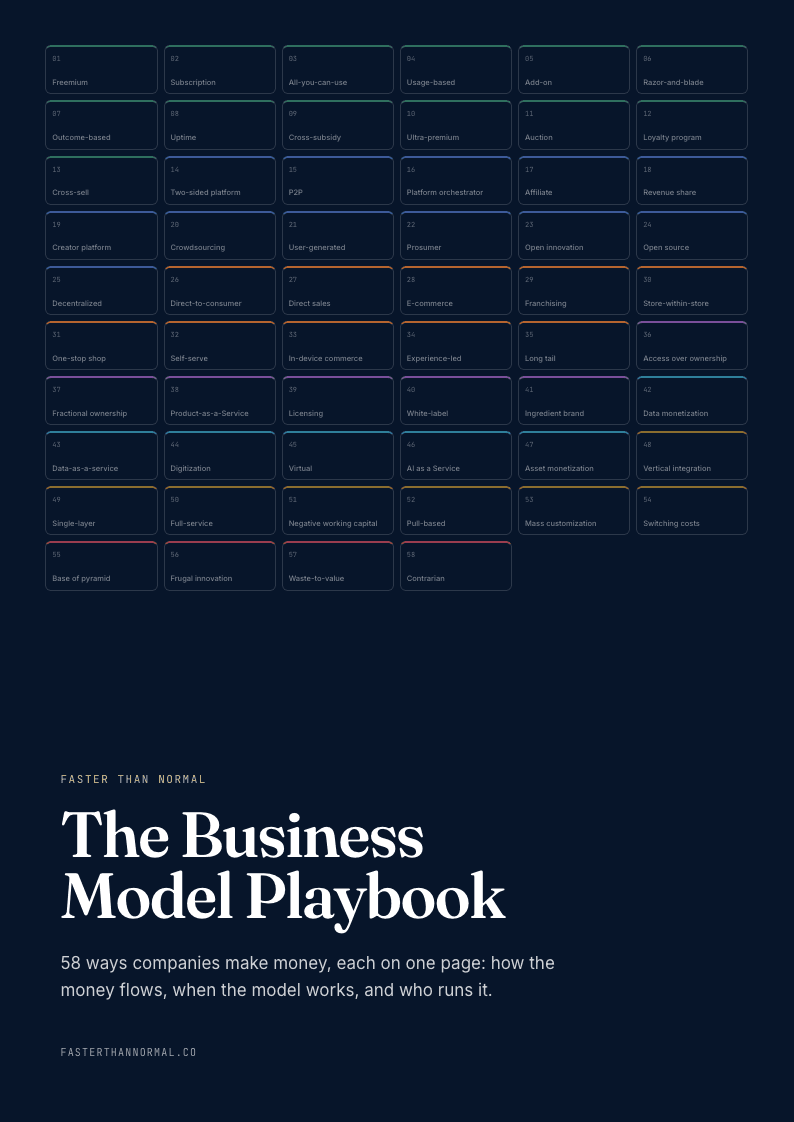
Free playbook
Get The Business Model Playbook
58 business models, one visual page each: how the money flows, the metrics that matter, and who runs it. Free when you join the Faster Than Normal email.
Free. No spam. Unsubscribe anytime.
Part IIIMaxims
-
Frustration is signal, not noise. The things that make you miserable as a consumer are often the things that make you formidable as a founder.
-
The side project is the strategy. Running an idea at the margins of your life, with no resources and no expectations, produces the purest form of product focus.
-
Community is a moat that capital cannot buy. Millions of users who have invested time, taste, and trust in a platform create switching costs that no competitor can replicate with money alone.
-
Your users will tell you when they're ready to pay. When people call your office asking how to add something to a cart that doesn't exist, the revenue model has already validated itself.
-
Hire like it's permanent; fire like it's urgent. The pain of a wrong hire compounds daily. The relief of a right hire is immediate. The gap between recognizing the former and achieving the latter is where most founders lose time.
-
Governance bloat kills velocity. A four-person board making decisions in a room will outperform a nine-person board making presentations in a conference call, every time.
-
Not knowing the terminology is the product insight. If you can't describe what you want to an expert, neither can millions of other people — and that gap is the product.
-
Let demand lead geography. Expand to where your users already are, not to where your strategy deck says they should be.
-
The best investor is the one who gets out of the way. Choose partners who offer guidance on request rather than direction by default.
-
A company, like a house, is never finished. The willingness to keep renovating — the product, the team, the roles, the vision — is the difference between companies that endure and companies that peak.
In Their Own Words
We started building the tools based on demand from the community.— Interview with Mansueto Ventures CEO Eric Schurenberg, 2021
It's about passion, not exits.— Interview, 2016
Hiring a diverse group of the right people has helped my business thrive.— Interview with Nick Hawkins, 2021
We ended up with plans in front of us that we didn't like and couldn't afford.— Interview with Nick Hawkins, 2021
Frustration is an important signal: it indicates an opportunity, a problem to be solved, a path to scale.— Masters of Scale Podcast, 2023
It's like a house. When you build a strong foundation from the beginning you can't build it from one material.— Interview with Mansueto Ventures CEO Eric Schurenberg, 2021
You have to bring lots of different materials, in the right time and places.— Interview with Mansueto Ventures CEO Eric Schurenberg, 2021
When you identify a problem, you need to ask for help.— Interview with Mansueto Ventures CEO Eric Schurenberg, 2021
Don't enter to exit. It's so true. The state of mind has to be, "I want to do it. It will be fun in the long term." To create something that will truly make an impact on many people or an industry? That's the best reason to start something.— Adi Tatarko, on the best advice she ever received
I can't even imagine going back now and doing one of them.— Adi Tatarko
You're not creating it for investors, you're not creating it to look nice on a powerpoint. You're creating it for real people and you need to listen to them.— Adi Tatarko
Really choose something that you are truly passionate about. It's so hard to do it. It's 24/7, even if you work just 14 or 16 or 12 hours. It's a rollercoaster with ups and downs. And if you're not really passionate about it, the chances of you sticking with it in the long term are way smaller.— Adi Tatarko
The important number is not how much we've raised but how many people are in our community.— Adi Tatarko


