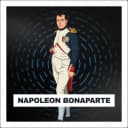
Napoleon Bonaparte (1769–1821) was a Corsican-born artillery officer who took power in France in the coup of 18 Brumaire in 1799 and crowned himself Emperor of the French in 1804. He fought some sixty major battles and gave France the Civil Code of 1804, whose 2,281 articles were later adopted or adapted across Europe and Latin America and remain living law in much of the world. His invasion of Russia in 1812 destroyed the Grande Armée; he abdicated in 1814, returned for the Hundred Days, was defeated at Waterloo on June 18, 1815, and died in exile on St. Helena on May 5, 1821.
On the evening of December 2, 1804, in the nave of Notre-Dame de Paris, a short man in an ermine-and-crimson mantle lifted a golden crown from the altar — bypassing the Pope who had traveled from Rome to bless the ceremony — and placed it on his own head. Then he turned to his older brother Joseph and allegedly whispered, "if only our father could see us now." The father in question, Carlo Buonaparte, had been dead for nearly twenty years, a minor lawyer from a minor island, buried far from home in Montpellier after a stomach cancer that killed him at thirty-eight. The son who invoked him had, in the intervening decades, gone from an artillery second lieutenant garrisoned at Valence to the sovereign of a European empire. What interests us is not the crown or the cathedral or even the extraordinary velocity of the ascent — it is the whisper. The aside to a brother. The invocation of the dead father. Because in that single aside Napoleon revealed what two decades of war, legislation, and imperial pageantry would only intermittently confirm: that the Corsican boy who had once been mocked for his accent never entirely left the body of the Emperor of the French, and that the distance between those two identities — the provincial outsider and the continental master — was the engine that powered everything.
By the Numbers
The Napoleonic Record
60Major battles fought (more than Alexander, Hannibal, and Caesar combined)
~6 millionEstimated deaths across the Napoleonic Wars, 1803–1815
2,281Articles in the Civil Code, promulgated March 21, 1804
40,497Letters in the General Correspondence (Fondation Napoléon edition)
44 millionPopulation of the French Empire at its peak, 1812
14 years, 5 monthsDuration of rule — from the Coup of 18 Brumaire to the first abdication
5 ft 7 inHis actual height at death — above average for Frenchmen of his era
The Island and the Accent
Corsica passed from Genoese to French sovereignty in 1768, one year before Napoleon was born. This timing is not incidental — it is the first fact about him that matters. He arrived into a family and a place caught between identities: Italian-speaking Corsicans living under a French flag they had not chosen. His father, Carlo Buonaparte, was a lawyer of ancient Tuscan lineage who had fought alongside Pasquale Paoli — the Corsican independence leader — before switching sides to accommodate the French occupation. Carlo married the beautiful and formidable Letizia Ramolino when she was fourteen; they would produce eight surviving children in difficult circumstances. Carlo's gift was not conviction but adaptation: he won the protection of the French governor, secured an appointment as judicial assessor in Ajaccio, and in 1778 obtained admission for his two eldest sons to the Collège d'Autun in continental France.
Napoleon was nine. He spoke French with a thick Corsican accent. He was combative, solitary, and proud — qualities his schoolmates at Brienne, the military college where he spent five years, rewarded with ridicule. "Ribulione," his childhood playmates in Ajaccio had called him — the Disruptor. At Brienne, the disruption took a different form. He devoured mathematics and ignored Latin. He defended Paoli in arguments and blamed his own father for capitulating. He organized mock sieges with other boys, displaying the instinct for spatial reasoning that would later make him the most dangerous artillery officer in Europe. A report by the inspector M. Keralio, filed upon Napoleon's departure from Brienne, identified the essentials: exceptional aptitude in mathematics, reserved character, ambition beyond his station. The inspector did not note the accent. By then, Napoleon had learned to weaponize his outsider status rather than apologize for it.
He graduated from the military academy in Paris in September 1785, ranking 42nd in a class of 58. His father had died of stomach cancer seven months earlier, leaving the family in straitened circumstances. Napoleon, not yet sixteen, assumed the position of head of the household — displacing his elder brother Joseph with the same instinctive authority he would later use to displace the Directory. He was commissioned as a second lieutenant of artillery in the regiment of La Fère, garrisoned at Valence, where he continued his education with ferocious autodidacticism, reading Voltaire, Rousseau, and works on strategy and tactics. He also wrote Lettres sur la Corse, a text vibrating with romantic attachment to the island he had left behind. This is the paradox that would define his career: he was a Corsican nationalist who would become the greatest French imperialist, a provincial outsider who would remake the center in his own image.
The Uses of Chaos
The French Revolution arrived not as an abstraction but as an opportunity. Between 1789 and 1793, Napoleon oscillated between Corsica and continental France, calibrating his allegiances with the precision of a man reading wind direction before placing artillery. He joined the Jacobin Club in Valence and became its president. He returned to Corsica and was elected lieutenant colonel in the national guard. He fell out with Paoli — who considered him a foreigner, the son of a turncoat — and when civil war erupted on the island in April 1793, the Buonaparte family was condemned to "perpetual execration and infamy." They fled to France.
This was the severance that made Napoleon possible. Stripped of Corsica, he had no identity to fall back on except the one he could construct. Within a few years he would drop the Italian spelling of his surname. He rejoined his regiment at Nice. And in September 1793, when the commander of the National Convention's artillery was wounded during the siege of Toulon — where royalists had invited British forces to occupy the port — an obscure Corsican captain named Bonaparte talked his way into the vacancy through the intercession of Antoine Saliceti, a fellow Corsican and friend of the family.
Toulon was a military success and also a demonstration of the operating system that would carry Napoleon to the summit: identify the decisive point, concentrate overwhelming force upon it, and move with a speed that makes deliberation impossible for the opponent. He was promoted to major in October. He took a bayonet wound in the thigh on December 16. Within days, the British evacuated. On December 22, at the age of twenty-four, he was made brigadier general. Augustin de Robespierre — brother of Maximilien, then the virtual head of the French government — wrote home praising the young officer's "transcendent merit."
The association with the Robespierres would nearly kill him. When Maximilien fell from power on 9 Thermidor (July 27, 1794), Napoleon was arrested on charges of conspiracy and treason. He was freed within two weeks but stripped of his command. He spent months in Paris, impoverished, lovesick over Désirée Clary — daughter of a rich Marseille businessman, sister of his brother Joseph's bride — and so desperate for employment that he considered offering his services to the Sultan of Turkey. The future emperor of half of Europe, at twenty-five, was an unemployed general with a suspicious political past and a foreign accent, contemplating a career in the Ottoman military.
Soldiers, you are naked, badly fed.… Rich provinces and great towns will be in your power, and in them you will find honor, glory, wealth. Soldiers of Italy, will you be wanting in courage and steadfastness?
The Whiff of Grapeshot
The moment arrived on 13 Vendémiaire, year IV — October 5, 1795. The National Convention, on the eve of its dissolution, had submitted a new constitution to referendum, along with decrees ensuring that two-thirds of its members would carry over into the new legislature. Royalists, sensing their chance to restore the monarchy, launched an insurrection in Paris. Paul Barras, entrusted with dictatorial powers to suppress the revolt, needed a general. He remembered the young officer from Toulon.
Napoleon did not hesitate. He positioned his guns — the artillery captain's reflex that preceded every political calculation — and fired grapeshot into the advancing columns of rebels. At least two hundred were killed. The Republic was saved, and its savior was appointed commander of the Army of the Interior. Within months he was the Directory's most trusted military advisor. Within months after that, he married Joséphine de Beauharnais — a Creole widow six years his senior, mother of two children, veteran of many love affairs, and recently the mistress of Barras himself — and was given command of the Army of Italy.
Joséphine: born Marie-Josèphe-Rose Tascher de La Pagerie on the sugar island of Martinique, married at sixteen to the Vicomte de Beauharnais, who was guillotined during the Terror, leaving her with two children and a network of connections that she deployed with an instinct for survival equal to Napoleon's own. She took a lover almost immediately after the wedding. Napoleon, departing for Italy two days after the ceremony, sent her letters of such unhinged passion that they remain among the most quoted love correspondence in European history. "Sweet and incomparable Josephine," he wrote, "what a strange effect you have on my heart!… I draw from your lips, from your heart, a flame that burns me." She did not write back with comparable frequency.
The Italian Method
He arrived at his headquarters in Nice in late March 1796 to find an army that existed largely on paper. The official strength was 43,000; the actual count was closer to 30,000 — ill-fed, ill-paid, ill-equipped. Within weeks, he had transformed this force into the most effective military instrument in Europe. He took the offensive on April 12 and executed a series of maneuvers that military historians have been studying for two centuries: separating the Austrian and Sardinian armies, defeating them in detail, and marching on Turin with a speed that left his opponents unable to coordinate a response.
The Italian campaign was Napoleon's laboratory. He developed the operational grammar that would define his subsequent career: the manoeuvre sur les derrières — sweeping around an enemy's flank to threaten their line of communication and force battle on disadvantageous terms; the habits of dispersed marching and rapid concentration that would mature, a decade later, into the bataillon carré of 1806; and above all, the principle of decisive mass at the critical point, which meant accepting risk everywhere else. King Victor Amadeus III of Sardinia asked for an armistice. The Pope signed one. The Duke of Parma, the Duke of Modena — they all signed.
At the Battle of Rivoli in January 1797, Napoleon destroyed the fourth and last Austrian army sent to relieve the besieged fortress of Mantua, which capitulated weeks later. He marched toward Vienna. The Austrians sued for peace with his army roughly a hundred miles from their capital. The Treaty of Campo Formio, which Napoleon negotiated essentially on his own authority — overriding the Directory's preferences — ceded the Austrian Netherlands to France, recognized the Cisalpine Republic he had created in northern Italy, and made Napoleon the most famous man in Europe at twenty-eight.
The Directory was displeased. Napoleon had given Venice to Austria against their wishes and failed to secure the Rhine frontier. But the Directory also understood that Napoleon's popularity made him untouchable. They were dealing, for the first time, with a general whose political leverage exceeded their own — a pattern that would intensify until it consumed the Republic itself.
The Desert and the Decisive Return
Egypt was simultaneously a strategic masterstroke and a strategic dead end. The idea was Napoleon's: occupy the Nile Delta, threaten Britain's route to India, and establish a French presence in the eastern Mediterranean. Charles-Maurice de Talleyrand — the foreign minister, a defrocked bishop of extraordinary cynicism and diplomatic genius who would serve and betray every French regime from the ancien régime to the July Monarchy — endorsed the plan. The Directory approved it, grateful for any scheme that would remove their dangerously ambitious general from Paris.
The expedition sailed in May 1798. Malta fell in June. Alexandria was taken by storm in the first days of July. At the Battle of the Pyramids on July 21, Napoleon routed the Mamluk cavalry with infantry squares and artillery — a demonstration of European tactical superiority that stunned the Middle East.
But on August 1, Admiral
Horatio Nelson destroyed the French fleet at anchor in Abū Qīr Bay, trapping Napoleon in his conquest. The strategic implications were catastrophic. Cut off from France, Napoleon marched into Syria in February 1799, where his advance was halted at the siege of Acre — an Ottoman fortress, backed by a British naval squadron under Sidney Smith, that proved, for once, that concentrated firepower could stop him. He retreated to Egypt, introduced Western administrative institutions with the efficiency of a man who treated every territory as a prototype for governance, and waited.
The news from Europe was both terrible and perfect. The French armies in Italy had been defeated. A new coalition — Britain, Austria, Russia, Turkey — had formed against France. The Directory was collapsing. Emmanuel Sieyès, one of the new directors, was searching for what he called a "saber" to prevent a royalist restoration. Napoleon, without orders, abandoned his army and sailed for France in late August 1799. His two frigates somehow evaded the British fleet. He landed at Fréjus on October 9 and reached Paris a week later.
The coup of 18-19 Brumaire (November 9-10, 1799) was almost farcically improvised. Sieyès — a political theorist who had helped create the Revolution's ideological architecture but lacked the nerve to seize power alone — provided the constitutional framework. Napoleon provided the bayonets. The directors were forced to resign. The legislative councils were dispersed. A new government, the Consulate, was established with three consuls: Napoleon, Sieyès, and Pierre-Roger Ducos. Only one of them mattered.
I am looking for a saber.
The Machinery of the State
Napoleon was thirty years old, thin, with closely cropped hair — le petit tondu, the "little crop-head." He was expected to bring peace, end disorder, and consolidate the Revolution's gains. He was also insatiably ambitious. He did not believe in the sovereignty of the people, in parliamentary debate, or in the popular will. He believed that an enlightened and firm will could do anything if it had the support of bayonets. He despised the masses and considered public opinion something he could mold and direct at pleasure. He has been called the most "civilian" of generals, but he never ceased to be a soldier.
What followed was the most consequential burst of administrative reform in European history. The constitution of year VIII (December 25, 1799) concentrated all real power in the First Consul. The other two consuls were figureheads. The Council of State — created by Napoleon, often personally chaired by him — became the engine of legislation and administrative adjudication. The prefect system installed centrally appointed administrators in every département, each one functioning as the First Consul's eyes, ears, and hands across France — supervising police, managing education, overseeing tax collection, coordinating public works, and reporting local sentiment to Paris with unprecedented regularity. Judges, previously elected, were now nominated by the government but assured independence through irremovability. The financial system was rebuilt: direct tax collection was professionalized, the franc was stabilized, and the Banque de France — part state, part shareholder — was established. Education was transformed into a public service. The Concordat of 1801 reconciled the Catholic Church with the revolutionary state — the Pope recognized the Republic, required the resignation of all former bishops, and accepted that new prelates would be designated by the First Consul.
And then the Code. The codification of French civil law had been attempted at least five times since 1790. Jean-Jacques-Régis de Cambacérès, that indefatigable jurist who would serve as Napoleon's Second Consul and later as Arch-Chancellor of the Empire, had drafted three versions — in 1793, 1794, and 1796 — all of which had failed to pass. Napoleon's contribution was not legal scholarship but political will. He appointed a commission of four experienced legal practitioners in 1800. They produced a draft in four months. When the draft came before the Council of State, Napoleon presided over many of the sessions himself, debating points of inheritance law with the fluency of a man who treated every domain of knowledge as a theater of operations. The code was enacted piecemeal as 36 separate laws in 1803 and 1804, then consolidated on March 21, 1804, as the Code Civil des Français.
Its 2,281 articles gave permanent form to the Revolution's gains — individual liberty, freedom of work, freedom of conscience, equality before the law, the lay character of the state — while also protecting landed property, favoring employers over employees, and granting only limited rights to women. It was, in the typically Napoleonic formulation, a blend of revolutionary innovation and autocratic consolidation. It was also, by any measure, one of the most influential legal documents in human history. It would be adopted or adapted in Belgium, Luxembourg, the Netherlands, Italy, Germany, Switzerland, Haiti, the Dominican Republic, Bolivia, Chile, Ecuador, Colombia, Uruguay, Argentina, and Louisiana — the only civil-law jurisdiction in the common-law United States. Two centuries after its promulgation, it remains living law across large portions of the world.
My real glory is not the forty battles I won, for Waterloo's defeat will destroy the memory of as many victories.… What nothing will destroy, what will live forever, is my Civil Code.
The Algebra of Battle
"Napoleon fought more battles than Alexander, Hannibal, and Julius Caesar combined," wrote David Chandler in
The Campaigns of Napoleon. "He is, beyond any doubt, the greatest of European soldiers." He never wrote a systematic treatise on warfare, though he often expressed the intention, remarking that everyone would be surprised at how simple his principles were. What survived were the
Maximes de guerre — topical, standalone statements dictated on St. Helena, covering everything from campaign planning to flanking attacks — and the operational record itself, which became the foundational text for military theorists from Clausewitz to Patton.
His method rested on several interlocking principles.
Speed: "I put my trust in the legs of my soldiers," he said. His basic strategic idea was a fast-moving army that could concentrate faster than the enemy could react. The corps system — semi-independent combined-arms units of 15,000 to 30,000 men, each capable of holding a position until reinforced — gave him operational flexibility that no other European army could match. Concentration at the decisive point: he accepted risk everywhere else, tolerating exposed flanks and weak screening forces, because he understood that local superiority at the moment of contact mattered more than overall numerical parity. Information dominance: he consumed intelligence reports with the same voracity he applied to legal briefs, maintaining a mental map of every unit's position that allowed him to make decisions faster than his opponents could transmit orders.
At Austerlitz on December 2, 1805 — the anniversary of his coronation, a coincidence he savored — he defeated the combined armies of Russia and Austria by deliberately weakening his right flank to lure the allies into overextending, then smashing through their center with concentrated force. It was a battle of such geometric precision that it is still taught at military academies worldwide. At Jena on October 14, 1806, he destroyed the Prussian army in a single afternoon. At Friedland on June 14, 1807, he shattered the Russians and forced Tsar Alexander I to sign the Treaties of Tilsit.
What Clausewitz observed about Napoleon — and Clausewitz was perhaps his most perceptive student, having fought against him at multiple engagements — was that his genius lay not in novel tactics but in the integration of decision-making speed, organizational design, and personal presence into a unified system. The coup d'oeil, Clausewitz called it — the flash of insight that cuts through the fog of war. Napoleon possessed it to a degree that his marshals, however talented, could only approximate. As a French sergeant-major later recalled of the fighting at Leipzig in 1813: "No-one who has not experienced it can have any idea of the enthusiasm that burst forth among the half-starved, exhausted soldiers when the Emperor was there in person. If all were demoralised and he appeared, his presence was like an electric shock. All shouted 'Vive l'Empereur!' and everyone charged blindly into the fire."
The Empire and Its Contradictions
He crowned himself Emperor on December 2, 1804 — technically, the Senate had proclaimed the hereditary empire on May 18, and a national plebiscite had ratified it overwhelmingly. The coronation at Notre-Dame, with Pope Pius VII in attendance, was theater designed to fuse revolutionary legitimacy with monarchical grandeur. Jacques-Louis David's immense painting of the event, which hangs in the Louvre, captures the intended message: this was a new kind of sovereignty, derived not from divine right but from martial achievement and popular consent, yet clothed in the symbols of ancient authority.
The empire that followed was an engine of modernization wrapped in the rhetoric of liberation and powered by conquest. Wherever French armies went, they carried the Code, the prefect system, the metric system, religious toleration, and the abolition of feudal privileges. They also carried expropriation, conscription, continental blockade, and the subordination of every occupied territory to French economic interests. Napoleon installed his brothers as kings — Joseph in Spain, Louis in Holland, Jérôme in Westphalia — and his marshals as regional governors, creating a continent-spanning patronage network held together by personal loyalty and the threat of force.
The Continental System, established by the Berlin Decree of November 1806, aimed to destroy British commerce by closing European ports to British goods. It was an act of economic warfare that demonstrated both Napoleon's strategic imagination and his fatal tendency to mistake the map for the territory. The blockade was unenforceable across Europe's thousands of miles of coastline. It alienated allies, provoked resistance, and drew him into the two campaigns that would destroy the empire: Spain and Russia.
The Peninsular War began in 1808 when Napoleon deposed the Spanish Bourbons and installed Joseph on the throne. He wrote to his stepson Eugène de Beauharnais on May 6, 1808: "We are nearing a solution. King Charles has surrendered to me all rights to the throne." What he did not anticipate was that the Spanish population would resist with a ferocity that no amount of military superiority could suppress. The guerrilla war that followed — the word guerrilla itself entered European languages from this conflict — tied down hundreds of thousands of French troops and became, in Napoleon's own later assessment, "the ulcer that destroyed me."
Moscow and the Arithmetic of Hubris
On June 24, 1812, Napoleon crossed the Niemen River with approximately 600,000 men — the largest army ever assembled in European history to that point. His proclamation to the troops framed the invasion as a defensive necessity: "Russia is impelled onward by fatality. Her destiny is about to be accomplished." The reality was that Tsar Alexander I had withdrawn from the Continental System, and Napoleon's logic demanded that no European power be permitted to defy him.
The Russian campaign was a masterclass in the limits of operational genius applied to strategic folly. Napoleon won most of the battles — at Smolensk, at Borodino — but the Russian army refused to be destroyed. It retreated deeper into the interior, burning crops and villages as it went. Napoleon reached Moscow on September 14 and found it burning. The Russians had set fire to their own capital rather than let it sustain the French army through winter. Napoleon waited five weeks for a peace offer that never came. He wrote to Alexander from the scorched Kremlin, protesting the barbarity of the arson with the wounded dignity of a conqueror deprived of his prize: "The superb and beautiful city of Moscow no longer exists. Rostoptchine gave orders to burn it.… Such conduct is atrocious and useless."
The retreat began on October 19. What followed was one of the greatest military catastrophes in recorded history. The Grande Armée was destroyed not primarily by Russian arms but by cold, starvation, disease, and the collapse of logistics across a thousand miles of hostile territory. Of the 600,000 who crossed the Niemen, only a small fraction returned — by some estimates, as few as 20,000 men of the main army. Napoleon abandoned his army — as he had abandoned his army in Egypt thirteen years earlier — and raced back to Paris to raise new forces and control the political narrative.
He rebuilt. He always rebuilt. In the spring of 1813, he fielded a new army of several hundred thousand, hastily raised and decidedly inferior in quality — conscripts who lacked the training and experience of the veterans frozen in Russia. He won at Lützen and Bautzen but could not achieve the decisive annihilation he needed. At Leipzig in October 1813 — the "Battle of the Nations" — he was defeated by a coalition of Russia, Prussia, Austria, and Sweden in a three-day engagement that cost approximately 100,000 casualties on both sides. He retreated across the Rhine. The coalition followed.
The Abdication and the Hundred Days
Paris fell on March 31, 1814. Napoleon's marshals — the men who had won his battles, grown rich on his patronage, and been elevated to dukedoms and principalities by his hand — refused to continue fighting. On April 6, at the Palace of Fontainebleau, he abdicated. On April 20, in the courtyard, he addressed the remnant of the Old Guard in what became one of the most quoted speeches in military history:
"Soldiers of my Old Guard: I bid you farewell. For twenty years I have constantly accompanied you on the road to honor and glory.… With men such as you our cause could not be lost; but the war would have been interminable; it would have been civil war, and that would have entailed deeper misfortunes on France. I have sacrificed all of my interests to those of the country."
He was exiled to Elba, a small island off the Italian coast, where he was permitted to retain the title of Emperor and given sovereignty over approximately 12,000 inhabitants. He lasted ten months. On February 26, 1815, accompanied by roughly a thousand men, many of them from the Old Guard, he slipped away from Elba, landed in France on March 1, and marched toward Paris, gathering supporters as he went. Louis XVIII fled. Napoleon resumed the throne.
The Hundred Days ended at Waterloo on June 18, 1815, where the combined armies of the Duke of Wellington and Field Marshal Blücher destroyed the last French army Napoleon would ever command. He abdicated again on June 22. This time, the Allies sent him to St. Helena — a volcanic rock in the South Atlantic, 1,200 miles from the nearest continent — where there would be no escape.
The Rock and the Pen
He lived on St. Helena for nearly six years, from October 1815 until his death on May 5, 1821, at the age of fifty-one. He dictated memoirs, reinterpreted his decisions, re-fought his battles, and constructed the legend that would outlast the empire. "Everything on earth is soon forgotten," he told the Count de Las Cases, his faithful companion and amanuensis, "except the opinion we leave imprinted on history."
Las Cases's record of those conversations, the Mémorial de Sainte-Hélène, published in 1823, sent shockwaves through French society. He presented himself as the savior of the Revolution, a man of peace thwarted by the reactionary kings of Europe, a modernizer working for the good of the people. The self-portrait was selective, self-serving, and extraordinarily effective. Pictures of Napoleon and his young son, Napoleon II — who had been raised in the Austrian court and would die of tuberculosis at twenty-one in 1832 — adorned the walls of peasant households across France.
In 1848, his nephew Louis-Napoleon Bonaparte leveraged the family name to win the presidency of the Second Republic; by 1852, he had declared himself Emperor Napoleon III. The Napoleonic legend — manufactured on a volcanic island by a man with nothing left but his pen and his mythology — had reshaped French politics a generation after his death.
Later generations of builders found in him a model of organization.
John D. Rockefeller is among those said to have admired his genius for it, and the comparison is not as eccentric as it sounds. Both men built systems — organizational architectures designed to operate at scale, with centralized decision-making, decentralized execution, and an information infrastructure that allowed the leader to maintain awareness of every significant variable. Both men understood that personal presence was an irreplaceable force multiplier. Both men's greatest strength — an instinct for concentration, for identifying the decisive point and overwhelming it — was also the source of their gravest exposure: Rockefeller's trust grew until it provoked the antitrust suit that broke it apart; Napoleon's empire grew until the system that sustained it could no longer bear the weight.
On St. Helena, in the damp and diminishing rooms of Longwood House, Napoleon gave his companions his assessment of what would endure: not the forty battles, not the empire, not the thrones of his brothers, but the Civil Code. The laws. The paperwork. The administrative machinery that would continue to reshape the legal systems of nations that had defeated him on the battlefield.
He died on May 5, 1821. In 1840, his body was returned to France and interred at Les Invalides in Paris, where it remains. The sarcophagus sits in an open crypt below floor level, so that visitors look down on it from the gallery above — a design that honors the emperor while inviting even admirers to contemplate the costs of glory. The ermine mantle, the laurel wreath, the whispered aside to Joseph — all of it was gone. What remained was the Code, the prefects, the lycées, the Banque de France, and the memory of a man who had shaped the modern world by refusing to accept the boundaries of the one he was born into.