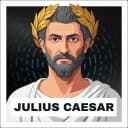
The River That Was Not a River
On a damp night in January 49 BCE, somewhere in the flatlands south of Ravenna — the exact location disputed by Italian municipalities to this day — a forty-nine-year-old man stood at the edge of a stream so small that in any other century it would have been forgotten entirely. The Rubicon barely counted as a river in any topographical sense; it was a legal fiction made liquid: a line drawn by the Lex Cornelia Majestatis separating Cisalpine Gaul from Italy proper, the boundary beyond which no Roman commander could lead an armed force without committing an act of war against the state. Behind him stood a single legion — the Thirteenth — roughly five thousand men who had followed him through eight years of Gallic winters and whose loyalty to him had long since eclipsed whatever residual allegiance they might have felt toward the Senate and People of Rome. Ahead lay either supreme power or annihilation.
The ancient sources cannot agree on what Caesar said before crossing. Suetonius gives us the theatrical alea iacta est — "the die is cast." Plutarch, drawing on a different tradition, has Caesar quoting the Greek playwright Menander. Both accounts share the same structural irony: the most consequential military act of the late Republic was not a siege or a pitched battle but a man wading across ankle-deep water in the dark. The gesture was everything. The river was nothing. And the man — who had spent his entire adult life understanding that in Roman politics, gesture was everything — knew precisely what he was doing.
What Caesar did at the Rubicon was less a spontaneous act of Napoleonic daring than the culmination of a career built on the systematic exploitation of a decaying system by someone who understood that system more intimately, more cynically, and more creatively than anyone alive. He was a patrician who championed the plebs. A debtor who became the richest man in Rome. A politician who became a general who became a dictator who became a god. And finally — on a mid-March morning four years and two months later — a corpse on the marble floor of the Senate House, leaking from twenty-three stab wounds, his toga pulled over his face in a last, involuntary gesture of Roman modesty.
This is the story of how one man dismantled a five-hundred-year-old republic and replaced it with himself. It is also — and this is the part that rarely gets told — the story of how the republic had already dismantled itself, and Caesar simply walked through the wreckage.
By the Numbers
The Caesarian Colossus
~100 BCEBorn in Rome, to the patrician but undistinguished gens Julia
8 yearsDuration of the Gallic Wars (58–50 BCE)
~1 millionGauls killed and another million enslaved, per Plutarch
800+Vessels in his second British invasion fleet (54 BCE)
4 yearsRoman Civil War, from Rubicon to final victory (49–45 BCE)
23Stab wounds received on the Ides of March, 44 BCE
~60Senators involved in the assassination conspiracy
A Patrician Without a Fortune
The name Julius misleads. It carries the accumulated grandeur of two millennia — Kaiser, Tsar, Qayṣar, the month of July, the calendar that structured Western civilization until 1582 and still governs the Orthodox churches. But in the Rome of the early first century BCE, the Julii Caesares were a family whose prestige dramatically exceeded their bank account. They were patricians, yes — members of Rome's original aristocratic caste, tracing their lineage, with the requisite aristocratic implausibility, to the goddess Venus herself. But patrician blood was no longer a political advantage. It was, in fact, a handicap: a patrician could not hold the office of tribune of the plebs, which had become one of the most powerful positions in Roman politics precisely because it was supposed to belong to commoners.
Gaius Julius Caesar was born on July 12 or 13, in what is most probably the year 100 BCE — a date that, if correct, means he held every office of his career two years ahead of the legal minimum age. His father, also Gaius Caesar, died when the boy was sixteen. His mother, Aurelia, was by all accounts the more formidable parent, and the ancient sources — Suetonius, Plutarch — suggest Caesar owed much of his formation to her. What the sources do not quite say, but the circumstantial evidence screams, is that Caesar grew up watching the Roman Republic eat itself.
The context matters more than the biography. Rome in the late second and early first centuries BCE was a state whose governing apparatus had been designed for a city and was now groaning under the weight of an empire. The Italian allies had revolted in 91 BCE because Rome refused to share citizenship. The peasant class that had once supplied the legions had been dispossessed by cheap grain imports and the consolidation of estates. Gaius Marius — Caesar's uncle by marriage, a self-made military genius, the
novus homo who had saved Rome from Germanic invasion — had responded to the manpower crisis by recruiting landless men into the army, a reform that shifted legionary loyalty from the state to the individual general who could promise them land and plunder after discharge. This was the crack in the foundation. Every subsequent catastrophe —
Sulla's march on Rome, the proscriptions, the civil wars — flowed from Marius's practical solution to a recruitment problem.
Marius himself was dead by 86 BCE, having returned from exile, massacred his enemies, seized a seventh consulship, and expired from natural causes within days of taking office. His widow, Julia — Caesar's aunt — would be eulogized by her nephew at her funeral in 69 or 68 BCE, in an oration that was also, not subtly, a public rehabilitation of the Marian political brand. Caesar understood funerals the way modern politicians understand television: as a medium for broadcasting identity.
The Education of a Debt Machine
The Roman political career — the cursus honorum — was an escalator that only moved if you kept feeding it money. A young aristocrat needed to win election to a series of magistracies: quaestor, aedile, praetor, consul. At each stage, the costs escalated. As aedile, you were expected to fund public games. As a candidate for higher office, you needed to distribute favors, host banquets, and maintain the loyalty of clients — a web of personal dependents that, for the most powerful families, could include entire nations. The system was, in effect, a leveraged buyout of the state conducted in perpetuity by the aristocratic class, and the returns — especially the provincial governorships that followed the praetorship and consulship — were staggering.
Caesar entered this machine with minimal capital and maximum ambition. In 84 BCE, at roughly sixteen, he committed himself to the radical populist faction by marrying Cornelia, the daughter of Lucius Cornelius Cinna, a noble allied with Marius. When Sulla — the conservative strongman who marched his army on Rome, proscribed thousands of his enemies, and restored senatorial supremacy by force — ordered Caesar to divorce Cornelia, the young man refused. He came close to losing his life. He found it advisable, the sources say with delicate understatement, to leave Italy.
The years of exile were not wasted. Caesar served on military staffs in Asia Minor, won a decoration for bravery at the siege of Miletus, and was captured by Cilician pirates — one of the symptoms, as Britannica notes with quiet savagery, of the anarchy into which the Roman nobility had allowed the Mediterranean world to fall. The pirate episode is revealing not for its adventure-story elements — the ransom, the daring escape — but for what it tells us about Caesar's psychology. According to Plutarch, when the pirates set his ransom at twenty talents, Caesar laughed and demanded they raise it to fifty, insisting they did not know whom they had captured. He then spent his weeks in captivity reading them his compositions and promising, cheerfully, to come back and crucify them. After the ransom was paid, he did exactly that: raised a private naval force, captured his captors, and had them executed. All this as a private citizen holding no public office.
Back in Rome after Sulla's death in 78 BCE, Caesar began the conventional work of a prosecuting advocate — targeting, of course, prominent Sullan counter-revolutionaries. He studied rhetoric at Rhodes under the famous professor Molon. He was elected to the college of pontifices. He won a military tribuneship. At each step, he borrowed more than he could afford, cultivated allies across factional lines, and demonstrated a talent for the kind of calculated generosity that is indistinguishable from bribery. His election as pontifex maximus in 63 BCE — high priest of the state religion, a lifetime appointment — was achieved, the sources say, "by a political dodge." The details are murky. The result was not: at thirty-seven, Caesar held one of the most prestigious positions in Rome, and he owed a fortune.
The debts were not incidental. They were structural. When Caesar was appointed governor of Farther Spain in 61 BCE, his creditors literally would not let him leave the city until Marcus Licinius Crassus — Rome's wealthiest man, a real-estate baron who had built his fortune buying the burning homes of proscription victims at fire-sale prices — personally guaranteed a quarter of Caesar's obligations. The governorship in Spain produced a military campaign that yielded enough plunder to partially restore Caesar's finances. But the deeper lesson was clear: in Rome, debt was leverage, and leverage was power, provided you kept moving fast enough to stay ahead of the bill collectors.
The Architecture of the Deal
The First Triumvirate — the informal alliance of Caesar, Pompey, and Crassus forged in 60 BCE — was a temporary alignment of three men who needed each other for precisely one cycle of mutual exploitation. They were neither equals nor friends.
Gnaeus Pompeius Magnus — Pompey the Great — was everything Caesar was not yet: a military hero of unquestioned stature, conqueror of the East, the general who had cleared the Mediterranean of pirates and reorganized Rome's eastern provinces with an administrator's precision. He was also a political naif. Pompey had returned from the East expecting the Senate to ratify his settlements and grant land to his veterans. The Senate, jealous and afraid, had blocked him at every turn. Pompey had the army, the reputation, and the popular adulation, but he could not get a bill through the legislature. He needed a politician.
Marcus Licinius Crassus was Pompey's opposite and rival: a man whose power derived entirely from money. He had crushed the slave revolt of Spartacus in 71 BCE, but the glory had been stolen by Pompey, who arrived at the tail end of the campaign and claimed credit. Crassus never forgave this. The enmity between the two men was one of the fixed points of Roman politics — and Caesar's genius lay in recognizing that he could bridge it.
The deal was elegant. Caesar, running for the consulship of 59 BCE, would use the office to push through Pompey's land bill and Crassus's financial interests. In return, Pompey would provide military muscle and popular support; Crassus would provide funding. To seal the arrangement, Caesar married his only daughter, Julia, to Pompey — a man twenty years her senior. The personal became political with a literalness that even Rome found startling.
As consul, Caesar got Pompey's land bill passed by circumventing the Senate entirely, bringing it directly to the popular assembly in a session where, according to multiple sources, Pompey's veterans packed the forum and Caesar's supporters physically intimidated the opposition. His co-consul, Marcus Calpurnius Bibulus — a conservative ally of Cato — was so thoroughly marginalized that he retreated to his house and spent the rest of his term issuing proclamations that nobody read. Romans joked that the consulship of Caesar and Bibulus had become the consulship of Julius and Caesar.
The prize for all this maneuvering was the provincial command that followed: the governorship of Cisalpine Gaul, Transalpine Gaul, and Illyricum, with four legions and a five-year term. It was, on paper, a routine assignment. In practice, it was a launchpad.
Eight Years of Blood and Prose
The conquest of Gaul — the campaign that made Caesar rich, famous, and ultimately ungovernable — began almost by accident. In the spring of 58 BCE, Caesar's legions were stationed in the eastern reaches of his province, poised for a campaign against Romania and its precious metals. But the migration of the Helvetii, a Celtic coalition from modern Switzerland attempting to cross Roman territory, gave him something better: a pretext.
All Gaul is divided into three parts.
That sentence — Gallia est omnis divisa in partes tres — is the most famous opening in military literature, and it is also the most deceptive. It presents as neutral geographic description what is in fact an act of intellectual conquest: the reduction of a vast, complex, culturally heterogeneous world into a schema that a Roman reader could comprehend and a Roman army could systematically devour. The Commentarii de Bello Gallico, Caesar's account of the Gallic Wars, is often taught as a model of plain Latin prose. It is more accurately understood as history's most sophisticated campaign book — a work of political communication disguised as field dispatches, written in the third person to create an illusion of objectivity while relentlessly advancing the author's interests.
The military achievement was real. Between 58 and 50 BCE, Caesar conquered the entirety of what is now France and Belgium, crossed the Rhine into Germania (building a bridge in ten days, dismantling it after eighteen — the engineering feat was the point), and mounted two expeditions to Britain in 55 and 54 BCE. The British campaigns were, in strictly military terms, failures — the weather was terrible, the fleet was nearly destroyed, and Caesar extracted tribute without establishing permanent control. But they were propaganda triumphs: Caesar had gone to the edge of the known world, and the Roman public was enthralled.
The human cost was staggering. Plutarch calculated that one million Gauls were killed and another million enslaved. The siege of Uxellodunum ended with Caesar ordering the hands cut off every surviving defender. When the Gallic chieftain Vercingetorix, who had united the tribes in a final uprising and nearly succeeded, laid down his sword at Alesia in 52 BCE and pleaded for mercy, Caesar imprisoned him for six years, then paraded him through Rome in chains during a triumph and had him strangled. The mercy Caesar would later show to Roman enemies in the civil war was a luxury he never extended to barbarians.
But the real achievement of the Gallic command was structural, not territorial. Eight years in the field gave Caesar something no Roman politician before him had possessed on this scale: a professional army of fanatical personal loyalty, funded by plunder, hardened by continuous combat, and answerable to him alone. The legions that crossed the Rubicon in 49 BCE were not instruments of the Roman state. They were Caesar's private army in everything but name. Marius had created the system. Caesar perfected it.
The Collapse of the Center
The triumvirate did not survive its own success. Julia, Caesar's daughter and Pompey's wife — the human bond that held the alliance together — died in childbirth in 54 BCE. Crassus, seeking his own military glory to rival Caesar's and Pompey's, led an army against the Parthian Empire and was destroyed at the Battle of Carrhae in 53 BCE. His severed head, according to one tradition, was used as a prop in a performance of Euripides at the Parthian court.
With Crassus dead and Julia gone, nothing remained to prevent the inevitable collision between Pompey and Caesar. The dynamics were almost mechanically predictable. Caesar in Gaul was accumulating power, wealth, and popular adoration at a rate that threatened every principle of the Roman political system — a system designed, above all, to prevent any single individual from becoming too powerful. Pompey, remaining in Rome despite holding a nominal command in Spain, was drifting toward the conservative senators who saw Caesar as an existential threat. Each side's fears were self-fulfilling: the Senate's attempts to recall Caesar and strip him of his army convinced Caesar that returning to Rome as a private citizen meant prosecution and ruin; Caesar's refusal to disband his legions convinced the Senate that he was an aspiring tyrant.
Caesar's demands were, on their face, reasonable. He wanted to stand for the consulship in absentia — to transition directly from military command to civilian office without the gap during which his enemies could prosecute him. The Senate, led by hardliners like Cato, refused. On January 7, 49 BCE, the Senate passed the senatus consultum ultimum — the ultimate decree, effectively declaring martial law and branding Caesar an enemy of the state. The tribunes loyal to Caesar, who had been vetoing measures against him, fled the city. Three days later, Caesar crossed the Rubicon.
— Suetonius, Lives of the Twelve Caesars
The phrase has calcified into cliché. But in context, it was a gambler's confession: Caesar was acknowledging, to himself and to his officers, that what he was about to do was irrevocable and that the outcome was not certain. He had one legion. Pompey had the loyalty of the Senate, the legal authority of the state, and the ability to raise armies across the Roman world. What Caesar had was speed, audacity, and the knowledge that Pompey was not ready.
The Velocity of Conquest
The civil war that followed was defined by Caesar's refusal to let events develop at their natural pace. He moved south through Italy with such speed that Pompey and the Senate abandoned Rome without a fight. Caesar entered the city, reinstated the tribunes, seized the treasury — one senator who tried to block the doors was told, with the kind of quiet menace that constituted Caesar's signature rhetorical register, that it would be easier for Caesar to kill him than to continue the conversation — and then left again, heading for Spain to neutralize Pompey's legions there before Pompey could organize in the East.
The Spanish campaign was swift and brilliant. The decisive confrontation came at Pharsalus, in central Greece, on August 9, 48 BCE. Pompey commanded a larger army, held a strong defensive position, and was advised by his officers to wait. His senatorial allies, impatient for victory, pressured him to attack. It was a catastrophic error. Caesar's veterans, outnumbered but superior in discipline and morale, shattered Pompey's line. Pompey fled to Egypt, where the young pharaoh Ptolemy XIII, hoping to ingratiate himself with the victor, had him murdered on the beach.
Caesar followed to Egypt and found himself entangled in a dynastic civil war between Ptolemy and his sister-wife
Cleopatra VII. The entanglement was political, military, and — famously — personal. Caesar installed Cleopatra on the throne, fathered a son (Caesarion, whose paternity was publicly acknowledged but never legally formalized), and spent several months in Alexandria before returning to the business of eliminating Pompeian resistance in North Africa and Spain.
By 46 BCE, Caesar was master of the Roman world and held the title of dictator — an office that, in the Roman constitution, was supposed to be temporary, held for six months during an emergency. Caesar held it for ten years. Then, in early 44 BCE, he had it declared perpetual. Dictator perpetuo. The constitutional fiction that separated dictator from king — already gossamer-thin — dissolved entirely.
The Reformer's Paradox
What Caesar did with supreme power was, in many respects, exactly what the Roman state needed. He reformed the calendar — the old Roman calendar had drifted so far from the solar year that the seasons no longer aligned with their months, and political manipulation of intercalary months had made the system a joke. Caesar's Julian calendar, introduced in 46 BCE with the help of the Alexandrian astronomer Sosigenes, was so accurate that it remained the standard in the Western world for over sixteen centuries; the Gregorian calendar that replaced it in 1582 was merely a minor correction. He tackled debt relief, a political explosive in a city where the gap between creditors and debtors mapped almost exactly onto the gap between patricians and plebs. He expanded the Senate — from around three hundred to nine hundred members — diluting the power of the old aristocracy and incorporating provincial elites. He resettled veterans in colonies across the Mediterranean. He extended Roman citizenship to communities in Gaul and Spain. He launched public works on a colossal scale, including the Forum Iulium.
Each reform was individually defensible, even visionary. Collectively, they amounted to the dismantling of the republican system — not because the reforms were tyrannical, but because they all flowed from the will of a single man who could not be checked, recalled, or overruled. The Senate, once the deliberative body of the republic, became an advisory council. The popular assemblies, once the arena of democratic politics, became rubber stamps. Caesar's generosity was real — he amnestied his defeated enemies, invited former Pompeians into his government, displayed a clemency that was, by Roman standards, extraordinary. But clemency is itself an expression of absolute power. To forgive is to assert the right to punish.
The Roman aristocracy understood this instinctively. Caesar's clemency was, for many senators, more insulting than Sulla's proscriptions, because proscriptions at least acknowledged that your opponents were dangerous enough to kill. Clemency said: You are beneath my notice.
The Problem of the Crown
In February 44 BCE, at the festival of the Lupercalia, Mark Antony — Caesar's most loyal lieutenant, a brilliant soldier and an erratic politician — publicly offered Caesar a royal diadem. Caesar refused it. The crowd cheered. Antony offered it again. Caesar refused again. The gesture was, almost certainly, choreographed: a way of testing public sentiment while maintaining plausible deniability. The Senate had already heaped upon Caesar honors that were, in all but name, monarchical — a gilded chair, triumphal costume, the title Pater Patriae, the declaration that his person was sacred and inviolable.
But the word rex — king — remained radioactive in Roman political culture. The Republic had been founded, nearly five hundred years earlier, on the expulsion of the last king, Tarquinius Superbus, and the oath that Rome would never again submit to royal rule. The man who had supposedly led that revolution was named Brutus.
When royal diadems were discovered on Caesar's statues, the tribunes of the plebs removed them and brought the perpetrator to trial. Caesar responded by having the tribunes dismissed — a breathtaking act of authoritarian overreach, since the tribunate was sacred and inviolable by ancient oath, guaranteed by the people themselves. The message was impossible to misread: Caesar would suffer no check on his power, not even the symbolic checks that Roman autocrats had traditionally maintained.
It was after this episode that Marcus Junius Brutus — who believed himself descended from the founder of the Republic, who had been spared by Caesar after Pharsalus, who had been appointed Urban Prefect and was being groomed, by some accounts, as a potential successor — began to take seriously the anonymous messages being left at his praetor's chair and on the statue of his ancestor: You are sleeping, Brutus. You are no true Brutus.
Twenty-Three Wounds
The conspiracy involved approximately sixty senators, led by Gaius Cassius Longinus and Marcus Junius Brutus. Cassius was the organizer, the man of action — a capable military commander whose motives, Plutarch says bluntly, lay in "personal animosity rather than in any disinterested aversion to tyranny." Brutus was the conscience, the legitimizing presence whose participation transformed a political murder into a philosophical act. Without Brutus, Plutarch notes, "men would say that if their cause had been just, then Brutus would not have refused to support it."
The assassination itself, on March 15, 44 BCE — the Ides of March, a date that had previously been notable mainly as a deadline for settling debts — was chaotic and amateurish. Caesar entered the Senate House, reportedly passing the soothsayer who had warned him of danger and joking, "The Ides of March have come." The soothsayer replied: "Aye, Caesar, but not gone." Inside, the conspirators surrounded him under the pretense of presenting a petition. Tillius Cimber grabbed Caesar's toga from his shoulder. Casca struck first, from behind. Caesar turned and caught Casca's arm, crying out. Then the knives came from every direction.
Suetonius says Caesar received twenty-three wounds. Only one, a physician later determined, was fatal — the second blow, which struck between the ribs. When Caesar saw Brutus among the attackers, he is said to have pulled his toga over his face — a Roman gesture of modesty in death, or perhaps of despair — and stopped resisting. Whether he said "You too, child?" (kai su, teknon?, in the Greek that educated Romans used for intimate speech) or something else, or nothing at all, the sources disagree. Shakespeare gave us "Et tu, Brute?" — words Caesar almost certainly never spoke, in a language he would not have used for the sentiment. But they are the words that endure, because Shakespeare understood something the historians sometimes miss: that the story's power lies not in what actually happened but in the relationship it illuminates — the betrayal of a father figure by a man who loved him, and whom he loved, and who killed him anyway because love is not the same as liberty.
The difference it could make to them turned on a mere quibble, since in plain fact "dictator" is exactly the same as "king."
The conspirators called themselves the Liberators. They had no plan for what came next. The Republic they imagined they were saving had already ceased to exist in any functional sense — destroyed not by Caesar alone but by a century of systemic failure, aristocratic greed, military privatization, and the refusal of a governing class to reform institutions that were visibly collapsing around them. Caesar's assassination did not restore the Republic. It triggered a new round of civil wars that ended, thirteen years later, with the establishment of the monarchy the assassins had tried to prevent — under Caesar's adopted great-nephew Octavian, who took the name Augustus and became the first Roman emperor.
The Writer as Conqueror
There is one more dimension of Caesar that the political narrative tends to flatten: he was, by any standard, one of the great prose stylists of the ancient world. The Commentarii — both De Bello Gallico and De Bello Civili — are masterpieces of controlled, economical Latin, written in the third person with a coolness that borders on the uncanny. Caesar refers to himself as "Caesar" throughout, never "I," creating a literary persona that is at once omniscient and strangely absent — a commander observed from the outside, his decisions presented as logical inevitabilities rather than personal choices.
Peter Stothard, author of The Last Assassin, notes that "one of the reasons why Caesar's Gallic Wars became a set text for generations and generations of schoolboys was not just because it showed a hero in his own voice — if you thought of Caesar as a hero — but it also had this extraordinarily disciplined, economical and beautiful use of language." Cicero, who was Caesar's political opponent and the greatest orator of the age, praised the Commentarii as models of clarity — nudi, recti et venusti (bare, direct, and graceful). This from a man who almost never praised anyone.
The books were weapons. Every passage of geographic description justified territorial expansion. Every account of a battle demonstrated Caesar's indispensability. Every digression on Gallic customs reinforced the narrative that these were dangerous, unstable peoples who required Roman order. Adrian Goldsworthy, whose
Caesar: Life of a Colossus is the standard modern biography, writes that the
Commentarii represent "the leap from Caesar the soldier and general to Caesar the statesman and nation builder." The best edition for English readers remains
The Landmark Julius Caesar, which places the prose in its geographical and strategic context through maps and annotations that reveal the full sophistication of what Caesar was doing — both on the battlefield and on the page.
What Remains
Caesar's name outlived his body with a persistence that no other figure of classical antiquity — save, perhaps, Alexander — can match. Kaiser, Tsar, Qayṣar: the family name became a title signifying supreme power in languages Caesar never heard, spoken in lands he never reached. The month of July preserves his praenomen. The calendar he commissioned structured Western timekeeping for sixteen centuries. The phrase "crossing the Rubicon" entered every European language as shorthand for irreversible commitment. Even people who know nothing of the historical Caesar — who could not place the First Triumvirate or the siege of Alesia or the reforms of the dictatorship — recognize the name as meaning something like power without limit.
Barry Strauss, the Cornell historian who has written extensively on Caesar as a leadership case study, frames the paradox precisely: "Caesar was one of history's greatest leaders and one of its worst. Far from being just the blindly arrogant dictator of Shakespeare's play, Caesar was a visionary of mind-boggling versatility who excelled at politics, communications, and war. But then there was his arrogance. He changed the world but nearly destroyed it."
The nearly is doing a great deal of work in that sentence. Caesar's reforms — the calendar, the debt relief, the extension of citizenship, the administrative rationalization of a sprawling empire — survived his death and became the foundation of the Augustan settlement that followed. His destruction of the Republic — the system of checks, balances, and shared power that had governed Rome for five centuries — also survived, becoming the permanent condition of the Roman state for the next four hundred years. Whether these two legacies can be separated is the question that Caesar's story perpetually poses and never resolves.
On the floor of the Senate House, March 15, 44 BCE, the dictator lay dead. His toga, pulled over his face by his own hand or by the impact of the blows, was soaked through. Around him, sixty men stood with bloodied knives, calling themselves Liberators, free at last. Outside, Rome was silent. Nobody cheered. The crowd, which Caesar had courted and fed and entertained and used for thirty years, did not rise to defend him or to celebrate his death. They simply waited, as people do when the ground beneath them shifts, to see what would come next.