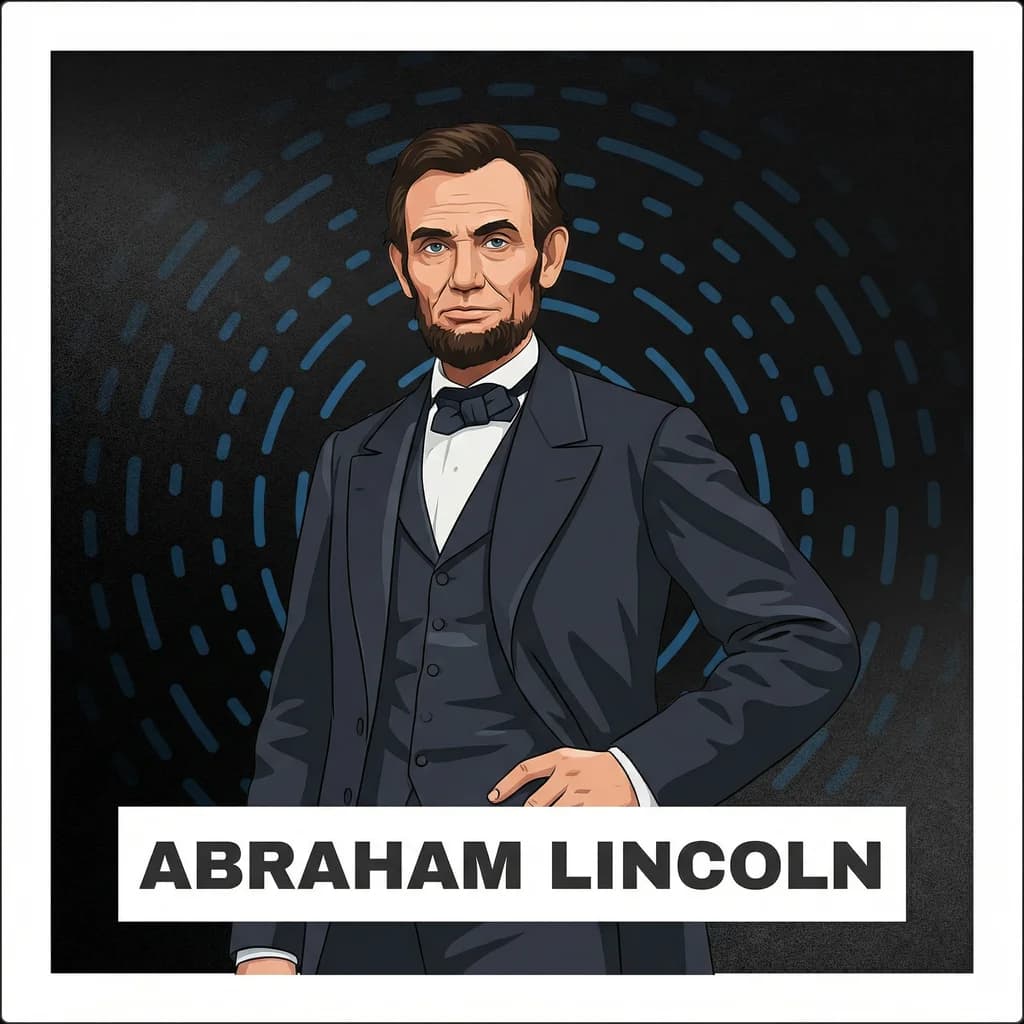
The Unfinished Sentence
On the evening of April 11, 1865 — two days after Robert E. Lee's surrender at Appomattox, five days before his own death — Abraham Lincoln stood in a second-floor window of the White House, manuscript in hand, reading aloud to a crowd gathered on the lawn below. The victory celebration they expected, the soaring peroration of a nation reborn, never came. Instead, Lincoln delivered a careful, lawyerly, almost tedious analysis of Reconstruction policy in Louisiana, dense with procedural detail, wholly lacking the cadences that had consecrated the dead at Gettysburg or the grace notes that had closed his second inaugural a month earlier. He spoke about ratified constitutions and the seating of congressional delegations. He spoke about the franchise. And then, near the end, almost as an aside, he said something that had never been said publicly by an American president: he endorsed giving the right to vote to some Black men — "the very intelligent, and on those who serve our cause as soldiers."
Among the crowd on the White House lawn stood John Wilkes Booth. According to testimony gathered afterward, Booth turned to a companion and said something to the effect that this was the last speech Lincoln would ever make.
Three days later, it was.
The man who preserved the Union and abolished slavery did not arrive at these achievements by straight-line conviction or prophetic clarity. He arrived by a process more radical than any sermon — by changing his mind. Lincoln's life, read forward rather than backward, is not the story of a visionary who always knew where he was going. It is the story of a man trapped inside a system that protected the thing he believed was evil, who spent decades grasping for adequate mechanisms of remedy, and who, when those mechanisms failed, had the rarest of political virtues: the willingness to abandon everything he had previously believed about how to solve the problem and try something entirely different. That willingness is what killed him.
By the Numbers
The Lincoln Presidency
1,503Days in office before assassination
$4M+Cost of the Civil War per day by 1864
~620,000Americans killed in the Civil War
3.1MEnslaved people freed by the Emancipation Proclamation
~200,000Black men who served in the Union Army and Navy
272Words in the Gettysburg Address
56Age at death, April 15, 1865
The Backwoods and the Borrowed Book
The man who would compose perhaps the finest prose in the history of American public life grew up in an environment that offered, by his own reckoning, "absolutely nothing to excite ambition for education." Born February 12, 1809, in a one-room log cabin three miles south of Hodgenville, Kentucky — dirt floors, no glass in the windows — Abraham Lincoln was the son of Thomas Lincoln, a sturdy, largely illiterate pioneer descended from a weaver's apprentice who had migrated from England to Massachusetts in 1637, and Nancy Hanks, a woman described by those who knew her as "stoop-shouldered, thin-breasted, sad," and fervently religious. The Hanks genealogy is difficult to trace; Nancy appears to have been of illegitimate birth. She died in the autumn of 1818, when Abraham was nine, somewhere in the forests of southwestern Indiana, where Thomas had moved the family two years earlier to escape a lawsuit over his Kentucky land title. The boy watched her buried in the woods.
Lincoln's earliest memory was of a flash flood washing away the corn and pumpkin seeds he had helped his father plant on the family's Knob Creek farm. This image — labor undone by forces beyond any individual's control, the work of planting rendered instantly meaningless — is almost too perfectly allegorical for the life that followed it. He recalled, in later years, the "panther's scream" and the bears that "preyed on the swine" in Indiana, and the poverty that was "pretty pinching at times." His entire formal schooling amounted to perhaps one year, attended "by littles" — a little now, a little then. Neighbors recalled the boy trudging miles to borrow a book. He read Parson Weems's
Life of George Washington,
Robinson Crusoe,
Pilgrim's Progress, and Aesop's
Fables. The Bible was the only book his family owned.
What transformed him was not the content of these books so much as the act of reading itself — the discovery that language could be a mechanism of escape, and then a mechanism of power. He taught himself grammar and mathematics. He studied law books. By the time he was twenty-one, six feet four inches tall, rawboned and lanky but muscular, walking in the long-striding, flat-footed manner of a plowman, he had resolved to leave frontier life behind entirely. "I have seen a great deal of the backsides of the world," he told an associate years later, and that was as far as he would go in discussing his origins. His father's second wife, Sarah Bush Johnston — a widow from Kentucky with three children of her own, whom Thomas married before the onset of Abraham's second motherless winter — had encouraged the boy's appetite for learning, running the household with energy and treating both sets of children as if she had borne them all. Lincoln called her his "angel mother." But the impulse that drove him from the backwoods cabin to the law office to the White House was something she had fed, not planted.
Prairie Lawyer, Prairie Politician
In March 1830, the Lincoln family moved again, this time to Illinois, with Abraham driving the team of oxen. Having just turned twenty-one, he tried his hand at everything — rail-splitting, flatboating (two voyages down the Mississippi to New Orleans), storekeeping, postmastering, surveying. In New Salem, a village of about twenty-five families on the Sangamon River, he found the first environment that rewarded his particular combination of physical strength, storytelling, and restless intelligence. He enlisted as a volunteer in the Black Hawk War of 1832, was elected captain of his company, saw no combat, and joked afterward that he had faced "a good many bloody struggles with the mosquitoes." He ran for the state legislature, lost, ran again, and won — four times, serving from 1834 to 1840.
His law partnership with William H. Herndon, which began in 1844, was one of those improbable professional marriages that seem to work precisely because neither party resembles the other. Herndon — nearly ten years younger than Lincoln, more widely read, more emotional, more extreme in his views — would become, after Lincoln's death, the self-appointed keeper of the Lincoln flame, collecting reminiscences and adding his own recollections, determined to preserve the human being against the gathering hagiography. "He saw, as the main feature" of Lincoln's character, Britannica notes, what others would soon paper over with myth.
The law practice mattered because it trained Lincoln in the art of persuasion within systems of constraint. The Constitution was not a suggestion. Precedent was not optional. The question that would define his political life — what do you do when the legal framework you revere protects an institution you find monstrous? — was a lawyer's question before it was a president's.
He married Mary Todd on November 4, 1842. She was ambitious, educated, from a prominent Kentucky family; he was melancholic, gangly, perpetually rumpled. They had four boys. Only one survived to adulthood. Lincoln suffered what contemporaries described as bouts of profound depression throughout his life — a darkness so visible that friends worried, at certain periods, for his safety. The relationship between this private anguish and his public capacity for empathy is a question biographers have chased for a century and a half without fully resolving it.
The Monstrous Injustice and the Impossible Question
Lincoln always said he could not remember a time when he did not think slavery was unjust. There is no reason, as the historian Eric Foner notes in
The Fiery Trial, to doubt the sincerity of that statement. The problem was the next question: what do you do about it?
On October 16, 1854, in Peoria, Illinois — the longest speech Lincoln ever delivered, running several hours — he laid out his position with a candor that most politicians would have found suicidal and most admirers of Lincoln today would find excruciating. Stephen A. Douglas, his great rival, had just forced through Congress the Kansas-Nebraska Act, opening vast western territories to the possible expansion of slavery. Lincoln was outraged. He said so with the language of abolitionists, not politicians:
I hate it because of the monstrous injustice of slavery itself. I hate it because it deprives our republican example of its just influence in the world, enables the enemies of free institutions with plausibility to taunt us as hypocrites, causes the real friends of freedom to doubt our sincerity, and especially because it forces so many really good men among ourselves into an open war with the very fundamental principles of civil liberty, criticizing the Declaration of Independence, and insisting that there is no right principle of action but self-interest.
And then, in the same speech, he said this: "If all earthly power were given me, I should not know what to do as to the existing institution." His first impulse, he admitted, would be to free all the slaves and send them to Liberia. But a moment's reflection convinced him that such "sudden execution" was impossible.
Free them and keep them among us as underlings? Free them and make them our equals? "My own feelings will not admit of this," Lincoln said, "and if mine would, we well know that those of the great mass of white people will not."
Foner, a professor of history at Columbia University who has spent decades studying the Civil War and Reconstruction, calls this paragraph a condensation of everything Lincoln believed about slavery up through the first years of the Civil War. The man hated the institution with genuine moral passion. But he could not envision a biracial America. He was a member of the Illinois Colonization Society — on its board of managers — which urged free Black people in Illinois to emigrate to Liberia. He held this position publicly and consistently from about 1852 until the Emancipation Proclamation over a decade later.
To read Lincoln's career forward, as Foner insists we must — rather than backward, with the Emancipation Proclamation as a foreordained destination — is to watch a man trapped inside a paradox he cannot solve. He revered the Constitution. He was a lawyer. The Constitution protected slavery. Abolitionists like William Lloyd Garrison burned the Constitution in protest; Lincoln would never have considered such a thing. So he grasped for mechanisms: gradual emancipation (the children of slaves freed after a certain date, perhaps twenty years in the future), compensation to slaveholders for the loss of their "property," and colonization — the exportation of the Black population to Africa or Central America or Haiti, so that white America would never have to confront the question of what a multiracial society might actually look like.
What is remarkable about Lincoln's colonization stance, as Foner notes, is what it was not. Unlike Henry Clay, who spoke of Black people as dangerous or criminally inclined, Lincoln's argument for colonization rested entirely on the depth of white racism: "the reason they should leave is white people are so racist that blacks will never be accorded equality in this country." It was not a defense. It was not, as Foner hastens to add, an excuse. But it was a different species of moral reasoning than the frank negrophobia that animated many of his contemporaries.
Walking a Tightrope with a Nuclear Weapon
The Lincoln-Douglas debates of 1858 — seven debates across Illinois for a U.S. Senate seat — gave the country its first sustained look at the man who would, two years later, win the Republican presidential nomination. Douglas, a Democrat, was perhaps the most popular politician in the North. His strategy was simple: accuse Lincoln, repeatedly and publicly, of believing in "Negro equality." This was, as Foner puts it, "the nuclear weapon of politics back then."
Lincoln had to deny it. And he did. The statements that most disturb Lincoln's admirers come out of these debates, where he explicitly denied believing that Black people should have the right to vote, the right to serve on juries, the right to intermarry with white people. What, then, did equality mean? Lincoln was precise: equality meant the right to improve your condition in life, as he had. The right to the fruits of your labor. On that ground, he insisted, Black people were equal to everyone.
But political rights, civil rights — these were "conventional rights," regulated by the majority. To us, this distinction sounds untenable. How can you improve your condition in life if you lack all legal rights? Lincoln had not yet thought that through. He was walking a tightrope in a state where it was illegal for Black people to enter — Illinois in the 1850s did not want any Black residents, slave or free — between his genuine belief in a basic equality of all persons and his unwillingness to challenge the white supremacist consensus that would have ended his political career instantly.
He lost the Senate race. But the debates made him famous. And fame, in the Republican Party of 1860, was worth more than a Senate seat.
The Team of Rivals and the House Divided
At the Republican National Convention in Chicago in May 1860, Lincoln was not the frontrunner. William H. Seward, the senator from New York, was the favorite — eloquent, experienced, well-funded. Salmon P. Chase of Ohio, who had built a national reputation defending fugitive slaves in court (earning the nickname "the attorney general for escaped slaves"), also sought the nomination. Chase — born in 1808 in Cornish, New Hampshire, educated partly by his uncle, Episcopal bishop Philander Chase, trained in law under Attorney General William Wirt, and afflicted with a presidential ambition so relentless that he would seek the nomination four separate times without success — permitted his pledged delegates to cast decisive votes for Lincoln on the third ballot.
Lincoln won the nomination. Then the presidency. Then, in one of the most audacious personnel decisions in American political history, he appointed his three principal rivals — Seward as Secretary of State, Chase as Secretary of the Treasury, Edwin M. Stanton as Secretary of War — to his cabinet. This was the gambit that Doris Kearns Goodwin would immortalize in
Team of Rivals: the notion that Lincoln's political genius lay not in defeating his enemies but in absorbing them, harnessing their ambition and talent to the machinery of governance while managing their egos and mutual antagonisms with a patience that bordered on the saintly.
But the Union Lincoln had won the right to lead was already disintegrating. Seven Southern states seceded before his inauguration. Four more would follow after Fort Sumter. In his First Inaugural Address, on March 4, 1861, Lincoln tried to thread the needle one last time:
I have no purpose, directly or indirectly, to interfere with the institution of slavery in the States where it exists. I believe I have no lawful right to do so, and I have no inclination to do so.
He said this with total sincerity. He also said that secession was illegal, that the Union was perpetual, and that he would enforce the laws. These two commitments — to the Union and to the constitutional protections of slavery — were irreconcilable. The war would prove which one he valued more.
The Failed First Plan
For nearly two years, Lincoln tried to make his gradualist vision work. He presented his plan — gradual emancipation, compensation to slaveholders, colonization of freed people — to the four border slave states that remained in the Union: Kentucky, Missouri, Delaware, and Maryland. They said no. Absolutely not. They did not want to get rid of slavery. They wanted to keep their slaves.
Meanwhile, the war was doing what Lincoln's policies could not. As soon as Union forces penetrated the South, enslaved people began running to Union lines — not in ones and twos but in hundreds, then thousands. The fact of their bodies, their presence, their refusal to remain property forced the question of slavery onto the national agenda regardless of what the president wanted. Federal commanders had to make policy on the ground: what do you do with a family that has walked forty miles through swamp to reach your camp? Send them back?
Almost immediately, the answer was no. Union policy, ad hoc and inconsistent but unmistakable in its direction, began treating these people as free. The institution Lincoln had no constitutional mechanism to destroy was destroying itself, one escape at a time, under the pressure of its own contradictions and the proximity of armed liberators.
And Lincoln was losing the war. The previous strategy — preserve the Union, leave slavery alone, wait for gradual mechanisms — was not working. The Confederacy was winning battles. Northern morale was sagging. The manpower advantage that should have been decisive was not materializing fast enough.
The Complete Reversal
The Emancipation Proclamation, issued on January 1, 1863, repudiated everything Lincoln had previously believed about how to end slavery.
It was immediate, not gradual. There was no mention of compensation to slaveholders. There was nothing in it about colonization. It freed approximately 3.1 million of the nation's 3.9 million enslaved people — those in states "in rebellion against the United States" — while leaving 800,000 in the loyal border states untouched. It was a military order, issued by the commander-in-chief, justified by military necessity, applicable only to enemy territory. Its legal status was, to put it mildly, contested: Lincoln himself worried the Supreme Court might overturn it, which is why he pushed for the Thirteenth Amendment to settle the question permanently.
And it opened the Union Army to the enlistment of Black men for the first time.
This last provision was not incidental. It was transformative. By the end of the Civil War, nearly 200,000 Black men had served in the Union Army and Navy. The image of Black soldiers fighting and dying for the nation was a very different vision of their future role in American society than "you should leave the country." As Foner argues, it was the Black soldiers — their courage, their sacrifice, their claim to citizenship earned in blood — that catalyzed the deepest change in Lincoln's racial attitudes in the final two years of his life.
The emancipation policy, and the use of colored troops, constitute the heaviest blow yet dealt to the rebellion.
When political allies urged Lincoln to rescind the Proclamation, his response was blunt: "We have promised these men in the Army freedom. How can we go back on that now that they have risked their lives and fought and died for the Union?" The promise was not abstractly moral. It was contractual. It was a debt.
Two months before the war ended, in February 1865, Lincoln told portrait painter Francis B. Carpenter that the Emancipation Proclamation was "the central act of my administration, and the greatest event of the nineteenth century."
The Prose of Self-Government
Lincoln's literary achievement is inseparable from his political achievement, and both are rooted in the same paradox: the man with less than a year of formal education became the finest prose stylist ever to hold the American presidency. He wrote his own speeches. He chose words with a lawyer's precision and a poet's sense of rhythm. Harriet Beecher Stowe remarked that his language had "the relish and smack of the soil."
The Gettysburg Address — 272 words, delivered on November 19, 1863, in approximately two minutes — accomplished something that no amount of military victory could: it redefined the purpose of the war. The Union was no longer merely being preserved. It was being remade. "A new birth of freedom," Lincoln called it, binding the nation's founding promise ("all men are created equal") to the sacrifice of the dead lying beneath his feet. The brevity was the message. In a culture that valued oratorial endurance — his Peoria speech had lasted hours — Lincoln's economy of language was itself a form of argument: that the truth, properly stated, requires almost no words at all.
His Second Inaugural Address, delivered on March 4, 1865, is 705 words long. A majority of those words are monosyllabic. It contains what may be the most morally complex sentence in American political rhetoric: "Fondly do we hope — fervently do we pray — that this mighty scourge of war may speedily pass away. Yet, if God wills that it continue, until all the wealth piled by the bond-man's two hundred and fifty years of unrequited toil shall be sunk, and until every drop of blood drawn with the lash, shall be paid by another drawn with the sword, as was said three thousand years ago, so still it must be said 'the judgments of the Lord, are true and righteous altogether.'"
The syntax spirals outward from human hope to divine inscrutability, from the intimate ("fondly," "fervently") to the cosmic ("three thousand years ago"), and lands on a quotation from the Psalms that refuses to exonerate either side. This is not a victory speech. It is a reckoning.
The Bullet, the Bed, and the Angels
On the morning of April 14, 1865 — Good Friday — John Wilkes Booth learned that the president would attend a performance of the comedy Our American Cousin at Ford's Theatre that evening. Booth was a member of one of America's most distinguished acting families: his brother Edwin was widely regarded as the country's leading performer, a mantle inherited from their father, Junius Brutus Booth. John Wilkes was celebrated for his charisma, athleticism, and dashing good looks. He had grown up in the border state of Maryland, considered himself a Southerner, and passionately defended the slave system. Having promised his mother he would not fight for the Confederacy, he remained in the North during the war, his hatred of abolitionists and of Lincoln deepening with each Union advance.
The plan was to assassinate three men simultaneously: Lincoln, Vice President Andrew Johnson, and Secretary of State William Seward. Booth assigned Lewis Powell — a tall, powerful former Confederate soldier — to kill Seward. George Atzerodt, a German immigrant who had served as a boatman for Confederate spies, was to kill Johnson. Booth reserved Lincoln for himself.
At approximately 10:15 pm, Booth entered the president's box, which was essentially unguarded. He found the inner door, barred the outer door from inside, waited for a line in the play that he knew would produce a big laugh, and fired a single shot from a .44-caliber derringer into the back of Lincoln's head. He slashed Major Henry Rathbone — one of the president's guests — in the shoulder with a knife, leapt from the box to the stage, broke his left leg, and either shouted "Sic semper tyrannis" ("Thus always to tyrants") or "The South is avenged" or both. He disappeared through a stage door where a horse was waiting.
Lincoln was carried across Tenth Street to the boarding house of William Petersen. In a small rented room, the president — too tall for the bed — was laid diagonally across it. Doctors had no hope. Throughout the night, cabinet members, officials, and physicians kept vigil. Mary Lincoln grieved hysterically. At 7:22 am on April 15, Abraham Lincoln was pronounced dead.
Secretary of War Edwin M. Stanton, standing in the room, spoke what may be the most disputed four words in American history: "Now he belongs to the ages." Or — witnesses disagree — "to the angels."
What the Assassination Made Possible
The next day was Easter Sunday. Throughout America, sermons in Christian churches equated Lincoln's martyrdom with the sacrifice of Christ. The man whom many Northerners had deeply disliked in life became, almost instantly, the nation's secular saint.
His body, in an elaborate open coffin, was taken on a thirteen-day train journey from Washington to Springfield, Illinois, lying in state in Independence Hall in Philadelphia, paraded down Fifth Avenue in New York. Millions of people lined the route.
The mythologizing began immediately. But it obscured something more consequential: who would succeed him. Andrew Johnson — a Tennessee Democrat whom Lincoln had placed on the unity ticket in 1864 — was, in Foner's pitiless assessment, "perhaps the worst president in all of American history." Deeply racist, stubborn, unwilling to change, out of touch with Northern public opinion and the Republican congressional majority, Johnson spent his presidency vetoing Reconstruction legislation and, astonishingly, encouraging violent resistance to federal law in the South. He was impeached by the House and came within a single Senate vote of removal.
Lincoln, Foner speculates, would have disagreed with Congress — he always disagreed with Congress — and then worked out a compromise. "They would've worked out a policy that all Republicans could support." Something like the Civil Rights Act of 1866, which gave basic civil rights to former slaves. Something like the Fourteenth Amendment, which established birthright citizenship and equal protection under the law. Perhaps limited Black suffrage, beginning with the soldiers. "This wouldn't have been as radical as the way Reconstruction eventually developed with full black suffrage," Foner argues, "but maybe it would've stuck longer."
Instead, Johnson's catastrophic presidency provoked the Radical Republican backlash, which in turn provoked the Ku Klux Klan, which in turn provoked a century of Jim Crow. The straight line from Lincoln's assassination to the evisceration of Reconstruction is not the only line of causation, but it is the most direct.
The Amendment That Remade the Nation
The Fourteenth Amendment, ratified in 1868, was the Emancipation Proclamation's constitutional heir. Its first section established what the Dred Scott decision had denied: that anyone born in the United States was a citizen, entitled to equal protection of the laws. The Congress that drafted it knew exactly what it was doing and whom it was including. They said explicitly, during debate, that the children of Chinese immigrants on the West Coast — a population "quite despised" at the time — would be citizens. The principle was universal by design.
"That notion of birthright citizenship sets us apart from most of the other countries in the world," Foner observes. "You could be born in Germany, if your parents are Turkish immigrants, you're not automatically a German citizen." The Fourteenth Amendment was Lincoln's posthumous gift to a nation that had not yet earned it — a promissory note on the ideal of self-government that the man from the dirt-floor cabin had spent his life trying to articulate.
The Image That Resolves
In the years after the assassination, Booth's diary was recovered from his body. In it, he had recorded his incredulity at the universal condemnation of his act. He had expected to be heralded as a hero.
Lincoln's body was exhumed and the coffin opened in 1901, thirty-six years after burial, as part of preparations for its permanent entombment in a reinforced vault in Springfield. Twenty-three people were present. According to witnesses, the body was remarkably well preserved. The face was recognizable. The mole was still visible on the right cheek.
A man who began life watching a flash flood wash away the seeds he had planted, and who ended it lying diagonally across a stranger's bed because his body was too long for the frame — who spent decades trapped inside a constitutional system that protected the thing he hated most, and who, when every gradualist mechanism failed, simply changed everything — lay in the dark of his vault in Oak Ridge Cemetery, still recognizable, still too large for the space that held him.