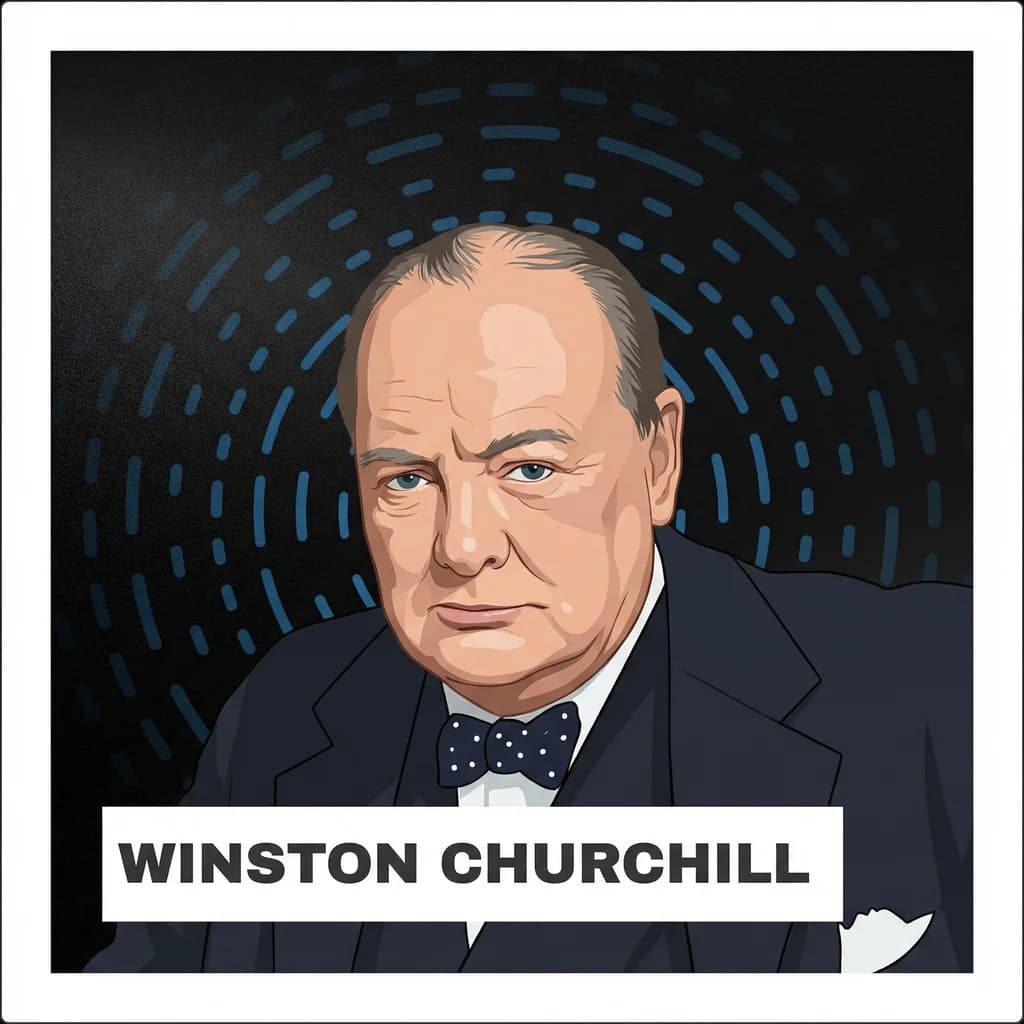
The Escaped Prisoner
On the night of December 12, 1899, a twenty-five-year-old war correspondent with no weapon, no map, no compass, and no food climbed over the corrugated iron fence of a makeshift prison in Pretoria, dropped into the garden of an adjacent house, walked with studied calm past a sentry who did not look up, and vanished into the streets of the Boer capital. He had no plan beyond the unshakable conviction that he was destined for greatness. Winston Leonard Spencer Churchill — son of a dead chancellor, grandson of a duke, half-American by blood, wholly English by temperament — had been captured three weeks earlier while defending an armoured train ambushed on the Natal railway, and he had spent every waking hour since calculating the geometry of his escape. The wall, the timing of the guards, the distance to the Delagoa Bay railway line, the location of Portuguese East Africa on the horizon — all of it he had worked out in the way he would later work out the geometry of a war: not with mathematical precision but with a kind of intuitive audacity that made the improbable seem, in retrospect, inevitable.
He found a freight train. He climbed aboard. He rode through the night under sacks of coal, shivering and utterly alone in Africa, which must have been the last place on earth he expected to meet someone from the English mill-town of Oldham, where he had lost his first parliamentary election six months earlier. And yet, impossibly, the mine manager who sheltered him for three days in a coal shaft below the veldt was Dan Dewsnap, an Oldham native, who locked his hand "in a grip of crushing vigour" and said: "They'll all vote for you next time."
They did. Churchill returned to Britain a military hero, won Oldham in the general election of 1900 by the narrowest of margins, and entered the House of Commons at twenty-six with £10,000 earned by his pen and a fame that far exceeded his father's at the same age. He would not leave public life for sixty-four years.
The escape from Pretoria is the founding myth of Churchill's career — the moment when the narrative he had been writing about himself since adolescence became the narrative the world believed. But it is also something more: a distillation of every paradox that would define the next six decades. The aristocrat who needed the coal miner's vote. The soldier who made his name as a journalist. The prisoner who escaped into politics. The man who could not sit still, could not stop talking, could not stop writing, could not stop believing — against mounting evidence — that history had reserved a particular role for him, and that the role would come.
It took forty years.
By the Numbers
The Churchill Record
90Years lived (1874–1965)
64Years in public life
2,300+Speeches delivered in his lifetime
43Books published in 72 volumes
500+Paintings completed as an amateur artist
10Years in the 'wilderness' (1929–1939)
1,815Days as wartime Prime Minister (1940–1945)
The Blood of Two Peoples
The raw materials of his character were Anglo-American, which is to say contradictory. His father, Lord Randolph Churchill — the meteoric Tory politician who rose to Chancellor of the Exchequer at thirty-seven and flamed out almost immediately, destroyed by syphilis and his own recklessness — was the younger son of the 7th Duke of Marlborough, descended from John Churchill, 1st Duke of Marlborough, the general whose victories against Louis XIV had shaped the map of Europe. Lord Randolph was brilliant, erratic, cruel to his son, and dead at forty-five. He cast a shadow from which Winston never fully emerged; the biography Winston published in 1906, Lord Randolph Churchill, is simultaneously an act of filial devotion and a self-portrait in negative — a study of what happens when genius is unaccompanied by patience.
His mother, Jennie Jerome, was the daughter of Leonard Jerome, a New York financier and horse-racing enthusiast whose fortune had been made and remade in the speculative frenzies of Gilded Age Manhattan. Jennie was a noted beauty, a social force, a woman who wrote articles, edited her own literary journal (The Anglo-Saxon Review), and deployed her connections with the ruthless efficiency of a field marshal. She was also, by the standards of Victorian motherhood, largely absent. The young Churchill passed what his biographers uniformly describe as an unhappy and sadly neglected childhood, redeemed only by the affection of Mrs. Everest, his devoted nurse — "Old Woom," as he called her — who became the surrogate mother and remained, until her death in 1895, the one figure in his early life who loved him without condition or reservation.
The combination was lethal and generative in equal measure. From his father he inherited the name, the ambition, the parliamentary instinct, and the fatal attraction to controversy. From his mother he inherited America — not its citizenship but its energy, its optimism, its refusal to accept that the accident of birth should limit the scope of action. "I am a child of both worlds," he told an audience at Harvard in 1943, and it was not a boast but a statement of anthropological fact. The aristocratic English blood gave him the confidence to address kings; the American blood gave him the audacity to argue with them.
At Harrow his academic record was conspicuously poor — a distinction he wore with a perverse pride that bordered on strategy. His father, surveying the wreckage of his school reports, decided the boy was fit only for the army. It took three attempts to pass the entrance examination to the Royal Military College at Sandhurst. But once admitted, something shifted. He applied himself seriously and graduated twentieth in a class of 130. The pattern was already visible: spectacular incompetence in any domain that bored him, matched by ferocious concentration when his interest was engaged.
The Self-Made Education
Churchill never attended university. This is a fact so often repeated that its strangeness has been worn smooth, but consider it: the most celebrated English-language prose stylist of the twentieth century, the winner of the Nobel Prize in Literature, the author of forty-three books in seventy-two volumes, educated himself in the officer's mess at Bangalore.
His first army posting, with the 4th Hussars in India in 1896, was a posting to boredom. The garrison slept through the murderous afternoons. Polo consumed the evenings. Churchill, recognizing the deficiencies of Harrow and Sandhurst with a clarity that would have horrified his former teachers, sent home for books. His mother complied — dispatching crates of Gibbon, Macaulay, Plato, Aristotle, Schopenhauer, Darwin, and volumes of the Annual Register covering decades of parliamentary debate. For hours every day, in the heat of a cantonment that no one of his rank was expected to take seriously, the young subaltern consumed the canon of Western civilization as though preparing for an examination that had not yet been set.
"What were Ethics?" he wrote later in
My Early Life. "They had never been mentioned to me at Harrow or at Sandhurst." A friend had told him that Christ's gospel was the last word in Ethics. This sounded promising, but before he could find the gospel he found Gibbon, who introduced him to the long, ironic view of human folly, and Macaulay, who taught him that history could be written as literature. In the mess, officers debated whether we should live again in another world after this one was over, and whether we had ever lived before. Churchill, characteristically, decided to settle these questions for himself by reading everything that bore upon them.
The self-education at Bangalore was not incidental to his career; it was his career, or at least its foundation. The books gave him what Sandhurst had not: a theory of history, a model of English prose, and a conviction that the destiny of civilizations turned on the character of individual men. Every speech he would ever give — the rolling cadences, the short Anglo-Saxon words, the architectural sentences that moved from particular to universal — was forged in that Indian heat, in the gap between what he had been taught and what he needed to know.
The War Correspondent Who Made Himself the News
Between 1895 and 1900, Churchill fought in four wars on three continents and nearly died in each one. He felt bullets whistling past his head in Cuba. He rode his grey pony along the skirmish lines on the North-West Frontier of India "in full view of the enemy" — "Foolish perhaps," he told his mother, "but I play for high stakes and given an audience there is no act too daring and too noble." He took part in the last great cavalry charge in British history at the Battle of Omdurman in 1898, riding with the 21st Lancers against the Dervishes in the Sudan. And through all of it, he was writing.
This was the double life that made him — soldier and journalist, participant and narrator, the man who made the news by writing it. His dispatches from the North-West Frontier became The Story of the Malakand Field Force (1898), his first book, published when he was twenty-three. The Sudan campaign became The River War (1899), a two-volume prose epic that brilliantly described the Kitchener expedition and established Churchill, in literary circles at least, as something more than a well-connected subaltern with a talent for self-promotion. By 1899, the Morning Post was paying him £250 per month — the equivalent of roughly £14,000 today — plus expenses, to cover the Boer War. His earnings as a war correspondent had increased tenfold in four years. His earnings from journalism dwarfed his army pay. The pen, not the sword, was the instrument of his ambition.
What made Churchill unusual was not the combination of fighting and writing — other officers did both — but the scale of his self-consciousness about the project. He was not merely reporting events; he was constructing a character. The daring young officer who braved enemy fire, who escaped from prison, who emerged from every crisis with a quip and a dispatch — this was a literary creation as much as a biographical fact. Churchill understood, at twenty-three, what most politicians learn only in middle age: that narrative is power, and the man who controls the story controls the outcome.
Of all the talents bestowed upon men, none is so precious as the gift of oratory. He who enjoys it wields a power more durable than that of a great king. He is an independent force in the world. Abandoned by his party, betrayed by his friends, stripped of his offices, whoever can command this power is still formidable.
He wrote those words at twenty-three. He would spend the rest of his life proving them.
Crossing the Floor, and Crossing Back
Churchill entered Parliament in February 1901 as the Conservative member for Oldham. He made his maiden speech four days later. A self-assurance redeemed from arrogance only by a kind of boyish charm made him, from the first, a notable House of Commons figure, though a speech defect — a slight stammer and a sibilant lisp — he never wholly lost. Lord Balfour, the Conservative leader, observed that Churchill carried "heavy but not very mobile guns." He excelled in the set speech, not the impromptu — a distinction that would persist throughout his career and that revealed something essential about his method. Every speech was written, rehearsed, revised. An hour of preparation for each minute of delivery. The spontaneity was manufactured; the passion was real.
Within four years he had done the unforgivable: he crossed the floor. The issue was free trade — Joseph Chamberlain's advocacy of protective tariffs drove Churchill, a convinced free trader, into the arms of the Liberals. He sat down next to David Lloyd George, the rising Welsh firebrand, in a gesture so flamboyant it amounted to a declaration of war against his own class. Churchill, as an alleged traitor, earned the lion's share of Tory animosity — an animosity that would shadow him for decades.
Lloyd George — the son of a Welsh schoolmaster, raised by an uncle who was a village cobbler, self-educated in law, a man whose political radicalism was forged not in the drawing rooms of Blenheim Palace but in the chapel-going nonconformist culture of rural Wales — became Churchill's closest political ally and eventual rival. The friendship between them illuminated something about Churchill that his Conservative critics never understood: his politics were not tribal but temperamental. He was a Tory who believed in social reform, a Liberal who believed in empire, a man whose deepest conviction was that the state existed to protect the liberty of the individual, and that the definition of liberty should be capacious enough to include a minimum wage.
At the Board of Trade (1908–1910), Churchill helped lay the foundations of what would become the welfare state — trade boards to fix minimum wages for sweated labour, state-run labour exchanges to combat unemployment. As Home Secretary (1910–1911) he pushed through prison reforms. As First Lord of the Admiralty (1911–1915) he dragged the navy into the twentieth century, creating a naval war staff and successfully campaigning for the largest naval expenditure in British history. He was thirty-seven years old and had already held more ministerial offices than most politicians accumulate in a lifetime.
And then Gallipoli.
The Catastrophe That Made the Man
The Dardanelles campaign of 1915 — the attempt to force a naval passage to Constantinople, knock Turkey out of the war, and outflank Germany on a continental scale — was Churchill's idea, and it was a disaster. The naval assault failed. The landings at Gallipoli became a slaughter. The campaign dragged on for months, consuming lives and reputations in equal measure, before the forces were evacuated in January 1916. Churchill, as First Lord of the Admiralty, bore the blame. He was forced to resign.
It marked the lowest point in his fortunes and the beginning of what might be called his first wilderness. The scale of the failure was immense — not merely military but personal. The man who had risen faster than any politician of his generation was suddenly radioactive. The Tories, who had never forgiven his defection, were delighted. The Liberals, who had embraced him as a convert, now treated him as a liability. He was forty years old, out of office, out of favour, and — for the first time in his adult life — silent.
He went to the Western Front. He commanded a battalion of the Royal Scots Fusiliers in the trenches. He painted. He brooded. And slowly, through the intervention of Lloyd George — who was anxious both to draw on Churchill's talents and to neutralize his critical guns — he returned to office, serving as Minister of Munitions (1917), Secretary of State for War and Air (1918–1921), and Colonial Secretary (1921–1922). He negotiated the Irish Treaty. He engineered a Middle East settlement. He promoted a Jewish national home in Palestine. But the stain of Gallipoli would not wash off. When he lost his seat in 1922, he found himself, as he later put it, "without an office, without a seat, without a party, and without an appendix."
He crossed the floor again — this time back to the Conservatives, who accepted his return with the wariness of a family welcoming back a prodigal son who might yet steal the silver. As Chancellor of the Exchequer under Stanley Baldwin (1924–1929), he made the controversial decision to return Britain to the gold standard at the prewar parity — a decision that strangled exports, deepened unemployment, and earned him the lasting enmity of John Maynard Keynes, who wrote The Economic Consequences of Mr. Churchill as a pendant to his earlier demolition of the Treaty of Versailles.
The pattern was now established. Dazzling ascent, catastrophic overreach, painful exile, improbable return. The question was whether the pattern had a ceiling — whether Churchill's career was destined to be a series of brilliant arcs that always ended in the same place, or whether there existed a crisis large enough to require exactly the combination of recklessness and resolve that no other politician could provide.
The Wilderness and the Prophet
The decade from 1929 to 1939 — the wilderness years — is the hinge of Churchill's biography, the period that separates the gifted but erratic politician from the man who would save Western civilization. He was out of office, out of favour with his party, and increasingly isolated within it. He had broken with the Conservative leadership over Indian self-rule — his opposition to the Government of India Bill was stubborn, backward-looking, and unpopular — and his support for King Edward VIII during the abdication crisis of 1936 had further diminished his standing. By the mid-1930s, as Roy Jenkins would later write, he was "gloriously unfit" for the office that everyone, including Churchill himself, suspected he would never hold.
And yet, throughout these years, he was doing the thing that nobody else in British politics had the courage or the clarity to do: warning about Adolf Hitler.
The warnings began in 1932, when Hitler was not yet chancellor, and they did not stop. In speech after speech — to half-empty chambers, to sceptical colleagues, to a public weary of war and inclined to give the new German regime the benefit of the doubt — Churchill laid out, with specificity that bordered on clairvoyance, the scale of German rearmament, the trajectory of Nazi ambition, and the catastrophe that would follow if Britain did not arm. He was accused of warmongering. He was accused of hysteria. He was accused, by Neville Chamberlain's allies, of placing personal ambition above national interest.
Chamberlain — the Birmingham businessman's son, the meticulous administrator, the man who genuinely believed that reasonable men could reach reasonable agreements with Adolf Hitler — returned from Munich in September 1938 waving a piece of paper and promising "peace for our time." Churchill rose in the House of Commons and said what almost no one else was willing to say: "We have sustained a total and unmitigated defeat." The response was fury. He was shouted down.
He judged himself a failure. The insight, reported by Sir Martin Gilbert, is essential to understanding what followed. Churchill did not regard his elevation to prime minister in May 1940 as a triumph; he regarded it as evidence that he had failed to convince the Baldwin and Chamberlain governments to take the measures that could have prevented war. Being called in to pick up the mess — to make good the neglect of his advocacy — was not, in his view, a vindication. It was a catastrophe that had arrived because no one had listened.
Let us therefore brace ourselves to our duties, and so bear ourselves, that if the British Empire and its Commonwealth last for a thousand years, men will still say, 'This was their finest hour.'
The Hour and the Man
On the morning of May 10, 1940 — the very day that Germany invaded France, Belgium, the Netherlands, and Luxembourg — Winston Churchill became Prime Minister and Minister of Defence. He was sixty-five years old. "I felt," he wrote later, "that all my past life had been but a preparation for this hour and for this trial."
The situation was, by any rational assessment, hopeless. France fell within six weeks. The British Expeditionary Force was evacuated from Dunkirk — 338,000 men rescued, but with the loss of nearly all their equipment. Britain stood alone. The United States was neutral. The Soviet Union had a non-aggression pact with Germany. The Luftwaffe was assembling across the Channel. Lord Halifax, the Foreign Secretary who had served under Chamberlain, advised opening negotiations with Germany. He could not see what Churchill saw: that even the appearance of a willingness to consider terms would destroy the last vestiges of British morale and lead to defeat.
Churchill refused. In the words of Labour politician Hugh Dalton, he was "the only man we have for this hour." The view was shared by the overwhelming majority of the British people. Public opinion polls — then in their infancy — showed that between July 1940 and May 1945, never less than 78 percent of those polled approved of Churchill as prime minister. Seventy-eight percent. For five years.
What Churchill did in the summer of 1940 was not, primarily, strategic. It was linguistic. In the dark early days of the war, he had few real weapons. He attacked with words instead. "Blood, toil, tears and sweat." "We shall fight on the beaches." "Their finest hour." "Never in the field of human conflict was so much owed by so many to so few." The speeches were defiant, heroic, and human, lightened by flashes of humour. As the journalist Beverley Nichols wrote, "He took the English language and sent it into battle." Churchill regularly devoted thirty to forty hours preparing a single speech. He wrote them all himself. That is why they were outstanding, and it is why, even eighty years later, they have the power to stir anyone who hears them.
Then came the Blitz. Fifty-seven consecutive nights of bombing beginning on September 7, 1940, followed by an intensifying series of nighttime raids over the next six months. More than 44,000 British civilians were killed. Erik Larson, in
The Splendid and the Vile, captures the texture of Churchill's first year in office — the midnight conferences, the rooftop vigils during air raids, the eighteen-hour workdays, the visits to bombed-out streets where he wept openly and the crowds cheered him anyway. He regularly worked from his bed in the mornings, propped against pillows, surrounded by papers and cigar smoke, a glass of weak whisky-and-water — what his daughter called the "Papa Cocktail" — within reach. He drove his staff relentlessly, but he drove himself harder. He could be charming and generous, but also exasperating, rude, and bad-tempered. Field Marshal Sir Alan Brooke, Chief of the Imperial General Staff, captured the paradox in a diary entry that might serve as an epitaph for anyone who ever worked with Churchill: "It is worth all these difficulties to have the privilege to work with such a man."
The Grand Alliance and Its Fractures
Churchill's strategic genius — if it can be called genius rather than a particularly forceful combination of instinct, stubbornness, and charm — lay in the construction of the Grand Alliance. He understood, from the moment France fell, that Britain could not win the war alone. Everything depended on drawing the United States into the conflict. His correspondence with Franklin Roosevelt, which began before Churchill became prime minister and continued for the duration of the war, is one of the great diplomatic documents of the twentieth century — part friendship, part salesmanship, part supplication conducted with the dignity of an equal.
On December 7, 1940 — a year before Pearl Harbor — Churchill wrote to Roosevelt a letter of extraordinary candour and strategic clarity: "As we reach the end of this year I feel that you will expect me to lay before you the prospects for 1941. I do so strongly and confidently because it seems to me that the vast majority of American citizens have recorded their conviction that the safety of the United States as well as the future of our two democracies and the kind of civilisation for which they stand are bound up with the survival and independence of the British Commonwealth of Nations." The letter was a masterpiece of controlled desperation — acknowledging British weakness without conceding British defeat, requesting American aid without requesting American troops, framing the relationship not as charity but as mutual interest.
Roosevelt responded with Lend-Lease. Churchill responded with gratitude and renewed pressure. When Japan attacked Pearl Harbor on December 7, 1941, Churchill is said to have gone to bed that night and "slept the sleep of the saved and thankful." The United States was in the war at last.
Within weeks Churchill was in Washington, holding a joint press conference with Roosevelt. The President introduced him to the American press corps — "wolves," Roosevelt said, compared to the British press's "lambs." Churchill, asked to stand so the reporters could see him, received loud and spontaneous cheers. Asked about Singapore, about German morale, about the prospects for victory, he answered with the Churchillian optimism that had sustained Britain through the Blitz: "The key to the whole situation is the resolute manner in which the British and American democracies are going to throw themselves into the conflict."
With Roosevelt and Stalin he shaped Allied strategy through the great conferences — Washington, Casablanca, Tehran, Yalta, Potsdam — but the Alliance was never comfortable. Stalin was a difficult ally who aggressively insisted on an invasion of northern France; Churchill resisted, believing any premature Second Front was likely to fail. The Americans, increasingly dominant in the partnership, often sided with Stalin on timing. Churchill's sensitivity to tactical considerations — his insistence on Mediterranean campaigns, on hitting the "soft underbelly" of Europe — was sometimes strategically brilliant and sometimes a rearguard action by a declining power attempting to preserve its sphere of influence. The tension between what Churchill wanted and what the Alliance could deliver was the central drama of the war's second half.
It is our British duty in the common interest as also for our own survival to hold the front and grapple with Nazi power until the preparations of the United States are complete.
Victory and Exile
On May 8, 1945, Churchill appeared on the balcony of Buckingham Palace with the Royal Family and announced the surrender of Germany. The crowds that filled the streets of London were celebrating not merely the end of the war but the man who had embodied their resistance. "This is your victory," he told them. They roared back: "No — it is yours."
Two months later, on July 26, the results of the general election were announced. Churchill's Conservative Party had been defeated in a landslide by Clement Attlee's Labour. The margin was staggering. An electorate weary of war was looking ahead to a new Britain — a welfare state, a National Health Service, a nation rebuilt from the rubble. They loved Churchill, but they did not trust the Conservatives to build the future. The man who had saved the country was dismissed by it.
Clementine Churchill — the beautiful Clementine Hozier whom Winston had married in 1908, in a marriage of unbroken affection that provided the only stable foundation in his turbulent life — tried to console him. "It may well be a blessing in disguise," she said. Churchill replied: "At the moment it seems quite effectively disguised."
The defeat devastated him. But it did not silence him. As Leader of the Opposition, he embarked on what amounted to a second prophetic career. Just as he had warned of the Nazi threat in the 1930s, he now warned of the Soviet threat — at a time when the Soviet Union was still widely regarded as an ally. On March 5, 1946, at Westminster College in Fulton, Missouri, introduced by President Truman, he delivered the speech that Russian historians date as the beginning of the
Cold War: "From Stettin in the Baltic to Trieste in the Adriatic, an iron curtain has descended across the Continent."
The American public reacted negatively. Americans still saw the Soviet Union as a wartime partner. Some politicians condemned the speech publicly while privately recognizing that Churchill was, once again, saying what no one else dared to say. Within a year, President Truman issued the Truman Doctrine. Within two years, the Marshall Plan was announced. The Iron Curtain speech, like the wilderness warnings of the 1930s, was initially unpopular and ultimately vindicated. The pattern held.
The Writer's Prize, the Peacemaker's Disappointment
On October 16, 1953, Prime Minister Churchill learned that he had won the Nobel Prize in Literature — "for his mastery of historical and biographical description as well as for brilliant oratory in defending exalted human values." His private secretary, Anthony Montague Browne, recalled the day with precision: "Churchill deeply wished to be remembered as a peacemaker. I remember vividly his early and touching joy, which turned to indifference when he learned that it was for Literature and not for Peace."
The disappointment was characteristic. Churchill had authored more than forty books, from the youthful dispatches that became The Story of the Malakand Field Force to the six-volume The Second World War (1948–1953) and the four-volume A History of the English-Speaking Peoples (1956–1958). His literary output was staggering — not merely in volume but in quality. He had transformed Chartwell, his beloved country estate in the Kent Weald, into what amounted to a literary factory, employing teams of research assistants and secretaries who worked until the small hours while Churchill dictated, revised, and dictated again. His grandson Winston S. Churchill later recalled that his grandfather did not have a speechwriter — "he wrote them all himself" — and that this was "why his speeches were outstanding."
Yet the Nobel, to Churchill, felt like a consolation prize. What he wanted was the Peace Prize — the recognition that his lifelong pursuit of peace through strength, from the Boer War settlement to the Irish Treaty to the Middle East settlement to the warnings against Hitler to the construction of the Grand Alliance to the Iron Curtain speech, constituted a coherent and singular contribution to human survival. He had been nominated for the Peace Prize repeatedly. He never received it.
On December 10, 1953, while rain poured down on a gloomy Stockholm afternoon, Lady Clementine Churchill received the Nobel Prize on her husband's behalf. He was too ill to attend — a stroke the previous June had caused partial paralysis, though by October he had made a remarkable recovery. The ceremony proceeded with faultless ritual. The Swedish author Sigfrid Siwertz spoke for the absent laureate. And at Chartwell, the greatest prose stylist of the age — the man who had sent the English language into battle — sat by the fire and thought about peace.
The Last Cigar
Churchill's second premiership (1951–1955) was an autumnal affair — the work of a man who was, in Jenkins's devastating phrase, "gloriously unfit for office." He was seventy-seven when he returned to Downing Street. His powers were visibly failing. He often conducted business from his bedside. The domestic labours of his administration — derationing, decontrolling, rehousing, safeguarding the precarious balance of payments — were far from his main concerns. He reserved more and more of his energies for what he regarded as the supreme issues: peace and war.
He wanted a summit conference with the Soviets. He believed, with the unfaltering conviction that had sustained him through every crisis of his life, that if the heads of government could sit down together, the danger of another world war could be eased. Repeatedly he risked rupturing the special relationship he valued above all others, challenging a reluctant Eisenhower to meet with him and the Russians. In 1955, "arming to parley," he authorized the manufacture of a British hydrogen bomb while still striving for the summit. Age robbed him of this last triumph. His powers were too visibly failing.
His eightieth birthday, on November 30, 1954, was the occasion of a unique all-party ceremony of tribute and affection in Westminster Hall. But the tribute implied a pervasive assumption that he would soon retire. On April 5, 1955, his resignation took place. He remained in the House of Commons — declining a peerage — to become "father of the house" and even, in 1959, to fight and win yet another election at the age of eighty-four.
On April 9, 1963, an act of Congress conferred upon him the unique distinction of honorary United States citizenship — the child of both worlds, honoured by both.
On January 24, 1965 — the seventieth anniversary of his father's death — Winston Churchill's struggle for life ended at his London home. He was ninety years old. Lord Moran's announcement said simply: "Shortly after 8 A.M., Sir Winston died at his home." About thirty members of the press were standing in the rain at the entrance to Hyde Park Gate when the statement was read to them.
He was given a state funeral — the first for a commoner since Gladstone in 1898. The body lay in state in Westminster Hall for three days. The service was held in St. Paul's Cathedral, whose huge dome had so long dominated London, surviving the Blitz that Churchill had survived. Almost the whole world paid tribute. Queen
Elizabeth II sent a message to Lady Churchill: "The whole world is the poorer by the loss of his many-sided genius while the survival of this country and the sister nations of the Commonwealth, in the face of the greatest danger that has ever threatened them, will be a perpetual memorial to his leadership, his vision, and his indomitable courage."
He was buried in the family grave in Bladon churchyard, Oxfordshire — a few hundred yards from Blenheim Palace, where he had been born ninety years earlier, prematurely, during a ball.