
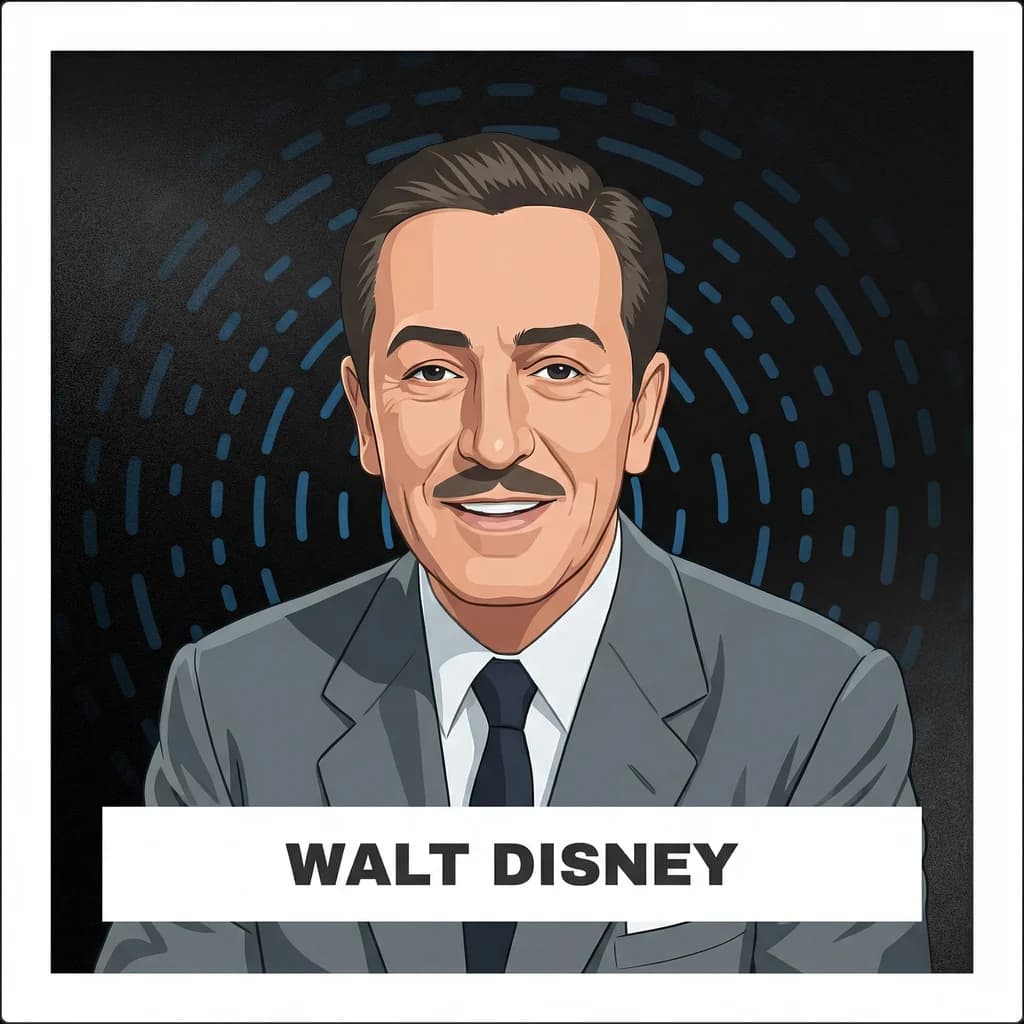

Part IThe Story
The Voice Inside the Mouse
On the nineteenth of September, 1928, an audience at the Colony Theatre in New York City watched a mouse steer a steamboat. The mouse whistled. He yanked a cat's tail and played a cow's teeth like a xylophone. He was grotesque and joyful and rhythmically synchronized to sound in a way no drawn figure had ever been, and the audience, according to every account that survives, went berserk. The cartoon lasted seven minutes and twenty-three seconds. It had been synchronized to music using a harmonica, pencils tapping on spittoons, and a bedsheet for a screen, in a series of desperate late-night sessions that cost its maker almost every dollar he had. The film was called "Steamboat Willie," and its star was Mickey Mouse, and the man who had willed both into existence had arrived in Los Angeles five years earlier with forty dollars, a cardboard suitcase, and an unfinished reel of film. He was twenty-six years old. He could not draw particularly well. He would, within a decade, become the most consequential figure in the history of American popular entertainment—not because he was the best draftsman, or the shrewdest dealmaker, or the most original storyteller, but because he understood, with a feral and inexhaustible certainty, that the thing people wanted was not a cartoon but a feeling, and that the feeling could be manufactured at industrial scale if you were willing to subordinate everything—comfort, solvency, sleep, the patience of everyone around you—to the quality of the feeling itself.
The speaking voice of Mickey Mouse was the voice of Walt Disney. That detail, reported in the first major profile of Disney—a 1931 New Yorker piece that described him as "a slender, sharp-faced, quietly happy, frequently smiling young man, thirty this month"—is not incidental. It is the skeleton key to the entire enterprise. Disney did not draw Mickey. He did not ink the cels or photograph them or compose the scores. What he did was inhabit the character, literally and figuratively, providing its high-pitched squeak until 1947 and, far more importantly, providing the animating vision that made a crudely rendered rodent into, as the profile put it, "the imp, the benevolent dwarf of older fables"—a creature "far more popular than the important gods, heroes, and ogres." Serge Eisenstein, the director of Battleship Potemkin and Ivan the Terrible, called Disney's work "America's most original contribution to culture." This was not flattery. Eisenstein wrote extensively about the "absolute perfection" of Disney's achievement, linking his name to Fra Angelico, Hans Christian Andersen, and St. Francis of Assisi. "The work of this master," Eisenstein claimed, "is the greatest contribution of the American people to art."
The man who elicited these superlatives lived in a six-room bungalow, drove a medium-priced domestic car, and plowed every cent he earned back into his studio. He never stopped working. If strange outcries and queer noises woke his wife, Lillian, at night, it was only Walt working on a new story. He swam and rode and played baseball with his staff, but all the time he was inventing. He was, in the deepest sense, the voice inside the mouse—and the mouse, eventually, became the voice of an entire nation's fantasy life.
By the Numbers
The Disney Empire at a Glance
$80MMarket cap when Warren Buffett invested in 1966
$500Total capital for the first Disney Bros. picture (1923)
$1.50Amount Disney couldn't pay to retrieve his shoes from a cobbler
5Full-length masterworks produced between 1937 and 1942
150,000Feet of film that feature producers might shoot for 6,000 feet of finished product
700Drawings per day produced by Ub Iwerks on 'Plane Crazy'
$750,000Bonus Disney paid his staff after 'Snow White' premiered
The Paper Route and the Blacking Factory
He was born Walter Elias Disney on December 5, 1901, in Chicago, in a wooden cottage on Tripp Avenue that his father, Elias, had built with his own hands. Elias was an Irish-Canadian carpenter and contractor, a restless and embittered man who would drag his family through a series of relocations—Chicago to Marceline, Missouri, to Kansas City, back to Chicago—driven by failure and a refusal to accept it. Flora Call Disney, Walt's mother, was a German-American former schoolteacher. Between them they produced five children, four boys and a girl, and the defining feature of the household was its mixture of austerity and motion: there was never enough money and never a settled address.
When Walt was four, the family moved to Marceline, a small Midwestern town on the mainline of the Atchison, Topeka and Santa Fe Railroad. It was here—fishing for catfish in Yellow Creek, sledding on its frozen surface in winter, sitting beneath what he called his "Dreaming Tree," a massive cottonwood on the family's farm—that Disney's imagination took its essential shape. He drew his first pictures in Marceline. A neighbor's horse named Rupert may have been his first commission: a local doctor, "Doc" Sherwood, either gave young Walt a nickel for the sketch or hung it on his wall, depending on which version Disney told. Either way, as his brother Roy later said, it remained "the highlight of Walt's life." There would never be a time when art was not a business, though what attracted Walt was not so much the money people traded for his art as the eager numbers in which they came to view it.
There was also an old Civil War veteran named Erastus Taylor who would regale the boy with battle stories. "I don't think he ever was in a battle in the Civil War," Walt later said, "but he was in all of them." The line is revealing. Far from chiding the old man for his fabrications, Disney was charmed. To be gripped by a story was everything. To realize it might not be true was no big deal. Changing its proportions, in fact, could be just the ticket.
The idyll ended in 1911. Elias's farming failed, and the family decamped for Kansas City, where he bought a morning paper route and conscripted his youngest sons into service. Walt was nine. He rose before 3:30 a.m., seven days a week, to fold and deliver papers in every weather before walking to the Benton Grammar School, where he arrived exhausted. On Sundays the load doubled, which meant skipping church. The adult Walt never went to church—a difficult smudge for those who acclaim him as the purveyor of all-American values.
The comparison to Dickens, so often invoked by Disney's biographers, is precise. What scarred both men was not physical pain but sameness without the prospect of relief. A thin-skinned, fanciful child will remember as torment what tougher spirits would regard as routine. Both came to believe, with humiliated pride, that their sufferings placed them in good stead with ordinary people—who would henceforth be diverted by entertainments that would swarm with animation. As G. K. Chesterton wrote of Dickens: "He did not write what the people wanted. Dickens wanted what the people wanted."
Walt, crowned "second dumbest" in his class by a Kansas City teacher, found favor by performing comic turns—he did a mean Chaplin—and by decorating the margins of his textbooks with pictures, then riffling them to make them move. A guy could go far on a riffle.
The Ambulance, the Craps Game, and the Forty Dollars
In 1917, the Disneys uprooted again, this time to Chicago, where Elias took a job with the O-Zell jelly-and-fruit-juice company. Walt enrolled at McKinley High School, drew for the school paper, attended night classes at the Chicago Academy of Fine Arts, and itched to escape. In 1918, at sixteen, he altered his documentation to add a year and enlisted in the Red Cross Ambulance Corps. Too late for the trenches, he was shipped to France after the Armistice, where he drove supply trucks, chauffeured officers, and covered his ambulance from stem to stern not with camouflage but with cartoons. France was "an interesting place," he noted, though its highest dividend was a purse of three hundred dollars he won at a craps game in Neufchâteau.
By October 1919, he was back in Kansas City, and the next three years—stumbling, broke, electrified—would determine everything. He found work as a commercial artist, where he met a taciturn, big-browed colleague named Ubbe Iwwerks. Iwwerks—who would soon change his name to Ub Iwerks, which didn't exactly help—was the son of an itinerant Dutch barber he loathed; upon hearing of his father's death, he reportedly sneered, "Throw him in a ditch." But he was a draftsman of extraordinary speed and precision, capable of producing two months' work in two weeks. Disney, by contrast, excelled at the corporate side. The central differences in their personalities were already visible: Iwerks could draw anything; Disney could sell anything. Together, they formed a small company, Iwerks-Disney Commercial Artists, which lasted exactly one month. Then they got jobs at the Kansas City Film Ad Company, making one-minute animated advertisements that played before movies. Disney learned about animation there—the frame-by-frame mechanics of creating the illusion of motion—and felt confident enough, by May 1922, to start his own firm.
Laugh-O-Gram Films, Inc., was registered with Disney listed as its president, despite being a minor and legally too young to serve as a corporate officer. Just like going to war. The company produced animations of fairy tales and children's classics—crude, uninteresting in comparison with the work of established studios—and they failed. A Kansas City dentist hired Laugh-O-Gram to make short films on dental hygiene, and Disney couldn't go close the deal because he had left his only pair of shoes at the shoemaker's and did not have the $1.50 he needed to retrieve them. By 1923, he was bankrupt.
He bought a one-way first-class ticket to Los Angeles. He had forty dollars.
Bacon and Eggs Without the Bacon
His brother Roy was already in California, convalescing from tuberculosis in a veterans' hospital, expecting to live only a short time, and thinking that the warm climate would be an agreeable place for his few remaining months. Roy Disney—quiet, cautious, deeply loyal, possessed of what one writer called "a calm understanding that the company's prosperity rested not on the rock of conventional business practices, but on the churning, extravagant, perfectionist imagination of his younger brother"—contributed about two hundred and fifty dollars. They borrowed enough to total five hundred. An uncle named Robert split a loan of five hundred into four installments and charged them eight percent interest. Walt's girlfriend from the studio, who would become Roy's wife, added twenty-five dollars. Do I hear the first, faint quack of Scrooge McDuck?
They built a camera stand in their uncle's garage and started Disney Bros. Cartoon Studio. Their first product was a bastard medium: human beings and drawn figures simultaneously, ordinary photography and pen and ink, inspired by Alice in Wonderland. The first picture brought in fifteen hundred dollars; half was profit, if you assume the brothers deserved no salary. During production they survived on one full cafeteria meal a day—Roy ordering the most filling vegetable, Walt the most filling meat, then sharing. Roy later described the first decade of their partnership as "bacon and eggs without the bacon."
— Roy Disney, on the early yearsWe shared everything in those days, including our bank account.
The lean time passed quickly. The Alice Comedies were moderately successful, and by 1927 Disney had moved to Universal, where he created Oswald the Lucky Rabbit—the true forerunner of Mickey Mouse. But when Disney tried to negotiate a better deal for a second year of Oswald cartoons, he discovered that his distributor had gone behind his back, signed up almost all of his animators, and planned to produce the cartoons without him. Worse: on rereading his contract, Disney realized he didn't own Oswald. The distributor did.
It was a devastating lesson. From that day forward, Walt Disney saw to it that he owned everything he made. Every subsequent decision—the insistence on controlling his characters, his television rights, his theme park, his name—traces back to a conference room in New York in 1928 where a twenty-six-year-old cartoonist learned that creativity without ownership is servitude.
Damn It, How Fast Does Music Go?
The Disneys left Universal with fifteen thousand dollars saved and no character. Sound was just revolutionizing motion pictures. The Jazz Singer had opened in October 1927. By May 1928, Disney was calling a halt to the production of silent cartoons. "Damn it, I know how fast film goes," he said, "but how fast does music go?"
Unlike the producers of feature films, he had nothing to scrap, no equipment to save, and hardly any public to worry about. This was the structural advantage of being small, broke, and desperate—an advantage Disney would exploit with a timing so exquisite it looked like fate.
Iwerks, working at a pace that remains staggering—up to seven hundred drawings a day—produced the first Mickey Mouse picture, "Plane Crazy." A second, "Gallopin' Gaucho," followed. Both were silent. Both were unsaleable. Disney pivoted instantly. He would make a third Mickey cartoon, this time with fully synchronized sound. In late June 1928, "probably around eight o'clock," as Neil Gabler reconstructs in Walt Disney: The Triumph of the American Imagination, a scene from what would become "Steamboat Willie" was projected onto a bedsheet and watched in trepidation by the studio's employees. A man with a harmonica and others tapping pencils on spittoons positioned themselves with a view of the sheet but out of sight of the audience, and tried, until two in the morning, to match the noise to the spectacle. It didn't work. A tryout with an orchestra, on September 15th, was a notable flop. Disney's letters and memos from this period read like lyrics from popular songs: "Old Man Opportunity rapping at our door." "Slap as big a mortgage on everything we got." "'Are we downhearted?' HELL NO."
He took the finished reel to the great producers and distributors in New York—the same men who had, months earlier, turned down the whole talking mechanism and were now furiously witnessing the success of the Vitaphone. Unanimously they informed Disney that no one would care for animated cartoons with sound. After several weeks, he found an independent backer. On September 19, 1928, the Colony Theatre audience was "panicked" by "Steamboat Willie." A few days later Mickey was the hit at Roxy's. Almost at once England all-hailed him.
The rest has been roses, roses all the way.
Where Did It Go To?
Almost. The rest has been obsession, relentless self-criticism, and the subordination of commercial congratulation to an interior standard that no one else could see.
When a Mouse or a Silly Symphony was finished, the business side and most of the artists would watch it carefully for commercial value—for those mysterious qualities they thought, or guessed, would make it popular. They would congratulate Walt. He accepted without enthusiasm. He was not putting on artistic side; he was not indifferent to profits. What he was doing was referring each finished picture back to the clear idea with which it started, the thing he had seen and heard in his mind before it ever came to India ink and sound tracks. In the process of making the picture, something often escaped, and Disney would wander moodily away from the projection room grumbling: "Where did it go to?" Then he would begin outlining the original idea again, with gestures and sound effects, to prove that he was right.
— Walt Disney, after screening a finished cartoonWhere did it go to?
This is the question that separates artists from craftsmen and founders from managers. "Where did it go to?" is not a complaint about execution. It is the recognition that between conception and completion, entropy intervenes—that the distance between the perfect thing in your head and the adequate thing on the screen is the space where mediocrity breeds. Most people accept the adequate version. Disney never did. He would retell the original story, acting out every part with gestures and animal sounds, making the case for a vision that existed nowhere but in his own nervous system.
The mechanics of the work were punishing. Six or seven drawings were required for every movement. The principal artists—"animators"—drew the first and last positions. The "in-betweeners" filled the intervening space with minute changes. Everything was transferred to celluloid, placed over a fixed background, and photographed individually. About eight hundred photographs could be taken in one day—some fifty feet of film. A new cartoon every two weeks.
But here is the advantage of the animated cartoon over the feature picture, one that Disney grasped before anyone else: there are no stars, and only as much film is taken as will be used. No hundred and fifty thousand feet shot for a six-thousand-foot picture. No temperamental actors. No weather delays. The entire production is a controlled environment, and the controller is the person with the vision. For a man like Disney—who craved absolute dominion over the finished product—animation was the perfect medium. It was total authorship.
A Gang of Wanderers and Post-European Misfits
The question of Disney's authorship has nagged scholars for a century. If he didn't draw Mickey, if the first Mickey picture was "largely the work of Iwerks, who cranked out up to seven hundred drawings a day"—should Iwerks get the credit? Disney himself was a "mediocre draughtsman, in comparison with the artists he employs." Shouldn't the real artists be celebrated?
The objection, though understandable, misses the point. Disney threw out the romantic notion of what an artist should be and the distance at which he should hold himself from society. He was not a solitary genius with a brush. He was a tightener—"incessantly churning out gags, pulling apart and fixing the gags of others, and pained by the sloppy and the slack." He was the one who insisted that Mickey Mouse have four fingers, not five, because he had observed that four was correct for a drawn character at that scale. He was the one who noticed a frog dancing on a log in a Silly Symphony, its shadow following in the pool below, and saw that if the shadow stayed behind while the frog hopped away—just for fifteen seconds—it would be a grace note of wit over the broad humorous symphony of the whole picture. He might as well complain, as Anthony Lane wrote in The New Yorker, that Henry Ford was not to be found underneath a Model T, tightening nuts.
What Disney gathered around him was, in Lane's phrase, "a gang of wanderers, outsiders, and post-European misfits." Vladimir (Bill) Tytla: born in Yonkers, the hefty son of a Ukrainian father and a Polish mother, whose animation of the demon in "Night on Bald Mountain" remains one of the most terrifying sequences in the history of film. Wolfgang Reitherman: born in Germany, the last of seven children, who would wind up directing The Jungle Book. Milt Kahl: German father who abandoned the family; in a company questionnaire, Kahl listed his hobby as "sexual intercourse." Art Babbitt: who had lived like a bum in New York before turning to animation. Ward Kimball: who remembered a shiftless childhood, attending twenty-two schools. Marc Davis: the son of a first-generation Jew of Russian extraction who traveled the country with a mind-reading act before landing in Klamath Falls, Oregon. There's a whole novel concealed in that sentence.
These men were encouraged to watch, and steal from, as many new releases as possible, in every genre. Their own tastes ran to the great illustrative artists of Europe—Honoré Daumier, Gustave Doré, Arthur Rackham—and equipped them for the parade of fairy tales on which Disney had his eye. The studio ran compulsory life-drawing classes. There was baseball on the lot, married men versus singles. No time clock. Three sick days in any given week with full pay before anyone investigated. Disney was constantly on the lookout for any employee he felt might be underpaid, and he would instruct the payroll office to make a salary adjustment.
"This place runs on a kind of Jesus Christ communism," Disney said.
The Plausible Impossible
In 1933, Franklin D. Roosevelt was inaugurated in March, "Three Little Pigs" came out in May, and before long this curt, boisterous fable was being praised for reflecting the gutsiness of the New Deal, guaranteed to chase away the lupine ravenings of the Depression. "Who's Afraid of the Big Bad Wolf?" became something close to a national anthem. If the song had run, "Don't Be Afraid of the Big Bad Wolf," it would have sounded like a public lecture. To ask the question "Who's afraid?" put Disney at the level of the playground. It was a taunt.
But Disney was already pushing beyond taunts. He had grasped something that would drive the next phase of his career: the "plausible impossible," as he called it. "I definitely feel that we cannot do the fantastic things based on the real unless we first know the real," he said. The characters would no longer balloon at will, stretching and squeezing with tumescent abandon, as the early Mickey had done. They would keep their feet on the ground, with all the moral purpose that such a stance implied. The backgrounds would become architecturally sound. The emotions would land because the physics felt right.
The decision to make Snow White and the Seven Dwarfs—the first full-length animated feature film—was greeted by Hollywood as lunacy. They called it "Disney's Folly." The production, budgeted at $250,000, eventually cost $1.49 million, a staggering sum in Depression-era Hollywood. Roy Disney, who managed the money while Walt managed the madness, scrambled to keep the studio solvent. If you added together the man-hours spent on the artwork, they would total two hundred years.
It premiered on December 21, 1937, at the Carthay Circle Theatre in Hollywood. Charlie Chaplin—a Disney addict from the start, and a wellspring of advice—wired Walt to predict that "all our fondest hopes will be realized tonight." They were. Snow White earned $8 million in its initial release, an astronomical figure. It won Disney a special Academy Award, presented by Shirley Temple: one full-size Oscar and seven smaller ones to represent the dwarfs.
But Disney, years later, was still fretting over the shortcomings of his heroine. Not her ethical decision to hang out with a large group of small men. The wobbles in her construction. "The bridge on her nose floats all over her face," he said.
The Five-Year Fury
Between 1937 and 1942, Disney delivered five full-length features: Snow White, Pinocchio, Fantasia, Dumbo, and Bambi. It is one of the most extraordinary creative bursts in the history of any medium. Pinocchio, the most ravishing of all the films, featured exquisite backgrounds painted on glass and modeled on the Bavarian town of Rothenburg ob der Tauber. Fantasia married classical music to animation so ambitiously that it bewildered audiences and lost money. Dumbo was made cheaply and fast, a populist corrective. Bambi attempted to catch the living soul of nature on film, with a realism so painstaking that Disney maintained enormous files of cross-sections and data on every animal extant.
The Paris exhibit of Disney's art—mounted at the Grand Palais, an act of cultural surrender by a nation that regards Disney as the arrowhead of American cultural assault—reveals how deeply these films drew on European traditions. A wonderful gouache of the sorcerer's cavern from Fantasia, with the shell-like spiral of staircase winding up into the ominous dark, hangs beside the same scene in oil on paper, now with the addition of Mickey's figure creeping along, his ears throwing bulbous circles of shadow on the opposite wall. The source: the flickering shadow steps of The Golem, directed by Paul Wegener in 1914. "The Mad Doctor," in which Mickey is strapped to a table beneath a descending circular saw, is juxtaposed with the laboratory scene from Frankenstein. The plunderings ran deep and wide.
And yet they were transmuted into something entirely new. The witch in Snow White—whose voice was provided by Lucille La Verne, who managed the transition to a cackle by the simple expedient of removing her false teeth—transfigures from a snotty Joan Crawford figure to something yet more disturbing. The sight of Snow White fleeing through the forest, pursued by swirling leaves, with branches clawing at her clothes, possesses not just a sharp-toothed, half-Teutonic atmosphere but is edited with a violent sophistication that chops straight into children's dreams. For a moment, it looks like Eisenstein. Which is precisely the point.
— Walt DisneyWe're through with caviar. From now on it's mashed potatoes and gravy.
The Strike and the Wound
The golden age ended with a labor dispute. In 1941, Art Babbitt—the former bum from New York, now one of Disney's finest animators and a committed union man—led a strike at the studio. The grievances were real: pay disparities, opaque bonus structures, the growing distance between a once-accessible Walt and his expanding workforce. But Disney experienced the strike as a personal betrayal, an assault on the family he believed he had built. The man who had said "This place runs on a kind of Jesus Christ communism" now stood before the House Un-American Activities Committee in October 1947, testifying that Communists had infiltrated his studio and taken over his artists.
"I feel that everybody in my studio is one hundred per cent American," he told the committee.
The strike scarred him in ways that never fully healed. When artists of the mid-1930s had found Chesterfield butts in their ashtrays in the morning, they suspected Walt had been snooping around their desks at night, spying on their work. Was that the forgivable flip side of genius, or did it foretell the Disney who appeared as a friendly witness before HUAC? The line between obsessive perfectionism and obsessive control is not always visible until it has been crossed.
Disney would never again enjoy the same bond of trust with his artists, or the same liberty to push animation to its limits. To compare Pinocchio with Peter Pan, released in 1953, is to pass from the embrace of magic to the selling of a cute idea, from the densely detailed to the dismayingly flat. The bestowing of life upon a wooden child is a perfect symbol of the animator's art. The flying lesson that Peter gives to the Darlings has the air of a cocky stunt.
The Happiest Place on Earth
By the early 1950s, Disney's attention was turning to grander but more manageable things—as if the batting of a doe's eyelashes, or little April showers going drip-drip-drop, were no longer quite suited to a man of the world. He had been planning themed experiences since the 1940s: a backlot tour, an amusement park for employees and their children. The concept grew. In 1952, he formed WED Enterprises—his own initials, Walter Elias Disney, deployed as a corporate name—to plan and build what would become Disneyland.
Financing proved brutal. Disney's own board of directors was skeptical. Roy, ever the cautious brother, worried about the money. Banks refused loans. But Disney secured a crucial deal with the American Broadcasting Company: ABC received the rights to produce a weekly Disney television program and a share of the park's profits, and in return provided the funding Disney needed. The decision was brilliant in a way that transcended the immediate transaction. Disney named his weekly television show not Walt Disney Presents or The Wonderful World of Walt Disney. He called it simply Disneyland, and every weekly episode was an advertisement for a park that did not yet exist. Eight months of national television promoting a place you couldn't visit. It may be the greatest product launch of all time.
And beneath that was another decision, one made nineteen years earlier, in 1936, when Disney chose not to relinquish his television rights to United Artists. The decision paid dividends two decades later, when technology developed by other people—broadcast television, Technicolor, synchronized sound before that—constantly benefited Disney's business. He did not invent the technology. He simply positioned himself to be its most creative exploiter, every time.
Construction at Anaheim began on July 21, 1954. The park opened on July 17, 1955. The weather was kind. So kind that the heels of women's shoes got stuck in the warm asphalt. An estimated twenty-eight thousand people poured through the gates, with seventy million more—about half the population of the country—watching on television. The broadcast was hosted by three celebrities, one of whom was the movie star Ronald Reagan.
Main Street, U.S.A.—the park's emotional entry point—was modeled on Marceline, Missouri. The stores tapered from nine-tenths scale at ground level to seven-tenths at the top, a forced perspective that made visitors feel simultaneously like giants and children. It was Marceline as Disney remembered it, which is to say Marceline as it never was: cleaner, brighter, unburdened by paper routes and predawn cold. Walt told anyone who listened that "more things of importance happened to me in Marceline than have happened since—or are likely to in the future." Main Street was his Rosebud, built in three dimensions and open to the public for the price of admission.
Within three years, Disneyland would outstrip Yellowstone, Yosemite, and the Grand Canyon as a tourist draw.
The Economics of Immortality
The best joke about Walt Disney is that he was not a good businessman. Anyone schooled in the legend of Disney the capitalist ogre must at some point deal with the fact that money, in itself, did not concern him. He didn't know how to spend it. He earned far less of it, for years, than seems economically possible. He threw no lavish parties, dressed casually in sweaters and pants, dined on cans of beans. The only large sum he ever personally spent was $125,000—the cost of his new studio.
What he did understand, with a precision that eluded more conventionally financial minds, was the economics of quality. Between forty and fifty percent of the return on each Mickey Mouse film was net profit. His potential income was enormous. Experts in 1931 already believed he was only at the beginning of his success. But Disney reinvested everything—every dollar he and Roy earned, on their fifty-fifty basis—back into the business. This was not asceticism. It was a bet. The bet was that quality, compounded over time, would create a kind of immortality—that the early Mickey Mouses would continue to generate demand years after their release, that characters created with sufficient depth would outlast the films that introduced them, that the brand itself would become the most valuable asset.
He was right. By 1935, before the arrival of full-length features, Mickey Mouse was responsible for the sale of five hundred million movie tickets around the world. Herman "Kay" Kamen—an ungainly marketing wizard from Baltimore who increased the licensing of Disney products by ten thousand percent in four years—boasted that his finest feat was "getting the Three Little Pigs up in lights in New York's strictly kosher Ghetto, and making them like it." At the 1933 Leipzig Trade Fair, forty percent of all novelties offered were inspired by Mickey Mouse. His name in Japan was Miki Kuchi.
When Warren Buffett visited the studio in 1966, Disney took him on a personal tour and laid out plans for the forthcoming Pirates of the Caribbean attraction, valued at $17 million. "Imagine my excitement," Buffett later said, "a company selling at only five times rides!" He purchased roughly five percent of Walt Disney Productions for $4 million. The entire company—Mickey Mouse, Silly Symphonies, animated features, live-action films, Disneyland—carried a market capitalization of $80 million. Buffett calculated that $80 million probably only covered what Disneyland itself was worth. Everything else was thrown in for free.
Buffett sold at forty-eight cents per share. Today, five percent of the Walt Disney Company is worth over $14 billion.
The Sorcerer's Aftereffects
Disney succumbed to lung cancer on December 15, 1966. He was sixty-five. Shortly before he died, he reportedly scrawled a few cryptic words on a note: "Ron Miller, 2 Way Down Cellar, Kurt Russell, and CIA—Mobley." It is believed he was writing about future projects. He was known to be impressed with Kurt Russell, then a fifteen-year-old rising actor.
His brother Roy, the quiet partner who had expected to die young in 1923, lived long enough to see Walt Disney World open near Orlando, Florida, on October 1, 1971. Roy insisted the park carry his brother's full name—not "Disney World" but "Walt Disney World"—so that people would always know it was one man's vision. Roy died two months later, on December 20, 1971.
The legend barely missed a beat. The company Walt built would go on to acquire Pixar, Marvel, Lucasfilm, and 21st Century Fox, becoming one of the largest entertainment conglomerates on earth. But the DNA was all there in that first studio on Hyperion Avenue, in the desperate late-night sessions with a harmonica and spittoons, in the phrase "Where did it go to?" repeated over a lifetime of refusing to accept the gap between vision and execution.
"I have no recollection of ever being unhappy in my life," Disney once said. That is both wishful thinking and bad remembering. Everyone recalls the death of Bambi's mother, the stick-legged fawn pining in the snow. Fewer remember what happens next. The oblivious birds strike up an immediate chorus: "Let's sing a gay little spring song, tra-la-la." The episode is closed, like a trapdoor.
In Marceline, Missouri, the remains of Walt Disney's Dreaming Tree—the massive cottonwood where he sat as a boy, inventing worlds—finally fell on May 28, 2015, presumably from a strong wind storm. What is left is coarse, woody debris, an anchor tying a small town in Missouri to a man who taught the world that the distance between a child lying on his stomach watching bugs and a global entertainment empire worth hundreds of billions of dollars is not as far as it seems. Just a riffle of the pages.
Part IIThe Playbook
Walt Disney's career offers a body of operational and creative principles that are, paradoxically, both wildly specific to animation and universally applicable. What follows are the lessons distilled from his decisions, many of which were made under extreme financial pressure and with no guarantee of survival.
The principles
- 1.Own everything you make.
- 2.Use structural disadvantage as speed.
- 3.Reinvest every dollar into quality.
- 4.Hold the vision against the crowd.
- 5.Build a controlled creative environment.
- 6.Let technology developed by others compound your advantages.
- 7.Make the product its own advertisement.
- 8.Hire outsiders with obsessive interior lives.
- 9.Never stop asking "Where did it go to?"
- 10.Design for accumulated emotional resonance, not single transactions.
- 11.Use nostalgia as a construction material.
- 12.Find the partner who complements your madness.
Principle 1
Own everything you make.
The Oswald lesson was the founding trauma of the Disney empire. In 1928, Disney discovered that his distributor owned the rights to Oswald the Lucky Rabbit and had poached most of his animators. He walked away with nothing but the lesson. From that point forward, Disney retained ownership of every character, every film, every right—including, crucially, his television rights, which he kept from United Artists in 1936. That decision paid dividends twenty years later when television became the vehicle for financing Disneyland.
The principle is not merely legal. It is philosophical. Disney understood that the creator who does not own his creation is a sharecropper. Ownership gives you the optionality to exploit your work across media, time periods, and geographies that do not yet exist. Mickey Mouse was created in 1928; he is still generating billions in 2024. That is the compounding power of intellectual property retention.
Tactic: Before signing any deal, ask: "Am I building equity in my own brand, or someone else's?" If the answer is the latter, renegotiate or walk.
Principle 2
Use structural disadvantage as speed.
When sound arrived in motion pictures, the major studios had enormous investments in silent-film equipment, contract players trained in pantomime, and established distribution networks—all of which made the transition to sound expensive, risky, and slow. Disney had none of these. He had no equipment to scrap, no stars to retrain, no public to disappoint. His poverty was his agility.
He grasped this instantly. Within months of The Jazz Singer, he was calling a halt to silent cartoon production. "Steamboat Willie" was conceived, produced, and distributed before most studios had figured out how to synchronize dialogue. The same pattern would repeat with color (Disney adopted Technicolor for "Flowers and Trees" in 1932, winning the first Academy Award for Best Cartoon) and later with television.
⚡
Disney's Technology Adoption
Each major technology shift found Disney faster than incumbents
1928
Adopts synchronized sound within months of The Jazz Singer
1932
First full-color cartoon (Flowers and Trees) wins Academy Award
1937
First full-length animated feature (Snow White)
1954
Launches weekly TV show to finance Disneyland
1955
Opens Disneyland, integrating TV, film, and physical experience
Tactic: When a technology shift arrives, audit what you don't have to protect. Your lack of legacy infrastructure may be your greatest asset.
Principle 3
Reinvest every dollar into quality.
Disney's personal lifestyle was famously modest: a six-room bungalow, a medium-priced car, ordinary clothes. Everything he earned went back into the studio. This was not merely frugality. It was a strategic bet that quality, compounded over time, produces both enduring demand and pricing power. The early Mickey Mouses continued to generate revenue four years after release—"used at children's matinées, for request programs, and as acceptable fillers"—because they were good enough to survive repeated viewing.
The logic extends to the catastrophic overruns on Snow White and Pinocchio. Those films cost far more than any rational financial analysis would have sanctioned. But they created an aesthetic standard that defined the studio's brand for decades, generated enormous library value, and proved that audiences would pay feature-film prices for animation. The short-term cost was ruinous. The long-term return was incalculable.
Tactic: Treat reinvestment in quality as a form of compounding. Each dollar spent on making the product better today generates returns across every future interaction with your brand.
Principle 4
Hold the vision against the crowd.
When Disney took "Steamboat Willie" to the major distributors, they unanimously told him no one would care for animated cartoons with sound. When he proposed Snow White, Hollywood called it "Disney's Folly." When he pitched Disneyland to his own board of directors and bankers, they thought he had lost his mind.
In each case, Disney was not operating on faith. He was operating on a private certainty—the thing he had seen and heard in his mind—that he could not fully communicate but also could not abandon. The key is that his conviction was not abstract optimism. It was grounded in specific, sensory detail: he knew exactly what the cartoon should look and sound like, exactly how the park should feel. The crowd couldn't see it because it didn't exist yet. That didn't make it wrong.
Tactic: When you encounter unanimous rejection of an idea you've tested against your own deep expertise, treat the unanimity as signal, not verdict. Crowds are excellent at evaluating what exists and terrible at imagining what doesn't.
Principle 5
Build a controlled creative environment.
Animation offered Disney something that live-action filmmaking never could: total control. No stars to manage, no weather to accommodate, no excess footage. Every frame was intentional. This structural advantage attracted a personality that craved dominion over the finished product, and Disney extended the principle beyond the medium itself. The studio became a self-contained world with its own classes, its own social rituals (baseball, no time clock), its own culture of review and critique. Disneyland extended the principle further—a physical space in which every sightline, every sound, every interaction could be designed and managed.
The danger, of course, is that control slides into surveillance. Disney's late-night desk inspections, his testimony before HUAC, and the 1941 strike all suggest that the line between healthy creative control and unhealthy personal control is thin and easily crossed. The principle works when the control serves the product. It fails when it serves the ego.
Tactic: Design your creative process so that every variable affecting the customer experience is intentional. But build in feedback mechanisms (unions, advisory boards, honest lieutenants) that prevent control from becoming paranoia.
Principle 6
Let technology developed by others compound your advantages.
Disney did not invent synchronized sound, Technicolor, television, or audio-animatronics (not entirely). What he did was position himself to be the most creative exploiter of each new technology as it arrived. The decision to retain television rights in 1936 paid dividends twenty years later. The decision to adopt sound before the major studios gave him a first-mover advantage that established Mickey Mouse as a global icon.
The pattern is consistent: someone else invents the infrastructure; Disney invents the application. This requires a particular kind of attention—not to the technology itself but to what the technology makes newly possible for storytelling and audience experience.
Tactic: Maintain a "technology watch" focused not on what's being built but on what new creative possibilities each technology unlocks. The best returns come from being the first to apply, not the first to invent.
Principle 7
Make the product its own advertisement.
The naming of the weekly television show Disneyland—not Walt Disney Presents—is a masterclass in self-reinforcing marketing. Every episode advertised the park. Every park visit created demand for the films. Every film created demand for the merchandise. Every piece of merchandise—Mickey Mouse on writing paper, as a radiator cap, in a comic strip in twenty-seven languages—reinforced the characters that drove the films that advertised the park.
Disney did not think in terms of individual products. He thought in terms of ecosystems. The Mickey Mouse Clubs enrolled three-quarters of a million children, creating a built-in audience for the films while generating feedback about what children liked. The licensing deals generated royalties while extending the brand's visibility. Each element fed every other element.
🔄
The Disney Flywheel
How each element of the Disney ecosystem reinforced every other
| Element | Feeds |
|---|---|
| Animated films | Characters → merchandise, theme parks, TV shows |
| Television show | Weekly advertising for Disneyland; audience development for films |
| Theme park | Physical embodiment of brand; drives film/merchandise demand |
| Merchandise licensing | Revenue + brand visibility in 27 languages |
| Mickey Mouse Clubs | Audience research + loyalty + ticket sales |
Tactic: Design your products so that using one naturally creates demand for another. The flywheel should be structural, not requiring constant marketing spend to maintain.
Principle 8
Hire outsiders with obsessive interior lives.
Disney's greatest artists were wanderers, misfits, and post-European outcasts—men with disrupted childhoods, immigrant parents, and a craving for pencil, paper, and peace. Tytla (Ukrainian-Polish), Reitherman (German), Kahl (abandoned by his father), Davis (son of a traveling mind-reader), Kimball (twenty-two schools). Animation held a peculiar attraction for the lonely and the avid.
Disney did not hire for pedigree or conventional credentials. He hired for obsessive craft and the capacity to lose yourself in work. The compulsory life-drawing classes, the encouragement to watch every new film release, the cross-referencing of European illustrative traditions—all of this created an environment where deep, idiosyncratic talent could be channeled toward a shared vision.
Tactic: When hiring for creative roles, look for evidence of obsessive self-directed learning and unconventional backgrounds. The most original work comes from people whose interior lives are richer than their resumes suggest.
Principle 9
Never stop asking 'Where did it go to?'
Disney's habitual post-screening question—wandering away from a room full of congratulations, grumbling about the gap between what he'd imagined and what had been produced—is the most important operational principle in his entire career. It is the refusal to accept the adequate version. It is the recognition that between conception and completion, entropy intervenes, and that the job of the creative leader is to fight that entropy in every frame.
This is not perfectionism in the trivial sense of obsessing over details. It is perfectionism in the structural sense of insisting that the finished product match the original emotional intent. Disney would retell the original story, acting it out with full sound effects and gestures, to demonstrate where the gap lay. The standard was not "Is this good enough to release?" but "Does this feel the way it was supposed to feel?"
Tactic: After completing any major project, before accepting congratulations, sit with the gap between your original vision and the final output. Name the gap. Then decide whether to ship or fix.
Principle 10
Design for accumulated emotional resonance, not single transactions.
Disney's characters were not designed to sell one film. They were designed to compound emotional resonance over a lifetime. Mickey Mouse, created in 1928, appeared in merchandise, clubs, comic strips in twenty-seven languages, and theme parks for nearly a century. The early films continued to generate demand four years after release—and then forty, and then ninety. This durability was not accidental. It was engineered through the "plausible impossible": characters grounded enough in real emotion to survive repeated viewing and generational transmission.
The principle extends to Disneyland, which was designed not as a one-time spectacle but as a place families would return to repeatedly, each visit layered with the emotional residue of the last. Disney said the park would never be finished. It was always evolving, always adding, but always anchored by the same emotional core.
Tactic: When designing a product, ask: "Will this still resonate with the same customer—or their children—in twenty years?" If not, you're building a transaction, not a brand.
Principle 11
Use nostalgia as a construction material.
Main Street, U.S.A. was not a reproduction of Marceline, Missouri. It was Marceline as Disney remembered it—cleaner, warmer, free of paper routes and predawn cold. Disney understood that nostalgia is not a weakness to be indulged but a material to be shaped. People don't want the past as it was. They want the past as it felt, in the best moments, when they were too young to notice the flaws. Disneyland gave them that past in three dimensions, at seven-tenths scale.
This is not cynicism. Disney's own nostalgia for Marceline was genuine and lifelong. "More things of importance happened to me in Marceline than have happened since—or are likely to in the future," he wrote. The power of the park came precisely from the authenticity of the emotion, even if the physical execution was carefully stylized. Authenticity of feeling combined with meticulous craft—that was the formula.
Tactic: Mine your own formative experiences for the emotional truth beneath the facts. Then build that truth into your product with enough craft that customers recognize the feeling as their own.
Principle 12
Find the partner who complements your madness.
Walt and Roy Disney split everything fifty-fifty from the day they started. Walt made the pictures; Roy managed the money. Roy, the older brother who had expected to die young, possessed exactly the qualities Walt lacked: patience, financial caution, the ability to negotiate with bankers without lunging into contracts. Roy never lost his calm understanding that the company's prosperity rested not on conventional business practices but on his brother's churning, extravagant, perfectionist imagination.
The partnership survived decades of tension. Roy thought Snow White was too expensive. Roy thought Disneyland was too risky. Roy fought Walt on a dozen budget overruns. And Roy, every single time, found the money. After Walt's death, Roy insisted that the Florida park carry his brother's full name—Walt Disney World—so that people would always know whose vision they were experiencing.
Tactic: If you are the visionary, find an operational partner who believes in your vision but not in your budgets. The creative tension between dreaming and financing is not a bug—it is the engine.

Free playbook
Get The Business Model Playbook
58 business models, one visual page each: how the money flows, the metrics that matter, and who runs it. Free when you join the Faster Than Normal email.
Free. No spam. Unsubscribe anytime.
Part IIIMaxims
-
Own what you create. The creator who does not own his creation is building equity for someone else. Disney lost Oswald once and never lost anything again.
-
Poverty is agility. When you have nothing to protect, you can adopt new technologies faster than incumbents burdened by legacy investments.
-
Quality compounds. Every dollar reinvested in making the product better generates returns across every future interaction with your brand—returns that are invisible on this quarter's balance sheet.
-
Unanimous rejection is a leading indicator, not a verdict. "Steamboat Willie," Snow White, and Disneyland were all rejected by experts before becoming defining works.
-
The vision lives in the body. Disney did not write memos about what Mickey should feel like. He acted it out—with gestures, sound effects, and animal noises—until the people around him could see what he saw.
-
Hire for obsession, not pedigree. The greatest Disney artists were misfits, immigrants' children, and self-taught wanderers who craved nothing more than pencil, paper, and peace.
-
Build flywheels, not products. Films feed parks feed merchandise feeds television feeds films. Design each element to create demand for every other.
-
Nostalgia is a construction material. People don't want the past as it was. They want the past as it felt. Build the feeling with enough craft that customers recognize it as their own.
-
Control serves quality until it serves ego. The same instinct that made Disney check every frame at 2 a.m. also led him to snoop through his employees' desks. Know when you've crossed the line.
-
Find the partner who funds the madness. Walt dreamed; Roy financed. The creative tension between visionary and operator is not dysfunction—it is the engine of durable enterprises.
In Their Own Words
All our dreams can come true if we have the courage to pursue them.
It's kind of fun to do the impossible.
When you're curious, you find lots of interesting things to do.
Laughter is timeless, imagination has no age, dreams are forever.
Togetherness, for me, means teamwork.
The way to get started is to quit talking and begin doing.
A man should never neglect his family for business.
If you can dream it, you can do it.
The more you like yourself, the less you are like anyone else, which makes you unique.
When you believe in a thing, believe in it all the way, implicitly and unquestionable.
Disneyland will never be completed. It will continue to grow as long as there is imagination left in the world.
I love Mickey Mouse more than any woman I've ever known.
I definitely feel that we cannot do the fantastic things based on the real unless we first know the real.— Walt Disney
This place runs on a kind of Jesus Christ communism.— Walt Disney, on the 1941 studio strike era
More things of importance happened to me in Marceline than have happened since—or are likely to in the future.— Walt Disney, on his childhood in Marceline
Imagine my excitement—a company selling at only five times rides!— Warren Buffett, after touring the Disney studio in 1966
The work of this master is the greatest contribution of the American people to art.— Sergei Eisenstein
Further reading
- Creators: From Chaucer and Durer to Picasso and Disney by Paul Johnson
- Disney's Land: Walt Disney and the Invention of the Amusement Park That Changed the World by Richard Snow
- Walt Disney: An American Original by Bob Thomas


