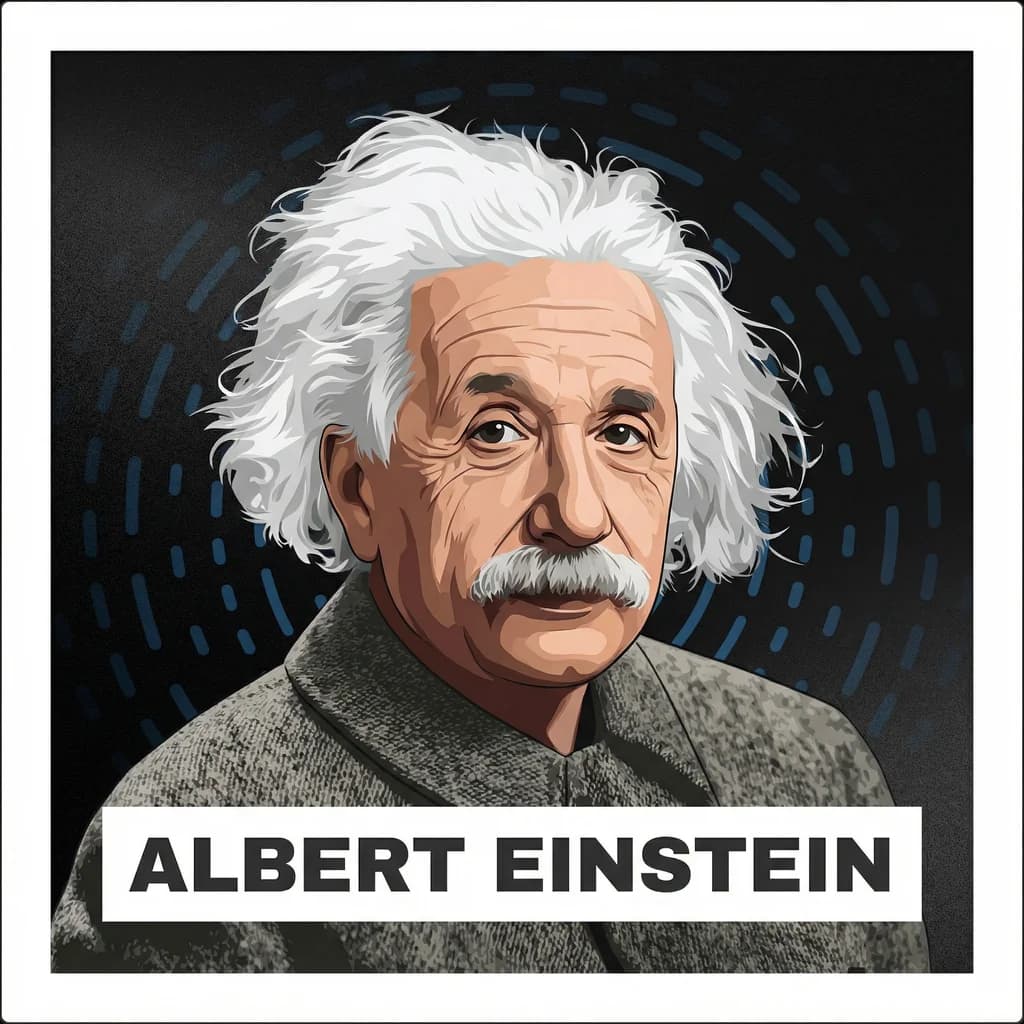
The Compass and the Abyss
In the spring of 1919, while Europe was still counting its dead, two teams of British astronomers sailed to opposite ends of the Atlantic — one to Sobral, Brazil, the other to the island of Principe off the coast of West Africa — to photograph a total solar eclipse and determine whether starlight bent around the sun in the manner predicted by a German-born physicist working at the Kaiser Wilhelm Institute in Berlin. The war had ended five months earlier. The Treaty of Versailles had not yet been signed. And yet here was the British scientific establishment, risking resources and reputation to test the theory of a citizen of the nation they had spent four years trying to destroy. When the photographic plates confirmed what Albert Einstein's equations had foretold — that gravity warps the fabric of space itself, curving light around massive objects — the news cracked open something in the popular consciousness that had nothing to do with physics. The Times of London ran the story on November 7, 1919, under a headline that could have adorned a religious broadsheet: "Revolution in Science — New Theory of the Universe — Newtonian Ideas Overthrown." Within weeks, Einstein — who had been almost a recluse, his contacts limited to quiet, scholarly men of his own type — was the most famous scientist on earth, a status he would hold for the rest of his life and well beyond it, though the precise nature of his fame would prove almost as strange and ungovernable as the universe he described.
The popular uproar surprised no one more than the author of the theory. Interviewers, photographers, lion-hunters, cause-promoters, testimonial-seekers, and what the New Yorker would later call "reflected-glory chasers of every kind came swarming into his life." A man of soft, plastic nature, Einstein was helpless in their hands. He had spent the war years completing his general theory of relativity while theologians proved their gods were in the trenches and chemists perfected poison gases — an act of fraternization with the enemy, or with the cosmos, depending on your loyalties. Now the cosmos was fraternizing back, and it wanted autographs.
What followed was one of the twentieth century's great paradoxes: a man who craved solitude became the world's most recognizable face, a thinker who dealt in the imperceptible became a creature of flashbulbs and newsreels, and a physicist who insisted that the universe obeyed rational laws found himself at the center of what he could only describe as "mass psychology." He would be offered the presidency of Israel and decline. He would write a letter that helped birth the atomic bomb and spend the rest of his life trying to undo its consequences. He would be surveilled by the FBI for twenty-two years, denounced by a cardinal as atheistic and immoral, and worshipped by millions who could not begin to understand his work. A stone image of him was built into a neo-Baptist church in New York. Rioters at the American Museum of Natural History broke iron gates and mauled special cops in a wild dash to see films purporting to explain relativity. And when he died, in the early hours of April 18, 1955, a pathologist at Princeton Hospital stole his brain without permission, placed it in two glass cookie jars, and drove it to the University of Pennsylvania in the back of his Ford.
The brain wandered for forty-three years — through Wichita, Kansas; through a series of failed marriages; through random mailings to researchers who struck the pathologist's fancy — before being returned, in 1998, to Princeton Hospital by an eighty-six-year-old man who had simply grown tired of guarding it. Einstein had insisted that his ashes be scattered in a secret location so that his final resting place would not become the subject of morbid veneration. He was defeated, at least in part, by the one organ he had used most extravagantly.
This is a man whose life cannot be told chronologically without distortion, because the central fact about Einstein is that he existed simultaneously in several incompatible registers: the cosmic and the domestic, the mythic and the bumbling, the revolutionary and the deeply conservative. He rewrote the laws of the universe and used a $1,500 check from the Rockefeller Foundation as a bookmark, lost the book, and could not remember who had sent the check.
By the Numbers
The Einstein File
1905Annus mirabilis: four papers that rewrote physics, written at age 26
$1,500Rockefeller Foundation check used as a bookmark, then lost
150Poor families in Berlin he was supporting by 1927
1,500Pages in his FBI surveillance dossier
43 yearsDuration his stolen brain wandered before being returned
1952Year he was offered — and declined — presidency of Israel
$33,000Value of a Guarnerius violin he refused as a gift
The Dopey One
He was slow to talk. The family maid called him "the dopey one." Several relatives considered him "almost backwards." He occupied himself, as a child, with quieter things — building houses of cards that reached fourteen stories, a feat of patience and structural intuition that his family found more alarming than impressive. His parents, Hermann and Pauline Einstein, were secular, middle-class Jews in Ulm, Württemberg. Hermann, originally a featherbed salesman, later ran an electrochemical factory with moderate success — moderate being the operative word, as the business would fail repeatedly, dragging the family from Munich to Milan to Pavia in a succession of commercial humiliations that left young Albert, at various points, a school dropout, a draft dodger, and an apparent dead end.
Two experiences cracked him open. The first was a compass, encountered at age five. The invisible force that deflected the needle — a force you could not see, could not touch, but which was undeniably there — planted in him what he later called a lifelong fascination with invisible forces. The second was a book of geometry, discovered at twelve, which he devoured and called his "sacred little geometry book." Between the compass and the geometry text, something was established: a conviction that beneath the apparent chaos of the physical world lay a hidden order, accessible not through obedience or authority but through solitary thought.
At the Luitpold Gymnasium in Munich, Einstein chafed against Prussian pedagogical discipline. One teacher told him he would never amount to anything. This was not, strictly speaking, a failure of perception — the boy who sat before him was insolent, distractible, contemptuous of rote learning. What the teacher could not perceive was that the insolence was itself a form of inquiry. Einstein's rebellion against dogma, which would prove essential to his physics, first manifested as a rebellion against teachers. He dropped out at fifteen. He failed his entrance examination to the Swiss Federal Polytechnic in Zurich — passing the math section brilliantly but bombing botany, zoology, and languages. He was admitted the following year, on the condition that he first finish high school at a special school in Aarau, Switzerland, run by Jost Winteler, with whose family he boarded. Winteler's daughter Marie became his first love. His sister Maja would eventually marry Winteler's son Paul. His closest friend, Michele Besso, would marry their eldest daughter Anna. The Wintelers were not a family so much as an ecosystem from which Einsteins would never fully detach.
At the Polytechnic, Einstein found the happiest years of his young life — and the professors who would ensure his post-graduation misery. He often cut classes to study advanced subjects on his own, earning the animosity of Heinrich Weber, from whom he unwisely requested a letter of recommendation. Einstein was subsequently turned down for every academic position he applied to. "I would have found [a job] long ago if Weber had not played a dishonest game with me," he wrote. His prospects did not look promising.
The Patent Clerk's Universe
The turning point came in 1902, when the father of his lifelong friend Marcel Grossmann — a mathematician who had been taking meticulous lecture notes while Einstein was reading Mach and Maxwell on his own — recommended him for a position as a clerk in the Swiss patent office in Bern. Grossmann was a compact, orderly young man, the kind of student who showed up to every lecture and kept his notes in perfect condition; that his friendship with the chaotic, class-cutting Einstein would prove scientifically fruitful says something about the complementary geometries of genius. About this time, Einstein's father, Hermann, became seriously ill. Just before he died, he gave his blessing for his son to marry Mileva Marić, the Serbian physics student Einstein had met at the Polytechnic. Their daughter Lieserl had been born in January 1902 — her fate remains unknown, most likely given up for adoption or lost to scarlet fever — and Einstein's father had died thinking his son a failure.
With a small but steady income for the first time, Einstein married Marić on January 6, 1903. Their sons Hans Albert and Eduard followed in 1904 and 1910. And then, in the patent office — six days a week, analyzing other people's inventions — Einstein began to daydream his way into immortality.
The job was, in hindsight, a blessing of the most improbable kind. He would quickly finish analyzing patent applications, leaving him time to pursue the thought experiment that had obsessed him since he was sixteen: What would a light beam look like if you could run alongside it? At the Polytechnic he had studied Maxwell's equations and discovered a fact unknown to Maxwell himself — that the speed of light remains constant no matter how fast one moves. This violated Newton's laws of motion. The contradiction would not let him rest.
In the span of six months in 1905 — his annus mirabilis, the miracle year — the twenty-six-year-old patent clerk published four papers in the Annalen der Physik, each of which would alter the course of modern physics. The first applied quantum theory to light, explaining the photoelectric effect by proposing that light travels in tiny packets — later called photons — and would eventually win him the Nobel Prize. The second offered the first experimental proof of the existence of atoms, through analysis of Brownian motion. The third laid out the mathematical theory of special relativity, reconciling the laws of mechanics with the laws of the electromagnetic field. The fourth, submitted almost as an afterthought, showed that relativity led to the equation E = mc², providing the first mechanism to explain the energy source of the sun and other stars. He also submitted a fifth paper that year as his doctoral dissertation.
Other scientists — Henri Poincaré, Hendrik Lorentz — had pieces of special relativity. But Einstein was the first to assemble the whole theory and to realize it was a universal law of nature, not a curious figment of motion in the ether. In the nineteenth century there had been two pillars of physics: Newton's laws of motion and Maxwell's theory of light. Einstein was alone in seeing that they were in contradiction and that one must fall.
This daily striving is dictated by no principle or program, but arises from immediate personal need. The emotional condition which renders possible such achievements is like that of the religious devotee or the lover.
He described the impulse to grapple with his problems as "a demoniac possession," needing no stimulation from conscious effort of the will. This was not false modesty. It was a description of a mind that worked the way a river works — following the contours of the problem with an inevitability that looked, from the outside, like effortlessness. His wife, his children, his friends — they all experienced the secondary effects of this possession. He was present and absent simultaneously, a man who could be heartbreakingly tender in the abstract and chillingly remote in the particular. He would later write, in a letter to his first wife during the dissolution of their marriage, instructions so clinical they read like patent office memoranda: conditions for cohabitation, protocols for communication, rules about laundry. The man who had dissolved the boundary between space and time could not dissolve the boundary between his inner world and the people who loved him.
The Geometry of Loneliness
In 1914, Einstein was appointed Director of the Kaiser Wilhelm Physical Institute and Professor at the University of Berlin — the pinnacle of German academic life. He became a German citizen again that year, a status he would renounce in 1933 for political reasons. His marriage to Mileva had been deteriorating for years. During the marriage, he had begun an affair with his cousin Elsa Löwenthal, and by the time he moved to Berlin, the personal wreckage was considerable. Mileva and the two boys remained in Zurich. Einstein and Mileva divorced in 1919 — the same year the eclipse confirmed general relativity, the same year he married Elsa — and the terms included an unusual provision: should he win the Nobel Prize, the money would go to Mileva. He won it in 1921 (awarded in 1922), and he gave her the prize money, as promised.
His son Eduard — brilliant, sensitive, increasingly unstable — would develop schizophrenia in his twenties. Einstein, by then in America, would never see him again after 1933. Hans Albert became an engineer. The distance between Einstein and his children was not merely geographic; it was structural, built into the architecture of a mind that could hold the curvature of spacetime but could not hold the curvature of an adolescent son's despair. "Deeply and passionately [concerned] with the fate of every stranger," wrote his friend and biographer Philipp Frank, Einstein "immediately withdrew into his shell" when relations became intimate.
Between 1907 and 1915, while the personal life unraveled, Einstein completed his masterwork. General relativity — the theory that gravity is not a force but a curvature of spacetime caused by mass and energy — was, by any measure, the most profound reimagining of the physical universe since Newton. The mathematician Marcel Grossmann, the same friend whose father had found Einstein the patent office job, provided crucial mathematical tools. Einstein's former classmate was now essential to his physics, their collaboration a quiet demonstration that genius, whatever else it is, is not solitary.
Even now, scientists marvel at the daring of general relativity. "I still can't see how he thought of it," said the late
Richard Feynman. Einstein himself described "the happiest thought of my life" as the realization, around 1907, that a person falling freely would not feel his own weight — that gravity and acceleration were, locally, indistinguishable. From this simple insight, pursued with a persistence that bordered on mania for eight years, he constructed a theory that predicted the bending of starlight, the existence of gravitational waves (confirmed a century later, in 2015), the expansion of the universe, and the slowing of time near massive objects — a prediction without which GPS navigation would not work.
The Idol and the Mob
The eclipse results of 1919 created not merely a famous scientist but an entirely new category of public figure — the scientist as celebrity, the thinker as sex symbol of the intellect. The chief agent in making Einstein the idol of the masses was Carr V. Van Anda, the great managing editor of the New York Times, a man who had taught himself to read hieroglyphics and had devoted himself to higher mathematics, and who possessed a journalistic hunch that a flaw might someday be found in the Newtonian theory. When the announcement came, Van Anda opened all the floodgates of publicity. The pages of the Times in Van Anda's day had the same authority with the journalistic profession that sacred gold plates had among the Mormons of Joseph Smith's day. The entire American press was soon struggling to explain relativity. Country weeklies held Einstein orgies patterned after the Einstein orgies in the Times.
It was stated in 1919 that only twelve persons in the world understood the Einstein theory, and it has since been stated that none of the twelve could grasp any of the popular explanations of it. The lazy man's way to understanding, according to the best authorities, was to spend ten or fifteen years on mathematics. And yet the public's appetite was inexhaustible. One psychoanalyst, analyzing Einstein's millions of admirers in a body, found that the incomprehensibility of the theory was itself the basis of his popularity — the Einstein-worshippers being puppets of the mysterious instinct which impels its victims to join lodges and go in for secret rites, passwords, gold-plated swords, and parades on boardwalks.
Einstein himself regarded money as something to give away. When a magazine offered him an amazing sum for an article, he rejected it contemptuously. "What?" he exclaimed. "Do they think I am a prizefighter?" But he finally wrote the article after arguing the magazine into cutting the price in half. He declined his post at the Institute for Advanced Study at Princeton on the ground that the salary was preposterously munificent, and was persuaded to accept only by the promise of an enormous pay cut. He objected to gifts but his 1930 trip to America netted him five violins and other valuable booty. His backbone stiffened when an admirer sought to press on him a Guarnerius valued at $33,000; this he firmly refused, saying he was not enough of a musician to do justice to the instrument.
Do they think I am a prizefighter?
He was chivied constantly into doing the opposite of what he planned. Before leaving Germany for a 1930 visit to America on the Belgenland, he announced he would give no interviews, pose for no pictures, make no speeches, and pay no visits, remaining aboard the ship. He was immediately chivied into interviews, broadcasts, luncheons, teas, dinners, and sightseeing expeditions. He toured Chinatown. He went to the opera. When he finally uttered a resolute "No more" and went into hiding, a reporter found him. "Go away," said Einstein, in his slow, reproachful manner, "immediately." Seeing the disappointment on the reporter's face, the scientist called after him, "Come back, young man, and I will try to answer your questions."
It was the habit of this good, easy man to reward those who violated his rules and penalize those who respected them. Courteous reporters were continually scooped by their unmannerly brethren.
The Foreigner's Country
There is such a thing as being a foreigner, but not in the sense implied by passports. The Italian writer Niccolò Tucci understood this when he visited Einstein's house on Mercer Street in Princeton in the late 1940s, dragged there by his mother-in-law Bice, who had come to see Maja, Einstein's younger sister — a woman who looked exactly like her brother (one would almost say she, too, needed a haircut) but who was a Tuscan peasant in temperament, quick to dismiss with a witty remark whatever in conversation did not make sense in plain, human terms.
Tucci's account of the visit is one of the most penetrating portraits of Einstein ever written, because Tucci saw what biographers routinely miss: that Einstein's joy was not the glow of celebrity or the satisfaction of reputation but the afterglow of work. Sitting in the room where Maja was recovering from a long illness, Einstein laughed so heartily at the most trivial things, listened with such concentration to nonsense, was so full of life that Tucci found himself both envious and angry. "Why is he so young," he asked himself, "and what makes him laugh so?"
Then he understood. Einstein had just come from his study. He was stretching his mind. He was "abroad." All his words were only formally addressed to the people in the room; actually, they were references to some demonstration he had received, in the heart of his own secret country, that something was exactly as he had suspected it would be. Tucci recognized the feeling because he had known it himself — as a seven-year-old making locomotives out of tin cans and old shaving brushes, the smokestack fashioned from the brush with the smoke. When the joy of toymaking became too great, the child had to interrupt his work and run to the living room, where the grownups were boring themselves to death. And he laughed at their words without bothering to inquire what they meant.
"You and your toys," Tucci thought, looking at Einstein with the envy that an ailing old man has for a young athlete.
At lunch, Bice asked Einstein why her eldest brother Michele — who had been Einstein's walking companion in their youth, with whom Einstein had enjoyed lengthy conversations about space and time — had never made an important discovery in mathematics. "Michele is a humanist, a universal spirit, too interested in too many things to become a monomaniac," Einstein said, laughing. "Only a monomaniac gets what we commonly refer to as results."
The remark was self-diagnosis disguised as commentary on a friend. Einstein was the monomaniac par excellence — a man who could hold a single problem in his mind for a decade, who could forgo the pleasures of breadth for the annihilating intensity of depth. Michele Besso — that gentle little man who sat in Bern, Switzerland, looking out into the world, leaning on a white beard that descended from almost under his blue eyes to the end of his necktie — was the road not taken. Every night for twenty years, Besso had looked into The Divine Comedy in the company of a friend, tried to find mathematical formulae to solve the crisis of the world, and for a long time, in the company of Einstein, had looked into the mysteries of higher mathematics. He had remained human. Einstein had become something else.
The Greeks and the Bomb
What he had become was this: the most famous refugee on earth.
As the Nazis rose to power, Einstein — who had been a pacifist, a Zionist, a supporter of the Weimar Republic — saw with painful clarity what was coming. In 1933, he renounced his German citizenship and emigrated to the United States, accepting a position at the newly founded Institute for Advanced Study in Princeton, New Jersey. He would never return to Europe.
The Institute was a peculiar institution — a collection of brilliant minds with no students to teach, no laboratories to run, no obligations beyond thought itself. Einstein became an American citizen in 1940. He settled into the white clapboard house at 112 Mercer Street, where he would live for the remaining twenty-two years of his life, walking to and from the Institute in his mothy sweaters and sandals, his hair increasingly wild, his face increasingly the face the world already knew from a thousand cartoons and posters.
On August 2, 1939, from a vacation cottage in Peconic, Long Island, Einstein signed the most consequential letter of the twentieth century. It was addressed to President Franklin Delano Roosevelt. The letter — drafted largely by the Hungarian physicist Leo Szilard, with input from Eugene Wigner and Edward Teller, all three of them refugees from European fascism — warned that recent work on uranium fission made it probable that "extremely powerful bombs of a new type may thus be constructed." A single bomb, carried by boat and exploded in a port, "might very well destroy the whole port together with some of the surrounding territory."
Szilard — a man of relentless energy and mordant wit, born in Budapest in 1898, who had studied physics in Berlin and fled to England in 1933 with, legend has it, his bags already packed — had been among the most vocal advocates for an American nuclear program. He understood, with the visceral terror of someone who had seen the Nazis up close, that Hitler would not hesitate to use such a weapon. Einstein, whose name carried an authority that no other scientist on earth could match, agreed to sign. He was a committed pacifist, but the prospect of nuclear weapons in Hitler's hands was, as he later wrote, something for which "I did not see any [other] way out."
The letter reached Roosevelt on October 11, 1939, delivered by Alexander Sachs, a Wall Street economist and unofficial presidential adviser who had insisted on reading it aloud to the president rather than letting it languish unread in a pile of correspondence. Roosevelt was initially noncommittal. At a second meeting the next morning, over breakfast, he became convinced. The chain of decisions that followed would lead, eventually, to the Manhattan Project, to Hiroshima and Nagasaki, and to a world that lived in the shadow of a weapon whose theoretical foundations Einstein had provided with E = mc².
Einstein himself played no role in the Manhattan Project. He was denied a security clearance in July 1940, ostensibly due to his pacifist tendencies — though the FBI, under J. Edgar Hoover, had been surveilling him for years, tapping his phones, opening his mail, rifling through his trash, compiling a dossier that would eventually reach fifteen hundred pages. Hoover believed Einstein was more radical "than even Stalin himself."
After the war, Einstein helped found the Emergency Committee of Atomic Scientists with Szilard. He spent the last decade of his life warning, in speeches and letters, of the catastrophe that nuclear weapons represented. "The war is won," he said in a 1945 Nobel Anniversary dinner address, "but the peace is not." He later told Newsweek: "Had I known that the Germans would not succeed in developing an atomic bomb, I would have done nothing."
The Epistemological Opportunist
Einstein's philosophy of science — a subject to which he returned throughout his life with a seriousness that astonished professional philosophers and irritated them in almost equal measure — was not a sideline to his physics. It was the engine of it.
"So many people today — and even professional scientists — seem to me like somebody who has seen thousands of trees but has never seen a forest," he wrote in 1944 to Robert Thornton, a young African-American philosopher of science who had just finished his Ph.D. at Minnesota. "A knowledge of the historic and philosophical background gives that kind of independence from prejudices of his generation from which most scientists are suffering. This independence created by philosophical insight is — in my opinion — the mark of distinction between a mere artisan or specialist and a real seeker after truth."
He had been saying more or less the same thing for decades. In a 1916 memorial for the physicist and philosopher Ernst Mach, he argued that concepts which have proven useful "easily achieve such an authority over us that we forget their earthly origins and accept them as unalterable givens." They come to be stamped as "necessities of thought," "a priori givens." The path of scientific advance is often made impassable for a long time through such errors. This was not abstract epistemology for Einstein; it was a direct description of what he had done in 1905 — demolishing the concept of absolute simultaneity, which had seemed as self-evident as breathing — and what he had done again in 1915, showing that the geometry of spacetime was not the fixed stage on which physics played out but was itself a dynamic participant, shaped by the matter and energy it contained.
When pressed to identify his philosophical allegiance, Einstein offered a famous dodge that was, in fact, a precisely calibrated statement of method. He said he must appear to the systematic epistemologist as "a type of unscrupulous opportunist: he appears as realist insofar as he seeks to describe a world independent of the acts of perception; as idealist insofar as he looks upon the concepts and theories as free inventions of the human spirit; as positivist insofar as he considers his concepts and theories justified only to the extent to which they furnish a logical representation of relations among sensory experiences. He may even appear as Platonist or Pythagorean insofar as he considers the viewpoint of logical simplicity as an indispensable and effective tool of his research."
This was not inconsistency. It was the operating system of a mind that understood, before the professional philosophers caught up, that no single philosophical framework could accommodate the demands of physics at the frontier. He drew on Mach's empiricism, Duhem's holism, Poincaré's conventionalism, and Kant's apriorism, discarding each when it ceased to be useful and retaining what worked. "The supreme task of the physicist," he wrote in a 1918 address honoring Max Planck's sixtieth birthday, "is the search for those most general, elementary laws from which the world picture is to be obtained through pure deduction. No logical path leads to these elementary laws; it is instead just the intuition that rests on an empathic understanding of experience."
The key word is empathic. Einstein's science was not, despite the popular image, an act of pure ratiocination performed in a vacuum. It was an act of sympathetic imagination — an ability to feel his way into the structure of the physical world, to ask what it would be like to ride alongside a light beam, to fall freely in a gravitational field, to be a clock traveling at great speed. The thought experiments that powered his breakthroughs were exercises in radical empathy with the inanimate.
God Does Not Play Dice
The great irony of Einstein's later career is that the man who had done more than anyone to birth quantum mechanics became its most persistent and penetrating critic. His 1905 paper on the photoelectric effect — the paper for which he won the Nobel Prize — had proposed that light comes in discrete quanta, a radical departure from the classical wave theory. His work on Brownian motion had confirmed the reality of atoms. He had been, in the first decade of the century, quantum theory's midwife.
But as quantum mechanics developed in the 1920s — through the work of Heisenberg, Schrödinger, Bohr, Dirac, and Born — into a theory that was fundamentally probabilistic, Einstein recoiled. "I am at all events convinced that He does not play dice," he wrote to Max Born in December 1926. The remark has been widely interpreted as evidence of dogmatic opposition — Einstein the reactionary, clinging to a clockwork universe. The truth is considerably more interesting.
Einstein accepted that quantum mechanics was indeterministic. He had, after all, discovered its indeterminism. What he could not accept was that the indeterminism was fundamental — that it reflected the deepest level of reality rather than our ignorance of that level. His critique was not mystical but technical, focused on a specific problem: the theory seemed to violate what he called the principle of separability — the idea that physically separated systems possess independent real states. In 1935, he published, with Boris Podolsky and Nathan Rosen, the famous EPR paper arguing that quantum mechanics was incomplete. The argument rested on what Einstein called "spooky action at a distance" — the apparent ability of a measurement on one particle to instantaneously affect a distant, entangled partner.
He was wrong, as subsequent experiments have confirmed. Quantum entanglement is real. God does, apparently, play dice. But Einstein's wrongness was productive in a way that mere correctness rarely is. His critique forced the quantum physics community to sharpen its thinking about the foundations of the theory, and the questions he raised — about locality, reality, and completeness — remain live issues in the philosophy of physics today.
The deeper point is that Einstein's opposition to quantum mechanics was not conservative. It was radical. He was demanding more of physics, not less — demanding that a fundamental theory provide a univocal, deterministic account of physical reality at the deepest level. That this demand may be unsatisfiable by the universe as it actually is does not diminish the intellectual courage of having made it.
The Last Tuscan
In the Princeton house on Mercer Street, the final years had a quality of monastic routine. Einstein would walk to the Institute in the morning, work on his unified field theory — the attempt to merge gravity and electromagnetism into a single mathematical framework, a quest he pursued for three decades without success — and walk home in the evening. He read the Greeks to his sister Maja every night for an hour or so, even if he had had an exhausting day. Empedocles, Sophocles, Aeschylus, and Thucydides received the tribute of the most advanced and abstract modern science in the calm voice of an affectionate brother keeping his sister company.
When Tucci, visiting in the late 1940s, expressed amazement that Einstein read the Greeks, the physicist was slightly hurt. "But I have never gone away from them," he said. "How can an educated person stay away from the Greeks? I have always been far more interested in them than in science."
Elsa had died in 1936. Helen Dukas, his devoted secretary since 1928, managed the household. Margot, Elsa's daughter from a previous marriage, lived with them — delicate and silent, looking like a Flemish painting. There was a dog named Chico who snatched at children's ribbons. The furniture suggested the house of a German university professor — the same quiet atmosphere of culture that remained suspended in the air almost as stubbornly as the smell of tobacco. One might say that the furniture had been seasoned with serious conversation.
He had arrived at a kind of peace, though it was a peace haunted by failure — the failure to unify the forces of nature, the failure to accept quantum mechanics, the failure to prevent the weapon whose theoretical possibility he had helped make real. "These grownups," he said to Tucci, shaking his head with the delight of a bad boy. "Isn't it terrible how readily they will obey?"
When Tucci asked about the chances that a chain reaction might destroy the planet, Einstein looked at him with sincere sympathy, took his pipe slowly out of his mouth, stretched out his arm, and explained why his pipe — now serving as the planet — was not likely to be blown to bits. Tucci was so pleased by the answer that he did not bother to understand the reasons.
Only a monomaniac gets what we commonly refer to as results.
On the train home from Princeton, Tucci's six-year-old daughter Bimba — who could not reliably count to six on her fingers — began to cry because she had lost the hat of a paper doll that Einstein's secretary had given her. To console her, Bice said, "Think, Bimba, when you grow up, you will be able to say that Einstein played the violin for you." (He had, earlier that afternoon, taken out his instrument for the first time in nearly a year and played a few bars from a
Mozart minuet.)
"Oh, come," said Bimba, "it isn't true."
"Why? Didn't he play for you?"
"Call that play?" she said, making a sour face. "He had to use a stick to play it."
Permanent Astonishment
On April 13, 1955, an abdominal aortic aneurysm ruptured. Einstein was taken to Princeton Hospital. He refused surgery. "I want to go when I want," he said. "It is tasteless to prolong life artificially. I have done my share; it is time to go. I will do it elegantly."
He died in the early hours of April 18. He was seventy-six years old. His ashes were scattered at an undisclosed location, in accordance with his wishes. His brain was not.
What remains — beyond the physics, beyond the fame, beyond the icon with the wild hair that adorns a million dormitory walls — is the image of a man in whom permanent astonishment shone from great eyes under apprehensive brows. He had looked at the universe and seen it was stranger than anyone had imagined, and the strangeness had never stopped surprising him, not even after he had been the one to reveal it. He used the same soap for shaving and washing because of a firm conviction that two kinds of soap needlessly complicate life. He padded about the house in bare feet or sandals. He adored Bach, Beethoven, and Mozart, but found that Wagner made him emotionally uncomfortable. He liked to take long walks alone, especially in the rain.
In the room on Mercer Street, the pipe sits on the desk, still warm.