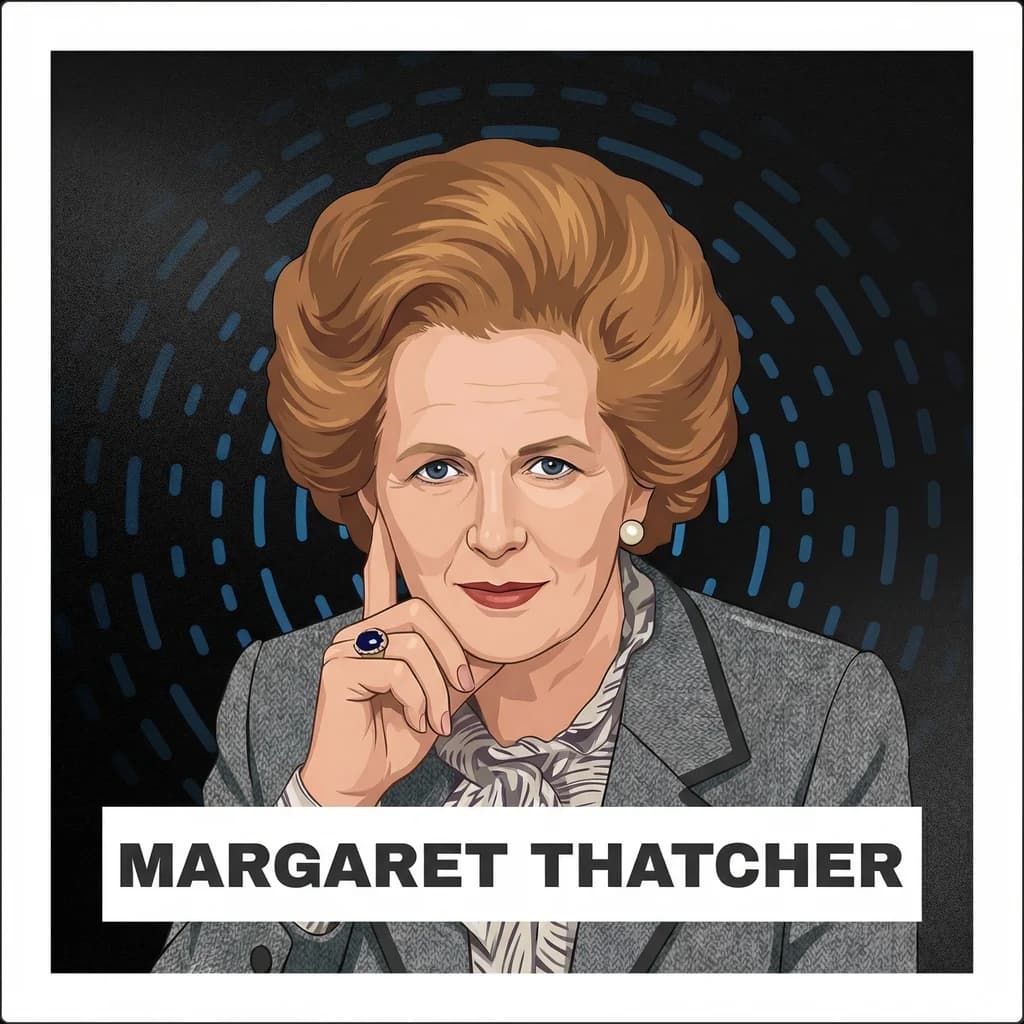
The Grocer's Scales
On the morning of November 28, 1990, Margaret Thatcher stood in the back of a Daimler as it pulled away from 10 Downing Street for the last time, her face a mask of composure that kept cracking at the edges. She had won the first ballot of the Conservative Party leadership contest eight days earlier — 204 votes to Michael Heseltine's 152, a clear majority by any ordinary arithmetic — but the Byzantine rules of the 1922 Committee demanded not merely a majority but a majority plus 15 percent, and she had fallen four votes short. Four votes. Her Cabinet colleagues, the men she had promoted, protected, and in many cases created, filed into her office one by one to tell her, with varying degrees of genuine sorrow and poorly concealed relief, that she could not win the second round. "It was treachery," she would say later, "with a smile on its face." The car turned onto Whitehall, and Britain's longest-serving prime minister since Lord Liverpool — eleven and a half years, three consecutive general election victories, a war won eight thousand miles from home, an ideology that bore her name — was simply gone.
What remained was the question that has never quite resolved, the question Grantham keeps asking and London keeps answering differently: how does a grocer's daughter from a flat above a corner shop in the East Midlands, a flat without running hot water or an indoor toilet, a flat where the Hibbert Journal — a quarterly of philosophy and theology — sat on the same table as the account books, become the most consequential British leader since Churchill? And the corollary, equally stubborn: why did the very qualities that made her ascent possible — the moral absolutism, the refusal to bend, the conviction that consensus was another word for capitulation — ensure that her own party would eventually do what the Labour Party, the Soviet Union, the Argentine junta, and Arthur Scargill's National Union of Mineworkers could not?
The scales in her father's shop weighed things precisely. She inherited that.
By the Numbers
The Thatcher Premiership
11.5 yearsConsecutive years as Prime Minister (1979–1990)
3Consecutive general election victories
1.5MPublicly owned housing units sold to tenants
3xIncrease in individual stockholders by end of 1980s
83% → 40%Top income tax rate cut during tenure
27% → 2.5%Inflation rate, peak (1975) to trough (1986)
4 votesShortfall that ended her premiership, November 1990
North Parade
The flat above the grocery at the corner of North Parade in Grantham, Lincolnshire, was not a place that produced prime ministers. It was a place that produced Methodists, small businesspeople, and children who understood that credit was a moral failing before it was a financial one. Alfred Roberts — grocer, alderman, lay preacher, mayor of Grantham (1945–46), chairman of the library committee, governor of both the town's secondary schools, a founder member of Grantham Rotary, chief air-raid welfare officer during the Blitz, a man who left school at thirteen and read with the ferocity of someone trying to make up for lost decades — never gave his customers credit. The family slipped loaves to neighbours on hard times, disguised as the surplus of her mother's "big bake," but the till was the till. Charity and commerce occupied the same counter; they did not blend.
"I just owe almost everything to my own father," Thatcher said on the steps of Downing Street in May 1979. "He brought me up to believe all the things I do believe." The sentence is so simple it conceals its radicalism. She was not saying he influenced her. She was saying he was her — that the beliefs arrived complete, like doctrine, and the subsequent decades of Oxford chemistry and Lincoln's Inn tax law and parliamentary maneuvering were merely the delivery mechanism for convictions formed in a flat above a shop where you could hear the lorries rumbling past on the Great North Road.
Beatrice Roberts, her mother — a former dressmaker who had also started up on her own — is almost invisible in the public record, a silence that Thatcher herself enforced. She barely mentioned her. The family attended church three or four times on Sundays. Alfred forbade his daughters from dancing or playing Snakes and Ladders on the Sabbath. He had a good bass voice; Beatrice had a contralto. A great-uncle made organs. The Hibbert Journal arrived every quarter. When a travelling theatre brought Shakespeare or a chamber quartet came to the local music club, the family went. This was not the threadbare deprivation of political myth — it was the severe, bookish richness of provincial nonconformist England, a culture that produced missionaries, industrialists, and people who could define the Bank of England's "fiduciary issue" at the kitchen table.
"My father was the only man I ever met who could actually define the term," Thatcher later joked. She was not entirely joking.
The Road from Serfdom
At eighteen, Margaret Roberts arrived at Somerville College, Oxford, to read chemistry. Her tutor was Dorothy Hodgkin, a crystallographer of ferocious brilliance who would win the Nobel Prize in 1964 — a woman who saw the architecture of molecules, who understood that structure determined function, that the invisible order beneath the visible surface was what mattered. Thatcher absorbed the method if not the politics; Hodgkin was a lifelong socialist.
But chemistry was a vehicle, not a destination. The Oxford University Conservative Association was where the real education happened. She became one of its first female presidents, and met the party's senior figures at precisely the moment of their greatest desolation — the landslide Labour victory of 1945, Clement Attlee's construction of the welfare state, the nationalization of coal, steel, railways, and the Bank of England. The Conservative Party was reeling, uncertain whether the postwar consensus represented the permanent future of Britain or a catastrophic wrong turn. Margaret Roberts, at twenty, had already decided it was the latter.
The intellectual ammunition came from Friedrich Hayek. She read
The Road to Serfdom as an undergraduate, and the effect was something between conversion and recognition — she experienced it not as a new argument but as the articulation of convictions she already held, stated with a force she could not yet match. Hayek's central claim — that you cannot compromise with socialism, even in mild social democratic forms, because by degrees it tends always toward totalitarian outcomes — became the deep structure of her political thought. It never changed. Decades later, as Leader of the Opposition, she reportedly slammed a copy of Hayek's
The Constitution of Liberty on a table during a policy discussion and declared: "This is what we believe."
The other intellectual pillar was Milton Friedman, the University of Chicago monetarist whose Nobel Prize in 1976 — two years after Hayek's — lent prestige to the idea that inflation was everywhere and always a monetary phenomenon, that governments caused it by printing money, and that the cure was discipline, not negotiation. Thatcher absorbed both men not as an economist absorbs theory but as a Methodist absorbs scripture: these were not hypotheses to be tested but truths to be applied.
Keith Joseph — the Conservative MP she first encountered as a young backbencher in 1959, a man of angular intelligence and agonized conscience who had co-founded the Centre for Policy Studies to propagate free-market ideas within a party that had largely abandoned them — served as the intellectual intermediary. Had Joseph not self-destructed as a leadership candidate in 1974 after a disastrous speech on eugenics, something resembling Thatcherism might have emerged under his name. But Joseph lacked the one thing that Margaret Roberts, who had married the wealthy divorced businessman Denis Thatcher in 1951, who had given birth to twins in 1953, who had read for the bar while raising children, who had lost two parliamentary elections in Dartford and kept coming back — the one thing she possessed in quantities that defied measurement.
She was willing to be hated.
The Winter and the Will
The Britain of the late 1970s was a country that had forgotten what it was for.
Inflation hit 27 percent. The pound required an emergency IMF loan in 1976 — the International Monetary Fund, the lender of last resort for failing economies, a humiliation once reserved for developing nations. The "Winter of Discontent" of 1978–79, that seasonal catastrophe of rolling strikes that left rubbish piling in Leicester Square and the dead unburied in Liverpool, was not merely an economic crisis but an existential one. The question was not whether the government could negotiate with the unions but whether the government or the unions governed Britain.
James Callaghan — the Labour Prime Minister, an avuncular former naval petty officer who had risen through the trade union movement, a decent man who understood that the system he had spent his life defending was consuming itself — reportedly told an aide during the crisis: "If I were a young man, I should emigrate." He may not have said it. But it captured the mood.
Thatcher entered 10 Downing Street on May 4, 1979, after leading the Conservatives to a decisive victory. She stood on the steps and quoted — improbably, for her — Saint Francis of Assisi: "Where there is discord, may we bring harmony." It was the last conciliatory thing she would say for eleven years.
The first term was savage. She inherited unemployment at 1.3 million; within two years it had more than doubled. Inflation, which she had promised to cure, actually doubled in her first fourteen months, exceeding 20 percent, before the monetary squeeze began to work. Manufacturing output fell sharply. Whole industries — steel towns in South Wales, shipyards on Tyneside, textile mills in Lancashire — were purged with the clinical detachment of a chemist removing impurities. Some of the firms were inefficient. Some were blameless. The method did not distinguish.
At the Conservative Party Conference in October 1980, with her approval ratings in free fall and the moderates in her own Cabinet — the "Wets," as the Thatcherite "Dries" dismissively called them — openly urging a U-turn, she delivered the line that became her epitaph: "You turn if you want to. The lady's not for turning." The sentence was written by the playwright Ronald Millar, borrowed from Christopher Fry's 1948 play The Lady's Not for Burning. It was a joke, a literary allusion, a piece of theatre. It was also, as it turned out, the literal truth.
You turn if you want to. The lady's not for turning.
The South Atlantic Proof
By early 1982, Thatcher was the most unpopular prime minister in the history of British polling. The economy was in recession, unemployment had passed three million, and her own backbenchers were restive. Then, on April 2, Argentine forces under General Leopoldo Galtieri invaded the Falkland Islands — a remote British dependency in the South Atlantic, home to 1,800 people and several hundred thousand sheep, a territory so obscure that the Foreign Office had been quietly exploring ways to hand it over.
Thatcher sent a naval task force of 27,000 across eight thousand miles of open ocean. She paraphrased
Queen Victoria: "Failure — the possibilities do not exist!" When South Georgia was retaken on April 25, she stepped outside Downing Street and told the gathered press to "rejoice." The war lasted seventy-four days. Two hundred and fifty-five British servicemen died. Six hundred and forty-nine Argentines died, and three Falkland Islanders. On June 14, white flags flew over Port Stanley.
The Falklands War did not merely save Thatcher's premiership — it created Thatcherism as a cultural phenomenon. Before the war, she was a radical economist pursuing unpopular policies. After the war, she was Britannia. "We have ceased to be a nation in retreat," she declared at Cheltenham in July 1982. The 1983 general election produced the largest increase in a governing party's parliamentary majority in British electoral history — a majority of 144 seats on just over 42 percent of the vote, aided immeasurably by a Labour Party that had torn itself apart and contested the election on what Gerald Kaufman, one of its own shadow cabinet members, memorably called "the longest suicide note in history."
The Miners, the Bomb, and the Moral of Force
The second term was the crucible. Thatcher had entered office promising to curb the power of the unions, which had demonstrated their ability to bring the country to a standstill — twice under Edward Heath, once under Callaghan. Her government enacted a systematic series of legal reforms: banning the closed shop, requiring unions to ballot their members before ordering strikes, forbidding sympathy strikes, making unions financially liable for damages caused by their members. These were not improvisations. They were the components of a strategy that had been planned, in detail, before she took office.
In March 1984, the National Union of Mineworkers, led by Arthur Scargill — a Marxist firebrand from Barnsley, a man of considerable charisma and catastrophic tactical judgment who refused to hold a national ballot of his own members — launched a strike to prevent the closing of twenty coal mines the government declared unproductive. The walkout lasted nearly a year. It became, in the public imagination and in fact, the decisive battle between the postwar settlement and the Thatcher revolution. Police and pickets clashed at Orgreave. Mining communities were torn apart. Scargill demanded unconditional surrender from a woman constitutionally incapable of offering it. The miners returned to work in March 1985 without winning a single concession. British trade unionism — the institutional expression of working-class solidarity that had shaped the country since the nineteenth century — was never the same. Employee days lost to strikes fell from 29.5 million in 1979 to 1.9 million by 1986.
Six months into the miners' strike, at 2:54 a.m. on October 12, 1984, the IRA detonated a bomb at the Grand Hotel in Brighton during the Conservative Party Conference. Five people were killed. Norman Tebbit, the Employment Secretary, was pulled from the rubble. His wife Margaret was paralyzed from the neck down. Thatcher, whose bathroom had been destroyed — she had finished her conference speech and was going through a last official paper in the sitting room — was unhurt. She insisted the conference open on schedule, walked on to the platform at 9.30 that morning, and delivered her rewritten speech later the same day. "It was an attempt to cripple Her Majesty's democratically elected government," she said. "That is the scale of the outrage in which we have all shared. And the fact that we are gathered here now, shocked but composed and determined, is a sign not only that this attack has failed, but that all attempts to destroy democracy by terrorism will fail."
She wrote to Michael Foot, the former Labour leader, who had sent a message of sympathy. Her handwritten reply contained a line that revealed more than she perhaps intended: "It is as well we cannot foretell the future — we could not endure the knowledge."
The Atlantic Alliance and the Cold War's End
The partnership with Ronald Reagan — the former Hollywood actor and California governor who arrived at the White House in January 1981 with a similar conviction that government was the problem, not the solution — was both ideological and personal, though the personal dimension was more complicated than the mythology allows. They had probably first met at a lunch hosted by Edward Heath in July 1972, when Reagan was Governor of California on a European tour for Richard Nixon. Their first substantive one-on-one meeting came in April 1975, at the House of Commons, shortly after Thatcher won the Conservative leadership. Reagan's thank-you letter was written as Saigon fell: "a dark day... somehow the shadows seem to have lengthened."
They shared an anticommunist worldview of almost theological intensity. Thatcher's 1976 speech condemning Soviet expansionism had earned her the nickname "Iron Lady" from a Soviet army newspaper — a designation she embraced with the visible delight of someone who has been handed the perfect brand. Reagan, with his affable delivery and apocalyptic convictions, was her complement rather than her mirror: where she argued from evidence, he argued from narrative; where she was abrasive, he was charming; where she demanded engagement, he radiated genial certainty. Together, they ensured that the Cold War continued in full frigidity until the arrival of Mikhail Gorbachev.
We can do business together.
It was Thatcher who identified Gorbachev as a different kind of Soviet leader, inviting him to Chequers in December 1984, three months before he became General Secretary. "We can do business together," she declared — a sentence that infuriated Cold War hawks and was vindicated by history. She then spent the next five years as the intermediary between Washington and Moscow, pushing Reagan and Gorbachev toward arms agreements while insisting on the maintenance of Britain's independent nuclear deterrent. In March 1982, Reagan confirmed the sale of the Trident II missile system to the United Kingdom, a transaction that ensured Britain's seat at the nuclear table for decades. For the only time since Churchill, Britain occupied a central position in dealings between the superpowers — not because of its military power, which was modest, but because of the force of its prime minister's personality.
The relationship was not without its betrayals. When the United States invaded Grenada — a Commonwealth nation — in October 1983 without consulting Thatcher, she was furious; looking back from the third volume of his authorized biography, Charles Moore writes that "she had been enraged by the Grenada invasion." She defended him publicly during the Iran-Contra affair. The alliance held, but it held on her terms only when she made it impossible for it not to.
Privatizing the State
The privatization program was the structural achievement that outlasted everything else — the policy that other nations studied, copied, and eventually accepted as self-evident, forgetting that when Thatcher proposed it, the idea of selling British Telecom, British Gas, British Airways, British Steel, and the water and electricity utilities to private investors seemed not merely radical but lunatic. The state had owned these enterprises since the postwar Labour government nationalized them. They were part of the national furniture.
By the end of the 1980s, the number of individual stockholders in Britain had tripled. The sale of 1.5 million publicly owned housing units to their tenants — the "Right to Buy" policy codified in the Housing Act of 1980 — created a new class of property owners with a material stake in the Conservative program. The council tenant who bought her flat was no longer a Labour voter by default. She was a stakeholder.
The economic record, however, was more ambiguous than the mythology admits. Bruce Bartlett, a former policy aide to both Reagan and George H.W. Bush, observed that the conservative legend about Thatcher's Britain was "at odds with the facts." Taxes as a share of
GDP actually
increased during her first seven years in office. She cut the top income tax rate from 83 percent to 60 percent immediately upon taking office, and later to 40 percent, but paid for the initial cut by nearly doubling the value-added tax from 8 percent to 15 percent. Arthur Laffer, the supply-side economist, wrote in the
Wall Street Journal in August 1979 that Thatcher was "taking with one hand while giving with the other." Public spending rose in real terms in all but two of her years in office. The National Health Service — which she personally supported, as did virtually every member of her party — remained untouched in its fundamental structure.
She was, in other words, far more pragmatic than her rhetoric suggested. The Iron Lady bent. She simply never admitted it.
The European Fault Line
The issue that destroyed her was, characteristically, the one on which she least liked to compromise. Britain's relationship with the European Community — the institutional ancestor of the European Union — ran through the second half of her premiership like a crack in load-bearing wall.
In 1984, amid fierce opposition from her European counterparts, she succeeded in dramatically reducing Britain's contribution to the EC budget. "I want our money back," she had declared in 1979, and she got most of it. The achievement was remarkable — a solo act of diplomatic will against the combined resistance of France, Germany, and the European Commission. It also established a pattern of confrontation that would prove fatal.
After her third electoral victory in 1987, her hostility toward European integration intensified. She resisted the single currency. She rejected political union. When she finally took sterling into the Exchange Rate Mechanism in October 1990, against years of her own argument, Moore writes that she "succumbed, ungraciously." She delivered the Bruges speech in September 1988, which became the founding text of British Euroscepticism: "We have not successfully rolled back the frontiers of the state in Britain, only to see them reimposed at a European level." Her traditionally pro-European party began to split. A string of senior ministers departed. Nigel Lawson, the Chancellor, resigned in October 1989, because he could not do his job "so long as Alan Walters remains your personal economic adviser"; Geoffrey Howe, the former Foreign Secretary and by then Deputy Prime Minister, followed a year later.
It was Howe who delivered the killing blow. Sir Geoffrey Howe — the mild-mannered lawyer whose rhetorical offensives a Labour MP had once compared to "being savaged by a dead sheep" — resigned on November 1, 1990, and gave a devastating resignation speech in the House of Commons on November 13. He compared Thatcher's European policy to sending cricketers to bat with broken bats, and invited "others to consider their own response." Heseltine, watching from the backbenches, responded by challenging her for the leadership.
The poll tax — the community charge, a flat-rate local tax that required every resident to pay the same regardless of income, introduced in Scotland in 1989 and in England and Wales in 1990 — had already destroyed her popularity on the streets. Riots in Trafalgar Square in March 1990 had alarmed the Conservative rank and file. But it was Europe that split the parliamentary party. She won the first ballot. She lost the war.
The Grammar of Conviction
The paradox at the center of Thatcher's career is that the qualities her party ultimately punished her for were the same ones that made her party's transformation possible. She could not modulate. Chris Patten, one of her ministers, observed that she recognized "people need to be a bit scared of you if you're going to get your own way." She had, he said, "an extraordinary style of summarising the conclusions of meetings at the beginning and then challenging the assembled company to say whether they thought she might be wrong." There was, Patten added, "always that slight sense of the anaconda in the chandelier."
She did not see this as a flaw. "I think sometimes the prime minister should be intimidating," she told the BBC in 2005. "There's not much point being a weak, floppy thing in the chair, is there?"
The combativeness was not theatre. It was method — specifically, it was the method of a trained scientist who gathered evidence rigorously and then delivered verdicts, of a barrister who specialized in tax law and understood that precision was a form of power, of a grocer's daughter who had watched her father weigh things exactly. "We are Methodists," she said in 1978, "and Methodism means method." The line is usually read as a joke. It was the most revealing thing she ever said about herself.
Her intellectual framework was essentially complete by the time she was thirty. What followed was not evolution but application — the deployment of fixed principles across changing circumstances. She read Hayek at eighteen and quoted him at sixty-five. She absorbed Friedman's monetarism in the 1970s and applied it, sometimes disastrously, in the 1980s. She inherited her father's belief that debt was a moral failing and governed a nation accordingly. The ideas did not change. The world changed around them, and when the world became complicated — when the European question demanded the kind of flexibility that was foreign to her temperament, when the poll tax required retreat, when her own Cabinet needed reassurance rather than instruction — the method that had carried her to three election victories became the mechanism of her destruction.
The single biggest intellectual error during my political lifetime has been to confuse freedom with equality. In fact, equality — being an unnatural condition which can only be enforced by the state — is usually the enemy of liberty.
The Woman in the Room
She was the first woman to lead a major Western democracy, and she refused, with a consistency that infuriated feminists and delighted her supporters, to acknowledge that this was remarkable or even relevant. "I don't think I have noticed any problems that might not have happened had I been a man," she told Central TV in 1986. "I less and less attribute a whole range of emotions to one particular sex." When pressed on whether the House of Commons was harder for a woman, she conceded a single point: "I don't think women like very much getting up and making speeches."
This was disingenuous. The obstacles were enormous and she knew it. As a young mother trying to win a parliamentary candidacy in the 1950s, she was repeatedly told — by the Conservative Party selection committees that were her natural constituency — that her proper place was at home. She came close to abandoning the attempt, removing her name from the party's list of approved candidates. Denis Thatcher's wealth made the enterprise possible — he supported her political ambition financially, emotionally, and logistically from 1951 until his death in 2003.
Her solution to the problem of being a woman in a male-dominated world was not to demand that the world change but to operate within it with such overwhelming force that gender became irrelevant — or at least irrelevant to the outcome. She was not a feminist in any recognizable sense. She appointed one woman, Janet Young, to her Cabinet. She did not legislate for equal opportunities. She believed, as she believed about most things, that individuals succeeded or failed on their own merits, and that structural explanations for individual outcomes were a form of moral evasion.
Yet her example was transformative precisely because it was not programmatic. By becoming prime minister without demanding that the rules be changed, she changed the rules forever. Every subsequent female leader in the Western world — whether they admired her politics or despised them — existed in a space she had opened. She would not have described it this way. She would have said she was simply doing the job.
The Ritz
Margaret Thatcher died at the Ritz Hotel in London on April 8, 2013, following a stroke. She was eighty-seven. She had suffered a series of minor strokes in 2002 and withdrawn from public speaking on her doctors' advice. Her daughter Carol revealed in a 2008 memoir that she had been showing symptoms of dementia since 2000. Sometimes she forgot what she had eaten for breakfast. Once she conflated the Falklands War with the Bosnian conflict. She had to be reminded, repeatedly, that Denis was dead.
The revelation provoked fury in Britain — not at the disease but at the disclosure. Andrew Pierce noted in the Daily Telegraph that Thatcher's friends had deliberately kept silent to "preserve the great lady's dignity and grace in a quiet, discreet way." Ronald Reagan Jr. called Carol Thatcher's account "in monumentally bad taste." The debate captured something essential about Britain's relationship with its most polarizing modern leader: even in her diminishment, the country could not agree on what it owed her, or what she had earned.
She received a ceremonial funeral with full military honours at St Paul's Cathedral. She had been made a life peeress in 1992, a Lady Companion of the Order of the Garter in 1995. In 2007, she became the first living ex-prime minister to be honoured with a statue in the Houses of Parliament, placed opposite
Winston Churchill in the Members' Lobby.
At a reception some years before the dementia closed in, Thatcher was photographed at the Chelsea Hospital, trailing behind Prince Charles, gazing up at a portrait of herself in royal purple. She studied her own likeness with the expression of a woman who was certain she had seen that face before but could not quite place it — as though she had come face to face with what she used to mean. The living Thatcher and the painted one regarded each other across a distance that could not be measured in feet, and for a moment the most certain woman of her age looked deeply, uncharacteristically puzzled.