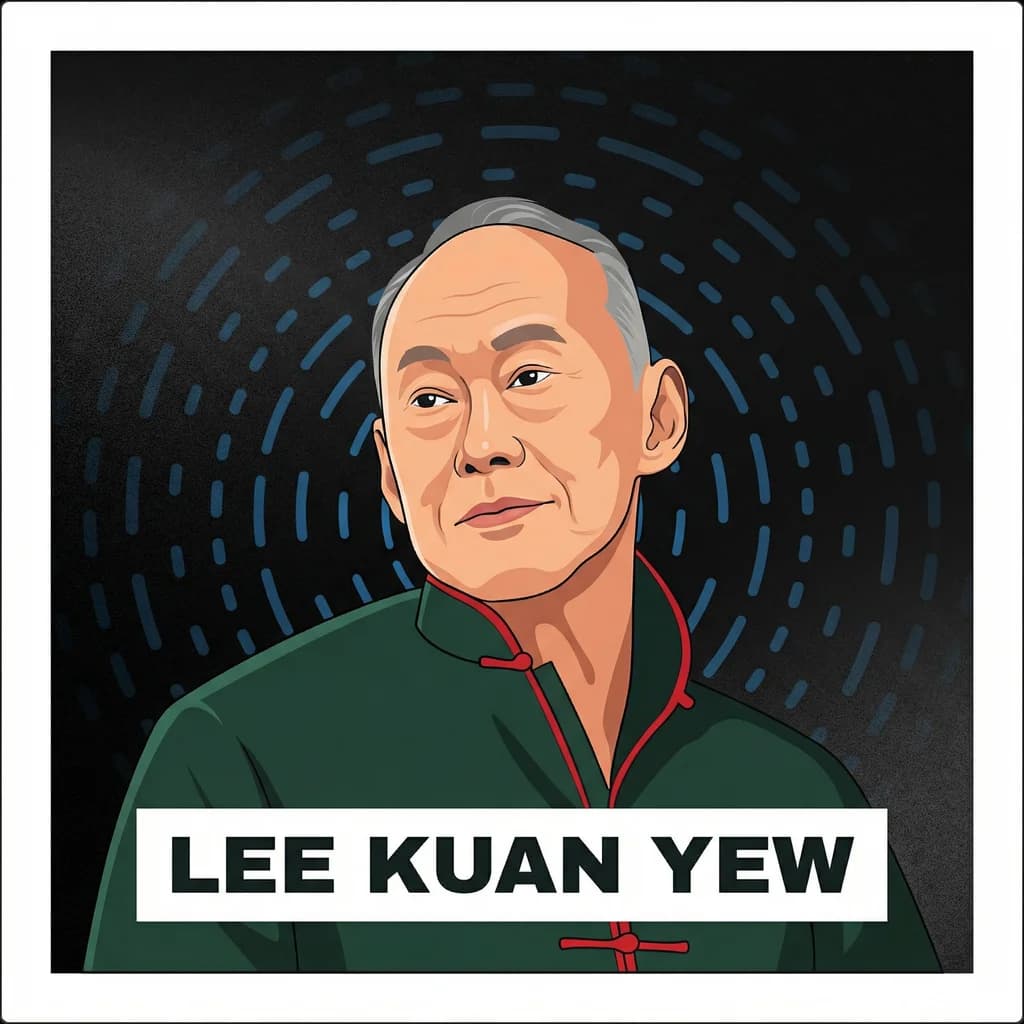
The Well
In the compound of a house at what is now Tembeling Road in Singapore, sometime around 1927, a man held his four-year-old son by the ears over the mouth of a well. The child had ruined an expensive jar of 4711 pale-green scented brilliantine. The father — Lee Chin Koon, a twenty-four-year-old storekeeper at Shell Oil Company whose own father had once maintained a limitless charge account at Robinsons and John Little, the two top department stores in Raffles Place, before the Great Depression obliterated the family fortune — had a violent temper, and that evening, as his son would later write, "his rage went through the roof." How could ears so small have been so tough that they were not ripped off, dropping the boy into the darkness below?
Half a century later, the boy — now the prime minister of an improbable sovereign nation — read in Scientific American that pain and shock release neuropeptides in the brain, stamping new experience into neural tissue and ensuring it would be remembered for a long time. He found this satisfying. It confirmed what he already knew about the mechanics of power: that memory is a function of consequence, that lesson-learning requires stakes, that the well must be real.
The boy's name was Harry Lee Kuan Yew. The name means "light that shines." He would go on to run the most successful small country in the history of the world for thirty-one years, attract the counsel-seeking visits of every American president from Richard Nixon to Barack Obama, be called "never wrong" by
Margaret Thatcher and "one of the legendary figures of Asia" by Obama, be credited with inspiring Deng Xiaoping's market reforms, and transform 225 square miles of swampy, resource-barren tropical island — an area roughly the size of Trenton, New Jersey — into a nation whose per capita
GDP would surpass that of the United States, whose passport would grant visa-free access to more than 190 countries, and whose cleanliness, efficiency, and prosperity would become the envy and rebuke of every developing nation on earth.
He would also ban chewing gum, cane vandals, muzzle the press, sue opposition politicians into bankruptcy, and govern with a severity that made even his admirers uneasy.
Henry Kissinger, who described him as one of only two "certifiable grand masters of international strategy" in the last half century — the other being, naturally, Kissinger himself — once wrote that "one of the asymmetries of history is the lack of correspondence between the abilities of some leaders and the power of their countries." Nixon went further: had Lee lived in another time and another place, he speculated, the man "might have attained the world stature of a Churchill, a Disraeli, or a Gladstone."
The asymmetry cuts both ways. The stage was small. The performance was not.
By the Numbers
The Singapore Experiment
$500 → $65,000Per capita GDP, 1959 to 2023
31 yearsTenure as Prime Minister (1959–1990)
225 sq miTotal land area of Singapore
5.9 millionPopulation of Singapore (2023)
43 of 51PAP seats won in first election, 1959
190+Countries accessible visa-free with Singapore passport
91Age at death, March 23, 2015
Four Anthems
Jon Huntsman Jr., the former U.S. Ambassador to China and Singapore — a man who had served as Utah's governor, run for president, and chaired the Atlantic Council before concluding that the most interesting leader he'd ever encountered governed a country smaller than Rhode Island — once recalled something Lee had told him. "During his lifetime he grew up learning four national anthems," Huntsman said. "Something that is completely foreign to our experience in the West." The anthems were those of the United Kingdom, Japan, Malaysia, and Singapore. Each represented a regime that had governed Lee's body. Only the last represented one he had governed himself.
The chronology is compressed, violent, disorienting. Born September 16, 1923, in a large two-story bungalow at 92 Kampong Java Road, Lee was the eldest of five children in a Chinese Singaporean family established on the island since the nineteenth century. His paternal great-grandfather had come from Guangdong province. His grandfather, Lee Hoon Leong, had worked his way up in a steamship company owned by the Indonesian-Chinese sugar king Oei Tiong Ham, becoming the tycoon's chief legal representative in Singapore. The family was Anglophile, prosperous, English-speaking. His grandfather gave him the nickname Harry. His first language was English; he would not learn Chinese until he entered politics.
Then the world collapsed. The Great Depression destroyed both the paternal and maternal family fortunes. His father, educated at St. Joseph's Institution but holding only a Junior School Certificate, could get nothing better than a storekeeper's job at Shell. Lee grew up with three brothers, a sister, and seven cousins in the same house, playing with the children of Chinese fishermen and Malays in a nearby kampong — fighting kites, tops, marbles, fighting fish. "These games nurtured a fighting spirit and the will to win," he would later write, with characteristic understatement. "I do not know whether they prepared me for the fights I was to have later in politics."
He was brilliant. At Raffles Institution, he came first in all of Singapore and Malaya in the Senior Cambridge examinations in 1940, winning the Anderson Scholarship to Raffles College. Then the Japanese came. On February 15, 1942, Singapore fell. Between February 18 and 22, the Japanese massacred between 50,000 and 100,000 Chinese Singaporeans in Operation Sook Ching. Lee narrowly escaped. Out with his family's rickshaw driver, Koh Teong Koo, they encountered Japanese soldiers ordering Chinese males to a screening exercise. They hid in a friend's house at 75 Maude Road until Lee found an opportune moment to slip away during a change of guard.
He was eighteen. He had just learned, in the starkest possible terms, that sovereignty is not a formality. It is the difference between life and death.
The Education of a Pragmatist
The Japanese occupation lasted three and a half years, and it remade him. The English-educated colonial boy began studying Chinese and Japanese. By 1943 he was working as an English-language editor for the Japanese information and propaganda department, the Hōdōbu — a position that gave him access to Allied news reports and confirmed that Japan was losing the war. He became a black market commodities broker. He manufactured adhesives. He survived.
What he took from the experience was not ideology but epistemology: a ruthless insistence on seeing the world as it actually was. The British, whom his family had venerated, had been humiliated — their great naval fortress surrendered in what Churchill called the worst disaster in British military history. The Japanese, whose brutality he had witnessed firsthand, had demonstrated that power was not polite. And the communists, who had organized the only effective resistance during the occupation, had shown that discipline and conviction could compensate for nearly everything else.
After the war, Lee briefly enrolled at the London School of Economics, where he encountered Harold Laski's socialism — ideas that would shape him, though not in the way Laski intended. He transferred to Fitzwilliam House, Cambridge, where he read law and headed the honors list, graduating in 1949 with a first-class degree. In December 1947, while still a student, he secretly married Kwa Geok Choo — a fellow Singaporean studying law at Girton College, Cambridge, who had also earned a first — in a quiet ceremony in Stratford, England. The secrecy was pragmatic: few parents or scholarship boards in the 1940s looked kindly on marriage before graduation.
At Cambridge, Lee met the men who would build Singapore with him. Goh Keng Swee — the future architect of Singapore's economy, a man who had studied the Meiji Restoration with the avidity of a doctoral student and concluded that Japan's secret was not culture but the systematic study, copying, and adaptation of best practices from around the world — was there. So was Toh Chin Chye, the future deputy prime minister. They formed the Malayan Student Forum and debated independence in the rooms where British colonial administrators had once been trained.
Lee was admitted to the English bar in 1950, returned to Singapore, married Kwa Geok Choo again (this time publicly, in September 1950), and began practicing law. He became legal adviser to the Postal Union, negotiating higher wages for postal workers. Then other trade unions. Then more. Each case was a tutorial in the mechanics of popular mobilization — how to channel grievance, how to build coalitions, how to make yourself indispensable.
We just about made it. We could easily have failed. If we hadn't made it then, I doubt if we could make it now. If we had thrown away the chances that came our way then in the 1960s, '70s, '80s, I think to restart now would have been very difficult. You had to preempt certain positions.
In 1954, at age thirty, Lee co-founded the People's Action Party. He became its secretary-general. The party was a deliberate chimera: it included socialists, trade unionists, and communists, because Lee understood that in postcolonial Singapore, the left had the organizational muscle and the streets, and he needed both. He accepted communist support for years, dancing with forces that could devour him, betting that his discipline was greater than theirs. The Americans, watching from their consulate, were alarmed. William Andreas Brown, a political officer in Singapore from 1961 to 1964, recalled that "in the early 1960s, his leftist policies led many to fear that Singapore was going to be the Cuba of Southeast Asia."
They were wrong, but not unreasonably so.
The Art of Riding the Tiger
The 1950s in Singapore were a knife fight conducted under parliamentary rules. The British were withdrawing; the question was who would fill the vacuum. Lee's genius was to position himself as the only man who could manage the communists without joining them and satisfy the British without serving them.
In 1955, a new constitution created 25 elected seats on the legislative council. Lee won one — representing Tanjong Pagar, a district of the poorest Chinese in Singapore. He would hold some form of that seat for the next sixty years, until his death.
He traveled to London repeatedly as a member of constitutional delegations — in 1956, 1957, and 1958 — negotiating Singapore's path to self-government. In 1957, a power struggle erupted within the PAP: the left wing ousted him from the secretary-generalship in August. He regained it in October. It was the last time anyone inside the party successfully challenged him.
The 1959 elections were decisive. Lee campaigned on an anticolonialist, anticommunist platform calling for social reforms and eventual union with Malaya. The PAP won 43 of 51 seats. But Lee refused to form a government until the British freed the left-wing PAP members who had been imprisoned in 1956. It was a brilliant stroke — simultaneously demonstrating his independence from the colonial power and his solidarity with the left, while ensuring that the freed men would owe their liberty to him.
On June 5, 1959, Lee Kuan Yew was sworn in as prime minister of Singapore. He was thirty-five years old. The country he now governed was, as he would later describe it to Terry Gross on NPR, "fairly dreadful for the vast majority; excellent for the wealthy minority of about 5 to 10 percent. Our people lived in shanty huts made of discarded soap boxes and zinc planks for the roof. And you have a hole in the ground for your toilet."
He immediately introduced a five-year plan: urban renewal, public housing, emancipation of women, expansion of education, industrialization. In February 1960, he established the Housing and Development Board, which would become the most ambitious public housing program in the developing world. He formed the People's Association to mobilize grassroots support. He cut his remaining ties with the communists in 1961, when the PAP's left wing broke away to form the Barisan Sosialis.
The tiger had been ridden. Now he was alone on the back of something else entirely: the question of survival itself.
The Expulsion
Lee passionately believed in merger. A multiracial federation with Malaya seemed to him the only viable guarantee of Singapore's security and economic future — a tiny Chinese-majority island surrounded by Malay-majority neighbors could not survive alone. In September 1962, a referendum approved merger. On September 16, 1963, Malaysia was formed, incorporating Malaya, Singapore, Sarawak, and Sabah.
It lasted twenty-three months.
The problem was race, and it was intractable. Lee's People's Action Party — 75 percent of whose members were Chinese — entered the 1964 Malaysian national elections, a move that panicked the Malay political establishment. Ja'afar Albar, secretary-general of the United Malays National Organisation, launched what Lee's associates called "racist agitation." Communal riots erupted in Singapore in July 1964. There was a second outbreak in September.
The letter Lee wrote to Australian Prime Minister Robert Menzies on April 20, 1965 — classified "Secret" — lays bare the desperation of those months. "I am convinced that if a solution is not found by the time the Commonwealth Prime Ministers meet in London in June, things may drift dangerously beyond redemption," Lee wrote. He described "the basic problem" with crystalline precision: "to create a Malaysian Government which can take the place of the former colonial government, and keep the peace between the different racial, linguistic and cultural groups that have settled in Malaysia during the period of British rule."
The Malaysian federal government drew up a case, secretly, to have Lee arrested. Malay extremists called publicly for his arrest when they were not calling for his murder. He escaped detention partly because British Prime Minister Harold Wilson, through High Commissioner Anthony Head, threatened that "draconian action by Kuala Lumpur would trigger strong reaction from Britain and the Commonwealth."
On August 7, 1965, S. Rajaratnam — the journalist-turned-politician who would become Singapore's first and longest-serving foreign minister — made a midnight phone call to Othman Wok, another cabinet minister. "We go to Kuala Lumpur tomorrow," Rajaratnam said. Othman's first question: "Have they arrested PM?"
They had not. What they had done was something arguably worse: they had expelled Singapore from the federation.
On August 9, 1965, Singapore became an independent and sovereign republic, against its will.
At a press conference that day, Lee — the man whose control would later become synonymous with the word "Singapore" — broke down. "The whole of my adult life," he said, pausing to bite his lip, dabbing his eyes, "I have believed in merger and the unity of these two territories. You know that we, as a people, are connected by geography, economics, by ties of kinship." He wept on television. It was the last time the country saw him cry in public.
The Rugged Society
What followed was the most concentrated act of nation-building in modern history.
The new country had no army, no natural resources, no hinterland, no guarantee that its water supply — which came through pipes from Malaysia — would not be shut off. Its population of 2.2 million was a polyglot mixture of Chinese, Malays, and Indians with no common language, no common history, and no shared sense of national identity. Indonesia, under Sukarno, was hostile. The British military base — which employed tens of thousands — was being wound down. Experts predicted failure.
Lee did not press for the immediate withdrawal of Commonwealth forces. Instead, he sought to phase them out slowly, replacing them with a Singaporean force locally trained and — in a choice rich with irony for a man whose nation had been expelled from a Malay-majority federation — patterned on the Israeli model. Like Israel, Singapore was a small, vulnerable state surrounded by larger, potentially hostile neighbors. Like Israel, it would compensate for its size through discipline, technology, and the cultivation of a citizen-soldier ethos.
But the military was a secondary concern. The primary one was the economy. "If you want to enthuse people to join you and to throw the British out, you've got to hold out to them the expectation of some benefit," Lee explained to Terry Gross. "And the benefit was we'll share all these fine things the British had. But, of course, the more people to share, then there were fine things. So the next problem is: How do we create more fine things? And that was the beginning of our learning process."
The learning process was ruthlessly pragmatic. Lee's initial instinct was do-it-yourself industrialization. When that proved insufficient, he pivoted — with a speed and completeness that would be inconceivable in a larger democracy — to attracting multinational corporations. This was heretical. The prevailing development economics of the 1960s held that multinationals were exploiters of cheap labor and extractors of raw materials. Lee didn't care. "Nobody else wanted to exploit the labor," he recalled. "So why not, if they want to exploit our labor? They are welcome to it. We were learning how to do a job from them, which we would never have learnt."
He called it "the rugged society," but Fortune magazine, in a remarkable 1974 profile, saw it more clearly: "The country is run very much like a corporation." The metaphor stuck, and for good reason. Lee striving above all for efficiency, coldly weighing every move against cost-effectiveness. "What good can we get out of it?" was the only question. He wooed foreign investment with five-year income-tax exemptions, government cost-sharing for worker training, and even partial capitalization of plants and equipment. During the first five years of independence, international manufacturers poured in $1.2 billion — about half from American corporations. General Electric alone opened seven plants. By 1974, 425 American companies operated in Singapore.
We do not expect something for nothing. We haven't got oil and minerals on which other people have to pay royalties. So we develop a different approach to life.
He kept labor cheap and disciplined by setting strict guidelines for both wage increases and working conditions. When low wages ceased to be a competitive advantage — as other Southeast Asian nations undercut Singapore — he reversed course, legislating rapid wage increases of 200 and 300 percent to force companies to innovate and adopt labor-saving technologies. The economic implications, always, were explained to employees and employers alike.
The Architecture of Control
The economic miracle was inseparable from the political system that produced it. Lee governed Singapore the way a gifted surgeon operates: with precision, authority, and a willingness to cause pain in service of a larger outcome.
The Barisan Sosialis boycotted Parliament from 1966, following the large-scale detention of left-wing leaders. The PAP won every seat in the elections of 1968, 1972, 1976, and 1980. Opposition parties managed to claim one or two seats thereafter. This was not entirely accidental. Lee sometimes resorted to press censorship. He sued opposition politicians for defamation with such regularity and success that the practice became a defining feature of Singaporean political culture. He restricted civil liberties in ways that made Western observers, and some Singaporean ones, deeply uncomfortable.
"Between being loved and feared," he told TIME in 2005, "I have always believed Machiavelli was right. If nobody is afraid of me, I am meaningless."
The Washington Post called him "the democratic world's favorite dictator." Fareed Zakaria, in a celebrated 1994 Foreign Affairs interview, described the government as "a 'soft' authoritarian regime, and at times it has not been so soft." Lee himself was unapologetic. "I'm not guided by what Human Rights Watch says," he told TIME. "I am not interested in ratings by Freedom House or whatever. At the end of the day, is Singapore society better or worse off? That's the test."
The test, by most economic measures, was passed spectacularly. By the 1980s, Singapore's per capita income was second in East Asia only to Japan's. The country had become the chief financial center of Southeast Asia. It boasted the world's busiest port, was the third-largest oil refiner, and had a corruption-free governance system that was the envy of the developing world. "They are not clean systems; we run clean systems," Lee said of Singapore's neighbors. "Their rule of law is wonky; we stick to it. We become reliable and credible to investors."
The social engineering was equally sweeping. The Housing and Development Board demolished old communities across the island, replacing them with mixed-race public housing estates — carefully designed to prevent ethnic enclaves and enforce the multiracialism that Lee regarded as the nation's foundational principle. Workers and employers were forced to save through the Central Provident Fund, a compulsory savings scheme whose contributions rose to 37 percent of income. The fund paid for housing, healthcare, education, and retirement — functions that in Western nations are funded through taxes, but which in Singapore were labeled differently, a sleight-of-hand that Lee exploited masterfully. As one economist noted, he suffered from "money illusion" — and so did his citizens, and this was the point.
Every year, the National Wages Council recommended a wage increase based on the previous year's growth. Every year, Lee increased the CPF contribution rate, but always such that there was still a net increase in take-home pay. "It was painless," he wrote. The population saved at rates that reached 47 percent of GDP — among the highest in the world — providing a steady stream of capital for the relentless infrastructure investments that made the island gleam.
Four official languages — English, Mandarin, Malay, and Tamil — accommodated the ethnic mosaic while English served as the language of business and instruction, tethering the island to the global economy. Birth control was promoted with a coerciveness tinged with eugenics: in 25 years, the average family shrank from six children to two. Young men were prohibited from wearing modishly long hair, which the chairman regarded as a symbol of Western counterculture and a menace to the work ethic he prized.
The question — the one that hovers over the entire enterprise, that has animated argument since the 1970s and will animate it long after — is whether the prosperity justified the control. Lee's answer was invariable: "The ultimate test of the value of a political system is whether it helps that society establish conditions which improve the standard of living for the majority of its people, plus enabling the maximum of personal freedoms compatible with the freedoms of others in society."
It is a formulation that concedes nothing while appearing to concede everything.
The Mentor
In November 1978, a small man — four feet eleven inches, seventy-four years old — arrived in Singapore on a tour of Southeast Asian capitals. His name was Deng Xiaoping, and he was about to transform China. Lee had provided him with a Ming vase spittoon and placed an ashtray in front of him. Deng, who was a famous chain-smoker, neither smoked nor used the spittoon. The same arrangements at dinner. He did not use either.
At dinner, Deng said: "I must congratulate you, you've done a good job in Singapore."
Lee replied: "Oh, how's that?"
"I came to Singapore on my way to Marseilles in 1920," Deng said. "It was a lousy place. You have made it a different place."
Lee, with the calculated humility that was one of his most effective weapons, responded: "Thank you. Whatever we can do, you can do better. We are the descendants of the landless peasants of south China. You have the mandarins, the writers, the thinkers and all the bright people. You can do better."
Deng looked at him but said nothing.
The next day, in their formal talks, Lee pivoted. "You spent all this time to convince me why we should fight the Russian bear," he told Deng. "Let me tell you that my neighbors want me to join them to fight you, you're the man who's giving us trouble. All this communist insurgency and your broadcasts urging them on and so on."
Deng screwed up his eyes, peered at him, and asked: "What do you want me to do?"
"Stop it," Lee said. One young man telling one old grizzly guerrilla fighter: Stop it.
"Give me time," Deng said. Eighteen months later, he stopped the broadcasts. At the end of December 1978, he announced the Open Door policy. In November 1992, during his famous tour of China's southern provinces, Deng uttered five words that Lee never forgot: "Learn from Singapore. Do better than them."
That man faced reality. I'm convinced that his visit to Bangkok, Kuala Lumpur and Singapore, that journey, in November '78, was a shock to him. He expected three backward cities. Instead he saw three modern cities and he knew that communism — the politics of the iron rice bowl — did not work.
This was Lee's deepest influence: not the management of a 225-square-mile island, but the demonstration effect on the world's most populous nation. No one outside China had such a profound impact on its economic trajectory. Every Chinese leader since Deng, including Xi Jinping, called Lee "mentor." The Singapore model — authoritarian governance married to market capitalism, meritocracy enforced through examination systems, social order maintained through a combination of incentive and compulsion — became the template that Beijing studied, adapted, and scaled.
Graham Allison, the Harvard political scientist who co-authored
Lee Kuan Yew: The Grand Master's Insights on China, the United States, and the World, asked Lee whether China's leaders were serious about displacing the United States as the number one power in Asia. Lee's answer was unequivocal: "Of course. Why not? Their reawakened sense of destiny is an overpowering force." He put the odds of China's success at four in five.
The Succession
Lee resigned as prime minister on November 27, 1990. He was sixty-seven. He did not, however, leave. He was named "senior minister" by his successor, Goh Chok Tong — a mild-mannered former brigadier-general who served, in the eyes of many observers, as a carefully calibrated interregnum.
Goh Chok Tong was Singapore's bridge — a technocrat of quiet competence, trained in economics at Williams College in Massachusetts, who lacked Lee's ferocity but shared his pragmatism. His principal function, it became clear, was to demonstrate that Singapore could transfer power peacefully while maintaining the system Lee had built — and to provide a buffer between the founding father and the founding father's son.
Lee's son, Lee Hsien Loong, had entered politics in 1984 at the urging of Goh. The elder Lee had insisted publicly, at a party conference, that his son would not succeed him directly. "I said it openly," he told TIME, "that I would not have him succeed me because it would be bad for him, bad for the country, and bad for me. He would be seen to have got there by my influence. That would diminish him, reduce his ability to govern." The interregnum lasted fourteen years. In 2004, Lee Hsien Loong became Singapore's third prime minister. His father took the newly created title of "minister mentor."
The mentoring sessions with Goh and the second generation of leaders were, by all accounts, intense. They were usually conducted over lunch. "We didn't discuss light topics," Goh recalled. "It was always political — what was happening in the region and how these events would affect us." Lim Chee Onn, another mentee, described the process: Lee "passed on a lot of his experience, his way of thinking, his way of analysis and of course, his own interpretations and assessments of situations. Not just the related facts, but also the way you look at things."
Lee held his seat in Parliament until his death, winning reelection in 1991, 1997, 2001, 2006, and 2011. He stepped down from the cabinet in May 2011 — finally, at age eighty-seven, relinquishing formal executive power. But his influence persisted. It persisted because the system he had built was designed to persist without him, a machine so well-calibrated that his absence would register as a fluctuation rather than a crisis. This was, perhaps, his most sophisticated achievement: the construction of an institution that could outlast its founder without requiring his destruction.
The Last Confession
In the fall of 2005, TIME sent three journalists to interview Lee Kuan Yew in the same rooms he had occupied since the 1970s — the Istana, the old colonial governor's house, a gleaming white bungalow surrounded by luxuriant lawns. The interview lasted nearly five hours over two days. Lee was eighty-two, still in good health, still lucid, still severe.
The conversation turned to faith.
"I would not score very highly on religious value," Lee said. Then the interviewers asked about the illnesses and deaths of loved ones — his wife, Kwa Geok Choo, who had suffered a series of strokes and could no longer speak; his son, Lee Hsien Loong, who had been diagnosed with leukemia in 1992, a diagnosis Lee described as a moment when "his world crashed."
His eyes welled up.
Emotional is not a word associated with Lee Kuan Yew. But in his final years, he broached the subject of death with an openness that startled people who knew him. He felt himself growing weaker, he said. He wanted to go quickly when the time came. He had given instructions: if he were to become incapacitated, life support was not to be prolonged.
He died at 3:18 a.m. on March 23, 2015, at Singapore General Hospital, from complications of severe pneumonia. He was ninety-one years old. It was the fiftieth year of the independence he had never wanted.
His son, the prime minister, said: "He inspired us, gave us courage, kept us together, and brought us here. He made us proud to be Singaporeans."
Charlie Munger, the vice chairman of Berkshire Hathaway — a man who had spent six decades evaluating the performance of human beings under conditions of uncertainty and found most of them wanting — put it differently. "If you will make a study of the life and work of Lee Kuan Yew," Munger told an audience, "you will find one of the most interesting and instructive political stories written in the history of mankind. This is better than Athens. This is an unbelievable history."
Seven days of national mourning followed. The streets of Singapore — those relentlessly clean, improbably ordered streets — filled with hundreds of thousands of people who stood in tropical rain to pay their respects to a man who had held their small, improbable country over a well and refused to let go.