


Part IThe Story
The Game That Is Now Illegal
One of Jackie Reses's first businesses — a boardwalk carnival game called flukey ball, operated with her brother on the Jersey Shore — is, she believes, now illegal. She offers this detail with something between pride and amusement, the way a person might describe the first apartment they ever lived in, the one with the broken heater and the view of a dumpster. The game was all cash. The margins were immediate. The customers walked up, paid, lost, and walked away. "I think the thing that really drove me was my own desire to succeed and make sure that I had the security that I could create for myself," she has said. She was basically living on her own by fourteen.
This is the fact about Jacqueline Reses that explains nearly everything that follows: the seven years at Goldman Sachs, the decade in private equity, the three years navigating Yahoo's $40 billion relationship with Alibaba, the five years building Square into something that resembled an actual bank, the phone call to the Treasury Secretary during a pandemic, and — at the end of all that accumulated competence — the decision, in 2022, to buy a hundred-year-old community bank in Kansas City, Missouri, and rebuild it from the inside out. The through-line is not ambition, exactly, though ambition is present. It's something closer to self-preservation elevated to a philosophy of action. A girl running carnival games in Atlantic City, a city built on the promise that odds favor the house, who decided very early that she would be the house.
By the Numbers
Jacqueline Reses
$4B+Loans extended to small businesses through Square Capital
$40BAlibaba IPO windfall she helped manage for Yahoo
$873MPPP loans facilitated through Square in Q2 2020 alone
1M+Customers served through Lead Bank
$110MFunding raised for Lead Bank
7Years spent at Goldman Sachs in M&A and principal investing
No. 15Lead Bank's rank on 2025 CNBC Disruptor 50 list
The Place That Saved Her Life
Atlantic City, New Jersey, in the 1970s and 1980s, was a place of fading grandeur and stubborn reinvention — a boardwalk resort town that had been America's playground before becoming something seedier, more desperate, more interesting. Reses's parents ran a medical supply company. The family was not wealthy. She describes the childhood as "pretty gritty," a phrase she uses repeatedly, without elaboration, as though the adjective contains everything she doesn't care to unpack. What she does say is that she was entrepreneurial before she knew the word: custom t-shirt businesses, a taxi company in college, and always the carnival games on the boardwalk with her brother. Quick setups, all cash, no inventory to speak of.
Wharton changed everything, or rather — in Reses's telling — it changed the trajectory without altering the underlying engine. She has described the University of Pennsylvania as "the place that saved my life," a phrase that carries an intensity almost disproportionate to how most people talk about their undergraduate education. But she means it in a specific way: Penn gave her relationships, access, and — most critically — the realization that she did not yet know how to build what she wanted to build. She had the instinct for business, the carnival-game instinct, the all-cash instinct. What she lacked was the technical architecture: the understanding of how capital structures work, how deals get done, how institutions metabolize risk. So she paused the entrepreneurial impulse. She went to Goldman Sachs.
This is a decision that reveals more about her than it might initially seem. Most people who go to Goldman Sachs from Wharton in the early 1990s are following a well-worn path. Reses went there the way a mechanic goes to an engine factory — to understand what she intended, eventually, to disassemble and rebuild.
Seven Years in the Cathedral
Goldman Sachs in the 1990s was the last great partnership on Wall Street, or nearly so — it would go public in 1999, ending an era that its own alumni would later describe in tones ranging from reverence to elegy. Reses spent seven years there, working in mergers and acquisitions and the principal investment area. She does not discuss this period of her career in specific deal terms, but she speaks about Goldman the way people speak about boot camp: with grudging gratitude for the discipline it imposed.
"Professionalism, excellence, and teamwork," she has said, listing the lessons Goldman taught her as though reciting a creed. The firm's emphasis on collaborative rigor — the relentless pressure to prepare, to anticipate, to understand a counterparty's position better than they understood it themselves — became foundational to her leadership style. Years later, when she was hiring for Square or running due diligence on a century-old bank in Missouri, the Goldman wiring was still operative. She once hired a young analyst at Goldman who later went on to a significant career on Wall Street. "She is an icon and role model for so many people, and changed the course of my life," that analyst, Samantha Greenberg, wrote decades later. Another former colleague recalled that Reses was "the brightest bulb on a very bright tree of Goldman associates" who helped build Marcus Cable into the largest privately held cable company in the United States, ultimately sold to Paul Allen in 1998. The deal eventually became what is now known as Charter Communications.
— Jacqueline ResesLeadership means making the decisions without a full view of all the facts you'd like to have; it means being good enough to earn the respect of those who are following your lead; it means driving team performance to be better than the sum of the individuals. Leadership is an honor bestowed upon you, and you better be ready for it.
From Goldman she moved to Apax Partners, one of the largest global private equity firms, where she led the U.S. media group for a decade — making some of the firm's largest and most complex investments in telecom, media, and technology, including Intelsat, Cengage Learning, and NEP Broadcasting. She also managed significant limited-partner and credit relationships. The work was unglamorous in the way that private equity often is: diligence, restructuring, the patient rewiring of underperforming assets. But it gave her something Goldman could not: the experience of actually operating inside the businesses she was investing in, of understanding not just capital structure but organizational culture, human capital, the friction between a company's stated strategy and its actual behavior.
Along the way, she also served as CEO of iBuilding Inc., a real estate software business spun out of Tishman Speyer, which she sold to Realeum Software in 2001. A footnote, almost. But footnotes accumulate.
The Toxic Relationship and the $40 Billion IPO
In 2012, Marissa Mayer — the former Google executive who had just been named CEO of Yahoo in an act of corporate rescue fantasy — recruited Reses to serve as the company's chief development officer. The title was deliberately capacious. Reses would focus on revenue and product partnerships, strategic acquisitions, and — this was the part nobody talked about publicly — the management of Yahoo's most valuable and most complicated asset: its stake in Alibaba Group.
Yahoo's relationship with Alibaba was, by 2012, a thing of legendary dysfunction. The American internet company had invested $1 billion in the Chinese e-commerce platform in 2005, acquiring a roughly 40 percent stake that would eventually become worth more than Yahoo itself. The situation was "toxic," as Reses later described it — a word that in corporate contexts usually means something polite, but here meant something closer to its chemical definition. Yahoo needed Alibaba's value; Alibaba needed freedom from Yahoo's oversight; and the cultural, regulatory, and strategic gaps between Sunnyvale and Hangzhou were enormous.
Reses was placed on Alibaba's board of directors, where she co-chaired the audit committee and worked on transactions related to both Alibaba and Ant Financial's international payments operation. The experience was formative in ways that had nothing to do with spreadsheets. "Commerce just works differently in a country like China," she later reflected. "For Americans or foreigners to succeed in this environment, they need to stop imposing their own view of how society works and recognize the Chinese system is just very different. It's not better, it's not worse, it's just different."
When Alibaba went public on the New York Stock Exchange in September 2014, raising $25 billion in what was then the largest IPO in U.S. history, Reses had been instrumental in navigating the byzantine financial, regulatory, and interpersonal dynamics that made the listing possible. The windfall for Yahoo was approximately $40 billion. It was, by any measure, one of the most consequential corporate transactions of the decade, and Reses had operated at its center — not as a principal, but as a translator between two commercial civilizations that did not particularly understand or trust each other.
At Yahoo, Reses also oversaw 22 acquisitions and the hiring of more than 2,000 people, including a new executive team. She drove the attrition rate of employees leaving voluntarily down by 59 percent. Resumes peaked at more than 12,000 per week. These are operational accomplishments, not glamorous ones, but they mattered — at a company where talent retention had become an existential problem, the fact that people stopped leaving was itself a turnaround story.
The Memo
In February 2013, Yahoo employees opened their emails to find a directive that would, within hours, become one of the most debated workplace policies in the history of American business. The memo, sent by Reses on behalf of CEO Marissa Mayer, announced that employees could no longer work from home.
"Some of the best decisions and insights come from hallway and cafeteria discussions, meeting new people and impromptu team meetings," Reses wrote. "Speed and quality are often sacrificed when we work from home. We need to be one Yahoo!, and that starts with physically being together."
The backlash was instantaneous and ferocious. Richard Branson criticized it publicly. Working Mother condemned it. Pundits called it retrograde, tone-deaf, snobbish. The Washington Post's Ruth Marcus noted the irony of Mayer building a personal nursery next to her office while telling employees they couldn't work from home. Less than a week later, Best Buy copied the policy, which only intensified the cultural firestorm.
What's instructive about the memo, in retrospect, is not the policy itself — which was a reasonable, if blunt, response to a specific organizational problem at a specific company where, as Mayer discovered by consulting VPN logs, many remote employees were simply not working — but the fact that Reses became its public face. She did not write the policy. She delivered it. And she absorbed the criticism without public complaint, a pattern that would recur throughout her career: the willingness to be the person in the room who delivers the difficult message, who takes the heat for the institutional decision.
Years later, asked whether she would write the memo differently, Reses said simply: "Oh yeah." She still believed collaboration benefited from physical proximity, but conceded that "over the last year, people found new, better ways to work." The admission was graceful, but the original willingness to send the memo in the first place — knowing the cultural detonation it would cause — was more revealing than the retraction.
The Company Built From the First Line of Code
By October 2015, when Reses left Yahoo for Square, at least twelve key executives had departed Mayer's company. Reses's exit was, for Yahoo, particularly painful — not just because of her competence, but because of what her departure signaled about the gravitational pull of a different kind of company.
Square in late 2015 was a payments processing firm with about a thousand employees, preparing for an IPO and looking to diversify beyond the white plastic card reader that had made it famous. Jack Dorsey — who was simultaneously running Twitter, a fact that Square's own SEC filings listed as a risk factor — had hired Reses to run Square Capital, the company's small business lending product, which had advanced more than $225 million to sellers since launching in May 2014.
The job was both smaller and larger than anything Reses had done before. Smaller in the sense that Square Capital was a tiny division inside a company that made 95 percent of its revenue from credit card processing. Larger in the sense that she would be building a financial services infrastructure from scratch — "from the ground up, first line of code, first policy," as she later described it — inside a technology company that aspired to become something the tech sector had never actually produced: a real bank.
— Jacqueline ResesSquare Capital reaches businesses that traditional financial institutions often neglect, and I'm very excited to expand that opportunity to others.
The challenges were stacked. There was no established market for sub-prime, small-dollar whole loans marketed to institutional investors. Square's borrowers were the barber shops and food trucks and taco stands — the businesses too small and too risky for traditional lenders to bother with. Reses had to invent not just the lending product but the capital markets infrastructure to fund it, the machine learning models to underwrite it, and the regulatory framework to sustain it.
She also, in what might be the most characteristically Reses detail of her entire career, took on the additional role of chief human resources officer. Running the lending business and the people team simultaneously sounds like organizational dysfunction, but at Square it reflected something deliberate: Reses's conviction that culture and product are not separate problems. The same instinct that told her which businesses were creditworthy also told her which people would thrive in a company that prized experimentation over experience.
"I like to hire for intelligence and grit," she has said. "Skill I think leads you down a wrong path when your job is to invent new things. Because there's no historic skill that you can often hire for that yields new inventions." The phrasing is precise. She is not anti-expertise. She is anti-precedent. If you want someone to create a thing that has never existed, you cannot hire someone whose primary qualification is having done the thing that already exists.
Henry Domenici, who came from Morgan Stanley where he had run the consumer asset-backed securities business, joined to lead Square Capital's financing. Ted Kosev, who had launched and grown Amazon Lending from program design to international expansion, came aboard to run product management and operations. The team Reses assembled was deliberately hybrid — people from institutional finance who understood how capital markets worked, paired with technologists who understood how to build products that didn't yet have names.
Calling the Treasury Secretary
In the early weeks of March 2020, as the COVID-19 pandemic shuttered businesses across the United States, Reses did something that most corporate executives would consider either audacious or insane. She called the Treasury Secretary.
The logic was simple, and urgent. The Treasury Department and the Small Business Administration were constructing what would become the Paycheck Protection Program — one of the largest emergency lending programs in American history. But the early design assumed that the money would flow through traditional banks, the JPMorgans and Wells Fargos that had branches on every corner. The problem was that the businesses most urgently in need of cash — the food trucks, the barber shops, the restaurants, the sole proprietors — didn't have banking relationships with JPMorgan. They had relationships with Square. They processed their payments through Square. Square had their transaction data, their revenue histories, their business addresses. Square could reach them in ways that large banks could not.
"Square helps the food trucks, the barber shops, the restaurants, as do other fintechs, and we had a way to get to them that most large banks really didn't," Reses recalled. "And so at that point in time, I had this idea that we should call the Treasury Secretary."
She reached out to Steve Mnuchin directly. The argument was that fintechs should be included as PPP lenders — a proposal that had no precedent in the history of the SBA's lending programs. Mnuchin agreed. And then the real work began.
"We had to build a product in two weeks that was one of the biggest lending programs ever created to serve the smallest companies in America," Reses said. Square facilitated roughly $873 million in PPP loans to more than 80,000 small businesses in the second quarter of 2020 alone. It was, she has said, "probably one of the most intense life experiences I've ever had. Stressful but incredible."
The PPP experience was not just operationally significant. It was philosophically significant. It proved — to regulators, to Congress, to the banking establishment — that fintech companies could operate within the regulated financial system at scale, under pressure, with real compliance requirements. It proved that the infrastructure Reses had been building at Square Capital was not a startup's experiment but a legitimate financial services platform. And it planted the seed of the idea that would eventually consume the next phase of her career: What if the fintech didn't just partner with a bank? What if the fintech was the bank?
The Charter
In March 2020, around the same time Reses was negotiating with the Treasury, the FDIC granted conditional approval for Square's industrial loan charter application. This was enormous. It meant Square could launch its own bank — Square Financial Services — becoming one of the first technology companies in the United States to achieve a bank charter. The approval had been years in the making, navigating a regulatory labyrinth that many fintech companies had attempted and few had survived.
Reses was slated to serve as executive chairwoman of Square Financial Services. The bank, by regulatory requirement, had to operate independently from the rest of the company — a structural firewall designed to prevent a technology parent from treating a bank subsidiary as a growth hack. Reses understood the gravity of this. She was not building a feature inside an app. She was building a regulated financial institution inside a technology company, subject to the same federal oversight as any community bank in America.
Then, on October 2, 2020, she resigned.
The departure was announced with the corporate delicacy that characterizes these things — Square said Reses had "helped the company achieve a number of milestones during her five-year tenure." But the timing suggested something more deliberate than burnout. Reses had spent five years constructing the machinery — the lending product, the capital markets relationships, the bank charter, the PPP infrastructure — and now she was leaving. Not because the work was done, but because she had seen, from the inside, both what fintech could achieve and where it was failing.
The Problem Beneath the Beautiful Sheen
The insight that drove Reses's next act was not a market opportunity in the conventional sense. It was a diagnosis. "One of the problems I've seen is that fintechs, over the last 10 to 15 years, have put a beautiful sheen on the front end of an app to make financial services easier," she said. "And I think we've all felt that with fintech apps that we use; the infrastructure, however, is terrible."
The word terrible is doing a lot of work in that sentence. What Reses meant was that virtually every fintech company in America — the neobanks, the buy-now-pay-later platforms, the payment apps, the expense management tools — relied on an underlying banking partner to actually hold deposits, issue cards, process transactions, and maintain regulatory compliance. And those banking partners, overwhelmingly, were traditional community banks that had neither the technology nor the organizational culture to operate at the speed fintech demanded. The result was a persistent, structural friction: beautiful apps sitting on top of rickety plumbing.
"In some cases, there's an abstraction layer to another set of clients underneath, and the banks have no idea how to understand the data and analysis of who they're serving, why they're serving them, and how their product works," Reses told Axios. The banks didn't understand their own customers because their actual customers were fintech companies whose actual customers were millions of end users the bank had never met.
This was not an academic observation. Reses had lived this friction for five years at Square. The "extreme pain and frustration in working with bank partners" was, she later said, the direct catalyst for what came next.
Buying a Bank
In 2022, Jacqueline Reses — together with three co-founders, all Square alumni: Erica Khalili, Homam Maalouf, and Ronak Vyas — bought a bank. Not metaphorically. They acquired Lead Bank, an FDIC-insured community bank in Kansas City, Missouri, that had been in continuous operation since 1928. A family-owned institution for many decades. Nearly a hundred years old.
"It's such a weird thing to say, yes, I own a bank. I went and bought a bank," Reses has acknowledged. "But when you understand the story, it kind of feels obvious."
The thesis was disarmingly clear: take a fully chartered, federally insured bank — one with the regulatory approvals, the deposit base, and the community relationships already in place — and graft onto it a modern technology platform capable of serving fintech companies as a banking-as-a-service provider. Don't build a bank from scratch, which takes years of regulatory agony. Don't partner with an existing bank, which creates the same friction Reses had spent her career fighting. Own the bank. Control the technology and the charter.
The acquisition required something that few people in fintech possessed: fluency in both worlds simultaneously. Reses understood the compliance requirements because she had navigated the FDIC's charter process for Square. She understood the technology requirements because she had built Square Capital's lending infrastructure from the first line of code. She understood the cultural challenge because she had spent three years at Yahoo managing the collision between a technology company's ambitions and an inherited organizational reality.
— Jacqueline ResesIt's been a fun journey to go from 'executive' to 'founder' as it's a deeper level of fear — but also satisfaction — from my previous day to day work. I feel the weight of every decision we make in a more visceral way.
The cultural challenge was real, and Reses has been candid about it. Lead Bank's existing employees — the tellers, the loan officers, the compliance staff — had been doing things a certain way for decades. They served local Kansas City businesses. They knew their customers by name. The introduction of a fintech layer, with its engineers and product managers and Silicon Valley cadences, required something more delicate than a corporate restructuring. It required earning trust.
Reses made herself part of the Kansas City community. She moved operations there. She kept the local banking business running. She retained staff. The message was not "we're replacing you" but "we're adding to what you've built." Lead Bank would maintain its consumer banking and business banking operations while simultaneously building a full-stack banking-as-a-service platform for fintech companies looking to embed financial products into their own offerings.
The Architecture of the New Bank
Lead Bank today is, structurally, two businesses operating under a single charter. The first is a traditional community bank — checking accounts, savings accounts, business loans, the kind of banking that has existed in Kansas City since 1928. The second is a banking-as-a-service platform that provides the regulatory and technological infrastructure for fintech companies to offer branded cards, bank accounts, lending products, and payment services to their own customers.
The client list is revealing. Affirm, the buy-now-pay-later platform where Reses also sits on the board. Ramp, the corporate card and expense management company. Flex. Various cryptocurrency companies. These are not small-town borrowers looking for a mortgage. They are venture-backed technology companies processing billions of dollars in transactions, each of which requires an underlying bank to hold deposits, issue cards, and maintain compliance with federal regulations.
"All want to run highly-compliant programs because they're highly-successful companies, but they want someone who can operate at the same speed that they can," Reses has said. This is the core of the value proposition: a bank that thinks like a technology company and a technology company that operates like a bank. The regulatory rigor of a chartered institution combined with the speed and flexibility of a startup.
The results have been notable. Lead Bank's revenue grew 9 percent quarter-over-quarter in Q3 2023; net profit increased 50 percent in the same period. The bank serves over one million customers. It has raised $110 million in funding. It appeared on the CNBC Disruptor 50 list in both 2024 (No. 34) and 2025 (No. 15), and on Forbes' Fintech 50. Newsweek named it one of America's Most Loved Workplaces. American Banker recognized it as an Innovator of the Year and a Best Bank to Work For.
🏦
Lead Bank: The Two-Sided Model
How Lead Bank operates as both a traditional community bank and a fintech infrastructure provider
| Business Line | What It Does | Who It Serves |
|---|---|---|
| Community Banking | Checking, savings, loans, local business banking | Kansas City residents and businesses |
| Banking-as-a-Service | Full-stack platform for embedded financial products — cards, accounts, lending, payments | Fintech companies (Affirm, Ramp, Flex, crypto firms) |
"How do you apply creativity to stuff that could be incredibly arcane, banal, and legally restrictive?" Reses has asked, framing the challenge as a question of imagination within constraints rather than imagination without them. This is, perhaps, the defining intellectual move of her career — not the disruption of regulation, but the creative exploitation of regulatory structure. She does not fight the system. She inhabits it.
A Family of Operators
There is a detail about Reses's family that most profiles mention only in passing, if at all. Her son, Jacob Reses, grew up in Woodside, California, attended Princeton University, and became the chief of staff to Senator J.D. Vance — and, as of January 2025, the chief of staff to the Vice President of the United States. Karen Reses, Jackie's mother, once shared an anecdote about Jacob's approach to life: "We were in New York one day in the Mayflower Doughnut Shop where there was a sign on the wall that read, 'As you amble through life, brother, whatever be your goal, keep your eye on the doughnut and not on the hole.'"
The Reses family, then — from Atlantic City boardwalk games to Goldman Sachs to the Vice President's office — is a study in a particular kind of American ambition: gritty, unsentimental, institution-fluent, and relentlessly upward. It is not a story of inherited advantage. It is a story of accumulated capability deployed across successive and increasingly consequential arenas.
Reses herself has, in addition to her Lead Bank responsibilities, accumulated a portfolio of institutional affiliations that reads like a syllabus in American power: board member of Affirm and Nubank (Nu Holdings), the Brazilian digital bank that serves over 100 million customers; former board member of Alibaba Group; former board member of Pershing Square Tontine Holdings, Bill Ackman's record-breaking SPAC; chairwoman of the Economic Advisory Council of the Federal Reserve Bank of San Francisco; board of advisors at the Wharton School; board member of NPR; co-author of Self-Made Boss, a McGraw Hill guide for small business owners; holder of multiple patents in payments, credit, and cryptocurrency. Named to Forbes' list of America's Richest Self-Made Women (No. 30 in 2021, with an estimated net worth exceeding $1 billion, driven largely by her Square equity). Named one of Fast Company's Most Creative People in Business. Named one of American Banker's Most Powerful Women in Finance.
The list is excessive in a way that resists narrative compression, which may be the point. Reses does not specialize. She accumulates.
The Weight of Every Decision
There is a phrase Reses uses that distinguishes her current work from everything that came before: "a deeper level of fear." She means the fear of ownership — the specific, physical sensation of being the person whose money, whose reputation, whose employees' livelihoods depend on every choice. At Goldman she was an advisor. At Apax she was an investor. At Yahoo she was an executive. At Square she was a leader. At Lead Bank she is an owner. The progression is one of increasing vulnerability, which is also increasing authority.
"I feel the weight of every decision we make in a more visceral way," she has said. The word visceral is the key. It signals something beyond intellectual engagement — a bodily relationship to risk that she did not experience when she was deploying other people's capital or operating within someone else's corporate structure. This is the boardwalk again, the carnival game, the all-cash proposition: if it works, you eat tonight; if it doesn't, you don't.
"Hope is not a strategy," she has said repeatedly, a mantra that sounds like corporate boilerplate until you consider its origin. A fourteen-year-old living independently in Atlantic City did not have the luxury of hope. She had the necessity of execution. That the same phrase governs her approach to banking regulation, fintech infrastructure, and team management thirty years later is not a coincidence. It is a consistency of character.
Lead Bank, as of 2025, sits at the intersection of several colliding forces in American finance: the blurring of boundaries between traditional banks and technology firms; the regulatory reckoning with banking-as-a-service models in the wake of several high-profile fintech partner bank failures; the ongoing demand from fintech companies for reliable, compliant, fast banking infrastructure; and the quiet resurgence of community banking as a regulatory and cultural counterweight to the too-big-to-fail institutions that dominate the landscape.
Reses has positioned Lead Bank — and herself — at the precise point where these forces converge. "I do think we're going to change banking, and I think we're going to make it better for people in the United States, in ways that they see — and ways that they don't see," she has said.
In Kansas City, in a building that has housed a bank since the Coolidge administration, a woman who once ran illegal carnival games on the Jersey Shore is writing the first line of code for the next iteration of American finance. The odds, as always, favor the house. The question is which house, and who owns it.
Part IIThe Playbook
Jacqueline Reses's career spans Goldman Sachs, Apax Partners, Yahoo, Square, and Lead Bank — from Wall Street M&A to the intersection of technology and regulated finance. The principles below are drawn from her decisions, her language, and the recurring patterns of her thirty-year trajectory.
The principles
- 1.Defer entrepreneurship until you understand the machinery.
- 2.Hire for intelligence and grit, not historic skill.
- 3.Occupy the position between two systems that don't understand each other.
- 4.Own the infrastructure, not just the interface.
- 5.Deliver the difficult message yourself.
- 6.Treat culture and product as the same problem.
- 7.Use constraints as creative material.
- 8.Call the person who can say yes.
- 9.Build from acquisition, not from scratch.
- 10.Graduate from operator to owner.
- 11.Accumulate institutional fluency across domains.
- 12.Hope is not a strategy.
Principle 1
Defer entrepreneurship until you understand the machinery
Reses wanted to be an entrepreneur from childhood. She was running businesses on the Atlantic City boardwalk before she was old enough to drive. When she arrived at Wharton, she recognized something that most aspiring founders do not: she did not yet possess the technical knowledge to build something durable. Rather than launching immediately after graduation, she spent seventeen years inside institutions — Goldman Sachs, Apax Partners — learning how capital moves, how deals close, how organizations metabolize change, and how risk is priced, managed, and transferred.
This was not timidity. It was strategic patience. The foundational skills she acquired in M&A, principal investing, and private equity operations became the invisible infrastructure of everything she later built at Square and Lead Bank. She understood balance sheets because she had restructured them. She understood regulators because she had negotiated with them. She understood boards because she had sat on them.
The lesson is counterintuitive in an era that celebrates the twenty-two-year-old founder: sometimes the most entrepreneurial thing you can do is not start a company. Instead, spend years inside the best institutions you can find, extracting the operational and financial literacy that will compound for decades.
Tactic: Before launching your own venture, identify the two or three specific institutional competencies you lack, and go work where you can acquire them — even if it means deferring your entrepreneurial timeline by a decade.
Principle 2
Hire for intelligence and grit, not historic skill
Reses's hiring philosophy is built on a paradox: the more novel the problem, the less useful prior experience becomes. "Skill I think leads you down a wrong path when your job is to invent new things," she has said. "Because there's no historic skill that you can often hire for that yields new inventions."
At Square Capital, she hired people from Morgan Stanley, Amazon, and Goldman Sachs — but not because they had done the specific thing she needed done. Henry Domenici knew securitization; Ted Kosev knew lending platforms; but neither had built what Square Capital needed to become, because what Square Capital needed to become had never existed. What Reses looked for was the capacity to "look in first principles and deconstruct a problem" — to approach a challenge without the cognitive constraint of knowing how it had been done before.
This is not anti-expertise. It is anti-precedent. The distinction matters. Reses values deep domain knowledge; she spent seven years acquiring it at Goldman. But she distinguishes between knowledge that illuminates a problem and knowledge that constrains the solution.
Tactic: When hiring for a role that requires invention, weight your evaluation toward intellectual horsepower, curiosity, and tolerance for ambiguity — and discount the candidate's familiarity with the existing way things are done.
Principle 3
Occupy the position between two systems that don't understand each other
The defining pattern of Reses's career is not operating within a single system but operating at the interface between two systems that are structurally incapable of communicating with each other. At Yahoo, she stood between American corporate governance and Chinese commercial culture, translating Alibaba's needs to Yahoo's board and vice versa. At Square, she stood between Silicon Valley's product development ethos and the federal regulatory apparatus. At Lead Bank, she stands between traditional community banking and venture-backed fintech.
In each case, the value she creates is translation — not metaphorical translation, but structural translation. She builds the organizational bridges that allow information, capital, and compliance to flow between systems that would otherwise reject each other like mismatched organ transplants.
This is a specific and under-recognized form of leadership. It requires genuine fluency in both systems — not the superficial familiarity of a consultant, but the deep operational knowledge of someone who has spent years inside each world. Reses can speak Goldman to regulators and Square to bankers because she has been both.
Tactic: Identify the two industries, functions, or cultures your business sits between, and invest heavily in developing genuine fluency in both — not just the vocabulary, but the operating logic, incentive structures, and unspoken assumptions.
Principle 4
Own the infrastructure, not just the interface
Reses's central insight at Square — and the founding thesis of Lead Bank — is that the most durable competitive advantage in financial technology is not the user-facing product but the underlying infrastructure. Fintech companies had spent fifteen years perfecting the interface: beautiful apps, seamless onboarding, instant transfers. But beneath the surface, they were all renting the same decrepit plumbing from the same community banks that didn't understand what they were providing.
By buying Lead Bank, Reses moved from building products on top of someone else's infrastructure to owning the infrastructure itself. This is a vertical integration play as old as Andrew Carnegie, but applied to financial services: control the charter, control the compliance framework, control the technology platform, and you control the economics of every fintech company that depends on you.
⚙️
Interface vs. Infrastructure
Where fintech value really accumulates
| Layer | Who typically builds it | Reses's approach |
|---|---|---|
| Consumer-facing app | Fintech startup | Let clients build their own |
| Banking infrastructure (charter, compliance, ledger) | Partner bank (often outdated) | Own it, modernize it, scale it |
| Regulatory relationship | Outsourced to compliance vendors | Embed it as a core competency |
Tactic: Ask where the bottleneck in your industry's value chain actually sits — it's rarely at the customer-facing layer. If you can own or control the infrastructure layer that everyone else depends on, you become the platform rather than the product.
Principle 5
Deliver the difficult message yourself
The Yahoo work-from-home memo is remembered as a cultural flashpoint, but for Reses, it was a leadership lesson in visibility and accountability. She was not the architect of the policy — that was Mayer — but she was the one who put her name on it. She absorbed the media firestorm, the criticism from advocacy groups, and the internal resentment without deflecting blame upward or hiding behind corporate communications.
This pattern recurs. At Square, Reses was the one who called the Treasury Secretary — not because it was her job, but because someone needed to make the case and she was willing to make it. At Lead Bank, she is the one who faces regulators, faces employees of the old bank she acquired, faces fintech clients who demand speed that compliance cannot always deliver.
The willingness to be the face of the unpopular decision, the risky call, the thing that might not work — this is a form of leadership that cannot be delegated. It earns a particular kind of trust: not the trust of someone who always makes people comfortable, but the trust of someone who will not hide.
Tactic: When your organization must deliver a difficult decision, deliver it yourself, in your own name — and resist the impulse to distance yourself from it through committees, spokespeople, or hedging language.
Principle 6
Treat culture and product as the same problem
At Square, Reses simultaneously ran the lending business and the people team. This dual role is almost unheard of in corporate structure — the head of a revenue-generating product line also overseeing HR, recruiting, and culture. But for Reses, the combination was not a bug. It was a reflection of her conviction that the quality of what you build is inseparable from the quality of who builds it.
At Yahoo, her operational accomplishments were explicitly cultural: reducing voluntary attrition by 59 percent, hiring 2,000 people, attracting 12,000 resumes per week. These are HR metrics, but they are also product metrics — a company that can attract and retain talent will build better products than one that cannot.
At Lead Bank, the cultural challenge was different: merging the institutional memory and community relationships of a century-old bank with the velocity and ambition of a Silicon Valley founding team. Reses didn't fire the existing staff. She invested in them, respected the local roots, and made herself part of the Kansas City community.
Tactic: If you're building something new, don't separate the "people problem" from the "product problem" — they are the same problem, and the leader who treats them as such will outperform the one who delegates culture to HR.
Principle 7
Use constraints as creative material
Banking is one of the most heavily regulated industries in the American economy. Most fintech founders treat regulation as an obstacle — something to route around, to abstract away, to defer dealing with until the company is big enough to afford compliance staff. Reses treats regulation as raw material.
"How do you apply creativity to stuff that could be incredibly arcane, banal, and legally restrictive?" she has asked. The question itself is the insight. The FDIC charter is not a prison; it is a moat. Federal insurance is not a burden; it is a trust signal. Compliance requirements are not friction; they are the barrier to entry that prevents competitors from replicating your model.
Lead Bank's entire value proposition depends on the creative exploitation of regulatory structure. The bank's charter allows it to hold deposits, issue cards, and make loans — capabilities that no fintech company can offer without a bank partner. By owning the charter and the technology, Reses turns the regulatory constraint into a competitive advantage.
Tactic: Instead of viewing your industry's regulatory or structural constraints as problems to solve, ask how they could become competitive advantages — what do they make possible that would be impossible without them?
Principle 8
Call the person who can say yes
When the pandemic hit and the Paycheck Protection Program was being designed, Reses did not wait for an invitation. She did not send an email to a government relations consultant. She called Treasury Secretary Steve Mnuchin directly, argued that fintechs should be included as PPP lenders, and built the product in two weeks after getting a yes.
This is not a story about connections, though Reses clearly had them. It is a story about a bias for direct action in moments of crisis. Most executives, confronted with a once-in-a-generation emergency, would convene a meeting, consult legal counsel, draft a memo, and wait for the industry association to organize a collective response. Reses skipped the intermediaries and went to the decision-maker.
The $873 million in PPP loans that Square facilitated in a single quarter — to more than 80,000 small businesses — was the result of one phone call that most people would not have made. Not because they lacked the phone number, but because they lacked the nerve.
Tactic: In a crisis, identify the single person who has the authority to approve what you need, make direct contact, and make your case — speed and directness are more valuable than process in moments of genuine urgency.
Principle 9
Build from acquisition, not from scratch
The decision to buy Lead Bank rather than apply for a de novo charter was not merely practical — it was strategic. Obtaining a new bank charter in the United States takes years of regulatory review, enormous legal expense, and uncertain outcomes. Only a handful of de novo banks have been chartered in the past two decades. By acquiring an existing bank, Reses obtained the charter, the FDIC insurance, the deposit base, the community relationships, and the regulatory track record in a single transaction.
This is a pattern she learned at Apax Partners, where the entire business model is built on acquiring existing businesses and improving them. It is also a pattern she employed at Yahoo, where she oversaw 22 acquisitions. The instinct is not to create from nothing but to find the existing structure that most closely approximates what you need and then reshape it.
At Lead Bank, the existing structure was a century-old community bank with deep local roots and outdated technology. Reses kept the roots and replaced the technology. The result is a platform that would have taken years to build from scratch but was operational within months of acquisition.
Tactic: Before building from scratch, ask whether there's an existing business, asset, or platform you could acquire and transform — the regulatory, reputational, and operational head start is often worth more than the acquisition price.
Principle 10
Graduate from operator to owner
Reses's career follows a deliberate arc from advisor (Goldman) to investor (Apax) to executive (Yahoo) to operator (Square) to owner (Lead Bank). Each stage involved greater personal exposure, greater decision-making authority, and — crucially — a "deeper level of fear." She has been explicit about this progression, describing the move from executive to founder as a qualitative transformation in how she experiences risk and responsibility.
Ownership changes the calculus. An executive who fails loses a job. An owner who fails loses capital, reputation, employees' livelihoods, and — in the case of a bank — depositors' trust. The visceral weight of ownership, which Reses describes in almost physical terms, creates a different quality of decision-making: slower where precision matters, faster where delay is the greatest risk.
Tactic: If your long-term goal is ownership, design each career move to increase your exposure to the consequences of your own decisions — the discomfort of increasing accountability is the most reliable preparation for the moment you're accountable for everything.
Principle 11
Accumulate institutional fluency across domains
Reses sits on the boards of Affirm and Nubank. She has chaired the Economic Advisory Council of the Federal Reserve Bank of San Francisco. She served on the boards of Alibaba, Pershing Square Tontine Holdings, NPR, the Wharton School, and numerous nonprofit organizations. She holds patents in payments, credit, and cryptocurrency.
This is not résumé padding. Each affiliation creates a node in a network of institutional knowledge that feeds back into her primary work. Sitting on Alibaba's board gave her insight into Chinese commerce that informed her understanding of global payment systems. Chairing the Fed's advisory council gave her early visibility into regulatory thinking. Serving on Affirm's board gives her direct insight into the needs of one of Lead Bank's most important clients.
The accumulation of institutional fluency across domains is itself a competitive advantage — it creates an information surface area that no single role could provide. Reses does not specialize because her greatest value is the ability to synthesize insights from multiple domains simultaneously.
Tactic: Pursue board seats, advisory roles, and cross-industry affiliations not for prestige but for the specific institutional knowledge each one provides — and look for opportunities where insights from one domain create asymmetric advantages in another.
Principle 12
Hope is not a strategy
Reses has used this phrase repeatedly, across multiple interviews and contexts, with the flatness of someone stating a physical law. It originated, almost certainly, in the Atlantic City childhood — in the experience of a fourteen-year-old who could not afford the luxury of optimism without action. And it has persisted through every stage of her career, applied with equal force to fintech infrastructure, regulatory navigation, talent management, and crisis response.
The phrase is not cynical. It is operational. It means: diagnose the situation accurately, identify the actions within your control, execute them with precision, and do not wait for external circumstances to improve on their own. It means: the PPP product needed to be built in two weeks, so build it in two weeks. The bank charter application needed to be perfect, so make it perfect. The community bank employees needed to trust you, so earn their trust.
It is, in the end, the organizing principle of a career built not on vision statements or inspirational rhetoric but on the accumulated habit of doing the next necessary thing, immediately, without waiting to be asked.
Tactic: Replace every instance of "I hope X will happen" in your planning with "I will do Y to make X happen" — and if there is no Y, accept that X is outside your control and plan accordingly.
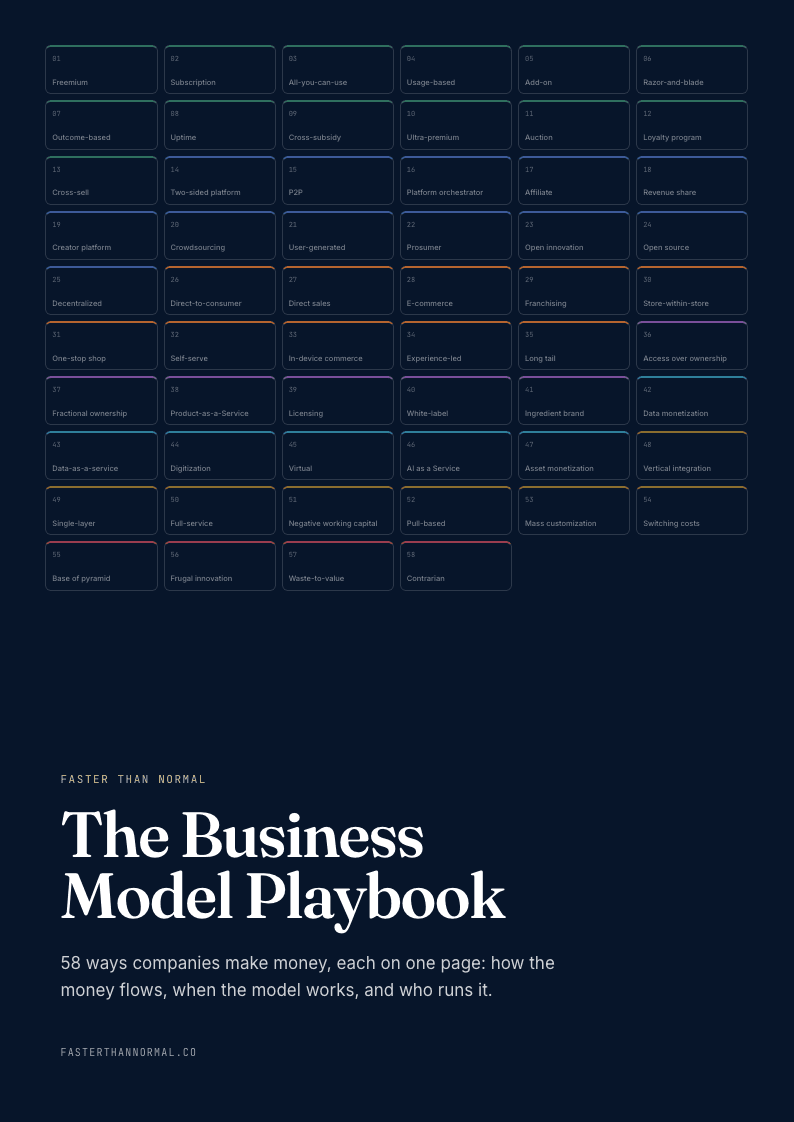
Free playbook
Get The Business Model Playbook
58 business models, one visual page each: how the money flows, the metrics that matter, and who runs it. Free when you join the Faster Than Normal email.
Free. No spam. Unsubscribe anytime.
Part IIIMaxims
-
Defer the launch, not the learning. Spend years inside the best institutions you can find before starting your own — operational literacy compounds more reliably than early equity.
-
Grit over skill in novel domains. When the job is invention, hire people who can deconstruct problems from first principles, not people who have done the existing version of the work.
-
Translate between systems. The greatest value is created not within a single domain but at the interface between two domains that cannot communicate with each other.
-
Own the plumbing. In any industry where participants rent infrastructure from someone else, the owner of the infrastructure controls the economics.
-
Absorb the heat. When the difficult decision must be communicated, put your name on it — the trust earned by visible accountability compounds over a career.
-
Creativity thrives within constraints. Regulation, compliance, and structural limitations are not obstacles to innovation — they are the raw material from which durable competitive advantages are built.
-
Go direct in a crisis. Skip the intermediaries, the committees, and the consultants. Call the person who can say yes. Speed is the strategy.
-
Acquire, then transform. Building from scratch is romantic; acquiring the closest approximation of what you need and reshaping it is faster, cheaper, and often better.
-
Fear is a feature of ownership. The visceral weight of being responsible for everything — capital, employees, depositors — produces a quality of decision-making that executive roles cannot replicate.
-
Hope is not a strategy. Diagnose accurately. Act immediately. Do not wait for external circumstances to improve on their own.
In Their Own Words
There used to be a one-way system where innovation started in a 60-mile radius of San Francisco. I no longer believe that to be true. And I think innovation is coming from all over the world.— Wharton FinTech Podcast, 2021
I describe Wharton and the University of Pennsylvania as a place that saved my life.— Wharton FinTech Podcast, 2021
The incredibly impactful experience of the Square Capital team navigating COVID and the complex dynamics of launching a PPP product in record-time taught us resilience.— Wharton FinTech Podcast, 2021
My experiences at Goldman Sachs and Yahoo taught me the importance of adaptability in a fast-paced environment.— Wharton FinTech Podcast, 2021
Building financial solutions for small businesses is not just a job; it's a mission.— Wharton FinTech Podcast, 2021
The incredibly impactful experience of the Square Capital team navigating COVID and the complex dynamics of launching a PPP product in record-time.
What drove my decision to join Square was the culture and the mission to help small businesses.
The meaningful lessons I learned while working at Goldman Sachs and Yahoo have shaped my approach to leadership.
I believe in the power of technology to transform financial services and make them more accessible.
Navigating challenges requires resilience and a willingness to adapt.
Small businesses are the backbone of our economy, and we must support them.
I think the thing that really drove me was my own desire to succeed and make sure that I had the security that I could create for myself, and so I felt that self-reliance and that entrepreneurial background really is what drove me.— Jacqueline Reses
One of the problems I've seen is that fintechs, over the last 10 to 15 years, have put a beautiful sheen on the front end of an app to make financial services easier. And I think we've all felt that with fintech apps that we use; the infrastructure, however, is terrible.— Jacqueline Reses
I like to hire for intelligence and grit. Skill I think leads you down a wrong path when your job is to invent new things. Because there's no historic skill that you can often hire for that yields new inventions.— Jacqueline Reses
I do think we're going to change banking, and I think we're going to make it better for people in the United States, in ways that they see — and ways that they don't see.— Jacqueline Reses
Would I write that memo differently now? Oh yeah.— Jacqueline Reses, on the Yahoo memo


