
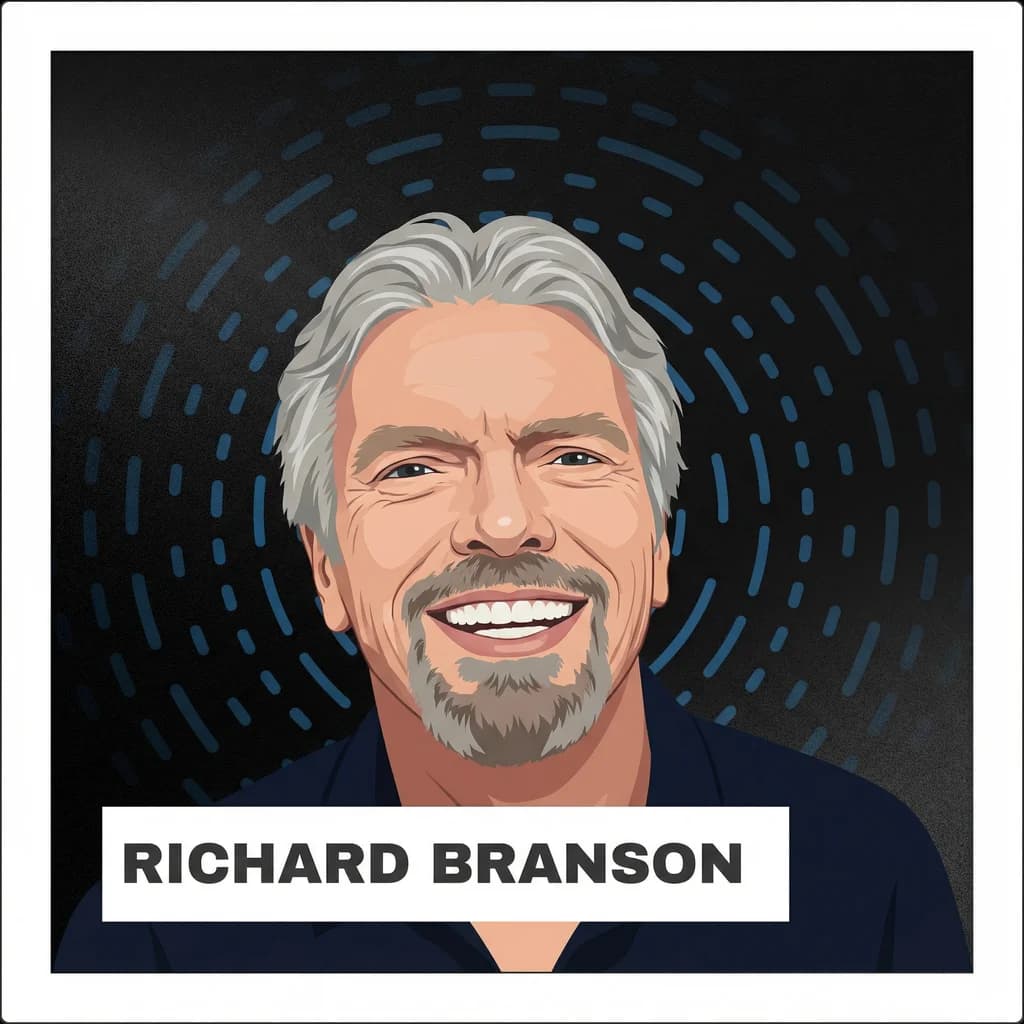

Part IThe Story
$39 on a Blackboard
The flight was cancelled and Richard Branson was livid. It was sometime in the early 1980s — he was twenty-eight or maybe thirty, the chronology shifts depending on which telling you trust — and he was trying to get to the British Virgin Islands to reunite with a woman named Joan, whom he hadn't seen in three weeks. American Airlines had stranded him. What happened next has been burnished into one of the great founding myths of late-twentieth-century capitalism, a story Branson has told so many times and with such evident pleasure that its edges have the smoothness of a river stone: he marched to the back of the airport, handed over his credit card ("hoping it wouldn't bounce"), chartered a plane, found a blackboard, and scrawled in chalk the words Virgin Airways — $39 one way. He filled the flight with fellow bumped passengers. When they landed, one of them offered a review: "Virgin Airways isn't too bad — smarten up the service and you could be in business."
The next morning, Branson called Boeing.
"I've just had a bad experience," he told whoever answered, "and I'm thinking of starting an airline called Virgin. Do you have any secondhand 747s for sale?"
This is, in miniature, the entire operating system of Richard Charles Nicholas Branson — the frustration that becomes an opportunity, the joke that becomes a company, the impulse that becomes a billion-dollar enterprise, the man who writes the business plan after he's already in motion. For more than half a century, across more than 400 businesses bearing the Virgin name, in industries ranging from punk records to space tourism, discount cola to cruise ships, mobile phones to mortgage lending, Branson has operated according to a logic that inverts the conventional grammar of entrepreneurship. Where most founders begin with a thesis and work toward execution, Branson begins with irritation — a cancelled flight, a boring industry, a customer experience so abysmal it offends his instinct for fun — and improvises his way toward a company. The blackboard at the airport wasn't a marketing plan. It was a punchline. The airline that followed wasn't a punchline at all.
By the Numbers
The Virgin Empire
400+Companies launched under the Virgin brand
35Countries with active Virgin operations
60,000+Employees worldwide at peak
~$3BEstimated net worth (2024, down from ~$8B peak in 2021)
$1BSale price of Virgin Records to Thorn EMI (1992)
86 kmAltitude reached on Virgin Galactic Unity 22 (July 11, 2021)
16Age when he launched his first business
The Boy Who Couldn't Read
Begin with the hands. In a 1992 interview at his Holland Park home in west London, journalist Megan Tresidder of the Sunday Telegraph noticed something peculiar about Britain's most famous entrepreneur: at forty-two years old, he still wrote on his hands. That day, scrawled in Biro across one palm, was a single word — MacGregor, the name of the Transport Minister. The house was sumptuously decorated in apricots and pale blues, but model airplanes were scattered everywhere, as if "a small boy stole in after the decorators left and set out his favourite toys." Branson himself was restless, rearranging his limbs, clasping his hands between his knees, rocking back and forth, at one point stretching full-length on the sofa. He drank four mugs of tea in an hour. He was, Tresidder observed, "quieter and more elusive than his public image suggests."
The public image — grinning, blond, seemingly fearless, perpetually in motion — has for decades obscured a more complicated figure. Branson is dyslexic. Severely so. At his all-boys boarding school, Scaitcliffe Preparatory in Windsor Great Park, he was beaten — beaten until he bled — "for being stupid," as he later told the BBC. He nearly failed out. Transferred to Stowe School in Buckinghamshire at thirteen, he continued to struggle. Creativity, spontaneity, lateral thinking — "the things I had always considered strengths," he has written — "were choked and suppressed." His self-esteem cratered. He dropped out at fifteen, or sixteen depending on the source, his headmaster offering a parting prophecy that was either prescient or damning: Branson would either end up in prison or become a millionaire.
His mother, Eve — a former showgirl, one of the first flight attendants to fly over the Andes in an unpressurized cabin, a woman who once snuck into a male-only glider pilot training program by pretending to be a boy — had other ideas about education. When Richard was four, she stopped the car a few miles from their home in Shamley Green, Surrey, and made him find his own way back across the fields. He got hopelessly lost. When he was perhaps ten or eleven (the age shifts), she woke him before dawn, packed sandwiches and an apple, and told him to cycle to Bournemouth. Fifty miles. He remembers setting off in the dark. He has no clear memory of how he got there or back, only of walking into the kitchen afterward, flushed with triumph, expecting a hero's welcome. "Well done, Ricky," his mother said, chopping onions. "Was that fun? Now, could you run along to the vicar's? He's got some logs he wants chopping and I told him that you'd be back any minute."
His father, Edward James Branson, was a barrister — quieter, more conventional, but supportive in his own way. The challenges in the Branson household were physical, not academic, and soon the children were setting them for themselves. Richard's earliest memory of learning to swim involves a bet with his Auntie Joyce: ten shillings if he could learn by the end of a Devon holiday. On the last day, he still couldn't do it. On the twelve-hour drive home, he spotted a river, begged his father to stop the car, jumped in, and won his ten shillings. The pattern was already legible: the audacity, the refusal to accept a timeline set by others, the willingness to leap into unfamiliar water.
"If I could say something to my 10-year-old self," Branson wrote decades later, "it would be a gentle reminder that being different does not mean you are flawed."
Student, Virgin, and the Postal Strike
At sixteen, with no qualifications and no evident future in formal education, Branson launched a magazine. He called it Student. It was run entirely by students, aimed at youth culture, and it was — improbably — not terrible. The first edition sold $8,000 worth of advertising. The first run of 50,000 copies was distributed for free. Branson secured interviews with John Lennon and Yoko Ono. He convinced major corporations to buy ad space. He also managed to get himself arrested, for advertising venereal disease counseling and condom availability in the magazine — a violation of the 1889 Indecent Advertisements Act and the 1917 Venereal Disease Act, two pieces of legislation that sounded, even then, as if they'd been exhumed from another century. He was convicted on one charge. The fine was the equivalent of fourteen dollars.
The magazine eventually began losing money, and Branson needed a new revenue stream. In 1970, he and his friend Nik Powell launched a mail-order record business. The name Virgin was Nik's idea — or maybe it was a collective joke among the team, all of whom were entirely new to business. Either way, it stuck. In 1971, Branson opened the first British discount record store, on Oxford Street in London. The timing was exquisite. British record retail at the time was dominated by WH Smith and John Menzies — places with, as Branson put it, "no atmosphere at all." Virgin's shop was something else: beanbag chairs, headphones for listening, the smell of incense. Countercultural life in a commercial space.
Then came the postal strike of 1971. Seven weeks. For a mail-order record company, this was an existential crisis — "we were facing oblivion," Branson later recalled. The strike forced a pivot from mail-order to retail that might otherwise have taken years. Catastrophe as accelerant. It would not be the last time.
With profits from the shop, Branson acquired a large, rundown manor house in Oxfordshire and converted it into a recording studio — The Manor. The idea was to create a different recording experience for artists, something that felt less like a corporate transaction and more like a creative retreat. One day, a young and unknown musician named Mike Oldfield left a demo tape with an engineer at The Manor. The engineer called Branson's cousin, Simon Draper — a music obsessive who served as Virgin's A&R conscience — and said they had to hear it.
— Richard BransonI approached six different companies but they wouldn't sign him — it was quite a unique sound like nothing they'd heard before, and therefore it was a risk. But it was a beautiful haunting tape that moved all of us.
Simon Draper — born in South Africa, a man whose ear for music was so instinctive that Branson once called him the single most important person in the history of Virgin Records — loved the tape immediately. But the problem was simple and enormous: they didn't have a record company. Branson approached six labels. All turned Oldfield down. The sound was too strange, too unclassifiable. So Branson did what Branson does: "I said screw it, let's start a record company and put it out ourselves."
Virgin Records was born in 1973. Tubular Bells became one of the bestselling albums of the decade, partly because it was used as the soundtrack for The Exorcist. It stayed on the UK charts for 247 weeks. "If Mike hadn't left his demo tape with us," Branson has written, "how different our paths might have been."
The label grew fast. The Sex Pistols — signed by Branson when every other label in Britain was terrified of them. The Rolling Stones. Culture Club. Phil Collins. Janet Jackson. Genesis. By the late 1980s, Virgin Records was the world's largest independent record label.
"My lack of knowledge and experience," Branson later reflected, "was a huge benefit."
A Child Being Bullied
Virgin Atlantic launched on June 22, 1984, with a single leased Boeing 747, flying the Gatwick-to-Newark route. The airline that began as a blackboard joke was now competing against British Airways, Pan Am, and TWA — carriers with hundreds of planes, decades of history, and the kind of institutional heft that should have made the upstart from the music business a footnote. Branson had done his diligence, of a sort: he'd negotiated a deal with Boeing to lease a secondhand jumbo jet for one year, with the option to return it if the venture failed. He structured everything — employment contracts, leasing, exchange exposure — around that one-year escape hatch. The downside was capped. The embarrassment would be survivable.
The key advisor was Sir Freddie Laker, a fellow British airline entrepreneur whose Laker Airways had been driven into bankruptcy in 1982 — destroyed, Laker believed, by the predatory pricing of British Airways and other established carriers. Laker was a large, gregarious, profane man who had lost everything and gained, in its place, the kind of wisdom that only comes from having been crushed. His counsel to Branson was threefold, delivered with characteristic bluntness: "You'll never have the advertising power to outsell British Airways. You are going to have to get out there and use yourself. Make a fool of yourself. Otherwise you won't survive." And: "Make sure you appear on the front page and not the back pages." And: "British Airways will try to wipe you off the map like they did to me. Three words of wisdom: sue the bastards."
All three prophecies proved accurate. Virgin Atlantic differentiated itself through service innovations — seat-back entertainment screens, Upper Class cabins, an atmosphere that was more fun than formal — and through Branson's relentless self-promotion. He dressed in a flight attendant's uniform. He appeared at launches in drag. He drove a tank through Times Square. The publicity was shameless and it was also, in strictly economic terms, rational: Virgin Atlantic could never match British Airways' advertising budget, so Branson was the advertising budget.
The competition was brutal. British Airways launched what Branson alleged was a "dirty tricks" campaign against Virgin Atlantic — a systematic effort to poach passengers, spread disinformation, and undermine the smaller airline's operations. Virgin sued. British Airways settled in 1993, paying £500,000 in damages to Branson personally and £110,000 to Virgin Atlantic, plus legal costs. Lord King, the British Airways chairman, was forced to resign. The affair became a David-and-Goliath parable that burnished Branson's brand as the eternal underdog — a positioning he has cultivated with such consistency that it amounts to a worldview.
But the legal battle had a cost that went beyond legal fees. To fund it — and to fund Virgin Atlantic's expansion — Branson made what he has called one of the hardest decisions of his life. In 1992, he sold Virgin Records to Thorn EMI for approximately $1 billion.
"I remember running down the street with tears streaming down my face," he told CNBC decades later, "past a sign that said, 'Richard sells for a billion.'"
The framing he's returned to again and again is parental: "Virgin Records was going unbelievably well. Virgin Atlantic was a child at school who was being bullied. I had to really turn my attention to the child that was being bullied." Sell the thriving older child to save the vulnerable younger one. It is a metaphor that reveals something essential about how Branson conceives of his companies — not as assets on a balance sheet, but as living things with needs, personalities, and claims on his loyalty.
He reportedly considered buying Virgin Records back as recently as 2012. He didn't.
The Conglomerate of Curiosity
By the mid-1990s, the Virgin Group was a hydra. More than 100 companies in nine divisions, churning constantly. Virgin Megastores. Virgin Cola. Virgin Vodka. Virgin Brides. Virgin Direct (financial services). Virgin Express (a cut-price European airline). Virgin Radio. Virgin Mobile. Virgin Trains. The logic — if it could be called logic — was not the portfolio theory of a diversified conglomerate or the vertical integration of a supply-chain optimizer. It was something stranger and more personal: Branson entered industries where he believed the customer experience was broken, where entrenched competitors were complacent, and where the Virgin brand's association with fun, irreverence, and consumer advocacy could create a wedge.
TIME magazine, in a 1996 profile, captured the paradox precisely: "He has amassed a billion-dollar fortune by doing things that business strategists suggest he shouldn't: he targets well-established industries with entrenched competitors — airlines, records, retailing — and then attacks head on."
The formula worked more often than it didn't, but the failures were instructive. Virgin Cola — launched in the UK in 1994, expanded to the US in 1998 with the aforementioned tank stunt in Times Square — ran headlong into the retaliatory power of Coca-Cola and Pepsi. Branson suspected the incumbents were making retailers "offers they couldn't refuse" to clear Virgin Cola from shelves. The brand eventually limped along before dying quietly, its only market leadership being, as Branson noted with characteristic dryness, "in Bangladesh." Virgin Brides missed product-market fit. Virgin Cars came too early for consumer trust in online car buying. Virgin Clothes entered a market too crowded and lacking a clear problem to solve. Virgin Vodka offered no discernible point of difference.
The commonality among the failures was revealing: they were industries where the Virgin brand couldn't identify a genuine customer pain point to exploit. Where Branson was solving a real problem — flying was miserable, record stores were soulless, mobile phone contracts were confusing — the brand thrived. Where he was simply applying the Virgin name to an existing commodity without reimagining the experience, it didn't.
— Richard BransonPeople quite like the underdog. You don't always want to be the smartass that is always successful.
Branson ran the entire operation with minimal bureaucracy. No central headquarters in the conventional sense — his office was the ground floor of his Holland Park house. No management hierarchy to speak of. Decisions were made fast, sometimes recklessly, always with the assumption that speed and flexibility were more valuable than perfection. "We make and implement decisions quickly," he wrote, "usually before our competitors in the market have held their fifth meeting on the same issue."
The structure was deliberately fragmented. Each Virgin company was a separate entity, typically a joint venture with outside partners, insulated from the others so that the failure of one wouldn't bring the rest crashing down. This was not an accident. It was the application of Branson's adventure logic to corporate architecture: protect the downside, so that if the balloon goes down, it doesn't take the airline with it.
The Brand as a Person
At a Wharton-organized telecast in the mid-2000s, Branson was asked how much it helped him to be famous. "It helps to be a global personality," he replied. "When you can pick up the phone and call the President of Nigeria, it cuts a lot of corners. You can get things done that you couldn't otherwise."
This is the heart of the matter. The Virgin brand is, more than any comparable global brand, inseparable from the body, personality, and reputation of a single person. Branson is the brand. His face, his grin, his willingness to dress in absurd costumes, his balloon crossings and powerboat records and space flights — these aren't peripheral to the business strategy. They are the business strategy. At his home that day in 1992, Tresidder asked him about this conflation, and he was characteristically self-deprecating about it, but also clear: "I think it is important that it just tickles you: to do something because you enjoy doing it and bring the accountants in later on."
The advertising economics were ruthlessly simple. When Branson announced a new domestic airline in India, he ended up on the front pages of every newspaper. "The costs of that in advertising terms," he observed, "would have been considerable." The Tim Ferriss interview, the TED talk, the Oprah conversation, the Guy Raz episode — each appearance functions simultaneously as entertainment, as brand reinforcement, and as a free advertisement reaching millions. Branson understood, decades before the term "personal brand" became a Silicon Valley cliché, that for certain kinds of businesses, the founder's personality is the moat.
But the conflation carries risk. When the pandemic hit in 2020, and Virgin Atlantic's sixty planes were grounded, and the health clubs were shuttered, and the hotels were dark, and Branson's team wrote to the UK government asking for support — a commercial loan, not a gift, he insisted — the public reaction was savage. Here was a man living on a private Caribbean island, asking for a bailout while ordinary people were losing their jobs. The brand that had been built on personal charm became, briefly, a liability.
"I'd never really had any coverage quite as painful as that," Branson admitted to the BBC. He said the request was "complicated" — the airline wasn't asking for charity but for an underwrite on loan agreements, similar to the £600 million the government had given easyJet. The government refused. A private rescue package eventually materialized: £200 million from the Virgin Group, an additional £1 billion from investors and creditors. Branson sold shares in publicly traded companies to find the cash.
He lost, by his own estimate, £1.5 billion during the pandemic. And for the first time in his life, he experienced depression.
"There was a time when I thought we were going to lose everything," he told the BBC. "We had 50, 60 planes all on the ground, and the health clubs all closed, the hotels all closed. And the worst would have been 60,000 people out on the streets."
The Edge of Space
The dream predated the company by years. In the early 1990s, Burt Rutan — a celebrated aeronautical engineer based in the Mojave Desert, a man whose designs had the elegance and impracticality of science fiction — set himself the challenge of building a spaceplane that could carry ordinary people above the atmosphere. Not government astronauts. Not test pilots. People. "I'm going to give it a try," Rutan said, with the confidence of someone who had never let impossibility deter him. "I'm going to go out and do it."
Rutan's creation, SpaceShipOne, completed the first privately funded human spaceflight on June 21, 2004, launched from a runway in the Mojave, slung under a carrier plane called White Knight, rocket engine igniting at 14 kilometers altitude, climbing to just over 100 kilometers — the Kármán line, the official boundary of space. Test pilot Mike Melvill experienced weightlessness. The vehicle re-entered the atmosphere using an ingenious "feathering" system that changed its shape to increase drag while maintaining stability. Over subsequent flights, SpaceShipOne won the $10 million Ansari X Prize, established by space entrepreneur Peter Diamandis to kickstart the space tourism industry.
Branson had been watching. In September 2004, at a press conference in London, flanked by Rutan, he announced that Virgin Galactic would offer commercial flights to space using vehicles based on SpaceShipOne's technology. The ticket price: $200,000 per seat.
"We hope to create thousands of astronauts over the next few years," Branson declared, "and bring alive their dream of seeing the majestic beauty of our planet from above."
What followed was seventeen years of development, delay, tragedy, and near-misses that would have broken most enterprises. The timeline stretched grotesquely beyond every projection. SpaceShipTwo — the commercial successor to SpaceShipOne, larger, designed to carry six passengers and two pilots — proved far more difficult to build than anticipated. The feathering system that had worked beautifully on the smaller vehicle introduced new aerodynamic challenges at commercial scale. Test after test produced incremental progress and incremental disappointment.
Then, on October 31, 2014, disaster. During a test flight over the Mojave Desert, SpaceShipTwo broke apart in midair. Co-pilot Michael Alsbury was killed. Pilot Peter Siebold was seriously injured but survived, ejecting from the disintegrating vehicle. The National Transportation Safety Board later determined that the accident was caused by the premature unlocking of the feathering system, combined with insufficient safeguards against human error.
It was a devastating blow — not only to the program's timeline, but to Branson personally. He flew to the Mojave immediately. The question of whether to continue was real.
He continued.
A new vehicle, VSS Unity, was built. Testing resumed. The delays accumulated — 2015, 2016, 2017, 2018, years blurring into each other as the promised date of commercial operations receded like a desert mirage. On July 11, 2021, Branson himself boarded Unity for a suborbital flight that reached 86 kilometers above New Mexico. It was the first fully crewed Virgin Galactic mission. He was seventy years old.
"It was one of those most extraordinary days, every aspect of it," he said afterward.
The flight was not without controversy. The New Yorker reported that Unity had flown outside its pre-agreed airspace during the ascent — the pilots encountering unexpected high-altitude winds, the vehicle's trajectory deviating from plan, cockpit warnings that company protocols would normally have required an abort. The pilots pressed on. The FAA grounded Virgin Galactic missions pending investigation. Virgin Galactic disputed the characterization, calling the trajectory deviation "controlled and intentional." The New Yorker stood by its account.
By December 2023, Branson told the Financial Times that he had no plans to invest more money in Virgin Galactic. The company had about $1.1 billion in cash, he said, and "should, I believe, have sufficient funds to do its job on its own." The stock, which had peaked at nearly $60 per share during the 2021 meme-stock frenzy, was trading below $2. Virgin Orbit, the satellite-launch spinoff, had filed for bankruptcy in April 2023.
The vision of democratized space travel remained — technically — alive. A new line of spacecraft called Delta was under development, projected to debut in 2026. But the connection between founder and company was fraying. The eternal optimist had, for the first time, publicly stepped back.
The Underdog in Silk
Branson's self-mythology is built on a paradox: he is a billionaire who insists on being seen as a scrappy outsider. "We never considered Virgin to be 'big business,'" he wrote. "We've always seen ourselves as the underdog. And we quite like it that way." The positioning is strategic — research from Wharton has shown that employees who believe others don't expect them to succeed tend to receive higher performance evaluations — but it also appears to be genuinely felt. Whenever Branson launches a new venture, he asks himself two questions: "If I create this, can it be better than what everybody else is doing?" and "Can it make a real difference in the world?" Not: "What's the addressable market?" Not: "What's the competitive moat?" The questions are about disruption and impact, framed in the language of the challenger, not the incumbent.
This is partly temperament. Branson has described himself, in multiple interviews, as shy — a characterization that startles people who know him only from the publicity stunts. Adam Grant, meeting him for the first time about a decade ago, was "stunned" and "unprepared for the fact that you're actually pretty shy." The shyness coexists with the showmanship. They are not contradictory. The stunts — the drag outfits, the bungee jumps, the tank in Times Square — are performances by someone who is, offstage, a hesitant speaker who apologizes for rambling and clasps his hands between his knees. The gap between the public figure and the private man is itself a kind of brand strategy, though Branson would probably recoil from such a clinical description.
He is also deeply, consistently focused on people in a way that transcends corporate platitude. "Having a personality of caring about people is important," he told the Wharton audience. "You can't be a good leader unless you generally like people. That is how you bring out the best in them." His mother's other lesson — beyond the endurance challenges — was about listening. She told him never to criticize others openly. If she heard him speaking ill of someone, she made him stand in front of a mirror for five minutes. "Her reasoning? All my critical talk was a poor reflection on my own character." He carries a notebook everywhere. He walks up and down Virgin Atlantic flights asking passengers and crew for feedback. He has insisted, for decades, on a management philosophy that is radically decentralized: small teams, minimal hierarchy, authority pushed to the front lines.
"I've been collaborating and delegating from day one of my career," he has written. "As a dyslexic and a school drop-out, I didn't have any choice."
The Billionaire Who Hates the Word
"One of the things — if I resent anything in life — is the tag 'billionaire,'" Branson told the BBC in 2023. "People don't address you by your net worth, they call you by your name." He has repeated this sentiment with increasing frequency as his fortune has, paradoxically, declined. From a peak of roughly $8 billion in early 2021 — inflated by Virgin Galactic's pandemic-era stock surge — his estimated net worth fell to approximately $3 billion by 2024, roughly where it had been in the year 2000. The decline was driven by the collapse of his publicly traded holdings: Virgin Galactic down 98% from its peak, Virgin Orbit bankrupt, the SPAC-listed companies (23andMe, Grove Collaborative) down more than 90%. Nationwide Building Society's acquisition of Virgin Money UK would strip away one of his last significant public stakes.
The irony is structural. Branson built his fortune through private companies, where valuations were opaque and patience could compound over decades. His pivot toward public markets — largely through the SPAC boom that peaked in 2020-2021 — exposed him to the merciless arithmetic of public market sentiment. The same mechanism that had inflated his net worth to $8 billion in a matter of months unwound it just as fast.
"It's hard in these times when things go wrong," said Claire Madden, managing partner at London-based private equity firm Connection Capital. Branson's empire "had a big jolt from the side through Covid."
But Branson's relationship with money has always been more complicated than the number suggests. "Significant profits have never been taken out of the Virgin Group," he wrote in his 2020 open letter to employees. "Instead they have been reinvested in building businesses that create value and opportunities." His net worth was "calculated on the value of Virgin businesses around the world before this crisis, not sitting as cash in a bank account ready to withdraw." This is both true and convenient — it's the defense of every asset-rich, cash-poor billionaire — but it also reflects a genuine philosophical commitment to reinvestment over extraction.
He has pledged billions to environmental causes: an estimated $3 billion in 2006 for fuel research, a commitment through Virgin Unite (the group's nonprofit foundation, founded in 2004) to tackling what he describes as the world's toughest problems. He co-created The Elders with Nelson Mandela and Peter Gabriel — a council of internationally renowned statesmen and women working on conflict resolution and global health. He received the United Nations Correspondents Association Citizen of the Year Award in 2007. He lives on Necker Island, his private island in the British Virgin Islands, which he purchased in 1978 for a reported £180,000, which doubles as both his home and a venue for convening the wealthy and powerful through an initiative called Audacious Ideas, organized with Chris Anderson of TED. The island is, depending on your perspective, either a philanthropic hub or a tax haven. Branson has been criticized for his residency in the British Virgin Islands, which has no income tax. He has not engaged substantively with this criticism.
Cruises, Hotels, and the Infinite Extension
In December 2014, Virgin Group announced it was entering the cruise industry. The venture, backed by Bain Capital, was called Virgin Cruises (later rebranded Virgin Voyages). The pitch was characteristically Branson: the industry was "staid," dominated by three large companies — Carnival, Royal Caribbean, Norwegian Cruise Line — all offering the same "family-friendly entertainment" and Las Vegas-like atmospheres of casinos, theaters, and all-you-can-eat buffets. Virgin's ships would be "more informal, fun, sexy, hip and cool," said Evan Lovell, a partner at Virgin Management. Parts of the ship's interior would appeal to clientele "more at home in downtown Manhattan, SoHo and the West Village" than on a traditional cruise. No children allowed.
Tom McAlpin, hired as CEO, had been the former president of Disney Cruise Line and former head of The World-Residences at Sea — a man who had operated at both ends of the cruise spectrum, from family mass-market to ultra-luxury residential. His appointment signaled ambition: Virgin Voyages wasn't going to be a novelty brand. The first ship, Scarlet Lady, would take years to build (new cruise ships cost upward of $1 billion) and voyages wouldn't begin until the end of the decade.
When Scarlet Lady finally launched, Branson sat down with a Condé Nast Traveler editor on a Bahamas sailing and described the guiding concept: "Abramovich's yacht, but for more people. Let's create the funnest yacht in the world." The ship featured crew members from 64 nations — fifty Russian, fifty Ukrainian, fifty British, fifty American. "And that's just how the world should be," Branson said. "You see how happy they are all working together."
The cruise venture was vintage Branson: identify a customer pain point (cruises are tacky), propose a lifestyle solution (cruises that feel like a cool downtown hotel), staff it with people who embody the brand's values (diversity, warmth, fun), and trust that the Virgin name carries enough cachet to attract the target demographic. Whether Virgin Voyages will become a profitable, scaled enterprise remains an open question. But as a demonstration of the Branson method — the relentless extension of a personal brand into industries where the incumbent experience feels tired — it is perhaps the purest expression of his approach since Virgin Atlantic.
Hotels followed a similar logic. Virgin Hotels, launched in 2015, aimed to rethink the staid business hotel. The properties featured quirky design, a loyalty program called Virgin Red, and a general vibe that was more boutique than corporate. A Virgin Hotels New York City — in Shoreditch-inspired fashion — became a hub for Branson's various events and launches, including the 2024 launch of DyslexicU, a free online university for dyslexic thinking, hosted by the Open University.
The Peter Pan Principle
There is a photograph of Branson from 2003 — he would have been fifty-three — in which he looks like a man twenty years younger: tanned, tousled, grinning with the unguarded delight of someone who has just gotten away with something. By 2025, at seventy-five, he was still getting up at 5:30 every morning on Necker Island, taking an ice bath on the beach, playing tennis at six, breakfasting on the roof of the Great House while watching flamingos and scarlet ibises and, sometimes, humpback whales.
He spoke to the singer Patti Smith about growing up as outsiders. "Patti said that she really began to know who she was at the age of 11," Branson wrote, "and upon reflection, I feel the same way. We both are able to stay passionate, creative and true to ourselves by holding onto a Peter Pan-like sense of wonder and exploration that we found within ourselves from an early age."
His wife Joan — whom he'd been trying to reach on that cancelled flight decades ago, whom he married on Necker Island in 1989 when their daughter Holly was eight and their son Sam was four — passed away in 2025. They had been together for fifty years. Holly became Virgin's Chief Purpose and Vision Officer and chair of Virgin Unite. Sam founded Sundog Pictures, a documentary production company, and co-founded Big Change, an education charity. Both children inherited their father's appetite for adventure; he once listed, with evident pride, the things they'd done together: kiting the English Channel, attempting to break the transatlantic sailing record, climbing Mont Blanc. "I think they will say that it's these sort of moments," he said, "when we've strived, that most likely would be the moments they'd remember the most in their lives."
Branson was knighted in 1999 for services to entrepreneurship. He has published multiple books: Losing My Virginity, his first autobiography; Finding My Virginity, the second; and in 2024, an audiobook combining both, read aloud by Branson himself. He has described his business philosophy with a Dr. Seuss allusion — "Oh, the places you'll go!" — that is either endearing or maddening depending on your tolerance for optimism.
The question that hangs over the Virgin empire in 2025 is whether the brand can survive the mortal body of its founder. Holly Branson has been groomed for succession, and Virgin Management's senior team has "over 75 years collective investment and operational experience." But the brand's power has always derived from the ineffable, unreplicable quality of Branson himself — his grin, his stunts, his capacity to make a trillion-dollar airline feel like a scrappy startup, his ability to call the President of Nigeria and cut a lot of corners. That power is not transferable.
On Necker, the flamingos continue to circle. The sun rises over the Atlantic. Somewhere in a notebook, written in the hand of a man who still can't spell but who has built and lost and rebuilt more enterprises than most people can name, there is probably another idea, scrawled in Biro, waiting to become a company.
Part IIThe Playbook
What follows is an extraction of the operating principles that have defined Richard Branson's approach to building, scaling, and — occasionally — losing businesses across more than five decades. These are not abstractions. They are patterns observable in the evidence.
The principles
- 1.Start with frustration, not a business plan.
- 2.Cap the downside, then swing hard.
- 3.Make yourself the advertising budget.
- 4.Build the brand as a franchise, not a holding company.
- 5.Hire for character, delegate by necessity.
- 6.Turn your disability into a design principle.
- 7.Compete only where the customer is being ripped off.
- 8.Keep the underdog posture long after you've won.
- 9.Protect the portfolio through structural isolation.
- 10.Know when to sell your first love.
- 11.Say yes now, figure it out later — but always have an exit.
- 12.Treat every company as a living thing.
Principle 1
Start with frustration, not a business plan
Virgin Atlantic began with a cancelled flight. Virgin Records began because no established label would sign Mike Oldfield. Virgin Voyages began because Branson thought cruises were tacky. The pattern is consistent across decades: Branson's best businesses originate not in market analysis or financial modeling but in personal irritation with a broken customer experience. The frustration is the thesis.
This is not merely a biographical quirk. It's a filtering mechanism. By starting with a specific, felt complaint — "flying is miserable," "record stores are soulless," "cruises are gaudy" — Branson ensures that every new venture has a built-in value proposition: the promise of something better than what currently exists. The businesses that failed (Virgin Cola, Virgin Vodka, Virgin Clothes) were the ones where the frustration was manufactured rather than felt — where Branson was entering a market not because the experience was broken but because the market was large.
Tactic: Before writing a business plan, identify the specific moment of customer frustration that makes you angry — the cancelled flight, the cold chicken, the soulless store — and build backward from that emotion.
Principle 2
Cap the downside, then swing hard
Branson's reputation as a daredevil obscures one of the most disciplined risk-management practices in modern entrepreneurship. When he launched Virgin Atlantic, he negotiated a deal with Boeing to lease a single 747 for one year with the option to return it if the business failed. He structured every contract — employment, leasing, exchange exposure — around that one-year escape hatch. "If we could limit everything to one year," he wrote, "we would have protected the downsides, and it would be worth having a shot at it."
This principle — asymmetric risk, where the potential upside is vast and the downside is bounded — runs through every major Branson venture. The hot-air balloon crossings were dangerous, but Branson ensured rescue mechanisms were in place. The entry into new industries was aggressive, but each Virgin company was a separate legal entity, insulated from the others. The man who drives tanks through Times Square is, behind the spectacle, a meticulous manager of downside exposure.
⚖️
Branson's Risk Architecture
How Branson structures asymmetric bets across ventures
| Venture | Downside Cap | Upside Potential |
|---|---|---|
| Virgin Atlantic (1984) | One-year lease with return option | Multi-billion-dollar airline |
| Virgin Records (1973) | One artist, one album, existing studio | World's largest independent label |
| Virgin Galactic (2004) | Phased investment, licensed technology | Space tourism monopoly |
| Virgin Cola (1994) | No meaningful structural cap | Challenge Coca-Cola (failed) |
Tactic: Before committing to any venture, define your escape clause — the specific conditions under which you can walk away with acceptable losses — and structure every contract around that exit.
Principle 3
Make yourself the advertising budget
Sir Freddie Laker's advice — "You'll never have the advertising power to outsell British Airways. You are going to have to get out there and use yourself" — became Branson's permanent operating doctrine. When he announced a new airline in India, he landed on every front page. The equivalent advertising cost would have been enormous. This is not vanity. It is arbitrage: Branson's personal fame generates media coverage whose value vastly exceeds what Virgin could afford to buy.
The approach has limits. It makes the brand dependent on a single mortal body. It creates vulnerability when the founder's actions generate negative coverage (the pandemic bailout request). And it raises the unanswered succession question: what happens to a brand built on one man's grin when that man steps back?
But for decades, it worked with extraordinary efficiency. Branson's visibility — his balloon crossings, his space flight, his costumes, his TED talks — functioned as a continuous, zero-marginal-cost advertising campaign that kept the Virgin name in public consciousness across dozens of industries simultaneously.
Tactic: If you can't outspend incumbents on advertising, find ways to convert your own story, personality, or actions into media coverage that serves the same function at a fraction of the cost.
Principle 4
Build the brand as a franchise, not a holding company
The Virgin Group is not a conglomerate in the traditional sense. It does not own and operate all its constituent businesses. Instead, it functions more like a brand franchise: Virgin licenses its name, invests equity (often alongside outside partners like Bain Capital), provides strategic guidance, and maintains brand standards. Each Virgin company is a separate entity with its own management, its own balance sheet, its own partners. Virgin Voyages is a joint venture with Bain. Virgin Money was a licensing deal. Virgin Mobile was sold to another operator.
This structure achieves several things simultaneously. It allows rapid expansion into new industries without requiring the central group to develop operational expertise in each one. It attracts world-class operators who want the Virgin brand but also want autonomy. It isolates risk, so that the failure of any single company doesn't endanger the others. And it turns the Virgin name itself into an asset — arguably the group's most valuable one — that generates licensing revenue and equity returns across a vast portfolio.
The weakness is quality control. When you franchise your brand to dozens of operators, you accept some loss of control over the customer experience. Branson's answer has been to maintain a small central team focused on brand standards and to make himself personally available as the quality-assurance mechanism — walking the aisles, taking notes, making calls.
Tactic: Consider whether your core asset is your operations or your brand — and if it's the brand, explore structures (licensing, joint ventures, franchise models) that allow you to extend it without diluting your attention.
Principle 5
Hire for character, delegate by necessity
Branson's dyslexia forced a management style that many founders arrive at only after years of costly micromanagement: he couldn't do everything himself, so he didn't try. He hired people whose skills complemented his deficits and then got out of their way. Simon Draper ran the A&R at Virgin Records. Tom McAlpin ran Virgin Cruises. A revolving cast of CEOs and managing directors ran individual Virgin companies with wide autonomy.
The hiring criterion was consistent: Branson looked for people he liked, trusted, and whose values aligned with the brand. He made decisions about people, by his own account, in about thirty seconds. "I also make up my mind about whether a business idea excites me within about 30 seconds too," he wrote. "Not always accurately!" The speed of judgment could be a liability, but it was consistent with a larger philosophy: trust your instincts, move fast, correct later.
His mother's other lesson — "listen more than you speak" — became a management practice. The notebook he carries everywhere. The walks through airplane cabins. The habit of sitting in the background at Virgin Unite events, taking notes rather than holding forth. These are not performative gestures. They are the information-gathering habits of a leader who knows he thinks differently and needs external input to compensate.
Tactic: Identify your two or three core strengths and hire aggressively to cover every other function — then give those hires genuine autonomy, not just the title.
Principle 6
Turn your disability into a design principle
Branson's dyslexia is not incidental to his business approach. It is foundational. His difficulty with reading and writing — the thing that got him beaten at school, that cratered his self-esteem, that made him a dropout at fifteen — became the source of his most distinctive competitive advantages: the ability to think in pictures rather than spreadsheets, the reliance on intuition over analysis, the preference for simplicity over complexity, the radical delegation that came from not being able to do the paperwork himself.
He has become, in his seventies, a passionate advocate for reframing dyslexia as a form of intelligence rather than a disability. The launch of DyslexicU in 2024, in partnership with the charity Made By Dyslexia and the Open University, was the institutional expression of a personal conviction: that the skills inherent to dyslexic thinking — complex problem-solving, adaptability, resilience, creative thinking — are "the most sought-after in every job, in every sector, globally."
The broader lesson is not specific to dyslexia. It is about the strategic value of constraint. Branson couldn't read a balance sheet, so he built organizations that didn't require him to. He couldn't write memos, so he built cultures that ran on conversation. He couldn't sit still in a classroom, so he built a career that required constant motion. The disability didn't disappear. It became the architecture.
Tactic: Audit your perceived weaknesses — the things you can't do, the skills you lack — and ask whether they're actually constraints that can be turned into structural advantages by building systems that route around them.
Principle 7
Compete only where the customer is being ripped off
Branson's two-question test for new ventures — "Can it be better than what everybody else is doing?" and "Can it make a real difference in the world?" — is, beneath the idealism, a rigorous competitive filter. The businesses that succeeded (airlines, records, mobile, cruises) were all in industries where Branson could point to a specific, demonstrable gap between what customers were getting and what they deserved. Flying was expensive and miserable. Record stores were boring. Mobile contracts were opaque. Cruises were tacky.
The businesses that failed (cola, vodka, clothes) were in industries where the existing product was, frankly, fine. Coca-Cola tastes good. Vodka is vodka. Branson couldn't articulate a genuine customer pain point, so the Virgin brand had nothing to push against. The insurgent needs a tyrant to overthrow.
🎯
The Branson Filter
Where the customer frustration test succeeded and failed
| Venture | Customer Pain Point | Outcome |
|---|---|---|
| Virgin Atlantic | Flying was expensive, boring, no entertainment | Success |
| Virgin Records | Labels ignored unconventional artists | Success |
| Virgin Mobile | Opaque contracts, poor service | Success |
| Virgin Cola | None — Coke and Pepsi taste fine | Failure |
| Virgin Vodka | None — no clear differentiation | Failure |
| Virgin Voyages | Cruises are gaudy, family-only, uncool | TBD |
Tactic: Before entering any market, conduct a "frustration audit" — identify the specific ways existing players are failing customers, and enter only if you can name those failures with precision.
Principle 8
Keep the underdog posture long after you've won
"People quite like the underdog," Branson observed. "You don't always want to be the smartass that is always successful." This is not false modesty. It is positioning. The Virgin brand's emotional power derives from its David-and-Goliath narrative — the scrappy challenger taking on British Airways, Coca-Cola, the cruise industry establishment. That narrative requires Branson to perpetually cast himself as the outsider, even as he controls a multi-billion-dollar empire.
The posture serves multiple functions. It generates consumer sympathy. It motivates employees who identify with the challenger mentality. It makes failures seem endearing rather than damning — Virgin Cola didn't fail because Branson was in over his head; it failed because the plucky underdog took a swing at the giant and missed. And it creates a psychological framework for entering new industries: each new venture is framed as a fresh insurgency, regardless of the resources backing it.
The risk is inauthenticity. At some point, a man who lives on a private island and flies to space in his own rocket ship strains credibility as an underdog. Branson has navigated this tension by maintaining personal humility — the shyness, the self-deprecation, the genuine warmth — that makes the underdog story feel emotionally true even when it's factually questionable.
Tactic: Regardless of your market position, frame every new initiative as an insurgency — define the incumbent you're challenging and the customer you're rescuing — and maintain that frame internally and externally.
Principle 9
Protect the portfolio through structural isolation
Every Virgin company is a separate legal entity. This is the most underappreciated element of Branson's architecture. When Virgin Cola failed, it didn't affect Virgin Atlantic. When Virgin Orbit went bankrupt, it didn't endanger Virgin Voyages. The corporate structure is designed like a ship with watertight compartments: a hull breach in one section doesn't sink the whole vessel.
This isolation also enables experimentation. Branson can afford to launch Virgin Brides or Virgin Cars or Virgin Vodka knowing that failure won't cascade. The cost of each individual experiment is bounded, and the learning is retained even when the company isn't. The portfolio approach — many bets, structurally isolated, with asymmetric upside — is, at scale, the venture capital model applied to a branded conglomerate.
Tactic: When building a portfolio of businesses or projects, ensure legal and financial separation between them so that the failure of any single initiative cannot threaten the others.
Principle 10
Know when to sell your first love
The sale of Virgin Records in 1992 — Branson's most painful business decision — was also his most strategically important. It generated approximately $1 billion in cash at the peak of the label's value, just before the music industry's long secular decline. It funded the defense and expansion of Virgin Atlantic, which became the cornerstone of the Virgin brand's global identity. And it demonstrated a capacity for unsentimental calculation that Branson's cheerful persona sometimes obscures.
"Sadly, sometimes you have to make difficult decisions in business," he told CNBC. "It was like having two children and one of them was being bullied." The metaphor is revealing: Branson's emotional attachment to his companies is genuine, but it doesn't override strategic logic. He wept, but he signed.
The lesson is about timing and triage. Branson sold at the right time (peak value) for the right reason (to protect a more strategically important asset). Most founders hold too long out of sentimentality. Branson held until holding was no longer rational, then let go.
Tactic: Regularly assess which of your ventures, however beloved, would generate more value for the portfolio as a whole if sold — and be willing to make the painful decision when the math is clear.
Principle 11
Say yes now, figure it out later — but always have an exit
"Screw it, let's do it" is Branson's most famous phrase, and it captures a genuine bias toward action over analysis. He makes decisions about people in thirty seconds. He makes decisions about businesses in thirty seconds. He called Boeing the day after the blackboard incident. He signed the Sex Pistols when every other label was terrified.
But the impulsiveness is paired with a structural discipline that the catchphrase obscures. Branson always builds in an exit. The one-year lease with Boeing. The separate legal entities. The joint ventures with outside capital partners. The impulsiveness is about entry — the willingness to leap before the analysis is complete. The discipline is about structure — the architecture that limits the cost of being wrong.
The combination is powerful. Speed of entry creates first-mover advantages and generates momentum. Structural protection ensures that speed doesn't become recklessness. The founder who says "screw it, let's do it" is also the founder who negotiated a buyback clause on a 747.
Tactic: Bias toward action on new opportunities, but before committing, identify the specific structural mechanism (time-limited lease, phased investment, contractual exit clause) that allows you to walk away if the thesis proves wrong.
Principle 12
Treat every company as a living thing
Branson's metaphors for his businesses are consistently biological, not financial. They are children, not assets. They have personalities, not just P&Ls. They can be bullied, nurtured, saved, or — when necessary — let go. This is not mere sentimentality. It creates an organizational culture where employees feel they belong to something alive and evolving, not a line item on a spreadsheet.
The biological metaphor also shapes strategic decisions. You don't abandon a child having a bad year. You don't starve a venture that's still learning to walk. But you also don't keep a terminally ill venture on life support when the resources could save others. Branson's willingness to shut down failing companies quickly — "you must be quick to accept that something is not going well and either change tack or close the business" — coexists with deep loyalty to ventures that still have potential.
The result is a portfolio that feels, from the outside, chaotic — too many industries, too many ventures, too little focus. But from the inside, it operates according to a clear logic: each company is a living experiment, tended with care, given room to grow or fail, and structurally isolated so that its fate doesn't determine the fate of the family.
Tactic: Cultivate genuine emotional investment in your ventures — it drives better decisions and deeper commitment — but pair it with the willingness to close or sell when the evidence demands it.

Free playbook
Get The Business Model Playbook
58 business models, one visual page each: how the money flows, the metrics that matter, and who runs it. Free when you join the Faster Than Normal email.
Free. No spam. Unsubscribe anytime.
Part IIIMaxims
-
Start with the cancelled flight. The best businesses begin not with market research but with personal frustration — the moment you experience a service so broken it offends you.
-
Structure the exit before you make the leap. Branson's one-year Boeing lease wasn't timidity. It was the discipline that made boldness rational.
-
Your weakness is your architecture. Dyslexia forced Branson to delegate, to hire complementary talent, to build by conversation rather than memo. Constraints shape the building.
-
The founder is the cheapest advertising. When you can't outspend incumbents, convert your story and personality into media coverage that serves the same function at zero marginal cost.
-
Fail where it doesn't matter. Structural isolation between ventures means that every experiment's downside is bounded. Virgin Cola's death didn't scratch Virgin Atlantic.
-
Sell at the peak, not the trough. Branson sold Virgin Records at maximum value, just before the music industry's secular decline. Sentiment is human; timing is strategy.
-
The underdog never retires. Framing every new venture as an insurgency — regardless of the resources behind it — generates consumer sympathy, employee motivation, and narrative momentum.
-
Listen more than you speak, then write it down. The notebook Branson carries everywhere is not a prop. It is the central tool of a leader who knows that the best ideas come from the edges, not the center.
-
Fun is a business model. Branson's insistence that work should be enjoyable is not a platitude. It drives hiring decisions, brand identity, customer experience design, and competitive differentiation.
-
Protect the downside, and the upside takes care of itself. Across fifty years and four hundred companies, the consistent pattern is asymmetric risk — capped losses, unbounded potential — applied with relentless discipline behind a mask of cheerful recklessness.
In Their Own Words
Screw it. Let's do it.
If somebody offers you an amazing opportunity but you are not sure you can do it, say yes –then learn how to do it later!
Train people well enough so they can leave, treat them well enough so they don't want to.
You don't learn to walk by following rules. You learn by doing and falling over.
Business opportunities are like buses; there's always another one coming.
Do not be embarrassed by your failures, learn from them and start again.
Too many people measure how successful they are by how much money they make or the people that they associate with. In my opinion, true success should be measured by how happy you are.
All you have in business is your reputation – so it's very important that you keep your word.
My general attitude to life is to enjoy every minute of every day. I never do anything with a feeling of, 'Oh God, I've got to do this today.
Respect is how to treat everyone, not just those you want to impress.— Screw It, Let's Do It: Lessons in Life
Life is a helluva lot more fun if you say yes rather than no.
We don't live forever and we might as well throw ourselves wholeheartedly into our lives. And if one ended up going earlier, at least we've lived very, very full lives.— Richard Branson
One of the things — if I resent anything in life — is the tag 'billionaire.' People don't address you by your net worth, they call you by your name, and what I've spent my lifetime doing is building ventures that hopefully will make a really positive difference to people's lives.— Richard Branson
I remember running down the street with tears streaming down my face, past a sign that said, 'Richard sells for a billion.'— Richard Branson, on selling Virgin Records
You'll never have the advertising power to outsell British Airways. You are going to have to get out there and use yourself. Make a fool of yourself. Otherwise you won't survive.— Richard Branson, recalling advice from Sir Freddie Laker
Most people want fun. They want to enjoy themselves. They want people to be human.— Richard Branson


