


Part IThe Story
Midnight at the Central Bank
Around midnight on October 11, 1960, a black Chrysler nosed through the empty streets near Havana's harbor, carrying the richest man in Cuba to the office of the man who intended to make him the poorest. Julio Lobo — sixty-two years old, walking with the limp he'd carried since a gangland shooter put a bullet through his skull and shrapnel near his spine — climbed the stairs to the second floor of the Banco Nacional de Cuba. There, behind lomas of paper and a dense fog of cigar smoke, sat Ernesto "Che" Guevara, thirty-two, the improbable new president of the central bank, austere and feverish, the very image of what the revolution called el hombre nuevo. They were, in their way, the last two serious men in a country being remade around them: on one side of the desk, the final symbol of Cuban capitalism; on the other, the calco of communist austerity. Guevara leaned forward in his chair, formally polite, firm, clear. The revolution was communist. Lobo, as a capitalist, could not remain as he was. He could stay and be part of it — Guevara was offering him, essentially, the sugar industry of Cuba, the thing Lobo had spent four decades building into a personal empire — or he could go.
Lobo's reply, when it came, was simple. "I'm a capitalist," he told the revolutionary, "and you're a communist, and I've been a capitalist all my life."
What happened next — the night of immobilization behind a locked bedroom door, the return to an office now occupied by a boy in olive green with his boots on Lobo's desk, the flight to Mexico, the years of diminishment in New York and finally Madrid — constitutes one of the twentieth century's most compressed parables of fortune and its annihilation. But the meeting itself was something rarer: a moment when two Cubas sat across from each other, recognized one another with something close to respect, and understood that one of them was already dead.
By the Numbers
The Lobo Empire at Its Peak
~$200MEstimated personal fortune (~$5B in today's dollars)
16Sugar mills owned or controlled
~10%Share of Cuba's total sugar crop
10,000+Volumes in his personal library
500Cables answered daily at his office
$200KEstimated net worth at death in 1983
85Years lived (1898–1983)
The Wolf from Caracas
His name in Spanish means wolf — lobo — and he explained the nickname with relish. "Lone wolf," he would say. But Julio Lobo Olavarría was not born in Cuba. He was born in Caracas, Venezuela, in 1898, into a Sephardic Jewish family — those Spanish-speaking Jews whose centuries of Iberian wandering had deposited them, by the turn of the twentieth century, at the intersection of Latin American finance and Old World displacement. His father, Heriberto Lobo, was a self-made banker of considerable nerve. Heriberto had risen through the ranks of the Banco de Venezuela with such speed that by twenty-two he was managing the institution. Then he made the mistake of having principles: when the Venezuelan dictator Cipriano Castro marched on Caracas and seized power in 1899, he ordered Heriberto to open the national vaults to finance his insurgent government. Heriberto refused. He was thrown in jail for thirty days, then deported.
The family — Heriberto, his wife Virginia, young Julio, and his sister Leonor — landed in New York, where the North American Trust Company immediately offered Heriberto the position of administrator of their Havana branch. It was 1900. Cuba had just won independence from Spain after thirty years of war. The island was in the opening chapter of its republican experiment, raw and wide open, a place where sugarcane was already the arterial system of the body politic and where a Venezuelan banker with a talent for credit could find a very large canvas. When the North American Trust's manager died of yellow fever, Heriberto was appointed to the top job. He began financing the sugar trade, then joined a trading firm that became known as Galbán-Lobo. He built a beautiful house. He and Virginia had two more children. And in a footnote that reads like prophecy working backward, Virginia even managed to exact revenge on the dictator who had exiled them: thirteen years later, when Cipriano Castro — now himself deposed and in exile — arrived in Havana trying to drum up support for a counter-revolution, Virginia rushed to his hotel and attacked him with her parasol.
Young Julio inherited his father's commercial instincts, his mother's temper, and something else entirely — a romantic attachment to greatness that would shape everything he built and everything he lost. He attended the Jesuit school Colegio de La Salle in Havana, then was sent to boarding school in New York, then to Columbia University, where he fenced, hung out with other Cuban exiles-in-training, and studied mathematics, literature, and philosophy. At Columbia he acquired two lifelong obsessions. The first was Napoleon Bonaparte, in whom Lobo saw something of his own appetite — the Corsican outsider who bent an empire to his will through intelligence, audacity, and work. The second was sugar, about which he began to speak with a poet's sensibility, describing the scent of cane fields as though it were the smell of destiny itself. He transferred to Louisiana State University to study sugar-mill engineering under Dr. Charles E. Coates, a pedagogue Lobo would credit for the rest of his life. "Whatever little success I have had," he told an LSU alumni gathering decades later, "I owe in great measure to the education which I received here."
He returned to Cuba in 1919, just twenty-one years old, and walked directly into the most volatile commodity market on earth.
The Dance and Its Aftermath
The years 1919 and 1920 in Cuba are remembered as the "Dance of the Millions" — a speculative frenzy in which sugar prices rocketed from around 9 cents a pound to 22.5 cents in May 1920, then collapsed to 3.75 cents by December. Fortunes were assembled and vaporized in the span of a single harvest. Banks failed by the dozen. The phrase entered Cuban Spanish as shorthand for the beautiful catastrophe of boom-and-bust, for the way sugar could make a man feel like a god one season and a beggar the next.
Lobo had arrived just in time. He took over the general management of Galbán-Lobo y Compañía — his father's trading firm — and the company, through a combination of Heriberto's caution and Julio's speed, escaped the worst of the crash, having sold most of its sugar before the price collapsed. In October 1921, barely two years into his career, Lobo brokered the largest sugar deal the world had ever seen — a $6 million transaction with the British firm Tate and Lyle. He stole it from under the nose of Manuel Rionda, the powerful Cuban sugar merchant who ran the rival Czarnikow-Rionda empire from New York.
Manuel Rionda was the old guard incarnate — a Spaniard who had built Czarnikow-Rionda into a trading house that handled approximately twenty percent of Cuba's sugar exports, a man whose network of mills, warehouses, and financing relationships represented the established order of the sugar world. For a twenty-three-year-old from a relatively minor firm to outmaneuver him on the world's biggest deal was not merely precocious. It was a declaration. "I think it was that trade," John Paul Rathbone writes in The Sugar King of Havana, "which gave Lobo the confidence — he'd been ambitious ever since a child — to think that he really could become 'Sugar King.'"
The confidence was not misplaced. Through the 1920s and into the 1930s, as Cuba endured the cycle of dictatorships, depressions, and political convulsions that would define its republican period, Lobo refined a method. He woke two hours before his rivals. He read everything. He ran information networks — offices around the world, a radio communications agency — that gave him faster, more accurate data on crop conditions, shipping schedules, and demand fluctuations than anyone else in the market. He backed his judgment, as he put it, "with good, fast, accurate information, courage and cash." By the time he was in his mid-thirties, friends had given him a second nickname: El Veneno — the Poisonous One — for his charm and his serpentine cunning in negotiation.
The Sergeants, the Gangsters, and the Four Inches of Skull
On September 4, 1933, a young, unknown sergeant named Fulgencio Batista led a protest for better conditions for non-commissioned officers in the Cuban army. Students joined. The government of the day was overthrown. This event — the Sergeants' Revolt — became the hinge on which Cuban history turned, though it looked at the time like merely another tropical putsch. It installed Batista as the island's strongman for the next quarter century and inaugurated a culture of cronyism, corruption, and gangsterism that transformed Havana into a city where the line between politics and organized crime was, at best, decorative.
Lobo, despite his wealth, took ferocious pride in his honesty. He saw it as the only way to make money that counted. "The only way to make money was to make it cleanly," Rathbone paraphrases him. "Otherwise, it didn't count, in his view." This was not merely temperamental fastidiousness. It was a business philosophy — the conviction that in a market where information was everything, your word was your principal asset. A speculator who lied was a speculator who would eventually be cut off from the intelligence network that made speculation possible.
Cuba, however, was not interested in clean money. The rebel groups and political gangsters that proliferated after 1933 operated protection rackets, and the story — told in multiple sources, repeated with slight variations — is that Lobo refused to pay $50,000 in protection money. The consequence was an assassination attempt in the style of Prohibition-era Chicago: Lobo was mowed down in a fusillade that left him with shrapnel lodged near his spine and a bullet that plowed through his skull, removing four inches of bone. He survived. Barely. He walked with a limp for the rest of his life.
He had also, at some earlier point, faced a firing squad — pardoned at the last moment. He had swum the Mississippi as a young man. He fenced in duels. The facts of Lobo's life have the quality of legend accumulated beyond the point of plausibility, except that they are all documented. "Such are the legends," Rathbone observes, "of which revolutions are made, and later justified." The man who refused protection money and survived a bullet to the head was the same man who, decades later, would refuse Che Guevara's offer and survive that too — though this time what was destroyed was not his body but his world.
— Julio Lobo, as quoted in TIME, March 9, 1953I back my judgment with good, fast, accurate information, courage and cash.
The Perfect Squeeze
Lobo's genius was not merely in reading markets. It was in constructing situations — in seeing, before anyone else, the geometry of a deal, the way quotas and contracts and shipping schedules could be arranged to create an irresistible pressure. His manipulation of Franklin Roosevelt's Good Neighbor Policy in 1934 was a case study that, according to the Wall Street Journal's Eduardo Kaplan, "placed him in a different league."
The mechanics were elegant. Roosevelt's Jones-Costigan Act of May 1934 established a quota system for sugar imports: each producing country — Cuba, the Philippines, Hawaii, domestic U.S. growers — was allocated a share of the American market. In theory, this protected everyone. In practice, it created an exploitable asymmetry. Lobo foresaw that once every other country had filled its quota, Cuba — which deliberately stalled on filling its own — would control the residual U.S. raw sugar market with no competition until the 1935 quotas took effect at year's end.
By late September 1934, Cuba still had several hundred thousand tons of quota left and the field to itself. Lobo cut a two-fold agreement with American refiners: he would sell a large portion of Cuba's remaining quota at 2.18 cents per pound — high, but worth paying — in exchange for guaranteed access and Cuba's promise not to sell to anyone else for the rest of the year. This trapped the short sellers — traders like Charles Hayden and William Douglas who had "borrowed" sugar from Cuba, sold it on the open market expecting to buy it back cheaper, and now found themselves squeezed between Lobo's locked-up supply and their own obligations. They had to buy from Lobo at whatever price he set, or default.
It was a corner — the market term for the move that Lobo would execute at least twice in his career on the international sugar market. The short sellers were ruined. Lobo was enriched. And the American government, whose policy he had jujitsued, could do nothing about it because every transaction had been legal, every contract fulfilled.
Mills, Ships, and the Napoleonic Obsession
Lobo's strategy shifted in the early 1940s. He was no longer content to be merely the world's greatest sugar trader — a man who moved paper and prices. He wanted to own the physical infrastructure of the industry itself. Between 1943 and the mid-1950s, he acquired sixteen sugar mills, though not all simultaneously, along with twenty-two warehouses, a sugar brokerage firm, a bank, a shipping company, an airline, and an insurance company. His first mill, Central Agabama — purchased in 1926 from a British bank — had been a disaster, with faulty crusher installations and $600,000 in accumulated losses. But Lobo learned from the failure and returned to mill ownership with the discipline of a man who understood both the romanticism and the brutality of fixed assets.
One of his objectives, according to Rathbone, was to push American capital out of the Cuban sugar industry. He bought mills from U.S. owners — Central Tinguaro, his favorite, acquired in March 1944 from the Cuban government after it had been seized from the Cuban American Sugar Company — because he believed Cubans should control their own country's primary industry. This was not socialism. This was nationalism of the capitalist variety, the conviction that an island's wealth should accrue to its own people, or at least to its own bourgeoisie. In this, Lobo and Fidel Castro — who would later destroy him — shared a surprising amount of common ground.
By the early 1950s, Lobo handled about half the entire Cuban sugar crop, at least a quarter of the Puerto Rican and Philippine crops, and dominated the market everywhere. Cuba controlled about half the world's "free-floating" sugar market — the portion not protected within countries like the United States or Europe — and Lobo controlled roughly ten percent of the Cuban crop. "I am the market," he told TIME magazine in March 1953. "I buy and sell sugar any time, day or night." The magazine described him as "a short, imperious man of 54," closing deals around the clock with New York, London, Frankfurt, Paris, Rio, and Manila.
— Julio Lobo, TIME, March 1953I am the market. I buy and sell sugar any time, day or night.
He fitted out a penthouse above his office so he could sleep near his cables. He answered five hundred cables a day. He started work two hours before anyone else. And in the evenings, when the last cable had been dispatched, he liked to walk alone from his office to the harbor, sit on the edge of a pier, gaze at the lapping waves, and think about the future of sugar.
This same man — this monomaniacal trader who described sugar as "my mistress" — also assembled the largest collection of Napoleonica outside France. Ten thousand volumes on Bonaparte. Paintings by Goya, Gainsborough, and allegedly Raphael, Michelangelo, and Da Vinci. Napoleon's death mask. His back teeth. A lock of his hair. A urinal that had belonged to the emperor himself, polished to a shine. The collection was housed in what would become, after the revolution seized it, the Museo Napoleónico in Havana — today arguably the finest repository of Napoleon-related artifacts to be found outside of France, a monument to one man's obsession built with sugar money, then appropriated by the state that ended the sugar age.
The juxtaposition tells you everything about Lobo that a straight biography cannot. Here was a man who woke at dawn to trade commodities by cable, who could calculate shipping costs and refining yields in his head faster than his subordinates could on paper, who survived assassination by gangsters and then went home to read about the Battle of Austerlitz. The Napoleon fixation was not merely decorative. Lobo saw in the Corsican a mirror: the outsider who mastered an empire through information superiority, speed of decision, and the willingness to stake everything on a single campaign. Both men, in the end, would be destroyed by the same flaw — the inability to conceive that the world might not bend to their will.
A Fond, Though Divorced, Father
The private Lobo is harder to reach than the public one. He was married in 1932 to María Esperanza Montalvo, a descendant of sugar industry elites whose celebrated local lineage opened doors to the most rarefied tier of the Cuban bourgeoisie. They had two daughters. The marriage did not last. TIME, in its 1953 profile, described him as "a fond, though divorced, father" who used to paste thought-provoking newspaper articles on his daughters' boudoir mirrors, made them eat ground-up eggshells for calcium ("brain food," he explained), and urged them to sit under a mango tree in the family patio because he had received some of his best inspiration in its shade.
He courted movie stars. Joan Fontaine. Bette Davis. He reportedly filled the swimming pool at his sprawling estate with perfume when Esther Williams came to visit. He was a fixture at the Tropicana, Havana's legendary nightclub, where the society columnist Aileen Mehle recalled seeing "Mike Tarafa and Julio Lobo, really great guys, the two richest men in Cuba," amid a scene of champagne, gambling, and music that never stopped. "Everybody was rich then," Mehle said. "The fellows that owned the sugar plantations were the only ones I knew."
But Lobo's philanthropy was not merely performative wealth. He built hospitals for his sugar workers. He endowed scholarships. He ran his mills with a paternalism that won genuine respect from employees — a fact that Che Guevara, who had studied Lobo's operations before their midnight meeting, knew well. Lobo was not a robber baron in the American mold. He was something more complicated: a nationalist capitalist in a country where capitalism and nationalism were about to become incompatible terms.
The Republic's Last Contradiction
The common assumption — in Havana, in Miami, in Washington — is that Cuba's economic elite was universally opposed to Fidel Castro from the moment he took power in January 1959. This is wrong. The vast majority of Cubans, including the wealthy, opposed Batista. He had taken power in a coup in 1952. He was corrupt. The mafia was a rising influence. There was not very much anyone liked about him.
When Castro appeared — romantic, bearded, in the Sierra Maestra with his guerrillas — he represented, for many in the Cuban bourgeoisie, not communism but liberation. The idea that Cuba's upper classes supported Batista and opposed Castro is a post-revolutionary simplification. Various members of the haute bourgeoisie funded the rebels. Some sent money directly to the Sierra Maestra. Lobo was among them. He was, as multiple sources confirm, a "die-hard anti-Batista supporter" who helped finance the opposition. He believed, as many did, that Castro would restore constitutional governance, clean out the corruption, and leave the economic order more or less intact.
This was the republic's last and most consequential self-deception. Lobo shared with Castro not only anti-Batista sentiment but a critical view of the American role in Cuban history, a belief in the centrality of sugar to the island's economic development, and even — in a detail that reads like a novelist's invention — a shared admiration for Napoleon. The sixty-two-year-old sugar baron and the young revolutionary leader both collected Napoleonic artifacts and revered Martí. They were, in certain lights, variations on the same Cuban archetype: the man who believed the island's destiny could be mastered through will.
The difference, of course, was that Castro intended to burn down the house that Lobo had furnished. By mid-1960, the nationalizations had begun. Sugar mills were seized. American companies were expropriated. The Cuban bourgeoisie that had financed the revolution discovered, too late, that the revolution had no use for a bourgeoisie. Rathbone describes the archetype: the wealthy Cuban "sympathizing with the 1959 revolution for its nationalistic overtones, while deliberately trying to ignore its Jacobin radical energy." Lobo was the last and most extreme example of this species. He had more invested in Cuba than anyone — financially, emotionally, philosophically. Unlike the Falla Bonet family, who took at least $40 million out of Cuba when they saw which way the wind was blowing, Lobo, a "furious nationalist," kept investing. He trusted his own intelligence. He had always been smarter than his rivals.
That trust led him to the Central Bank at midnight.
The Boy in the Chair
After the meeting with Guevara, Lobo went home. He spent the night more or less immobilized behind a locked bedroom door, unable to conceive that his empire had gone. When he finally recovered himself the next day, he went to his office in Old Havana. Everything was boarded up. A young boy in an olive green uniform sat in his chair with his feet up on the desk.
"Now we've got you where we want you," the boy said. "Naked." Stripped of all possessions.
Lobo, whose wit had survived bullets and firing squads and the collapse of sugar prices, fired back immediately: "Chico, I was born naked, I will die naked, and some of my happiest moments have been naked."
He turned on his heel and marched out. Later that day, he took a flight to Mexico, then went to New York. He had been fully invested in Cuba. His assets outside the island amounted to roughly $4 million — his Wall Street office, Olavarría & Co., managed by his cousin Gustavo, and some scattered accounts. A small fraction of the $200 million empire that had been nationalized overnight. His fourteen refineries and cane fields, which produced three million tons of sugar annually. His sixteen mills. His twenty-two warehouses. His bank, his shipping company, his airline. Napoleon's teeth.
The declassified minutes of the 464th meeting of the U.S. National Security Council, held on October 20, 1960 — nine days after the Guevara meeting — contain a single, clinical reference: "A Cuban sugar magnate, Julio Lobo, who recently left Cuba after his holdings were seized by the government, has said that Guevara had stated to him that while Khrushchev may admit the possibility of coexistence between capitalism and socialism, such co-existence was not possible in Cuba." That is how an empire enters the historical record: as a subordinate clause in a Cold War briefing.
The Second Fortune and Its Destruction
For a while, in exile, everything went swimmingly. Lobo kept trading sugar. He was still a financial genius. He still had his contacts, his speed, his information networks — diminished, but not destroyed. He told people he had made back all his money, and that when Castro fell — which he believed was inevitable — he would return to Cuba, reinvest every cent, rebuild the island, and become richer than ever.
Then one day he zigged on the markets when he should have zagged.
The details of the second ruin are less documented than the first — no midnight meeting with a revolutionary, no boy in olive green, just the ordinary catastrophe of a speculator who bets wrong. Lobo had always been a speculator at heart. His talent for information gathering and his appetite for risk were inseparable; you could not have one without the other. In Cuba, this combination had been tempered by physical assets — mills, warehouses, ships — that provided ballast against speculative losses. In exile, stripped of those assets, he was pure trader again, a sixty-something-year-old man living on speed and nerve, and the markets are indifferent to biography.
He lost everything. The second fortune, painstakingly rebuilt, evaporated. It was, as Rathbone writes, "a terribly sad ending for a man because he really had been the king, and this was his great humbling."
Lobo spent his final years in Madrid. When he died on January 30, 1983, his capital was estimated at $200,000. From $200 million to $200,000 — the symmetry is almost literary, a decimal point's cruel joke. In fact, according to Rathbone, very few of Lobo's generation prospered in exile. The skills that had made them masters of a particular island at a particular moment did not transfer cleanly to the larger, colder, less personal markets of the world.
The Plaque on the Wall
In April 2010, Rathbone visited Lobo's former offices in Old Havana. They had been renovated. On the wall, there was a plaque honoring Lobo's memory — a simple but accurate and quite long description of his life. In a country that still proclaimed itself revolutionary, in a building that had been seized from its owner half a century earlier, here was a quiet acknowledgment: this man was not merely a capitalist villain. He was something the revolution needed to remember in order to understand itself.
The Museo Napoleónico — housed in the palace where Lobo's father had lived, where Lobo himself had moved his ten thousand volumes and his Goyas and Gainsboroughs and his daughters after his father's death in 1950 — is today a functioning museum, recently renovated, with more than a thousand engravings and an exhibition that traces Napoleonic propaganda through the art of the print. The Napoleonic Historical Society held its 2017 annual conference there, riding from the Hotel Sevilla to the museum in 1950s American convertibles, receiving welcoming remarks from the director, Dr. Sadys Sánchez Aguilar. The collection is, arguably, the finest assemblage of Napoleonica outside France. Every artifact in it was purchased with sugar money by a man who died with $200,000 to his name.
— John Paul Rathbone, author of The Sugar King of HavanaI came to see Lobo as a kind of machine with which to explore the pre-revolutionary period.
The paradox is perfect, and perfectly Cuban. The capitalist's obsession, seized by the communist state, became one of the state's cultural treasures. The revolution that destroyed Lobo preserved the thing he loved most — not the sugar, not the money, but the artifacts of a man who had, like Lobo himself, believed that destiny could be bent through will alone. Napoleon died in exile too. On a smaller island, with less sugar, but the same view of the waves.
Part IIThe Playbook
Julio Lobo's career — from the $6 million Tate and Lyle deal at twenty-three to the midnight meeting with Guevara at sixty-two — offers a concentrated education in the mechanics of building, maintaining, and ultimately losing a commodity empire. What follows are the principles embedded in his practice, extracted not from what Lobo said about himself (he was not given to theorizing) but from the pattern of his decisions.
The principles
- 1.Win on information speed, not capital size.
- 2.Start your day before the market does.
- 3.Your first big deal is a declaration — make it count.
- 4.Integrity is infrastructure, not a luxury.
- 5.See the geometry of regulation before others do.
- 6.Move from trading to owning when the cycle turns.
- 7.Nationalism can be a business strategy.
- 8.Cultivate obsessions adjacent to your work.
- 9.Paternalism, done honestly, is a moat.
- 10.Concentration risk will destroy what skill built.
- 11.Know when the speculation must end.
- 12.Survive the bullet; don't survive the exile.
Principle 1
Win on information speed, not capital size
Lobo did not start as the biggest player in Cuban sugar. Galbán-Lobo was a respectable firm, but it was dwarfed by Czarnikow-Rionda, which handled twenty percent of Cuba's exports. What Lobo built was not a bigger balance sheet but a faster nervous system. He maintained offices around the world, ran a private radio communications agency, and processed five hundred cables a day — an extraordinary volume for a private firm in the 1940s and 1950s. When TIME profiled him in 1953, the emphasis was not on his capital but on his information: "I back my judgment with good, fast, accurate information, courage and cash." The order of that list matters. Information first.
In commodity markets, where the product is undifferentiated, the edge belongs to whoever knows the state of the crop, the shipping schedule, the refinery capacity, and the political temperature before anyone else. Lobo understood this before telecommunications made it obvious. His investment in information infrastructure — communications networks, global offices, personal intelligence relationships — was the foundation on which every speculative position rested.
Tactic: Build your information infrastructure before you build your position; in commodity businesses, the speed of your intelligence network determines the ceiling of your returns.
Principle 2
Start your day before the market does
Lobo began work two hours before his rivals. He fitted a penthouse above his office so he could sleep near his cables. Even when traveling, he dealt in sugar day and night by international telephone. "This business needs me," he said, and the statement was not arrogance but description. Sugar was a global market operating across time zones; a two-hour head start in Havana meant catching the tail end of the Asian trading day and being prepared for the European open.
The habit was not a productivity hack. It was a structural advantage compounded daily. Over decades, those two morning hours — reading cables, assessing crop reports, making early calls — gave Lobo a cumulative information edge that no single brilliant trade could replicate. His competitors were reacting to the market as it opened. Lobo was shaping it.
Tactic: Gain time asymmetry over competitors — arrive first, stay latest, and use the quiet hours for synthesis, not email.
Principle 3
Your first big deal is a declaration — make it count
Lobo was twenty-three when he brokered the $6 million Tate and Lyle deal in October 1921 — the world's largest sugar transaction at the time. He did not merely win a trade; he stole it from Manuel Rionda, the most powerful man in Cuban sugar, and in doing so announced to the industry that a new force had arrived. Rathbone identifies this as the inflection point: it was the trade that gave Lobo the confidence to believe he could become the Sugar King.
The psychology matters as much as the economics. A first major deal establishes your identity in the market. It tells counterparties who you are, what you're capable of, and how you compete. Lobo did not ease into prominence. He exploded into it by targeting the incumbent's most lucrative relationship.
Tactic: Choose your first major move for its signal value — not just its return — and target it at the incumbent you intend to displace.
Principle 4
Integrity is infrastructure, not a luxury
In a Cuba saturated with corruption — where protection rackets, political gangsters, and crony capitalism were the cost of doing business — Lobo's insistence on honesty was not merely virtuous. It was strategic. In a market that runs on relationships and handshake agreements, your word is your principal asset. A speculator who lies gets cut off from the very intelligence network that makes speculation possible.
Lobo refused to pay $50,000 in protection money. He took a bullet to the skull for it. But he also built a reputation that made counterparties around the world — in New York, London, Frankfurt, Manila — willing to deal with him on terms they would not have offered to a less trustworthy operator. His integrity was not an expense. It was the cheapest form of insurance.
⚖
Integrity as Competitive Advantage
How Lobo's honesty functioned in a corrupt market environment
| Conventional approach | Lobo's approach |
|---|---|
| Pay protection money as cost of doing business | Refuse and absorb the physical consequences |
| Cut deals with political patrons for market access | Win on information and execution, not connections |
| Treat reputation as a soft asset | Treat reputation as the hardest asset in a relationship-based market |
Tactic: In environments where corruption is the norm, integrity becomes a source of asymmetric trust — cultivate it as you would any other form of capital.
Principle 5
See the geometry of regulation before others do
Lobo's 1934 manipulation of the Jones-Costigan Act was not a brute-force move. It required seeing, months in advance, how the interaction between quota allocations, filling schedules, and short-selling contracts would create a window of monopolistic pricing power for whoever timed their sales correctly. He deliberately stalled Cuba's quota fulfillment while other countries filled theirs, then set his own price when the market had no alternative supply.
This was not illegal. It was not even, strictly, unethical. It was a reading of the regulatory landscape so precise that it functioned as a kind of financial jiu-jitsu — using the opponent's own rules as the instrument of their defeat. The American short sellers who were trapped had made their bets based on the assumption that the quota system would function as designed. Lobo understood that every regulatory system contains exploitable asymmetries, and that the person who identifies them first captures the spread.
Tactic: Study new regulations not for compliance but for the asymmetries they create — the gaps between what the system assumes and what the system permits are where the largest returns hide.
Principle 6
Move from trading to owning when the cycle turns
For twenty years, Lobo was primarily a trader — a man who moved paper and prices. In the early 1940s, he shifted strategy and began acquiring physical assets: sugar mills, warehouses, shipping companies, an airline. The timing was deliberate. The war years compressed supply chains, revalued fixed assets, and created opportunities to buy mills from distressed or distracted owners (including the U.S. government, which had seized some from foreign companies). Lobo recognized that trading profits are volatile and temporary; ownership of productive assets generates durable cash flow and gives the trader a structural position in the market that pure speculation cannot replicate.
His first mill acquisition, Central Agabama in 1926, had been a disaster — faulty installations, $600,000 in losses. He learned from the failure. When he returned to mill ownership in the 1940s, he did so with both a trader's sense of timing and an operator's discipline. By the 1950s, he owned sixteen mills and controlled the logistics chain from field to port.
Tactic: Use the information advantages gained from trading to identify the right moment to transition from renting market access (trading) to owning it (assets).
Principle 7
Nationalism can be a business strategy
Lobo bought mills from American owners because he believed Cubans should control Cuba's primary industry. This conviction — that an island's wealth should accrue to its own people — was not ideological window-dressing. It was a competitive strategy. By framing his acquisitions as a nationalist project, Lobo built political goodwill across the Cuban spectrum, from the bourgeoisie to the anti-Batista opposition to the revolutionary movement itself. He funded Castro's guerrillas in the Sierra Maestra. He maintained relationships with government officials of every stripe. His nationalism gave him a political license to operate that a purely foreign-owned firm could never have obtained.
The irony is lethal: the same nationalist instinct that drove Lobo to invest everything in Cuba — rather than diversifying offshore, as the Falla Bonet family did — was the instinct that destroyed him when the revolution redefined who "the people" were and how their wealth would be distributed.
Tactic: Align your business strategy with the deep narrative identity of your market — but build an exit that your convictions don't prevent you from using.
Principle 8
Cultivate obsessions adjacent to your work
The Napoleon collection was not a rich man's hobby. It was the expression of a mental model. Lobo studied Napoleon as a strategist studies a predecessor — analyzing campaigns, logistics, decision-making under uncertainty, the management of empire. The ten thousand volumes on Bonaparte were not decoration; they were a private curriculum. Lobo reportedly received "some of his best inspiration" sitting in the shade of a mango tree after hours of reading. The man who cornered the sugar market was also the man who could tell you the disposition of French forces at Marengo.
The collection also served a social function. It made Lobo a figure of cultural significance, not merely economic power. It connected him to European intellectual traditions that elevated his status in the eyes of Cuban and international elites alike. A man with Napoleon's death mask on his wall is not merely rich; he is interesting. And in a market where relationships determine deal flow, being interesting is a competitive advantage.
Tactic: Develop a deep intellectual interest outside your primary domain — not as a hobby but as a parallel education in strategy, pattern recognition, and the psychology of power.
Principle 9
Paternalism, done honestly, is a moat
Lobo built hospitals for his sugar workers. He endowed scholarships. He paid attention to the welfare of the people who harvested, processed, and shipped his sugar. This was not performative corporate social responsibility; it was an operational strategy that produced loyalty, reduced labor disruption, and created a constituency that defended Lobo even when political winds shifted. Che Guevara studied Lobo's operations and, by all accounts, was impressed enough by his treatment of workers that he offered Lobo the directorship of the entire sugar industry — not as a punishment but as a genuine recognition of competence.
In a commodity business where labor disruptions can destroy a harvest, where political instability makes every fixed asset vulnerable, and where the quality of execution at the mill level determines margin, the relationship between owner and worker is not a soft factor. It is a hard one.
Tactic: Invest in the welfare of the people who execute your strategy at the operational level — not as charity, but as the cheapest form of risk mitigation and the most durable form of competitive moat.
Principle 10
Concentration risk will destroy what skill built
Lobo's $200 million fortune was almost entirely invested in Cuba. His assets outside the island amounted to roughly $4 million — Olavarría & Co. on Wall Street and some scattered accounts. When the revolution nationalized his holdings overnight, he lost ninety-eight percent of his net worth. The Falla Bonet family, who were arguably less talented operators, survived the revolution in better financial condition because they had diversified offshore to the tune of $40 million.
Lobo's concentration was not ignorance. It was conviction — the nationalist belief that Cuba deserved his full investment, combined with the speculator's confidence that he could read political risk as fluently as he read crop reports. He was wrong. Political risk, unlike commodity risk, is non-linear: it looks manageable until the moment it is total.
Tactic: No matter how deep your conviction or how accurate your read on the local environment, maintain a meaningful share of assets in jurisdictions beyond the reach of any single political authority.
Principle 11
Know when the speculation must end
Lobo rebuilt a second fortune in exile through sugar trading. Then he lost it all in a single bad bet. The details are sparse — "he zigged when he should have zagged" — but the lesson is structural. A speculator who has lost his physical assets and is operating purely on trading skill is dangerously exposed. In Cuba, Lobo's mills and warehouses had provided ballast; a bad trade could be absorbed by the cash flow from productive assets. In exile, without that ballast, every trade was naked.
Warren Buffett has observed that speculation is most dangerous when it appears most successful. Lobo's second fortune — built quickly, in markets he understood intimately — would have looked like proof that his genius was intact. It was. But genius without ballast is leverage without collateral. The same skills that built the fortune ensured that when the bad bet came, the loss was total.
Tactic: Distinguish between speculation as a complement to an asset base and speculation as a standalone activity — the former can be managed, the latter will eventually destroy you.
Principle 12
Survive the bullet; don't survive the exile
Lobo survived a bullet to the skull. He survived a firing squad. He survived the Dance of the Millions, the Machado dictatorship, the Batista coup, and twenty-two months of revolutionary government. What he did not survive — what no skill or courage could protect against — was the loss of context. In Cuba, Lobo was not merely a rich man. He was a figure embedded in a specific ecology of relationships, institutions, physical assets, and cultural meaning. His information network, his reputation, his political relationships, his mills, his workers, his Napoleon collection — all of these were elements of a system that produced Julio Lobo the Sugar King. Remove the system and you have Julio Lobo the trader, which is a lesser thing.
The lesson applies beyond the specific catastrophe of revolution. Every builder is, to some degree, a product of their ecosystem. The skills that made Lobo supreme in Havana — local intelligence, personal relationships, a physical asset base that created informational feedback loops — were diminished or inapplicable in New York. He could still trade. He could not still be the market.
Tactic: Audit honestly how much of your advantage is personal skill and how much is ecosystem — and plan accordingly for the possibility that the ecosystem disappears.
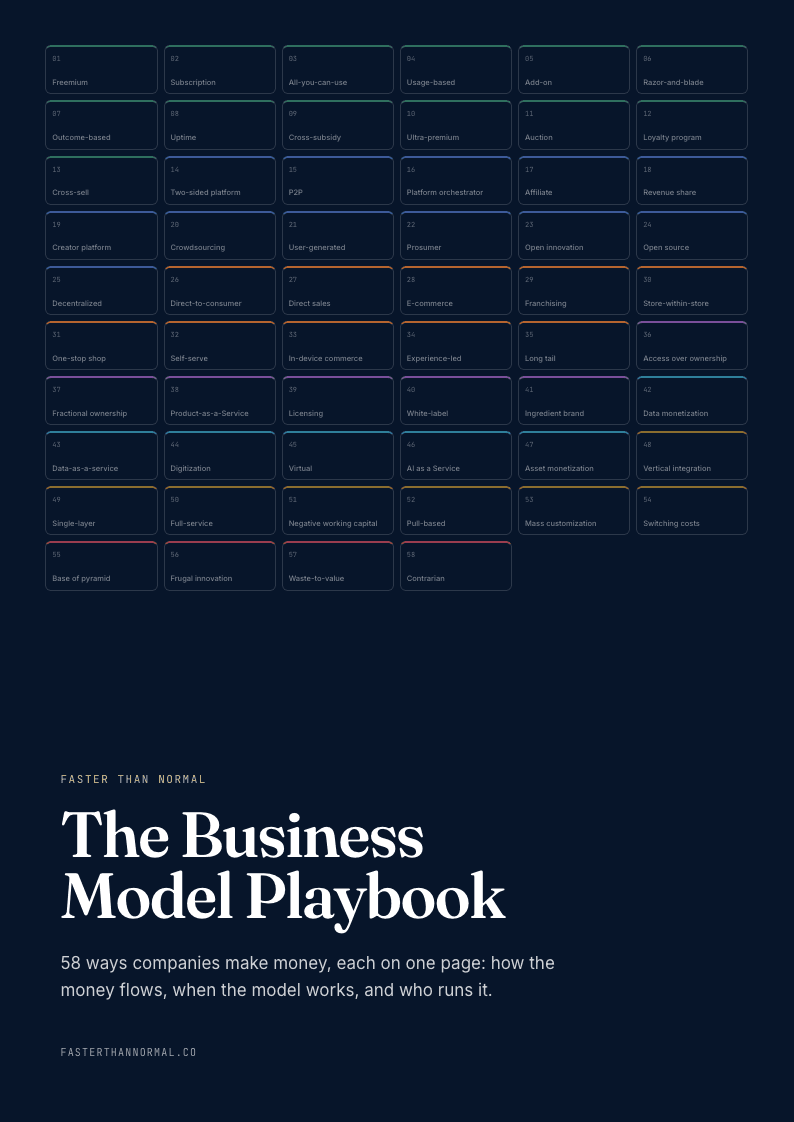
Free playbook
Get The Business Model Playbook
58 business models, one visual page each: how the money flows, the metrics that matter, and who runs it. Free when you join the Faster Than Normal email.
Free. No spam. Unsubscribe anytime.
Part IIIMaxims
-
Information is the first edge, not capital. In commodity markets, the trader who knows the state of the crop before his competitors doesn't need to be the biggest — he needs to be the fastest.
-
Your word is your hardest asset. In a corrupt environment, integrity isn't idealism — it's the cheapest form of insurance and the most durable source of trust.
-
The first deal is a signal, not just a transaction. Choose your opening move for what it communicates to the market about who you are and who you intend to displace.
-
Regulation creates asymmetry. Every quota, every tariff, every policy instrument contains a gap between its intention and its effect — the fortune goes to whoever identifies that gap first.
-
Own the infrastructure before someone else does. Trading profits are volatile; productive assets generate durable cash flow and transform a speculator into a market-maker.
-
Conviction without diversification is a death sentence. Lobo believed in Cuba more than anyone, invested more than anyone, and lost more than anyone. The Falla Bonets, who hedged, survived.
-
An ecosystem produces you more than you produce it. Audit how much of your advantage is personal and how much is environmental — then plan for the environment to vanish.
-
Adjacent obsessions sharpen the primary one. Lobo's study of Napoleon was not a diversion from sugar — it was a parallel education in strategy, logistics, and the management of empire.
-
Paternalism, done with integrity, builds loyalty no contract can replicate. Lobo's hospitals and scholarships for workers created a human moat that even Guevara respected.
-
The speculator's final enemy is himself. The same appetite for risk that builds the fortune is the one that, without ballast, destroys the second fortune in exile.
In Their Own Words
To have Croesus-like wealth is referred to be as rich as Julio Lobo.
He was known as the king of sugar, not just of Havana but of the world.
Lobo captures the period's contradictions.
He swam the Mississippi as a young man.
He fenced in duels.
He survived assassin's bullets.
He was put against the wall to be shot but pardoned at the last moment.
He courted movie stars, raised a family, and made and then lost 2 fortunes.
He became the chief authority in any debate surrounding the world's sweetener par excellence.
He was capable of buying and reselling 350,000 tons of the product under agreements he signed without the slightest hesitation.
Trade union leader Eusebio Mujal called him 'public enemy number one.
Chico, I was born naked, I will die naked, and some of my happiest moments have been naked.— Julio Lobo, to the young revolutionary in his office, October 1960
I'm a capitalist and you're a communist, and I've been a capitalist all my life.— Julio Lobo, at his meeting with Che Guevara, as recounted by John Paul Rathbone
Whatever little success I have had in my life especially in sugar, I owe in great measure to the education which I received here many years ago.— Julio Lobo, LSU alumni address, circa 1963
When you read Cuban history books, you see his name always as a footnote to some large deal, some large sugar crop, but his life is sort of shadowy and mysterious. And in time, I came to see Lobo as a kind of machine with which to explore the pre-revolutionary period.— John Paul Rathbone, NPR interview, August 2010
Further reading
- The Sugar King of Havana: The Rise and Fall of Julio Lobo, Cuba's Last Tycoon by John Paul Rathbone


