


Part IThe Story
The Daughter of the Lions Club
On a weeknight sometime around 1982, a beat-up Volkswagen Beetle pulled out of a working-class neighborhood in Tustin, California, carrying an automobile painter in his one sports coat and his fifteen-year-old daughter, who had dressed for a podium. Julie Spellman was headed to a Lions Club speech tournament—the kind of civic-hall competition where a high schooler could, if she was good enough, walk away with $500 in cash prize money. For a family without much, the money mattered. She was good. She was often very good. But on this particular evening she made it to the semifinals and lost to the daughter of the club's president.
On the drive home, she complained. The winner had been cutesy. The winner had connections. The fix, she implied, was in.
Her father looked at her. "First of all, Julie, you're never going to be the daughter of the president of the Lions Club," he said. "That's not the family you were born into." He paused. "And I believe you can do anything, but you have to be so much better than anyone else that they have to give it to you." Another pause. "Tonight, you weren't that much better."
Four decades later, Julie Sweet—now Julie Spellman Sweet, chair and chief executive officer of Accenture, a $176 billion company with roughly 774,000 employees spread across more than 120 countries—calls that car ride her first experience of constructive feedback. It is also, she has said, the foundational lesson of her career. Be so much better that they have to give it to you. Not a little better. Not marginally more prepared. So much better that the question of whether the game is rigged becomes irrelevant, because you have rendered the rigging moot.
The sentence has the cadence of a motivational poster, the kind of thing you'd find in a corporate training deck or stitched onto a throw pillow. But what makes it interesting—what makes Sweet interesting—is the particular way she has spent her life operationalizing it. She did not rise by being the loudest or the most charismatic or the most politically adept. She rose by being relentlessly, almost compulsively, prepared. By treating ignorance not as a source of shame but as a problem to be scheduled away—biweekly, for eighteen months, with a tutor if necessary. By making lateral career moves that looked, to everyone watching, like they were either brave or insane, and then learning so fast that the question stopped mattering. She is, in the taxonomy of corporate leaders, an unusual species: the lawyer who became a technologist, the outsider who became the ultimate insider, the general counsel who became CEO of a company whose previous leaders had all joined straight out of college.
This is the story of how she did it—and what it reveals about the nature of preparation, reinvention, and the peculiar alchemy of leading an organization so large that its workforce exceeds the population of San Francisco.
By the Numbers
Accenture Under Julie Sweet
$64.9BAnnual revenue, fiscal year 2024
~774,000Employees worldwide
$176BApproximate market capitalization, mid-2025
$3BGenerative AI bookings, fiscal year 2024
46Acquisitions closed in fiscal year 2024, totaling $6.6B
9,000+Clients served across 120+ countries
#2Ranking on Fortune's 2025 Most Powerful Women list
The Painter's Daughter and the Scholarship Board
Julie Terese Spellman was born in 1967 and raised in Tustin, a small city in Orange County, California, wedged between the aspirational sprawl of Irvine and the fading agricultural flatlands of what was then a quieter, more working-class stretch of the county. Her father painted automobiles. Her mother was a beautician. Neither had passports. The household was not poor in any desperate sense, but it operated within the tight constraints of trades-level income in a state that was, even then, growing expensive. Education was the family catechism. When Julie was in eighth grade, her mother enrolled in college—a fact Sweet has cited repeatedly as formative, the signal that self-improvement was not a luxury but a duty.
At Tustin High School, Sweet channeled her energy into speech and debate, a discipline that rewards exactly the qualities she would later deploy in boardrooms: the ability to synthesize complex information under pressure, to read an audience, to project authority while standing alone at a lectern. She was, by all accounts, exceptional. Good enough to win cash prizes at civic tournaments. Good enough to earn a scholarship to Claremont McKenna College, one of Southern California's most selective liberal arts institutions—a school that, for a painter's daughter from Tustin, represented a leap across several class gradients at once.
What happened next is the kind of detail that, in retrospect, looks like destiny but at the time was mere serendipity. At a scholarship award dinner, Sweet sat next to a member of the college's scholarship board who, discovering her interest in international relations, suggested she study Chinese. This was the mid-1980s, when most Americans studying an Asian language chose Japanese—Japan was the economic juggernaut, the object of both admiration and anxiety. China was still emerging from the wreckage of the Cultural Revolution. To study Chinese was to bet on a future that most people couldn't yet see.
Sweet went home that night and told her parents—the ones without passports—that she was going to study Chinese. She has described this as one of the most important decisions of her life, and it is worth pausing on the mechanism: a stranger at a dinner table painted a picture, and she committed. Not tentatively, not with caveats. She committed the way her father would have expected her to—completely, so much better that they had to give it to her.
She spent six months in Taiwan and six months in Beijing during her junior year. She graduated Phi Beta Kappa in 1989 with a degree in international relations. Then she went to Columbia Law School, where she was named a Harlan Fiske Stone Scholar, and emerged in 1992 with a J.D. and a set of skills—legal reasoning, Mandarin fluency, an instinct for uncharted territory—that didn't yet have an obvious application. She would spend the next eighteen years finding one.
The Ninth Woman
Cravath, Swaine & Moore occupies a singular position in American law. Founded in 1819, it is not the largest firm or the most profitable per partner in any given year, but it is, by the profession's internal reckoning, among the most prestigious—a finishing school for a certain kind of corporate lawyer, the kind who does billion-dollar mergers and complex financings and never, under any circumstances, advertises. The firm's partnership model is famously brutal: associates are hired in cohorts, worked relentlessly for seven to nine years, and then either elevated to partner or shown the door. There is no middle ground. The culture is meritocratic in the way that extreme pressure environments often are—everyone suffers equally, and the survivors bond over shared privation.
Sweet arrived in 1992 and threw herself into corporate work: underwriting, private equity, mergers and acquisitions. In 1994, she helped the firm open its Hong Kong office—a natural deployment for a Mandarin-speaking associate with an international relations degree—and spent two years there. She has described the experience of being a tall, blonde, young American woman speaking fluent Chinese in Hong Kong's legal circles as both differentiating and clarifying: bias, she learned, was often unconscious, and the best way to navigate it was to be so demonstrably competent that the bias became irrelevant. The Lions Club lesson, internationalized.
In 1999, she made partner—the third woman to reach the corporate partnership, and only the ninth woman partner overall in a firm with a 180-year history. The significance of that number is easy to gloss over. Nine. In nearly two centuries. Sweet has spoken about a moment shortly before her election, during an unconscious-bias training session that the firm, in a forward-thinking move for the era, had organized. A facilitator turned to her—the most senior woman in the room—and asked if she had experienced any of the scenarios being discussed. Sweet opened her mouth and no words came out. She began sobbing. She couldn't stop. She left the conference room, retreated to her office, and waited.
The story, as she has told it, unfolds from there with a kind of dark comedy. Word spread through the firm instantly. The men gathered. They didn't know what to do. They sent the first woman partner, Susan, to Sweet's office to assess the situation. Susan, who understood that there was no scandal—just the accumulated weight of years of navigating spaces not built for her—listened. And Sweet, composing herself, made a private calculation: in two weeks she would be a partner, and she could either pretend nothing had happened or she could use the moment. She chose the latter. She went back out, explained herself, and discovered that her vulnerability had created something she hadn't expected—trust, connection, a kind of authority that being unflappable never could have produced.
She returned to Hong Kong in 2001 to co-head the office until it closed the following year, then settled back into New York. By 2010, she had been a Cravath partner for a decade—a comfortable, lucrative, deeply established position. She was 42 years old, embedded in one of the most elite professional ecosystems in the world, and she was about to walk away from all of it.
The Jump
The catalyst, as Sweet tells it, was death. Her father died at 68—not old, not young, but precisely the age at which a life lived within narrow constraints begins to look, from the outside, like a life that ran out of time. "It reminded me to make sure I was living life to the fullest," she has said. The sentiment is common enough. What was uncommon was her response.
Accenture came calling in 2010 with an offer to become its general counsel. The firm was in the middle of a strategic pivot, moving from its legacy in IT outsourcing and systems integration toward a more acquisitive, digitally-oriented model, and it wanted a business-minded lawyer who could execute on that ambition. Sweet, whose entire career had been built on dealmaking, was a natural fit for the legal dimension of the role. What was not natural—what was, in fact, almost absurd—was the idea that a corporate attorney from a white-shoe Manhattan law firm would thrive inside a global technology consultancy headquartered in Dublin. She didn't know what the cloud was. She has said this openly, without embarrassment, as if admitting ignorance were simply the first step in a protocol she had already designed for eliminating it.
The man who recruited her, then-CEO Bill Green—who had led Accenture from 2004 to 2010, growing revenues from $13.7 billion to $21.6 billion and expanding the company's international footprint—told her something she would repeat for years: he hadn't hired her to be a lawyer. He had hired her to be a business leader with a legal background. The distinction mattered. It meant that her job was not to manage risk in a narrow, defensive sense but to understand the business well enough to help shape its strategy. It was an invitation to cross a boundary that, in most corporations, is carefully policed.
Sweet took the invitation literally. She enlisted Bhaskar Ghosh—an Accenture lifer who would later become the company's chief strategy and innovation officer—as a personal technology tutor. They met every two weeks for eighteen months. The curriculum was, in effect, a private seminar on everything Sweet didn't know: cloud computing, data analytics, digital strategy, the architecture of modern enterprise IT. She was, by her own account, a voracious and unashamed student, the kind of person who treats not knowing something as a scheduling problem rather than an existential one.
— Julie Sweet, on joining AccentureAs a young professional, you set a learning agenda. That's what I did. Because if you set a learning agenda, you will actually achieve it and you'll wake up.
Simultaneously, she was doing what she had been hired to do: running Accenture's legal department, serving as principal counsel to the board and senior leadership, and—critically—managing the company's accelerating M&A strategy. Before Sweet arrived, Accenture made a handful of acquisitions per year. Under her watch, that pace would eventually reach roughly forty per year. The shift was not merely quantitative. It represented a fundamental change in how Accenture thought about growth: not just organically, through winning new consulting engagements, but through buying capabilities—design firms, digital agencies, AI startups, data analytics companies—that the firm couldn't build fast enough on its own.
The Notebook
In late 2014, roughly a month before she would be diagnosed with breast cancer for the first time, Sweet was in a routine one-on-one meeting with Pierre Nanterme, who had become Accenture's CEO in 2011. Nanterme—a Frenchman who had spent his entire career at the firm, rising through the European consulting ranks to lead a company that was, under his stewardship, undergoing its most aggressive transformation since independence from Arthur Andersen—was known for his intensity, his strategic ambition, and his conviction that Accenture's future lay in digital services rather than in the traditional outsourcing contracts that had long been its bread and butter. Under Nanterme, Accenture Digital was created, design firms like Fjord were acquired, and revenues rose from $25 billion to $43.2 billion.
At the end of their meeting, Nanterme closed his notebook, pushed it aside, and said something Sweet did not expect: "I think you could run this place someday."
Sweet was the general counsel. The general counsel does not become CEO. Certainly not at a company where every previous leader had joined straight out of college and spent decades ascending through the consulting ranks. Nanterme acknowledged this—he suggested she would need to run a business unit first—but the signal was unmistakable. He was telling her she was in the succession conversation.
Sweet's response, as she has recounted it, was shaped by a piece of advice she had once received from Dina Dublon, a former CFO of JPMorgan Chase who served on Accenture's board. Dublon had told her: when someone offers you a stretch role, don't ask "are you sure?" Don't hedge. Lean in. Sweet leaned: "Why, yes, I'd be interested. What did you have in mind?"
What Nanterme had in mind was Accenture's North American business—its largest geographic market, responsible for roughly $18 billion in revenue, a sprawling operation that would put Sweet in charge of thousands of consultants, dozens of industry verticals, and the company's most important client relationships. In May 2015, she was named group chief executive of North America, succeeding Stephen Rohleder, who retired after 34 years at the firm. The appointment was effective June 1. Four years later, in September 2019, she became CEO.
The intervening years had been cruel to the man who had identified her potential. Nanterme resigned for health reasons and died in January 2019 at the age of 59. David Rowland served as interim CEO until Sweet's appointment was announced. Marjorie Magner, then non-executive chair of the board, cited Sweet's "leadership record, business experience, and commitment to innovation and company values." The language was boilerplate. The reality was not. Accenture had chosen, for the first time in its history, a CEO who was a woman, a lawyer, and an outsider—someone who had not grown up inside the company's famously insular culture but who had, through a combination of relentless learning, strategic positioning, and the quiet accumulation of institutional knowledge, made herself indispensable.
Reinvention as Operating System
To understand what Sweet inherited—and what she has built—requires understanding the peculiar nature of Accenture itself. The company is, in the most reductive sense, a consulting firm. But that description is like calling Amazon a bookstore. Accenture's roots trace to the early 1950s, when Arthur Andersen's consulting division helped design and install a UNIVAC-based payroll system for General Electric—one of the first commercial uses of electronic computers. The consulting arm grew throughout the following decades, was formally established as Andersen Consulting in 1989, endured a bitter arbitration with its parent firm, and on January 1, 2001, adopted the name Accenture and incorporated in Bermuda. (It later moved its headquarters to Dublin.) The timing was inadvertently fortunate: the separation insulated the consultancy from Arthur Andersen's catastrophic collapse in the wake of the Enron scandal.
Accenture went public on the New York Stock Exchange in July 2001 in what was then one of the largest IPOs in U.S. history, raising nearly $1.7 billion. From there, each successive CEO expanded the aperture. Joe Forehand (1999–2004) oversaw independence and the IPO, nearly doubling revenues to $13.7 billion. Bill Green (2004–2010) expanded the international presence and grew revenues to $21.6 billion. Nanterme (2011–2019) created Accenture Digital, acquired design and marketing firms like Fjord and Droga5, and pushed revenues to $43.2 billion.
A
Accenture's CEO Succession
Each leader expanded the company's definition of itself.
1999–2004
Joe Forehand: Independence, IPO, revenues from $6.9B to $13.7B
2004–2010
Bill Green: International expansion, revenues to $21.6B
2011–2019
Pierre Nanterme: Digital pivot, acquisitions, revenues to $43.2B
2019–present
Julie Sweet: AI, cloud, learning culture, revenues to $64.9B
Sweet's contribution to this lineage is not a single dramatic pivot but rather a compounding series of moves that, taken together, amount to a thesis about what Accenture is becoming. The thesis: in an era of AI-driven transformation, the most valuable thing a consulting firm can offer is not advice but execution at scale. Not a slide deck about what you should do but a partner who will actually rewire your company—your data infrastructure, your workforce skills, your organizational structure, your compliance frameworks—to operate in fundamentally different ways.
This sounds abstract. The numbers are not. Under Sweet, Accenture's market capitalization has roughly doubled, from about $90 billion in 2018 to over $170 billion by mid-2025. Annual revenue has grown from $41 billion to $64.9 billion. The workforce has expanded from 460,000 to approximately 774,000. And the nature of that workforce has shifted: Accenture is no longer primarily a firm of management consultants and IT outsourcers but an increasingly hybrid organization that includes designers, data scientists, AI engineers, marketing strategists, and—through acquisitions like the online learning platform Udacity, purchased in 2024 as part of a new business called LearnVantage—educational technologists.
The Russia Decision, and Others Like It
On February 24, 2022, Russia invaded Ukraine. World leaders issued statements. Monuments were lit in blue and yellow. Executives of companies with operations in Russia began debating—cautiously, lawyerly, with an eye toward quarterly earnings—whether it was ethical to stay.
Accenture had a $120 million business and 2,300 employees in Russia. At the company's Washington, D.C., offices, Sweet convened her senior team. Joel Unruch, Accenture's general counsel—who had joined the company in 2011 after working as corporate counsel at Amazon and as an associate at, of all places, Cravath, Swaine & Moore—recalled the conclusion of one of those calls. "We got off the phone after one of those calls, and Julie said, 'We're getting out of Russia,'" Unruch told Fortune. "With less than 24 hours of thinking. The next day, we announced it."
Accenture's announcement came on March 3, one week after the invasion began. By April 1, the company was out—having spun off its Russian operation to in-country employees and taken a $96 million loss. "Sometimes the right thing to do is not clear," Sweet has said. "But Russia was super clear. This was not one of those things where we wanted to wait and see, 'What will others do?'"
The episode is revealing not for the moral clarity—many companies eventually exited Russia—but for the speed and the mechanism. Sweet's decision-making process, as those who work with her describe it, follows a consistent pattern: rigorously study the problem, seek input from a wide range of sources, then move with a velocity that borders on startling. The analytical phase is deep; the execution phase is abrupt. There is no gradual escalation, no lengthy deliberation once the inputs are in. The former lawyer builds the record, then rules.
— Jane Fraser, CEO of CitigroupJulie is one of the top leaders in the corporate world, period. I mean, there aren't many other people who can come close.
This pattern—study fast, decide faster—has defined her strategic bets as well. When generative AI burst into public consciousness in late 2022 and early 2023, Sweet moved with characteristic urgency: Accenture announced plans to open six generative AI studios in North America as part of a planned network of ten worldwide, backed by $3 billion in spending over three years. By early 2024, the plan had expanded to include nine additional studios in Asia-Pacific and Latin America. By the end of fiscal 2024, Accenture had hit $3 billion in generative AI bookings—a leap from $300 million the prior fiscal year. In the first quarter of fiscal 2025 alone, the company banked $1.2 billion in AI bookings.
The acquisitions, too, accelerated. In fiscal 2024, Accenture closed 46 deals worth $6.6 billion. The cadence—roughly one acquisition per week—required the kind of institutional M&A muscle that Sweet had spent her first five years at the company building. She was, in a sense, harvesting capabilities she had planted as general counsel a decade earlier.
What She Doesn't Know (And How She Fixes It)
There is a question Sweet asks every job candidate, regardless of role or seniority: "What have you learned in the last six months?"
The question is disarming in its simplicity. It has no correct answer in the traditional sense. You can say you learned to bake bread—Sweet herself offered this as her own answer during a podcast appearance, alongside a more expected response about artificial intelligence. The point is not what you learned but whether you are the kind of person who is always learning something. If you cannot answer the question, Sweet has said, "then we know that they're not a learner."
This is not a hiring gimmick. It is the distillation of a worldview. Sweet's entire career has been built on the conviction that ignorance is temporary and correctable, that the most dangerous state is not not knowing but not knowing that you don't know—or, worse, knowing and not caring. When she joined Accenture and didn't understand cloud computing, she scheduled biweekly tutorials. When she became CEO and needed to communicate a massive restructuring to 770,000 people across 120 countries, she didn't send a memo—she recorded a video, because "reading it on a piece of paper would not have conveyed the why in the same way as hearing it—hearing the excitement in my voice, understanding the passion we have for why we're changing." When she decided that every Accenture leader needed to be a better communicator, she didn't write a position paper; she required all her direct reports to work with speech coaches and embedded communication and change-management training into every level of leadership, starting in 2025.
The learning obsession is also the engine of what Sweet calls Accenture's "reinvention" strategy—the word she uses more than any other, the through-line of every earnings call, every Davos panel, every client pitch. On her first day as CEO, in September 2019, she announced a program to train every Accenture employee on the key technologies transforming business. By the time generative AI arrived in force, more than 600,000 employees had basic AI training. This was not prescience—Sweet did not predict ChatGPT—but it was preparation at a scale that made the company able to move faster than its competitors when the moment came.
Rewiring the Machine
In June 2025, Accenture announced that it would consolidate its five main business divisions—Strategy and Consulting, Technology, Operations, Industry X, and Song—into a single umbrella unit called Reinvention Services, effective September 1. The reorganization was the largest structural change in the company's history, reversing what Sweet described as "five decades of how we're working."
The logic was characteristic: clients seeking AI-driven transformation don't want to navigate five different Accenture divisions to get a single integrated solution. They want one partner who can handle strategy, technology, data, AI, operations, and industry-specific expertise simultaneously. The restructuring was not a cost-cutting exercise, though it inevitably surfaced efficiencies and redundancies. It was a bet that the future of consulting lies not in specialized silos but in integrated delivery—a bet that Accenture's massive scale, which competitors often frame as a liability (how do you make a 774,000-person organization agile?), is actually its greatest asset.
Sweet communicated the change via video rather than memo—a deliberate choice that she refined through multiple iterations with her leadership team. "I try to have no ego on communication," she told Fortune, "because it's so important that we're really clear." The statement is revealing for what it does not say: Sweet does not claim to be a natural communicator in the charismatic, Steve Jobs mold. She claims to be a disciplined one. Every message is workshopped, tested, iterated. The vulnerability she displayed at Cravath in 1999 was spontaneous; the communication strategies she deploys at Accenture are engineered.
The Reinvention Services restructuring also absorbed—or sidelined—some of Sweet's more ambitious experiments. Accenture Song, the marketing and creative services unit assembled through more than 40 acquisitions, had drawn mixed reviews. David Droga—the legendary Australian advertising creative who had sold his agency, Droga5, to Accenture in 2019 and had led Song since its creation—stepped down as CEO of the unit in May 2025, remaining as vice chairman. The move was framed as part of the broader consolidation, but it also reflected a reality that some campaigns—most notably a widely criticized rebranding effort for Jaguar—had raised questions about whether a consulting firm could truly compete in the volatile, taste-driven world of creative advertising.
The Cancer, Twice
Sweet was first diagnosed with breast cancer in late 2014, roughly a month after Pierre Nanterme told her he thought she could run the company someday. She has spoken about the diagnosis as a clarifying experience—the kind of event that strips away the ambient noise of professional ambition and forces a reckoning with what actually matters. She found the cancer through a self-exam. She was treated. She continued working. She does not dwell on the details publicly, except to note that the experience sharpened her sense of purpose.
In February 2025, the cancer came back. Sweet disclosed the recurrence in a memo to Accenture's employees and in an 8-K filing with the SEC, noting that "the prognosis from my doctor is excellent; the cancer was caught early, and my condition is curable." She continued to work through several weeks of radiation treatment.
The transparency was deliberate. Sweet has spoken explicitly about wanting to model a different approach to illness in the corporate world—one that rejects the old Steve Jobs playbook of concealment and euphemism. "We want people to build long-term careers," she told Fortune, "and cancer happens to people." She has pointed to the declining rate of cancer screening among women—down to 10% from 12% over the past five years, according to the Hologic Global Women's Health Index—as a reason to be public about her own experience.
"This time around, for me, it was a little bit more of a wake-up call about just focusing on my health," she said in a podcast interview. "It was a reflection on, I want to live a really long life, like you get really clear. And I want that to be a quality life."
The second diagnosis, like the first, did not slow her. If anything, it seemed to accelerate the intensity of her public engagement—more interviews, more panels, more detailed articulations of Accenture's AI strategy, as if the urgency of the body's finitude had been transmuted into the urgency of institutional transformation.
The Paradox of Scale
There is a tension at the heart of Sweet's project that she acknowledges without fully resolving. Accenture is, by any measure, enormous. It employs more people than live in most American cities. It serves more than 90% of the Fortune 100 and three-quarters of the Fortune 500. Dozens of clients pay it more than $100 million in a single quarter. Its workforce is the largest in the Fortune Global 500 to be led by a woman.
And yet Sweet insists—emphatically, repeatedly, in interview after interview—that agility and speed are her signature achievements. "Super fast," she told Fortune. When President Trump unveiled his aggressive tariff schedule in April 2025, Accenture held webinars with 900 clients around the world within a week. When Russia invaded Ukraine, Sweet exited in days. When generative AI emerged, she had 600,000 employees pretrained.
The contradiction is not a contradiction if you understand it as a thesis about modern organizational design: that scale and speed are not opposites but complements, that the largest organizations can be the fastest if their leaders are willing to invest in continuous learning, integrated structure, and a culture that Sweet describes as "progress over perfection"—a willingness to move before all the answers are in, to ship the imperfect and iterate.
Whether this thesis holds over time is an open question. Accenture's stock declined more than 18% in the first seven months of 2025, making it one of the weaker performers in the S&P 500. The value of new bookings fell in both the second and third quarters of fiscal 2025, raising investor concerns about growth. About 8% of Accenture's global revenue comes from U.S. federal work, and the Trump administration's directive to the General Services Administration to review federal consulting contracts and demand lower costs introduced what the company called "ongoing uncertainty." These are not existential threats, but they are reminders that even the most sophisticated reinvention narrative is subject to the mundane gravitational pull of macroeconomic cycles, political risk, and client budget constraints.
Sweet's response to these headwinds has been to talk about the long game—about "pivoting from efficiency to growth," about "physical AI" as the next frontier, about the shift from "how do I scale?" to "can I scale?" to "how fast can I scale?" The language is relentless. The word reinvention appears in virtually every public statement. It is both a strategy and a mantra, a description of what Accenture does for its clients and a description of what Sweet has done to herself.
— Julie SweetAI is only a technology. The value comes from reinvention of how we work, our workforces, and the tools we use. We are making sure that we are leading the way with our own reinvention.
The Beat-Up Volkswagen
There is one more thing about the Lions Club story, one more thing about the car ride home from the speech tournament in 1982. The father who delivered that piece of constructive feedback—"you have to be so much better than anyone else that they have to give it to you"—died at 68. Sweet was in her early forties. She quit her partnership at one of the most prestigious law firms in the world and joined a company she barely understood. She had eighteen months of biweekly technology tutorials ahead of her, and a decade of reinvention after that, and two bouts with cancer, and a restructuring of 774,000 people that she announced not in a memo but in a video, because she wanted them to hear her voice.
She still gives out copies of a 2013 book called Weekend Language: Presenting with More Stories and Less PowerPoint—she brought 300 copies to her daughter's high school career day. She still asks every job candidate what they've learned in the last six months. She still tells the story about her father's VW Bug, the one sports coat, the drive home.
The car, like the lesson, was not elegant. It did not need to be. It just needed to get her where she was going.
Part IIThe Playbook
Julie Sweet's career offers a set of operating principles that are, in their specificity, more useful than they first appear. She is not a founder mythologized for a single visionary insight. She is an operator who built a career—and rebuilt a company—through a series of deliberate, compounding decisions. The playbook that follows is derived from those decisions.
The principles
- 1.Treat ignorance as a scheduling problem.
- 2.Choose uncharted territory over crowded fields.
- 3.Redefine your job before someone else does.
- 4.Build the M&A muscle before you need it.
- 5.Study fast, decide faster.
- 6.Use vulnerability strategically, not accidentally.
- 7.Make learning the culture, not a program.
- 8.Communicate through presence, not paper.
- 9.Prepare the organization before the opportunity arrives.
- 10.Scale and speed are complements, not opposites.
- 11.When the answer is clear, don't wait for consensus.
- 12.Survive the stretch role by refusing to flinch.
Principle 1
Treat ignorance as a scheduling problem
When Sweet joined Accenture in 2010, she didn't know what the cloud was. She did not panic or pretend otherwise. She found Bhaskar Ghosh, a technology expert inside the company, and scheduled biweekly tutorials for eighteen months. The gap between what she knew and what she needed to know was large, but it was finite, and she treated it that way—as a deficit with a timeline for correction.
This is a fundamentally different posture than the one most executives adopt when confronted with unfamiliar domains. The standard approach is to hire specialists, delegate the technical details, and maintain a strategic overview. Sweet did the opposite: she built personal fluency, not to replace the specialists but to ask them better questions, to understand when they were right and when they were hedging, to participate in decisions rather than merely ratifying them.
The principle extends beyond her own learning. Sweet's insistence on asking every job candidate "What have you learned in the last six months?" is a filter for the same quality. She is not looking for people who know everything. She is looking for people who treat not-knowing as a temporary condition.
Tactic: When you encounter a domain you don't understand, find the best internal expert, schedule recurring sessions with a fixed duration, and build personal fluency rather than delegating comprehension.
Principle 2
Choose uncharted territory over crowded fields
Sweet studied Chinese when most Americans studied Japanese. She joined a law firm with only two women partners. She left a comfortable partnership to become general counsel at a technology consultancy. Each move took her into a space where the competitive landscape was thinner and the learning curve steeper.
"Focusing on uncharted territory helped me differentiate myself and gave me broad experience," Sweet has said. "I gained a lot of confidence, because when you take on new things and succeed, you build confidence for the next new thing." The logic is compounding: each unfamiliar environment builds a capacity for the next one, so that by the time the truly high-stakes bet arrives—the leap from law to technology, the jump from general counsel to CEO—the muscles for adaptation are already developed.
The risk of uncharted territory is obvious: there is no playbook, no established network, no guarantee of success. The advantage is less obvious but more durable: in a crowded field, being marginally better yields marginal returns. In an empty one, even moderate competence can look like genius.
Tactic: When choosing between a well-trodden career path and an unfamiliar one, bias toward the unfamiliar—not for its own sake, but because differentiation compounds more steeply than optimization.
Principle 3
Redefine your job before someone else does
Bill Green told Sweet he hadn't hired her to be a lawyer but a business leader with a legal background. She took the instruction seriously. As general counsel, she didn't limit herself to managing risk and compliance. She embedded herself in Accenture's M&A strategy, served on its Capital Committee, and contributed to its broader business direction. By the time the CEO role opened, her candidacy was not absurd—it was the logical extension of a role she had already expanded far beyond its nominal boundaries.
This is a principle that applies broadly but is rarely executed well. Most people define their role by its job description. Sweet defined hers by the value she could create. The distinction is not about working longer hours or taking on more tasks; it's about understanding which contributions, beyond your formal mandate, would make you indispensable to the organization's most important decisions.
Tactic: Identify the two or three strategic decisions your organization will face in the next three years, and find ways to contribute to them regardless of whether they fall within your formal role.
Principle 4
Build the M&A muscle before you need it
When Sweet arrived as general counsel in 2010, Accenture made a handful of acquisitions per year. By the time she became CEO, the pace had accelerated to roughly forty per year. In fiscal 2024, Accenture closed 46 deals worth $6.6 billion. This capability—the legal, operational, and cultural infrastructure to identify, acquire, and integrate companies at industrial scale—was not built overnight. It was built during Sweet's five years as general counsel, when the groundwork was legal and procedural, and then scaled during her four years running North America, when the emphasis shifted to strategic fit and execution speed.
The lesson is not about acquisitions specifically. It is about building institutional capabilities during periods of relative calm so they are available during periods of acute need. When generative AI created an urgent demand for specialized talent and technology, Accenture did not need to learn how to acquire companies. It already knew.
Tactic: Identify the capability your organization will need most urgently in three to five years and begin building the infrastructure for it now, even if the current demand doesn't justify it.
Principle 5
Study fast, decide faster
Sweet's decision to exit Russia took less than 24 hours. Her commitment to $3 billion in AI investment came before most companies had finished their first generative AI pilots. Her response to tariff uncertainty—900 client webinars within a week—was logistically staggering and strategically deliberate.
The pattern is consistent: extended study followed by sudden action. The study phase is deep—Sweet meets with dozens of CEOs, consults her leadership team, reads voraciously, asks probing questions until she fully understands the issue. But once the inputs are in, there is no gradual escalation. The decision is made, announced, and executed.
This is not recklessness. It is the opposite: the depth of preparation enables the speed of execution. Because Sweet has already done the work of understanding, she does not need to deliberate. The information has been processed; what remains is the act of choosing.
⚡
Sweet's Decision Framework
| Phase | Duration | Method |
|---|---|---|
| Study | Weeks to months | CEO conversations, expert input, data analysis, team debate |
| Decide | Hours to days | Rapid synthesis, clear criteria, personal conviction |
| Execute | Immediate | Video communication, organizational mobilization, public commitment |
Tactic: Separate the study phase from the decision phase. Invest heavily in the former, then collapse the latter to the minimum viable timeframe.
Principle 6
Use vulnerability strategically, not accidentally
Sweet's breakdown during unconscious-bias training at Cravath in 1999 was unplanned. But what followed was strategic: rather than retreating into composure, she returned to the group, explained herself, and discovered that vulnerability—authentic, unscripted—created trust and connection that polished professionalism never could.
She has applied this lesson deliberately throughout her career. Her public disclosures about cancer—both in 2014 and again in 2025—were calculated acts of transparency. She filed an 8-K. She sent a memo to employees. She discussed her diagnosis on podcasts and in interviews. Each disclosure was framed not as a confession of weakness but as a demonstration of how organizations should treat illness: openly, supportively, without pretending that leaders are immune to the conditions that affect everyone.
The principle is not "be vulnerable at all times." It is: when vulnerability arrives uninvited, don't waste it. The moments when a leader is most human are the moments when trust is most available. But only if the vulnerability is genuine and the follow-through is intentional.
Tactic: When an unplanned moment of vulnerability occurs—a health crisis, a mistake, an emotional reaction—resist the instinct to minimize it. Instead, frame it in a way that builds trust and models the culture you want to create.
Principle 7
Make learning the culture, not a program
On her first day as CEO, Sweet announced a training initiative for every Accenture employee on key technologies transforming business. She asks every manager to do a learning activity with their teams during work hours at least once a month. She acquired Udacity in 2024 and built LearnVantage, an AI-powered platform for identifying skills gaps and delivering personalized learning, with $1 billion in planned investment over three years. The ambition is not incremental upskilling but what Sweet calls "readiness"—ensuring that when a technological shift arrives, the organization is already literate enough to respond.
The difference between a learning program and a learning culture is the difference between a fire drill and a fire department. Programs are episodic. Culture is continuous. Sweet's insistence on embedding learning into the rhythm of daily work—not as an add-on but as a structural expectation—means that when 600,000 employees had completed basic AI training before generative AI arrived, it was not because they were ordered to but because the organization had made learning as routine as breathing.
Tactic: Don't wait for a technological disruption to train your workforce. Build learning into the operating rhythm of the organization—monthly team activities, personal learning agendas, recurring investment—so that readiness precedes demand.
Principle 8
Communicate through presence, not paper
When Sweet needed to announce the largest restructuring in Accenture's history, she recorded a video. The choice was deliberate. "Reading it on a piece of paper would not have conveyed the why in the same way as hearing it," she said. She refined the message through multiple iterations with her leadership team, soliciting critiques with what she described as "no ego on communication."
The principle is not that memos are bad. It is that the medium must match the magnitude. A routine policy change can be an email. A fundamental restructuring of how 774,000 people work requires the leader's voice, face, and emotional conviction. Sweet's investment in communication infrastructure—speech coaches for all direct reports, communication training embedded at every leadership level—reflects a belief that organizational clarity is not a nice-to-have but a competitive advantage.
Tactic: For any communication that involves significant change, choose the medium that conveys the most human context—video over memo, in-person over video, conversation over broadcast—and invest in refining the message before delivering it.
Principle 9
Prepare the organization before the opportunity arrives
Accenture's $3 billion in generative AI bookings in fiscal 2024 did not emerge from a standing start. It was possible because Sweet had, years earlier, invested in training 600,000+ employees on AI fundamentals, built a global network of AI studios, and created partnerships with firms like Nvidia and Palantir. When the generative AI wave hit, Accenture was not scrambling to understand the technology—it was already selling solutions.
This is the strategic equivalent of her father's advice: be so prepared that when the opportunity arrives, the outcome is inevitable. Preparation at organizational scale requires years of investment in capabilities that may not yield immediate returns. The training initiative launched on Sweet's first day as CEO, in September 2019, did not produce measurable revenue until generative AI bookings began flowing in 2023. Four years of investment preceded the payoff.
Tactic: Identify the next technological or market shift that will create demand in three to five years and begin investing in organizational readiness now—training, infrastructure, partnerships—even if the current business case is thin.
Principle 10
Scale and speed are complements, not opposites
The conventional wisdom holds that large organizations are slow. Sweet's counter-thesis is that large organizations can be fast if they invest in integrated structure, continuous learning, and a culture of "progress over perfection." Her evidence: exiting Russia in a week, hosting 900 client webinars within days of tariff announcements, restructuring the entire company's five-decade-old organizational model in a single move.
The key mechanism is what Sweet calls readiness—the condition of having already done enough preparation that speed does not require recklessness. A 774,000-person organization cannot be nimble if every decision requires educating the workforce from scratch. It can be nimble if the workforce is already literate, the decision-making framework is clear, and the leader is willing to act.
Tactic: Invest in the preconditions for speed—workforce literacy, integrated organizational structure, clear decision frameworks—so that when rapid action is required, it is a matter of execution rather than education.
Principle 11
When the answer is clear, don't wait for consensus
Sweet's leadership style is, by her own description, "collaborative but decisive." She seeks wide input, including from people with opposing views. But when the analysis converges on a clear answer, she does not wait for unanimity. The Russia exit, the AI investment, the restructuring—each involved extensive consultation followed by unilateral commitment.
The distinction between collaboration and consensus is critical. Collaboration means gathering the best available information and perspectives. Consensus means waiting until everyone agrees. Sweet does the former relentlessly and abandons the latter the moment the evidence points in a single direction. "Sometimes the right thing to do is not clear," she has said. "But Russia was super clear."
Tactic: Separate the input phase from the decision phase. Seek diverse perspectives aggressively, then make the call without waiting for agreement—and communicate the rationale clearly enough that those who disagree can at least understand why.
Principle 12
Survive the stretch role by refusing to flinch
When Nanterme told Sweet she could run Accenture someday, her instinct—informed by Dina Dublon's advice—was not to question the offer but to embrace it. "Why, yes, I'd be interested. What did you have in mind?" The same posture characterized her leap from Cravath to Accenture, her move from general counsel to North America CEO, and her acceptance of the global CEO role. In each case, the gap between her existing experience and the demands of the new role was significant. In each case, she closed it through preparation rather than hesitation.
The principle is not about false confidence. It is about the recognition that stretch roles are, by definition, uncomfortable, and that the discomfort is the point. The person who asks "are you sure?" signals doubt—not in the role, but in themselves. The person who says "yes, and what's the plan?" signals readiness to learn.
Tactic: When offered a role that feels like a stretch, resist the impulse to express doubt. Accept the challenge, then immediately begin the work of closing the gap between your current capabilities and the role's demands.
Free playbook
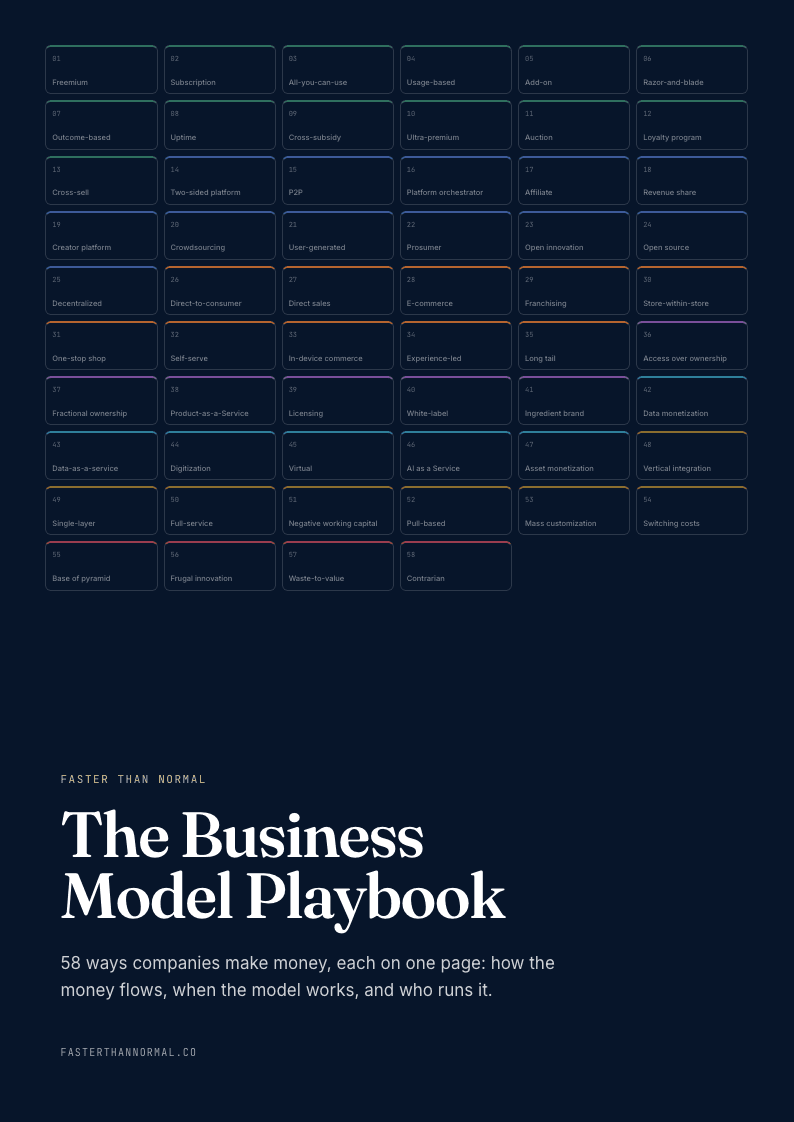
Get The Business Model Playbook
58 business models, one visual page each: how the money flows, the metrics that matter, and who runs it. Free when you join the Faster Than Normal email.
Free. No spam. Unsubscribe anytime.
Part IIIMaxims
-
Be so much better that they have to give it to you. Preparation should be so thorough that bias, politics, and gatekeeping become irrelevant to the outcome.
-
Ignorance is a scheduling problem. If you don't understand something critical, find the best expert, set a recurring meeting, and build fluency on a deadline.
-
When someone offers you a stretch role, don't ask "are you sure?" Accept the challenge, then close the gap between what you know and what the role demands.
-
A comment is no longer a comment. At scale, every word a leader says is amplified. Calibrate accordingly—but don't let caution prevent honesty.
-
Set a learning agenda or you'll never learn. Personal development doesn't happen by accident. Schedule it, measure it, and make it as non-negotiable as any business meeting.
-
Collaborative but decisive. Seek wide input from diverse perspectives, then make the call without waiting for unanimity. Speed follows clarity.
-
Progress over perfection. A culture that demands perfection before action will never move fast enough. Create safety for imperfection, then iterate.
-
The future of AI and companies is human in the lead. Technology changes the tools. Humans decide what to build with them.
-
Every leader needs to think of themselves as a reinventor. The question is not whether transformation is necessary but whether you are willing to lead it—starting with yourself.
-
Cancer happens to people. Transparency about illness builds trust, models vulnerability, and encourages others to prioritize their own health. Don't hide behind the job.
In Their Own Words
If your dreams don't scare you, they're not big enough.— Fortune Most Powerful Women Summit, 2025
Every leader needs to think of themselves as a reinventor.— Fortune, 2025
I have an amazing job. I work with great people doing super-exciting work.— Interview, 2022
There will be plenty of times where being a woman is probably not helping your career, so when it does help your career, take the opportunity and then stand out.— Forbes, 2018
I look at it every day when I think about where I need to take our company, and where I need to continue to learn as a company.— Fortune Most Powerful Women Summit, 2025
Learning is a lifelong journey; it's important to never stop learning.— Interview, 2022
Learning is a continuous journey, and I believe that it's essential for personal and professional growth.
We need to be willing to reinvent ourselves top to bottom.— Fortune interview, 2025
I'm learning every day. I love my job.— Interview with IMD, 2022
You're never going to be the daughter of the president of the Lions Club. That's not the family you were born into. And I believe you can do anything, but you have to be so much better than anyone else that they have to give it to you. Tonight, you weren't that much better.— Julie Sweet, recounting her father's advice
I think one of my superpowers is asking for help. Maybe that goes back to humility and the idea of building great teams. If you focus on how you deliver value, then it becomes very natural that you have to have a team and you have to ask for help, because at the level that we operate, no one delivers value alone.— Julie Sweet, on leadership
Reading it on a piece of paper would not have conveyed the why in the same way as hearing it—hearing the excitement in my voice, understanding the passion we have for why we're changing.— Julie Sweet, on communicating major change
In order to capture the opportunity with AI, you really have to be willing to rewire your company. Many times, when clients are saying, we're not getting a lot out of AI, it's because they're trying to apply it to how they operate today.— Julie Sweet, on AI and reinvention
As a working mom, one of the things that kind of went to the wayside the most was a focus on my health. This time around, for me, it was a little bit more of a wake-up call. I want to live a really long life, like you get really clear. And I want that to be a quality life.— Julie Sweet, on her second cancer diagnosis


