


Part IThe Story
Two Hands on the Glass
In the winter of 1989, a forty-six-year-old oil wildcatter from Arkansas stood in the lobby of the Mansion on Turtle Creek in Dallas, trying to hold a glass of water without spilling it. He couldn't. His hands shook so badly he needed both of them to bring the rim to his lips. Hours earlier, Jerry Jones had walked into a press conference at the Dallas Cowboys' Valley Ranch headquarters and announced three things in rapid succession: that he had purchased the franchise for $140 million, that he had fired Tom Landry — the only head coach in the team's twenty-nine-year existence — and that he intended to involve himself in every aspect of operations, "from jocks to socks." The performance was bravado, a masterwork of showmanship by a man who felt like he was dying inside. "I put on a brave face," Jones would admit decades later, seated in the second-floor office of a billion-dollar headquarters complex he'd built in Frisco, Texas. The brave face was "the ultimate con."
The con worked on almost everyone — except Jones himself. For years afterward, he could not discuss the events surrounding the purchase without breaking into a cold sweat and fighting back tears. He consulted doctors. They told him it was normal, that he was experiencing his own private version of post-traumatic stress. The team he'd just bought was losing $1 million a month. The FDIC had foreclosed on 13 percent of the franchise; another 40 percent was headed to the courthouse. His accountants, his lawyers, his family — everyone who loved him had begged him not to do it. He had pledged 100 percent equity, every dollar he and his family possessed, against a business that appeared to be careening toward bankruptcy. The morning after the press conference, Jones woke up in his hotel room and his first thought was: My God, what have I done?
Minutes later, the phone rang. It was Bum Bright, the man who'd sold him the team. "Jerry, I have someone who says that whatever agreement you and I have, if I take your name off and put their name on it, they'll give you $10 million to go back to Little Rock." Ten million dollars to walk away. To erase the whole thing. To go back to being rich and anonymous in Arkansas, to the plan his wife Gene had for travel and empty-nesting and maybe even golf. Jones said: "Thanks, but no thanks."
That refusal — not the purchase itself, not the firings, not the three Super Bowl trophies that followed — may be the most revealing decision Jerry Jones ever made. It tells you everything about the man: that the gamble was never really about money, that the terror was real but insufficient to override the hunger, and that once he committed to a thing, retreat was a kind of death more frightening than failure. The Cowboys were not an investment. They were a new life. "I never got involved with the Cowboys for an investment, or to say I bought something," he has said. "I came in for a change in career. I looked at it as though I had a new job."
That job has now lasted thirty-six years. The franchise Jones purchased for $140 million — while it hemorrhaged cash, played to half-empty stadiums, and had just posted a 3–13 season — is today valued at $10.32 billion by Sportico, the most valuable sports franchise on the planet. An increase of more than 9,000 percent. The man who was called a "hillbilly buffoon" on Dallas talk radio, who received death threats and hate mail, who was mocked as "Jethro Jones" by columnists, has been inducted into the Pro Football Hall of Fame, named one of Forbes's 100 Greatest Living Business Minds, and recognized as the number-one most important person in the NFL by USA Today. He has also not won a Super Bowl in three decades. That paradox — the richest team in sports, run by its most powerful and visible owner, mired in its longest championship drought — is the essential tension of the Jerry Jones story. It is a story about what happens when a man who cannot stop building discovers that the thing he built may have become the very obstacle to the thing he wants most.
By the Numbers
Jerry Jones and the Dallas Cowboys
$140MPurchase price of the Cowboys in 1989
$10.32BFranchise valuation (Sportico, 2025)
3Super Bowl victories (1992, 1993, 1995 seasons)
30Consecutive seasons without an NFC Championship appearance
$250MEstimated annual sponsor revenue
$1.2BCost of AT&T Stadium
$12.8B+Estimated net worth (Forbes, 2023)
The Grocer's Son
To understand Jerry Jones, you have to understand Pat Jones, and to understand Pat Jones, you have to understand a fruit stand in North Little Rock, Arkansas, in 1945. J.W. "Pat" Jones — Jerry's father, his hero, his primary text — had the energy of a locomotive. He opened a small grocery store, and the family lived next door. He opened a bigger one, and they lived above it. Pat had a promotional genius that bordered on mania: he hosted a live radio show inside his supermarket, broadcasting from between the produce and the canned goods, turning the weekly shop into a spectacle. The soldiers were coming home from the war. Businesses were being born. Pat Jones wanted his son to understand that opportunity was a function not of circumstance but of effort — violent, sustained, unreasonable effort.
From sixth grade onward, Jerry worked two hours a day after school in his father's store. In December he sold Christmas trees. In summer he scooped ice cream. He stocked shelves, did inventory — sometimes through the night. Once, he grumbled about always having to work. Pat pulled him aside. "That concerns me," his father told him. "I want you not only to learn how to work, but also to not resent working." The sentence lodged in Jerry's mind like a splinter.
There was another lesson, delivered after a high school championship football game in which Jerry — normally a running back — was moved to guard and got beaten up badly. He came home and went straight to bed, despondent. Pat found him there. "Son, do you love football?" Jerry said he did. "Then what are you doing in this bed? If you lie in this bed, you are going to be a loser for the rest of your life. Now get up, and if they ask you to be the water boy, then drown them with the damn water." That sentence, too, stayed.
The pattern was set early: a father who viewed stasis as moral failure, who treated the line between work and identity as nonexistent, and a son who absorbed those lessons so completely that they became indistinguishable from personality. Pat Jones would later leave the grocery business for insurance, joining Modern Security Life in Missouri and helping make it hugely profitable. Jerry followed him there after college. The father's restlessness, his promotional instincts, his conviction that there was no dream too big and no restriction on accomplishing it — all of it became the operating system on which Jerry Jones ran.
The Cocaptain and the Wildcatter
At the University of Arkansas, Jerry Jones was moved from running back to the offensive line, which tells you something about his body and something else about his disposition. He wasn't fast enough or elusive enough to carry the ball, but he was tough enough and stubborn enough to block for those who could. During his senior year, he cocaptained the 1964 national championship team under Coach Frank Broyles — a man whose influence Jones would cite for the rest of his life. He graduated in 1965 with a degree in business administration and, improbably, received a master's in fine arts the same year. He would later earn an MBA in 1970.
But the degrees were incidental to the education that mattered. Jones sold insurance in college. He sold shoes out of his car. He was, by every account, a born salesman — not in the pejorative sense of the word, but in the deeper sense: a person who genuinely believed that the thing he was selling could transform the buyer's life, and who could transmit that belief through sheer force of energy and attention. Bill "Groundhog" Ferrell, the Arkansas football trainer, once told Jones he had "the lowest tolerance for pain of any kid we have ever had at this school." Jones didn't argue. "Groundhog, I'm different from these other guys," he said. "I feel more, I see more, I talk more. I just have a lot more feelings than these other guys." It was not false modesty or self-deprecation. It was a precise diagnosis.
After graduation, Jones tried several ventures. He attempted to open a chain of pizza restaurants in Missouri. It failed. He worked at Modern Security Life with his father. He invested in real estate, overextended himself, and ran into trouble — at one point his credit card was declined at a rental car counter in Dallas. Then, in 1971, he founded an oil and gas exploration company, Jones Oil and Land Lease, and entered the world of wildcatting.
Wildcatting is the art of drilling for oil in unproven territory, and it suited Jones's temperament the way the offensive line had suited his body. The odds are terrible. Most wells come up dry. But the ones that hit can return fortunes, and the game rewards exactly the kind of reckless, information-hungry, deal-obsessed personality that Jones had been cultivating since childhood. His company struck oil in Oklahoma. He branched into gas drilling. He formed Arkoma Production Company with a partner named Bill Sparks and developed a knack for recognizing undervalued opportunities that others dismissed as too risky — at one point, stubbornly holding onto a $500,000 land investment until a Walmart and a highway materialized nearby, turning it into $20 million.
By the late 1980s, Jones had made enough to be comfortable for generations. He sold Arkoma for $175 million. His youngest child had started college. His wife Gene anticipated travel, relaxation, perhaps a life less governed by the four a.m. phone calls and the obsessive deal-making. Jones told his accountant, Jack Dixon, that he had no plans of ever touching the money. No more risk. He was done.
He was not done.
The Almost-Owner, Twice
The hunger for a football team had been there since Jones was twenty-three years old. In 1966, he nearly purchased the San Diego Chargers of the American Football League, agreeing to pay Barron Hilton $5.8 million. Then he discussed it with his father. Pat Jones, the man who told his son to drown people with the water, counseled caution. Jerry backed out. Later that same year, the AFL and NFL announced their merger, and the Chargers franchise was sold for roughly $10 million. By the early twenty-first century, it would be valued at more than $5.8 billion. Jones never stopped regretting the decision — or rather, never stopped learning from the regret. The lesson was not that his father was wrong. The lesson was that there are moments when hesitation is the only unforgivable sin.
Twenty-three years later, the moment came again. In 1984, Jones had learned the Cowboys were for sale, did some research, and discovered the transaction had already happened privately. "At that point, I really only wanted to buy the Cowboys," he said, "so I thought that dream was done. I should point out, at the time, I couldn't have financially done it anyhow." But by the fall of 1988, word came that the franchise was back on the block. This time, Jones had the money — mostly from the Arkoma sale. And this time, he had something else: a specific, almost mystical conviction that the deal was his destiny.
There is an improbable aside in the story of how Jones financed the purchase. His daughter attended Stanford, and Jones — unable to bear the distance — kept inventing reasons to fly to California. He rented an office in downtown Palo Alto. Then, looking for something to do in the area, he went to Brentwood, about twenty miles from San Francisco, bought twenty-five residential lots, and instead of building houses, drilled four gas wells. Those four wells, in eighteen months, generated enough cash to fund the acquisition. "Paying attention to my kids actually led me to getting involved in the passion of my life," Jones has said. The anecdote is pure Jones: a story about fatherly devotion that is also a story about restless deal-making that is also a story about drilling for gas on land zoned for tract homes. In his world, there is no separation between sentiment and enterprise.
— Jerry JonesI was blindly intoxicated with the idea of being involved with sports and the NFL.
The Cowboys he bought were a disaster. Not the mythic "America's Team" of Roger Staubach and Tom Landry's fedora, but a franchise that had posted five consecutive losing seasons, was bleeding $1 million a month, and had seen attendance at Texas Stadium plummet to an all-time low of 49,141 per game — nearly 12,000 below the league average. Only one game in the 1988 season had avoided a local television blackout. The U.S. government owned 13 percent of the team due to seizures during the savings and loan crisis. When Jones consolidated the franchise's losses with his own 11 percent interest on the debt he'd pledged against accounts receivable, he was losing more than $100,000 per day. "We are all human," Jones would later say. "You come in here and invest $160 million in the community, and all you do is get your butt kicked."
The Saturday Night Massacre
The firing of Tom Landry has calcified into a parable about hubris, but the reality was more complicated and more painful than the legend allows. Landry had coached the Cowboys for twenty-nine years. He had invented the 4-3 defense and the Flex defense. He had taken the franchise to five Super Bowls and won two. He was, in Dallas, not merely a coach but a civic institution, his stone face and fedora as much a part of the city's self-image as the skyline. By 1989, however, the team was coming off a 3–13 season, its third consecutive losing campaign, and Landry — then sixty-four — showed no signs of stepping aside.
Jones flew to Austin to tell Landry in person, but the meeting has been remembered less for its content than for its clumsiness. The news leaked before Jones could deliver it privately, and the press conference that followed — in which Jones introduced himself, confirmed Landry's dismissal, and announced the hiring of Jimmy Johnson, his former Arkansas teammate, all in a single breathless evening — was a catastrophe of optics. The Dallas media savaged him. Fans were furious. Death threats materialized. The hate mail was voluminous and creative.
"The greatest thing that is going to ever happen to the Cowboys is Jimmy Johnson," Jones declared at the press conference. It was, in retrospect, one of the truest things he ever said — and one of the most damaging. Because Jones, in his exuberance, had already begun the process that would eventually destroy his relationship with the man he'd just anointed.
Jimmy Johnson — born in Port Arthur, Texas, raised in the same hardscrabble competitive culture that produced Janis Joplin and the Beaumont refineries — was a coaching savant whose gifts for talent evaluation and psychological manipulation were matched only by his ego. He had turned the University of Miami into a national champion. He had no NFL experience. What he had was an almost preternatural ability to identify which players on a losing roster had value and which were, in his immortal phrase, "poison." Jones and Johnson were both Arkansas men, both cocksure, both convinced they were the indispensable element. This was the seed of their later rupture, visible from the very first day to anyone paying close enough attention.
The first season was 1–15, the worst in franchise history. Troy Aikman, whom Jones had made the number-one overall pick in the 1989 draft — one of his first acts as general manager — threw twice as many interceptions as touchdowns. Jones slept on a bed at Valley Ranch headquarters. He rarely managed more than three or four hours. The words of Pat Jones circled in his head: Jerry, you cannot afford to fail now. You are just too much in the public eye. The sleeplessness, the debt, and the pressure conspired to produce atrial fibrillation — an irregular heartbeat that substantially increases the risk of stroke. Jones has attempted multiple medical procedures to correct it. None have worked. He still has the condition, managing it with medication. He calls it "the good-time heart."
The Heist
What happened next is one of the great turnaround stories in professional sports, and it began with a trade that everyone — sportswriters, fans, rival executives — thought was lunacy. At the start of the 1990 season, the Cowboys traded Herschel Walker, their star running back, to the Minnesota Vikings for a package of players and draft picks that, when the dust settled, amounted to the raw material for a dynasty. The Walker trade is often credited to Jimmy Johnson's genius for player evaluation, and that credit is deserved. But it was Jones who pulled the trigger, who absorbed the public fury, and who understood that the trade's logic was not football logic but asset logic — the recognition that a single depreciating star was worth less than a portfolio of future options.
The draft picks yielded Darren Woodson, a defensive back who would become a three-time All-Pro, and helped secure the resources to build around Aikman and running back Emmitt Smith, whom Johnson had selected in the first round of the 1990 draft. Michael Irvin — a wide receiver of almost obscene talent and even more obscene confidence, a man who had been drafted the year before Jones arrived — completed the triumvirate that Dallas fans would call "The Triplets." By 1991, the Cowboys finished 11–5 and returned to the playoffs after a five-year absence. By 1992, they were Super Bowl champions, demolishing the Buffalo Bills 52–17. They repeated in 1993, beating Buffalo again, 30–13. Jones became the first owner in NFL history to guide his team to back-to-back championships.
And then the partnership disintegrated. The fault lines had always been there — Jones's insistence on credit, Johnson's intolerance for sharing it. Jones wanted to be more than an owner; he wanted to be recognized as a co-architect of the dynasty. Johnson wanted what every great coach wants: the autonomy to run his operation without interference and the acknowledgment that the victories belonged primarily to him. Shortly after the second Super Bowl win, at a banquet, Jones was overheard saying he could have won those championships with any number of coaches. Johnson heard about it. The remark detonated what was already a fragile peace.
Johnson quit — or was fired, depending on who you ask. Jones replaced him with Barry Switzer, yet another Arkansas man, a coach of prodigious recruiting talent and legendary informality who would prove exactly wrong for the moment. Switzer's Cowboys won Super Bowl XXX following the 1995 season, beating the Pittsburgh Steelers. Three championships in four years. The Dallas Cowboys were named the NFL's Team of the 1990s.
And then: nothing. No more Super Bowls. No more NFC Championship appearances. Thirty consecutive years and counting.
The Revenue Revolutionary
To focus only on the championship drought is to miss the other half of the Jerry Jones story — the half that got him into the Hall of Fame, the half that transformed the economics of professional sports. Because while the Cowboys have not hoisted a Lombardi Trophy since January 1996, Jones has spent the intervening decades remaking the NFL's business model with a ferocity and inventiveness that rivals anything he did on the field.
Before 1995, the NFL controlled nearly all sponsor inventory. Teams could not sign their own stadium deals or cut their own licensing agreements. The league operated, in theory, as a socialist partnership — thirty-two owners sharing revenue equally, bound by collective agreements that suppressed individual enterprise. Jones looked at this system and saw an inefficiency so vast it bordered on negligence. In 1995, he announced stadium sponsorship deals with American Express, Nike, and Pepsi, deliberately targeting categories where the league had exclusive arrangements with competitors. It was an act of commercial insurrection.
"The success of the league has really been to operate as a partnership," Commissioner Paul Tagliabue said at the time, the statement dripping with reproach. The league sued Jones. Jones countersued. A year later, both sides dropped their lawsuits, and the Cowboys kept their deals. The precedent was set: individual teams could market aggressively within their own stadiums, and the old collectivist model cracked open like a wellhead. Last year, the Cowboys generated roughly $250 million in sponsor revenue from partnerships with AT&T, Miller Lite, Bank of America, American Airlines, and Ford Motor. Across the league, all thirty-two teams collectively produced an estimated $2.5 billion. Jones alone accounted for a tenth of the total.
In 2002, the Cowboys opted out of the league's shared merchandise system. They still kick back their allotted percentage into the revenue-sharing pool, but the team's merchandise business has grown far faster than the league average, approaching $200 million in annual revenue from licensed goods. The Cowboys are the only NFL franchise that markets its own apparel. When the collective bargaining agreement was renegotiated, a special carve-out was written to accommodate what Jones had already built.
— Jerry Jones, Sports Business Journal, 2013I never dreamed it would not only be days of building a football team and competing and trying to win. I thought I was going to an island of sport, and removing myself from the mainstream of what I knew to be the most competitive place in the world, and that is in the middle of business competition. Trying to make a dollar: Now that is competitive. There are no rules, for the most part.
Then came the stadium. AT&T Stadium opened in Arlington, Texas, in 2009, at a cost of $1.2 billion — the most expensive sports venue ever built at the time. One of the largest domed stadiums in the world, it seats 80,000 but can be reconfigured for more than 100,000. The Arlington taxpayers contributed $325 million; Jones covered the rest through a combination of personal capital, NFL financing mechanisms, ticket taxes, and debt. He secured a $475 million line of credit at the height of the financial crisis, when banks were collapsing nationwide — a feat that said as much about the Cowboys' brand as any Super Bowl victory. An average of 1,500 fans per day still pay at least $40 for guided tours, generating nearly $10 million annually. Jones is spending $300 million to upgrade the venue ahead of the 2026 World Cup.
The stadium was only the beginning. In 2016, the Cowboys opened The Star, a 91-acre, $1.5 billion headquarters and mixed-use development in Frisco, complete with practice facilities, corporate offices, retail, and residential components. Jones cofounded Legends Hospitality with the New York Yankees — a joint venture that manages live events, concessions, and sponsorships for venues worldwide. Legends acquired ASM Global in 2024, making it the largest venue management company on the planet. Jones's real estate company, meanwhile, accumulated enough property north of the Dallas metroplex over the past twenty-five years to become the area's largest landholder. What he bought as "grandchildren stuff" — land for horses and cattle and dove hunting — has appreciated into billions of dollars of commercial development.
The Shadow Commissioner
Jones's influence extends well beyond the Cowboys' balance sheet. Within months of purchasing the team in 1989, he joined a cadre of newer owners — the so-called "Chicago 11" — who blocked the appointment of Jim Finks as NFL commissioner, paving the way for Paul Tagliabue instead. Just months after that, Jones was instrumental in a small group of owners who refused to give television networks a rebate on broadcast rights, even though the networks were losing millions. "It would be shortsighted on our part to do that," Jones said. The networks expected rights fees to drop. Instead, Jones — by then a member of the broadcasting committee — engaged Rupert Murdoch, and Fox snatched the NFL rights away from CBS in a deal exceeding $1 billion, launching the era of mega-broadcast contracts.
He has served on the NFL's Management Council Executive Committee, Broadcast Committee, Business Ventures Committee, Special Committee on League Economics, and the Competition Committee — becoming, in 1992, the first owner since Paul Brown to be appointed to the latter. He has reportedly been involved in the relocation of multiple franchises. He has shaped labor negotiations, most notably during the 2011 lockout, when he stood up in a room full of owners and players, pointed at union management, and asked the players whether they'd rather have him or them trying to increase revenue. The trade-off he proposed — a lower percentage of a much larger pie — was a crystallization of his worldview: grow the whole, and everyone benefits.
But the power has not come without conflict. In 2017, Jones attempted to block the contract extension of Commissioner Roger Goodell, going so far as to hire attorney David Boies and threaten litigation against the league and its compensation committee. The NFL's lawyers sent a scathing letter to Boies, accusing Jones of "conduct detrimental to the League's best interests" and distributing "an outdated, historical artifact" to fellow owners in an attempt to sabotage negotiations. Jones was removed from the compensation committee. The episode revealed the limits of his influence — or, rather, the point at which his fellow owners would unite against even the most powerful among them. He is called the "shadow commissioner" precisely because his authority is enormous but unofficial, exercised through relationships, media access, and sheer force of personality rather than through institutional mandate.
A Face in the Crowd
There is another dimension to the Jerry Jones story, one that resists the heroic narrative and demands reckoning. On September 9, 1957 — five days after the famous Little Rock Nine crisis at Central High — a fourteen-year-old Jerry Jones stood on the steps of North Little Rock High School as a phalanx of white boys blocked six Black students from entering the desegregated building. An Associated Press photograph, taken by William P. Straeter, shows a crew-cut teenager in a striped shirt, craning for a better view from the top landing near the school's double-leaf entry doors.
Richard Lindsey, one of the six Black students, remembered someone in the crowd putting a hand on the back of his neck. A voice said: "I want to see how a nigger feels." The six students were turned away. Desegregation at North Little Rock High was delayed by a decade.
Jones has acknowledged his presence in the photograph. "That was, gosh, 65 years ago and curious kid, I didn't know at the time the monumental event that was going on," he said in 2022. He insists he was there only to watch, not to participate, that his football coach had warned the team to stay away and he went anyway out of curiosity. "I've got a habit of sticking this nose in the right place at the wrong time." He has not explicitly said he regrets attending.
The photograph surfaced in November 2022, in a lengthy Washington Post investigation by David Maraniss and Sally Jenkins that noted, among other things, that Jones has never hired a Black head coach in more than three decades of ownership. The juxtaposition was deliberate and devastating: the boy on the steps in 1957, the man behind the desk in 2022, and the unbroken line connecting them. Jones pointed to Will McClay, a Black executive who holds a prominent position in the Cowboys' player personnel department, and to his long business partnership with Emmitt Smith. He spoke for more than two hours with the Post's reporters — the only NFL owner who agreed to discuss the league's failure to promote Black coaches — and said he hires "who he believes is the best person for the job."
The incident does not reduce to a simple verdict. Jones was fourteen. He grew up in a segregated state, in a segregated time, in a family whose grocery store was, by his account, integrated. He was not a ringleader. But he was there, on the landing, in the rear row of the human bulwark. The photograph endures because it refuses resolution — because it implicates without convicting, because it forces the viewer to decide what "curious" means when you're standing at the epicenter of racial violence.
The Circus at The Star
The Cowboys' 91-acre headquarters in Frisco is designed so that there is no separation between football and business. This is not an accident. It is architecture as philosophy. Fan tours glide past practice fields; players stand in line behind marketing employees in the cafeteria; the building hums with commercial activity at all hours. One former Cowboys executive described the scene as a total "circus." "It is almost like football is an afterthought," he said.
Mike McCarthy, who coached the Cowboys from 2020 through 2024, reportedly grew so frustrated by the distractions that he told a co-worker he never would have taken the job if he knew it would be like this. During football season, coaches typically have ten minutes to eat lunch before their next meeting. At The Star, you stand in line behind twelve people, half of whom work in marketing and take a full hour to eat. The environment is a monument to Jones's genius for monetization and, arguably, to its cost.
"Jerry and Stephen are all about the money and monetizing every aspect of the Cowboys," the former executive explained. "That gets frustrating. That gets distracting to get your job done. I would always say it's hard enough to win in the NFL as it is with all things being equal. You've got 31 other teams who are really competitive. Now you're going to load this one team up with all these distractions they've got to deal with? It's not putting them in the best position to be successful."
The critique is not new. It has been leveled at Jones in various forms since at least the mid-1990s, when Johnson's departure first raised the question of whether Jones's desire for control was compatible with championship-level football. The Cowboys have cycled through nine head coaches since Jones bought the team. After the 2024 season — a 7–10 campaign that represented the franchise's worst record in a decade — McCarthy was let go, and Jones hired Brian Schottenheimer, the team's offensive coordinator, as the tenth. The hiring was widely perceived as the selection of a coach who would defer to Jones rather than challenge him. Schottenheimer's father, Marty, had gone 200–126–1 in twenty-one seasons as an NFL head coach. Jones cited "osmosis" — the football knowledge acquired "sitting around the breakfast table" — as a qualification.
The pattern is legible. Jones hires coaches he believes he can collaborate with, and then the collaboration becomes a form of subordination, and then the coach departs — by firing, by non-renewal, or by quiet mutual exhaustion — and the cycle restarts. The one coach who refused to be subordinated was Jimmy Johnson, and Johnson produced three Super Bowls. The lesson seems obvious. Jones has acknowledged it, obliquely, many times. "I'm sick about it," he told USA Today in 2023, speaking of the drought. "I really beat myself up over not getting a Super Bowl with Romo here. And we had Bill Parcells here. Excellent coach and an exceptional quarterback. To not have gotten it done during those years really tears me up."
The Wildcatter's Return
In 2018, at age seventy-five, Jones made a bet that reminded the business world he was still, at his core, an oil-and-gas man. He swapped fifty-two net producing oil wells and a series of uncompleted wells he owned in North Dakota's Bakken formation for 88.57 million shares of Comstock Resources, a publicly traded natural gas producer, worth $620 million. Comstock was saddled with a poor balance sheet and mediocre reserves. Natural gas prices were low — about $3.25 per million BTU. "I couldn't find another investor out there that was positive on natural gas," said Neal Dingmann, an energy analyst at Truist Securities.
Jones doubled down in 2019, injecting another $475 million in cash into Comstock. Gas prices had fallen further, to less than $3. The consensus was that he had overpaid for a money-losing business. Sound familiar?
By 2022, natural gas had traded as high as $9.85. Jones's original Comstock shares were worth $1.68 billion — a 328 percent return. Including the follow-on investment, he held the equivalent of 182.3 million shares worth nearly $3.5 billion. He refocused Comstock as a pure-play natural gas producer in the Haynesville Basin, a massive deposit beneath east Texas and northern Louisiana, and sold off the North Dakota assets at a profit. The investment outperformed even the Cowboys' extraordinary appreciation over the same period. "He made one of the biggest out-of-consensus bets," Dingmann said. "It's almost like when he bought the Dallas Cowboys. It looks like an easy bet now, but at the time, everybody shook their head."
The parallel is structural, not merely rhetorical. In both cases, Jones identified a distressed asset that others had abandoned, committed capital at maximum uncertainty, restructured the operation around his own vision, and waited for the market to catch up. The wildcatter's instinct — the willingness to drill in unproven territory, to risk everything on a conviction the data cannot fully support — has never left him. It is the same instinct that led him to those four gas wells in Brentwood, California, on lots bought because he missed his daughter.
365 Days of Sizzle
In September 2025, the Dallas Cowboys opened their season in Philadelphia, standing on the sideline while the Eagles raised a championship banner. Thirty years had passed since America's Team last won a Super Bowl. Micah Parsons — a two-time All-Pro edge rusher, the most dynamic Cowboy since DeMarcus Ware, perhaps the best defensive player in football — had just been traded to Green Bay after a contract dispute that devolved into personal acrimony between Jones and Parsons's agent, David Mulugheta. Jones had bypassed the agent, trying to broker the deal one-on-one, as if his name and the star on the helmet were leverage enough. Parsons signed a four-year, $188 million extension with the Packers, making him the highest-paid non-quarterback in NFL history. "FLEECED" trended on X within minutes.
Jones compared the trade to the Herschel Walker deal. The comparison did not land.
"I never wanted this chapter to end, but not everything was in my control," Parsons wrote in a farewell message. "My heart has always been here, and still is." The sentiment was genuine, and that was what made it devastating. The Cowboys had lost not just a player but a symbol — a young man who wanted to stay and couldn't, who represented exactly the kind of transformative talent around which championships are built, and who was traded away not because of football calculus but because of a personal standoff between an eighty-two-year-old owner and an agent he refused to go through.
Jones, characteristically, did not retreat from the cameras. He never does. He conducts postgame press conferences as if he were the head coach. He has a weekly radio show. He holds court in the bowels of AT&T Stadium after every game, win or loss, answering questions until the last reporter's phone dies. He appeared on CNBC to discuss the team's valuation. He sat for ABC News to address the Parsons trade. He spoke to the Dallas Morning News at training camp, where, within a four-minute span, he revealed a decade-long battle with Stage 4 melanoma — successfully treated with a trial drug — and the story of Bum Bright's phone call the morning after the purchase.
The candor is remarkable and strategic and compulsive all at once. Dale Hansen, the legendary Dallas sports anchor, once launched into an on-air evisceration of Jones — calling the Cowboys a "Mickey Mouse" operation — while Jones stood just off-camera, a few feet away. When the newscast ended, Jones looked at Hansen and said: "You want to go grab a beer?"
"He's like that old boxing doll we all had as kids, with the rounded bottom," Hansen told a reporter. "You can hit Jerry right upside the head. He'll just bounce back up with a grin on his face and keep right on going."
The availability is unprecedented for an NFL owner. It is also, transparently, a form of control. By talking more than anyone else, Jones ensures that the narrative flows through him. He is the source, the subject, and the editor. Other owners hide behind front offices and carefully worded statements. Jones gives you the fifteen-minute monologue in the middle of a negotiation, the cigar-in-hand soliloquy overlooking the practice field, the disarming confession that arrives just when you thought you were asking the tough questions. The Cowboys are, as one reporter put it, "a soap opera 365 days a year." Jones is the auteur, the star, and the audience.
— Jerry Jones, 2023I know how hard it is to win a Super Bowl. You shouldn't give up the ghost because you fall short in a highly competitive league.
The Gambler in the Fourth Quarter
In August 2025, three hundred million Netflix subscribers gained access to "America's Team: The Gambler and His Cowboys," an eight-part docuseries tracing Jones's arc from the son of an Arkansas grocer to the summit of professional sports. The series was produced in partnership with Skydance Sports and NFL Films, using never-before-seen footage from the league's archive and interviews with Troy Aikman, Michael Irvin, Emmitt Smith, Deion Sanders, Jimmy Johnson, Barry Switzer, Rupert Murdoch, and Phil Knight. Charlotte Jones — Jerry's daughter, the Cowboys' chief brand officer, and increasingly the most strategically minded member of the family — served as executive producer. "A very special and deeply personal project," she called it.
Jones is eighty-three years old. He still sleeps three or four hours a night. He still makes phone calls at four in the morning. He still does an hour on the elliptical every morning, making calls while he does it. He predicted, in a 2013 interview, that there would be an NFL franchise in London within five years. There isn't one yet. He has talked about league expansion, about international games, about the "huge growth left" in franchise values as private equity enters the NFL. He sees the future the way wildcatters see the earth: as a surface concealing immensities of value that require only conviction and capital to extract.
His three children — Stephen, the Cowboys' chief operating officer; Charlotte; and Jerry Jr. — occupy senior positions in the organization and represent a succession plan that is, by the standards of family-owned sports franchises, unusually deep and public. The Jones family is the Cowboys, in a way that transcends any individual member. Stephen handles day-to-day operations and has been described as more cautious than his father — a man who prefers to re-sign existing players rather than pursue marquee free agents, who clutches the purse strings where Jerry would have thrown them open. The tension between father and son mirrors the tension within the franchise itself: the gravitational pull of the bold stroke versus the discipline of incremental management.
Jones has said he will never sell the team. When asked, on CNBC, about the franchise's valuation, he steered the conversation toward growth — toward the next television deal, the next international market, the next revenue line. The money is real but it isn't the point. The point is the thing itself. The game. The competition. The deal. The moment when the phone rings at dawn and the person on the other end isn't sure if you're just waking up or never went to sleep.
Jim Dent's biography, King of the Cowboys, captures a version of Jones that is both mythic and mundane — a man of outsize appetites and genuine warmth, of colossal achievements and equally colossal blind spots. David Magee's Playing to Win examines the business dimension, the innovations and the controversies, the deals that remade an industry. Both books gesture toward the central paradox without fully resolving it: that the man who revolutionized the NFL's business model has been unable, for three decades, to win the thing the business is nominally about.
In the Frisco headquarters, in the office overlooking the practice field, the morning light catches the glass in Jerry Jones's hand. He does not need two hands anymore. The tremor of 1989 has been replaced by something steadier and more complicated — the calm of a man who has outlived his doubts, if not his hunger. Below him, players run routes. Marketing employees eat lunch. Tour groups photograph the lobby. Somewhere in the building, a deal is being made, a sponsorship signed, a revenue stream identified and captured. The circus never stops. The ringmaster, gray-haired now but still talking, still selling, still drilling where no one else will drill, shows no sign of leaving the tent.
Part IIThe Playbook
Jerry Jones's career defies easy extraction into principles — it is too contradictory, too personal, too entangled with the specific circumstances of Arkansas oil money, 1990s football, and a particular kind of American appetite. But within the contradictions, patterns emerge. What follows is an attempt to identify the operational logic beneath the showmanship — the recurring moves that, across five decades of deal-making, reveal a coherent if imperfect philosophy of building, owning, and competing.
The principles
- 1.Treat every acquisition as a career change, not an investment.
- 2.Buy distressed assets at maximum uncertainty.
- 3.Make cost awareness total and personal.
- 4.Challenge the league — then set the new standard.
- 5.Build the venue, own the ecosystem.
- 6.Be the story.
- 7.Staff for collaboration, not autonomy.
- 8.Use family as succession infrastructure.
- 9.Maintain a wildcatter's portfolio.
- 10.Understand that brand and winning are not the same thing — and that only one of them compounds.
- 11.Never give up the ghost.
Principle 1
Treat every acquisition as a career change, not an investment.
Jones did not buy the Cowboys the way a private equity firm acquires a portfolio company. He bought them the way a person changes religions. He pledged 100 percent of his personal wealth. He fired the existing management on Day One. He installed himself as president and general manager. He moved into the team's headquarters. The distinction matters: an investor preserves optionality; a convert burns the boats.
This total commitment created enormous risk — the atrial fibrillation, the sleeplessness, the PTSD-like symptoms — but it also generated an informational and operational advantage that no absentee owner could match. Jones knew every player, every contract, every sponsorship deal, every line item in the budget. When he told reporters he intended to be involved "from jocks to socks," he was describing a management philosophy, not making a boast. The depth of his engagement meant that decisions could be made faster, opportunities identified sooner, and problems addressed before they metastasized.
The approach works best when the business is small enough for one mind to encompass — which is why it produced championships in the early 1990s, when the Cowboys were a turnaround operation, and has been less effective as the franchise grew into a $10 billion enterprise with hundreds of employees and competing priorities.
Tactic: When acquiring a business, decide upfront whether you're buying a financial asset or starting a new chapter — and structure your involvement, compensation, and risk accordingly. Half-commitment produces half-results.
Principle 2
Buy distressed assets at maximum uncertainty.
The Cowboys in 1989. Comstock Resources in 2018. The lots in Brentwood drilled for gas instead of built for houses. The land north of the metroplex purchased as "grandchildren stuff." Jones's career is a series of bets made when the consensus was maximally negative and the price reflected it. He did not merely tolerate uncertainty; he sought it out, understanding that the discount embedded in distress was itself the margin of safety.
📉
The Distress Playbook
Jones's major acquisitions share a common pattern: others' fear creates his opportunity.
| Asset | Year | Price Paid | Condition at Purchase | Outcome |
|---|---|---|---|---|
| Dallas Cowboys | 1989 | $140M | Losing $1M/month, 3–13 record, FDIC seizure | Valued at $10.32B |
| Comstock Resources | 2018–19 | ~$1.1B | Poor balance sheet, low gas prices | Shares worth ~$3.5B by 2022 |
| North Texas land | 2000s | Undisclosed | Cattle country, no commercial development | Largest landholder in booming Frisco corridor |
The key is not recklessness but informed conviction. Jones did not buy the Cowboys on a whim; he had been studying the NFL for decades and had nearly bought the Chargers twenty-three years earlier. He did not buy Comstock impulsively; he was a lifelong oil-and-gas operator who understood the cyclical nature of commodity prices. The bets look wild from the outside but feel inevitable from the inside.
Tactic: Develop deep domain expertise in an industry before a downturn arrives, so that when distressed assets surface, you can act on conviction rather than analysis-by-committee.
Principle 3
Make cost awareness total and personal.
The year before Jones bought the Cowboys, the team lost $9 million. A few years later, the Cowboys were making more than $30 million in annual profit. The turnaround was not driven by revenue alone — it was driven by what Jim Dent's biography describes as "ruthless cost cutting." Jones revitalized luxury suites, moved the press box to a more lucrative location, introduced in-stadium advertising, and — critically — eliminated every position that was not directly generating revenue.
This mirrors the approach of Sam Walton at Walmart and Ingvar Kamprad at IKEA, both of whom treated cost control as a competitive advantage rather than an accounting exercise. Jones's version was characteristically personal: he did not delegate cost-cutting to a CFO; he made the decisions himself, often in the first weeks of ownership, with the ruthlessness of a man who was losing $100,000 a day and could feel every dollar leaving.
Tactic: In a turnaround, attack costs personally and immediately — do not wait for a task force's recommendations. Every dollar saved in the first ninety days buys time that no later optimization can replace.
Principle 4
Challenge the league — then set the new standard.
Jones's 1995 decision to sign his own sponsorship deals — in direct violation of league rules — was not mere defiance. It was a calculated provocation designed to reveal that the NFL's centralized marketing model was leaving billions on the table. By forcing a lawsuit, Jones created a public negotiation that resulted in new rules benefiting all teams — but benefiting the Cowboys most, because they had the brand and the infrastructure to capitalize.
The strategy recurred with the merchandise opt-out in 2002, the stadium deals, and the Fox broadcasting contract. In each case, Jones pushed beyond the established boundary, absorbed the institutional backlash, and emerged with a new arrangement that expanded the pie while preserving his outsized slice.
Tactic: When you believe an industry norm is suppressing value, challenge it openly and absorb the short-term cost of conflict. The new standard that emerges will disproportionately benefit the entity that forced the change.
Principle 5
Build the venue, own the ecosystem.
AT&T Stadium was not just a place to play football. It was a platform — a physical instantiation of the Cowboys brand that could be monetized 365 days a year through concerts, college football, boxing, WWE, soccer, daily tours, and corporate events. The Star in Frisco extended the logic further, embedding the franchise in a mixed-use development that generated revenue from real estate, retail, and hospitality alongside football operations. Legends Hospitality — the joint venture with the Yankees that became the world's largest venue management company — projected the model outward, turning Jones's stadium-building expertise into a scalable business.
🏟️
From Stadium to Ecosystem
The evolution of Jones's venue strategy.
1989
Acquires Texas Stadium with the Cowboys; begins monetizing luxury suites and advertising.
2008
Co-founds Legends Hospitality with the New York Yankees.
2009
AT&T Stadium opens in Arlington — $1.2 billion, 80,000+ seats, $10M/year in tour revenue.
2016
The Star opens in Frisco — 91-acre, $1.5 billion mixed-use headquarters.
2024
Legends acquires ASM Global, becoming the world's largest venue management firm.
2025
$300M stadium upgrade ahead of 2026 World Cup.
The insight is that a sports franchise's most valuable asset is not its roster but its audience — and that a venue, properly designed, is an attention-harvesting machine that operates year-round, not just on Sundays.
Tactic: Design physical spaces as platforms for multiple revenue streams rather than single-purpose facilities. The venue should generate income whether or not the primary tenant is performing.
Principle 6
Be the story.
No NFL owner conducts postgame press conferences. Jones does, after every game. No NFL owner has a weekly radio show. Jones does. No NFL owner would stand just off-camera while a local anchor called his operation "Mickey Mouse" and then invite the anchor for a beer. Jones did.
The availability is not vanity — or rather, it is not only vanity. It is a media strategy rooted in the understanding that attention is the primary input of brand value, and that the person who controls the narrative controls the brand. By making himself the face of the Cowboys — rather than any player, coach, or executive — Jones ensured that the franchise's visibility was not dependent on winning. The Cowboys have been the NFL's most watched, most discussed, most valuable franchise for decades, despite a championship drought that would have rendered any other team irrelevant.
The cost is real. Every coaching dispute, every contract negotiation, every personnel decision becomes a public drama because Jones has made himself the protagonist. The "365 days of sizzle" is inseparable from the thirty-year drought. But as a pure brand-building strategy, the results are irrefutable.
Tactic: If you are the owner or CEO, decide whether the brand is bigger than you — or whether you can make it bigger by becoming inseparable from it. If the latter, commit fully: availability, candor, and the willingness to absorb criticism are the costs of narrative control.
Principle 7
Staff for collaboration, not autonomy.
Jones's greatest football success came with Jimmy Johnson, a coach who demanded and received near-total autonomy over personnel decisions. Every subsequent coach has operated with less independence. The pattern suggests that Jones selects for deference — hiring coaches who will collaborate rather than command, who will accept his involvement in roster construction and game-day decisions.
This is the principle most directly responsible for both his business success and his football failure. In the corporate sphere, Jones's hands-on involvement has produced extraordinary results: the sponsorship revolution, the stadium, the merchandising empire, the real estate portfolio. In football, it has produced a franchise that cannot sustain excellence because the person making the final decisions is optimizing for engagement and brand value as much as for wins.
The tension is irresolvable. Jones cannot hire another Jimmy Johnson without ceding the control that defines his ownership. He cannot cede control without becoming a different person.
Tactic: Be honest about whether you're staffing for partners or for employees. The former produces breakthroughs; the latter produces consistency. You cannot have both from the same hire.
Principle 8
Use family as succession infrastructure.
The Jones family operates as a distributed management team, with Stephen handling operations, Charlotte managing brand and marketing, and Jerry Jr. overseeing sales and business development. This is not nepotism in the pejorative sense; it is a deliberate structural choice that aligns the family's financial interests with the franchise's long-term health and reduces principal-agent problems that plague professional management of family-owned enterprises.
The risks are real — groupthink, deference to the patriarch, difficulty attracting non-family talent who see a ceiling — but so are the advantages. The family's willingness to relocate to Frisco (a decision led by the next generation over Jerry's initial resistance) and to invest in Legends suggests that the succession infrastructure is functional, not decorative.
Tactic: If building a family enterprise, assign distinct domains of authority to each family member early, and empower them to make decisions the patriarch initially resists. The test of succession planning is whether the next generation can overrule the founder — and whether the founder can accept it.
Principle 9
Maintain a wildcatter's portfolio.
Jones's wealth is not solely a function of the Cowboys. His investments in oil and gas (Comstock Resources), hospitality (Legends), real estate (the Frisco corridor and surrounding development), pizza franchises (Papa John's in Texas), and esports (Complexity Gaming) represent a portfolio that is diversified by asset class but unified by a single investment thesis: acquire undervalued assets in industries you understand deeply, apply operational intensity, and wait.
The Comstock bet — acquiring a struggling gas company when natural gas prices were depressed and the consensus was negative — is the purest expression of this thesis. So is the land north of Dallas, purchased when it was cattle country and held until the metroplex expanded to meet it. The patience required for these bets contradicts the popular image of Jones as impulsive. He is impulsive in his commitments — the decision to buy the Cowboys was made almost instantly — but patient in his harvests.
Tactic: Maintain a portfolio that includes at least one out-of-consensus bet in a domain where you have genuine expertise. The returns from one correct contrarian bet can exceed the cumulative returns of a dozen conventional investments.
Principle 10
Understand that brand and winning are not the same thing — and that only one of them compounds.
The Dallas Cowboys have been valued as the world's most valuable sports franchise for nine consecutive years by Forbes — a streak that encompasses precisely zero conference championship appearances. The brand has compounded while the product has stagnated. This is both Jones's greatest achievement and his most troubling legacy. He proved that in professional sports, brand value is not solely a function of on-field performance; it is a function of narrative, visibility, venue, and emotional attachment.
⚖️
The Brand-Winning Divergence
Cowboys valuation vs. postseason performance, Jones era.
| Period | Franchise Value | Super Bowls | NFC Championship Games |
|---|---|---|---|
| 1989–1996 | $140M → ~$320M | 3 | 4 |
| 1997–2009 | ~$320M → ~$1.6B | 0 | 0 |
| 2010–2025 | ~$1.6B → $10.32B | 0 | 0 |
But the divergence also contains a warning. Brand value without competitive success is ultimately extractive — it feeds on nostalgia, on the memory of greatness, on the emotional investment of a fan base that has no other team to root for. It can persist for decades, but it cannot persist forever. At some point, the gap between the brand promise and the competitive reality becomes untenable. Jones knows this. "We write a check with our mouth that our butt has to cover," he has said. "Or should cover."
Tactic: Build a brand that can survive losing seasons, but never confuse brand durability with competitive excellence. The former buys time; only the latter justifies the emotional investment of your stakeholders.
Principle 11
Never give up the ghost.
Jones is eighty-three. He has atrial fibrillation. He survived Stage 4 melanoma through a trial drug. He sleeps three hours a night. He still conducts press conferences, makes four a.m. phone calls, rides in helicopters over his real estate developments, and insists the Cowboys are built to compete now, not rebuild. The refusal to retreat — from the Bum Bright phone call in 1989 to the Micah Parsons trade in 2025 — is not strategy. It is character. It is the boy in the bed, hearing his father's voice: If you lie in this bed, you are going to be a loser for the rest of your life.
Whether this constitutes wisdom or pathology depends on which chapter of the story you're reading. In the early chapters, the refusal to quit produced championships. In the later chapters, it has produced a franchise that cannot change because the person at the top cannot change. But there is something admirable — even moving — about a man who, at eighty-three, still believes the next well will come in.
Tactic: Persistence is the most valuable trait in business — until it becomes the most destructive. The challenge is knowing the difference, and the honest answer is that most founders never do.
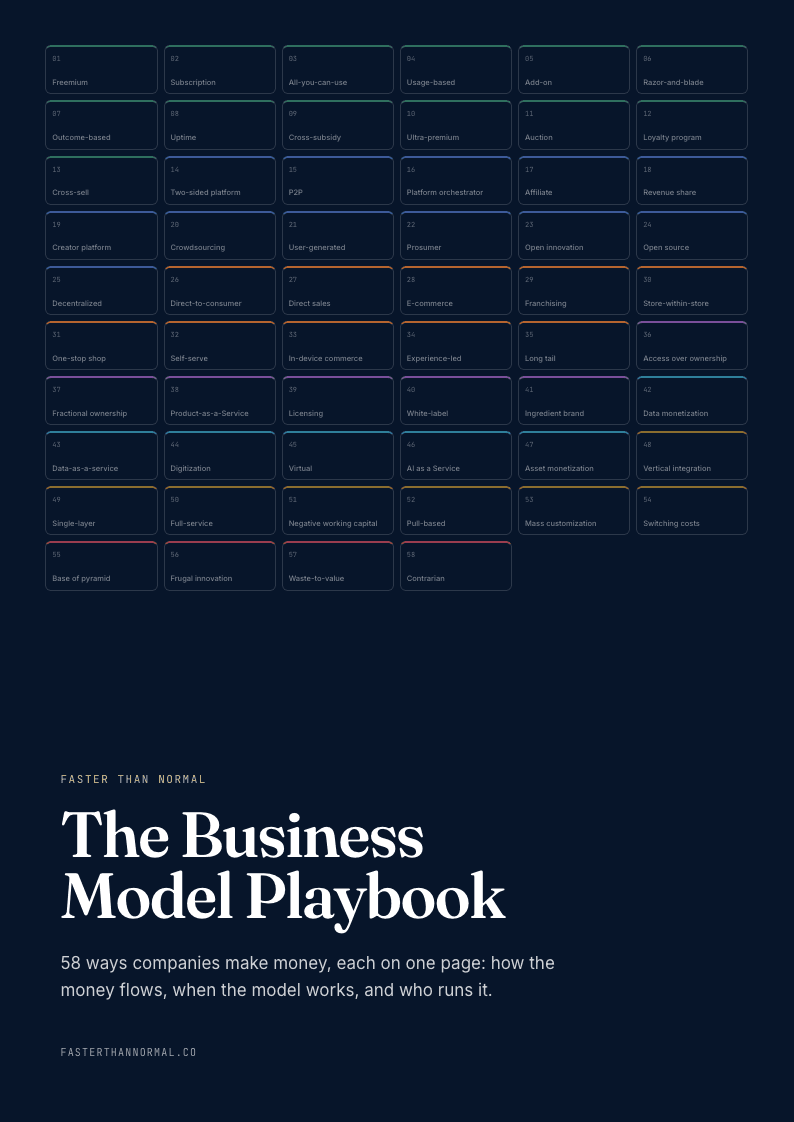
Free playbook
Get The Business Model Playbook
58 business models, one visual page each: how the money flows, the metrics that matter, and who runs it. Free when you join the Faster Than Normal email.
Free. No spam. Unsubscribe anytime.
Part IIIMaxims
-
Distress is discount. The best acquisitions are the ones that terrify your advisors. If your accountants and lawyers are comfortable with the price, you're probably overpaying.
-
Total commitment is its own competitive advantage. Pledging 100 percent equity — financial, reputational, emotional — produces an intensity of focus that diversified investors cannot match.
-
Cost control is not an accounting function. It is a leadership discipline. The founder who personally reviews expenses in the first ninety days sets a culture that outlasts any CFO.
-
Challenge the system, then become the standard. When institutional rules suppress value, provoke a renegotiation. The entity that forces the change captures the disproportionate upside.
-
The venue is the platform. A building designed for a single purpose is a depreciating asset. A building designed as a revenue ecosystem compounds.
-
Narrative control is brand control. The person who talks the most shapes the story. Availability is not weakness; it is strategy — provided you can absorb the criticism that comes with it.
-
Hire partners, not employees — but know the cost. Autonomous lieutenants produce breakthroughs. Compliant ones produce consistency. The founder's choice between the two reveals what they value more: excellence or control.
-
Out-of-consensus bets require in-domain expertise. Contrarianism without knowledge is just gambling. The wildcatter who knows the geology can afford to drill where others won't.
-
Brand can survive losing. It cannot survive irrelevance. Visibility, narrative, and emotional attachment will sustain a franchise through lean years — but only if the implicit promise of future competitiveness remains credible.
-
The gambler's greatest asset is the refusal to quit. And his greatest liability is the same thing.
In Their Own Words
I promise you that during my life, I was more concerned about not letting people down, about doing my part, than I was ever into what it did for me
The only way to break out is to gamble — take a chance with that first pick if you wanna dramatically improve your team
What you do is a little bit of my philosophy. Controversy. Controversy. I'm serious. I'm dead serious. Not serial killing. Not that. But controversy.
I just want to be relevant. I just want you to be looking at us.
If we had picked Manziel, he'd guarantee our relevance for 10 years.
I can tell you, I grew up with great coaching, and it had nothing to do with sports. I had great parents.
Nobody ever got to the top trying to have it on his best day. Football shows you how to do it when it's not your best day.— Jerry Jones
There is no such thing as status quo. If you're not moving forward every day, then you are falling behind.— Jerry Jones
We write a check with our mouth that our butt has to cover. Or should cover.— Jerry Jones, on the Cowboys' brand and business
When I woke up my first thought was, 'My God, what have I done?'— Jerry Jones, on the morning after purchasing the Cowboys
Son, do you love football? Then what are you doing in this bed? If you lie in this bed, you are going to be a loser for the rest of your life. Now get up, and if they ask you to be the water boy, then drown them with the damn water!— Pat Jones, to his son Jerry


