
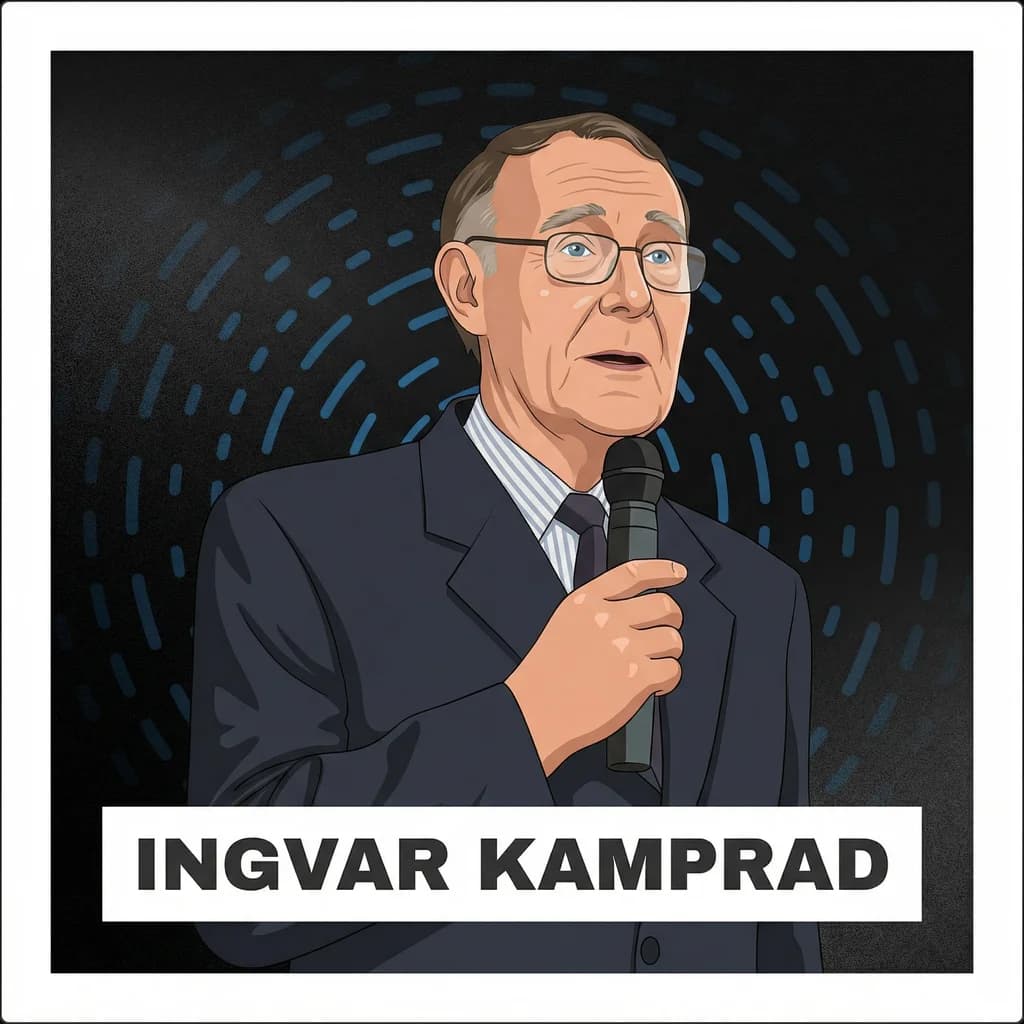

Part IThe Story
The Legs Come Off
One evening in 1956, in the dim light of a makeshift photography studio somewhere in rural Småland, a designer named Gillis Lundgren was trying to fit a table into the back of a car. He and Ingvar Kamprad had been working through the night, photographing a new leaf-shaped coffee table called LÖVET for the next catalog. The session was done, the table was beautiful, and there was no way it was going through the door of the vehicle. Lundgren stared at the problem for a moment, then grabbed a screwdriver. "So I unscrewed the legs," he said later, as though this were the most obvious thing in the world. Kamprad watched. Something clicked — not the legs reattaching, but an idea so simple it would restructure the economics of the entire global furniture industry. If you removed the legs — if you flattened the thing, boxed it, stacked it — the manufacturer paid less to ship it, the retailer paid less to store it, and the customer paid less to own it. The customer would also have to build the table themselves, but Kamprad, who had spent his entire life asking people to accept a little less convenience in exchange for a much lower price, understood instinctively that this was not a bug. It was the product.
That screwdriver moment — improvised, practical, born of a tight parking lot rather than a corporate strategy session — contains the entire theology of IKEA. Every innovation at the company would follow the same logic: strip away the unnecessary, redistribute the labor, pass the savings to the customer, and do it with such conviction that what looks like deprivation becomes a kind of democratic luxury. The man who built this theology was not an engineer or a designer or a theorist of retail. He was a dyslexic farm boy from the poorest province in Sweden who had been selling matchboxes from his bicycle since he was five years old, and who, at seventeen, registered a company whose name was an acronym of his own initials and the coordinates of his childhood — Ingvar Kamprad, Elmtaryd, Agunnaryd. He would spend the next seventy-four years — from 1943 until his death at ninety-one in 2018 — building that company into the largest furniture retailer on Earth, a business generating €45 billion in annual revenue with more than 480 stores across six continents, all without ever issuing a single share of stock, taking a dollar of outside capital, or borrowing meaningful money. Bloomberg estimated his net worth at $58.7 billion. He drove a 1993 Volvo, flew economy, and bought his clothes at flea markets.
The paradox at the center of Ingvar Kamprad's life is not the distance between his frugality and his fortune — that's merely colorful. The real paradox is the distance between his democratic vision and his autocratic temperament, between his stated mission to serve "the many people" and his youthful allegiance to movements that sought to destroy them, between the warmth that made employees love him and the obsessive control that made him structure his empire so that no single person — not even his own sons — could ever truly own it. He built a company designed to outlive everyone, and the question of whether that design reflected generosity or fear is one IKEA's corporate architecture still cannot answer.
By the Numbers
The IKEA Empire
€45.1BAnnual revenue (Ingka Group, FY2023)
480+Stores across six continents
860MAnnual store visits worldwide
$58.7BEstimated net worth at death (Bloomberg)
0Shares of stock ever issued
74Years Kamprad worked at IKEA (1943–2018)
€2B+IKEA Foundation grants since founding
Stones and Silence
To understand Ingvar Kamprad you must first understand Småland, and to understand Småland you must go back to the Ice Age. The glaciers, retreating north ten thousand years ago, deposited across this province an inexhaustible supply of stones — granite boulders that heaved up through the soil every winter, no matter how many the farmers cleared the autumn before. Generation after generation, the people of Småland made walls from the stones and furniture from the forests and a culture from the necessity of doing much with almost nothing. The province sits roughly 150 miles south of Stockholm, a landscape of dark pine forests and cold lakes, of red-painted timber cottages spaced far enough apart that loneliness becomes a personality trait. Average population density: twenty-four people per square kilometer. Smålanders are known throughout Sweden the way New Englanders are known in America — thrifty, taciturn, skeptical of luxury, and slightly insufferable about all three qualities.
Kamprad was born on March 30, 1926, in the parish of Pjätteryd, near the town of Älmhult, on a farm called Elmtaryd. His father, Feodor, managed the family property; his mother, Berta, was by all accounts kind, resourceful, and universally loved — the sort of woman who could keep a household running on ingenuity and warmth in a region where survival was never assumed. Ingvar spent his early years at his mother's family home, Majtorp, before the whole family moved to Elmtaryd when he was seven. At Majtorp there was a maternal grandfather, Carl Bernhard Nilsson, who ran a hardware store that sold everything from nails to dynamite and smelled of herring and leather. This grandfather was the boy's first business school. Ingvar could spend entire days behind the counter, playing shop, running errands that felt like games. "Play, play, play," the IKEA Museum account summarizes. The store was a paradise. The boy was learning the texture of transactions — the negotiation, the inventory, the small human drama of buying and selling — before he could properly read.
But the other grandparent mattered more, and in darker ways. Ingvar's paternal grandparents, Achim and Franziska Kamprad, were German immigrants who had arrived in Sweden from Saxony and the German-speaking part of the Austro-Hungarian Empire in 1896, purchasing the Elmtaryd farm. Three years later, Achim committed suicide when the farm's finances seemed beyond saving, leaving Franziska — pregnant, with two small children — to run the property alone. She did. She was, by every account, dominant, stubborn, and formidable, qualities that saved the farm and scarred the family. When Ingvar arrived at Elmtaryd at age seven, Grossmutter Fanny doted on him with a ferocity she denied everyone else, including his father Feodor, whom she had apparently crushed into permanent submission. Kamprad himself later acknowledged that this grandmother's influence was "devastating" — not because she was cruel to him, but because her adoration was so total and so exclusive that it warped his sense of the world.
Franziska Kamprad was also, as her grandson would eventually admit in Leading by Design: The IKEA Story, "a great admirer of Hitler." The grandmother's politics flowed into the household like groundwater. Feodor, the damaged son of a suicide and a despot, absorbed them. And Ingvar, the golden grandchild, absorbed them too — attending meetings of the pro-fascist New Swedish Movement as a teenager, becoming, according to the Swedish Security Service file opened on him in 1943, Member No. 4,014 of Swedish Socialist Unity, the country's leading far-right party during the war. He was seventeen. It was the same year he registered IKEA.
The Contradiction That Does Not Resolve
The two facts sit side by side with the stubborn irreconcilability of stones in a Småland field. In 1943, Ingvar Kamprad founded a business that would become a global emblem of egalitarian design, and Ingvar Kamprad was placed under surveillance by Swedish intelligence for his involvement in a Nazi organization. Both things happened to the same boy, in the same year, in the same small town.
The fuller picture, excavated over decades by journalists and most thoroughly by the Swedish investigative author Elisabeth Åsbrink, is worse than youthful folly. Kamprad did not merely attend a few meetings. He actively recruited for the Swedish Socialist Union. He invited fascist comrades to his home at Elmtaryd and was regarded as their benefactor. He sent money. He acted as publisher for at least one book by Per Engdahl, the leader of Sweden's anti-Semitic fascist movement after the war. And the relationship with Engdahl persisted: a 1950 wedding invitation from Kamprad to Engdahl, uncovered by Åsbrink, begins with "BB" — bäste broder, best brother — and speaks of pride in their shared circle. In 1951, Engdahl gave a speech at Kamprad's first wedding.
When these connections first became public in the 1990s, Kamprad apologized, calling his involvement "the greatest mistake of my life" and "youthful stupidity." He wrote a letter to IKEA employees asking forgiveness. The apology worked — the brand was too strong, the contrition sufficiently abject, the Swedish public willing to file it under the category of wartime confusion. But when Åsbrink interviewed Kamprad in 2010 at IKEA's headquarters in Älmhult — at the corporate address of 1 Ikea Street — and pressed him repeatedly about Engdahl, the ninety-year-old furniture dealer who had spent six decades preaching democratic values offered a reply that cracked the surface of every apology he had ever made:
— Ingvar Kamprad, to Elisabeth Åsbrink, August 2010Per Engdahl was a great man, and I'll maintain that as long as I live.
How to reconcile this with the man who simultaneously employed Otto Ullmann, a Jewish refugee from Austria, as one of IKEA's first workers? Ullmann had been hired as a farmhand by the Kamprad family during the war and became Ingvar's close friend. His parents were murdered in Auschwitz. When Åsbrink asked Kamprad how he could remain loyal to both Engdahl and Ullmann — the Holocaust denier and the Holocaust survivor — he answered: "There's no contradiction as far as I'm concerned." Ullmann's own children, according to Åsbrink, said their father was furious when the fascist connections surfaced in the 1990s and refused to forgive Kamprad.
There is no clean way to narrate this. The standard biographical treatment — youthful mistake, sincere apology, redemptive life's work — collapses under the weight of the 2010 interview. What remains is a man of extraordinary business genius and genuine warmth who carried within him a compartmentalization so total that he could not see — or would not acknowledge — the moral chasm between the two loyalties. When Åsbrink published her findings in book form in 2011, IKEA took a month to respond and then made a $51 million donation to the United Nations High Commission on Refugees, the single-largest donation in the organization's history. The gesture was enormous and insufficient, which is perhaps the only honest summary available.
The Education of a Mail-Order Boy
Strip away the shadow and return to the sunlit version: the boy on the bicycle, the matchboxes, the lingonberries, the garden seeds that earned enough money for a racing bike and a typewriter. At five years old, Ingvar Kamprad was selling matches to neighbors, having discovered the foundational principle of his career — that you could buy something cheaply in bulk from Stockholm and sell it at a low price locally while still making a profit. From matches he graduated to fish, Christmas decorations, pencils, ballpoint pens, nylon stockings, picture frames. He was, from the beginning, a middleman — not an inventor, not a craftsman, but a broker of the gap between factory price and retail price. At boarding school, he noticed that pencils from his wholesaler cost half an öre each but sold in the grocery store for ten öre. The spread offended him. It would always offend him.
In 1943, his father gave him a small sum of money as a reward for succeeding at school despite his dyslexia. (He needed his father's written permission to register a company at seventeen, and also required the signature of his guardian, which he obtained by cycling to the man's house in Bankaboda and talking him into it.) The company was IKEA — the initials I.K. from his name, E from Elmtaryd, A from Agunnaryd. He sold miscellany: watches, wallets, jewelry, pens. He placed advertisements in local newspapers. He distributed a makeshift mail-order catalog called ikéa-nytt, writing all the copy himself. He shipped products via the local milk van, which delivered them to the nearest train station. The early logo included an accent over the "E" — a hint, perhaps, of aspirations beyond Småland.
By 1948, he had introduced furniture to the catalog, sourced from local manufacturers in the forests near Elmtaryd. The response was immediate and overwhelming. Sales climbed from 100,000 to 600,000 kronor in three years. By 1951, he abandoned everything else — the pens, the stockings, the picture frames — to focus exclusively on low-priced furniture and home furnishings. He published the first proper IKEA catalog that year. It would eventually become one of the most-printed publications in human history, distributed in over two dozen languages, with a larger annual print run than the Bible.
But the mail-order model had a flaw. Competitors began selling inferior furniture at similarly low prices, and because customers could not see or touch the products before ordering, they had no way to distinguish IKEA's quality from the junk. Complaints rose. Customer trust eroded. Kamprad faced a choice: let the business degrade into a race to the bottom, or find a way to let people experience the product before buying. In 1953, with characteristic audacity, he opened a permanent showroom in Älmhult — a converted workshop where customers could come, sit in the chairs, open the drawers, run their hands along the wood grain. It was, in essence, the prototype of the modern IKEA store. People came from extraordinary distances. The showroom eliminated the quality question and set the stage for everything that followed.
The Boycott That Built an Empire
Success in Sweden's furniture market of the 1950s was not merely a matter of offering lower prices. It required surviving the wrath of an established industry that viewed those prices as an existential threat. The Swedish furniture cartel — an ecosystem of manufacturers, retailers, and trade associations that had comfortably controlled pricing for decades — looked at Kamprad's operation and decided to destroy it.
The mechanism was a boycott. Swedish suppliers were pressured, individually and collectively, to stop selling to IKEA. Manufacturers who continued to work with Kamprad found themselves blacklisted by other retailers. At industry trade fairs, IKEA was denied entry. The established players assumed that a young mail-order dealer from the provinces, cut off from his supply chain, would simply wither and die.
They were wrong, and the way they were wrong would define IKEA's strategic DNA for the next seventy years. Kamprad did not capitulate, compromise, or retreat. He went around them. Barred from buying the same mass-produced furniture as his competitors, he began designing his own. He forged relationships with small, independent manufacturers willing to violate the boycott through back channels — rerouting orders, creating new company identities, going directly to factories to build production relationships based on personal trust rather than industry protocol. And then he did something that, in Cold War Sweden, was nearly unthinkable: he went to Poland.
— Ingvar KampradThe boycott only made us stronger, and the crisis became a non-crisis as we were constantly coming up with new solutions.
In 1961, at the height of hostilities between East and West, Kamprad moved significant portions of IKEA's manufacturing to communist Poland. Malcolm Gladwell, speaking at the World Business Forum years later, put it bluntly: "That's like Wal-Mart moving to North Korea." Swedes called him a traitor. He didn't care — or, more precisely, he possessed what Gladwell identified as a rare combination of conscientiousness, openness, and disagreeableness that made him constitutionally incapable of caring about social disapproval when a cost advantage was at stake. Polish manufacturers offered dramatically lower production costs. The quality was comparable. The vodka, consumed in enormous quantities during negotiations, gave him what he later described, with uncharacteristic candor, as an alcohol problem he would spend decades managing through month-long abstinence cycles three times a year.
The boycott, intended to kill IKEA, instead forced every innovation that made IKEA unique. In-house design capability. An independent supply chain. International sourcing. The flat-pack revolution that began with Gillis Lundgren's screwdriver. Without the boycott, Kamprad might have remained a moderately successful Swedish furniture retailer. With it, he was compelled to reinvent the entire model — to become, as the Harvard Business School case study would later describe, an "innovative and unconventional entrepreneur whose approaches redefine the nature and structure of the industry."
The Cathedral of Inconvenience
The first proper IKEA retail store opened in Älmhult in 1958 — 6,700 square meters, the largest furniture display in Scandinavia at the time. It contained the elements that would become liturgical: the winding path through room settings that forced customers to see everything, the warehouse section where you located your own flat-packed boxes using a cryptic alphanumeric code, the restaurant (added in 1960) that served Swedish meatballs to shoppers who might otherwise leave at lunchtime. The restaurant was born of observation: Kamprad noticed that people walked out of the store to eat at nearby restaurants and never came back. "It's tough to do business on an empty stomach," became an IKEA maxim. By 2002, the stores were selling 112 million meatballs in the UK alone.
The genius of the IKEA store was that it transferred enormous amounts of labor from the company to the customer — browsing without salespeople, retrieving from the warehouse without staff, transporting in your own car without delivery trucks, assembling at home without craftsmen — and then framed each transfer as a benefit. Lower prices! Democratic design! The satisfaction of building something yourself! Researchers would later study this phenomenon and give it a name: the IKEA Effect. People love products more when they complete the assembly themselves, because the labor creates a sense of ownership that money alone cannot buy. Kamprad understood this intuitively, decades before any psychologist formalized it.
Gillis Lundgren — the man with the screwdriver, who had joined IKEA as its fourth employee and become its chief designer — was the other architect of the store concept. Born with an illustrator's eye and a mechanic's pragmatism, Lundgren sketched the BILLY bookcase on the back of a napkin in 1978, worried he would forget it. The BILLY would become perhaps the most ubiquitous piece of furniture in the world: over sixty million units produced, one for roughly every hundred people on Earth, manufactured at a rate of one every three seconds at the Gyllensvaans Möbler factory in Kattilstorp. Bloomberg would create the Billy Bookcase Index — a purchasing power comparison across countries, like the Big Mac Index — as evidence of the product's global baseline status.
The stores themselves were deliberately placed on the outskirts of cities, near major highways and ports, where land was cheap and parking lots could be enormous. This was heresy in an industry that depended on high-street visibility. But Kamprad understood that furniture shopping was not an impulse purchase — people would drive to a destination if the destination was compelling enough and the prices low enough. The stores' exteriors were painted in the Swedish national colors, blue and yellow, a choice that gradually fused IKEA's brand identity with Sweden's national identity so completely that the two became nearly inseparable. Walking into an IKEA store anywhere in the world — in Gwangmyeong, South Korea, or Kungens Kurva, outside Stockholm — is walking into a simulacrum of Sweden: the blonde wood, the meatballs, the lingonberry jam, the wordless assembly instructions drawn with a cheerfulness that belies the complexity of what you're about to attempt.
The Testament
By the mid-1970s, IKEA was expanding fast — new stores opening constantly, iconic products rolling out (LACK, BILLY, IVAR, KLIPPAN), international ambitions escalating — and Kamprad was getting nervous. Not about growth, but about meaning. He had moved his family to Denmark in 1973 to escape Sweden's restrictive foreign exchange regulations and punitive tax rates, and then, in 1976, to Switzerland. The physical distance from Älmhult — from the factory floors, the warehouse workers, the co-workers (he hated the word "employees") who embodied the culture he had built — alarmed him. How could he talk to people he never saw? How could the IKEA spirit survive when the man who had breathed it into existence was living in a Swiss village?
His answer was to write it down. In 1976, Kamprad produced a nine-point document titled "The Testament of a Furniture Dealer" — a cultural manifesto so specific, so idiosyncratic, and so persistently relevant that it is still handed to every new IKEA employee nearly fifty years later. Jesper Brodin, the current CEO of Ingka Group, received his copy when he joined the company as a sales manager in 1999 and still considers its lessons "timeless." The document opens with a declaration of purpose — "To create a better everyday life for the many people" — and then lays out the operational philosophy required to achieve it:
The product range is the company's identity. Profit gives resources, but must be earned before it is spent. Reaching good results with small means. Simplicity is a virtue. Doing it a different way. Concentration. Taking responsibility. Most things still remain to be done — a glorious future!
The Testament is not a strategy document. It is a belief system. Its central conviction — "We have decided once and for all to side with the many" — carries the force of a moral commitment, not a market positioning statement. Kamprad meant it. The many people were not an addressable market; they were a cause. And the instrument of that cause was relentless, almost fanatical cost control. "Expensive solutions to any kind of problem are usually the work of mediocrity," he wrote. "We have no respect for a solution until we know what it costs."
This was not theory. Kamprad's personal life was the Testament made flesh. He flew economy, even long-haul. He took the Stockholm subway using his pensioner's discount. He visited vegetable markets at closing time to negotiate lower prices. He drove the Volvo until it was an antique. He got his hair cut in developing countries. When a Swedish television documentary in 2016 asked about his wardrobe, the then-eighty-nine-year-old billionaire replied: "I don't think I'm wearing anything that wasn't bought at a flea market. It means that I want to set a good example." His former executive assistant, Johan Stenebo, wrote in a behind-the-scenes book called The Truth About IKEA that the frugality was partly performance — "He wanted to appear a man of the people, one of us" — but even Stenebo acknowledged that the performance was grounded in genuine conviction. The man really did reuse tea bags.
The Architecture of Eternity
Kamprad's deepest obsession was not cost or design or even customers. It was time. He wanted IKEA to live forever. When Ingka Group CEO Jesper Brodin asked him how he defined long-term planning, Kamprad replied: two hundred years. Not a metaphor. A planning horizon.
To achieve this, he constructed one of the most labyrinthine corporate structures in the history of private enterprise. In the early 1980s, Kamprad transferred ownership of the Ingka Group — which owns and operates the majority of IKEA stores worldwide — to the Stichting Ingka Foundation, a Dutch entity whose stated purpose includes both charitable donations and reinvestment in the business. The Foundation owns itself. No Kamprad family member holds shares. Separately, the IKEA brand, trademarks, and franchise concept were placed under the control of Inter Ikea, whose ultimate parent is the Interogo Foundation, based in Vaduz, Liechtenstein. The Kamprad family members on the supervisory councils of these entities are, by statute, always in the minority.
The effect of this architecture is radical: when Kamprad died on January 27, 2018, at his home in Småland, his $58.7 billion fortune — as calculated by Bloomberg — technically "fell to no one," as the Financial Post reported. His three sons, Peter, Jonas, and Mathias — who have never given interviews and are involved in running the family's Ikano Group, a separate constellation of finance, real estate, and retail businesses with total assets of about $10 billion — do not and cannot directly control the furniture empire their father built. The structure makes it impossible for any individual, whether manager or heir, to assume the kind of total authority Kamprad himself once wielded. It is, depending on your interpretation, an act of supreme institutional generosity or supreme institutional paranoia — a founder ensuring his creation will outlive every human impulse, including the ambitions of his own children.
— Per Heggenes, CEO of the IKEA Foundation, to Bloomberg, 2012He was not interested in money. That is clear from the way he structured the ownership.
The charitable dimension is real and substantial. The IKEA Foundation, funded by dividends flowing from Ingka Group through the Ingka Foundation, has distributed more than €2 billion in grants to partners worldwide, with a focus on climate change, refugee support, and poverty reduction in developing economies. In 2011, following the Åsbrink revelations, it made the $51 million UNHCR donation. In 2019, it established a €33 million endowment at Lund University — the largest with such a purpose since the university's founding in 1666 — to secure the School of Industrial Design that Kamprad had been funding since its inception twenty years earlier. These are not token gestures. But neither does the foundation structure resolve the fundamental opacity of who benefits from IKEA's profits, how much is reinvested versus donated, and whether the apparatus that Kamprad built primarily serves philanthropy or perpetuity. "We tried to figure it out and couldn't," Fortune magazine admitted.
The Expansion and the Discipline of Patience
IKEA's international growth follows a pattern that looks, from the outside, almost absurdly slow — until you notice that the slowness is the strategy. Kamprad founded the company in 1943. It didn't sell furniture until 1948. The first store opened in 1958. The first international store — Norway — came in 1963, a full twenty years after the founding. Denmark followed in 1969. Switzerland, Germany, and Australia came in the 1970s. The United States in 1985. China not until the late 1990s. South Korea in 2014, after six years of scouting and planning. India only in the late 2010s, with a planned $2 billion investment over a decade. Each new market was approached with the caution of a military campaign and the humility of a guest.
The South Korea entry is instructive. It took six years from the first scouting trip to the store opening in Gwangmyeong, outside Seoul. The team spent months studying the Korean preference for metal chopsticks, the importance of kimchi refrigerators, the appropriate size of children's sections in a culture where kids are given ample space in family living quarters. They still got some things wrong — underestimating the parking needed, and selling a map that labeled the body of water east of Korea as the "Sea of Japan" rather than the "East Sea," provoking local fury. But the 624,000-square-foot Gwangmyeong store, more than three times the size of an average Walmart Supercenter, became one of IKEA's top-performing outlets within its first year.
"They are ferocious about not expanding too rapidly," said David Marcotte of consulting firm Kantar Retail. Current CEO Jesper Brodin has formalized this instinct into a rule: more than 10% annual growth is too fast. The target band is 5–9% — enough to compound powerfully over decades, restrained enough to avoid the organizational hangovers that come with overextension. This patience is made possible by the foundation structure, which insulates IKEA from the quarterly-earnings pressure that forces publicly traded companies into growth-at-all-costs strategies. There are no shareholders demanding returns. There is only the mission — Kamprad's two-hundred-year clock, ticking slowly.
🌍
IKEA's Deliberate International Expansion
A timeline of studied patience: 20 years before the first foreign store, 30 years before leaving Scandinavia.
1943
Kamprad registers IKEA as a mail-order business in Älmhult, Sweden.
1948
Furniture added to the catalog for the first time.
1953
First showroom opens in Älmhult.
1958
First full IKEA retail store: 6,700 sq. meters in Älmhult.
1963
First international store opens in Norway — 20 years after founding.
1969
Denmark store opens; Finland blocked by permit issues.
1970s
Eight new markets on three continents, including Germany and Australia.
1985
First US store opens.
2000
E-commerce sales begin.
2014
South Korea opens after six years of preparation.
2018
Kamprad dies. More than 400 stores in 52+ markets worldwide.
The Price Comes First
The most counterintuitive thing about IKEA's design process is that it begins not with aesthetics or materials or customer surveys but with a price tag. Kamprad codified this in the Testament: "There shall always be a substantial price difference compared to our competitors, and we shall always have the best value-for-money offers for every function." In practice, this means that IKEA designers are told the retail price of a product before they draw a single line. A bookcase must cost this much. A sofa must cost that much. Now design backward from the constraint.
This inverted the traditional furniture industry, where designers created freely and accountants priced the result. At IKEA, the production engineer and the logistics specialist sit alongside the designer from the first day. Every product must fit on a standard European pallet. Every material choice must justify itself against the price target. Every curve, every joint, every millimeter of wood must survive the question: What does this cost?
The results are products like the Poäng chair, whose sticker price is 70% cheaper now than it was thirty years ago. Or the Bang mug — 25 million sold per year — whose tapered design allows more mugs to be stacked per pallet, reducing shipping costs per unit. Or the Ektorp sofa, redesigned in 2010 with detachable armrests that halved the packaging size, halved the number of lorries required, and cut a seventh off the retail price. These are not design compromises. They are design achievements born of constraint — the same logic that produced the flat-pack in the first place, the same instinct that saw table legs as problems to be removed rather than features to be preserved.
The naming convention carries the same mix of whimsy and system. Kamprad, partly dyslexic, found names easier to remember than product numbers, so he created a taxonomy: beds named after Norwegian towns, sofas after Swedish towns, dining tables after Finnish places, chairs after men's names, fabrics after women's names, rugs after Danish places, lighting after terms from music and meteorology and nautical life. The BILLY bookcase, named after a male name, belongs to the "bookcase ranges — occupations" category, though no one seems to recall which occupation. "He loves to tell that story," said Juni Wannberg, a guide at the IKEA Museum in Älmhult.
The Family He Neglected and the One He Built
Kamprad married twice — first in 1951, briefly, and then to Margaretha Stennert in 1963, with whom he had three sons: Peter, Jonas, and Mathias. The family moved to Denmark in 1973, then to Switzerland in 1976, following the IKEA treasury as it fled Sweden's tax regime. The sons grew up in the orbit of the company, inescapably. Kamprad acknowledged, with a regret that sounded more like an observation than an apology, that he had neglected his family for the business. In meetings, his sons sat in silent obedience when their father spoke. New IKEA projects still invariably originated with Kamprad himself, even in his eighties.
When Margaretha died in 2011, the tether to Switzerland loosened. Kamprad, eighty-seven and contending with heart and back problems, began planning his return to Småland. In 2014, coinciding with the relaxation of Swedish tax laws — though the family spokesman insisted the timing was coincidental — he moved back to a farmhouse near Älmhult. The previous year, he had stepped down from the board of Inter Ikea Holding, and Mathias, the youngest son, became chairman. But in Älmhult, Ingvar remained omnipresent — visiting the product development labs, chatting with co-workers, walking the aisles. "He'll always do it. I'm convinced about that," his spokesman told reporters.
The sons have never given interviews. They manage the Ikano Group — the family's separate collection of finance, real estate, and retail businesses — and serve on the supervisory councils of the various IKEA foundations, always as a minority. The arrangement reflects Kamprad's conviction, expressed in the Testament, that "taking responsibility is a privilege" but also, implicitly, that no individual — not even one bearing his name — should be trusted with too much of it. The company he built was not a family business in any conventional sense. It was a quasi-religious institution whose founder happened to have sons.
The other family — the one Kamprad built deliberately — was IKEA's workforce, whom he insisted on calling "co-workers." He personally handed out Christmas presents to thousands of employees every year. He called them by first names. He walked their floors. The culture he created was, by corporate standards, genuinely unusual: flat hierarchies, a prohibition on luxury (no business-class flights, no expensive hotels, no company cars), a vocabulary of egalitarian informality that echoed the Småland values of his childhood. Employees who resonated with the culture tended to stay for decades. Those who didn't left quickly. There was no middle ground.
BoKlok and the Extension of the Mission
In the 1990s, most new homes in Sweden were priced beyond the reach of ordinary people. Kamprad looked at this the way he had once looked at the gap between factory prices and retail prices for furniture: as an offense against common sense, and an opportunity. Together with Melker Schörling, then president of the construction giant Skanska — a man whose career in industrial efficiency mirrored Kamprad's own obsession with cost structures — he created BoKlok, Swedish for "Live Smart."
The concept applied IKEA logic to housing: large volumes, low prices, industrialized production, standardized designs that prioritized light, natural materials, and energy efficiency over architectural showmanship. The guiding question — Kamprad's question, characteristically precise — was: "How much can a single nurse with a child afford to spend on a home?" The answer in the mid-1990s was about 3,000 Swedish kronor per month, roughly $380. Every subsequent decision — materials, floor plans, construction methods — worked backward from that number.
The first BoKlok development opened in 1997 near Helsingborg. Kamprad attended the ceremony and walked around asking homebuyers, "What can we do better?" The reviews were rapturous, in both daily newspapers and design magazines. By 2018, more than 11,000 BoKlok homes had been produced, mostly in the Nordics. Cozy, not flashy. Homes for nurses and sales clerks and single parents and young families still at university. The mission — "a better everyday life for the many people" — extended beyond furniture, beyond the store, into the most fundamental human need: shelter.
The Return to Småland
He died on January 27, 2018, a Saturday, at his home in Småland. Peacefully, following a short illness, surrounded by his family. He was ninety-one. The company he had founded seventy-four years earlier issued a statement through its Swedish unit. Jesper Brodin, CEO of the IKEA Group, called his legacy one that "will be admired for many years to come." Torbjörn Lööf, CEO of Inter Ikea, spoke of his "dedication and commitment to always side with the many people." Lars Thorsén, CEO of the Ikano Group, noted: "No matter how big or small the detail, his ideas were grounded on the firm belief that things could always be improved or done differently. And many times, the best ideas were the simplest."
In 2014, shortly after returning to Sweden, Kamprad had donated 53 million kronor — roughly $7.7 million — to a foundation in Agunnaryd, his hometown. The money was for rural development, for encouraging long-term living and working in the area. Agunnaryd's population numbered only a few hundred. Bengt Nilsson, chairman of the local board, told the Smålandsposten: "We're very proud of Ingvar Kamprad around here and we're of course very thankful that he thinks of his hometown like this."
He had spent four decades in exile — Denmark, then Switzerland — building the machinery of corporate immortality, layering foundations upon foundations, transferring control to entities that owned themselves, writing testaments and dictionaries and cultural bibles to preserve the spirit of a company born in a godforsaken place deep in the forest. And then, at the end, with his wife gone and his back failing and his sons dispersed across the empire, he came home. Not to the vast blue-and-yellow stores that bear his initials, not to the boardrooms in Leiden or Vaduz, but to Småland — to the stones and the silence, the red cottages and the dark pines, the soil that yields nothing without effort. The farm was still there. His name was still on it. The glaciers had moved on ten thousand years ago, but the stones, as always, kept rising.
Part IIThe Playbook
Ingvar Kamprad spent seventy-four years building IKEA, and in 1976 he distilled his operating philosophy into a nine-point manifesto he called "The Testament of a Furniture Dealer." What follows are the deeper principles embedded in that document and in his life — not the slogans, but the structural logic beneath them. These are the ideas that turned a mail-order business in rural Sweden into the world's largest furniture retailer without ever taking outside capital.
The principles
- 1.Design backward from the price tag.
- 2.Let your enemies build your moat.
- 3.Transfer labor to the customer — and make them love it.
- 4.Treat cost consciousness as a moral position, not a financial one.
- 5.Write the culture down before you lose it.
- 6.Own the structure that owns the business.
- 7.Expand at the speed of learning, not ambition.
- 8.Make constraint the engine of innovation.
- 9.Side with the many — and mean it.
- 10.Build for the two-hundred-year clock.
- 11.Lead by example, not by title.
Principle 1
Design backward from the price tag
Most companies design a product and then figure out what to charge. Kamprad reversed the sequence entirely. The retail price is decided first — based on what "the many people" can afford — and the design, materials, engineering, and logistics are all reverse-engineered to hit that number. This is not a negotiation between the design team and the finance team. It is a constitutional constraint, established before a single sketch is drawn.
The effect is profound. When the price is fixed and non-negotiable, every participant in the product development process — designers, production engineers, logistics specialists, material scientists — is forced to innovate within the constraint rather than negotiate around it. The Poäng chair costs 70% less in real terms than it did thirty years ago not because materials got cheaper but because the constraint forced continuous re-engineering. The Bang mug's tapered shape is not an aesthetic choice; it is a pallet-stacking optimization that reduces shipping cost per unit.
This approach requires what Kamprad called "democratic design" — the balance of five dimensions: form, function, quality, sustainability, and low price. All five must be present simultaneously. The price does not excuse bad design. The design does not excuse a high price. The tension between these requirements is the creative engine.
Tactic: Before beginning any product or service development, fix the end-user price first and make the entire team engineer backward from that number — treating the price as a design constraint, not a financial afterthought.
Principle 2
Let your enemies build your moat
The Swedish furniture cartel's boycott of IKEA in the 1950s was intended to destroy the company. Instead, it forced Kamprad to develop every capability that would later constitute IKEA's competitive advantage: in-house design, independent supply chains, international sourcing, and the flat-pack innovation. Without hostile pressure, IKEA might have remained a reseller of other manufacturers' products — a middleman, not a system.
The lesson is not merely "turn lemons into lemonade." It is that existential threats, properly metabolized, create structural advantages that would never emerge from internal strategy sessions. When competitors blocked Kamprad's access to Swedish suppliers, the response — going to Poland, designing his own products, inventing flat-pack distribution — created barriers to entry that no competitor has successfully replicated in seventy years.
Kamprad understood this instinctively: "The boycott only made us stronger, and the crisis became a non-crisis as we were constantly coming up with new solutions." The crisis forced differentiation. The differentiation became identity. The identity became moat.
Tactic: When competitors or incumbents try to shut you out of the existing supply chain or distribution system, treat it as a forcing function to build your own — the proprietary infrastructure you create under duress will become your most defensible asset.
Principle 3
Transfer labor to the customer — and make them love it
IKEA's business model is, at its core, a labor arbitrage. The customer does the browsing (no salespeople), the retrieving (self-service warehouse), the transporting (your car, not our trucks), and the assembling (your hands, not our workers). Each transfer of labor from the company to the customer reduces cost, which reduces price, which increases volume, which further reduces cost. The flywheel spins.
But the transfer must not feel like deprivation. It must feel like empowerment. Researchers have formalized this as "the IKEA Effect" — the psychological phenomenon whereby people value products more when they've invested their own labor in building them. Kamprad understood this decades before the research existed. The act of assembly is not a bug in the business model; it is the emotional core of the brand experience. You built this. It's yours.
The store layout reinforces this: the winding path through room settings is not merely merchandising; it is an immersive experience that makes the customer feel like an interior designer. The pencil and notepad (the pencil, famously, is short — Kamprad once challenged the Swedish pencil industry about why pencils needed to be long when short ones worked just as well) make you an active participant in the shopping process, not a passive recipient of sales pressure.
Tactic: Identify every task your company performs that the customer could do themselves — and redesign the experience so that the transfer of labor feels like a gain in autonomy, personalization, or satisfaction rather than a loss of service.
Principle 4
Treat cost consciousness as a moral position, not a financial one
For most companies, cost control is a financial discipline — a means of protecting margins. For Kamprad, it was a moral imperative. "Every time IKEA spends one krona foolishly, it comes right out of the customer's pocket," he argued, echoing Sam Walton's identical conviction almost word for word. The logic is that if you have committed to serving "the many people" — people who cannot afford expensive solutions — then waste is not merely inefficient. It is a betrayal.
This framing transforms cost consciousness from a management exercise into a cultural identity. When the founder drives a 1993 Volvo and buys clothes at flea markets, those are not eccentricities. They are sermons. Every employee who sees the billionaire founder flying economy understands that frugality is not something the company imposes on them while leadership indulges itself. It is the water everyone swims in.
💰
Cost Control as Culture: Kamprad vs. Convention
How IKEA's approach to cost differs from standard corporate practice.
| Standard approach | Kamprad's approach |
|---|---|
| Cost control is a finance function. | Cost control is a moral obligation to the customer. |
| Leaders earn perks as they advance. | Leaders model austerity to set the cultural norm. |
| Savings improve margins. | Savings reduce prices. |
| Frugality is a phase (startup stage). | Frugality is permanent, regardless of scale. |
Kamprad pushed cost awareness "at all levels with almost manic frenzy." The word "manic" is not accidental. It conveys the intensity required to sustain this discipline across decades and continents, in a company with over 200,000 co-workers and €45 billion in revenue. The discipline does not weaken as the company grows. It intensifies.
Tactic: Frame cost discipline not as financial prudence but as a moral contract with your customer — and ensure that leadership's personal behavior reinforces the message at every level.
Principle 5
Write the culture down before you lose it
The Testament of a Furniture Dealer was not written because Kamprad wanted to be a corporate philosopher. It was written because he was moving to Switzerland and could no longer talk to every employee in person. The impetus was practical, not aspirational. He saw the culture eroding as the company expanded, as new hires arrived without any connection to the values that had built IKEA, and as layers of management accumulated between the founder and the front lines.
The solution was documentation — but documentation of a particular kind. The Testament is not a strategy memo or an HR manual. It is a declaration of beliefs, written in the first person, with the emotional force of a letter from a father to his children. It reads like what it is: one man's attempt to preserve what he considers sacred against the entropy of growth.
The document works because it is specific rather than generic. "Simplicity is a virtue" is not just a platitude; it is accompanied by operational details — no business-class flights, no expensive hotels, bureaucracy as "the greatest enemy." "Doing it a different way" is not a vague innovation slogan; it is a mandate to question every industry convention. The specificity makes the values actionable, which makes them cultural rather than aspirational.
Tactic: Before your company outgrows your ability to transmit culture through personal contact, write down not what you do but what you believe and why — and make the document specific enough to be operationally binding.
Principle 6
Own the structure that owns the business
Kamprad's corporate architecture — the nested foundations, the Dutch entities, the Liechtenstein holding companies — is often described as tax optimization. It is that, but it is also something more radical: an attempt to remove the business from the control of any individual, including its founder and his heirs.
The Stichting Ingka Foundation owns the company. The foundation owns itself. No person is entitled to its assets. The Kamprad family serves in minority roles on supervisory councils. Profits can be reinvested in the business or donated to charity — the only two permitted uses. The structure eliminates the possibility of a hostile takeover, a forced public offering, a succession crisis driven by family infighting, or an impatient investor demanding short-term returns.
The cost is transparency. Outsiders cannot determine who truly benefits from IKEA's profits. The charitable purpose of the foundation coexists with a structure that allows indefinite reinvestment, and the line between philanthropy and perpetuity is deliberately blurred. But the benefit — from Kamprad's perspective — is permanence. The business is designed to outlive every stakeholder, every generation, every economic cycle.
Tactic: If your goal is institutional longevity, design ownership structures that prevent any single actor — including you — from making decisions that prioritize short-term interests over the long-term mission.
Principle 7
Expand at the speed of learning, not ambition
IKEA's internationalization timeline — twenty years to the first foreign store, thirty years to leave Scandinavia, six years to open in South Korea — looks absurdly slow against the growth trajectories of modern companies. But the slowness is itself a competitive strategy. Each new market is entered only after exhaustive study, adaptation, and preparation. The company learns the local culture, adjusts its product range (kimchi refrigerators in Korea, smaller kitchens in Tokyo), and builds logistics infrastructure before opening a single store.
Current CEO Jesper Brodin has quantified this: 5–9% annual growth is the target range. Above 10% is dangerous. "Many companies make the mistake of growing very fast when it is possible and then suffering the hangover-like symptoms of the rapid growth phase," he told Dagens Industri. The foundation structure enables this patience by eliminating external pressure to accelerate.
The result is a company that rarely retreats from a market once it enters. The stores are right-sized, the supply chains are established, and the cultural adaptation is genuine rather than cosmetic. Slowness is not caution; it is thoroughness.
Tactic: Define a maximum growth rate for your business — a speed above which organizational capacity degrades — and treat that ceiling as seriously as you treat your revenue targets.
Principle 8
Make constraint the engine of innovation
The flat-pack was born because a table wouldn't fit in a car. The independent supply chain was born because suppliers were boycotting. The showroom was born because customers couldn't trust mail-order quality. The restaurant was born because shoppers left at lunchtime. In every case, IKEA's most significant innovations emerged not from R&D departments or brainstorming sessions but from operational problems encountered in the field.
Kamprad institutionalized this by making constraint a design principle. Products must fit on standard pallets. Stores must operate without salespeople. Prices must be substantially below competitors. Each constraint eliminates easy solutions and forces creative ones. The BILLY bookcase's production line — one unit every three seconds, 600 tonnes of particle board per day — exists because the price target demanded that level of manufacturing efficiency.
This is not the same as "move fast and break things." It is closer to "define the boundaries precisely and then explore every inch of the space within them." The boundaries are permanent. The exploration is endless.
Tactic: When facing an operational constraint, resist the instinct to remove the constraint — instead, hold it fixed and force your team to innovate within it, on the assumption that the constraint-driven solution will be more durable than the unconstrained one.
Principle 9
Side with the many — and mean it
"We have decided once and for all to side with the many." This is not a marketing tagline. It is a strategic commitment that determines product range, pricing, store location, supply chain design, and corporate structure. "The many people" — Kamprad's phrase, used with the specificity of a theological term — are not wealthy. They cannot afford expensive furniture. They live in apartments, not houses. They need functional, well-designed products at prices that respect their economic reality.
Every strategic decision at IKEA is filtered through this commitment. Store locations on the outskirts of cities, where land is cheap: because the savings go to the customer. Self-assembly: because it eliminates labor cost. Flat-packing: because it eliminates shipping cost. No external financing: because debt service would eventually be passed to the customer. The BoKlok housing project: because the mission extends beyond furniture to shelter itself.
The commitment also determines what IKEA refuses to do. It does not compete in luxury. It does not chase high-margin niches. It does not optimize for profit maximization. The foundation structure ensures that profits are recycled into lower prices or charitable work rather than distributed to shareholders. This is Kamprad's most radical proposition: that a company can grow to €45 billion in revenue by systematically deprioritizing profit in favor of price.
Tactic: Define your "many people" with the same specificity Kamprad used — not as a market segment but as a moral constituency — and filter every strategic decision through the question of whether it serves their interests or merely your margins.
Principle 10
Build for the two-hundred-year clock
When Kamprad told Brodin that "long-term" meant two hundred years, he was not being whimsical. The foundation structure, the zero-debt policy, the refusal to go public, the massive cash reserves (IKEA held $19.7 billion in cash at the end of its 2009 fiscal year), the culture of reinvestment over distribution — all of these are instruments of a time horizon that most businesses cannot imagine, let alone plan for.
The single most important feature of this approach is the absence of external shareholders. Public markets operate on quarterly time horizons. Private equity operates on three-to-seven-year fund cycles. Kamprad's foundations operate on generational cycles. This difference in time horizon cascades through every decision: store design investments that take a decade to pay off, supply chain relationships averaging eleven years, sustainability commitments that sacrifice near-term margin for long-term material access.
Kamprad's only rule of finance — "the money must be earned first, and only then can it be spent" — is the operational expression of this time horizon. Debt accelerates growth but introduces fragility. Self-funding limits speed but eliminates existential risk. Over two hundred years, the tortoise devours the hare.
Tactic: Identify the structural dependencies in your business that force short-term thinking — whether they are shareholder expectations, debt covenants, or fund timelines — and systematically remove or renegotiate them in favor of longer time horizons.
Principle 11
Lead by example, not by title
"If there is such a thing as good leadership, it is to give a good example." Kamprad repeated this line for decades, and he lived it with a literalness that bordered on performance art. The Volvo. The economy flights. The pensioner's subway discount. The flea-market wardrobe. The vegetable market at closing time. Every personal choice was a public signal to 200,000 co-workers: the rules apply to everyone, including the man whose initials are on the building.
But the principle extended beyond personal austerity. Kamprad gave employees responsibility early and extensively. He insisted on flat hierarchies. He hated titles. He walked factory floors and store aisles into his late eighties, asking the same question he asked at the first BoKlok opening: "What can we do better?" His assistants — many of whom later became IKEA CEOs, including Jesper Brodin, Anders Dahlvig, Peter Agnefjäll, and Jon Abrahamsson Ring — learned leadership not from management courses but from proximity to a founder who treated every interaction as both a lesson and a test.
The Testament formalized this: "Responsibility has nothing to do with education, financial position, or rank. Responsibility takers can be found everywhere. They are necessary in every system. They are essential for progress." Today, Ingka Group calls this philosophy "leadership by all" — the idea that leadership is a mindset, not a position, and that all 174,000 co-workers can exercise it.
Tactic: Ensure that your personal behavior — compensation, travel, lifestyle — is consistent with the cultural values you ask your team to embody; leadership credibility is built not by what you say but by the gap (or lack thereof) between your words and your choices.

Free playbook
Get The Business Model Playbook
58 business models, one visual page each: how the money flows, the metrics that matter, and who runs it. Free when you join the Faster Than Normal email.
Free. No spam. Unsubscribe anytime.
Part IIIMaxims
-
The price is the first design decision. Begin every product with its retail price, then engineer backward — the constraint will produce better solutions than freedom ever would.
-
Boycotts are business plans in disguise. When incumbents try to cut off your supply, they are telling you exactly which capabilities you need to build in-house.
-
Inconvenience, properly framed, is a premium feature. Transferring labor to the customer reduces cost; the customer's investment of effort increases their attachment to the product.
-
Frugality is a sermon, not a spreadsheet. When the founder flies economy, every employee understands that cost discipline is not negotiable at any level.
-
Write it down before you move away. Culture survives distance and time only if it is documented with enough specificity to be operationally binding.
-
Design your company to outlive you — and your children. The ownership structure should make it impossible for any individual to sacrifice long-term mission for short-term gain.
-
Grow at the speed of learning. The right growth rate is the fastest speed at which organizational capacity can absorb new complexity without degrading.
-
Patience is a structural advantage. Foundation ownership, zero debt, and massive cash reserves create a time horizon that publicly traded competitors simply cannot match.
-
The many people are not a market segment. They are a moral constituency whose interests override margin optimization.
-
Most things still remain to be done — a glorious future. The work is never finished; the eighth point of the Testament is the recognition that complacency is the only terminal disease.
In Their Own Words
Only those who are asleep make no mistakes.
I could have an office all to myself but since my collaborators don't have one, then I too am contented to have a desk in a shared room.
What is good for our customers is also in the long run good for us.
Making mistakes is the privilege of the active. It is always the mediocre people who are negative, who spend their time proving that they were not wrong.
People say I am cheap, and I don't mind if they do.
The word impossible has been and must remain deleted from our dictionary.
I'm stingy and I'm proud of the reputation.
I'm not afraid of turning 80 and I have lots of things to do. I don't have time for dying.
Time is your most important resource. You can do so much in ten minutes. Ten minutes; once gone is gone for good.
Creativity and believing in your work is absolutely a necessary part of success.
Happiness is not reaching your goal. Happiness is being on the way.
We have decided once and for all to side with the many. What is good for our customers is also, in the long run, good for us. This is an objective that carries obligations.— Ingvar Kamprad, The Testament of a Furniture Dealer, 1976
Expensive solutions to any kind of problem are usually the work of mediocrity. We have no respect for a solution until we know what it costs.— Ingvar Kamprad, The Testament of a Furniture Dealer, 1976
Only while sleeping one makes no mistakes. Making mistakes is the privilege of the active — of those who can correct their mistakes and put them right.— Ingvar Kamprad, The Testament of a Furniture Dealer, 1976
We focus on helping people to grow, so that they themselves can improve their daily lives. Converting the cycle of poverty into a cycle of prosperity.— Ingvar Kamprad, letter establishing the IKEA Foundation
IKEA is not the work of one person alone. It is the result of many minds and many souls working together through many years of joy and hard work.— Ingvar Kamprad
Further reading
- Leading By Design: The Ikea Story by Ingvar Kamprad


