
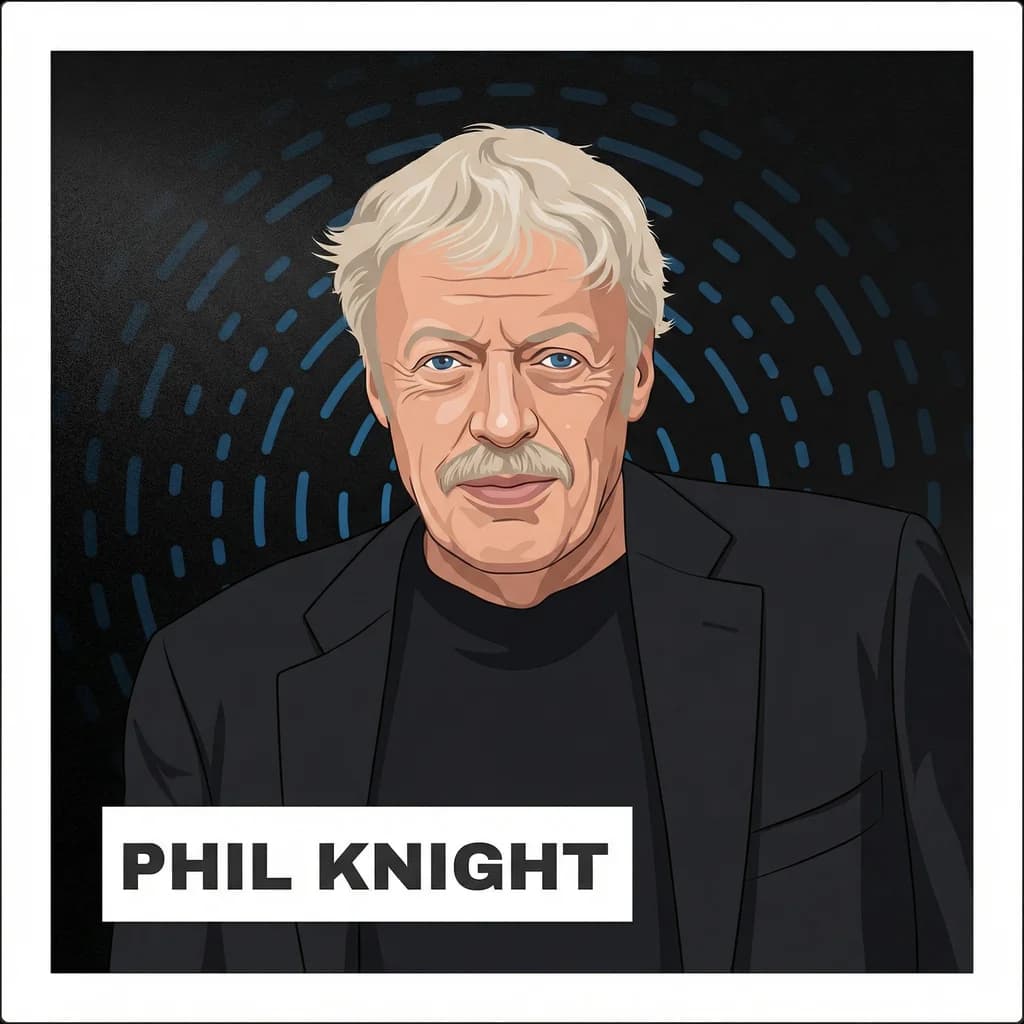

Part IThe Story
The Thirty-Five Dollar Checkmark
She charged him two dollars an hour. Carolyn Davidson, a graphic design student at Portland State University, had been approached by a fidgety accounting professor who moonlighted as a shoe salesman — or perhaps a shoe salesman who moonlighted as an accounting professor; it was getting harder to tell. Phil Knight needed a logo. "What kind?" she asked. "I don't know," he said. "That gives me a lot to go on," she said. "Something that evokes a sense of motion," he offered. She returned with a fat checkmark, a swooping curve that looked to Knight like nothing in particular. He studied it. Turned it over. Frowned. "I don't love it," he said. "Maybe it will grow on me." He paid her $35.
That was 1971. The swoosh — this thing he didn't love, this accident of a broke student's drafting table — would become one of the most recognized symbols on earth, more universally legible than the cross in certain zip codes, stitched onto the feet of athletes and presidents and schoolchildren on six continents. By the time Knight gave Davidson 500 shares of Nike stock in 1983, the gesture was worth a small fortune. By the time she still held those shares decades later, it was worth roughly a million dollars. A $35 commission transmuted, through patience and compound growth, into proof of everything Knight believed about the relationship between value and time.
The swoosh is the perfect emblem for the man who created it — not because it represents triumph or victory, but because it was chosen reluctantly, under pressure, with incomplete information, by someone who trusted the thing would reveal its meaning later. Knight's entire career proceeded this way. He named the company at the last possible second, on a phone call to a factory, choosing "Nike" — the Greek goddess of victory — over his own preferred "Dimension Six," a name so bad his colleagues still teased him about it years later. He signed Michael Jordan only after being pushed into it by a subordinate. He went public only when the alternative was insolvency. The greatest brand builder of the twentieth century built his brand not through grand strategy but through a series of forced choices, each one made with just enough conviction to keep moving forward, and not one ounce more.
By the Numbers
The Nike Empire
$46.7BAnnual revenue (FY 2022)
$35Original cost of the Swoosh logo
$500Each co-founder's initial investment (1964)
79,100Employees worldwide (2022)
$2BDonated to OHSU Knight Cancer Institute (2025)
$178MKnight's net worth on IPO day, Dec. 2, 1980
~$31.5BEstimated Knight family net worth (2024)
The Newspaper Publisher's Son
Portland, Oregon, in the 1940s, was a city of rain and restraint, a place where ambition was considered slightly impolite. Philip Hampson Knight was born there on February 24, 1938, the eldest of three children. His father, William "Bill" Knight, had begun adult life as a lawyer but pivoted — in a move that would prove genetically resonant — into newspaper publishing, eventually overseeing the Oregon Journal. His mother, Lota Hatfield Knight, was a homemaker whose emotional intelligence operated as a quiet counterweight to her husband's reserve. The family lived in Eastmoreland, a neighborhood of modest respectability, and Phil attended Cleveland High School, where he was largely uninterested in academics and devastated when he was cut from the sophomore-and-under baseball team.
"I was heartbroken," he recalled, "but my mom said, 'You are not going to mope around the house. You're either going to get a paper route or go out for track.'" He chose track. It was the first of many pivots forced by rejection, the first demonstration of a pattern that would define his life: foreclosure of one path opening a corridor to another.
Bill Knight looms larger in the Nike origin story than most accounts suggest. The standard mythology emphasizes Bill Bowerman, the legendary track coach, as the father figure — and Bowerman was essential, transformative, irreplaceable. But it was Bill Knight who bankrolled the crazy idea with a $50 loan. It was Bill Knight whose friends at United Press International in Tokyo gave a directionless 24-year-old the contacts he needed. It was Bill Knight, the newspaper publisher, who modeled for his son a particular kind of quiet authority — the power of the person who controls the medium without appearing on the front page. Phil Knight would spend his entire career being the most powerful person in sports while granting as few interviews as humanly possible. The personality of the father, transmuted into the son, became the personality of the brand: omnipresent, elusive, a force you sensed before you understood.
Knight enrolled at the University of Oregon in 1955, where he ran middle-distance track with competence but not distinction. He was, by his own admission, "good, not great" — fast enough to letter, not fast enough to matter. But Oregon's track program was not merely a team. It was a laboratory. And its proprietor was obsessed.
The Cobbler of Eugene
Bill Bowerman was born in 1911 in Portland, graduated from the University of Oregon, fought in World War II as an infantry commander, returned decorated, and in 1948 took over the head coaching position at Oregon's track and field program. During his 24-year tenure he would lead the team to four NCAA Championships, coach 33 Olympians, 16 sub-four-minute milers, and 64 All-Americans. He served as head coach of the 1972 U.S. Olympic team. But none of that is quite what made Bowerman Bowerman.
What made Bowerman Bowerman was his shoes.
He was appalled by the running footwear available to his athletes in the late 1950s — heavy leather contraptions, essentially repurposed tire rubber, that left runners' feet bleeding after five miles. So he learned cobbling. He wrote to shoe companies proposing design improvements. None responded. He deconstructed existing shoes with a band saw, examined their anatomy, consulted a Springfield bootmaker, and began building prototypes in his own workshop. He would sneak into his runners' lockers, steal their shoes, tear them apart, stitch them back together with some modification, then return them. The runners would either fly like deer or bleed. He never stopped.
"One ounce sliced off a pair of shoes," Bowerman preached, "is equivalent to 55 pounds over one mile." The math was precise: an average stride of six feet, spread across a mile's 5,280 feet, yields 880 steps. Remove one ounce from each step — 55 pounds on the button. Lightness equaled less burden equaled more energy equaled more speed. Speed equaled winning. Bowerman liked to win.
He did not consider himself a track coach. He insisted he was a "professor of competitive response." The distinction mattered enormously. He was not training runners for Saturday's race; he was training young men for the rest of their lives — for the competitions that have no finish line, no starter's pistol, no stadium full of witnesses. He had fired at the enemy in Italy. He understood competition at its most absolute.
Phil Knight was the first student-athlete to wear a pair of Bowerman's handmade shoes. In a letter dated August 8, 1958, Bowerman suggested a weight-training regimen and running schedule, then closed with a postscript: "If you have a pair of shoes that you think would make good flats, send them down to me. They will be ready for you when school starts." Knight was chosen not because he was the team's best runner but precisely because he wasn't — Bowerman could afford to lose a guinea pig who wouldn't cost him points at meets. Knight tried the shoes at practice one evening, but his teammate Otis Davis spotted the prototypes, tried them on, loved them, and never gave them back. Davis would go on to win Olympic gold in the 400 meters in 1960, wearing shoes born in a coach's workshop in Eugene, Oregon.
Something had been planted. Not a business plan — Knight didn't have one yet — but something subtler. A conviction that what people put on their feet mattered more than anyone realized. That the invisible infrastructure of athletic performance was also its most consequential. That innovation didn't require a factory or a fortune. It required obsession and a band saw.
The Paper That Became a Company
Knight graduated from Oregon in 1959 with a business degree, spent a year in the U.S. Army, and then enrolled at Stanford University's Graduate School of Business. He arrived shy, insecure, an introvert in the clinical sense. "For me, an extrovert was a person who stared at other people's shoes," he later told Stanford's graduating class of 2014. But Stanford cracked something open. In a second-year entrepreneurship course taught by Frank Shallenberger — a mechanical engineer turned business professor known as "the father of small business" — Knight was assigned to write a paper on starting a small company in an area he knew well.
He chose running shoes.
The paper's thesis was as elegant as it was contrarian: Japanese manufacturing, which had already disrupted the camera industry by producing high-quality products at lower cost than German competitors, could do the same to athletic footwear. At the time, Germany dominated the sneaker market, largely through Adidas. American shoes were, in Knight's memorable phrasing, "offshoots of tire companies. Shoes cost $5 and you would come back from a five-mile run with your feet bleeding." Japanese labor was cheaper. Japanese manufacturing was fast. The economics were irresistible.
The paper got an A. His classmates greeted the presentation with "labored sighs and vacant stares." Not one asked a single question.
This is the kind of detail that, in retrospect, operates as prophecy. The idea that would generate over $46 billion in annual revenue was first received with total indifference by a room full of Stanford MBA candidates. Knight would later describe his sense of calling in almost spiritual terms: "It didn't even look like an idea. It looked like a place. It looked like a person or some life force that existed long before I did, separate from me, but also a part of me, waiting for me but also hiding from me."
After graduating in 1962, Knight did not race home to execute the plan. Instead, he flew to Hawaii, spent ten weeks selling encyclopedias door-to-door (badly) and surfing (better), then caught a flight to Tokyo. The city was still recovering from wartime devastation — "vast sections of the city were total liquid black," he recalled. Through his father's UPI contacts, he mentioned his crazy idea to a group of expat journalists. They were unimpressed. But they pointed him toward the Importer, a monthly magazine, and the staff there pointed him toward a company called Onitsuka, makers of Tiger athletic shoes, in Kobe.
The advice the Importer staff gave him about negotiating with Japanese businessmen proved more valuable than anything he'd learned at Stanford: "It's a culture of indirection. No one ever says, straight out, no. But they don't say yes, either… don't be cocky."
The Birth of Blue Ribbon
On November 22, 1962, Knight walked into the Onitsuka offices in Kobe. Four executives sat across a conference table. One asked a simple question: "Mr. Knight — what company are you with?"
He had not prepared for the simple. He'd rehearsed the complicated sell — the market opportunity, the distribution economics, the Japanese camera analogy. But not this. Reaching into childhood, he recalled the ribbons he'd won at track meets. "Gentlemen, I represent Blue Ribbon Sports of Portland, Oregon."
The company did not exist. He had invented it on the spot, in a conference room in Kobe, out of panic and instinct. It was the most consequential lie of his career, and he would spend the next two decades making it true.
He placed an order for samples. Fifteen pairs. Then sat alone in a chair at the chaotic Osaka Airport and asked himself where he was going. A voice said: race home, get this business going. Another said: if you don't go around the world now, you won't for decades. He flew to Hong Kong. The samples didn't arrive for 14 months.
When they finally came — twelve pairs of creamy white shoes with blue stripes — Knight held them up to the light and "caressed them as sacred objects, the way a writer might treat a new set of notebooks." He sent two pairs to Bowerman. The coach was so impressed he demanded to be let in on the deal. On January 25, 1964 — a Saturday; the same day the Beatles registered their first number-one hit in the United States — they met for lunch at the Cosmopolitan Hotel in Portland. An hour later, they shook hands across the table. Each put up $500. Blue Ribbon Sports was born.
Their first order: 300 pairs of shoes. First year sales: $8,000. Profit: $250. Knight was simultaneously working as an accountant at Price Waterhouse, fulfilling Army Reserve obligations two Tuesdays a month and one Sunday, teaching accounting at Portland State University, and, in his remaining hours, selling Tiger shoes out of the trunk of his lime green Plymouth Valiant at regional track meets. He described his multitasking honestly: "I can drive a car, eat a McDonald's filet o' fish and read a newspaper, all at the same time." He did this until he rear-ended the car in front of him.
— Phil Knight, 1992 Nike Shareholder LetterThere were many dark days. We always knew we could fail, we knew we might fail, and sometimes we even thought we should fail, but never did we think we would fail.
Sales doubled every year. $8,000 became $16,000. Then $100,000. Then $500,000. By 1969, Blue Ribbon had sold $1 million worth of shoes. Knight left his other jobs to focus on the company full-time. But exponential growth on a $500 capital base created its own existential problem. "Your rate of growth is too fast for your equity," his banker told him. "How can such a small company grow too fast?" Knight asked. "Growth off your balance sheet is dangerous," the banker replied. "Life is growth," Knight said. "You grow or you die."
This was not mere philosophical stubbornness. Knight had both an MBA and a CPA license. He understood balance sheets, cash flows, the arithmetic of insolvency. He was choosing, with full knowledge, to ride the edge — to keep doubling orders from Japan while running perpetually short on cash, to treat every quarter's revenue as next quarter's inventory investment, to grow faster than prudence allowed because prudence would mean ceding ground to competitors with deeper pockets. Two banks ultimately dropped him as a customer.
The Waffle Iron and the Goddess
In 1967, Bowerman modified the Onitsuka Tiger to create the Tiger Cortez, a shoe that proved wildly popular with runners. But by 1971, the relationship with Onitsuka had soured — disputes over distribution exclusivity, suspicions that the Japanese company was seeking other American distributors, a slow-motion divorce that left Blue Ribbon Sports needing its own shoes, its own name, its own identity. Everything.
The name came from Jeff Johnson, Blue Ribbon's first full-time employee — a former Stanford runner who had initially been a customer, then a zealot, then an indispensable hire. Johnson was a one-man operation who ran the company's East Coast operations, kept meticulous records, wrote obsessive memos, and, one night in 1971, literally dreamed the name "Nike." The Greek goddess of victory. Knight debated it with Bob Woodell, the company's fourth full-time employee — a former Oregon runner paralyzed from the waist down after a wrestling accident, who operated as Knight's operational conscience from a wheelchair. Knight wanted "Dimension Six." Everyone else hated it. At the last possible moment, with a factory deadline approaching, Knight called in the name. "Nike," he mumbled. "Hm," Woodell said.
The waffle sole came from Bowerman's kitchen. In 1971, staring at his wife Barbara's waffle iron over breakfast, Bowerman saw a pattern that could provide superior traction at minimal weight. He poured liquid rubber into the iron — ruining it permanently — and created the prototype for what would become Nike's signature innovation. The waffle sole offered better grip on any surface, particularly wet roads, while remaining lighter than anything on the market. It was the physical manifestation of Bowerman's entire philosophy: that ounces are pounds, that lightness is speed, that innovation is sometimes just a household appliance repurposed by a stubborn man.
The first Nike shoes debuted at the 1972 Olympic trials in Eugene, Oregon — Bowerman's home turf, with Bowerman himself serving as head coach of the U.S. Olympic team. Knight put Nikes on the feet of several top finishers. When they made national television, the swoosh went with them.
Among the most visible runners to wear Nikes was Steve Prefontaine — a cocky, anti-establishment distance runner from Coos Bay, Oregon, who embodied everything Knight admired and could never quite be. Prefontaine was brash where Knight was shy, flamboyant where Knight was guarded, willing to say publicly what Knight could only think privately. He became the brand's first true athlete-ambassador, not through a marketing contract but through a genuine alignment of spirit. When Prefontaine died in a car accident in 1975 at age 24, it devastated the company. But it also cemented something: the idea that Nike was not merely selling shoes but telling stories about human striving, stories that could end in tragedy as easily as triumph.
The Education of an Introvert
Knight's personality is the great paradox of the Nike story. He built the most visible brand in sports while being, by his own account, pathologically shy. "I have the personality of a runner," he told The Athletic in 2017, as though that explained everything. And in a way it did. Running is solitary, repetitive, interior. It demands sustained effort without external validation. The crowd sees you only at the start and the finish; the miles between are yours alone.
He rarely gave interviews. He almost never made public appearances. He was, by multiple accounts, aloof, withdrawn, reclusive. When the 2016 memoir Shoe Dog was published, it represented the first time he had told his own story in any detail, and it covered only the years up to 1980 — the struggle years, not the triumph. Even in revelation, he held back.
Yet this same man created a corporate culture of extraordinary emotional intensity. Nike's campus in Beaverton — 22 buildings on 213 acres, recently renamed the Philip H. Knight Campus — is named for athletes: the Mia Hamm Building, the LeBron James Innovation Center, the Serena Williams Building. "When we go to work on Monday morning and one of our athletes has performed at a high level," Knight said, "everybody in the company — from clerks to the CEO — is lifted by that." He built a company that runs on the emotional energy of athletic performance, channeling the feelings he could never comfortably express into a brand that expresses little else.
— Phil Knight, Literary Arts event, 2016A lot of people say, 'Well, you created a culture' — but it wasn't me. Basically, it kind of bubbles up from the people. You can't dictate a culture… it comes from within. I've got fingerprints on the culture, but it is by no means dictated by me.
The line between modesty and misdirection can be thin. Knight's claim that he didn't create Nike's culture is technically accurate — cultures are emergent phenomena — and deeply misleading. He hired the people who created the culture. He set the terms of competition. He chose, again and again, to prioritize competitive intensity over bureaucratic order, to tolerate misfits and eccentrics, to reward results over process. His 1977 manifesto — actually drafted by Rob Strasser, a key Nike executive who would later, ironically, defect to Adidas — codified the ethos in ten blunt principles: "Our business is change." "We're on offense. All the time." "Perfect results count — not a perfect process. Break the rules: fight the law." "This is as much about battle as about business."
Strasser himself was a Portland lawyer with a personality as large as his physical frame — a man who would later be credited by Willamette Week as "the man who saved Nike" for his role in the Jordan deal. His departure for Adidas in the late 1980s was one of the few betrayals that visibly wounded Knight. The manifesto Strasser wrote survived his defection, became gospel, and was eventually expanded into Nike's "Maxims" — a set of internal principles that employees treated with near-religious seriousness. Ex-employees reportedly treasured copies decades after leaving the company.
Air
By 1980, Nike had gone public, and Knight's stake was worth $178 million. His overriding feeling, he wrote, was regret. "Because I honestly wished I could do it all over again." The IPO solved the cash crisis that had plagued the company since inception — no more begging bankers, no more near-death experiences with working capital — but it also ended something. The startup phase, the period when the company was a band of misfits running on fumes and belief, was over.
What followed was a crisis of relevance. Nike's running boom had peaked. The aerobics craze of the early 1980s caught the company flat-footed — Reebok surged, offering stylish shoes to women who didn't care about waffle soles or sub-four-minute miles. Nike's revenue declined. The company that had never stopped growing suddenly couldn't find the next wave.
The solution came not from Knight but from Sonny Vaccaro, a basketball promoter and Nike consultant who had been preaching the gospel of college basketball to anyone who would listen. Vaccaro — a Pittsburgh-born operator who had built his career connecting shoe companies with college coaches, a man whose rolodex was his fortune and whose instincts about athletic celebrity ran years ahead of conventional marketing wisdom — urged Knight to sign a rookie guard from the University of North Carolina. The kid's name was Michael Jordan.
Knight was initially reluctant. Nike's entire marketing budget for the basketball division would need to be concentrated on a single unproven player. Jordan himself preferred Adidas. But Vaccaro persisted, and in 1984, Nike signed Jordan to a five-year, $2.5 million contract — the most lucrative sneaker deal in history at the time — to promote a shoe called the Air Jordan. Black and red. Initially sold for $65 a pair ($192 in 2023 dollars).
The NBA promptly banned the shoes for violating uniform standards and fined Jordan $5,000 every time he wore them. Nike paid the fines. Then it ran an ad campaign around the ban: "The NBA can't stop you from wearing them." Within the first two months of the shoe's release, Nike sold $70 million worth of Air Jordans. By the end of 1985, revenue exceeded $100 million.
The Jordan signing didn't just save Nike's basketball division. It invented an entirely new paradigm — the athlete as brand, the endorsement deal as narrative partnership, the shoe as cultural artifact. In 1997, Nike spun the Jordan brand into its own division, replacing the swoosh with the "Jumpman" silhouette. Air Jordans transcended athletics entirely, becoming foundational to sneaker culture, hip-hop, streetwear, the entire architecture of aspirational consumption that would define American popular culture for the next four decades. An original pair of Air Jordans sold at auction for $1.8 million in 2023.
The irony is almost too perfect: Knight, the introvert who hated advertising, who described himself as someone for whom an extrovert was "a person who stared at other people's shoes," built the most emotionally resonant marketing machine in corporate history by giving his brand a face he could never have been.
The Sweatshop Problem
Nike's rapid growth was fueled, in part, by the same economic logic that had inspired Knight's Stanford paper: cheaper labor in Asia. Shoes were manufactured in Indonesia, Vietnam, China, Cambodia — developing economies where the cost of production was a fraction of what it would be in the United States. By the 1990s, this model had made Nike enormously profitable. It had also created a moral catastrophe.
Allegations of sweatshop conditions, child labor, forced overtime, and abusive management at Nike's contract factories surfaced throughout the decade. The company's initial response was denial and deflection — the factories were operated by independent contractors, Nike argued, not by Nike itself. This was technically true and ethically irrelevant. Consumers didn't care about corporate structure. They cared that the shoes on their children's feet had been stitched by children in Jakarta.
Knight eventually acknowledged the problem. In 1998, he announced a series of reforms: factory codes of conduct, raised minimum ages for workers, adoption of U.S. clean-air standards in overseas facilities, independent auditing. The company continued to address labor concerns through the 2000s and beyond. But the damage to Nike's reputation was deep, and the underlying tension — between a brand built on aspiration and a supply chain built on exploitation — was never fully resolved.
In Indonesia, Nike's second-largest production hub, roughly 100 factory workers from more than 10 Nike supplier facilities told an Oregonian/OregonLive reporter they made nowhere near twice the minimum wage that Nike had publicly claimed as a global average. "Bullshit," a union official said, in English. A worker in West Java, told where on Nike's website the company made the wage claim, shook his head: "No, no, no. It's not true."
Knight's first public claim about supplier wages paying roughly twice the local minimum dates to the 1990s crisis. The company has reasserted it since 2021. Nike's head of human rights described the 1.9x figure as a "global average" — a statistical truth that obscured ground-level reality for hundreds of thousands of individual workers earning as little as $150 a month.
This is not a contradiction Knight resolved so much as one he outlasted. Nike's brand proved resilient enough to survive the sweatshop era, in part because its emotional appeal — the sense of human striving, the "Just Do It" ethos — operated at a level of abstraction that could coexist with uncomfortable supply chain realities. Whether that represents a triumph of brand building or a failure of collective moral attention is a question each consumer answers with their wallet.
Just Do It and the Art of Controlled Controversy
In 1987, Nike used the Beatles' "Revolution" to promote its Air-branded shoes — the first time the band's music had appeared in advertising. In 1988, the agency Wieden+Kennedy, a Portland shop that had become Nike's creative partner, produced a campaign built around three words that an ad executive, Dan Wieden, had adapted from the last words of convicted murderer Gary Gilmore before his execution: "Let's do it." Wieden softened it to "Just Do It."
The slogan worked because it was not about winning. It was about the daily struggle, the act of starting, the decision to move when everything in you resists movement. It was, in its way, a distillation of Knight's own morning runs — "Why is it always so hard to get started?" — elevated to universal philosophy. It applied to athletes and non-athletes alike, to anyone who had ever faced a task they didn't want to begin.
Knight himself claimed to hate advertising. "We're a marketing company," he told the Harvard Business Review in 1992, a statement that sounds paradoxical only if you confuse marketing with advertising. To Knight, marketing meant understanding your customer so deeply that the product sold itself. The advertising was just amplification of an authentic signal.
Nike learned, over decades, to weaponize controversy. In 2018, for the 30th anniversary of "Just Do It," the company featured Colin Kaepernick — the former San Francisco 49ers quarterback who had protested social injustice by kneeling during the national anthem — in an ad campaign. "Believe in something. Even if it means sacrificing everything." The backlash was immediate and furious, particularly among older consumers. Some burned their Nikes. The company's stock dipped briefly. Then it surged. The campaign resonated with Nike's core demographic — consumers between 18 and 34 — and drove $6 billion in brand value increase within a year.
This was not recklessness. It was the logical extension of a philosophy Knight had articulated for decades: the brand must reflect real values, and those values must occasionally cost something. Nike had done the same thing with the Jordan ban in 1984, with its embrace of women athletes, with its willingness to stand by Tiger Woods and Kobe Bryant through personal scandals while dropping Maria Sharapova and Lance Armstrong. The calculus was never purely moral. It was strategic morality — conviction deployed at commercially optimal moments.
The Things That Don't Resolve
Knight married Penelope "Penny" Parks in 1968, after meeting her in a Portland State accounting class he was teaching. The couple had three children. Their eldest son, Matthew, died in a scuba-diving accident in 2004 at age 34. Knight stepped down as CEO the same year.
In Shoe Dog, Knight writes about Matthew's death with the kind of controlled devastation that reveals more than effusion could — the phone call, the moment of understanding, the bottomless guilt of a father who spent too many years building a company and not enough building a relationship with his son. The regret is specific and unresolvable. No amount of revenue, no number of swooshes stitched onto shoes in 190 countries, makes it negotiable.
Knight continued as chairman until 2016. He replaced himself as CEO with William Perez, an industry outsider from S.C. Johnson, who lasted 13 months before being pushed out for what Nike diplomatically described as "differences regarding leadership." The real problem was simpler: Perez didn't understand the culture, and the culture rejected him the way a body rejects a transplant. Knight replaced Perez with Mark Parker, a Nike lifer who had joined in 1979 and understood the organization from the inside. Parker served until 2020, when he was succeeded by John Donahoe, who was in turn replaced by Elliott Hill in October 2024. Knight remains chairman emeritus, still active, still present, still the gravitational center around which the company orbits.
His philanthropy has been staggering in scale and concentrated in geography. The Phil and Penny Knight Foundation has given away nearly $1.2 billion since its founding in 1997, with almost all of it directed to Oregon. Two $500 million gifts to the University of Oregon — in 2013 and 2021. A $2 billion donation to the OHSU Knight Cancer Institute in 2025, described as the largest single gift ever made to a U.S. university. $400 million to Stanford for the Knight-Hennessy Scholars program. $226 million through the foundation in 2024 alone, including $10 million to Albina Head Start, which provides free early childcare to low-income families, and $10 million to Self Enhancement Inc., which serves underserved youth. Quieter gifts: $8.5 million to the 1803 Fund, which works to advance Portland's Black community.
He has also invested in Laika, the stop-motion animation studio he acquired after buying a majority stake in Will Vinton Studios in 2002 and ousting its founder. The studio, renamed after the dog who was the first living creature sent into orbit, has produced Coraline, Kubo and the Two Strings, and other films that carry a quality Knight would recognize: obsessive craftsmanship, willingness to fail, the conviction that art is worth the expense.
And he has waded into politics — $3 million to the Bring Balance to Salem PAC for Republican legislative candidates in Oregon, $3.75 million to Betsy Johnson's independent gubernatorial campaign in 2022, $1.5 million to Republican nominee Christine Drazan. He has cited his discomfort with Oregon's progressive direction. For a man who spent decades avoiding public positions on anything, this late-career political spending is notable — not for its dollar amounts, which are trivial relative to his wealth, but for what it reveals about a man who finally, in his late eighties, has decided that silence is no longer a viable strategy.
The Morning Run
In the opening pages of Shoe Dog, Knight describes a morning run in 1962 — the year he returned to Portland after Stanford, the year before everything began. He is 24, living with his parents, sleeping in his childhood bed, staring at his college trophies and high school blue ribbons. He runs through fog, through the daily rain, his legs and lungs warming, his thoughts clarifying. He sees his crazy idea "shining up ahead," and it doesn't look crazy anymore. "It looked like a place. It looked like a person or some life force that existed long before I did."
Sixty years later, the Philip H. Knight Campus stretches across 400 acres in Washington County, Oregon. The buildings bear the names of athletes: Mia Hamm, Serena Williams, LeBron James. Seventy-nine thousand employees work under the swoosh. The company's annual revenue exceeds $46 billion. The man who started it all turns 87 and still parks himself in arenas over Thanksgiving to watch college basketball, still gets "real emotional" about coaches making sacrifices to attend a tournament held in his honor, still believes — against all evidence that he himself has generated about the business of college athletics — that there is something redemptive in the spectacle of young people competing for the love of a school.
"College sports are truly something truly special," he told The Athletic in 2022, the repetition of "truly" revealing not carelessness but emphasis. "The special thing is the emotion that comes off of an athletic field, and it all relates to the excuse to go back and love your school."
The 400-acre campus, the $31.5 billion fortune, the swoosh on every continent — these are outcomes, not explanations. The explanation is simpler and stranger. A shy kid from Eastmoreland, the son of a newspaper publisher, ran track without distinction, wrote a paper nobody cared about, lied about a company that didn't exist, and then spent half a century making the lie true — not through genius or charisma or strategic brilliance, but through an almost physiological inability to stop moving forward. "Don't stop," he told himself on that morning run. "Don't even think about stopping until you get there, and don't stop after that. Don't ever stop."
On October 14, 2025, Nike's current CEO, Elliott Hill, sent an all-staff email renaming the world headquarters for its founder. "This is more than a name change," Hill wrote. "It's a tribute to the man whose vision created a global movement."
In the distance, through Portland's eternal fog, you can almost see a 24-year-old in shorts and sweatshirt, clipping off brisk six-minute miles, chasing something he cannot name.
Part IIThe Playbook
Phil Knight's career spans six decades, from a $500 handshake partnership to a $46 billion global empire. The principles below are drawn from the specific decisions, failures, and patterns documented across that arc — not motivational abstractions, but operational realities that can be isolated, studied, and applied.
The principles
- 1.Sell what you believe; belief is the product.
- 2.Choose co-founders who complement your deficiencies, not mirror your strengths.
- 3.Grow faster than your balance sheet allows — but never faster than your product deserves.
- 4.Let the name come last.
- 5.Use athletes as media, not just as endorsers.
- 6.Build culture through hiring misfits, not writing mission statements.
- 7.Embrace controversy as brand strategy — but only when it aligns with the customer you want.
- 8.The introvert's advantage: disappear into the institution.
- 9.Treat supply chain economics as founding strategy, not operational afterthought.
- 10.Never hire your replacement from outside the culture.
- 11.Concentrate philanthropy geographically for compound impact.
- 12.Don't stop.
Principle 1
Sell what you believe; belief is the product
Knight failed at selling encyclopedias. He was mediocre at selling mutual funds. He was spectacular at selling running shoes. The difference wasn't technique — it was conviction. "I believed in running," he wrote. "I believed that if people got out and ran a few miles every day, the world would be a better place, and I believed these shoes were better to run in. People, sensing my belief, wanted some of that belief for themselves."
This is not a soft insight. It is a structural observation about how markets work. When the seller's relationship to the product is purely transactional — I sell this because it makes me money — the customer senses it, consciously or not, and discounts accordingly. When the seller's relationship is authentic — I sell this because I use it, need it, love it — the customer perceives something beyond the product. They perceive an identity they might share.
Nike's entire marketing architecture rests on this foundation. "Just Do It" works not because it's clever but because it's true — true to the daily experience of running, true to the company's own history of nearly failing and choosing to keep going. The brand's emotional resonance is not manufactured. It is amplified.
Tactic: Before selling anything, ask whether you would use it daily, defend it in an argument, and feel diminished if it disappeared — if not, you're selling the wrong thing.
Principle 2
Choose co-founders who complement your deficiencies, not mirror your strengths
Knight was an introvert with financial acumen and sales instincts. Bowerman was a charismatic leader with obsessive product innovation skills and zero interest in business operations. Knight understood markets; Bowerman understood materials. Knight could read a balance sheet; Bowerman could read a runner's gait. They overlapped on almost nothing except a shared conviction that shoes mattered more than anyone realized.
This complementarity was not accidental — Knight sought out Bowerman specifically because the coach understood the product at a level Knight never could. And Bowerman accepted because he recognized that Knight could take his innovations to a market he had no interest in navigating. The 50-50 handshake was between two men who each possessed what the other lacked.
⚡
The Knight-Bowerman Complementarity
How two radically different skill sets created a complete company.
| Dimension | Phil Knight | Bill Bowerman |
|---|---|---|
| Personality | Introverted, analytical | Charismatic, commanding |
| Core skill | Finance, distribution, sales | Product design, athlete development |
| Risk posture | Aggressive growth on thin capital | Obsessive iteration on single products |
| Relationship to athletes | Fan, observer | Coach, mentor, laboratory partner |
| Philosophy | "Life is growth. You grow or you die." | "One ounce off a shoe = 55 pounds over a mile." |
Tactic: When choosing a co-founder, map your weaknesses first, then find someone whose strengths fill those gaps — not someone who reinforces what you already do well.
Principle 3
Grow faster than your balance sheet allows — but never faster than your product deserves
Knight doubled sales every year for the first decade. He did this on $500 of initial capital, with no venture funding, no line of credit, and eventually no bank willing to work with him. His banker told him his growth rate was "troubling." He responded: "A one hundred percent increase in sales is troubling?" The banker said: "Growth off your balance sheet is dangerous." Knight said: "Life is growth. You grow or you die."
This was a calculated gamble, not recklessness. Knight had an MBA and a CPA license. He understood the risks of undercapitalization. But he also understood something his banker didn't: in a market undergoing rapid expansion, the cost of growing too slowly exceeded the cost of growing too fast. Every dollar not spent on inventory was a dollar ceded to competitors. The right risk posture was aggressive — provided the product was genuinely superior. Knight's growth was dangerous but defensible because customers kept coming back. The shoes were better.
The distinction matters enormously. Growth that outpaces product quality destroys companies. Growth that outpaces capital on the strength of genuine product-market fit builds empires — painfully, precariously, but durably.
Tactic: If customers are returning and evangelizing, treat capital constraints as the problem to solve — not growth itself.
Principle 4
Let the name come last
Knight wanted to call the company "Dimension Six." His team hated it. Jeff Johnson dreamed the name "Nike" in his sleep. Knight chose it at the last possible second, on a phone call to a factory, with a deadline bearing down. "Nike," he mumbled. "Hm," said Woodell.
The swoosh cost $35 and was selected reluctantly. The "Just Do It" slogan was adapted from a murderer's last words. The Air Jordan was named by an executive, not by Knight. In each case, the identity element that would prove most iconic was chosen under time pressure, with incomplete enthusiasm, by a team that trusted the product more than the packaging.
There is a lesson here about the relationship between branding and substance. Knight did not begin with a brand and search for a product to attach it to. He began with a product he believed in — lighter, better, cheaper running shoes — and let the brand identity emerge from the product's reality. The swoosh didn't make Nike shoes good. Good shoes made the swoosh meaningful.
Tactic: Get the product right first — naming, branding, and identity work should follow market traction, not precede it.
Principle 5
Use athletes as media, not just as endorsers
Knight's strategy was deceptively simple: "The secret to business is to build the kind of shoe professional athletes will wear, then put them on the pros. The rest of the market will follow." This was not celebrity endorsement as it had traditionally been practiced — a famous face appearing in an ad saying they liked a product. This was integration. The athlete wore the shoes in competition. The shoes appeared on television not as advertising but as news. The endorsement was the performance itself.
Consider the economics. A full-page ad in Sports Illustrated cost roughly $50,000 in 1981. But the cover of Sports Illustrated, featuring an athlete wearing Nikes? "You can't buy the cover," Knight said. Then, smiling: "Maybe you can't, but Nike can." Not by paying the magazine, but by putting shoes on the athletes the magazine would photograph.
The Jordan deal radicalized this approach. By betting the entire basketball marketing budget on one player, Nike transformed Jordan from an endorser into a co-creator — a partner whose identity was inseparable from the product's identity. The shoes weren't advertised by Jordan. They were Jordan.
Tactic: Don't pay for attention; create the conditions under which your product generates attention organically, through integration into events and contexts your audience already watches.
Principle 6
Build culture through hiring misfits, not writing mission statements
Knight's early hires were not corporate archetypes. Jeff Johnson was an obsessive letter-writer who ran the East Coast operation solo and dreamed company names in his sleep. Bob Woodell was a paralyzed former athlete who operated from a wheelchair and served as Knight's conscience. Rob Strasser was a Portland lawyer with a combative personality who drafted the company's internal manifesto and then defected to Adidas. They were, in Knight's own description, "a ragtag group of misfits and savants who quickly became a band of swoosh-crazed brothers."
The culture wasn't designed. It was selected for. Knight hired people who cared about running, about competition, about proving something to themselves and the world. The shared obsession created alignment without bureaucracy. "You can't dictate a culture," Knight said. "It comes from within."
This approach carries risks — misfits are unpredictable, and cultures built on shared obsession can become insular, cultish, blind to their own failures. Nike's labor controversies, its treatment of female employees and athletes (which led to significant internal upheaval in 2018), and its insular resistance to outside leadership are all, in part, pathologies of a culture built by and for true believers.
Tactic: Hire for obsession with the mission, not for credentials or résumé fit — but build accountability mechanisms to prevent shared obsession from becoming shared blindness.
Principle 7
Embrace controversy as brand strategy — but only when it aligns with the customer you want
Nike paid Jordan's NBA fines for wearing banned shoes, then ran ads celebrating the ban. It featured Kaepernick knowing it would alienate older consumers. It used the Beatles' "Revolution" knowing the band's estate would object. In each case, the controversy was not an accident but a strategic choice to deepen alignment with a target audience by provoking the audiences Nike didn't need.
The key distinction: Nike's controversies are selective. The company stood by Tiger Woods through personal scandal but dropped Lance Armstrong after his doping admission. It embraced Kaepernick's social justice stance but remained silent on other political issues. The pattern reveals not principled consistency but strategic coherence — controversies are embraced when they reinforce the brand's positioning with its core demographic and avoided when they don't.
This requires knowing your customer with ruthless precision. Nike's Kaepernick campaign succeeded because the company knew — through data, intuition, and decades of market presence — that its core buyers would rally rather than recoil. The older consumers who burned their shoes were, from Nike's perspective, acceptable losses.
Tactic: Before embracing a controversial position, verify that it will strengthen loyalty among your most valuable customers, even if it costs you customers you can afford to lose.
Principle 8
The introvert's advantage: disappear into the institution
Knight's aversion to public exposure was not a liability. It was a strategic asset. By refusing to become the face of Nike, he ensured the brand could be represented by athletes — people who were more charismatic, more aspirational, more universally admired than any CEO could be. Jordan was Nike's face, not Knight. Prefontaine was Nike's soul, not Knight. "Just Do It" was Nike's voice, not Knight's voice.
This created institutional durability. Brands built around charismatic founders — think Steve Jobs, or Elon Musk — face succession crises when the founder departs. Nike's brand was never dependent on Knight's personal magnetism because Knight had no personal magnetism to withdraw. The swoosh survived his retirement as CEO, his departure as chairman, and will survive his death, because it was never about him.
The paradox is that Knight's anonymity made him more powerful, not less. He controlled the company without the accountability that comes with public visibility. He could make decisions without the performative pressure of being a public figure. His silence was not absence. It was presence of a different kind — the kind that shapes outcomes without being seen.
Tactic: If you are not a natural public figure, don't force it — instead, build a brand and institution that can carry the company's identity without relying on yours.
Principle 9
Treat supply chain economics as founding strategy, not operational afterthought
Knight's original insight was not about shoes. It was about manufacturing arbitrage. Japanese labor was cheaper than German labor. Japanese quality was comparable. Therefore, importing Japanese shoes and selling them at American prices would generate margins sufficient to fund a new company. The entire Nike story begins with a supply chain insight.
This is underappreciated. Most entrepreneurial narratives emphasize product innovation or marketing genius. Knight's first competitive advantage was neither. It was the simple recognition that the same product could be made better and cheaper somewhere else — and that distribution, not manufacturing, would be the strategic bottleneck.
The approach also created Nike's most persistent vulnerability. By outsourcing manufacturing entirely, the company gained flexibility and margins but lost control of the conditions under which its products were made. The sweatshop crisis of the 1990s was a direct consequence of the founding strategy's structural logic: when you optimize for cost, the humans who bear that cost eventually become visible.
Tactic: Understand the economics of your supply chain before you design your product — and build monitoring systems that will prevent your cost advantages from becoming reputational liabilities.
Principle 10
Never hire your replacement from outside the culture
Knight's one experiment with an external CEO — William Perez, hired from S.C. Johnson in 2004 — lasted 13 months. Nike's statement cited "differences regarding leadership." Knight reportedly told analysts that Perez "failed to make a smooth transition from the packaged goods business to athletic shoes and apparel." The real issue was cultural incompatibility. Nike's internal culture, built over four decades of shared obsession with athletic performance, simply rejected an outsider who didn't speak its language.
Every subsequent CEO — Mark Parker (joined 1979), John Donahoe (a Nike board member before becoming CEO), Elliott Hill (a Nike lifer who returned from retirement) — has been an insider. The lesson Knight drew was absolute: Nike's culture is its competitive advantage, and the CEO must be a product of that culture, not an import.
👟
Nike CEO Succession
From founder to present — all but one were insiders.
1972
Phil Knight becomes CEO at founding
2004
William Perez hired externally from S.C. Johnson — lasts 13 months
2006
Mark Parker appointed; joined Nike in 1979
2020
John Donahoe becomes CEO; prior Nike board member
2024
Elliott Hill returns from retirement; Nike lifer
Tactic: When planning succession, develop internal candidates over years rather than recruiting external executives — culture transfer is harder than skill transfer.
Principle 11
Concentrate philanthropy geographically for compound impact
Knight's foundation gave away $226 million in 2024. Nearly all of it went to Oregon — $182 million to the University of Oregon, $10 million to Albina Head Start, $10 million to Self Enhancement Inc., $8.5 million to the 1803 Fund. The Knight Foundation has given nearly $1.2 billion since 1997, overwhelmingly within a single state.
This is not diversified philanthropy. It is concentrated investment in a specific geography and set of institutions, compounding over decades. The result is disproportionate impact: the Knight Cancer Institute at OHSU, the Phil and Penny Knight Campus for Accelerating Scientific Impact at Oregon, the transformation of University of Oregon athletics into a national powerhouse. By choosing depth over breadth, Knight has reshaped the institutions of his home state in ways that a scattered national giving strategy never could.
"We focus our efforts on a few specific causes," Knight wrote in Shoe Dog. "We give away $100 million each year, and when we're gone we'll give away most of what's left."
Tactic: If your philanthropic goal is transformation rather than reputation, concentrate giving in a specific geography or institution where repeated investment compounds over time.
Principle 12
Don't stop
This is not a metaphor. It is the literal instruction Knight gave himself on a morning run in 1962, and it is the closest thing he has to a unified theory of everything. "Don't stop. Don't even think about stopping until you get there, and don't stop after that. Don't ever stop."
The application is operational, not inspirational. When banks dropped Blue Ribbon as a customer, Knight didn't stop — he found Nissho Iwai, the sixth-largest Japanese trading company, and secured financing. When Onitsuka tried to cut off distribution, he didn't stop — he created his own shoe line. When the running boom faded, he didn't stop — he signed Michael Jordan and invented a new category. When the sweatshop scandal threatened the brand, he didn't stop — he reformed the supply chain and outlasted the news cycle.
The principle has a darker implication: Knight's inability to stop also cost him time with his family, contributed to his eldest son's sense of a father who was always elsewhere, and created a company culture where overwork was normalized and dissent was discouraged. The same relentlessness that built the empire also extracted a price that no amount of revenue can repay.
Tactic: When facing a setback that feels terminal, treat it as a waypoint — the only failure that matters is the one after which you stop moving.

Free playbook
Get The Business Model Playbook
58 business models, one visual page each: how the money flows, the metrics that matter, and who runs it. Free when you join the Faster Than Normal email.
Free. No spam. Unsubscribe anytime.
Part IIIMaxims
-
Conviction scales; charm doesn't. Knight failed at selling encyclopedias and mutual funds but succeeded at selling shoes — the difference was not technique but authentic belief in the product.
-
The paper nobody cares about may be the one that matters most. Knight's Stanford classmates met his Japanese shoe thesis with vacant stares; it became the blueprint for a $46 billion company.
-
Growth off your balance sheet is dangerous — but slower growth on a superior product is fatal. The correct response to being undercapitalized in an expanding market is not caution but creative financing.
-
Invent the company name after you've proven the business model. Knight operated as Blue Ribbon Sports for seven years before becoming Nike; the name followed the reality.
-
Every ounce is 55 pounds. Bowerman's arithmetic — one ounce removed per step, multiplied across 880 steps per mile — is a universal principle: marginal improvements compound across scale.
-
Don't buy the ad; become the news. Putting shoes on athletes who make headlines generates more brand equity than any amount of purchased media.
-
The culture rejects what doesn't belong. Knight's one external CEO hire lasted 13 months; institutional culture is more powerful than any individual executive.
-
Philanthropy compounds when concentrated. Nearly $1.2 billion given to a single state over 27 years has reshaped Oregon's institutions in ways that diversified national giving never could.
-
The introvert's edge is institutional durability. By never becoming the face of Nike, Knight ensured the brand would survive his departure — personality-dependent companies face succession crises that institution-dependent companies do not.
-
Don't ever stop. The only advice Knight gave himself at 24, the only advice he says anyone should ever give — and the principle whose cost he knows better than anyone.
In Their Own Words
Make history or be a part of it.
The cowards never started and the weak died along the way –that leaves us.
Play by the rules, but be ferocious.
Dream audaciously. Have the courage to fail forward. Act with urgency.
Life is growth. You grow or you die.
I wanted to build something that was my own, something I could point to and say: I made that. It was the only way I saw to make life meaningful.— Shoe Dog
Don't tell people how to do things, tell them what to do and let them surprise you with their results.— Shoe Dog
The easiest way to find out how you feel about someone. Say goodbye.— Shoe Dog
I'd tell men and women in their midtwenties not to settle for a job or a profession or even a career. Seek a calling.— Shoe Dog
Let everyone else call your idea crazy... just keep going. Don't stop.— Shoe Dog
You are remembered for the rules you break.— Shoe Dog
I wanted to leave a mark on the world. I wanted to win. No, no, that's not right. I simply didn't want to lose.— Phil Knight, Shoe Dog
Now that you have graduated, the goal should not be to seek a job or even a career, but to seek a calling. That search has just begun.— Phil Knight, Stanford Graduation Address, 2014
The secret to business is to build the kind of shoe professional athletes will wear, then put them on the pros. The rest of the market will follow.— Phil Knight, HBR interview, 1992
Dare to take chances, lest you leave your talent buried in the ground.— Phil Knight, Stanford Graduation Address, 2014
Like it or not, life is a game. Whoever denies that truth, whoever simply refuses to play, gets left on the sidelines, and I didn't want that. More than anything, that was the thing I did not want.— Phil Knight, Shoe Dog
Further reading
- Shoe Dog: A Memoir by the Creator of Nike by Phil Knight


