


Part IThe Story
Two Boys from Niles
John Francis Dodge was born on October 25, 1864, in Niles, Michigan, a small town on the St. Joseph River near the Indiana line. His brother Horace Elgin Dodge followed on May 17, 1868. Their father ran a machine shop and foundry that worked on marine engines, and the boys grew up around lathes, castings, and the smell of hot iron. Money was scarce. The family moved to Port Huron in 1882 and then to Detroit in 1886, chasing steadier work in a city that was already turning into the machine shop of the Great Lakes.
In Detroit the brothers spent roughly eight years at a boiler maker, learning the unglamorous discipline of work that had to hold pressure without failing. In 1894 they crossed the river to Windsor, Ontario, as machinists at the Dominion Typograph Company, which built typesetting machines. Typesetting equipment rewarded tight tolerances and punished sloppiness, and both brothers came out of that shop with reputations as craftsmen who could make almost anything with their own hands.
The two were inseparable in a way that later became part of their legend. They worked together, invested together, and, when they finally put their name on a car, they put it in the plural. Detroit lore holds that mail addressed to only one of them was returned as undeliverable. Whether or not every letter bounced, the point stuck: in business the Dodges presented themselves as a single unit, and their company would be called Dodge Brothers, never Dodge.
They were not the same man twice, though. John, the elder, was the talker, the negotiator, the one who dealt with bankers, suppliers, dealers, and eventually Henry Ford. He had a fierce temper and threw himself into Republican politics. Horace was quieter and more at home on the shop floor, where he designed machines and production methods. He later became a serious patron of music in Detroit and a yachtsman. Inside their own plant they kept offices at opposite ends of the building, which was less a sign of distance than a division of territory: the front of the business belonged to John, the back to Horace.
By the Numbers
The Dodge Brothers' Arc
$10,000Credit and cash the brothers put in for 10% of Ford Motor Company in 1903
~60%Share of the value of Ford cars supplied by the Dodge shop, 1903 to 1913
$25MPrice Henry Ford paid in 1919 to buy out the brothers' Ford stake
21,181Dealer applications received before the first Dodge car was built
145,139Dodge vehicles sold in 1920, second in the U.S. industry
$146MAll-cash price Dillon, Read paid for Dodge Brothers in 1925
Bearings, a Machine Shop, and Olds
The brothers' first real product was a better bicycle part. The 1890s bicycle craze had turned the ball bearing into a mass-market component, and ordinary bearings clogged with road grit. Horace worked out a dirt-proof design and patented it in late 1896. The brothers teamed with a partner named Fred Evans, and from mid-1897 the Evans & Dodge bicycle was built in Windsor using the new bearing.
The venture lasted only a few years. By 1900 the brothers had sold out their interest for about $10,000, and in early 1901 they used the money to open their own machine shop in Detroit with about a dozen employees. The timing was lucky and the skills were not. The shop took general work, but the city around it was filling with men trying to build horseless carriages, and nearly all of them needed precision parts they could not make themselves.
The shop's quality got noticed quickly. By September 1901 the Detroit Free Press was running praise of the new Dodge operation. More important than the press was a customer: Ransom E. Olds, whose curved-dash Oldsmobile was the first American car built in real volume.
In June 1901 the Dodges took an order from Olds for 2,000 engines. In 1902 they added a contract for 3,000 transmissions. For a shop that had existed only months, these were enormous jobs, and they forced the brothers to learn the thing that would define the rest of their careers: how to produce identical, reliable parts at a volume no craftsman shop had ever attempted.
The Olds work turned the Dodges into the largest parts supplier in the young industry and gave them one of the largest machine shops in Detroit. They built a new plant at Hastings Street and Monroe Avenue to handle it. The work also taught them something about their position. A supplier who does most of the precision manufacturing on a car holds real leverage, but only as long as the carmaker keeps buying. Olds was a volatile partner, and the brothers began looking for a customer who might become bigger.
That customer arrived in the form of a man who had already failed twice.
Betting the Shop on Henry Ford
Henry Ford in early 1903 was a talented engineer with a racing reputation, two collapsed car companies behind him, and a group of investors led by the coal dealer Alexander Malcomson who wanted to try again. What he did not have was a factory. On February 28, 1903, the Dodges signed a contract to build 650 "running gears" for Ford's new car. A running gear was essentially the whole automobile minus its body, wheels, and tires: engine, transmission, and axles. The price was $250 each, or $162,500 for the lot.
To fill the order the brothers had to retool their shop, investing somewhere between $60,000 and $75,000 of their own money, depending on the account. They protected themselves in the contract. If Ford could not pay, the tools and the finished product would belong to the Dodges. It was the clause of men who had watched the young industry chew through companies and who had no intention of being dragged down with one.
Ford did fall behind on payments almost immediately. Instead of seizing the parts, the brothers converted their position. They forgave $7,000 that was overdue, added $3,000 in fresh credit, and took 100 shares, a tenth of the new company, in exchange. Ford Motor Company was incorporated on June 16, 1903. John Dodge became a director and later vice president.
The decision looks obvious in hindsight and was nothing of the kind at the time. The Dodges were betting their shop on a customer with a thin track record, and then taking equity in lieu of cash from a company that could not pay its bills. What made the bet rational was their skin in the game on both sides. They already controlled the most important manufacturing in the car. If Ford succeeded, their parts business and their shares would rise together. If Ford failed, they owned the tooling. The asymmetry ran heavily in their favor.
Building Most of the Ford
For the next decade the Dodge shop was, in practical terms, Ford's factory for the parts that mattered. Output climbed from about 150 sets a month in mid-1904 to about 333 a month by early 1905. The brothers supplied the running gear for Ford's Models F, H, K, and N, and then, from 1908, for the Model T. In later litigation Henry Ford himself acknowledged that the Dodges had built the entire car except the body, wheels, and tires.
The volumes were immense by any earlier standard. To keep up, the brothers built a new plant in Hamtramck, just outside Detroit, designed by the industrial architect Albert Kahn, and moved into it in November 1910. A rail line connected it to Ford's Highland Park factory. By early 1914 the Dodge works employed about 5,000 men and turned out roughly 250,000 transmissions, drive shafts, and rear axles a year. Across 1903 to 1913, the Dodge shop accounted for roughly 60 percent of the value of every Ford car built.
This was a lucrative position and a precarious one. The Dodges had tied their fortunes to a single customer, and that customer was steadily learning to do their job. From 1906 Ford began making more of his own engines, and Highland Park, the most famous factory in the world after its moving assembly line came online in 1913, was designed to bring manufacturing inside. The brothers could see the math. A supplier whose buyer can substitute in-house production is renting its future, and the lease was running out.
They also held something no ordinary supplier had: a tenth of the buyer. Ford's dividends were making them rich even as Ford's plans threatened their shop.
Firing the Biggest Customer
In July 1913 the brothers gave Ford a year's notice that they would stop supplying parts when their contract ran out in July 1914. John resigned as a Ford vice president in August 1913, though the brothers kept their shares. They had decided to build a car of their own.
They prepared carefully. In June 1912 they had already hired Frederick J. Haynes, a production man from the Franklin company, to manage their factory. On July 1, 1914, they incorporated Dodge Brothers with $5 million in capital, all of it their own. Each brother held 24,995 shares, and a close associate, Alfred McMeans, held the last ten. There were no outside investors to answer to and no bankers to satisfy.
Then they told the world. The brothers announced that a Dodge Brothers car would be ready within about a hundred days and described themselves as the makers of vital parts for more than half a million cars already on the road. That claim was their marketing strategy in one sentence. Millions of Americans had never heard of the Dodges, but the men who sold cars had, and anyone who drove a Ford was already driving Dodge engineering.
Dealers responded before there was anything to sell. Within four months the company received 21,181 applications from people who wanted a Dodge franchise. No car existed yet. The applications were a bet on the brothers' reputation among the trade, and they gave Dodge Brothers a distribution network and a waiting market on its first day.
Dodge v. Ford
Their Ford shares turned out to be the most consequential investment of their lives, and not only because of the money. In 1915 and 1916 Henry Ford decided to stop paying the large special dividends that had been flowing to shareholders. Ford Motor Company was sitting on a surplus of roughly $60 million, and Ford wanted to plow it into an enormous new plant on the River Rouge and into lower car prices and higher wages. He spoke of wanting to employ still more men and to spread the benefits of industry as widely as possible.
The Dodges, now running a competing car company and needing capital, had other ideas about whose money that was. In 1916 they sued. The case reached the Michigan Supreme Court, which ruled in 1919 in Dodge v. Ford Motor Co. The court declined to stop the Rouge expansion, deferring to management's business judgment, but it ordered Ford to pay a special dividend of about $19.3 million. More lastingly, it stated plainly whom a business corporation was supposed to serve.
— Justice Russell C. Ostrander, Dodge v. Ford Motor Co., Michigan Supreme Court, 1919A business corporation is organized and carried on primarily for the profit of the stockholders. The powers of the directors are to be employed for that end.
The ruling became one of the most cited cases in American corporate law, a founding text for the idea of shareholder primacy, taught to generations of law and business students who have never heard of the Dodges' transmissions. The brothers were not litigating philosophy, though. They were protecting a stake and, indirectly, funding a rival.
Henry Ford's response was to get rid of every minority shareholder. He let it be known that he might leave and start a new car company, a threat that would have gutted the value of the existing firm. The shares were then quietly bought up. In July 1919 the Dodges sold their 10 percent to Ford for $25 million. Accounts differ on how much the brothers had earned in dividends before that, and the figures in company histories and later summaries do not agree, but their $10,000 stake had returned many hundreds of times over. Henry Ford now owned his company outright, and the Dodges had turned a supplier's credit line into one of the great investment returns of the era.
The First Dodge
The first Dodge Brothers car rolled out of Hamtramck on November 14, 1914. It was a four-cylinder touring car rated at 35 horsepower, against about 20 for the Model T, and it sold for more than a Ford but far less than a luxury car. It had an all-steel body from the Budd company of Philadelphia at a time when most bodies used wood framing, and a 12-volt electrical system. The brothers had not tried to beat Ford at cheapness. They had aimed a notch above him, at buyers who wanted something sturdier than a Tin Lizzie and could pay a little more for it.
They tested that sturdiness in ways that became company legend. Stories circulated of John dropping tires off a four-story building and crashing a car at about 20 miles an hour to see what gave. The brothers also built what is often described as the first test track built by an automaker for its own cars: a loop of creosoted planks a bit over half a mile around, with a steep hill climb. Before the public drove a Dodge, the company tried to break one.
To build the car they expanded the Hamtramck works from about 500,000 square feet to about 1.4 million, spending more than a million dollars on construction and another half million on tools, with a tool staff of about 180 people. Production of an entirely new product ramped with remarkable speed: 45,003 cars in 1915, 70,799 in 1916, and 101,270 in 1917. Ford built 720,041 Model Ts in 1917, so Dodge was never close to Ford in volume. It did not need to be. By 1916 Dodge ranked second in American sales, and in 1920 it was second again with 145,139 vehicles.
Selling Dependability
The brothers hired the Detroit advertising man Theodore MacManus, whose work for Dodge started in August 1914, before the car was finished. The campaign leaned on a single idea. Early billboards showed nothing but the name "Dodge Brothers." Later versions added "Motor Car," and then the word that became the brand: "Dependable." The company is widely credited with making "dependability" a household word in automobile advertising.
The emblem said the same thing in another language. The Dodge badge showed a six-pointed star made of two interlocked triangles, with the brothers' initials at the center. The name was a partnership, the badge a joining, and the promise was that the car would work.
The word had evidence behind it. In 1916, during the U.S. Army's expedition into Mexico in pursuit of Pancho Villa, a young lieutenant named George S. Patton led a raid on May 14 in three Dodge touring cars, often cited as the first American motorized military action. General John J. Pershing reportedly came to want Dodges above other makes, and the Army bought about 250 of them for the campaign. During the First World War, the U.S. government bought more than 15,000 Dodge vehicles, many as ambulances.
The company also moved into commercial vehicles, adding a screen-side delivery truck in October 1917 and a panel "Business Car" in March 1918. Each new body type sold to a slightly different customer on the same claim: this machine will hold up.
War Work and the Shop Floor
The war produced the brothers' most dramatic feat of production. The French army's 155-millimeter Schneider howitzer and Filloux gun depended on a hydraulic recoil mechanism so demanding that French factories could make only about five a day. The United States needed thousands. Other American manufacturers considered the part too difficult to build.
John Dodge met with Secretary of War Newton D. Baker and promised to start production within four months at cost plus 10 percent. The government funded a new plant for the work, with an authorization of up to $3.5 million. Horace designed 129 special machines to make a part that had never been built at scale. Production began on schedule, and output eventually reached about 30 mechanisms a day. That fell short of the 50 a day the brothers had promised, but it was six times what the French themselves managed.
The episode shows the two brothers' roles clearly. John made the promise in Washington, and Horace had to make it true on the shop floor. Their partnership worked because each trusted the other's half of the business completely.
The factory kept growing. The workforce went from about 7,000 in April 1915 to about 20,000 by 1920, and the Hamtramck complex, later known as Dodge Main, reached about 3.3 million square feet.
The Dodges ran their shop differently from Ford. They did not match Ford's famous $5 day of 1914, and they did not need to. Their production pace was gentler than Highland Park's, turnover was a constant worry for every Detroit employer, and the brothers were known for small touches that mattered to men doing brutal work, such as sandwiches and beer for foundry workers. Starting in November 1919 they worked with John Dancy of the Detroit Urban League to hire Black workers, at a time when many Detroit plants hired few.
They were also working mechanics themselves, and people in the trade knew it. A Michigan trade paper put it bluntly the summer the car company was founded.
— Michigan Manufacturer and Financial Record, 1914The Dodge brothers are the two best mechanics in Michigan. There is no operation in their own shop from drop forging to machining, from tool-making to micrometic measurement, that they can't do with their own hands.
That reputation was the foundation of everything else. The dealers who applied before a car existed, the Army officers who asked for Dodges, and the Secretary of War who took John's four-month promise seriously were all trusting the same thing: that these two men understood manufacturing better than almost anyone alive.
Outside the plant, the brothers spent like the very rich men they had become. Horace built Rose Terrace, a mansion in Grosse Pointe, in 1912, supported the Detroit Symphony, and helped make possible its new Orchestra Hall. John's temper and political brawling made him a figure of Detroit gossip. Neither, as far as the record shows, ever stopped thinking of himself primarily as a machinist.
Two Deaths in One Year
In January 1920 the brothers went to New York for the National Automobile Show. Both fell ill with influenza, part of the late wave of the pandemic that had swept the world since 1918. John's illness became pneumonia, and he died at the Ritz-Carlton in New York on January 14, 1920, with Horace, himself sick, nearby. He was 55. Sixteen workers from the factory carried his coffin.
— Detroit Free Press, on the death of John Dodge, 1920This community can ill afford to lose John Dodge. He was a citizen who counted. He was one of the big forces in the making of modern Detroit.
Horace never fully recovered, from the illness or, by most accounts, from his brother's death. He died in Palm Beach, Florida, on December 10, 1920, at 52. At his funeral the minister described him as a man with a passion for music and a mechanic with the soul of a poet. In less than a year, the company named for two brothers had lost both of them.
The Largest Check
Frederick Haynes, the production manager the brothers had hired in 1912, became president in January 1921 on a five-year contract. The company kept doing what it did well. In 1922 it introduced an all-steel closed Business Coupe, and in 1925 and 1926 it absorbed the Graham Brothers truck business. From 1922 through 1924 Dodge ranked third in the industry.
The brothers' widows, Matilda Rausch Dodge and Anna Thomson Dodge, controlled the company, and in January 1925 they decided to sell. General Motors, run by Alfred Sloan after the ouster of Billy Durant, reportedly offered $124 million. The New York investment bank Dillon, Read & Co. won with $146 million, all in cash, and closed the deal on April 30, 1925. The check was described at the time as the largest ever written in American industry. Dillon, Read financed it by selling about $160 million of bonds and preferred stock to the public.
Bankers are not carmakers. In April 1926 Dillon, Read replaced Haynes with Edward G. Wilmer, and the company's commitments to Budd for steel bodies and stampings grew expensive. Sales fell sharply in 1927, and Dodge slid to thirteenth place in the industry.
Walter Chrysler had been watching. His young Chrysler Corporation made good cars but lacked the foundry capacity, the enormous plant, and above all the dealer network of Dodge. In 1928 he bought Dodge for stock worth roughly $170 million and assumed about $60 million in debt, using the prospect of a new low-priced Chrysler car, the DeSoto, as leverage to show he could compete without Dodge if he had to. The boards approved in late May, and the deal closed on July 31, 1928. Each company brought about 4,500 dealers. Within days of the announcement a trade paper began referring to Ford, General Motors, and Chrysler as the "Big Three," and the phrase stuck for a century.
What the Brothers Left
The Dodge name outlived the brothers by a long way. Dodge Main in Hamtramck kept building vehicles until it closed around 1980, and Dodge remains a Chrysler brand, now inside Stellantis. The widows used their fortunes in ways that shaped Michigan. Matilda Dodge Wilson built Meadow Brook Hall in Rochester Hills, briefly served as Michigan's lieutenant governor in 1940, and in 1957 gave her estate and $2 million to Michigan State University to found the campus that became Oakland University.
Their business legacy is harder to summarize because it runs through three different stories. As suppliers, they showed how much leverage a precision manufacturer holds when a customer depends on it, and how quickly that leverage disappears once the customer learns to make the part. As investors, they turned a rescue loan into a tenth of the most successful manufacturing company of the age and then used the courts to defend it, leaving behind a landmark case on corporate purpose. As carmakers, they built a brand on one word, proved it with trucks in the Mexican desert and plank test tracks in Hamtramck, and reached second place in the industry within two years of their first car.
Most founders of the early auto industry are remembered for a single thing. The Dodges started as the men who made Ford's cars run, became the men who sued Ford and won, and finished as the men whose company was the prize that made Chrysler a giant. They did all of it in less than twenty years, and nearly all of it together.
Part IIThe Playbook
The Dodge brothers never wrote a management book, and their company did not survive them for long as an independent firm. What they left is a record of decisions: where to supply, when to take equity, when to walk away from a customer, how to launch a brand, and how two very different people split a business without splitting apart. The principles below are drawn from those decisions.
The principles
- 1.Master the hardest part of the product.
- 2.Write the downside into the contract.
- 3.Take equity when the customer cannot pay.
- 4.Watch for the customer who is learning your job.
- 5.Leave on your own schedule.
- 6.Sell to the trade before you sell to the public.
- 7.Compete one notch above the leader.
- 8.Own a single word.
- 9.Break your own product first.
- 10.Split the company by temperament.
- 11.Defend your stake in writing and in court.
Principle 1
Master the hardest part of the product.
The Dodges never chose the easy work in the early auto industry. They made engines, transmissions, and axles, the components that demanded precision tolerances and heavy machine tools. Bodies, wheels, and tires they left to others. That choice gave them a position no body shop or upholsterer could match. Olds needed them, then Ford needed them, and for a decade Ford could not build a car without them.
Owning the hardest part of a product creates a kind of power that has little to do with size. The Dodge shop was far smaller than the companies it supplied, but it controlled the bottleneck. When the brothers later built their own car, that same capability let them go from announcement to production in months.
Tactic: List the components of your industry's product in order of difficulty to make well. If you are not responsible for one of the top two, ask what it would take to get there.
Principle 2
Write the downside into the contract.
The 1903 Ford contract included a clause that gave the Dodges the tools and the finished parts if Ford could not pay. It was a small line in a supplier agreement, and it changed the whole character of the bet. The brothers were risking most of their capital on an unproven company, but they had defined in advance what they would keep if things went wrong.
That clause later gave them bargaining power. When Ford fell behind, the Dodges were negotiating from a position of security rather than desperation, which is why they could choose to convert debt into shares instead of simply scrambling to collect. A clear BATNA makes generosity possible.
Tactic: Before signing any agreement that commits a large share of your resources, write down exactly what you retain in the failure case. If the answer is "nothing," renegotiate before you start work.
Principle 3
Take equity when the customer cannot pay.
When Ford ran late on its bills, the Dodges forgave $7,000, extended $3,000 more, and accepted a tenth of the company. That $10,000 turned into $25 million in sale proceeds plus years of dividends. Few supplier decisions in business history have paid off so well.
The logic was sound, not lucky. The Dodges knew the product intimately because they built most of it. They could judge its quality better than any outside investor. Taking equity aligned their incentives with Ford's growth and meant they profited from both the parts and the business. The key was that they understood exactly what they were buying into.
Tactic: When a promising customer asks for extended terms, consider asking for a small equity stake instead of more credit. Only do this where your own work gives you real insight into the customer's product.
Principle 4
Watch for the customer who is learning your job.
From 1906 Ford began bringing engine production in-house, and Highland Park was designed to make the company self-sufficient. The Dodges saw what this meant. Their largest customer was systematically learning to do what they did, and at some point would not need them.
Suppliers often miss this pattern because the orders keep growing while the relationship weakens. Rising volume can hide falling interdependence. The Dodges read the direction of the relationship, not the size of the latest order.
Tactic: For each major customer, track not just revenue but how much of your function they now perform internally. If that share is rising, start building your alternative before the orders decline.
Principle 5
Leave on your own schedule.
The brothers gave Ford a year's notice in July 1913, a full year before their contract ended, and they had hired Frederick Haynes to run production a year before that. By the time the supply relationship ended in 1914, they had a new company incorporated, capital committed, and a car nearly ready.
Leaving a dependent relationship is safest when you choose the timing. The Dodges walked away from their biggest customer while they were still essential to it, which let them exit on good terms, keep their shares, and use the final year of Ford revenue to fund the transition.
Tactic: If you know a key relationship will end, set the date yourself and announce it with enough lead time to build the replacement. An exit you plan beats one forced on you.
Principle 6
Sell to the trade before you sell to the public.
Before the first Dodge car existed, 21,181 people had applied to sell it. The general public barely knew the brothers' name, but everyone in the car business knew who made the Ford's engine and transmission. The brothers' announcement spoke directly to that audience, and it gave the new company a distribution network before launch.
Reputation inside an industry is an asset that can be converted into a launch. Dealers, suppliers, and mechanics had watched the Dodges' work for years. That trust was worth more than any advertising budget in the first months, because it put Dodge cars in showrooms across the country from the start.
Tactic: Before launching a product, identify the professionals who will distribute, recommend, or service it. Win them first, using the track record they have already seen.
Principle 7
Compete one notch above the leader.
The Dodges never tried to beat the Model T on price. Their car cost more, had more power, and used an all-steel body. They aimed at people who had outgrown a Ford or wanted something sturdier, a market Ford's single-model strategy left open.
Going head-to-head with a dominant low-cost producer is usually a losing fight. Stepping one level up lets a challenger use the leader's own customers as its market, selling them the next thing they want. The Dodges reached second place in the industry without ever coming near Ford's volume.
Tactic: Study the market leader's most common customer complaint. Build the product that fixes it, priced just high enough to be clearly different and just low enough to be an easy step up.
Principle 8
Own a single word.
Dodge Brothers advertising built the brand around dependability. Billboards moved from the name alone to "Dependable," and the idea ran through every piece of marketing. The company became so tied to the word that it is credited with making it standard vocabulary in the car trade.
A single word is easy to remember and hard for competitors to steal once it is established. It also disciplines the company. Every engineering decision, from the steel body to the test track, could be judged by whether it made the car more dependable.
Tactic: Choose the one word you want customers to associate with your product. Then check whether your engineering, service, and marketing decisions actually earn it.
Principle 9
Break your own product first.
The brothers were known for abuse testing: tires dropped from buildings, deliberate crashes, and a plank test track with a steep hill. They wanted to find the failure points before a customer did. The Army's experience in Mexico and in the First World War then gave the brand real-world proof.
Stress-testing is a direct route to credibility. A claim of dependability means little if the company has not tried to make its product fail. The Dodges combined internal testing with field testing under the harshest conditions available.
Tactic: Design a test that would embarrass your product if it failed, and run it before launch. Publish the results if the product passes.
Principle 10
Split the company by temperament.
John handled money, sales, dealers, suppliers, and Ford. Horace handled design, machines, and the factory floor. They kept offices at opposite ends of the building, and each trusted the other's judgment in his own domain. When John promised the War Department recoil mechanisms in four months, Horace built the 129 machines to deliver.
Partnerships fail when both partners want the same job. The Dodges divided the company along the lines of who they were, not along a chart, and the division held for their entire careers.
Tactic: If you run a company with a partner, write down which decisions each of you owns outright. Revisit it only when one of you is consistently frustrated, not every time you disagree.
Principle 11
Defend your stake in writing and in court.
When Henry Ford withheld dividends to fund his expansion, the Dodges did not complain privately. They sued, and the Michigan Supreme Court ordered a special dividend of about $19.3 million. The case also strengthened their hand when Ford moved to buy them out, and they left with $25 million.
Minority owners are often treated as passive. The Dodges knew their rights, used them, and turned a legal fight into a favorable sale. They did it while running a competing company, which shows how clearly they separated their roles as investors and as operators.
Tactic: If you hold a minority stake, know exactly what the governing documents and the law entitle you to. Assert those rights early and in writing, before the majority has settled on a plan.
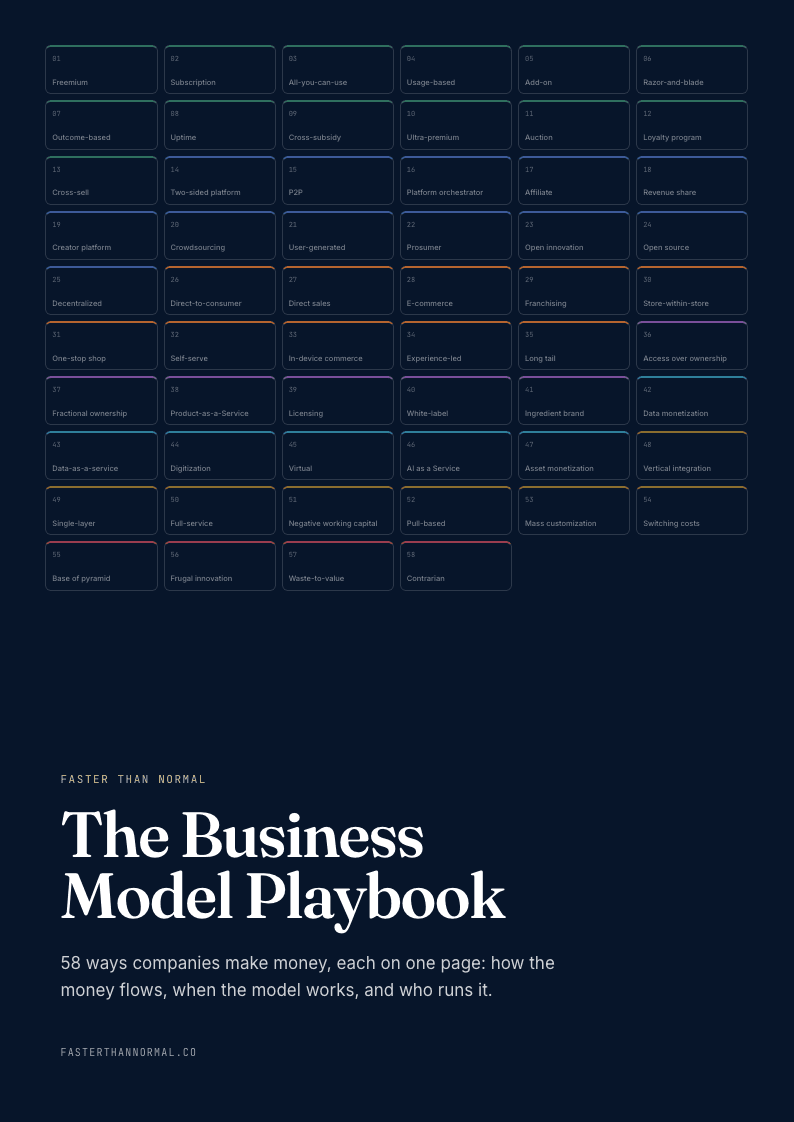
Free playbook
Get The Business Model Playbook
58 business models, one visual page each: how the money flows, the metrics that matter, and who runs it. Free when you join the Faster Than Normal email.
Free. No spam. Unsubscribe anytime.
Part IIIMaxims
-
Precision is a moat. The work other shops find too difficult is the work that makes you hard to replace.
-
A rescue is also a purchase. When you bail out a partner, decide what you are buying, not just what you are saving.
-
Growing orders can hide a shrinking role. Measure how much a customer needs you, not only how much it spends.
-
Reputation travels through the trade first. Industry insiders form their opinion of you years before customers do, and that opinion can be spent.
-
The runner-up position can be very profitable. Second place in a huge market, with better margins, can be worth more than a fight for first.
-
A promise needs someone to keep it. Commitments made in meeting rooms depend on the people who have to build them.
-
Brothers make a brand. Putting two names under one badge told buyers the company was a partnership they could trust.
-
Founders are a single point of failure. The Dodges built a company that ran without them, but not one that stayed independent without them.
-
Owners should read the rules. A shareholder who knows the law can bargain as hard as a manager who controls the plant.
In Their Own Words
A factory is only as good as the people who work in it. Invest in your workers, and they'll invest in your success.— Horace Dodge
We're tired of being carried around in Henry Ford's vest pocket. We're going to start making our own cars.— John Dodge
We build cars the way we'd want to own them ourselves. Every Dodge Brothers car is a car we'd be proud to drive.— Horace Dodge
Price is what you pay. Value is what you get. We've always believed that customers will pay more for a car that gives them more.— John Dodge
A machine is only as good as the man who makes it and the materials that go into it. We never compromise on either.— Horace Dodge
The difference between a good car and a great car is in the details that nobody sees but everybody feels.— John Dodge
Quality is never an accident. It is always the result of intelligent effort, skillful execution, and the vision to see excellence where others see 'good enough.'— John Dodge
Competition makes us all better. When we were Ford's suppliers, we made them better. Now that we're competitors, we'll make the whole industry better.— Horace Dodge
There's room in this business for everyone who can build a good car and sell it at a fair price. The market will decide who survives.— John Dodge
Independence isn't just about being your own boss. It's about having the freedom to do things the right way, even when it's not the easy way.— John Dodge
Every problem is an opportunity to find a better solution. The question isn't whether something can be improved—it's whether we're smart enough to figure out how.— Horace Dodge
Innovation doesn't mean doing something completely new. Sometimes it means doing something old in a completely new way.— Horace Dodge
The best engineering is invisible to the customer. They don't need to understand how it works—they just need to know that it works better.— John Dodge
We don't build cars to meet specifications. We build cars to exceed them. Specifications are minimums, not targets.— Horace Dodge
A business partnership is like a marriage—it only works when both parties are committed to making the other successful.— John Dodge
The best investment we ever made was in ourselves—in our skills, our knowledge, and our ability to solve problems that others couldn't solve.— Horace Dodge
Success isn't about being the biggest or the cheapest. It's about being the best at what you choose to do.— John Dodge
We don't just employ machinists—we employ craftsmen. There's a difference, and that difference shows in every car we build.— John Dodge
The machine doesn't make the part—the machinist makes the part. The machine is just a tool, and tools are only as good as the hands that guide them.— Horace Dodge
Pay a man well, treat him with respect, and give him the tools to do his job right, and he'll give you work that exceeds your expectations.— John Dodge
We're not just building cars—we're building a company that will outlast us both. The cars will change, but the commitment to excellence must never change.— John Dodge
The measure of a company isn't how much money it makes this year. It's whether it's building something that will still matter twenty years from now.— Horace Dodge
We started as machinists, and we'll always be machinists at heart. Everything else—the business, the success, the recognition—that's just what happens when machinists refuse to compromise.— John Dodge
The automobile industry is still young. We're not just building cars for today's roads—we're building cars for roads that don't exist yet and customers who haven't been born yet.— Horace Dodge
Further reading
- The Dodge Brothers: The Men, the Motor Cars, and the Legacy by Charles K. Hyde


