


Part IThe Story
In the spring of 2003, a woman who had spent a decade making watch lenses in a factory district of Shenzhen received a phone call that would, within twelve years, make her the richest self-made woman on the planet. The caller was from Motorola. They wanted to know if her small operation — a company she'd bootstrapped from a three-bedroom apartment with her siblings and cousins — could develop glass screens for a new mobile phone. What Motorola didn't know, and what Zhou Qunfei herself could not yet fully grasp, was that this phone call was the hinge on which the entire smartphone supply chain would eventually turn. What she did know was this: she would need to sell her house, liquidate nearly everything she owned, and bet her life — quite literally, as it turned out — on a technology transition that most of her competitors hadn't yet recognized. The woman who picked up that call had lost her mother at five, dropped out of school at sixteen, and once earned roughly a dollar a day peeling watch glass in a factory where shifts ran past midnight. She was thirty-three years old.
The Glass Beneath Everything
To understand Zhou Qunfei, you have to understand what a touchscreen actually is — or rather, what it was before it became invisible. Every smartphone you have ever held, every tablet your child has smeared with fingerprints, every Tesla dashboard glowing in a dark garage, relies on a single mundane material: a precisely engineered sheet of glass, cut and polished and chemically strengthened to tolerances measured in microns. Somebody has to make that glass. Somebody has to make it at a quality that satisfies Apple's legendarily punishing specifications, at a volume measured in hundreds of millions of units per year, at a cost that leaves room for profit margins thinner than the glass itself. For more than two decades, that somebody has been Zhou Qunfei's company, Lens Technology.
The numbers are staggering in the way that only supply-chain numbers can be — enormous and yet, to the end consumer, entirely invisible.
By the Numbers
Lens Technology
$7.7BRevenue in fiscal 2023
133,600+Employees worldwide
32Factories across China
~25%Global mobile glass market share
$608MRaised in 2025 Hong Kong secondary listing
HK$20,000Zhou's starting capital in 1993 (~US$3,000)
$17BPeak personal net worth (2020)
Zhou Qunfei is not a household name in the West, and that is precisely the point. She occupies a position in the global technology ecosystem that is simultaneously indispensable and invisible — the kind of manufacturer whose absence would halt production lines in Cupertino and Seoul and Wolfsburg, but whose existence registers only as a line item on a bill of materials. Apple's customers worship the screen. They do not think about who made the glass.
A Father's Hands
She was born in 1970 in Xiangxiang, a small city in Hunan province — the same central Chinese region that produced Mao Zedong, though Zhou's family story is about as far from revolutionary mythology as rural China can deliver. Her father had been a soldier. Before Zhou was born, an industrial accident in the 1960s left him partially blinded and missing a finger. A skilled craftsman despite his disabilities, he supported the family by making bamboo baskets and chairs, repairing bicycles — the kind of resourceful improvisation that rural poverty demands and that Zhou would later deploy at an industrial scale. Her mother died when Zhou was five. She was the youngest of three children.
The details of her childhood are not picturesque. She raised pigs and ducks to bring in food and money. She was the only one of her siblings to attend secondary school, and she showed promise — bright enough that people noticed, not connected enough for it to matter. At sixteen, in 1986, she dropped out. The family needed income. She moved in with her uncle's family and joined the great migration to Shenzhen.
Shenzhen in 1986 was not yet the gleaming megalopolis of the Pearl River Delta, but it was already something: a Special Economic Zone, designated by Deng Xiaoping just six years earlier as a laboratory for capitalism with Chinese characteristics. It was a magnet for millions of young migrants from the interior — peasant children who arrived at factory gates with nothing but their labor and the vague, electric sense that the old rules might not apply here. Zhou was one of them. She was sixteen. She had no diploma, no connections, and no English — a deficit she would later describe as her biggest regret.
What she did have was a plan, or at least a set of instincts that functioned like one. She deliberately chose to work for companies located near Shenzhen University, so she could take part-time courses. While working factory shifts that ran from eight in the morning to midnight — and sometimes to two a.m. — she studied accounting, computer operations, customs processing. She even got a commercial vehicle license. The girl who couldn't afford to stay in school was assembling, course by course, the toolkit of a future CEO.
The Watch Lens and the Resignation Letter
Her first job was at a small family-run factory making watch parts, for about 180 yuan a month — roughly a dollar a day. She had dreamed of being a fashion designer. Instead she was polishing glass.
The conditions were harsh. "I worked from 8 a.m. to 12 a.m., and sometimes until 2 a.m.," she later recalled. After three months, she decided to quit. But the manner of her quitting tells you something essential about Zhou Qunfei — something that separates her from the millions of other young migrants who cycled through Shenzhen's factory districts in those years. She didn't simply walk out. She wrote a letter of resignation. In it, she explained her reasons for leaving but also expressed gratitude for the opportunity. The letter was sufficiently articulate, sufficiently thoughtful, that the factory chief offered her a promotion instead.
She stayed. She was promoted to a managerial role. She learned the business from the inside — not just the manual labor of glass polishing, but the mechanics of production, the logic of factory management, the way a small operation could differentiate itself on quality when it couldn't compete on scale.
When that factory eventually folded, she had her opening. It was 1993. She was twenty-two.
Twenty Thousand Hong Kong Dollars
The seed capital was HK$20,000 — approximately US$2,547.80 at the time, though the story has been rounded to $3,000 so often that the round number has acquired the weight of myth. The encouragement came from a cousin. The workforce was her brother, her sister, their spouses, and two additional cousins — eight people in total, plus Zhou herself. They worked and lived together in a three-bedroom apartment in Shenzhen that served simultaneously as factory floor, office, and dormitory. For four years.
The company made watch lenses. Zhou's pitch to customers was simple: higher quality. In a market segment where most competitors treated watch glass as a commodity, she bet on precision and consistency. She took a hands-on approach that bordered on obsessive, involving herself in all aspects of the operation — including repairs and improvements to factory machinery, which she redesigned herself. The self-proclaimed perfectionist was building her reputation one watch lens at a time.
Over the next decade, the apartment workshop grew into a factory with a thousand employees. It was a solid business. It was not yet the business that would make her a billionaire.
— Zhou QunfeiI chose to be in business, and I don't regret it.
That transformation required a technology shift — the kind that comes along perhaps once in a generation, that reshuffles supply chains and mints new fortunes and destroys old ones with equal indifference. The shift, when it came, arrived in the form of a phone call from Motorola.
The Razr's Edge
In 2001, Zhou's company had already begun to pivot. A contract with TCL Corporation, the Chinese electronics giant, to make mobile phone screens signaled that the future lay not in watchmaking but in the device that was rapidly replacing the watch as the object people checked most frequently. But TCL was a domestic contract, a beachhead. The real breakthrough came two years later.
In 2003, Motorola was developing what would become the Razr V3 — the phone that, for a brief cultural moment before the iPhone rendered it obsolete, defined what a mobile phone could look like. Motorola needed glass screens. They reached out to Zhou's company while it was still producing watch faces. Zhou won the contract, beating out rival bidders. In 2004, Lens Technology sold over 100 million units for the Motorola V3 model alone.
But winning the contract nearly killed her.
"A business rival was jealous," Zhou later recounted. "That company teamed up with the raw material supplier and tried to squeeze me out of the game." The supplier defied industry norms and demanded full payment before delivering any materials. Zhou had just started out in the mobile screen business and had little financial flexibility. She sold her house. She sold other valuables. It wasn't enough.
What happened next is the darkest passage in Zhou Qunfei's story, and she has told it with a candor that is unusual for a Chinese billionaire, unusual for anyone. "I was desperate," she said. "I stood on the platform at Hung Hom Station in Hong Kong, almost jumped off, delirious, thinking that when I am gone, all the trouble will too be gone."
A phone call from her daughter pulled her back.
"I realized that for my family and employees, I cannot give up. I had to carry on."
She sent what she described as a "911" email to Motorola. With their help — the details of which she has not publicly elaborated — she overcame the financial crisis. The supplier was dealt with. The production lines resumed.
— Zhou QunfeiI stood on the platform at Hung Hom Station in Hong Kong, almost jumped off, delirious, thinking that when I am gone, all the trouble will too be gone.
There is a particular kind of entrepreneurial origin story that gets told and retold until it hardens into parable — the darkest-before-dawn narrative, the moment of near-total collapse that precedes the exponential ascent. Zhou's Hung Hom Station moment has this shape. But it resists the parable's easy redemptive arc because she has told it too specifically, too viscerally, for it to be smoothed into inspiration. She was standing on a train platform in Hong Kong contemplating suicide because a competitor had conspired with a supplier to destroy her. The phone rang. Her daughter was on the line. She stepped back. The next year, she shipped a hundred million units.
The iPhone Inflection
On January 9, 2007, Steve Jobs stood before a packed auditorium in a black turtleneck and blue jeans. "Every once in a while," he said, "a revolutionary product comes along that changes everything." He introduced the iPhone. Two weeks later, according to Patrick McGee's reporting on the making of the iPhone, Jobs walked into a divisional meeting in a bad mood, pulled out his prototype — its plastic screen gouged by the keys in his pocket — threw it onto the boardroom table, and demanded: "Make it glass."
Apple needed a supplier who could produce chemically strengthened glass at smartphone scale. The glass itself would come from Corning — Gorilla Glass, a technology originally developed for fighter-jet cockpits in the 1960s that had never found a commercial market. But Corning made the raw material. Someone still had to cut it, polish it, treat it, and deliver it in the precise specifications and enormous volumes that Apple required. By 2007, Lens Technology was already manufacturing glass screens for HTC, Nokia, Samsung, and Motorola. When Apple came calling, Zhou was ready.
The timing was not coincidental. Zhou had spent the years since the Motorola contract systematically building the capabilities — the factory capacity, the quality control systems, the engineering talent — that would be required when the smartphone revolution arrived. She didn't know exactly what form the revolution would take. But she had positioned Lens Technology at the intersection of glass and electronics, which turned out to be exactly where the future was standing.
The scale of what followed defies casual comprehension. Lens Technology became the primary supplier of touchscreen glass covers for both Apple and Samsung — the two companies that, between them, dominated the global smartphone market. At its peak, the company was supplying glass to nearly 25 percent of the global mobile market. The three-bedroom apartment in Shenzhen had become a manufacturing empire spanning 32 factories across seven locations in China, employing tens of thousands.
The IPO and the Richest Self-Made Woman
On March 5, 2015, Lens Technology went public on the Shenzhen ChiNext market. It was China's largest tech IPO of the first quarter of that year. The stock price nearly tripled from its offering price. Zhou Qunfei owned 98 percent of the company. Her husband, Zheng Junlong, who served as Vice Chairman, owned 1.4 percent. Between the two of them, they held virtually the entire enterprise.
Zhou's net worth temporarily reached $10 billion, making her the richest woman in China. By 2017, Forbes estimated her fortune at $7.4 billion and named her the richest self-made woman in the world — the youngest self-made female billionaire on their list, among a record 56 self-made female billionaires globally. By 2020, in a year when Chinese billionaires collectively added $1.5 trillion to their wealth (a rate the Hurun Report described as unprecedented), Zhou's fortune more than tripled to $17 billion.
The trajectory is, by any measure, extraordinary. A girl who grew up raising pigs and ducks on a subsistence farm in Hunan — who dropped out of school at sixteen, who earned a dollar a day polishing watch glass, who lived and worked in a three-bedroom apartment with eight relatives — was now worth more than Richard Branson, more than Ralph Lauren, more than all but a handful of people on earth.
People in the industry call her "Brother Fei" — a Chinese honorific that cuts across gender, conferring the respect typically reserved for male bosses. She has described herself as a self-proclaimed perfectionist. She works eighteen-hour days. She keeps living quarters in her office. She has stated that she has started a total of eleven companies over the course of her career.
The Architecture of Obsession
The perfectionism is not metaphorical. Zhou's approach to manufacturing is characterized by a hands-on intensity that would be unusual in a founder-CEO of any company, let alone one employing over 133,000 people. From the earliest days of the apartment workshop, she involved herself in machine repair and the redesign of factory equipment — not delegating the engineering but doing it herself, a pattern that persists in her insistence on personally reviewing production processes and quality standards.
This is significant because the touchscreen glass business is, at its core, a precision manufacturing business operating at commodity-adjacent margins. The glass must be perfect — optically clear, chemically strengthened, scratch-resistant, precisely cut to tolerances that leave no room for error — and it must be produced in quantities measured in hundreds of millions of units. The quality bar is set by customers like Apple, whose supplier requirements are among the most demanding in any industry. Meeting those requirements consistently, at that scale, is not a matter of inspiration. It is a matter of process control, equipment calibration, workforce training, and the kind of operational discipline that has to be embedded in every layer of an organization.
Zhou's solution has been to embed herself. Even as Lens Technology grew from a workshop to an empire, she maintained the habit of direct involvement that she developed when the entire company fit in an apartment. The distance between the founder and the factory floor remained, in some essential sense, negligible.
In 2017, Lens Technology became the first Apple supplier to commit to using 100 percent renewable energy in its operations — a milestone the company said it would reach by the end of 2018. It was a forward-looking bet on sustainability at a time when most Chinese manufacturers regarded environmental commitments as a Western luxury. But it was also a competitive move: by aligning early with Apple's increasingly vocal environmental agenda, Zhou secured her position as a preferred supplier in a relationship where preferences are measured in billions of dollars of annual orders.
Beyond the Screen
If Zhou Qunfei had stopped at smartphone glass, she would still be one of the most consequential manufacturers of the twenty-first century. She did not stop.
The logic of Lens Technology's expansion follows the logic of its founder's career: identify the next surface that the world will need to be covered in precision glass, and be there when the call comes. After smartphones came smart wearables — the glass covers for smartwatches and fitness trackers. Then came computers and tablets. Then, in the most ambitious pivot of all, came electric vehicles.
The automotive glass market represents a fundamentally different challenge from consumer electronics. The screens are larger. The safety requirements are more stringent. The customers — Tesla, among others — are no less demanding than Apple but operate on different production cycles and different quality standards. The shift from phones to cars is not merely a change in product dimensions. It is a change in engineering culture, in supply chain relationships, in the regulatory environment that governs every piece of glass that goes into a vehicle.
Zhou made the bet anyway. By 2023, Lens Technology's product portfolio spanned smartphones, computers, smart wearables, and electric vehicles. The company's revenues jumped 16.7 percent to $7.7 billion in fiscal 2023. The workforce had grown to over 133,600 employees. In July 2025, Lens Technology completed a secondary listing in Hong Kong, raising $608 million specifically earmarked to support overseas expansion — a signal that the next chapter of the company's story will be written not just in China but globally.
The Immigrant Who Never Left
Zhou Qunfei's story is, in one sense, a classic immigration narrative — except the immigration was internal. She migrated from rural Hunan to urban Guangdong, from the agricultural interior to the manufacturing coast, from the old China of subsistence farming to the new China of export-driven growth. The distance from Xiangxiang to Shenzhen is roughly 800 kilometers. In economic terms, in 1986, it might as well have been the distance between centuries.
This internal migration — the largest peacetime movement of people in human history, with hundreds of millions of Chinese peasants flowing into coastal factory cities from the 1980s onward — is the social phenomenon that made China's manufacturing miracle possible. Zhou is one of its most spectacular individual products. But her story also illuminates something that the grand narrative of Chinese industrialization often obscures: the specific, brutal, intimate texture of what it meant to be a young woman from the countryside arriving in a factory district with no education, no capital, and no safety net.
The area she grew up in, Zhou has said, was a place where girls didn't have the luxury of going to middle school. Their options were to get engaged or married and spend their whole lives in the village. She refused. But the refusal was not a single dramatic gesture. It was a daily practice — studying accounting by lamplight after a sixteen-hour shift, writing a resignation letter when other workers would have simply disappeared, saving HK$20,000 over the course of years when her daily wage was a dollar.
"I had to constantly think about where my next meal is and how I am going to get it," she has said of her childhood. That sentence, delivered without self-pity in an email to CNBC, contains the entire engine of her ambition. The scarcity was not just material. It was temporal, existential — the knowledge that there was no margin, no second chance, no one coming to help.
— Zhou QunfeiI had to constantly think about where my next meal is and how I am going to get it.
The Queen of Glass
They call her the Queen of Mobile Phone Glass. The nickname has the quality of a folk title — something conferred by an industry rather than a publicist, carrying the weight of grudging respect from competitors who have watched her outmaneuver them for two decades.
The title is deserved, but it undersells what Zhou Qunfei has actually built. Lens Technology is not just a glass company. It is a precision manufacturing platform that has demonstrated an unusual capacity for pivoting across product categories while maintaining the quality standards and production volumes that its most demanding customers require. The pivot from watch lenses to mobile screens to automotive glass is not three different businesses. It is one capability — the ability to produce precision glass at scale — applied to successively larger and more complex substrates.
2016 was a rough year. Sales and profits slid 17 percent and 26 percent, respectively. Zhou had built one of the world's great manufacturing companies on the back of the smartphone boom, and now that boom was decelerating. Unit growth was slowing. Average selling prices were under pressure. The easy years — if any year in precision manufacturing can be called easy — were over.
She responded by diversifying. The automotive pivot. The wearables push. The renewable energy commitment. The Hong Kong secondary listing to fund international expansion. Each move reflected the same pattern she had followed throughout her career: read the next transition before it arrives, position the company at the intersection, and bet big when the moment comes.
An Image That Resolves
In the photographs that accompany profiles of Zhou Qunfei — the posed corporate portraits, the factory-tour snapshots — she is often shown in her office at Lens Technology, the company she built from an apartment workshop into a $7.7-billion-a-year enterprise. The office reportedly includes living quarters, because she works eighteen-hour days and the commute is wasted time.
Somewhere in the supply chain of every iPhone sold in the world, there is a piece of glass that passed through one of her thirty-two factories — cut, polished, chemically strengthened, inspected, and shipped by some of her 133,600 employees. The glass arrives in Cupertino or Zhengzhou as a component, anonymous, fungible, invisible to the consumer who will eventually tap and swipe and scroll across its surface millions of times without ever thinking about who made it, or how, or at what cost.
On a train platform in Hong Kong, in 2003, a woman who had sold her house to fulfill a contract with Motorola stood at the edge and considered stepping off. Her phone rang. Her daughter's voice pulled her back. Twenty-two years later, if you hold your phone up to the light and look at the glass — really look at it, past the notifications and the apps and the manufactured glow — you are looking at something she made.
Part IIThe Playbook
Zhou Qunfei's career is a masterclass in precision manufacturing, vertical ambition, and the particular kind of resilience that comes from having nothing to lose. The principles below are distilled from her decisions, her methods, and her own words — a playbook for building an enduring industrial enterprise from zero.
The principles
- 1.Start where the world isn't looking.
- 2.Bet your house — literally.
- 3.Never stop being a factory worker.
- 4.Educate yourself on the factory floor's dime.
- 5.Win on quality when you can't win on scale.
- 6.Position for the transition before it arrives.
- 7.Anchor to the most demanding customer.
- 8.Turn family into a founding team, then professionalize.
- 9.Survive the darkest moment and compound from there.
- 10.Diversify the substrate, not the capability.
- 11.Align with your customer's values before they ask.
- 12.Persevere, especially during the most difficult times.
Principle 1
Start where the world isn't looking
Zhou Qunfei's entry point into manufacturing was watch lenses — a product category so unglamorous, so far from the cutting edge, that it attracted minimal competition from well-capitalized firms. This was strategic, even if it didn't look like strategy at the time. Watch lenses in 1993 were a commodity business with room for quality differentiation and low barriers to entry for someone with factory experience and HK$20,000. By starting in a neglected corner of precision glass, Zhou built the skills, relationships, and operational discipline that would later prove decisive in smartphones and automotive displays.
The lesson is not merely about humility. It is about choosing a starting position where the learning curve is affordable, where failure won't kill you, and where mastery of the fundamentals can be transferred to adjacent, higher-value domains when the opportunity arrives.
Tactic: Identify the unglamorous, low-competition market adjacent to the high-growth future market, and use it as your training ground.
Principle 2
Bet your house — literally
When the Motorola contract arrived in 2003, Zhou faced a classic entrepreneur's dilemma: a transformative opportunity that exceeded her financial capacity. Her response was to liquidate personal assets — selling her house and other valuables — to meet the supplier's demand for upfront payment. This was not a metaphorical commitment. She converted her personal wealth into working capital at the precise moment when losing the bet would have meant personal ruin.
The willingness to make this kind of all-in bet is what separates lifestyle businesses from breakout companies. Zhou had a viable watch-lens operation. She could have declined Motorola, stayed comfortable, and remained anonymous. Instead, she bet everything on the belief that the mobile phone market represented a fundamental shift — and that being early to that shift was worth the risk of total loss.
Tactic: When a genuinely transformative opportunity appears, match the scale of your commitment to the scale of the opportunity — even if it means putting personal assets on the line.
Principle 3
Never stop being a factory worker
From the three-bedroom apartment to the 32-factory empire, Zhou maintained direct involvement in production processes, equipment design, and quality control. She repaired and redesigned factory machinery herself. She kept living quarters in her office to maximize time on-site. This is not a founder's charming eccentricity. It is a management philosophy.
In precision manufacturing, the gap between what management thinks is happening on the production line and what is actually happening on the production line is where quality failures originate. Zhou's hands-on approach collapses that gap. It also signals to a workforce of 133,600 employees that the founder considers no operational detail beneath her attention — a cultural message that cascades through every level of the organization.
Tactic: Maintain direct contact with the operational core of your business, regardless of scale — the founder's proximity to the product is itself a competitive advantage.
Principle 4
Educate yourself on the factory floor's dime
Zhou deliberately chose employers located near Shenzhen University so she could attend part-time courses. While working grueling factory shifts, she studied accounting, computer operations, customs processing, and obtained a commercial vehicle license. She couldn't afford formal education, so she constructed an informal one around the constraints of her working life.
This pattern — treating employment as a platform for self-education rather than merely as a source of income — gave Zhou a breadth of functional knowledge that most factory workers lacked and that many formally educated managers never acquire. She understood production, finance, logistics, and regulation not as abstract disciplines but as interconnected systems she had personally operated.
Tactic: Treat every job as a tuition-free education; aggressively pursue adjacent knowledge that your current role doesn't require but your future role will demand.
Principle 5
Win on quality when you can't win on scale
In the early years, Zhou's apartment workshop couldn't compete with established manufacturers on volume or price. Her differentiator was quality — she promised higher-quality watch lenses than competitors and delivered on the promise through personal involvement in every stage of production. This quality-first positioning attracted customers willing to pay a premium and, critically, built the reputation that later attracted Motorola and Apple.
Q
Zhou's Quality Ladder
How quality positioning opened successively larger opportunities
1993
Apartment workshop differentiates on watch lens quality
2001
TCL Corporation contract for mobile phone screens
2003
Motorola Razr V3 contract — 100M+ units in 2004
2007
Apple iPhone supplier relationship begins
2017
First Apple supplier to commit to 100% renewable energy
2023
EV and automotive glass for Tesla and others
Quality, in Zhou's case, was not just a product attribute. It was a customer acquisition strategy. Each quality-driven relationship opened the door to the next, larger customer — a compounding reputational flywheel that eventually made Lens Technology the default choice for the most demanding buyers in the world.
Tactic: When you lack scale advantages, make quality your moat — it compounds into reputation, which compounds into access to increasingly valuable customers.
Principle 6
Position for the transition before it arrives
Zhou didn't predict the iPhone. She didn't need to. What she did was position Lens Technology at the intersection of glass and electronics — a position that made the company the obvious supplier when the smartphone revolution materialized. By the time Apple needed touchscreen glass at scale, Zhou had already spent four years building capacity for Motorola, HTC, Nokia, and Samsung.
The same pattern recurred with electric vehicles. Long before the automotive glass market reached critical mass, Zhou began building the capabilities — larger substrates, automotive-grade safety standards, new customer relationships — that would be required when the transition arrived. She expanded from phones to wearables to computers to cars, each pivot anticipated before the market fully materialized.
Tactic: You don't need to predict the future precisely; you need to position your capabilities at the intersection where multiple possible futures converge.
Principle 7
Anchor to the most demanding customer
Apple is the most demanding customer in consumer electronics. Its supplier requirements are legendarily stringent — covering quality tolerances, production processes, environmental standards, and labor practices. Many manufacturers avoid Apple contracts because the margins are thin and the compliance burden is heavy. Zhou sought them out.
Anchoring to Apple imposed a level of operational discipline on Lens Technology that became, over time, its most durable competitive advantage. Once you can satisfy Apple, you can satisfy anyone. The Apple relationship forced continuous improvement, drove investment in quality infrastructure, and — through the renewable energy commitment — pushed Lens Technology toward environmental leadership that differentiated it from competitors.
Tactic: Deliberately seek your industry's most demanding customer; their standards become your standards, and their standards become your competitive moat.
Principle 8
Turn family into a founding team, then professionalize
Zhou's founding team was entirely familial — her brother, sister, their spouses, and two cousins. This is a common pattern in Chinese entrepreneurship and in immigrant businesses globally: the family provides trust, flexibility, and a willingness to share hardship (like living and working in the same three-bedroom apartment for four years) that would be impossible to extract from hired employees at the earliest, most fragile stage of a company's life.
But the family founding model has a natural ceiling. Zhou's success depended on her ability to transition from a family workshop to a professionally managed enterprise — scaling from eight relatives in an apartment to 133,600 employees across 32 factories. The details of that transition are not well documented, but the outcome speaks for itself: a founder who started with family and built an institution.
Tactic: Use trusted personal networks to survive the founding phase, but design the organization to scale beyond them — the family gets you started, but the institution is what endures.
Principle 9
Survive the darkest moment and compound from there
The Hung Hom Station moment is not a motivational story. It is a data point about the psychological cost of entrepreneurship at the extremes — and about the irreducible role of contingency in outcomes. If Zhou's daughter had not called at that moment, Lens Technology would not exist. Apple's touchscreen supply chain would look different. The richest self-made woman in the world would be someone else, or no one.
Zhou survived. And because she survived, everything that followed — the hundred-million-unit Motorola contract, the Apple relationship, the IPO, the $17 billion fortune — compounded from the decision to step back from the platform edge. The most consequential business decision Zhou Qunfei ever made was not a business decision at all. It was the decision to answer her phone.
Tactic: Build systems of personal resilience — relationships, commitments, reasons to persist — because in entrepreneurship, the ability to survive the worst moment is the precondition for everything that follows.
Principle 10
Diversify the substrate, not the capability
Lens Technology's expansion from watch lenses to phone screens to automotive glass looks, on the surface, like diversification. It is not. It is the application of a single core capability — precision glass manufacturing at scale — to successively larger and more complex substrates. The fundamental skill set remains constant. The addressable market expands.
🔬
One Capability, Many Substrates
Lens Technology's expansion model
| Substrate | Era | Key Customer | Complexity |
|---|---|---|---|
| Watch lenses | 1993–2001 | Various | Baseline |
| Mobile phone screens | 2001–present | Motorola, Apple, Samsung | Medium |
| Tablet/computer glass | 2010s–present | Multiple OEMs | Medium |
| Smart wearables | 2015–present | Multiple OEMs | Medium |
| Automotive/EV glass | 2020s–present | Tesla, others | High |
This is a fundamentally different strategy from conglomerate diversification, where a company enters unrelated businesses to spread risk. Zhou's approach concentrates risk in a single capability while spreading it across end markets. If smartphone demand declines, automotive demand may be rising. The manufacturing platform serves both.
Tactic: Diversify your applications, not your core capability — depth of mastery in one domain, applied broadly, is more defensible than shallow competence in many.
Principle 11
Align with your customer's values before they ask
In 2017, Lens Technology became the first Apple supplier to commit to 100 percent renewable energy — a pledge it aimed to fulfill by end of 2018. At the time, environmental sustainability was not yet a prerequisite for Apple supplier status. Zhou moved early, aligning with a value system that she anticipated would become a requirement.
This preemptive alignment accomplished multiple objectives simultaneously: it strengthened the Apple relationship, differentiated Lens Technology from competitors, reduced long-term energy costs (renewable energy in China was becoming cheaper than fossil alternatives in many regions), and positioned the company favorably with regulators and investors. The commitment cost money upfront. It was an investment in relationship durability.
Tactic: Study your most important customer's stated values and commit to them before they become requirements — proactive alignment builds trust and creates switching costs.
Principle 12
Persevere, especially during the most difficult times
Zhou has been asked, repeatedly, what accounts for her success. Her answer is consistent and unadorned: perseverance. "Many people would experience a serious blow to their confidence when they encountered setbacks," she has said, "but the key to success is to persevere, especially during the most difficult times."
It sounds like a platitude. It is not. Perseverance, in Zhou's usage, is not the motivational-poster version — a vague exhortation to try harder. It is a specific operational practice: when the supplier conspires against you, sell your house. When the funding gap threatens to destroy the business, email Motorola at midnight. When the factory shift runs to 2 a.m., study accounting by lamplight. Perseverance, for Zhou, is the refusal to accept that any given constraint is permanent — combined with the willingness to pay whatever personal cost is required to prove it.
Tactic: Treat perseverance not as an emotional disposition but as a decision-making framework: when faced with an obstacle, ask what you would sacrifice to overcome it, and whether the outcome justifies the price.
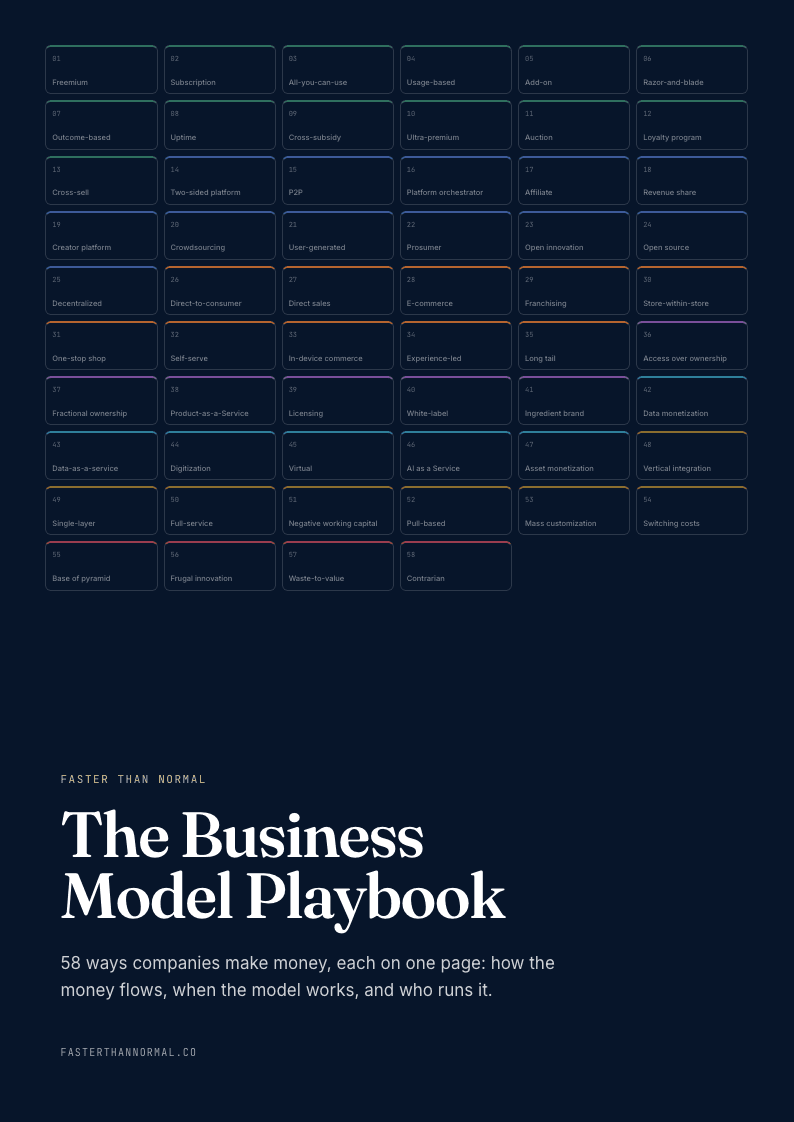
Free playbook
Get The Business Model Playbook
58 business models, one visual page each: how the money flows, the metrics that matter, and who runs it. Free when you join the Faster Than Normal email.
Free. No spam. Unsubscribe anytime.
Part IIIMaxims
-
Start in the unglamorous adjacent. The watch lens led to the phone screen led to the car windshield. Every great industrial position begins with a product nobody else finds interesting enough to perfect.
-
Personal ruin is an acceptable bet — once. Zhou sold her house to fund the Motorola contract. The willingness to convert everything personal into a single professional bet is what separates breakout founders from lifestyle operators.
-
Study on stolen time. If you can't afford education, arrange your life so that education is a byproduct of your employment. Zhou chose employers by their proximity to a university.
-
Quality is a customer acquisition strategy. In commodity markets, exceptional quality isn't just a product attribute — it's a reputation that compounds into access to progressively larger opportunities.
-
The founder's body on the factory floor is a management tool. Direct operational involvement signals organizational values more effectively than any mission statement.
-
Survive the platform edge. The most consequential decision in entrepreneurship is often not a strategic choice but the decision to continue existing. Build reasons to persist that are stronger than reasons to quit.
-
One capability, many surfaces. True diversification is not spreading across unrelated businesses. It is deepening mastery of a single capability and applying it to every surface the world needs covered.
-
Align with your best customer's future values. Don't wait for requirements to become mandatory. Anticipate them, commit early, and convert compliance into competitive advantage.
-
The darkest moment is also the most leveraged. Zhou's near-collapse during the Motorola crisis preceded the hundred-million-unit contract that made everything else possible. Proximity to failure is often proximity to breakthrough.
-
Refuse the village. Zhou's origin story is a story of refusal — refusing the marriage, the village, the predetermined life. The first entrepreneurial act is the decision that the default outcome is unacceptable.
In Their Own Words
When you have the ability to learn, you have the ability to continue to grow. … The clients won't give you a better price for your products simply because you have a higher degree, but your knowledge of the business will help maintain the competitiveness of your company.— Inc. article, 2021
I have encountered many difficulties and setbacks as an entrepreneur. If I gave up then, there wouldn't have been Zhou Qunfei or Lens Technology.— CNBC Make It interview
Perseverance is the key to success.
I like to master technologies myself.
The experience of observing the way water rolls off the leaf gave me inspiration for the anti-fingerprint coating patent.
If you are poor, even if you live downtown, nobody knows you. If you are rich, you can live on a remote mountain and distant relatives will come to see you.— Her father's saying
I dropped out of high school to work, but I never stopped learning.
I believe that hard work and determination can change your life.
I realized that for my family and employees, I cannot give up. I had to carry on.— Zhou Qunfei
Many people would experience a serious blow to their confidence when they encountered setbacks, but the key to success is to persevere, especially during the most difficult times.— Zhou Qunfei
If I gave up then, there wouldn't have been Zhou Qunfei or Lens Technology.— Zhou Qunfei


