
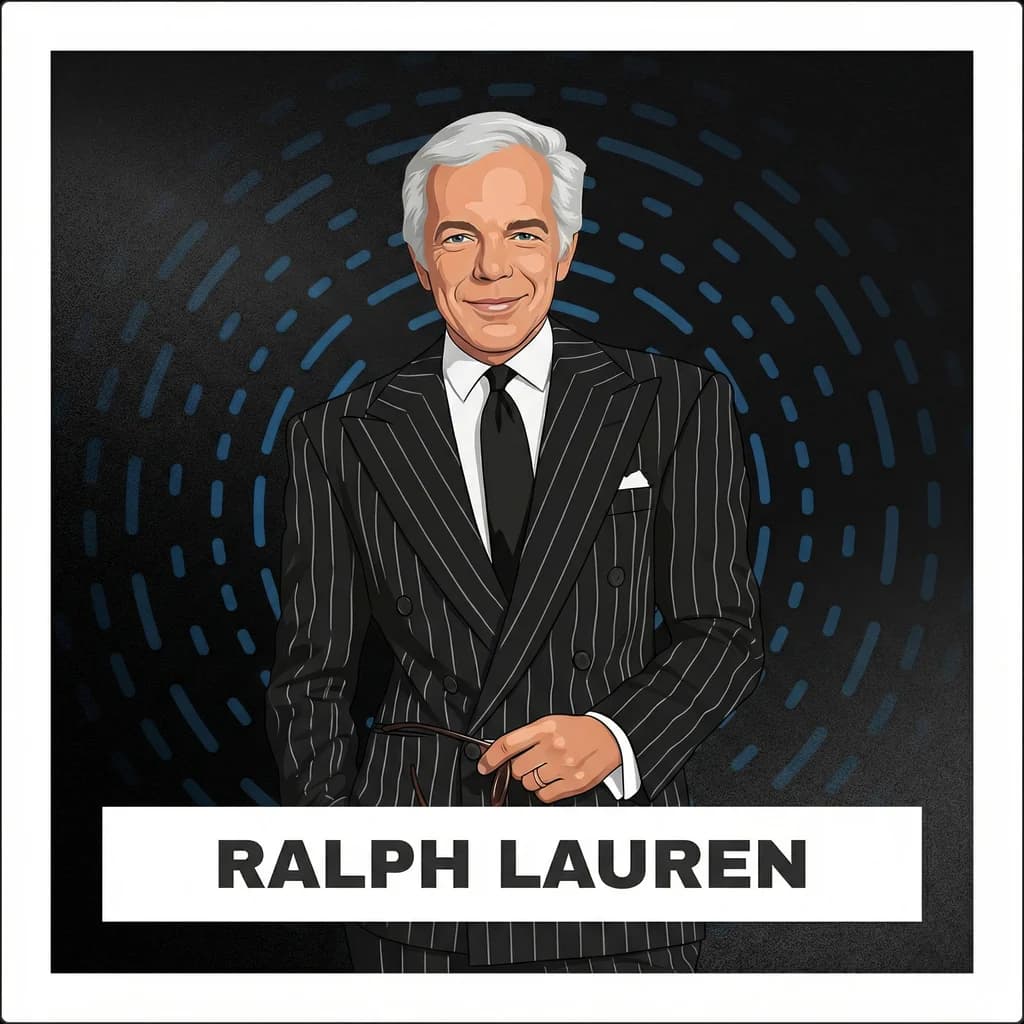

Part IThe Story
The Tie That Wouldn't Bend
In 1967, a twenty-seven-year-old necktie salesman walked into the buying office at Bloomingdale's — "the hottest store in America," he would later call it — carrying a collection of handmade ties that were wider than anything on the market, cut from fabrics nobody used for neckwear: rich repps, bold prints, luxurious silks that belonged on upholstery, not under chins. The buyer liked them. He would take them, he said, on two conditions: make them slightly narrower, and remove the designer's own label from the back, replacing it with the Bloomingdale's name. The young man — born Ralph Lifshitz in the Bronx, renamed Ralph Lauren at sixteen, possessed of no formal design training and no capital beyond a single drawer in a shared showroom in the Empire State Building — wanted the sale badly. Bloomingdale's was the center of the retail universe, and he was nobody, a kid from Mosholu Parkway who had been selling gloves and suits for other people his entire working life. He said no. He walked out. "I thought my legs would crumble," he recalled more than fifty years later, telling the story to a roomful of Wall Street analysts. Six months passed. Then Bloomingdale's called back and said yes — on his terms, with his label, at his width. "Had I changed that tie," Lauren told the crowd, "I would not be here today."
That moment — a broke young man refusing the biggest retailer in Manhattan because the compromise would have erased his name — contains the entire architecture of what would follow: the Polo empire, the Rhinelander Mansion on Madison Avenue, the 17,000-acre ranch in Colorado, the $14,000 alligator handbag named after his wife, the Gulfstream, the fleet of vintage cars, the Presidential Medal of Freedom. All of it flows from the conviction that the thing you are selling is not a product but a world, and that a world without your name on it belongs to someone else.
By the Numbers
The Ralph Lauren Empire
$7.1BAnnual global revenue (fiscal 2025)
1967Year Polo was founded with a line of ties
17,000Acres at Double RL Ranch, Colorado
30+Ralph's Coffee and restaurant locations worldwide
$465.4MIPO proceeds from 17.9M shares sold, June 1997
2025Year awarded the Presidential Medal of Freedom
Mosholu Parkway and the Education of Desire
The Bronx in the 1940s and 1950s was a sorting machine for immigrant children, a place where the sons and daughters of people who had fled pogroms, famines, and fascism were given the raw materials of American life — public schools, stickball, the subway — and left to assemble an identity from whatever they could find. Ralph Lifshitz, born October 14, 1939, was the third of four children in an Ashkenazi Jewish family that had come from Belarus. His father, Frank, was an artist who painted houses for a living — a man who understood color and surface but earned his wages applying other people's choices to other people's walls. His mother, Frieda, had reportedly hoped Ralph would become a rabbi.
He became something stranger. As a teenager in Mosholu Parkway, where the neighborhood divided neatly into teenage gangs — the "rocks" in black leather jackets, the "preps" in crewneck sweaters and penny loafers — Ralph belonged to neither tribe and both. He mixed army fatigues with tweeds. He studied the screen movements of Fred Astaire and Cary Grant the way other boys studied batting averages. Calvin Klein, who also grew up in the Bronx, later recalled: "When I was a child in the Bronx, I would see him and think, 'Who is this person? Who dresses like that?'" At sixteen, Ralph and his brother Jerry changed their surname to Lauren — the teasing at school had become intolerable — while another brother, Lenny, kept the family name. It was a small, deliberate act of self-authorship, the first of many. The boy who would build an empire on the fantasy of inherited American elegance began by inheriting nothing and inventing everything, starting with his own name.
He attended Baruch College in Manhattan, studying business at night while working sales jobs during the day. A brief stint in the Army. Then a position at Brooks Brothers, that cathedral of Ivy League propriety, where the young Lauren did not design but sold — absorbing, through the daily handling of button-down oxfords and regimental ties, a tactile education in what quality felt like and what aspiration looked like when it was draped over a man's shoulders. He would later write, in a rare autobiographical moment: "I loved the oldness, the custom mood of navy blazers, school crests, rep ties, flannels, and saddle shoes." The kid from the Bronx did not merely admire the wardrobe of the American aristocracy. He memorized it. And then he improved it.
A Single Drawer in the Empire State Building
The mythology of American enterprise is thick with garages — Hewlett and Packard's in Palo Alto, Disney's uncle's in Los Angeles, Bezos's in Bellevue. Ralph Lauren's origin story is more compressed than a garage. It is a drawer. One drawer, in a shared showroom, in the Empire State Building, from which he sold his first ties under the name Polo in 1967.
The name was a calculated act of aspiration. "It had that vaguely English sense to it," he explained in a 1983 interview. Polo — not baseball, not basketball, not any of the sports a kid from the Bronx would have actually played. Polo: the game of princes and Park Avenue, of riders on horseback with mallets raised, of a world so rarefied that most Americans had never seen a match and couldn't name a single player. Lauren chose to name his company after a sport he had never played, in a country whose aristocracy he was not born into, and the audacity of the gesture was itself the product. He was not selling ties. He was selling the permission to imagine yourself as someone who might, on a Saturday in Greenwich, attend a polo match.
His employer at the time was Beau Brummell, a tie manufacturer whose president, Abe Rivetz, listened to Lauren's pitch to design his own line and delivered a verdict that belongs in any anthology of catastrophic misjudgments: "The world is not ready for Ralph Lauren." Lauren convinced Rivetz to let him try anyway, and with ties that were wider, thicker, and more expensive than anything on the market — made from fabrics that made established buyers uneasy — he went door to door. In his first year, working from that single drawer, he sold $500,000 worth of ties to Paul Stuart, Neiman Marcus, and eventually, after the standoff, Bloomingdale's. By 1968, he had secured his own in-store shop at Bloomingdale's — a rarity for a designer so new — and incorporated the business as Polo Fashions, Inc. A $30,000 loan helped him expand into a full menswear line. In 1970, he won the Coty Award for men's design, the industry's highest honor at the time. He was thirty years old.
— Ralph LaurenI wasn't going to change the ties, and I didn't, and I walked out. I thought my legs would crumble.
The speed of the ascent obscures something essential about the nature of the bet. Lauren was not, in any conventional sense, a fashion designer. He had no training at Parsons or FIT. He could not sketch. He did not drape fabric on mannequins or construct patterns. What he possessed instead was something rarer and more dangerous: a vision so complete and so internally consistent that it functioned as a kind of gravitational field, pulling products, stores, advertising, and eventually an entire lifestyle into its orbit. The ties were not the business. The ties were the first sentence of a story he intended to tell for the rest of his life.
Dressing Gatsby, Becoming Gatsby
In 1974, Ralph Lauren dressed Robert Redford for Jack Clayton's film adaptation of The Great Gatsby. The clothing came from Lauren's current line — not custom-made for the film but pulled from the racks, as if Jay Gatsby himself might have wandered into a Polo showroom. The tweed suits, the cream-colored Oxford shirts, the linen trousers — they looked as though they had always existed in that lost, elegant world of West Egg, because Lauren had designed them to evoke exactly that world. The film itself was a critical disappointment. The clothes were not. Overnight, the Ralph Lauren look stopped being a designer preference and became a cultural reference point, a visual shorthand for a particular kind of American romance: the yearning of the self-made man for the grace and ease of old money, the persistent belief that you can reinvent yourself so completely that even the past submits to your version of events.
The parallel between Lauren and Fitzgerald's creation is almost too neat, and Lauren, a man of sincerity rather than irony, seems never to have been troubled by it. Gatsby invented himself out of nothing, and the invention destroyed him. Lauren invented himself out of the Bronx, and the invention made him one of the richest self-made men in America. The difference, perhaps, is that Lauren understood something Gatsby did not: you cannot just attend the party. You have to own the house, design the furniture, choose the lighting, arrange the flowers, and sell tickets to the guests. Control everything, and the fantasy becomes indistinguishable from reality.
Three years later, he dressed Diane Keaton for Woody Allen's Annie Hall (1977), and the effect was, if anything, more significant. Keaton's character — the slouchy blazers, the men's vests, the oversized khakis — became one of the most imitated looks in American fashion history. Keaton herself later said: "His closet was kind of like my closet. He loved the way women looked in men's big jackets and sweaters and lots of layers." Lauren deflected the credit. "He always emphatically stated that she was me and her style was my style," Keaton recalled. "Actually it was all Ralph."
The twin film triumphs established a pattern that would define Lauren's approach to marketing for the next five decades: he did not advertise fashion. He cast a movie. Every campaign, every store window, every runway show was a set — a narrative tableau in which the clothes were not the subject but the setting, and the customer was invited not to buy a garment but to step into a scene. As Paul Goldberger, the architecture critic and Lauren's friend, observed: "Come into my movie, buy a piece of this life. As opposed to just a piece of clothing."
The Mesh Shirt and the Architecture of Ubiquity
In 1972, Lauren introduced what would become his single most important product: a short-sleeved mesh cotton polo shirt, available in twenty-four colors, embroidered with a tiny emblem of a polo player on horseback, mallet raised. The shirt cost more than its competitors. It was not technically innovative. Its design was a variation on the tennis shirt that René Lacoste had popularized decades earlier. And yet the Lauren polo shirt would become one of the most widely worn garments in the history of American clothing — a piece so ubiquitous that it transcended fashion entirely and entered the realm of cultural infrastructure, the way Levi's jeans or Converse sneakers did before it.
The logo did the real work. That tiny horseman, no larger than a postage stamp, did more work per square centimeter than perhaps any other emblem in commercial history. It communicated, in a single image, everything Lauren wanted his brand to mean: sport, wealth, tradition, ease, the English countryside as filtered through an American optimism that refused to acknowledge class boundaries. You did not need to play polo, or know anyone who played polo, or have ever seen a polo match, to wear the shirt. You needed only to want the life the logo suggested — and who, looking at that little rider, galloping across your left breast toward some unseen finish line, could resist?
The shirt also solved a problem that had bedeviled American designers for decades: how to make menswear aspirational without making it threatening. Lauren's polo shirt was the safest garment in America. It was neither too formal nor too casual, neither too expensive nor too cheap, neither too fashionable nor too dowdy. "Buying Ralph is like buying a Maytag," said Hal Reiter, president of Herbert Mines Associates, who owned six pairs of Ralph Lauren trousers and two of his suits — an established brand that stood for reliability and quality. The comparison, though intended as a compliment, reveals something Lauren would spend the rest of his career trying to reconcile: how to be both an appliance and a dream.
By the 1980s, the Polo brand was generating an estimated $1.3 billion in annual retail sales. Lauren's personal wealth was estimated at $300 million. He and his wife Ricky — born Ricky Ann Loew-Beer, whom he had married in 1964, a union that would prove to be one of the most durable in an industry notorious for destroying marriages — shuttled by private jet among homes in New York, Colorado, and Jamaica with their three children: Andrew, David, and Dylan. The family appeared in his advertising. They were the living proof of the world he was selling.
The Mansion on Madison
In the mid-1980s, Lauren acquired the lease on the Rhinelander Mansion at 867 Madison Avenue, a Beaux-Arts limestone townhouse built in 1898, and spent a reported fortune renovating it into the flagship store that would become the physical embodiment of his brand. When it opened in 1986, it was unlike anything the retail world had seen. It did not look like a store. It looked like the home of someone impossibly wealthy, impossibly tasteful, and impossibly organized — a fictional aristocrat whose library was always dusted, whose silver martini shaker was always polished, whose closet contained exactly the right number of cashmere sweaters in exactly the right shades.
The Rhinelander Mansion made an argument: that clothes were inseparable from context — that a navy blazer hanging on a chrome rack under fluorescent light was a different object than the same blazer draped over a leather club chair beside a crackling fireplace with an old painting on the wall above. The environment did not support the merchandise. The environment was the merchandise. You could buy the blazer, yes, but what you were really buying was a piece of the room, a fragment of the life that the room implied.
Jerry Seinfeld, a comedian who would become one of the most famous men in America, captured the psychology of the moment: "I remember the jeans and the cologne. Everybody was wearing that. It was very aspirational for me at that time. I was completely broke for most of the seventies and eighties. So it was just, you know . . . it was, like, when you made it, that's what you would buy."
The store marked a turning point in Lauren's relationship with the retail industry. For years, he had griped that department stores did not display his clothes with sufficient elegance — that they crammed Polo next to lesser brands, under lighting that flattened the colors and destroyed the mood. The Rhinelander Mansion was his answer: if they would not present his vision properly, he would present it himself. It was the beginning of a slow, decades-long shift from wholesale dependence to direct-to-consumer control that would ultimately define the company's survival strategy in the twenty-first century.
A Brain Tumor, a Ranch, and the Expansion of the Dream
In 1987, Ralph Lauren was diagnosed with a benign brain tumor. He underwent surgery to have it removed. He was forty-seven years old, at the peak of his powers, and the brush with mortality did what such brushes often do to ambitious men: it intensified everything. The work became more urgent. The vision expanded.
The expansion had begun earlier — in 1978, with the launch of fragrances (Lauren for women, Polo for men), and in 1983, with an extensive home furnishings line that would eventually include pillows, throws, bed and bath products, furniture, and household paint. But after the surgery, the pace accelerated. Lauren seemed determined to leave no surface of American domestic life untouched by his aesthetic. If you could sleep on his sheets, eat off his plates, sit on his furniture, paint your walls with his colors, and then dress yourself in his clothes, you were no longer merely a customer. You were an inhabitant.
Around the same time, he and Ricky purchased property in the Colorado uplands near Telluride. It would become the Double RL Ranch — nearly 17,000 acres, "bigger than Manhattan," Lauren liked to tell visitors with a grin. The ranch was named for Ralph and Ricky, and its existence served a dual purpose: it was the private sanctuary of a family that, despite enormous public visibility, maintained an almost ferocious privacy, and it was the living laboratory for a new aesthetic direction. The Double RL line, launched in 1993, drew on the iconography of the American West — worn denim, Navajo blankets, hand-tooled leather, the romantic ruin of frontier life — and added it to Lauren's repertoire of aristocratic Anglophilia and East Coast prep. The cowboys on the ranch tended a thousand head of cattle, whose meat would eventually be served at The Polo Bar in Manhattan and whose hides would be crafted into boots and bags for the RRL collection.
— Ralph Lauren, interview with Oprah WinfreyI'm really proud that I went to my own beat, that I didn't sell out. I've always had a sense of self; I never wanted to be part of the crowd.
The ranch completed something in the Lauren mythology. Here was a man who had begun with the fantasy of English aristocracy and the American East Coast elite, and who had now absorbed the American West as well — not as a costume but as a lived experience, or at least as close to a lived experience as a billionaire fashion designer flying in on a Gulfstream could achieve. The clutter on his desk — tiny cowboy boots, tin robots, toy cars, vintage model airplanes — told the story of a man who collected not wealth per se but the artifacts of his own imagination, the physical evidence that the dream could be made real.
Going Public, Staying Private
On June 11, 1997, Polo Ralph Lauren Corporation began trading on the New York Stock Exchange. Lauren sold 17.9 million shares at $26 a share, raising $465.4 million — but retained a majority of the voting rights, ensuring that the company's creative direction would remain under his control. Goldman Sachs, which had invested a minority stake in 1994, managed the offering. The company that had started with a drawer full of wide ties was now a public corporation valued at billions of dollars.
The IPO was a critical juncture, and Lauren navigated it with the same instinct he had shown at Bloomingdale's thirty years earlier: take the money, keep the power. The dual-class share structure meant that outside shareholders could participate in the financial upside but could not dictate strategy, creative direction, or the fundamental character of the brand.
The years that followed were years of extraordinary expansion. The first RL Restaurant opened in Chicago in 1999, adjacent to the store on Michigan Avenue. Ralph's opened in Paris in 2010, in the converted courtyard and stables of the company's Boulevard Saint-Germain store. The Polo Bar debuted in Manhattan in January 2015. Lauren was no longer selling clothes, or even a lifestyle. He was selling hospitality, creating physical spaces where customers could eat, drink, and sit inside the world his advertising had always depicted. The restaurants served the same function as the Rhinelander Mansion: they argued that the brand was not a brand at all but a way of living, complete and self-sustaining, from the burger on your plate to the boots on your feet.
By the early 2000s, the Polo Ralph Lauren Foundation had been established, funding cancer research (a cause close to Lauren after his own health scare) and literacy programs. In 1998, Lauren pledged $13 million to the Smithsonian Institution to help preserve the Star-Spangled Banner — the original flag that had inspired the national anthem. From a man who had built a multi-billion-dollar business on an idealized vision of American life, the gesture felt less grandiose than inevitable.
The Discount Trap and the Frog in the Pot
Success, in the fashion business, contains within it the seeds of a particular kind of failure. The more people want your brand, the more stores want to carry it. The more stores carry it, the wider your distribution. The wider your distribution, the more tempting it becomes to create lower-priced lines for lower-tier retailers. And the more your products appear on clearance racks at T.J. Maxx, the less anyone believes you when you say the word "luxury."
Ralph Lauren fell into this trap in the 2000s, and the fall was protracted and painful. In 2007, Fortune reported that Lauren was developing American Living, a new moderately priced line exclusively for J.C. Penney. Simultaneously, the company was pushing further upscale with flagship stores in Tokyo and Moscow. The question Fortune posed — "Can he really sell all things to all people?" — was, in retrospect, less a question than a warning.
The answer, delivered over the next decade, was emphatic: no. Sales and profits declined after nearly uninterrupted growth since 1967. The brand's luxury bona fides eroded slowly, like riverbank soil in a steady current. By the mid-2010s, Ralph Lauren products were fixtures at discount chains — J.C. Penney, Kohl's, T.J. Maxx — and the welter of overlapping sub-brands (Polo, Lauren, Chaps, Denim & Supply, Rugby, Club Monaco, RRL, Purple Label, Black Label, Blue Label) was confusing customers and diluting the central promise. Patrice Louvet, who would later become CEO, would describe the dynamic as a series of small concessions, each one seemingly harmless, that together slowly boiled the brand.
In September 2015, Lauren announced that he was stepping down as CEO, though he would remain as executive chairman and chief creative officer. Stefan Larsson, a former H&M executive, was brought in to run the business. The marriage lasted barely a year. Larsson and Lauren clashed over the direction of the company — the fundamental tension between a founder's vision and an operator's efficiency — and Larsson departed in 2017. The episode underscored a truth about founder-led companies that is easy to state and exceedingly difficult to manage: the brand is the founder's taste, and any CEO who attempts to override that taste is not running the company but destroying it.
The Rescue: Patrice Louvet and the Return to the Source
Patrice Louvet arrived at Ralph Lauren in July 2017 from Procter & Gamble, where he had spent thirty years rising through the ranks of the consumer goods giant, most recently as group president of global beauty. He was French-born, bespectacled, partial to immaculate navy suits from Purple Label and natty pocket squares. He came from a world of toothpaste and razor blades, and he would arguably save the most important American fashion company from obsolescence.
Louvet's strategy, unveiled in 2018 under the name "Next Great Chapter," was simultaneously radical and conservative. Radical because it required pulling out of more than a thousand U.S. department stores — two-thirds of those where the brand was present — and shutting down cheaper labels to focus on the higher-end offerings. Conservative because the intellectual foundation of the strategy was, essentially, to go back to the beginning: to treat Ralph Lauren as the luxury company it had always been before the discount fever set in. "Ralph founded this company as a luxury company, and what we needed to do was go back to this mindset," Louvet told Fortune.
The results were striking. The average price for a Ralph Lauren item doubled in ten years. Far fewer items ended up in the discount bin. The company shifted from a wholesale-dependent model — at the mercy of department store buyers and their clearance racks — to a business that was more than 70 percent direct-to-consumer, controlling its own stores, its own website, and its own narrative. Ralph's Coffee, a venture that would have seemed absurd in the era of J.C. Penney collaborations, expanded to more than thirty locations worldwide, with customers lining up around the block. The brand's fashion credibility, which had seemed mortally wounded, recovered.
What Louvet understood — and what Larsson, for all his operational skill, apparently did not — was that his job was not to replace Lauren's vision but to create the conditions for that vision to be expressed at its highest level. "It's my job to create the conditions for my team to be successful," Louvet said, describing his philosophy. "If I do that well, I'll be fine." He framed his approach as "servant leadership" — a term from the management consultancy playbook that, in this context, carried a specific and unusual meaning: the CEO serves the creative founder, not the other way around. The relationship worked because Louvet genuinely deferred to Lauren on matters of taste and brand expression while exercising rigorous discipline on matters of distribution, pricing, and operational efficiency. As of September 2025, the company's "Next Great Chapter: Drive" plan projected revenue growth at a compounded annual rate of mid-single digits through fiscal 2028, with operating profit growth exceeding top-line growth. Shares were near all-time highs.
— Patrice Louvet, CEO, Ralph Lauren CorporationThere are a number of levers you can pull to continue fast growth that you can convince yourself are not problematic. You keep dialing it up. Until one day, like a frog that's been boiled gradually, your brand equity dies.
The Family and the Succession
Ralph Lauren married Ricky Ann Loew-Beer in 1964, three years before he sold his first tie under the Polo name. More than sixty years later, they are still married — a duration so unusual in the fashion industry that it almost functions as a design statement in itself, a piece of evidence that the stability and warmth depicted in Lauren's advertising is not entirely imagined.
David Lauren, the middle of their three children, joined the company in 2000 after a detour through media — he had founded Swing magazine as a Duke undergraduate in 1994, built it to a circulation of 200,000, and watched it fold in 1998. He traveled to Vietnam, Cambodia, and China with a backpack, then came home and, at his father's invitation, tried working at the family company "for at least a year." Twenty-five years later, he is chief branding and innovation officer and vice chairman of the board, overseeing global marketing, digital content, and the company's technology partnerships. He launched ralphlauren.com in 2001, making it one of the first luxury brands to sell online. His older brother, Andrew, became a film producer. His younger sister, Dylan, opened Dylan's Candy Bar, the largest candy store in the world.
"As a kid I never really thought of my father as a famous designer nor did I think about money or fashion in a big way," David has said. "My father was not a party person nor did he go out to fashion industry events. We really led a life about family. A real life." The portrait that emerges from interviews with and about the Lauren family is of a household that was simultaneously enveloped in the brand and insulated from the industry — a family that appeared in the advertising but did not attend the society dinners, that lived inside the world Ralph had created but treated it as a home rather than a set.
The question of succession — what happens to a company so thoroughly identified with a single individual's taste that the SEC filings open with a full-page photo of him on horseback — is the defining strategic challenge of Ralph Lauren's next chapter. David Lauren's expanding role suggests one answer. The "Next Great Chapter: Drive" plan, with its emphasis on institutional capabilities and systematic growth, suggests another: that the company is being architected to survive the eventual absence of its founder by embedding his aesthetic DNA so deeply into the organizational culture that it can be reproduced without him. Whether that is possible — whether a brand built on one man's instinct can outlive that instinct — is a question the fashion industry has answered, historically, in both directions. Chanel endured. Halston did not.
No Irony, No Apology
There is no irony to Ralph Lauren. That may be the most important thing to know about him, and the thing that makes him most difficult to write about in an era that treats sincerity as a character flaw. As Paul Goldberger observed in Vanity Fair: "Lauren isn't trying to live in the past. He's trying to get the past to live in the present, which takes a lot more chutzpah, because to make it work you have to get other people to sign on to your fantasies. No one — well, no one since Walt Disney — has done a better job of that than Ralph Lauren."
The Disney comparison recurs throughout the literature on Lauren, and it is worth interrogating. Both men built empires on the commercialization of innocence. Both created immersive worlds — physical environments in which the customer is enveloped by a unified aesthetic vision. Both were accused of sentimentality, of selling a sanitized version of reality that erased the messy, the ugly, the contradictory. And both answered the accusation the same way: with their balance sheets. "I try to give people a clean, aspirational quality, with no bullshit," Lauren told Fortune in 1996. "Where's the negative in that?"
The negative, critics would argue, is that Lauren's vision of America — the silver martini shaker, the preppy sweater, the polo match, the ranch — is a fantasy of whiteness, of privilege, of a class structure that the country has never fully acknowledged and that Lauren, the son of Belarusian Jewish immigrants, was never born into. The criticism has real force, and the brand's early imagery did little to answer it. What Lauren's defenders point to is that he did not reproduce the American elite so much as edit it: he took out the drunkenness, the decay, the cruelty, the boredom, and left only the surfaces. His version of American life was, as the Washington Post noted, an environment where "the clutter has a gloss" and "if a rugby shirt on his runway has a bit of grime, it was patted on before the show." The artifice was the art.
And the market for that art turned out to be astonishingly broad. "You don't have to be a Republican to enjoy dressing like one," Goldberger wrote. Lauren's customer base eventually spanned prep school students and Wall Street executives, hip-hop artists and Midwestern housewives, British aristocrats and Japanese streetwear collectors. Jerry Seinfeld bought his suits. Oprah Winfrey toured the ranch on camera. The brand became, in the words of the company's own strategic plan, "an inclusive luxury lifestyle brand" — a phrase that would be an oxymoron for almost any other company but that, for Ralph Lauren, described the central paradox on which the entire enterprise was built: luxury that feels democratic, exclusivity that invites everyone in.
In January 2025, at the age of eighty-five, Ralph Lauren received the Presidential Medal of Freedom, reported at the time as a first for a fashion designer. He had already been awarded the Legion of Honour by France in 2010, the James Smithson Bicentennial Medal in 2014, and an honorary Knight Commander of the Order of the British Empire in 2019 — reportedly the first American designer so honored. The CFDA had given him its Lifetime Achievement award in 1991, its Fashion Legend award in 2007, and multiple Designer of the Year awards in between. He works out with a personal trainer for ninety minutes every morning. He is careful about what he puts in his body. He visits his stores. He watches the customers.
On a blustery August day at the Double RL Ranch, wearing faded blue denim jeans, a white cotton Henley, a matching denim jacket, and grey New Balance trainers, he ushered a visitor inside the Saloon — a log cabin with a wraparound porch and its own private cinema, the screen swagged in crimson velvet curtain like a Vaudeville IMAX, the seats distressed leather club chairs. "It's always like a movie," he said. "It's a movie that tells you a story that I want to express. If you just do clothes, it doesn't mean as much." Through the window, the wind swirled through the thigh-high grass, and the San Juan Mountains held their ancient line against the sky, and the wooden fence that Oprah Winfrey had once commented on stretched toward a horizon that was, in that light, indistinguishable from one of his advertisements.
Part IIThe Playbook
Ralph Lauren built what is arguably the most successful fashion company in American history without formal design training, without fashion school, without a mentor in the industry, and without ever producing a single garment that could be called avant-garde. His playbook is less about fashion than about the construction of a world — and the discipline required to keep that world coherent across fifty-eight years, thousands of products, and the relentless gravitational pull of compromise. What follows are the principles that emerge from that construction.
The principles
- 1.Refuse the first compromise — it sets the price for every one that follows.
- 2.Sell a world, not a product.
- 3.Use outsider status as creative fuel.
- 4.Control the context, not just the content.
- 5.Design for timelessness, not trendiness.
- 6.Build a brand architecture that captures every customer — and protects the peak.
- 7.Know when you've boiled the frog.
- 8.Hire operators who serve the vision, not replace it.
- 9.Make the family the brand — and the brand the family.
- 10.Turn every surface into a story.
- 11.Retain structural control, even when you take outside money.
- 12.Treat sincerity as a competitive advantage.
Principle 1
Refuse the first compromise — it sets the price for every one that follows.
The Bloomingdale's standoff in 1967 was a negotiation over tie width and labels that became a constitutional moment — the point at which Lauren established, irrevocably, that his name and his vision were non-negotiable. Every subsequent decision in the company's history — the refusal to let retailers dictate display standards, the insistence on opening his own stores, the dual-class share structure at IPO — was an echo of that first refusal.
The lesson is not that you should always say no to powerful partners. It is that the first concession you make defines the relationship, and in a brand business, the relationship between creator and distributor determines everything. Had Lauren removed his label from the ties, he would have become a supplier — anonymous, interchangeable, subject to the buyer's next whim. By keeping his name, he became a brand. The six months of silence that followed were the price of that distinction.
Tactic: Identify the one thing about your product or brand that, if compromised, would reduce you from a differentiated creator to a commodity supplier — and make that your non-negotiable line, regardless of the short-term cost.
Principle 2
Sell a world, not a product.
Lauren's fundamental insight — the one that separates him from every other fashion designer of his generation — was that people do not buy clothes. They buy identities. A navy blazer is a navy blazer; placed inside a world the customer wants to live in, it becomes a way into that life.
From the very beginning, Lauren's advertising featured narratives rather than garments — cinematic tableaux of families at country houses, couples on horseback, sun-dappled afternoons at a polo match. The garments were present but incidental, the way furniture is present in a film but you are watching the actors. This approach was a deliberate strategic choice rather than an accident of taste, and it allowed the brand to expand into categories — home furnishings, restaurants, fragrances, coffee — that would be absurd for a company that sold only clothes but were logical extensions of a company that sold a way of living.
Tactic: Before designing a product, design the world it belongs to — the scene, the narrative, the emotional context. Then let the product serve the story, not the other way around.
Principle 3
Use outsider status as creative fuel.
Ralph Lauren grew up, as the 1986 TIME cover story noted, "a long way from all the things he really admired: hand-tailored clothes, manor houses, sports cars, fine horses and manicured lawns." He was not born into the world he would spend his career depicting. He was born in the Bronx, the son of a housepainter, in a family that had fled Belarus. He changed his name at sixteen. He never attended design school. He never played polo.
This distance became the source of his vision. Because Lauren saw the American elite from the outside, he saw it more clearly — and more generously — than anyone who had grown up inside it. He stripped away the dysfunction and preserved only the beauty. His version of Wasp life was, as Vanity Fair observed, "always a little cleaner, a little brighter, just a touch more polished" than the real thing. An insider would have known too much to idealize it. An outsider idealized it instinctively, and in doing so, created something more appealing than reality.
Tactic: Your distance from the world you aspire to enter is not a weakness — it is the lens that allows you to see what insiders take for granted and to present it in a way they never would.
Principle 4
Control the context, not just the content.
For years, Lauren complained that department stores did not display his clothes properly — that they crammed Polo next to inferior brands under unflattering light. Most designers griped and accepted it. Lauren griped and then opened the Rhinelander Mansion. He did not merely design clothes; he designed the environments in which they would be experienced. The flagship store, the RL Restaurant, Ralph's Coffee, The Polo Bar — each was a controlled environment in which the brand's story could be told without interference from a department store buyer's markdown strategy.
🏠
Context Control: From Wholesale to Ecosystem
Ralph Lauren's evolution from wholesale dependency to direct-to-consumer control.
| Era | Distribution Model | Brand Control |
|---|---|---|
| 1967–1986 | Department stores, licensed boutiques | Limited — at mercy of retail partners |
| 1986–2015 | Flagship stores + expanding wholesale | Mixed — own stores high, wholesale eroding |
| 2017–present | 70%+ direct-to-consumer | High — pricing, display, narrative all controlled |
The shift from wholesale to DTC was existential as much as it was about distribution. In a wholesale model, the retailer controls the context — the lighting, the adjacencies, the markdown cadence — and the brand is a guest in someone else's house. In a DTC model, the brand controls everything, and the customer enters the brand's house. Lauren understood this distinction decades before it became a Silicon Valley truism about "owning the customer relationship."
Tactic: If the environment in which your product is experienced degrades the product's value, build your own environment — even if it means sacrificing short-term distribution breadth for long-term brand equity.
Principle 5
Design for timelessness, not trendiness.
"I'm interested in longevity, timelessness, style — not fashion," Lauren once said, and the distinction is not semantic. Fashion is seasonal; style is generational. Fashion requires constant novelty; style rewards consistency. Fashion is a treadmill; style is a flywheel.
Lauren's refusal to chase trends was, for decades, dismissed by fashion critics as a lack of innovation. His designs were "derivative," they said — echoes of things that already existed, English tweeds and American sportswear and Western wear, rearranged but never reinvented. Lauren absorbed the criticism and continued doing exactly what he had always done. "He has a philosophy that things that are timeless get better with age," David Lauren explained. "He's built an entire company around identifying, perpetuating, and loving the things that last."
The bet paid off spectacularly when the fashion cycle turned in his favor. As Gen Z discovered vintage clothing and thrift stores, the old Polo pieces — the 1989 American flag sweater, the 1992 Stadium jacket, the Polo Bear knitwear — became some of the most coveted items in streetwear. Lauren had not designed for nostalgia. He had designed for permanence, and permanence, given enough time, generates its own nostalgia.
Tactic: Build products that your customers' children will want to inherit. If a design decision serves this season but not the next decade, reject it.
Principle 6
Build a brand architecture that captures every customer — and protects the peak.
Ralph Lauren operates one of the most sophisticated multi-tier brand architectures in consumer business. At the apex sits Purple Label, hand-tailored in Italy from the finest cashmere and silk, priced from $1,500 to well above $3,000. Below it, the Ralph Lauren Collection bridges designer-level quality and broader distribution at $500 to $1,500. Polo Ralph Lauren, the volume driver, occupies the $50 to $500 range. Lauren by Ralph Lauren offers accessible women's contemporary pieces. And at the base, Polo Sport and outlet products serve as the customer acquisition tool, starting at $30.
📐
The $30-to-$3,000 Architecture
How Ralph Lauren structures its brand pyramid.
| Tier | Price Range | Function |
|---|---|---|
| Purple Label | $1,500–$3,000+ | Halo effect — defines the ceiling of luxury |
| Ralph Lauren Collection | $500–$1,500 | Bridge between accessible and ultra-luxury |
| Polo Ralph Lauren | $50–$500 | Volume driver and aspirational sweet spot |
| Lauren / Chaps | $30–$300 | Entry-level acquisition and department store presence |
The architecture creates a powerful psychological effect: the existence of a $3,000 suit makes a $150 polo shirt feel like a bargain, because the customer knows the logo on their chest also appears on garments they cannot yet afford. It creates an aspiration ladder — the college student in a $30 tee graduates to a $150 polo as a young professional, then to a $500 dress shirt, then, eventually, to a Purple Label suit. The brand captures lifetime value.
The danger — which Lauren learned the hard way in the 2000s — is that overexposure at the bottom of the pyramid erodes the credibility of the top. When too many items end up at T.J. Maxx, the $3,000 suit stops performing its halo function. The pyramid collapses into a flat plane. Louvet's turnaround was, in essence, a rebuilding of the pyramid's structural integrity.
Tactic: Design your pricing architecture so the peak creates a halo over the base, and the base creates a pipeline to the peak — but guard the peak ruthlessly, because once it loses credibility, the entire structure fails.
Principle 7
Know when you've boiled the frog.
The most dangerous mistakes in brand management are not the sudden catastrophes. They are the incremental compromises — each individually defensible, collectively fatal. Lauren's decision to supply J.C. Penney, to expand into a thousand-plus department stores, to proliferate sub-brands — each was rational in isolation. Together, they nearly destroyed the luxury positioning that was the company's core asset.
The lesson is that brand equity is a depleting resource. Every discount, every off-brand retail partnership, every confusing sub-label draws down the account. And unlike financial capital, brand equity does not come with a dashboard that tells you the balance in real time. You find out it is gone only when customers stop aspiring.
Tactic: Establish a regular, honest audit of your brand's positioning — not through financial metrics, which are lagging indicators, but through qualitative signals: Where does your product appear? Who is wearing it? What do they say when asked why? If the answers embarrass you, the frog is already warm.
Principle 8
Hire operators who serve the vision, not replace it.
The brief, failed tenure of CEO Stefan Larsson (2015–2017) and the enduring success of Patrice Louvet (2017–present) illustrate a truth about founder-led companies that is widely acknowledged and rarely acted upon: the right operator for a visionary founder genuinely believes the founder's vision is correct and sees the job as removing the obstacles to its full expression. Strategic brilliance matters less.
Louvet, a thirty-year Procter & Gamble veteran, came from a world that could not be more different from high fashion. But he understood something that eluded Larsson: at Ralph Lauren, the creative vision is not an input to the strategy. It is the strategy. His job was not to bring a new strategy but to execute the existing one at a higher level of discipline — pulling out of bad distribution, refocusing on the best products, investing in direct-to-consumer, and, above all, protecting Lauren's ability to do what he had always done.
Tactic: When hiring an operator for a founder-led company, select for alignment with the vision first and operational skill second. The most capable operator who disagrees with the founder's vision will do more damage than a less capable one who believes in it.
Principle 9
Make the family the brand — and the brand the family.
The Lauren family has appeared in the company's advertising for decades. Ricky, Andrew, David, Dylan — they are not spokesmodels. They are evidence. Their presence in the ads argues, implicitly but powerfully, that the world Ralph Lauren is selling actually exists, that somewhere there is a family this beautiful, this happy, this well-dressed, living in houses this lovely, and that family happens to be the family of the man who designed the clothes. It is the most persuasive form of marketing imaginable: the founder as the first and most committed customer.
David Lauren's evolution from magazine publisher to chief branding and innovation officer represents a generational transfer of the brand's narrative authority. His sister Dylan's candy empire and his brother Andrew's film career diversify the family's cultural footprint without diluting the brand's core. The family structure mirrors the brand architecture: multiple expressions, one underlying identity.
Tactic: If your personal life is consistent with your brand's values, make it visible — not as performance but as proof. The most powerful brand ambassador is the founder who genuinely lives the life the brand depicts.
Principle 10
Turn every surface into a story.
Lauren's expansion from ties to suits to womenswear to home furnishings to restaurants to coffee was less diversification in the traditional sense than narrative completion. Each new category was not a new business but a new chapter in the same story. The Polo Bar did not compete with other restaurants. It competed with the idea of eating somewhere that did not feel like a Ralph Lauren world. The home furnishings line did not compete with Pottery Barn. It competed with the idea of sleeping on sheets that did not match the life you had dressed yourself for.
This approach — treating every surface the customer touches as a storytelling opportunity — is what allowed Ralph Lauren to transcend the fashion industry entirely and become what the company now calls "a luxury lifestyle brand." The category expansion was limitless because the story was limitless. As long as there were surfaces in a customer's life that were not yet Ralph Lauren, there were chapters still to write.
Tactic: Map every surface your customer touches in a typical day — from the bed they wake up in to the coffee they drink to the clothes they wear to the restaurant they eat in — and ask: does our story extend to that surface? If not, consider whether it should.
Principle 11
Retain structural control, even when you take outside money.
When Ralph Lauren went public in 1997, he sold $465 million worth of shares but retained a majority of voting rights through a dual-class share structure. The decision gave outside investors economic participation but not strategic control.
The structure has proven its value repeatedly. During the discount-driven decline of the 2000s, the board could not force Lauren out or override his creative judgment. During the Larsson experiment, Lauren could end it when the fit proved wrong. The dual-class structure is the reason the company's SEC filings still open with a full-page photo of the founder on horseback. It is the reason the brand's creative direction has remained, for nearly sixty years, in the hands of the man whose name is on the label.
Tactic: If you must take outside capital, structure the deal to preserve your control over the decisions that define the brand. Economic dilution is recoverable; creative dilution is not.
Principle 12
Treat sincerity as a competitive advantage.
The fashion industry runs on irony, camp, provocation, and the relentless pursuit of novelty. Ralph Lauren has survived in this environment for nearly six decades by doing the opposite: being completely, almost stubbornly sincere. He means it. The ranch, the vintage cars, the cowboy boots on his desk, the ninety-minute morning workouts at eighty-five — none of it is a pose. "The reason it still works is because I am who I am," he has said. "If you like my style you will like my clothes."
In an era of performative authenticity — brands claiming "values" they do not hold, founders cultivating personas they do not inhabit — genuine sincerity is disorienting. It resists ironic reading. It cannot be deconstructed because there is nothing behind the surface except more surface, all the way down. Lauren is not pretending to be a rancher or an English gentleman or an Ivy League scion. He is a man who loves those aesthetics with an intensity that has not diminished in sixty years, and who has spent his entire life making them available to anyone who shares that love. The sincerity is what makes the marketing strategy work.
Tactic: If your brand's values are genuinely your values — if you would live this way regardless of whether anyone was watching — say so plainly and repeatedly, and let the consistency speak for itself. In a world of manufactured authenticity, the real thing is unmistakable.

Free playbook
Get The Business Model Playbook
58 business models, one visual page each: how the money flows, the metrics that matter, and who runs it. Free when you join the Faster Than Normal email.
Free. No spam. Unsubscribe anytime.
Part IIIMaxims
-
An industry verdict is only an opinion. His employer's president told Lauren, "The world is not ready for Ralph Lauren." Lauren persuaded him to let him try anyway and sold $500,000 of ties in his first year.
-
You can lead a craft you can't perform. Lauren had no design training, could not sketch, and did not drape or cut patterns. What he supplied was a consistent vision and the judgment to hold everyone else's work to it.
-
The film can flop and the wardrobe still win. The Great Gatsby (1974) was a critical disappointment, yet the Polo clothes Robert Redford wore turned Lauren's look into a cultural reference point. Judge a placement by what it does for your product, not by the reviews of the vehicle.
-
Giving away credit can cost you nothing. Lauren insisted that Diane Keaton's Annie Hall style was her own; Keaton said it was all Ralph. Keaton's own telling handed him the credit anyway.
-
Sometimes the way back is to get smaller. Louvet's recovery plan pulled Ralph Lauren out of more than a thousand U.S. department stores and shut down cheaper labels. Average prices doubled over ten years, and the shares approached all-time highs.
-
Reliable and aspirational pull in opposite directions. "Buying Ralph is like buying a Maytag," one admirer said, meaning it as praise. Lauren spent his career trying to be both an appliance and a dream; lean too far toward either and the brand loses something.
-
An heir's failed venture can be good training. David Lauren's Swing magazine folded in 1998; two years after joining the company, he launched ralphlauren.com, making it one of the first luxury brands to sell online.
-
A strong balance sheet doesn't answer a fair criticism. Critics called Lauren's America a fantasy of whiteness and privilege, and the brand's early imagery did little to respond. Commercial success can defer that kind of question, but it doesn't settle it.
-
A brand built on one person's taste has to plan for their absence. The company is trying to embed Lauren's aesthetic so deeply that it can be reproduced without him. Fashion history offers both outcomes: Chanel endured; Halston did not.
In Their Own Words
I don't design clothes, I design dreams.
Books open windows to the world and have the power to transform lives.
You have to create something from nothing.
I believe in style, not fashion.
Style is very personal. It has nothing to do with fashion. Fashion is over quickly. Style is forever.
Each day is an occasion to reinvent ourselves.
Enjoy your family. Do things that you like to do. Stay strong. That's the secret to remaining happy.
Fashion is not necessarily about labels. It's not about brands. It's about something else that comes from within you.
What I do is about living. It's about living the best life you can and enjoying the fullness of the life around you- from what you wear, to the way you live, to the way you love.
I've never wanted to be in fashion. Because if you're in fashion, you're going to be out of fashion.
I am constantly drawing inspiration from everything I see—the places I travel, the people I know and the movies I see.
I'm interested in longevity, timelessness, style — not fashion.— Ralph Lauren
I try to give people a clean, aspirational quality, with no bullshit. Where's the negative in that?— Ralph Lauren, to Fortune, 1996
Had I changed that tie, I would not be here today. I believed in myself.— Ralph Lauren, on the Bloomingdale's negotiation
I didn't have a plan. It's been instinct, gut, love, passion and honesty.— Ralph Lauren, to British GQ, 2018
It's always like a movie. It's a movie that tells you a story that I want to express. If you just do clothes, it doesn't mean as much.— Ralph Lauren, on his ranch in Colorado
Further reading
- Ralph Lauren: The Man Behind the Mystique by Jeffrey A. Trachtenberg


