


Part IThe Story
The Hostess Who Couldn't Make Cocktails
She was, by her own cheerful admission, a terrible hostess. On weekends in the late 1970s, Peggy Cherng — who during the week coded battlefield simulators for the United States Navy and developed pattern-recognition algorithms for CAT scans at McDonnell Douglas — would drive from her engineering job to a Chinese restaurant on Foothill Boulevard in Pasadena, California, tie on an apron, and attempt to seat guests. "I could only do hosting, and I was not a good hostess," she later recalled. "Not very efficient. I couldn't make cocktail drinks." The image is worth holding: a woman with a doctorate in electrical engineering from the University of Missouri, whose research specialty was complex predictive analytics, fumbling with a seating chart at a family restaurant that was, at the time, barely breaking even. The restaurant was Panda Inn. Her husband, Andrew, and his father, a master chef named Ming-Tsai Cherng, had opened it on June 8, 1973, with a Small Business Administration loan and whatever cash the family could scrape together. In those early years, the family worked for free to keep the associates paid. Peggy would remember this later with the flatness of someone stating a mathematical proof: the inputs were labor and sacrifice, the output was survival.
What nobody at Panda Inn could have known — not the Caltech physicists who became regulars, not the Pasadena locals who slowly discovered the Mandarin and Sichuan flavors that distinguished it from the Cantonese norm — was that the woman who couldn't mix a decent drink would become the systems architect of a $5.9 billion restaurant empire, one of the richest self-made women in America, and the co-CEO of the largest Asian dining concept in the United States. That the inefficient hostess would build one of the first computerized point-of-sale systems in the restaurant industry, then use that technological infrastructure to scale a single food-court outlet into more than 2,500 locations across the globe — all without taking a dollar of venture capital, without selling a single share to the public, and without franchising a single store.
The paradox at the center of Peggy Cherng's story is not the familiar immigrant-makes-good arc, though it is that too. It is something more particular and more revealing: the question of what happens when a mind trained in systems engineering — in pattern recognition, in predictive modeling, in the reduction of complex phenomena to computable variables — encounters the radically human, radically chaotic business of feeding people. And what happens when that mind decides, against every signal from the market, that the way to scale is not to optimize for profit but to optimize for people.
By the Numbers
The Panda Empire
2,500+Panda Express locations worldwide
$5.9BEstimated revenue (2024)
50,000+Employees globally
$3.6BPeggy Cherng's estimated net worth (2025)
110M lbsOrange Chicken produced annually
$0Venture capital or public equity raised
0Franchised locations in the U.S.
Burma, Hong Kong, Kansas, Rain
Born Peggy Tsiang on December 18, 1947, in Mawlamyine, British Burma — a port city on the Andaman Sea, in a country that was just then shuddering into independence — she moved with her family first to China, then to Hong Kong, where they settled. The details of the early years are sparse, rendered by Cherng herself with the economy of someone who measures output, not sentiment. She was good at math. Her family believed in education, a conviction that was, for a girl in postwar Myanmar, quietly radical. She was, as she later put it, "eager to go to college." Hong Kong, with its British-inflected educational culture, sent most of its ambitious students overseas.
In 1967, at roughly nineteen, she enrolled at Baker University — a tiny Methodist liberal-arts school in Baldwin City, Kansas, a town so small that its primary claim to fame was a Civil War skirmish. The disconnect is almost comic: a young woman from the humid chaos of Hong Kong arriving in the wind-scoured plains of eastern Kansas, population hovering around 3,000. But Baker had one thing that would reshape her life. It had Andrew Cherng.
Andrew, born Jin Chang Cherng in Yangzhou, China, in 1948, was the son of a chef. His father, Ming-Tsai Cherng, had cooked at the Grand Hotel in Taipei after the family fled mainland China following the Communist victory. They later moved to Yokohama, Japan, where Ming-Tsai worked in restaurant kitchens. In 1966, Andrew immigrated to America alone at eighteen, landing at Baker to study mathematics. He carried with him a work ethic he would later illustrate through an oddly vivid anecdote: as a boy in Taiwan, he had loved deep-cleaning the household fan, wiping each individual wire of the cage. "If I decide to take on anything, I want to do it well," he said, "and I want to make sure no one else can do better." It is the kind of statement that sounds like a platitude until you watch someone build 2,500 identical restaurants without permitting a single one to operate outside their direct control.
Peggy and Andrew noticed each other immediately — two Chinese students at a small Kansas school where the international population could be counted on one hand. They became friends, then fell in love, then hatched a plan: finish undergraduate work as fast as possible, go to graduate school together, get married. But Peggy, characteristically, made a pragmatic detour. She transferred to Oregon State University. Not because she knew anyone there. Not because she had any particular connection to the Pacific Northwest. "It was a scholarship," she said. "I just went."
At Oregon State, she powered through a four-year applied mathematics program in three years. Her memories of Corvallis are, by her own telling, almost comically utilitarian: "Mostly I remember rain, green and studying. It was raining a lot in Oregon. And Oregon was very green. And I believe one time I got poison oak." She and Andrew maintained their relationship across the distance — Kansas to Oregon — in an era before email, before free long-distance calling, before any of the technologies that would later make such connections trivial. "I don't think we could afford to talk much," she said. "At that time a long-distance call was quite expensive." The courtship survived on letters and mathematics, which may be the same thing.
The Divergent Paths That Converged
After Oregon State, Peggy reunited with Andrew at the University of Missouri. He earned a master's in applied mathematics in 1972. She stayed and kept going — a master's in computer science, then a doctorate in electrical engineering, completed in late 1974. Her specialization was in the technologies that would define the next half-century: complex pattern recognition and predictive analytics programming. She developed software that made CAT scans more diagnostically useful. She built battle simulators for the Navy. She was, by every measure, a rising star in the defense-industrial complex, the kind of technical mind that large aerospace firms competed to recruit.
Andrew, meanwhile, took a different path — one that seemed, by the standards of credentialism, like a step backward. In 1972, he moved to Los Angeles to help his cousin run a Chinese restaurant called Ting Ho. After a few months of managing someone else's operation, he found a place of his own. On June 8, 1973, he and his father opened Panda Inn on Foothill Boulevard in Pasadena — a full-service Chinese restaurant offering Mandarin and Sichuan cuisine in a market dominated by Cantonese standards. The funding came from a Small Business Administration loan and family savings. The early reviews, at least from the proprietor, were mixed. "I was so sure that we were going to do well because I know our food, and I know the other Chinese restaurants," Andrew recalled. "They don't have very good food. So when we opened, I thought, 'We're gonna kick butt!' But those days, the customers didn't come easy. It took a lot of effort."
The Cherngs married in 1975. They started a family — three daughters: Andrea, Nicole, and Michelle. And for the next seven years, they lived a bifurcated existence that is difficult to imagine in today's era of "lean in" career optimization. During the week, Peggy did cutting-edge programming and engineering at McDonnell Douglas and later 3M — the kind of classified, high-clearance work that placed her at the intersection of computation and national security. On weekends, she drove to Pasadena and tried, with acknowledged incompetence, to help run a Chinese restaurant. "I was there in a limited capacity at first," she said, laughing at the memory.
Two lives. Two skill sets. Two worlds that had not yet discovered how much they needed each other.
— Peggy CherngI remember the family was working for free in order to keep the restaurant afloat and our associates paid.
The Mall That Changed Everything
The pivot — the moment that turned a successful regional restaurant into something with the potential for national scale — arrived not through strategic planning but through a chance encounter, the kind of randomness that retrospective narratives usually sand down into inevitability.
In the early 1980s, the developer of the Glendale Galleria II, a shopping mall under construction in Glendale, California, had eaten at Panda Inn. He liked the food. He was filling out his food court. He invited Andrew Cherng to take a space. It was, on its face, an absurd proposition: a sit-down restaurant known for its Mandarin cuisine was being asked to compress itself into a food-court stall, to compete with pizza slices and soft pretzels, to serve Chinese food at fast-food speed and fast-food prices. But Andrew, who had spent a decade learning the brutality of restaurant economics — the razor margins, the exhausting hours, the relentless competition — saw something that his instincts told him was worth the risk.
In October 1983, the first Panda Express opened in the Glendale Galleria food court. And it was at this moment that Peggy Cherng made a decision that would prove more consequential than any she had made at McDonnell Douglas. She left the defense industry. She joined the family business full time. The year was 1982 — just before the Glendale opening — and the proximate cause was the death of Andrew's father, Ming-Tsai Cherng, whose absence created an operational void. But the deeper cause was that Peggy had recognized something: the fast-food spinoff would require systems. Not recipes, not charm, not foot traffic — though it would need all of those. It would need the kind of operational infrastructure that only someone trained in systems engineering could build.
"I took a different career path," she said later, with the understatement of someone who had traded coding Navy battle simulators for tracking wonton soup inventory.
What she built was, by the standards of 1983 restaurant technology, revolutionary. Peggy introduced one of the first computerized point-of-sale systems in the fast-food industry — a system in which staff could punch meal orders into a computer rather than scribbling them on paper. "I think we were one of the first to use POS," she said. "It was confusing at the beginning, especially when everyone got nervous and pressed the wrong buttons. But it made everything more efficient." She didn't just install off-the-shelf software; she optimized the programming herself, developing customized operating systems to track inventory, purchasing, and customer feedback. She brought the analytical rigor of pattern recognition — the same discipline she had applied to CAT scans — to the question of how a kitchen moves food from wok to warming tray to plate.
This was not, in the conventional telling, the glamorous part of the Panda Express story. The glamorous part was the orange chicken, invented in 1987 by chef Andy Kao during a trip to Hawaii with Andrew — a dish that would eventually move 110 million pounds per year. The glamorous part was the expansion: 100 restaurants by 1993, 2,000 by 2018, 2,500 by 2024. But the infrastructure that made that expansion possible — the invisible architecture of data and logistics — was Peggy's. Without it, Panda Express would have been what most Chinese-American fast-food operations were: a single location, maybe two, run by an exhausted owner-operator serving food that had idled too long in warming trays.
The Heresy of Not Franchising
To understand what makes Panda Restaurant Group unusual, you have to understand the economics it rejected.
The standard playbook for American fast-food expansion is franchising. You develop a concept, you codify the operations manual, you sell the right to use your brand and your recipes to independent operators who bear the capital cost of building out locations. The franchisor collects royalties and fees; the franchisee takes the operational risk. It is a capital-light, high-margin model that has built empires from McDonald's to Subway to Taco Bell. It is, by the logic of modern business, the obviously correct strategy for scaling a restaurant brand.
The Cherngs considered going public in the 1990s. They decided against it. "Luckily we didn't," Peggy said. "Our business mentality is to focus on people and food and less on profit. If we went public, maybe we would have had to change our philosophy." This is a remarkable statement from the co-CEO of a company generating nearly $6 billion in annual revenue. Not that private ownership is preferable — many founders say that — but that profit is subordinate to people and food. That the entire logic of shareholder capitalism, with its quarterly cadence and its relentless optimization for return on equity, would have corrupted the thing they were trying to build.
They don't franchise, either. Every Panda Express in the United States is company-owned and company-operated. (The only exceptions are licensing arrangements in non-traditional venues — airports, military bases, university food courts — where outside operators run locations under strict brand controls.) This means that every one of the more than 50,000 Panda employees is, in some sense, a member of the Cherng family's extended organization. Every cook, every cashier, every counter worker reports up a chain that terminates with Andrew and Peggy.
The financial implications are staggering. A franchised chain can expand with relatively little capital; a company-owned chain must fund every new location itself. It must hire every manager, train every employee, absorb every lease. The Cherngs have done this — built a 2,500-location empire — entirely on retained earnings. No venture capital. No private equity. No public offering. The company's profit margin, which Peggy has described as "over 10 percent," is deployed back into the business. Growth is funded by the thing itself.
Monte Baier, Panda's senior vice president of international development, has explained the logic in cultural terms: "Our locations are company owned so our associates feel a part of this extended family." When Panda expanded internationally — to 13 countries by 2018, including Russia and the Philippines — they chose operating partners not primarily for their capital or their market knowledge but for "culture fit." For the Philippines launch, they partnered with Jollibee Foods Corporation, the country's dominant fast-food company. The first criterion was not financial capability. It was whether Jollibee believed in developing its people.
— Peggy Cherng, Chico Enterprise-Record, 2015Our business mentality is to focus on people and food and less on profit. If we went public, maybe we would have had to change our philosophy.
The Engineer's Kitchen
There is a temptation, when writing about Peggy Cherng, to separate the engineer from the restaurateur — to treat her technical background as a biographical curiosity, a "before" that preceded the "after" of Panda Express. But the truth is that Peggy Cherng never stopped being an engineer. She simply changed the domain.
The systems she built did more than track orders. They created a feedback loop — a closed circuit connecting customer behavior, inventory levels, food preparation timing, and labor deployment — that allowed Panda Express to solve the central problem of Chinese fast food: freshness. The stereotype of grab-and-go Chinese food, as the writer Ed Leibowitz observed in Los Angeles magazine, was "dimly lit storefronts where exhausted owner-operators serve chicken chow mein or sweet-and-sour pork turned into mush and shoe leather after idling for too many hours in the warming trays." Peggy's systems attacked this directly. Dishes at Panda Express are prepared in small batches and stay on the steam table for no more than twenty minutes. "Anything longer than 45 minutes we have to discard because vegetables will turn brown," she explained. The data infrastructure she built — tracking which dishes sold fastest at which locations, at which times of day, in which seasons — allowed kitchens to calibrate their production cycles with a precision that is invisible to the customer but essential to the experience.
When the company moved beyond its original mall-based model to open standalone street locations — a strategic shift that began in the 2000s — the challenge was fundamentally different. Mall food courts provided captive audiences; standalone stores had to generate their own traffic. Peggy's response was, again, systematic: promotions, discounts, adjusted preparation schedules. Cooks at street locations began preparing favorites like orange chicken in even smaller batches, because the slower foot traffic meant each serving spent more time in the warming tray. This is not the kind of insight that appears in a Harvard Business School case study. It is the kind of insight that comes from a woman who spent years making CAT scans more useful by optimizing signal-to-noise ratios, and who understood that the "signal" in a restaurant is freshness and the "noise" is everything that degrades it.
By the time Panda Express opened its "innovation kitchen" in Pasadena's Hastings Ranch area — a test concept featuring customizable orange chicken wraps, boba tea bars, plush sofas, and flat-screen TVs — the underlying technological infrastructure was sophisticated enough to support radical experimentation without disrupting the core operation. Glass-door refrigerators displayed tubs of uniformly cut vegetables, an aesthetic borrowed from steakhouse dry-aging displays. "It's appealing for the younger generation," Peggy said, with the pragmatism of someone who has been tracking generational preference data for decades.
The Tao of the Steam Table
Leibowitz's 2015 profile of the Cherngs in Los Angeles magazine opens with a scene so precisely rendered it deserves attention: his three-year-old son, Isaac, playing in a plastic log cabin, picks up a toy phone and places an imaginary order. "Hello, Panda? Broccoli, chicken, tofu, beef." The child had never been to Panda Express. But the brand had already colonized his imagination.
This is the kind of cultural penetration that money cannot buy and advertising cannot manufacture. It is the product of something Peggy Cherng would describe, in her characteristically analytical way, as a function of consistency — the same food, the same greeting ("Welcome to Panda!"), the same energy level, the same immaculate tables, repeated across 2,500 locations until the pattern embeds itself in the collective consciousness. "The cooks, cashiers, and counter people always exuded energy and a sense of purpose," Leibowitz wrote. "They appeared to be working toward something more than at something, and that something was our satisfaction."
What the observer is describing — the sense that Panda Express employees are animated by something beyond their hourly wage — is the operational expression of a philosophy that the Cherngs have cultivated with the same rigor Peggy applied to her software systems. The Panda Restaurant Group headquarters in Rosemead, California, is festooned with motivational posters and books on personal development. The company holds weekend meetings — not optional, not perfunctory — where employees ranging from servers to PR executives gather for team-building activities. The Cherngs have been public advocates of the Landmark Forum, a personal-development program descended from Werner Erhard's est training, which Andrew endorsed on ABC's Nightline. Employees are actively encouraged to attend personal improvement seminars.
This is the point where a skeptical observer might pause. Corporate-mandated self-improvement programs have a checkered history, and the line between empowerment and coercion is not always visible to those standing on one side of it. Andrew Cherng's philosophy — "Our associates are our inspiration" — sounds, depending on your vantage point, either genuinely humanistic or like the kind of motivational language that papers over structural power asymmetries.
But the evidence suggests something more complicated than either interpretation. Panda Restaurant Group has appeared repeatedly on Fortune's "100 Best Companies to Work For" list. Hourly wages have increased by 30% since 2020, with average hourly pay exceeding $18. In 2024, 65% of managers earned more than $90,000 in total cash compensation, with the highest bonus exceeding $180,000. The company's Learning Benefit initiative provides up to $525 per employee for books, courses, and class materials. These are not the metrics of a company that uses motivational language as a substitute for material investment.
"We are not in the food business," Peggy has said. "We are in the people business." It is the kind of statement that has been uttered by so many CEOs that it has become almost meaningless. Except that the Cherngs have structured their entire company — its ownership, its capital allocation, its refusal to franchise — around the literal truth of it.
Chinese American, Not Chinese
Panda Express sells American Chinese food. This distinction — which might seem like a marketing nicety — is, in fact, the conceptual foundation of the entire enterprise.
American Chinese cuisine is its own tradition, one that emerged from the adaptation of Chinese cooking techniques and flavor profiles to American ingredients, American palates, and the particular economics of American restaurant life. It is not a degradation of "authentic" Chinese food. It is something else entirely — a hybrid form with its own grammar, its own classics, its own cultural weight. Orange chicken, the dish that has become synonymous with Panda Express, was invented in 1987 by drawing on the sweet-and-tart flavor profiles of Andrew Cherng's hometown region in China and adding local Hawaiian citrus oil. It was created in Hawaii, tested on Hawaiian palates, then brought to the mainland. It is, in the most literal sense, a Pacific Rim invention — neither Chinese nor American but something born in the space between.
Peggy Cherng has been explicit about this positioning. "We're a Chinese American company," she said. "This type of cuisine is an authentic immigrant experience in itself." The formulation is precise: the cuisine is not a pale imitation of something better. It is the authentic expression of a particular experience — the immigrant experience, the experience of translation and adaptation, the experience of making something new from the collision of the old world and the new. It is, Peggy seems to suggest, exactly what it claims to be.
This framing matters because it addresses, obliquely, the critique that Panda Express has faced from food purists and cultural commentators: that it represents a homogenization, a flattening, a betrayal of the complexity of Chinese culinary traditions. Peggy's response — delivered not as a rebuttal but as a description — is that homogenization is itself a tradition. That the act of adapting is the act of creating. That the 67.9 million pounds of orange chicken served since 2014 constitute not a dilution but a cuisine.
Their daughter Andrea, now the company's Chief Brand Officer, has taken this cultural argument a step further. "In Chinese culture, making food and gathering around the table is an invitation to experience the love and care of your family," she has said. "As a child, though I was wrapped in the warmth of my family's kitchen, I never saw the food or the vibrant family gatherings of my childhood depicted." The absence she describes — the invisibility of Chinese American food traditions in mainstream American culture — is precisely what Panda Express, at its best, fills. Not by performing authenticity but by being, unapologetically, what it is.
Paying It Forward, Paying It Back
In 1999, the Cherngs established Panda Cares, the philanthropic arm of Panda Restaurant Group. By 2023, the foundation had raised more than $212 million for health, education, and disaster relief. The scale is significant; the structure is more so. Panda Cares is not a conventional corporate philanthropy operation, where a percentage of profits is donated to selected causes and a press release is issued. It is embedded in the operations of the company itself. Customers can create their own fundraising events at Panda Express restaurants, with 20% of event sales donated to the organization of their choice. Associates participate in fundraising drives as part of their work life. In 2022, Panda Cares donated $22.7 million, supported 131 children's hospitals, helped 7.5 million patients, and opened 11 new Centers of Hope.
The Cherngs' personal philanthropy has been focused, overwhelmingly, on education and medical research — the two domains that their own immigrant trajectories touched most intimately. In 2017, they gave $30 million to the California Institute of Technology, endowing the Andrew and Peggy Cherng Department of Medical Engineering — the first department of its kind in the country. The gift was, Peggy said, a matter of "heart and mind." The Cherngs had lived in Pasadena since 1973; many Caltech faculty had become regulars at Panda Inn. "I got to know Richard Feynman, Murray Gell-Mann, and Fredrik Zachariasen," Andrew noted. "We seem to be most popular with physicists." Peggy, elected to Caltech's Board of Trustees in 2012, had seen herself as an ambassador for the institute ever since — a woman who had traded aerospace engineering for restaurant management but who still thrilled at the science.
In 2023, the Cherngs made an even larger commitment: $100 million to City of Hope, the Duarte, California–based cancer research and treatment center, to advance cancer care integrating Eastern and Western healing methods. A $5 million gift to UNLV's William F. Harrah College of Hospitality created a first-of-its-kind academic concentration in fast-casual dining — an acknowledgment that the industry the Cherngs had helped pioneer was mature enough to warrant its own academic discipline. Donations to Phoenix Children's Hospital, through a $14.8 million multi-year pledge, made Panda Express the hospital's largest corporate partner. During 2020, the company donated 5 million pieces of personal protective equipment to hospitals in need.
"We are first-generation immigrants here, and we were educated in the United States," Peggy told the New York Times. "The giving back and paying forward is very important to us." In 2019, the Carnegie Corporation named her one of its Great Immigrants — a Fourth of July tradition honoring naturalized citizens whose contributions have enriched American life. The citation noted her net worth, her company's scale, her role in devising the technological solutions that enabled Panda's expansion. But it also quoted her directly, and the quote carried a weight that no balance sheet could convey: "We are first-generation immigrants here."
— Peggy Cherng, Carnegie Corporation profile, 2019We are first-generation immigrants here, and we were educated in the United States. The giving back and paying forward is very important to us.
The Architecture of Invisibility
There is a peculiar quality to the Cherngs' public profile, which is that they barely have one. Andrew and Peggy Cherng run a company with more than 50,000 employees and nearly $6 billion in revenue. Their combined net worth exceeds $3.6 billion. They are among the wealthiest self-made immigrants in American history. And yet they are, to most Americans, completely unknown. The contrast with other fast-food dynasties is instructive. Ray Kroc, the man who turned McDonald's from a single hamburger stand into a global empire, became a cultural icon, the subject of books and films and endless hagiography. Dave Thomas, the founder of Wendy's, appeared in more than 800 television commercials. Colonel Harland Sanders became, literally, a logo. The Cherngs have done none of this. They do not appear in their own advertising. They do not write memoirs. They grant interviews sparingly, and when they do, the quotes tend toward the philosophical rather than the promotional.
This anonymity is not accidental. It is structural. The Cherngs' refusal to franchise, to go public, to seek outside capital — all of the decisions that have defined Panda's growth trajectory — have also insulated them from the publicity apparatus that attaches to public companies. There are no analyst calls, no shareholder letters, no SEC filings to parse. The Cherng Family Trust, established in 2005, operates as a single-family office investment firm making direct private equity and venture capital investments, as well as real estate investments. Its portfolio is sparse by the standards of family offices of comparable wealth — a $30 million Series D investment in Networked Insights in 2017, an acquisition of Beekman 1802 in 2021. The family also invested with Andrew's friend David Grieve, the real estate investor, in distressed assets after the 2008 financial crisis and later in Taco Bell franchises through Diversified Restaurant Group.
But the public record is thin. The Cherngs are not secretive in the way of oligarchs or recluses; they are private in the way of people who have concluded that the energy spent managing a public persona is energy not spent managing a company. Peggy serves on the board of East West Bancorp, the holding company for East West Bank — the largest independent commercial bank focused on the Chinese-American community. She is a trustee of Caltech. These are civic commitments, not publicity vehicles.
The result is that Panda Express, despite being one of the most recognizable fast-food brands in America — a company that serves orange chicken in airports, shopping malls, military bases, university food courts, and standalone restaurants in all 50 states — retains the curious quality of seeming like an independent operation. It has the ubiquity of a franchise and the identity of a family business. This is not a contradiction. It is the design.
The Couple and the Company
Running a company with your spouse is, as Fortune magazine once delicately observed, "not easy." The annals of couple-founded businesses are littered with divorces, lawsuits, and the particular savagery that occurs when romantic dissolution meets corporate governance. Chris and Tory Burch founded a fashion empire together, divorced, and ended up in a legal battle that included the spectacle of Chris launching what critics called a "revenge retail company." Kate and Andy Spade built a handbag brand, sold a majority stake, and learned — like many couple-entrepreneurs — that the hardest part was not the building but the boundaries.
The Cherngs have been married since 1975. They have co-run Panda Restaurant Group for more than four decades. They hold identical titles: co-chair, co-CEO. The question of how they divide responsibilities has been answered, in public, with characteristic precision: Andrew is the operations and culture person — the one who focuses on people, on expansion, on the emotional temperature of the organization. Peggy is the systems person — the one who builds the infrastructure, tracks the data, ensures that the organism can grow without losing coherence. "Andrew is responsible for the work with employees and their motivation," as one analysis put it, "and Peggy is the so-called science technician of their team."
This division — the humanist and the engineer, the front of house and the back of house — mirrors the structure of the restaurants themselves. A Panda Express works because the customer-facing experience (the energy, the greeting, the customization) and the operational infrastructure (the supply chain, the POS system, the freshness protocols) are synchronized. The Cherngs' marriage, in this reading, is not merely a personal arrangement but an organizational principle. The company is built in their image.
Nancy Rothbard, a professor of management at Wharton, has argued that the key to success in couple-run companies is to "be really explicit about what's allowed to spill over and what's not." The Cherngs have never spoken publicly about this boundary-setting in granular terms. But the evidence — five decades of marriage, three daughters raised, a multibillion-dollar company built without acrimony, without public disputes, without the drama that has consumed other entrepreneurial couples — suggests that the boundary, however it was established, has held.
The Immigrant Algorithm
There is a pattern in immigrant entrepreneurship that is so consistent it amounts to an algorithm. The inputs are: displacement from a home culture, arrival in a new one, the simultaneous possession of an outsider's perspective and an insider's hunger. The outputs are: an ability to see opportunities that natives miss, a willingness to work at a level that natives won't, and a particular form of gratitude — not sentimental but structural — that expresses itself as reinvestment in the adopted country.
Peggy Cherng fits this pattern so precisely that she almost seems engineered for it. Born in Burma, raised in Hong Kong, educated in Kansas, Oregon, and Missouri, she arrived in the United States with nothing but academic credentials and mathematical ability. She married a man whose father was a chef and whose childhood had been shaped by the same sequence of displacement — China to Taiwan to Japan to Kansas. Together, they built a business that is, in its deepest logic, a machine for converting immigrant work ethic into American institutional form.
But the algorithm, if we're being honest, requires a variable that is harder to quantify: the willingness to subordinate personal ambition to a shared enterprise. Peggy Cherng was, by every conventional measure, more accomplished than her husband when she left McDonnell Douglas. She had a doctorate. She was working on classified defense projects. Her career trajectory, had she remained in engineering, would have led to senior positions at major aerospace firms. She walked away from all of it to build POS systems for a Chinese food chain.
The decision has never been framed — by Peggy or by anyone who has written about her — as a sacrifice. It is framed as a different career path, a lateral move, an application of the same skills in a different domain. And this reframing is itself revealing. It suggests a mind that measures success not by the prestige of the output but by the elegance of the system. A battle simulator and a restaurant inventory tracker are, at the level of computational logic, solving the same class of problem: predicting complex outcomes from a set of initial conditions. The Navy needed to know what would happen when certain forces were deployed in certain configurations. Panda Express needed to know how much orange chicken to prepare at 2:30 p.m. on a Tuesday in Topeka. The math is the same. Only the stakes are different.
Or maybe, for the woman who once couldn't make cocktails, the stakes are exactly the same.
The Whole-Person Paradigm
"We believe in the whole-person paradigm — which is physical, mental, emotional and spiritual growth," the Cherngs have said. "When we can help children achieve a sense of well-being, we can deliver much-needed relief not only to the child, but to the entire family." They were speaking about their work with children's hospitals, but the language applies — they would insist it applies — to everything they do.
Panda Restaurant Group's employee development programs extend well beyond what the restaurant industry typically offers. In 2020, the company donated $5 million to UNLV to create an academic concentration in fast-casual dining — not just because the industry needed trained managers, but because Andrew and Peggy Cherng believed, with the conviction of people who had bootstrapped their own educations across multiple countries, that formal education transforms lives. Their Learning Benefit initiative — $525 per employee for books, courses, and class materials — is modest in dollar terms but radical in its signal: this is a company that believes its hourly workers are capable of intellectual growth, and is willing to pay for it.
The Cherngs' personal-development philosophy has been shaped by multiple influences — Confucian family values, American self-improvement culture, the Landmark Forum, and whatever private synthesis emerges from five decades of building a business together. The result is a corporate culture that some observers find inspiring and others find unsettling — a company where weekend team-building meetings are the norm, where motivational posters cover the headquarters walls, where the line between employer and life coach is, at a minimum, blurry.
But the outcomes are hard to argue with. Panda Express's employee retention rates, its rankings on workplace satisfaction surveys, and its promotion-from-within statistics all suggest that whatever the Cherngs are doing — however unconventional, however difficult to categorize — is producing an organization that people want to be part of. The company reported in 2024 that 65% of its managers made over $90,000 in total cash compensation. In an industry notorious for poverty wages and grinding turnover, this is not a trivial achievement.
Peggy Cherng, who grew up in postwar Myanmar, who powered through a mathematics degree in Oregon rain, who coded battle simulators in a male-dominated defense industry before the term "glass ceiling" had entered the lexicon — Peggy Cherng does not sentimentalize adversity. But she has structured her company around a belief that adversity, properly supported, becomes growth. "A growth mindset comes from an individual that believes 'I can' and has the grit and perseverance to be deeply guided in their purpose in life," she has said. "This builds inner strength, allowing people the ability to get back up when they get knocked down temporarily."
On June 8, 2023, Panda Inn turned fifty years old. The restaurant on Foothill Boulevard in Pasadena — the one where the family had worked for free, where Peggy had fumbled with seating charts and given up on cocktails — still operates. Andrew still talks about the physicists who used to eat there. Peggy still credits her Oregon State scholarship with making everything possible. The company they built employs more than 50,000 people, feeds millions, and has never answered to anyone but themselves. The orange chicken goes from wok to steam table. Twenty minutes, no more. Somewhere, a child picks up a toy phone.
Part IIThe Playbook
The principles that follow are distilled from Peggy Cherng's five-decade career — from defense engineering to restaurant empire, from immigrant student to billionaire co-CEO. They are not the generic maxims of a motivational poster. They are the operating logic of a woman who approached the chaos of the restaurant industry with the rigor of a systems engineer, and who built one of America's largest private companies by refusing nearly every piece of conventional wisdom about how to scale.
The principles
- 1.Apply technical training to non-technical domains.
- 2.Build the infrastructure before you need it.
- 3.Refuse the franchise model when your competitive advantage is culture.
- 4.Stay private to stay philosophical.
- 5.Optimize for freshness, not efficiency.
- 6.Divide leadership along complementary axes.
- 7.Treat immigrant displacement as a strategic asset.
- 8.Invest in employees as if they were the product.
- 9.Define your category rather than competing within it.
- 10.Make philanthropy structural, not supplemental.
- 11.Scale through retained earnings to preserve autonomy.
- 12.Let invisibility be your brand strategy.
Principle 1
Apply technical training to non-technical domains
Peggy Cherng's doctorate in electrical engineering — her specialization in pattern recognition and predictive analytics — was not abandoned when she left McDonnell Douglas. It was transplanted. The POS system she built for Panda Express in 1983 was, at its core, the same class of problem she had been solving for the Navy: how do you predict complex outcomes from a set of initial conditions, and how do you create feedback loops that allow the system to correct itself in real time?
The lesson is not that everyone with a STEM degree should open a restaurant. The lesson is that deep technical training produces a mode of thinking — systematic, data-driven, feedback-oriented — that is portable across domains. Peggy didn't bring her engineering skills to the restaurant business as a gimmick. She brought them as a worldview. She looked at a kitchen and saw a system with inputs, outputs, and optimizable variables. This perspective gave Panda Express a structural advantage that competitors — many of whom were better cooks but worse systems thinkers — could not match.
Tactic: Identify the core analytical framework of your training and ask where else it applies — not as a metaphor, but as an operational methodology.
Principle 2
Build the infrastructure before you need it
Peggy built Panda Express's computerized ordering and inventory systems before the company had scaled beyond a handful of locations. In 1983, a food-court stall did not "need" a POS system. Most fast-food operators were managing orders on paper. But Peggy understood — from her engineering background — that systems designed for small scale rarely survive large scale. You build the infrastructure for the company you intend to become, not the company you currently are.
This principle applied not just to technology but to operational protocols. The freshness standards (twenty minutes on the steam table, forty-five minutes maximum), the customer feedback tracking, the inventory optimization — all were codified early, when the stakes were low and the cost of experimentation was manageable. By the time Panda Express was opening its hundredth location, the systems were already mature.
Tactic: Invest in operational infrastructure disproportionate to your current scale — the cost of overbuilding early is always less than the cost of retrofitting later.
Principle 3
Refuse the franchise model when your competitive advantage is culture
The Cherngs' decision not to franchise was not anti-growth. It was pro-coherence. Franchising allows rapid capital-light expansion, but it also introduces entropy — variation in quality, divergence in culture, dilution of the customer experience. For a company whose competitive advantage was not its recipes (which could be copied) but its operational consistency and employee culture (which could not), franchising would have been existentially corrosive.
🔄
Franchise vs. Company-Owned: The Panda Tradeoff
| Dimension | Franchise Model | Panda Model |
|---|---|---|
| Capital requirements | Low (franchisee funds buildout) | High (company funds every location) |
| Expansion speed | Fast | Slower, but controlled |
| Quality consistency | Variable | Uniform |
| Cultural coherence | Difficult to maintain | Preserved by design |
| Employee relationship | Indirect (via franchisee) | Direct (50,000+ company employees) |
| Profit per location | Lower (royalty fees only) | Higher (full operating margin) |
Every company must decide what it is optimizing for. If the goal is maximum locations in minimum time, franchise. If the goal is maximum coherence across every location, own.
Tactic: Before choosing a scaling model, identify your actual competitive advantage — and ask whether that advantage survives delegation to independent operators.
Principle 4
Stay private to stay philosophical
Peggy Cherng's statement that going public "maybe would have required us to change our philosophy" is one of the most revealing things she has ever said. It implies that she views public ownership not merely as a financial structure but as an epistemological constraint — a way of seeing the business that would, inevitably, reshape what the business is.
Public markets demand quarterly performance, analyst narratives, growth guidance. They optimize for metrics that are measurable and short-term. The Cherngs' emphasis on employee development, on community giving, on the "whole-person paradigm" — these are long-term investments whose returns are real but not easily captured in an earnings call. Staying private allowed the Cherngs to operate on their own time horizon, which turned out to be indefinite.
Tactic: If your strategy depends on investments that take years or decades to compound, protect yourself from capital structures that impose shorter time horizons.
Principle 5
Optimize for freshness, not efficiency
The standard fast-food model optimizes for labor efficiency: prepare as much food as possible in advance, hold it in warming trays, minimize the number of times a cook must fire up a wok. Peggy's model optimizes for a different variable: the time between when food is cooked and when it is served. Twenty minutes on the steam table, no more. This is deliberately less efficient — it requires more frequent cooking cycles, more labor per serving, more waste from discarded food that sits too long.
But it produces a perceptibly better product. And in a market where most competitors were optimizing for efficiency, Peggy's choice to optimize for freshness created a quality gap that customers could taste, even if they couldn't articulate it. The insight is generalizable: in any industry where competitors have converged on one optimization variable, choosing a different variable — especially one that is harder to execute — creates sustainable differentiation.
Tactic: Identify the variable your industry collectively optimizes for, then ask: what would happen if you optimized for a different, harder-to-execute variable instead?
Principle 6
Divide leadership along complementary axes
Andrew and Peggy Cherng divided their company not by function (marketing vs. operations) but by cognitive mode. Andrew is the emotive leader — the culture-builder, the motivator, the person who sets the emotional temperature of the organization. Peggy is the analytical leader — the systems-builder, the data-tracker, the person who ensures the organism can scale without losing coherence. This division mirrors the structure of the restaurants themselves, where the customer-facing experience and the back-end infrastructure must be synchronized.
The key insight is that complementarity, not similarity, is the basis of a durable leadership partnership. The Cherngs succeeded not because they agree on everything but because they occupy different cognitive territories, each covering ground the other cannot.
Tactic: In any leadership partnership, map each person's cognitive strengths and ensure they are non-overlapping — then build organizational structure around that division.
Principle 7
Treat immigrant displacement as a strategic asset
Peggy Cherng's trajectory — Burma to Hong Kong to Kansas to Oregon to Missouri to Pasadena — gave her something that cannot be acquired through business school: a sensitivity to dislocation, a practiced ability to adapt to alien environments, and a deep understanding of what it means to translate one culture's norms into another culture's idiom. American Chinese food is, itself, a product of translation — Chinese cooking adapted to American ingredients and palates. The Cherngs' immigrant experience was not incidental to their product. It was their product.
More broadly, displacement trains the mind to see patterns that insiders miss. Peggy arrived at Baker University in Kansas in 1967 as a teenager from Hong Kong. She had no contextual knowledge of American food culture. This absence of context became, paradoxically, an advantage: she could see the American dining landscape without the assumptions that constrained native-born operators.
Tactic: Audit your own experiences of displacement — geographic, cultural, professional — and ask what they allow you to see that insiders cannot.
Principle 8
Invest in employees as if they were the product
Panda Express's 30% increase in hourly wages since 2020, its $525 per-employee learning benefit, its weekend team-building meetings, its promotion-from-within culture — these are not HR initiatives. They are product investments. A Panda Express employee who is well-compensated, well-trained, and personally invested in the company's mission produces a different customer experience than one who is not. The Cherngs understood that in a service business, the employee is the product — that the food is necessary but not sufficient, and that the human interaction at the counter is where brand loyalty is actually forged.
This is not a new idea. But the Cherngs have pursued it with a consistency and a financial commitment that most companies, particularly in fast food, are unwilling to match.
Tactic: Calculate what percentage of your revenue you invest in employee development, then ask whether that percentage reflects your actual dependence on employee performance.
Principle 9
Define your category rather than competing within it
Panda Express did not try to compete with "authentic" Chinese restaurants. It did not try to compete with McDonald's or Burger King. It created a category — fast-casual American Chinese food — that had essentially no competition when it launched in 1983, and in which it remains the dominant player four decades later. Peggy Cherng's insistence that Panda Express is "a Chinese American company" serving cuisine that is "an authentic immigrant experience in itself" is not defensive positioning. It is category creation. By defining what they are rather than defending what they are not, the Cherngs made competitive comparisons irrelevant.
Tactic: Stop positioning against competitors and start defining your own category — the language you use to describe your company should make competition a non-sequitur.
Principle 10
Make philanthropy structural, not supplemental
Panda Cares is not a charitable arm bolted onto a for-profit enterprise. It is woven into the daily operations of the company — into customer interactions (fundraising events at individual restaurants), into employee culture (associate-driven donation drives), into corporate partnerships (multi-year, multi-million-dollar hospital commitments). The Cherngs' $212 million in charitable giving since 1999 is not a percentage-of-profit allocation decided in a boardroom. It is an operational philosophy expressed through 2,500 locations.
The strategic insight is that philanthropy, when embedded in operations rather than siloed in a foundation, becomes a competitive advantage. It attracts employees who want to work for a mission-driven company. It creates customer loyalty that transcends product quality. And it generates the kind of community relationships — with hospitals, schools, civic institutions — that no advertising budget can buy.
Tactic: Redesign your charitable giving so that it flows through your operations rather than alongside them — make every employee and every customer a participant.
Principle 11
Scale through retained earnings to preserve autonomy
The Cherngs built a $5.9 billion company without venture capital, private equity, or public equity. Every new location was funded by the profits of existing locations. This approach is slower than capital-markets-funded expansion, but it preserves something that money cannot buy back once it's sold: control. Control over the pace of growth, control over corporate culture, control over the decision to prioritize people over quarterly earnings.
📈
Panda Express Growth Timeline
1973
Panda Inn opens in Pasadena, California
1982
Peggy Cherng joins the company full-time
1983
First Panda Express opens at Glendale Galleria
1993
100th Panda Express location opens
1999
Panda Cares foundation established
2018
2,100+ locations; operations in 13 countries
2024
2,500+ locations; $5.9 billion in revenue
The implicit math: it took 10 years to reach 100 locations, then another 25 years to reach 2,500. The growth curve is not exponential. It is steady, compounding, and entirely self-funded. This is what patient capital looks like when the capital comes from your own cash register.
Tactic: Before seeking external capital, calculate how long it would take to reach your growth targets on retained earnings alone — and ask what you would have to give up to accelerate.
Principle 12
Let invisibility be your brand strategy
The Cherngs are among the wealthiest self-made immigrants in American history, and most Americans have never heard of them. This is not a failure of public relations. It is a strategy. By declining to become the face of their brand — by letting the orange chicken and the cheerful counter workers and the red-and-black signage do the talking — they have created a brand that feels, paradoxically, both ubiquitous and intimate. Panda Express is everywhere, but it doesn't feel corporate. It feels like the Chinese restaurant down the street, just reliably good.
The deeper insight is about ego management. Most founders want credit. Most founders want their story told. The Cherngs have consistently chosen operational excellence over personal recognition, and the company has benefited from the absence of a personality cult. There is no founder mythology to manage, no public persona to protect, no risk that the brand becomes conflated with a polarizing individual. The company is the brand. The food is the brand. The people are the brand. The founders are, by design, invisible.
Tactic: Ask whether your personal visibility is serving the company or serving your ego — and if the answer is the latter, consider disappearing.
Free playbook
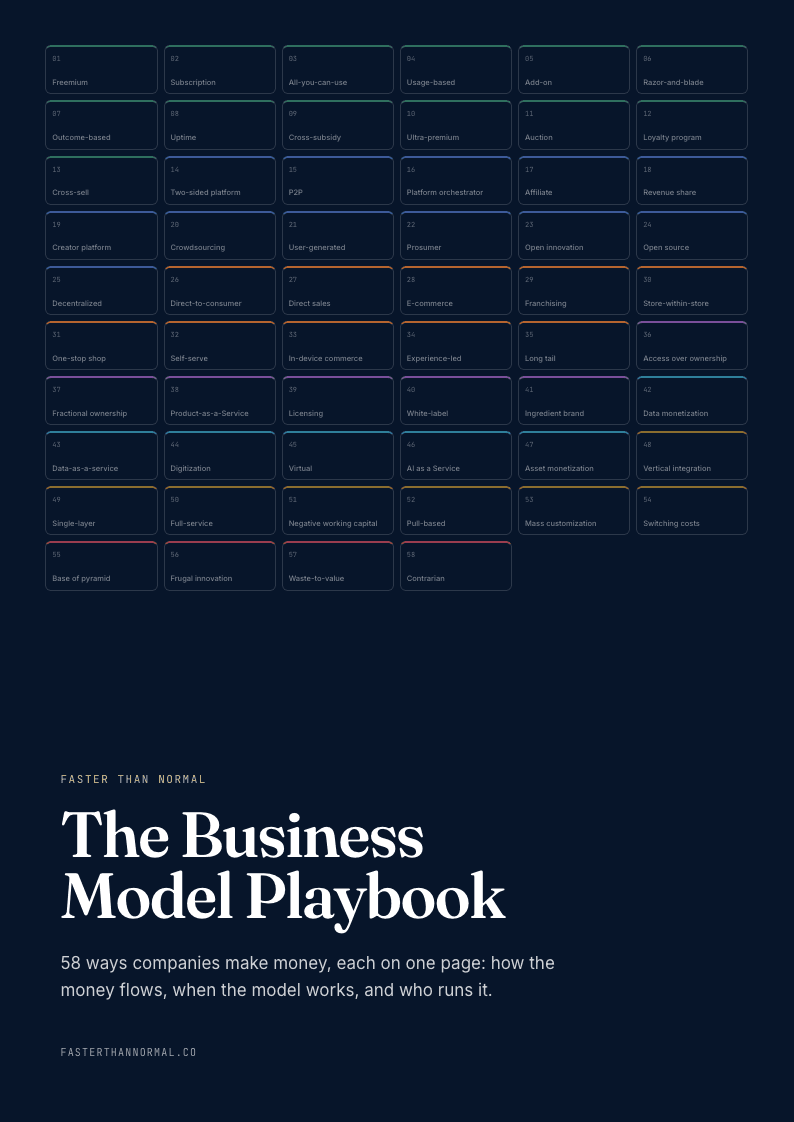
Get The Business Model Playbook
58 business models, one visual page each: how the money flows, the metrics that matter, and who runs it. Free when you join the Faster Than Normal email.
Free. No spam. Unsubscribe anytime.
Part IIIMaxims
-
The systems matter more than the recipes. Peggy Cherng's competitive advantage was never the food itself — it was the infrastructure that ensured the food was consistent, fresh, and scalable across thousands of locations.
-
Stay private to stay honest. Public markets impose a logic that may be incompatible with your values. If your strategy depends on long-term, hard-to-quantify investments in people and culture, protect your autonomy.
-
Displacement is training. The immigrant experience — the serial adaptation to alien environments — produces a cognitive flexibility that native-born operators struggle to match. Don't minimize your dislocation. Leverage it.
-
Own the variable your competitors ignore. When everyone optimizes for efficiency, optimize for freshness. When everyone optimizes for growth speed, optimize for coherence. Differentiation lives in the variables nobody else is willing to pay for.
-
Complementary leadership beats consensus. The strongest partnerships are built on cognitive non-overlap, not agreement. Divide by thinking mode, not by function.
-
Fund growth from the thing itself. Retained earnings are slower than venture capital but preserve something capital markets cannot return: the right to define your own success metrics.
-
Embed giving in operations, not in press releases. Philanthropy that flows through your business — through your employees, your customers, your daily transactions — creates deeper impact and deeper loyalty than philanthropy administered from a separate foundation.
-
Define your category; don't defend your position. Peggy Cherng never argued that Panda Express was "real" Chinese food. She argued it was something new — an authentic expression of the immigrant experience. This made the authenticity debate irrelevant.
-
The founder's ego is the company's liability. The Cherngs' deliberate invisibility allowed Panda Express to become a brand defined by its product and its people, not by the personalities of its owners. Consider the competitive advantage of disappearing.
-
Twenty minutes on the steam table, no more. The standard matters more than the strategy. If you can't articulate the specific, measurable standard that defines your product's quality — and enforce it across every location, every day — your strategy is just a story you tell yourself.
In Their Own Words
We are building a culture on trust, and the aim of trust is love.
Love is the verb we emphasize with our Panda family. We must respect and care for each other.
In order to be successful, businesses need to be active in their communities and encourage others to be, too.— Interview with Business Insider
I am grateful for the education I got at Oregon State.
It is important to me that you know that I am grateful for the education I got at Oregon State.
We must push and stretch each other.
The motivation of going public is really a financial play.
I didn't have any friends there, so that wasn't why. It was a scholarship. I just went.
Life is tough, life is difficult.
Life is something you really have to face squarely on.
It is about overcoming the difficulty.
Continuous improvement is happiness.
I find it amusing when my Chinese friends visit and claim that Orange Chicken is not 'authentic' Chinese food.— The 80s and 90s, 2023
Panda Cares is a way for us to give back to the communities that support us.— Business Insider, 2020
Life is tough, life is difficult. It is about overcoming the difficulty.— New York Times, 2018
I didn't do it with the intention of becoming a billionaire — but that's exactly what happened.— Business Insider, 2020
We are not in the food business. We are in the people business.— Peggy Cherng
We're a Chinese American company. This type of cuisine is an authentic immigrant experience in itself.— Peggy Cherng, on Panda Express's cultural identity
Andrew and I came to the U.S. for a chance at a better education and a better life. Our company mission of inspiring better lives stemmed from our journey of humble beginnings to where we are now with Panda — none of which would have been possible without the support of others.— Peggy Cherng, on philanthropy
A growth mindset comes from an individual that believes 'I can' and has the grit and perseverance to be deeply guided in their purpose in life. This builds inner strength, allowing people the ability to get back up when they get knocked down temporarily.— Peggy Cherng, on leadership


