


Part IThe Story
On a September morning in 1889, a one-eyed man stood on a wooden platform in the Montana wilderness and drove a final spike into the earth. There was no golden spike, no telegraph message flashed to waiting cities, no champagne uncorked for dignitaries — just iron meeting iron in the rain, witnessed by a handful of laborers and a few bewildered Blackfeet watching from a ridge. James Jerome Hill had built a transcontinental railroad from St. Paul to Puget Sound without a single dollar of government subsidy, without a single acre of federal land grant, and he marked the occasion with the unsentimental efficiency that had characterized every decision he'd made for thirty years. The other transcontinentals — the Union Pacific, the Northern Pacific, the Central Pacific — had gorged themselves on public money, laid track through empty desert to collect mileage payments, and promptly gone bankrupt. Hill built his road the way a farmer plants a field: slowly, methodically, with an obsessive attention to the grade of every mile and the economic potential of every station, understanding that the railroad existed not for itself but for the country it would create along its route. The distinction would prove to be the most consequential insight in the history of American infrastructure.
He was, by that point in 1889, already the most powerful man between Chicago and the Pacific Ocean, though almost nobody in New York or Washington could have told you his name. Within fifteen years, he would control more railroad mileage than any individual in world history, fight and win a war against the combined forces of E. H. Harriman and the Union Pacific that nearly crashed the American economy, attempt to build a global trade network connecting the wheat fields of Minnesota to the rice paddies of China and Japan, and then — in an act of governmental overreach that still reverberates through antitrust jurisprudence — watch the Supreme Court of the United States dismantle the holding company he'd constructed to secure his empire. He would die in 1916 owning a $931 million fortune (roughly $27 billion in current terms), a thirty-six-thousand-square-foot mansion on Summit Avenue in St. Paul, and a reputation that, depending on the teller, cast him as either the last great builder of the American frontier or one of the robber barons who stole it.
The truth, as usual, lived in the contradiction.
The Education of a Border Town
The facts of James Hill's origins are sparse and mythologized in roughly equal measure. Born on September 16, 1838, in a log farmhouse near Rockwood, Ontario — a hamlet in Wellington County so small it barely registered on maps of Upper Canada — he was the third of four children born to James Hill Sr. and Ann Dunbar Hill, Scots-Irish Protestants of modest means who had immigrated a generation earlier from County Armagh. His father farmed and occasionally ran a small general store. The family was poor but literate, which in rural Ontario in the 1840s was the relevant distinction.
At nine, a playmate's arrow struck him in the right eye, destroying it permanently. The injury ended whatever vague ambitions the boy harbored of a military career — he had been reading accounts of Wellington and Napoleon with the intensity that other boys reserved for fishing — and redirected his ferocious energy inward, toward books, numbers, and the mastery of systems. He attended the Rockwood Academy, a one-room school whose curriculum ran toward practical mathematics and rhetoric rather than classical languages, and devoured everything the school's meager library could offer. At fourteen, his father died. At seventeen, with nothing to inherit and nothing to keep him, he walked away from Ontario and headed south.
The destination was the Orient. Hill intended to travel to St. Paul, Minnesota, then west to the Pacific, then by ship to India or China, where he imagined himself in the fur trade or — the ambition keeps shifting in his early letters — as some kind of commercial agent of the British Empire. He arrived in St. Paul on July 21, 1856, eighteen years old, one-eyed, with no connections and almost no money, and immediately encountered the first of the geographical facts that would govern his life: the Mississippi River. The steamboat season had ended. The roads west were impassable. He would have to wait until spring to continue his journey.
He never left.
By the Numbers
The Hill Empire
8,316Route miles of the Great Northern Railway at its peak
$0Federal land grants or government subsidies received
$931MEstimated fortune at death in 1916 (~$27B today)
$400MCapitalization of Northern Securities Company, 1901
36,000 sq ftSummit Avenue mansion in St. Paul
3,700Miles from St. Paul to Seattle — the GN mainline
1889Year the Great Northern reached Puget Sound
The Levee and the Ledger
What kept Hill in St. Paul was the same thing that would eventually make him: the confluence of river and railroad, the point where goods changed hands and fortunes accrued to whoever controlled the transfer. In 1856, St. Paul was less a city than a staging ground — a ragged collection of warehouses, saloons, and steamboat landings perched at the head of navigation on the Mississippi, the last reliable port before the river shallowed into uselessness. Everything moving into or out of the northern Great Plains passed through St. Paul. Furs, timber, and wheat came down; manufactured goods, immigrants, and capital went up. The young Hill, stranded and broke, hired on as a shipping clerk for a steamboat company and began to learn the grammar of commerce.
He learned fast. Within two years he was running his own freight-forwarding operation, matching shippers with capacity on the river and on the handful of short-line railroads beginning to radiate outward from the city. He learned the fur trade, the lumber trade, the coal trade. He taught himself surveying, geology, and — crucially — the economics of transportation, developing an almost preternatural ability to calculate the cost of moving a ton of freight over any distance by any mode. By the time he was twenty-five, he was the indispensable middleman of the upper Mississippi, the man who knew where every bushel of wheat was and what it would cost to move it to market. "He could tell you the grade of every hill between here and the Rockies," a competitor later marveled, "and what it would cost to haul a carload of lumber over each one."
He also learned patience. For nearly two decades — from 1856 to 1878 — Hill operated as an agent, a broker, a middleman, building wealth and expertise without ever owning the primary asset. He traded in fuel, ran a steamboat line on the Red River, brokered deals for the newly arriving railroads, and waited. He was waiting, it turned out, for the right railroad to fail.
The Wreck of the St. Paul & Pacific
The St. Paul & Pacific Railroad was, by the mid-1870s, one of the most spectacular failures in American finance. Chartered in 1862 with a generous federal land grant — 2.5 million acres of Minnesota prairie, to be earned by completing its lines — the railroad had been looted by its Dutch bondholders, mismanaged by a succession of incompetent presidents, and left half-built, its tracks ending abruptly in the middle of nowhere, its rolling stock rusting, its bonds trading at fifteen cents on the dollar. The financial panic of 1873 had finished it off. By 1876, the railroad was in receivership, and nobody with any sense wanted anything to do with it.
Nobody except Hill. He had been watching the St. Paul & Pacific for years, studying its land grant, its route, its potential. He understood what the Dutch bondholders and New York financiers did not: that the railroad's unfinished lines pointed directly toward the Canadian border, where the province of Manitoba was experiencing an agricultural boom, and that whoever completed the connection would control the only rail link between Winnipeg and the American rail network. The land grant alone — millions of acres of fertile prairie — would be worth more than the purchase price if the railroad could be made to work.
The problem was money. Hill had accumulated a respectable fortune — perhaps $100,000 by the late 1870s — but the St. Paul & Pacific would require millions. He needed partners, and he found them in a trio of men whose biographies read like a casting call for a Victorian adventure novel. Norman Kittson was a former fur trader turned steamboat operator, a Canadian by birth and a gambler by temperament, who had been Hill's partner in the Red River Transportation Company. Donald Smith — later Lord Strathcona — was the chief commissioner of the Hudson's Bay Company, a Scotsman who had spent decades in the Canadian wilderness and now controlled vast pools of capital in Montreal. George Stephen — later Lord Mount Stephen — was the president of the Bank of Montreal, a financial aristocrat whose reserved manner concealed a willingness to bet everything on a single deal.
Together, the four men formed a syndicate, pooled their resources, and in 1878, in a transaction of labyrinthine complexity, acquired the bankrupt St. Paul & Pacific for approximately $5.5 million — most of it borrowed against the very land grants they were purchasing. It was a leveraged buyout avant la lettre, and it carried enormous risk: if the railroad's lines could not be completed before a statutory deadline, the land grants would revert to the federal government and the entire investment would be worthless.
Hill drove the construction himself, spending the summer of 1878 on horseback along the right-of-way, bullying contractors, firing incompetents, and personally selecting the route through the Red River Valley. The lines were completed on time. The land grants were secured. The Manitoba Road, as it came to be known, began generating profits almost immediately. Within five years, the syndicate's original $5.5 million investment was worth over $25 million, and Hill — who had negotiated for himself the largest share of the equity — was a millionaire many times over.
The men who would become his partners had risked everything alongside him. Smith and Stephen would go on to build the Canadian Pacific Railway, applying many of the same principles Hill was developing in Minnesota. Kittson died in 1888, wealthy and largely forgotten. But it was Hill who emerged from the Manitoba Road deal with the operating control, the strategic vision, and the appetite for something far more ambitious.
— James J. HillWhat we want is the best possible line, shortest distance, lowest grades, least curvature that we can build. We do not care enough about money to spend it on a road that is not going to be first class in every respect.
The Gospel of the Low Grade
Most railroad men of Hill's era built for speculation. They laid track fast and cheap, collected their government subsidies and land-grant acreage, sold bonds to unsuspecting European investors, and moved on. The physical railroad — its grades, its curves, its bridges — was almost an afterthought. Jay Gould, the most notorious of the breed, openly admitted he had no interest in running a railroad; he made his money buying and selling them. Even the more respectable operators — Collis Huntington of the Southern Pacific, Tom Scott of the Pennsylvania — treated construction as a financial exercise, not an engineering one.
Hill was different, and the difference was theological. He believed, with the fervor of a convert, that the economics of a railroad were determined at the moment of construction, in the physical characteristics of the roadbed itself. Every degree of curvature, every foot of unnecessary grade, every poorly placed bridge added permanent cost to every ton of freight that would ever cross the line. A one-percent grade — barely perceptible to the human eye — might double the amount of fuel a locomotive consumed per mile. A poorly surveyed route that added even ten miles to the distance between two cities would cost shippers money for decades. These were not abstractions. Hill calculated them obsessively, filling notebooks with grade profiles, fuel consumption estimates, and tonnage projections that would have baffled most of his contemporaries.
The result was a railroad unlike any other in America. The Great Northern — the name Hill gave to his expanding system in 1890, consolidating the Manitoba Road and its various extensions — was engineered to the lowest possible operating cost per ton-mile. Hill personally supervised the surveys, rejected routes that other engineers considered perfectly adequate, and spent lavishly on the initial construction so that he could spend parsimoniously on operations forever after. Where the Northern Pacific, his government-subsidized rival, crossed the Rockies at an elevation of 5,567 feet through the Mullan Pass, Hill's engineers found Marias Pass at 5,213 feet — lower, shorter, and cheaper to operate through in winter. Where other roads economized on rail weight and bridge construction, Hill used the heaviest rail available and built his bridges to carry twice their expected load.
The obsession with grades extended to every dimension of operations. Hill standardized his locomotive fleet, reducing the number of engine types from dozens to a handful, so that any mechanic at any shop on the system could repair any engine. He designed his own freight cars — larger and more efficiently loaded than the industry standard. He established experimental farms along his route, distributing free seed and livestock to settlers, reasoning that prosperous farmers would generate more freight than impoverished ones. He set freight rates low enough to attract traffic but high enough to cover his costs, and he defended those rates with the ferocity of a man who understood that a railroad's only sustainable advantage was efficiency.
Building the Country Before the Railroad
The most radical element of Hill's strategy had nothing to do with engineering. It was, rather, an inversion of the standard railroad business model that amounted to a new theory of development.
The government-subsidized transcontinentals — the Union Pacific, the Northern Pacific, the Central Pacific — were built on what might be called the "railroad first" model. You laid track across empty territory, collected your land grants, sold the land to settlers, and hoped the settlers would generate enough freight to justify the railroad's existence. It was a model that encouraged speed over quality, speculation over development, and boom-and-bust cycles that left bankrupt railroads and stranded settlers scattered across the West.
Hill reversed the sequence. He built the railroad only where — or only after — there was economic activity to support it. Before extending his lines, he would study the agricultural potential of the territory, recruit settlers, help them acquire land, provide them with seed and livestock, and build grain elevators and flour mills along the proposed route. Only when there was a reasonable expectation of freight traffic would the steel go down. "You can't build a railroad through a wilderness and expect it to pay," he told his engineers. The wilderness had to be settled first.
This was not philanthropy. It was strategy of the most calculated kind. By investing in the development of the territory his railroad served, Hill was building permanent demand for his service — creating customers before he created the infrastructure to serve them. The settlers who took his seed and his cattle became dependent on his railroad to ship their wheat to market. The flour mills he helped establish along his route became captive shippers. The towns that grew up around his stations — towns like Havre, Montana, and Spokane, Washington — owed their existence to decisions Hill had made years earlier about where to place a water tower or a section house.
The approach was paternalistic, even imperial, and it generated resentment proportional to its effectiveness. But it also created something that none of the other transcontinentals could claim: a railroad that actually made money. The Great Northern Railway was the only transcontinental in American history that never went bankrupt — not during the Panic of 1893, which destroyed the Northern Pacific, the Union Pacific, and the Santa Fe; not during the depression of the 1890s; not ever. While his competitors lurched from receivership to reorganization, Hill's road paid dividends every year, its traffic growing as the settlers he had recruited produced more wheat, more lumber, more freight.
— James J. HillMost men who have really lived have had, in some shape, their great adventure. This railroad is mine.
The Pacific Dream and the Silk Routes
For Hill, reaching Puget Sound in 1889 was not an end but a hinge. The Pacific Ocean was not a wall; it was a doorway — to Japan, to China, to the markets of Asia whose combined population dwarfed the entire Western Hemisphere. Hill had been dreaming about the Orient since he was seventeen, standing on the St. Paul levee and staring west. Now, with his railroad complete, he intended to build a trade system that would move American wheat and cotton east across the Pacific and bring Asian silk, tea, and manufactured goods west across his rails to the markets of the Midwest and the East Coast.
In the 1890s, he commissioned the construction of two enormous steamships — the Minnesota and the Dakota, each over 28,000 gross tons, among the largest cargo vessels afloat — to operate a trans-Pacific service between Seattle and ports in Japan, China, and the Philippines. The ships were designed not as passenger liners but as floating warehouses, optimized to carry the maximum tonnage of bulk freight at the lowest possible cost. Hill personally negotiated trade agreements with Japanese and Chinese merchants, traveling to the Far East to study local markets and identify opportunities.
The vision was breathtaking in its ambition and almost entirely ahead of its time. Hill imagined a vertically integrated trade corridor — farm to ship to factory to consumer — that would connect the interior of North America to the economies of the Pacific Rim. He lobbied Congress for lower tariffs on Asian goods, argued that American prosperity depended on access to Asian markets, and predicted that the center of gravity of world commerce was shifting from the Atlantic to the Pacific. He was, in many respects, describing the global economy of the late twentieth century. But the late nineteenth century was not ready for it. The trans-Pacific trade never generated the volumes Hill projected, the Dakota ran aground and sank off the coast of Japan in 1907, and Congress — beholden to domestic manufacturers who wanted high tariffs, not low ones — refused to lower the trade barriers that Hill considered essential.
The failure of the Pacific strategy was the great frustration of Hill's later career, and it reveals the limits of even the most powerful individual will when it collides with politics. Hill could build a railroad by sheer force of engineering and financial acumen. He could not build a trading system that required the cooperation of governments on three continents.
The Northern Securities War
The events of 1901 would make Hill a household name — not for building, but for fighting. The antagonist was Edward Henry Harriman, a small, sharp-featured New Yorker who had rebuilt the Union Pacific from bankruptcy into one of the most profitable railroads in America. Where Hill was massive and physical — six feet tall, broad-shouldered, with a full beard that made him look like an Old Testament patriarch — Harriman was compact and cerebral, a Wall Street creature who operated through proxies, holding companies, and financial instruments that Hill considered morally dubious. The two men despised each other with the special intensity reserved for competitors who understand each other perfectly.
Harriman, a financier born in Hempstead, Long Island, who had entered Wall Street as a broker's clerk at fourteen and remade himself into the supreme strategist of American railroading by sheer intellectual force, wanted the Burlington. The Chicago, Burlington & Quincy Railroad was the key to the entire western railroad system — the only line that connected Chicago, the nation's rail hub, to the territory west of the Missouri River. Whoever controlled the Burlington controlled access to the transcontinental routes. Hill had been stalking the Burlington for years; so had Harriman.
In 1901, Hill struck first. In alliance with J. P. Morgan — the most powerful banker in America, whose involvement conferred a legitimacy that Hill's prairie origins could not — Hill purchased the Burlington for approximately $200 per share, a total cost of roughly $215 million. The deal was structured through the Northern Pacific, which Hill controlled jointly with Morgan, and it gave Hill a continuous rail system from Chicago to Puget Sound.
Harriman was furious. Denied the Burlington, he conceived a plan of astonishing audacity: he would buy not the Burlington but the Northern Pacific itself, acquiring a majority of its stock on the open market and thereby seizing control of Hill's entire empire from within. Working through the banking house of Kuhn, Loeb & Co. — led by Jacob Schiff, Morgan's great rival — Harriman began buying Northern Pacific shares in secret.
What followed was one of the most violent episodes in the history of Wall Street. As Harriman's buying drove Northern Pacific's stock price from $100 to $149 in a matter of days, short sellers — traders who had bet against the stock — found themselves unable to cover their positions. On May 9, 1901, Northern Pacific stock briefly touched $1,000 per share in the frantic bidding, while the rest of the stock market collapsed as traders liquidated everything they owned to raise cash. The Panic of 1901, as it became known, destroyed fortunes in hours and terrified the nation.
Hill and Morgan won — barely. By the time the dust settled, they held a majority of Northern Pacific's common stock, though Harriman had acquired a majority of the preferred. The victory was narrow enough to be terrifying, and Hill's response was characteristic: rather than leave himself vulnerable to another raid, he proposed the creation of a holding company — the Northern Securities Company — that would consolidate his control of the Northern Pacific, the Great Northern, and the Burlington into a single, unassailable corporate fortress. Morgan agreed. Northern Securities was incorporated in New Jersey on November 13, 1901, capitalized at $400 million.
It lasted three years. President Theodore Roosevelt, seeking to establish his reputation as a trust-buster, directed his attorney general to file suit against Northern Securities under the Sherman Antitrust Act. The case reached the Supreme Court in 1904, and on March 14, the Court ruled 5–4 that the holding company constituted an illegal restraint of trade. Northern Securities was dissolved.
Hill was incandescent. He considered the decision an act of political cowardice, an assault on property rights, and an economic absurdity — the merged company, he argued, would have reduced costs and lowered freight rates, benefiting the very farmers and shippers the government claimed to protect. He never forgave Roosevelt, and he never stopped believing that the dissolution of Northern Securities was one of the great mistakes of American governance.
— James J. Hill, on the Northern Securities decisionThe government might as well try to prohibit a man from owning a house and a barn at the same time.
The Farmer's Railroad and the Farmer's Enemy
The paradox of James J. Hill is that the same man who did more than any individual to develop the agricultural Northwest also became, in the popular imagination, the embodiment of monopolistic greed. The Populist movement of the 1890s — a genuine insurgency of farmers, laborers, and small-town merchants who believed, with considerable justification, that the railroads had too much power — made Hill its favorite villain. He was the "Empire Builder," and the word empire was not meant as a compliment.
The complaints were not imaginary. Hill's railroad was, in many of the communities it served, the only railroad — and the only means of getting crops to market. His freight rates, however low by industry standards, were still high enough to consume a significant share of a farmer's income. His land company controlled millions of acres, and his grain elevators dominated local markets. Farmers who depended on Hill for their livelihood resented the dependence, and they channeled that resentment into political movements — the Grange, the Populists, eventually the Progressives — that demanded government regulation of railroad rates.
Hill fought regulation with the same ferocity he brought to everything else. He testified before Congress, funded friendly newspapers, and argued, with data and logic that his opponents found infuriating, that railroad rates were already lower than they had ever been and that government interference would raise costs, not lower them. He was, in many cases, correct. The Great Northern's rates were among the lowest of any railroad in America, and Hill could demonstrate — and did, repeatedly — that his profits came from volume and efficiency, not from gouging captive shippers.
But being correct was not enough. The Hepburn Act of 1906 gave the Interstate Commerce Commission real power to set railroad rates, and the regulatory framework it established would constrain the railroad industry for the rest of the century. Hill regarded it as the beginning of the end — the moment when the government decided to punish efficiency rather than reward it. He may have been right about that, too.
Summit Avenue and the Art of Silence
The private Hill was as formidable as the public one, and considerably more interesting. He married Mary Theresa Mehegan in 1867 — she was the daughter of Irish immigrants, a Catholic in a world of Protestant railroad men, and Hill converted to Catholicism for her, a decision that was either a testament to his devotion or a shrewd calculation about the demographic future of the upper Midwest, or both. They had ten children, of whom nine survived to adulthood. The marriage endured fifty years, which in the Gilded Age was either remarkable or unremarkable, depending on what you mean by endured.
The house on Summit Avenue in St. Paul — completed in 1891, thirty-six thousand square feet of red sandstone, with a two-story art gallery, a pipe organ, and a heating system that consumed sixteen tons of coal a day — was Hill's most visible concession to the culture of conspicuous consumption that defined the era. He filled it with paintings: Corots, Millets, Delacroixs, acquired with the same systematic thoroughness he applied to railroad surveys. The art collection was genuine — Hill had taste, or at least the intelligence to hire people who did — but the house itself was a fortress, built to intimidate rather than charm, its sheer mass a physical assertion of the builder's will.
Hill himself remained curiously invisible. He gave few interviews, made no public speeches that were not strictly necessary, and cultivated an almost monastic aversion to personal publicity. His surviving correspondence reveals a mind of extraordinary precision and range — he wrote knowledgeably about soil chemistry, locomotive design, tariff policy, and Chinese trade customs — but almost nothing about his own interior life. The one-eyed man from Ontario had constructed a persona as carefully engineered as his railroad: all surface, no grade, maximum efficiency, minimum waste.
He died on May 29, 1916, at the age of seventy-seven, in the house on Summit Avenue. His son Louis succeeded him at the Great Northern, but the empire was already passing into the hands of managers and regulators who would, over the following decades, prove Hill's darkest predictions correct. The Great Northern was eventually merged into the Burlington Northern in 1970, and then into the Burlington Northern Santa Fe — now BNSF Railway, a subsidiary of Berkshire Hathaway — which still runs trains over many of the grades Hill surveyed a century earlier.
The final spike he drove in Montana in 1889 was made of iron, not gold, because gold was soft and iron was what held things together. He would have appreciated the metaphor, though he would never have used it. Metaphors were waste.
Part IIThe Playbook
James J. Hill built the only transcontinental railroad in American history that never went bankrupt, fought Wall Street's most powerful financiers to a draw, and developed a theory of infrastructure investment that remains relevant more than a century after his death. The following principles are distilled from his decisions, his methods, and his mistakes.
The principles
- 1.Build for operations, not for speculation.
- 2.Create your customers before you create your product.
- 3.Master the unit economics before scaling.
- 4.Wait for the right asset to fail.
- 5.Verticalize relentlessly along the value chain.
- 6.Use geographic monopoly as a platform, not a moat.
- 7.Recruit your allies from complementary positions.
- 8.Underpromise on construction, overdeliver on capacity.
- 9.Treat regulation as a permanent operating constraint.
- 10.Build institutions that outlast individuals.
- 11.Align your network with the direction of trade.
- 12.Disappear into the work.
Principle 1
Build for operations, not for speculation.
The defining error of Gilded Age railroading was the confusion of construction with value creation. Jay Gould, Collis Huntington, and the men who built the Union Pacific treated railroads as financial instruments — vehicles for collecting subsidies, selling bonds, and manipulating stock prices. The physical railroad was a means to a financial end. Hill inverted the hierarchy entirely. For him, the financial structure existed to serve the physical railroad, and the physical railroad existed to move freight at the lowest possible cost.
This inversion produced radically different decisions at every level. Where speculators laid track fast and cheap to maximize their subsidy claims, Hill built slowly and well. Where others economized on rail weight and bridge construction, Hill overbuilt — spending more upfront to reduce operating costs permanently. The Great Northern's operating ratio (operating expenses as a percentage of revenue) was consistently among the lowest in the industry, not because Hill squeezed his workers but because he had engineered waste out of the system at the moment of construction.
The principle applies far beyond railroads. Any business that confuses the act of building with the act of operating — that treats product development as a fundraising exercise rather than an operational one — is making the same mistake the Union Pacific made. The question is not how fast you can build, but how efficiently the thing you build will run forever after.
Tactic: Before scaling any infrastructure or product, calculate the permanent operating cost per unit of throughput and optimize relentlessly for that number, even if it means slower initial deployment.
Principle 2
Create your customers before you create your product.
Hill's most counterintuitive strategy was his insistence on developing the economic hinterland before extending his railroad into it. He distributed free seed, imported purebred cattle from Scotland, established experimental farms, and recruited settlers from Scandinavia and Germany — all before laying a single rail into new territory. This was not charity. It was demand creation of the most sophisticated kind.
By ensuring that there would be freight to haul before the railroad arrived, Hill eliminated the most dangerous variable in the transcontinental business model: the empty train. The Northern Pacific, built ahead of demand on the assumption that "if you build it, they will come," spent decades hauling too little freight over too much track. Hill's road, built behind demand, was profitable from its first day of operation.
The modern analogy is the platform company that seeds its marketplace with supply before opening to consumers — or the enterprise software company that customizes its product for its first ten customers before attempting to sell to a thousand. Hill understood that the hardest part of building a network business is not building the network; it is building the economic ecosystem that makes the network valuable.
Tactic: Before launching into a new market, invest directly in the success of your earliest customers — even at a loss — so that their demand justifies your infrastructure.
Principle 3
Master the unit economics before scaling.
Hill's notebooks, which survive in the archives of the James J. Hill Reference Library in St. Paul, are filled with calculations that would be recognizable to any modern startup founder: cost per ton-mile, revenue per car-mile, fuel consumption per grade-foot. He was, before the term existed, an operator obsessed with unit economics — and he understood that the only way to achieve scale profitably was to make each individual unit of production profitable first.
His insistence on the lowest possible grades, the most efficient locomotives, the largest freight cars, and the most rational routing was, at bottom, a unit-economics strategy. Every decision was evaluated against its impact on the cost of moving a single ton of freight a single mile. When Hill's competitors accused him of spending too much on construction, he would produce his operating cost figures and demonstrate that his "expensive" railroad was, per ton-mile, the cheapest in the country.
📊
Hill's Operating Advantage
Comparative operating ratios among western railroads, circa 1895
| Railroad | Operating Ratio | Status During 1893 Panic |
|---|---|---|
| Great Northern (Hill) | ~58% | Solvent, paid dividends |
| Northern Pacific | ~72% | Bankrupt |
| Union Pacific | ~68% | Bankrupt |
| Santa Fe | ~74% | Bankrupt |
Tactic: Identify the single unit of production that defines your business — one ride, one transaction, one delivery — and make it profitable before pursuing volume.
Principle 4
Wait for the right asset to fail.
Hill spent twenty-two years in St. Paul — from 1856 to 1878 — before making his first major acquisition. During that time, he built expertise in every dimension of the freight business: steamboats, warehousing, fuel distribution, railroad operations. When the St. Paul & Pacific collapsed into bankruptcy, he was the only person in the Northwest who understood both its engineering potential and its financial distress well enough to structure a viable acquisition.
The timing was not accidental. Hill had been watching the St. Paul & Pacific for years, waiting for the combination of management failure, financial distress, and strategic opportunity that would allow him to acquire it at a fraction of its intrinsic value. He did not create the crisis; he exploited it. And he was able to exploit it only because he had spent two decades building the knowledge and relationships necessary to act decisively when the moment came.
This is the most underappreciated aspect of Hill's career: the patience. In a culture that celebrates speed, Hill's twenty-two-year apprenticeship looks like paralysis. It was, in fact, the most productive period of his life — the years when he accumulated the intellectual capital that made everything else possible.
Tactic: Build deep expertise in an industry for years before attempting to acquire assets within it, so that when distressed opportunities arise, you can evaluate them faster and more accurately than anyone else.
Principle 5
Verticalize relentlessly along the value chain.
Hill did not merely build a railroad. He built the entire ecosystem that a railroad required. He owned coal mines that supplied his locomotives, lumber companies that built his ties, grain elevators that loaded his cars, steamship lines that carried his freight across the Pacific, and land companies that recruited the settlers who grew the wheat that filled his trains. At every point in the value chain, Hill sought to capture the margin that would otherwise accrue to a middleman.
The verticalization was strategic, not merely acquisitive. By controlling the supply chain from farm to port, Hill could optimize the entire system in ways that a mere railroad operator could not. He could adjust planting schedules to match railroad capacity, route grain to the elevator with the most available storage, and time his Pacific steamships to connect with his trains in Seattle. The result was a logistics network of extraordinary efficiency — a nineteenth-century supply chain managed with the precision of a modern tech company.
Tactic: Identify the choke points in your value chain and, where possible, own them — not for the sake of owning more, but to eliminate the coordination costs and misaligned incentives that degrade system performance.
Principle 6
Use geographic monopoly as a platform, not a moat.
In many of the communities his railroad served, Hill was a monopolist — the only rail connection to the outside world. He could have exploited that position by charging the highest rates the market would bear, as many of his contemporaries did. Instead, he deliberately kept rates low, reasoning that low rates would stimulate more economic activity, which would generate more freight, which would produce more revenue than high rates ever could.
This was not altruism. It was platform economics, decades before the concept had a name. Hill understood that his railroad's value was proportional not to the rates it charged but to the volume of economic activity it supported. A farmer who paid $0.10 per bushel in freight would plant more wheat than one who paid $0.20 — and the additional volume, multiplied across thousands of farms, would more than compensate for the lower rate.
The strategy made Hill rich and his shippers relatively prosperous, but it also created the political vulnerability that eventually led to government regulation. Farmers who depended on Hill's railroad resented the dependence, regardless of how fair the rates were. The lesson: platform economics create value, but they also create constituencies with the power to reshape the terms of the platform.
Tactic: When you hold a dominant position, price for volume rather than margin — but anticipate and prepare for the political backlash that platform power inevitably generates.
Principle 7
Recruit your allies from complementary positions.
The syndicate that acquired the St. Paul & Pacific — Hill, Kittson, Smith, and Stephen — was not a group of friends or a network of financiers. It was a coalition assembled from complementary positions, each member contributing something the others could not provide. Hill brought operating expertise and local knowledge. Kittson brought capital and river-trade connections. Smith brought access to Canadian political and commercial networks. Stephen brought the financial credibility of the Bank of Montreal.
No one member could have executed the deal alone. Hill could not have raised the capital without Smith and Stephen. Smith and Stephen would not have known the opportunity existed without Hill. The syndicate's structure — each partner essential, none dominant — allowed it to overcome obstacles that would have defeated any individual actor.
Tactic: When assembling a team for an ambitious acquisition or venture, recruit partners who fill specific capability gaps rather than partners who share your existing strengths.
Principle 8
Underpromise on construction, overdeliver on capacity.
Hill's railroads were overbuilt by the standards of his time. He used heavier rail, stronger bridges, and gentler grades than any of his competitors, and he was routinely criticized — by investors, by engineers, even by his own partners — for spending too much on construction. His response was always the same: the cost of building right the first time was a fraction of the cost of rebuilding later, and the operating savings from a well-built road would compound forever.
He was vindicated every time a competitor's bridges washed out, every time a rival's light rail cracked under heavy traffic, every time a poorly graded line required helper engines to push trains over a hill that Hill's surveyors would never have accepted. The Great Northern's infrastructure was still in excellent condition decades after Hill's death, while his competitors had to rebuild their lines repeatedly.
Tactic: Invest disproportionately in the quality of your core infrastructure — the thing your product runs on — even if it means slower initial growth, because infrastructure quality compounds over time while infrastructure shortcuts compound too, in the other direction.
Principle 9
Treat regulation as a permanent operating constraint.
Hill fought government regulation with every tool at his disposal — testimony, lobbying, litigation, public argument — and he lost. The Hepburn Act, the Interstate Commerce Commission, the dissolution of Northern Securities: each represented a permanent constraint on his freedom of action, and each forced him to adapt his strategy rather than abandon it.
The adaptation is the instructive part. After the Northern Securities decision, Hill reorganized his empire into legally separate entities that maintained coordination through interlocking directorates and shared management — a structure that complied with the letter of the antitrust laws while preserving much of the operational integration the holding company had provided. After the Hepburn Act, he focused even more intensely on cost reduction, reasoning that if the government was going to cap his rates, his only path to profitability was to lower his costs faster than the regulators could lower his prices.
Tactic: When facing regulatory constraints, do not waste energy fighting the regulation itself — invest that energy in redesigning your operations to be profitable under the new constraints.
Principle 10
Build institutions that outlast individuals.
Hill's railroad survived him by more than half a century, operating profitably and maintaining its independence until the Burlington Northern merger of 1970. This longevity was not accidental. Hill invested heavily in institutional capacity — training programs for engineers and managers, standardized operating procedures, a corporate culture of frugality and operational excellence — that ensured the railroad would function effectively regardless of who sat in the president's chair.
He also, crucially, resisted the temptation to create a dynasty. While his son Louis eventually led the Great Northern, Hill filled his senior management with men selected for competence rather than pedigree, and he established governance structures that limited the family's ability to extract value from the company. The contrast with other Gilded Age empires — the Vanderbilts' New York Central, which decayed through generations of family management, or the Goulds' various railroads, which collapsed almost immediately after Jay Gould's death — is stark.
Tactic: Design your organization's operating systems, training programs, and governance structures for a future in which you are no longer present.
Principle 11
Align your network with the direction of trade.
Hill's Pacific strategy failed, but the failure illuminates a principle that his domestic strategy vindicated spectacularly: the value of a transportation network depends on its alignment with the direction of trade. The Great Northern succeeded because it connected the wheat-producing interior of North America to the consuming markets of the East Coast and the export terminals of the Great Lakes — a trade flow that was massive, growing, and structurally durable.
The trans-Pacific trade, by contrast, was speculative. Hill was betting on a future in which American agricultural exports would flow west to Asia rather than east to Europe, and that Asian manufactured goods would flow east to America. He was right about the direction but wrong about the timing — by roughly a century. The markets he envisioned in 1900 would not materialize until the 1980s and 1990s.
Tactic: Before building any network — physical or digital — map the direction and magnitude of the trade flows it will serve, and build first where the flows are largest and most predictable.
Principle 12
Disappear into the work.
Hill gave almost no interviews, made no unnecessary public appearances, and cultivated a deliberate obscurity that seems bizarre in an age of robber-baron flamboyance. While Vanderbilt built mansions on Fifth Avenue and Carnegie endowed libraries across the country, Hill stayed in St. Paul, filling his notebooks with grade calculations, and let his railroad speak for itself.
The obscurity was strategic. Hill understood that public attention was, for a monopolist, a liability — that every speech, every interview, every display of wealth would be used against him by the Populists and Progressives who were already calling for government regulation. By remaining invisible, he denied his critics a target.
But the obscurity was also temperamental. Hill was a builder, not a performer, and he appears to have genuinely preferred the private satisfactions of operational excellence to the public rewards of celebrity. The notebooks in which he worked out his grade calculations are, in their way, more revealing than any autobiography: they show a mind that found its deepest pleasure in solving concrete problems, not in contemplating its own significance.
Tactic: Let the quality of your work be your primary form of communication, and resist the temptation to build a personal brand that creates political and competitive vulnerabilities.
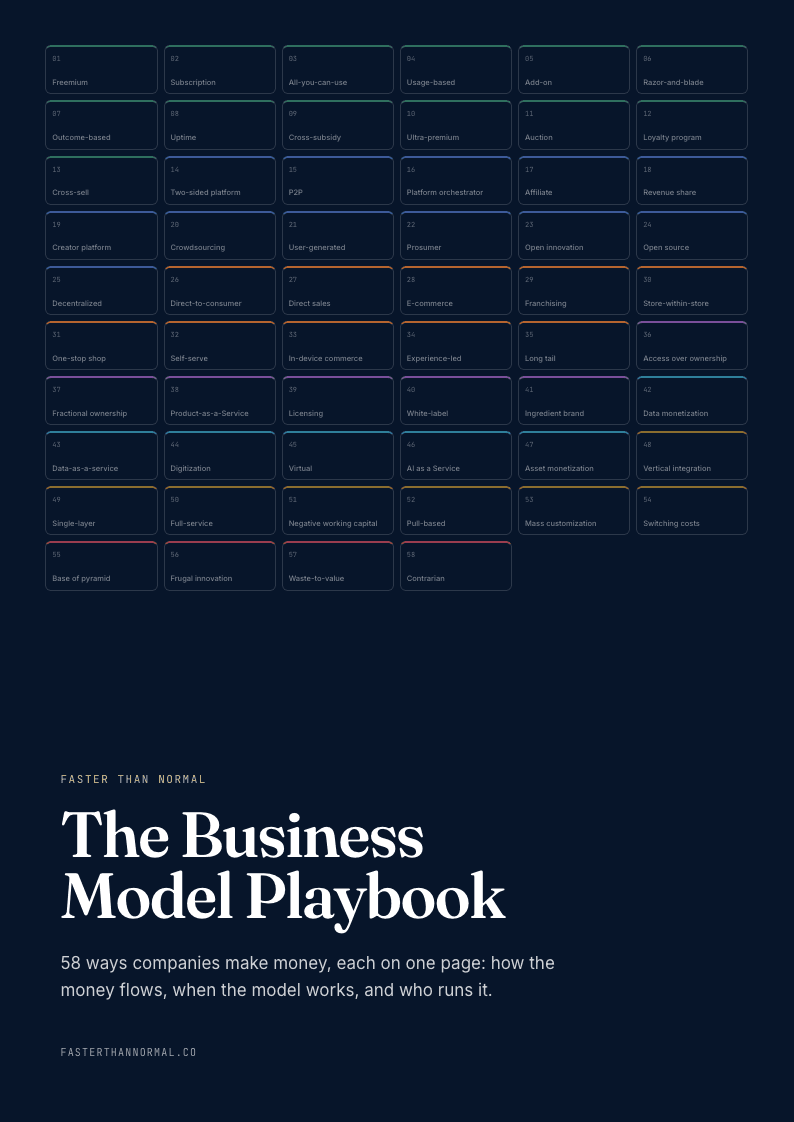
Free playbook
Get The Business Model Playbook
58 business models, one visual page each: how the money flows, the metrics that matter, and who runs it. Free when you join the Faster Than Normal email.
Free. No spam. Unsubscribe anytime.
Part IIIMaxims
-
Efficiency is a permanent asset. Every dollar saved in operating cost compounds across every ton of freight that will ever cross the line. Build for the long denominator.
-
Demand precedes infrastructure. The railroad that builds ahead of its customers goes bankrupt. The railroad that builds behind them prints money.
-
Patience is the most undervalued form of leverage. Hill waited twenty-two years before making his first acquisition. The waiting was the work.
-
The unit of production tells you everything. Master the cost of one ton-mile, one transaction, one delivery. Everything else is commentary.
-
Your competitors' subsidies are your competitors' weakness. Free money encourages waste. Earned money encourages discipline.
-
Overbuilding the foundation is the cheapest investment you will ever make. Light rail cracks. Heavy rail compounds.
-
Control the ecosystem, not just the asset. A railroad is worth more when you also own the grain elevators, the steamship lines, and the experimental farms that generate its freight.
-
Monopoly without modesty invites regulation. If you hold a dominant position, price as though you don't — or the government will price for you.
-
The best corporate defense is operational excellence, not financial engineering. Northern Securities was dissolved. The Great Northern's low grades were not.
-
Disappear into the institution. The man who builds a mansion on Fifth Avenue gets investigated. The man who stays in St. Paul and fills notebooks with grade calculations gets left alone — for a while.
In Their Own Words
The passenger train is like the male teat – neither useful nor ornamental.
If you want to know whether you are destined to be a success or a failure in life, you can easily find out. The test is simple and it is infallible: Are you able to save money? If not, drop out. You will lose. You may think not, but you will lose as sure as you live. The seed of success is not in you.
There is no such thing as a free lunch.
The only way to get ahead is to work hard and be honest.
Success is the result of a combination of hard work, good judgment, and a little luck.
To be successful, you must be able to see the invisible.
You cannot build a reputation on what you are going to do.
The best way to predict the future is to create it.
It is not the strongest of the species that survive, nor the most intelligent, but the one most responsive to change.
The road to success is dotted with many tempting parking spaces.
A great business is not built on the idea of making money, but on the idea of serving people.
The man who moves a mountain begins by carrying away small stones.
You can't build a railroad through a wilderness and expect it to pay.— James J. Hill, on government-subsidized railroads
Further reading
- James J. Hill: Empire Builder of the Northwest by Michael P. Malone


