


Part IThe Story
A Pile of Parts at Brooklands
In early March 1908, in a brick shed beside the Brooklands motor-racing circuit in Surrey, a pair of British mechanics took three Cadillac cars apart down to the last bolt. The cars were ordinary single-cylinder Model Ks, pulled from the stock of Cadillac's London agent, Frederick Bennett. Officials of the Royal Automobile Club supervised every step. The parts from all three cars were thrown together in a single heap, roughly seven hundred pieces per car, so that nobody could say which crankshaft, piston, or gear had come from which machine. Then the officials went further. They picked out eighty-nine parts, locked them away, and replaced them with fresh components taken straight from the London storeroom shelves.
The rules for rebuilding were strict. The mechanics were allowed wrenches and screwdrivers. They were not allowed files, scrapers, or any of the hand-fitting that nearly every car of the period needed before its parts would work together. At one point a storm flooded part of the shed, and some of the parts had to be wiped clean of rust with oily rags. When the three cars were finally rolled out, they were a mismatched sight, fenders and bonnets in the wrong colors, and the watching press nicknamed them harlequins. Then each car was driven five hundred miles around the Brooklands track. They completed the run with almost no trouble; the only recorded fault was a broken cotter pin, replaced from stock.
The Royal Automobile Club awarded Cadillac its Dewar Trophy for the year's most important advance in the motor industry. It was the first time an American car had won it. Cadillac turned the result into a slogan it still uses: "Standard of the World." The phrase has since come to suggest leather and chrome, but in 1908 it meant something narrower and more demanding. It meant that any Cadillac part would fit any Cadillac.
The man responsible was not at Brooklands. He was in Detroit, sixty-five years old, with a long white beard and the manner of a New England deacon. His name was Henry Martyn Leland, and he had spent more than four decades learning, in armories and machine shops, the discipline that made the demonstration possible. He would go on to found a second great American luxury car company, Lincoln, when he was seventy-four. He would lose both companies to men who valued volume over precision. And he would leave the automobile industry a set of habits (tight tolerances, written procedures, gauges on every bench) so thoroughly absorbed that they now look like common sense.
By the Numbers
Henry Leland's Career in Figures
0.001 in.The tolerance Leland demanded of suppliers, including a young Alfred Sloan
59Leland's age when Cadillac was organized in 1902
89Parts swapped for new stock in the 1908 Brooklands test
$4.5MPrice General Motors paid for Cadillac in July 1909
6,500Liberty aircraft engines Lincoln delivered in World War I
$8MFord's winning bid for the bankrupt Lincoln in February 1922
A Vermont Farm and a Worcester Bench
Leland was born on February 16, 1843, in the northern Vermont hill country near the Canadian border. Sources disagree about whether the town was Danville or Barton; he grew up in Barton, the youngest of eight children of Leander and Zilpha Leland, farming people of modest means. By the late 1850s the family had moved to Worcester, Massachusetts, then one of the busiest machine-building towns in New England, and there the teenage Leland was apprenticed as a machinist. His master was Charles Crompton, whose family built power looms for the textile mills.
The Civil War decided the direction of the rest of his life. Too young to be taken into the army when he first tried to enlist, he went instead to the United States Armory at Springfield, Massachusetts, in 1863, where he worked as a toolmaker. Springfield was the national center of what historians now call armory practice: the attempt, pursued by the War Department since the early nineteenth century, to make rifles whose parts could be swapped from one weapon to another. A trigger or a lock plate made in one room had to fit a stock made in another. Achieving that required jigs to hold the work, fixtures to guide the cutting tools, and above all gauges, so that every part could be checked against a standard rather than against its neighbor. Leland absorbed all of it.
He came of age in time to cast his first presidential vote in 1864, for Abraham Lincoln. He admired Lincoln for the rest of his life, and half a century later he would name a company after him.
When the war ended, the armory laid men off. Leland moved through a series of well-known machine shops, including Colt's armory at Hartford, building tools. His family's later account says the work took a toll, and that after a period of illness he briefly tried police work and read law at night before deciding he had no taste for either. In 1872 he wrote to Brown & Sharpe of Providence, Rhode Island, and asked for a job as a machinist. The Rhode Island Heritage Hall of Fame, drawing on family recollection, records that he arrived on July 1 wearing his police uniform because it was the only suit he owned.
Eighteen Years at Brown & Sharpe
Brown & Sharpe was the right place for a man of Leland's temperament. The firm made precision measuring instruments and machine tools, and it had begun selling hand-held micrometers accurate to a thousandth of an inch in 1867. It also manufactured, under contract, the Willcox & Gibbs sewing machine, a delicate mechanism whose small parts had to be made in quantity and fit without fuss. The historian David Hounshell, in his study From the American System to Mass Production, singles Leland out as one of the mechanics who made that product better.
Leland started in the screw-machine section of the sewing machine department. Over the next few years he refined the company's screw gauges and changed how small parts were supplied: rather than making screws afresh for every batch of machines, the department held them in stock, made to gauge and ready to use. From 1878 until 1890 he ran the entire sewing machine department. Hounshell notes that he took the job only after Lucian Sharpe, who led the firm after Joseph Brown's death in 1876, agreed to Leland's conditions. The department had been run by internal contractors, who hired their own men and were paid by the piece. Leland wanted the contract system abolished, piecework paid directly, and the authority to set his workers' wages himself. He got all three.
A cost study done a year after the change found labor costs in the department down by 47 percent, and Leland claimed quality had improved by a similar margin. The Willcox & Gibbs company had once demanded elaborate inspection sheets from Brown & Sharpe. Eventually it stopped asking for them, because the work was consistently good.
He also pushed the company's machine tools forward. Hardened steel parts warped in heat treatment, so they either had to be fitted by hand during assembly or ground to size afterward. Brown & Sharpe's grinding lathes suffered because abrasive grit got into the ways, the guides on which the carriage traveled, and wore them out of true. Leland argued to Joseph Brown that a grinder with protected ways would have enormous uses beyond sewing machines. Brown eventually agreed and designed the universal grinding machine, one of the landmark machine tools of the century.
The habit Hounshell considers most telling was a clerical one. Leland insisted that every operation on every part be written down on a sheet, along with the tools, jigs, fixtures, and gauges required. Good mechanics had always carried such sequences in their heads. Leland put them on paper, where foremen could follow the work and materials could be moved in the right order. Years later he described what those years had meant to him.
— Henry M. Leland, quoted in David A. Hounshell, From the American System to Mass Production, 1984My vision of the possibilities of manufacturing broadened. My interest became intensified. I realized that manufacturing was an art and I resolved to devote my best endeavors and my utmost ability to the Art of Manufacturing.
By the mid-1880s Brown & Sharpe was sending him out on the road to sell. His travels took him often to Detroit, a lumber and stove-making city with a growing population of machine shops and tinkerers.
Detroit and the Business of Doing It Right
In 1890, at forty-seven, Leland moved to Detroit to start his own shop. His partners were Charles Norton, a Brown & Sharpe colleague who would later become famous for grinding machines of his own, and Robert Faulconer, a wealthy Detroit lumberman who supplied most of the money. The firm began as Leland, Faulconer & Norton; after Norton left, it became Leland & Faulconer. It did gear cutting and grinding, built special machine tools, and found early customers among bicycle makers, including Pope of Hartford, for whom it improved the hardening of gears on chainless bicycles. In 1896 it added a foundry and began building engines, steam and gasoline, for marine and industrial use. Leland's son Wilfred, who had been studying medicine, left his studies to join the business, and for the rest of Henry's career Wilfred handled much of the finance and diplomacy that his father found tiresome.
The foundry produced one of the founding stories of the Leland legend. Customers, foremen, and even some of the firm's own stockholders complained that Leland rejected far too many castings. He would not relent. The line he wrote about that episode, preserved in the family biography, became a kind of creed.
— Henry M. Leland, Master of Precision: Henry M. Leland, 1966There always was and there always will be a conflict between Good and Good Enough, and in opening up a new business or a new department one can count upon meeting resistance to a high standard of workmanship. It is easy to get cooperation for mediocre work, but one must sweat blood for a chance to produce a superior product.
In 1900 Ransom Olds hired Leland & Faulconer to build transmissions for his curved-dash runabout, the first gasoline car made in real volume in America. After a fire destroyed Olds's engine works in March 1901, he gave the firm a contract for engines as well. The same design was also being built by an outside supplier, the machine shop of John and Horace Dodge (see the Dodge brothers). According to Cadillac historian Maurice Hendry, the Leland-built engines quickly gained a reputation for running better, because they were made to closer limits.
Leland's engineers then worked out that a handful of changes to ports, valves, and timing would make the engine substantially more powerful without making it more expensive to build. Accounts differ on how much more powerful; the least generous put the gain at around a quarter, the most generous at nearly triple. Olds's management turned the redesign down. Retooling after the fire would delay production they could not afford to lose. Leland was left with an engine and no car to put it in.
Cadillac from the Remains of Henry Ford
He did not have to wait long. In March 1902 Henry Ford walked out of the Henry Ford Company, his second failed attempt at a car business, after a falling-out with the Detroit investors who had backed him. They felt he spent his time building racers instead of a product they could sell. In August, two of those backers, William Murphy and Lemuel Bowen, called in Leland to appraise the plant and tooling so they could liquidate it at a fair price.
Leland did the appraisal and then told them they were making a mistake. The factory was usable. What the company lacked was a sound car, and he had the engine for one. Leland & Faulconer could build that engine, along with transmissions and steering gear, for less than it had charged Olds. The investors agreed to reorganize instead of closing. In late August 1902 the company took a new name, borrowed from the French officer Antoine de la Mothe Cadillac, who had founded Detroit in 1701. The city had marked its bicentennial the year before.
Leland was fifty-nine. He became a director and shareholder of the Cadillac Automobile Company while continuing to run Leland & Faulconer, which supplied the mechanical heart of the car. The first Cadillacs were finished in October 1902 and shown at the New York automobile show in January 1903, priced at $750 for the runabout. They were simple, light, single-cylinder machines that looked much like the Ford Model A of the same year, and for a clear reason: both descended from work begun in the same factory.
What set the Cadillac apart was how it was made. It was durable, easy to live with, and free of the fussiness of most early cars. Cadillac's advertising promised that when you bought one, you bought a round trip. Between 1903 and 1906, according to Hendry's figures, the company sold more than twelve thousand cars, enough to make it one of the country's best-selling makers in those years.
The early arrangement had a flaw. Leland & Faulconer's machining was excellent, but body and chassis assembly at the Cadillac plant fell behind. In 1905 the investors solved the problem by merging the two operations into the Cadillac Motor Car Company, with Henry Leland as general manager and Wilfred as assistant treasurer. From then on the whole car, not just its engine, was made under Leland's rules.
Those rules were famous and sometimes feared. Suppliers remembered being dressed down for missing his standards. One of them was a young bearing salesman from New Jersey named Alfred Sloan, then running the Hyatt Roller Bearing Company. Hyatt's first shipment of bearings to Cadillac was rejected because the parts were not uniform to within a thousandth of an inch. Sloan went to Detroit to argue and ended up listening. Decades later, as the retired chairman of General Motors, he paid Leland a tribute in his memoir.
— Alfred P. Sloan Jr., My Years with General Motors, 1964He was a generation older than I and I looked upon him as an elder not only in age but in engineering wisdom. He was a fine, creative, intelligent person. Quality was his god.
Sloan wrote that Leland taught him the need for greater accuracy to meet the demands of interchangeable parts, and that the lesson changed how Hyatt made everything. He also traced a line of descent from the arms-making pioneers of the early nineteenth century, through Leland, to the automobile industry. It is a fair summary of what Leland carried from Springfield to Detroit.
The Standard of the World
The Brooklands test was Frederick Bennett's idea. Bennett, Cadillac's British agent, had visited Detroit, seen how the cars were made, and persuaded the Royal Automobile Club to stage a standardization trial. The club invited any maker selling cars in Britain to enter. Only Cadillac accepted. The trial began at the end of February 1908 and finished on March 13, when the three rebuilt cars completed their five hundred miles. One of them was then locked away and later entered in the club's two-thousand-mile reliability trial that year, where it did well again.
The Dewar Trophy for 1908 went to Cadillac. The American press grasped the implication quickly. One magazine predicted that standardization and interchangeable parts would give buyers a better car at a lower price. That was precisely what happened, though mostly not at Cadillac. Within months Henry Ford introduced the Model T, and at Highland Park his production men drew up operation sheets for every part, listing machining steps, tools, fixtures, and gauges. Hounshell notes the lineage directly: the Ford men were doing what Leland had done with sewing machines at Brown & Sharpe.
Interchangeability was also a service promise. A Cadillac owner in a distant town could order a replacement part by number and expect it to fit. In an era when repair often meant a blacksmith with a file, that was worth paying for.
Inside General Motors
By 1909, William Durant was assembling General Motors, the holding company he had organized the previous autumn around Buick. Durant (see Billy Durant) bought companies quickly, usually with stock and borrowed money, and he wanted Cadillac. The Cadillac investors were willing. Even a successful carmaker had come close to trouble in the panic of 1907, and the Murphy group was ready to cash out. Wilfred Leland negotiated for Cadillac and insisted on cash. On July 29, 1909, General Motors bought Cadillac for $4.5 million. Durant, who cared more about acquiring companies than managing them, asked the Lelands to stay and promised them a free hand. They stayed.
The arrangement was tested almost immediately. By the autumn of 1910 GM had overextended itself and needed about $15 million to survive. According to the family's account and later histories, Wilfred Leland's presentation on Cadillac, a debt-free, well-run division, was what persuaded a syndicate of bankers led by Lee, Higginson & Company and J. & W. Seligman that the corporation was worth rescuing. The bankers imposed conditions, and one of them was Durant's removal from control. For the next several years GM was run by bankers who treated Cadillac's earnings as the means of repaying the loan.
Leland kept working. He was approaching seventy and was known around Detroit as the Grand Old Man of the industry. Within GM he held conferences to spread his production methods to other divisions. And Cadillac kept introducing things other makers had not managed.
The most important was the electric self-starter. Starting a car meant turning a hand crank, which could kick back violently when the engine fired. People broke arms and wrists. A story that has come down through Cadillac history links Leland's resolve to the death of an acquaintance, the carmaker Byron Carter, after a cranking accident; the details are disputed, but Leland's concern about cranking injuries is well documented. When his own engineers could not produce a starter small enough to be practical, he turned to Charles Kettering of the Dayton Engineering Laboratories Company, known as Delco, which had already supplied Cadillac's ignition. Kettering's insight was to combine starting, ignition, and lighting into one electrical system, with a motor that only had to deliver great force for a few seconds. Delco had a working version by early 1911. Leland ordered twelve thousand units for Cadillac's 1912 models, forcing Delco to turn itself from a research shop into a manufacturer almost overnight.
The self-starter won Cadillac a second Dewar Trophy, for 1912. It also removed the physical strength required to start a car, and with it one of the main barriers to cars being driven by anyone who could not or would not wrestle a crank. Within a few years it was standard across the industry.
In the autumn of 1914 Cadillac introduced a V-8 engine for its 1915 models, the first V-8 produced in volume by an American maker. Rivals sniped at it. Cadillac's advertising agency answered with a single advertisement written by Theodore MacManus and published in The Saturday Evening Post on January 2, 1915, under the title "The Penalty of Leadership." It named no car and no competitor. It argued that any work that becomes a standard also becomes a target, and that whatever truly deserves to live will live. It ran once and became one of the most reprinted pieces of American advertising copy.
Walking Out Over the War
Leland had expected a European war well before it came, and after a trip abroad in 1913 he became convinced the United States would have to join it. When America entered the war in April 1917, the government needed aircraft engines in large numbers, and Cadillac was an obvious source. Durant, who had regained control of General Motors by 1916, refused to put GM plants to military work. Contemporaries and later historians describe him as opposed to the war on principle.
The Lelands would not accept that. In the summer of 1917 Henry and Wilfred resigned from Cadillac, the company Henry had built, and set out to form a new one for war production. Henry was seventy-four.
They moved fast. Henry recruited engineers and managers from Cadillac. Wilfred went to Washington. By the end of August 1917 the new Lincoln Motor Company had a government contract, worth about $10 million, to build Liberty engines, the twelve-cylinder aero engine designed in a few days that spring by Jesse Vincent of Packard and Elbert Hall of Hall-Scott. Leland named the firm after the first president he had voted for.
The Liberty was built by several automobile companies at once, which its modular design allowed. Ford made the cylinders for everyone. Lincoln was among the final assemblers and by the end of the war employed about six thousand people. It delivered some 6,500 engines. In the summer of 1918 the government enlarged its order to nine thousand engines, with an option for more.
Then came the Armistice. The War Department cancelled the remaining orders, and Lincoln was left with a new factory, a trained workforce, a heavy tax bill for 1918, and nothing to build.
The Lincoln Car
Leland decided to build the car he had always wanted to build. In January 1920 the company was reorganized, with new stock issued largely to the Lelands themselves, and the plant was retooled for automobiles. The first Lincoln, the Model L, was completed in September 1920. It had a V-8 engine of Leland's design and the workmanship everyone expected from him.
It also arrived at a bad moment and in dated clothes. The postwar economy fell into a sharp recession in 1920 and 1921, and the luxury market collapsed with it. The Lincoln's bodies looked conservative next to its rivals, and the company struggled to move from war production to car production at the pace it had promised; some buyers waited close to a year for their cars. Sales fell far short of plan.
The government then made things worse. In 1921 federal tax authorities presented Lincoln with a claim of several million dollars, treating as income the depreciation the company had claimed on its war-built plant. Wilfred fought it, and a new lien followed. In November 1921 Lincoln's board voted to put the company into receivership.
The Lelands needed a buyer who would keep the company whole rather than break it up. The one who stepped forward was Henry Ford, whose second company Leland had turned into Cadillac twenty years earlier.
Four Months with Henry Ford
On February 4, 1922, Ford Motor Company bought Lincoln at the receiver's sale for $8 million. It was the only bid. Ford had first offered $5 million, and the court refused to accept so little for a plant whose assets were conservatively valued at around $16 million. Ford then paid off suppliers and the reduced tax lien so the factory could resume work. The press hailed him as Lincoln's rescuer. Edsel Ford, who admired the Lincoln, was put in charge of it within Ford.
The Lelands believed they had been promised continued control of the company and fair treatment of Lincoln's original shareholders, who had been nearly wiped out in the receivership. Almost at once, Ford's men arrived to "observe" Lincoln's methods and began replacing Leland loyalists. Accounts drawn from the Leland side describe Ford's production chief, Charles Sorensen, pressing Lincoln to use parts its inspectors had rejected. Whatever the details, the two approaches could not coexist. Ford's genius was volume and cost; Leland's was precision regardless of cost.
On June 10, 1922, Ford's executive secretary, Ernest Liebold, came to the plant and asked for Wilfred's resignation. When it was clear Liebold spoke for Henry Ford, Henry Leland resigned too. Both men left the factory that afternoon. Henry was seventy-nine.
He spent much of the next decade trying to make Ford compensate Lincoln's stockholders. In 1927 the Lelands organized some eighteen hundred shareholders in a lawsuit against Ford Motor Company. Ford's lawyers fought it to the Michigan Supreme Court, and by 1931 Leland had to tell his fellow shareholders that their legal remedies were exhausted.
Lincoln itself did well under Edsel Ford, who paired the Leland chassis with fine coachwork. It produced 7,875 cars in 1923 and was profitable by the end of that year. The chassis Leland designed stayed in production until 1930.
The Grand Old Man
Leland's life in Detroit was not confined to the factory. He was a leading figure in the Detroit Citizens League, a progressive reform group supported largely by the city's Protestant business and professional class. It campaigned for a new city charter, against saloons, and for the open shop, in which a worker need not belong to a union to be hired. Those causes fit him: sober, orderly, suspicious of anything that interfered with a man doing a day's work well. His wife, Ellen, whom he had married in Massachusetts in the 1860s, died in 1914. Two of their three children died before he did.
Henry Leland died in Detroit on March 26, 1932, at eighty-nine. He is buried in the city's Woodmere Cemetery.
His reputation has always been a little odd. He founded two of the great American luxury brands, yet neither bears his name, and both reached their greatest size under other people. He never became rich on the scale of Ford or Durant. His direct heirs in the industry are hard to identify, partly because his ideas became so general. Every modern factory that writes down its process, gauges its parts, and refuses to let an operator improvise a fit is running on principles Leland spent his life enforcing.
What he could not do was make those principles win against a competing priority. Durant wanted to buy and grow; the bankers wanted repayment; Ford wanted volume at the lowest cost. Each time, Leland's insistence on doing the work right was valued until it became inconvenient, and then he was out. The pile of parts at Brooklands proved his method could be demonstrated. His last decade proved that demonstration alone does not protect it.
Part IIThe Playbook
Henry Leland's methods came from gun shops and sewing machine rooms long before they reached the automobile, which is part of why they have lasted. They are about making things the same way every time, deciding what quality means before arguing about cost, and knowing when to walk away. The principles below come from what he built, how he ran his shops, and the fights he chose.
The principles
- 1.Measure against the gauge, not the neighbor.
- 2.Write the process down.
- 3.Take authority before responsibility.
- 4.Reject the casting.
- 5.Let someone else stage the proof.
- 6.Hold suppliers to your tolerance.
- 7.Buy the capability you lack.
- 8.Remove the barrier nobody else will.
- 9.Turn a spare design into a company.
- 10.Put conditions on the sale.
- 11.Leave over principle, and move fast.
Principle 1
Measure against the gauge, not the neighbor.
The craft tradition Leland inherited fitted each part to the part beside it. A skilled man filed a bearing until it suited that particular shaft. The result could be beautiful, but it could not be repeated, and nothing from one machine could be trusted in another. The armory tradition he learned at Springfield replaced that relationship with a third party: the gauge. Every part was checked against a fixed standard, so any two parts that passed would fit each other.
Leland built everything on that shift. At Brown & Sharpe he refined the screw gauges before he changed anything else. At Cadillac, quality control meant measurement at a thousandth of an inch, which in turn meant that a car assembled from a scrambled heap at Brooklands would run. The trophy was for interchangeability, and interchangeability was nothing more than every part agreeing with the same gauge.
Tactic: For any output your team produces repeatedly, define the reference standard it is judged against, and check work against that standard rather than against the previous batch.
Principle 2
Write the process down.
Hounshell's most telling detail about Leland is that he required operation sheets: every step on every part, with the tools, jigs, fixtures, and gauges listed. The knowledge had always existed in good mechanics' heads. Leland's contribution was to move it onto paper, where a foreman could check it, a new hand could learn it, and a manager could spot waste in the sequence.
That clerical habit turned out to be one of the most transferable ideas in industrial history. Ford's production men used the same kind of sheets to plan Model T production. A written standard operating procedure is what lets a method survive the person who invented it.
Tactic: Pick the process in your business that depends most on one person's memory, and have that person write it out step by step, including what tools and checks each step needs.
When Lucian Sharpe offered Leland the sewing machine department in 1878, Leland did not simply accept. He set conditions: end the internal contract system, pay piecework directly, and let the department head set wages. Sharpe agreed reluctantly. The result was a 47 percent cut in labor cost and better work.
Leland made the same demand twice more. He stayed at Cadillac under General Motors only after Durant promised him a free hand. He left when that freedom was withdrawn over war work. He understood that responsibility for results without control over the means is a trap, and he preferred to negotiate the point before starting rather than argue it afterward.
Tactic: Before accepting a turnaround or a new mandate, list the two or three decisions you must control to succeed, and make them explicit conditions of taking the job.
Principle 4
Reject the casting.
In the early days of the Leland & Faulconer foundry, customers, foremen, and stockholders all complained that Leland threw back too many castings. That was when he wrote about the permanent conflict between good and good enough, and the effort required to get anyone to cooperate on superior work.
Rejection was Leland's main instrument of culture. Every returned casting told the foundry what the standard really was, more clearly than any memo. It was expensive in the short run, and it was how Leland & Faulconer became the supplier Ransom Olds trusted with his engines.
Tactic: When a new standard is being set, reject the first batch that falls short, visibly and without negotiation; the cost of that one batch buys the standard for everything after it.
Principle 5
Let someone else stage the proof.
Cadillac did not organize the Brooklands trial. Frederick Bennett proposed it, and the Royal Automobile Club designed and supervised it. That independence was the point. A factory claiming its parts were interchangeable was advertising. A British motoring club scrambling the parts and locking away eighty-nine of them was evidence, and it produced a quality signal no competitor could match, especially since none of them accepted the invitation.
Leland's contribution was confidence: he had made the cars so they would survive any fair test. The strongest proof of quality is one designed by a skeptic and open to rivals.
Tactic: Invite an outside party to test your product's central claim under their own rules, and publish the result whether or not competitors take part.
Principle 6
Hold suppliers to your tolerance.
A finished car is only as precise as its least precise part. Leland knew this, and he held outsiders to the same limits as his own shop. When Hyatt's first bearings failed his standard, he sent them back. When Alfred Sloan came to argue, Leland explained what the cars needed. Sloan went home and rebuilt Hyatt's standards around the lesson.
The episode shows the upside of being demanding. A supplier who meets your standard gets better for every customer, and if he is good, he remembers who taught him. Sloan remembered for sixty years.
Tactic: Put your key tolerances in writing for every supplier, reject deliveries that miss them, and offer to show the supplier how you measure.
Principle 7
Buy the capability you lack.
Leland wanted an electric starter. His own engineers could not build one small and strong enough. So he went to Charles Kettering, whose Delco had already shown what it could do with Cadillac's ignition, and then committed to twelve thousand units for a single model year. That order turned a laboratory idea into an industry standard.
He did not insist the work be done in-house. He insisted it be done to his standard, and he was willing to place a very large bet on an outside specialist to get it. The size of the order is what made the invention real.
Tactic: When your own team is stuck on a problem that matters, find the specialist who has solved a neighboring problem and back them with a commitment large enough to make it their priority.
Principle 8
Remove the barrier nobody else will.
Most makers in 1910 accepted hand cranking as a fact of motoring. It was dangerous and it kept many potential drivers away, but everyone had it, so no one lost sales over it. GM's bankers questioned spending on a starter when competitors did not bother.
Leland saw the crank as a flaw worth fixing regardless of what rivals did. The self-starter won Cadillac its second Dewar Trophy and widened the market for cars. The barrier that everyone tolerates is often the largest opportunity in the industry.
Tactic: List the inconveniences your customers accept because every competitor shares them, and pick the one whose removal would open the product to people who currently stay away.
Principle 9
Turn a spare design into a company.
When Olds turned down Leland's improved engine, the design sat unused. A few months later Leland was hired to appraise a failed factory for liquidation. He connected the two: a usable plant with no product, and a product with no plant. He told the investors to reorganize rather than sell, and Cadillac was the result.
Opportunity came from holding something in reserve and recognizing the moment it fit. Leland's rejected engine was worth more to Murphy and Bowen than to Olds, because they had everything else a carmaker needed except the one thing he had.
Tactic: Keep an inventory of designs, ideas, or assets that were turned down elsewhere, and review it whenever you encounter a business that has capacity but lacks a product.
Principle 10
Put conditions on the sale.
Wilfred Leland negotiated Cadillac's sale to General Motors, and he refused stock in favor of cash and refused a private inducement to lower the price. The Lelands then made their staying conditional on independence. Those terms protected them for years.
The Lincoln sale shows the opposite. Negotiating from receivership, with little formal leverage, the Lelands relied on Ford's assurances about control and about compensating shareholders. Those assurances were not enforceable, and within four months the Lelands were gone and the shareholders' claims went unpaid despite a lawsuit that reached the state supreme court.
Tactic: In any sale or merger, get every promise that matters to you written into the agreement; treat verbal assurances as worth nothing once the money has changed hands.
Principle 11
Leave over principle, and move fast.
When Durant refused war work in 1917, Leland did not stay and lobby. He resigned from the company he had built, at seventy-four, and within weeks had a new company, a government contract, and a plant under construction. The speed came from the reputation he had accumulated: engineers followed him from Cadillac, and Washington trusted the name.
The lesson is double-edged. Lincoln's war work succeeded, but the abrupt end of the war left it stranded. Leaving on principle was right for Leland, and the capacity to act on it immediately was what made it effective. It did not make the new venture safe.
Tactic: If you might one day need to leave over a matter of principle, build the relationships and reputation now that would let you start again quickly, and plan for the new venture's main customer disappearing.
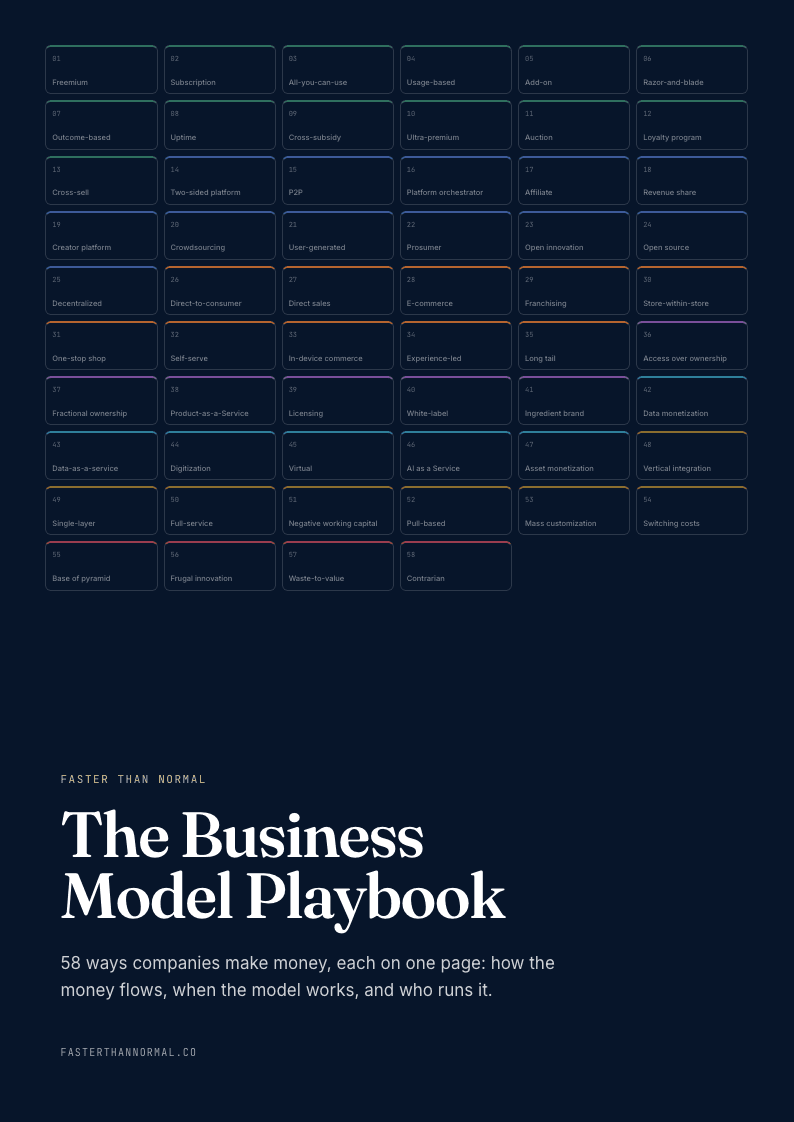
Free playbook
Get The Business Model Playbook
58 business models, one visual page each: how the money flows, the metrics that matter, and who runs it. Free when you join the Faster Than Normal email.
Free. No spam. Unsubscribe anytime.
Part IIIMaxims
-
Consistency is a feature customers can feel. A car that runs the same as every other car of its model is worth more than a brilliant one-off, because the buyer can trust what he has not yet seen.
-
The records outlive the craftsman. What a master mechanic knows dies with him unless someone writes it down; Leland's operation sheets are one reason his methods spread further than his companies.
-
Age is not a reason to stop starting. Leland organized Cadillac at fifty-nine and Lincoln at seventy-four. Deep expertise can make a late start faster, not slower.
-
Your best students may be your suppliers. The man Leland corrected over a bearing shipment went on to run General Motors and credited him for it.
-
Reputation is capital you can move. When Leland left Cadillac, the engineers and the government contracts came with him, because they were following the man.
-
Financiers value quality until it costs them. Durant, the GM bankers, and Ford each prized Leland's standards and then overruled them when the standards got in the way of growth, repayment, or volume.
-
Good timing matters as much as good engineering. The Lincoln Model L was well made and launched into a recession; excellence does not rescue a product from its market.
-
A founder's name is not the same as control. Leland built two great marques and owned neither for long; the legacy survived, but the power to protect it did not.
-
Principles are proved in the moments they are expensive. Rejecting castings, refusing stock, and resigning over war work each cost Leland something, and each is why his standard is remembered.
In Their Own Words
The man who can make parts so accurately that they are interchangeable can make anything.— Henry Leland
Accuracy means something. It is the foundation of good workmanship and the basis of confidence between man and man, between employer and employee.— Henry Leland
For the most meritorious performance of the year... demonstrating the possibility of the production of motor cars with such precision and accuracy of construction as to render the parts interchangeable.— Royal Automobile Club citation
I have always believed that the man who builds the best product will eventually control the market, regardless of the temporary advantages that others may gain through lower prices or clever marketing.— Henry Leland
The Lincoln represents the highest achievement in American automotive engineering. It is not merely an automobile, but a precision instrument that happens to provide transportation.— Automotive trade press review, 1921
There is no job so simple that it cannot be done wrong, and no job so complex that it cannot be done right if proper methods are used.— Henry Leland
Quality is never an accident; it is always the result of intelligent effort.— Henry Leland
A reputation for precision is worth more than any amount of advertising, because it represents the accumulated trust of thousands of satisfied customers.— Henry Leland
The secret of successful manufacturing is not in making things cheaply, but in making them so well that customers are willing to pay what they are worth.— Henry Leland
Every improvement in manufacturing methods should serve two purposes: to make the product better and to make the work easier for the man who does it.— Henry Leland
Innovation without precision is merely expensive experimentation. Precision without innovation is merely expensive craftsmanship. Success requires both.— Henry Leland
The best machine is not the one that runs fastest, but the one that runs most consistently.— Henry Leland
A business built on cutting corners will eventually find itself cornered by competitors who refuse to cut corners.— Henry Leland
The customer who buys on price alone will never be loyal, but the customer who buys on value will remain loyal even when competitors offer lower prices.— Henry Leland
The best way to ensure quality is to hire people who take pride in their work, then give them the tools and training they need to do it right.— Henry Leland
A manager's job is not to watch people work, but to create conditions where people can do their best work.— Henry Leland
Standards that are not measured are merely suggestions. Standards that are measured but not enforced are merely recommendations. Only standards that are measured and consistently enforced become part of the culture.— Henry Leland
The most expensive mistake a manager can make is to accept mediocrity in the name of efficiency.— Henry Leland
Yesterday's precision is today's starting point. What satisfied customers last year will disappoint them this year unless we continue to improve.— Henry Leland
The enemy of excellence is not failure, but satisfaction with current success.— Henry Leland
Every problem is an opportunity to improve, and every improvement creates new opportunities.— Henry Leland
Progress is not about doing things faster, but about doing them better. Speed without quality is merely expensive waste.— Henry Leland
The measure of a man's work is not what he accomplishes in a day, but what remains valuable after he is gone.— Henry Leland
Competition based on price alone is a race to the bottom. Competition based on quality is a race to the top, and there is always room at the top.— Henry Leland
Further reading
- Master of Precision: Henry M. Leland by Henry M. Leland


