


Part IThe Story
Where Else in the World
In January 1943, at the peak of the most destructive war in human history, a New York Times reporter followed a big, bald, sixty-year-old man through the Richmond, California shipyards — five waterline miles of organized pandemonium where a quarter-million workers, men and women both, welded and hammered and hoisted prefabricated steel sections into vessels that would keep Great Britain alive. The man doing the talking was Henry J. Kaiser, and he was talking fast. He gestured at the spectacle below them — the cranes swinging hull sections into place, the sparks cascading from welding torches wielded by women who six months earlier had never touched an acetylene flame — and asked the reporter the only question that mattered to him: "Where else in the world can you see anything like this?"
Where else indeed. Kaiser's seven shipyards were at that moment producing an average of one Liberty ship per day — 441-foot vessels, each carrying 9,000 tons of guns and ammunition and tanks, assembled by workers who had been recruited from farms and cities across America, trained in weeks rather than years, and organized into a production system that the traditional shipbuilding industry considered somewhere between foolish and impossible. Later during the tour, Kaiser confessed he often lay awake at night grappling with ideas "because there is so much more I could do that it's pitiful." He mentioned eleven secret projects the country knew nothing about. Were any of them startling, the reporter asked? "They all are," Kaiser said, with a straight face.
The boast sounds absurd. It was also, by any reasonable accounting, true. By the time Henry John Kaiser died on August 24, 1967, at the age of eighty-five — still working twelve-hour days, still dreaming — he had founded more than one hundred companies. His construction consortiums had built the Hoover Dam, the Bonneville Dam, the Grand Coulee Dam, the San Francisco–Oakland Bay Bridge, and the Los Angeles Aqueduct. His shipyards had produced 1,490 vessels for the U.S. Maritime Commission — roughly 27 percent of all wartime American shipbuilding output, completed in two-thirds the time and at a quarter of the cost of the industry average. He had established the first integrated steel mill on the West Coast. He had created an aluminum empire from surplus government plants. He had attempted, spectacularly and unsuccessfully, to break into the automobile business. He had built resort hotels in Hawaii. And he had, almost as an afterthought to keeping his workers healthy, invented the modern health maintenance organization — Kaiser Permanente — which today serves more than 12.5 million members and generates nearly $100 billion in annual revenue.
Forbes ranked him the eleventh most influential businessman of all time. In the summer of 1944, Franklin Roosevelt's closest advisors considered him as a potential vice-presidential running mate — an entrepreneur with no political experience, no party affiliation, and no campaign contributions to his name. The FBI prepared a dossier. And yet today, as the Engelsberg Ideas writer Gordon Sander observed, "Nullities are remembered, while colossi fall between the cracks." Ask a hundred Americans to name the man who built Hoover Dam and kept the Atlantic supply lines open during World War II and invented the HMO, and you will receive, in return, a hundred blank stares.
This is the story of how a school dropout from upstate New York who wanted to be a photographer became, for a brief incandescent period, the most famous industrialist in America — and why his particular genius, the ability to see an industry he knew nothing about and conclude he could do it faster and cheaper and more humanely than anyone who'd been doing it for decades, was both his greatest gift and the source of his most spectacular failures.
By the Numbers
The Kaiser Empire
100+Companies founded
1,490Ships built during WWII
4 days, 15 hrsRecord time to build a Liberty ship
250,000Peak wartime workforce
$123MRFC loan for Kaiser Steel (1942)
12.5M+Kaiser Permanente members today
$2.5BPersonal fortune at death
The Shoemaker's Son
The family into which Heinrich Kaiser was born, on May 9, 1882, in Sprout Brook, New York — a hamlet so small it barely registered on maps — was, by every measurable standard, struggling. His father Franz, who went by Frank, had emigrated from Steinheim in Hesse, a small medieval town on the southern banks of the Main River, in 1872. Frank Kaiser was a shoemaker by trade, an alcoholic by reputation, and a man who found it difficult to prosper selling shoes in a tiny hamlet sixty miles west of Albany. Henry's mother, the former Anna Marie Yops — known as Mary — worked first in a cheese shop, then as a part-time nurse. There were three older sisters: Elizabeth, Anna, Augusta. Henry was the only son, and the family's finances were never not precarious.
The country was still convulsing from the financial Panic of 1893 when thirteen-year-old Henry, having completed eighth grade, quit school to help support his family. It took three weeks to find work — a stockroom delivery boy at a dry goods store in Utica, four miles from home, paying $1.50 a week. Unable to afford trolley fare, he walked both ways. His mother, alarmed by his decision to leave school, struck a bargain with him: they would read books to each other every evening. This ritual — the immigrant mother and the boy who was already in a hurry to become something — is one of the founding myths of the Kaiser story, and like most founding myths it carries the weight of everything that followed. Mary Kaiser died on December 1, 1899, at the age of fifty-two. Legend holds she died in Henry's arms. He was seventeen. He would later blame her death, in part, on inadequate healthcare — a conviction that smoldered for four decades before expressing itself as one of the most consequential innovations in American medicine.
But that was later. In 1899, Henry Kaiser was a teenage dry goods clerk with a dead mother, a going-blind father, three sisters to support, and a single passion he believed would be his life's work: photography. He had acquired his first Kodak camera at twelve, growing up just a few counties from Rochester, where George Eastman was revolutionizing the industry. He found work with photography supply companies, traveling New York State as a salesman — learning, as he would learn in every subsequent industry, the rhythms of the trade from the sales side first, where you encountered the customer's problem before you encountered the engineer's solution.
In 1901, at eighteen or nineteen, Kaiser learned that a part interest in a photography studio in the resort town of Lake Placid was for sale. By one account, he offered the owner, W.W. Brownell, a proposition of stunning audacity: he would work for no pay for a year — just room and board — and if he tripled the studio's business, he would receive a half-interest. Brownell accepted. Kaiser, as he would do for the rest of his life, worked more hours than anyone else. He sold, he waited on customers, he touched up photographs. He introduced one-day photo service. By his third month, he had fulfilled his promise. He became a partner, then bought Brownell out entirely, and eventually operated three photographic studios and supply stores on the East Coast.
He might have spent his life in photography. The pivot came in 1906, in Lake Placid, when he met Bess Fosburgh. Her father, sizing up the charming young man with the modest origins, made a request that was common for the era but would prove uncommonly consequential: go West, establish yourself, and then come back to marry my daughter. Kaiser was not offended. He was galvanized.
Go West, Young Man, and Pave Something
Spokane, Washington, in 1906 was a frontier city still under construction, and Henry Kaiser arrived with nothing but his salesmanship and a deadline imposed by a prospective father-in-law. He found work in hardware sales, then as manager of a regional hardware business, learning on the fly the relationships between builders and their material suppliers. On April 8, 1907, having established himself sufficiently, he returned east and married Bess Fosburgh. Their first son, Edgar Fosburgh Kaiser, was born later that year.
The hardware business put Kaiser in daily contact with road contractors, and the exposure revealed something critical: the American West was being built, literally, and the men doing the building were not, by Kaiser's reckoning, moving fast enough. Roads were being paved at two miles per month. Kaiser saw waste. He saw opportunity. In 1912, he went to work for a Canadian paving company, the J.F. Hill Company, learning the mechanics of road construction from the inside. When his employer, a firm working a road-building contract in Vancouver, went bankrupt in 1914, Kaiser did what would become his signature move: he got a loan, took over the failing company's remaining contract, hired many of its former employees, and finished the job at a profit.
The Henry J. Kaiser Company, Ltd., established in 1914, was a paving contractor — and an unusually aggressive one. Where his competitors relied on manual labor and slow-curing methods, Kaiser invested in the most advanced road-paving machinery available, equipment that was expensive to acquire but dramatically cheaper to operate over time. It was a capital-intensity bet that would repeat itself throughout his career: spend heavily on technology and infrastructure at the front end, compress timelines, and let the savings compound. On a California paving contract, he laid a mile of road per week instead of the industry standard of two miles per month. State officials visited him repeatedly, suspicious that he was cutting corners. He wasn't. He was just faster.
The nickname arrived: "Hurry Up Henry."
Between 1914 and 1930, Kaiser built California dams, Mississippi River levees, and highways. He established sand and gravel plants to supply his own materials — the earliest expression of a vertical integration instinct that would define nearly everything he touched. But the contract that Kaiser himself maintained had established his future was in Cuba: 200 miles of road and 500 bridges in the province of Camagüey, an $18 million project that his company completed in four and a half years instead of the scheduled seven. Cuba taught him how to manage a diverse workforce in hostile terrain, how to compress impossibly long timelines, and how to think about infrastructure not as discrete projects but as systems — roads need gravel, gravel needs quarries, quarries need transportation, transportation needs roads.
By the late 1920s, Kaiser had moved his headquarters to Oakland, California, and was positioning himself for something bigger than highways. The American West was about to be reshaped by the largest public works projects in human history, and Kaiser intended to be the man who built them.
Taming Water
The story of American dam-building in the 1930s is inseparable from the story of Henry Kaiser, though to say he "built" the Hoover Dam is to simplify a more interesting truth. Kaiser helped organize and lead a consortium called Six Companies, Inc. — a loose grouping of builders and earth movers that pooled resources, expertise, and political connections to win contracts too massive for any single firm. It was, in its way, a precursor to the modern joint venture, and Kaiser was its most aggressive promoter.
Six Companies began construction on the Boulder Dam (later renamed Hoover) on the Colorado River in 1931. The project was staggering in scale: a 726-foot-high concrete arch-gravity dam requiring 3.25 million cubic yards of concrete, built in a narrow desert canyon where summer temperatures routinely exceeded 120 degrees. The workforce grew from 106 men when the contract was awarded in March 1931 to 5,251 at peak employment. Six Companies finished two years ahead of schedule — a fact that Kaiser ensured everyone in Washington knew about, and that generated both admiration and friction. The Interior Secretary Harold Ickes charged the consortium with violations of the eight-hour workday law; fines reached $350,000. Kaiser, in a public relations blitz that revealed his instinct for narrative, sent documents dramatizing the company's effort to high government officials and congressmen. The fine was reduced to $100,000. More importantly, Kaiser became known in Washington as a force to be reckoned with — a man who got things done faster than anyone expected, and who could work the levers of government with the same intensity he brought to construction sites.
The consortium moved on to Bonneville Dam on the Columbia River in Oregon, Grand Coulee Dam in Washington State, and the San Francisco–Oakland Bay Bridge. When Kaiser lost the bid to build the Shasta Dam in Northern California, he did something characteristic: rather than sulk about the lost contract, he started a cement company to supply the six million barrels needed for the project. The Permanente Cement plant, erected in 1939 in the foothills above what is now Cupertino, California — named after Permanente Creek, which ran perpetually year-round — included a nine-mile conveyor belt that carried cement across a mountain to the dam site. The creek's name would later attach itself to the most enduring institution Kaiser ever created, thanks to Bess Kaiser, who thought its connotation of permanence suited their healthcare foundation.
— Henry J. KaiserIf I don't dream I'll make it, I won't even get close.
These dam projects were more than engineering feats. They were laboratories. Grand Coulee alone taught Kaiser how to manage workforces of thousands in remote locations, how to negotiate with unions and government bureaucracies simultaneously, how to supply materials at industrial scale across vast distances, and — crucially — how to keep workers healthy enough to keep working. It was at Grand Coulee that his son Edgar helped establish a prepaid medical program for workers, the embryo of what would become Kaiser Permanente. The dam projects also cemented (literally and figuratively) Kaiser's relationship with the federal government — a relationship that would prove essential during the war years, and that would later expose him to the charge that he was less a "can-do capitalist" than a "government entrepreneur" feeding at the public trough.
The Patriot in Pinstripes
Henry Kaiser had never built a ship. He had never seen a ship being built. What he had seen, by 1940, was that the United States was going to need an enormous number of cargo vessels very quickly, and that the existing shipbuilding industry — with its craft traditions, its riveting methods, its six-month construction cycles — was catastrophically unprepared to provide them. A U.S. battleship took 230 days to build. The entire American shipbuilding workforce in 1939 numbered roughly 40,000. And the Atlantic was filling with German U-boats that were sinking British merchant ships faster than the world's shipyards could replace them.
"I'm a builder," Kaiser told people who questioned his qualifications, "and if you call yourself a builder, you ought to be able to build anything."
The British government, desperate for cargo ships, placed the first orders. Kaiser established his first Richmond, California, shipyard in December 1940 and began applying methods that the shipbuilding industry considered heretical. Where traditional shipbuilders constructed vessels from the keel up with a single crew — a method essentially unchanged since the nineteenth century — Kaiser introduced modular prefabrication: ships were broken into 250-ton sections, assembled in parallel throughout the yard, then hoisted into position by massive cranes and welded together. It was, conceptually, an automobile assembly line stretched to the scale of a 441-foot vessel. One of Kaiser's associates had visited a Ford Motor plant and watched workers on the line; the translation from cars to cargo ships was Kaiser's imaginative leap.
The implications for labor were revolutionary. Traditional riveting required six months of training. Welding could be mastered in two weeks. This meant Kaiser could hire not just experienced shipyard workers — of whom there were far too few — but women, minorities, wounded veterans, and anyone else willing to learn a repetitive physical task. At their peak, Kaiser's shipyards employed more than 250,000 workers and constituted one of the most diverse industrial workforces in American history. Women made up approximately 30 percent. Thousands of African Americans migrated from the South, swelling Richmond's population from 20,000 to over 100,000 in three years. Kaiser built an entire city — Vanport, Oregon, with 9,942 housing units for 42,000 people — to house his Portland-area workers. He recruited Native Americans off reservations. He established child care centers at his shipyards, inviting leading child development researchers from Columbia University and UC Berkeley to design facilities and programs so that parents could build ships without worrying about their children.
The production numbers were, as biographer Mark Foster wrote, "spectacular." Between 1941 and 1945, Kaiser's seven shipyards — four in Richmond, two in Portland, one in Vancouver, Washington — produced 1,490 vessels, including Liberty ships, Victory ships, escort aircraft carriers, tankers, and landing ships. The yards produced ships in two-thirds the time and at a quarter of the cost of the industry average. The Liberty ship Robert E. Peary was assembled in four days, fifteen hours, and twenty-seven minutes as part of a publicity stunt and shipyard competition — but by 1944, the standard production time for a Liberty ship had dropped to just over two weeks, using normal methods. Kaiser alone accounted for approximately 27 percent of all U.S. Maritime Commission construction.
The escort carrier story deserves its own digression. On June 2, 1942, Kaiser pitched the U.S. Navy brass on building small aircraft carriers — compromise designs using modified merchant ship hulls, cheaper and faster to produce than fleet carriers. He was voted down 16 to 0. The admirals considered the ships too flimsy and worried the program would divert Kaiser from cargo ship production. But a chance encounter between a Kaiser Company vice president's friend and someone with close connections to President Roosevelt led to a meeting the next morning with FDR and several admirals. Kaiser won them over and was awarded a contract for fifty Casablanca-class escort carriers. These "baby flattops" would prove instrumental in the Battle of Leyte Gulf in October 1944, one of the largest naval engagements in history.
— A competitor, on Kaiser's successHe was successful because he was ignorant — he never knew what he couldn't do.
Kaiser's wartime fame was immense. He appeared on magazine covers, in newsreels, in comic books — a 1943 issue of Real Heroes honored him alongside Admiral William "Bull" Halsey and General Brehon Somervell. President Harry Truman wrote him personally in August 1945, calling upon him to lead a national clothing collection campaign for war refugees, citing the "magnificent" results of Kaiser's previous efforts. "Without adequate clothing and other necessities of life to sustain victims of war on the long road to rehabilitation," Truman wrote, "there can be no peace."
But the wartime experience also planted the seeds of what Kaiser's critics would later call his fatal flaw: a conviction, reinforced by staggering success, that there was no industry he could not enter, no problem he could not solve, no institution he could not remake in his own image. The war had taught him, he said in a December 1943 speech, "to employ our vast resources and to multiply them a million-fold by power and the machine." The question was whether that lesson would transfer to peacetime industries with entrenched competitors, established brands, and customers who were not the U.S. government.
Steel, Aluminum, and the Art of the Government Loan
Kaiser's relationship with the federal government was, depending on your sympathies, either the natural partnership of a visionary builder with the only entity capable of funding projects at national scale, or a case study in the art of public subsidy extraction. The truth, as usual, resided somewhere in the uncomfortable middle.
To supply steel for his shipyards, Kaiser organized Kaiser Steel at Fontana, California, in 1942 — the first integrated steel mill on the West Coast — using a $123 million Reconstruction Finance Corporation loan that drew considerable criticism from Congress and Wall Street alike. Eastern steel manufacturers viewed Kaiser as an upstart who was using government money to compete against companies that had built their capacity with private capital. Kaiser viewed them as monopolists who had deliberately starved the West Coast of steel production to maintain their pricing power. Both were partially right.
Kaiser Steel at Fontana became profitable, though it was never Kaiser's smoothest operation. He laid down a rule from the plant's inception: "Don't make it a nuisance." His engineers installed $5 million worth of air pollution control devices, developed a $30,000 laboratory to study the effects of contaminants on plant life, and operated three greenhouses to monitor smoke patterns — progressive measures for the 1940s, though the plant would face increasing environmental scrutiny in later decades. (The Fontana mill eventually passed through corporate raiders, went bankrupt in 1987, and is now an auto race track. A peculiarly American afterlife.)
The aluminum story was more consequential. During the war, the American aluminum industry was essentially a monopoly controlled by Alcoa. When the government built surplus aluminum plants to support wartime production, it faced an antitrust dilemma: returning them to Alcoa would reinforce the monopoly; selling them to a competitor would create a more competitive market. Kaiser, who had dabbled in light metals during the war, seized the opportunity. He leased, and eventually purchased, three government-owned aluminum plants — in Mead and Trentwood, Washington, and an alumina refinery in Baton Rouge, Louisiana — founding Permanente Metals Corporation in 1946, later renamed Kaiser Aluminum and Chemical Corporation.
The government chose Kaiser over higher bids specifically because it wanted to foster a third major competitor in the aluminum market. This was industrial policy of a kind that makes laissez-faire purists uncomfortable, and Kaiser was its primary beneficiary. By 1953, Kaiser Aluminum's primary output had reached over 25 percent of total U.S. production. The company went public in July 1948. By the early 1950s, it controlled bauxite mines in Jamaica, refineries, smelters, and finishing plants across the country — a vertically integrated aluminum empire built, in the first instance, on government surplus. Kaiser Aluminum still exists today, headquartered in Franklin, Tennessee, with $3.0 billion in 2024 revenue and approximately 4,000 employees, though no member of the Kaiser family retains any involvement.
Debacle in Detroit
The automobile venture is where the Kaiser narrative turns from triumph to something more instructive. It is the story of what happens when a man whose genius lies in speed, scale, and government partnership enters an industry that rewards patience, branding, and consumer psychology — qualities that Henry Kaiser, for all his brilliance, did not naturally possess.
In 1945, Kaiser partnered with Joseph W. Frazer — a veteran automobile executive who had been president of Graham-Paige — to form Kaiser-Frazer Corporation. Joseph Washington Frazer was everything Kaiser was not in the auto world: a patrician industry insider with decades of experience in Detroit, a man who understood the rhythms of model years and dealer networks and the strange alchemy by which a car becomes an object of desire rather than mere transportation. The partnership acquired a surplus bomber plant at Willow Run, Michigan, using a $44 million government loan, and began producing two nameplates from virtually identical cars: the popular-priced Kaiser and the upscale Frazer.
The timing was initially perfect. In the immediate postwar seller's market, with pent-up demand for new automobiles and the Big Three still retooling, Kaiser-Frazer sold everything it could make. The cars were among the first newly designed postwar models, and they generated genuine excitement. But the market normalized. By 1949, Ford, General Motors, and Chrysler introduced new designs, and Kaiser-Frazer's fundamental weaknesses — a modified Continental industrial engine rather than a proprietary powerplant, no pre-war brand equity, limited dealer network, and manufacturing costs that couldn't compete with Detroit's economies of scale — became lethal.
Kaiser, characteristically, pushed for more production when Frazer counseled restraint, creating an oversupply of cars that took more than a year to sell. The two men clashed, and Frazer left the company in 1951. Kaiser renamed it Kaiser Motors Corporation, introduced the compact "Henry J" model — named after himself, a move that combined vanity with market miscalculation — and continued building passenger cars until 1955. By then, the venture had lost $52 million in seven years.
Kaiser repaid his government loan, as he always did. The point was never that he was a cheat or a grifter. The point was that the skills required to build a Liberty ship in four days — speed, prefabrication, government coordination, workforce mobilization — were almost perfectly inversely correlated with the skills required to build a car company: brand development, distribution relationships, iterative product design, and the slow accumulation of consumer trust. Kaiser's principal rule was speed: "There's no money in a slow job." But the automobile business was, fundamentally, a slow job.
The one bright spot from the automotive misadventure was Willys-Overland, which Kaiser acquired along the way. The Jeep brand, which Kaiser Industries produced in the U.S. and thirty-two other countries, retained genuine value. Kaiser sold Willys Motors to American Motors Corporation in 1970 for approximately $70 million. AMC successfully revived the Jeep brand, demonstrating what Kaiser might have accomplished had he understood the auto industry a little better. In 1987, Chrysler bought AMC — primarily to get Jeep — for $1.1 billion.
The Doctor Will See You Now
The healthcare story is the one that justifies everything. It is also the one that began not as a grand vision but as a practical problem: how do you keep thousands of construction workers healthy in the remote desert, where the nearest hospital might be a hundred miles away and a sick worker was a worker who wasn't pouring concrete?
In 1933, a young surgeon named Sidney R. Garfield — fresh from a Los Angeles County Hospital residency, idealistic and broke — accepted the opportunity to care for thousands of workers building the Colorado River Aqueduct in the Southern California desert. Garfield borrowed money to construct a small hospital called Contractors General, about six miles west of Desert Center, California, complete with advanced medical equipment and air conditioning in a location where both were improbable luxuries. He became the sole physician for thousands of workers when his partner left. His founding nurse, Betty Runyen, learned advanced skills — starting IVs, driving ambulances to remote job sites — that went far beyond the conventional nursing scope of the 1930s.
Garfield's problem was financial. He treated sick and injured workers regardless of whether their insurance covered the care, and the resulting payment gaps threatened to close the hospital. Henry Kaiser, one of the aqueduct's contractors, heard about the problem and sent insurance executive Harold Hatch to devise a solution. The agreement they reached was deceptively simple and historically enormous: Kaiser's Industrial Indemnity Exchange would prepay Garfield a fixed amount per worker per day for work-related injuries and health care. Workers would then voluntarily prepay a premium of five cents per day from their paychecks for non-work-related health care. Comprehensive coverage. No extra out-of-pocket costs. Thousands enrolled. The hospital stayed open.
This was, in embryo, the prepaid group practice model — the architecture that would eventually become the health maintenance organization. Kaiser and Garfield refined it at the Grand Coulee Dam construction site in the late 1930s, then scaled it massively during the war years. By 1942, Kaiser's Richmond shipyard workers had access to a fifty-cent-a-week nonindustrial health plan that was so overwhelmingly popular the Permanente Health Plan struggled to keep up with enrollment and facilities. Kaiser built hospitals. He hired doctors. He established the Kaiser Foundation Medical Care Program, which eventually built nineteen hospitals providing preventive health care for more than one million people.
— Henry J. Kaiser, National Press Club, 1954If we can build ships, and planes, and tanks, and guns, and bullets to protect our national security, can we not build hospitals and clinics to protect the lives of our people?
The decision to open the plan to the general public, on July 21, 1945, was the inflection point. As the war ended and shipyard employment collapsed, Kaiser and Garfield faced a choice: shut down the health plan or offer it to anyone willing to pay. The San Francisco Chronicle reported that "any individual may walk into the hospital and apply for complete, prepaid medical care." Groups of twenty-five workers under one employer could also obtain service. The three-hundred-bed Oakland hospital had eighty full-time physicians and surgeons, laboratories, clinics, and pharmacies.
Kaiser saw the health plan not merely as a benefit for his workers but as a model for national healthcare — and he said so, repeatedly, with the same promotional intensity he brought to shipbuilding. In March 1945, he submitted a "Proposal for a Nation-Wide Pre-Paid Medical Plan Based on Experience of the Permanente Foundation Hospitals" that began with a statement of striking confidence: "It is maintained that the greatest service that can be done for the American people is to provide a nationwide prepaid health plan that will guard these people against the tragedy of unpredictable and disastrous hospital and medical bills."
He harangued fellow business leaders to follow his lead. He made public campaigns. He proposed legislation through Senator Claude Pepper. He told audiences at the National Press Club that prepaid healthcare and newspaper subscriptions operated on the same economic principle: "Your services are paid for monthly by the subscribers of the thousands of newspapers all over the country. You offer comprehensive news coverage on a monthly payment basis. We do have that in common."
The medical establishment fought him. Traditional physicians saw prepaid group practice as a threat to the fee-for-service model. Organized medicine attacked the plan. But Kaiser Permanente survived, grew, and became the template for the HMO movement that would reshape American healthcare over the next half-century. Today, Kaiser Permanente employs more than 235,000 people and physicians, operates across multiple states, and remains the most visible institutional legacy of a man who founded over a hundred companies. The boy whose mother died, he believed, from inadequate healthcare had built a system that would care for millions.
The Spruce Goose and Other Misadventures
Not every Kaiser venture succeeded, and several veered into the territory of magnificent overreach. His wartime collaboration with Howard Hughes — the aviation mogul who was, in his own way, another man who never knew what he couldn't do — produced the concept of a ten-engine cargo plane. The idea never got off the drafting board, though it contributed to the lore of the HK-1 flying boat (the "Spruce Goose") that Hughes eventually built to vindicate himself before Congress. Kaiser and Hughes were kindred spirits in their audacity and unalike in almost every other respect: Kaiser was gregarious, Hughes reclusive; Kaiser managed vast workforces, Hughes trusted almost no one; Kaiser repaid every government loan, Hughes disappeared into litigation and paranoia.
The cargo planes and related ventures drew Congressional investigations, part of a broader postwar backlash against industrialists who had profited from government wartime spending. Kaiser, who had been celebrated as "Mr. Can Do" during the war, found himself recast as a man who had enriched himself at public expense. The Republican congressman William B. Widnall of New Jersey, opposing a Congressional Medal of Honor for the then-eighty-two-year-old Kaiser in 1964, summarized the reservations: "I question whether this gentleman is an industrial giant on the basis of having hewed it out himself, as have other leaders of industry in this country."
The criticism stung because it contained a sliver of truth. Kaiser's relationship with government — the RFC loans, the surplus plant acquisitions, the wartime contracts — was more intimate than that of most industrialists, and his promotional genius ensured that the public narrative always emphasized his patriotism rather than his subsidy. The historian Stephen Adams, in his book Mr. Kaiser Goes to Washington, characterized him as a "government entrepreneur" — a more nuanced and arguably more accurate label than either "can-do capitalist" or "war profiteer." Kaiser used government not as a crutch but as a platform, and the distinction between the two is both real and easy to elide.
A Pacific Paradise
Kaiser's final act was Hawaiian. From 1954 to 1960, he directed the construction of the Hawaiian Village resort center in Waikiki — a development that included the installation, on January 12, 1957, of the first civilian geodesic dome in the United States, built in a remarkable twenty hours using the prefabrication techniques Kaiser's workers had perfected in the wartime shipyards. Five days had been allocated. The crew, taking advantage of low winds, started ahead of schedule and finished before Kaiser could fly out from California to see it. "Why those dirty pups," he said, "they did it without me."
The Hawaiian Village was sold in 1961 to the Hilton hotel chain for more than $21 million. Kaiser also developed Hawaii Kai, a residential community on Oahu. He had fallen in love with the islands, and he spent his final years there with his second wife, Alyce (known as Ale), whom he married after Bess's death. He was, even in his eighties, working twelve-hour days, managing his multiple business ventures, dreaming of new projects.
He died in Honolulu on August 24, 1967. He divided his fortune — estimated at $2.5 billion — between Ale and the Henry J. Kaiser Family Foundation, which was created to support the Kaiser medical program. His son Edgar received nothing because, as the will stated, he was "otherwise cared for." Edgar replaced his father as chairman of the various Kaiser companies but lacked the ownership stake and the force of personality to hold the empire together. Kaiser Industries voluntarily liquidated in 1977. Kaiser Steel was sold, plundered by corporate raiders, and went bankrupt in 1987. Kaiser Aluminum survived but as a shadow of its former self. Ale returned to Hawaii only twice after the funeral, then moved to Greece and sold all the properties she had shared with Henry.
The empire did not survive its founder. But the institutions did — Kaiser Permanente above all, serving millions of members in states from California to Georgia, a monument to a practical problem solved in the Mojave Desert in 1933, when a young surgeon couldn't keep his hospital open and an industrialist's insurance man figured out that five cents a day, prepaid, was enough to change everything.
The Man Who Always Hurried
TIME magazine's obituary headline on September 1, 1967, captured the essential rhythm: "The Man Who Always Hurried." It was not entirely a compliment. Speed was Kaiser's religion — "There's no money in a slow job," he said repeatedly — and his capacity to compress timelines was genuinely extraordinary. But speed, as the automobile debacle demonstrated, was not always the right tool. Some things require patience, accretion, the slow building of trust between a company and its customers. Kaiser never fully grasped this, because his most formative experiences — the dam contracts, the war shipyards — rewarded exactly the opposite: urgency, improvisation, the willingness to start before you fully understood what you were doing.
His management style was "hands on" in the extreme. He despised desk work and committee reports. He was a visionary, not a details man. His passion was for the job site, the conversation with workers, the improvisational solution to a problem encountered at two in the morning. He was an extraordinary salesman — charming, vital, rough-edged, possessed of an infectious confidence that drew people into his orbit. The Washington power brokers who supported him did so not just because he delivered results but because he made them feel that they were participating in something important, something faster and more alive than ordinary government contracting.
He was also, in ways that his admirers sometimes elide, a man whose success depended on institutions and relationships he did not create. The New Deal infrastructure spending that funded the dams. The wartime mobilization that funded the shipyards. The RFC loans that funded the steel mill. The surplus government plants that funded the aluminum company. Kaiser did not invent the conditions that made his career possible; he was the most brilliant exploiter of those conditions, the man who saw what the moment demanded and moved faster than anyone else to provide it. This is not a criticism. It is a description of a particular kind of genius — situational, improvisational, dependent on the alignment of personal ambition with national need.
In the 1940s, that alignment was perfect. In the postwar years, as the conditions changed, the alignment faltered. The automobile industry did not need a man who could build things fast; it needed a man who could build things people wanted to buy again and again. The aluminum industry did not need a frontier visionary; it needed patient operators who could manage commodity cycles. Kaiser's later ventures — some successful, some not — all bore the imprint of a man who had learned the deepest lesson of his life during the war and could not quite unlearn it.
What endures is not the empire but the idea. Find a need and fill it. Build the supply chain you need rather than waiting for someone else to provide it. Treat your workers as assets rather than costs, and their health as an investment rather than an expense. Move into industries you know nothing about, because the fresh eye sees what the expert has learned to ignore. And above all: hurry. There is always so much more you could do that it's pitiful.
In Honolulu, in the Hawaiian Village he built and sold, the trade winds still blow through the Kaiser dome — assembled in twenty hours by workers who had learned, in the shipyards of Richmond, that impossible timelines were the only kind worth setting.
Part IIThe Playbook
Henry Kaiser's career spanned more than half a century and more than a hundred companies, from photography studios to dams to shipyards to health systems. The principles below are distilled from his decisions, his failures, and the patterns that recur across wildly different industries and eras. They are not motivational slogans. They are operational insights, grounded in specific choices that produced specific outcomes.
The principles
- 1.Enter industries you know nothing about — and make ignorance an advantage.
- 2.Speed is a strategy, not a personality trait.
- 3.Build the supply chain before you need it.
- 4.Use government as a platform, not a crutch.
- 5.Treat labor as the most valuable capital.
- 6.Solve the adjacent problem.
- 7.Name things simply.
- 8.Know when speed is the wrong tool.
- 9.Sell the vision before you build the factory.
- 10.Institutionalize the accident.
- 11.The founder's absence is the ultimate test.
Principle 1
Enter industries you know nothing about — and make ignorance an advantage
Kaiser had never built a ship when he entered the shipbuilding business. He had never manufactured cement when he started a cement company. He had never made steel when he organized Kaiser Steel. He had never produced aluminum when he bought surplus government plants in 1946. A competitor described his success as the product of ignorance: "He never knew what he couldn't do."
This was not recklessness. It was a deliberate epistemological strategy. Kaiser understood that incumbents in mature industries develop not just expertise but also inherited constraints — assumptions about how things must be done that have hardened into dogma. The traditional shipbuilding method of constructing vessels from the keel up with a single crew was not the result of careful optimization; it was the residue of centuries of craft tradition. Kaiser, unburdened by that tradition, imported mass production techniques from the automobile industry and compressed build times from six months to two weeks. The experts who said it couldn't be done were right that it couldn't be done the way they did it. Kaiser simply did it a different way.
The caveat — and the automobile story provides it — is that ignorance is only an advantage in industries where the critical bottleneck is production methodology rather than customer intimacy. Kaiser's fresh eye transformed shipbuilding because the customer was the U.S. government, which wanted vessels fast and cheap. In the automobile business, where the customer was a consumer making an emotional purchase, Kaiser's ignorance of branding, distribution, and product design was not an asset but a liability.
Tactic: When entering a new industry, audit which assumptions are genuine constraints and which are inherited habits — then attack the habits with methods imported from elsewhere.
Principle 2
Speed is a strategy, not a personality trait
"There's no money in a slow job." Kaiser's obsession with speed was not mere impatience — it was an economic insight. In construction, where contracts often included completion bonuses and penalty clauses, finishing early directly translated to higher margins. In wartime shipbuilding, where German U-boats were sinking ships faster than the Allies could replace them, speed was a matter of national survival. Kaiser structured his entire operation — prefabrication, modular assembly, rapid training, parallel workflows — around the premise that time was the most expensive input.
In Cuba, his company completed 200 miles of road and 500 bridges in four and a half years instead of the scheduled seven. On California paving contracts, he laid a mile of road per week instead of the industry standard of two miles per month. The Hoover Dam was finished two years ahead of schedule. Liberty ships went from six-month builds to two-week builds. A geodesic dome in Hawaii was erected in twenty hours instead of five days.
⏱
Kaiser's Speed Advantage
Across industries, Kaiser consistently outperformed timelines — often dramatically
| Project | Industry standard | Kaiser's time |
|---|---|---|
| California road paving | 2 miles/month | 1 mile/week |
| Cuba road contract | 7 years | 4.5 years |
| Hoover Dam | 6 years (scheduled) | 4 years |
| Liberty ship construction | ~6 months | ~2 weeks (standard), 4.5 days (record) |
| Hawaiian geodesic dome | 5 days allocated | 20 hours |
The structural insight is that speed was not about working harder — it was about redesigning the production system so that time-consuming sequential steps became parallel ones. Prefabrication meant sections could be built simultaneously. Welding instead of riveting meant workers could be trained in weeks rather than months. Speed was an architectural property of the system, not a motivational exhortation to the workforce.
Tactic: Redesign the production sequence to make parallel what was previously serial — the biggest time savings come from structural changes, not effort increases.
Principle 3
Build the supply chain before you need it
Kaiser's most distinctive strategic instinct was vertical integration — not as a theoretical preference but as a practical response to supply constraints he encountered repeatedly. When he needed sand and gravel for road construction, he built sand and gravel plants. When he needed cement for the Shasta Dam, he built a cement factory and a nine-mile conveyor belt. When he needed steel for his shipyards, he built an integrated steel mill. When he needed aluminum for his automobile business, he acquired government surplus aluminum plants.
This was not diversification for its own sake. Each vertical integration move was triggered by a specific supply bottleneck that threatened an existing project. Kaiser's experience on massive construction projects taught him that dependency on external suppliers introduced delays and cost overruns that no amount of project management could eliminate. The only reliable supply chain was one you controlled.
The pattern — encounter a bottleneck, build a company to eliminate it, then discover that the company itself is a viable business — explains how a road paving contractor ended up running cement, steel, aluminum, and gypsum companies. Each new business was, at its origin, a supply chain solution for an existing business. The empire grew not from a grand strategy but from the accumulation of solved problems.
Tactic: When a supply constraint threatens your core operation, consider whether building or acquiring the supplier creates a standalone business — the best conglomerates are portfolios of solved bottlenecks.
Principle 4
Use government as a platform, not a crutch
Kaiser's relationship with the federal government was the most controversial aspect of his career and the most instructive. He used $123 million in RFC loans to build a steel mill, acquired surplus government aluminum plants at favorable terms, and built 1,490 ships on government contracts. His critics called him a "government entrepreneur." His defenders noted that he repaid every loan and delivered every contract ahead of schedule and under budget.
The distinction matters. Kaiser did not seek government subsidies to avoid market competition; he sought government partnership to enter markets where the capital requirements exceeded what private financing alone could provide. The Hoover Dam could not have been built by a single private company. The wartime shipbuilding mobilization could not have been funded by private shipyards. The West Coast steel industry could not have been established without public capital to break the Eastern monopoly.
Kaiser's genius was in understanding that government, at certain historical moments, has needs that align with private ambition — and that the entrepreneur who can articulate that alignment most compellingly wins the contract. His public relations skill was not incidental to his government relationships; it was the mechanism through which he framed his private projects as public goods. The Fontana steel mill was not "Kaiser's steel company" — it was "the West Coast's first integrated steel mill," a matter of regional economic independence.
Tactic: Frame your venture's objectives in terms of the platform provider's strategic needs — whether that provider is a government, a corporate partner, or a marketplace.
Principle 5
Treat labor as the most valuable capital
Kaiser's labor practices were, for his era, extraordinary. He paid well. He cooperated with unions rather than fighting them. He built housing for workers (Vanport, Panorama City). He established child care centers designed by the country's leading child development researchers. He created the first prepaid health plan. He hired women and minorities at a time when most industrial employers actively excluded them.
This was not philanthropy. It was strategy. Kaiser understood — from his road-building days in Cuba, from the dam sites, from the shipyards — that workforce turnover, absenteeism, and low morale were the most expensive problems in labor-intensive industries. A healthy worker who was not worried about her children or her medical bills was a more productive worker. The fifty-cent-a-week health plan was not a cost; it was an investment that reduced absenteeism, improved retention, and accelerated training — because a worker who stayed longer became more skilled, and a more skilled worker built ships faster.
The child care centers at the Kaiser shipyards are a particularly telling example. Kaiser didn't just provide babysitting; he invited Catherine Landreth of UC Berkeley and Lois Meek Stolz of Columbia University to design programs that became models for the postwar child development field. This was overkill by conventional cost-benefit analysis — and exactly right by Kaiser's logic, which held that if you were going to solve a problem, you should solve it so well that the solution itself became an asset.
Tactic: Calculate the true cost of workforce instability — turnover, absenteeism, training replacement — and invest in employee welfare up to that amount, treating it as an operational expense with measurable ROI.
Principle 6
Solve the adjacent problem
Kaiser Permanente did not begin as a healthcare company. It began as a solution to a construction problem: workers in remote desert locations needed medical care, and there was no economically viable way to provide it through traditional fee-for-service medicine. The prepaid model was invented not because Kaiser had a theory about healthcare economics but because a hospital was about to close and someone had to figure out how to keep it open.
Similarly, Kaiser Aluminum did not begin as an aluminum company. It began because Kaiser needed aluminum for his automobile business and Alcoa's monopoly made supply uncertain. Kaiser Steel did not begin as a steel company. It began because West Coast steel shipments were too slow for Kaiser's shipyards.
The pattern is consistent: Kaiser's most successful ventures originated as solutions to problems adjacent to his primary business. The implication is that the best diversification opportunities are not found by surveying attractive industries from the outside but by following the supply chain and customer journey of your existing business until you encounter a problem that no one is solving well.
Tactic: Map the supply chain and customer experience of your core business, identify the points of friction that cost you the most time and money, and evaluate whether solving those frictions could be a standalone business.
Principle 7
Name things simply
Kaiser Aluminum. Kaiser Steel. Kaiser Cement. Kaiser Gypsum. Kaiser-Frazer Automobiles. Kaiser Permanente Hospitals. Kaiser Broadcasting. Kaiser Construction. Kaiser Paving Company. The naming convention was almost comically straightforward: the founder's surname followed by the product or industry. In a conglomerate of more than one hundred companies, this simplicity was not laziness — it was architecture. Every company carried the Kaiser brand, which meant every success reinforced every other company's credibility, and the founder's personal reputation served as a unified trust signal across wildly different industries.
The risk, of course, was that every failure would tarnish the brand too. The Kaiser-Frazer automobile debacle did not help Kaiser Aluminum's reputation. But on net, the simplicity created an enormous advantage in an era when Kaiser was constantly entering new industries and needed to signal credibility to customers, partners, and government officials who knew his name from other contexts.
Tactic: When building across multiple domains, use a naming architecture that allows reputation to transfer — simplicity and consistency signal confidence and create compounding brand equity.
Principle 8
Know when speed is the wrong tool
The automobile failure is the most important lesson in the Kaiser playbook precisely because it reveals the boundary condition of his primary strategy. Kaiser-Frazer lost $52 million in seven years not because Kaiser was incompetent but because he applied wartime production logic to a consumer business. He pushed for volume when the market wanted differentiation. He overproduced when demand softened. He prioritized manufacturing speed when the bottleneck was consumer desire.
Joseph Frazer, his partner, counseled restraint and was overruled. Frazer understood something Kaiser did not: that in a consumer market with entrenched competitors and strong brand loyalties, the most dangerous thing you can do is build faster than people want to buy. Kaiser's instinct — always accelerate, always produce more, always finish ahead of schedule — was precisely wrong for an industry where success required the slow cultivation of dealer relationships, brand identity, and iterative product improvement.
Tactic: Before applying your proven playbook to a new domain, test whether the bottleneck is on the supply side (where speed helps) or the demand side (where speed can be fatal).
Principle 9
Sell the vision before you build the factory
Kaiser was, first and always, a salesman. He sold photography services, then hardware, then road-paving contracts, then dam-building proposals, then shipbuilding capacity, then healthcare plans, then resort hotels. His correspondence, speeches, and public appearances reveal a man who understood that the most important moment in any venture was not the construction but the pitch — the moment when you convinced someone with money or authority that your vision was worth funding.
His wartime pitch for escort carriers is the emblematic example. Voted down 16 to 0 by the Navy brass, Kaiser found an alternative route to the President himself and won a contract for fifty ships within twenty-four hours. The structural lesson is not about political connections (though those helped) but about persistence in selling: Kaiser treated rejection as information about which door to try next, not as a verdict on the idea.
His 1954 National Press Club speech on hospital construction — "If we can build ships, and planes, and tanks, and guns, and bullets to protect our national security, can we not build hospitals and clinics to protect the lives of our people?" — was not an argument but a performance, designed to make the audience feel that failure to act was a moral failure. Kaiser sold with emotion and justified with data. The sequence mattered.
Tactic: Lead with the emotional case — the urgency, the moral stakes, the vision — then support with evidence; reversed, the same material loses 90% of its persuasive power.
Principle 10
Institutionalize the accident
Kaiser Permanente, the most enduring institution Kaiser created, began as an improvised solution to an emergency — a desert hospital running out of money — and became a model for national healthcare. The geodesic dome in Hawaii was a marketing installation for Kaiser Aluminum that became an architectural landmark. The Richmond shipyards' child care centers, created out of wartime necessity, became foundational research sites for the postwar child development field.
The pattern suggests a meta-principle: Kaiser's most lasting contributions were not the things he planned but the things he built to solve immediate problems and then recognized as having value beyond their original purpose. The prepaid health plan was not designed to reshape American medicine; it was designed to keep a hospital open in the Mojave Desert. But Kaiser and Garfield had the wisdom — and the promotional instinct — to recognize that what worked for construction workers could work for everyone.
This is the difference between an entrepreneur who solves problems and one who builds institutions. The problem-solver moves on to the next crisis. The institution-builder looks at the solution and asks: "What else is this?"
Tactic: After solving an urgent operational problem, step back and ask whether the solution has value as a standalone product, service, or institution — the best businesses often begin as internal tools.
Principle 11
The founder's absence is the ultimate test
When Henry Kaiser died, he left his fortune to his second wife and a foundation, not to his son Edgar. Edgar inherited management responsibility but not ownership, and without the gravitational force of the founder's personality and ownership stake, the empire fragmented within a decade. Kaiser Industries liquidated in 1977. Kaiser Steel went bankrupt in 1987. No member of the Kaiser family retains involvement in any of the companies. The contrast with Ford — where family ownership preserved continuity across generations — is stark.
The lesson is structural, not sentimental. Kaiser built companies around his personal relationships, his promotional genius, and his ability to move faster than institutional processes could constrain him. These were extraordinary assets. They were also non-transferable. When the founder departed, the companies lost not just their leader but their operating principle — the force that made disparate ventures cohere into something greater than the sum of their parts.
The companies that survived — Kaiser Permanente, Kaiser Aluminum — did so because they had developed institutional logic independent of the founder. Kaiser Permanente's prepaid group practice model did not require Kaiser's personal involvement to function; it was a system, not a personality. The companies that failed — Kaiser Steel, Kaiser Industries — were those that depended most on the founder's relationships and force of will.
Tactic: Build systems that can operate without you, and test them by stepping away periodically — the ventures that survive your absence are the ones that will survive your departure.
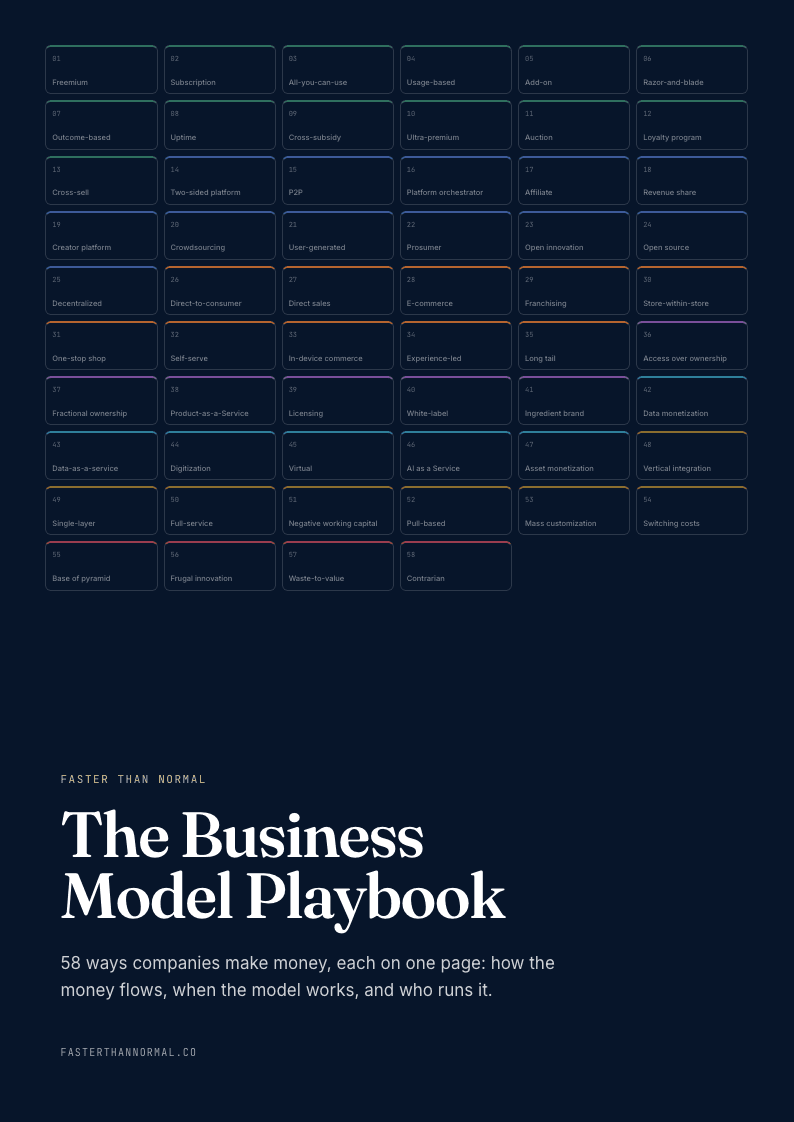
Free playbook
Get The Business Model Playbook
58 business models, one visual page each: how the money flows, the metrics that matter, and who runs it. Free when you join the Faster Than Normal email.
Free. No spam. Unsubscribe anytime.
Part IIIMaxims
-
Ignorance is a strategic asset — in the right conditions. The outsider sees waste that the expert has learned to accept. Enter industries where the bottleneck is production methodology, not customer intimacy, and your fresh perspective compounds.
-
Speed is an architecture, not an attitude. The biggest time savings come from redesigning the system — making parallel what was serial, prefabricating what was built in place — not from exhorting workers to move faster.
-
Every bottleneck is a potential business. When your supply chain fails you, build the missing link yourself. The best conglomerates are portfolios of solved constraints.
-
Sell the moral case first, justify with data second. Kaiser pitched escort carriers to the President after the admirals said no. He pitched national healthcare as a moral obligation after the AMA called it socialism. Emotion opens the door; evidence walks through it.
-
Your workers' health is your balance sheet. The fifty-cent-a-week health plan was not charity — it reduced absenteeism, cut turnover, and accelerated training. Every dollar spent on employee welfare is a dollar that doesn't leak out through workforce instability.
-
Government is a customer, not a charity. Kaiser used public capital to build private companies, but he delivered every contract ahead of schedule and repaid every loan. The distinction between subsidy and partnership lies in performance.
-
The things you build to solve emergencies often outlast the things you planned. Kaiser Permanente began as an improvised fix for a failing desert hospital. The geodesic dome was a marketing stunt. Recognize when a tactical solution has strategic legs.
-
An empire built on personality does not survive the personality. Kaiser's companies fragmented within a decade of his death because they depended on his relationships and force of will rather than transferable systems. Build institutions, not fiefdoms.
-
Name things so simply it feels almost lazy. Kaiser Aluminum, Kaiser Steel, Kaiser Cement. When you are entering new industries constantly, simplicity of nomenclature allows reputation to compound across domains.
-
The auto industry teaches humility. Kaiser's $52 million loss in seven years of car manufacturing is the clearest evidence that supply-side genius does not translate to demand-side markets. Know which kind of problem you are facing before applying your playbook.
In Their Own Words
Live daringly, boldly, fearlessly. Taste the relish to be found in competition — in having put forth the best within you.— How to Capture Life's Greatest Values in Reader's Digest, Vol. 56 (January 1950), p. 18
Problems are only opportunities in work clothes.
I make progress by having people around me who are smarter than I am and listening to them. And I assume that everyone is smarter about something than I am.
I'm a builder, and if you call yourself a builder, you ought to be able to build anything.— Henry J. Kaiser
Ironical as it must appear, the war has taught us to employ our vast resources and to multiply them a million-fold by power and the machine. If we rebuild a world of monopoly and special privilege, we will taste a defeat as bitter as a victory for the Axis powers.— Henry J. Kaiser, December 1943
On this one fact, there is unanimous agreement: every man in the American Forces has the right to come home not only to a job but to peace. Anything less would be a denial of the true American way of life.— Henry J. Kaiser, Herald Tribune Forum, October 17, 1944
You can't sit on the lid of progress. If you do, you will be blown to pieces.— Henry J. Kaiser
Why those dirty pups, they did it without me.— Henry J. Kaiser, on the Hawaiian geodesic dome his crew finished before he arrived
Further reading
- Freedom's Forge: How American Business Produced Victory in World War II by Arthur Herman
- Henry J. Kaiser: Builder in the Modern American West by Mark S. Foster


