
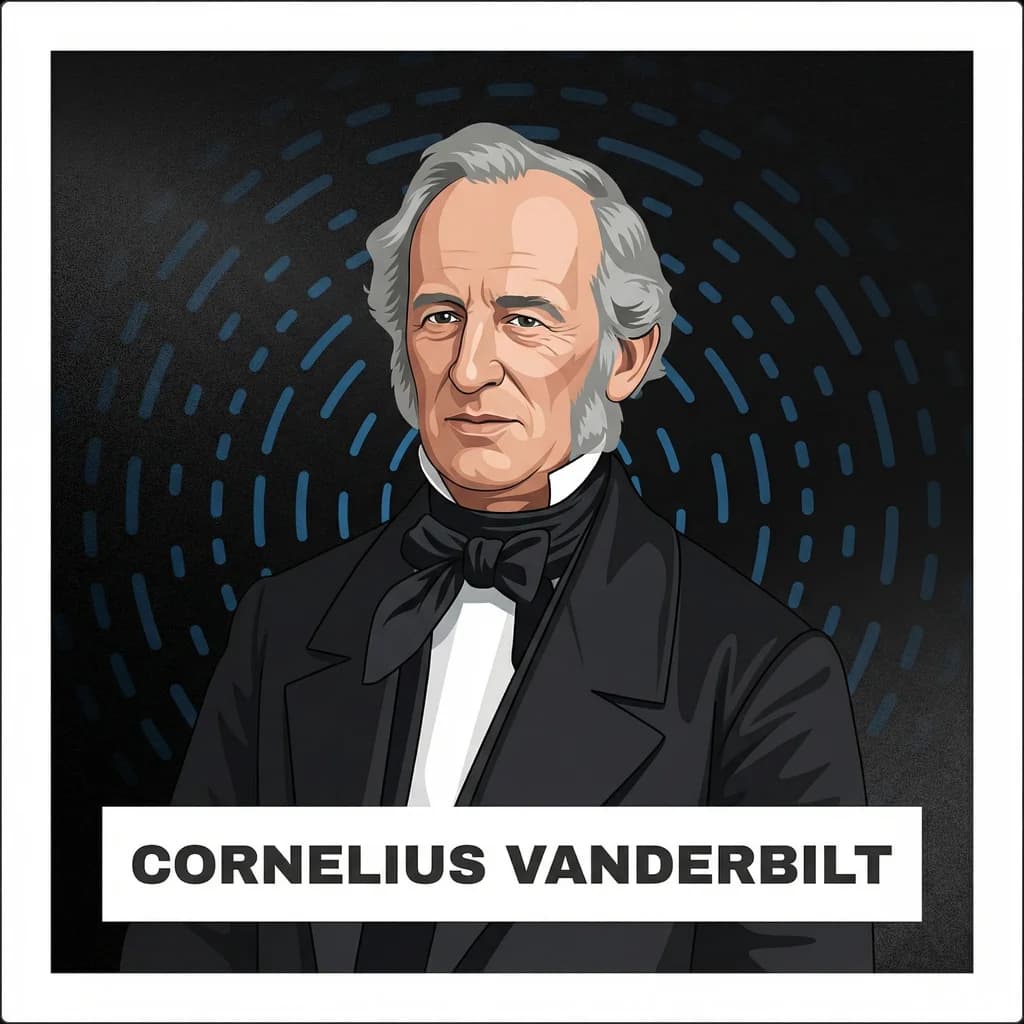

Part IThe Story
The Letter That Burned a Country
In the winter of 1853, two men who had been entrusted with the management of Cornelius Vanderbilt's Accessory Transit Company — the wildly profitable steamship line that carried gold-drunk prospectors from New York to San Francisco via a shortcut across Nicaragua — decided to steal it from him. Charles Morgan and Cornelius K. Garrison, men who owed their positions to Vanderbilt's own patronage, executed a stock manipulation scheme while the Commodore was on a grand tour of Europe aboard his personal steam yacht, the North Star, the largest private vessel in the world at that time. They diverted profits, watered shares, and effectively seized control of the company Vanderbilt had built from nothing but a map of Central America and the conviction that he could move people faster than anyone alive.
Vanderbilt was sixty years old. He had been working since the age of eleven. He had already amassed a fortune that made him one of the richest men in America. A reasonable person — a person governed by the normal calculus of risk and reward, fatigue and diminishing returns — might have sued, settled, retired to his brick townhouse on Washington Place, and counted his millions. Instead, Vanderbilt sat down and wrote a letter that has since become one of the most famous threats in American business history:
— Cornelius Vanderbilt, letter to Charles Morgan and Cornelius K. Garrison, 1853Gentlemen: You have undertaken to cheat me. I won't sue you, for the law is too slow. I will ruin you.
He meant it. Over the next several years, Vanderbilt launched a competing steamship line that undercut his former partners' fares so viciously that it bled their operation white. When that proved insufficient, he entangled himself in the geopolitics of Central America, financing a private military campaign to overthrow the American filibuster William Walker — who had seized the Nicaraguan government and revoked Vanderbilt's transit charter — ultimately helping to topple a sovereign nation's regime to reclaim a shipping route. The man who had started life ferrying vegetables across New York Harbor in a borrowed boat would, in his seventh decade, wage what amounted to a private foreign war.
This is the dissonance at the center of Cornelius Vanderbilt's life: the longest, most consequential, and most internally contradictory career in nineteenth-century American capitalism. He was born into a world that still remembered George Washington and died in a world that would soon know John D. Rockefeller. He started in a rural, agricultural, essentially colonial economy in which the word "businessman" did not yet exist, and he ended in a corporate industrial order that he had done as much as anyone to create. He was, depending on whom you asked and when you asked them, the champion of the common man or its most ruthless exploiter — a revolutionary who destroyed monopolies or a tyrant who built new ones — a patriot who donated his largest warship to the Union Navy or a profiteer who squeezed the government for every dollar the war would yield.
The paradox is not resolvable. It is the point.
By the Numbers
The Commodore's Empire
$100MEstimated fortune at death (1877), ~$2.5B in 2024 dollars
1 in 9Ratio of U.S. dollars Vanderbilt owned at peak wealth
$100Loan from his mother to buy his first boat at age 16
13Children with first wife Sophia Johnson
100+Steamships owned and operated at his maritime peak
$1M/yearRevenue from Nicaragua transit route in the 1850s (~$26M today)
83Age at death on January 4, 1877
The Harbor and the Hundred Dollars
The water came first. Before the steamships, before the railroads, before the mansions and the stock manipulations and the private wars, there was the harbor — the tidal flats between Staten Island and Manhattan, gray and brackish and thick with commerce, where a Dutch farmer's son learned that the fastest route between two points was also the most profitable one.
Cornelius Vanderbilt was born on May 27, 1794, on Staten Island, New York, the fourth of nine children in a family of Dutch ancestry so old it predated the Revolution. His father, also named Cornelius — the family recycled names with the same thrift it applied to everything else — was a farmer who supplemented his income by ferrying produce and merchandise across the harbor in a periauger, a flat-bottomed, two-masted sailing vessel suited to shallow water and heavy loads. The boy worked with his father from the time he could stand on a deck, and he attended school only briefly. Five years of formal education, total. He would later seem proud of the lack.
At sixteen, Vanderbilt borrowed $100 from his mother, Phebe Hand — a woman whose name suggests the Puritan severity of her convictions — and bought his own periauger. The terms of the loan were straightforward: repay in full by the end of the season. He repaid it within months. Then he bought another boat. Then another. By the time the War of 1812 broke out, the teenager had acquired a government contract to supply six New York forts, a feat of procurement and logistics that would have taxed men twice his age. The profits from this venture allowed him to build three sailing vessels, one of which was the largest schooner on the Hudson River.
It was the schooner that earned him the nickname. Commanding such a vessel — regal in scale if not in appointment — Vanderbilt was called "Commodore" by the men who worked the harbor. He encouraged the title. He wore naval attire, though he held no military rank. The honorific was pure theater, and Vanderbilt understood theater the way he understood tides: as a force you could harness if you respected its power.
What is remarkable about this period is not the accumulation of boats but the accumulation of knowledge. Vanderbilt was not merely ferrying cargo; he was studying the geometry of commerce — the relationship between speed, cost, route, and volume that would become the organizing principle of his entire career. He learned ship design by building ships. He learned customer behavior by watching who boarded and why. He learned, above all, that the man who controlled the route controlled the money, and the man who moved goods faster and cheaper than his competitors did not need to control anything else.
The Education of an Apprentice
In 1817, Vanderbilt did something that seemed, on its face, like a step backward. He sold his fleet of sailing vessels and went to work as a ferry captain for Thomas Gibbons, a wealthy businessman who operated a commercial steamboat service between New Jersey and New York. Vanderbilt was twenty-three years old and already successful. He was not, by temperament, a man who worked for other people. But Gibbons had something Vanderbilt needed: access to the new technology of steam.
Gibbons was a litigious Georgian planter — pugnacious, rich, and locked in a legal battle with the powerful Livingston-Fulton monopoly, which held an exclusive license from New York State to operate steamboats on the state's waterways. The case, Gibbons v. Ogden, would eventually reach the Supreme Court in 1824, where Chief Justice John Marshall ruled that the federal government's power to regulate interstate commerce superseded state-granted monopolies. It was one of the most consequential decisions in American legal history, and it opened the waterways to competition. Vanderbilt was not a lawyer, but he was the man piloting the boat that provoked the lawsuit.
For roughly a decade, Vanderbilt ran Gibbons's steamboat operation with a ferocity that alarmed competitors and delighted passengers. He cut fares. He improved schedules. He slept on the boats to save money and supervised every aspect of operations with the obsessive attention to detail that would characterize his entire life. His wife, Sophia Johnson — his first cousin, whom he had married in 1813 — ran a tavern at the New Jersey ferry landing that served as both a boarding house and a de facto customer service operation.
The apprenticeship under Gibbons gave Vanderbilt two things. First, an intimate understanding of steam technology — how it worked, what it cost, where it could go, and what it couldn't yet do. Second, an understanding that government-granted monopolies were not invincible. They could be broken. Vanderbilt had watched the Livingston-Fulton monopoly crumble under the weight of constitutional challenge and competitive pressure, and the lesson lodged in him like a bone splinter: monopolies existed to be destroyed, and the destroyer would be whoever offered a better service at a lower price.
By the late 1820s, Vanderbilt had learned enough. He went into business on his own.
The Geometry of Fare Wars
The pattern that emerged in the 1830s and 1840s would repeat, with variations, for the next four decades. Vanderbilt entered a market. He cut prices to levels his competitors considered suicidal. He ran better boats on tighter schedules. Passengers flooded to him. Competitors bled cash. Eventually, one of two things happened: either the competitors paid Vanderbilt to go away — offering him hefty sums not to compete, a form of tribute that he accepted with the unsentimental pragmatism of a man who understood that money was money — or they collapsed, and Vanderbilt absorbed their routes.
The fare wars were not merely tactical. They reflected a genuinely radical economic philosophy. The Livingston-Fulton monopoly and its successors believed in a fixed market — a natural number of passengers who would travel between two cities at a given price, and competition as a destructive force that robbed incumbents of their due. Vanderbilt believed the opposite. He believed in a growing market. He believed that more people wanted to travel between cities than currently did, and that they would travel by steamboat if rates were cheap enough. The repeated price reductions were a competitive weapon, yes, but they were also an expression of faith — faith that demand was elastic, that the economy was expanding, and that the man who unlocked latent demand would capture far more value than the man who milked existing demand at inflated prices.
This was, as T.J. Stiles notes in The First Tycoon, "a surprisingly new" notion. And it worked. Vanderbilt became a millionaire by age forty-five. He owned and operated more than one hundred steamships running between New York and Boston. He had more employees than any other business in the United States.
— Cornelius Vanderbilt, court testimony, 1869How do I make a profit? I make it by a saving of the expenditures. If I cannot use the capital of that road for pretty nigh $2,000,000 per year better than anyone that has ever been in it, then I do not want to be in the road.
The pattern illuminated something essential about Vanderbilt's mind. He did not think in terms of products or assets. He thought in terms of systems — the interlocking relationships between cost, speed, volume, and route that determined whether a transportation network created or destroyed value. His genius was not invention. He did not invent the steamship any more than he would later invent the railroad. His genius was optimization: the relentless, unglamorous, obsessive reduction of waste and the expansion of throughput. He could look at a route and see, with an almost physical immediacy, where the fat was — which vessels were overstaffed, which schedules were slack, which fares were too high for the market to bear.
And yet for all his wealth, the city's elite remained slow to accept him. In the 1840s, Vanderbilt built a large brick home for his family at 10 Washington Place, in what is now Greenwich Village. It was a respectable address, but respectability was not acceptance. New York's merchant aristocracy — the families who traced their lineage to colonial shipping fortunes and who considered commerce a birthright rather than a skill — regarded Vanderbilt as rough and uncultured. He swore like the sailor he effectively was. He had five years of schooling. He made no effort to soften himself for polite company.
The rejection stung, though Vanderbilt would never have admitted it. What he did instead was what he always did: he got richer.
The Nicaraguan Shortcut
The California Gold Rush of 1849 presented Vanderbilt with a problem that was, at bottom, a geometry problem. Tens of thousands of prospectors needed to get from the East Coast to San Francisco. There were three ways to do it: overland, which took months and killed a meaningful percentage of those who attempted it; by sea around Cape Horn at the southern tip of South America, which also took months; or across the Isthmus of Panama, where an established transit route — slow, expensive, controlled by competitors — moved passengers through jungle and across a narrow land bridge.
Vanderbilt looked at the map and saw a fourth option. Nicaragua, located north of Panama, offered a natural transit corridor: up the San Juan River from the Caribbean coast, across Lake Nicaragua, and then a short overland journey to the Pacific. The route was two days shorter than Panama and vastly cheaper to operate. Nobody had built the infrastructure to support it. Vanderbilt would.
He founded the Accessory Transit Company, built docks and a connecting road across Nicaragua, and established a steamship connection that became an instant commercial success, earning more than $1 million per year — roughly $26 million in today's money. The route was faster, cheaper, and more reliable than any alternative, and it demonstrated Vanderbilt's core competitive insight: the value of a transportation network is determined not by the elegance of its vessels but by the intelligence of its route.
It was this company that Morgan and Garrison stole from him while he sailed the Mediterranean on the North Star. And it was the recovery of this company — or rather, the annihilation of the men who stole it — that drew Vanderbilt into the strangest chapter of his career: a private war against William Walker.
Walker was one of the most improbable figures in American history — a five-foot-two, hundred-pound Tennessean with a medical degree, a law degree, and a messianic belief in Manifest Destiny. In 1855, Walker invaded Nicaragua with a force of fifty-eight mercenaries, seized the government, declared himself president, and reinstated slavery. Morgan and Garrison had allied with Walker, who revoked Vanderbilt's transit charter and handed the route to the two men who had already betrayed him.
Vanderbilt's response was characteristically disproportionate. He financed and helped organize a coalition of Central American armies — Costa Rica, Guatemala, Honduras, El Salvador — to overthrow Walker. He hired agents. He supplied weapons. He manipulated shipping routes to cut off Walker's supply lines. It was, in effect, a private foreign policy operation conducted by a sixty-year-old shipping magnate who had never held public office and who viewed the affair not as a geopolitical crisis but as a collections problem.
Walker was eventually captured and executed by firing squad in Honduras in 1860. Vanderbilt got his route back. The episode revealed something about his character that the fare wars had only hinted at: the asymmetry between the injury and the response, the absolute refusal to absorb a loss, the willingness to spend more punishing a transgression than the transgression itself had cost. As Edward Renehan writes in Commodore, if you crossed Vanderbilt, he would set out to conquer you no matter how long it took. Surrender would usually take the form of a deal. The exception was Walker, who was not a businessman, who could not be bought, and who ended up dead.
The Conversion at Seventy
In the early 1860s, Cornelius Vanderbilt was nearly seventy years old, worth roughly $11 million, and operating the largest private shipping fleet in the United States. He had spent his entire adult life on the water. He understood ships the way a surgeon understands anatomy — by feel, by instinct, by decades of cutting. And then, with the absolute certainty of a man who has never been wrong about a route, he turned away from the water and toward the rails.
The American Civil War was both catalyst and cover. Vanderbilt donated his largest and fastest steamship — named, with characteristic modesty, the Vanderbilt, built at a cost of roughly $1 million — to the Union Navy, which used it to chase down Confederate raiders. The gift was genuine patriotism and shrewd positioning in equal measure: it demonstrated loyalty to the Union cause while signaling to Washington that Vanderbilt was a man of national consequence, deserving of national-scale opportunities.
The real opportunity was the railroad. In 1850, the United States' economy had been roughly the size of Italy's. By 1890, it would be the largest in the world. What happened in between was the railroad. It linked east to west, interior to coast. It made possible economies of scale that the steamship, for all its speed, could never achieve on land. It stimulated steel and manufacturing and agriculture and finance. And Vanderbilt, who had spent five decades mastering the geometry of transportation on water, recognized that the same geometry — speed, cost, route, volume — applied with even greater force on iron rails.
He began buying railroad stocks. He acquired the New York and Harlem Railroad, then the Hudson River Railroad, then — in his most consequential move — the New York Central Railroad, which connected Albany to Buffalo and, through various subsidiary lines, extended to Chicago. He merged these properties into the New York Central and Hudson River Railroad, creating a unified transportation system that connected the nation's largest city to the industrial heartland.
The consolidation was brutal, contested, and occasionally illegal. Vanderbilt fought stock manipulation battles with Daniel Drew, Jay Gould, and Jim Fisk — men whose financial machinations made Vanderbilt look, by comparison, like a Quaker elder. The Erie War of 1868, in which Vanderbilt attempted to seize control of the Erie Railroad through a massive stock purchase while Drew, Gould, and Fisk frantically printed new shares and fled to New Jersey to escape arrest, was one of the great financial spectacles of the nineteenth century. Vanderbilt lost that particular battle — one of the few outright defeats of his career — but the loss barely dented his fortune and did nothing to slow his consolidation of the New York Central system.
What distinguished Vanderbilt from the speculators was that he actually ran the railroads. He was not a financial engineer leveraging paper assets. He was an operator. He rode his own trains. He inspected his own track. He imposed the same obsessive cost discipline on the railroads that he had imposed on his steamship lines: standardized equipment, stringent accounting, relentless reduction of waste. The result was a railroad system known for dependability, punctuality, and — by the standards of the era — affordability.
— Cornelius Vanderbilt, court testimony, 1869I never had any advantage of anybody in running steamships; but if I could not run a steamship alongside another man and do it as well as he for twenty percent less than it cost him, I would leave the ship.
The rhetoric of efficiency masked an extraordinary act of reinvention. Vanderbilt was seventy when he began his railroad career in earnest. Seventy. In an era when life expectancy hovered around forty, he was embarking on what would become the most profitable phase of a career that was already six decades old. The man who had mastered sail reinvented himself for steam, and the man who had mastered steam reinvented himself for rail — each time not as a dilettante sampling a new industry but as an operator who intended to dominate it utterly.
The Blockhead's Inheritance
The question of succession haunted Vanderbilt's final years with a particular cruelty. He had thirteen children with his first wife, Sophia Johnson, who died in 1868. A year after her death, Vanderbilt — now seventy-five and worth nearly $100 million — married Frank Armstrong Crawford, a woman from Alabama who was more than four decades his junior. The marriage was his second act of reinvention in that decade, and it introduced the figure who would ultimately determine the direction of both his fortune and his only significant philanthropic act.
His eldest son, William Henry Vanderbilt, had grown up under the Commodore's withering contempt. The father constantly berated and criticized the boy, calling him a "blockhead" and a "blatherskite" — two of the Commodore's favorite insults. William longed to prove himself but never dared stand up to the fearsome old man, cringing under his father's rudeness in a pattern that was both psychologically devastating and, as it turned out, strategically sound. The son who absorbed his father's abuse without rebellion was the son who learned his father's business without distortion.
William Henry Vanderbilt was not a blockhead. He was, in fact, a methodical, deeply competent manager who had been carefully trained — through his father's overseeing if not his kindness — starting as a clerk at a New York banking house at age nineteen, then ascending through the Staten Island Railway (president by 1862), the Hudson River Railway (vice president by 1865), and finally the New York Central and Hudson River Railroad (vice president by 1869, president by 1877). When the Commodore died on January 4, 1877, at the age of eighty-three, William inherited the bulk of the estate — nearly $100 million — and proceeded to nearly double it in less than nine years, dying in 1885 with a fortune of approximately $194 million. At the time of his death, William Henry Vanderbilt was the richest man in the world.
The inheritance was itself a statement of philosophy. Vanderbilt left the overwhelming majority of his fortune to a single son — not divided among his thirteen children, not distributed to charity, not scattered across trusts and foundations. One heir. One fortune. One railroad system. The Commodore believed in concentration the way he believed in speed: as a natural law that punished the diluted and rewarded the focused.
But the concentration could not hold. William's children divided the fortune. Their children divided it further. The Vanderbilts built the largest mansions Americans had ever seen — New York townhouses that spanned entire city blocks, Biltmore in North Carolina (a 250-room French Renaissance château that remains America's largest private residence), the Breakers in Newport, Rhode Island. They married European nobility, collected art, threw parties of such extravagance that a single dinner could cost more than the Commodore's mother had lent him to buy his first boat. By the 1973 reunion of Vanderbilt descendants — more than a hundred of them, gathered at Vanderbilt University in Nashville — there was not a single millionaire among them.
The dissipation of the Vanderbilt fortune is one of the great parables of American wealth, and it carries an irony the Commodore would have appreciated with grim satisfaction: the man who understood concentration better than anyone in his century produced heirs who understood dispersion better than anyone in theirs.
The Bishop and the Donation
Frank Armstrong Crawford, the Commodore's young second wife, had a cousin in Nashville: Bishop Holland McTyeire of the Southern Methodist Church. Vanderbilt — a man with five years of formal schooling, no philanthropic history to speak of, a vocabulary seasoned with profanity, and no prior connection to the American South — was introduced to the Bishop in early 1873. Within a few meetings, McTyeire had convinced the seventy-nine-year-old tycoon to donate $500,000 to establish a university "in or near" Nashville, Tennessee.
The conversion was as sudden and improbable as Vanderbilt's pivot to railroads. Here was a man who had spent his entire life accumulating wealth with the single-mindedness of a natural force, who had never shown the slightest interest in education (having abandoned his own at age eleven), who viewed charity with the suspicion of a man who believed that anyone worth helping could help himself — and he wrote a check for half a million dollars to build a school in a region he had never visited.
By October 1875, classes had begun at the new institution, now named Vanderbilt University. McTyeire, serving as president of the Board of Trust, had virtually single-handedly selected the campus site — sixty-six acres of farmland on Nashville's western border — overseen building construction and landscaping, and selected the faculty alongside Chancellor Landon Garland. The university organization called for five schools: theological, literary and scientific, medical, law, and "Normal" (teacher training). The first Academic class had 115 students.
The donation was the largest philanthropic act of Vanderbilt's life, and it remains the only significant charitable legacy attached to his name. That it was prompted not by a lifelong commitment to education but by the persuasive powers of his wife's cousin — a clergyman who understood, perhaps better than Vanderbilt's business rivals ever did, how to close a deal with the Commodore — says something about the man that his railroad conquests do not. He was susceptible to the right appeal at the right moment, provided the appeal came from someone whose motives he trusted and whose conviction he respected.
It is also worth noting that the gift was, in Vanderbilt's terms, modest. Half a million dollars represented roughly half a percent of his total fortune. He gave away less to found a university than he had spent building a single steamship.
The Radical Who Became the Establishment
The narrative arc of Cornelius Vanderbilt's life describes a paradox that would recur, with variations, in the careers of Rockefeller, Carnegie, Ford, and every subsequent American tycoon: the radical who, having destroyed the old order, becomes the new order, and the new order becomes as calcified and self-serving as the one it replaced.
In his early career, Vanderbilt was genuinely revolutionary. He broke monopolies. He lowered prices. He expanded access to transportation for ordinary Americans who had previously been priced out of travel. To Jacksonian Democrats who championed laissez-faire as an egalitarian creed, Vanderbilt epitomized the entrepreneur as champion of the people — the businessman as revolutionary. His infuriated opponents — the Livingston-Fulton heirs, the subsidized steamship operators, the patrician merchants who viewed commerce as a gentleman's preserve — denounced him as destructive, as the enemy of every American maritime enterprise, as a man who pursued competition for competition's sake. The New York Times condemned him. He did not care.
But by the time he controlled the New York Central Railroad, Vanderbilt was no longer the insurgent. He was the incumbent. He set rates. He determined routes. He decided which towns thrived and which withered. The man who had once attacked government-granted monopolies now sought — and received — government cooperation in building his railroad empire. The champion of competition became, in the eyes of his critics, the champion of consolidation. The word "robber baron," coined to describe the predatory railroad magnates of the Gilded Age, would attach itself to Vanderbilt's name as stubbornly as the honorific "Commodore."
The transition was not hypocrisy. It was the logic of his own system carried to its conclusion. If the most efficient operator should control the route, and if Vanderbilt was the most efficient operator, then Vanderbilt should control all the routes. The principle that had justified his attacks on the Livingston-Fulton monopoly now justified his own monopoly. The geometry hadn't changed. Only his position within it.
A Fortune in One of Nine Dollars
The scale of Vanderbilt's wealth resists comprehension. At the peak of his fortune, he owned the equivalent of one in every nine dollars in circulation in the United States. No American before him had accumulated anything comparable; no American since, measured as a proportion of national wealth, has matched it. When he died on January 4, 1877, his estate was valued at approximately $100 million — a figure that, adjusted for inflation, translates to roughly $2.5 billion in 2024 dollars, though even this understates the comparison, since the American economy was a fraction of its current size.
The fortune was built without inheritance, without formal education, without political office, without the benefit of limited liability or modern corporate law. It was built on boats. Boats and rails and the unshakable conviction that the man who moved things fastest and cheapest would inherit the earth — or at least the trade routes.
Vanderbilt's approach to wealth was paradoxical in a way that distinguished him from the philanthropic tycoons who followed. He did not believe in giving it away. He did not believe in spending it ostentatiously. (The mansions and the yachts came, but they were late and comparatively modest by the standards his grandchildren would set.) He believed in having it — in the weight of capital as a competitive weapon, as a barrier to entry, as proof of victory. Money was not an end. It was the score.
His will reflected this philosophy with stark clarity. The bulk of the fortune went to William Henry. Small bequests — insultingly small, by the standards of the estate — went to the other children. Several of them contested the will. The resulting litigation, played out in New York courts in 1877 and 1878, was a public spectacle of family bitterness that the Commodore, who had spent his life winning fights, was no longer alive to enjoy.
Conquest as Character
To understand Vanderbilt is to understand that competition was not, for him, a means to an end. It was the end. The fare wars, the stock battles, the Nicaraguan adventure — these were not strategies deployed in service of wealth accumulation. They were expressions of a temperament that found its deepest satisfaction in the act of conquest itself.
Consider the asymmetry. Vanderbilt did not merely want to win; he wanted his opponents to know they had lost. The letter to Morgan and Garrison — "I will ruin you" — was not a legal threat. It was a declaration of personal war. The financing of the campaign against William Walker was not a business decision in any rational sense; the cost of the intervention far exceeded the value of the transit route at that moment. It was revenge, dressed up as commerce.
This is what his contemporaries meant when they observed that Vanderbilt "temporarily subjugated the need for" making money "to achieve" winning. He was only interested in two things: making money and winning. And when the two came into conflict, winning came first.
The psychology is not complicated. It is the psychology of a boy who left school at eleven, who was dismissed by New York's elite as rough and uncultured, who watched the patrician merchants of Manhattan look down on him from their inherited perches and decided — not consciously, perhaps, but with the deep instinctive certainty that governed all his decisions — that the only acceptable response was to become so rich, so powerful, so completely dominant that the question of acceptance became irrelevant. You did not need to be accepted by the establishment if you were the establishment. And if the establishment refused to acknowledge the fact, you could simply buy it.
He never quite did. The social acceptance that eluded Vanderbilt in the 1840s eluded him, to some degree, for the rest of his life. It would be left to his grandchildren and great-grandchildren to storm the gates of Mrs. Astor's Four Hundred, to build the Metropolitan Opera when denied boxes at the Academy of Music, to marry their daughters to European dukes and counts. The Commodore had made the money. His descendants would spend it on the respectability he never achieved and, one suspects, never truly wanted.
January 4, 1877
He died on a Thursday. The New York Times published a lengthy obituary — the same New York Times that had once condemned him for pursuing competition for competition's sake. The city that had been slow to accept the rough Staten Island ferryman now acknowledged what the harbor had always known: that Cornelius Vanderbilt, for all his profanity and his five years of schooling and his bottomless appetite for victory, had done more to shape the physical infrastructure of the American economy than any other individual of his century.
His body was interred at the Moravian Cemetery on Staten Island, not far from the tidal flats where he had first borrowed a boat. The largest private fortune in American history passed to a single heir. The university he had founded with reluctant generosity continued to grow in Nashville. The railroads he had built continued to carry the commerce of a nation that was, in 1877, still becoming itself.
What remained — what outlasted the fortune and the mansions and the railroads and the university — was the method. The geometry. The conviction that in any system of exchange, the advantage belongs to the operator who moves goods faster, cheaper, and more reliably than anyone else, and who is willing to destroy anyone who stands in the way. It was not a philosophy suited to gentleness. It was a philosophy suited to a country that was building itself by force, and that needed men who understood force, and who could turn it into something that looked, from a sufficient distance, like progress.
The boats are gone now. The harbor is quieter. But the routes endure.
Part IIThe Playbook
Cornelius Vanderbilt's career spanned seven decades, two transportation revolutions, and the transformation of the United States from an agricultural backwater to the world's largest economy. The principles below are drawn from the specific decisions, tactics, and patterns that defined his approach — not as abstract business wisdom but as operational doctrine tested across sixty years of competition, consolidation, and occasionally outright warfare.
The principles
- 1.Apprentice before you build.
- 2.Compete on the route, not the vessel.
- 3.Price for the market that doesn't exist yet.
- 4.Make efficiency the moat.
- 5.Accept tribute when offered.
- 6.Make the punishment disproportionate to the crime.
- 7.Reinvent in your seventies.
- 8.Consolidate the system, not the asset.
- 9.Concentrate the inheritance.
- 10.Operate, don't speculate.
- 11.Use social exclusion as fuel.
- 12.Win first, profit second.
Principle 1
Apprentice before you build.
Vanderbilt sold his fleet and went to work as a ferry captain for Thomas Gibbons in 1817 — a move that, by every surface measure, was a demotion. He was already a successful entrepreneur. He chose to become an employee. The reason was simple: Gibbons operated steamboats, and Vanderbilt didn't yet understand steam. Rather than dabble in the new technology from a position of ignorance, he embedded himself in it for nearly a decade, learning operations from the inside while someone else bore the capital risk.
The apprenticeship gave him two things no amount of money could buy: operational mastery of steam technology and a front-row seat to the destruction of the Livingston-Fulton monopoly via Gibbons v. Ogden. When he finally launched his own steamship business in the late 1820s, he was not experimenting. He was executing.
Tactic: Before entering a new industry or technology, find a way to apprentice under someone who is already operating in it — even if it means a temporary step backward in status or compensation.
Principle 2
Compete on the route, not the vessel.
Vanderbilt's Nicaragua transit line was not successful because he built better ships than his competitors. It was successful because he found a better route — a natural corridor across Central America that cut two full days off the journey to San Francisco compared to the established Panama crossing. The insight was geographic, not technological.
Throughout his career, Vanderbilt demonstrated that the dominant competitive variable in transportation is not the quality of any individual asset but the intelligence of the network. The best boat on the wrong route loses to a mediocre boat on the right one. This principle drove his railroad consolidation strategy as well: he didn't merely buy railroads; he connected them into a unified system linking New York to Chicago, creating network effects that individual lines could never achieve.
Tactic: When entering a competitive market, focus on route and network architecture before investing in individual assets. The system-level advantage compounds; the asset-level advantage depreciates.
Principle 3
Price for the market that doesn't exist yet.
Vanderbilt's fare wars were not merely predatory pricing. They were based on a genuinely radical economic theory: that demand was elastic, that the market for travel was far larger than incumbents assumed, and that lower prices would create new customers rather than merely redistribute existing ones.
⚡
Two Models of Market Demand
Vanderbilt's philosophy vs. the incumbent orthodoxy
| Incumbent Assumption | Vanderbilt's Assumption |
|---|---|
| Fixed number of passengers at a given price | Latent demand unlocked by lower prices |
| Competition is destructive, robbing operators of their due | Competition is generative, expanding the total market |
| Maintain margins by defending price | Grow volume by cutting price |
| Protect the current business | Build the future business |
The Livingston-Fulton steamboat monopoly kept the same number of boats running at the same fares for years, and saw ridership steadily drop. Vanderbilt cut fares repeatedly and saw ridership explode. The lesson is not merely about pricing. It is about imagination — the willingness to believe that the market you can see is a fraction of the market that exists.
Tactic: When pricing a product or service, ask not "What will the existing market bear?" but "What price would create a market that doesn't yet exist?"
Principle 4
Make efficiency the moat.
Vanderbilt's competitive advantage was never proprietary technology, government contracts, or brand. It was cost structure. He could run a steamship alongside a competitor and do it for twenty percent less than it cost the other man — a margin that came from obsessive operational discipline: fewer crew, tighter schedules, less waste, better maintenance, personal supervision of every material detail.
This advantage was almost impossible to replicate because it was not a single innovation but a culture of continuous optimization embedded in the operator himself. Competitors could copy his routes and match his fares, but they could not copy the sixty years of accumulated operational instinct that allowed Vanderbilt to see waste the way a hawk sees movement.
Tactic: Build competitive advantage not on any single defensible asset but on a cost structure so relentlessly optimized that competitors cannot match your economics at your prices.
Principle 5
Accept tribute when offered.
One of Vanderbilt's least celebrated but most revealing tactics was his willingness to be paid not to compete. On multiple occasions, rivals offered him substantial sums to withdraw from a market rather than continue the fare war. Vanderbilt accepted these payments without hesitation or ego.
This was not capitulation. It was arbitrage. If a competitor was willing to pay Vanderbilt more to leave a market than he could earn by staying in it, the rational move was to take the money and redeploy the capital elsewhere. The unsentimental pragmatism of this approach — treating competition as a tool rather than an identity — gave Vanderbilt a flexibility that his ego-driven rivals lacked.
Tactic: Never confuse a competitive position with an identity. If an opponent is willing to pay you more to exit than you can earn by staying, take the money.
Principle 6
Make the punishment disproportionate to the crime.
The letter to Morgan and Garrison. The private war against William Walker. The stock battles with Drew, Gould, and Fisk. In each case, Vanderbilt's response to betrayal or competition was massively disproportionate to the initial offense. He spent more punishing transgressions than the transgressions had cost him.
This was not irrational. It was a reputation strategy. By establishing that the cost of crossing Cornelius Vanderbilt was catastrophic — that he would pursue you across oceans and decades, that no settlement was possible until you had submitted completely — he created a deterrent effect that reduced the frequency of future challenges. The investment in disproportionate retaliation was an investment in future peace.
Tactic: When establishing a reputation in a competitive arena, make the cost of challenging you visibly and memorably catastrophic — not to be cruel, but to ensure you are challenged less often.
Principle 7
Reinvent in your seventies.
Vanderbilt entered the railroad business at nearly seventy years of age. He had spent fifty years mastering water transportation. A lesser operator would have coasted on his maritime fortune. Instead, Vanderbilt recognized that the fundamental principles of his career — speed, cost, route, volume — applied with even greater force to railroads, and he reinvented himself as a railroad magnate with the same intensity he had brought to steamships in his twenties.
1810
Begins ferrying cargo on New York Harbor as a teenager.
1817
Sells fleet; apprentices under Thomas Gibbons in steamship operations.
1829
Launches own steamship business.
1851
Opens Nicaragua transit route during California Gold Rush.
1862
Begins acquiring railroad stocks; donates warship to Union Navy.
1867
Consolidates New York Central and Hudson River Railroad.
1873
Donates $500,000 to found Vanderbilt University.
1877
Dies at 83 with a fortune of ~$100 million.
The willingness to reinvent at an age when most people (even in our era, let alone the nineteenth century) have long since ossified is one of Vanderbilt's most distinctive traits. It suggests that his competitive advantage was not domain expertise but a transferable operating system — a way of analyzing transportation networks that worked regardless of whether the network ran on water or rail.
Tactic: Build skills that are transferable across domains rather than specific to a single technology or industry. The operator who can see the geometry of any system will outlast the specialist who masters only one.
Principle 8
Consolidate the system, not the asset.
Vanderbilt did not simply buy railroads. He bought connecting railroads — the Harlem, the Hudson River, the New York Central — and merged them into a unified system that created value no individual line could capture. The whole was worth more than the sum of its parts because it eliminated the friction of transfers, standardized equipment, and offered shippers a single point of contact for routes spanning hundreds of miles.
This was systems thinking before the term existed. Vanderbilt understood that a fragmented network of competing railroads, each optimized for its own short segment, produced a worse experience and a higher cost than a single integrated system optimized for the entire route. The consolidation was controversial — critics saw it as monopolistic — but it was also genuinely more efficient.
Tactic: When building or acquiring, optimize for system-level value creation rather than asset-level returns. The connecting link that makes three existing assets work together is often more valuable than any of them individually.
Principle 9
Concentrate the inheritance.
Vanderbilt's decision to leave the bulk of his $100 million fortune to a single heir — William Henry — rather than dividing it among his thirteen children was not cruelty (though several children experienced it as such). It was an application of the same principle that governed his business strategy: concentration of capital creates advantage; dispersion destroys it.
The subsequent history of the Vanderbilt fortune validated his instinct, if not his method. William Henry nearly doubled the fortune in nine years. His children divided it. Their children divided it further. Within three generations, the family that had owned one in nine American dollars had no millionaires among its descendants. The lesson is not that primogeniture is just — it is manifestly unjust — but that Vanderbilt correctly identified the mathematical reality: fortunes divided geometrically collapse geometrically.
Tactic: When transferring control of an asset — whether a company, a fortune, or a project — resist the democratic impulse to distribute evenly. Concentrate authority and resources where they will be most effectively deployed, even when it creates resentment.
Principle 10
Operate, don't speculate.
The Erie War of 1868 pitted Vanderbilt against Daniel Drew, Jay Gould, and Jim Fisk — three men who were, in modern terms, financial engineers rather than operators. They printed shares, manipulated stock prices, and fled to New Jersey to escape arrest. Vanderbilt lost the battle because his opponents were playing a different game: not operations but paper manipulation.
But Vanderbilt won the war. Drew died broke. Gould died relatively young and widely despised. Fisk was murdered by a romantic rival. Vanderbilt died the richest man in America. The distinction was that Vanderbilt's wealth was anchored in physical assets — ships, rails, routes — that generated cash flow regardless of what the stock market did. The speculators' wealth was anchored in positions that required constant manipulation to maintain.
Tactic: Build wealth on assets you operate and understand, not on positions that depend on market sentiment or financial engineering. Operational cash flow is the only durable form of wealth.
New York's merchant elite regarded Vanderbilt as rough, uncultured, and unworthy of social acceptance. They were right about the first two and spectacularly wrong about the third. Vanderbilt used their rejection not as a wound to be healed but as a furnace to be stoked. Every snub became a reason to get richer. Every closed door became a reason to buy the building.
The psychology is not admirable in any conventional moral sense. It is powered by resentment, by the furious need to prove wrong the people who dismissed you. But it is remarkably effective as a motivational structure, and Vanderbilt sustained it for six decades without burning out — a feat of emotional endurance that suggests the fuel source was inexhaustible.
Tactic: When excluded from an establishment, don't seek admission. Build something so large that the establishment becomes irrelevant — or must come to you.
Principle 12
Win first, profit second.
Vanderbilt was only interested in two things: making money and winning. And when the two came into conflict — when the cost of victory exceeded the financial return — he chose victory every time. The Nicaraguan campaign, the disproportionate retaliations, the willingness to sustain losses in fare wars that a rational actor would have abandoned — all reflected a hierarchy of values in which conquest took precedence over profit.
This is, paradoxically, one of the reasons he ended up so rich. Competitors who optimized for short-term profit were predictable: they would retreat when the economics turned negative. Vanderbilt, who optimized for dominance, was unpredictable: he might keep fighting long past the point of financial rationality, which made him terrifying to oppose and expensive to challenge. The reputation for irrationality was itself a rational asset.
Tactic: In competitive situations, signal (and deliver) a willingness to sustain losses that your opponents cannot match. The competitor who is willing to lose more in the short term often wins more in the long term — because fewer people are willing to compete with them.

Free playbook
Get The Business Model Playbook
58 business models, one visual page each: how the money flows, the metrics that matter, and who runs it. Free when you join the Faster Than Normal email.
Free. No spam. Unsubscribe anytime.
Part IIIMaxims
-
Speed is the ultimate subsidy. The fastest route wins regardless of who has the fanciest vessel. Vanderbilt's Nicaragua shortcut beat the established Panama route not because his ships were better but because his map was.
-
Monopolies are invitations. Every government-granted monopoly is a protected market waiting for someone aggressive enough to break it open. Vanderbilt built his career on the ruins of incumbents who believed their positions were permanent.
-
Demand is not fixed. The assumption that there is a "natural" number of customers at a given price is the most expensive mistake an operator can make. Lower the price. Watch who shows up.
-
Operational discipline is the least imitable advantage. Any competitor can copy your route. No competitor can copy your cost structure if that cost structure is the product of decades of obsessive attention to waste.
-
Apprentice under someone who has what you need. Selling his fleet to work as Gibbons's ferry captain was the shrewdest "demotion" in business history. Vanderbilt traded status for knowledge and came out richer.
-
Concentration beats distribution. Fortunes divided equally collapse exponentially. The same principle applies to companies, resources, and attention.
-
Reinvention is not optional. Vanderbilt mastered sail, then steam, then rail. The operator who cannot abandon the last technology for the next one will be abandoned by the market.
-
Revenge is a business strategy. Disproportionate retaliation is an investment in deterrence. The cost of one spectacular punishment is cheaper than the cost of a hundred small betrayals.
-
Never confuse acceptance with power. New York's elite refused to accept Vanderbilt for decades. He outlasted, outearned, and out-built every one of them. Respectability is what people pursue when they cannot acquire dominance.
-
The score is the fortune, not the spending. Vanderbilt's personal spending was modest relative to his wealth. The mansions, the yachts, the jeweled tiaras — those came from his grandchildren, who had inherited the money but not the instinct that produced it.
In Their Own Words
If I had learned education I would not have had time to learn anything else.
You have undertaken to cheat me. I won't sue you, for the law is too slow. I'll ruin you.
Never be a minion, always be an owner.
I don't care half so much about making money as I do about making my point, and coming out ahead.
Never tell anyone what you are going to do till you've done it.
What do I care about the law? Ain't I got the power..?
I am not afraid of my enemies, but by God, you must look out when you get among your friends.
There is no friendship in trade.
I have always served the public to the best of my ability. Why? Because, like every other man, it is to my interest to do so.
I have been insane on the subject of money-making all my life.
Money is power, and you ought to be careful with your money.
Work for your money, don't let your money work only for others.
If a fellow's got guts he can always win.
All you have to do is attend to your own business, then go ahead. I never tell what I'm going to do till I've done it.
I guess I've built a hundred steamships and steamboats… I never paid a dollar of insurance… Good vessels and good masters – that's the best kind of insurance.
You've got to make folks believe you'll always run. If they can depend on you, they'll deal with you.
Ain't got time to be sick.
Gentlemen: You have undertaken to cheat me. I will not sue you because the law takes too long. I will ruin you.— Letter to Charles Morgan and C. K. Garrison, 1877
Pay ready money for everything you buy, and never sell anything you don't own.
The law, as I view it, goes too slow for me when I have the remedy in my own hands.— Testimony to Thurlow Weed, 1867
I can't afford to be sick no longer.
Say nothing and jump quick.
He had spent most of his career as a radical force. From his beginnings as a teenage boatman before the War of 1812, he had led the rise of competition as a virtue in American culture. He had disrupted the remnants of the eighteenth-century patricians, shaken the conservative merchant elite, and destroyed monopolies at every step.— T.J. Stiles, The First Tycoon
The railroads are not run for the benefit of the 'dear public' — that cry is all nonsense — they are built by men who invest their money and expect to get a fair percentage on the same.— William Henry Vanderbilt, Chicago Daily News, October 9, 1882


