


Part IThe Story
The Photograph She Had Never Seen
Sometime in the spring of 2021, Carol Tomé's sister sent her a photo book. It contained a picture Tomé had never encountered — four generations of women in a single frame: her great-grandmother, her grandmother, her mother, and Carol herself as an infant, held aloft in her grandmother's arms. The great-grandmother had traveled west in a wagon train and homesteaded in Wyoming. The grandmother's husband died the day Carol's mother was born; she walked to work in high heels every day of her adult life, never owned a car, never owned a home. The mother was a homemaker for twenty-seven years, until divorce sent her into the world of finance for the first time — without ever having held a checkbook. When she died, she left a multi-million-dollar estate.
And now her daughter was running UPS.
"I just busted out crying," Tomé told an interviewer, "because holy crap. Sometimes we think we haven't come very far and yet we've come so far."
The photograph arrived roughly a year into Tomé's tenure as chief executive of United Parcel Service, an institution founded in 1907 by a nineteen-year-old named James E. Casey out of a cellar beneath his partner's uncle's tavern in Seattle — a company that, by 2020, employed more than half a million people, delivered some twenty-five million packages daily across 220 countries and territories, and had never, in its 113-year existence, been led by a woman or by an outsider. Tomé was both. She had been, when the call came, fully retired on a 550-acre farm in Chickamauga, Georgia, raising cattle, tending gardens, and — by her own frank admission — going out of her mind with boredom. She was sixty-three years old. UPS's stock price had been flat for six years. Returns on its $24 billion in deployed capital had been declining for almost as long. The board needed someone who understood retail customers and e-commerce logistics and, above all, how to make money — because UPS, for all its operational virtuosity, had been struggling to convert volume into value. They drew up a leadership profile. It matched one person. The person was already in the room.
That convergence — the retiring executive who couldn't stay retired, the institution that prized insularity forced to look outward, the CFO's eye applied to the CEO's chair during the most disruptive logistics environment in a century — would produce one of the more consequential corporate transformations of the early 2020s. It is a story about the tension between growth and discipline, between bigness and betterness, between loyalty to the past and the imperative to survive it.
By the Numbers
UPS Under Carol Tomé
$91.1BUPS revenue in 2024
500,000+Employees worldwide
25.2MAverage packages delivered per day
220+Countries and territories served
$5.9BReturned to shareowners in 2024 (dividends + buybacks)
~34,000Operational roles reduced since January 2025
$20BHealthcare logistics revenue target
The Banker's Daughter from Jackson Hole
Jackson, Wyoming, in the 1960s and 1970s, was not the billionaire playground it would become. It was a small mountain town where the Teton Range imposed itself on every sightline and where self-reliance was less philosophy than meteorological necessity. Carol B. Tomé — born January 8, 1957 — grew up there as the daughter of a community banker, a man whose institution was the kind of place where you knew every depositor's first name and every borrower's capacity to repay. She learned to hunt. She learned to sew. She lived, as she later described it, off the land. Her passion for finance, improbably, started during college summers spent working at her father's bank, where the rhythms of lending and deposit-taking seeped into her like groundwater.
She earned a bachelor's degree in communication — not finance, not economics — from the University of Wyoming, a choice that would later prove unexpectedly useful for a woman who would spend decades translating numbers into narratives for boards and investors and the general public. Her plan, upon graduation, was simple: return to Jackson, work in her father's bank, live the life she had always known. Then her father called. He was divorcing her mother after twenty-seven years of marriage. He was selling the bank.
It was, Tomé would later say, one of the best things that could have happened to her. The destruction of the plan created the career.
She went to the University of Denver — drawn there, she has said, by the memory of a commencement speaker at her high school graduation, Maurice Mitchell, DU's thirteenth chancellor, a man "like a father figure but very statesmanlike and very impressive" — and earned an MBA with a concentration in finance. In 1981, she became a commercial lender at United Bank of Denver, the institution that would eventually be absorbed by Wells Fargo. Eleven years in banking. Then Johns-Manville Corporation, where she served as director of banking, overseeing acquisitions globally. Then Riverwood International Corporation, as vice president and treasurer, which brought her to Atlanta — the city that would claim the rest of her professional life.
In 1995, she walked into a Home Depot store on a whim. She invested her money. A few years later, given a job opportunity, she invested her time.
The Orange Apron Years
The Home Depot that Carol Tomé joined in 1995 as vice president and treasurer was still recognizably the creation of its legendary co-founders, Bernie Marcus and Arthur Blank — two men who had been fired from Handy Dan Home Improvement Centers in 1978 and, with the rage of the unjustly dismissed, built a retail empire that would transform American homeownership. Marcus, a pharmacist's son from Newark, New Jersey, had the salesman's gift for spectacle; Blank, a Babson College accounting graduate from Queens, had the operator's instinct for systems. Together they created a culture of entrepreneurial intensity and customer obsession that, by the time Tomé arrived, had powered the company from a handful of Atlanta-area stores to a national juggernaut.
Tomé worked under every CEO in Home Depot's history. She donned the orange apron at nights and on weekends, working alongside store associates, learning the business from the concrete floor up. In May 2001, she was named chief financial officer. She would hold the title for eighteen years.
The numbers from that tenure are staggering in their simplicity: under Tomé's financial stewardship, Home Depot expanded from roughly 400 stores to over 2,200. Revenue approached $100 billion. Shareholder value increased by approximately 450 percent. But the most telling episode may have been the one that didn't show up on a balance sheet. In 2014, when the CEO succession process elevated Craig Menear rather than Tomé, she stayed. She supported Menear. She kept building.
"It was such the right time for me to leave Home Depot," she said of her eventual retirement in 2019. "I was at peace."
The peace lasted approximately six months.
— Carol ToméI really do like to make money and I like to generate value. At Home Depot they had a 450% increase in shareholder value during my tenure. Wouldn't it be fun to do something like that at UPS?
The Outsider-Insider
The mechanism by which Carol Tomé became CEO of UPS is itself a study in institutional ambivalence. UPS had never hired its chief executive from outside the company. Not once. The eleven CEOs who preceded Tomé — stretching back to Jim Casey himself — had all risen through the brown-uniformed ranks, steeped in a culture so distinctive and insular that the company's internal argot constituted practically a dialect. The package car. The Diad. The 340 methods. Every UPS driver was taught to hold car keys on a ring finger, to walk at a brisk pace, to carry packages under the left arm. The company didn't just deliver parcels; it had, over more than a century, developed a quasi-monastic commitment to operational consistency that bordered on the liturgical.
And yet, by 2019, that very consistency had become a trap. UPS had deployed some $24 billion in capital, but returns on that capital had been declining for nearly six straight years. The stock was flat. The competitive landscape was mutating — Amazon was building its own delivery network with frightening speed, FedEx was recalibrating, and the explosion of e-commerce was generating enormous volume but at declining margins. UPS was getting bigger without getting better.
The board, chaired by the departing CEO David Abney — a man who had spent forty-six years inside the company — initiated a formal search. They developed, as Tomé described it, a detailed persona: they needed someone who understood the changing competitive customer environment, who grasped the end-to-end retail experience, who had e-commerce knowledge, and who could, above all, "drive higher returns on capital." The search firm found no one who fit the profile.
Then someone on the board looked across the table. Tomé had been a UPS director since 2003 — seventeen years of board meetings, audit committee oversight (she chaired it), deep familiarity with the company's financials, its people, its problems. She was, in the most literal sense, an outsider-insider: not a UPS lifer, but neither a stranger.
"Me?" she asked. "Am I not too old?"
"You're not too old," they told her.
She went home and consulted her husband, Ramon. His response: "Would you please go back to work?"
On March 11, 2020, UPS filed a Form 8-K with the Securities and Exchange Commission. Attached was an offer letter, addressed to Carol Tomé at 100 Galleria Parkway, Suite 1440, Atlanta, Georgia. Initial base salary: $104,167 per month — $1,250,000 annually. Management Incentive Program target: 165 percent of base. Start date: June 1, 2020. Reporting structure: directly to the Board of Directors.
Three days after that SEC filing, the World Health Organization declared COVID-19 a global pandemic.
Into the Fire
When Carol Tomé tells the story of her first months at UPS, she structures it as a paradox: the worst possible timing was, in certain respects, the best possible education.
"I thought I'd be travelling the world meeting people, visiting our facilities, shaking hands and meeting customers," she recalled. Instead, she was scrambling. UPS's half-million employees were essential workers — the people who kept commerce moving while the rest of the world sheltered in place. But the company wasn't ready. There weren't enough masks, enough hand sanitizer, enough gloves, enough operating procedures to keep drivers and package handlers safe while simultaneously absorbing the tsunami of e-commerce volume that the pandemic unleashed.
The second quarter of 2020 required UPS to hire 45,000 additional workers just to keep operations running. Delivery volume surged as Americans, locked in their homes, ordered everything from groceries to furniture to home gym equipment online. The brown trucks became, for millions of people, the most reliable connection to the outside world.
Tomé's response was, characteristically, both human and analytical. "Job number one," she said, was taking care of UPS's people. She tracked a metric called "likelihood to recommend" — the percentage of employees who would recommend UPS as a place to work. When she arrived, it sat at 51 percent. "That meant 49% wouldn't recommend us as a place to work," she said. "My hair was on fire."
But she also used the enforced stillness of the pandemic — no travel, no road shows, no glad-handing — to do something a globe-trotting CEO never would have had time to do: she studied the company from the inside. One-on-one conversations. Deep dives into the business model. Levers and margins and customer segmentation, examined with the obsessive granularity of a CFO who had spent two decades reading financial statements the way a surgeon reads MRIs. What she found confirmed her initial intuition: UPS was chasing volume at the expense of value. It was getting bigger. It was not getting better.
— Carol Tomé, Harvard Business Review, September 2021When I decided to accept the role of chief executive officer of UPS, in the late winter of 2019, it seemed like a straightforward choice. Having recently retired from Home Depot after 24 years of service, nearly two decades of them as CFO, I wasn't necessarily looking for a new job.
Better, Not Bigger
Three words became Carol Tomé's strategic thesis, her internal rallying cry, and — depending on whom you asked — either her most clarifying contribution or the most controversial managerial decision in UPS's modern history.
Better, not bigger.
The logic was brutal in its simplicity. UPS had been treating all volume as good volume. A package from Amazon, shipped at razor-thin margins under aggressive contract terms, occupied the same truck, the same sorting facility, the same driver's time as a package from a small business paying full price for the reliability and the network. One generated pennies of profit. The other generated dollars. To a CFO's eye — and Tomé's eye was permanently, constitutively a CFO's eye — this was an obvious misallocation of assets.
She segmented UPS's customers with surgical precision. Small and medium-sized businesses (SMBs) became the priority: they valued the end-to-end network, they were willing to pay for it, and they generated meaningfully higher margins than enterprise shippers who used their scale to extract discounts. Healthcare logistics became a strategic initiative — nearly 50 percent of future pharmaceutical sales, Tomé observed, would be biologics requiring temperature-controlled handling, and UPS had invested heavily in cold-chain infrastructure, even manufacturing its own dry ice at a rate of 1,200 pounds per hour.
The corollary of prioritizing high-value customers was, necessarily, deprioritizing low-value ones. And the single largest low-value customer, by a wide margin, was Amazon.
By early 2025, Tomé had announced that UPS would cut its Amazon volumes by more than 50 percent by June 2026. Amazon, which generated roughly 12 percent of UPS's revenue, was being deliberately shed — a decision that, in the short term, would mean 20,000 fewer jobs and a leaner network but, in Tomé's calculus, would produce a more profitable and strategically coherent company. "We are executing the most significant strategic change in direction in UPS's history," she said in the fall of 2025.
The market's response was ambivalent. The Teamsters' response was hostile. The strategic logic was unimpeachable. Whether it would work — whether a logistics company could voluntarily shrink its way to greater value — remained, as of this writing, an open question.
The Teamsters and the Phone Call from Pelosi
UPS employs more Teamsters than any company on earth. This is not a metaphor; it is a labor-relations fact that shapes nearly every operational and financial decision the company makes. The International Brotherhood of Teamsters represents roughly 340,000 UPS workers — drivers, package handlers, loaders, unloaders — whose compensation, working conditions, and retirement benefits are negotiated through a master contract that, when it expires, creates a kind of gravitational event in the American economy. The last time UPS's Teamsters went on strike, in August 1997, 185,000 workers walked off the job for fifteen days, paralyzing the nation's package delivery infrastructure and forcing the company to grant substantial raises and abandon plans for an independent pension plan.
In 2023, the contract was up for renewal again, and Tomé found herself navigating one of the highest-stakes labor negotiations in recent corporate history.
The opening weeks went well enough. "Our objectives were not that far apart," Tomé recalled. They were making progress. Then, one weekend, the Teamsters stopped returning calls. They stopped returning texts. Instead, Teamster leadership — led by General President Sean O'Brien, a combative Bostonian who had campaigned on a promise to take a harder line with UPS than his predecessor — went on the media circuit. They wanted to negotiate the contract in the airwaves.
Then Carol Tomé received a phone call from Nancy Pelosi.
"I'm calling to see if I can help," Pelosi said.
"Well, you could call them," Tomé replied, "ask them to come back to the table, because if they come back to the table, I am convinced we can get a deal."
Pelosi called. The Teamsters returned. They got a deal. A strike was averted.
The 2023 contract was, by any measure, generous to workers — significant wage increases for both full- and part-time employees, with particular attention to part-timers, who constitute nearly half the UPS workforce and whose low pay had contributed to chronic turnover. The New York City Comptroller, custodian of city retirement funds holding $191 million in UPS shares, had written to Tomé urging her to bridge the gap, arguing that the cost of a strike — in lost revenue, lost market share, and long-term customer defection — far exceeded the cost of a deal.
Tomé agreed. But the deal's economics would ripple through UPS's financials for years, accelerating the very restructuring that "better, not bigger" demanded. Labor costs went up. The imperative to automate, to consolidate, to shed low-margin volume intensified.
Cutting the Network, Building the Future
The scale of the restructuring Tomé initiated is difficult to overstate. Since January 2025, UPS has eliminated approximately 34,000 operational roles and ceased daily operations at 93 sites. The company warned of potential closure of up to 10 percent of its buildings, reductions in vehicle and aircraft fleets, and a smaller overall workforce. These changes fell under an interlocking set of internal programs — Network of the Future, which consolidates sorting operations and expands automation; Network Reconfiguration, a 2025–2027 initiative to redesign the physical network end to end; and Efficiency Reimagined, which aligns organizational processes to the new model.
The cost savings were substantial: approximately $2.2 billion already realized by the third quarter of 2025, with year-on-year savings projected at $3.5 billion for the full year. Transformation costs — consulting fees, employee separation benefits, program expenses — totaled $422 million through September 30, 2025, with full-year adjusted exclusions projected between $400 million and $650 million.
At the same time, Tomé was building. In September 2024, UPS acquired two cold-chain logistics companies in quick succession, bolstering its healthcare division for temperature-sensitive shipments. The company purchased MNX Global Logistics in 2023, specializing in critical healthcare product delivery. Happy Returns, a sales returns technology provider, was acquired to serve the growing reverse-logistics needs of e-commerce. In 2024, UPS agreed to buy Estafeta, a Mexican express delivery company, expanding its Latin American footprint. And under Tomé, UPS landed a major contract with the U.S. Postal Service, now handling most of its air cargo — a deal that leveraged UPS Airlines' massive Louisville hub, known as Worldport, the fifth busiest cargo airport on earth.
The healthcare bet is the signature wager of Tomé's tenure. She has publicly stated her expectation that UPS's healthcare logistics business will double to $20 billion in revenue within two years. If it works, it will fundamentally alter UPS's revenue composition, shifting the company from a package carrier that happens to handle some medical shipments to a healthcare logistics platform that also delivers packages.
📦
The 'Better, Not Bigger' Portfolio Shift
Key strategic moves under Carol Tomé, 2020–2025
| Move | Year | Strategic Rationale |
|---|---|---|
| Amazon volume cut by 50%+ | 2025–2026 | Shed low-margin enterprise volume |
| Healthcare acquisitions (Bomi Group, MNX Global) | 2022–2023 | Build cold-chain and critical delivery capability |
| Happy Returns acquisition | 2023 | Reverse logistics for e-commerce |
| Estafeta acquisition (Mexico) | 2024 | Latin American express delivery expansion |
| USPS air cargo contract | 2020s | Leverage Worldport capacity |
| Network Reconfiguration (93 sites closed) | 2025 | Consolidate and automate |
| Coyote Logistics sold to RXO | 2024 | Divest non-core truckload brokerage (~$1B) |
The Culture Question
One of the quieter, more revealing elements of Tomé's UPS tenure has been her insistence — unusual for a CEO with a CFO's pedigree — that culture precedes strategy. Peter Drucker's famous dictum that "culture eats strategy for breakfast" is the kind of thing that executives quote at conferences and then proceed to ignore when the spreadsheets arrive. Tomé appears to have taken it literally.
In the middle of the pandemic's chaos, when every part of the business was disrupted, she convened her leadership team to define a corporate purpose. The statement they produced — Moving our world forward by delivering what matters — sounds, on first reading, like the kind of anodyne slogan that consultants generate by the yard. But Tomé invested it with a specificity that gave it actual organizational force. "I love this because you can unpack it in so many different ways," she said. "It's not just about moving goods; it's about doing good too."
She paired the purpose statement with a set of behaviors and values that she insisted the leadership team model publicly — including vulnerability, which, in a 113-year-old institution with a military-inflected operational culture, was close to heretical. She asked every employee she met a simple question: What's your why? The question was simultaneously corny and devastating. People answered.
The "likelihood to recommend" metric — her chosen proxy for cultural health — moved from 51 percent to 61 percent under her watch, with a stated goal of 80 percent. The Teamsters, whom many CEOs would have regarded as an adversary, she publicly described as a competitive advantage. "I love them because they are part of our brand," she told Fortune. "The stories you hear about our UPS drivers, doing good in the communities. You don't hear that a lot about the other players."
This was either genuine conviction or masterful labor-relations positioning. It was probably both.
The Paradox of the CFO as CEO
There is a particular kind of executive who rises through the finance function — through Treasury, through financial planning and analysis, through the audit committee and the investor relations road show — and who, upon reaching the chief executive's chair, cannot quite shed the reflex to see every decision as a capital allocation problem. This is, in certain circumstances, exactly what a company needs. It can also be, in others, a form of organizational myopia.
Tomé's career is the most compelling argument for the CFO-to-CEO pathway in recent corporate history. At Home Depot, she delivered a 450 percent increase in shareholder value over nearly two decades. At UPS, she took a company that had been growing its way into declining returns and imposed the discipline of a financial mind that instinctively asked not "How much can we grow?" but "How profitably can we grow?" She segmented customers by margin contribution, shed low-value volume, invested in high-value capabilities, and cut costs with the kind of specificity — $3.5 billion in projected savings, 34,000 roles, 93 sites — that only someone who had spent a lifetime reading P&L statements could execute with conviction.
The risk, of course, is that the discipline becomes its own end. The Teamsters have accused UPS of using buyouts to erode the workforce in violation of the 2023 contract, which required the creation of at least 22,500 new positions. General President O'Brien's union has urged a judge to block UPS's $150,000 buyout offers to drivers. The tension between financial optimization and labor obligations is not academic; it is, for 340,000 Teamster members and their families, existential.
Tomé's total compensation in 2024 was $24,063,977 — base salary of $1,509,713, stock awards of $18,283,138, option awards of $1,358,768, and a management incentive payout of $2,747,677 (91 percent of target). These numbers are not unusual for a Fortune 50 CEO, but they land differently when juxtaposed with 20,000 job cuts and the closure of nearly a hundred facilities. Whether the juxtaposition is fair — whether the cuts are the necessary surgery that preserves the remaining 480,000 jobs — is a question that will be answered by time, not by commentary.
The Wagon Train and the Drone
UPS made history in 2019 when its UPS Flight Forward subsidiary became the first company to receive Federal Aviation Administration approval to operate a drone airline — unlimited drones, unlimited remote operators, permission to fly at night, no weight restrictions. In 2023, the FAA granted UPS beyond-visual-line-of-sight approval, eliminating the requirement for ground-based visual observers. The company's initial focus was healthcare delivery — vaccines, critical biologics, lab specimens — but the certification places no limits on scope.
This is, in a certain light, the purest expression of the continuity that connects Jim Casey's bicycle messengers in 1907 to Carol Tomé's autonomous aircraft in 2025. The business has always been about getting something from one place to another, faster and more reliably than anyone else. The vehicles change. The network logic doesn't.
But the photograph that Carol Tomé's sister sent her — the one with four generations, the wagon train and the high heels and the checkbook and the corner office — suggests a different kind of continuity, one that has less to do with logistics than with a particular strain of American ambition, the kind that moves west and doesn't stop. Her great-grandmother homesteaded. Her grandmother walked to work until she died. Her mother turned divorce proceeds into a multi-million-dollar estate without ever having balanced a ledger. And Carol Tomé took a company that had spent 113 years refusing to hire an outsider and, within five years, executed what she called "the most significant strategic change in direction in UPS's history."
On May 3, 2025, she delivered the commencement address at Oglethorpe University in Atlanta. The university's Board of Trustees had voted to bestow upon her an honorary doctor of letters degree — placing her in a tradition that included President Franklin Delano Roosevelt, Amelia Earhart, and Ambassador Andrew Young.
On April 27, 2024, in Savannah, Governor Brian Kemp and the Georgia Historical Society had inducted her as a Georgia Trustee — the highest honor the state can confer — under the motto of the colony's original eighteenth-century charter: Non Sibi, Sed Aliis. Not for self, but for others.
Whether the motto describes her tenure at UPS or merely decorates it is something that will depend on which side of the package car you're standing on — whether you are a shareholder watching margins improve, or a driver watching colleagues take buyouts, or a small business owner whose packages now arrive faster, or a Teamster general president preparing for the next negotiation. The story isn't over. It may, in fact, be entering its most consequential chapter.
What is settled is the image: a baby held aloft by three generations of women who built from nothing, each one further from the wagon train and closer to something none of them could have named. The great-grandmother crossed a continent. The granddaughter crossed an industry. The distance between the two is measured in neither miles nor years but in a kind of compounding audacity — the interest on inherited grit, reinvested.
Part IIThe Playbook
Carol Tomé's career — from commercial lender to Home Depot CFO to the first outside CEO in UPS's 113-year history — offers a concentrated study in how financial discipline, cultural intuition, and strategic clarity can be applied to transform institutions from within. The following principles are drawn from her decisions, her public statements, and the observable outcomes of her leadership.
The principles
- 1.Apply the CFO's lens to the CEO's job.
- 2.Segment ruthlessly — not all revenue is created equal.
- 3.Choose better over bigger.
- 4.Use the board seat as a graduate education.
- 5.Let crisis compress your learning curve.
- 6.Define purpose in the middle of chaos, not after it.
- 7.Treat your workforce as brand, not cost.
- 8.Be willing to shed your largest customer.
- 9.Pair contraction with construction.
- 10.Ask the uncomfortable question first.
- 11.Let the destroyed plan become the career.
- 12.Measure culture with the same rigor you measure capital.
Principle 1
Apply the CFO's lens to the CEO's job.
Most CEOs are promoted from operations, sales, or general management — functions that reward growth, market share, and customer acquisition. Tomé came from finance, where the cardinal virtue is not revenue but return on capital. This distinction shaped every major decision of her UPS tenure. Where her predecessors had pursued volume — more packages, more routes, more trucks — Tomé asked a different question: At what margin?
Her first instinct upon studying UPS's business model was not to identify growth opportunities but to identify value leakage. She found it in the gap between the capital deployed ($24 billion) and the declining returns that capital generated. The diagnosis was classic CFO: the company was over-investing in low-return activities while under-monetizing its high-value capabilities.
The CEO who comes from finance brings a particular superpower — the ability to see through the vanity of top-line growth to the reality of bottom-line value creation. The risk is an over-correction toward austerity. The art is in knowing when to cut and when to build.
Tactic: Before pursuing growth, audit your existing business for return on capital by customer segment — then reallocate resources from low-return segments to high-return ones, even if it means shrinking the top line.
Principle 2
Segment ruthlessly — not all revenue is created equal.
Tomé's customer segmentation at UPS was not a general strategic framework; it was a specific, data-driven exercise in identifying which customers generated profit and which merely generated activity. She discovered that small and medium-sized businesses — companies that valued UPS's integrated network and were willing to pay for reliability — produced meaningfully higher margins than enterprise shippers like Amazon, which used scale to negotiate discounts that compressed margins to near zero.
This insight seems obvious in retrospect. But for a company that had spent decades optimizing for total volume, it required a fundamental reorientation. Tomé didn't just identify the segments; she built the commercial strategy, the pricing architecture, and the resource allocation around them. The "Fastest Ground Ever" initiative, which accelerated ground delivery speeds, was specifically designed to win SMB business — because speed, not price, was the competitive dimension that mattered to those customers.
Tactic: Map your customer base on a two-axis grid — willingness to pay on one axis, margin contribution on the other — and design your strategy for the customers in the upper-right quadrant, not the ones generating the most revenue.
Principle 3
Choose better over bigger.
"Better, not bigger" is the organizing metaphor of Tomé's UPS tenure, and it represents something more radical than it sounds. In logistics, scale is the default strategic imperative — more packages create more route density, which lowers per-unit cost, which enables lower prices, which attracts more packages. This flywheel logic has dominated the industry for decades.
Tomé's insight was that the flywheel had begun spinning in the wrong direction. Volume growth was outstripping margin growth. More packages meant more labor, more capital expenditure, more complexity — but not proportionally more profit. By deliberately constraining volume (the Amazon reduction), investing in automation (Network of the Future), and consolidating infrastructure (93 site closures), she was betting that a smaller, more efficient UPS would generate more value than the sprawling one she inherited.
Tactic: When your business is growing but your returns are declining, your strategy has a volume addiction — formulate a specific "better" metric (return on capital, margin per unit, revenue per employee) and subordinate all growth decisions to it.
Principle 4
Use the board seat as a graduate education.
Tomé served on UPS's board of directors for seventeen years before becoming CEO. During that time, she chaired the audit committee, reviewed the company's financials with the depth and regularity that the role demanded, and developed intimate knowledge of UPS's operations, culture, strengths, and vulnerabilities — all without being responsible for day-to-day management.
This "outsider-insider" position gave her a rare advantage: she understood the institution well enough to lead it, but wasn't acculturated enough to accept its limitations as immutable. She knew where the bodies were buried without having buried them herself. When the board developed the leadership persona for the next CEO, the profile matched her not by coincidence but by convergence — the accumulation of seventeen years of fiduciary observation had made her, in effect, the most informed external candidate imaginable.
Tactic: If you serve on a board, treat it as a deep-immersion case study — learn the business model, the capital structure, the culture, and the competitive dynamics with the same rigor you'd apply to your own company, because the opportunity to lead may arrive without warning.
Principle 5
Let crisis compress your learning curve.
The conventional wisdom about taking a CEO role during a global pandemic is that it's terrible timing. Tomé has argued the opposite — that COVID-19 gave her an educational advantage no normal onboarding could have provided. Instead of globe-trotting, she spent her first months in one-on-one conversations, deep-diving into the business model, studying levers and margins and customer data with the obsessive focus that only enforced stillness permits.
"I was very blessed in many ways that I onboarded during the pandemic," she said, "because I was able to study the company, get to know our people, and bring strategic clarity to our business."
The insight is counterintuitive but powerful: crisis strips away the ceremonial obligations of leadership — the travel, the speeches, the performative visibility — and forces the new leader into the substance of the business faster than any structured onboarding program.
Tactic: When you enter a new leadership role during a crisis, resist the urge to perform normalcy — instead, use the disruption to go deep, ask questions you wouldn't normally have time for, and develop your strategic thesis before the world speeds up again.
Principle 6
Define purpose in the middle of chaos, not after it.
Most companies define their purpose statement during calm periods, at off-site retreats with facilitators and whiteboards. Tomé did it during the pandemic, when UPS drivers were risking their health to deliver essential goods and the company's purpose was being tested in the most literal possible way. The resulting statement — Moving our world forward by delivering what matters — emerged not from abstraction but from lived experience.
The timing was strategic, not accidental. A purpose defined during crisis carries emotional weight that a purpose defined during prosperity never can. Every UPS worker who had been on the front lines during COVID-19 could see their own experience reflected in the words. It became, as Tomé described it, "a rallying cry" — not because the language was particularly original, but because the context in which it was adopted made it feel earned.
Tactic: Define your organization's purpose during a moment of genuine difficulty, when the gap between what you do and why it matters is most visible — the statement will carry far more organizational authority than one crafted during peacetime.
Principle 7
Treat your workforce as brand, not cost.
In a commoditized industry where brown trucks and white trucks and gray vans all deliver boxes, differentiation is elusive. Tomé's counterintuitive competitive insight was that UPS's Teamster workforce — often framed by analysts as a cost disadvantage relative to FedEx's non-union drivers or Amazon's gig-economy contractors — was actually a brand asset.
"I love them because they are part of our brand," she said. "The stories you hear about our UPS drivers, doing good in the communities." This wasn't sentimentality; it was a commercial observation. The UPS driver who knows your name, who leaves packages in the right spot, who checks on elderly customers — that driver is performing a brand function that no algorithm or app can replicate. In a world of increasingly impersonal delivery, the human connection becomes the competitive moat.
The tension, of course, is that this same workforce is the company's largest cost center. Tomé's challenge has been to honor the brand value of the workforce while simultaneously restructuring the cost base through automation and network consolidation — a balancing act that the Teamsters have not always found convincing.
Tactic: Identify the components of your cost structure that also function as brand assets, and protect them even as you optimize everything else — the most durable competitive advantages often hide inside your largest expense line.
Principle 8
Be willing to shed your largest customer.
The decision to cut Amazon volumes by more than 50 percent is, in terms of sheer commercial audacity, the most consequential move of Tomé's CEO tenure. Amazon represented approximately 12 percent of UPS's revenue. Shedding it meant losing billions in top-line sales, cutting 20,000 jobs, and betting that the margin improvement from eliminating low-profit volume would more than compensate.
This kind of decision — voluntarily walking away from your biggest customer — is almost never made, because the short-term revenue loss is visible and the long-term margin improvement is theoretical. It requires the confidence that comes from having done the customer segmentation (Principle 2) and the capital allocation math (Principle 1) thoroughly enough to trust the numbers over the instinct to protect revenue.
Tactic: If your largest customer is also your lowest-margin customer, model the scenario of losing that customer entirely — if the rest of the business is healthier without them, that's not a risk scenario, it's a strategy.
⚖️
The Amazon Calculus
Conventional wisdom vs. Tomé's approach
| Conventional Wisdom | Tomé's Approach |
|---|---|
| Protect your largest customer at all costs | Evaluate every customer by margin contribution |
| Volume drives scale economics | Wrong volume destroys scale economics |
| Revenue loss is always bad | Revenue loss can be strategically optimal |
| Grow the top line, margins will follow | Fix the margin structure, sustainable growth follows |
Principle 9
Pair contraction with construction.
The risk of "better, not bigger" is that it devolves into mere cost-cutting — a CFO's austerity program dressed up in strategic language. Tomé's counterweight to contraction was a simultaneous, aggressive investment in new capabilities: healthcare logistics (Bomi Group, MNX Global, two unnamed cold-chain acquisitions in September 2024), reverse logistics (Happy Returns), geographic expansion (Estafeta in Mexico), and government contracts (USPS air cargo).
The sequencing matters. She did not cut first and invest later; she did both simultaneously, creating a narrative — for investors, for employees, for customers — that the company was not shrinking but transforming. The $20 billion healthcare revenue target provided a specific, measurable destination that justified the pain of the restructuring. Without that target, the 34,000 job cuts would have read as mere retrenchment. With it, they read as reallocation.
Tactic: Never announce a contraction without simultaneously announcing the investment it funds — people can tolerate loss if they can see what it's building.
Principle 10
Ask the uncomfortable question first.
Tomé has described a competitive-strategy exercise she uses with her leadership team: imagine what your competitors could do to take you down, then design your defense against it. The question is deliberately uncomfortable because it forces executives to confront their own vulnerabilities rather than congratulate themselves on their strengths.
She also asks a simpler, more personal version of the uncomfortable question to every employee she meets: If there was one thing, if you were me and there was one thing you would change, what would you change? The question works because it's specific (one thing), it's empowering (if you were me), and it yields unfiltered intelligence (not scripted, not filtered, just keeping it real, as she puts it).
Tactic: Structure your information-gathering around uncomfortable questions — "What would destroy us?" to your leadership team, "What would you change?" to your front line — because the most valuable intelligence is always the intelligence people are reluctant to volunteer.
Principle 11
Let the destroyed plan become the career.
When Carol Tomé's father called to say he was divorcing her mother and selling the bank, her plan — return to Jackson, work at the bank, live in Wyoming — was destroyed in a single phone call. She has called it one of the best things that could have happened. The logic is not that destruction is inherently good; it is that the plans we make in our twenties are almost always too small for the people we are capable of becoming, and sometimes external disruption is the only force powerful enough to break us free from them.
This principle recurred throughout her career. She wasn't looking for a job when UPS called. She was retired. She was at peace. Her husband had to tell her to go back to work. The pattern is consistent: the best opportunities arrived not when she was seeking them but when she had stopped seeking them, and the destroyed plan — the father's phone call, the pandemic, the retirement that didn't take — created the opening.
Tactic: When your plan is destroyed by forces beyond your control, resist the urge to reconstruct it — instead, treat the destruction as information about what you were too cautious to pursue on your own.
Principle 12
Measure culture with the same rigor you measure capital.
Tomé's decision to track "likelihood to recommend" as a key performance indicator — and to report it publicly, with the same seriousness that she reported return on invested capital — was a signal that culture, in her framework, was not a soft concern but a hard metric with direct financial implications. When the number sat at 51 percent, she described her reaction in visceral terms: "My hair was on fire."
The discipline of measuring culture quantitatively is, for a CFO-turned-CEO, both natural and radical. Natural because measurement is the CFO's native language. Radical because most companies treat culture as atmospheric — something you feel rather than count. Tomé's insistence on counting it — and on setting an explicit target (80 percent) — gave the organization a cultural KPI that was as concrete as a revenue target.
Tactic: Select one quantitative metric that proxies for your organization's cultural health, set an explicit multi-year target, and report progress against it with the same frequency and rigor as your financial results.
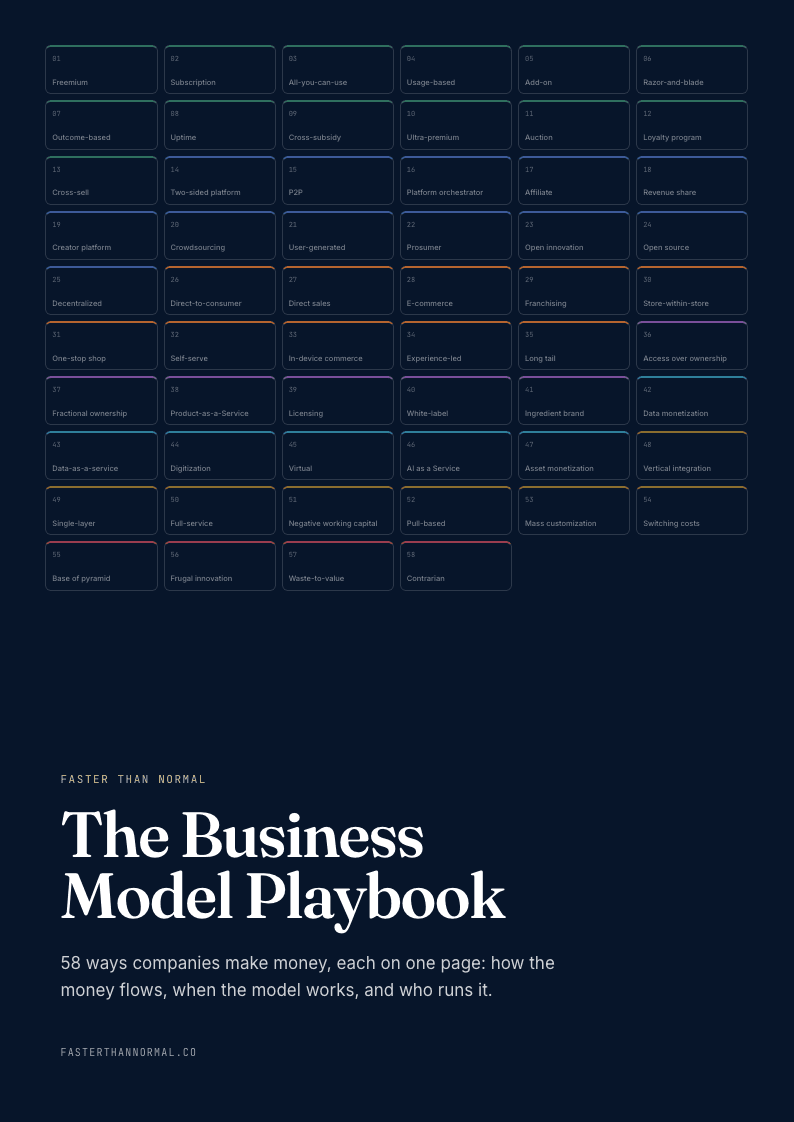
Free playbook
Get The Business Model Playbook
58 business models, one visual page each: how the money flows, the metrics that matter, and who runs it. Free when you join the Faster Than Normal email.
Free. No spam. Unsubscribe anytime.
Part IIIMaxims
-
Don't confuse volume with value. The most dangerous growth is the kind that makes your top line bigger while making your returns smaller — every package has a margin, and not all margins are positive.
-
The CFO's superpower is the question "At what return?" Every growth initiative should be subjected to a capital allocation test before it becomes a strategic priority.
-
Let the destroyed plan become the career. When external forces demolish your trajectory, treat the wreckage as raw material for something larger than what you had planned.
-
Be the outsider-insider. Seventeen years on a board gave Tomé institutional knowledge without institutional Stockholm syndrome — proximity without capture is the ideal position from which to lead change.
-
Boredom is diagnostic. If you are bored in retirement, you are not retired; you are between callings. Pay attention to the restlessness.
-
Measure culture like capital. If you can't quantify your organization's cultural health, you can't manage it — pick a number, set a target, report it publicly.
-
Your most expensive asset may be your most valuable brand. Before you automate the human element, calculate its brand value — the thing customers love about you may be the thing the spreadsheet says to cut.
-
Negotiate with the long view. The cost of a labor deal is paid over years; the cost of a strike is paid over decades in lost trust and lost customers.
-
Cut and build simultaneously. Contraction without construction reads as decline; contraction paired with visible investment reads as transformation.
-
Ask the one-thing question. "If you were me and there was one thing you would change, what would you change?" is the highest-signal question a leader can ask — because it is specific, empowering, and almost impossible to answer dishonestly.
In Their Own Words
Leading today requires grace, humility, empathy, and courage.— Conversation with The Buckhead Coalition
I've learned a lot since I took the CEO role. It is an honor and a privilege to serve, but also a heavy responsibility.— Conversation with The Buckhead Coalition
As a global company, the proximity to one of the world's busiest airports was an added plus.— Conversation about UPS's headquarters
I'm proud of UPSers, who throughout the pandemic showed up….UPSers are essential workers, they are truly moving our world forward by delivering what matters.— Conversation about UPS during the pandemic
I was at peace.— Interview with SaportaReport, 2021
We still think Georgia is a great place to do business.— Conversation about UPS's headquarters
I am committed to transforming UPS into a people-focused, customer-first organization.— Interview on leadership vision
I have always believed in breaking glass ceilings.— Comment on her appointment as CEO
We are CEOs of communities.— Conversation with The Buckhead Coalition
I credit my mentors for shaping my career.— Comment on her experience at The Home Depot
I am proud of our financial performance, last year reporting the highest revenue and operating profit in our company history.— Conversation about UPS's financial success
I continue to drive meaningful change and innovation within the supply chain space.— Comment on her leadership at UPS
UPSers are essential workers, they are truly moving our world forward by delivering what matters.— Conversation about UPS's role during the pandemic
I'm proud of UPSers, who throughout the pandemic showed up.— Conversation about UPS's role during the pandemic
I'm not under any additional pressure than any of my male counterparts.— Conversation with The Buckhead Coalition
I have a competitive workforce and labor environment.— Conversation about UPS's headquarters
I have worked under every CEO in The Home Depot's history.— Profile on Carol B. Tomé
I am the first outsider CEO, the first woman CEO, and the first woman CEO in the industry. I broke lots of glass.— Carol Tomé
I was very blessed in many ways that I onboarded during the pandemic because I was able to study the company, get to know our people, and bring strategic clarity to our business.— Carol Tomé, on the pandemic onboarding
I was at peace. I'm like, this is going to be great. I'm going to do corporate boards, my foundation, my family office, the farm, and spend more time with my family and friends.— Carol Tomé, on retirement
What Peter Drucker said, long, long time ago — culture eats strategy for breakfast. And we saw that. The strategy didn't matter so much. It was the culture that powered us through.— Carol Tomé, on culture and strategy
Moving our world forward by delivering what matters. I love this because it's not just about moving goods; it's about doing good too.— Carol Tomé, on UPS's purpose


