
General Thinking & Meta-Models
Section 1
The Core Idea
An unforced error is a mistake that was not caused by the opponent or by external pressure — you had the initiative, the information, and the time, and you still failed. The term comes from tennis: a shot into the net or wide when no one forced the error. In strategy and operations, unforced errors are self-inflicted losses: missed deadlines that had no external blocker, deals lost because you did not prepare, outages caused by a change you chose to ship without testing.
The distinction matters because it shifts the locus of control. When the market moves against you or a competitor undercuts you, the cause is external. When you forget to renew a contract, ship a known bug, or skip the step that would have caught the failure, the cause is internal. Unforced errors are preventable by definition. They are the losses that hurt most because they were entirely avoidable.
Protecting and surviving requires reducing the rate of unforced errors. That means checklists for high-stakes routines, forcing functions that block dangerous shortcuts, and a culture that treats "we could have avoided this" as a signal to fix the process, not just blame the person.
Free playbook
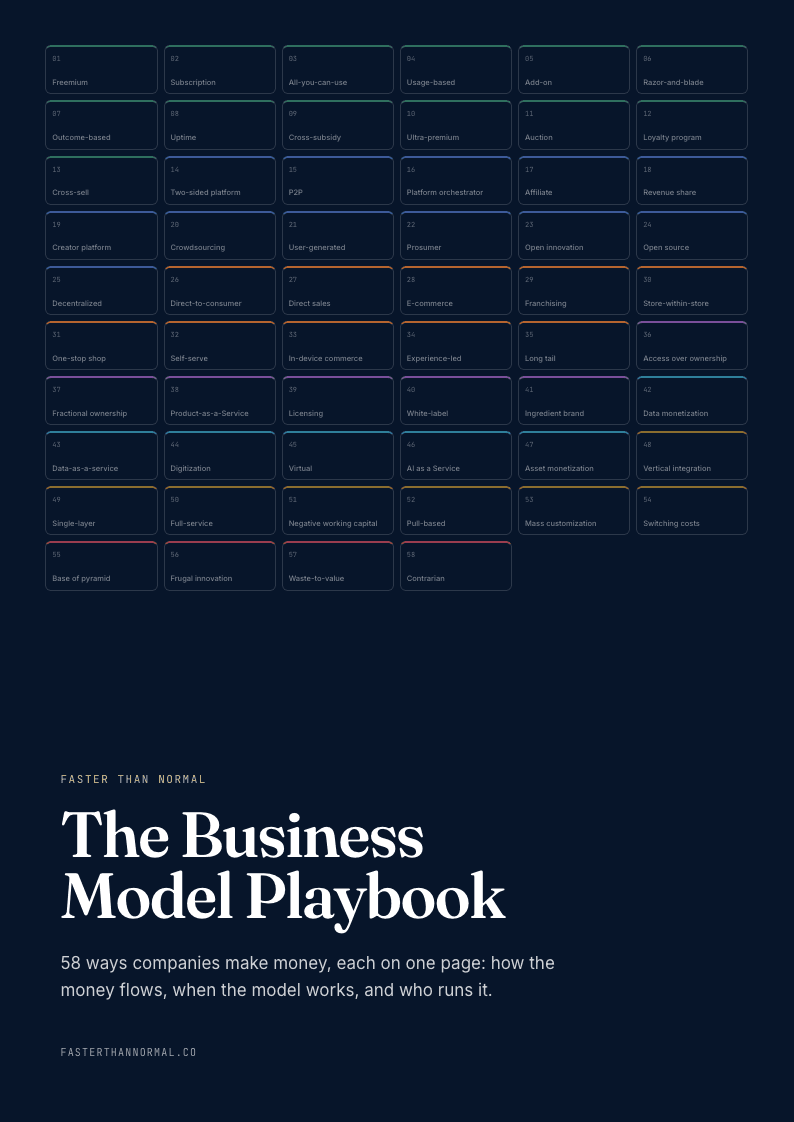
Get The Business Model Playbook
58 business models, one visual page each: how the money flows, the metrics that matter, and who runs it. Free when you join the Faster Than Normal email.
Free. No spam. Unsubscribe anytime.
Section 2
How to See It
Unforced errors show up when the cause of failure traces back to your own process, oversight, or choice — not to a competitor, customer, or random shock. Look for: failures that a simple checklist would have prevented, decisions made without the information that was available, and repeat patterns of the same type of mistake.
Business
You're seeing Unforced Error when a key client churns because no one followed up on the renewal date. The contract was in your system; the relationship was healthy. The loss was caused by internal process failure, not by the client or a competitor. The fix is a process that surfaces renewal dates and assigns ownership.
Technology
You're seeing Unforced Error when an outage is caused by a deployment that skipped staging or by a config change that was not reviewed. The failure was not caused by traffic spike or hostile actor; it was caused by a decision to shortcut the normal process. Post-mortem: we had the controls and chose not to use them.
Investing
You're seeing Unforced Error when a position is closed at a loss because of a fat-finger trade, a missed margin call that could have been anticipated, or a failure to rebalance when the plan was clear. The loss was not caused by the market alone; it was caused by operational or procedural failure.
Markets
You're seeing Unforced Error when a company misses earnings because it misreported inventory or forgot to account for a one-time cost that was known. The miss was not driven by demand shock or competition; it was driven by internal error. The market punishes unforced errors more than forced ones because they signal weak controls.
Section 3
How to Use It
Decision filter
"After any significant failure, ask: was this forced or unforced? If unforced — we had the information, the time, and the process to prevent it — treat it as a process failure. Add a checklist, a forcing function, or a review step so the same error cannot recur."
As a founder
Audit your critical paths: sales cycle, product launch, hiring, compliance. Where have you lost deals, missed launches, or created risk without an external cause? Those are unforced errors. For each pattern, add a simple control — a date in the CRM, a gate before production, a checklist before offer. The goal is to make unforced errors structurally harder.
As an investor
When a portfolio company misses plan or has an incident, classify: forced (market, competitor, regulation) or unforced (operational, oversight, self-inflicted). Unforced errors correlate with weak processes and often repeat. The question is whether management has installed the checks to reduce them. A company that keeps making the same unforced error has a culture or process problem.
As a decision-maker
Before approving a risky move, ask: what would make this an unforced error? If we have the data and the time to validate, and we skip the step, any failure is unforced. Default to the checklist. Default to the review. The cost of one preventable failure often exceeds the cost of a hundred extra checks.
Common misapplication: Blaming individuals for unforced errors without changing the process. If the same type of error recurs, the system allowed it. Fix the system — checklist, automation, review — so that the next person cannot make the same mistake.
Second misapplication: Calling every failure unforced. Some losses are forced: the competitor undercut you, the regulation changed, the customer had a budget freeze. The discipline is honest classification. Unforced errors are the subset where you had control and did not use it.
Section 4
The Mechanism
Section 5
Founders & Leaders in Action
John WoodenHead Coach, UCLA Basketball, 1948–1975
Wooden focused on eliminating unforced errors: turnovers, missed free throws, defensive lapses that had nothing to do with the other team. He drilled fundamentals so that under pressure his players would not beat themselves. "Don't mistake activity for achievement" — the activity that matters is the one that removes self-inflicted loss.
Andy GroveCEO, Intel, 1987–1998
Grove insisted on clear ownership and follow-through so that Intel did not lose to itself. Missed commitments, unread memos, and skipped steps were treated as unforced errors: we had the ability to prevent this. His management system was designed to surface and fix process failures before they became strategic losses.
Section 6
Visual Explanation
Unforced Error — Failure caused by your own process or choice, not by opponent or external shock. Preventable by checklists, forcing functions, and review.
Section 7
Connected Models
Unforced errors sit with margin of safety, process design, and decision quality. The models below help prevent or learn from self-inflicted failure.
Reinforces
Margin of Safety
Margin of safety is the buffer that allows you to absorb shocks. Unforced errors shrink that buffer: you lose margin to mistakes that did not need to happen. The two together say: protect margin by reducing preventable loss.
Leads-to
Pre-Mortem Analysis
Pre-mortems imagine failure before it happens. For unforced errors, the question is: what would we regret not doing? What checklist or gate would have prevented this? Run the pre-mortem to design the controls that make unforced errors less likely.
Tension
Process Overhead
Process — checklists, reviews, gates — reduces unforced errors but adds overhead. The tension is between speed and control. The discipline is to add process where the cost of an unforced error is high and to keep process light where it is low.
Reinforces
Decision Fatigue
Decision fatigue increases unforced errors: when people are tired or rushed, they skip steps and take shortcuts. Reducing cognitive load and standardising high-stakes decisions (checklists, defaults) reduces the rate of unforced errors.
Leads-to
Hanlon's Razor
Hanlon's Razor says not to attribute to malice what can be explained by incompetence or oversight. Many "sabotage" or "bad luck" narratives are unforced errors: we had the chance to prevent it and did not. Classify honestly.
Reinforces
Redundancy
Redundancy — a second pair of eyes, a backup check — catches errors before they become unforced losses. The cost of redundancy is often lower than the cost of one high-impact unforced error.
Section 8
One Key Quote
— Tennis maxim, applied to strategy"You can't control the other guy. You can only control whether you beat yourself."
The quote distils the logic: external factors (the opponent, the market) are partly out of your control. Your own errors are fully in your control. The strategic move is to minimise the subset of losses that are self-inflicted. Every unforced error you eliminate is a point you did not give away.
Section 9
Analyst's Take
Faster Than Normal — Editorial View
Unforced errors are the most painful losses because they were avoidable. When you lose to a competitor, you can learn and adapt. When you lose because you forgot to do the thing you knew you should do, the only response is to fix the process so it cannot happen again.
Classify failures honestly. It is tempting to blame the market, the customer, or bad luck. The discipline is asking: did we have the information and the process to prevent this? If yes, it was unforced. Treat it as a process failure and add a control.
Checklists and gates are underrated. The best teams reduce unforced errors not by working harder but by making critical steps mandatory. A renewal reminder, a staging gate, a sign-off before launch — each one blocks a class of unforced error. The cost is small; the payoff is avoiding one catastrophic self-inflicted loss.
Repeat unforced errors signal a broken process. If the same type of error happens again after "we'll be more careful," the system is allowing it. Change the system. Assign ownership. Automate the check. Individual vigilance is fragile; process is durable.
Section 10
Summary
An unforced error is a loss caused by your own process or choice when you had the information and the ability to prevent it. Protecting and surviving requires classifying failures as forced or unforced and fixing the process for the latter — checklists, forcing functions, and review — so the same error cannot recur.
Section 11
Further Reading
01
Book
Gawande makes the case that checklists reduce preventable errors in high-stakes domains (surgery, aviation). The same logic applies to business: make critical steps explicit and mandatory.
02
Book
Perrow distinguishes errors that are inherent in complex systems from those that could have been prevented by better process. Unforced errors sit in the second category.
03
Book
Kahneman documents how shortcuts and fatigue lead to systematic errors. Many of these are unforced in the sense that a slower process or a checklist would have caught them.
04
Book
Dekker reframes "human error" as often a process and system problem. Aligns with treating unforced errors as process failures and fixing the system.
05
Book
Grove's focus on measurable output and clear ownership is a blueprint for reducing unforced errors: when everyone knows who is responsible for what, preventable failures drop.