


Part IThe Story
The Slaughterhouse Option
On a December afternoon in 1946, William Zeckendorf held an option on seventeen acres of slaughterhouses along the East River in Manhattan and no earthly idea what to do with them. He had taken the option on instinct — the land sat between 42nd and 48th Streets, hard against the water, and even covered in blood and offal it had to be worth something, though the something had not yet revealed itself. The option was expiring. His deposit was at risk. Then he opened a newspaper and read that New York City was about to lose the United Nations because no suitable site could be found for the organization's permanent headquarters. Nearly 250 American cities — from San Francisco to the Black Hills of South Dakota, where a local booster had told diplomats they could get "very good dinners in the area for $1.25 or less" — had lobbied for the privilege. Manhattan, improbably, had shown almost no interest. Zeckendorf picked up the telephone, called Mayor William O'Dwyer, who connected him to the Rockefellers, who bought the land for $8.5 million and donated it to the United Nations.
It was the most consequential real estate transaction of the twentieth century, and Zeckendorf made essentially nothing on it. This was, in a sense, the man entire: a dealer of almost supernatural instinct and almost pathological disregard for his own balance sheet, a figure whose vision for what cities could become consistently outran his capacity to pay for what cities already were. He would build an empire valued at over $300 million, reshape the skylines of New York, Denver, Montreal, Washington, Philadelphia, and Los Angeles, give I. M. Pei his start, pioneer the concept of the modern mixed-use development, and then go bankrupt. His story is not a cautionary tale, exactly, nor is it a triumph. It is something more unsettling — a demonstration that the qualities that make someone capable of seeing what no one else can see are the same qualities that make them incapable of stopping.
By the Numbers
The Zeckendorf Empire at Peak
$300M+Webb & Knapp portfolio value at peak (early 1960s)
17 acresAssembled site for United Nations headquarters
$8.5MPrice Rockefellers paid for the UN land in 1946
12,000Acres controlled in a single Los Angeles tract
$3B+Estimated value of projects developed over career
1965Year Webb & Knapp entered involuntary bankruptcy
1976Year of Zeckendorf's death, at age 71
Misplaced Westerners
The Zeckendorfs were, as Big Bill himself later wrote, "really misplaced westerners." He was born on June 30, 1905, in Paris, Illinois — a town named for no romantic reason, a small prairie outpost where his father, Arthur Zeckendorf, worked as a merchant. The family was Jewish, their roots tangled somewhere in the European diaspora before branching into the American interior. In 1908, when William was three, Arthur moved the family to Cedarhurst, on Long Island, and went into the shoe business. The boy grew up playing cowboys and Indians on a suburban lawn, nursing the conviction — not unusual in boys, but unusually persistent in this one — that the world was a place to be remade rather than merely inhabited.
He enrolled at New York University. He found it a waste of time. He dropped out. This is the kind of biographical fact that, in retrospect, gets dressed up as prescience or rebellion, but in Zeckendorf's case it was probably something simpler: impatience. He was a man who would spend his entire life unable to sit still, unable to tolerate the distance between an idea and its execution, unable — and this was the fatal thing — to tolerate the distance between ambition and capital. He went into real estate because it was the one profession where a man with no money, no degree, and no particular pedigree could, through sheer force of personality, assemble the world.
For years, he was a run-of-the-mill broker, "of little repute even among real-estate men," as The New Yorker put it in a 1951 profile, "and so far from prosperous that at one point his home telephone was cut off because he couldn't pay the bill." That enforced absence from the telephone made his heart, as the profile's author noted with exquisite dryness, "grow excessively fond of it." It would become his signature instrument — later, at the height of his power, he would juggle three phones simultaneously, stack half a dozen long-distance calls like planes circling LaGuardia, install a car phone in his Chrysler limousine, and once, while bedridden with influenza in Rome, run up a $300 phone bill in a single call to his office. His wife had limited him to one call that day. He felt much better for it.
The Cylinder and the Igloo
In 1938, Zeckendorf was offered a partnership at Webb & Knapp, Inc., a New York real estate firm of modest reputation and immodest liabilities. By 1942, when he became executive vice-president and general overseer, the concern's liabilities exceeded its assets by $137,000. It was less a company than a promissory note with letterhead.
What Zeckendorf did next belongs to the category of transformations so total they resist explanation. Within a decade, Webb & Knapp had a liquidating value conservatively estimated at twenty million dollars. Its portfolio included, in the words of that same New Yorker profile, "such disparate items as a twelve-thousand-acre tract within the city limits of Los Angeles, a railroad in Hoboken, a jail in Boise, and, locally, the Airlines Terminal Building, 1 Park Avenue, the Marguery, and a large portion of the gilt-edged no man's land that separates Macy's from Gimbel's." Zeckendorf was its sole owner. He was forty-six years old.
He operated from what became one of the most famous offices in American business: a cylindrical, windowless room paneled in teakwood, set like an igloo in a white marble lobby — a space that announced, with architectural force, that its occupant had no interest in looking outward at the city because he was too busy reimagining it from the inside. It was here that he received I. M. Pei, Jacqueline Kennedy, Leonard Lyons, insurance executives, shoe store brokers, and anyone else who might be useful in the ceaseless project of buying, selling, developing, and — when all else failed — simply dreaming up real estate ventures of escalating audacity.
A colleague once compared his face to "a dish of sweet-and-sour pickles." He smiled constantly, his whole broad face lighting up, then snapped into an expression of such grim solemnity that the same people who had just been charmed felt a cold wind pass through them. He weighed around 250 pounds when not dieting — a fact noted by nearly every journalist who profiled him, as though his physical mass were an expression of his appetites, which it probably was. He stood six feet tall. He was bald. In 1946, Fortune predicted he would "very likely be the first American to land on the moon." He never expressed any such specific aspiration, but — as The New Yorker noted with a precision that bordered on affection — "inasmuch as he sometimes describes himself as an uninhibited opportunist; is unusually imaginative, venturesome, unpredictable, ambitious, and resourceful; loves to travel long distances by air; and often intones the maxim 'You never can tell till you try,' he might well turn the trick."
— William ZeckendorfYou never can tell till you try.
The Art of Assembly
Zeckendorf's genius — and it was genius, in the specific and limited sense that it involved perceiving value where others perceived only vacancy or squalor — lay in assembly. He did not build buildings so much as he built the conditions under which buildings became inevitable. He saw parcels of land the way a chess player sees a board: not as individual squares but as systems of potential, where the value of any single piece depended on its relationship to every other piece.
The United Nations deal was the paradigm. He took an option on slaughterhouses. He had no plan. Then a headline appeared, and he saw the connection — between his seventeen acres of abattoirs and a global institution's desperate search for a home — that no one else could see, and he moved so fast that by the time anyone understood what had happened, the deal was done. The Rockefeller family put up the $8.5 million. The United Nations got its headquarters. And Zeckendorf got something better than profit: reputation. He became the man who had given the world a home.
This pattern — see what others cannot, move before others will, assemble what others think unassemblable — repeated itself across the continent. In Los Angeles, he bought the Twentieth Century Fox back lot and developed Century City, transforming a movie studio's surplus acreage into a city within a city. On Long Island, he built Roosevelt Field, the shopping center that rose on the site where Charles Lindbergh had taken off for Paris, turning an airstrip into a consumer cathedral. In Denver, he built the Mile High Center. In Montreal, Place Ville-Marie. In Washington and Philadelphia, urban-renewal projects of staggering scope. His was a vision of the American city as a thing to be built not incrementally, from the bottom up, but comprehensively, from the top down, by a single mind with sufficient nerve.
Not long after the UN deal, a broker came to Zeckendorf to ask if he'd let a shoe store tenant expand into adjacent space. Zeckendorf said no — he had a larger deal pending with a competitor. "Tell you what I'll do," he said. "I'll give your store a hundred thousand dollars just to move away." The broker asked if he was kidding. Zeckendorf said he certainly was not, and offered to shake hands on the proposition. Still clasping Zeckendorf's hand, the broker exclaimed, "Who would have thought of that but Zeckendorf!" Zeckendorf beamed.
The anecdote is trivial. And yet it captures something essential — the way Zeckendorf thought in terms of systems, not transactions. The $100,000 was not generosity; it was the cost of removing an obstacle from a larger architecture of value. He was always doing this: spending extravagantly on the small piece that unlocked the large configuration. He was a man, his associates noted, who sometimes bought properties at a loss simply to give "some poor broker a commission." Webb & Knapp owned, as one colleague put it, "one ghastly property today we paid a hundred and ten thousand for, and which we've never made a penny on." Sentiment and strategy were, in Zeckendorf's hands, indistinguishable. And both were expensive.
Pei's Patron
The single most consequential decision Zeckendorf made — more consequential than the UN deal, because its effects would radiate across the built world for half a century — was hiring a young, largely unknown Chinese-American architect named Ieoh Ming Pei.
Pei was born in Canton, China, in 1917, the son of a prominent banker. He came to the United States at seventeen, studied at MIT and Harvard's Graduate School of Design under Marcel Breuer and Walter Gropius, and by the late 1940s had joined Zeckendorf's operation as an in-house architect. He was then in his early thirties — brilliant, exacting, and almost entirely without a reputation. It was Zeckendorf who saw something in him. Zeckendorf, who had no formal architectural training and no aesthetic pretensions beyond a gut conviction that buildings should be bold, recognized in Pei a capacity for monumental thought that matched his own.
The partnership was extraordinary. Pei designed project after project for Webb & Knapp: Kips Bay Plaza, with its severe concrete grid; Society Hill in Philadelphia; Mile High Center in Denver. Zeckendorf gave Pei what no cautious developer would have given a young architect — scale, freedom, and the resources to think in city blocks rather than building lots. And Pei gave Zeckendorf what no other architect could have given him — the conviction that commercial real estate could be architecture, that a developer's ambitions could serve not just the market but the city.
— Martin Filler, Vanity Fair, 1989So widely accepted is Pei's eminence today that it is difficult to realize that twenty-five years ago his relative inexperience and obscurity helped capture the imagination of his most important client.
The relationship between patron and architect was, in its way, a love story. Zeckendorf's two-story, glassed-in penthouse lounge — the cylindrical office had by then been joined by a rooftop aerie where he entertained — became a salon where Pei met Jacqueline Kennedy, where the great and the moneyed mixed in ways that would later prove transformative. When Mrs. Kennedy set out to choose an architect for the John F. Kennedy Library after the assassination, Pei was the dark horse on a shortlist that included Mies van der Rohe (phlegmatic, infirm, seventy-eight), Louis Kahn (whose Philadelphia office horrified her with its tin cans piled high with cigarette butts), and Philip Johnson (suave, established, fifty-eight). Pei was forty-seven. He had been born one month before JFK. He won. And though Zeckendorf's empire was by then crumbling, the architect he had nurtured would go on to build the East Wing of the National Gallery, the Louvre Pyramid, the Bank of China Tower in Hong Kong — to become, as the Hong Kong customs official would one day put it, "the most famous architect in the world."
Zeckendorf had made that possible. Not through wealth alone, but through a particular kind of faith: the willingness to bet on a person's future rather than their past. It was the same instinct that made him an extraordinary dealmaker and a terrible steward of his own finances.
The Physics of Leverage
The problem with Zeckendorf was the problem with leverage itself: it is a force multiplier that does not distinguish between gains and losses.
Webb & Knapp was publicly traded. This was unusual for a real estate firm of its era, and it created pressures that would prove fatal. Zeckendorf needed constantly to generate earnings, to service debt, to demonstrate growth — not because the underlying assets lacked value, but because the structure demanded motion. He was, in the vocabulary of a later generation of financiers, "running hot." Projects in five, six, ten cities simultaneously. Deals stacked upon deals. The phone calls — twenty-seven hundred dollars for a four-week European trip, three hundred dollars for a single bedridden afternoon in Rome — were symptoms of a man who could not stop moving because stopping meant the structure would catch up to itself.
He was also, as his son would later note with quiet devastation, increasingly out of touch. "Because of that large chain of command," William Zeckendorf Jr. remembered in a Forbes interview in 1983, "things started getting away from us. We got out of touch." The son had worked his way up to president in his father's shadow, watching "the glorious ride up, sitting helpless through the awful ride down." The ride down began when Marine Midland Bank called in an $8.5 million note — a sum that, for a man who had assembled seventeen acres for the United Nations, should have been trivial. But in a leveraged empire, trivial sums become fatal when they arrive at the wrong moment. Webb & Knapp entered involuntary bankruptcy in 1965. Zeckendorf declared personal bankruptcy four years later.
He was sixty years old. He had built, by one estimate, $3 billion worth of projects across the continent. He had conceived Century City, Roosevelt Field, Place Ville-Marie, Kips Bay, Mile High Center. He had introduced I. M. Pei to the world. He had given the United Nations a home. And now his phone bills exceeded his net worth.
A Smaller Telephone
The years after bankruptcy were the years that reveal character — or, more precisely, the years that reveal which parts of character survive the destruction of everything character was built upon.
Zeckendorf endured "a few years as a small-time developer," as Forbes put it with brisk cruelty, and then he died, in 1976, at the age of seventy-one. But the cruelty of that description obscures something important: even in bankruptcy, the institutions came back to him. Equitable Life Assurance Society and Manhattan Savings Bank financed his first project after the collapse. "They realized that over the years my father had done enough for them," his son said, "and they were willing to help." This is a detail worth sitting with. In an industry built on trust, on handshakes and phone calls and the assessment of a man's word as collateral, the institutions that had lost money with Zeckendorf still trusted him enough to back him again. The genius survived the bankruptcy. The reputation survived the ruin. What did not survive was the scale.
His autobiography, Zeckendorf: The Autobiography of the Man Who Played a Real-Life Game of Monopoly, published in 1970 with co-author Edward McCreary, is a document of magnificent self-regard and surprising candor. Sam Zell — the Chicago real estate investor who would himself become a billionaire and who read Zeckendorf's autobiography as a young man — told the podcaster David Senra decades later, in his deep and definitive voice, simply: "Read it." Zell had found in Zeckendorf a template: the audacity, the instinct, the willingness to move when others hesitated. What Zell took from the book, and what distinguished his own career from Zeckendorf's, was a lesson Zeckendorf himself never fully absorbed: the relationship between vision and capital is not romantic. It is structural. And structure kills.
The Correction of the Son
William Zeckendorf Jr. was his father's negative image. Where the elder was flamboyant, the son was quiet. Where the father operated from a cylindrical teakwood igloo, the son met visitors in "his modest, almost spartan office in the building where he lives — an office utterly unlike his father's grandiose headquarters." Where Big Bill's voice boomed across three telephone extensions attached to fifteen-foot cords, his son "speaks softly, so softly it is sometimes difficult to follow what he is saying."
The corrections were deliberate, almost surgical. "Today we have a very small, tight organization," the younger Zeckendorf told a Forbes interviewer in 1983. "It's basically myself, my two sons and ten other people." He had watched the glorious ride up and sat helpless through the awful ride down. Control, he understood, was the thing his father had sacrificed in pursuit of scale. "Who wants to have the pressures of generating earnings for Wall Street and all the attendant publicity?" he said. "I prefer the anonymity to the notoriety. I started out way up at the top with publicity. It's a double-edged sword."
Bill Jr. did not criticize his father's flamboyance — not directly, not publicly. But clearly he would have none of it. He developed projects mostly in New York City. He stayed private. He kept the organization lean. And he built, quietly and steadily, the kind of career his father might have had if his father had been a different man — which is to say, a career built on the discipline of restraint rather than the intoxication of expansion.
His own memoir, Developing: My Life, published posthumously, reconstructs his career deal by deal. Against adverse forces — market slumps, construction delays, rent-controlled tenants, bankrupt contractors — properties are assembled, loans secured, profits made, neighborhoods changed. Over twenty-two years, he turned parking lots, derelict department stores, and pornographic theaters into condominiums and mixed-use developments. He anticipated and propelled the redevelopment of the Upper West Side and Long Island City. His was the work of a man who had learned, from watching his father's destruction, that the art of development is not the art of the grand gesture but the art of the controlled bet.
A Washington Post profile from 1991 put it with lapidary precision: "Bill Zeckendorf is no Donald Trump."
Limestone and Memory
The third generation arrived with a problem every dynastic heir faces: how to honor the name without repeating the fate.
Arthur Zeckendorf, born in 1959, and his older brother William Lie Zeckendorf, born in 1958, grew up on the Upper East Side, inheriting a surname that carried both glory and caution in roughly equal measure. They worked for their father before co-founding Zeckendorf Development, LLC, in 2004. By then, Manhattan's luxury condominium market had entered one of its periodic fevers — glass towers by Richard Meier, Jean Nouvel, Charles Gwathmey, and Herzog & de Meuron were multiplying across the skyline, each one sleeker and more transparent than the last, each selling apartments for incomprehensible sums to people who occupied them a few weeks per year.
The Zeckendorf brothers chose the opposite direction. They hired Robert A. M. Stern, the Yale dean and neo-traditionalist architect, who told them that what New York really needed was a luxury building that looked more like the old-fashioned ones, not less. They purchased a full block facing Central Park between 61st and 62nd Streets — half of it containing the faded Mayflower Hotel, the other half a vacant lot facing Broadway — from the Goulandris shipping family for $401 million in 2004. The price was so outrageous that, as the architecture critic Paul Goldberger noted, "people wondered if the Zeckendorf brothers didn't have some strange death wish, some desire to follow their celebrated grandfather, the original William Zeckendorf, into bankruptcy."
They did not have a death wish. They had done two studies: one concerning the features that made the great New York City apartment buildings great — courtyards, proportioned windows, lobbies with human warmth — and another about the best kind of limestone to use. The answer: Indiana limestone, from the same quarry that had supplied the Empire State Building. They clad their building, 15 Central Park West, in that stone. They added a 14,000-square-foot fitness center, custom oak paneling, individual wine cellars, an in-house chef. They built thirty-five stories of limestone against a skyline of glass.
Four-fifths of the two hundred-odd units sold. A duplex penthouse went for $45 million — at that time, the highest price ever paid for a condominium in New York City. Total sales reached $2 billion on a $1 billion cost. "Our strategy was to focus on the high end," Arthur told the New York Observer, "because that is where we saw strength in the market today." The brothers had done what their grandfather would have understood instinctively and what their father had taught them structurally: they made a very expensive but tightly controlled bet, and they got out.
— M. Myers Mermel, real-estate investor and consultantThey are calmly rational. They just go quietly about the things that they are doing and seem to be able to accommodate the changes as they happen.
The Homburg and the Limestone
To be born a Zeckendorf, the Observer noted in 2006, "is to try to avoid the fate of your father." The sentence has the sound of Greek tragedy, but the Zeckendorf story is more properly American — a narrative about the immigrant energy that builds empires and the inherited caution that consolidates them, about the relationship between the visionary who creates the game and the descendants who learn to play it without going broke.
Big Bill Zeckendorf liked to wear a Homburg hat. He took all manner of people to his two-story glassed-in lounge — I. M. Pei, Jackie Onassis, insurance executives, newspaper columnists, anyone who might advance or simply appreciate the grand project. He was, as the architectural historian Sara Stevens documented in her study Developing Expertise, one of the figures who helped transform real estate development from a trade into a profession — who positioned developers as the saviors of American cities, bringing modernist architecture and suburban amenities to city centers in the 1950s and 1960s. His son undid the spectacle and kept the substance. His grandsons added the spectacle back, but in a register their grandfather would barely have recognized: not the spectacle of personality but the spectacle of material. Indiana limestone, not teakwood igloos.
The continuity runs deeper than style. Arthur Zeckendorf, explaining why he chose expensive stone for 15 Central Park West, reached for a memory: "That was part of growing up in New York. It really was to respect the beauty of Central Park and of New York City." His brother William had few doubts about his career choice. "If I had any, they were answered pretty quickly." Together they developed approximately $3.5 billion in properties. They are builders. They like to build. Their grandfather said the same thing, in almost the same words, in his 1970 autobiography, six years before his death: "It was a matter of my personality. I like to build."
Three generations. The first built an empire and lost it. The second built a practice and kept it. The third built a monument — 15 Central Park West, a building that stands on the most expensive block in Manhattan, clad in stone from the quarry that supplied the Empire State Building — and sold it. The Zeckendorf story is not about real estate. It is about the metabolization of failure across generations, about the way a family learns to contain the thing that made it great.
The Moon and the Telephone
There is a detail in the New Yorker profile that has stayed with me. It concerns Zeckendorf's telephone habits during a trip to Europe: "During a four-week trip to Europe last year, his bill for conferring electronically with his colleagues came to twenty-seven hundred dollars." This was 1950 or 1951. Adjusted for inflation, that is roughly $30,000 in today's money — for phone calls. On a single trip.
The detail is comic, and it is also diagnostic. Zeckendorf could not be separated from his deals because his deals could not be separated from him. He was the human switchboard through which every transaction flowed. When his wife limited him to one phone call during a Roman flu, he stayed on long enough to run up a $300 charge "and felt much better for it." The telephone was his oxygen, his instrument of control, his proof of indispensability. And indispensability, for a man running an empire built on leverage and personal relationships, was both his greatest asset and his most dangerous liability. When Webb & Knapp went under, it was not because the assets lacked value. It was because the assets were inseparable from the man, and the man was mortal, and mortality — in the form of exhaustion, overextension, the simple accumulation of obligations — eventually presented its invoice.
Fortune predicted in 1946 that Zeckendorf would be the first American to land on the moon. He did not land on the moon. He landed, as all men of extreme ambition eventually do, on the ground — hard, broke, and bewildered that the distance between vision and reality, which he had spent his entire life trying to eliminate, turned out to be the one distance that could not be assembled away. But the buildings remain. And the family name, carried now by grandsons who build in limestone what he built in leverage, is still on the skyline.
In his cylindrical windowless office, paneled in teakwood, with three telephones and no view, William Zeckendorf sat at the center of everything — the deals, the architects, the cities, the century — and saw the whole board at once. The igloo had no windows because it didn't need them. The city was inside.
Part IIThe Playbook
William Zeckendorf's career offers a set of principles that cut across real estate, capital allocation, and the management of dynastic ambition. Some of these lessons are positive — strategies that produced extraordinary results. Others are cautionary — patterns that, left unchecked, destroyed what they created. The most interesting ones are both.
The principles
- 1.See systems, not parcels.
- 2.Take the option before you have the plan.
- 3.Patronage as strategy: bet on people before the market validates them.
- 4.Leverage is a physics problem, not a courage problem.
- 5.The telephone principle: be the switchboard, but know the switchboard is the single point of failure.
- 6.Let reputation survive ruin.
- 7.The dynastic correction: each generation must solve the prior generation's fatal flaw.
- 8.Build conviction through material, not just concept.
- 9.Anonymity as competitive advantage.
- 10.Scale is a drug. Dose accordingly.
- 11.The controlled bet: spend extravagantly within a bounded frame.
- 12.Exit the deal. Don't marry the building.
Principle 1
See systems, not parcels
Zeckendorf's signature skill was the ability to perceive relationships between properties that appeared unrelated. The $100,000 he paid a shoe store to vacate wasn't generosity — it was the removal of a piece from a larger board configuration. The slaughterhouse option wasn't speculative real estate — it was a bet on the latent value of adjacency, location, and scale. Where other brokers saw individual parcels, Zeckendorf saw assemblages: clusters of properties whose collective value exceeded their individual prices by multiples.
This systems-level thinking extended to his approach to cities themselves. Century City wasn't a building — it was the transformation of a studio back lot into an urban center. Place Ville-Marie wasn't a tower — it was the reorganization of downtown Montreal around a single vertical anchor. He thought in city blocks, not building lots.
The principle applies far beyond real estate. In any market where assets are priced individually but create value in combination — venture portfolios, corporate roll-ups, media IP — the arbitrage lies in seeing the assembly before others see it.
Tactic: Before evaluating any individual asset, map its value in combination with everything adjacent to it — physically, strategically, temporally — and price the assembly, not the piece.
Principle 2
Take the option before you have the plan
Zeckendorf took options on properties he did not yet know how to use. The seventeen acres of slaughterhouses had no business plan attached when he wrote the check. He simply knew — with the instinct of a man who had spent decades studying urban geography — that the land had to be valuable for some purpose he had not yet identified. The plan arrived in a newspaper headline.
This is a fundamentally different approach to opportunity than the one taught in business schools, where strategy precedes commitment. Zeckendorf committed first and strategized second, operating on the principle that certain assets — prime land, unique positioning, irreplaceable location — will reveal their purpose to anyone patient enough to hold them and creative enough to listen.
The risk, of course, is that patience and creativity are not infinite resources. The option on the slaughterhouses was expiring. The deposit was at risk. In Zeckendorf's case, the universe cooperated. But the universe does not always cooperate, and the difference between vision and recklessness is often determined after the fact.
Tactic: When you encounter an asset whose value you cannot fully articulate but whose scarcity is obvious, secure the option first and solve for the use case second — but set a hard deadline for the thesis to emerge.
Principle 3
Patronage as strategy: bet on people before the market validates them
Hiring I. M. Pei when he was an unknown architect in his early thirties was not charity. It was the most strategic hire in the history of American real estate development. Pei was brilliant but unproven. Established developers would not have given him a commission of significant scale. Zeckendorf gave him city blocks.
The result was a relationship of mutual amplification: Pei elevated Zeckendorf's projects from commercial developments into architectural events, and Zeckendorf gave Pei the portfolio — Kips Bay, Mile High Center, Society Hill — that would eventually lead to the Kennedy Library, the National Gallery's East Wing, and the Louvre Pyramid. Zeckendorf captured years of world-class architectural talent at below-market cost, because the market had not yet recognized what he had recognized.
This is the patron's advantage in any field: the ability to identify talent at the moment of maximum asymmetry between ability and reputation, and to lock in that talent through scale, freedom, and loyalty before the broader market catches up.
Tactic: Identify the most talented person in your domain who has not yet been validated by institutional consensus, and offer them the largest canvas available — before someone else does.
Principle 4
Leverage is a physics problem, not a courage problem
Zeckendorf's collapse was not caused by bad ideas. His projects were, almost without exception, visionary in conception and successful in execution. Century City, Place Ville-Marie, Roosevelt Field — these were not failures. The failure was structural: too much debt, too many simultaneous projects, too little margin for error in a portfolio where every asset was leveraged against every other asset.
The lesson is not "avoid leverage." Leverage is the mechanism by which real estate — and many other capital-intensive businesses — creates value. The lesson is that leverage is a physics problem: it amplifies force in both directions, and the relevant question is not "how much can I borrow?" but "what happens to the entire system when any single component underperforms?"
Marine Midland Bank calling in an $8.5 million note should not have been an existential event for an empire valued at hundreds of millions. That it was tells you everything about the fragility of Zeckendorf's capital structure. He had built a system with no shock absorbers.
⚖
The Leverage Paradox
Zeckendorf's empire illustrated a universal principle of leveraged systems.
| Leverage amplifies | Zeckendorf's experience |
|---|---|
| Vision → Scale | Built $3B+ in projects across a continent |
| Complexity → Fragility | One $8.5M note triggered involuntary bankruptcy |
| Reputation → Access | Institutions came back even after bankruptcy |
| Ambition → Overextension | Projects in 10+ cities simultaneously with thin reserves |
Tactic: For every leveraged commitment, model the scenario where that commitment fails simultaneously with two others — and ensure the system survives.
Principle 5
The telephone principle: be the switchboard, but know the switchboard is the single point of failure
Zeckendorf was the human hub through which every deal, every relationship, every decision flowed. Three phones, fifteen-foot cords, calls stacked like aircraft over LaGuardia. This gave him extraordinary control and extraordinary speed — no intermediaries, no filters, no delays between perception and action.
It also meant that the empire could not function without him. There was no institutional structure capable of operating independently. His son, who watched the system from the inside, identified this precisely: "Because of that large chain of command, things started getting away from us. We got out of touch." The chain of command was, in fact, the opposite of a chain — it was a star topology, with Zeckendorf at the center, and when the center failed, the whole network failed.
This is the founder's paradox in every domain: the same intensity of involvement that creates the enterprise makes the enterprise fragile. The solution is not to disengage — Zeckendorf's personal relationships with lenders, brokers, architects, and politicians were genuine competitive advantages — but to build systems that can carry the load when the switchboard goes dark.
Tactic: Audit your organization for decisions that cannot be made in your absence — not the strategic ones, which should require you, but the operational ones, which should not.
Principle 6
Let reputation survive ruin
After Webb & Knapp's bankruptcy, after personal bankruptcy, after the public humiliation of financial collapse, the insurance companies and savings banks came back to Zeckendorf. Equitable Life and Manhattan Savings Bank financed his first post-bankruptcy project. They did this not out of charity but out of a calculated assessment that Zeckendorf's track record of creating value for his partners — over decades, across dozens of projects — outweighed the catastrophe of his financial collapse.
This is a principle that operates on a timescale most people underestimate. Reputation is not a snapshot; it is an accumulation. Zeckendorf had spent twenty years making money for institutions before he lost money for them. The ledger, viewed in its entirety, was still positive. And the institutions knew — in the way that people who have worked with someone for decades know — that the bankruptcy was a function of structure, not of judgment.
The implication is that every transaction, every relationship, every handshake is a deposit into a reputational account that may not be drawn upon for decades — and that the account's value is tested not in good times, when everyone is solvent, but in bad times, when only the deepest reservoirs of trust hold.
Tactic: In every deal, leave the counterparty feeling they got slightly more than they expected — the compound interest on that surplus is your insurance against the inevitable downturn.
Principle 7
The dynastic correction: each generation must solve the prior generation's fatal flaw
William Zeckendorf Jr. built his entire career as a correction of his father's. Where the father was public, the son was private. Where the father ran hot, the son ran cool. Where the father's organization had "lots of vice presidents and a large staff," the son's had "basically myself, my two sons and ten other people." The grandsons, in turn, corrected the correction: they reintroduced ambition and scale, but within a framework of tight financial control — condominiums, not rental properties; single projects brought to completion and sold, not sprawling portfolios held indefinitely.
Z
Three Generations of Zeckendorf Correction
1938–1965
William Sr. builds continental empire via Webb & Knapp. Fatal flaw: leverage and overextension. Bankruptcy.
1975–2004
William Jr. rebuilds quietly in New York. Correction: small organization, private ownership, controlled scale. Trades spectacle for survival.
2004–present
Arthur & William Lie co-found Zeckendorf Development. Correction of the correction: reintroduce ambition and scale, but via condominiums (sell, don't hold) with tight cost discipline.
This pattern — the dynastic pendulum, swinging between the flaw of one generation and the overcorrection of the next — is visible in every family enterprise. The trick, which the third generation of Zeckendorfs appears to have learned, is to borrow the strengths of every predecessor while avoiding the weaknesses of any single one. Build like the grandfather. Control like the father. Sell like neither.
Tactic: Identify the single trait that made your predecessor (or your company's previous era) successful and simultaneously destroyed them — then build a system that preserves the trait while containing its consequences.
Principle 8
Build conviction through material, not just concept
When the Zeckendorf grandsons chose Indiana limestone for 15 Central Park West — stone from the same quarry that supplied the Empire State Building — they were not just making an aesthetic decision. They were making an argument. The stone said: this building is permanent. This building belongs to the history of New York. This building is not a glass speculation but a civic act.
The material itself created conviction in buyers. It communicated seriousness in a market flooded with glass towers that signaled novelty. And it justified premium pricing — not through abstract marketing language, but through the physical, tactile reality of stone that you could touch, stone that had weight, stone that had history. Arthur Zeckendorf's two studies — one on what made great apartment buildings great, another on the best limestone — were acts of epistemic discipline. He did not assume he knew what luxury meant. He researched it, and then he built the research into the walls.
Tactic: When entering a market where differentiation is claimed through narrative, differentiate instead through material — the thing the customer can see, touch, and verify without trusting your story.
Principle 9
Anonymity as competitive advantage
"I prefer the anonymity to the notoriety," William Zeckendorf Jr. said. "I started out way up at the top with publicity. It's a double-edged sword." This was not modesty. It was strategy. Anonymity, in a competitive market, is camouflage. It allows you to assemble properties without alerting competitors, to negotiate without the distortion of a public profile, to operate without the pressure of maintaining a brand narrative.
His father's fame had been, in some respects, a liability — it attracted attention to every deal, inflated expectations, and created a public persona that the man had to service alongside his actual business. The son understood that the most successful real estate investors — the ones who compound quietly across decades — are the ones whose names the public never learns.
Tactic: Measure the marginal benefit of every unit of public attention against its cost in competitive intelligence, negotiating leverage, and operational freedom — and default to silence when the math is ambiguous.
Principle 10
Scale is a drug. Dose accordingly.
Zeckendorf's autobiography, read decades after his death by a young Sam Zell, communicated the intoxication of scale with an honesty that most business memoirs lack. "Fishing for piranhas in South America and selling ships to Greeks for profit" — this is not the language of a man running a disciplined operation. It is the language of a man high on his own velocity.
The lesson Zell drew, and which distinguished his own career, was that scale should be a function of opportunity, not appetite. Zeckendorf's appetite for deals — new cities, new countries, new asset classes — consistently exceeded his capital base, and the gap was papered over with debt. Every leveraged acquisition felt, in the moment, like proof of genius. In aggregate, they were proof of addiction.
Tactic: Before entering any new market, geography, or asset class, answer a single question: "Am I doing this because the opportunity is extraordinary, or because I've run out of dopamine in my current portfolio?"
Principle 11
The controlled bet: spend extravagantly within a bounded frame
The grandsons' strategy at 15 Central Park West synthesized the family's accumulated wisdom into a single principle: spend extravagantly within a bounded frame. The $401 million land purchase was extravagant. The Indiana limestone was extravagant. The amenities — wine cellars, in-house chef, 14,000-square-foot fitness center — were extravagant. But the bet was bounded: one building, one site, condominiums sold to individual buyers, debt repaid from sales proceeds. There was no second project hanging on the success of the first. No empire to feed. No Wall Street earnings to generate.
This is the opposite of Zeckendorf Sr.'s model, where every project funded the next project in an endless chain of leverage. The grandsons treated 15 Central Park West as a standalone proposition — a maximum-conviction bet within a defined risk envelope. The result: $2 billion in sales on $1 billion in costs, with no systemic risk.
Tactic: When you have high conviction in a single opportunity, concentrate your capital there — but refuse to let that opportunity become the foundation for the next one. Each bet stands alone.
Principle 12
Exit the deal. Don't marry the building.
Big Bill Zeckendorf held properties the way a romantic holds relationships — with passion, attachment, and an unwillingness to let go even when the economics demanded it. His son and grandsons developed condominiums: buildings designed, from conception, to be sold. The shift from holding to selling — from landlord to developer — was not just a financial strategy. It was a philosophical one. It reflected the understanding that in real estate, as in all capital-intensive businesses, the moment of maximum value is rarely the moment of maximum attachment.
Zeckendorf Sr. wanted to own cities. His descendants wanted to shape them and move on. The emotional discipline required to exit a building you have conceived, designed, and constructed — to hand the keys to a buyer and walk away — is the discipline that separates developers who compound wealth from developers who accumulate buildings and go broke.
Tactic: Define your exit criteria before you break ground — not just the price, but the timeline and the conditions — and treat that criteria as contractual, not aspirational.
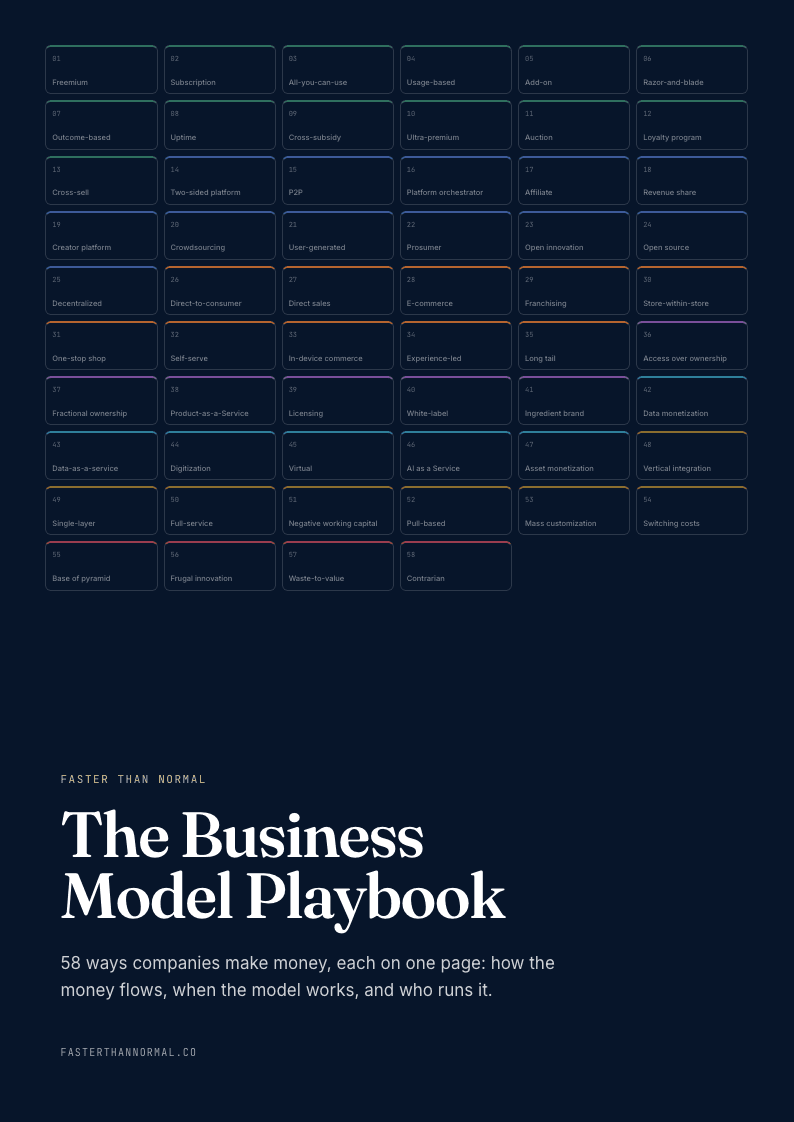
Free playbook
Get The Business Model Playbook
58 business models, one visual page each: how the money flows, the metrics that matter, and who runs it. Free when you join the Faster Than Normal email.
Free. No spam. Unsubscribe anytime.
Part IIIMaxims
-
Assembly creates value that acquisition cannot. The whole is worth more than the sum of the parcels — but only if you can see the whole before anyone else can.
-
The option is cheaper than the answer. Secure the position first. Solve for the use case second. But never hold an option without a deadline.
-
Bet on talent at the moment of maximum asymmetry. The best patronage — in architecture, in investing, in hiring — happens when ability exceeds reputation by the widest margin.
-
Leverage does not distinguish between vision and vanity. Both borrow at the same interest rate.
-
Your phone bill is a proxy for your fragility. If the organization cannot function without you for a week, the organization is you — and you are mortal.
-
Reputation compounds slower than debt, but survives longer. The institutions came back after the bankruptcy. The leverage did not.
-
Each generation's job is to solve the prior generation's fatal flaw — without losing the prior generation's defining strength. Build like the grandfather. Control like the father. Sell like neither.
-
Material conviction outperforms narrative conviction. Indiana limestone says more than a marketing deck.
-
Silence is a competitive advantage in markets where everyone is shouting. The best deals happen when no one knows you're in the room.
-
The igloo had no windows because it didn't need them. When you can see the whole board, the view outside is a distraction.
In Their Own Words
It is always wise when dealing away from home to have influential local partners.
A citizen of a small town can, through circumstances or design, come to know almost everyone in the community.
One of the best ways to determine the value of vast holdings is to have someone make you a bona-fide offer for them.
The stars must have been right when we met, for each of these men had individual visions about Montreal which matched mine, so we could work together.
Any real-estate man is interested in twenty-two acres of singly owned midtown city property.
A prime requisite for a successful program is a mayor strong enough to control the local demagogues and predators who inevitably rise up to attack or to fatten off a great development.
Through lack of imagination and of boldness in execution the project died stillborn.
It takes much more than the razing of slums and putting up of clean new apartments to revitalize a great area stricken with a combination of social and economic ills.
It takes much more than the razing of slums and putting up of clean new apartments to revitalize a great area stricken with a combination of social and economic ills: revitalizing parts of a city's core calls for a change in its human chemistry.
Much of the intricacy and interest of Montreal flowed from the curious, unwritten rules of coexistence between the French and English of Canada.
I was principle troubleshooter for Webb & Knapp and would not have it any other way.
Can I talk off the record? Well, what I say, and I don't think you will want to repeat, is: 'I'm the guy that got the girl pregnant. Those fellows you see around here are merely the obstetricians.
It was a matter of my personality. I like to build.— William Zeckendorf Sr., autobiography, 1970
Who wants to have the pressures of generating earnings for Wall Street and all the attendant publicity? I prefer the anonymity to the notoriety. I started out way up at the top with publicity. It's a double-edged sword.— William Zeckendorf Jr., Forbes, 1983
Because of that large chain of command, things started getting away from us. We got out of touch.— William Zeckendorf Jr., Forbes, 1983
Our strategy was to focus on the high end, because that is where we saw strength in the market today. If we saw strength in the West 30's and the West 40's, we would go there.— Arthur Zeckendorf, New York Observer, 2006
Further reading
- Zeckendorf: The autobiography of the man who played a real-life game of Monopoly by William Zeckendorf


