


Part IThe Story
The Ferry to Capri
Somewhere in 1969 — the year is imprecise because the principals have never cared to clarify it — a young woman born in Haifa and raised in Geneva boarded a ferry from Naples to the island of Capri. The captain of the vessel was a Neapolitan named Gianluigi Aponte, a man from Sant'Agnello whose family had worked the sea for generations and who, at that moment, was steering tourists across one of the most photographed stretches of water on earth. What passed between them on that crossing has never been disclosed to journalists, biographers, or the public. Rafaela Diamant and Gianluigi Aponte are not, by temperament or by strategy, people who explain themselves. What is known is that within a year of meeting, the banker's daughter from Geneva and the ship captain from the Sorrentine Peninsula had pooled their ambitions, borrowed $200,000, and purchased a secondhand cargo vessel called the Patricia. That loan — secured from a friend named Dominique Denat — represented the total capitalization of a venture that would, over the next five decades, become the largest container shipping company on the planet, surpassing Maersk, CMA CGM, and every state-backed Chinese carrier. By 2025, Rafaela Aponte-Diamant's personal net worth would reach $37.6 billion, making her the richest self-made woman in the world, the wealthiest person in Switzerland, and almost certainly the most consequential businessperson most people have never heard of.
The obscurity is not incidental. It is the method.
By the Numbers
The MSC Empire
$37.6BRafaela Aponte-Diamant's personal net worth (Forbes, 2025)
923Cargo ships in the MSC fleet
20%+MSC's share of global container shipping market
500+Ports served across six continents
150,000MSC employees worldwide
$200KOriginal loan to purchase the first ship in 1970
$6BPurchase price of Bolloré Africa Logistics (December 2022)
The Daughter of Bankers, the Wife of Captains
To understand Rafaela Aponte-Diamant, you must first understand what she is not. She is not an heiress in the conventional sense — no family shipping line was handed down, no container fleet bequeathed. She is not a tech founder who scaled a product into a platform into a monopoly. She is not a celebrity executive whose public persona became inseparable from her corporate brand. She is, instead, something rarer and more difficult to categorize: a woman who co-built, from a single vessel and a borrowed sum that would not cover a studio apartment in Geneva today, an infrastructure empire that physically moves a measurable fraction of all goods traded on earth — and who did it so quietly that the Forbes list had to go looking for her.
Rafaela Diamant was born on March 26, 1945, in Haifa, in what was then the British Mandate of Palestine. Her father was an Israeli banker who would relocate the family to Switzerland when Rafaela was a young child, settling in Geneva, where he took up a position as an executive in the city's financial sector. Geneva in the postwar decades was exactly what it remains today: a city of private wealth, international organizations, and studied discretion. The banking world her father inhabited — one of confidential client relationships, cross-border capital flows, and an almost liturgical commitment to privacy — would leave a permanent impression on his daughter. The Aponte family's later decision to keep MSC private, to never list shares on a public exchange, to refuse almost all press inquiries, to build a $75 billion combined fortune in near-total silence — this was not merely a business strategy. It was a worldview absorbed in childhood.
Gianluigi Aponte, the man she met on that Capri ferry, came from an entirely different world. Born in 1940 in Sant'Agnello, a small town on the Sorrentine coast near Naples, he grew up in a family with centuries of seafaring tradition. Where Rafaela's background was Alpine, financial, and Jewish — her maiden name, Diamant, is an Ashkenazi surname meaning "diamond" — Gianluigi's was Mediterranean, maritime, and Catholic. He had worked his way up to captain by his late twenties, commanding ferry routes between the Italian mainland and its islands. The encounter between them was, in a sense, a meeting of two Europes: the Geneva of numbered accounts and the Naples of salt-encrusted hulls. The synthesis they produced would draw on both.
After their meeting, Gianluigi relocated to Geneva. He took a position as a broker at a Swiss bank — a pivot that must have felt strange for a man who had spent his adult life at sea — but the move was strategic. The couple was already thinking about what would come next. Banking was a way station. The destination was cargo.
The Patricia and the Logic of Secondhand Ships
The $200,000 that Dominique Denat lent them in 1970 was not, by the standards of the shipping industry, a serious sum. The major carriers of that era — Maersk, Hapag-Lloyd, the Japanese consortiums — operated fleets worth hundreds of millions. But the Apontes were not entering the industry the way incumbents would have expected. They were entering it from below.
The Patricia, their first vessel, was a small, secondhand cargo ship. The choice was revealing. Rather than borrow heavily to acquire a single modern vessel and compete on the marquee routes between Northern Europe and North America, Rafaela and Gianluigi targeted routes that the established carriers considered marginal: the lanes between Europe and Africa, the Mediterranean feeder services, the trade corridors where volumes were thinner but competition was also sparse. This was not glamorous work. Africa-bound cargo in the early 1970s was not the stuff of shipping lore. But it was available, and the Apontes were willing to carry it.
Their second ship was named the Rafaela. The gesture was romantic, certainly, but it also encoded something about the nature of the partnership: this was not a business where one spouse built and the other watched. Rafaela Aponte-Diamant was, from the beginning, an equal co-owner and an active participant in the company's strategy. Her background in finance — absorbed through her father's world, if not through formal training in the field — complemented Gianluigi's operational knowledge of ships. She managed financial strategy, client relationships, and the organizational architecture of a company that was growing faster than anyone outside their small circle in Geneva realized.
Within nine years of founding MSC, the Apontes had built a fleet of seventeen ships. Seventeen. From one. In an industry where capital requirements are enormous and margins are thin, where a single vessel can cost tens of millions of dollars and where fuel costs, port fees, and insurance premiums conspire to crush undercapitalized entrants, this rate of expansion was extraordinary — and it was achieved almost entirely through the acquisition of secondhand tonnage, purchased at discounts from carriers who were upgrading or downsizing, then deployed on routes where MSC could undercut competitors on price without sacrificing reliability.
— Dominique Denat, speaking to Le Matin (2022)Her role is decisive. She has a very strong character.
The strategy was both simple and revolutionary: buy cheap, serve the underserved, reinvest relentlessly. It was, in its way, the maritime equivalent of what Southwest Airlines would do in aviation or what Walmart would do in retail — a relentless focus on cost structure and willingness to operate in markets that prestige-conscious competitors disdained. The difference was that Rafaela and Gianluigi never talked about it. There were no conference keynotes, no case studies, no hagiographic business press profiles. The ships moved. The fleet grew. The family said nothing.
Geneva, Not Naples
In 1978, the Apontes made a decision that would have been unintelligible to most Italian shipping families: they moved MSC's headquarters from Naples to Geneva.
The logic was, in retrospect, impeccable. Geneva offered political stability in a decade when Italy was convulsed by the anni di piombo — the Years of Lead, when political terrorism, labor unrest, and economic volatility made the country a difficult base for any enterprise with global ambitions. Switzerland's tax regime was favorable. Its banking infrastructure was world-class. Its neutrality — political, diplomatic, financial — provided a kind of frictionless platform for a company that needed to operate across dozens of jurisdictions, many of them in the developing world, without being identified too closely with any single nation's interests.
But the move was also, one suspects, temperamental. Geneva suited the Apontes in ways that Naples never could. The city's culture of discretion — its allergy to display, its preference for understated wealth, its deep institutional commitment to privacy — was perfectly aligned with the way Rafaela and Gianluigi wanted to run their lives and their business. They settled in Champel, a residential neighborhood favored by Geneva's international elite, and proceeded to build a global shipping empire from a city that most people associate with watchmaking and diplomacy, not container logistics.
The headquarters in Geneva became, in time, the nerve center of an operation that would span 155 countries, employ 150,000 people, and operate from 675 offices worldwide. But it remained, always, a family operation — controlled entirely by Rafaela and Gianluigi, governed by their instincts, and insulated from the pressures that publicly traded competitors faced: quarterly earnings calls, activist shareholders, the performative transparency of modern corporate governance. MSC would not have a Wikipedia page until remarkably late. The company published no annual report. Journalists who called were politely declined. The Apontes' rare public appearances were almost always tied to the christening of new cruise ships — events with a ritual, ceremonial quality that allowed them to be seen without being known.
The Art of Compounding in Steel and Saltwater
What MSC did between 1978 and 2022 is one of the great compounding stories in the history of global industry, and it happened almost entirely outside public view.
The playbook did not change in its essentials. The Apontes continued to acquire secondhand vessels, deploying them on routes where they could win market share through competitive pricing and operational efficiency. They reinvested profits into fleet expansion rather than extracting dividends. They avoided debt wherever possible and maintained the kind of conservative balance sheet that allowed them to move opportunistically when competitors were distracted or distressed. When the shipping industry went through one of its periodic downturns — and container shipping is among the most cyclical businesses on earth, subject to the whims of global trade volumes, fuel prices, port congestion, and geopolitical disruption — MSC used the downturn to buy vessels at depressed prices, expanding capacity precisely when conventional wisdom said to contract.
By the 1990s, MSC had established itself as a major player, challenging carriers that had been in business for a century or more. By the 2000s, it was one of the top three. By 2022, it had overtaken Maersk — the Danish giant that had dominated container shipping for decades — to become the largest container shipping company in the world by fleet size and overall capacity. The company now operates over 923 cargo ships and commands a market share exceeding 20%, according to Alphaliner's rankings.
The numbers are almost hallucinatory when you trace them back to their origin. One ship, borrowed money, African trade routes. Fifty-five years later: the largest fleet on the world's oceans.
The compounding was enabled by a structural decision that is easy to overlook but impossible to overstate: the Apontes never took MSC public. They never sold equity. They never brought in outside investors. They never hired a CEO from McKinsey or Goldman Sachs. Every dollar of profit went back into the business or stayed within the family. The result was that when the shipping industry experienced its greatest windfall in modern history — the pandemic-era surge that sent container rates to astronomical levels between 2020 and 2022 — the Apontes captured the entirety of that value for themselves. Their combined net worth, which had been estimated at roughly $8.4 billion each in the pre-pandemic era, more than quadrupled.
Cruise Ships and the Interior Eye
In 1988, the Apontes did something that surprised the shipping industry, such as it paid attention to them at all: they expanded into holiday cruises.
The acquisition of the liner Monterey marked the founding of MSC Cruises, a subsidiary that would grow into the world's third-largest cruise company and the largest privately owned cruise line on the planet. The logic of the diversification was characteristically Aponte — it leveraged existing maritime expertise, it targeted a market segment with high margins and growing demand, and it allowed the family to build a consumer brand that could coexist alongside their cargo business without cannibalizing it.
What was less expected was who would lead the aesthetic vision of the cruise division. Rafaela Aponte-Diamant, the co-founder who had spent two decades managing the financial and organizational architecture of a container shipping company, took personal charge of the interior decoration of MSC's cruise ships. This was not a ceremonial role. Anyone who has been aboard an MSC cruise vessel — and millions have — has experienced Rafaela's taste directly: the marble, the gilt, the chandeliers, the Mediterranean palette that manages to be opulent without tipping into vulgarity. The ships feel, unmistakably, like the work of someone who grew up between Switzerland and Italy and absorbed the aesthetics of both.
The detail is easy to dismiss as anecdotal, a billionaire's hobby. It is something else. It reveals a mind that operates across registers — from the macroeconomics of global trade to the thread count of upholstery fabric, from fleet acquisition strategy to the placement of a light fixture in a ship's atrium. The capacity to hold both scales simultaneously, to care about hull tonnage and chandelier design with equal seriousness, is not common. It is, in fact, a signature of the kind of founder who builds enduring enterprises: the refusal to delegate taste, the insistence that every touchpoint of the business reflect a coherent sensibility.
— ForbesRafaela, with her keen eye for aesthetics, spearheads the decoration efforts aboard MSC Cruises, infusing each vessel with elegance and allure.
MSC Cruises now operates a fleet of modern mega-ships that compete directly with Carnival, Royal Caribbean, and Norwegian. The cruise division, like the cargo division, remains entirely family-owned.
The Vertical Empire
The Apontes did not stop at ships and cruises. Their expansion followed a logic of vertical integration that, once you see it, appears almost inevitable — though it was anything but.
In 1988, the same year they launched the cruise division, Rafaela and Gianluigi established MEDLOG, an inland logistics company designed to extend MSC's reach beyond the port. Where container shipping ends at the dock, MEDLOG picks up — handling trucking, rail transport, warehousing, and last-mile delivery. The creation of an in-house logistics arm meant that MSC could offer customers a seamless chain from origin to destination, eliminating the handoff points where delays, damage, and cost overruns typically accumulate.
In 2000, the couple established Terminal Investment Limited (TIL), a container terminal operator that gave MSC direct control over the port infrastructure through which its ships moved. Owning terminals — or holding long-term concessions on them — is the shipping equivalent of a railroad owning its stations: it guarantees access, reduces dependency on third parties, and creates a structural advantage that is nearly impossible for competitors to replicate quickly.
And then, in December 2022, MSC completed the acquisition of Bolloré Africa Logistics — the African transport and logistics arm of the French conglomerate Bolloré Group — for $6 billion. The deal gave MSC a commanding position in African logistics, a continent where infrastructure is still being built and where the company that controls the ports, warehouses, and inland transport networks will shape the economic geography of the next century. It was, in a sense, a return to origins: Africa had been MSC's first market, the continent where Rafaela and Gianluigi had found the underserved routes that established their company. Half a century later, they were buying the infrastructure itself.
🚢
The MSC Ecosystem
From a single cargo vessel to vertical integration across the maritime value chain.
1970
MSC founded with one secondhand ship, the Patricia, on Europe-Africa routes.
1978
Headquarters relocated from Naples to Geneva, Switzerland.
1988
MSC Cruises launched with acquisition of the liner Monterey; MEDLOG inland logistics established.
2000
Terminal Investment Limited (TIL) founded for port operations.
2018
MSC Foundation established for humanitarian and conservation work.
2022
MSC overtakes Maersk as world's largest container shipping company; acquires Bolloré Africa Logistics for $6 billion.
2025
Fleet exceeds 923 cargo ships; Rafaela's net worth reaches $37.6 billion.
The Pandemic Windfall and the Paradox of Invisibility
The COVID-19 pandemic was, for most of the world, a catastrophe. For container shipping, it was something more complicated: a catastrophe that generated the largest windfall the industry had ever seen.
The mechanics were straightforward. Lockdowns shifted consumer spending from services to goods. Suddenly, billions of people who would have spent money on restaurants, travel, and entertainment were instead ordering furniture, electronics, exercise equipment, and everything else that could be delivered to a doorstep. Demand for container shipping exploded. At the same time, port congestion — caused by labor shortages, COVID protocols, and the sheer volume of cargo — meant that ships sat idle for weeks waiting to unload, effectively removing capacity from the market. The result was a supply-demand imbalance that sent container shipping rates to levels that industry veterans had never imagined possible. Spot rates on the Shanghai-to-Los Angeles route, which had historically hovered around $1,500–$2,000 per forty-foot equivalent unit, surged above $10,000 — and at peak, well beyond that.
For MSC, as a private company with full ownership retained by the founding family, every dollar of this windfall flowed directly to Rafaela and Gianluigi. There were no public shareholders to absorb the gains. No quarterly reports to parse. No activist investors demanding share buybacks. The Apontes simply captured the surplus and reinvested it — ordering new vessels, acquiring Bolloré, expanding terminal operations, and positioning MSC for the next cycle.
The pandemic also made Rafaela Aponte-Diamant briefly, uncomfortably visible. Forbes and Bloomberg, tracking the explosion in shipping wealth, identified her as the richest self-made woman in the world. Articles appeared. Lists were updated. The Apontes' combined fortune, estimated at roughly $16.8 billion before the pandemic, more than quadrupled. For a couple who had spent five decades avoiding the spotlight, the attention was unwelcome. They gave no interviews. They issued no statements. They did not, as many newly minted billionaires do, hire a public relations firm to manage their image. They simply continued to operate.
The paradox of their position is striking. Rafaela Aponte-Diamant is, by one measure, the most successful female entrepreneur in the history of the world. Her fortune exceeds that of Oprah Winfrey, Sara Blakely, and every other woman who built her wealth from scratch. She commands a larger fleet than most navies. Her company moves a fifth of all containerized goods on earth. And yet the average person — even the average business reader — has never heard her name. She does not appear at Davos. She does not sit on the boards of publicly traded companies. She does not fund a think tank or endow a university chair. The MSC Foundation, established in 2018, handles the family's philanthropic commitments — total donations had reached $12.9 million by 2022, a sum that is, relative to the family's wealth, vanishingly small by the standards of American-style mega-philanthropy — but Rafaela's role on its board is her only formal organizational affiliation outside the company itself.
Dynasty as Strategy
The Apontes have two children: Diego and Alexa. Both hold senior positions within MSC. Diego serves as the company's president. Alexa is its chief financial officer. Gianluigi, now in his mid-eighties, remains executive chairman. Rafaela holds no formal title, which is itself a kind of title — an indication that her authority within the company transcends organizational charts.
The family structure is not incidental to MSC's success; it is constitutive of it. A privately held company of MSC's scale — roughly $28 billion in annual revenue, by some estimates — requires a governance model that can make large, long-term decisions without the friction of external oversight. The Apontes have achieved this by keeping control entirely within the family and by grooming the next generation to assume operational responsibility while the founders remain strategically engaged. It is a model that has more in common with the great Italian merchant families of the Renaissance — the Medicis, the Sforzas — than with the corporate governance frameworks taught in business schools.
The risk, of course, is the same risk that bedevils all family enterprises: succession. What happens when Gianluigi and Rafaela are no longer present? Will Diego and Alexa maintain the partnership's coherence? Will the third generation — if it comes — dilute the ownership or the focus? These are questions that MSC has never publicly addressed, because MSC does not publicly address anything. The family's silence on succession planning is either a sign of supreme confidence or a ticking bomb. Possibly both.
The Aponte Method
There is a temptation, when writing about people who have achieved what the Apontes have achieved, to attribute their success to a single insight or a single quality: visionary leadership, relentless execution, market timing. The truth is messier and more instructive.
What Rafaela Aponte-Diamant and her husband built was not the product of a single brilliant decision. It was the product of fifty-five years of compounding decisions, each one individually unremarkable — buy this ship, serve that route, hire that person, move to this city — but collectively transformative. The Apontes did not disrupt shipping. They did not invent a new technology or a new business model. They did what the incumbents were doing, but cheaper, more patiently, and with a longer time horizon. They took the returns from each year and plowed them back into the next. They avoided the temptations that destroy family businesses: ego, diversification into unrelated vanity projects, the desire to be seen.
The method is, in a word, unfashionable. In an era that celebrates the founder as celebrity, the pitch deck as narrative, and the IPO as validation, the Apontes offer a counter-model: build slowly, own everything, say nothing. It is not a method that will generate TED talks or venture capital. It is a method that, over half a century, generates $75 billion.
For those interested in the fuller financial narrative of Rafaela's journey, The Financial Story of Rafaela Aponte-Diamant offers a dedicated account of the couple's wealth-building trajectory.
A Ship Named Rafaela
There is one more detail worth holding.
When Gianluigi Aponte named the company's second ship the Rafaela, he was twenty-nine or thirty years old, newly married, recently relocated from a ferry captain's life in Naples to a broker's desk in Geneva, and in possession of exactly two cargo vessels, a mountain of debt, and no guarantee that any of it would work. The gesture was, at that scale, almost absurdly sentimental — a man naming a rusting secondhand cargo ship after his wife, as though it were a yacht or a firstborn child.
But the name stuck. And the woman it honored went on to build, from that small and improbable beginning, a fleet that now numbers nearly a thousand vessels, an empire that spans every ocean and every continent, and a fortune that places her among the fifty wealthiest human beings alive. She did it without giving a single major interview. Without appearing on a magazine cover. Without ever, so far as the public record shows, explaining what she was doing or why.
The Rafaela is long since scrapped. The name endures on the Forbes list, on the MSC Foundation's board, and on the interior walls of cruise ships that carry millions of passengers through waters her husband once navigated alone. The woman herself remains in Geneva, in Champel, in silence — the richest self-made woman in the world, still decorating ships.
Part IIThe Playbook
Rafaela Aponte-Diamant's career offers a set of operating principles that are deceptively simple and extraordinarily difficult to execute. They are not lessons in disruption or innovation. They are lessons in discipline, patience, and the power of compounding over decades. What follows is an attempt to extract the implicit logic of the Aponte method — a playbook for building enduring enterprises in capital-intensive industries, drawn from the observable record of fifty-five years of execution.
The principles
- 1.Enter from below.
- 2.Buy secondhand. Deploy where others won't.
- 3.Never sell equity.
- 4.Relocate for structure, not sentiment.
- 5.Use downturns as acquisition windows.
- 6.Integrate vertically before competitors notice.
- 7.Diversify into adjacent markets that leverage existing expertise.
- 8.Treat silence as competitive advantage.
- 9.Keep the family inside the business.
- 10.Compound. Then compound again.
- 11.Sweat the details at every scale.
- 12.Build for the century, not the quarter.
Principle 1
Enter from below.
The Apontes did not attempt to compete with Maersk or Hapag-Lloyd on their strongest routes. They entered the shipping industry through its least glamorous corridors — Europe-to-Africa cargo lanes that established carriers considered marginal. This is a pattern visible across many of the most successful enterprises in capital-intensive industries: Southwest Airlines entered through secondary airports, Walmart entered through small-town America, and MSC entered through African trade routes. The common logic is that incumbents optimize for their most profitable segments and neglect the periphery, creating an opening for entrants who are willing to accept lower margins in exchange for market access and operational learning.
Entering from below is not merely a tactical choice; it is a psychological one. It requires founders who are comfortable with unglamorous work, who do not need external validation, and who can see the long-term strategic value of positions that appear unpromising in the short term. Rafaela and Gianluigi's willingness to carry cargo to West Africa when every ambitious shipping executive was competing for the transatlantic routes was not humility — it was calculation.
Tactic: Identify the markets or customer segments that your industry's incumbents consider beneath them, and build your operational foundation there before moving upmarket.
Principle 2
Buy secondhand. Deploy where others won't.
MSC's fleet was built, for decades, on secondhand vessels purchased at discounts from carriers that were upgrading or exiting. This kept capital expenditures low, reduced financial risk, and allowed the company to expand capacity faster than competitors who were commissioning expensive newbuilds from shipyards with multi-year lead times.
The secondhand strategy also created a structural advantage in the company's target markets. On the thin routes MSC served — where volumes did not justify the deployment of expensive, state-of-the-art vessels — older, cheaper ships were perfectly adequate. The cargo did not care how old the ship was. It cared that the ship arrived on time and that the rate was competitive. By matching vessel quality to route requirements rather than pursuing fleet modernity for its own sake, MSC achieved an asset-efficiency ratio that more capital-intensive competitors could not match.
Tactic: Match your capital investment to the actual requirements of your target market, not to industry vanity standards — and use the savings to expand faster.
Principle 3
Never sell equity.
This is perhaps the single most consequential decision in the Apontes' history, and it is one they made not once but every day for fifty-five years. MSC has never gone public. It has never raised external equity capital. The company remains 100% owned by Rafaela and Gianluigi, split equally between them.
The implications are enormous. Full ownership means full control: no board of directors answering to outside shareholders, no quarterly earnings pressure, no activist investors demanding strategic changes. It also means full capture of value creation. When container shipping rates surged during the pandemic, the Apontes did not share those profits with pension funds or hedge funds. They kept everything.
The tradeoff, of course, is that organic growth without external capital requires extraordinary financial discipline. Every expansion must be funded from retained earnings or from debt that the company can service through cash flow. The Apontes managed this by maintaining conservative balance sheets, avoiding excessive leverage, and reinvesting relentlessly.
⚖️
Public vs. Private: The MSC Difference
How full ownership shaped MSC's trajectory versus publicly traded competitors.
| Publicly traded carriers | MSC (Aponte family) |
|---|---|
| Quarterly earnings pressure from shareholders | Multi-decade time horizon, no external reporting |
| Windfall profits shared with public investors | 100% of value retained by founding family |
| Strategic decisions subject to board and investor scrutiny | Decisions made by family consensus, executed immediately |
| Succession governed by corporate governance frameworks | Succession managed as family matter |
Tactic: Before raising external capital, calculate the lifetime cost of dilution — not just the percentage you're giving up today, but the compounded value of that percentage over decades.
Principle 4
Relocate for structure, not sentiment.
The 1978 move from Naples to Geneva was not a lifestyle choice. It was a structural decision that optimized MSC's operating environment for the next half-century. Switzerland offered political stability during Italy's turbulent Years of Lead, a favorable tax regime, a world-class banking infrastructure, and a culture of institutional privacy that aligned with the Apontes' operating philosophy.
Too many founders remain anchored to their place of origin out of loyalty, identity, or inertia. The Apontes were unsentimental. They loved Naples — Gianluigi's entire family history was rooted there — but they recognized that Geneva was a better platform for a global enterprise. The move also sent a signal to the international business community: MSC was not a regional Italian shipping company. It was a Swiss-headquartered global operation.
Tactic: Evaluate your company's domicile as a strategic asset — consider regulatory environment, tax structure, access to talent, and cultural alignment with your operating philosophy.
Principle 5
Use downturns as acquisition windows.
Container shipping is violently cyclical. Rates can double in a year and collapse in the next. Vessel values follow the same trajectory. Most carriers respond to downturns by cutting costs, deferring investment, and hoarding cash. The Apontes did the opposite. When shipping rates collapsed and vessel prices fell, MSC accelerated its acquisition of secondhand tonnage, buying capacity at depressed prices that would prove spectacularly cheap when the cycle turned.
This is the classic Buffett principle — be greedy when others are fearful — applied to physical assets rather than financial instruments. But executing it requires two things that most companies lack: a strong enough balance sheet to deploy capital during a downturn, and the psychological fortitude to invest when every signal in the market says to retreat.
Tactic: Maintain sufficient financial reserves to act as a buyer when your industry enters a downturn — the assets you acquire at the bottom of the cycle will compound disproportionately as conditions normalize.
Principle 6
Integrate vertically before competitors notice.
The creation of MEDLOG (inland logistics, 1988) and Terminal Investment Limited (port operations, 2000) gave MSC control over the full supply chain, from inland origin to port to ocean crossing to destination port to final delivery. This vertical integration created a seamless service offering that was difficult for competitors to replicate and that locked in customers who valued end-to-end reliability.
The $6 billion acquisition of Bolloré Africa Logistics in 2022 was the culmination of this strategy: MSC now owns the infrastructure — ports, warehouses, rail networks — through which African trade flows. Owning the infrastructure is categorically different from using it. It transforms a shipping company from a service provider into a platform, one that other companies must pass through and pay to use.
Tactic: Map your industry's value chain and identify the nodes where you are dependent on third parties — then evaluate whether owning those nodes would create a durable competitive advantage.
Principle 7
Diversify into adjacent markets that leverage existing expertise.
MSC Cruises was not a random diversification. It was a logical extension of the Apontes' core competence: operating large vessels across international waters. The cruise industry required the same capabilities — fleet management, port logistics, maritime regulation compliance, crew management — but generated higher margins per passenger-mile than cargo shipping. The adjacency meant that the learning curve was shallow, the capital could be deployed efficiently, and the brand could be extended without dilution.
The key discipline is adjacency. The Apontes did not diversify into real estate or technology or media. They stayed within the maritime ecosystem, expanding into every segment — cargo, cruises, logistics, ports — that could benefit from their existing knowledge and relationships.
Tactic: When diversifying, insist on genuine capability overlap — can your existing team, assets, and knowledge create a meaningful advantage in the new market?
Principle 8
Treat silence as competitive advantage.
The Apontes' refusal to engage with the press, to publish annual reports, or to appear at industry conferences is not merely a personality quirk. It is a strategic choice that yields concrete advantages. Competitors cannot analyze MSC's financial position, strategic priorities, or investment plans from public filings, because there are none. Regulators and tax authorities deal with the company on its own terms. The media cannot construct a narrative about the company that the Apontes do not control, because the Apontes provide no narrative at all.
Silence is also a form of operational discipline. Companies that talk publicly about their strategies create expectations — among customers, employees, and competitors — that constrain future flexibility. The Apontes' silence preserves maximum optionality. They can enter a new market, exit an old one, acquire a competitor, or restructure a division without having to explain themselves to anyone outside the family.
Tactic: Audit your company's public communications and ask what strategic information you're giving away for free — then decide whether the benefits of transparency outweigh the costs.
Principle 9
Keep the family inside the business.
Diego Aponte (president) and Alexa Aponte (CFO) did not inherit sinecures. They inherited operational responsibility for one of the world's largest private companies. The decision to groom both children for senior leadership roles — rather than hiring external professional managers — reflects a conviction that family alignment, trust, and shared values are more important than credentialed expertise in running a company of this scale.
The risk is obvious: family members may lack the skills or temperament for the roles they're assigned. The advantage is less obvious but potentially more powerful: family leaders who are deeply aligned on values, time horizon, and risk tolerance can make decisions faster and with greater conviction than a professional management team that must navigate internal politics and competing incentives.
Tactic: If you are building a family enterprise, invest heavily in developing the next generation's capabilities — formal education, external work experience, gradual assumption of responsibility — rather than assuming that bloodline alone qualifies them for leadership.
Principle 10
Compound. Then compound again.
The core of the Aponte method is not a strategy. It is arithmetic. One ship in 1970 became 17 by 1979. The fleet continued to grow through the 1980s, 1990s, 2000s, and 2010s. By 2025, MSC operated 923 cargo ships. The annual growth rate implied by this trajectory is not spectacular in any single year. It is relentless over decades.
Compounding works because each year's base is larger than the last. A 10% growth rate applied to a 17-ship fleet adds fewer than 2 ships. The same rate applied to a 923-ship fleet adds 92. The Apontes understood this intuitively and structured their business to maximize the compounding effect: full ownership (no dilution), reinvestment of profits (no dividends to external shareholders), conservative leverage (no forced asset sales during downturns), and operational discipline (no value destruction through unforced errors).
Tactic: Identify the single metric that most drives long-term value in your business and structure every decision around maximizing its compound annual growth rate.
Principle 11
Sweat the details at every scale.
Rafaela Aponte-Diamant's personal involvement in the interior design of MSC's cruise ships is not a billionaire's indulgence. It is an expression of a principle that runs through the entire enterprise: that excellence at the micro level and excellence at the macro level are not separate disciplines but the same discipline, applied at different scales. A founder who delegates taste entirely — who says "I'll handle strategy, someone else can handle the details" — creates an organization where the details gradually drift from the founder's vision, and the vision gradually loses its coherence.
The willingness to care about chandelier placement while also managing a fleet of nearly a thousand cargo ships is not a contradiction. It is a signal of the kind of intense, comprehensive engagement that characterizes the most enduring enterprises.
Tactic: Identify the touchpoints in your business where quality is most visible to customers, and retain personal involvement in those touchpoints regardless of your scale.
Principle 12
Build for the century, not the quarter.
Every significant decision the Apontes have made — from the initial focus on African routes, to the move to Geneva, to the refusal to go public, to the vertical integration into logistics and ports, to the acquisition of Bolloré — makes more sense on a fifty-year time horizon than on a five-year one. The African routes were marginal in 1970 but positioned MSC perfectly for the continent's economic growth in the 2000s and beyond. The refusal to go public constrained growth in the short term but maximized value capture over decades. The vertical integration required upfront capital that depressed returns in the near term but created a structural moat that competitors could not easily breach.
Building for the century requires a particular kind of temperament — one that is immune to short-term feedback, indifferent to peer comparison, and comfortable with the slow accumulation of advantage. It also requires a governance structure — private ownership, family control — that insulates decision-makers from the pressures that push publicly traded companies toward short-term optimization.
Tactic: Before making any major strategic decision, evaluate it on a fifty-year time horizon — ask not "will this pay off by next quarter?" but "will this look like the obvious choice when viewed from fifty years hence?"
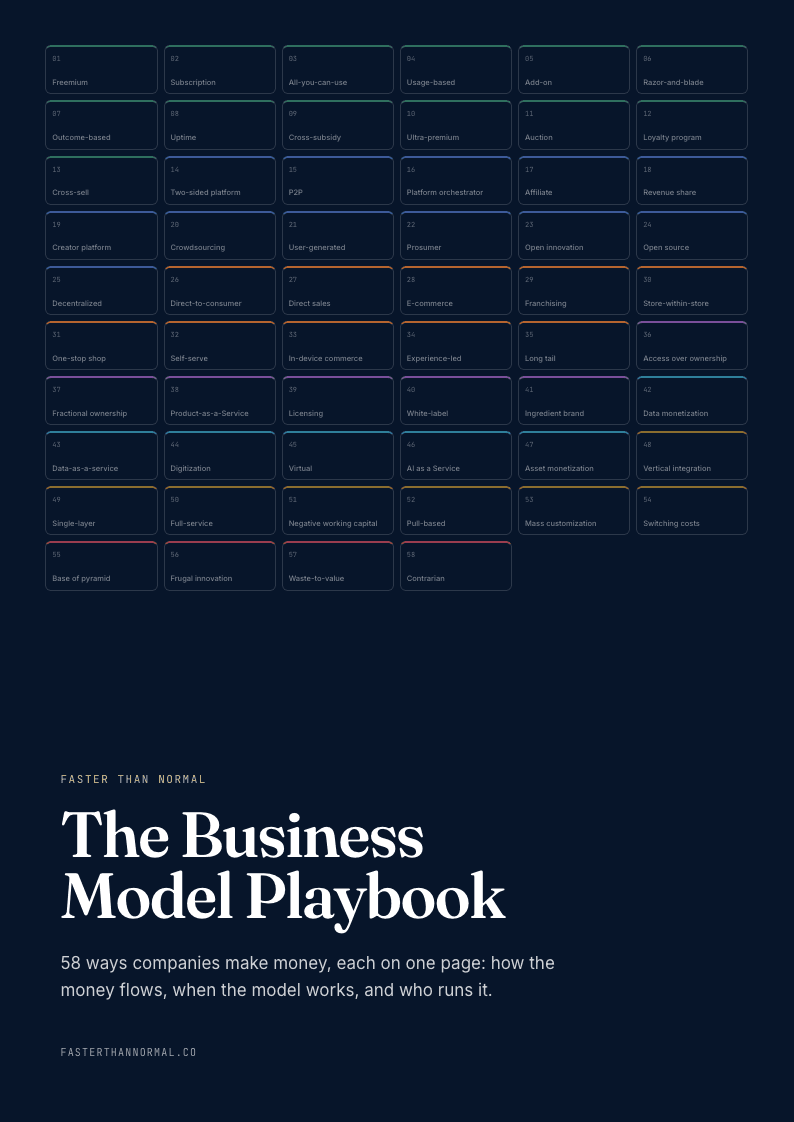
Free playbook
Get The Business Model Playbook
58 business models, one visual page each: how the money flows, the metrics that matter, and who runs it. Free when you join the Faster Than Normal email.
Free. No spam. Unsubscribe anytime.
Part IIIMaxims
-
Start with what you can afford, not what you wish you had. A secondhand ship and a $200,000 loan built the largest fleet on earth — the constraint was the catalyst.
-
Serve the markets that prestige ignores. The routes between Europe and Africa were beneath the notice of established carriers, and that inattention was the opening that made everything possible.
-
Ownership is the ultimate compounding mechanism. Every percentage point of equity you retain today multiplies across every year of future growth; never give it away without understanding the lifetime cost.
-
Privacy is not secrecy — it is optionality. The less your competitors, regulators, and the press know about your plans, the more freedom you have to change them.
-
Relocate to the jurisdiction that fits the business, not the biography. Sentiment is for holidays; structure is for headquarters.
-
Buy when others are selling. The courage to invest during industry downturns — when vessels are cheap and competitors are frightened — is the single greatest source of asymmetric returns in capital-intensive industries.
-
Vertical integration is a moat you build one link at a time. Owning ships is a business; owning ships, ports, and inland logistics is a platform.
-
A family that operates together governs together. Shared values and trust across generations are worth more than the most credentialed outside management team — but only if the next generation earns its place.
-
Details at every scale. The person who decorates the cruise ships and the person who acquires the fleet should be, if possible, the same person — or at least governed by the same sensibility.
-
Let the work speak. Then let it keep speaking. Fifty-five years of compounding growth, accomplished in near-total silence, is the most eloquent statement of all.
In Their Own Words
What started as a romantic meeting on a ferry to Capri in 1969 transformed into a lifelong personal and business partnership.
In every important decision, I had an active and important role.
Our journey to success was not without its ups and downs, but we always focused on our goals.
We took routes that other shipping companies would not, which allowed us to grow our fleet significantly.
Understanding the market is crucial; it's about making smart decisions and effective teamwork.
Starting with a small family-led operation, we aimed to build something great.
Diversifying our business was essential for growth and stability.
We made sure to take a controlling stake in our company to secure our future.
My upbringing taught me the value of hard work and careful financial management.
The shipping industry is about more than just logistics; it's about building relationships.
Every challenge we faced was an opportunity to learn and improve.
Success is a journey, not a destination; it requires continuous effort and adaptation.
What started as a small family-led operation slowly became the world's largest container shipping line.
My rise began when I met my future husband, Gianluigi Aponte.
It started much earlier, with steady work and clear ideas about what I wanted to build.
I understood money early, not from a billionaire's lifestyle, but from watching how carefully my father worked.
Together, we started the Mediterranean Shipping Company in 1970.
Our supply chain operation now operates out of 80 countries worldwide.
We made sure to take a 50% controlling stake in MSC.
I grew up speaking multiple languages, which helped me move easily in the international business world.
My story did not start with money or popularity.
I developed an early understanding of what it meant to work hard.
The couple used a $200,000 loan to purchase the vessel and start their empire.
While established shipping giants focused on premium routes and services, MSC identified underserved markets and offered competitive pricing without compromising reliability.— Office Chai, on the Apontes' strategy


