


Part IThe Story
The Postcard from Williamsburg
Somewhere in the autumn of 1984, on a bench in the shade at Colonial Williamsburg, a forty-three-year-old woman who had already lived two full careers sat watching tourists in tricorn hats file past reconstructed eighteenth-century shops and felt something click. The feeling was closer to indignation than nostalgia, though nostalgia was part of it. Pleasant Rowland—former second-grade teacher, former television news anchor, successful textbook author pulling six figures in royalties from reading programs used in classrooms across America—had come to Virginia with her husband for a conference and found herself ambushed by the past. The costumes, the homes, the accessories of everyday life. The way a pewter tankard on a rough-hewn table could conjure an entire civilization. "I remember sitting on a bench in the shade," she later recalled, "reflecting on what a poor job schools do of teaching history… was there some way I could bring history alive for them, the way Williamsburg had for me?"
She dashed off a postcard to Valerie Tripp, a fellow children's author. Thirty-five years later, Rowland would remember that the postcard contained, in compressed and slightly manic form, essentially the entire concept: the dolls, the books, the period clothing, the accessories, the retail stores, even the idea for a musical. The whole architecture of what would become a $700 million company, scribbled on a three-by-five-inch rectangle of cardstock somewhere between the Governor's Palace and the silversmith's shop.
The second catalyzing event came that winter. Christmas shopping for her eight- and ten-year-old nieces, Rowland surveyed the toy aisles and found them spiritually barren. Barbie, with her impossible proportions and dream houses, was training girls in the performance of adult femininity. Cabbage Patch Kids, with their scrunched faces and adoption certificates, were training them in motherhood. Where was the doll for a girl who was still just a girl—who might want a companion her own age, living through something real, dressed in clothes that meant something? "Are you kidding?" the marketers and manufacturers told her when she described her vision. "Historical dolls in the day and age of Barbie?"
By the Numbers
The Pleasant Company Empire
$1.7MSales in first four months (1986)
$300MAnnual revenue by mid-1990s
$700MSale price to Mattel (1998)
36M+American Girl dolls sold to date
$1.2MPersonal savings invested at founding
500KNames on initial mailing list
$110Current base doll price (up from $68 in 1986)
Chocolate Cake with Vitamins
To understand what Pleasant Rowland built, you have to understand what she was before she built it—and the thread that connects all her incarnations is a single, almost monomaniacal conviction about reading.
Pleasant Williams Thiele was born on March 8, 1941, in Chicago, the eldest of four children raised in Bannockburn, a leafy suburb north of the city. Her father, Edward M. Thiele, was a prominent advertising executive who rose to become president of the Leo Burnett agency—the firm behind the Jolly Green Giant, the Marlboro Man, Tony the Tiger—from 1961 to 1971. Her sister, Barbara Whitney Carr, would later become president and CEO of the Chicago Botanic Garden. There was, in other words, a family aptitude for building institutions that felt inevitable only after they existed.
Rowland graduated from Wells College in Aurora, New York, in 1962—a small women's liberal arts school perched on the eastern shore of Cayuga Lake, in a village so picturesque it would later become the canvas for her most personal philanthropic obsession. She went straight into a second-grade classroom at Mattapan Elementary in Massachusetts, where she discovered, with the intensity of a convert, that she had no idea how to teach children to read. The existing curricula struck her as limp, disconnected, unserious. So she built her own.
"Reading is at the heart of all achievement," she would say, with the compressed certainty of someone who has arrived at a first principle. "Without it, the American dream is out of reach. With it, anything is possible."
The materials she cobbled together in that Massachusetts classroom eventually became Beginning to Read, Write, and Listen, published by J.B. Lippincott in 1971—the first academic kindergarten curriculum ever published, by her account, and one that remained in continuous use for four decades. She authored dozens of short, colorful alphabet books still published by McGraw-Hill. She developed the Addison-Wesley Reading Program. She was, in short, an expert in packaging knowledge for young minds in forms they would actually consume. The textbook royalties alone—$1.2 million, accumulated over years of steady backlist sales—would become the seed capital for everything that followed.
Between the teaching and the textbooks came a brief, revealing detour. From 1968 to 1971, Rowland worked as a news reporter and anchor at KGO-TV, an ABC affiliate in San Francisco. The pivot seems improbable—schoolteacher to television journalist—until you recognize the connective tissue: both jobs are fundamentally about communication, about taking complex information and making it vivid, immediate, accessible to an audience that didn't know it was interested. She learned, at KGO, how to tell a story to people who weren't sitting still.
She carried all of it—the teacher's instinct for pedagogy, the ad executive's daughter's feel for branding, the journalist's sense of narrative economy, the textbook author's rigor about facts—into the company she founded in 1986 in Middleton, Wisconsin, with her own $1.2 million. She called it Pleasant Company, which sounds like either a Puritan settlement or a mission statement, and it was a little of both.
"We give girls chocolate cake with vitamins," she told people. It was the most concise articulation of her philosophy: the books are exciting, the magazine is fun, the dolls and accessories are pretty. But embedded in the pleasure is substance—history, character, the slow accumulation of a moral vocabulary. The sugar was the delivery mechanism. The medicine was the point.
The Original Three
The first Pleasant Company catalogue landed in the fall of 1986, mailed to roughly 500,000 upscale consumers from a purchased list, supplemented by advertisements in the New Yorker and Smithsonian. Rowland had worked with a small team to produce a lavish publication that pictured dolls in enticing tableaux where everything in the image was for sale: furniture, accessories, extra outfits. It was a retail catalogue that read like a storybook, or a storybook that functioned as a retail catalogue—the distinction was the point.
Inside were three nine-year-old girls: Kirsten Larson, a Swedish immigrant settling on the Minnesota frontier in 1854. Samantha Parkington, a well-to-do orphan growing up in the Progressive Era of 1904. Molly McIntire, a bespectacled Midwesterner on the home front during the Second World War. Each doll was eighteen inches tall, with heavy, plush bodies and appealing faces—not the glossy plastic perfection of Barbie, but something warmer, more tactile, more real. Each came with a set of six books about her life, following her through approximately one year during a significant point in American history.
The dolls cost over $60 in 1986—expensive enough to feel aspirational, affordable enough to remain within reach of the middle class that was Rowland's target market. This was deliberate. As marketing scholars would later note in a 2009 Journal of Marketing article, American Girl was "a 'masstige' brand in a time of mass affluence," pitched precisely at the anxious, striving parents of the eighties and nineties who responded to national narratives of progress and prosperity by gearing play toward replication of the family's class position. The books taught historical facts. The dolls had documentable, diverse interests and well-rounded personalities. They seemed, as one observer put it, like obvious college-bound types. American Girl offered preparation for the college essay in the form of a toy.
By Christmas 1986, Pleasant Company had sold $1.7 million worth of product through mail order alone. By the second year, sales reached $7.6 million. The mailing list, which had started at 500,000 names, grew to eight million over the first three years. By 1991, sales hit $77 million—all from a catalogue and word of mouth, with no retail stores, no television advertising, no distribution through toy stores. Rowland had, with almost perverse deliberateness, violated every rule in the toy industry.
She sold directly to parents, not through retailers—preserving control over the brand experience. She paired toys with books, creating a combined entertainment-and-education proposition that no competitor could replicate by copying just one element. She marketed to mothers and grandmothers as much as to girls, building the brand around intergenerational connection. And she priced the products high enough that purchasing them felt like an event, a ceremony, a statement of values.
— Pleasant RowlandI am opposed to the mass culture which tries to sell young girls sophisticated notions of their sexuality. The American Girls are portrayed by their accompanying books as intelligent, active, and heroic; in other words, anything but traditional.
The dolls were, from the beginning, not just toys but a brand—a complete consumer universe with its own internal logic, its own aesthetic, its own moral vocabulary. Rowland understood something that would take the rest of the toy industry another decade to grasp: that the most powerful product is not a thing but a world.
The Weight of a Ribbon Bookmark
What was it, exactly, that made American Girl so different from everything else on the shelves? The answer has something to do with density—the sheer accumulation of sensory and narrative detail packed into every object.
The books came with ribbon bookmarks. The dolls had thick, brushable hair. Samantha's trunk contained miniature replicas of real Victorian objects. The catalogue was so lovingly composed that one woman told the authors of Dolls of Our Lives that she demanded her mother read it to her like a bedtime story. Every element communicated the same message: this matters, this is real, this is worth your attention.
For the girls who received these dolls—overwhelmingly, the first target audience was children of the eighties and early nineties, now adult millennials—the experience was immersive in a way that predated and perhaps anticipated the immersive digital environments that would follow. You didn't just play with an American Girl doll. You entered her world. You learned about her era. You wore matching clothes. You wrote on a tiny slate from Samantha's schoolroom accessories. You dressed as Kirsten for Christmas and used an Advent wreath as a headdress for Santa Lucia.
"I was very dedicated to the cause," one woman, Elizabeth Phillips, a self-described Kirsten, told a reporter. "I was trying to be that one doll to the depths of my bones." Phillips wore her Santa Lucia dress to a Republican convention with family members. "Fiscally conservative," she said, "socially Kirsten."
This was identity formation as much as consumer behavior. Rowland's twin innovations—a multifaceted, highly detailed consumer universe paired with a doll that was herself a girl—invited children to perform themselves. You chose your doll based on who you believed yourself to be: Samanthas were bookish but outdoorsy, smart but not show-off-y, loyal friends. Felicitys were horse girls. Kirstens had arts-and-crafty streaks. Mollys were cool nerds before that was a thing. One Molly friend faked having bad vision so she could get glasses; when she finally confessed, she had to wear corrective lenses to bring her eyes back to normal.
The marketing researchers who studied visitors to Chicago's American Girl Place for more than three years concluded that the dolls should be understood not as "tidily nested identical entities" over which the brand held ultimate narrative control, but as "a disorderly aggregation… filled with ambiguities that consumers are driven to resolve and lacunae they are compelled to fill." The researchers called American Girl an "open source" brand—citing Linux and Wikipedia as contemporaneous examples—and argued, presciently, that brands which allowed consumers to become storytellers and content creators in their own right were the way of the future. By that measure, Rowland had built a platform in 1986.
The Addy Problem
The limits and power of Rowland's approach are visible, with almost painful clarity, in the story of Addy Walker.
Introduced in 1993 as Pleasant Company's first—and for nearly two decades, only—Black historical doll, Addy's story follows a nine-year-old girl born into slavery on a tobacco plantation in North Carolina, her eventual escape with her mother during the Civil War, and her new life in Philadelphia. The character was the fifth doll in the collection, arriving seven years after the original three white girls and two years after Felicity Merriman, another white character from Colonial Williamsburg.
Rowland convened a panel of Black scholars to advise on Addy's character, plot, and history. Connie Porter, a Black novelist, was hired to write the six books. The company's approach to telling Addy's story was, by the standards of a children's consumer brand in the early nineties, remarkably unflinching. There were no white saviors. Slavery was depicted as dehumanizing and hopeless. When Addy's mother escapes with her elder daughter, she leaves an infant behind. "I wanted children to see African American people as part of strong, loving families, caught up in slavery, doing what they had to do to survive," Porter said.
And yet: the company that produced Addy also produced Felicity Merriman, whose family owns enslaved people referred to in the books as "servants." The gap between those two narrative choices—scrupulous honesty in one character's story, euphemistic evasion in another's—reveals something essential about the contradictions embedded in the American Girl project from the start. History was a narrative of progress, and ordinary girls were its protagonists, but the brand had to decide, character by character, whose discomfort it was willing to risk.
For Black girls who played with Addy, and Black parents who considered buying the doll, the experience was freighted in ways that went beyond nostalgia. Brit Bennett, in a 2015 Paris Review essay, asked the question that hovered over the entire enterprise: "If a doll exists on the border between person and thing, what does it mean to own a doll that represents an enslaved child who once existed on that same border?"
The answer, as with so much about American Girl, was that the complexity was the product. The scholars called it ambiguity. The marketers called it engagement. The children just played—which meant they absorbed, without necessarily being able to articulate, the contradictions of American history itself: that freedom was universal and unequally distributed, that progress was real and partial, that you could love your country and be appalled by it, sometimes in the same breath.
— Brit Bennett, Paris Review, 2015If a doll exists on the border between person and thing, what does it mean to own a doll that represents an enslaved child who once existed on that same border?
A Cathedral of Commerce
In 1998, the same year she sold Pleasant Company to Mattel for $700 million, Rowland opened the first American Girl Place in Chicago—a 35,000-square-foot retail experience that was less a store than a theme park for the daughters of the professional-managerial class.
Girls could have tea with their dolls. They could get their dolls' hair done at the Doll Hair Salon. They could browse accessories ranging from velvet settees to VW Beetles to spa chairs. They could eat finger sandwiches at the American Girl Café while their doll sat in a booster seat at the table. The entire operation was designed to make the purchase of a $110 doll feel like an event, a pilgrimage, a rite of passage—which, for many families, it was.
Rowland had always understood that she was selling not objects but experiences. The catalogue had been an experience. The books had been an experience. The magazine—American Girl, a bimonthly publication that functioned as a sort of Real Simple for the prepubescent set—had been an experience. The stores were merely the physical culmination of a strategy that had been in place since the first postcard from Williamsburg: surround the girl with a complete world, and she will never want to leave.
By the time of the Mattel sale, the brand had accumulated a dizzying array of touchpoints and spinoffs. Infant Bitty Baby dolls. Cookbooks. Theatre kits. Paper dolls. D.I.Y. craft kits. A clothing line. An annual Girl of the Year model. A customizable contemporary doll available in tens of skin and hair tone combinations. A puberty guide for girls called The Care and Keeping of You that became, for an entire generation, the first frank conversation they had about their changing bodies. Pen-pal opportunities. The magazine. The stores.
More than twenty-three million dolls had been sold. American Girl magazine had a circulation of nearly half a million. In the second quarter of 2013, American Girl's sales rose fourteen percent while other Mattel lines like Barbie and Fisher-Price posted declines. The brand had become, improbably, the thing that kept its corporate parent afloat.
Selling the Company, Keeping the Mission
The decision to sell to Mattel in 1998 was, by Rowland's own account, less about money than about scale. She was fifty-seven. She had built a $300-million-a-year company from scratch using $1.2 million in personal savings and a mailing list. She had no heirs to whom to pass the business—she and her husband, W. Jerome "Jerry" Frautschi, a quiet, motorcycle-riding Madison businessman who had run the family printing company Webcrafters for forty-two years, had no children. The company needed a corporate parent with manufacturing infrastructure and global distribution. Mattel had both.
Frautschi himself is a study in contrasts that illuminate what made the Rowland-Frautschi partnership work. A Korean War Navy veteran, he was a big, friendly man with a Wisconsin accent that emerged when he talked about the family cabin outside Minocqua, old-fashioned manners that registered as genuine rather than performed, and a single notable eccentricity: he loved to ride his Kawasaki motorcycle around the country. When asked about Rowland, his face lit up with adoration. When asked about himself, he became physically uncomfortable, as though self-disclosure were a mild form of violence. "This isn't about Jerry Frautschi," he told a reporter. The bold, modernist art in his office had been chosen by his wife.
Rowland stayed on as president and chairman of American Girl until 2000, then stepped away. The separation was not entirely clean. Under Mattel's stewardship, the brand expanded rapidly—more dolls, more characters, more stores, more product lines—but critics argued that the expansion came at the cost of depth. Characters came and went with increasing speed. The original three were archived: Samantha in 2009, Kirsten in 2010. Molly would follow. The emphasis shifted from deepening your relationship with one doll and her world to expanding your network of friends, collecting limited-edition releases before they disappeared.
"You buy yourself," Robin Bernstein, a Harvard cultural historian, observed of the customizable My American Girl line. "It's all about you, you, you." Instead of you becoming your doll, your doll becomes you.
Whether this represented betrayal or evolution depended on what you thought the brand was for. Rowland had built American Girl to teach girls about history—to pull them out of themselves and into the lives of others across time. Mattel's American Girl taught girls about themselves—which was, perhaps, what the market demanded, but it was not the same thing.
The Second Act in Aurora
After leaving American Girl, Rowland turned her attention—and her fortune—to two things: reading instruction and the physical restoration of the past.
In 2003, she formed the Rowland Reading Foundation to update and distribute the Superkids reading program she had originally developed decades earlier as a young teacher, and to support research into the most effective methods of teaching children to read. The foundation, headquartered in Middleton, Wisconsin, continues to operate with Rowland as president, drawing no salary. It is, in a sense, a return to the beginning—to the conviction that reading is the master skill, the skeleton key, the precondition for everything else.
But her most visible philanthropic project—and her most controversial—was the restoration of Aurora, New York, the tiny village on Cayuga Lake where she had attended Wells College.
Aurora in the early 2000s was a place of faded grandeur: paint peeling off old mansions, the inn struggling to stay open, the college struggling with enrollment. Rowland swept in with money, vision, and a perfectionism that rattled the village to its core. She bought buildings and tore others down. She moved houses, businesses, and trees. She buried power lines. She spent $2 million on a lavish refurbishing of college interiors. She opened the Aurora Inn, a red-brick hotel with gleaming white porches, and later the Rowland House, a third property in what became the Inns of Aurora. She restored the village market until it featured exquisitely perched baskets overflowing with ripe tomatoes and eggplants—a tableau that seemed, to some residents, almost too good to be true.
"How polished we are now, how shiny," said the village historian, Sheila Edmunds. "But at what cost?"
The cost was, in part, the kind of disruption that accompanies any large-scale restoration: changed sightlines, demolished structures, displaced businesses, the imposition of one person's aesthetic vision on a community of seven hundred. "It wasn't restoration," said one resident. The implication was that it was something closer to creation—the construction of an idealized past that had never quite existed, a Colonial Williamsburg on Cayuga Lake.
The parallel to American Girl was not lost on anyone who noticed it. Rowland had spent her career creating meticulously researched, emotionally resonant versions of the American past for consumption by girls and their families. In Aurora, she was doing the same thing—but with real buildings, real streets, real people who had to live inside the diorama.
The Overture
The philanthropy extended far beyond Aurora. In Madison, Wisconsin, the couple's generosity remade the city's arts landscape with a totality that bordered on the geological.
Frautschi donated $205 million—first $50 million in 1998, then another $50 million, and eventually the full amount—to establish the Overture Center for the Arts, a performing arts center and gallery that opened in 2004 and today hosts nearly 500,000 artistic and educational experiences annually. The gift is cited as one of the largest gifts to the arts from a single donor in the country. Rowland created the Great Performance Fund, a $46 million endowment to support Overture's resident arts organizations, providing $2 million in annual revenue. She founded Concerts on the Square, a free public summer concert series that has run for over forty years.
Since 1988, the annual American Girl Benefit Sale—Rowland's brainchild—has raised more than $22 million for the Madison Children's Museum and the American Girl Fund for Children, which each year exposes tens of thousands of Madison-area children to world-class creativity.
Rowland gave $2 million to the Waisman Center at UW–Madison for early childhood programs serving children with developmental disabilities—a gift she framed explicitly as a return to her origins: "I began my career as an early childhood teacher and know first-hand how valuable the center's work is in the area of developmental disabilities." She endowed the Rowland Distinguished Directorship for the Center for Textiles, Culture and Design at the UW School of Human Ecology. She provided the lead gift for the restoration of Ten Chimneys in Waukesha. She saved Red Pine Camp in northern Wisconsin from development. She endowed a gallery at the Milwaukee Art Museum.
And then, in 2012, her kidneys failed.
After two decades of chronic kidney disease, blood tests revealed stage 4 kidney failure—kidneys performing at roughly fifteen percent. No family member was a match. Rowland wrote a letter "to everyone I knew." Multiple people volunteered to donate. Within weeks, a UW Health surgeon was transplanting a donated kidney. She left the hospital two days later. "This was a miracle to me," she said.
Her gratitude took the form of a $10 million gift to create the Pleasant T. Rowland Transplant Clinic at University Hospital, announced in 2021. "It feels nearly impossible to say thank you enough to the kidney donor who saved my life," she said. "Life after transplant is wonderful."
The Brand That Taught Girls to Be Online
The most surprising legacy of American Girl may be one that Rowland never intended and could never have anticipated.
The brand positioned itself, throughout the nineties and two-thousands, as a wholesome alternative to the encroaching digital world—a "safe sounding board and community" for girls who knew better than to waste their time in chat rooms. The dolls and books themselves, with their focus on historical reenactments and educational reading, seemed like healthy alternatives to childhoods increasingly under threat from the Internet.
Yet American Girl taught girls to present themselves the way they later would online. The magazine invited girls to write in with their questions, to become pen pals with other American Girl–loving girls, to supply their own family trees for paper dolls in which each woman in a familial line could be represented by a paper cutout, complete with clothes based on family photographs. Participating in an American Girl pen pal network felt old-timey in the nineties, but in fact segued neatly into a millennial-pioneered form of peer connection—the long-distance, online-only friend.
Almost all dolls prepare girls to perform womanhood. Baby dolls ready them for mothering; Barbies for being sexual objects. Rowland's dolls invited girls to perform themselves—to define themselves by riffing on type, to tell their life stories through brand-established channels. The brand introduced millennials to the pleasure of curating an identity, of selecting from a menu of archetypes, of presenting a coherent self to an audience of peers.
American Girl, in other words, was a pre-digital social network. It prepared an entire generation for the platform economy without knowing it—or wanting to.
As one observer noted: "A new type of relationship first experienced by my generation is 'girl I've been friends with online for 20 years.'" The roots of that relationship ran through burgundy catalogues and eighteen-inch dolls with brushable hair.
Constant Dawn
Early settlers called Aurora, New York, the village of constant dawn—a name that evokes both the optimism of beginning and the strangeness of light that never quite resolves into day.
Pleasant Rowland, who turned eighty-four in March 2025, remains active in her foundations, still drawing no salary, still pursuing the reading instruction programs she began as a young teacher in Massachusetts. A documentary—All American Girls, directed by Christy Wegener and produced by Participant and Conduit Films—is in production, featuring Rowland's first extended sit-down interview and never-before-seen footage from the brand's archives. She granted the film rights to her story for the first time.
The brand she created has entered a strange second life. Adult millennials in their thirties gather at American Girl Cafés. There are multiple American Girl recap podcasts, a host of history meme accounts, YouTube creators who replicate period American Girl outfits in adult sizes. The dolls have been spoofed on Saturday Night Live, referenced in The Last of Us, and generate some of the highest social media engagement of any brand in history. Nearly four decades after their inception, the eighteen-inch dolls have become vehicles for political and cultural expression in ways that would have been unimaginable in 1986.
The original American Girls—Kirsten, Samantha, Molly—appear to their now-adult fans as missives from a past that the Internet has both resurfaced and erased. Our early childhoods preceded social media completely, but our teenage understandings of ourselves were irrevocably colonized by it. By college, we had immigrated to the land of the online and could never return home. American Girl may have prepared us to be good digital subjects, but the dolls were not of the Internet themselves; as we logged on, they stayed behind.
One writer, reflecting on the experience of rediscovering the original American Girl catalogue online—each page photographed and uploaded to a blog—described a visceral memory stirring from some untrodden, internal place: of holding up the page with Felicity pictured vertically in the centerfold, the midsection of her floral everyday dress dimpled by the magazine's staples. The concentration she possessed, then, to fall into the images of the trunk and accouterments as though in contemplation of a Bruegel. She hadn't seen these images for twenty years, but she still remembered every page.
Part IIThe Playbook
Pleasant Rowland built one of the most culturally significant consumer brands of the twentieth century by ignoring virtually every piece of conventional wisdom about the toy industry. She sold directly to parents instead of through retailers. She paired toys with books in an era when the two categories were considered incompatible. She priced her products above the mass market in a business built on volume. She marketed history to children raised on cartoons. And she did it all with her own money, from a town no one in the toy industry had heard of, in a category—educational dolls for tween girls—that didn't exist before she invented it.
The principles below are distilled from Rowland's decisions, her public statements, and the testimony of those who studied, worked with, or grew up inside the world she created.
The principles
- 1.Build the world, not the product.
- 2.Sell to the buyer, not the user—then make the user the evangelist.
- 3.Control the entire experience.
- 4.Embed substance inside pleasure.
- 5.Price for ceremony, not accessibility.
- 6.Use your first career as raw material for your second.
- 7.Self-fund to preserve conviction.
- 8.Design for ambiguity.
- 9.Build intergenerational bridges.
- 10.Know when the mission requires a new vehicle.
- 11.Restore, don't just donate.
- 12.Treat the catalogue as the product.
Principle 1
Build the world, not the product.
Rowland never described herself as making dolls. She was building a world—a complete consumer universe with its own internal logic, aesthetic, and moral vocabulary. The doll was the anchor, but the books, the clothing, the accessories, the magazine, the catalogue, the retail stores, and eventually the online community all worked together to create something greater than any single product. Marketing researchers at the Journal of Marketing recognized this as early as 2009, calling American Girl an "open source" brand that invited consumers to become co-creators of narrative. The insight was that depth of world-building creates a moat that competitors cannot cross by copying any single element. Barbie had better distribution. Cabbage Patch Kids had a better price point. Neither had a world.
Tactic: Before building the product, define the complete universe it inhabits—the stories, the aesthetics, the rituals, the community—and ensure that every touchpoint reinforces the same emotional logic.
Principle 2
Sell to the buyer, not the user—then make the user the evangelist.
American Girl's primary customer was the eight-year-old girl's mother, grandmother, or aunt—the adult woman who made the purchasing decision and who responded to the brand's promise of educational value, historical literacy, and wholesome play. Rowland marketed to these women through catalogue aesthetics, book quality, and institutional credibility (partnership with Scholastic, advisory panels of scholars). But the genius was that once the product was in the girl's hands, the girl became the evangelist—demanding the next book, the next accessory, the next visit to the store—and the mother became the repeat buyer. The mailing list grew from 500,000 to eight million in three years, driven almost entirely by word of mouth among mothers.
Tactic: Identify the actual decision-maker in your purchase chain and build your brand messaging for them, while ensuring that the end user's experience creates organic demand that the decision-maker cannot resist.
Principle 3
Control the entire experience.
For most of its independent existence, Pleasant Company sold exclusively through its own catalogue, its own phone lines, and its own retail stores. Rowland refused to distribute through toy stores, department stores, or mass-market retailers. This was heretical in the toy industry, where shelf space at Toys "R" Us was the currency of survival. But direct distribution gave Rowland total control over how the brand was presented, priced, and experienced. No doll sat on a shelf next to a discounted competitor. No retailer could undercut her margins. No store associate could misrepresent the product. The experience of purchasing an American Girl doll—through a catalogue that doubled as a storybook, or in a store that doubled as a theme park—was itself part of the product.
Tactic: When the experience is the product, distribution through third-party channels that degrade the experience is not a growth strategy—it is brand destruction. Control the channel even if it limits scale.
Principle 4
Embed substance inside pleasure.
"Chocolate cake with vitamins" was a design philosophy. Every element of the American Girl experience was engineered to be enjoyable first—beautiful dolls, exciting stories, a dreamy catalogue—and educational second. The history was rigorous (advisory panels of scholars, meticulously researched period details, books written by serious authors like Connie Porter and Valerie Tripp), but it was always in service of pleasure, never the reverse. Children learned about the Civil War not by studying it, but by falling in love with Addy Walker. They absorbed the Progressive Era not through textbooks, but through Samantha Parkington's encounters with child labor. The substance was invisible to the consumer—which is how it got consumed.
📚
The Hidden Curriculum
How American Girl embedded education inside entertainment.
| Surface experience | Embedded lesson |
|---|---|
| Brushing Kirsten's hair | Swedish immigrant experience on the frontier |
| Accessorizing Samantha's trunk | Class inequality in Progressive Era America |
| Reading Addy's escape story | The dehumanization of slavery |
| Matching outfits with Molly | Home front sacrifice during WWII |
| Paper dolls in the magazine | Matrilineal family history and genealogy |
Tactic: If your product has a pedagogical or functional purpose, don't lead with the function. Lead with the desire. Make the medicine invisible inside the pleasure.
Principle 5
Price for ceremony, not accessibility.
At over $60 in 1986 (approximately $170 in today's dollars), American Girl dolls were significantly more expensive than mass-market alternatives. The base price has since risen to $110. This pricing was not incidental—it was structural. A high price point transformed the purchase from an impulse buy into an event, a gift, a ritual. Parents saved for it. Girls anticipated it. Grandmothers bestowed it. The doll arrived not as one of many toys, but as the toy—a cherished possession that was put away and passed down. Rowland explicitly wanted the dolls to be "quality pieces—not plastic playthings—made for children over eight years old to treasure." The price was part of the quality signal, and the quality signal was part of the emotional architecture.
Tactic: If your product is meant to be cherished, price it to be cherished. Ceremonial pricing creates emotional weight that discounting destroys.
Principle 6
Use your first career as raw material for your second.
Rowland's trajectory—teacher, journalist, textbook author, toy mogul—appears zigzagging only in retrospect. Each phase contributed essential skills to the next. Teaching gave her an instinct for how children learn and what captures their attention. Television journalism taught her narrative economy and the art of communicating to an audience that isn't sitting still. Textbook publishing gave her expertise in packaging knowledge in forms that institutions would adopt and distribute. The toy company synthesized all three: storytelling, pedagogy, and product development, unified by a deep understanding of how children process information.
🔄
Career Convergence
How each of Rowland's careers fed the next.
1962
Begins teaching second grade at Mattapan Elementary, Massachusetts.
1968
Joins KGO-TV in San Francisco as news reporter and anchor.
1971
Publishes Beginning to Read, Write, and Listen—first academic kindergarten curriculum.
1973
Develops Addison-Wesley Reading Program; becomes leading textbook author.
1984
Visits Colonial Williamsburg; conceives American Girl on a postcard.
1986
Founds Pleasant Company with $1.2M in personal savings.
1998
Sells to Mattel for $700M; opens first American Girl Place.
2003
Founds Rowland Reading Foundation—returns to literacy mission.
Tactic: Don't abandon your prior expertise when you change careers—metabolize it. The most powerful founders bring skills from domains their competitors don't even know exist.
Principle 7
Self-fund to preserve conviction.
Rowland invested $1.2 million of her own textbook royalties to start Pleasant Company. She took no venture capital. She answered to no board. This financial independence allowed her to make decisions that no investor-backed founder could have made: selling exclusively through catalogues, refusing mass-market distribution, pricing above the competition, pairing toys with six-book historical fiction series. Every one of these decisions would have been challenged—and likely vetoed—by a board optimizing for short-term growth. Her reasons for self-funding were philosophical as well as financial. She believed the brand would work, and she believed that the only way to prove it was to build it without compromise.
Tactic: If your vision requires decisions that are legible only in hindsight, self-funding—or funding structures that preserve founder control—may be the only way to execute without dilution of conviction.
Principle 8
Design for ambiguity.
The marketing scholars who studied American Girl found that the brand's power came not from the clarity of its narratives but from their ambiguity—"lacunae" that consumers were compelled to fill. The dolls were specific enough to be interesting and vague enough to be personal. Addy's story raised questions about race, ownership, and freedom that the books did not fully resolve. Samantha's world contained both luxury and poverty without offering easy moral judgments. The result was that girls didn't just consume the stories—they remixed them, extended them, argued about them, and used them as starting points for narratives of their own. This was not a bug in the design. It was the design.
Tactic: Leave strategic gaps in your product's narrative. Consumers who fill in the blanks become co-creators, and co-creators become lifelong fans.
Principle 9
Build intergenerational bridges.
Rowland explicitly designed American Girl to connect mothers, daughters, and grandmothers. The paper dolls in the magazine traced matrilineal family lines. The catalogue was addressed to parents as much as children. The store experience was built for shared participation. "What I think American Girl really does," Rowland said, "is give mothers and daughters and grandmothers a chance to connect, as my mother and grandmother had with me in a simpler time of childhood." This intergenerational architecture served both emotional and commercial purposes: it created multiple purchase occasions (birthdays, holidays, rites of passage) and multiple buyers (parents, grandparents, aunts) for the same product. But more importantly, it embedded the brand in family ritual, making it resistant to the disposability that plagues most toy brands.
Tactic: Design your product for the relationship between generations, not just the individual consumer. Products embedded in family ritual have durability that products marketed to individuals cannot match.
Principle 10
Know when the mission requires a new vehicle.
Rowland sold Pleasant Company to Mattel in 1998, stepped away in 2000, and immediately redirected her energy to the Rowland Reading Foundation—a nonprofit devoted to the same literacy mission that had animated her entire career. She did not try to replicate American Girl. She did not start a competing toy company. She recognized that the company she had built needed corporate infrastructure to scale, and that her personal mission—teaching children to read—could be pursued more purely through a nonprofit than through a consumer brand. The sale moved resources from one vehicle to another, with the mission held constant.
Tactic: The mission is not the company. When the company can no longer serve the mission without compromise, sell the company and find a vehicle that can.
Principle 11
Restore, don't just donate.
Rowland's philanthropy is distinguished from conventional wealthy giving by its specificity and its physicality. She does not simply write checks to institutions. She restores buildings, rewires villages, rebuilds transplant clinics, endows reading programs. Each gift is a project—with an aesthetic vision, a timeline, a measurable outcome. The Aurora restoration, the Overture Center, the Waisman Center expansion, the transplant clinic—each follows the same pattern: identify something broken or underperforming, apply capital and design rigor, and transform it into something that functions beautifully. This is, of course, the same thing she did with American Girl: she identified a broken category (dolls for tween girls), applied capital and design rigor, and created something that functioned beautifully.
Tactic: Treat philanthropy with the same design discipline you bring to product development. The most impactful gifts are not the largest—they are the most specific, the most designed, the most obsessively executed.
Principle 12
Treat the catalogue as the product.
The Pleasant Company catalogue did more than sell. It was the primary medium through which most girls experienced the brand—the "storefront" that millions of children pored over, memorized, and demanded to be read aloud. Rowland invested in the catalogue as though it were a magazine, with rich photography, narrative layouts, and production values that far exceeded industry norms. For years, the catalogue was the company: there were no retail stores, no television ads, no third-party distribution. Every dollar of the first $77 million in annual sales came through a mailing list and a publication that girls treated as literature.
Tactic: If your marketing material is the primary point of consumer contact, invest in it as though it were the product itself. The catalogue, the email, the website, the packaging—whatever your customer touches first and most often—deserves the same design attention as the thing inside.
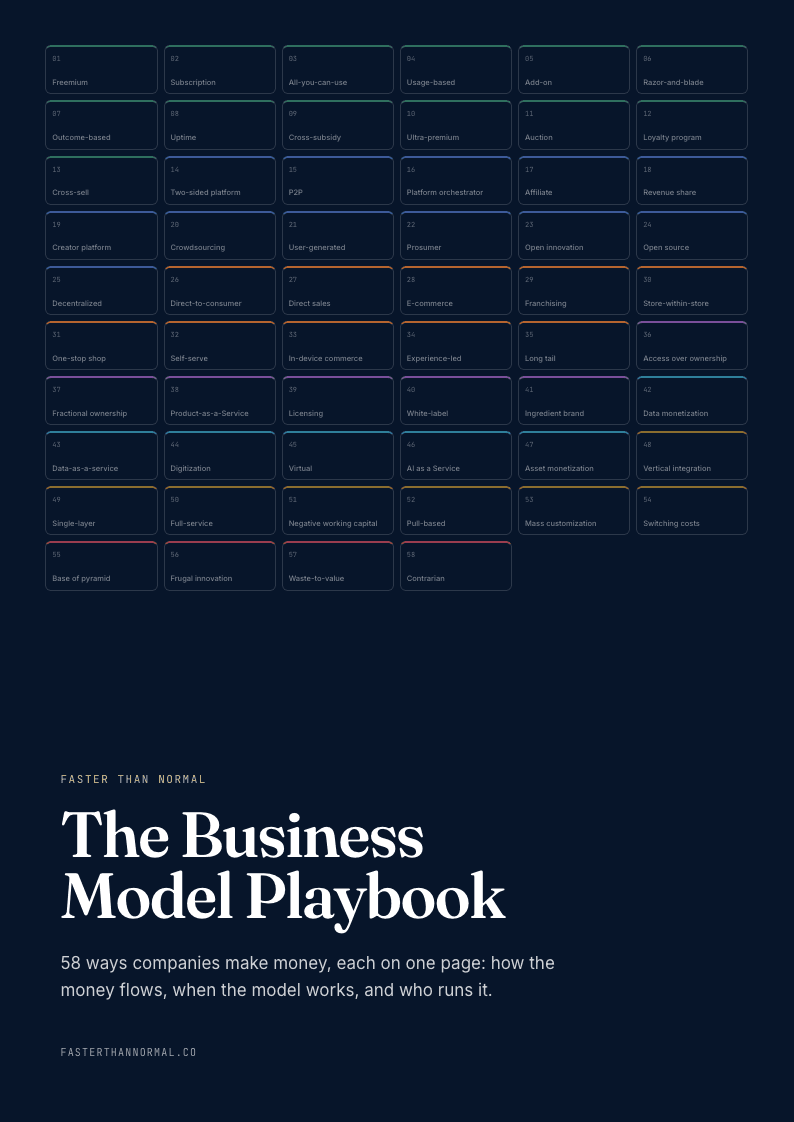
Free playbook
Get The Business Model Playbook
58 business models, one visual page each: how the money flows, the metrics that matter, and who runs it. Free when you join the Faster Than Normal email.
Free. No spam. Unsubscribe anytime.
Part IIIMaxims
-
Treat "Are you kidding?" as a map of the gap. Marketers and manufacturers laughed at historical dolls in the age of Barbie. Their certainty was the reason the category was empty.
-
The postcard is the business plan. The best ideas arrive whole. If you can describe the entire concept on a three-by-five-inch card—the product, the audience, the distribution, the experience—you have something worth building.
-
Shop for someone you love and note what's missing. The idea came together in a toy aisle, buying for two nieces, where every doll trained girls to be women or mothers and none let them stay girls.
-
Your candor is judged by your least honest story. The same company that told Addy's story without euphemism called Felicity's family's enslaved people "servants." Readers notice the gap between the two, and it becomes part of the brand.
-
Whoever buys your brand will optimize it for what sells. Under Mattel, the dolls moved from pulling girls into other lives to "you, you, you." If you sell, assume the purpose you built is negotiable to the new owner.
-
Perfection imposed on neighbors reads as ownership. In Aurora, the same rigor that built American Girl produced "It wasn't restoration" and "at what cost?" A diorama is harder to defend when real people have to live inside it.
-
When no one close can help, ask everyone. No family member was a kidney match. Rowland wrote to everyone she knew, several people volunteered, and she had a transplant within weeks.
-
A wholesome brand can train the habit it stands against. American Girl sold itself as an alternative to the Internet and ended up teaching a generation to curate an identity and keep long-distance friends.
-
Retiring the originals doesn't retire the attachment. Samantha and Kirsten were archived, and adult fans kept them alive anyway through cafés, podcasts, and memes. The founding products can outlast the company's interest in them.
-
The largest gift may come from the partner who won't talk about it. Frautschi gave $205 million for the Overture Center and told a reporter, "This isn't about Jerry Frautschi." The founder's story is rarely the whole household's story.
In Their Own Words
Toys are the seeds from which the tree of creativity grows. Nourish them well, and watch imagination bloom.
You can spend your life looking over your shoulder or you can look ahead. I choose to look ahead.
At an age when girls are old enough to read and still love to play, they need books and dolls that capture their imaginations and are worth caring for. I hope The American Girls Collection will be dearly loved and well played with and then passed down to other generations of girls tomorrow—a reminder that growing up in America is, has been, and can always be an experience to treasure.— Pleasant Rowland, catalogue letter to parents, 1987
Beginning to Read launched me on my second career as a textbook author. It was the first academic kindergarten curriculum ever published and has been in continual use for 40 years.— Pleasant Rowland, speech to educators, 2011
I loved the costumes, the homes, the accessories of everyday life. All of it completely engaged me.— Pleasant Rowland, on her visit to Colonial Williamsburg
It feels nearly impossible to say thank you enough to the kidney donor who saved my life and to the many doctors and staff at UW Hospital who made it happen. Life after transplant is wonderful.— Pleasant Rowland, on her kidney transplant, UW Health


