


Part IThe Story
The Cover Story
After Phebe Novakovic married Michael Vickers in 1985, the alumnae magazine at Smith College announced the nuptials with a breezy, innocent sentence: "Mike and Phebe met in the foreign service." That is what is known in the espionage trade as a cover story. The two had met while working for the Central Intelligence Agency, and Vickers was not just any operative—he was a former Green Beret who would become the chief strategist for the agency's covert program to arm the Afghan mujahideen against the Soviet army, a man whose exploits would later be dramatized in Charlie Wilson's War. Novakovic's role remains what the intelligence community would classify as a "known unknown." Her company biography confirms she served as a CIA operations officer from 1983 to 1986. When colleagues and board members are interviewed about her, nearly all of them instantly volunteer, unprompted: "You know she was in the CIA?" But like any good operative, Novakovic does not so much as whisper a word about her activities. Former colleagues believe she spent time overseas, probably under some official government cover, gathering intelligence about military capabilities. "One thing I do know," one former government official told Fortune, "is she wasn't just an analyst sitting in an office back in D.C."
Even her closest friends had no clue. Patricia Anne Lind, godmother to one of Novakovic's three daughters and co-general counsel of Nine West Holdings, admitted years later: "I thought she was somewhere in Washington. Clearly I hadn't known what my best friend was doing."
This is the founding paradox of Phebe Novakovic's career, and the key to understanding the $47.7 billion enterprise she commands: the woman who runs the world's third-largest defense contractor—manufacturer of the M1 Abrams tank, nuclear-powered submarines, Gulfstream jets, and a vast archipelago of IT and cybersecurity systems—is also the woman who has spent four decades perfecting the art of not being seen. She is allergic to the press. She is noticeably scarce on the Washington think tank circuit. She limits contact with Wall Street analysts to quarterly calls and the occasional investor conference, where her answers are terse and heavy on financials and light on elaboration. She does not maintain a LinkedIn profile. She travels to meetings with not more than two or three executives, when most CEOs of her stature arrive with entourages. She told David Rubenstein, the Carlyle Group co-founder, during one of her rare public conversations: "I've lived in this town for a long time and I've learned it's best to fly underneath the radar screen."
The radar screen, in this case, is Washington, D.C.—the city where she has spent the bulk of her professional life, orbiting the gravitational center of American power without ever quite becoming a public figure within it. And yet her influence is immense. General Dynamics, under her twelve-year tenure as chairman and CEO, has more than doubled its stock price, reported record revenues, secured the largest Navy contract in history—a $24.2 billion multiyear order to build Virginia-class nuclear submarines—and emerged in 2025 as one of the few major defense contractors whose funding was untouched by the Department of Government Efficiency. She sits on the board of JPMorgan Chase. Fortune ranks her among the hundred most powerful people in business. Forbes once named her the twenty-fifth most powerful woman in the world.
And still, for most people, this profile may be the first time they have heard her name.
By the Numbers
The General Dynamics Empire
$47.7BRevenue in 2024, up 12.9% year-over-year
117,000Employees worldwide
$13.63Record diluted EPS in 2024
$3.2BFree cash flow in 2024
$24.2BLargest Navy contract ever: Virginia-class submarines
12Years as Chairman and CEO (2013–present)
$287MEstimated net worth (2026)
The Serbian Immigrant's Daughter
The story begins not in the corridors of Langley or the shipyards of Bath, Maine, but in post-war Serbia, with a teenage boy who arrived in the United States at the age of seventeen carrying fifty dollars in his pocket and fluency in six languages, none of them English. Novakovic's father had emigrated from Serbia after World War II, a man who exemplified the particular kind of self-reliance that emerges when the old world collapses and the new one demands everything you have. He overcame the language barriers, the cultural dislocation, the vertigo of reinvention, and built a career in American military intelligence, rising to the rank of lieutenant colonel in the United States Air Force. He met Novakovic's mother at Syracuse University; she provided what biographers of immigrants might call the domestic counterweight—grounding in American life, stability against the constant centrifugal force of military reassignment.
Phebe Novakovic was born in November 1957, and the pattern of her childhood was the pattern of the military family: constant relocation, frequent uprooting, the development of adaptive resilience as a survival mechanism rather than a personality trait. Much of her youth was spent on U.S. Air Force bases in West Germany and briefly in Italy, deep in the Cold War's continental theater, where the Berlin Wall was not a metaphor but a physical fact a few hours' drive away. This was not an abstract geopolitical education. It was immersive. The daughter of a military intelligence officer, living on NATO bases in divided Europe, absorbing the daily texture of civilizational confrontation—the checkpoints, the surveillance, the palpable sense that the order of things was fragile and defended at great cost.
"It really gave you a sense of both being an American and the potential threats to America," she later said. The phrasing is revealing. Being an American and the threats to America—yoked in the same sentence, as though identity and danger are inseparable, as though to understand one is to be permanently vigilant about the other.
Her father's story—the immigrant who arrived with nothing, who was given everything by a country he then spent his career defending—became the foundational narrative of her worldview. "The opportunities that this country afforded him were really inculcated to me at an early age," she told Rubenstein, "and so I really believe in serving the nation." The word "inculcated" is precise and deliberate. Not "taught." Not "shared." Inculcated—pressed in, like a lesson driven into metal.
Smith, Wharton, and the Road to Langley
She enrolled at Smith College in Northampton, Massachusetts, the elite women's liberal arts institution, and graduated in 1979 with a bachelor's degree in government and German—a curriculum that married the analytical with the linguistic, the theoretical with the practical, and that pointed unmistakably toward a career in the national security apparatus. German, in 1979, was not a language you studied for its literary pleasures alone. It was the language of the divided continent, of NATO's front line, of the intelligence battleground where Novakovic had spent her formative years.
What happened next remains partially obscured. She began her career in 1979 as an analyst for the McLean Research Center, performing operational analyses on Department of Defense weapons systems—the kind of work that positions a young graduate at the intersection of defense policy and technical capability. By 1983, she had entered the CIA as an operations officer.
Three years. That is all the public record reveals about her time at the agency: 1983 to 1986. The brevity is itself informative. CIA operations officers are not analysts poring over satellite imagery in windowless rooms. They are the human intelligence collectors—the case officers who recruit foreign agents, manage networks of informants, and operate under cover in hostile environments. Former colleagues believe she served overseas, though where and doing what remains classified. The fact that even her best friend did not know suggests deep cover, not a desk in Langley.
She left the CIA in 1986, married Vickers, and by 1988 had earned her MBA from the Wharton School at the University of Pennsylvania. The transition from covert operations officer to business school student is jarring if you think of these as separate worlds. It is less jarring if you understand the CIA as, at its core, an organization that values the same skills business schools claim to teach: the ability to read complex environments, manage asymmetric information, build trust with skeptical counterparts, and make high-stakes decisions under conditions of radical uncertainty. Wharton gave her the financial vocabulary. The agency had already taught her the rest.
The Pentagon Years
The period between Wharton and General Dynamics—roughly 1988 to 2001—constitutes the bureaucratic middle passage of Novakovic's career, the years she spent embedded in the machinery of American defense policy. She worked for the White House Office of Management and Budget, rising to the position of Deputy Associate Director for National Security, where she was responsible for managing and submitting the President's budget for the Department of Defense and U.S. intelligence agencies. The scope of that responsibility is easily underestimated. The OMB is where policy meets money, where the abstract imperatives of national strategy are translated into line items and appropriations. To manage the defense budget is to understand, at a granular level, what every weapons system costs, what every intelligence program requires, and what trade-offs the executive branch is willing to make.
From 1997 to 2001, she served as Special Assistant to the Secretary and Deputy Secretary of Defense, managing processes for all major Department of Defense budget and policy decisions. This was the Clinton administration—a period of post–Cold War recalibration, when the defense establishment was simultaneously shrinking and reorienting, when the "peace dividend" was being spent and the threats that would define the next two decades—terrorism, cyber warfare, asymmetric conflict—were germinating in the background.
What Novakovic acquired during these years was not glamorous, but it was lethal in the corporate context she would soon enter: an encyclopedic understanding of how the Pentagon buys things. She knew the procurement process from the inside—its rhythms, its pathologies, its pressure points. She knew which programs had political support and which were vulnerable. She knew the people. She understood the byzantine relationship between congressional appropriators, military service chiefs, and defense contractors. When she walked into General Dynamics in 2001, she did not arrive as a business executive learning the defense industry. She arrived as a defense insider learning the business.
The Apprenticeship
She joined General Dynamics in 2001 as Vice President of Strategic Planning. The man running the company was Nicholas Chabraja—a lawyer turned CEO who had engineered what was arguably the most consequential single acquisition in modern defense industry history: the purchase of Gulfstream Aerospace in 1999 for approximately $5 billion. Chabraja, who led General Dynamics from 1997 to 2009, was a cerebral operator, a deal-maker who understood that a defense company's survival in the post–Cold War era depended on diversification beyond purely military platforms.
Novakovic's apprenticeship under Chabraja was formative. She worked as, in effect, his chief of staff—a role that gave her an unobstructed view of how a strong and intelligent CEO operates. "I was the beneficiary of a lot of learning," she later acknowledged. The phrasing, characteristically, credits the institution rather than herself. In the corporate grammar of General Dynamics, the individual is subordinate to the mission.
Her ascent through the company was methodical. Vice President of Strategic Planning in 2002. Senior Vice President of Planning and Development in 2005, responsible for government relations, communications, international business, investor relations, and strategic planning—a portfolio that touched nearly every external-facing function of the corporation. Executive Vice President of Marine Systems in 2010, overseeing Bath Iron Works, Electric Boat, and NASSCO—the three shipbuilding subsidiaries that constitute the backbone of the U.S. Navy's surface combatant and submarine industrial base.
Each role was larger than the last, each positioned her closer to the center. But the path was not unobstructed. When Chabraja retired in 2009, the board chose Jay L. Johnson as his successor—a former Chief of Naval Operations and board member who brought the imprimatur of military leadership and the instinctive trust of the company's largest customer, the U.S. Navy. Novakovic, the head of marine systems, was passed over. She did not leave. She did not complain publicly. She waited.
The Predecessor's Mistake
Jay Johnson's tenure as CEO, from 2009 to 2012, is the dark chapter that makes the Novakovic era legible. Johnson inherited a strong company and proceeded to chase growth in unfamiliar territory. In 2011, he spent nearly $1 billion to acquire Vangent, a healthcare IT provider—a move that took General Dynamics further from its core competencies and into a market it did not understand. In 2012, he acquired a civilian cybersecurity company and a maker of wireless network equipment. The strategy was fashionable: defense spending was being squeezed by sequestration, and the received wisdom held that defense companies needed to diversify into adjacent commercial markets to survive.
The results were disastrous. General Dynamics took a traumatic loss. The stock suffered. Wall Street's confidence eroded. By mid-2012, the board had seen enough. Johnson announced he would step down by year's end, and on May 2, 2012, Novakovic was elected President and Chief Operating Officer—a position that was, in practice, the final proving ground before the top job. On January 1, 2013, she became Chairman and Chief Executive Officer.
The contrast between Johnson and Novakovic is instructive not as a simple tale of bad predecessor and good successor, but as a parable about institutional self-knowledge. Johnson bet that General Dynamics could become something it was not. Novakovic bet that it could become more completely what it already was. One leader chased revenue. The other chased returns.
— Phebe NovakovicChasing revenues that don't have good earnings doesn't help us or shareholders one lick.
The Turnaround That Wasn't a Turnaround
Novakovic's first act as CEO was, in a sense, an act of subtraction. She did not announce a bold new vision or a transformative strategic pivot. She slashed spending. She expanded profit margins. She returned cash to shareholders. She described her approach with a phrase so plain it could be mistaken for modesty: "doing what we know how to do."
The simplicity was strategic. At a company that designs nuclear submarines and M1 Abrams tanks—products whose development cycles span decades and whose manufacturing tolerances are measured in thousandths of an inch—the CEO's job is not to disrupt. It is to execute. Novakovic understood that General Dynamics' competitive advantage lay not in flashy acquisitions but in operational discipline: tighter margins, better cost control, relentless attention to the fundamental mechanics of performance.
She articulated this as what she called a "value creation equation": strong operating performance, coupled with the wise deployment of capital, creates value. The components of operating performance were specified with the precision of an engineering brief: increased earnings, margin expansion, return on invested capital, and cash generation. Every employee, she insisted, needed to understand how his or her work connected to that equation. "If you're in contracts, the terms you write into the contract impact the operating performance of that contract. If you're on the manufacturing shop floor, producing a product, you need to continuously improve your processes."
The results were rapid. By 2014, General Dynamics' stock price had more than doubled from its levels at the time she assumed command. Last year's earnings of $2.5 billion were just shy of the company's record of $2.6 billion in 2010. Her 2024 performance was even more emphatic: $47.7 billion in revenue, up nearly 13% year-over-year, with record diluted earnings per share of $13.63 and free cash flow of $3.2 billion. Her three-year total shareholder return of 34.9% outpaced the S&P 500's 29.3%.
Linda Hudson, a former CEO of BAE Systems' U.S. operations who had worked with Novakovic, was blunt in her assessment: "Phebe has hit it out of the park streamlining the organization. The stock price is phenomenal."
But Hudson also voiced a worry that would shadow Novakovic's tenure: "I don't think it's going to be a growth market. And you need bigger players in order to maintain capacity." Novakovic's back-to-basics approach had rescued General Dynamics from its predecessor's missteps. The question was whether discipline alone could sustain a company in a world where defense spending might stagnate.
The CSRA Gamble
Novakovic answered that question in 2018 with the $9.8 billion acquisition of CSRA, a major IT services provider to the federal government. The deal was, by the standards of Novakovic's otherwise austere stewardship, enormous—the largest acquisition General Dynamics had made in years, and a bet that the future of defense contracting would be shaped as much by data, cybersecurity, and cloud computing as by steel and propulsion systems.
The acquisition was not a departure from her principles; it was an extension of them. CSRA was not a healthcare IT startup or a consumer cybersecurity play. It was deeply embedded in the federal government's IT infrastructure—the kind of work General Dynamics already understood. The deal consolidated General Dynamics' information technology and mission systems business segments into a single reporting unit, enabling collaboration on government contracts and positioning the company to capture demand for combined services in cybersecurity, cloud migration, and AI-driven decision-making.
By 2024, the Technologies segment was winning contracts that confirmed the logic of the acquisition: a $4.5 billion contract to provide cloud and other services to the National Geospatial-Intelligence Agency, a $396 million SOCOM IT contract to modernize networks and enhance AI-driven decision-making, and a $922 million bid to modernize the IT infrastructure of U.S. Central Command. The CSRA acquisition was not a moonshot. It was Novakovic doing what she always does—identifying a capability gap, filling it with a disciplined acquisition, and then grinding out returns.
Submarines, Tanks, and the Morality of Deterrence
There is an unavoidable moral dimension to running a company whose products include Mark 84 bombs, nuclear-powered submarines, and armored vehicles deployed in theaters of war. Novakovic does not avoid it. She confronts it with the directness of someone who has thought about it for forty years and arrived at a conclusion she does not intend to revisit.
"It is our moral imperative to support our nation and to support our nation's allies in the work they do to keep democracies safe," she told The Wall Street Journal in 2021. When an activist challenged her at a shareholder meeting about the company's products, she responded: the company's armored vehicles, nuclear-powered submarines, and other systems are meant to "deter evil—and there is evil in this world."
The language is deliberate. Not "provide security." Not "fulfill contracts." Deter evil. Novakovic operates from a moral framework rooted in the Cold War realism of her childhood—the conviction that the international order is maintained by force, that democracies survive because they are willing to defend themselves, and that the companies providing the instruments of that defense are engaged in a fundamentally moral enterprise. "These are principles, not politics," she said.
This worldview places her in direct conflict with a growing constituency—anti-war activists, shareholder advocacy groups, student movements—that views the defense industry as a machinery of violence rather than deterrence. Her company has faced pushback from shareholders over the use of its weapons in Gaza and its role in producing key components of nuclear weapons. She has been named in open letters demanding that defense contractors sever ties with Israel. At her 2024 shareholder meeting, activists confronted her directly.
Novakovic's response has been consistent: she does not engage on the activists' terms. She does not debate the morality of specific conflicts. She returns, always, to the premise: "There's a fundamental consistency about the importance of national security" regardless of which administration occupies the White House. The premise is not argued. It is asserted.
— Phebe Novakovic, speaking at a shareholder meeting, 2021Our products deter evil—and there is evil in this world.
The Silicon Valley Rebuke
In June 2019, at Boston College's Carroll School of Management, Novakovic delivered what amounted to a public rebuke of Silicon Valley's fraught relationship with the American military. Google employees had recently revolted against the company's participation in Project Maven, a Pentagon AI initiative, and other tech firms were expressing reluctance to work with the Department of Defense.
"I'm frankly alarmed when I see some companies to whom much is given not want to work with the US government," she said. "Where do they think the platform for their technology innovation comes? It comes from the security and stability of this nation."
The argument is not original—it echoes a long tradition of defense-industrial advocacy—but coming from Novakovic, it carried particular force. She had spent her entire career in the ecosystem that connects American security to American prosperity: the CIA, the OMB, the Pentagon, and now the corner office of a company that builds the physical architecture of deterrence. To her, the tech companies' reluctance was not a principled stand but a failure of gratitude—a refusal to acknowledge the debt that the entire American technology enterprise owes to the security umbrella under which it was built.
The speech also contained a warning that transcended the parochial concerns of defense procurement. "I worry profoundly about our divisiveness as a nation," she said. "You can destroy yourself much faster than an enemy can destroy you. And, typically, great empires fall from the inside out."
It was the most expansive public statement of her worldview—the immigrant's daughter, the Cold War child, the former spy, warning that the real threat to American power is not a foreign adversary but the erosion of shared purpose.
The COVID Audit
The pandemic arrived in early 2020 and tested every defense contractor's operational resilience. For Novakovic, it functioned as what former Secretary of Defense Jim Mattis—a retired Marine Corps general who served on General Dynamics' board from 2013 to 2016—described as "an audit of your organization."
Novakovic's response was characteristic: she consulted broadly—business unit leaders, managers, board members, medical advisers—learned rapidly, and laid out a clear series of steps, trusting her division heads to execute. Among the most significant decisions: she authorized more than $1 billion in cash advances to General Dynamics' supply chain partners, ensuring that smaller suppliers were not bankrupted by the economic shock. The company conducted a companywide inventory of personal protective equipment, redistributed surplus goods—including latex gloves—to the federal government and agencies like the New York Police Department.
The U.S. government designated General Dynamics' defense and aerospace manufacturing operations as critical infrastructure. Simply shutting down was not an option. Novakovic had to keep submarines under construction, tanks in production, and IT systems operational while protecting 100,000-plus workers from a virus that was, in those early months, poorly understood and rapidly lethal.
Mattis, whose own leadership was forged in combat, noted that the company's pre-existing culture—the "ethos" that Novakovic had painstakingly built around transparency, honesty, trust, and alignment—proved its value during the crisis. The ethos was not a corporate brochure. It was a decision-making framework that functioned under pressure because it had been internalized at every level of the organization.
The Quiet Machine
What makes Novakovic unusual among Fortune 100 CEOs is not merely her reticence—though that is striking enough in an era of performative corporate leadership—but the totality of her disappearance from the public sphere. She is not on social media. She does not give keynote speeches at Davos. She does not publish thought leadership articles. She does not brand herself. Loren Thompson, a defense consultant who works with General Dynamics, observed: she "doesn't give much thought to branding or to her image."
The few public appearances she has made are revealing precisely because of their rarity. Her most substantive interviews have not been with journalists but with peers: David Rubenstein of Carlyle, Thomas Kennedy of Raytheon. She seems to calibrate the depth of her disclosure to the credibility of her interlocutor. With analysts, she is terse—financials only. With defense industry insiders, she is more expansive, willing to discuss patriotism, culture, and the moral dimension of her work. With the press, she is a wall.
This is not shyness. It is strategy—or rather, it is the operationalization of a worldview. Novakovic learned at the CIA that information is currency, that disclosure is a choice with consequences, and that the person who controls the flow of information controls the narrative. She applies these principles to corporate leadership with a rigor that would be recognizable to any intelligence officer. She does not leak. She does not speculate. She does not provide ammunition to competitors, critics, or the merely curious.
The result is a paradox: one of the most powerful women in American business is also one of the least known. She runs a company that generates more revenue than Netflix, that employs more people than most cities, that builds the instruments upon which the security of the Western alliance depends—and she does it in something approaching total obscurity. The obscurity is not incidental. It is the method.
Culture as Operating System
If there is a single idea that anchors Novakovic's leadership philosophy, it is the primacy of culture—not as corporate window dressing, but as the foundational operating system of a complex institution.
"The reason it's important is because culture undergirds everything you do," she told an audience at the Boston College Chief Executives Club. "It's the personality of the organization. So part of that culture is alignment, transparency, honesty, and trust."
At General Dynamics, the culture is codified in what the company calls its "Ethos"—a moral code that Novakovic describes in language more commonly associated with military organizations or religious orders than with publicly traded corporations. "At General Dynamics, our Ethos is our moral code," reads the company's responsibility page. "It demands that we treat each other with respect, humanity and dignity."
Novakovic's insistence on culture has a practical function: in a company with 117,000 employees across four business segments—Aerospace, Marine Systems, Combat Systems, and Technologies—spread across dozens of countries, operating under exacting government security requirements, the only way to maintain coherence is through shared values. You cannot micromanage a nuclear submarine program from corporate headquarters. You can only ensure that the people building the submarine share a common understanding of what matters.
"It's not enough for senior leadership to be sitting in an ivory tower issuing dicta," she has said. "All 90,000 employees need to understand where we are headed and why." The number has since grown to 117,000, but the principle has not changed. Push the value creation equation down to the lowest competent level. Trust the people. Hold them accountable. And never, ever stop.
— Phebe Novakovic, Boston College Chief Executives Club, June 2019The key to a successful life is determination—relentless determination. You never, never, never give up. Irrespective of your gender, your color, where you're from, you just never give up.
Great Nations and Their Allies
In a 2021 interview with The Wall Street Journal, Novakovic articulated a view of American power that is unfashionable in certain quarters and foundational in others: "Great nations survive when they have lots of allies, despite how difficult they are, despite how unfair or unequal in contribution they may be. No nation is an island, successfully."
The statement is geopolitical, but it is also autobiographical. Novakovic is the product of an alliance—the daughter of a Serbian immigrant who found refuge in the American military establishment, a woman who spent her career in the connective tissue between American power and its global commitments. She grew up on NATO bases. She gathered intelligence for the CIA during the final decade of the Cold War. She managed the defense budget at OMB during the 1990s, when the alliance structure was being tested by the Balkan wars. She oversaw the construction of nuclear submarines designed to preserve the nuclear triad that underpins NATO's deterrence posture.
Her conviction that alliances matter is not abstract theorizing. It is the product of lived experience in every institution that maintains those alliances—the intelligence community, the Pentagon, the defense industrial base. When she warns that "typically great empires fall from the inside out," she is not quoting a historian. She is drawing on a career that has given her an unusually long view of American power—its sources, its fragilities, and the industrial capacity required to sustain it.
In 2024, General Dynamics landed a $1.3 billion contract to deliver armored vehicles to Austria. The following year, its funding was untouched by DOGE while competitors scrambled. The company's backlog at the end of 2024 stood at $91.3 billion—the largest in its history. Submarines were being built. Tanks were being modernized. Gulfstream jets were being certified and delivered. The machine was running.
The Image That Resolves
There is a detail from Novakovic's family history that functions almost as a parable. Her father arrived in the United States at seventeen, a Serbian refugee with fifty dollars and six languages but no English. He learned the language. He joined the Air Force. He rose to lieutenant colonel in military intelligence. He married. He raised a daughter who would one day run a company that builds the submarines, tanks, and aircraft that defend the nation that took him in.
Novakovic does not tell this story for sentimental reasons. She tells it because it is the engine of her worldview—the conviction that America is a country that earns loyalty by offering opportunity, and that the defense of that opportunity is not merely a policy choice but a moral obligation. The Serbian immigrant's daughter, the spy who disappeared into the shadows, the CEO who refuses to be seen—all of these are the same person, animated by the same logic: the most important work is done quietly, and the measure of a life is not visibility but consequence.
On any given day, somewhere in the waters of the Pacific or the Atlantic, a Virginia-class submarine built by General Dynamics' Electric Boat division is running silent and deep, unseen and undetectable, carrying out a mission that most Americans will never know about. Phebe Novakovic would consider that a perfectly acceptable arrangement.
Part IIThe Playbook
The principles below are distilled from Phebe Novakovic's four-decade career across the CIA, the Pentagon, the Office of Management and Budget, and General Dynamics. They reflect not the generic wisdom of executive coaching but the specific, hard-won convictions of a leader whose formative experience was in intelligence operations and national security—a world where mistakes are measured in lives lost and secrets compromised rather than quarterly earnings missed.
The principles
- 1.Invisibility is a competitive advantage.
- 2.Do what you know how to do.
- 3.Culture is not a program. It is the operating system.
- 4.Push the equation to the lowest competent level.
- 5.Master the customer's internal logic before you sell to them.
- 6.Discipline capital allocation as if your survival depends on it.
- 7.Use the apprenticeship. Study the predecessor.
- 8.Protect the supply chain as you would protect a flank.
- 9.Articulate a moral framework and do not flinch from it.
- 10.Never, never, never give up.
- 11.Treat alliances as structural, not transactional.
- 12.Let crises audit your organization.
Principle 1
Invisibility is a competitive advantage
In an era when CEOs compete for podcast appearances and social media followers, Novakovic's deliberate obscurity reads as anachronistic—until you consider its strategic function. By limiting public exposure, she controls the information environment. Competitors cannot decode her strategy from keynote speeches. Analysts cannot construct narratives from offhand remarks. The press cannot manufacture controversy from quotes taken out of context. Her quarterly calls are "heavy on financials and light on elaboration"—a format that delivers exactly the information institutional investors need and nothing that adversaries, competitors, or critics can exploit.
This is not introversion. It is intelligence tradecraft applied to corporate leadership. At the CIA, Novakovic learned that every disclosure is a choice with consequences, that information is currency, and that the person who controls the flow of information controls the situation. She applies these principles to General Dynamics with a discipline that most corporate leaders would find claustrophobic but that has produced a remarkably clean signal-to-noise ratio in the company's public communications.
Tactic: Audit your public communications for unnecessary disclosure—every interview, social post, and conference appearance should pass a strict cost-benefit test of what you gain versus what you reveal to competitors and critics.
Principle 2
Do what you know how to do
When Novakovic took over from Jay Johnson in 2013, the company was reeling from acquisitions in healthcare IT and civilian cybersecurity—businesses General Dynamics did not understand and could not operate effectively. Her response was not to develop a new strategy but to return to the old one: build submarines, tanks, jets, and IT systems for the U.S. government. "Doing what we know how to do" was her formulation.
The principle sounds tautological until you observe how frequently companies violate it. Johnson's predecessor, Nicholas Chabraja, had made a brilliant diversification move with Gulfstream—but Gulfstream was still a high-end manufacturing platform sold to sophisticated buyers, which rhymed with General Dynamics' core identity. Johnson's acquisitions did not rhyme. They were leaps into unfamiliar markets driven by a theory about where defense spending was headed rather than a sober assessment of what General Dynamics was actually good at.
Novakovic's discipline in returning to the core is what investors sometimes call "strategic clarity"—the willingness to say no to opportunities that fall outside the circle of competence. Her $9.8 billion CSRA acquisition in 2018 tested this principle but ultimately confirmed it: CSRA was a federal IT services company, deeply embedded in the government customer base that General Dynamics already served. It was an adjacency, not a departure.
⚖
Two Acquisitions, Two Outcomes
The contrasting logic of General Dynamics' acquisitions under two CEOs.
| Acquisition | Year | CEO | Core Adjacency? | Outcome |
|---|---|---|---|---|
| Vangent (healthcare IT) | 2011 | Jay Johnson | No | Traumatic loss |
| CSRA (federal IT services) | 2018 | Novakovic | Yes | Record revenue, expanded capabilities |
Tactic: Before pursuing any growth initiative, ask: "Does this rhyme with what we already do well?" If the answer requires more than one sentence to explain, it probably doesn't.
Principle 3
Culture is not a program. It is the operating system.
Novakovic's emphasis on culture is not the soft, aspirational kind that populates corporate mission statements. It is structural. She defines the ethos of General Dynamics around four terms—alignment, transparency, honesty, and trust—and treats these not as values to be celebrated but as operational requirements to be enforced.
The distinction matters. In a company with 117,000 employees building nuclear submarines and classified defense systems, cultural failure is not a morale problem. It is a security problem. A culture of dishonesty produces cover-ups. A culture of misalignment produces cost overruns. A culture without trust produces the insider threats that Novakovic—drawing on her intelligence background—identifies as the most dangerous cyber risk her company faces. "I worry an awful lot about the cyber threat from the inside," she has said. "I think insider threats can be a significant problem for companies."
Her approach to building culture is not top-down inspiration but bottom-up internalization. "It's not enough for senior leadership to be sitting in an ivory tower issuing dicta. All employees need to understand where we are headed and why."
Tactic: Define your culture in no more than four concrete terms. Then ask every employee at every level to explain, in their own words, how their specific work connects to those terms.
Principle 4
Push the equation to the lowest competent level
Novakovic's "value creation equation"—strong operating performance plus wise capital deployment equals value—is deliberately simple. The power of the formulation lies not in its content but in its distribution. She insists that every employee, from the contracts office to the manufacturing floor, understand how their work contributes to the equation.
"Each individual needs to understand how he or she contributes to that value proposition," she has said. "If you're in contracts, the terms you write into the contract impact the operating performance of that contract. If you're on the manufacturing shop floor, producing a product, you need to continuously improve your processes. Every process that anyone in this company touches, they need to think how to make it better."
This is the operational translation of decentralization. General Dynamics is organized into four segments—Aerospace, Marine Systems, Combat Systems, and Technologies—each with significant autonomy. Novakovic's role is not to manage each segment but to ensure that every segment operates according to the same equation. The CEO sets the framework. The division presidents execute. The shop floor improves.
Tactic: Distill your company's value creation logic into a single equation simple enough to fit on a business card. Then push ownership of that equation to the front lines.
Principle 5
Master the customer's internal logic before you sell to them
Novakovic spent thirteen years inside the U.S. government's national security apparatus before joining General Dynamics. She managed the defense budget at OMB. She staffed the Secretary of Defense's decision-making process. She understood the Pentagon's procurement logic not as an outsider bidding on contracts but as an insider who had written the requirements, allocated the funds, and navigated the political dynamics that determine which programs survive and which are cancelled.
This is an almost unfair advantage in the defense industry, where the customer is a monopsony—a single buyer with enormous bargaining power and byzantine internal processes. Most defense executives learn the Pentagon's ways from the outside, through decades of sales calls and lobbying. Novakovic learned them from the inside, at the level where budget decisions are actually made.
Tactic: Before entering any market with a dominant customer, invest years—not months—in understanding that customer's internal decision-making process, budget cycle, and political constraints. The time spent learning is the time that compounds most powerfully.
Principle 6
Discipline capital allocation as if your survival depends on it
Since becoming CEO, Novakovic has consistently prioritized return on invested capital (ROIC) as the definitive measure of capital allocation discipline. Her long-term incentive structure ties 50% of executive compensation to three-year average ROIC, with a relative total shareholder return modifier. The 2024–2026 cycle targets ROIC of 13.2%—sixty basis points higher than the prior cycle—reflecting continuous tightening of the standard.
The philosophy extends beyond executive compensation. Novakovic has returned billions to shareholders through stock buybacks—$17.08 billion since late 2007—while simultaneously funding the CSRA acquisition and investing in Gulfstream's next-generation G700 and G800 aircraft. The tension between returning cash and investing in growth is the central capital allocation challenge of any industrial company. Novakovic navigates it by demanding that every dollar of investment earn a return that exceeds the company's cost of capital, and by refusing to chase revenue growth that does not generate commensurate earnings.
Tactic: Make ROIC—not revenue growth, not market share—the primary metric by which all capital allocation decisions are evaluated. Tie executive compensation to it with a three-year lookback.
Principle 7
Use the apprenticeship. Study the predecessor.
Novakovic's time as Nicholas Chabraja's chief of staff was not merely a career step; it was a structured apprenticeship in CEO-level decision-making. She watched a master operator navigate acquisitions, board dynamics, and government relations at close range. When she was passed over for the CEO job in 2009 in favor of Jay Johnson, she did not leave—she stayed, observed the new CEO's mistakes, and was ready when the board turned to her.
The lesson is twofold. First, proximity to senior leadership is itself a form of education—more valuable, in many cases, than formal training. Second, studying a predecessor's failures is as instructive as studying their successes. Johnson's tenure taught Novakovic exactly what not to do. When she took the helm, she did not need to experiment. She already knew which experiments would fail.
Tactic: Seek roles that give you proximity to the CEO's decision-making process, even if they are not on the conventional fast track. The learning compounds invisibly but decisively.
Principle 8
Protect the supply chain as you would protect a flank
Novakovic's military vocabulary is not decorative. When she discusses supply chain security, she uses the language of combat: "Find the weak flank. The supply chain can be the weak flank. And folks who are our potential enemies are not stupid—so find the Achilles' heel, go for it."
Her response during COVID-19—authorizing more than $1 billion in cash advances to suppliers—was not generosity. It was tactical. A disrupted supply chain is a broken production line, and a broken production line is a failed contract. In the defense industry, where programs are measured in decades and penalty clauses are severe, losing a supplier can cascade into years of delay and billions in cost overruns.
Novakovic also advocates for industry-wide cooperation on supply chain security, particularly in cybersecurity. "If we see a particular cyberattack, we tell our customer, and our customer disseminates it to Raytheon and Lockheed Martin and everyone else. There's nothing stronger than a common defense."
Tactic: Identify your supply chain's most vulnerable links. Invest in their resilience as you would invest in your own operations—because their failure becomes your failure.
Principle 9
Articulate a moral framework and do not flinch from it
Many CEOs avoid moral language, preferring the safer terrain of shareholder value and stakeholder engagement. Novakovic does the opposite. She frames her company's mission in explicitly moral terms—"our moral imperative to support our nation"—and does not retreat when challenged. When activists confront her at shareholder meetings, she does not equivocate or empathize. She restates the premise: "Our products deter evil—and there is evil in this world."
The moral framework serves a practical function: it provides a decision-making filter that is immune to political shifts. "There's a fundamental consistency about the importance of national security" despite administration changes, she has said. This consistency allows General Dynamics to maintain long-term strategic focus regardless of which party controls the White House or Congress.
Tactic: Articulate the moral premise of your enterprise in plain language. Use it as a decision-making filter, not a marketing tool. When challenged, restate the premise rather than debating the challenger's terms.
Principle 10
Never, never, never give up
Novakovic's most quoted statement is also her simplest: "The key to a successful life is determination—relentless determination. You never, never, never give up. Irrespective of your gender, your color, where you're from, you just never give up."
The tripled "never" echoes Churchill, and the echo is probably intentional. But the statement is not rhetorical. It is autobiographical. Novakovic was passed over for CEO in 2009. She spent three years watching her successor stumble. She could have left for a CEO role elsewhere. She stayed, she delivered, and when the board needed her, she was ready.
Her advice to women seeking corporate leadership reflects the same philosophy: "Be part of a team and do the job in front of you as best as you possibly can. In a functional organization, the rest will take care of itself." And then the caveat: "If it is a dysfunctional organization, all bets are off. Get out of there."
Tactic: Distinguish between patience and passivity. Patience in a functional organization compounds into opportunity. Patience in a dysfunctional one wastes your life. Know the difference, and act accordingly.
Principle 11
Treat alliances as structural, not transactional
"Great nations survive when they have lots of allies, despite how difficult they are, despite how unfair or unequal in contribution they may be. No nation is an island, successfully."
Novakovic extends this geopolitical principle to the defense industrial base itself. She advocates for "comity" among competitors—sharing cybersecurity intelligence, cooperating on supply chain protection, and building what she calls "common defense." This is unusual in any industry and especially unusual in one as competitive as defense contracting.
The principle reflects her intelligence background: the CIA's most effective operations depend on allied intelligence services, just as General Dynamics' most important programs depend on a network of more than 35,400 suppliers, including over 12,000 small businesses. No company, like no nation, is an island.
Tactic: Identify the areas where cooperation with competitors strengthens the entire ecosystem. Invest in those areas even when the competitive instinct says to hoard.
Principle 12
Let crises audit your organization
Jim Mattis's observation that "COVID is like an audit of your organization" captures a principle that Novakovic has internalized: crises do not create organizational weaknesses. They reveal them. The companies that survive crises are the ones whose cultures, processes, and supply chains were built to withstand stress before the stress arrived.
Novakovic's pandemic response worked because she had spent seven years building the ethos, the value creation equation, and the decentralized decision-making structure that allowed General Dynamics to adapt rapidly. The crisis did not require a new strategy. It required the existing strategy to perform under pressure.
Tactic: Design your organization as though the next crisis is already underway. The time to build resilience is before you need it—not during the audit.
📊
Novakovic's Value Creation Equation
The four pillars of operating performance at General Dynamics.
| Pillar | Definition | Organizational Level |
|---|---|---|
| Increased Earnings | Revenue growth with margin discipline | Segment presidents |
| Margin Expansion | Cost reduction and process improvement | Program managers |
| Return on Invested Capital | Capital allocation exceeds cost of capital | CFO and corporate |
| Cash Generation | Convert earnings to free cash flow | Every employee |
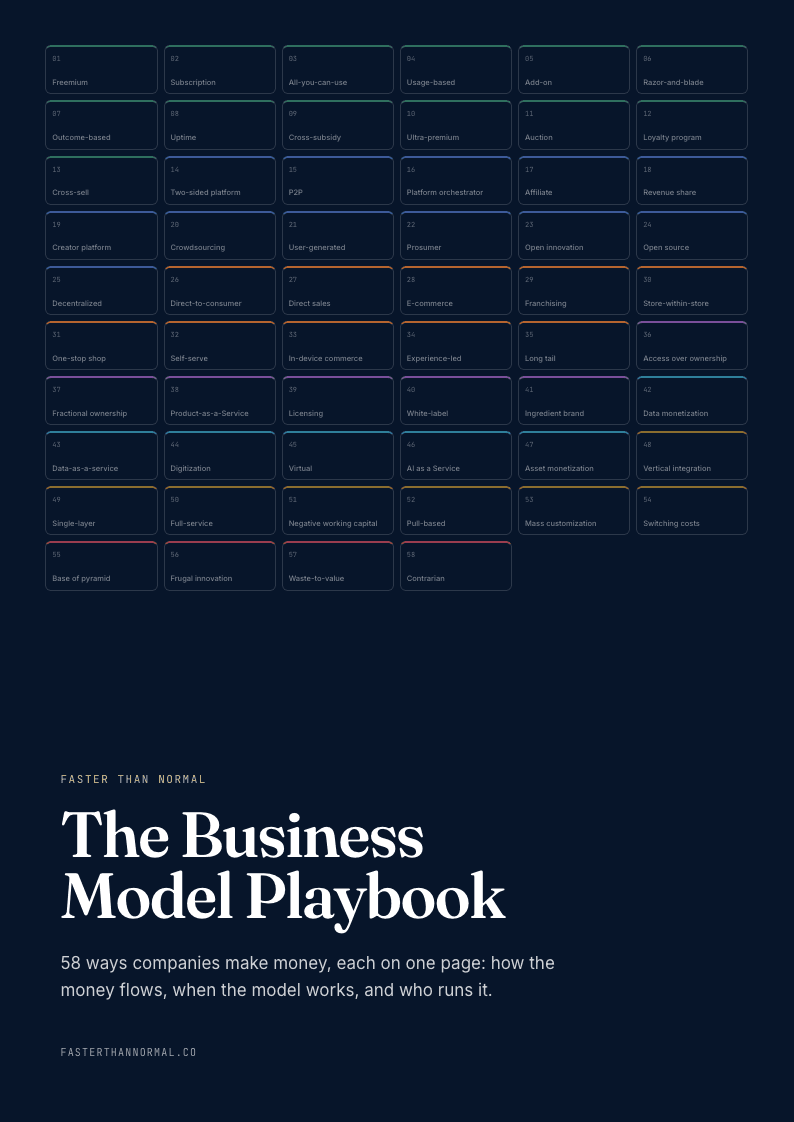
Free playbook
Get The Business Model Playbook
58 business models, one visual page each: how the money flows, the metrics that matter, and who runs it. Free when you join the Faster Than Normal email.
Free. No spam. Unsubscribe anytime.
Part IIIMaxims
-
Fly underneath the radar screen. Visibility is not power. Control of information is power. The less you say publicly, the less ammunition you provide to competitors, critics, and the merely curious.
-
Do what you know how to do. Strategic clarity is the willingness to say no to opportunities that fall outside the circle of competence—even when the market rewards diversification.
-
Culture undergirds everything. Alignment, transparency, honesty, and trust are not aspirations. They are operational requirements that must be internalized at every level of the organization.
-
Chasing revenues without earnings is chasing wind. Revenue growth that does not generate commensurate returns on invested capital destroys value rather than creating it.
-
Every process anyone touches, they need to think how to make it better. Continuous improvement is not a program. It is a habit pushed to the lowest competent level.
-
A good leader needs good character. Technical skill and strategic intelligence are necessary but insufficient. The moral compass must be constantly interrogated: Am I doing the right thing?
-
Find the weak flank. Your adversaries—whether competitors, hackers, or geopolitical rivals—will attack your most vulnerable point. Identify it before they do.
-
Be part of a team and do the job in front of you. In a functional organization, excellence in the current role is the most reliable path to the next one. If the organization is dysfunctional, leave.
-
Perseverance is not a virtue. It is a requirement. Sometimes the only strategy is to never stop, never quit, and outlast the obstacles.
-
Principles, not politics. Anchor your enterprise's mission in convictions that survive the electoral cycle. If your strategy changes with every administration, it was never a strategy.
In Their Own Words
It is our moral imperative to support our nation and to support our nation's allies in the work they do to keep democracies safe.— Interview with The Wall Street Journal, June 2021
You have to define the culture and the fundamental moral character of the organization.— Joseph Wharton Dinner, 2017
Simplicity is critical to communication.— Joseph Wharton Dinner, 2017
Our mission is to create value for our shareholders, our customers, our employees and our community.— Joseph Wharton Dinner, 2017
Establishing a cultural environment is the first step toward success in any institution.— Joseph Wharton Dinner, 2017
Strong operating performance, coupled with the wise deployment of capital, creates value.— Joseph Wharton Dinner, 2017
We defined a set of principles by which we live: transparency, honesty, trust and alignment.— Joseph Wharton Dinner, 2017
Be part of a team and do the job in front of you as best as you possibly can. In a functional organization, the rest will take care of itself.— Interview with David Rubenstein, Bloomberg Television
I was the beneficiary of a lot of learning.— Interview with David Rubenstein, Bloomberg Television
Adaptability is a must-have business skill.
In the high-stakes world of the defense industry, you have to be prepared for volatility.
Innovation is not just about technology; it's about how we think and operate.
The best leaders are those who can listen and learn from their teams.
Success is built on a foundation of trust and collaboration.
The opportunities that this country afforded him were really inculcated to me at an early age and so I really believe in serving the nation.— Phebe Novakovic, The David Rubenstein Show
I'm fiercely patriotic. I'm proud of that. I think we need to have more of a national dialogue about the importance of patriotism and shared values, so I'm not shy about it.— Phebe Novakovic, Boston College Chief Executives Club, June 2019
You can destroy yourself much faster than an enemy can destroy you. And, typically, great empires fall from the inside out.— Phebe Novakovic, Boston College Chief Executives Club, June 2019
Great nations survive when they have lots of allies, despite how difficult they are, despite how unfair or unequal in contribution they may be. No nation is an island, successfully.— Phebe Novakovic, The Wall Street Journal, 2021
I'm frankly alarmed when I see some companies to whom much is given not want to work with the US government. Where do they think the platform for their technology innovation comes? It comes from the security and stability of this nation.— Phebe Novakovic, Boston College Chief Executives Club, June 2019


