


Part IThe Story
Empty Boxes on East Broadway
On March 16, 1966, a new kind of shoe store opened at 704 East Broadway in Anaheim, California. It was a small showroom carved out of the front of a factory, about 400 square feet in one account, under a sign reading Van Doren Rubber Company. On display were samples of three styles of canvas shoes, priced from $2.49 to $4.99. Many of the boxes on the shelves behind the counter were empty. The partners didn't know how many orders they'd get, so they hadn't made much stock yet.
The customers who came in that day, a dozen by most counts and more than twenty in the founder's own later memory, tried on samples and placed orders. The shoes were then made in the factory behind the showroom and collected later. When the first customers came back for their shoes, the founder, a thirty-five-year-old shoe-factory veteran named Paul Van Doren, realized that nobody had put any cash in the register. He couldn't make change. So he handed over the shoes and asked people to come back and pay when they could. Every one of them did.
He was blunt about it many years later. He told WWD the mistake was stupid, and that the lesson he took from it was to treat people the way you'd want to be treated. The episode captures a lot of what followed: a manufacturer who had never run a shop, selling direct to the public, improvising, and finding that customers repaid trust with loyalty.
Van Doren and his partners went on to build Vans into the defining shoe of Southern California skateboarding, and eventually into a brand that its later owner, VF Corporation, grew past $2 billion a year in sales. He lived to see his memoir, Authentic, published on April 27, 2021, and died nine days later, at ninety.
By the Numbers
The House of Vans
20 yearsVan Doren's apprenticeship at the Randolph Rubber Company before founding Vans
$2.49Price of the cheapest shoe on opening day, March 16, 1966
~70Vans stores in California by the end of the 1970s
$20M → $40M+Annual sales before and after Fast Times at Ridgemont High (1982)
$12MDebt when Vans filed for Chapter 11 in 1984, per WWD
$74.4MPrice McCown De Leeuw & Co. paid for Vans in 1988
$396MPrice VF Corporation paid for Vans in 2004
Sparklers and Dutch the Clutch
Paul Van Doren was born in Boston on June 12, 1930, to Johnson and Rena Van Doren. His father was an inventor and entrepreneur; his mother was a seamstress. The family lived in Randolph, Massachusetts, a shoe town south of Boston.
In the first chapter of Authentic, excerpted by Fortune, Van Doren recalled working in his father's barn making Fourth of July sparklers. His job was to attach a few dozen sticks to a wooden frame and dip them into a barrel of flammable compound. He was, as he put it, the assembly line. When his father could afford to hire another worker, the new man turned out to be three times as slow and paid three times as much, and the boy quit.
He was more interested in horses than school. As a teenager he spent his days at the racetrack, where, according to The Irish Times and other obituaries, he was known as Dutch the Clutch for his skill at working out the odds. He left school early; sources put it at fourteen or sixteen. His mother decided the racetrack was no career and found him a job at a local shoe factory.
The gambler's feel for numbers never left him. The company that eulogized him in 2021 singled out his knack for figures and a genius for efficiency.
Twenty Years at Randy's
The factory was the Randolph Rubber Company, known as Randy's. Van Doren started there at sixteen as a service boy, a runner who carried materials around the plant, and stayed about twenty years. Randy's made vulcanized canvas sneakers and had a long relationship with Keds, though it was a minor player next to Keds and Converse. Van Doren learned the whole process, from cutting and sewing canvas uppers to vulcanizing the rubber soles in heat so they bonded to the upper. His mentor was Bob Cohen, the owner's son, whom he later described as the smartest man he had ever met.
One night with Cohen changed his outlook. As he tells it in Authentic, Cohen took the young supervisor to a Boston shoe trade show, where Van Doren's job was to set up and break down the booth. One buyer there represented more than half of Randy's business. By evening he was drunk, and he ordered Cohen to go out to Boston Common and catch him a pigeon. Van Doren watched from a lamppost on Tremont Street as a man he admired stumbled around trying to do it rather than risk the account.
— Paul Van Doren, Authentic: A Memoir by the Founder of Vans, 2021Someday, someway, somehow, I would figure out a way to get rid of the middlemen.
He drew two conclusions, both of which he said later shaped Vans. He would never work with jerks, and he would never let one customer have that much power over his business. The second became a strategy. If shoemakers depended on a handful of department-store buyers, the way out was to sell to the public directly.
Van Doren kept rising at Randy's. By his mid-thirties he was running its most successful factory and, according to several accounts, held the title of executive vice president.
The Garden Grove Assignment
In 1964 Randy's sent Van Doren to Southern California to turn around an underperforming factory it operated in Garden Grove, in Orange County. His brother James and a colleague, Gordon Lee, went with him. By the family's account, the turnaround worked.
That summer, as recounted by WWD and by his son Steve in a 2016 interview with the Los Angeles Times, Van Doren set up a Randy's booth at the surf contest in Huntington Beach. There he met Duke Kahanamoku, the Hawaiian swimmer and surfer. Kahanamoku and a group of well-known surfers were wearing matching Hawaiian shirts, and Van Doren offered to make shoes from the fabric. Kahanamoku handed over one of the shirts, and Van Doren took it back to the factory and made the shoes. It was a small favor, but it gave him an idea he would use again: canvas shoes could be made from almost any fabric that could survive vulcanization.
Soon afterward he left Randy's. In his telling, the break came when Cohen promoted to top positions a group of managers who, in Van Doren's view, had just run another manufacturing operation into the ground. Asking his team to report to them felt like another request to go chase a pigeon, and he quit.
Building the House of Vans
The plan was simple to describe and unusual for its time: a factory in the back making shoes and a store in the front selling them. The partners were Paul, his younger brother James, Gordon Lee and Serge D'Elia. According to WWD, D'Elia put up $250,000. The rest of the start-up effort came from the family. Van Doren's in-laws, brother-in-law, brothers and children helped build out the factory, paint it and install the machinery, and when the store was ready to open, his school-age children handed out flyers around the neighborhood.
Van Doren thought "Van Doren Rubber Company" was the wrong name for a shoe shop, since the rubber part, as he wrote, didn't exactly scream shoe store. The retail sign became "House of Vans," and the first shoebox slogan, according to WWD, promised canvas shoes for the entire family.
The very first style was a lace-up canvas deck shoe designated Style 44, renamed the Authentic in the 1990s. It came in navy, light blue, white and loden green. Its thick, grippy vulcanized sole was the product's real advantage, and it wasn't right at first. The original diamond-patterned soles cracked across the ball of the foot after a short time. The flaw showed up quickly because the people who bought the shoes came back to the same building where they were made. The factory changed the tread to a denser pattern, and the waffle sole became the company's signature.
Moms, Fabric and One Shoe at a Time
The early customers taught Van Doren who his market was. In an excerpt from Authentic published by GQ, he describes a family of four. He put shoes on the little girl who needed them, and on her brother, who didn't but wouldn't leave without a pair, so Van Doren gave those away. Then the mother talked her reluctant husband into a pair and vetoed his choice of color twice before he settled on green.
— Paul Van Doren, Authentic: A Memoir by the Founder of Vans, 2021I had never realized that the mom is really the boss of the family. Mom is almost always the one who decides when, where, how, and everything else about shopping for the family.
Van Doren changed course. He added colors in response to requests, made more of whatever sold, and tried women's styles such as espadrilles and saddle shoes, which did little. What worked was custom manufacturing. A woman came into the store with a piece of pink fabric left over from a dress she had sewn and couldn't find matching sneakers anywhere in Orange County. Remembering Kahanamoku's shirt, Van Doren offered to make her a pair from her own fabric for the usual price plus 50 cents, slipping the job into the line between scheduled color changes. She pulled out a second swatch, in yellow.
His partners agreed to make it a service. Every store took custom orders, first from customers' own fabrics and later from Vans' swatch books. Drill teams, cheerleaders, marching bands, choirs and sports teams across Southern California ordered shoes in their school colors. Vans also began selling single shoes, so a customer who wore out one shoe, or whose feet were different sizes, didn't have to buy a pair. Van Doren wrote that podiatrists started sending patients to Vans. When he noticed girls buying boys' shoes two sizes down, he stopped making separate boys' and girls' lines and went unisex.
The factory made all of this possible. Every Vans style used the same two kinds of rubber sole and the same vulcanizing process, the hardest part of shoemaking. Only the uppers differed. That meant the line could change color or style every day, or every hour, while conventional shoemakers changed their range once a year.
— Paul Van Doren, Authentic: A Memoir by the Founder of Vans, 2021It helps that we knew our customers, especially the skaters, the surfers and the moms.
A Store Nearly Every Week
Vans grew by adding shops. In 1967, according to one company history, it opened a new retail outlet nearly every week. The model stayed the same: small stores stocked from the Anaheim factory, selling at prices well below national brands. The company's own history, as summarized by Wikipedia, says that when half of the first ten stores were losing money, the accountants advised closing them. Van Doren opened more instead, on the reasoning that more volume through the factory would lower the cost of every pair. By the end of the 1970s Vans had roughly seventy stores in California.
Staffing that many shops stretched the family thin. Steve Van Doren, who had painted the original factory with his siblings, went to work behind a counter at eleven. His father told WWD in 2021 that he did it because he had run out of help. A customer wrote in to complain that it was appalling to put a child that age to work, then added that after meeting him, she had no doubt the next generation would be a great one. The younger Van Doren has spent his working life at the company since. The shops also doubled as a distribution network the national brands didn't have. Most sneakers of the era reached customers through department stores and sporting-goods chains that ordered a season ahead. Vans could ship a new color from Anaheim to its own shelves within days and see in the sales figures whether it worked.
His aversion to paid marketing lasted until 1972. That year he attended the Munich Olympics, where, as WWD recounts, he watched Mark Spitz win his seventh gold medal and wave to the crowd holding a pair of Adidas shoes. The Games ended in tragedy with the massacre of Israeli athletes, but Van Doren came home convinced that athletes could sell shoes. He did not have Adidas's budget, and he didn't need it. The athletes who mattered most to his business were teenagers in his own county.
The Skaters Find the Shoe
By the early 1970s, skateboarders had discovered the Style 44. The thick waffle sole stuck to the board and let them feel it underfoot, and the shoes were cheap and hard to wear out. Skaters wore out their back shoe faster than the front, from braking and sliding, and Vans, which already sold single shoes, would sell them one replacement. Navy deck shoes were on the feet of the Zephyr team, the Dogtown skaters later known as the Z-Boys, at the 1975 Del Mar Nationals.
Van Doren invited two of them, Stacy Peralta and Tony Alva, to talk about design and pick up free shoes. Peralta became the company's first sponsored skater. According to The Irish Times, Van Doren eventually paid him $300, then a significant sum, to wear Vans as he toured. Out of those conversations came Style 95 in 1976, now called the Era, which the company credits to Alva and Peralta. It had a padded collar for ankle protection and came in two-tone color combinations. Steve Van Doren told the Smithsonian that his father, set in his ways after thirty years of making shoes, padded the collar, added an outside heel counter and switched to the heaviest-duty canvas available. It was the first Vans shoe designed for skateboarding.
The skaters also supplied the slogan. The skate shoe was marketed as the "Off the Wall" shoe, after the way skaters launched out of the walls of drained swimming pools, and the phrase, along with a skateboard-shaped logo, became Vans' brand line.
The next two years set the product line that Vans still sells. In 1977 came Style 36, the Old Skool, with leather panels for durability and a curving side stripe that began, in the company's telling, as a doodle by Van Doren himself; it was first called the jazz stripe. The same year brought Style 98, the slip-on. In 1978 Style 38, the Sk8-Hi, extended the upper above the ankle for skaters riding pools and ramps. The checkerboard pattern also came from customers. As Steve Van Doren told WWD, kids at Huntington Beach High School were drawing checkerboards on the rubber foxing of their slip-ons, so Vans printed the pattern first on the rubber and then on the canvas.
Fast Times and a Fateful Handover
In the late 1970s, Paul Van Doren stepped back from running the company. Accounts put the date between 1976 and 1980, and his brother James took over. Paul turned to breeding racehorses.
Then came Hollywood. Sean Penn was a regular at the Vans store in Santa Monica and bought a pair of checkerboard slip-ons for himself. According to WWD, the store's manager, soon to become the company's publicity manager, delivered two dozen pairs to Universal. In Fast Times at Ridgemont High (1982), Penn's stoner surfer Jeff Spicoli wears the checkerboard slip-ons almost throughout, and the shoes filled the cover of the soundtrack album. The checkerboard slip-on design was credited to James Van Doren. Vans went from roughly a $20 million company to one on track for $40 million to $45 million.
The windfall set up a disaster. Under James, Vans tried to compete with the national athletic brands across the board, launching shoes for baseball, football, basketball, soccer, running, volleyball, wrestling and even breakdancing. It built a 175,000-square-foot plant in Orange, pushed its workforce past 1,000, and signed licensing deals for Vans-branded sunglasses and notebooks. Every one of those shoes was still made in the United States, while competitors had moved to lower-cost production in Asia. Cheap counterfeits of the checkerboard slip-on flooded the market, forcing price cuts. The new categories cost a fortune and brought in little.
In 1984, after defaulting on a payment to a creditor, Vans filed for Chapter 11 bankruptcy protection. WWD puts the debt at about $12 million.
Paying a Hundred Cents on the Dollar
Paul Van Doren came out of retirement to run the reorganization as president. As his son Steve told WWD, the bankruptcy court approved a settlement under which Vans would pay creditors 25 cents on every dollar owed. Paul thought that was wrong. He asked for a longer repayment schedule, three and a half to four years in Steve's recollection, and paid everyone in full.
The cuts were severe. Vans narrowed its focus back to the canvas shoes and the skate, surf and BMX customers who had built it. The memoir recalls that at one point employees had to bring toilet paper from home. Vans emerged from Chapter 11 in 1986, and by 1987, in the family's account, its debts were cleared; sales that year reached about $50 million, and the company was profitable again.
— Paul Van Doren, Authentic: A Memoir by the Founder of Vans, 2021With success comes reputation, with hardship comes character.
In 1988, with the company healthy, Van Doren and Gordon Lee sold Vans to the investment firm McCown De Leeuw & Co. for $74.4 million. Van Doren stayed on as chairman for a time while the new owners installed a professional chief executive, Richard Leeuwenberg. Vans went public in 1991, selling 4.1 million shares at $14 each.
After the Sale
Van Doren's later distance from the company has been glossed over in many tributes, but the Los Angeles Times noted that by his death he had been more than a quarter-century removed from Vans. The decisions that shaped the modern brand were made by others. In the mid-1990s management moved manufacturing overseas and in 1995 closed the Orange plant, laying off nearly 1,000 workers. Vans leaned into sponsorship instead of factories. In 1995, a longtime customer named Kevin Lyman approached the company about his traveling music festival, and Steve Van Doren suggested combining it with an amateur skate contest. The Vans Warped Tour ran for about twenty-five years. Vans also bought surfing's Triple Crown in Hawaii and began collaborating with outside brands, including a 1996 shoe with the New York skate shop Supreme.
VF Corporation bought Vans in 2004 for $396 million, when it had about $325 million in annual sales. By 2015 revenue was $2.2 billion, and Vans was VF's second-largest and most profitable brand. The family stayed close: Steve Van Doren became vice president of events and promotions, his sister Cheryl vice president of human resources, and two grandchildren held marketing and merchandising roles. The company still sells custom shoes, now designed online. In Authentic, Van Doren gave VF credit for understanding how a company's origin story can strengthen a brand: it adjusted the classic designs without overhauling them and reissued heritage pieces such as the shoe first made from Duke Kahanamoku's shirt. The checkerboard that kids once drew on their slip-ons is now a registered trademark for footwear, which the company defends in markets around the world.
Van Doren spent his last years on Authentic, which argued that his business had been built on people first and business second. He described himself as more of a problem solver than a visionary. Tony Alva narrated the audiobook. Paul Van Doren died on May 6, 2021, at the home of one of his children in Fullerton, California. The Irish Times reported the cause as kidney failure. He was survived by five children, Paul Jr., Steve, Cheryl, Taffy and Janie, along with ten grandchildren and ten great-grandchildren. His brother James had died in 2011, at seventy-two.
The Irish Times cast him as a countercultural counterpart to Phil Knight, who had built Nike in the same era with Asian contract manufacturing and huge athlete endorsements. Van Doren built his company in the opposite way: a factory he could see from the sales counter, and endorsements from teenagers he met in his own stores. The comparison shows both the strengths and the limits of his approach. His model gave Vans its identity and its loyal customers. It also made the company vulnerable once it tried to compete in categories where it had no customer relationship and where rivals made shoes far more cheaply.
Part IIThe Playbook
Paul Van Doren's lessons come mostly from his own memoir and from the recollections of his family and partners, and they should be read with that in mind. But the core decisions are well documented: selling direct from the factory, taking custom orders, working with skaters on design, and paying creditors in full after the company nearly died. The principles below are drawn from those decisions.
The principles
- 1.Sell direct from the factory floor.
- 2.Sell to whoever makes the buying decision.
- 3.Make the odd request routine.
- 4.Build a line that can change by the hour.
- 5.Treat product complaints as the design brief.
- 6.Fill the factory before judging the store.
- 7.Recruit the scene's best users as designers.
- 8.Adopt what customers are already doing.
- 9.Stay in the game you can win.
- 10.Pay back every dollar.
- 11.Hire the person, not the résumé.
Principle 1
Sell direct from the factory floor.
The pigeon episode convinced Van Doren that a manufacturer dependent on a few big buyers was at their mercy. His answer was to put a store in front of the factory. Selling direct removed the wholesaler's margin, which let Vans undercut national brands, and it removed the buyer who could dictate terms.
The less obvious benefit was information. Customers who walked into the House of Vans were standing a few yards from the production line. Their complaints, requests and purchases reached the people making the shoes the same day. In a conventional distribution channel that feedback would have been filtered through several layers and delayed by a season.
Tactic: Find a way to sell at least part of your output directly to end users, even if most of it goes through intermediaries. Use that direct channel as an early-warning system for what the market wants.
Principle 2
Sell to whoever makes the buying decision.
Van Doren assumed he was selling shoes to the people who wore them. One family's visit taught him otherwise: the mother decided what everyone bought. He responded by adding colors, trying styles for women, and designing custom services that appealed to the parent choosing shoes for a household.
Later the decision-maker changed. For the skate shoe, it was the teenage skater and the peers he wanted to impress. Van Doren's skill was noticing who actually chose, and adjusting the product and the pitch accordingly.
Tactic: For your top three customer segments, write down who uses the product, who pays for it and who makes the decision. If those are different people, make sure your product and marketing are designed for the one who decides.
Principle 3
Make the odd request routine.
The woman with pink fabric could have been told no. Van Doren made her shoes for 50 cents extra and then turned the exception into a service in every store. The same instinct produced single-shoe sales, mismatched sizes for customers with different-sized feet, and team colors for schools across Southern California.
Van Doren wrote that he hated policies that stopped businesses from making substitutions, and that customers who are accommodated become fiercely loyal. The custom program also acted as marketing, bringing in people who later bought standard shoes. It's a classic case of the principle to do things that don't scale, and one that eventually did scale.
Tactic: Keep a log of the requests your team turns down. Each quarter, pick the most common one and work out whether you could offer it as a standard service at a modest premium.
Principle 4
Build a line that can change by the hour.
Custom orders were possible only because of how the factory was designed. Every Vans style used the same two soles and the same vulcanizing process. Only the canvas uppers varied. That meant the hardest and most capital-intensive step stayed constant, while the part customers noticed, the color and pattern, could change whenever demand did.
Conventional manufacturers set their line once a year. Vans could respond to a trend, a school order or one woman's dress within days.
Tactic: Identify the most expensive, hardest-to-change step in your production process and standardize it. Push all variety into the cheaper, later stages where changes cost little.
Principle 5
Treat product complaints as the design brief.
The first Vans soles cracked across the ball of the foot. Because customers brought the shoes back to the same building where they were made, the defect surfaced quickly, and the factory redesigned the tread. The fix became the waffle sole, the brand's most recognizable feature and the reason skaters liked the shoe.
Van Doren said the best teachers in the art of retail are the customers themselves. The waffle sole shows why. The complaint pointed straight at the improvement, and fixing it created an advantage competitors didn't have.
Tactic: Put the people who design your product in direct contact with returns and complaints, every week. Ask of each recurring complaint whether fixing it could become a feature you advertise.
Principle 6
Fill the factory before judging the store.
When half the early stores lost money, the accountants recommended closing them. Van Doren opened more, according to the company's history, reasoning that the factory's costs were largely fixed and every extra pair sold spread them further. Judged on its own, each store looked weak. Judged as outlets for a factory with spare capacity, they made sense.
This is a lesson about economies of scale in an integrated business, where the profitability of one unit depends on the volume it brings to another. It can also go badly wrong, as it did in the early 1980s, when the company expanded capacity and product lines faster than real demand.
Tactic: Before closing an unprofitable outlet or product, calculate how much fixed cost it absorbs elsewhere in the business. Judge it by its contribution to the whole system, not by its own profit and loss statement alone.
Principle 7
Recruit the scene's best users as designers.
Van Doren didn't try to guess what skaters wanted. He invited Stacy Peralta and Tony Alva in, gave them shoes, and listened. The result, the Era, was designed around their demands: a padded collar, a stronger heel and tougher canvas. Paying Peralta to wear Vans gave the shoe credibility among skaters that advertising could not have bought.
The approach fit Van Doren's temperament and budget. He couldn't match Adidas or Nike in endorsement money, but the athletes who mattered to his niche were local, accessible, and happy to collaborate for shoes and a modest fee.
Tactic: Identify the most respected users in your smallest, most demanding customer group. Give them early access and a real role in design, and credit them publicly for what they contribute.
Principle 8
Adopt what customers are already doing.
The checkerboard pattern began with kids drawing on the rubber of their slip-ons. "Off the Wall" came from the way skaters rode out of empty pools. The one-shoe replacement served skaters who were already wearing out their back foot. In each case, Vans noticed what customers were doing with or saying about the product and made it official.
This is cheaper and more reliable than inventing trends. A behavior customers have already adopted has demonstrated demand, and customers see the result as theirs.
Tactic: Regularly look at how customers modify, decorate, misuse or talk about your product. When the same modification shows up more than once, consider turning it into an official version.
Principle 9
Stay in the game you can win.
The near-collapse of the 1980s came from abandoning what Vans did well. After Fast Times, the company chased basketball, football, running and even breakdancing, where it had no special customer relationship, no design advantage and much higher costs than Asian-made rivals. The skate and surf customers who had built Vans got less attention, and counterfeiters picked off the checkerboard business.
Van Doren's recovery plan reversed that drift and returned the company to its core competency: simple vulcanized shoes for the board-sports customers who already loved them. Later management kept that focus, and it's the business VF bought.
Tactic: Before entering a new category, ask what specific advantage you bring to it that incumbents lack. If the only answer is that your brand is hot right now, stay out.
Principle 10
Pay back every dollar.
The bankruptcy court offered Vans a settlement at 25 cents on the dollar. Van Doren asked for more time instead and paid creditors in full. That cost the company years of austerity. In return it kept the trust of suppliers and lenders, and, in his son's account, earned Van Doren a respect that outlasted the crisis.
For a company whose brand rested on trust, from the honor-system opening day onward, the choice was consistent. His own reputation and the company's were effectively the same asset.
Tactic: When a crisis gives you a legal way to shed obligations, calculate the long-term cost to your relationships before taking it. If you can survive while paying in full, even slowly, consider doing so.
Principle 11
Hire the person, not the résumé.
Van Doren told WWD that when he interviewed job candidates, the first thing he did was throw their résumés away. He cared about the person. A good person would have a good-enough résumé, he said, and a bad one would probably have a wonderful one.
The approach fit a company that was largely built by family members, partners he had known for years, and customers who became employees and promoters. It also reflected the lesson from the pigeon: character mattered more to him than credentials.
Tactic: In your next hiring round, run at least one interview without the candidate's résumé in the room. Focus on how the person thinks, what they care about and how they treat people, then check the résumé afterward.
Free playbook
Get The Business Model Playbook
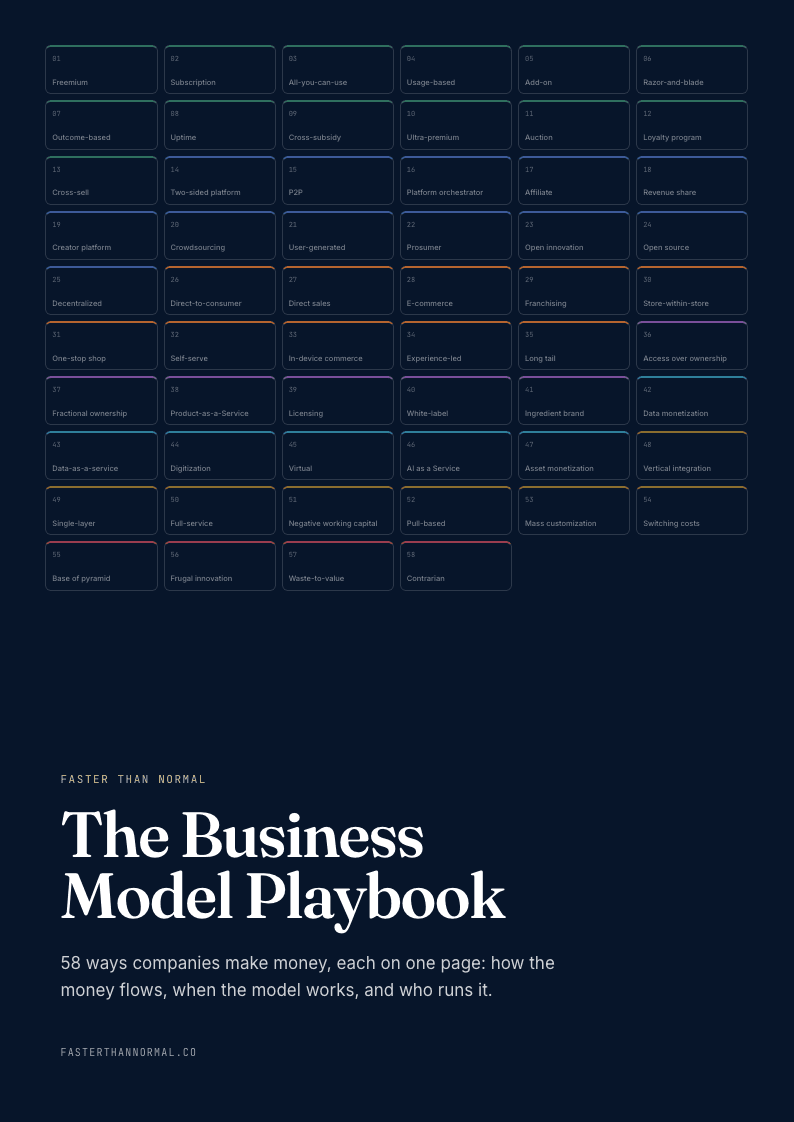
58 business models, one visual page each: how the money flows, the metrics that matter, and who runs it. Free when you join the Faster Than Normal email.
Free. No spam. Unsubscribe anytime.
Part IIIMaxims
-
Trust customers first. The opening-day customers who took their shoes on credit all came back to pay. Starting from trust cost Van Doren almost nothing and bought loyalty.
-
Never let one account own you. Watching his mentor chase a pigeon for a buyer taught Van Doren that dependence on one customer eventually costs your dignity along with your margin.
-
Problems are better guides than visions. Van Doren called himself a problem solver, not a visionary. Most of Vans' signature features began as fixes for something that wasn't working.
-
Family labor is start-up capital. In-laws, brothers and children built the first factory and handed out the first flyers. The earliest investment in Vans was sweat.
-
Luck rewards the prepared shelf. Fast Times made the checkerboard slip-on famous, but only because Vans had already made it, sold it in Santa Monica and got it to the studio.
-
A hit can be more dangerous than a flop. Doubling sales after 1982 gave Vans the confidence and cash to overreach. Success deserves the same scrutiny as failure.
-
Handing over the keys is a strategic decision. Van Doren's retirement put the company in the hands of a successor whose expansion nearly bankrupted it. Choosing a successor and a plan deserves as much care as founding.
-
The founder's example sets the terms. Van Doren's refusal to take the discounted settlement signaled to employees and suppliers what the company stood for more clearly than any statement could.
-
Know when to sell. Van Doren sold after the company was repaired and profitable, not while it was broken, and got $74.4 million for a business that had been bankrupt four years earlier.
In Their Own Words
Change is inevitable, but your core values should remain constant. That's what people really connect with.— Paul Van Doren
I had to tell the first twelve customers to come back later for their change. I didn't even have a cash register—just a cigar box.— Paul Van Doren
We weren't trying to make skateboard shoes. We were just trying to make good shoes that kids could afford.— Paul Van Doren
We never tried to be cool. We just tried to be real. The kids could tell the difference.— Paul Van Doren
Bankruptcy was the hardest thing I ever went through. But it also taught me that you can lose everything and still come back if you believe in what you're doing.— Paul Van Doren
I never set out to build a billion-dollar company. I just wanted to make good shoes and treat people right. Everything else followed from that.— Paul Van Doren
The customer is right there in front of you. Why would you want layers of people between you and them telling you what they think the customer wants?— Paul Van Doren
We didn't sponsor athletes to sell shoes. We sponsored them because we believed in what they were doing.— Paul Van Doren
We let the kids teach us what they needed. They were the experts, not us.— Paul Van Doren
If kids can't afford your shoes, you're not really in the kids' shoe business.— Paul Van Doren
Keep it simple, keep it real, and keep it focused. Everything else is just distraction.— Paul Van Doren
We started with $400 and a dream. That was enough because we weren't trying to impress anyone—we were just trying to solve a problem.— Paul Van Doren
The biggest risk is not taking any risk at all. If you're not willing to fail, you'll never succeed.— Paul Van Doren
Authenticity isn't a marketing strategy. It's who you are when nobody's watching.— Paul Van Doren
A brand isn't what you say it is. It's what the community says it is.— Paul Van Doren
The best marketing is a great product and people who genuinely care about their customers.— Paul Van Doren
Success isn't about how much money you make. It's about whether you can look at yourself in the mirror and be proud of what you've built.— Paul Van Doren
The moment you start making decisions based on what you think will make you the most money instead of what's right for your customers, you've lost your way.— Paul Van Doren
Culture isn't something you can manufacture. It has to grow organically from the values you actually live by.— Paul Van Doren
Innovation doesn't always mean inventing something completely new. Sometimes it means doing something old in a better way.— Paul Van Doren
We didn't have focus groups or market research. We had customers who would tell us exactly what they thought, and we listened.— Paul Van Doren
The best ideas come from the people who actually use your products, not from people in conference rooms who've never touched them.— Paul Van Doren
Further reading
- Authentic: A Memoir by the Founder of Vans by Paul Van Doren


