


Part IThe Story
The $500 Booth
On a Saturday morning in 2006, at a street fair on Abbot Kinney Boulevard in Venice, California, a twenty-six-year-old woman with sun-streaked hair and no business plan paid $500 to rent a booth. She had no logo, no wholesale accounts, no LLC. What she had were stacks of hand-sewn T-shirts and hoodies — garments she'd been making on a sewing machine in her garage between shifts at a surf shop, garments that strangers on the sidewalk kept stopping her to ask about, garments stitched with rainbow stripes and lightning bolts that looked like artifacts from a decade she'd never lived through. She sold out. The take was $8,000. By nightfall, the booth was bare and Paige Mycoskie had something more valuable than inventory: proof of demand, the only market research that matters.
Seventeen years later, those same hand-stitched rainbow stripes — rendered now across hoodies, joggers, cashmere, swimwear, surfboards, and a custom Honda Rebel motorcycle — generate somewhere north of $150 million in annual revenue. Aviator Nation has never taken a dollar of outside investment. Mycoskie remains its sole shareholder, its CEO, its creative director, and the person who still personally sketches every piece of apparel. Forbes estimates her net worth at $490 million. She paid herself a $47.5 million dividend last year. The factory is in South Los Angeles. The tags are hand-stitched. The profit margins exceed 70 percent. And the whole enterprise began because a woman from Arlington, Texas, could not find a T-shirt soft enough.
By the Numbers
Aviator Nation
$150M–$200MProjected annual revenue (2023)
100%Ownership retained by Mycoskie
$0Outside investment raised
582Employees
20+Retail locations across the U.S.
$490MEstimated net worth (Forbes, 2025)
$47.5MDividend paid to founder in a single year
The Mycoskies of Arlington
To understand Paige Mycoskie, you have to understand a particular kind of Texas family — upper-middle-class, sports-obsessed, relentlessly encouraging in the way that produces either conformists or renegades, rarely anything in between. Her father, Mike Mycoskie, was an orthopedic surgeon who practiced in Arlington for over forty-five years, a man who would later retire to Beaver Creek, Colorado, and open a gallery of motivational word-art paintings — canvases inscribed with affirmations, conversation-starters designed to uplift strangers, as though the practice of leaving Post-it notes of encouragement around the family home had finally outgrown the refrigerator door. Her mother, Pam Mycoskie, was an author and cookbook entrepreneur — Butter Busters, a low-fat cookbook phenomenon of the nineties, was her calling card — a woman who understood intuitively that you could build a brand around a single strong idea communicated with evangelical clarity.
The Mycoskie household ran on positivity as infrastructure. Blake, Paige, Tyler — the three siblings — grew up leaving motivational notes for themselves and each other, a practice their parents later credited with shaping each child's entrepreneurial trajectory. It sounds like something from a commencement address, saccharine and unprovable, except that all three went on to start businesses: Blake founded TOMS Shoes, the one-for-one philanthropic juggernaut that would be valued at $625 million before Bain Capital acquired half of it in 2014. Tyler founded Dollar Driver Club, a direct-to-consumer golf equipment venture. And Paige — the middle child, the one who played state-championship volleyball and competed on the Arizona State University water ski team, the one who studied journalism at the Walter Cronkite School — would become the wealthiest of them all.
There's a particular tension in being the sibling of a philanthropic celebrity. Blake Mycoskie's TOMS became a case study in social entrepreneurship, a Harvard Business Review mainstay, a brand so morally legible that its founder received the Secretary of State's Award of Corporate Excellence from Hillary Clinton in 2009. He appeared on Ellen, on Tim Ferriss's podcast, on Shark Tank. He gave commencement addresses. He wrote Start Something That Matters, a bestseller that promised you could blend profit and purpose into something durable.
Paige's project would carry none of that philanthropic framework. Aviator Nation is not a social enterprise. It does not donate a hoodie for every hoodie sold. It makes extremely comfortable, extremely expensive clothing in America, pays its workers hourly so they don't rush, and keeps the money. The implicit argument is different: that making something beautiful and real and locally manufactured — and refusing to sell the company — is itself a kind of integrity. The contrast with her brother's model is never stated but always present, like two answers to the same family question about what it means to do something worthwhile.
The Accidental Californian
The pivot point, the hinge on which everything else swings, was a reality television show. In 2002, Paige and Blake Mycoskie competed together on Season 2 of CBS's The Amazing Race. They were the youngest team that season — a brother and sister from Texas, prone to small mistakes, blessed with cutthroat natures that carried them to the final three. They lost the million-dollar prize by four minutes. Four minutes. It took Blake years, by his own admission, to put those words together without weeping.
But the show's press tour brought them to Los Angeles, and the city reached into Paige like a hook. "I'll never forget walking out to the beach and seeing people rollerblading and biking and playing frisbee and volleyball and surfing," she told Forbes, "and I was like, 'Oh, my God, this is my dream.'" She dropped out of Arizona State. She moved to California. She was twenty-two years old.
The next few years were a search. She worked briefly in television production — she was on set for Survivor — and hated the experience. She freelanced in photography, video, graphic design, branding. She developed campaigns for her brother's nascent TOMS Shoes. She interned at Shape magazine. None of it stuck. Nothing had the texture of the thing she was looking for, which she couldn't yet name but knew by feel — literally by feel, by the way fabric hung, by the softness of cotton worn down by decades of washing, by the precise drape of a 1970s concert tee found at a flea market after a full day of searching.
She was living in Venice and working part-time at ZJ Boarding House, a surf shop in Santa Monica, as an assistant buyer. She surfed before work. She haunted thrift stores and flea markets in her off hours, hunting for vintage garments with an intensity that bordered on compulsion. "I'd spend a whole day looking for one T-shirt," she said. The problem was always the same: the colors were faded, the fit was wrong, the fabric had degraded. She was picky in a way that constituted a kind of vision — she knew exactly what she wanted and could not find it anywhere on earth.
So she bought a sewing machine. Two hundred dollars. And she started making the clothes herself.
The Garage and the Single Needle
The technical detail matters, because it is the thing that makes Aviator Nation what it is, and the thing that most commentators gloss over in favor of the vibes. Mycoskie taught herself to sew using a single-needle lockstitch — the same technique used in high-end garment construction, a method that is slower, more labor-intensive, and produces a subtle imperfection in every seam that reads, to the educated eye and the sensitive fingertip, as handmade. She bought vintage sweatshirts and T-shirts in large sizes, cut them apart, and reconstituted them into new garments, adding hand-drawn screenprinted graphics — lightning bolts, rainbow stripes, psychedelic maidens, big-wave surfers — that she sketched by hand and scanned into a computer. The slight wobble of a hand-drawn line, the irregular spacing of a hand-stitched stripe: these were not flaws. They were the product.
It took her three months of nightly sewing to feel confident enough to sell. "I literally sewed every day and night during that time," she said. "I look back now on that time and it really blows me away how obsessed I was with it. I remember literally sewing through the night because I was so anxious to figure out a fit or a style that I had in my mind." The obsession was the point. She was not iterating toward a minimum viable product. She was trying to reverse-engineer the feeling of a garment that had been loved for thirty years.
She wore the clothes she made — to work at the surf shop, to trade shows, to the grocery store. People stopped her. Constantly. On the street, in stores, at trade shows where she was attending as a buyer, not a seller. Three people stopped her in a single day — one on the sidewalk, one in the grocery store, one in a boutique called Planet Blue — each asking the same question: What are you wearing and where can I buy it? At a San Diego trade show with her boss, she was stopped roughly fifty times. These were not casual compliments. These were purchase inquiries. The demand was not theoretical. It was ambient, insistent, and impossible to ignore.
— Paige MycoskieI started making clothes for myself because what I wanted to wear did not exist.
Fred Segal and the Walk-In
The legend, as Mycoskie tells it — and there is a quality of origin mythology to all of this, the garage, the street fair, the hand-stitched tags — is that she walked into Fred Segal in Santa Monica wearing her own clothes and asked to see the buyer. Fred Segal, for the uninitiated, was one of the most exclusive boutiques in Los Angeles, the kind of store where a nobody with no line sheet and no appointments does not get a meeting. But the buyer looked at what she was wearing, and placed an order. Eight thousand dollars' worth. She repeated the trick at other boutiques, walking in cold, dressed in her own product, letting the garment do the talking.
Jim Moore, the creative director of GQ magazine — a man who had spent decades evaluating menswear, who had seen every designer pitch and every collection walk — later described her with a precision that cut through the noise: "She's an original, a true bohemian who understands men's clothing as well as women's, knows how to have something for each and how to blur the lines a little." He named her one of GQ's best new menswear designers in America for 2013, an honor that included a capsule collaboration with Gap for worldwide distribution. "I always urge young designers to pull every penny together and open a store as soon as they can," Moore said. "That's what she did, and it became her laboratory."
The laboratory opened in 2009 on Abbot Kinney Boulevard in Venice — just blocks, as it happened, from the TOMS flagship store her brother had opened. The space was not conceived as a retail store. It was a workshop that she needed to sell from in order to make rent. But Mycoskie painted murals on the walls, set up a record player, installed a ping-pong table, built a stage in the back where friends could play music. She nailed Grateful Dead and Steely Dan album covers to the walls alongside vintage skate decks. She put in a "720 Degrees" arcade game. A Los Angeles Times critic walked in and described it as "like stumbling into a frat house with a feminine touch" — a sensory immersion so complete "you half expect your shoes to be sticking to the floor from last night's kegger."
This was the insight that separated Aviator Nation from ten thousand other T-shirt brands: the store was not a store. It was a venue. It was an argument, rendered in physical space, for a particular way of feeling. People did not walk in to buy a hoodie. They walked in to inhabit a decade they had never experienced and leave in a better mood than when they arrived.
— Paige MycoskieThis is my little oasis of awesomeness. I hope people leave in a better mood than when they came in.
The Anti-Fashion Fashion Company
There is a paradox at the center of Aviator Nation that Mycoskie has never fully resolved, and the unresolvedness is part of its power. The brand sells hoodies for $180 and sweatpants for $160 and cashmere pieces for $500. Its celebrity clientele reads like a casting sheet: Reese Witherspoon, Jennifer Lawrence, Gwyneth Paltrow, Jennifer Aniston, Jay Z, Robert Downey Jr., Matthew McConaughey, Jake Gyllenhaal, Selena Gomez, Zac Efron, Chris Martin — who selected an Aviator Nation surfboard for his birthday in March of a recent year. It is sold at Nordstrom and Bloomingdale's. Its signature sweatsuits have become, in the words of one strategic marketing advisor, "a kind of flex … You would be so famous you didn't have to conform to any dress code."
And yet Mycoskie insists, with what appears to be genuine conviction, that she operates outside the fashion system entirely. "I don't look at trend reports or runway shows," she has said repeatedly. "I'm not in that world." She does not attend Fashion Week. She does not hire trend forecasters. She does not design collections around seasonal themes dictated by industry calendars. She designs what she personally wants to wear, full stop. "I always ask myself, 'Would I wear this?' and if the answer is no, I don't do it."
Bonnie Morrison, a strategic marketing advisor who served as Coach's vice president of public relations for five years, located the paradox precisely: "I think their secret sauce is really how they've harnessed the magic of a certain type of California star power. To me, it harkens back to Jennifer Aniston's maharishi pants and white tank top in the 90s. In Hollywood, dressing down became a kind of flex." What Aviator Nation sells, in other words, is not clothing. It is the signification of not caring about clothing, rendered in $180 fleece, which is itself a deeply sophisticated fashion proposition — perhaps the most sophisticated, because it asks the consumer to believe they are opting out of the system that they are, in fact, buying into.
Dr. Courtney Campbell, a veterinarian and television personality, captured the consumer phenomenology with accidental brilliance. He was walking down State Street in Santa Barbara when he noticed pedestrians wearing the same deliberately faded sweatshirt with five rainbow stripes and a gold-tone zipper. "Everyone wearing them looked so relaxed and polished," he said, "like they sold their tech company and became a surfer." The aspirational identity encoded in a single garment: post-ambition, post-striving, California-as-endpoint. Some had beautiful French bulldogs. He was like, that breed is so trendy right now, those hoodies must be too.
The Calculus of Ownership
The most consequential decision Paige Mycoskie ever made was the one she did not make. She never took outside investment. Not a dollar. Not from friends, not from family, not from venture capital, not from private equity. In an era when the default founder narrative involves raising successive rounds of capital, surrendering board seats, and racing toward either an IPO or an acquisition, Mycoskie financed her entire growth through expanding lines of credit from banks — small loans, gradually increasing, repaid, then increased again.
The reasoning was not strategic in the way a business school case would present it. It was emotional, even temperamental. "If I was going to take money from someone, I would have to owe someone something, and it would be not in my control," she told Forbes. "I wouldn't feel the freedom that I feel to design what I design." Freedom. Not optionality, not leverage, not runway. Freedom. The word recurs in her interviews like a drumbeat: the freedom to make what she wants, to open stores where she wants, to pay herself what she wants, to never explain her decisions to a board.
The cost of this freedom was time. The growth was slower than it would have been with capital. She carried debt. She worried about payroll. She made do with a four-person team working out of a garage before she could afford the Abbot Kinney space. She considers November 29, 2019, Aviator Nation's first day of "true profitability" — "that's the day I paid off all my debts and credit lines." Thirteen years after founding. Thirteen years of making every garment in America, paying workers hourly, and refusing to cut corners on fabric, stitching, or the tiny details that most consumers would never notice and that Mycoskie would never forgive herself for compromising.
— Paige MycoskieI strongly believe the longer it takes to acquire wealth the more you appreciate it. It's not about building fast and selling out, it's about creating a life that you enjoy and having a desk you can't wait to wake up to.
The bet paid off in a way that the venture-backed model almost never permits. Mycoskie owns 100 percent of a company doing $150 million to $200 million in annual revenue with profit margins above 70 percent. She answers to nobody. When Forbes estimated her net worth at $350 million, she publicly suggested the number was at least double that. She has acquired at least nine properties — homes in Malibu, Venice Beach, Marina del Rey, a lakeside house in Austin purchased for $15 million, a ski chalet in Aspen. The wealth is not theoretical. It is liquid, real, and entirely hers.
The Pandemic as Accelerant
The story of Aviator Nation during COVID-19 is the story of an accidental category winner. When the pandemic hit in March 2020, Mycoskie had just opened six new stores that had been open for less than a month. The governor of California issued the shelter-in-place order on a Thursday. Every store went dark.
Mycoskie called her head of e-commerce. They organized a flash sale — 20 percent off everything on the website, with proceeds directed to supplementing the salaries of Aviator Nation's then nearly 300 employees. In twenty-four hours, the sale generated $1.4 million in revenue — the brand's biggest single day of all time. Some accounts put the figure at $1.5 million. Either way, the message was unmistakable: when the entire country was locked in their homes, desperate for comfortable clothing that also looked presentable on a Zoom call, Aviator Nation had been training for this moment for fourteen years.
After posting $27 million in sales for 2019, Aviator Nation nearly tripled to $70 million in 2020. Sales hit $110 million in 2021. Then $130 million in 2022. The trajectory was projected at $150 million to $200 million for 2023. Plenty of other brands rode the pandemic athleisure wave — the now-defunct Entireworld, countless cooling loungewear startups that burned through venture capital and vanished. What distinguished Aviator Nation was durability. The brand had been profitable since its second year. The product was not a pivot. It was the original thesis. The pandemic did not create the demand; it universalized it.
The deeper lesson is structural. Because Mycoskie had no investors to satisfy, no burn rate to justify, and no board demanding hypergrowth, she could make decisions based on survival and employee welfare rather than shareholder returns. The flash sale was not a growth hack. It was an act of improvisation by a sole owner who needed to pay her people. That the improvisation produced the company's greatest revenue day was a byproduct, not a strategy.
The Stores as Stages
There are now more than twenty Aviator Nation retail locations across the United States — Venice, Manhattan Beach, Malibu, San Francisco, Aspen, Austin, Nashville, a 2,700-square-foot flagship at 93 Mercer Street in SoHo. Each store is a custom build. Mycoskie personally travels to each location, helps paint the murals, makes every creative decision about the build-out. The stores feature record walls of local artists' albums, vintage arcade games, surfboards on the walls, live music stages. The Malibu location includes Dreamland, an event space. Santa Monica has RIDE, a wellness exercise studio. There is a mobile store housed in an Airstream trailer.
The store-opening philosophy is revealingly personal: Mycoskie opens stores in her favorite places. Aspen was considered risky — "super seasonal, super-expensive real estate," people told her. It became one of her top-performing locations. Austin was a homecoming of sorts; she packed up and moved there on May 1 of a recent year, sat alone in the space with her notebook, and visualized the store from scratch, building it around a stage for live music. The partnership with Austin City Limits Music Festival began because she cold-called the C3 office until someone from C3 happened to walk into her Venice store and loved it. She built a hand-painted rainbow teepee for artists to hang out in backstage. She designed ACL merchandise with a rainbow Texas graphic that artists liked so much they wore it around the festival. The shirts sold out.
This pattern — cold outreach, chance encounter, creative collaboration, sellout — repeats with Lollapalooza, South by Southwest, John Mayer's Born and Raised tour, the Global Citizen Festival. Each partnership extends the brand's presence into the music world that Mycoskie considers inseparable from her design ethos. "Music is a thread that runs through the company," she has said. "It's connected to everything we do."
Made in America, Defended in Court
The decision to manufacture entirely in Los Angeles — every garment, every tag, every stripe — is both the brand's moral argument and its operational constraint. The factory in South L.A. employs over 300 workers. Fabric strips are cut by hand. Tags are hand-stitched. Pieces are priced according to the time they take to make; some hoodies require hours. Workers are paid hourly so they don't rush. The fabric supplier is the same man Mycoskie found in 2007 who still makes her fabric today — a relationship that has outlasted most marriages.
"I really believe it makes the quality so much better because I'm able to get samples delivered to me every day for fine-tuning," Mycoskie told the Los Angeles Times. "You can see that the pieces aren't perfect, which gives them character and a handmade feel." The imperfection is the signature. The slight wobble, the human variance, the evidence of hands — these function in Aviator Nation the way a patina functions on leather or the crackle on a vinyl record. They are proof of provenance.
But success at this scale attracts legal challenge. In 2017, ILC Trademark Corporation, a British Virgin Islands entity that owned a legacy lightning bolt trademark originally registered in 1978 for a surfboard brand, sued Aviator Nation and Mycoskie personally in the Central District of California for trademark infringement and unfair competition, claiming that Aviator Nation's bolt mark was confusingly similar to its own. The case dragged on for years. In November 2020, the court ruled in Aviator Nation's favor, finding that the bolt mark was descriptive and that Mycoskie had successfully proved affirmative defenses based on delay.
Then, in May 2024, adidas — the German sportswear giant — filed a new trademark infringement suit against Aviator Nation and Mycoskie personally in the U.S. District Court for the District of Oregon. Case number 3:2024cv00740. The nature of suit: trademark. The cause of action: 15 U.S.C. § 1051. A jury has been demanded by both parties. As of mid-2024, the case remains active.
These legal battles are the tax on success in the fashion industry — the cost of becoming visible enough to trigger corporate territorial instincts. Mycoskie has weathered them without comment, without panic, without the existential crisis that a venture-backed founder with a board to answer to might experience. She is her own board. The only person she must explain her legal strategy to is herself.
The Question of Nostalgia
The deepest question about Aviator Nation is whether it is selling clothing or selling a feeling about time. Mycoskie was born in 1980. She did not live through the 1970s. The music, the colors, the typography, the surf culture she channels — all of it is inherited, reconstructed, imagined. The stores play Aerosmith's "Sweet Emotion" and display Grateful Dead album covers not as lived memory but as curated mythology. The brand name itself — Aviator Nation — comes from the aviator sunglasses Mycoskie fell in love with after seeing Top Gun as a child, which was released in 1986, a full decade after the era she's invoking.
"People often don't understand how I'm the age I am, but I'm creating experiences in my stores that feel like years past," she has said. "The only way I can explain it is I just do what feels right to me. It's not really strategic; it's more organic. Drawings I did even as a child reflected this time period." This is either mysticism or honesty, and possibly both. Mycoskie seems genuinely unable to explain why she is drawn to a decade she never inhabited, and the inability to explain it is, paradoxically, what makes the brand feel authentic rather than calculated. A designer who could articulate a coherent theory of 1970s revivalism would be suspect. A designer who simply does it because she can't help herself — who sewed through the night because she was "so anxious to figure out a fit or a style that I had in my mind" — operates from a place that strategy cannot reach.
The commercial genius, if we can call it that, is that nostalgia for the 1970s is inexhaustible precisely because it is not rooted in memory. It is rooted in longing — for ease, for color, for analogue imperfection, for a world before screens. Every new customer who pulls on a $180 hoodie is not remembering the seventies. They are imagining a version of themselves freed from the present. The hoodie is a vehicle for temporal escape, priced at a level that communicates it is not a costume but a lifestyle.
The Concrete Image
Mycoskie married artist Jessica Martin in March 2025, in a three-day celebration at One&Only Mandarina in Mexico — ocean on one side, rainforest on the other, the kind of setting she has always gravitated toward, where the built world gives way to the natural one. She lives now between Venice and Austin, still designs every garment, still approves every print and production sample, still travels to new store locations to help paint the murals. She ranks sixty-seventh on Forbes' 2025 list of America's Richest Self-Made Women, with a self-made score of 8 out of 10.
Back in Arlington, Texas, her father's AIM Gallery in Vail continues to sell one-of-a-kind paintings inscribed with affirmations and motivational phrases — the same practice of leaving encouragement on Post-it notes that the Mycoskie children grew up with, now rendered as fine art, priced for tourists, hung in a mountain town where visitors leave feeling uplifted by words painted on canvas. The family business, in the end, has always been the same business: the conversion of optimism into product, the commercialization of feeling good.
In the Aviator Nation factory in South L.A., a seamstress cuts a fabric strip by hand, aligns it on a hoodie, and guides it under a single-needle machine. The stitch wavers slightly — a millimeter here, a millimeter there — and the imperfection stays. Nobody corrects it. Nobody smooths it out. It ships like that, deliberate in its unevenness, a $180 argument that the hand-touched thing is worth more than the perfect thing, and that what you cannot find in the world, you build yourself.
Part IIThe Playbook
Paige Mycoskie built a $150-million-plus apparel brand without outside investors, without fashion industry credentials, and without a business plan. She did it by following instincts so personal they look idiosyncratic until you examine them closely, at which point they reveal a coherent operating philosophy. What follows are the principles embedded in her decisions.
The principles
- 1.Be your own first customer.
- 2.Let demand find you before you find distribution.
- 3.Never sell the company.
- 4.Protect the constraint that makes you different.
- 5.Build stores that are not stores.
- 6.Open where you'd vacation.
- 7.Ignore the fashion calendar.
- 8.Use imperfection as brand signature.
- 9.Grow at the speed of debt, not equity.
- 10.Treat crisis as a forcing function for resourcefulness.
- 11.Keep the founder's hand on every product.
- 12.Sell a feeling about time, not a garment.
Principle 1
Be your own first customer
Mycoskie did not identify a market gap through research. She experienced it in her own body — the frustration of never finding a T-shirt soft enough, a fit relaxed enough, colors vivid enough. She bought a sewing machine not to start a business but to solve a personal problem. The business was a byproduct of the solution.
This is a fundamentally different posture from the standard startup approach of identifying a market opportunity and building toward it. Mycoskie's product-market fit was guaranteed from the start because she was both the product designer and the target customer. Every design decision was filtered through a single, non-negotiable question: "Would I wear this?" This eliminated the need for focus groups, trend reports, or consumer testing. It also ensured that the brand's aesthetic remained coherent over nearly two decades, because the person making the decisions was the same person whose taste defined the brand.
The limitation of this approach is obvious: it works only when your personal taste happens to resonate with a commercially significant audience. Mycoskie's did. The insight is not that every founder should design for themselves, but that authentic obsession produces a kind of product clarity that market research cannot replicate.
Tactic: Before building for a market, ask whether you are the market — and whether your dissatisfaction with existing options is specific enough to become a product.
Principle 2
Let demand find you before you find distribution
Before Mycoskie rented the booth at the Abbot Kinney street fair, before she walked into Fred Segal, before she opened a store — the demand had already declared itself. Strangers stopped her on the street. Buyers at trade shows asked where to purchase what she was wearing. Three people in a single day asked the same question. She did not create demand through marketing; she detected demand through wearing the product in public.
This is a zero-cost form of market validation that most founders overlook because it feels passive. It is not passive. It requires making something compelling enough that strangers interrupt their day to inquire about it, which is an extraordinarily high bar. Mycoskie's first fifty trade show encounters were more informative than any survey, because they represented unprompted purchase intent from professional buyers.
The sequencing matters. She validated demand → then sold at a street fair → then approached boutiques → then opened her own retail. Each step was underwritten by evidence from the previous one. She never built ahead of demand.
Tactic: Before investing in distribution, find a way to put your product in front of potential customers in an organic context and measure unprompted interest — not polite compliments, but "where can I buy this?"
Principle 3
Never sell the company
Mycoskie's refusal to take outside investment is not a financial strategy. It is a psychological one. "I wouldn't feel the freedom that I feel to design what I design," she said. The word is freedom, not returns. She organized her entire business around preserving creative and operational autonomy, accepting slower growth and personal financial risk as the price.
The result: 100 percent ownership of a company doing $150 million or more in annual revenue with 70-percent-plus margins. No board meetings. No investor updates. No pressure to optimize for exit. The wealth accrues entirely to her, on her timeline, in forms she chooses — including a $47.5 million annual dividend.
⚖
The Ownership Trade-Off
What Mycoskie sacrificed vs. what she gained by refusing outside capital.
Tactic: Before accepting investment, calculate not just the financial cost of dilution but the psychological cost of accountability to others — and decide which currency you value more.
Principle 4
Protect the constraint that makes you different
Manufacturing in Los Angeles, with hand-cut fabric strips, hand-stitched tags, and hourly-paid workers, is expensive. It is also the reason Aviator Nation's products feel different from every other premium sweatpant on the market. The imperfection, the texture, the weight of the garment — these are artifacts of the manufacturing process, not design choices applied after the fact.
Mycoskie has never wavered on this constraint despite its cost. She could produce overseas for a fraction of the price and pocket the difference. She could automate the stitching. She could source cheaper fabric. Each of these optimizations would erode the thing that makes the product irreplaceable. The constraint is not an obstacle to overcome; it is the competitive moat.
This is the opposite of the lean startup ethos, which prioritizes eliminating constraints. Mycoskie's insight is that some constraints — the ones that are difficult and expensive and that competitors are unwilling to replicate — are your most valuable assets.
Tactic: Identify the constraint in your business that feels like a burden but that competitors would never voluntarily adopt — and double down on it.
Principle 5
Build stores that are not stores
Every Aviator Nation retail location is designed as an immersive environment — vintage arcade games, concert posters, surfboards, live music stages, record walls of local artists. The Venice flagship has a back patio where bands play free concerts. The Austin store was built around a stage. Customers do not enter to transact. They enter to inhabit a world.
This converts the retail experience from a commodity (buying a hoodie) into a scarce good (feeling like you've stepped into 1975 California). It generates organic foot traffic and social media content without paid advertising. And it creates a switching cost that e-commerce cannot replicate: you can buy the hoodie online, but you cannot replicate the sensory environment of the store.
Mycoskie's retail is, in effect, her marketing. With 90 percent of sales flowing direct-to-consumer, the stores serve as both revenue centers and brand-building instruments — a dual function that eliminates the traditional separation between brand marketing spend and retail operations.
Tactic: Design your physical spaces to deliver an experience that cannot be replicated digitally — the experience becomes the marketing that justifies the real estate.
Principle 6
Open where you'd vacation
Mycoskie's site-selection methodology is startlingly simple: she opens stores in her favorite places. Venice, Malibu, San Francisco, Aspen, Austin, Nashville, SoHo. The logic is circular in a way that turns out to be self-reinforcing: she loves places with strong local communities and visitor traffic; places with strong local communities and visitor traffic are, by definition, commercially viable for a lifestyle brand.
This approach eliminates the analytical overhead of traditional site selection — the demographic studies, the traffic counts, the competitive mapping — and replaces it with a single heuristic: "Would I want to hang out here?" The heuristic works because Mycoskie's personal preferences correlate with her brand's target customer. She is, again, her own first customer.
The Aspen bet is instructive. Conventional wisdom said it was too seasonal and the real estate too expensive. It became one of her top-performing stores. Gut instinct, when it is informed by deep pattern recognition about where lifestyle-oriented consumers congregate, can outperform spreadsheet analysis.
Tactic: If your personal preferences align with your customer's, trust your instinct on location — but verify that the instinct is informed, not merely wishful.
Principle 7
Ignore the fashion calendar
Mycoskie does not attend Fashion Week. She does not subscribe to trend services. She does not design around seasonal themes. She designs what she wants to wear, approves every sample herself, and releases products on her own timeline. This is heresy in an industry organized around biannual collections, trend cycles, and the approval of editors and buyers.
The advantage is that Aviator Nation's aesthetic is immune to trend fatigue. The 1970s-inspired palette, the rainbow stripes, the lightning bolts, the smiley faces — these are not trends. They are a fixed visual vocabulary that has remained essentially unchanged since 2006. Customers know exactly what they're getting, and the brand doesn't need to reinvent itself every season to generate interest.
The disadvantage is that the brand risks stagnation. But Mycoskie mitigates this through category expansion — swimwear, activewear, outerwear, surfboards, cashmere, a Honda motorcycle collaboration — rather than aesthetic reinvention. The look stays the same; the applications multiply.
Tactic: If your brand's identity is strong enough, expand the canvas (new categories, new collaborations) rather than changing the palette.
Principle 8
Use imperfection as brand signature
The hand-drawn lightning bolts. The slightly uneven stitching. The fabric strips cut by hand rather than by machine. These imperfections are not tolerated — they are cultivated. They signal handmade provenance in a world of machine-perfect uniformity.
This is a deliberate inversion of the traditional quality paradigm, in which perfection signals premium. In Aviator Nation's world, perfection signals mass production. Imperfection signals human labor, care, and the kind of luxury that machines cannot produce. It is the same logic that makes a hand-thrown ceramic bowl more valuable than a factory-molded one, or a vinyl record more prized than a digital file.
The strategic implication is that imperfection, when it is consistent and intentional, becomes a trademark — not in the legal sense but in the perceptual one. It is extremely difficult for competitors to replicate, because replicating deliberate imperfection at scale requires the very artisanal manufacturing process that most brands have eliminated.
Tactic: Identify the imperfections in your process that signal authenticity rather than sloppiness, and protect them as aggressively as you would a patent.
Principle 9
Grow at the speed of debt, not equity
Mycoskie financed her growth through bank credit lines — small amounts, gradually increasing, repaid, then expanded. This imposed a natural speed limit on the business: she could only grow as fast as her cash flow and creditworthiness permitted. The discipline was external, not self-imposed.
📈
Revenue Trajectory
Aviator Nation's growth under a debt-only financing model.
2006
Founded in Venice Beach garage. $500 booth at Abbot Kinney street fair yields $8,000.
2009
First brick-and-mortar store opens on Abbot Kinney Boulevard, Venice.
2012
$5 million in annual sales. Two stores and an Airstream mobile store.
2019
$27 million in revenue. Nov. 29: all debts and credit lines paid off.
2020
$70 million in revenue. Pandemic-driven demand triples sales.
2021
$110 million in revenue.
2022
$130 million in revenue.
2023
$150M–$200M projected revenue. 20+ stores nationwide.
This approach produced a thirteen-year runway to "true profitability" — far longer than any VC-backed company would tolerate. But the payoff was that when profitability arrived, it belonged entirely to Mycoskie. The compound effect of 100 percent ownership at these revenue and margin levels produces wealth at a rate that diluted founders rarely achieve.
Tactic: If your business can generate revenue from day one and your category doesn't require winner-take-all speed, consider debt financing over equity — the slower growth preserves ownership that compounds dramatically at scale.
Principle 10
Treat crisis as a forcing function for resourcefulness
When COVID-19 shuttered all of Aviator Nation's stores in March 2020 — including six that had been open less than a month — Mycoskie did not convene a strategy session. She called her head of e-commerce and organized a 20-percent-off flash sale within days, directing proceeds toward employee salaries. The sale generated $1.4 million in twenty-four hours.
The speed of response was possible only because Mycoskie is the sole decision-maker. No board to consult. No investors to reassure. No consensus to build. She identified the priority (pay employees), chose a mechanism (flash sale), and executed — in a timeframe that a committee-governed company could not match.
The broader lesson is that sole ownership, which is often framed as risky, becomes an advantage in crisis precisely because it eliminates the coordination costs that slow corporate response. When survival is at stake, the ability to act unilaterally is worth more than the distributed wisdom of a board.
Tactic: Build decision-making structures that allow you to act within hours during a crisis, not weeks — the speed of your first response often determines the trajectory of your recovery.
Principle 11
Keep the founder's hand on every product
As of her most recent public statements, Mycoskie still designs every piece of apparel Aviator Nation produces. She approves every print and every top-of-production sample. She travels to new stores to help paint the murals. She remains CEO, creative director, and lead designer simultaneously.
This is unusual at the revenue scale Aviator Nation has reached. Most brands at $150 million employ teams of designers and creative directors, with the founder stepping into a strategic or ambassadorial role. Mycoskie's insistence on maintaining hands-on creative control is both the brand's greatest asset and its most obvious bottleneck.
The asset: every product reflects a single coherent vision. The brand never drifts, never dilutes, never loses its voice. The bottleneck: the company's growth is ultimately constrained by one person's creative bandwidth. Mycoskie has mitigated this by building a team she trusts — many members have been with her for eight to ten years — and by working remotely from multiple locations, using travel and outdoor activity as creative fuel.
Tactic: Decide which decisions must remain with the founder and which can be delegated — then protect the founder's involvement in the former with the same intensity you'd protect a trade secret.
Principle 12
Sell a feeling about time, not a garment
Aviator Nation's ultimate product is not cotton or fleece or cashmere. It is temporal displacement — the sensation of inhabiting a version of 1970s California that never quite existed, rendered in a garment you can wear while checking email. The stores amplify this: walk into any Aviator Nation location and you enter a constructed past, complete with period-correct music, decor, and sensory cues.
This is the most difficult competitive advantage to replicate, because it is not a feature of the product but a meaning attached to the product. Any competitor can source soft fabric and sew rainbow stripes. No competitor can replicate Mycoskie's specific relationship to the 1970s — the childhood drawings that reflected the era, the inexplicable affinity, the obsessive curation of vintage artifacts. The brand's authenticity derives from its founder's authenticity, which is, by definition, inimitable.
The commercial power of nostalgia for a decade most customers never lived through is that the nostalgia is aspirational rather than memorial. It is infinitely renewable because it references a feeling, not a fact.
Tactic: Identify the emotional territory your brand occupies — not what it does but what it means — and ensure that every touchpoint (product, packaging, retail, collaboration) reinforces that meaning.
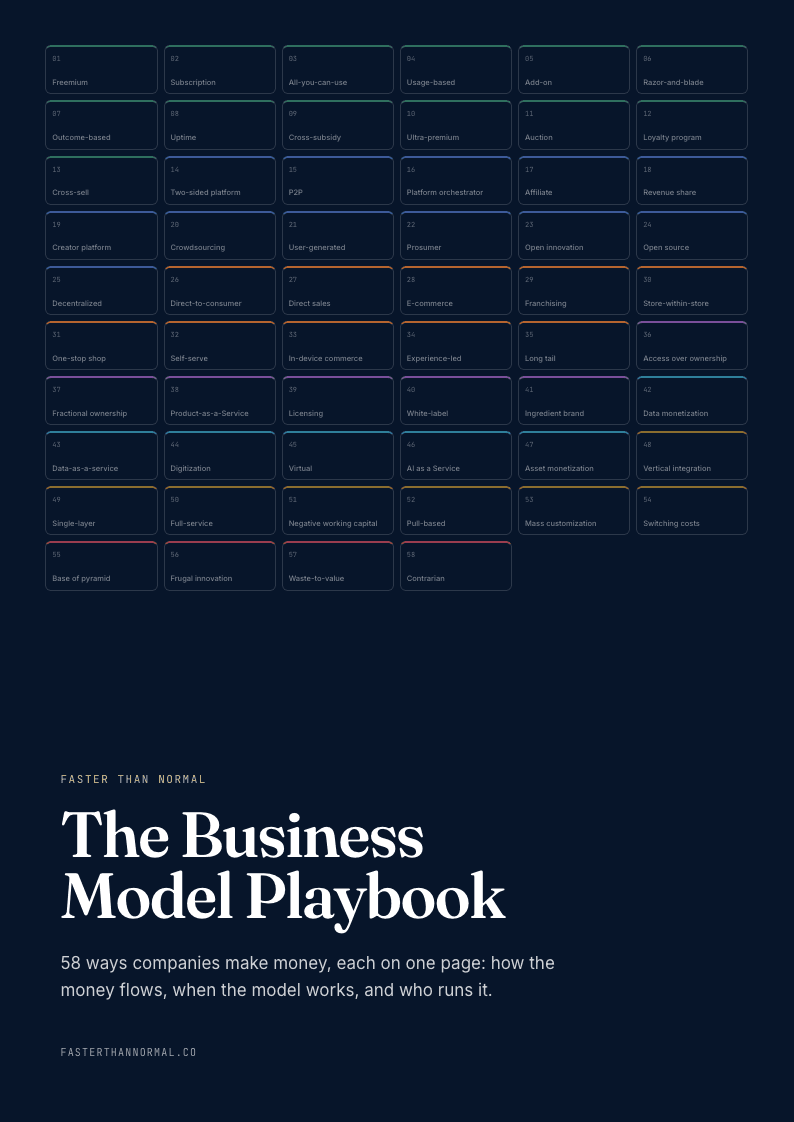
Free playbook
Get The Business Model Playbook
58 business models, one visual page each: how the money flows, the metrics that matter, and who runs it. Free when you join the Faster Than Normal email.
Free. No spam. Unsubscribe anytime.
Part IIIMaxims
- Wear the prototype. The most reliable market research is whether strangers ask where to buy what you're wearing.
- Solve for yourself first. If the product you want doesn't exist, the business case is your own dissatisfaction.
- Debt is patience; equity is speed. Choose the financing instrument that matches your temperament, not just your growth ambitions.
- Freedom is a financial asset. The value of owning 100 percent of a profitable company compounds in ways that diluted ownership cannot match.
- Imperfection at premium is a moat. Hand-made irregularity signals provenance that machines cannot counterfeit.
- Stores are media. A physical space that delivers an unreplicable experience is marketing that pays rent rather than costing it.
- Trust the inexplicable affinity. If you are drawn to something you cannot fully explain, the inability to explain it may be what makes it authentic.
- Pay your people first, figure out the rest later. Crisis response reveals priorities; make sure yours are the right ones.
- The family business is optimism. Some people inherit capital. Others inherit a disposition. The disposition may compound faster.
- Thirteen years is not too long. True profitability, on your own terms, with no one to answer to, is worth the wait.
In Their Own Words
I really had this mentality that I could do anything that I wanted to do.— Athleisure Mag interview, 2019
My passion for 1970's fashion and music manifested in Aviator Nation.— Create & Cultivate 100 List, 2022
Keeping the garments made in America is a core value for the brand.— Create & Cultivate 100 List, 2022
I wanted to create garments with the same look and feel of the vintage pieces I had been collecting for years.— Talking Top 10 interview, 2020
I practice intermittent fasting and avoid emails until after my morning workout.— Pursuit of Wellness podcast, 2025
My family nurtured my entrepreneurial spirit and artistic talents from an early age.— Pursuit of Wellness podcast, 2025
I meticulously oversee the brand's growth to over 20 retail locations across the US.— Pursuit of Wellness podcast, 2025
I start my days focusing on fitness to boost productivity and creativity.— Pursuit of Wellness podcast, 2025
I wanted to learn new things and do creative things.— Athleisure Mag interview, 2019
The quality becomes so much more important when you can watch your creation come to fruition.— Create & Cultivate 100 List, 2022
I have remained deeply involved in every aspect from design to business operations.— Pursuit of Wellness podcast, 2025
I launched an online flash sale to supplement my employees' salaries during quarantine.— Create & Cultivate 100 List, 2022
I wanted to learn to make the tee of my dreams.— Create & Cultivate 100 List, 2022
If I was going to take money from someone, I would have to owe someone something, and it would be not in my control. I wouldn't feel the freedom that I feel to design what I design.— Paige Mycoskie
Creativity comes from feeling like you have no limits, and without restrictions you can evolve in a lot of different ways.— Paige Mycoskie
I've realized if you let things happen naturally, you're more likely to find happiness.— Paige Mycoskie
When I was a kid, I got some aviator sunglasses after seeing Top Gun. Aviator Nation represents a group of people who are cool without trying too hard.— Paige Mycoskie
My overhead was very low in the early years and I was always sure not to spend more than I was bringing in.— Paige Mycoskie


