


Part IThe Story
In the fall of 1980, somewhere in a modest apartment in Troy, Michigan — a suburb so determinedly unremarkable that its primary claim to fame was proximity to Detroit's corporate parks — two former employees of Tata Consultancy Services pooled $2,000 and filed incorporation papers for a company they called Syntel. The sum was not symbolic. It was what they had. Neerja Sethi was twenty-five years old, a mathematics graduate from Delhi University with an MBA in operations research and a freshly minted master's in computer science from Oakland University. Her husband, Bharat Desai, was twenty-eight, an IIT Bombay–trained electrical engineer who had arrived in America four years earlier to write code for TCS. They had no venture capital, no family money, no office space beyond their living room, no employees beyond themselves. Their first-year revenue would amount to $30,000 — a number so modest it barely covered the cost of a shared American life. Nearly four decades later, in October 2018, the French IT conglomerate Atos SE would acquire Syntel for $3.4 billion. Sethi's stake alone was worth an estimated $510 million. That single transaction — the conversion of apartment-launched ambition into ten-figure liquidity — tends to dominate the telling. But the real story is the thirty-eight years in between, the compounding of small advantages into an empire that, at its peak, employed 23,000 people across three continents. And the even deeper story is what the number obscures: what it means to build a company not from a garage in Palo Alto but from a two-bedroom flat in suburban Michigan, not with the wind of Silicon Valley mythmaking at your back but against the headwinds of immigration, gender, and an industry that didn't yet know it needed what you were selling.
The Arithmetic of Beginnings
By the Numbers
The Syntel Empire
$2,000Initial investment, 1980
$30,000First-year revenue
$924MAnnual revenue by 2017
23,000Employees at peak, 80% in India
$3.4BAtos SE acquisition price, October 2018
~$510MSethi's estimated payout from acquisition
$1BForbes-estimated net worth, 2022–2025
To understand Neerja Sethi you have to understand the mathematics — not the mathematics she studied at Delhi University, though those matter too, but the cold arithmetic of the Indian IT diaspora in the late 1970s. India's information technology industry barely existed as an export sector. TCS, founded in 1968, was the pioneer, dispatching young engineers to American corporations that needed bodies to write COBOL and maintain mainframes. The work was unglamorous, the pay modest by American standards but extraordinary by Indian ones. The engineers arrived on work visas, lived frugally, sent money home, and — in most cases — eventually returned. What Sethi and Desai saw, working inside the TCS machinery, was a structural arbitrage so obvious it was almost invisible: American corporations had an insatiable appetite for software services; India had an inexhaustible supply of technically trained, English-speaking engineers willing to work for a fraction of American wages. TCS had proved the model. The question was whether two people with no capital, no reputation, and no institutional backing could replicate it.
Sethi's background was not, strictly speaking, humble — she was educated, ambitious, and had emigrated by choice rather than desperation — but it was emphatically middle-class in the Indian sense. Born in India in 1955, she pursued her undergraduate degree in mathematics at the University of Delhi, then added an MBA in operations research from the same institution. The combination was telling: she was not merely numerate but operationally minded, drawn to the systems that govern how work flows through organizations. Her subsequent decision to pursue a master's in computer science at Oakland University in Michigan was both pragmatic and prescient. She arrived in America during the late 1970s, a period when the personal computer revolution was still a hobbyist's fantasy and "computer science" carried none of the cultural cachet it would later acquire. She went to work at TCS. She met Bharat Desai. They married. They began to plot.
Desai, born in Mombasa, Kenya, and raised in India, had graduated from IIT Bombay in 1975 with a degree in electrical engineering — the kind of credential that, within the Indian technical elite, functions as both intellectual validation and lifelong social currency. He moved to the United States in 1976, joining TCS as a programmer. IIT Bombay's alumni network would prove instrumental decades later, not merely as a source of talent but as a connective tissue linking Syntel to the broader ecosystem of Indian entrepreneurial success in America. But in 1980, all of that was hypothetical. What was real was the apartment, the $2,000, and a bet that two people could do what TCS did — just smaller, leaner, and on their own terms.
Troy, Michigan, and the Staffing Arbitrage
Syntel began not as a technology company in any meaningful sense but as a staffing firm — a matchmaker between Indian software engineers and American corporations that needed them. This distinction matters because it reveals the strategic pragmatism that characterized Sethi's approach from the start. Building proprietary technology required capital they didn't have. Recruiting talent and placing it required nothing but a telephone, a Rolodex, and the credibility that came from having worked inside the industry you were now serving. The model was asset-light by necessity but scale-ready by design. Every placement generated a margin. Every margin could fund the next hire. The flywheel, once started, was self-sustaining.
The first year's $30,000 in revenue was, in the language of venture capital, a "proof of concept" — evidence that the model worked, however modestly. By 1984, four years in, Syntel had crossed its first million dollars in annual revenue. The trajectory was not exponential in the way Silicon Valley demands but it was relentless, the kind of steady compounding that only becomes visible in retrospect. Sethi served as the company's treasurer for the first sixteen years — a title that, in a two-person startup, meant she managed everything that wasn't sales: payroll, compliance, immigration paperwork, vendor negotiations, the unglamorous infrastructure that allows a services business to function. Her MBA in operations research was not decorative. It was load-bearing.
— Bharat Desai, co-founder of SyntelIt's about having a strong vision and the patience to build it step by step.
The patience was tested early and often. The American IT services market in the 1980s was not a frictionless meritocracy. There were, as Desai later acknowledged, "biases in some people's mind" — a diplomatic understatement for the suspicion that greeted Indian entrepreneurs trying to sell American corporations on the idea of outsourcing critical technical work to a company run from a Michigan apartment. The biases were not exclusively racial, though race was a factor; they were also structural. Large American companies preferred to work with large American vendors. The notion that a husband-and-wife team from India could deliver enterprise-grade IT services reliably, at scale, was counterintuitive to procurement departments trained to minimize risk by maximizing the size of their suppliers. Sethi and Desai's response was not to confront the bias but to outperform it — to deliver work of such consistent quality that the risk calculus eventually tipped in their favor.
The Invisible Co-Founder
The history of technology entrepreneurship is littered with partnerships in which one founder becomes the public face while the other recedes into operational obscurity. Hewlett and Packard. Gates and Allen. Jobs and Wozniak. The pattern is so consistent it suggests something structural about how narratives of innovation are constructed: they require a protagonist, preferably singular. Neerja Sethi's role at Syntel fits this pattern with an additional layer of complexity — she was not merely the quieter co-founder but a woman in an industry that, in the 1980s and 1990s, was overwhelmingly male, operating within a cultural framework (Indian-American, first-generation immigrant) that did not always celebrate female entrepreneurial ambition in its own right.
What the record shows is this: Sethi was an executive at Syntel from its founding in 1980 through the Atos acquisition in 2018 — thirty-eight consecutive years. She served as treasurer, then as vice president of corporate affairs. She sat on the board of directors. She was, by any measure, a co-builder of the enterprise. What the record does not show — because Sethi has maintained a public profile so low it approaches translucence — is the texture of that contribution. She has given almost no interviews. She has published no memoir. Her name appears in SEC filings, in Forbes lists, in the occasional Indian newspaper profile, but always in the same compressed formula: co-founded Syntel with her husband, started with $2,000, now worth $1 billion. The formula is true. It is also radically incomplete.
The incompleteness is, in one reading, a choice — a deliberate refusal to participate in the apparatus of personal branding that her peers in the tech industry have embraced with varying degrees of enthusiasm. In another reading, it reflects the structural invisibility that attaches to certain kinds of entrepreneurial contribution. Operational excellence is inherently less narratable than visionary leadership. The person who ensures that payroll is met, that immigration paperwork is filed correctly, that clients receive invoices on time, that the company's financial architecture can support growth — that person is indispensable but not, in the conventional sense, a protagonist. Sethi's silence may be strategic, temperamental, cultural, or some combination of all three. What it is not is accidental.
The Offshore Model and Its Discontents
Syntel's growth through the 1980s and into the 1990s tracked a broader transformation in the global technology services industry — the shift from onshore staffing (placing Indian engineers at American client sites) to offshore delivery (performing work in India at dramatically lower cost). This shift was not unique to Syntel; it was the tidal force that created Infosys, Wipro, HCL, and a generation of Indian IT services giants. But Syntel rode the wave with particular effectiveness, in part because its small size allowed it to be nimble and in part because Sethi and Desai had spent years building the operational scaffolding — the project management processes, the quality assurance protocols, the communication infrastructure — that made offshore delivery feasible.
By the late 1990s, 80 percent of Syntel's workforce was based in India. The economics were devastating to competitors who relied on domestic labor: Syntel could offer comparable or superior work at a fraction of the cost. American clients, under relentless pressure to reduce IT spending, found the proposition irresistible. Revenue climbed. The company's margins, in an industry where margins were everything, were among the best in the sector.
But the offshore model brought scrutiny. The U.S. Department of Labor ordered probes into Syntel's labor practices — a consequence of the broader political tension surrounding H-1B visas and the perception that Indian IT firms were displacing American workers. The investigations were not unique to Syntel; they were an occupational hazard for the entire Indian IT services industry. But for a company founded by two immigrants, the scrutiny carried an additional edge. Sethi and Desai had built their American dream on the premise that labor markets, like capital markets, should be global. The political system was not always persuaded.
Going Public, Staying Private
Syntel's initial public offering in 1997 was, in one sense, a validation — the market's imprimatur on a business that had taken seventeen years to build. In another sense, it was an anomaly. The late 1990s were the era of the dot-com frenzy, when companies with no revenue and barely coherent business plans commanded valuations in the billions. Syntel, by contrast, was profitable, growing, and fundamentally boring — a services company that made money by deploying engineers to maintain corporate IT systems. It was not going to appear on the cover of Wired. It was not going to make anyone rich overnight. But it was going to compound.
The IPO brought public attention and, with it, recognition. Forbes named Syntel one of the "Best 200 Small Companies in America" multiple times. Individual Investor magazine ranked it 29th among "America's Fastest Growing Companies" in 1998. Business Week placed it 70th on its "Hot Growth Companies" list. In 1996, even before the IPO, Desai received the "Entrepreneur of the Year" award from USA Today and NASDAQ. The accolades attached primarily to Desai — he was, after all, the chairman, the public face — but the operational machine they recognized was a joint creation.
What Sethi and Desai did not do, in the years after the IPO, was sell. They held their shares. They maintained control. They resisted the temptation — common among founders of newly public companies — to diversify their wealth at the first opportunity. This was either supreme confidence or supreme stubbornness, depending on your theory of portfolio management. The effect, however, was to concentrate their fortunes in a single asset: Syntel itself. When the Atos acquisition came in 2018, that concentration paid off spectacularly. But for the intervening twenty-one years, it meant that the Sethi-Desai net worth was essentially a leveraged bet on a single company in a single industry.
— Forbes, on Neerja Sethi's inclusion in America's Richest Self-Made Women, 2015Sethi, who had served as an executive at Syntel since 1980, did not join Atos after the acquisition.
$3.4 Billion and the Art of the Exit
On October 1, 2018, Atos SE — a French multinational IT services corporation headquartered in Bezons, a Paris suburb — completed its acquisition of Syntel for approximately $3.4 billion. The price represented a significant premium and valued Syntel at roughly 3.7 times its 2017 revenue of $924 million. For Atos, the acquisition was a strategic play to expand its digital services capabilities and strengthen its position in North America. For Sethi and Desai, it was the culmination of thirty-eight years of compounding.
Sethi's estimated $510 million payout made her, in a single transaction, one of the wealthiest Indian-American women in the country. Forbes had been tracking her ascent for years — she appeared on the inaugural 2015 list of America's Richest Self-Made Women at number 14, and continued to appear in subsequent years, hovering around the billion-dollar mark. The 2018 acquisition crystallized her wealth from theoretical (shares in a publicly traded company subject to market fluctuations) to actual (cash and equivalents). She did not join Atos after the deal closed. Neither did Desai. They were done.
The decision not to join the acquiring company is, in the corporate M&A literature, a signal. It can mean many things — exhaustion, disagreement over strategy, a desire to retire, a conviction that the acquiring company's culture is incompatible with one's own. In Sethi's case, the signal is ambiguous, because Sethi has offered no public explanation. What is clear is that by 2018, she was sixty-three years old, had spent her entire professional career at a single company, and had achieved a financial outcome that would have been unimaginable in 1980. There was, perhaps, nothing left to prove. Or perhaps there was, but not at Atos.
Fisher Island and the Architecture of Wealth
After the Atos acquisition, Sethi and Desai relocated — or rather, settled more permanently — on Fisher Island, Florida, a 216-acre barrier island accessible only by ferry from the southern tip of Miami Beach. Fisher Island is, by median income, the wealthiest zip code in the United States: a community of approximately 700 residences where the average household income exceeds $2 million. It is the kind of place where billionaires can be anonymous, where the infrastructure of daily life (private beach club, golf course, marina) is calibrated to eliminate friction, where wealth is neither displayed nor discussed but simply assumed.
The choice of Fisher Island is telling. Sethi and Desai did not pursue the philanthropic celebrity circuit of Manhattan, the political influence-brokering of Washington, or the venture capital second act that beckons many retired tech founders. They went somewhere quiet. This is consistent with everything else in the record: Sethi's aversion to publicity, her absence from social media, her refusal to participate in the speaking-circuit economy that monetizes entrepreneurial success into a form of entertainment. She is, as far as public records indicate, present at charitable events, listed as a co-host for cultural functions (a 2014 ceremony at Boston's Symphony Hall honoring A.R. Rahman, for instance, lists "Neerja Sethi and Bharat Desai" among the event co-hosts at Berklee College of Music), and active through the family foundation. But she is not, in any meaningful sense, a public figure. The billion dollars did not change this. If anything, it insulated it.
The Desai Sethi Imprint
Wealth at Sethi's scale demands a vehicle, and hers is the Desai Sethi Family Foundation — later rebranded and expanded through what appears to be at least two entities: the Desai Sethi Foundation (DSF) and the Ds Foundation. The philanthropic portfolio is focused on education, entrepreneurship, healthcare, and economic mobility, with particular attention to underserved youth in Michigan and Florida — the two states where Syntel's American story was rooted.
The flagship philanthropic achievement is the Desai Sethi School of Entrepreneurship (DSSE) at IIT Bombay. The origin story is characteristically understated: in 2014, Desai (IIT Bombay class of 1975) and Sethi donated $1 million to establish a Centre for Entrepreneurship at the institution. In December 2019, IIT Bombay's Board of Governors approved the conversion of the Centre into a full School. A new 115,000-square-foot building — featuring a makerspace, design thinking studios, co-working labs, a proof-of-concept lab, and manufacturing facilities — was unveiled in a plaque ceremony attended by both Sethi and Desai. The facility is designed as a bridge between academic research and commercial application, a "lab to market" pipeline for student entrepreneurs.
The $20 million commitment to establish the Desai Sethi Urology Institute at the University of Miami's Leonard M. Miller School of Medicine, dedicated on February 28, 2022, extended the philanthropic footprint into healthcare. Led by Dr. Dipen J. Parekh, the Institute was conceived as a center for robotic surgery innovation and urologic research — a choice that, while less narratively resonant than the IIT Bombay investment, reflects a pattern of substantial, institution-building gifts rather than scattershot check-writing.
In 2025, the couple joined the Giving Pledge — Warren Buffett, Bill Gates, and Melinda French Gates's initiative encouraging billionaires to commit the majority of their wealth to philanthropy. Their joint statement described their wealth as "a responsibility to give back meaningfully" and emphasized "long-term, systemic change, particularly in areas where young people face structural barriers to advancement." The Giving Pledge commitment, representing an estimated $1.3 billion between the two of them, was the largest new pledge in the initiative's 2025 cohort.
— Bharat Desai and Neerja Sethi, Giving Pledge statement, 2025Our wealth represents a responsibility to give back meaningfully.
The Paradox of Self-Made
Forbes has, since 2015, included Neerja Sethi on its list of America's Richest Self-Made Women. In 2015, she debuted at number 14. By 2023, she was at number 25, with a net worth estimated at $990 million. The Hurun Research Institute's 2023 ranking of the world's self-made women billionaires placed her at number 99 globally, with a wealth of $1.1 billion. These rankings place her in the company of figures like Oprah Winfrey, Sheryl Sandberg, and Rihanna — women whose names are synonymous with personal brands, media empires, and cultural ubiquity. Sethi is the opposite of all of that. She is famous for being on the list. She is not famous.
The "self-made" designation carries its own tensions. Sethi built Syntel with her husband. The company was a partnership — personal and professional — and the Forbes ranking, which tracks individual net worth, necessarily disaggregates a joint achievement into separate balance sheets. Bharat Desai appears on separate lists, with an estimated net worth of $1.6 billion as of 2025. Together, they are worth approximately $2.6 billion. Separately, they are each rich. The distinction matters because it reflects a broader cultural discomfort with the idea that entrepreneurial success might be collaborative rather than individual, marital rather than singular. The Forbes methodology — which tracks shareholders' stakes and assigns individual values — is designed for a world of heroic solo founders. Syntel was never that kind of story.
What the rankings do capture, however, is the magnitude of Sethi's achievement relative to her starting point. A woman born in India in 1955, educated at Delhi University, arriving in America in the late 1970s with a student visa and a mathematics degree, building a company from a $2,000 investment to a $3.4 billion exit — the arc is genuinely extraordinary. It is also, in the context of the Indian-American immigrant experience, not entirely unique. Jayshree Ullal, born in London and raised in India, became president and CEO of Arista Networks and is worth $2.4 billion. Neha Narkhede, a LinkedIn engineer who co-founded Confluent, is worth $520 million. Indra Nooyi ran PepsiCo. The pattern is too consistent to be coincidental: Indian-origin women, technically educated, emigrating to the United States, building or leading companies of enormous value. Sethi was among the first. She will not be the last.
Silence as Strategy
There is a version of Neerja Sethi's story that would make a splendid TED talk: immigrant woman, $2,000, apartment, billion dollars, American dream. The narrative ingredients are all present. Sethi has declined to deliver that talk, or any talk, or any interview that would allow her to shape the public understanding of her own life. This is, in the contemporary attention economy, almost perverse. The entire apparatus of entrepreneurial celebrity — the podcast circuit, the keynote speeches, the ghostwritten memoirs, the LinkedIn thought leadership — exists to amplify exactly the kind of story Sethi embodies. She has refused all of it.
The refusal invites speculation. Is it humility? Cultural conditioning? Temperament? Strategic calculation? There is, in the Indian business tradition, a long history of wealth that does not speak — families like the Birlas and the Ambanis who, for decades, operated with minimal public commentary, allowing the scale of their enterprises to do the talking. Sethi may simply belong to this tradition. Or she may have concluded, correctly, that in an industry where she spent thirty-eight years executing rather than performing, silence was more authentic than suddenly discovering a public voice.
What her silence does, inadvertently, is create a kind of Rorschach test. Those who value operational excellence see a master builder who let the work speak for itself. Those who study gender dynamics see a woman whose contributions were structurally undervalued by the same media and market forces that elevated her husband. Those who analyze wealth see a billionaire who has managed to remain, in an era of compulsive disclosure, genuinely private. All three readings may be true simultaneously.
The couple's two children have maintained a similarly low profile. Pia Desai has appeared in connection with the Desai Sethi Foundation's work, but neither child has sought or received significant public attention. The family's philanthropic work is conducted primarily through institutional channels — foundation grants, university endowments, the Giving Pledge — rather than through the kind of personal storytelling that characterizes many contemporary philanthropists. Even in giving money away, Sethi has managed to remain largely invisible.
The Long Compound
On a warm evening in Miami in February 2022, at the Rubell Museum — a converted industrial space in Allapattah that houses one of the largest private contemporary art collections in North America — the University of Miami dedicated the Desai Sethi Urology Institute. University President Julio Frenk spoke. The dean spoke. A trustee spoke. The Miami-Dade County mayor spoke. Somewhere in the room, surrounded by large-scale paintings and institutional gratitude, were Bharat Desai and Neerja Sethi, the benefactors whose $20 million had made the evening possible. There is no record of Sethi speaking at the event. There is no record of her declining to speak. She was present. She was, as she has always been, the person in the room who funded the room.
This is the final arithmetic of Neerja Sethi's career: $2,000 became $3.4 billion. An apartment in Troy, Michigan, became a 115,000-square-foot entrepreneurship building at one of Asia's great engineering universities, a urology institute at a major American medical school, a foundation serving underprivileged youth in two states, and a $1.3 billion Giving Pledge commitment. The compounding was not merely financial. It was institutional — the slow, patient, unglamorous accumulation of capability, reputation, and eventually, legacy.
Somewhere on Fisher Island, accessible only by ferry, in a community designed to make wealth both comfortable and unremarkable, Neerja Sethi — seventy years old, co-founder of an enterprise that no longer bears her operational imprint, signatory to a pledge that commits her to giving away the bulk of what she built — is, presumably, at home. The apartment in Troy is long gone. The $2,000 has multiplied beyond any reasonable expectation. The silence, one suspects, continues.
Part IIThe Playbook
Neerja Sethi's career offers a set of principles that are, in their way, deeply unfashionable — not the disruptive mantras of Silicon Valley's founder-celebrity culture but the quieter logic of immigrant pragmatism, operational discipline, and compounding patience. What follows is an attempt to extract those principles from the evidence of what she actually did, rather than what she said about doing it.
The principles
- 1.Start with arbitrage, not invention.
- 2.Choose asset-light models when capital is scarce.
- 3.Let operations be your moat.
- 4.Compound before you compound.
- 5.Build the partnership first, the company second.
- 6.Refuse to perform — let the work be the narrative.
- 7.Hold your concentration.
- 8.Time the exit to the cycle, not the ego.
- 9.Give institutionally, not performatively.
- 10.Use silence as a competitive advantage.
Principle 1
Start with arbitrage, not invention.
Syntel was not built on a proprietary technology, a patented algorithm, or a novel product insight. It was built on the oldest business logic in the world: buy low, sell high. In this case, "buy low" meant recruiting technically skilled engineers in India, where labor costs were a fraction of American rates, and "sell high" meant deploying them at American corporations willing to pay full market price for IT services. The arbitrage was obvious to anyone who had worked inside TCS — which is to say, it was obvious to Sethi and Desai. Their insight was not that the arbitrage existed but that it was replicable by a small, independent firm.
The lesson is counterintuitive in a startup culture that fetishizes invention. Most enduring businesses are not built on unprecedented ideas but on the disciplined exploitation of known inefficiencies. Sethi and Desai did not need to invent the offshore IT services model. TCS had already proved it. They needed to execute it better, cheaper, or more reliably than anyone else their size — and they did.
Tactic: Before chasing novelty, look for structural inefficiencies in established markets where your specific background, network, or expertise gives you an execution advantage.
Principle 2
Choose asset-light models when capital is scarce.
Syntel's initial business — software staffing — required almost no capital. There was no inventory, no manufacturing, no equipment beyond a telephone and whatever computing was necessary for basic business operations. The company's primary asset was its people, and those people were, technically, assets that walked in the door every morning and walked out every evening. This was not a limitation; it was a strategy. An asset-light model allowed Sethi and Desai to grow without external funding, to maintain control without dilution, and to generate positive cash flow from nearly the beginning.
⚖
Capital Efficiency: Syntel vs. Typical Tech Startups
How Syntel's model differed from the conventional venture-backed playbook.
| Dimension | Venture-backed startup | Syntel (1980–1997) |
|---|---|---|
| Initial capital | Seed round ($500K–$2M+) | $2,000 personal savings |
| Path to profitability | 3–7 years (if ever) | Profitable from year one |
| Founder dilution by IPO | 50–80% | Minimal — no outside investors pre-IPO |
| Primary asset | Intellectual property | Human capital (billable engineers) |
| Growth rate | Exponential or death | Steady compounding |
The consequence of bootstrapping was that Sethi and Desai retained enormous ownership stakes through the IPO and beyond. When the $3.4 billion exit came, they captured most of the value — rather than sharing it with a series of venture investors who had funded the company's early growth. Capital efficiency, over a sufficiently long time horizon, is the most powerful form of leverage available to founders.
Tactic: If you lack capital, choose a business model where your primary input is labor or expertise rather than equipment or inventory — and reinvest margins relentlessly.
Principle 3
Let operations be your moat.
In the IT services industry, differentiation is notoriously difficult. One firm's Java developer is, in theory, substitutable for another's. The services are, at the commodity level, interchangeable. What distinguishes winners from losers in this market is not product but process — the reliability of delivery, the quality of project management, the consistency of communication, the ability to scale teams up and down without disrupting client operations.
Sethi's background — operations research, mathematics, computer science — was precisely calibrated for this kind of work. Her contribution to Syntel, as near as the evidence allows us to reconstruct it, was fundamentally operational: building the systems, processes, and financial infrastructure that allowed the company to deliver services reliably at scale. This is not the kind of contribution that generates headlines. It is the kind that generates margins.
Tactic: In a commoditized market, invest disproportionately in the operational infrastructure that competitors neglect — delivery processes, quality assurance, client communication — because reliability is the last thing to be commoditized.
Principle 4
Compound before you compound.
Syntel took seventeen years to reach its IPO. It took another twenty-one years to reach its acquisition. The total arc — from founding to exit — was thirty-eight years. In a culture that celebrates the overnight unicorn, this timeline is almost embarrassing. It is also, by any financial measure, spectacularly successful.
The principle at work is one that Morgan Housel, among others, has articulated: the most powerful force in finance is not rate of return but duration of compounding. Syntel's returns were not extraordinary in any single year. But compounded over nearly four decades, with founders who never sold, the result was a $3.4 billion enterprise built from $2,000 in seed capital. That represents a roughly 1.7-million-times return on investment — a number so large it becomes abstract.
Sethi's patience — her willingness to occupy the same company, the same role, the same industry for thirty-eight years — was not merely temperamental. It was economic. Every year she didn't sell was a year the compounding continued.
Tactic: Resist the urge to optimize for speed. If the underlying economics are sound, duration of ownership is the single most powerful variable you control.
Principle 5
Build the partnership first, the company second.
Sethi and Desai were married before they were co-founders. Their partnership was personal before it was professional, and it endured for the entire lifespan of the enterprise. This is unusual. Spousal co-founding teams face well-documented challenges — the blurring of personal and professional boundaries, the difficulty of maintaining distinct identities, the risk that marital conflict will contaminate corporate decision-making. The Sethi-Desai partnership appears to have navigated these challenges successfully, though the absence of public commentary from either party makes it impossible to know what tensions existed behind the scenes.
What is observable is a clear division of labor: Desai as the external face (chairman, media spokesperson, award recipient) and Sethi as the internal operator (treasurer, VP of corporate affairs, board member). This division may have been chosen or it may have been imposed by cultural expectations. Either way, it worked. The company had a consistent voice externally and a consistent hand operationally, and neither founder needed to do everything.
Tactic: In any partnership, establish complementary roles early and commit to them — not because one role is more important, but because clarity of function reduces friction and amplifies output.
Principle 6
Refuse to perform — let the work be the narrative.
Sethi's near-total absence from the public discourse surrounding her own company is, in the context of contemporary entrepreneurship, extraordinary. She has not written a book. She has not launched a podcast. She has not built a personal brand. She has not delivered a TED talk, a keynote, or a commencement address. She has not, as far as any public record indicates, given a single substantive interview about her experience building Syntel.
This refusal has costs. It means that her contributions are systematically underrepresented in the historical record. It means that others — journalists, list-makers, Forbes editors — define her narrative. It means that aspiring entrepreneurs who might benefit from her operational wisdom have no access to it. But it also has benefits. It means she was never distracted by the performance of entrepreneurship at the expense of its practice. It means she was never drawn into the competitive signaling that consumes so many founder-CEOs. It means that her time and attention were, for thirty-eight years, directed at the enterprise itself rather than at the story of the enterprise.
Tactic: Before investing time in telling your story, ask whether telling the story serves the work — or merely serves your ego.
Principle 7
Hold your concentration.
After Syntel's 1997 IPO, Sethi and Desai maintained a concentrated ownership position in the company. They did not diversify into a portfolio of investments. They did not take chips off the table. This strategy is, by the standards of modern financial planning, irresponsible — the equivalent of putting all your eggs in one basket and then sitting on the basket for two decades. It also made them billionaires.
The argument for concentration is simple: if you have superior information about a single asset (because you built it and operate it), diversification is a tax on your conviction. The argument against concentration is equally simple: even the best operators cannot control macroeconomic forces, regulatory changes, or competitive disruption. Sethi and Desai bet on themselves, and they won. But the bet was real. Had Syntel faltered — had the offshore backlash intensified, had a major client defected, had the dot-com crash destroyed their market — the concentrated position would have been devastating.
Tactic: If you have genuine edge — informational, operational, or structural — in a single asset, concentration can generate returns that diversification cannot. But be honest about whether your edge is real or imagined.
Principle 8
Time the exit to the cycle, not the ego.
1980
Syntel founded in Troy, Michigan apartment with $2,000
1984
Revenue crosses $1 million
1997
IPO on NASDAQ
2017
Revenue reaches $924 million; 23,000 employees
2018
Atos SE acquires Syntel for $3.4 billion
2022
Desai Sethi Urology Institute dedicated at University of Miami
2025
Sethi and Desai join the Giving Pledge
The 2018 Atos acquisition came at a moment when the IT services industry was undergoing significant consolidation. Large European firms like Atos, Capgemini, and Sopra Steria were actively acquiring mid-market players to build scale and geographic reach. Syntel, with its strong margins, established client relationships, and significant India-based workforce, was an ideal target. Sethi and Desai sold into this demand — accepting a premium valuation at a moment when buyers were most motivated.
The timing suggests strategic awareness rather than emotional attachment. Many founders hold too long, unable to separate their identity from the enterprise they built. Sethi and Desai appear to have made a clear-eyed assessment: the company had reached a scale where further growth would require either significant investment in new capabilities or a partnership with a larger entity. They chose the latter, and they chose it when the market favored sellers.
Tactic: Develop an exit framework based on market conditions and strategic fit, not on your emotional attachment to the company. The best time to sell is when you don't need to.
Principle 9
Give institutionally, not performatively.
The Sethi-Desai philanthropic model is notable for what it is not. It is not a vanity foundation with a glossy website and a full-time communications staff. It is not a vehicle for social media–friendly giving. It is not a mechanism for converting charitable donations into personal brand equity. It is, instead, a set of large, institution-building commitments — a school of entrepreneurship at IIT Bombay, a urology institute at the University of Miami, a pledge to give away the majority of a multi-billion-dollar fortune — administered through established institutional channels.
This approach sacrifices visibility for leverage. A $20 million gift to a university medical school will, over decades, train hundreds of physicians, generate research that benefits millions, and create a self-sustaining institutional capability that outlasts the donors. A $20 million personal branding campaign, by contrast, generates a news cycle. Sethi and Desai have consistently chosen the former.
Tactic: When giving, prioritize institutional capacity-building over individual transactions. The goal is not to be seen giving but to create self-sustaining systems that compound after your involvement ends.
Principle 10
Use silence as a competitive advantage.
In an economy where attention is currency, Sethi's refusal to seek it is — paradoxically — a form of power. She cannot be misquoted because she does not speak. She cannot be criticized for a poorly received interview because she does not give interviews. She cannot be drawn into the social media controversies that consume the time and emotional bandwidth of more visible entrepreneurs because she does not participate in social media. Her public persona is, essentially, a balance sheet — net worth, company founded, acquisition price — and balance sheets are difficult to argue with.
The competitive advantage of silence is not merely reputational. It is cognitive. Every hour not spent preparing a keynote, managing a Twitter backlash, or sitting for a magazine profile is an hour available for the actual work of building and operating an enterprise. Sethi's thirty-eight-year tenure at Syntel suggests that this tradeoff was, for her, overwhelmingly positive.
Tactic: Audit the time you spend on self-promotion and ask what you would build if you redirected that time entirely toward execution. The answer may surprise you.
Free playbook
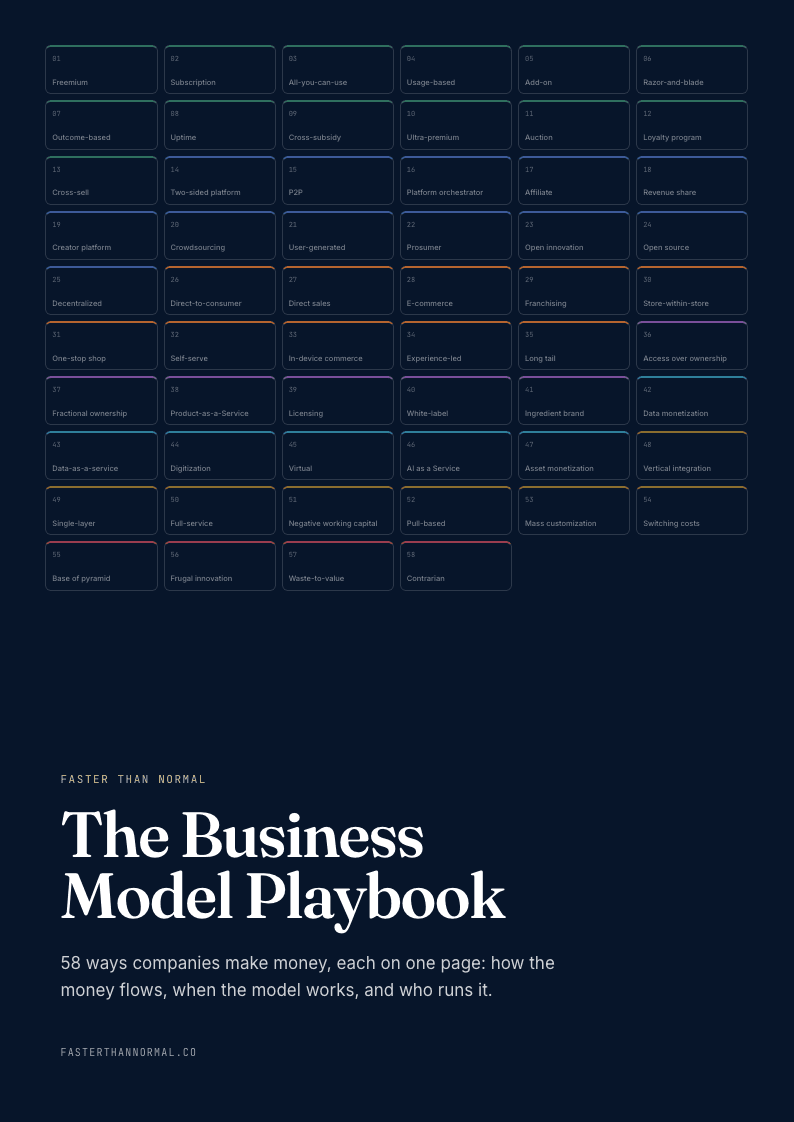
Get The Business Model Playbook
58 business models, one visual page each: how the money flows, the metrics that matter, and who runs it. Free when you join the Faster Than Normal email.
Free. No spam. Unsubscribe anytime.
Part IIIMaxims
-
$2,000 is enough. The initial investment is almost never the binding constraint. Resourcefulness, domain expertise, and willingness to start small matter more than seed capital.
-
Arbitrage is underrated. The most durable businesses are often built not on invention but on the disciplined exploitation of structural inefficiencies that others are too proud or too impatient to pursue.
-
Operations is strategy. In services businesses, the operational infrastructure — processes, quality assurance, financial management — is the product. Everything else is marketing.
-
Duration beats intensity. Thirty-eight years of steady compounding will outperform almost any short-term growth rate. The variable that matters most is how long you stay in the game.
-
Complementary partnerships outlast heroic solos. A clear division of labor between co-founders — one external, one internal — reduces friction and multiplies capability.
-
Silence preserves optionality. The less you say publicly, the fewer positions you need to defend, the fewer controversies you invite, and the more time you have for the work itself.
-
Concentration rewards conviction. If you built the asset and understand it better than anyone, diversification is a hedge against your own judgment. Know when that hedge is prudent and when it's cowardice.
-
Sell into demand. The optimal exit is determined by market conditions and strategic fit, not by emotional readiness. The best time to sell is when buyers are most motivated and you don't need the money.
-
Give to institutions, not to cameras. Philanthropy that builds self-sustaining institutional capacity — a school, a research institute, an endowment — compounds in ways that transactional giving cannot.
-
The immigrant's edge is permanent. The combination of technical education, cultural adaptability, frugality born of necessity, and the relentless drive to justify the decision to leave home — these are not temporary advantages. They are the foundation of empires.
In Their Own Words
Entrepreneurship has a transformative power. But this is not for everybody. The journey is tough — the path is covered with stones and thorns, not roses. Entrepreneurs need to have passion, self-belief, discipline and perseverance.— Bharat Desai, on the Desai Sethi School of Entrepreneurship at IIT Bombay
IIT Bombay has the expertise and the convening power to bring together the best minds in entrepreneurship and innovation. Our hope is that the building is bustling with student activity, mentorship, and research, where the 'lab to market' concept truly takes shape and helps grow commercialization.— Bharat Desai, at the DSSE building unveiling, IIT Bombay


