


Part IThe Story
The Milk
The night she became president of PepsiCo — one of the most powerful corporate positions on earth, a title conferred upon fewer than a handful of people in the company's four-decade history — Indra Nooyi drove home at speed. The year was 2001. She had spent seven years climbing from senior vice president of corporate strategy to the very top of the finance function, had quarterbacked the spin-off of Pizza Hut, KFC, and Taco Bell into what became Yum! Brands, had engineered the $3.3 billion acquisition of Tropicana and the $13.4 billion merger with Quaker Oats, and now she had been made president and CFO, the position that all but guaranteed the chief executive's chair. She burst through the front door, brimming. Her mother was in the kitchen.
"I've got great news," Nooyi said.
Her mother barely looked up. "The news can wait. Can you go out and get the milk?"
Nooyi went. She drove to the store, bought the milk, came back, and slammed the gallon on the counter. She was livid.
Her mother's response was surgical: "You may be president of PepsiCo. You might be on the board of directors. But when you enter this house, you're the wife, you're the daughter, you're the daughter-in-law, you're the mother. You're all of that. Nobody else can take that place. So leave that damned crown in the garage. And don't bring it into the house."
It is the most repeated Indra Nooyi story in existence, and she tells it so often — in commencement addresses, in boardrooms, on podcasts, in the pages of My Life in Full — that it has acquired the polish of parable. Which is precisely the point. The story contains her entire philosophy compressed into a single domestic scene: that the crown is real but provisional, that the garage is a liminal space between two identities neither of which can be abandoned, that the woman who buys the milk and the woman who engineers a $13 billion acquisition are the same person and the tension between them is not a problem to be solved but a condition to be endured. It is a story about power and its insufficiency. About belonging in two worlds and being fully claimed by neither.
Nooyi would carry that tension for another seventeen years inside PepsiCo, and it would shape everything — her strategy, her management style, her conception of what a corporation owed the world and what the world owed the families who kept it running.
By the Numbers
The PepsiCo Transformation
$35B → $63.5BAnnual revenue growth during CEO tenure (2006–2018)
80%+Net revenue growth over her full PepsiCo career
162%Total shareholder return as CEO, beating the S&P 500
48Consecutive quarters as CEO
$57BMarket capitalization growth during tenure
12Years as CEO — fifth in PepsiCo's 42-year history
1stWoman of color and immigrant to lead a Fortune 50 company
A Rosewood Swing in Madras
In the house on T. Nagar in Madras — the city now called Chennai, sprawling along the eastern coast of Tamil Nadu — there hung a rosewood swing from chains embedded in the wall. It occupied the center of a room with shiny red floors and almost no furniture. The swing was in constant use. The women of the house sat on it to gossip about politics and children's grades. The elders gathered there to match horoscopes for marriages. And when the adults dispersed, the children piled on — Indra, her older sister Chandrika, her younger brother Nandu — singing Beatles and Beach Boys songs for two hours straight, the chains creaking a rhythm that gave them their beat.
Indra Krishnamurthy was born on October 28, 1955, eight years after Indian independence, into what she describes as a "good Tamilian, South Indian family" — conservative, devout Hindu, middle class. Her father worked as an official at the State Bank. Her mother was a homemaker of a particular type: one who refused to let her daughters imagine a smaller life than her sons'. Most evenings at the dinner table, she required Indra and Chandrika to write speeches about what they would do if they were president, chief minister, or prime minister. The girls would present their arguments. The mother would adjudicate. The point, Nooyi later realized, was not to win. It was to learn how to hold a room.
The family did not take vacations. They did not eat out. ("If we ever suggested to our mother that we should eat out, she would say: 'I'll make it!'") The grandfather — the "loving enforcer" — imposed structure: reading, homework, discipline. But within those frames, an unusual freedom. The girls and boys were treated identically. "Dream as much as you can," her father and grandfather told them. "You can be whatever you want, and there should be no difference between men and women."
It was a contradiction that Nooyi has spent a lifetime navigating — a conservative household that was, on the question of female ambition, quietly radical. The same India that maintained separate living rooms for men and women also produced a girl who joined an all-girls cricket team, played guitar in an all-female rock band at Madras Christian College, and graduated with a degree in physics, chemistry, and mathematics in 1974, one of only five women admitted to the science program. Her sister Chandrika would become a Grammy-nominated world musician and a financial advisor at NYU. Her brother Nandu would found Trident Investment Management in New York. The dinner-table exercise, it turned out, was not performance. It was preparation.
Unheard-of for a Brahmin Girl
There were two MBA programs in all of India. Nooyi got into the Indian Institute of Management in Calcutta, one of the most competitive graduate programs in the country. She graduated in 1976, took a job at Tootal, a British textile firm with extensive Indian holdings, then moved to Johnson & Johnson in Bombay as a brand manager. Her assignment was Stayfree — menstrual pads. In a country that banned direct advertising for feminine hygiene products, this was a problem of exquisite difficulty. Nooyi devised a workaround, marketing directly to female college students, bypassing broadcast media entirely. The campaign worked. It was also, in retrospect, a template: take an intractable constraint, reframe it as a design problem, find the seam.
But she felt underprepared. She read about the Yale School of Management in a magazine and applied. "It was unheard of for a good, conservative, south Indian Brahmin girl to do this," she said. "It would make her an absolutely unmarriageable commodity after that." To her surprise, her parents agreed. In 1978, at twenty-two, she boarded a plane to New Haven, Connecticut. She arrived with a scholarship and nothing else.
The cultural dissonance was immediate. She worked the overnight shift as a receptionist to make fifty cents more an hour. She could not afford a suit for job interviews and wore a sari instead — not out of cultural pride but out of economic necessity. She graduated in 1980 with a master's in public and private management, applied to Boston Consulting Group, and wore the sari to that interview too. She got the job. An employee in career development had seen her leaving a previous interview in tears, asked what she normally wore in India, and told her: wear that. If they don't want to hire you for who you are, they don't deserve you.
It was one of those small pivots — a stranger's kindness — that Nooyi would later crystallize into a leadership axiom. She stayed at BCG for six years, married fellow consultant Raj K. Nooyi in 1981, and began building the skill that would define her career: the ability to take the most complex topic and simplify it. Difficult projects landed in her lap, and when she couldn't solve them, people concluded the project needed rethinking, not the analyst. She moved to Motorola in 1986, became Vice President and Director of Corporate Strategy and Planning, then to ABB — the Swiss industrial conglomerate — where she led corporate strategy integrating diverse product divisions into a coherent whole, overseeing roughly $10 billion of ABB's $30 billion in global sales.
By 1994, she was being courted simultaneously by PepsiCo and General Electric for executive-level positions. She chose Pepsi. The CEO, Wayne Calloway — a Wake Forest graduate, a Southerner of old-school graciousness who had built PepsiCo's international snack-food business — convinced her she would have real influence. At thirty-eight, Nooyi arrived on the executive floor at Purchase, New York. No foreign-born person and no woman had ever been there.
The Strategic Mind at Purchase
The PepsiCo that Nooyi entered in 1994 was a sprawling, unruly empire. It made soft drinks. It operated Pizza Hut, KFC, and Taco Bell. It had Frito-Lay. It had ambitions but lacked coherence. Nooyi's title was Senior Vice President of Corporate Strategy and Development, and the first thing she did was the thing consultants do when they're good: she zoomed in before she zoomed out. She visited factories, walked manufacturing lines, talked to R&D teams, studied the margins on a 25-cent bag of Doritos. "If you don't understand the business down to where the rubber meets the road," she said, "you can make decisions at the top which are not implementable."
What she saw was a company stretched too thin. The restaurants — Pizza Hut, KFC, Taco Bell — were capital-intensive and margin-poor, and they competed with PepsiCo's own beverage customers. Why would a McDonald's franchisee sell Pepsi when Pepsi owned a rival chain? In 1997, Nooyi drove the spin-off of the restaurant division into Tricon Global Restaurants — later Yum! Brands — for $4.5 billion. The proceeds slashed PepsiCo's $8.5 billion debt mountain by more than half and freed capital for what Nooyi saw as the real game: building a diversified portfolio of food and beverage brands that could weather the inevitable decline of carbonated soft drinks.
The acquisitions came fast. In 1998, Tropicana for $3.3 billion — putting PepsiCo in direct competition with Coca-Cola's Minute Maid in the non-fizzy market. In 2001, Quaker Oats for $13.4 billion — a price that raised eyebrows, but the deal brought Gatorade, and Gatorade was a $2 billion brand growing in a category — sports drinks — that the soda giants had barely touched. Later, Wimm-Bill-Dann, the Russian dairy and juice company, PepsiCo's largest international acquisition. Each move followed the same strategic logic: reduce dependence on the flagship cola, build positions in adjacent categories where consumer trends were favorable, and use the combined distribution network to create barriers to entry.
— Indra NooyiWhy are you looking at just one brand? That's the first problem with the way you look at the beverage business. Twenty-five years ago, the market used to be 80% sodas and 20% all other beverages. Today, it's about 40% sodas and 60% other beverages. People say that the red beverage is timeless. The blue beverage is timely. I'd rather be timely than timeless.
Steve Reinemund — who succeeded Calloway and then Roger Enrico as CEO — recognized what Nooyi could do. A former U.S. Marine and PepsiCo lifer, Reinemund was a process-driven operator who trusted Nooyi's strategic instincts. He named her president and CFO in 2001 and put her on the board. When Reinemund abruptly decided to retire in 2006 after just five years, many analysts were surprised by the timing. Few were surprised by the choice. On October 1, 2006, Indra Nooyi became the fifth CEO in PepsiCo's forty-two-year history. The first woman. The first immigrant. The first person of color.
She was fifty years old, and her first act carried a message. She had a rival for the position — Mike White, a gifted operator who ran PepsiCo International. Rather than let him walk, she ensured he received a pay raise and expanded influence within the company. It was a move that surprised PepsiCo veterans. It also telegraphed her understanding of something most new CEOs miss: that the team matters more than the triumph.
Performance with Purpose
The strategy arrived with a name — Performance with Purpose — and the name itself was a provocation. In the mid-2000s, the phrase "socially responsible" still carried a whiff of charity, of siphoning shareholder returns into do-gooder projects. Nooyi rejected the framing entirely. "The biggest issue is when you use the words 'socially responsible,'" she told the New York Times. "It sounds like you're giving away money that shareholders should be getting. It's not about giving away money we've made. It's about how we make money a different way."
The concept rested on three pillars: transform the product portfolio toward healthier offerings, reduce PepsiCo's environmental footprint, and empower employees and communities. The language was deliberate — performance came first, because without it, purpose was philanthropy, and philanthropy at a public company was a luxury that activist shareholders could revoke in a single proxy season.
Nooyi reclassified PepsiCo's entire product line into three categories: "fun for you" (Doritos, regular Pepsi), "better for you" (baked chips, diet sodas), and "good for you" (Quaker oatmeal, Tropicana, hummus). The goal was not to eliminate the fun-for-you products — "I'm also for consumer choice," she said — but to shift the portfolio's center of gravity. Rather than put regular Pepsi at eye level in retail stores, put Diet Pepsi, Pepsi Max, Pepsi Zero Sugar there instead. "This is not about taking choice away. This is about nudging consumers to the healthier choice because societies are changing."
The resistance was ferocious. Critics inside PepsiCo told her to forget the nutrition stuff and focus on selling more chips and soda. Wall Street worried that purpose would dilute margins. And then there was Steve Jobs, who called her with a characteristically uncompromising suggestion: cut half the sugar out of Pepsi's products. Nooyi liked the audacity. The chemistry was impossible — sugar is a structural ingredient in carbonated beverages, not merely a sweetener — but the impulse crystallized something. "It's not a question of right or wrong," she later said. "It's: Are you doing the right things to get to the right goal? That's where people fall down."
She brought in a Chief Design Officer — one of the first in the consumer-goods industry — and mandated that design thinking be embedded across PepsiCo's innovation process. "It's a fine line between innovation and design," she told Harvard Business Review. "Hopefully design leads to innovation, and innovation demands design." This wasn't about prettier packaging. It was about rethinking the user experience from first principles: how a chip bag opens, how a bottle feels in the hand, how a product sits on a shelf. The design function became a Trojan horse for centralization, pulling disparate business units into coordinated global strategies.
The numbers validated the bet. Over her twelve years as CEO, PepsiCo's annual revenue rose from $35 billion to $63.5 billion. Net revenue grew more than 80 percent. Total shareholder return hit 162 percent, beating the S&P 500 over the same period. Market capitalization grew by $57 billion. In her final quarter — Q3 2018 — the company generated $16.5 billion in net revenue, with 4.9 percent organic revenue growth, the highest rate in twelve quarters.
The Right Side of the Decimal
If Performance with Purpose was the cathedral, the foundation was pennies. Steve Reinemund had taught Nooyi about "the right side of the decimal" — the tiny costs that compound across a global distribution network. Can you remove a penny from each delivery route? Half a cent from packaging? When her team protested — "I'm selling a 25-cent bag of Doritos, don't talk about millions" — she countered that the micro-pennies were precisely where millions lived.
She was, by every account, a granular operator inside a strategic frame. "I pick up the details that drive the organization insane," she said. "But sweating the details is more important than anything else." She maintained a personal tracking system for four hundred rising stars across PepsiCo's global workforce. She wrote letters to the parents of her senior executives, thanking them for raising such talented children — a gesture so unexpected that several parents framed the letters. She was not above negative feedback delivered with surgical humor. She pushed until people solved problems and would not accept "I don't know" as an answer. When she insisted her team find an alternative to expensive palm oil, they kept searching until they landed on rice bran oil.
The operating philosophy was captured in an unlikely metaphor. "Zoom in before you zoom out" — descend to ground level, understand the mechanics, then rise to thirty thousand feet to set direction. Most CEOs, she believed, stayed at altitude. The good ones touched the earth.
— Indra NooyiI pick up the details that drive the organization insane. But sweating the details is more important than anything else.
The Kendall Jenner Ad and Other Fires
On April 4, 2017, PepsiCo released a commercial featuring Kendall Jenner handing a can of Pepsi to a police officer during what appeared to be a protest march. The ad was intended to communicate unity. What it communicated was something else entirely — a grotesque trivialization of the Black Lives Matter movement, a billion-dollar brand co-opting the imagery of political resistance to sell soda. The internet detonated. Within twenty-four hours, it was the most mocked advertisement in America.
Nooyi was traveling overseas. When she landed and heard the blowback, she gave a two-word instruction: "Pull the ad." She didn't wait for a full analysis, didn't convene focus groups, didn't ask the marketing team to explain. She acted. "We didn't care what it cost us to make the ad," she said. "We are not going to hurt anybody, because that is not what Pepsi is about."
Then came the deeper work. She ordered a review of iconic historical images to create a database of visual references that PepsiCo should never use in advertising — images freighted with political or racial sensitivity that a commercial brand had no business appropriating. "We are a consumer brand," she said. "Consumer brands have to be very careful, because you don't want to alienate any part of the consumer base. You want to be in the discussion in a positive-to-neutral way. Never in a negative way, because it takes a while to recover. People have long memories."
What is striking about Nooyi's account of the Jenner ad is the absence of self-pity and the presence of institutional pride. "Pepsi does not have a bad bone in its body," she said — and then listed the evidence. PepsiCo was the first major American company to put an African American in an advertisement. The first to promote an African American to vice president in the history of corporate America. The first to field an African American sales force calling on African American customers in the Deep South. "We were a company that was culturally considered the most advanced when it came to Black causes." The ad came, she insisted, from a good place. But good intentions and good judgment are different things, and the distance between them is where reputations burn.
The Cost of the Crown
On a stage at the Aspen Ideas Festival in 2014, Nooyi told an audience that women "cannot have it all." She was not being defeatist. She was being empirical.
"You don't get to be CEO by being the perfect Mom, the perfect wife. You don't. You do the best you can. It's hard to make those sacrifices." She described missing school events, missing field trips, arriving late to the reception of a friend whose eulogy she was supposed to deliver because PepsiCo needed her. She described "dying with guilt" — her phrase — over the accumulation of absences. Her daughters grew up with Raj, her husband, absorbing the domestic logistics that Nooyi's schedule could not accommodate. The extended family in Connecticut helped. But the arithmetic was always the same: time is the critical currency, and she spent almost all of it on PepsiCo.
Brenda Barnes — who ran Pepsi-Cola North America and had three children under twelve — quit in 1997 after less than a year as division CEO. She spent eight years at home before returning to corporate life as CEO of Sara Lee. Barnes's departure was not a failure of ambition. It was a rational response to the rules of engagement, which were, as Nooyi put it, "absolutely unforgiving." Compromise to accommodate home life was unthinkable. Barnes didn't have Nooyi's extended family support system. And in the late 1990s, there was no technology to maintain meaningful daily contact with children from the road.
"The whole issue boils down to time," Barnes told the press.
Nooyi agreed — and then spent the next two decades arguing that corporations and governments should redesign the architecture of work so that the choice Barnes faced would not recur. In her farewell letter to PepsiCo associates on October 2, 2018, she wrote: "Think hard about time." It was the second of five lessons she offered in her parting words, and it landed with the weight of experience. Not principle. Experience. The letter cited the Book of Proverbs ("Where there is no vision, the people perish") and a New Yorker cartoon ("Yes, the planet got destroyed. But for a beautiful moment in time, we created a lot of value for shareholders"). It was the voice of a woman who had mastered both the sacred and the absurd.
She never asked her board for a raise. Not once. "I find it cringeworthy," she said. "I cannot imagine working for somebody and saying my pay is not enough." One year, after a financial crisis, the board gave her a raise and she turned it down. They were confused. "Say you gave me the raise and I turned it down," she told them. And they did. She and Raj have lived in the same house for over thirty years. They bought the neighboring properties and demolished the houses — not to expand, but to prevent anyone from building a gigantic mansion next door. They landscaped the land and let neighbors walk through it.
The compensation question reveals something about Nooyi that the strategy narratives miss. She is not, at bottom, a person motivated by accumulation. She is a person motivated by legitimacy — by the need to prove, to a mother at a dinner table in Madras, to a career counselor at Yale, to a boardroom full of men who had never seen a woman in a sari on the executive floor, that she belonged. The money was evidence, not the goal. And when the evidence was sufficient, she stopped counting.
Two Countries, One Claim
In November 2009, at a meeting in Washington between American and Indian business executives, President Barack Obama introduced Indra Nooyi to Prime Minister Manmohan Singh. Singh exclaimed: "Oh! But she is one of us!" Obama, without missing a beat: "Ah, but she is one of us, too!"
Nooyi calls it the moment she will never forget — spontaneous kindness from the leaders of the two countries that made her. She is still the girl from T. Nagar, connected to the lessons and culture of her youth. She is also the woman who arrived in America at twenty-two and rose to lead an iconic company, a journey she believes possible only in the United States. She belongs in both worlds. The duality is not metaphorical. She bought a sprawling apartment in Chennai's Poes Garden neighborhood, near the homes of J. Jayalalithaa and Rajinikanth, reportedly for ₹6.5 crore. She attends the December Carnatic music festival when she can. A niece of the renowned Carnatic singer Aruna Sairam, she carries that tradition in her ear the way she carries BCG frameworks in her head — as structure, as rhythm, as a way of organizing complex information.
In 2007, the Indian government awarded her the Padma Bhushan, the country's third-highest civilian honor. The same year, the U.S. Department of Homeland Security named her an "Outstanding American by Choice." The symmetry was almost too perfect. Two nations, each claiming her as evidence of their own possibility.
She has deployed this duality strategically. Her background — cutting across national, cultural, and gender boundaries — gave her a "true appreciation for diversity" that was not theoretical but lived. She wore a sari to her first serious job interview. She sang Beatles songs on a rosewood swing in Madras. She ran a $200 billion empire from Purchase, New York, and tracked four hundred rising stars by name. The immigrant's double consciousness — the ability to see a culture from both inside and outside simultaneously — became, in her hands, a management tool.
After the Crown
On October 3, 2018, Nooyi stepped down as CEO and handed the job to Ramon Laguarta, a PepsiCo veteran she had groomed. She remained as chairman until early 2019. "When I decided to retire, I was exhausted," she told CNN. "I had been on the job for 12 years, 12 great years, and I actually thought I'd miss PepsiCo a lot. The next day I was a new person and I never missed my old job. Even for a minute."
She missed some of the people. Not the quarterly earnings cycle.
In 2019, her portrait was inducted into the Smithsonian National Portrait Gallery. She joined the board of Amazon, where she chairs the audit committee. She sits on the supervisory board of Royal Philips. She became a founding member of the Americas advisory panel of Temasek, the Singapore government's investment firm. She joined the boards of Memorial Sloan Kettering Cancer Center and the MIT Corporation. She taught leadership at West Point — the Class of 1951 Chair for the Study of Leadership — working with the Department of Behavioral Sciences on the development of leaders of character. She co-chaired the Reopen Connecticut Advisory Group during the pandemic.
She made a landmark gift to Yale School of Management, endowing the deanship of the school — the first woman to endow a deanship at a top business school, and the most generous graduate in Yale SOM's history in terms of lifetime giving.
And she wrote her book. My Life in Full, published in September 2021, is a memoir that functions as both autobiography and policy brief. The first half traces the arc from Madras to Purchase. The second half is a sustained argument — carefully documented, urgent in tone — for redesigning the "care ecosystem": paid leave, work flexibility, stable scheduling for shift workers, employer-provided or employer-supported childcare. It is a book that says, in essence: I made it, and the cost was too high, and the cost was not inevitable — it was a design failure, and design failures can be fixed.
The Swing Still Hangs
There is a line from Nooyi's conversation with Adam Grant that lodges in the mind: "You're a product of all your experiences." It sounds banal until you consider the experiences she is compressing — the dinner-table debates in T. Nagar, the sari at BCG, the Tropicana deal, the Jenner ad, the milk her mother demanded she buy on the night of her greatest professional triumph. Each one links to the next in a chain of formation so tight that retrospect makes it look like destiny. It wasn't. It was decision after decision, made under uncertainty, at cost.
She sits on the Amazon board now and watches Andy Jassy run a company of staggering complexity. "Every day that I sit on the Amazon board," she says, "I say, 'Thank God I'm not Andy Jassy.' Because how he runs such a phenomenal company so well just amazes me." This is not false modesty. It is the candor of a person who spent twelve years at the center and knows what it extracts. Twenty percent of her, she admits, wants to get back in the game. Eighty percent is grateful to be free.
In Chennai, the city she left in 1978, the rosewood swing still hangs from its chains in the old house. Her own children love it when they visit. The creaking still gives a beat. The repertoire of songs — Beatles, Beach Boys, Cliff Richard — has probably not changed. The swing is in use all the time, by women chatting about politics and children's grades, by elders matching horoscopes, by kids who pile on and sing for two hours straight, and by the ghost of a girl who was asked, every night at dinner, what she would do if she were president.
Part IIThe Playbook
What follows distills Indra Nooyi's leadership philosophy into twelve principles — drawn not from abstraction but from specific decisions, crises, and trade-offs across a career that began in a Madras textile firm and culminated in one of the most consequential CEO tenures in modern consumer business. These are operating principles, not inspirational slogans. They carry the weight of $63.5 billion in annual revenue, forty-eight consecutive quarters, and the scars that come with both.
The principles
- 1.Zoom in before you zoom out.
- 2.Reframe "social responsibility" as a business model choice.
- 3.Classify your portfolio to change your portfolio.
- 4.Master both sides of the decimal.
- 5.Make your rival's departure more expensive than their defeat.
- 6.Lead culture change by arming missionaries, not issuing mandates.
- 7.Use design as a Trojan horse for coordination.
- 8.Pull the ad — then build the database.
- 9.Assume positive intent, always.
- 10.Write letters to parents.
- 11.Know the politics. Don't play them.
- 12.Leave the crown in the garage.
Principle 1
Zoom in before you zoom out.
Nooyi's first instinct upon arriving at PepsiCo in 1994 — and upon taking any new strategic assignment — was to descend to ground level. She visited factories. She walked manufacturing lines. She talked to R&D teams and route salespeople. "If you don't understand the business down to where the rubber meets the road, you can make decisions at the top which are not implementable." This was not micromanagement but what she calls "micro-understanding" — developing a tactile feel for the business that informs the strategic frame rather than being replaced by it.
When she eventually approved a major ERP investment at PepsiCo, she read thousands of pages of documentation before signing off. Her questions were written out. She expected direct answers. The discipline separated her from the many CEOs who approve technology investments they cannot describe. The zoom-in was not permanent — she always returned to altitude — but it inoculated her against the most dangerous pathology of senior leadership: deciding on the basis of abstraction.
Tactic: Before setting strategic direction for any business unit or initiative, spend time at the operational level — visit the factory, walk the floor, talk to the people who touch the product — so your decisions are grounded in mechanics, not assumptions.
Nooyi understood that the language around corporate purpose was itself a strategic problem. When executives said "socially responsible," investors heard "giving away money." When they said "sustainability," operators heard "higher costs." So she reframed the entire conversation. "It's not about giving away money we've made. It's about how we make money a different way."
Performance with Purpose was designed to be syntactically unambiguous: performance first, because without commercial results the purpose was unsustainable. The strategy was to align the company's financial interests with the direction of consumer and regulatory trends — healthier products, lower environmental impact, better talent retention — so that what appeared to be altruism was, on close inspection, competitive positioning. She was betting that the future consumer would penalize companies that hadn't adapted, and that the cost of adaptation today was lower than the cost of irrelevance tomorrow.
Tactic: When proposing purpose-driven initiatives, never frame them as charitable — frame them as business model innovations that lower future risk, capture emerging demand, or improve talent acquisition relative to competitors.
Principle 3
Classify your portfolio to change your portfolio.
One of Nooyi's most consequential moves was a simple act of taxonomy. She divided PepsiCo's entire product portfolio into three buckets: "fun for you," "better for you," and "good for you." The categories themselves were not revolutionary. The power lay in what they enabled: every product had a label, every label carried a direction, and the direction was clear — shift investment toward "better" and "good" while managing the decline in "fun" without destroying the cash flows that funded the transition.
🏷️
Portfolio Classification Framework
PepsiCo's product taxonomy under Performance with Purpose
| Category | Examples | Strategic Direction |
|---|---|---|
| "Fun for You" | Doritos, regular Pepsi, Mountain Dew | Manage and optimize |
| "Better for You" | Baked chips, Diet Pepsi, Pepsi Zero Sugar | Grow and promote |
| "Good for You" | Quaker oats, Tropicana, hummus | Invest and expand |
The classification also had an internal political function: it made it harder for division heads to resist the transition, because their products were publicly labeled. A Frito-Lay executive could argue against health-oriented innovation in theory. It was harder to argue against it when the CEO had categorized your flagship product as "fun for you" in front of the entire organization, implicitly positioning it as the category being de-emphasized.
Tactic: When driving a strategic shift across a diversified organization, create a simple, public classification system for the existing portfolio that makes the direction of change legible to every employee and investor — and hard to reverse.
Principle 4
Master both sides of the decimal.
Steve Reinemund taught Nooyi about "the right side of the decimal" — the pennies and half-pennies that, across a global distribution network, compound into hundreds of millions. When your team says "I'm selling a 25-cent bag of Doritos, don't talk about millions," you are hearing the voice of someone who has confused the unit of sale with the unit of impact.
Nooyi's operating philosophy combined two scales that most leaders keep separate: the macro-strategic (which categories to enter, which companies to acquire, how to position the portfolio for the next decade) and the micro-operational (the cost per delivery route, the packaging waste per unit, the shelf placement of Diet Pepsi versus regular Pepsi). The leaders who live only at altitude miss the pennies. The leaders who live only on the ground miss the shifts. Mastering both sides of the decimal means moving fluidly between scales, understanding that the strategic vision is only as good as the thousands of tiny operational decisions that execute it.
Tactic: For every strategic initiative, identify the micro-unit of cost or performance improvement that compounds across your scale — the penny per route, the half-cent per package — and make it a tracking metric alongside the big-picture KPIs.
Principle 5
Make your rival's departure more expensive than their defeat.
When Nooyi was named CEO in 2006, her chief rival for the position was Mike White, who ran PepsiCo International. The conventional move would have been to let him leave — a departing rival is a resolved conflict. Instead, Nooyi ensured White received a pay raise and expanded authority. She understood that losing a gifted operator to a competitor was a greater cost than managing the ego dynamics of a disappointed contender. More subtly, she understood that generosity toward a rival sent a signal to the entire organization: this is a leader who values capability over personal threat.
The move also had a practical dimension. PepsiCo International was a critical growth engine, and its leader needed to be fully committed. A demoralized or resentful White running a key division would have been worse than no White at all.
Tactic: When you win a competition for a role and the runner-up reports to you, invest immediately in their authority, compensation, and visibility — the signal to the organization is worth more than the cost, and retaining their talent is worth more than the comfort of their departure.
Principle 6
Lead culture change by arming missionaries, not issuing mandates.
After announcing Performance with Purpose, Nooyi's first visit was to the Frito-Lay team in Plano, Texas. They were her first recruits. She armed them — and others across the company — with the messages and data they needed to persuade the rest of the organization. "Not every meeting was successful," she said. "I faced a lot of resistance. Critics told me to forget all this nutrition stuff and just focus on selling more chips and soda."
But she did not attempt to win the argument from the top. She built a coalition from the middle, creating a distributed network of advocates who carried the message into contexts where the CEO's authority alone would have provoked resistance. The coalition eventually outweighed the critics — not because the critics were overruled, but because they were surrounded.
This is a fundamentally different model from the "declare the vision and demand compliance" approach. Nooyi treated culture change as a persuasion campaign, not a command. The CEO set direction and provided ammunition. The organization did the converting.
Tactic: When launching a major strategic reorientation, identify your earliest internal converts, equip them with compelling data and narratives, and deploy them as peer-to-peer advocates before escalating the message through formal channels.
Principle 7
Use design as a Trojan horse for coordination.
When Nooyi hired PepsiCo's first Chief Design Officer — Mauro Porcini, brought in from 3M — the stated purpose was to bring design thinking into the innovation process. The unstated purpose was more structural: design became the mechanism through which Nooyi centralized decision-making across PepsiCo's sprawling, fiercely autonomous business units.
If every product needed to pass through a design review — packaging, user experience, shelf presence, brand coherence — then every product team was, by definition, coordinating with a central function. The design function became a connective tissue that linked Frito-Lay to Pepsi-Cola to Tropicana to Quaker in ways that operational silos had previously prevented. It also shifted the culture toward accepting failure as a necessary input to innovation, since design processes are iterative by nature and require prototyping, testing, and discarding.
Tactic: When you need to coordinate autonomous business units without triggering territorial resistance, introduce a new function that every unit must engage with — design, data, sustainability — and use it as the structural mechanism for cross-unit alignment.
Principle 8
Pull the ad — then build the database.
The Kendall Jenner debacle taught Nooyi a two-phase crisis management principle. Phase one: act immediately on incomplete information when the downside risk of delay exceeds the downside risk of error. She pulled the ad before she understood the full scope of the backlash, because a consumer brand's reputation erodes faster than analysis can be completed. Phase two: conduct a systematic post-mortem that produces a durable asset. She ordered a review of iconic historical images and built a reference database of visual references that PepsiCo should never use in advertising — images with political, racial, or historical sensitivity.
The first phase is about speed. The second is about institutional learning. Most organizations do one or the other: they react quickly and move on, or they analyze slowly and react too late. Nooyi's contribution was to sequence them correctly.
Tactic: In a brand or reputational crisis, make the immediate call based on values, not data — then use the aftermath to build a permanent institutional asset (a database, a review process, a red-line list) that prevents recurrence.
Principle 9
Assume positive intent, always.
This was her father's advice, and she has elevated it to a management principle. "Whatever anybody says or does, assume positive intent." The application is counterintuitive: when someone gives you harsh feedback, when a colleague challenges your strategy, when a subordinate says something that sounds like insubordination, begin from the assumption that they are trying to help. This is not naïveté. It is a deliberate cognitive discipline that prevents the defensive reactions which destroy information flow in hierarchical organizations.
When the CEO assumes negative intent, the organization learns to withhold bad news. When the CEO assumes positive intent, the organization learns that candor is safe. The result is faster problem identification, richer feedback loops, and a culture where disagreement is treated as signal rather than threat.
Tactic: When you receive feedback or pushback that triggers a defensive reaction, pause and explicitly reframe it as a contribution — ask yourself, "What would this sound like if the person were genuinely trying to help?" — before responding.
Principle 10
Write letters to parents.
Nooyi wrote personal letters to the parents of her senior executives, thanking them for raising such talented children. Some parents framed the letters. The gesture was unusual for a Fortune 500 CEO — most would not think to reach past the employee to the family that produced them. But for Nooyi, who grew up in a household where parental expectation was the primary engine of ambition, this was not a quirky management practice. It was an expression of her deepest belief about how people are formed.
The practice also carried a strategic logic. It bound employees to the organization emotionally in a way that compensation alone could not. When your mother has a framed letter from the CEO of PepsiCo on her wall, your loyalty to that company becomes entangled with your loyalty to your family. The cost was a few hours of letter-writing per year. The return was incalculable.
Tactic: Find ways to acknowledge the people behind your people — parents, mentors, partners, communities — through personal, non-transactional gestures that cost little but create deep emotional ties to the organization.
Principle 11
Know the politics. Don't play them.
"Where there are people, there's politics," Nooyi observed. "Understand the politics, but don't play in the politics." She drew a sharp distinction between political awareness — knowing who doesn't like whom, understanding how meetings really work, reading the informal power structures — and political participation, which meant gossip, maneuvering, alliance-building against rivals.
Her career is evidence of the principle. She observed the power dynamics at BCG, Motorola, ABB, and PepsiCo with the eye of an anthropologist. She knew where the informal veto points were, who needed to be persuaded before a meeting rather than during it, which signals mattered and which were noise. But she did not build her career by undermining competitors or cultivating factional loyalties. She built it by being indispensable — the person who could take the most complex problem and simplify it. When your value proposition is analytical clarity, you don't need political cover.
Tactic: Invest in understanding your organization's informal power dynamics — who influences whom, where decisions really get made — but channel that understanding into more effective persuasion, not into political maneuvering.
Principle 12
Leave the crown in the garage.
This is not merely a work-life balance platitude. It is a theory of identity management that applies at every level of leadership. The crown — the title, the authority, the deference — is real inside the institution and imaginary outside it. The leader who carries the crown everywhere becomes dependent on it, and when it is removed (by retirement, by termination, by the simple passage of time), the self collapses. The leader who leaves it in the garage maintains a sense of self that is independent of the role — as a parent, as a spouse, as a daughter, as a person who buys milk.
Nooyi has said that the day after she retired from PepsiCo, she felt like a new person and never missed the job. Not for a minute. This is the payoff of the garage discipline: when you have practiced being a person outside the role for decades, the transition is a relief rather than an identity crisis. Many retired CEOs describe the departure as devastating. Nooyi describes it as liberation. The difference is not temperamental. It is structural — a function of having maintained, under enormous pressure, a self that the crown could not define.
Tactic: Establish and protect identities outside your professional role — as a parent, a community member, a student, a friend — so that when the role changes (and it will), your sense of self remains intact.
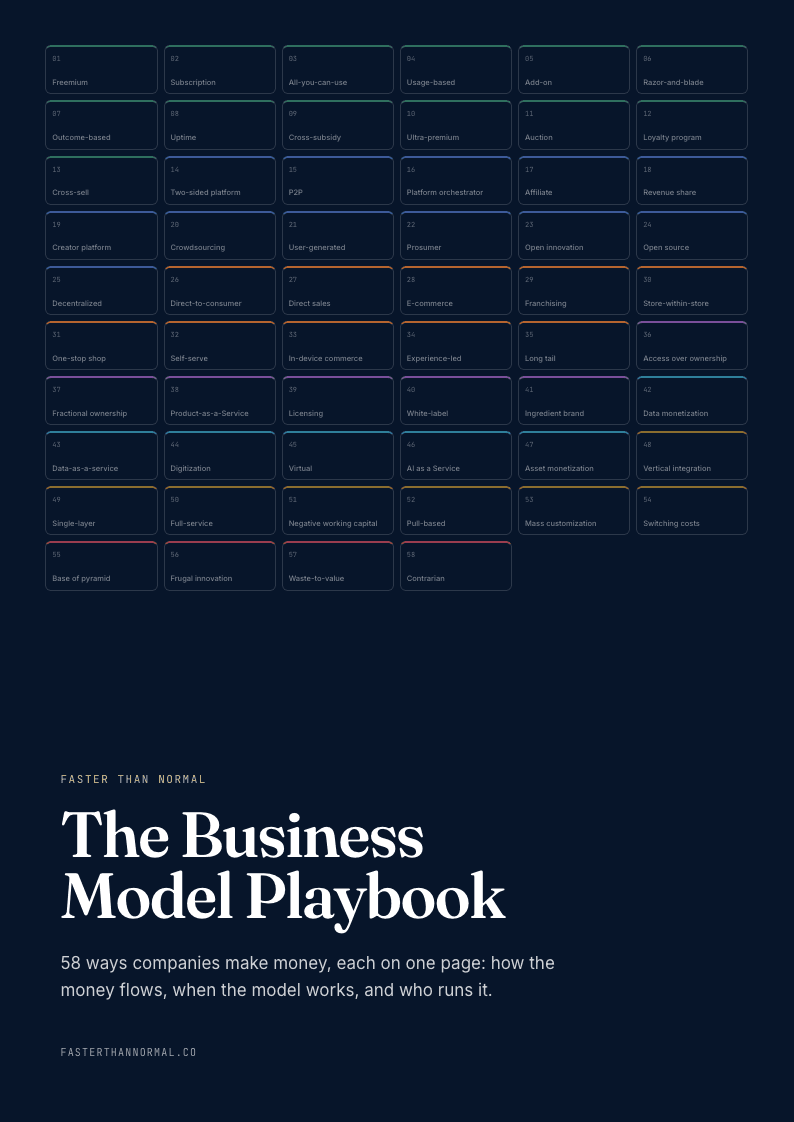
Free playbook
Get The Business Model Playbook
58 business models, one visual page each: how the money flows, the metrics that matter, and who runs it. Free when you join the Faster Than Normal email.
Free. No spam. Unsubscribe anytime.
Part IIIMaxims
-
The crown is portable; the self is not. Build an identity that survives the removal of your title. The leader who needs the crown to feel whole has already lost the most important negotiation.
-
Simplification is the highest-leverage skill. The ability to take the most complex problem and render it legible to a room full of smart, impatient people is the skill that will be demanded of you at every level of leadership — and the one that most people never develop.
-
Nudge, don't dictate. You can reshape consumer behavior and organizational culture by changing what is easy, visible, and default — eye-level shelf placement, meeting agendas, hiring processes — without removing anyone's choices.
-
Net worth is not self-worth. Compensation is evidence of market value, not of human value. When the two become confused, you will make decisions that serve the number rather than the mission.
-
The immigrant's double consciousness is a superpower. Seeing a culture from both inside and outside simultaneously — understanding its logic while perceiving its absurdities — is a form of strategic intelligence that no MBA can teach.
-
Diversity is a number; inclusion is a mindset. Hiring from the full talent pool is arithmetic. Making every person feel that they belong is architecture — and most organizations fail at the architecture.
-
There is nothing like a concrete life plan to weigh you down. Staying open to opportunities that arise — rather than fixating on a predetermined path — allows you to capture value that rigid planning would miss.
-
Performance and purpose are not trade-offs; they are complements. The company that solves for society's emerging needs captures the demand that competitors stuck in yesterday's model will forfeit.
-
Assume positive intent until the evidence makes that impossible. This is not softness. It is a cognitive discipline that keeps information flowing upward in organizations where fear otherwise kills candor.
-
Think hard about time. Every deadline you set, every meeting you schedule, every evening you sacrifice is a choice with consequences that compound. Most urgency is artificial. Most regret is about time.
In Their Own Words
Please help someone else rise. Great leaders set out to make others better as a result of their presence—and make sure that impact lasts in their absence.— Yale School of Management Commencement Address, 2015
Leadership is hard to define, and good leadership even harder.
You cannot deliver value unless you anchor the company's values.
Success is not about climbing up, it's about lifting others as you rise.
Growth and comfort do not coexist.
I want women to rise without losing their values.
The glass ceiling will go away when women help other women break through that ceiling.
Do the right thing, even when no one is watching.
Work and life are not opposites—they are partners.
You have to show up with strength and humility.
Be the kind of leader that people want to follow.
Women helping each other – coaching, mentoring, and providing tips – is a great way for us to be our own force.
Values should guide every decision you make.
Hard work, courage, and resilience always win.
The biggest issue is when you use the words "socially responsible." It sounds like you're giving away money that shareholders should be getting. It's not about giving away money we've made. It's about how we make money a different way.— Indra Nooyi, New York Times interview, 2021
You may be president of PepsiCo. You might be on the board of directors. But when you enter this house, you're the wife, you're the daughter, you're the daughter-in-law, you're the mother. You're all of that. Nobody else can take that place. So leave that damned crown in the garage.— Indra Nooyi, on her mother's instruction
We face an ever-more-challenging business environment. And we need to get out in front of events and shape them, rather than to wait and be buffeted by them. This means we will have to be bolder and more creative than ever before.— Indra Nooyi, farewell letter to PepsiCo associates, October 2, 2018
People say that the red beverage is timeless. The blue beverage is timely. I'd rather be timely than timeless.— Indra Nooyi, conversation with Adam Grant, 2021
The challenge of a leader is looking around the corner and making change before it's too late.— Indra Nooyi, on corporate leadership


