
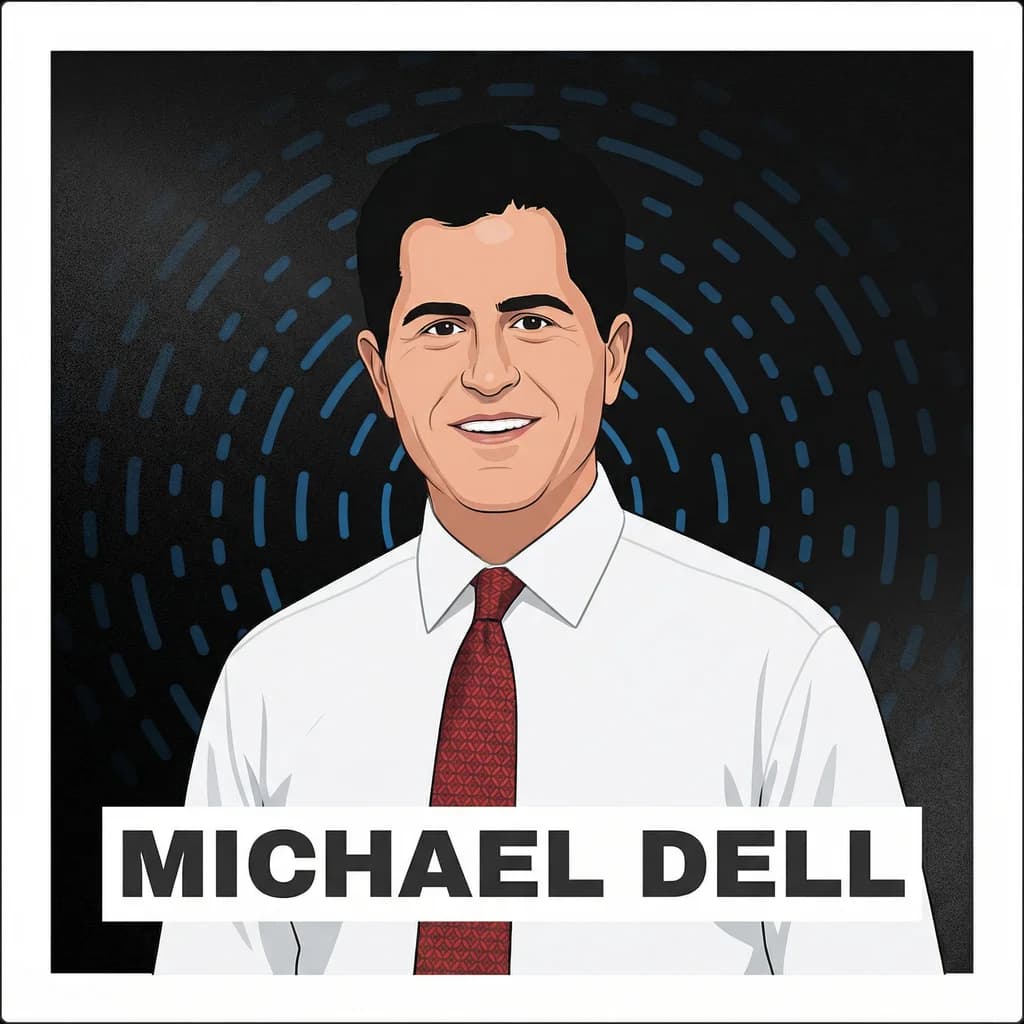

Part IThe Story
Mrs. Icahn's Meatloaf
The meatloaf was homemade. That detail matters — not because it tells us anything about the quality of Gail Icahn's cooking, but because it tells us everything about the surreality of the evening. It was sometime in the middle of 2013, and Michael Dell was sitting at the dining room table of Carl Icahn — the most feared corporate raider of his generation, a man who had made billions terrorizing boardrooms from TWA to Yahoo — eating dinner with his adversary and his adversary's wife while the fate of the company that bore his name hung in the balance. "Carl Icahn was trying to take my company away from me," Dell later recalled. The company he'd started in his freshman dorm room at the University of Texas in 1984 with $1,000, the company that had made him the youngest CEO in the Fortune 500 at age twenty-seven, the company that had once commanded a market capitalization north of $120 billion — this company, his company, almost slipped away from him over a nine-month proxy war that would end not with capitulation but with the most audacious leveraged buyout since the financial crisis. He would bet $700 million of his own fortune on the outcome.
What kind of person eats meatloaf with the man trying to destroy him? The answer, as it turns out, is the same kind of person who, at fifteen, disassembled an Apple II computer just to see if he could put it back together. The same kind of person who, as a teenager selling newspaper subscriptions for the Houston Post, filed Freedom of Information Act requests to obtain marriage license records — because he'd figured out that newlyweds were likelier to subscribe, and he could target them with direct mail instead of cold-calling strangers. He made $18,000 that year. More than some of his teachers. The kid bought himself a BMW.
Michael Dell is not a showman. He is not a provocateur, not a philosopher-king, not one of those tech CEOs who launches himself into orbit or tweets market-moving pronouncements at 2 a.m. He is measured, analytical, and — as Fortune once put it — "almost intentionally unexciting." When asked how big the AI opportunity might be for Dell Technologies, he paused, reconsidered his own words, and delivered what may be the most inconclusive conclusion in the history of corporate prognostication: "I don't know for sure. Nobody knows." This is not the rhetoric of a visionary. It is the rhetoric of a survivor — of someone who has been right enough, often enough, for long enough, that he no longer needs to perform certainty. He has been running his company for forty years. He owns 53% of its stock. When asked the secret of his longevity, he offered: "There's a simple part of this, which is, you just don't quit."
By the Numbers
The Dell Empire
40+Years as founder-CEO of Dell Technologies
$95.6BDell Technologies revenue, fiscal year 2025
$147BEstimated net worth (Bloomberg, December 2025)
53%Dell Technologies stock owned by Michael and Susan Dell
$67BEMC acquisition price — largest tech deal in history at the time
$6.25BPersonal philanthropic commitment to children's investment accounts (2025)
$1,000Initial capital invested in 1984
The $18,000 Paperboy
To understand Michael Dell you have to understand Houston in the early 1980s — a sprawling, oil-flushed, aspirational city where the sons of orthodontists and stockbrokers were expected to become orthodontists and stockbrokers, or maybe, if they were especially ambitious, both. Alexander Dell fixed teeth. Lorraine Dell traded stocks. Their son Michael, born February 23, 1965, was expected to pursue medicine. He enrolled as a pre-med at the University of Texas at Austin in 1983, as dutiful Jewish sons sometimes do, and lasted roughly one semester before the gravitational pull of commerce overwhelmed whatever residual interest he had in organic chemistry.
But the instinct was older than college. At eight, he applied to take a high school equivalency exam — not because he was desperate to learn more, but because he wanted to get out and into the business world faster. By his early teens he was investing in stocks and precious metals with money earned from part-time jobs. The Apple II disassembly at fifteen was not a science project; it was industrial espionage conducted by a child. He wanted to understand where the value was, and what he discovered in those guts — a collection of commodity components assembled by a company that charged several times their cost — planted a seed that would germinate a few years later in a six-by-eight-foot dorm room.
The newspaper story deserves lingering over, because it contains in miniature the entire logic of what Dell would later build. A high schooler at Memorial High in Houston, Michael got a summer job selling subscriptions to the Houston Post. The standard approach was cold-calling — dial strangers, absorb rejection, repeat. Dell hated it. So he asked himself a different question: Who is most likely to want a newspaper subscription right now? The answer was newlyweds and recent homebuyers — people setting up households, nesting, establishing routines. Using FOIA requests, he obtained marriage license records from the county. He cross-referenced addresses. He designed direct-mail campaigns. He hired friends to help. "Jackpot!" he recalled decades later on a Fortune podcast, and you can hear in that single word the unmistakable delight of a sixteen-year-old who has just discovered the power of customer segmentation.
The $18,000 was more than the money. It was a proof of concept: that the intermediary was the problem, that going directly to the person who wanted what you were selling — rather than broadcasting to everyone and hoping — could be radically more efficient. This insight would become the foundation of one of the largest technology companies on earth.
Three Guys with Screwdrivers
The founding myth is lean. In 1984, Michael Dell registered a company called PC's Limited with the State of Texas. His initial investment: $1,000. His workforce: "three guys with screwdrivers sitting at six-foot tables." His product: IBM PC-compatible computers built from stock components, assembled to order, and sold directly to customers at prices ten to fifteen percent below retail.
The economics were shockingly simple. Dell had noticed — first when he disassembled that Apple II, and then more acutely when he examined IBM PCs — that the components inside a $3,000 personal computer cost roughly $600. None of the parts were made by IBM. There was no proprietary technology to license, no manufacturing secret to reverse-engineer. The markup was pure distribution: the cost of moving boxes through dealers, sitting in inventory, depreciating on shelves. What if you bypassed all of that? What if you advertised in computer magazines, took orders by phone, and assembled each machine to the buyer's specifications only after it was paid for?
The answer was negative working capital — one of the most beautiful phenomena in business. Dell collected payment from customers before it paid suppliers. Parts arrived just in time for assembly. There was no warehouse full of unsold inventory slowly losing value. The faster Dell grew, the more cash the business generated. It was, in effect, a perpetual motion machine fueled by other people's money. By the time the operation moved out of the dorm room and into an off-campus apartment, monthly sales had reached $80,000. Dell broke the news to his parents over spring break. He was dropping out of college to sell computers.
Within a year, the company produced its first original design, the Turbo PC, priced at $795. By 1986, PC's Limited was offering the first toll-free technical support line in the industry. In 1988, the company changed its name to Dell Computer Corporation, went public at $8.50 a share, and grossed $159 million in its first fiscal year as a public entity. The growth was extraordinary not because it was fast — lots of companies grow fast — but because it was profitable. Dell didn't burn cash to acquire customers. It generated cash from every sale. The business model itself was the competitive advantage.
— Michael DellI believe that you have to understand the economics of a business before you have a strategy, and you have to understand your strategy before you have a structure. If you get these in the wrong order, you will probably fail.
The Youngest in the Room
In 1992, Michael Dell became the youngest CEO ever to lead a company ranked on the Fortune 500. He was twenty-seven. The significance of this milestone is not that it happened but that it happened quietly. Dell was not Steve Jobs, holding aloft a translucent Macintosh to rapturous applause. He was not Bill Gates, who by 1992 had already become the world's richest man and a cultural lightning rod. Dell was an operational savant — a logistics genius who had turned supply chain management into an art form, and whose public persona could be summarized as "the guy who makes the beige boxes."
This anonymity was strategic, even if it wasn't entirely intentional. Dell understood something that many founder-CEOs learn only in retrospect: that the brand should be the product, not the person. While other technology companies tied their fortunes to charismatic leaders — Jobs at Apple, Gates at Microsoft, Larry Ellison at Oracle — Dell Computer Corporation was selling efficiency. The pitch was never "our technology is more beautiful" or "our vision is grander." It was: we will build exactly what you want, deliver it faster, and charge you less. In a commodity market, this was devastating.
By the late 1990s, Dell was the world's leading maker of personal computers. Revenue exploded from $3.5 billion in 1994 to $25 billion by 2000. The stock price appreciated roughly 97,000% from its 1988 IPO to its 1999 peak. The market capitalization surpassed $120 billion — at a time when Apple, under the struggling stewardship of Gil Amelio and then the newly returned Jobs, was valued at a paltry $2.3 billion. Dell had become so dominant, so seemingly invincible, that in October 1997, when asked at a technology conference what he would do if he ran Apple, Michael Dell quipped: "What would I do? I'd shut it down and give the money back to the shareholders."
Steve Jobs never forgave him for this. It would prove to be one of the most spectacularly wrong predictions in the history of American business — but also, at the time, a perfectly rational assessment. Dell was seeing the world through the only lens he had: unit economics, operational efficiency, direct customer relationships. By those metrics, Apple in 1997 was a disaster. That he couldn't imagine what Apple would become says less about Dell's intelligence than about the limits of any single framework for understanding the world.
When the Model Stopped Working
The trouble started around 2005, though the seeds were planted earlier. Personal computers and laptops, which accounted for roughly sixty percent of Dell's sales, were no longer the rich profit center they had once been. No-name rivals from Taiwan and China were grinding margins to razor-thin levels. The direct-sales model that had been so devastatingly efficient was losing its edge as competitors like HP and Lenovo built out their own supply chain capabilities and the internet made price comparison trivially easy. Worse, the product category itself was under siege: Android smartphones and iPads — not Windows laptops — were becoming the devices that actually excited consumers and generated healthy margins.
Dell's share of a contracting PC market slipped from 16.6 percent to 10.7 percent between 2006 and 2012. The company fell from first place to third, behind Hewlett-Packard and Lenovo. Servers, which should have been a growth engine as companies built out data centers, were experiencing their own margin compression — from operating margins of roughly fifteen percent down to high single digits, according to Sterne Agee analyst Shaw Wu, converging rapidly toward the mid-single-digit margins of PCs themselves. The cloud was accelerating this: big customers like Google and Facebook were building their own equipment cheaply, and smaller companies were abandoning on-premises hardware altogether in favor of rented time on AWS.
Dell had stepped down as CEO in 2004, handing the role to Kevin Rollins, a move that in hindsight looks less like succession planning than exhaustion. When Rollins couldn't arrest the decline, Dell returned in 2007, writing in an internal email that would later become public: "The direct model has been a revolution, but it is not a religion." It was an extraordinary admission from the man who had built the temple. The implication was unmistakable: everything was on the table.
— Michael Dell, internal email, April 2007The direct model has been a revolution, but it is not a religion.
But changing direction inside a public company — with quarterly earnings calls, analyst expectations, activist shareholders, and a stock price that punished any hint of long-term thinking — proved agonizing. Dell needed to build new capabilities: enterprise software, data storage, networking, services. These required acquisitions that would depress near-term earnings. Wall Street wanted results now. Dell was thinking in decades. The gap between those two time horizons would become a chasm.
The $24.4 Billion Gamble
On February 5, 2013, Dell Inc. announced it would go private in a $24.4 billion leveraged buyout — the largest since the financial crisis. The deal was straightforward in structure if not in ambition: Michael Dell would roll over his existing equity stake and contribute approximately $700 million in additional cash. Silver Lake Partners, one of the most prominent technology-focused private equity firms, would put in roughly $1 billion. Microsoft — desperate to shore up a critical hardware partner at a time when its own Windows ecosystem was under pressure — agreed to lend $2 billion. The remainder would be financed by a consortium of banks including Bank of America Merrill Lynch, Barclays, Credit Suisse, and RBC Capital Markets. The company would take on approximately $15 billion in new debt.
Egon Durban, the Silver Lake partner who led the deal, was a Stanford-trained former Morgan Stanley banker who had built his career on the thesis that technology companies navigating existential transitions were systematically undervalued by public markets. He saw in Dell what Dell saw in himself: a business with real assets, real customer relationships, and a real transformation opportunity, all obscured by the pathological short-termism of quarterly reporting.
The reaction from Wall Street ranged from skeptical to hostile. The New York Times DealBook called it "a huge gamble" that "does nothing to divert the forces reshaping the technology industry." Analysts questioned whether Dell could grow its way out from under $15 billion in debt in a declining market. And then Carl Icahn showed up.
Icahn — born in Queens, raised in Far Rockaway, a former medical student turned options trader turned corporate predator — had accumulated a significant stake in Dell and saw the buyout as an attempt to steal the company from its public shareholders at a depressed price. He launched a proxy fight, proposing alternative transactions that he argued would deliver more value. For nine months, the battle consumed Dell's attention, required constant shareholder communication, and generated the kind of tabloid-worthy drama that Dell the man had spent his entire career avoiding.
The meatloaf dinner at the Icahn residence was an attempt at détente that solved nothing. Icahn later told Fortune's Michal Lev-Ram that he "welcomes Dell's hatred" — a line that reads like a Bond villain's toast but was delivered with the blunt sincerity of a man who has been hated by better. The proxy fight ended in September 2013 when Dell's shareholders approved the buyout. Michael Dell owned his company again. The real work was about to begin.
The EMC Masterstroke
Going private gave Dell something he hadn't had in twenty-five years: silence. No quarterly earnings calls. No analyst days. No obligation to explain to short-term shareholders why spending billions on enterprise infrastructure made sense when the PC business was still generating the majority of revenue. For the first time since he was a teenager assembling computers in an apartment off campus, Michael Dell could operate entirely on his own timeline.
He used the freedom aggressively. Between 2013 and 2015, Dell made a series of acquisitions to build out its enterprise capabilities — networking, security, cloud management. But the move that stunned the industry came in October 2015, when Dell announced the acquisition of EMC Corporation for $67 billion. It was the largest technology deal in history. EMC, based in Hopkinton, Massachusetts, was the world's leading provider of data storage systems and had a controlling stake in VMware, the dominant player in server virtualization. The combination would create the largest privately controlled, integrated technology company on the planet — one that could sell everything from laptops to servers to storage to networking to cloud management under a single umbrella.
Joe Tucci, EMC's longtime CEO — a Rhode Island native who had spent his career in enterprise technology and had built EMC into a $60 billion juggernaut through a relentless acquisition strategy of his own — was nearing retirement. He saw the Dell deal as a way to secure EMC's legacy while providing shareholders a premium. The merger required navigating extraordinary complexity: regulatory approvals across multiple jurisdictions, the tracking stock structure used to handle VMware's publicly traded shares, and the sheer operational challenge of integrating two massive organizations with different cultures, different sales forces, and different relationships with many of the same customers.
Dell Technologies — the combined entity — re-listed on public markets in December 2018, five years after going private. The privatization had served its purpose: it bought time for the transformation that Wall Street wouldn't have tolerated in real time. Michael Dell's stake in the combined company, plus his shares in VMware and a position in Broadcom (which later acquired VMware), would eventually push his personal net worth past $100 billion — a milestone reached on March 1, 2024, when Dell Technologies' fourth-quarter earnings sent the stock up 32% in a single session.
— Michael Dell, memo to employees, February 2013Dell's transformation is well under way, but we recognize it will still take more time, investment and patience. I believe that we are better served with partners who will provide long-term support to help Dell innovate and accelerate the company's transformation strategy.
The Anti-Charisma
There is a particular kind of tech CEO that Silicon Valley lionizes: the reality distortion field generator, the first-principles thinker, the person who walks on stage in a black turtleneck and tells you the future has arrived. Michael Dell is not that. He has never been that. His friend Marc Benioff — the Salesforce founder, himself a maximalist showman — once noted that Dell had recently taken up hunting with a bow and arrow, which is perhaps the most revealing hobby a man of his temperament could adopt: patient, precise, solitary, lethal.
In person, Dell is measured to the point of opacity. Fortune's Michal Lev-Ram, after spending weeks reporting a 2024 cover story, observed that "it's hard to get a splashy sound bite out of Michael Dell, even if you tee him up for one." He doesn't do bombastic declarations. He doesn't have a side hustle that involves blasting himself into outer space. When photographed, he tolerates but doesn't relish the experience. His uniform — dark slacks, navy denim button-down — is Texan for business casual, no matter the season and no matter the occasion.
This deliberate unflashiness has been both asset and liability. In the 1990s, when Dell Computer Corporation was the fastest-growing major company in America, anonymity was fine — the model sold itself. In the 2000s, when the company needed to reinvent itself, the lack of a visible, galvanizing leader made the transition harder to communicate to investors, employees, and customers who couldn't quite see where the story was going. And in the 2020s, as AI has turned hardware companies into unexpected beneficiaries of the most capital-intensive technology buildout since the internet, Dell's refusal to overpromise has become, paradoxically, its most compelling feature.
"We didn't make up this game," Dell told Fortune in late 2024, discussing the AI infrastructure boom, "but you happen to need a lot of our stuff to make it work." Then, with a bluntness that bordered on comedy: "We are the biggest and best in the world at doing this. This is kind of our job."
The Sovereign Bet
The AI wave hit Dell Technologies like a tailwind that its CEO, characteristically, refused to oversell. In the most recent fiscal quarter before March 2024, orders for AI-optimized servers were up forty percent. The company's infrastructure solutions group saw an eighty percent revenue jump by the end of 2024, driven by sales of servers loaded with Nvidia's H100 and MI300X chips. Dell was partnering with Elon Musk's xAI on its Colossus supercomputer in Memphis, deploying servers with tens of thousands of Nvidia AI chips. "We've got a big team there," Dell said, "that are resident in the facility to make sure everything's working."
But the opportunity Dell sees extending beyond the American hyperscalers — beyond xAI, OpenAI, Google, and Meta — is what he calls "sovereign AI." The idea is simple and geopolitically explosive: every significant nation on earth wants its own AI infrastructure, trained on its own language, culture, and values, hosted on its own soil.
"Pick a country ranked by GDP," Dell explained to CNBC's Sara Eisen in June 2024. "The top forty-nine other than the U.S., they all need one. They want their culture, their language, and their beliefs, instantiated within their own AI. They don't want this data to go off somewhere else. They don't want it to be trained by something from California."
This is the kind of observation that only a hardware person would make — and only a hardware person with four decades of selling to enterprises and governments would see as a business opportunity rather than a geopolitical abstraction. Dell Technologies manufactures and sells the physical infrastructure that AI requires: servers, storage, networking, the entire stack from edge to core to cloud. The company stores and protects and manages more data than any other on the planet, a capability inherited from the EMC acquisition. Every seven or eight months, Dell told CNBC, the amount of data in the world doubles. "And that number's probably shrinking."
The AI PC refresh — the consumer-facing bet — has been slower than expected. Dell admitted in December 2024 that adoption of AI-enabled personal computers was "definitely delayed." But he'd seen this movie before. "The refreshes are usually underestimated, sometimes they go a little bit faster, sometimes a little bit slower." Windows 10's end of life was approaching. The largest installed base of PCs in history was aging. "Our job is in every turn of the crank, every new generation, pile on enough new features that enough users say, 'Yeah, it's time.'"
The Philanthropic Inversion
In December 2025, Michael and Susan Dell stood in the Roosevelt Room of the White House alongside President Trump to announce a $6.25 billion personal commitment — the largest gift ever devoted to American children — to fund investment accounts for roughly twenty-five million kids. The accounts, seeded with $250 each and structured as part of the bipartisan Invest America Act, could be opened starting July 4, 2026, and cashed out when the child turned eighteen. The donation extended eligibility beyond the congressional program, which covered babies born between January 1, 2025, and December 31, 2028, to include children already born and aged ten and under.
The philanthropic impulse was not new. In 1999, Michael and Susan had established the Michael & Susan Dell Foundation, focused primarily on children's health, education, and economic stability in urban communities. In 2013, the foundation invested $50 million in the University of Texas at Austin's plan to build what would become Dell Medical School — a new kind of medical school designed not merely to train physicians but to rethink the role of academic medicine in community health. Michael delivered the keynote address at Dell Med's Class of 2024 convocation, telling graduates: "From breakthrough treatments to diagnosis to preventive and predictive care, the connection between medicine, health care and technology is growing stronger and deeper by the day."
There is something worth noting about the arc. The boy whose parents wanted him to be a doctor funded a medical school. The teenager who disassembled an Apple II now preaches the integration of AI into clinical care. The man who made his fortune eliminating intermediaries between manufacturer and customer is, in his philanthropic life, trying to eliminate intermediaries between children and economic opportunity — seeding investment accounts directly, bypassing the slow machinery of generational wealth transfer. The pattern is consistent. Cut out the middleman. Go direct.
The Forty-Year Return
In the spring of 2024, when Fortune published its cover story on Dell's fortieth anniversary at the helm, the writer noted that Dell Technologies' stock had just hit an all-time high above $131, driven by AI-server demand. By the end of 2025, Dell's personal net worth was estimated at $147 billion, making him the eleventh-richest person on the planet. The company that Vanity Fair had once described, with maximum coastal condescension, as "manufacturer of computers one avoids in a computer lab in favor of any and all Apple options" was now positioned at the center of the most consequential infrastructure buildout in a generation.
Dell's response to all of this was, predictably, muted. "It feels every bit as big as previous waves, but probably bigger," he told Fortune, pondering the AI opportunity. Then a pause. "You know, maybe quite a bit bigger." Another pause. "I don't know for sure. Nobody knows."
He was seated in a conference room at Dell Technologies headquarters outside Austin, where the temperature had hit eighty-eight degrees in early March. Dark slacks. Navy button-down. Just emerged from a photo shoot he'd tolerated but hadn't enjoyed.
Forty years earlier, in that same city, he'd been a nineteen-year-old with a thousand dollars and a theory about unit economics. He'd been right. Then he'd been wrong. Then he'd bet everything — his name, his fortune, seven hundred million dollars in cash — on the belief that he could be right again, if only the world would give him enough time and enough silence. The world had given him both, and he had used them to build something that the nineteen-year-old in the dorm room could never have imagined and the forty-seven-year-old eating Carl Icahn's wife's meatloaf had only barely dared to hope for.
Outside the conference room, servers hummed in data centers from Memphis to Mumbai, storing and processing the swelling ocean of the world's data. Somewhere in that ocean was the marriage license data of every county in Texas, available to anyone with a FOIA request and the wit to know what to do with it.
Part IIThe Playbook
Michael Dell has been running his company for four decades — longer than most marriages, longer than most careers, longer than the entire lifespan of many of his competitors. The following principles are drawn not from his public pronouncements (though he is admirably explicit about his philosophy) but from the pattern of decisions that have defined his trajectory: the bets placed, the bets declined, the moments when he chose patience over spectacle and precision over charisma.
The principles
- 1.Understand the economics before you have a strategy.
- 2.Go direct — always.
- 3.Never confuse your model with your religion.
- 4.Use darkness as a workshop.
- 5.Bet your own money.
- 6.Collect the data before you sell the product.
- 7.Resist the cult of charisma.
- 8.Treat transformation as a continuous loop.
- 9.Own the infrastructure layer.
- 10.Don't quit.
Principle 1
Understand the economics before you have a strategy
Dell has said it plainly: "I believe that you have to understand the economics of a business before you have a strategy, and you have to understand your strategy before you have a structure. If you get these in the wrong order, you will probably fail." This is not a platitude. It is a sequence — and the sequence matters.
When the nineteen-year-old Dell disassembled an IBM PC and discovered that $600 in components was selling for $3,000, he didn't immediately develop a corporate strategy or design an organizational chart. He first understood the unit economics: the spread between input cost and retail price, the absence of proprietary components, the inventory costs borne by the distribution channel. Only then did a strategy emerge (sell direct, assemble to order), and only then did a structure follow (three guys with screwdrivers, a phone line, a six-foot table). Every subsequent pivot — from PCs to servers, from direct-only to hybrid channels, from public to private and back — followed the same sequence: economics first, strategy second, structure third.
The inverse — building a structure before understanding the economics, or copying a strategy without understanding the underlying unit economics that make it work — is the most common cause of corporate failure. Dell's insistence on sequencing is a rebuke to the many companies that begin with organizational design and work backward.
Tactic: Before any strategic initiative, map the complete unit economics — input costs, customer acquisition costs, margin structure, cash conversion cycle — and ensure the strategy you're building flows from those numbers, not the other way around.
Principle 2
Go direct — always
The direct model at Dell was never just about selling computers without retail middlemen. It was an epistemological stance: the belief that the best information about what customers want comes from talking to customers, not from talking to channel partners who talk to customers. Every layer of intermediation is a layer of information loss.
This principle expressed itself at sixteen (targeting newlyweds via FOIA data instead of cold-calling), at nineteen (taking phone orders instead of stocking retail shelves), and at fifty-nine (building AI servers to spec for xAI and sovereign governments). The specific mechanism changed. The underlying logic didn't: eliminate the gap between what you make and who uses it.
The direct model also generated a powerful financial engine. By collecting payment before purchasing components, Dell operated with negative working capital — meaning growth was self-funding. The faster the company grew, the more cash it generated. This inverted the normal relationship between growth and capital needs, and it was only possible because there was no inventory sitting in a warehouse, losing value, waiting for a buyer.
Tactic: In any business, identify the layers of intermediation between you and your end customer. Each layer costs you money, time, and information. Remove as many as you can — not just to reduce cost, but to increase the quality of the signal you're receiving about what the market actually wants.
Principle 3
Never confuse your model with your religion
Dell's 2007 admission that "the direct model has been a revolution, but it is not a religion" was the pivotal sentence in the company's modern history. It acknowledged what many founder-CEOs cannot: that the thing that made you successful can become the thing that kills you if you cling to it past its useful life.
The direct-only model had been devastatingly effective in the 1990s, when customers valued customization and price, and the internet had not yet made comparison shopping effortless. By the mid-2000s, the advantage had eroded. Competitors had copied the supply chain innovations. Commodity components had become truly commodity — available to anyone. The channel Dell had bypassed had evolved. Enterprise customers wanted solutions, not just boxes. Consumer customers wanted to touch products before buying.
Dell's willingness to abandon the model that defined his identity — to start selling through Walmart and Best Buy, to shift investment toward enterprise software and services — was an act of intellectual honesty that most founders are constitutionally incapable of. It required separating ego from strategy, and treating the company's competitive approach as a hypothesis to be tested rather than a truth to be defended.
Tactic: Regularly subject your core competitive advantage to a "religion test." If you find yourself defending a practice because "it's who we are" rather than because the data supports it, you've crossed from strategy into dogma. Build a process for challenging your own assumptions before the market does it for you.
Principle 4
Use darkness as a workshop
The decision to take Dell private in 2013 was not an exit. It was a strategic instrument — the creation of an environment in which fundamental transformation could occur without the distorting pressure of quarterly reporting.
🔒
Public vs. Private: The Transformation Window
Dell's five years as a private company (2013–2018) enabled moves that would have been impossible under public market scrutiny.
| Public company constraint | What privatization enabled |
|---|---|
| Quarterly earnings pressure | Multi-year investment in enterprise capabilities |
| Activist shareholder interference | Full founder control over strategic direction |
| Stock price volatility during acquisitions | $67B EMC deal executed without public market reaction |
| Analyst scrutiny of margin compression | Freedom to sacrifice near-term margins for long-term positioning |
Rebecca Homkes, the strategy scholar who analyzed Dell's privatization in her book Survive, Reset, Thrive, describes what Dell executed as a "hard reset" — a fundamental restructuring of strategy, structure, and operating model that requires acknowledging that your current competitive advantages are no longer sufficient. Hard resets, she notes, "are not for the faint of heart." They require a small, committed team willing to lead the change, and a longer time horizon than public markets typically allow.
Dell used the darkness wisely. By the time the company re-listed in December 2018, it was a fundamentally different business — an end-to-end infrastructure provider rather than a PC manufacturer.
Tactic: When you need to execute a fundamental transformation, honestly assess whether your current ownership and governance structure allows the time horizon required. If it doesn't, change the structure — not the strategy.
Principle 5
Bet your own money
In the 2013 leveraged buyout, Michael Dell committed approximately $700 million of his own fortune on top of rolling over his existing equity. This was not a financial requirement — Silver Lake and the lending banks would have structured the deal regardless. It was a signal, and signals matter.
When a founder puts personal capital at risk alongside institutional investors, several things happen simultaneously. The deal's credibility increases with lenders, regulators, and potential co-investors. The founder's alignment with the outcome becomes unambiguous — there is no scenario in which he profits while others lose. And the psychological commitment deepens: money you've invested yourself is money you will fight harder to protect.
Dell's willingness to bet his personal fortune also resolved the principal-agent problem that plagues most corporate transformations. He wasn't a hired CEO executing someone else's turnaround plan. He was the largest shareholder, the largest individual investor in the deal, and the CEO. The interests were perfectly aligned because they were all the same person's interests.
By 2025, that $700 million commitment — plus his rolled-over equity, his EMC deal exposure, and the subsequent appreciation — had compounded into a personal fortune of $147 billion. The return on conviction was staggering.
Tactic: In any high-stakes decision, find a way to put your own resources — money, time, reputation — visibly on the line. Skin in the game is not just a financial concept; it is a credibility mechanism that aligns incentives and communicates commitment more powerfully than any memo.
Principle 6
Collect the data before you sell the product
The newspaper subscription story is not just charming origin lore. It reveals a cognitive pattern that Dell has replicated throughout his career: before trying to sell anything, figure out who wants it and why.
At sixteen, this meant FOIA-ing marriage licenses. At nineteen, it meant taking phone calls from customers and learning exactly which features they valued enough to pay for — information that retailers, insulated from end users by layers of distribution, never had. At fifty-nine, it meant tracking the installed base of aging PCs (the largest in history), monitoring Windows 10 end-of-life timelines, and knowing that a refresh cycle was inevitable even if the timing was uncertain.
"You want to have big ears," Dell has written. "To listen, to learn, and to be curious." This sounds anodyne until you realize that most companies do the opposite: they build a product, then try to convince people to buy it. Dell's consistent approach has been to understand the demand signal first — through data, customer conversations, and market analysis — and then build precisely to that signal.
The approach scales. Dell Technologies today employs what Dell describes as deep customer engagement across 180 countries: "Everything interesting in the world revolves around data. If you want to make an autonomous vehicle or advance drug discovery with mRNA vaccines or you want to create a new kind of company in the financial sector, everything interesting in the world revolves around data."
Tactic: Invest in demand intelligence before investing in supply. Whether through data analysis, customer interviews, or market testing, understand who your buyer is and what they need before you build what you think they want.
Principle 7
Resist the cult of charisma
Dell's anti-charisma is not a weakness he compensates for; it is a deliberate competitive positioning. In a technology industry that rewards showmanship — the product launch as theater, the CEO as philosopher — Dell has built a $95 billion company on the premise that the infrastructure matters more than the narrative.
This has costs. Dell Technologies has never generated the cultural excitement of Apple, the developer devotion of Google, or the meme-stock energy of Tesla. It is, by design, boring. But boring, in the hardware infrastructure business, is a feature. Enterprise customers spending millions on servers and storage want reliability, not charisma. They want the CEO to understand their data architecture, not to tweet about the singularity.
"He seems to go out of his way to not put on a performance," Fortune observed, "even as he's embarking on what could be his greatest act yet." The anti-performance is itself a performance — a signal to the institutional buyers who are Dell's most important customers that this is a company run by an adult, for adults, with adult concerns about uptime, compatibility, and total cost of ownership.
Tactic: Match your public persona to your customer's expectations. In markets where trust and reliability matter more than excitement, under-promising and over-delivering is a more durable competitive advantage than any product launch keynote.
Principle 8
Treat transformation as a continuous loop
Dell has executed not one but at least four major strategic pivots in forty years: from dorm-room PC assembler to direct-sales juggernaut (1984–1992), from PC maker to enterprise infrastructure provider (2007–2013), from public company to private (2013), and from private back to public with an entirely different portfolio (2018). Each pivot built on the last. None was a clean break.
1984
Founded PC's Limited in UT Austin dorm room with $1,000
1988
IPO at $8.50/share; renamed Dell Computer Corporation
1992
Youngest CEO on Fortune 500 at age 27
2001
Becomes world's largest PC maker
2004
Steps down as CEO; Kevin Rollins takes over
2007
Returns as CEO; begins enterprise pivot
2013
Takes Dell private for $24.4 billion
2015
Announces $67 billion EMC acquisition
2018
Dell Technologies re-lists on public markets
2024
Net worth passes $100 billion on AI-server demand
Dell's own framing — "you must change or die; there are only the quick and the dead" — sounds dramatic, but his actual execution of change has been patient, sequential, and grounded in the economics-strategy-structure sequence described in Principle 1. He does not pivot on a whim. He pivots when the unit economics of the existing model deteriorate to the point where continuation is more dangerous than change.
Tactic: Build organizational muscle for continuous transformation by treating each pivot not as a crisis but as a natural phase in a recurring loop. The loop runs: stabilize current operations, identify the next strategic position, build capabilities for the transition, and execute. Then repeat.
Principle 9
Own the infrastructure layer
Dell's positioning in the AI era is not an accident. It is the culmination of a twenty-year bet on enterprise infrastructure — servers, storage, networking — that looked questionable in the smartphone era and looks prescient now.
The logic is structural. Every AI model, regardless of who builds it, requires physical computing infrastructure. Training a large language model requires thousands of GPUs mounted in servers, connected by high-speed networks, cooled by sophisticated thermal management systems, and fed by massive storage arrays. Dell Technologies manufactures all of these components or integrates them into complete systems. The company doesn't build the chips (that's Nvidia, AMD, Intel) or the models (that's OpenAI, Anthropic, Google). It builds the physical substrate on which everything else runs.
"We didn't make up this game," Dell says, "but you happen to need a lot of our stuff to make it work."
This is the infrastructure layer strategy: position yourself as the essential, unglamorous foundation that every application depends on. It is not the layer that generates headlines or captures consumer imagination. But it is the layer that generates revenue regardless of which application, which model, or which AI company ultimately wins.
Tactic: In rapidly evolving markets, identify the infrastructure layer — the physical or digital substrate that every competing approach requires — and build your position there. Infrastructure layers are less volatile than application layers and generate more durable competitive advantages.
Principle 10
Don't quit
When asked the secret of his forty-year tenure as founder-CEO, Dell's answer was characteristically compressed: "There's a simple part of this, which is, you just don't quit." Then, the kicker: "That — and owning 53% of your company's shares — will do it."
The joke lands because it contains two truths simultaneously. The first is psychological: Dell's persistence through the 2005–2013 wilderness years, the proxy fight with Icahn, the $15 billion of debt from the LBO, the integration of EMC — none of this was inevitable. At any point, he could have stepped aside, sold his stake, and retired to a life of bow hunting and philanthropy. He chose not to.
The second truth is structural: ownership matters. Dell's majority stake gave him a degree of control that most founder-CEOs lose the moment they take outside capital. He could not be fired by his board. He could not be outvoted by activist shareholders (Icahn tried). He could not be pressured into short-term decisions by institutional investors threatening to dump the stock. His ownership was not a consequence of his persistence; it was the precondition for it.
"Life is about taking a punch, falling down, getting back up and fighting again," Dell has written. The language is deliberately unchic. There's no Greek myth, no Nietzsche, no reference to first principles or second-order thinking. Just: get hit, stand up, continue. It is the philosophy of a man who has been doing the same thing for four decades, not because he lacks imagination but because he has the rare capacity to see a forty-year project through to completion.
Tactic: Build structural mechanisms — ownership stakes, governance protections, financial independence — that give you the ability to persist through long-term transformations. Willpower is necessary but insufficient. You need the structural power to act on your conviction when the market, the board, or the pundits tell you to quit.

Free playbook
Get The Business Model Playbook
58 business models, one visual page each: how the money flows, the metrics that matter, and who runs it. Free when you join the Faster Than Normal email.
Free. No spam. Unsubscribe anytime.
Part IIIMaxims
-
Economics → strategy → structure. Understand the unit economics of your business before you develop a strategy, and understand your strategy before you build a structure. Reverse the order and you will fail.
-
Ideas are a commodity; execution is not. Coming up with a great idea or strategy is necessary but not sufficient for success. Detailed operational discipline is what separates the living from the dead.
-
The religion test. When you find yourself defending a practice because "it's who we are" rather than because the data supports it, you have crossed from strategy into dogma. Kill the dogma before it kills you.
-
Design from the customer back. Every product, every service, every strategic decision should originate in an understanding of what the customer actually needs — not what you find interesting to build.
-
Never be the smartest person in the room. Surround yourself with people who challenge you, teach you, inspire you, and push you to be your best. Learn to recognize and appreciate people's different talents.
-
The rate of change only accelerates. It will not slow down in the future. Organizations that do not continuously reimagine themselves will be displaced by those that do.
-
Don't be a victim, ever. Victimhood is a losing mindset. Self-determination requires focusing on what you can control and driving forward.
-
Never let a good crisis go to waste. If there is no crisis, create one — as a way of motivating change and progress. Crises often reveal opportunities that complacency obscures.
-
Anger is counterproductive. Feel frustrated, but don't stay angry. Be motivated by a desire to help others rather than a desire to punish adversaries — even the ones trying to take your company at Carl Icahn's dinner table.
-
You just don't quit. The simplest explanation for four decades of survival is also the truest. Persistence is not a virtue; it is a prerequisite.
In Their Own Words
Ideas are commodity. Execution of them is not.
Sometimes it's better not to ask-or to listen-when tell you something can't be done. I didn't ask for permission or approval. I just went ahead and did it.— Direct from Dell: Strategies That Revolutionized an Industry
If you want to sustain excellence over a long time, you'd better come up with a system that works well. Anyone can sprint for a little while, but you can't sprint for forty years.
Regrets are born of paths never taken.
You don't have to be a genius or a visionary or even a college graduate to be successful. You just need a framework and a dream.
There is no better catalyst to success than curiosity.
The point is, you can't keep doing the same thing and expect it to keep working.
Try never to be the smartest person in the room. And if you are, I suggest you invite smarter people … or find a different room.— Commencement address to University of Texas at Austin, 2003
There's always an opportunity to make a difference.
Collaboration equals innovation.
Anything that can be measured can be improved.
Don't spend so much time trying to choose the perfect opportunity, that you miss the right opportunity.
You can't be afraid to fail because that's when you learn.
If you want to really make it big, you better come up with something unique. It better be differentiated — that nobody else is doing.— Michael Dell, Fortune interview, 2017
If you go and ask people if it's a good idea, most of them will tell you no. So don't go ask.— Michael Dell, Fortune interview, 2017
Every seven or eight months, the amount of data in the world doubles, and that number's probably shrinking. We store and protect and manage more data than any company in the world.— Michael Dell, CNBC interview, June 2024
We didn't make up this game, but you happen to need a lot of our stuff to make it work. We are the biggest and best in the world at doing this. This is kind of our job.— Michael Dell, Fortune interview, December 2024
How do we use AI responsibly — make sure our models are trained to understand our ethics, our laws, morals, humanity? How do we democratize this power and use it to democratize health care?— Michael Dell, Dell Medical School convocation, May 2024


