


Part IThe Story
The Race to the Red Truck
On a warm evening in the late 1940s, somewhere along Main Street in Heber Springs, Arkansas — a town of fewer than three thousand souls tucked into the Ozark foothills of Cleburne County — a group of teenage girls spotted a red Ford truck rolling toward them. The truck had a name painted on the side: Johnnie Hunt. The driver was twenty-one years old, five-eleven, lean and blond, a seventh-grade dropout who hauled livestock to his sale barn and still carried the calloused hands of a boy who'd worked his uncle's sawmill since age twelve. The girls flagged him down for a ride. One of them — a friend who fancied Johnnie — climbed into the seat beside him. But the next evening, when the red Ford reappeared on Main Street, a sixteen-year-old named Johnelle DeBusk outran every one of her friends to claim that seat first. The friend who'd been displaced didn't speak to her for three days. Johnelle didn't care. She'd gotten beside him, and she never left.
It is a small story — adolescent, almost comic — but it contains, in miniature, everything that would follow. The willingness to move faster than anyone else. The instinct for positioning. The refusal to yield ground once claimed. And a particular kind of stubbornness, born not from ideology but from recognition: she saw what she wanted and she went for it, full tilt, on a dusty Arkansas road, in feed-sack dresses, during the tail end of the Depression's long shadow.
Seventy-five years later, Johnelle Terria DeBusk Hunt — born January 4, 1932, in Heber Springs, the daughter of a poultry farmer named Johnie Jacob DeBusk — holds a 19.25% stake in J.B. Hunt Transport Services, a Fortune 500 company with $12.1 billion in annual revenue. Her net worth exceeds $5 billion. She is ninety-four years old. She still goes to the office.
By the Numbers
The J.B. Hunt Empire
$12.1BAnnual revenue of J.B. Hunt Transport Services (2024)
19.25%Johnelle Hunt's personal stake in JBHT
$5.6BEstimated net worth (February 2026)
5Trucks the Hunts started with in 1969
$3,000J.B.'s initial investment in the rice hull business (1961)
55Years of marriage before J.B.'s death in 2006
~34,000J.B. Hunt Transport employees today
The Poultry Farmer's Daughter
The DeBusk household in Heber Springs was modest but not desperate. Johnelle's father ran the Red River Feed Company, supplying feed to poultry growers across Cleburne County. He owned trucks — big ones, the kind that could haul tonnage of chicken feed on the narrow gravel roads that passed for infrastructure in Depression-era rural Arkansas. Johnelle grew up around these trucks the way other children grew up around family dogs. "I learned to drive very early," she recalled in a 2017 interview, "and I would take one of Daddy's big trucks on a Sunday afternoon and put my friends all in it and drive around in the neighborhoods right there in town, driving that big truck. It was just what we did." She was driving trucks in high school. This was not, at the time, remarkable in that particular corner of the Ozarks, where girls were expected to be useful before they were expected to be decorative. But it planted something — a fluency with the physical machinery of commerce, an ease with scale, a comfort behind the wheel in every sense — that would matter enormously later.
Her mother, Ollie Jane DeBusk, was by all accounts warm and resourceful, the kind of woman who made feed-sack fabric into dresses for her children and never complained about the indignity. Johnelle's father was a hard worker who valued family above all else, and the rhythm of the DeBusk home — early mornings, physical labor, no pretension, absolute clarity about money — would become the rhythm of the company she would co-found.
She was crowned Miss Cleburne County in 1949. She enrolled at Arkansas State Teachers College in Conway (now the University of Central Arkansas) with aspirations to become a teacher. She dropped out. What pulled her away was not indifference to education but the gravitational force of a man who had, by then, handed her an engagement ring — purchased for $80 borrowed from his aunt — while driving her to her high school graduation. He didn't get down on one knee. He just handed it to her on the road. That was Johnnie.
Johnnie's Machine
Johnnie Bryan Hunt was born on February 28, 1927, in the same town — Heber Springs — five years before Johnelle. His father, Walter Neal Hunt, died when Johnnie was still young; his mother, Alma Naomi Everett Hunt, struggled. Growing up during the deepest years of the Great Depression meant Johnnie left school after seventh grade to work his uncle's sawmill. He picked cotton alongside a boy named J.R. Cash, who would become Johnny Cash. The two would remain friends. He joined the Army briefly after the war, then cycled through a dizzying sequence of occupations — lumber salesman, auctioneer, lawn-sod peddler, and above all, truck driver, working for Superior Forwarding Company hauling freight across Arkansas and beyond.
He was not educated, but he was extraordinary. He possessed the kind of relentless, lateral intelligence that formal education often fails to produce and sometimes actively destroys. He noticed things. Driving his routes through the rice country of eastern Arkansas, he saw farmers burning rice hulls on the side of the road — mountains of the stuff, the waste product of rice milling, going up in smoke. Johnnie looked at those hulls and saw poultry litter. Arkansas was chicken country. Poultry houses needed cheap bedding material. Rice hulls were free. All he needed was a machine to compress them and a truck to deliver them. So he designed the machine himself, drew up the spec plans, obtained a patent, and convinced Johnelle that they should sell their house, take out loans, and start a rice hull packaging operation in Stuttgart, Arkansas.
They married on January 19, 1952. Johnelle had made him promise one thing before the wedding: "that we will never own another truck." She tells the story with a laugh, because the promise lasted exactly seventeen years.
The Five O'Clock Call
The J.B. Hunt Company opened its doors in 1961, in Stuttgart, with $3,000 in capital and a vision so narrow it barely qualified as a business plan: package rice hulls, sell them to poultry farms, deliver them by truck. Johnelle worked part-time at first. She was content as a homemaker — cooking, sewing, raising two children, Jane and Bryan — and she had no particular ambition to enter the workforce. "As long as Johnnie drove a truck, I didn't have to work," she would say. "But when he started his own business, things changed."
The change was not gradual. The rice hull operation consumed them both. Johnelle took over correspondence, financial statements, bookkeeping. Part-time became full-time within months. She learned to manage credit, to read balance sheets, to track receivables with the obsessive precision of someone who understood that a single unpaid invoice could mean the difference between making payroll and not.
Then Johnnie lost $19,000 in the first year.
Then, in 1971, the entire rice hull plant burned to the ground. Everything. Destroyed. Johnelle and Johnnie sat in their living room in the small hours of the morning, silent, staring at each other. Finally Johnelle spoke: "Johnnie, we've lost the business. You're going to have to go back to driving a truck."
He didn't respond right away. Then: "No, let's get a mobile home and fix it up for the office, and we'll start over tomorrow."
By Sunday, she had called the phone company to run a line to the mobile home. By Monday morning, she had called an office supply vendor, secured used furniture, gone to the bank for scratch pads and pencils. While waiting for the furniture, they sat on the floor of the mobile home, recreating orders from memory, buying rice hulls from another source to fill them. The plant was rebuilt. The business survived. It eventually became the largest rice hull corporation in the country.
But by then, the trucking company had already started.
In 1969, at the suggestion of Red Hudson — founder of Hudson Foods, a major poultry customer — Johnnie bought five tractors and seven refrigerator trailers. J.B. Hunt Transport Services was born as a sidecar to the rice hull business, barely an afterthought. It lost $19,000 in its first year. Accountants told them to shut it down. They kept working. It never lost money again.
The real struggle, though, was collecting. In the pre-deregulation trucking industry of the early 1970s, margins were microscopic, rates were regulated, and customers paid on their own schedule or not at all. Johnelle took the collections job by default — nobody else wanted it, nobody else would do it the way she did it — and discovered that she possessed a capacity for ruthlessness that surprised even her.
— Johnelle HuntI will say that I am a nice person and love people, but when it comes to collecting on debts, I can be the meanest person you'll meet. I would call the folks who owed us money at 10 at night and as early as 5 a.m. If they would hang up, I'd just call them back. I would say, 'Pay me and I won't call you again.'
One employee remembered her instruction: "Don't ever be ashamed to ask somebody to pay us. We did the work." She would get the home phone numbers of accounts receivable contacts and call them at night. She would call at five in the morning and, when they hung up, call back three times. She had, she said, "no limits in what I would try to collect the money because it was that desperate."
This is the part of the J.B. Hunt origin story that gets told as a colorful anecdote — the plucky wife making collection calls from the kitchen table. But it was not colorful. It was existential. The company was hemorrhaging cash. Deregulation had not yet arrived. The margins between survival and bankruptcy were measured in individual invoices. Johnelle Hunt, college dropout from Heber Springs, kept J.B. Hunt Transport alive by sheer force of will and an absolute refusal to let anyone owe her money.
The Windshield and the Rearview Mirror
The division of labor in the Hunt partnership was simple, elegant, and never explicitly negotiated. "Johnnie was the love of my life and he had big dreams for the future," Johnelle said. "He always looked out the windshield at the next big thing and I was always looking out of the rearview mirror trying to hold everything together."
This is the sentence she uses most often, and it has the quality of a maxim polished by decades of repetition. But unlike most frequently repeated phrases, it remains precisely true. Johnnie was a dreamer, an idea man, a natural salesman who carried a money clip stuffed with $100 bills and handed them to strangers he thought could use the cash. He wore cowboy hats. He had the charisma of a man who had survived a fiery truck crash on the highway between Hoxie and Jonesboro — trapped in the burning cab, kicking the door until it gave way, hearing (he said) God tell him to walk away from this — and who had emerged not humbled but emboldened, convinced that his survival meant his ambitions were sanctioned.
Johnelle was the opposite of visionary. She was operational. She managed money, signed checks, paid bills, tracked receivables, handled driver complaints at two in the morning, soothed the wives of truckers who missed anniversaries and birthdays, took orders sitting on the floor of a mobile home while the rice hull plant smoldered. She was the anchor. "Mr. Hunt came up with the ideas, some wild and crazy," one longtime employee observed, "and Mrs. Hunt always added that little dose of reality and that's what made it work so well."
Lane Kidd, president of the Arkansas Trucking Association, put it more directly: "J.B. was the marketer, but Johnelle was as much a part of their company's growth because she was the anchor in the office, managing the money and signing the checks. Johnelle is a legend in her own right."
The word legend is deployed loosely in business profiles. But consider: in 2001, J.B. and Johnelle Hunt were inducted together into the Arkansas Business Hall of Fame — the only couple in the institution's history to be so honored. This was not a courtesy extended to a spouse. It was a recognition that the company bearing Johnnie's initials was, in fact, co-created by two people whose contributions were different in kind but equal in necessity.
"They were so together with this business," the employee continued, "that the 'J' in J.B. Hunt could actually stand for Johnelle."
The Unsigned Document
Sometime in the mid-1970s — Johnelle cannot recall the exact date, but she remembers the room, the faces, the stakes — J.B. Hunt and his wife sat down with their accountants to evaluate the future of J.B. Hunt Transport. The trucking operation was paying its bills, but barely, and sometimes only because creditors granted extensions on due dates. Reality was not matching the dream. The accountants' recommendation was clear: shut down the trucking side. Focus on the rice hull business.
Johnnie told the room he would walk away from trucking if the business couldn't turn a profit during the next quarter.
After the meeting, Johnelle typed up what her husband had just said — a written commitment to close the trucking operation if the numbers didn't improve. She took the document into his office and asked him to sign it.
He handed it back to her unsigned. Then he turned his attention to whatever was on his desk.
"It was never mentioned again," Johnelle recalled. "We just knew we needed to get back to work and work harder."
This is the single most revealing anecdote in the J.B. Hunt archive. It tells you everything about Johnnie's relationship to his own words — that he would make dramatic declarations to satisfy a room full of accountants, but that his actual operating principle was simply to keep going. The document was theater. The refusal to sign was reality. And Johnelle, who had typed the thing, who had walked it into his office, understood immediately: the conversation was over. The trucking company would continue. They would work harder.
By 1983, J.B. Hunt Transport was the 80th largest trucking firm in the United States, with more than $620 million in revenue. That year, they sold the rice hull business, and the trucking company went public, offering over one million shares of stock. When Johnnie sought to take the company public, Johnelle recalled, investment bankers told them the deal would never work. She went along to the meetings anyway. "I went with him to convince them," she said. The bankers were convinced.
A Handshake on the Steel Highway
The Motor Carrier Act of 1980 changed everything. Before deregulation, trucking companies needed government authority to carry specific goods in specific lanes at near-fixed prices. The act blew the doors open: carriers could expand customer bases, operate in new geographies, compete on price. J.B. Hunt Transport, lean and aggressive, was built for this new environment. The company exploded.
But the transformative moment — the one that elevated J.B. Hunt from large trucking company to logistics empire, the deal that would get Johnnie inducted into the Supply Chain Hall of Fame alongside Henry Ford and Malcolm McLean — happened on a train.
Mike Haverty was the president of the Santa Fe Railway Company. A railroader to his marrow, Haverty nevertheless understood that the future of freight movement lay not in the rivalry between truck and train but in their synthesis. Trucks were nimble on short hauls; railroads were efficient on long ones. The obvious play was to combine them — intermodal transportation, putting truck trailers on flatcars for the long-distance segment, then transferring them to trucks for final delivery. The concept had been discussed for years. Nobody had made it work.
Haverty admired Johnnie Hunt's reputation for doing things differently. On November 1, 1989, he invited Johnnie to ride with him on a train heading west from Chicago. Somewhere between Illinois and the western plains, the two men sketched out an agreement: J.B. Hunt trailers would ride on Santa Fe rails. Trucks and trains would stop competing and start collaborating. They sealed it with a handshake.
— Johnelle HuntThey came up with this idea of putting the trailers on the trains. And look what we have today just because of the friendship of two people that said it can be done when others thought it couldn't.
The resulting service, called Quantum, was the first successful intermodal venture between the trucking and railroad industries. It was revolutionary in the literal sense: it reversed decades of antagonism between two modes of transportation. It also proved enormously profitable. J.B. Hunt's intermodal segment would grow to generate $1.52 billion in quarterly revenue by 2025, accounting for nearly half the company's total sales. Johnnie would continue to innovate — double-stack intermodal containers, company-owned chassis, onsite terminals — but the fundamental insight was crystallized on that train ride: the most efficient transportation network is not a single mode maximized but multiple modes integrated.
By 1993, J.B. Hunt Transport's annual revenue had eclipsed $1 billion. By the time Johnnie stepped down as president in 1982 and as chairman of the board in 1995, the company he and Johnelle had started with five used trucks was one of the largest publicly held truckload carriers in the nation. He carried his money clip and his cowboy hats and his conviction that every day should be a big day. He walked the halls of corporate headquarters each morning, greeting employees and perpetually asking: "Is it going to be a big day?" and "Is it big yet?"
There is, Johnelle would later say, an imaginary sign outside the building: "If you have a crazy idea come here, there's a man that'll listen to you."
December 7, 2006
On December 2, 2006, Johnnie Bryan Hunt fell on the ice. He sustained a severe head injury. He was taken to a hospital in Springdale, Arkansas, where he lay in a coma for five days.
Johnelle was at his bedside. She was seventy-four years old. They had been married for fifty-four years. She had two children, seven grandchildren, a trucking empire worth billions, and a partner who could not hear her. She told him not to worry. She told him she would keep his dreams alive.
He died on December 7, 2006. He was seventy-nine.
The grief was enormous — the loss of a lifelong partner, a best friend, the man she had outrun her friends to sit beside in a red Ford truck on Main Street in Heber Springs. But Johnelle Hunt did not retreat. She did what she had always done. She went back to work.
At the time of his death, J.B. Hunt had been involved in close to ninety projects through Hunt Ventures, his real estate development company. Johnelle came out of retirement in her mid-seventies to take over the operation. She assumed the chairmanship of Hunt Ventures and began managing the portfolio of developments, the most ambitious of which was Pinnacle Hills — a 700-plus-acre mixed-use project in western Rogers featuring over 1.4 million square feet of retail and restaurants, 960,000 square feet of Class A office space, and more under construction.
When a reporter visited her in Johnnie's penthouse office — the one he had designed, with panoramic views and "J.B. Hunt" embedded in the marble floors — she was asked if she was thinking about moving. "Well, we have about 16,000 square feet here," she replied, "and we don't need this much space. I can rent that out for a lot!"
She was in her mid-eighties by then. She had a rock quarry operation in Honduras. She had gas and oil drilling in Texas. She texted constantly during interviews as mining decisions awaited her approval. When asked how she handled the pace, she admitted she sometimes got tired, "but I promised Johnnie I'd look after things."
The Imaginary Sign
To understand what Johnelle Hunt actually built, you have to reckon with a paradox: the most powerful woman in the history of American trucking never intended to work.
She said this openly, repeatedly, without embarrassment. She was content as a homemaker. She wanted to cook and sew and raise her children. She did not have a career plan. She entered the trucking industry by default — because her husband started a business and somebody had to manage the money — and she stayed because the business kept growing and because she was, it turned out, spectacularly good at the parts nobody else wanted to do.
This is not a narrative that fits comfortably into contemporary models of female entrepreneurship, which tend to emphasize ambition, vision, disruption, the self-conscious choice to break barriers. Johnelle Hunt did not break barriers on purpose. She broke them because they were between her and the accounts receivable ledger. She collected debts with a ferocity that terrified delinquent customers not because she was making a feminist statement but because the lights needed to stay on. She managed the finances of a billion-dollar corporation not because she aspired to the C-suite but because Johnnie needed her to.
And yet the effect was the same. She became the first woman inducted into the Arkansas Women's Hall of Fame from the transportation industry. She became a regular on Forbes' list of America's Richest Self-Made Women. She served as corporate secretary on the J.B. Hunt Transport board of directors until 2008. She was named 2012 Woman of the Year by the Women's Foundation of Arkansas, received an honorary Doctor of Humane Letters from the University of Arkansas in 2009, and accepted the Legacy of Leadership Award from Arkansas Business.
"I never backed down from any job that needed doing in our business," she said. "Women bring a different perspective to the table, and that perspective is necessary for moving any transportation organization forward."
The quiet revolution she enacted — simply by being present, competent, and unwilling to yield — changed J.B. Hunt Transport's culture in ways that echoed for decades. Shelley Simpson, who was named CEO and president of J.B. Hunt effective July 1, 2024, has a career at the company spanning nearly thirty years. When the appointment was announced, Johnelle offered her public endorsement: "I care deeply about the long-term success of the company, and these changes give me great confidence in the company's ability to continue to prosper well into the future." A woman who had co-founded the company passed the torch to a woman who would now run it, and neither of them treated this as remarkable.
The Steward of the Scroll
The black-and-yellow scroll logo on the side of J.B. Hunt trucks was chosen by Johnnie himself. It has never been changed. It appears on thousands of trucks and trailers moving across North America, one of the most recognized symbols in transportation. Johnelle regards it the way a museum curator regards a founding artifact — it represents continuity, the unbroken thread connecting five trucks in 1969 to a $15 billion market capitalization today.
Since Johnnie's death, Johnelle has poured her energy into two pursuits: maintaining the business empire they built together and giving it away. The philanthropy is staggering in scope if characteristically quiet in execution. A $5 million donation to the Arkansas Game & Fish Commission for the J.B. and Johnelle Hunt Family Ozark Highlands Nature Center, which opened in Springdale in 2020 on sixty acres near Interstate 49. A $250,000 pledge to UAMS to establish the Hunt Family Fund for Excellence, supporting the Northwest Regional Campus. Service on the Harvey & Bernice Jones Eye Institute Advisory Board. Founding chairmanship of the United Way Alexis de Tocqueville Society for Washington County. Founding executive board membership of the Ozark Affiliate of Susan G. Komen. The Campaign for the Twenty-First Century at the University of Arkansas, a major fundraising drive that raised over $1 billion, for which she served as campaign treasurer.
And in 2024, the defining gesture: Johnelle's children, Jane Hunt and Bryan Hunt, announced a $100 million gift — the signature gift of the family — to the University of Arkansas for the Land of Opportunity Scholarship, supporting Pell-grant-eligible and low-income students from all seventy-five Arkansas counties. Johnelle was in the audience. Jane noted in her statement: "Arkansas was the Land of Opportunity for my dad." J.B. Hunt had quit school in the seventh grade. His children were giving $100 million so that other Arkansans wouldn't have to.
Bryan Hunt, who serves on the board of J.B. Hunt Transport Services, delivered the commencement address at the University of Arkansas in December 2024. "In the history of J.B. Hunt," he told the graduates, "every president, CEO and chairman has been a graduate of the University of Arkansas. That's how important this institution is to us." He reiterated his father's message — "People are important" — and urged the graduates to listen and learn from those around them, regardless of position. It was the kind of advice Johnelle had been giving for seventy years, in her own way, from the floor of a mobile home in Stuttgart to the penthouse office in Rogers.
An Admitted Weakness for Shoes
A reporter who spent several hours interviewing Johnelle in 2016, when she was eighty-four, came away with a few impressions. She was a tough businesswoman. She was warm, direct, and funny. She had an admitted weakness for shoes — "Johnnie would laugh and say that I buy too many shoes!" — as her husband had one for cowboy hats. She occupied a 16,000-square-foot penthouse office she didn't need and was thinking about renting it out. She was running a mining operation in Honduras via text message. She was, in every measurable sense, one of the most powerful and wealthy women in America, and she was also a grandmother from Heber Springs who still measured her life against the promises she'd made to a man she loved.
"I hope that I will just be a good steward of all that Johnnie and I have been blessed with," she said, "and hopefully make life better for those whose paths I cross."
The word steward is precise. She does not say owner or builder or leader. She says steward — a word that implies temporary custody of something that belongs, ultimately, to a purpose larger than yourself. This is how Johnelle Hunt thinks about the company, the wealth, the 700 acres of Pinnacle Hills, the nature center, the scholarships: as things entrusted to her, to be managed with the same discipline she brought to collecting invoices at five in the morning.
When she goes to the office — and she still goes — she works on the projects Johnnie started. She calls it a continuation. "It's his vision for this part of northwest Arkansas," she said. "I feel like when I am working on these projects, he's still here with me and we're working on these together."
The last public image worth holding is not the one you'd expect — not the Forbes list, not the penthouse, not the ceremony at the Arkansas Business Hall of Fame. It is Johnelle Hunt at a J.B. Hunt event honoring forty-eight truck drivers who had reached the two-million-mile and three-million-mile safe-driving milestone. She stood in front of them and said thank you. "Being with the drivers is one of my favorite things," she explained. She knew what those miles cost. She had married a truck driver who wasn't home for their wedding anniversary until their twenty-fifth. She had taken calls at two in the morning from drivers whose wives were furious, whose children were asking where Daddy was, who were ready to quit. She had listened, talked them through it, and hung up the phone in the dark of a house in Stuttgart or Lowell or Rogers.
She is ninety-four. She still has the $80 engagement ring.
Part IIThe Playbook
Johnelle Hunt's career offers a set of principles that are non-obvious precisely because they are embedded in a life that appears, on its surface, unremarkable — a woman from a small town who married a truck driver and helped him build a business. The principles below are drawn from the evidence of her decisions, not from abstract business theory. They represent the operational intelligence of someone who kept a company alive when the accountants said to close it, who collected debts at five in the morning, and who came out of retirement at seventy-four to manage ninety simultaneous real estate projects.
The principles
- 1.Turn operational necessity into competitive advantage.
- 2.Never be ashamed to ask for what you're owed.
- 3.Let the unsigned document speak.
- 4.One windshield, one rearview mirror.
- 5.Survive the fire, then start over tomorrow.
- 6.Deregulation favors the prepared.
- 7.Integrate what others insist on separating.
- 8.Stewardship outlasts ambition.
- 9.Culture is set by who answers the phone at 2 a.m.
- 10.Make everyone know their job is important.
- 11.Tell the struggle story.
- 12.Hold the ring.
Principle 1
Turn operational necessity into competitive advantage
Johnelle Hunt did not choose to become the company's collections manager. She inherited the role because nobody else would do it and because the company would die without cash flow. But she didn't merely perform the function — she became ferocious at it, calling delinquent accounts at five in the morning and ten at night, refusing to stop until she was paid. What began as desperation became a core competency: J.B. Hunt Transport had better cash-flow discipline than its competitors because Johnelle Hunt treated every unpaid invoice as an existential threat.
The lesson is not about collections specifically. It is about the transformation of constraints into strengths. Every startup has roles that nobody wants. The founder who fills those roles with genuine intensity — rather than minimal competence — converts a liability into a moat.
Tactic: Identify the one operational function in your business that nobody wants to own, and either own it yourself or make it the best-executed process in the company.
Principle 2
Never be ashamed to ask for what you're owed
"Don't ever be ashamed to ask somebody to pay us. We did the work." This instruction, given to an employee, reveals a philosophy of business that is deceptively simple: value delivered should be compensated. Johnelle Hunt had no patience for the social awkwardness around money that prevents founders from collecting aggressively. She understood that politeness, in the context of unpaid receivables, is a form of self-destruction.
In pre-deregulation trucking, margins were paper-thin. A single delinquent account could cascade into a liquidity crisis. Johnelle's willingness to pursue payments with uncomfortable persistence — home phone numbers, late-night calls, repeated callbacks after hang-ups — was not rudeness. It was survival strategy elevated to art form.
Tactic: Build a collections culture that treats accounts receivable as seriously as sales — because revenue that isn't collected is worse than revenue that isn't earned, since it carries the cost of delivery without the benefit of payment.
Principle 3
Let the unsigned document speak
The mid-1970s meeting with the accountants — where Johnnie declared he'd shut down trucking if it didn't turn a profit next quarter, and then refused to sign the document Johnelle typed up — is a masterclass in the difference between strategic communication and strategic commitment. Johnnie used the declaration to motivate a room. He never intended to follow through. The unsigned document was the tell.
Johnelle understood this instantly. She didn't argue. She didn't press. She put the paper away, and the trucking company survived to become a Fortune 500 enterprise. The principle is about recognizing when rhetoric is performing a function distinct from commitment — and responding accordingly.
Tactic: When evaluating commitments — your own or others' — distinguish between statements made to create urgency and statements that represent actual decision points. One is a motivational tool; the other is a strategic constraint. Know which you're dealing with.
Principle 4
One windshield, one rearview mirror
Johnelle's metaphor for her partnership with Johnnie — he looked out the windshield, she looked out the rearview mirror — is the clearest articulation of complementary co-founder dynamics in the history of American business. It is not about one person being more important than the other. It is about the recognition that a vehicle needs both perspectives to survive.
The windshield person sees opportunity, trajectory, the open road. The rearview-mirror person sees what's falling apart behind them, what hasn't been paid, what's about to come loose. Most founder duos implicitly have this division but fail to name it, leading to conflict when the visionary perceives the operator's concerns as pessimism, or when the operator perceives the visionary's ambitions as recklessness.
🔄
The Hunt Partnership Model
Complementary roles that powered J.B. Hunt Transport
| Johnnie (Windshield) | Johnelle (Rearview Mirror) |
|---|---|
| Dreamer, salesman, idea generator | Collector, bookkeeper, operational anchor |
| Designed the rice hull machine | Rebuilt orders from memory after the fire |
| Handshake deal with Santa Fe Railway | Made sure the company could fund the expansion |
| Walked the halls asking "Is it big yet?" | Called delinquent accounts at 5 a.m. |
Tactic: In any co-founder relationship, explicitly name who is looking forward and who is looking back — then protect each person's authority within their domain. The windshield should not override the rearview mirror, and vice versa.
Principle 5
Survive the fire, then start over tomorrow
When the rice hull plant burned in 1971, Johnelle's instinct was to accept the loss and have Johnnie go back to driving a truck. Johnnie's instinct was to get a mobile home and start over the next morning. Neither instinct was wrong. Johnelle's was realistic; Johnnie's was defiant. But it was the combination — her pragmatic assessment of the situation creating the urgency that powered his refusal to accept it — that produced the result.
The restart was executed with extraordinary speed: phone line on Sunday, used furniture on Monday, scratch pads from the bank, orders recreated on the floor. The lesson is not just about resilience. It is about the infrastructure of resilience — having the relationships (the phone company, the office supply vendor, the bank) and the institutional knowledge (the orders, stored in Johnelle's memory and in singed accounting books salvaged from the safe) to rebuild in hours rather than months.
Tactic: Before you ever face a crisis, build the network and documentation that would allow you to restart from zero in 72 hours. The companies that survive catastrophe are not the ones with the best luck but the ones with the best recovery infrastructure.
Principle 6
Deregulation favors the prepared
The Motor Carrier Act of 1980 deregulated the interstate trucking industry, allowing carriers to expand geographies, compete on price, and serve new customers. Many established trucking companies — comfortable with the predictability of regulated routes and rates — were devastated. J.B. Hunt Transport thrived because it was already lean, aggressive, and operationally disciplined. The company had standardized its fleet with fuel-efficient engines, improved fuel mileage and utilization, and given drivers uniforms. When deregulation opened the doors, J.B. Hunt walked through them faster than anyone.
The broader principle: regulatory change is a constant in every industry. The companies that benefit are not the ones that lobby hardest against change but the ones that have built the operational foundation to exploit the new landscape. Johnelle's cash-flow discipline and Johnnie's operational innovations meant that J.B. Hunt was not dependent on the regulatory status quo for its profitability.
Tactic: Audit your business for dependencies on the current regulatory environment. For each dependency, ask: if this regulation were eliminated tomorrow, would we be a winner or a loser? Then build the capabilities that would make you a winner regardless.
Principle 7
Integrate what others insist on separating
For decades, the trucking and railroad industries were adversaries. Each mode guarded its market share against the other. The insight that Johnnie Hunt and Mike Haverty reached on that train in November 1989 — that combining truck and rail into a single intermodal service would create more value for customers than either mode could offer alone — was obvious in retrospect and heretical at the time.
The intermodal partnership with Santa Fe Railway (now BNSF) became the single most important strategic decision in J.B. Hunt's history. It created an entirely new service category, transformed the company's business model, and generated a competitive advantage that persists thirty-five years later. The principle is about recognizing when industry orthodoxy — in this case, the assumption that trucks and trains are competitors — is actually an artifact of institutional inertia rather than economic logic.
Tactic: Map the rivalries in your industry and ask: which of these conflicts exist because of genuine value-chain opposition, and which exist because of historical accident or ego? The integration opportunities are hiding in the second category.
Principle 8
Stewardship outlasts ambition
Johnelle Hunt does not describe herself as an owner, a builder, or a leader. She describes herself as a steward. "I hope that I will just be a good steward of all that Johnnie and I have been blessed with." This framing — wealth and enterprise as something entrusted rather than earned outright — produces a different set of decisions than the language of ownership.
A steward preserves, maintains, and thoughtfully extends. A steward does not liquidate for personal consumption or abandon what they've been given. When Johnnie died in 2006 and Johnelle came out of retirement to manage ninety projects through Hunt Ventures, she was not building an empire. She was honoring a trust. The distinction matters because it explains her remarkable longevity as an active business figure — you can tire of ambition, but stewardship is a duty that does not diminish with age.
Tactic: Reframe your relationship to your enterprise from ownership to stewardship. Ask: if this business were entrusted to me rather than created by me, what decisions would I make differently? The answer will often reveal opportunities for long-term value creation that short-term ownership thinking obscures.
Principle 9
Culture is set by who answers the phone at 2 a.m.
In the early years of J.B. Hunt Transport, the company published a phone number for drivers to call when they were in trouble. The person on the other end of that line, at home, at all hours of the night, was Johnelle Hunt. Drivers called her when they wanted to quit. Their wives called when they were furious. "I have been called every name in the book by upset drivers and their wives," Johnelle recalled. "I would listen to their concern and then talk them through it."
This is not a policy. It is a culture, established by the behavior of the co-founder. When the boss — not a call-center employee, not a mid-level manager, but the person whose name is on the building — personally absorbs the pain of the frontline workforce, the entire organization receives a signal about what matters. It communicates that drivers are not interchangeable units of labor but people whose struggles are worth the co-founder's sleep.
Tactic: Identify the most emotionally difficult point of contact in your organization — the complaint line, the escalation path, the crisis moment — and spend time there yourself. Not as a one-time stunt, but as a regular practice. Culture is determined by who shows up when things are hardest.
Principle 10
Make everyone know their job is important
"Hire the best and treat others like you would want to be treated," Johnelle said, summarizing the management philosophy she and Johnnie shared, "and always treat people with respect and make them know that every job is important. I just feel like that you have to make everyone know, from the maintenance people all the way through, their job is just as important as someone that's the chairman or president of the company."
This is not corporate boilerplate. It is the operating system of a company that grew from five trucks to thirty-four thousand employees. Johnnie walked the halls every morning, greeting employees by name. Johnelle answered driver complaints at two in the morning. The signal was consistent: you matter. Your work matters. The scroll on the side of the truck belongs to you as much as it belongs to us.
Tactic: Create rituals — daily, weekly, annual — that concretely demonstrate the value of every role in the organization. Not through words on a values poster, but through the visible behavior of leadership: who they talk to, what they celebrate, whose calls they take.
Principle 11
Tell the struggle story
"It didn't just all fall from the sky one day," Johnelle said. "People need to know the struggles. And it should give them hope when they do hear the stories from the past. It shows them what is possible."
J.B. Hunt Transport leadership periodically invites Johnelle to address current employees about the company's hardscrabble beginnings. She tells them about the $19,000 loss in the first year, the fire, the mobile home office, the five o'clock collection calls. The purpose is not nostalgia. It is calibration — reminding a $12 billion company that it was once sitting on the floor of a mobile home recreating orders from memory.
The struggle story serves three functions: it creates psychological safety (if the founders nearly failed, current employees can afford to take risks), it establishes resilience as a cultural norm (we have survived worse), and it provides proportion (today's problems are real but not existential).
Tactic: Document your company's founding struggles in specific, granular detail — the dollar amounts lost, the crises survived, the moments of near-failure — and make them a regular part of how new employees are onboarded. Abstract values statements inspire no one; concrete survival stories do.
Principle 12
Hold the ring
Johnnie Hunt borrowed $80 from his aunt, bought a small diamond ring, and handed it to Johnelle while driving her to her high school graduation. Years later, after the company made him a multimillionaire, he bought her a much larger diamond. She treasures both. But the first ring — the one that cost him weeks of labor at seventeen, the one she still has more than seventy years later — is the one that tells the story.
The principle is about remembering what things cost when they cost you everything. The $80 ring is a totem of a time when every dollar was a sacrifice. Johnelle's insistence on keeping it, on valuing it equally with or above the replacement, reflects the mindset that kept J.B. Hunt Transport alive during its most desperate years: never lose track of what it took to get here.
Tactic: Keep a physical artifact from your company's earliest, most precarious stage — the first invoice, the original equipment, the lease for the first office — and put it somewhere you see it daily. It will recalibrate your relationship to risk, spending, and scale more effectively than any financial report.
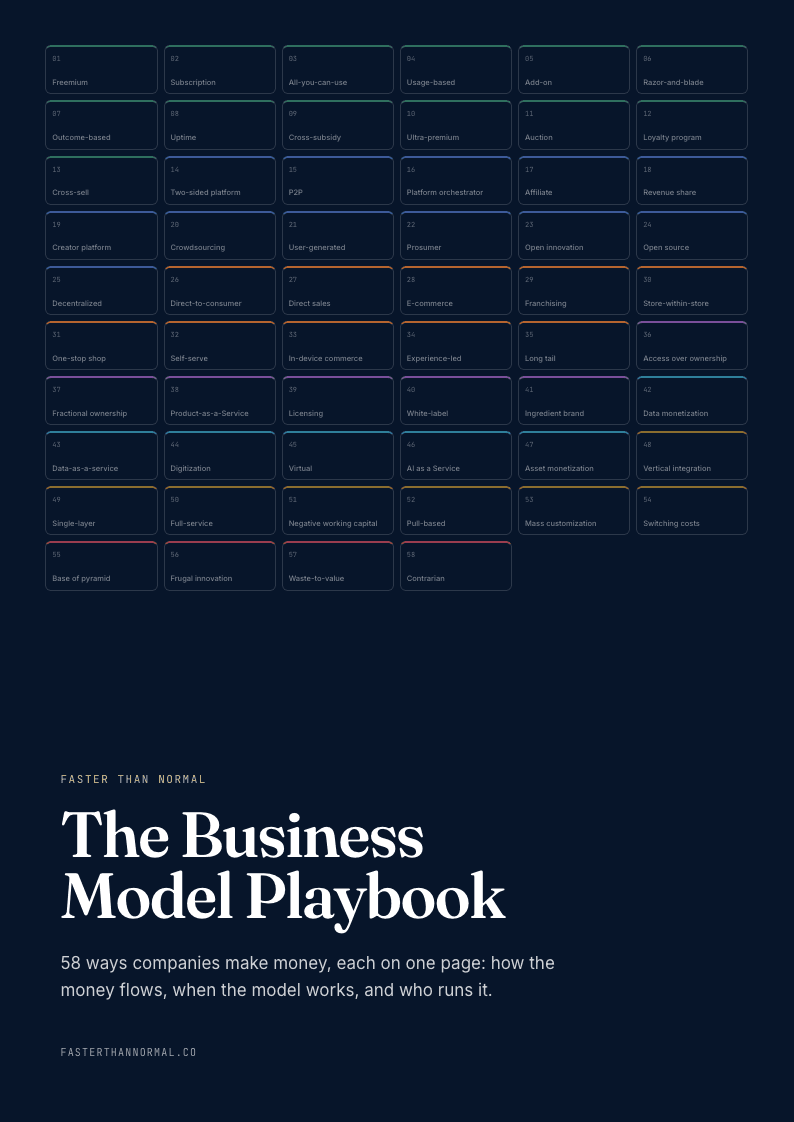
Free playbook
Get The Business Model Playbook
58 business models, one visual page each: how the money flows, the metrics that matter, and who runs it. Free when you join the Faster Than Normal email.
Free. No spam. Unsubscribe anytime.
Part IIIMaxims
-
The best collections strategy is total commitment. Call at five in the morning, call at ten at night, call back when they hang up. Money owed to your company is not a social inconvenience — it is the lifeblood of the enterprise.
-
The rearview mirror is as important as the windshield. Visionaries need operators. Operators need visionaries. Neither role is subordinate. The company that lacks either perspective is driving blind.
-
Start over tomorrow. When disaster strikes, the correct response is measured in hours, not weeks. Get a mobile home, run a phone line, sit on the floor and recreate the orders.
-
Work harder is always a valid strategy. After the accountants recommended shutting down trucking, the Hunts didn't pivot, restructure, or rebrand. They simply worked harder. Sometimes the answer is not more clever but more effort.
-
Treat every job as if it is as important as the chairman's. The maintenance worker and the CEO occupy the same moral plane. Organizations that genuinely believe this retain people longer and perform better than organizations that merely say it.
-
The struggle is the curriculum. Share your founding hardships in specific detail with current employees. Sanitized origin stories inspire no one; the truth about near-failure builds real resilience.
-
Integrate what the industry separates. The biggest opportunities in any industry are hidden inside the rivalries that everyone accepts as natural law. The J.B. Hunt–Santa Fe Railway deal was a handshake that created billions in value.
-
Stewardship, not ownership. Framing your wealth and enterprise as a trust to be managed — rather than a trophy to be displayed — produces better decisions across every time horizon.
-
Keep the first ring. Never lose track of what things cost when they cost you everything. The artifact of your earliest sacrifice is the most valuable thing you own.
-
Presence at the hardest moment defines culture. Who answers the phone at 2 a.m. tells the entire organization what matters more than any values statement ever could.
In Their Own Words
Everything we touched didn't turn to gold, and everything we did didn't work, but we always tried to make it work… We knew if it all failed, we could go back to where we were and be happy.
Don't ever go to work in your husband's business on a part-time basis. You will end up never leaving.— Summit Luncheon, 2022
Johnnie was the love of my life and he had big dreams for the future. He always looked out the windshield at the next big thing and I was always looking out of the rearview mirror trying to hold everything together.
I will say that I am a nice person and love people, but when it comes to collecting on debts, I can be the meanest person you'll meet.
It was not uncommon for me to get a call from a driver who had run into trouble and was about to quit.
I learned to drive very early and I would take one of Daddy's big trucks on a Sunday afternoon and put my friends all in it and drive around in the neighborhoods.
I was actually driving a truck when I was in high school.
We published our number for them to call and I was on the other end at home.
I would call the folks who owed us money at 10 at night and as early as 5 a.m.
Pay me and I won't call you again.
As long as Johnnie drove a truck, I didn't have to work, but when he started his own business, things changed.
I was always trying to hold everything together.
I learned to drive very early and I would take one of Daddy's big trucks on a Sunday afternoon and put my friends all in it and drive around in the neighborhoods right there in town.— Interview, July 2017
I love truck drivers. I know the life of a truck driver.— Speech to Arkansas Trucking Association
Wherever I'm at, I'm happy where I am.— Speech, unspecified event
The first 10 years of the trucking company were really a struggle. Everything we touched didn't turn to gold, and everything we did didn't work, but we always tried to make it work.— Interview, unspecified date
Johnnie was the love of my life and he had big dreams for the future. He always looked out the windshield at the next big thing.— Summit Luncheon, September 29, 2022
We just kept working.— Interview, unspecified date
It was a mansion to us.— Speech, unspecified event
I was not for moving to Northwest Arkansas.— Interview, unspecified date
He was a salesman, and he was a good salesman. It didn't come easy.— Interview, unspecified date
I will say that I am a nice person and love people, but when it comes to collecting on debts, I can be tough.— Summit Luncheon, September 29, 2022
There's an imaginary sign outside this building. None of us can see it, but the people that are passing by can. It says, 'If you have a crazy idea come here, there's a man that'll listen to you.'— Johnelle Hunt
It was not uncommon for me to get a call from a driver who had run into trouble and was about to quit. I would listen to their concern and then talk them through it. I understood their issues, after all I was married to a truck driver who missed many family events.— Johnelle Hunt
Johnnie, we've lost the business. You're going to have to go back to driving a truck.— Johnelle Hunt, to her husband after the 1971 fire


