

Part IThe Story
The Bench in Valentino Park
In the autumn of 1918, a twenty-year-old man sat on a bench in Valentino Park in Turin and wept. He had been discharged from the Italian Army after nearly dying — not from combat but from the flu pandemic that was then consuming Europe in a second, more indiscriminate wave of slaughter. He had survived two operations at the military hospital in Brescia. His father was dead. His older brother was dead. The family metalworking business that had once employed thirty people building bridges and roofs for the state railways had collapsed. He had come to Turin because he wanted to work at Fiat, and Fiat had turned him away. He had no money, no experience, limited education. He was too tall, too thin, too sick, too alone.
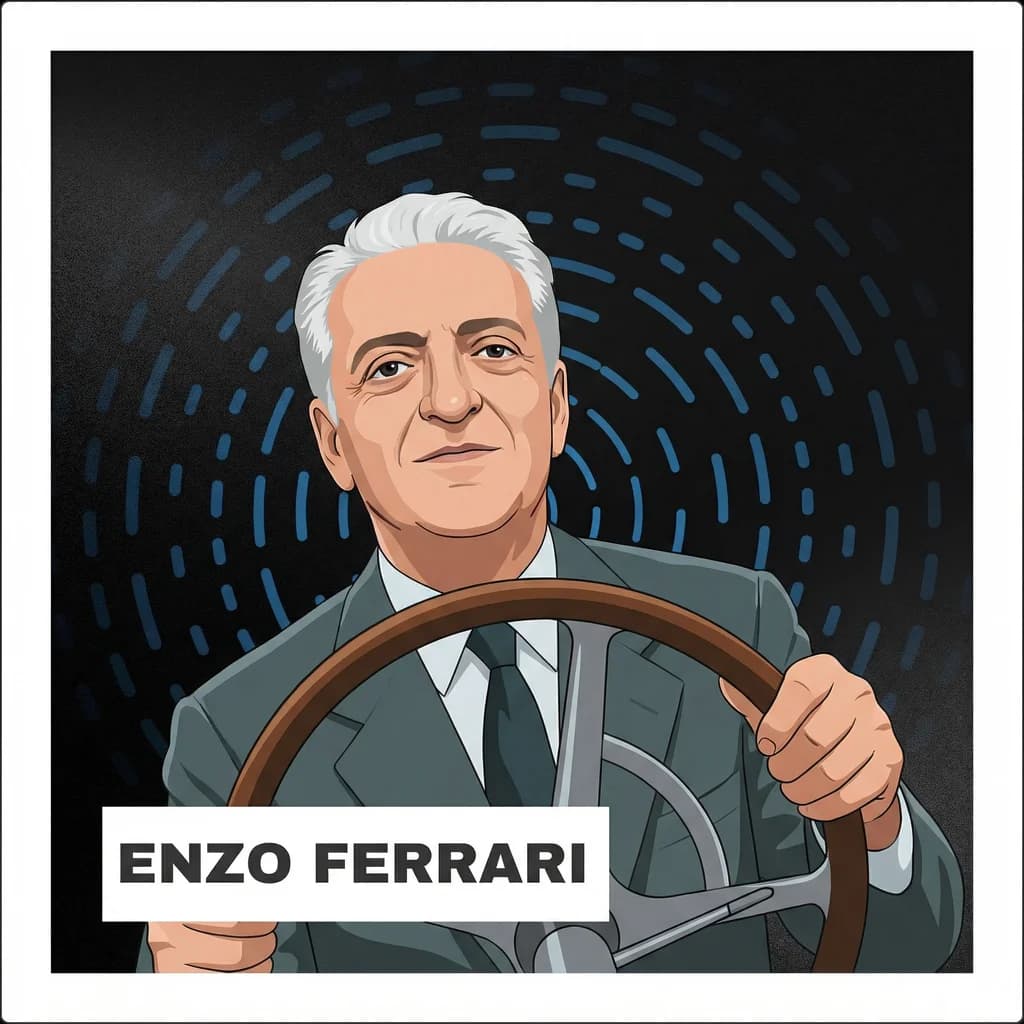
The man's name was Enzo Anselmo Giuseppe Maria Ferrari, and the bench in Valentino Park would become one of the foundational myths of his life — a story he told and retold, burnishing and polishing it the way his father had once polished iron. Decades later, after he had built the most famous racing team in the history of motorsport, after his cars had won more than five thousand races, after his name had become synonymous with speed and beauty and a particular Italian ideal of excellence purchased at terrible cost, Ferrari would return to the memory of that bench. He wept there again, he said — but this time from triumph, after winning the Italian Grand Prix, a victory that brought the world championship back to Maranello. The symmetry was almost too perfect, which should make us suspicious. Enzo Ferrari was, among other things, a consummate mythmaker, a man who understood that the story you tell about yourself can be more durable than the steel you bend.
But the tears on the bench — the first set, the ones born of despair — those were real enough. Everything that followed for the next seventy years was an answer to the question that bench posed: What do you do when you have nothing but a passion to get somewhere?
By the Numbers
The Ferrari Empire
90Years lived (1898–1988)
5,000+Races won by Ferrari cars (1948–1988)
25World titles earned under his leadership
~13,000Cars produced annually today
$80B+Ferrari market capitalization (2024)
60%Repeat customer rate
1F1 teams competing in every season since 1950
The Blacksmith's Son and the Bologna Road
The Ferrari family were not poor, exactly, but they were embedded in the working life of the Po Valley in a way that left little room for pretension. Alfredo Ferrari, Enzo's father, had started with a dirt-floor workshop next to a dirt-floor house in Modena — an ancient, gray city that sweltered in summer and was often enveloped by what one biographer called "a dismal, greasy fog" in winter. The region had been known for its metalworking since the Middle Ages, and Alfredo had grown his operation into something respectable: a shop of about thirty men, forging components for the Italian state railways. His wife, Adalgisa, kept the household running above the factory floor. Their elder son, also named Alfredo but called Dino, preferred formal education. Enzo did not.
What Enzo preferred was the workshop itself. In his autobiography, he would claim he wanted to be "a worker — nothing else." He dropped out of technical school. He was not academically gifted. He was interested in clay pigeon shooting, using a Flobert rifle his father had given him. He had precisely one ambition that mattered: at age ten, his father took him and Dino to the Circuito di Bologna on the Via Emilia, and he watched Felice Nazzaro win the race. "I'm going to be a racing driver," the boy announced. He was fifteen.
The early twentieth century in northern Italy was a landscape where metalwork and speed were converging into something new. The crescent of land defined by the Po River — running from Turin through Milan to Modena and Bologna — would eventually produce Fiat, Alfa Romeo, Maserati, Lamborghini, and Ferrari. The soil was right. But in 1916, when both Alfredo and Dino died within the same year — Alfredo from pneumonia, Dino from what was likely the flu or typhoid — the soil under Enzo's feet turned to nothing. He was eighteen. The family business collapsed. He was forced to take a job as an instructor at the lathe operator school in the fire brigade workshop of Modena. The following year, he was conscripted into the Third Alpine Artillery Division, where he shoed mules for the mountain regiment. Then the flu nearly killed him, too.
This is the biographical compression that matters: by the time Enzo Ferrari was twenty years old, he had lost his father, his brother, his livelihood, and very nearly his life. The institutions he turned to — the Army, Fiat — either discharged him or refused him. What remained was the memory of Nazzaro's car screaming down the Via Emilia and the unshakeable conviction that he was meant to be near machines that moved at extraordinary speed. Whether he would drive them, build them, or manage the men who did both was a question that would take another decade to resolve.
An Agitator of Men
Ferrari's racing career, when it came, was respectable but not extraordinary. He scraped together enough money to buy his first race car in 1919 and debuted at the Parma–Poggio di Berceto hillclimb, driving a 2.3-liter CMN, finishing fourth in his category — ninth overall. Not bad for a man who had recently been shoeing mules. He moved to Milan to work for Costruzioni Meccaniche Nazionali as a test driver, then graduated to racing, then in 1920 joined Alfa Romeo — a move that would define the next twenty years of his life.
At Alfa, Ferrari was competent behind the wheel. He won three Grand Prix races in 1924, including the Coppa Acerbo at Pescara, which he would remember with particular satisfaction for the rest of his life. But he was not Tazio Nuvolari. Nobody was. In 1931, during a practice run for the Circuito delle Tre Provincie, Ferrari rode as a passenger alongside Nuvolari — the "Flying Mantuan," a tiny, feral genius of a driver from nearby Mantua who seemed to operate at a frequency no other human could detect — and the experience shattered whatever remained of Ferrari's ambitions as a racer. Nuvolari's magical ability so impressed him that he would forever afterward call him the greatest driver of all time. But the deeper revelation was more personal: Ferrari understood that his gift was not for driving. It was for something else entirely.
"I have never considered myself a designer or an inventor," Ferrari said late in life, "but only one who gets things moving and keeps them running. My innate talent was for stirring up men."
This was not false modesty. It was a precise self-diagnosis. Brock Yates, whose Enzo Ferrari: The Man and the Machine remains the essential English-language biography, described Ferrari as "the consummate manager of men — not docile, soft men, but proud, fiercely competitive, egocentric men." Luca Dal Monte, in his monumental Enzo Ferrari: Power, Politics, and the Making of an Automotive Empire, a 954-page work of near-obsessive archival diligence, put it more sharply: Ferrari possessed a volatile mixture of brute force, paranoia, and guile that he deployed on employees, drivers, competitors, and the media with equal abandon. He was charismatic enough to make proud men into supplicants willing to risk their lives for the Scuderia. Then he often drove them out, or mad, or into early graves.
The word he used for himself — agitatore di uomini, agitator of men — carried a specific Italian inflection that is difficult to render in English. It suggested not just motivation but provocation, a deliberate unsettling of equilibrium to produce creative energy. Ferrari did not manage through consensus or kindness. He managed through tension, playing drivers against each other, engineers against designers, lovers against wives. "If by dictator you mean demanding from others the utmost commitment to their job," he once said, "they definitely have a point."
The Prancing Horse and the Dead Pilot's Mother
In 1923, after winning the first Circuito del Savio at Ravenna, Ferrari met Count Enrico Baracca, father of Francesco Baracca — Italy's most accomplished fighter ace of the First World War, credited with thirty-four aerial victories before being shot down and killed in June 1918. The Count was moved by Ferrari's performance. Later, Ferrari met Countess Paolina Baracca, Francesco's mother, who gave him a signed photograph and invited him to use her son's personal emblem — a black prancing horse, the cavallino rampante — as his own mascot.
The emblem had decorated the fuselage of Baracca's SPAD S.XIII fighter. Ferrari added a canary-yellow background — the color of Modena — and a tricolor stripe at the top. The prancing horse would not appear on a racing car until 1932, when Scuderia Ferrari ran its first race at the 24 Hours of Spa, but from that meeting onward, it was Ferrari's talisman. The symbolism was layered and deliberate: a dead hero's boldness transferred to a living man's machines, the martial spirit of flight fused with the earthbound violence of speed. It was, in other words, a story — and Ferrari, who had briefly considered becoming a sports journalist and who harbored dreams of singing grand opera, understood the power of stories better than any automobile manufacturer before or since.
The Scuderia Ferrari was founded in Modena on December 1, 1929. Scuderia means "stable" — as in a place for horses — and the name itself was a branding masterstroke, conjuring images of thoroughbreds and aristocratic sport while the operation was, in reality, a glorified racing garage. Initially, the team prepared and raced Alfa Romeo cars, fielding a stable of more than forty drivers, including Nuvolari himself. Ferrari had married Laura Garello in 1923 — a union that would prove durable and difficult in roughly equal measure — and when their son Alfredo was born in 1932, nicknamed Dino after Enzo's dead father and brother, Ferrari retired from driving entirely. He was thirty-four. His racing career had comprised perhaps fifty significant events. His career as an impresario was just beginning.
The Divorce from Alfa and the Birth of the 125 S
The relationship between Ferrari and Alfa Romeo deteriorated throughout the 1930s the way most relationships do between a strong-willed subordinate and an increasingly paranoid employer — slowly, then all at once. Ferrari proved successful managing Alfa's racing efforts, which only made Alfa's leadership more suspicious of him. In 1937, Alfa bought out most of Scuderia Ferrari, wanting to bring its racing program under its own roof. They retained Ferrari as an adviser, a role that suited neither party. In 1939, they parted ways. A public announcement from Alfa claimed "mutual agreement." Ferrari later claimed he had been kicked out.
The separation came with a non-compete clause: Ferrari could not use his own name or rebuild the Scuderia for several years. So he created Auto Avio Costruzioni — AAC — and set up shop in Modena, building and repairing cars and supplying machine tools and aircraft parts to the Italian military during the war. AAC's first car was the Tipo 815, a machine assembled in months from borrowed components to compete in the 1940 Mille Miglia. Two 815s started the race. Neither finished. It was a beginning, of a kind.
In 1942, anticipating Allied bombing — correctly, as it turned out — Ferrari moved his factory from Modena to the village of Maranello, twelve kilometers to the south. The Allies bombed the new factory twice, in 1944. Ferrari rebuilt. This pattern — destruction followed by reconstruction, catastrophe followed by stubborn resumption — would repeat itself so many times across his life that it acquired the force of a governing principle. By 1945, flush with cash from wartime contracts and free of his non-compete with Alfa, Ferrari commissioned the engineer Gioacchino Colombo to design a completely new car from scratch.
Colombo — a brilliant, volatile Milanese engineer who had designed the legendary Alfa Romeo 158 Alfetta — produced for Ferrari a 1.5-liter V-12 engine, the first to carry the Ferrari name. The choice of a twelve-cylinder configuration was deliberate: it was the architecture of excess, of smooth power delivery, of a particular kind of mechanical extravagance that became, from that moment forward, the signature of the house. The car it powered, the 125 S, emerged from the Maranello factory in 1947. Ferrari was forty-nine years old. He had been waiting his entire life.
The 125 S's first race, on May 11, 1947, at the Piacenza circuit, ended in retirement — a fuel pump failure. Ferrari called it "a promising failure." Two weeks later, on May 25, at the Rome Grand Prix on the Circuito di Caracalla, the 125 S won. It was Ferrari's first victory under his own name.
— Enzo FerrariAll we wanted to do was build a conventional engine, only one that would be outstanding.
Saturn Devouring His Sons
The 1950s were Ferrari's decade of triumph and carnage, intertwined so tightly that it became impossible to separate glory from grief. Ferrari entered Formula One in 1950, the inaugural season of the World Championship, and the Scuderia has competed in every single season since — the only team in history to have done so. Ferrari's sports cars won the 24 Hours of Le Mans for the first time in 1949, when Luigi Chinetti — a rakish, fast-talking Italian-American who had emigrated to New York and become Ferrari's indispensable link to the lucrative American market — drove a 166 MM for twenty-three of the race's twenty-four hours and won.
Chinetti deserves his own compressed biography: born in 1901 in a small town near Milan, he had raced for Alfa Romeo in the 1930s, emigrated to the United States in 1940, became a naturalized citizen, and opened a Ferrari dealership on the East Coast that functioned as a beachhead for the brand in the richest consumer market on earth. Chinetti understood Americans — their appetite for speed, their willingness to pay for exclusivity, their susceptibility to the mystique of European craftsmanship — and he channeled that understanding back to Maranello, where Ferrari alternated between gratitude for Chinetti's salesmanship and contempt for the American customers who, Ferrari felt, bought his cars "as showpieces rather than race-engineered masterpieces." Somebody once asked Chinetti whether Enzo deserved the reputation for coldness. After considering it, Chinetti replied, "I don't think he liked anyone."
The victories accumulated. Alberto Ascari won the World Drivers' Championship in 1952 and 1953. Ferrari sports cars dominated Le Mans, the Mille Miglia, the Targa Florio. Phil Hill — a cerebral, anxious Californian who became the first American to win the F1 World Championship, in 1961 — drove Ferraris with a mixture of devotion and dread that was typical of the men who entered the Commendatore's orbit. But the drivers also died. And they died with a frequency that, even by the brutal standards of 1950s motorsport, was staggering.
Ascari was killed in a crash in 1955. Eugenio Castellotti, a dashing young Italian whom Ferrari admired, died in a testing crash at Modena in 1957. Luigi Musso and Peter Collins — Collins was one of the drivers Enzo genuinely loved, a warmth he extended to very few — died in Ferrari F1 cars in 1957 and 1958. Alfonso de Portago, a Spanish aristocrat and bobsled champion who raced with the casual fatalism of his class, crashed his Ferrari during the 1957 Mille Miglia, killing himself, his navigator, and at least nine spectators. That disaster — the car shredding into the crowd on a straight near the town of Guidizzolo — convinced the Italian government to outlaw road racing, ending the Mille Miglia forever. Ferrari was charged with manslaughter. He was acquitted. But the final running of the Mille Miglia also brought him the glory he craved: Piero Taruffi, whom Ferrari had personally convinced to race despite being close to retirement at age fifty, drove a 315 S to victory.
The Italian press, surveying this wreckage of young lives, reached for the darkest myth they could find. They called Ferrari Saturno che divora i suoi figli — Saturn devouring his sons.
— Enzo Ferrari, to The Times of London, 1962Racing is a great mania to which one must sacrifice everything, without reticence, without hesitation.
The cruelty of the epithet was compounded by private tragedy. Dino Ferrari — Enzo's legitimate son, the boy named for the dead father and dead brother, the one being groomed to inherit the company — had been diagnosed with Duchenne muscular dystrophy. Dino was gifted: he designed the 750 Monza engine and was deeply involved in the company's engineering work. He died on June 30, 1956, at twenty-four. Enzo and Laura were devastated. Their marriage, already strained by Enzo's habitual philandering — he had maintained a relationship with Lina Lardi, who in 1945 had borne him a second son, Piero — fractured further after Dino's death, though Laura remained closely involved with company oversight, scrutinizing the books, challenging Enzo's decisions, serving as a kind of shadow board of directors consisting of a single furious, grieving woman.
The late 1950s were thus a time when everything Ferrari had built seemed poised on the edge of dissolution. Drivers were dying. His son was dead. His marriage was a ruin. The Italian press wanted his head. And yet he never wavered from the mission. The bell rang, and Enzo Ferrari answered it.
The Deal That Never Was
In 1963, Ferrari's finances were precarious. Racing was ruinously expensive. Road-car sales helped, but Ferrari produced only a few hundred cars per year, each one essentially handmade by workers whose skill level was closer to watchmaking than to industrial manufacturing. A visiting New Yorker journalist, Winthrop Sargeant, observed in January 1966 that "it is obvious that a Ferrari is the product of a sort of automotive watchmaker." The factory at Maranello was not immaculate in the modern sense — more easy chairs and workshop clutter than chrome and smoked glass — but the cars that emerged from it were miracles of hand-fitted precision. The problem was that miracles of hand-fitted precision do not generate the cash flow necessary to win at Le Mans.
Ford Motor Company, under the leadership of Henry Ford II, saw an opportunity. Ford was attempting to shed its dowdy image and compete in European racing. The simplest path was acquisition: buy Ferrari, absorb the racing operation, and use the Ferrari name to sell glamour alongside Galaxies and Fairlanes. Negotiations began. Ford dispatched teams of lawyers and accountants to Maranello. A price was discussed — reportedly around $18 million. Ferrari appeared willing. Then, at the last moment, Ferrari walked away.
The precise reasons for the collapse of the Ford–Ferrari deal remain disputed. The conventional narrative — the one dramatized in the 2019 film Ford v Ferrari — holds that Ferrari balked when he realized the deal would strip him of control over the Scuderia's racing program, the one thing he would never surrender. There may also have been issues of Italian pride, Enzo's instinctive distrust of American corporate culture, or simply the kind of brinkmanship at which he excelled. The collapse enraged Henry Ford II, who reportedly told his executives: "Go to Le Mans. And beat his ass."
The comparison between the two men was instructive. Henry Ford II — known as "the Deuce" — was a third-generation industrialist, a manager rather than a founder, presiding over a company of hundreds of thousands of employees and billions in revenue. Ferrari was an autocrat running a firm of perhaps a thousand workers in a provincial Italian village, making decisions from a desk behind dark glasses, controlling everything from engine specifications to the personal lives of his drivers. Ford could buy whatever he needed. Ferrari had to build what he wanted with whatever he could scrape together. Ford commanded an empire. Ferrari was the empire.
Ford spent millions developing the GT40, a purpose-built Le Mans weapon engineered in England and America. Ferrari fought back with the tools he had always used: brilliant engineers like Mauro Forghieri — who was just twenty-six when Ferrari thrust him into the role of chief engineer in 1962, and who would design some of the most beautiful and effective racing cars ever built — ferocious drivers, and the old man's unrelenting will. Ford won Le Mans in 1966, 1967, 1968, and 1969. Ferrari did not win again there until 1970. But the rivalry did something Ferrari could not have purchased at any price: it made his name known to every household in America.
Selling Cars to Race
There is a story — possibly apocryphal, certainly instructive — about a prince who visited Ferrari's showroom in the early days. The prince admired the cars, pointed to his favorite, and said, "I'll take it." Ferrari replied, without hesitation, that every car on the lot was already spoken for. There was a six-month waiting list. The truth was that not one of those cars had been sold. Ferrari was desperate to move inventory. But he understood something that most manufacturers did not: scarcity creates desire, and desire creates value.
"A Ferrari must be desired," he said. "It cannot and must not be perceived as something that is immediately available; otherwise, the dream is gone."
This was not a marketing tactic adopted in response to market research. It was an expression of personality — the same personality that refused to break up relationships between drivers and team because it was too easy, the same personality that treated his customers with the barely concealed disdain of a man who believed most of them were unworthy of his machines. Ferrari's business strategy, to the extent that it could be called a strategy at all, rested on a single inversion of the normal order of industrial capitalism: he did not build cars to sell them. He sold cars to fund his racing.
"Jaguar is racing to sell cars," he told a journalist after losing Le Mans to Jaguar in 1956. "I'm selling cars to race. I'll be back on top."
The distinction was subtle but total. Every other car manufacturer who competed in motorsport — Ford, Jaguar, Mercedes, Porsche — used racing as a marketing tool for their road-car business. Ferrari used his road-car business as a revenue stream for racing. Scuderia Ferrari had been founded in 1929, nearly two decades before Ferrari built his first car. The company existed to race. The cars were a necessary, lucrative, and occasionally beautiful by-product.
This inversion explains much that otherwise appears irrational about Ferrari's behavior: his refusal to expand production beyond a few thousand units per year, his contempt for customers who wanted comfort over performance, his willingness to burn through engineers and designers and drivers in pursuit of an extra tenth of a second per lap. It also explains the company's extraordinary financial position today. Ferrari does no television advertising. Its brand is built entirely on the racetrack. Roughly sixty percent of Ferrari purchases are made by repeat customers. EBITDA margins have expanded from approximately twenty-six percent in 2015 to thirty-eight percent in 2024. The company's market capitalization exceeds $80 billion — more than Ford, more than General Motors, more than almost every automaker on earth — while producing fewer than fourteen thousand cars per year.
The Architecture of Secrecy
By the mid-1960s, Enzo Ferrari had become as famous for what he concealed as for what he displayed. He almost never left Modena. He did not take vacations. He ate at the same restaurants, kept the same hours, wore the same dark suits and, increasingly, the same opaque sunglasses that became his most recognizable attribute. He was six feet two, broadly built, and he used his physical presence the way he used silence — as a tool of intimidation.
The sunglasses were partly a style choice and partly a tactical one. "Who knew what was going on in the Old Man's eyes?" one biographer asked. Ferrari understood that opacity is power. If your employees cannot read your expression, they cannot calibrate their behavior to please you, which means they must operate in a state of perpetual uncertainty — and uncertainty, for a man who managed through tension, was the ideal working condition.
His daily routine was monastic. He rose early, worked at the factory, lunched at a favored trattoria, returned to work, and went home. He had no hobbies other than the business itself. Brock Yates noted that Ferrari never took a vacation in his life. His personal world was divided between two households — Laura and the memory of Dino in one; Lina Lardi and their son Piero in the other — maintained in parallel for decades, a domestic arrangement that was scandalous by the standards of respectable Italian society but entirely consistent with the mores of his generation, in which, as one biographer put it, "mothers were worshipped, wives tolerated, and other women treated as objects of either scorn, or lust, or both."
Piero Lardi Ferrari was born in 1945 but not publicly acknowledged by his father for thirty-three years — not until Laura's death in 1978 freed Enzo from the obligation of discretion. Piero had been working at Ferrari under his mother's surname since the 1960s. After Laura died, Enzo acknowledged him, named him his heir, and Piero adopted the Ferrari name. He would inherit ten percent of the company and eventually become vice-chairman, a position he holds to this day. His grandson, Enzo Mattioli Ferrari — named for the founder six months before the old man died — now runs Ferrari Family Investments and serves as president of the Cavallino Classic, the annual gathering of Ferrari devotees in Palm Beach, where he was recently photographed in a scarlet blazer and jet-black sunglasses. Before the cameras rolled, he swapped his dark shades for thick-rimmed eyeglasses. "That is Enzo," he said, meaning the sunglasses belonged to the legend, not to him.
The Fiat Bargain and the Throne Retained
In 1969, facing the same financial pressures that had nearly driven him into Ford's arms six years earlier, Ferrari sold a fifty percent stake in his company to Fiat. The buyer was Gianni Agnelli — L'Avvocato, the Advocate — the most powerful industrialist in Italy, heir to the Fiat empire, a man whose personal style was as legendary in its way as Ferrari's own: the watch worn over the shirt cuff, the rumpled elegance, the effortless command of postwar Italian capitalism.
There is a story of their first significant encounter. Agnelli asked Ferrari, "You know how to win?" Ferrari replied: "I'm trained to win."
The deal with Fiat was everything the Ford deal was not. Ferrari retained the presidency of the company and — crucially — complete control over Scuderia Ferrari's racing operations. He kept the thing he cared about most. Fiat got the brand and the industrial capacity. Ferrari got money and freedom. It was, in its way, a masterpiece of negotiation: the smaller party dictating terms to the larger by making himself indispensable to the very thing the larger party wanted to buy.
Ferrari resigned as president in 1977 but retained control of the Scuderia until his death. Fiat expanded its ownership to ninety percent in 1988. By then, Ferrari — the man — was ninety years old, largely confined to his routines in Modena and Maranello, his body crumbling while his mind, everyone agreed, remained sharp. He still attended test sessions at Fiorano, the private circuit he had built adjacent to the factory. He still interrogated engineers about lap times. He still answered the bell.
The Sound of the V-12 at Idle
What was it about the cars themselves? There is a moment in the 1986 Autosport interview — one of the last major press encounters of Ferrari's life — when the journalist Nigel Roebuck visits Maranello and walks through the road-car assembly line. "Can you imagine a Testarossa assembly line?" he writes. The factory had "a cheerful, lived-in quality untypical of today." Not chrome and smoked glass. Easy chairs and engine blocks. Workers fitting components by hand with a precision that had more in common with Stradivari than with Detroit.
Ferrari's obsession was always the engine. "Aerodynamics are for people who can't build engines," he supposedly said — a line that was probably more provocation than engineering doctrine, but which captured his bias perfectly. The V-12 was his signature, his fetish, his first love. When a driver stepped on the gas, Ferrari wanted him "to shit his pants." The sound of a Ferrari engine at full throttle was, and remains, one of the most distinctive noises in the mechanical world — a banshee wail that rises from a low, loping idle to a scream at redline. The engine was the heart; everything else — chassis, bodywork, aerodynamics — existed to carry the heart around.
This created a particular approach to car building that valued feel over efficiency, drama over refinement, and individual genius over systematic optimization. Ferrari's cars were not always the most reliable. They were not always the fastest on every circuit. But they possessed a quality that no amount of corporate engineering could replicate: they were alive in a way that other machines were not. Mauro Forghieri, who served as Ferrari's chief engineer for two decades and designed the legendary 250 GTO and the championship-winning F1 cars of the 1970s, described the old man's approach as fundamentally sensory — Ferrari judged an engine by its sound, a chassis by the way it felt through the steering wheel, a car by the expression on the driver's face when he climbed out.
— Enzo FerrariWhen the driver steps on the gas, I want him to shit his pants.
The Last of the Titans
Enzo Ferrari died on August 14, 1988, in Modena. He was ninety years old. His death was not announced until the following day — a final act of secrecy from a man who had spent his life controlling information.
The editorial writers groped for words. Many called him an automotive pioneer, which, strictly speaking, he was not — he invented no fundamental technology, held no transformative patents. Others called him a great racing driver, which he was not — he was competent, no more. He was, as Brock Yates wrote, "exactly what he had repeatedly said he was: an agitator of men." From 1930 onward, for nearly sixty years, hardly a day had passed when the thought of winning automobile races with cars bearing his name was not foremost in his mind. Win or lose, he unfailingly answered the bell.
In his will, he named Piero as his heir. Fiat completed its acquisition of the remaining shares. The racing team continued. In the years since his death, Scuderia Ferrari has won the Constructors' Championship sixteen times. Michael Schumacher won five consecutive drivers' titles for the team between 2000 and 2004. In 2023, Ferrari returned to Le Mans for the first time in decades and won the Hypercar class at the hundredth anniversary race — then won again in 2024. The company went public on the New York Stock Exchange in 2015, trading under the ticker RACE.
Ferruccio Lamborghini's descendants play with hotels and wine. The Maserati brothers sold their shares in the 1930s. Alfa Romeo is now a subsidiary of Stellantis. The Ferraris — Piero, his children, his grandchildren — still have a say at Ferrari. The name endures in a way that no other automotive dynasty's does, which is exactly what the old man intended when he chose a dead pilot's horse as his emblem and a provincial Italian city's color as his flag.
In the Ferrari Museum in Modena, among the rotating displays of cars and engines and technical drawings, there sits a transparent case containing a pair of black sunglasses. They are small, unremarkable — the kind of object that could belong to anyone. But they belonged to Enzo Ferrari, and in their opacity they contain everything: the ambition and the grief, the speed and the carnage, the terrible joys. The eyes behind them are closed forever. The machine keeps running.
Part IIThe Playbook
Enzo Ferrari's life offers no tidy instruction manual. He was contradictory, ruthless, sentimental, and sometimes cruel. He destroyed relationships as readily as he built cars. But within the chaos of his ninety years, there are patterns — principles that operated consistently across decades, through wars and bankruptcies and the deaths of people he loved. What follows is an attempt to extract those principles without sanitizing them.
The principles
- 1.Sell cars to race. Don't race to sell cars.
- 2.Be an agitator, not a manager.
- 3.Manufacture scarcity before you manufacture products.
- 4.Survive every catastrophe, then resume.
- 5.Choose the V-12: obsess over the core, outsource the rest.
- 6.Use opacity as strategy.
- 7.Negotiate from weakness as though you hold every card.
- 8.Attract the proud and the gifted, then unsettle them.
- 9.Let the product be the advertising.
- 10.Compound knowledge over a single domain for decades.
- 11.Retain control of what matters; sell everything else.
- 12.The most beautiful victory is always the next one.
Principle 1
Sell cars to race. Don't race to sell cars.
Ferrari's foundational inversion — building road cars to fund racing, not racing to sell road cars — was not a strategy adopted after careful analysis. It was an expression of identity. Scuderia Ferrari existed from 1929. The first Ferrari road car did not appear until 1947. The company's DNA was competition; the luxury-goods business was grafted on as a survival mechanism.
This inversion produced extraordinary discipline. Because every lira spent on road cars was a lira diverted from racing, Ferrari was parsimonious about production and obsessive about margins. He never expanded beyond what the racing program required. He never chased volume. He never diluted the brand. The result, decades later, is a company with the pricing power of Hermès and the emotional intensity of a World Cup.
Most businesses struggle to define their hierarchy of priorities. Ferrari never did. Racing was first. Everything else was in service of racing. When the hierarchy is clear, every other decision — pricing, production volume, hiring, partnerships — becomes vastly simpler.
Tactic: Identify the one activity that is the reason your company exists, and structure every revenue stream as a means to fund and protect that activity.
Principle 2
Be an agitator, not a manager.
Ferrari's self-description as an "agitator of men" was not euphemism. He deliberately created environments of tension, competition, and uncertainty. Drivers were played against each other. Engineers received contradictory instructions. Loyalty was demanded but never fully reciprocated. The result was a state of creative ferment that produced extraordinary machines — and, not infrequently, extraordinary bitterness among the people who built them.
This is not a universally applicable management philosophy. It requires a particular kind of leader — one with deep charisma, genuine expertise, and the emotional resilience to withstand the hostility that provocation inevitably generates. Ferrari possessed all three. His ability to recognize talent was near-infallible: he identified Nuvolari, Ascari, Forghieri, Hill, Surtees, and Lauda, among others, as exceptional before anyone else did. And he understood that exceptional people respond to challenge, not comfort.
The risk of this approach is obvious: burnout, defection, resentment. Ferrari lost many of his best people over the years. But he also got performances from them that no one else could have elicited. The trick — and it is a dangerous trick — is to push people to the edge of their tolerance without pushing them over it.
Tactic: If you lead exceptionally talented people, recognize that your job may be less to direct their work than to create the conditions — including productive discomfort — under which they do their best work.
Principle 3
Manufacture scarcity before you manufacture products.
Ferrari's refusal to sell a car to a willing buyer — even when he was desperate for revenue — was an act of breathtaking nerve that contained a profound insight about luxury markets. The fastest way to destroy a premium brand is to reveal that supply exceeds demand. By creating artificial scarcity, Ferrari established the psychological framework within which every subsequent transaction occurred: the customer was competing for access, not the seller competing for attention.
This principle has survived intact for seventy-five years. Ferrari still produces fewer cars than it could sell. It still maintains waiting lists. It still controls allocation with an iron hand. The result is a customer base that is sixty percent repeat buyers — people who return not because Ferrari advertises to them (it does no television advertising) but because ownership itself has become a form of membership in an exclusive club.
🏇
Scarcity as Strategy
Ferrari's approach to demand management inverts the normal logic of manufacturing.
| Conventional Manufacturer | Ferrari |
|---|---|
| Produce to meet demand | Produce below demand |
| Advertise to generate awareness | Win races to generate desire |
| Expand distribution to grow revenue | Restrict distribution to protect pricing |
| Discount to clear inventory | Maintain waiting lists to increase perceived value |
Tactic: Before you optimize production, ask whether your market would value your product more if it were harder to obtain — and whether you have the nerve to turn away willing buyers.
Principle 4
Survive every catastrophe, then resume.
The pattern of Ferrari's life was: disaster, then continuation. His father and brother died in 1916; he scraped together a career in racing. He was fired from Alfa Romeo in 1939; he founded his own company. His factory was bombed twice in 1944; he rebuilt. His son died in 1956; he kept racing. The Italian press called him Saturn; he acquitted himself of manslaughter charges and won more races. Ford tried to buy him; he walked away and became more famous than ever.
This is not resilience in the motivational-poster sense. It is something closer to pathological stubbornness — an inability or unwillingness to accept that any setback is final. Ferrari never paused to grieve publicly, never took a sabbatical, never retreated. The bell rang, and he answered it. This quality — what Brock Yates called his "ironbound tenacity" — was not admirable in every respect. It made him emotionally unavailable to the people who loved him and dangerously indifferent to the human costs of his ambition. But it kept the operation running for sixty years without interruption.
Tactic: Build the organizational capacity to absorb catastrophe without changing course — which means keeping reserves, maintaining optionality, and refusing to let any single failure define the strategic direction.
Principle 5
Choose the V-12: obsess over the core, outsource the rest.
Ferrari's insistence on the V-12 engine as his company's signature was not merely aesthetic preference — it was a declaration of strategic focus. The engine was the one component he would never compromise on, the irreducible center of what made a Ferrari a Ferrari. Everything else — chassis design, bodywork, even aerodynamics — was secondary. He could commission coachbuilders like Pininfarina and Scaglietti to clothe his machines. He could hire outside engineers to handle specific problems. But the engine was sacred.
This is a principle with broad applicability. Most organizations struggle because they try to be excellent at everything simultaneously. Ferrari succeeded by being uncompromising about one thing — the powerplant — and pragmatic about everything else. The result was a product whose identity was unmistakable, whose quality in the one dimension that mattered most was beyond question, and whose secondary characteristics could be adapted and improved without ever diluting the core.
Tactic: Identify the single element of your product or service that is irreplaceable — the thing that, if compromised, would destroy your identity — and protect it fanatically, even at the expense of other capabilities.
Principle 6
Use opacity as strategy.
The sunglasses were not an affectation. They were a management tool. Ferrari understood that information asymmetry is power — that if your employees, competitors, and customers cannot read your intentions, they are forced to operate in a state of uncertainty that gives you perpetual initiative. He rarely left Modena. He granted few interviews. He never explained his decisions. He made his factory a fortress and his personality a mystery.
This is the opposite of the modern cult of transparency, which holds that leaders should be open, communicative, and emotionally accessible. Ferrari was none of these things — and his company outperformed virtually every rival for decades. The lesson is not that opacity is always superior to transparency, but that selective control of information is a legitimate and powerful tool, particularly in industries where mystique is part of the value proposition.
Tactic: Audit what you reveal and to whom — not because transparency is wrong, but because indiscriminate openness forfeits the strategic advantage of controlling narrative timing.
Principle 7
Negotiate from weakness as though you hold every card.
Ferrari's behavior in the Ford negotiations — walking away from an $18 million deal when his company was financially precarious — was either madness or genius, depending on whether you believe he knew what would happen next. The evidence suggests he did not. He simply could not accept terms that stripped him of control over the Scuderia. But the effect of his walk-away was to establish a reputation for unshakeable independence that made every subsequent negotiation — including the far more favorable Fiat deal six years later — easier.
When Ferrari sold to Fiat, he retained the presidency and complete authority over racing. He achieved this not because Agnelli was weak, but because Ferrari had established, through decades of refusal and stubbornness, that he was the kind of man who would burn the house down rather than hand over the keys. Counterparties negotiate differently when they believe the other side truly does not care about the outcome.
Tactic: In any negotiation, identify the one term you will not concede — and make it credibly clear, through your history of behavior, that you would rather walk away than compromise it.
Principle 8
Attract the proud and the gifted, then unsettle them.
Ferrari's talent strategy was two-fold. First, he had an almost infallible eye for exceptional ability — in drivers, engineers, and designers. He identified Tazio Nuvolari, Alberto Ascari, Mauro Forghieri, and Niki Lauda before anyone else recognized their full potential. Second, once he had attracted them, he refused to make them comfortable. He demanded, provoked, and occasionally betrayed — not out of malice, necessarily, but because he believed that comfort was the enemy of performance.
This is the most controversial of Ferrari's principles. It produced extraordinary results and extraordinary casualties. The question every leader must answer is whether the incremental performance gains from creative tension justify the human costs. Ferrari's answer was unequivocal: yes. The drivers who died would probably have given the same answer, at least before they died. The engineers who left in frustration might disagree.
Tactic: Recruit for talent and character simultaneously — look for people with the inner fire to thrive under pressure — and accept that some exceptional people will leave, understanding that the intensity that drives some away is the same intensity that makes the remaining few exceptional.
Principle 9
Let the product be the advertising.
Ferrari has never run a television commercial. Its entire marketing strategy, from 1947 to the present, has consisted of winning races. The logic is simple and circular: win on the track, generate desire, sell cars, use the revenue to win more races. This flywheel — track success generating brand equity generating revenue generating track investment — is the most efficient marketing engine in the luxury automotive industry.
The underlying principle is that demonstrated excellence is more persuasive than claimed excellence. A Ferrari advertisement would actually diminish the brand, because it would imply that the company needs to persuade people to buy its product — which would shatter the illusion of scarcity and exclusivity that is the brand's foundation.
Tactic: If your product is genuinely exceptional, the most powerful marketing investment you can make is in making the product even more exceptional — not in telling people about it.
Principle 10
Compound knowledge over a single domain for decades.
Ferrari spent sixty years — from 1929 to 1988 — focused on a single endeavor: winning automobile races. He did not diversify into other businesses. He did not pursue adjacent markets. He did not seek political office or write management books or launch a clothing line. He sat in Modena and thought about engines and drivers and lap times, day after day, year after year, decade after decade.
The compounding effect of this focus was staggering. By the end of his life, Ferrari possessed an intuitive understanding of motorsport engineering, talent management, competitive strategy, and brand building that no contemporary could match, because no contemporary had been doing the same thing, in the same place, for as long as he had. Knowledge compounds like capital — but only if you keep it invested in the same domain.
Tactic: Before you pursue the next opportunity, ask whether the compounding value of another year of depth in your current domain exceeds the expected value of breadth in a new one.
Principle 11
Retain control of what matters; sell everything else.
The Fiat deal was a masterclass in structuring a partnership to preserve autonomy. Ferrari sold fifty percent of the economic value of his company while retaining one hundred percent of the control over the thing he cared about most — the racing team. He understood, with the clarity that comes from knowing exactly who you are, which aspects of his empire were negotiable and which were not.
This principle extends beyond financial transactions. In every partnership, every hiring decision, every strategic alliance, there are elements that are core to identity and elements that are instrumental. Ferrari never confused the two. He was happy to let Fiat handle industrial logistics, dealer networks, and capital expenditure. He would not let them touch the Scuderia.
Tactic: Before entering any partnership or transaction, draw a bright line between the activities that define your identity and the activities that support it — and structure the deal so that the former remain entirely under your control.
Principle 12
The most beautiful victory is always the next one.
In 1986, at eighty-eight years old, Enzo Ferrari was asked whether he had any ambitions remaining. He smiled. "I've been involved in racing since 1919," he said, "and to go on living, a human being must always have new ambitions. At Ferrari, the most beautiful victory is always the next one."
This was not a platitude. It was the operating principle of a man who, for nearly seven decades, had treated every race, every season, every car as though it were the first — and the last. There was no sentiment for past machinery at Maranello. Grand Prix cars were routinely broken up once their useful purpose had been served. Not a single "shark nose" from the dominant 1961 season was preserved. The past was fuel, not treasure. It existed to be burned in pursuit of the future.
The most dangerous moment for any organization is the one that follows a great success. Ferrari understood this instinctively. He was, by all accounts, more demanding in victory than in defeat — because victory bred complacency, and complacency was the only enemy he could not outrun.
Tactic: Institutionalize the habit of treating every achievement as the starting point for the next effort — and resist the temptation to preserve and celebrate past successes at the expense of future ones.

Free playbook
Get The Business Model Playbook
58 business models, one visual page each: how the money flows, the metrics that matter, and who runs it. Free when you join the Faster Than Normal email.
Free. No spam. Unsubscribe anytime.
Part IIIMaxims
- Invert the value chain. Build the business around the activity you love, not the other way around — then let the business fund the obsession.
- Scarcity is a discipline, not a tactic. Produce less than you could sell, and never let the customer see your desperation.
- The engine is everything. Find the single irreducible element that defines your product, and protect it with fanatical intensity.
- Tension is generative. Comfort produces mediocrity; demand more from people when they succeed, not only when they fail.
- Opacity preserves optionality. Control what you reveal, when you reveal it, and to whom — information surrendered is leverage lost.
- Survive, then resume. Treat every catastrophe as a temporary interruption, not a permanent redefinition. The bell will ring again.
- Your walk-away price defines your brand. The thing you refuse to sell — control, quality, identity — is the thing that makes everything else valuable.
- Depth compounds; breadth dissipates. Sixty years in one domain produces knowledge that no amount of diversification can replicate.
- Let the product speak. If you need to advertise, you have already lost the argument about quality.
- The most beautiful victory is the next one. Sentiment for past success is the first symptom of decline.
In Their Own Words
Aerodynamics are for people who can't build engines.
What's behind you doesn't matter.
Everyone dreams of driving a Ferrari. It was my intent from the start.
I don't sell cars; I sell engines. The cars I throw in for free since something has to hold the engines in.
Second is the first of the losers.
The client is not always right.
One must keep working continuously; otherwise, one thinks of death.
I build engines and attach wheels to them.
I have yet to meet anyone quite so stubborn as myself and animated by this overpowering passion that leaves me no time for thought or anything else.
The fact is I don't drive just to get from A to B. I enjoy feeling the car's reactions, becoming part of it.
I have never considered myself a designer or an inventor, but only one who gets things moving and keeps them running. My innate talent was for stirring up men.— Enzo Ferrari
A Ferrari must be desired. It cannot and must not be perceived as something that is immediately available; otherwise, the dream is gone.— Enzo Ferrari
I've been involved in racing since 1919, and to go on living a human being must always have new ambitions. At Ferrari the most beautiful victory is always the next one.— Enzo Ferrari, Autosport interview, 1986
If there was one essential quality about the man, it was his ironbound tenacity, his fierce devotion to the single cause of winning automobile races with cars bearing his name. From 1930 onward, for nearly sixty years, hardly a day passed when this thought was not foremost in his mind. Win or lose, he unfailingly answered the bell.— Brock Yates, Enzo Ferrari: The Man and the Machine
I was back where I had started. No money, no experience, limited education. All I had was a passion to get somewhere.— Enzo Ferrari


