


Part IThe Story
The Cow
In the spring of 1933, in a farming village called Asan-ri in the Tongchon district of Gangwon Province — a place so poor that arguments between parents were, as the eldest son would later recall, "always about food" — an eighteen-year-old boy sold his father's cow for 70 won. The sum was roughly five pence in British currency, enough to purchase a single train ticket to Seoul. He had tried to escape before. Twice he had been caught and dragged home by his father, a man described by his neighbors as the "No. 1 farmer" in the village, which meant only that he worked harder than anyone else at remaining poor. This time the boy made it to the capital, enrolled in a bookkeeping school, and began reading newspaper articles about a certain Abraham Lincoln who had risen from humble origins to the presidency of a distant republic. Two months later, his father found him again. Brought him home. Again.
What makes the story singular is not the escapes — running away from home is common enough among desperate adolescents — but the cow. That stolen animal would become the most famous bovine in Korean economic history, the origin myth of a conglomerate that would eventually employ 200,000 people, earn $90 billion a year, and produce everything, as it liked to boast, "from chips to ships." Sixty-five years after selling the cow, the old man — by then the richest person in Korea, chairman of eighty-six companies, builder of the nation's first highway and its first car and its largest shipyard — would drive 1,001 head of cattle across the Demilitarized Zone into North Korea, a gesture so extravagant and absurd and deeply personal that Christopher Hitchens, visiting Pyongyang around the same time, could only marvel at the surrealism of the entire peninsula. The cattle were a repayment, Chung Ju-yung said. A debt to his father. A debt to the land that made him.
The arithmetic is worth pausing over. One cow sold for 70 won in 1933. One thousand and one cows returned in 1998. The interest rate on guilt, it turns out, is compounding.
The Shape of the Country
To understand Chung Ju-yung, you have to understand the country he was born into, which is to say: a country that, for the first half of his life, barely existed as a sovereign entity, and for the second half, was rebuilding itself from rubble so total that the phrase "economic miracle" is not hyperbole but clinical description.
Korea in 1915, the year of Chung's birth on November 25, was a Japanese colony. It had been formally annexed in 1910 and would remain under imperial rule until 1945 — thirty-five years during which Koreans were subjects, not citizens, their language suppressed, their economy organized for extraction. Chung's father, Chung Bong-sik, eldest son of seven siblings in a family of no distinction, farmed rice in a landscape of extraordinary natural beauty and grinding material deprivation. His mother, Han Sung-sil, was known as the best wife of the best farmer, which meant she "did twice as much work as others when she wove silk or weeded field." The family had eight children. Food was scarce. Some years, they ate tree bark.
The boy who would become the Bulldozer graduated from Songjeon Elementary School — the entirety of his formal education, six years — and wanted to become a teacher. His father wanted him to become the next No. 1 farmer. The grandfather taught him Chinese literature. These three forces — the desire for knowledge, the obligation of filial duty, the inheritance of classical culture — would pull at Chung for the rest of his life, never fully resolving into anything as simple as a single identity.
By the Numbers
The Hyundai Empire at Its Peak
86Subsidiary companies at peak
$90BAnnual revenue at height
200,000Employees worldwide
70 wonPrice of the cow that started it all
1,001Cattle driven across the DMZ in 1998
6th gradeChung's formal education
85Age at death, March 21, 2001
Four Escapes and a Rice Shop
The chronology of Chung's early life reads like a folktale with too many iterations to be plausible, except that every detail is documented. Escape attempt one: age sixteen, 1931, he and a friend trek fifteen miles through the Paechon Valley to Kowon, find work as construction laborers. Two months. Father finds him. Home. Escape attempt two: he and two friends head for Seoul. One friend is caught by a sibling. Chung and the remaining companion are swindled by a stranger who promises them jobs, takes all their money. Father finds him staying near the grandfather's house. Home again. A year of farming. Escape attempt three: the cow, the train ticket, the bookkeeping school, Abraham Lincoln, two months of freedom. Father. Home.
After the third failure, something shifted. Chung resolved to become the best farmer his father wanted — a surrender, apparently, to fate. Then consecutive years of famine destroyed even that modest ambition. The land itself was telling him to leave.
Escape attempt four: 1934, age eighteen, he left at night. No cow this time. No friend. Just a boy walking toward Seoul in the dark. Nobody stopped him. Nobody brought him back. His father, perhaps, had finally understood something about the irreversibility of certain desires.
In Seoul, Chung worked as a dock laborer at Inchon, carried stone and wood for the construction of Boseong College (the future Korea University), operated as a handyman in a syrup factory. The jobs were brutal and low-paying, but they taught him the texture of physical labor — the smell of wet cement, the weight of a rice sack on a bicycle in the rain. He would never forget these things, and he would never romanticize them.
His break, such as it was, came at the Bokheung Rice Store, where he was hired as a delivery boy. Three days into the job, he had to deliver a load of rice and red beans by bicycle. It was pouring rain. He had never ridden a bicycle while carrying goods. He wobbled, fell into the mud. The bike was bent. The rice and beans were filthy. He spent three nights practicing loaded bicycle riding, learning techniques from a more experienced delivery boy. Within six months, the shop owner promoted him to bookkeeper and accountant. Within two years, the owner — impressed by Chung's work ethic and integrity — was dead, and had left the store to his employee.
Chung renamed it the Kyungil Rice Store and made it prosper. He was twenty-two years old, the proprietor of his first business, and already developing the conviction that would define his career: that diligence compounded, that reputation was capital, that frugality was not deprivation but discipline. Then the Japanese colonial government imposed rice rationing, and the business was destroyed.
He went home. Briefly. Then came back. Started an auto repair shop called A-do Service in 1940 — his first contact with machinery, with the logic of engines and the economics of speed. He knew nothing about cars. He hired a skilled mechanic and charged lower prices. The shop grew from 20 to 70 employees. He repaired in five days what competitors took twenty. A fire destroyed the shop. He rebuilt it. The Japanese government seized it in 1943, merging it with a steel mill to support the war effort.
The pattern was establishing itself: build, lose, rebuild. Build, lose, rebuild. Each time, Chung learned something. Each time, the scale grew larger. The man who would later build the world's largest shipyard was learning, in the wreckage of a rice store and a car repair shop, that destruction was not the opposite of creation but its prerequisite.
Hyundai Means Modern
Korea was liberated from Japan on August 15, 1945. Within two years, the peninsula would be divided along the 38th parallel into Soviet and American zones of occupation — a partition that no Korean had chosen and that would harden, after the cataclysm of the Korean War (1950–1953), into one of the most heavily militarized borders on earth. Chung Ju-yung, born in what was now North Korea, would never return home except as a visitor bearing cattle.
In 1946, he reopened his auto repair business and renamed it the Hyundai Auto Service Center. The word hyundai means "modern" in Korean — a name that was simultaneously a promise to the future and an indictment of the present. The following year, he founded Hyundai Civil Industries, later Hyundai Engineering & Construction. He was thirty-two years old, the father of a growing family (he had married Byun Joong-seok, the daughter of a farmer from a hamlet near his home village), and the owner of two fledgling companies in a country that was about to be torn apart.
The Korean War interrupted everything. Chung and his extended family fled south to Busan, the last bastion of resistance. There, amid chaos and displacement, he secured a contract to build barracks for U.S. Army troops — the kind of unglamorous, essential work that established relationships and generated cash flow. When the American military wanted the grass in a cemetery to look green for a visit by President Eisenhower, Chung transplanted thirty truckloads of barley shoots. The gesture was absurd, a miniature act of stagecraft performed for an imperial audience, but it revealed something essential about Chung's character: he would do whatever was needed to get the job done, and he would not distinguish between a great project and a small one if both required his full attention.
After the war, South Korea was a devastated country — per capita income lower than many sub-Saharan African nations, infrastructure gutted, millions displaced. President Syngman Rhee's government was corrupt and inefficient. But the reconstruction itself was an opportunity of staggering proportions for a man who understood construction, who worked harder than anyone else, and who had no patience for the conventional distinction between "possible" and "impossible."
— Chung Ju-yungWhen attempting something difficult, people utter the words 'wrong' or 'impossible.' They said we couldn't build a highway so cheaply. They said it was crazy for us to build a shipyard. They said it wasn't possible to move heavy underwater equipment by barge.
The Dictator's Contractor
On May 16, 1961, General Park Chung-hee seized power in a military coup that would transform South Korea from an agrarian backwater into an industrial powerhouse — and that would entangle Chung Ju-yung in a relationship with state power that was, depending on your perspective, either the engine of national development or the original sin of Korean crony capitalism.
Park Chung-hee — a slight, intense former officer in the Japanese Imperial Army who had studied at the Manchurian military academy — had a vision for Korea that was essentially Meiji Japan transposed onto the Korean peninsula: rapid, state-directed industrialization, export-oriented growth, suppression of labor unions, and the concentration of economic power in a handful of family-run conglomerates called chaebol. The deal was simple and brutal. The government provided cheap credit, protection from foreign competition, and lucrative contracts. The chaebol delivered results — building the roads, bridges, factories, and ships that would drag the country into the modern era. Failure was not tolerated. Success was rewarded with more work.
Chung thrived in this system. He was, by temperament and experience, perfectly suited to a regime that valued speed, obedience, and tangible results over deliberation, transparency, and democratic niceties. When the government wanted a highway built from Seoul to Busan — 428 kilometers, the spine of the nation's transportation network — the World Bank said it wasn't economically viable. Chung built it anyway, faster and cheaper than anyone thought possible. The Gyeongbu Expressway, completed in 1970, became a symbol of Korean development and of Chung's method: promise the impossible, plan obsessively in private, execute with terrifying speed in public.
His relationship with Park was symbiotic and mutually corrupting. The dictator needed builders; Chung needed contracts and credit. The arrangement produced extraordinary results — South Korea's GDP grew at an average of 9.6% per year during the 1960s and 1970s — and extraordinary distortions. Hyundai expanded not because the market demanded it but because the state directed it. The company's debts grew as fast as its revenues. The line between public purpose and private enrichment blurred until it was functionally invisible.
Chung was appointed Special Adviser to the Korea Chamber of Commerce and Industry. He visited the Blue House — the presidential residence — with extraordinary frequency. He was, in the language of his critics, "King Chairman," a man who ran his company along the lines of strict Confucian hierarchy while benefiting from a political system that was Confucian in its own way: patriarchal, authoritarian, and convinced that order was more important than liberty.
The question of how to judge this bargain — was it patriotism or opportunism? nation-building or self-dealing? — remains unresolved, and the honest answer is that it was all of these things simultaneously. South Korea is now the eleventh-largest economy in the world. Its citizens live in a vibrant, noisy democracy. The highway is still there.
A 500-Won Note and a Shipyard
In 1971, Chung Ju-yung walked into a meeting at Barclays Bank in London carrying a 500-won note. On the back of the note was an image of a geobukseon — a turtle ship, an ironclad warship used by the Korean navy in the sixteenth century to defeat a Japanese invasion fleet. Chung showed the note to the bankers and said, in effect: We Koreans were building warships four hundred years ago. Surely you can lend us money to build tankers.
It worked. Or rather, it worked in the specific sense that Barclays extended the financing — though the full story is more complicated, involving a pre-existing order from the Hong Kong shipping magnate C.Y. Tung for two very large crude carriers (VLCCs), a contract signed before the shipyard itself existed. Chung had sold a ship before he had a yard to build it in. He had secured a customer before he had a product. The audacity was breathtaking, and so was the risk.
The construction of Hyundai Heavy Industries' shipyard at Ulsan, on Korea's southeastern coast, proceeded with a speed that bordered on derangement. Chung built the yard and the first ship simultaneously — a decision that violated every principle of sequential project management and that only made sense if you understood his motto: shorten the time. The first tanker was built in two halves because the dockyard was too small to accommodate the full vessel. When the halves did not fit together, Chung had them welded — a brute-force solution that worked, barely — and set up a shipping company to use the misfit vessel himself. He then built a second tanker for his foreign client, and this one fit.
Within a decade, Hyundai Heavy Industries was the largest shipbuilder in the world. The yard at Ulsan, which had been empty coastline in 1972, was turning out supertankers, bulk carriers, and container ships at a pace that astonished the global maritime industry. Chung had entered an industry with no experience, no technology, and no track record, and had succeeded by sheer velocity — by moving so fast that competitors could not respond and skeptics could not be proven right before the ship was already in the water.
— Chung Ju-yungDon't you know that the person who thinks a job is possible is the one who is going to get it done?
The episode with the 500-won note became a founding legend, repeated so often that it acquired the patina of parable. But beneath the myth was a real strategic insight. Chung understood that credibility was performative — that a man who could project absolute confidence in the impossible was, paradoxically, more trustworthy than a man who hedged his promises. The bankers at Barclays were not idiots. They knew that Korea had no shipbuilding industry. They lent the money anyway, because the man across the table seemed to believe, with every cell in his body, that it would work. And it did.
From Chips to Ships to Cars
The diversification of Hyundai into automobiles is, if anything, more improbable than the shipbuilding story, because it required not just industrial capacity but consumer trust — and in the 1960s and 1970s, the idea that a Korean company could build a car that anyone outside Korea would want to buy was treated, by the global automotive establishment, as a joke.
Chung founded Hyundai Motor Company in 1967, initially assembling Ford Cortina models under license. But his ambition was always to design and build a Korean car — a vehicle conceived, engineered, and manufactured entirely within the country. In 1975, Hyundai launched the Pony, the first mass-produced car designed and built in South Korea, styled by Giorgetto Giugiaro's Italdesign and powered by a Mitsubishi engine. The Pony was not a great car. It was cheap, functional, and adequate — which, for a nation emerging from poverty, was exactly enough.
When Hyundai began exporting cars to the United States in the 1980s, the Hyundai Excel became a bestseller on price alone. It was also, famously, unreliable. The jokes wrote themselves. ("How do you double the value of a Hyundai? Fill it up with gas.") But Chung's response to quality problems was characteristically direct: he poured money into research and development, recruited foreign engineers, invested in in-house engine and transmission manufacturing, and gradually — over decades, not quarters — transformed Hyundai from a punchline into a serious competitor. By the time of his death in 2001, the foundations had been laid for Hyundai Motor's eventual ascent to the third-largest automobile manufacturer in the world.
The trajectory from rice delivery boy to car manufacturer — from a bicycle wobbling in the mud to a global automotive brand — spans a distance so vast that it resists conventional narrative. The usual word for it is "inspiring," and it is. But it is also instructive in a more specific way, because Chung's method was the same at every scale: identify an industry where Korea had no presence, commit resources before the capability existed, learn by doing rather than by studying, and compress the timeline until the gap between ambition and execution narrowed to nothing.
In the 1980s, he jumped into semiconductors. Hyundai Electronics (later Hynix, later SK Hynix) became one of the world's largest memory chip producers. By that point, the pattern was so established that skeptics had stopped bothering to object. The Bulldozer was going to build whatever he wanted to build, and arguing about it was a waste of breath.
The Olympics and the Desert
Two episodes from the middle chapters of Chung's career illustrate the range of his ambitions and the method by which he achieved them.
The first: the 1988 Seoul Olympics. In the early 1980s, the idea that South Korea — a country that most Westerners associated with war, poverty, and military dictatorship — could host the Olympic Games was widely dismissed. Japan, with its established infrastructure and international prestige, was the favored candidate. Chung played a key role in Seoul's successful bid, leveraging his personal relationships, his construction capacity, and his nationalist conviction that Korea deserved a place on the global stage. When the International Olympic Committee selected Seoul over Nagoya in 1981, it was a watershed moment for the country's self-image — proof that the decades of frantic development had produced something more than factories and highways: they had produced a nation that the world was willing to take seriously.
The second: the Middle East construction boom. In the 1970s, the oil shock that devastated Western economies created an extraordinary opportunity for Korean construction firms. The oil-producing states of the Persian Gulf had vast revenues and vast building programs, and they needed contractors who could work fast, work cheap, and deliver on schedule. Hyundai became a dominant player in this market, executing mega-projects like the Jubail Industrial Harbor in Saudi Arabia — one of the largest construction undertakings of the twentieth century — and deploying thousands of Korean workers to the desert.
Chung's approach to these projects was logistically audacious. When critics said it was preposterous to ship enormous supplies of construction materials by barge from Ulsan Port to Jubail Port, he did it anyway. When he needed 200,000 tonnes of rock to block a tidal flow for his massive land reclamation project at Seosan, South Korea, he scuttled a retired supertanker as the foundation for a dyke. The solution was crude, unconventional, and effective — a capsule description of Chung's entire engineering philosophy.
The Middle East projects did more than generate revenue. They earned foreign currency at a time when South Korea desperately needed it, and they gave Hyundai's workers and engineers experience at a scale that could not have been obtained domestically. The men who built harbors in Saudi Arabia came home knowing how to build anything.
The Confucian Patriarch
For more than thirty years, Chung Ju-yung's six surviving sons were summoned to breakfast at 5:30 a.m., by which time their father had been awake for two hours, reading newspapers and making phone calls. He rose at 3:00 a.m. He walked to work, accompanied by his sons, five of whom were given top positions within the Hyundai empire. He expected from them — and from every executive in his organization — the same punishing work ethic he demanded of himself: fifteen-hour days, total commitment, no excuses.
The portrait that emerges from the testimony of subordinates and family members is not comfortable. Chung was fiercely authoritarian. He was said to hurl ashtrays and slap managers who displeased him. He hated trade unions with a visceral intensity that led to pitched battles at the Ulsan shipyard. He ran his company like a feudal estate — the "King Chairman" who brooked no criticism and treated dissent as disloyalty. His personal wealth was estimated at more than $4 billion, and the source of that wealth was inseparable from the state patronage and cheap credit that had built Hyundai.
The family dynamics were complicated and, eventually, tragic. Chung had eight sons and three daughters. His first four children were born of his marriage to Byun Joong-seok; the others, it was widely believed, had different mothers, though in accordance with traditional Korean custom, five were registered as born from his wife. His eldest son, Chung Mong-pil, who would have been the undisputed heir, was killed in an automobile accident on the Gyeongbu Expressway — the highway his father had built — in 1982. Another son, Chung Mong-woo, suffered from depression and committed suicide in 1990. A third, Chung Mong-hun, the favored fifth son and heir apparent, committed suicide in 2003, two years after his father's death, amid a corruption investigation.
There is a pattern here that cannot be ignored: the patriarch who built everything, whose sons destroyed themselves trying to satisfy him or escape him or succeed him. The Confucian virtues that Chung espoused — filial piety, hierarchy, duty — were also Confucian vices when taken to their extremes: rigidity, authoritarianism, the suppression of individual will in service of collective obligation. Chung embodied his creed's strengths and its costs.
— The Daily Telegraph, obituary, March 22, 2001One of his sons committed suicide because, it was said, he was not able to satisfy his father.
The Presidential Misadventure
In 1992, unhappy with what he perceived as government interference in Hyundai's affairs, Chung Ju-yung did what many powerful businessmen fantasize about but few actually attempt: he started his own political party and ran for president of South Korea.
The United People's Party was Chung's vehicle, and his campaign platform was a straightforward extension of his business philosophy: end corruption, run the country efficiently, get things done. Voters were unimpressed. Chung polled 16% — a poor third-place finish that exposed the limits of his charisma outside the construction site. He was a builder, not a politician. He could command workers and negotiate with bankers, but he could not persuade a democratic electorate that a seventy-seven-year-old autocrat who had spent his career benefiting from military dictatorships was the right man to lead a newly democratizing nation.
The aftermath was worse than the defeat. Hyundai was punished by the withdrawal of state bank loans — the same system of government patronage that had built the company now turned against it. A year later, Chung was forced to stand trial for siphoning off the equivalent of £42 million from one of his companies to finance his political campaign. He was sentenced to three years in prison. The sentence was later suspended, ostensibly due to his age and contributions to the economy, but the damage was done. The invincible Bulldozer had been humbled, and the cracks in the Hyundai empire — the massive debts, the overexpansion, the reliance on political favor — were now visible to everyone.
The presidential campaign was the one project where Chung's method failed completely. He had treated politics the way he treated shipbuilding: identify the goal, commit totally, execute at speed. But politics is not engineering. You cannot bulldoze a democracy. The voters are not barley shoots that can be transplanted for the convenience of a visiting dignitary.
The Cattle Drive
On June 16, 1998, Chung Ju-yung — eighty-two years old, diminished by the political debacle and the Asian financial crisis that had brought Hyundai to the brink of collapse — climbed into a truck at the head of a convoy carrying 500 head of cattle and drove north across the Demilitarized Zone, through the truce village of Panmunjom, into North Korea. He returned in October with another 501 head. One thousand and one cows, crossing the most heavily fortified border on earth, led by the richest man in the South returning to the country of his birth.
The gesture was called many things. A publicity stunt. A humanitarian act. A business maneuver — Chung was negotiating for the right to run tourist ships to North Korea's spectacular Mount Kumgang region. Christopher Hitchens, writing in Vanity Fair, described it with the bemused detachment of a man confronting something that defied his categories. The North Korean state media celebrated it. South Korean reformers saw it as a step toward reconciliation. Cynics noted that Chung stood to profit handsomely from any opening of economic relations.
All of these interpretations are true, and none of them is sufficient. Because the cattle drive was also, transparently, an act of personal reckoning — the old man returning to the land he had left sixty-five years earlier with nothing, bringing with him, literally, the repayment of a debt that had compounded across a lifetime of astonishing accumulation. The cow his father had never forgiven him for selling. The family he had never seen again after the division of the peninsula. The village of Asan-ri, from which he had taken his pen name and to which he could never truly return, because the place he remembered no longer existed except in memory and on currency notes.
Chung's final years were marked by this paradox: the man who had spent his life building was now watching his creation come apart. The Asian financial crisis of 1997–1998 exposed the structural vulnerabilities of the chaebol system — the massive debts, the circular ownership structures, the dependence on government favor. Hyundai's total debt exceeded $50 billion. Creditors seized shares. The government forced restructuring. The conglomerate was broken up, its subsidiaries distributed among Chung's surviving sons in a process that resembled nothing so much as a feudal partition, complete with fratricidal rivalries and contested inheritances.
Chung Mong-koo, the second son, took Hyundai Motor and Kia. Chung Mong-joon, the sixth son — a politician and vice-chairman of FIFA — took Hyundai Heavy Industries. Chung Mong-hun, the fifth son, was given the rump Hyundai Group, a diminished version of what had been the largest corporation in South Korea. The sons fought bitterly. The markets were pleased.
The Bulldozer at Rest
Chung Ju-yung contracted pneumonia in early 2001 and was hospitalized at the Asan Medical Center in Seoul — a hospital he himself had established. On March 21, at approximately 10:00 p.m., he stopped breathing. His five surviving sons were at his bedside. He was eighty-five years old.
The obituaries struggled with the same tension that defines his legacy: the man who built South Korea's industrial backbone was also the man who embodied the cronyism and authoritarianism that accompanied it. The Guardian called him a "larger-than-life figure, whose passing marks the end of an era." The Telegraph noted the corruption and the family tragedies. TIME listed him among Asia's great industrialists. The Washington Post observed that he "symbolized South Korea's economic miracle in the aftermath of war and personified the cronyism that accompanied it."
The Far Eastern Economic Review had already placed him among the ten greatest persons in Asia in the twentieth century — a list that suggests either the magnitude of his achievement or the poverty of the competition, or both.
What is certain is that the country he left behind bore the marks of his work as visibly as a landscape bears the marks of a glacier. The highways, the bridges, the shipyards, the factories, the cars — all of it traceable, in some measure, to the decisions of a man who could not accept the fixed ideas inherent in common sense, who believed that "if you search for a method, it will come to you," and who, when the method did not come, simply pushed harder.
In retirement, he had built a huge ranch on reclaimed land at Seosan — the same project where he had scuttled a supertanker to block the tides. He raised cattle there, tending animals on ground that had been seafloor, in a country that had been ruins, in a life that had begun with tree bark and ended with an empire.
The ranch at Seosan still operates. The cattle graze on land that Chung Ju-yung pulled from the ocean. The tides come in, meet the dyke, and retreat.
Part IIThe Playbook
Chung Ju-yung's career spanned more than half a century and encompassed construction, shipbuilding, automotive manufacturing, electronics, and geopolitics. The principles that follow are drawn from his autobiography, Born of This Land, and from the pattern of decisions that defined Hyundai's ascent. They are not motivational slogans. They are operational doctrines, tested under extreme conditions.
The principles
- 1.Sell the ship before you build the shipyard.
- 2.Shorten the time.
- 3.Treat reputation as compounding capital.
- 4.Use formal ignorance as competitive advantage.
- 5.Commit resources before capability exists.
- 6.Frugality is a moral position, not a financial tactic.
- 7.Go where the money is moving.
- 8.Lead from the ground, not the office.
- 9.Plant multiple seeds, cultivate one or two.
- 10.Make the personal gesture at scale.
- 11.Absorb destruction as information.
- 12.Never confuse common sense with the limits of the possible.
Principle 1
Sell the ship before you build the shipyard
Chung's entry into shipbuilding inverted the conventional sequence of industrial development. The standard approach: build capability, then seek customers. Chung's approach: secure the customer, then build the capability. He signed the contract with C.Y. Tung for two VLCCs before Hyundai Heavy Industries had a single dry dock. He obtained the Barclays financing by waving a banknote with a sixteenth-century warship on it. The shipyard at Ulsan was constructed simultaneously with its first vessel.
This is not recklessness disguised as strategy. It is the recognition that in capital-intensive industries, the hardest problem is not technical execution but demand certainty. A contract in hand transforms a speculative investment into a funded project. The capability gap becomes a timeline problem rather than an existential one — and timeline problems are what Chung was best at solving.
The principle applies far beyond shipbuilding. In any business where the cost of building precedes the revenue of selling, securing demand before committing capital radically de-risks the venture while maintaining the urgency that drives execution.
Tactic: Before investing in building capacity, secure a binding commitment from a customer — even if you have to show them a banknote to get it.
Principle 2
Shorten the time
Chung called this his motto, and it was the single most consistent operational principle across every Hyundai venture. The Gyeongbu Expressway was built faster than the World Bank thought possible. The Ulsan shipyard was constructed and producing vessels simultaneously. Hyundai's auto repair shop completed in five days what competitors took twenty.
The logic is deeper than mere impatience. In a developing economy where capital is scarce and interest rates are punishing, time is the most expensive input. Every day of delay is a day of debt service without revenue. Every month of construction is a month that competitors can respond. Speed creates a compounding advantage: the faster you deliver, the sooner you reinvest, the more projects you can undertake, the more experience you accumulate.
Chung's method of shortening the time was not to cut corners but to plan obsessively in private and then execute without hesitation in public. "Before starting any project, I spent an enormous amount of time and effort thinking, analyzing, and planning every detail," he wrote. "When it's time to implement these plans, it may look like I'm working off the cuff or even being reckless."
Tactic: Separate thinking time from execution time — plan exhaustively before you begin, then compress the execution phase until it looks reckless to outsiders who don't know the plan.
Principle 3
Treat reputation as compounding capital
At the Bokheung Rice Store, Chung's diligence and honesty so impressed the owner that the man bequeathed the business to his employee rather than selling it. This was not luck. It was the return on a reputational investment that Chung had been making from the day he fell off his bicycle in the mud and spent three nights learning to ride properly.
"Credibility grows like a tree," Chung wrote. The metaphor is precise: slow to establish, visible once mature, destroyed in a moment by a single act of dishonesty. Chung's ability to secure financing from Barclays, contracts from foreign governments, and cooperation from skeptical workers all depended on a personal reputation that had been built, transaction by transaction, over decades.
In a business environment where formal institutions — credit ratings, legal contracts, regulatory frameworks — were weak or nonexistent, personal credibility was the only collateral that mattered. Chung understood this instinctively. Every promise kept was a deposit. Every deadline met was a compounding event.
Tactic: Treat every commitment, no matter how small, as a reputational transaction that compounds — because in the long run, your word is the only asset that cannot be seized, burned, or rationed.
Principle 4
Use formal ignorance as competitive advantage
Chung's education ended at the sixth grade. He never stopped being sensitive about this — the nickname "Bulldozer" stung partly because it implied an unsophisticated mind. But his lack of formal training was also, paradoxically, a source of strength. He had no preconceptions about what was possible or impossible in shipbuilding, automotive manufacturing, or semiconductor fabrication, because he had never been taught the conventional limitations.
"People who only thought with their common sense and shunned adventure often found my ways of doing things ridiculous and ignorant," he wrote. This is not anti-intellectualism. It is the observation that expertise often comes bundled with assumptions about what cannot be done — assumptions that are, in some cases, simply wrong.
Chung compensated for his lack of formal education with voracious reading ("If my first mentors were my parents, then my second mentors were books") and obsessive thinking ("If I'm not sleeping, I'm thinking"). His knowledge was not organized into academic categories; it was organized around problems. This gave him a freedom of approach that conventionally trained engineers and managers often lacked.
Tactic: When entering an industry where you have no credentials, treat your ignorance as freedom from inherited assumptions — but compensate by outworking every expert in the room on the specific problem at hand.
Principle 5
Commit resources before capability exists
⚡
The Chung Sequence
How Hyundai entered new industries by inverting the conventional order
| Conventional sequence | Chung's sequence |
|---|---|
| Develop technology → Build factory → Find customers | Find customers → Commit capital → Build factory and develop technology simultaneously |
| Hire experts → Study the market → Enter cautiously | Enter boldly → Learn by doing → Hire and train as you go |
| Wait for proof of concept → Then scale | Scale immediately → Use urgency to force the proof of concept |
This principle is the organizational corollary of Principle 1. Chung repeatedly committed Hyundai to projects that exceeded its existing capabilities — the Thailand highway in 1965 (beating 29 competitors from 16 advanced countries when Korea had no expressway of its own), the Ulsan shipyard, the Pony automobile — and then raced to build the capability before the deadline arrived.
The risk was real: failure at any of these ventures would have been catastrophic. But the commitment itself created the conditions for success. When there is no fallback plan, the entire organization focuses on execution with a clarity that contingency planning can never produce.
Tactic: Make commitments that slightly exceed your current capability — enough to force organizational growth, not enough to guarantee failure.
Principle 6
Frugality is a moral position, not a financial tactic
Chung mandated that employees use both sides of every sheet of paper. He drove a Hyundai car. He ate company-provided meals. These were not affectations; they were expressions of a worldview in which waste was a form of disrespect — disrespect for the labor that produced resources, for the poverty from which Chung had emerged, and for the workers who were building the company alongside him.
"I've never come across a company that thrives under a luxury-loving, wasteful owner," he wrote. The principle went beyond personal behavior. Hyundai's cost discipline was a structural competitive advantage: lower overhead meant more capital available for reinvestment, and reinvestment was the engine of growth. The frugality that began as a response to poverty became, at scale, a form of strategic discipline.
The distinction between frugality and austerity matters. Austerity means cutting spending to survive. Frugality means directing every won toward its highest-value use. Chung was frugal, not austere: he invested aggressively in machinery, training, and research even as he refused to waste money on executive luxuries.
Tactic: Make frugality a cultural norm, not a periodic initiative — and ensure that the money saved flows directly into capability-building rather than shareholder distributions.
Principle 7
Go where the money is moving
When the OPEC oil shock of the 1970s devastated Western economies, Chung did not see a crisis. He saw a massive transfer of wealth from oil-consuming nations to oil-producing nations, and he positioned Hyundai to capture a share of the construction spending that would follow. The Middle East boom that resulted — billions of dollars in contracts for harbors, roads, industrial facilities — was not an accident for Hyundai. It was the product of a deliberate strategic decision to go where capital was accumulating and to arrive before competitors understood the opportunity.
The same logic applied to the U.S. automobile market (a vast consumer economy hungry for affordable cars), the semiconductor industry (driven by exploding demand for computing), and even the tourism venture in North Korea (a bet on the eventual opening of the world's most closed economy).
Chung's genius was not in predicting the future but in reading the present with extreme attention — noticing where money was moving, where demand was forming, where the gap between what existed and what was needed was widest.
Tactic: Instead of forecasting trends, track capital flows — identify where large sums are being transferred and position yourself to serve the resulting demand.
Principle 8
Lead from the ground, not the office
Chung was famous for showing up at construction sites, walking factory floors, and eating with workers. This was not democratic egalitarianism — the man threw ashtrays at executives and ruled his family like a Confucian emperor. It was operational intelligence. A leader who is present at the point of execution sees problems that reports and meetings cannot convey. A leader who eats with workers builds loyalty that incentive programs cannot purchase.
During the construction of the Ulsan shipyard, Chung rallied workers through fifteen-hour days with promises that were specific and material: "You'll have a TV and a refrigerator in five years and a car in fifteen." These were not empty motivational slogans. They were accurate predictions. The workers who built the shipyard did, in fact, acquire televisions, refrigerators, and eventually Hyundai cars, because the economy they were building lifted them along with it.
Tactic: Spend more time at the point of execution than in the conference room, and make promises to your workers that you can quantify and that you intend to keep.
Principle 9
Plant multiple seeds, cultivate one or two
"When a small idea the size of a grain of rice is implanted in my mind, I nurture it until it grows into a major project that I can visualize in my head," Chung wrote. "That is a specialty of mine. I don't just cultivate one seed but plant multiple seeds. As they grow, I carefully consider my options before selecting a seed or two to cultivate."
This is portfolio thinking applied to strategic planning. Chung did not commit to a single opportunity and ignore all others. He maintained a pipeline of ideas at various stages of maturity — construction, shipping, automobiles, electronics, tourism, politics — and allocated resources to those that showed the most promise at a given moment. The failed presidential campaign was a seed that did not survive transplanting. The shipyard was a seed that grew into a forest.
The discipline is in the selection, not the planting. Anyone can generate ideas. The rare skill is knowing which ones to water and which to let die.
Tactic: Maintain a portfolio of strategic ideas at different stages of development, but be ruthless about concentrating resources on the one or two that demonstrate the strongest fit with market conditions.
Principle 10
Make the personal gesture at scale
The cattle drive to North Korea was, in business terms, an irrational act — a wealthy man spending millions to transport livestock across a minefield for sentimental reasons. But the gesture achieved something that no corporate strategy or diplomatic negotiation could have: it made Chung Ju-yung into a symbol of Korean reunification, a figure whose personal story — born in the North, built the South — embodied the tragedy and possibility of the divided peninsula.
The principle extends beyond geopolitics. Throughout his career, Chung made gestures that were disproportionate to their immediate practical value but enormously powerful as signals. Transplanting barley shoots for Eisenhower's visit. Building a bridge "at cost" after the Korean War. Showing a banknote to London bankers. Each gesture communicated something about the man's character and the company's values that no advertisement or press release could convey.
Tactic: Identify moments where a personal, symbolic gesture — disproportionate to its immediate utility — can communicate your values and commitment more powerfully than any rational argument.
Principle 11
Absorb destruction as information
Chung's rice store was destroyed by colonial policy. His auto repair shop burned down. His auto repair shop was seized by the Japanese government. His first major bridge project was swept away by floods. The Pony was mocked. The presidential campaign failed. The Asian financial crisis nearly destroyed Hyundai.
At no point in this catalog of disasters did Chung interpret failure as a verdict. He interpreted it as data. "It is failures rather than successes that teach us invaluable lessons," he wrote. "It is not necessary to remember one's success. That should be remembered by others instead. Rather, we should remember our losses and failures — those who forget their failures will fail again and again."
The psychological resilience required to absorb repeated destruction and extract learning from it — rather than despair, blame, or avoidance — is perhaps the rarest quality in Chung's makeup and the hardest to teach. It is not optimism. It is something colder and more durable: the refusal to let any single outcome define the trajectory.
Tactic: After every failure, conduct a rigorous post-mortem that extracts specific, actionable lessons — then destroy the emotional residue and move forward with the new information.
Principle 12
Never confuse common sense with the limits of the possible
"I am someone who believes that if a person limits themselves to the fixed ideas inherent in common sense, they will not be very creative." This was not a platitude for Chung; it was an operating principle that he deployed against every skeptic, regulator, engineer, and banker who told him something couldn't be done.
The World Bank said the Seoul-Busan Expressway was economically unviable. Common sense. The global shipping industry said Korea couldn't build tankers. Common sense. The automotive establishment said Korean cars would never compete. Common sense. In each case, the "common sense" assessment was a projection of existing conditions into the future — a static analysis applied to a dynamic situation. Chung understood that conditions change, especially when you are the one changing them.
The distinction between delusion and vision is thin, and it is defined entirely by outcomes. Chung walked the line for sixty years, and he fell off it only once — when he ran for president, a venture where the conditions were genuinely beyond his power to change. The rest of the time, his refusal to accept common-sense limitations was not recklessness but perception: he saw possibilities that others, constrained by their expertise and experience, could not.
Tactic: When told something is impossible, ask whether the objection is based on the laws of physics or the assumptions of people who have never tried — and if it's the latter, try.
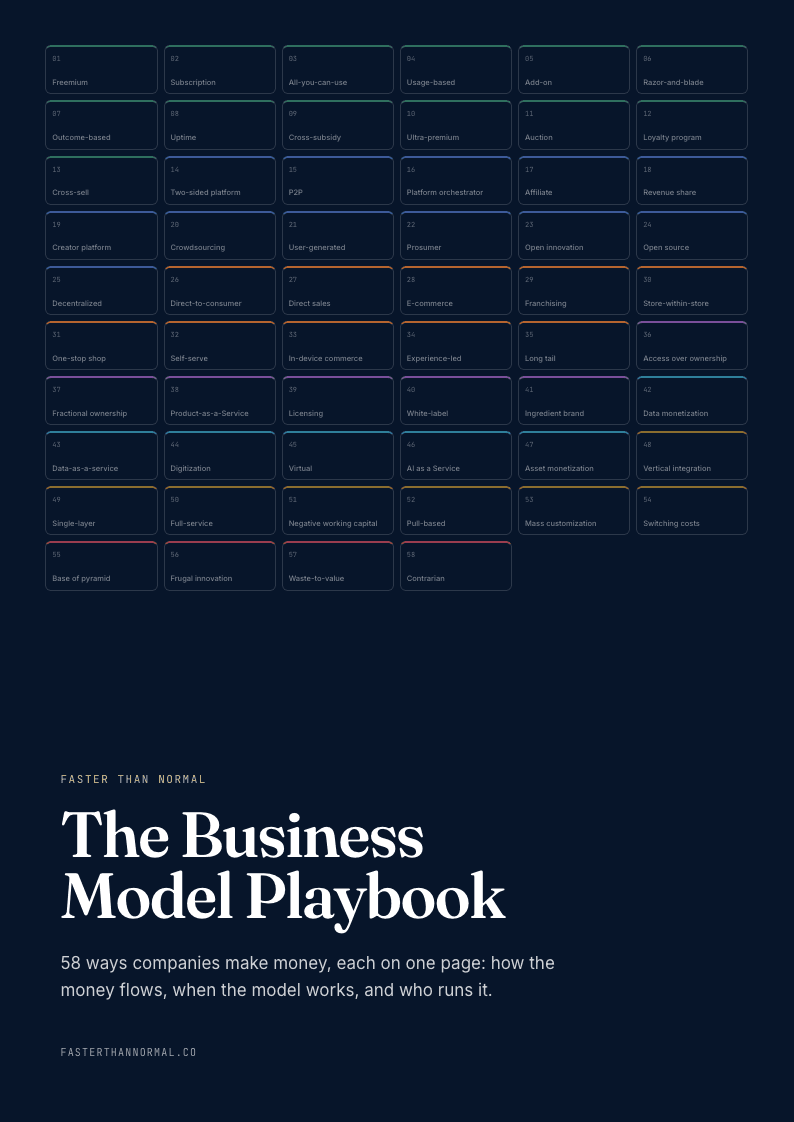
Free playbook
Get The Business Model Playbook
58 business models, one visual page each: how the money flows, the metrics that matter, and who runs it. Free when you join the Faster Than Normal email.
Free. No spam. Unsubscribe anytime.
Part IIIMaxims
-
Credibility grows like a tree. Every promise kept is a deposit in an account that pays compound interest; every promise broken is a chainsaw.
-
Shorten the time. The most expensive resource is not capital or labor but duration — compress the timeline and everything else becomes cheaper.
-
The cow always comes due. Personal debts — to family, to origins, to the land that made you — are not extinguished by success but enlarged by it.
-
Ignorance is freedom from inherited assumptions. The expert knows what cannot be done; the outsider has no such handicap.
-
Diligence is the highest form of compound interest. "If you are diligent for a day, you will sleep comfortably for a night. If you are diligent for a year, two years, 10 years, your whole life — your accomplishments will be recognized by all."
-
Waste is disrespect. Frugality honors the labor that produced the resource and the poverty from which the enterprise emerged.
-
Commit before you're ready. The gap between ambition and capability is a timeline problem, and timeline problems are solvable.
-
Common sense is a photograph of yesterday. It tells you what existed, not what is possible.
-
Eat with the workers. The leader who is present at the point of execution sees what reports cannot convey and earns loyalty that incentives cannot buy.
-
There are hardships but never failures. A loss that yields experience is not truly a loss — it is tuition paid to the university of the actual.
In Their Own Words
I became successful even though I came from a poor family and had no proper education.
I did not receive much schooling. But not receiving formal education does not mean one is lacking in wisdom.
My own academic progress stopped at the sixth grade due to the extraordinary hardships of our family's circumstances, not because I found formal education to be superfluous.
I've always enjoyed reading great books. If my first mentors were my parents, then my second mentors were books.
I think harder, work harder, have greater courage, and am more active than others.
How can you know it's impossible if you haven't tried it?
Conviction creates indomitable efforts. This is the key to miracles.
If you are diligent for a day, you will sleep comfortably for a night. If you are diligent for a month, the quality of your life will noticeably improve.
If you are diligent for a year, two years, 10 years, your whole life—your accomplishments will be recognized by all.
The diligent lead lives 100 times more productive than the lazy.
Great work requires obsession, not balance.
I think harder, work harder, have greater courage, and am more active than others. Before starting any project, I spend an enormous amount of time and effort thinking, analyzing, and planning every detail. When it is time to implement these plans, it may look like I am working off the cuff, or even recklessly, but if I hadn't first sat down and planned everything out, the Hyundai Group of today could never have existed.— Chung Ju-yung, Born of This Land
If I'm not sleeping, I'm thinking. My thoughts are not the result of a conscious decision to think. They just come to me in a successive stream of thoughts, all connected and flowing into each other. Like all business people, a great idea starts with one single thought. When a small idea the size of a grain of rice is implanted in my mind, I nurture it until it grows into a major project that I can visualize in my head.— Chung Ju-yung, Born of This Land
Half measures, compromises, cutting corners, or 'being realistic' do not exist in my world.— Chung Ju-yung, Born of This Land
It is failures rather than successes that teach us invaluable lessons. It is not necessary to remember one's success. That should be remembered by others instead. Rather, we should remember our losses and failures — those who forget their failures will fail again and again.— Chung Ju-yung, from Hyundai Motor Manufacturing Alabama
Further reading
- Born of this land: my life story by Chung Ju Yung


